
PBM Reform Podcast
Pharmacy Podcast Network
0
Pharmacy benefit managers were created as middlemen to reduce administrative costs for insurers, validate a patient’s eligibility, administer plan benefits, and negotiate costs between pharmacies and health plans. Over time, PBMs have been allowed to operate virtually unchecked. A lack of transparency in PBM practices has led several states to implement licensure/registration, fair pharmacy audit, or generic drug pricing legislation to try to level the playing field for pharmacies and patients. This Podcast is focusing on discussions & interviews about PBM Reform & those and Business of Pharmacy professionals leading this much needed reform.
Epizode
-
 Patients Rising Rx with Terry Wilcox | PBM Reform with APCI 05.10.2026 34minThis is part one of a two part conversation with Terry Wilcox, Co-Founder and CEO of Patients Rising. Find out what Patients Rising is doing for advocacy and change to better our patients by visiting https://www.patientsrising.org/about-patients-rising
 -
 Iowa’s PBM Reform Breakthrough: Inside Senate File 383 | PBM Reform with APCI 24.09.2026 30minGuest: Iowa State Representative Brett Barker, PharmD — District 51Guest Host: Todd S. Eury, Pharmacy Podcast NetworkRegular Host: Greg Reybold — on special assignmentSponsored by: American Pharmacy Cooperative, Inc. (APCI) Iowa has delivered one of the most significant state-level victories in the continuing fight for pharmacy benefit manager reform. On this episode of the PBM Reform Podcast, guest host Todd S. Eury sits down with Iowa State Representative Brett Barker, PharmD, a practicing pharmacist and representative of Iowa House District 51, for an inside look at the passage of Senate File 383 and what the new law could mean for independent pharmacies, employers, patients and the future of PBM regulation across the country. Representative Barker brings a rare perspective to the discussion. In addition to serving in the Iowa Legislature, he is a pharmacist and pharmacy executive who understands firsthand the financial pressures facing community pharmacies. Barker served as one of the House floor managers for SF 383 as the legislation moved through the Iowa General Assembly. The legislation cleared the Iowa House by a 75–15 vote after previously passing the Senate 36–14. Governor Kim Reynolds signed SF 383 into law on June 11, 2025, and its primary provisions became effective July 1, 2025. SF 383 establishes substantial new requirements governing pharmacy benefit managers and their relationships with pharmacies, health plans and other payors. Among its provisions, the law addresses PBM reimbursement practices, pharmacy contracting, pass-through pricing, pharmacy appeals and disputes, network participation and protections intended to prevent discriminatory treatment of pharmacies. One of the central themes of the legislation is greater transparency and accountability surrounding the flow of prescription-drug dollars. The law defines and establishes requirements involving pass-through pricing, in which payments made by a third-party payor to a PBM for prescription drugs correspond to payments made to the dispensing pharmacy, including applicable professional dispensing fees. During the conversation, Todd and Representative Barker explore: Why PBM reform became such an urgent issue for Iowa pharmacists and patients. What community pharmacies were experiencing financially before SF 383. How pharmacists, pharmacy owners and advocacy organizations helped educate Iowa lawmakers. The political battle surrounding the legislation and what ultimately helped generate bipartisan support. Why PBM reimbursement methodology is central to pharmacy sustainability. The importance of giving pharmacies meaningful mechanisms to challenge reimbursement and contractual disputes. The role Representative Barker's pharmacy background played in explaining PBM economics to fellow legislators. The opposition lawmakers encountered while attempting to move PBM reform forward. What other states can learn from Iowa's strategy. Why pharmacists need greater representation inside state legislatures. Whether Iowa's legislation could become a model for broader PBM reform nationwide. Governor Reynolds described the legislation as an effort to bring greater accountability to PBMs and noted when signing the bill that Iowa was joining a growing number of states pursuing similar reforms. For independent community pharmacists, the Iowa experience demonstrates something increasingly important: PBM reform is no longer simply a pharmacy reimbursement debate. It is becoming a healthcare access, competition and patient-care issue being fought state by state. Representative Barker's story also highlights another major theme of the PBM Reform Podcast — the importance of pharmacists becoming directly engaged in public policy. When pharmacists bring their clinical knowledge, business experience and patient relationships into state government, they can help lawmakers understand how policies written hundreds of miles away ultimately affect
 -
 Winning Hearts, Minds, and Policy with Strategic Communications | PBM Reform 25.08.2026 42minMany pharmacy leaders focus on legislation and lobbying. Why is strategic communication on social media equally important? Dr. Maurice PharmD joins Breck Rice on this episode of the PBM Reform Podcast. eKSsdTHlSWcgEnRjIkQv
 -
 TRICARE and the Fight for Military Pharmacy Access | PBM Reform with APCI 17.08.2026 53minThe PBM Reform Podcast, sponsored by APCI, welcomes John Vinson, PharmD, Chief Executive Officer of the Arkansas Pharmacists Association, for a timely conversation with host Greg Reybold about the management of the TRICARE pharmacy benefit. Express Scripts administers pharmacy benefits for TRICARE, the Department of Defense healthcare program serving more than 9 million active-duty service members, military retirees, and family members. In fiscal year 2023 alone, TRICARE spent more than $8 billion on prescription medications. Greg and John examine concerns surrounding Express Scripts’ administration of the program, including shrinking pharmacy networks, reduced patient choice, questionable contractor reporting, specialty-drug delivery oversight, and the consequences for independent and rural pharmacies. A 2025 Government Accountability Office investigation found that: TRICARE’s minimum network requirement fell from 50,000 to 35,000 pharmacies. The network had approximately 13,165 fewer pharmacies in late 2024 than in late 2022. An estimated 380,000 beneficiaries may have been forced to find another pharmacy. The Defense Health Agency relied heavily on contractor-submitted reports that contained inaccuracies. DHA had not consistently audited the data used to evaluate beneficiary access. GAO’s two corrective recommendations remain open as of August 2026, although DHA has begun adding reporting and auditing requirements. The episode also addresses higher 2026 prescription copayments. For most non-active-duty beneficiaries, home-delivery copays are now $14 for generic formulary drugs, $44 for brand-name drugs, and $85 for non-formulary medications. At retail network pharmacies, the corresponding 30-day copays are $16, $48, and $85. Greg and John discuss whether PBM-driven network reductions represent true savings—or simply transfer costs, inconvenience, and access barriers to military families and the community pharmacies serving them. Key discussion points Express Scripts’ role in administering the TRICARE pharmacy benefit Pharmacy network contraction and beneficiary disruption Access challenges facing rural communities and military families Inaccurate contractor data and insufficient federal oversight Specialty-pharmacy delivery and monitoring concerns Rising 2026 copayments and pressure toward mail order Arkansas’ leadership in challenging PBM vertical integration The need for transparency, accountability, adequate reimbursement, and patient choice Important clarification: TRICARE is administered by the Department of Defense and is distinct from healthcare and pharmacy services operated by the Department of Veterans Affairs. Sponsored by APCI — American Pharmacy Cooperative, Inc. Sources: U.S. Government Accountability Office, TRICARE’s 2026 pharmacy-benefit update, official 2026–2027 pharmacy costs. eKSsdTHlSWcgEnRjIkQv
 -
 Pharmacists Fight Back: Federal PBM Reform Advances | PBM Reform with APCI 31.07.2026 46minPBM Reform PodcastSponsored by American Pharmacy Cooperative, Inc. (APCI)Host: Greg ReyboldSpecial Guest: Ben Mudd, PharmD, Executive Director, Kentucky Pharmacists Association Momentum for meaningful pharmacy benefit manager reform is building in Washington. In this episode of the PBM Reform Podcast, host Greg Reybold welcomes Dr. Ben Mudd, Executive Director of the Kentucky Pharmacists Association, to examine the bipartisan Pharmacists Fight Back Act, H.R. 6610, and what its advancement could mean for patients, pharmacists, employers, and the future of independent pharmacy. On July 22, 2026, the House Committee on Oversight and Government Reform reported the legislation favorably following a committee markup. Introduced by Chairman James Comer of Kentucky and Representative Jake Auchincloss of Massachusetts, the bill would establish new requirements for pharmacy benefit managers participating in the Federal Employees Health Benefits Program. The proposed reforms would require participating PBMs to provide fair pharmacy reimbursement, apply manufacturer rebates toward reducing beneficiaries’ prescription drug costs, prohibit patient steering to PBM-affiliated pharmacies, increase transparency, and establish penalties for noncompliance. Greg and Ben discuss why the Federal Employees Health Benefits Program could become an important proving ground for broader PBM accountability and how federal action may influence commercial plans, state legislation, and future healthcare policy. Episode Discussion The conversation explores: Why H.R. 6610 has attracted bipartisan support How PBM reimbursement practices threaten independent pharmacy sustainability The impact of patient steering and PBM-affiliated pharmacy networks Why manufacturer rebates should directly reduce patients’ prescription costs What “fair reimbursement” must include to protect pharmacy access How enforcement provisions and financial penalties could improve accountability Kentucky’s role in advancing pharmacy and PBM reform The connection between federal legislation and state-level advocacy What pharmacists should communicate to legislators and patients The remaining steps required before H.R. 6610 can become law Dr. Mudd brings the perspective of a practicing community pharmacist and association executive who has worked extensively in pharmacy advocacy. A graduate of the University of Kentucky College of Pharmacy, he practiced in both chain and independent pharmacy settings before assuming leadership of the Kentucky Pharmacists Association. Ben is running for Kentucky State Senate position this November. Lear more about his platform and issues most important: https://www.votemudd.com/meet-ben Key Takeaway PBM reform is no longer simply an industry debate. It is a patient-access, healthcare-affordability, pharmacy-choice, and community-infrastructure issue. The Pharmacists Fight Back Act represents a significant federal effort to separate PBM compensation from practices that may increase drug costs, restrict patient choice, and financially disadvantage independent pharmacies. The legislation’s advancement is an important milestone—but pharmacists must remain informed, engaged, and vocal as the bill moves through the legislative process. Subscribe to the PBM Reform Podcast for continuing coverage of legislation, regulation, litigation, and advocacy shaping the future of pharmacy benefit management and community pharmacy. The PBM Reform Podcast is sponsored by American Pharmacy Cooperative, Inc., supporting independent pharmacies and advocating for a more transparent, competitive, and patient-centered prescription drug marketplace. eKSsdTHlSWcgEnRjIkQv
 -
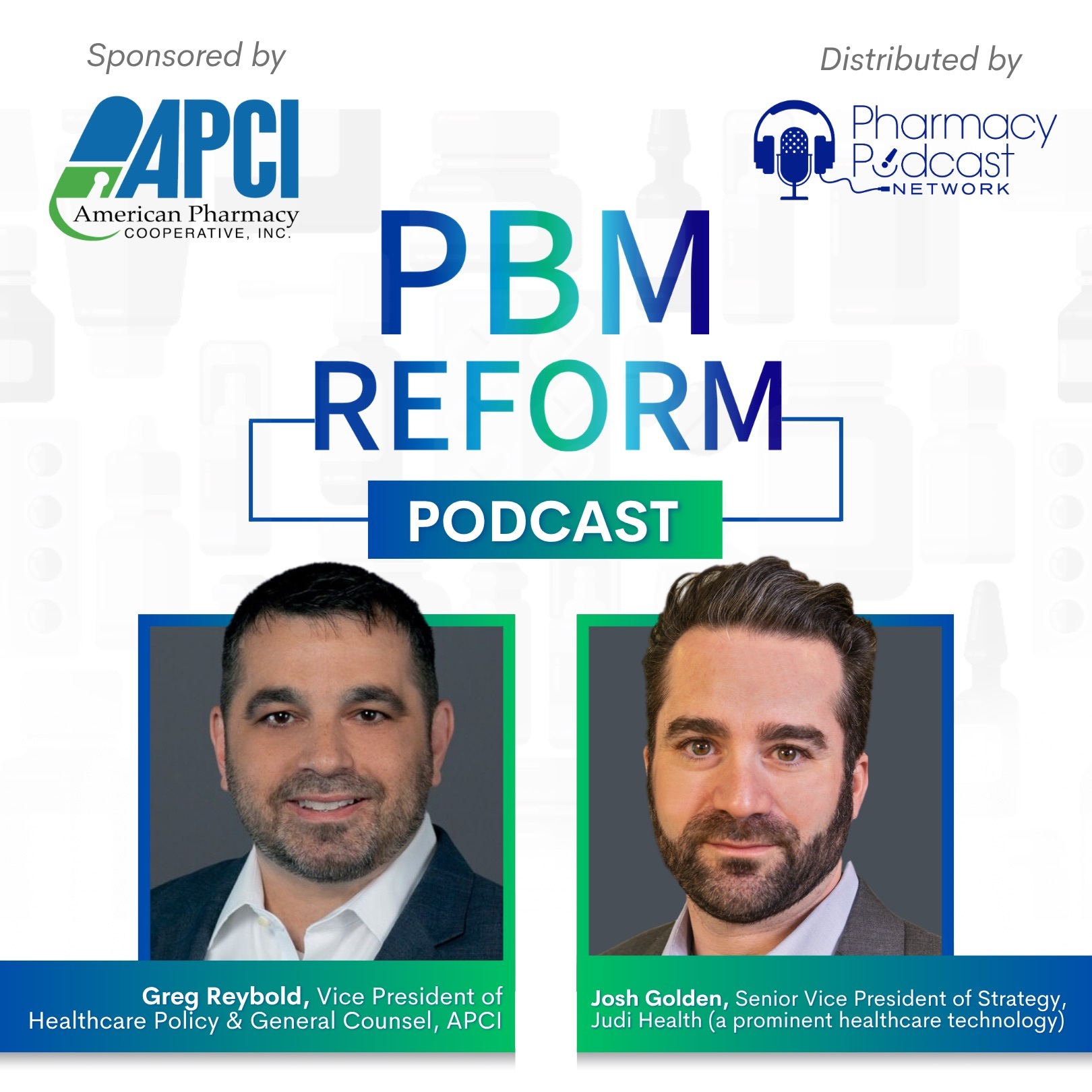 Transparency, Auditing, and the PBM Shell Game | PBM Reform Podcast with APCI 02.06.2026 48minIn this episode of the PBM Reform Podcast, host Greg Reybold, Vice President and General Counsel at APCI, welcomes Josh Golden, Senior Vice President of Strategy at Judi Health and a nationally recognized voice in Pharmacy Benefit Manager reform. With more than 20 years of healthcare consulting experience, Golden brings deep expertise in vendor procurement, contract negotiation, plan design, and benefit strategy for large employers, government entities, and unions. Together, Reybold and Golden examine the financial models behind today’s PBM industry and why true transparency remains so difficult for employers, plan sponsors, patients, and pharmacies. The conversation explores how current PBM arrangements often benefit the PBMs more than the employers paying for coverage or the patients relying on their prescription benefits. Golden explains why auditing PBM contracts, rebate structures, spread pricing, administrative fees, pharmacy networks, and formulary decisions is essential to understanding the real economics of prescription drug benefits. This episode also addresses a growing concern in healthcare: PBM steering behavior. Are patients being quietly pushed toward specific formularies, specific pharmacies, and restricted networks that operate like closed networks without being clearly disclosed? Reybold and Golden discuss how this behavior can limit patient choice, disadvantage independent pharmacies, and distort the stated goal of lowering drug costs. The discussion also tackles the role of federal reform efforts, including whether the Appropriations Act represents meaningful PBM accountability or whether it risks becoming another layer in the broader shell game surrounding PBM reform. Finally, the episode asks one of the most important questions in pharmacy policy today: should PBMs own pharmacies? If vertical integration is promoted as a way to lower drug costs, where is the proof — and who actually benefits? Transparency, Auditing, and the PBM Shell Game | PBM Reform Josh Golden is the Senior Vice President of Strategy at Judi Health (a prominent healthcare technology and benefit management firm closely associated with Capital Rx) and a nationally recognized thought leader in Pharmacy Benefit Manager (PBM) reform. With over 20 years of healthcare consulting experience, Golden specializes in vendor procurement, contract negotiation, and plan design consultation for large employers, government entities, and unions.
 -
 Tennessee PBM Reform Win | PBM Reform with APCI 29.04.2026 33minTennessee lawmakers have passed a major pharmacy reform bill aimed at pharmacy benefit managers, or PBMs, by barring companies from owning both a PBM and a pharmacy. The legislation is widely seen as targeting CVS Health, which owns Caremark and operates pharmacies across the state.Supporters say the bill is designed to curb vertical integration, restore fair competition, and protect independent pharmacies from reimbursement practices they view as harmful to patient access and community pharmacy survival.CVS has pushed back hard, warning that the new law could force it to shut down its 134 Tennessee pharmacy locations and trigger a legal challenge. The company argues the measure would reduce access for patients and does not directly address broader PBM issues like pricing or formularies.This Tennessee fight reflects a larger national battle over PBM reform, pharmacy ownership, market power, and the future of prescription drug access.
 -
 PBM Reform Updates, Next steps, from CPhA | PBM Reform with APCI 04.03.2026 44minIn this episode, listeners get to know the leadership of the California Pharmacists Association (CPhA), exploring their professional journeys, personal backgrounds, and the experiences that shaped their commitment to advancing the pharmacy profession. Susan Bonilla, CEO of the California Pharmacists Association, joins Dr. Sean Kim, PharmD, Vice President of Practice & Professional Development at CPhA, to discuss California’s progress in pharmacy benefit manager (PBM) reform. As the largest state in the nation, California continues to play a significant role in shaping policies that strengthen patient access to pharmacy care and improve transparency within the prescription drug supply chain. Bonilla and Kim share insights into the reforms California has achieved, the legislative and regulatory priorities currently underway, and how these efforts may influence PBM reform conversations across the country. The PBM Reform Podcast is sponsored by the American Pharmacy Cooperative, Inc. (APCI). APCI’s sponsorship supports the production of this program but does not imply affiliation with the individual guests, nor endorsement of the views, opinions, or insights shared by podcast hosts or guests. APCI does not endorse any statements or content discussed on the PBM Reform Podcast or across the Pharmacy Podcast Network. Please reach out to the APCI Communication's team for additional information.
 -
 Bagging Better Benefits: The Grocery PBM Disruptor | PBM Reform 22.02.2026 40minHow Kroger does PBM and the future of community pharmacy is clinical encounters.
 -
 Pharmacists Fight Back! Live on Capitol Hill | PBM Reform with APCI 17.12.2025 41minAmerican Pharmacy Cooperative, Inc. (APCI) called on Congress on Thursday, December 11, 2025 to pass the reintroduced Pharmacists Fight Back Act, two coordinated pieces of federal legislation designed to reform pharmacy benefit manager (PBM) practices. The Pharmacy Podcast Network provides exclusive coverage of the event held on Capitol Hill.
 -
 U.S. Congressman Jake Auchincloss | PBM Reform with APCI 14.12.2025 41minIn this episode, Greg Reybold speaks with Jake Auchincloss, U.S. Congressman of Massachusetts 4th District.
 -
 Don't Get Paid Below Your Cost Anymore! | PBM Reform 12.12.2025 31minThis week on the PBM Reform Podcast, Breck L. Rice takes listeners inside a major new software upgrade designed to integrate directly with state-level PBM complaint and reporting systems. Breck also recounts his recent meetings with state Insurance Commissioners—where he presented this breakthrough technology while PBM lobbyists pushed back in real time, leaving community pharmacy with only one voice in the room standing up for them. He underscores a critical issue that often goes unaddressed: while states continue to pass legislation aimed at PBM accountability, the real failures are happening in execution and enforcement. Without meaningful oversight, even the strongest laws fall short, and independent pharmacies continue to bear the consequences.
 -
 Cutting Through the Noise: A nuanced discussion on MFN, Rebates, and Premiums | PBM Reform with APCI 13.11.2025 54minDr. Robert Popovian is a pharmacist, and economist with a deep background in research and public policy. In this episode we have a nuanced discussion on policy impacting pharmacy including PBMs, President Trumps Most Favored Nation Executive Order, Rebates, and insurance premiums. Links to resources referenced in discussion:• Pioneer Institute, 340B tool: https://pioneerinstitute.org/340babuse/• Pioneer Institute, IRA tool: https://pioneerinstitute.org/the-inflation-reduction-act-ira-overview/• Editorial regarding TrumpRX: https://www.linkedin.com/pulse/promise-trumprx-robert-popovian-vskne/?trackingId=dtiG1P%2B%2BSDq6adLfFeEbeg%3D%3D• Pioneer Institute, IRA report: https://pioneerinstitute.org/wp-content/uploads/Prescription-Drug-Price-Controls-06252025.pdf • GHLF tool, Impact of Accumulators and Maximizers on Premiums: https://cutt.ly/Rr9Di7Vf• Conquest Advisors website: https://conquestadvisors.godaddysites.com/
 -
 PBM Reform and the AMA | PBM Reform 05.09.2025 28minIn this episode, we sit down with the President of the American Medical Association to discuss PBM reform and its impact on patients, physicians, and the future of healthcare. From drug pricing transparency to ensuring access to needed medications, this conversation explores why PBM reform is at the center of today’s healthcare policy debates.
 -
 Behind the Policy: PBMs, Drug Pricing & Telehealth with Conor Sheehey | PBM Reform with APCI 03.09.2025 56minJoin our co-hosts Todd Eury and Greg Reybold in this exclusive interview with Conor Sheehey, who most recently served as senior health policy advisor to U.S. Senate Finance Committee Chair Mike Crapo (R-ID). In this role, he advised the Committee on a range of health care policy issues, including prescription drug pricing, telehealth, AI, provider coverage and reimbursement, fraud and abuse, medical devices, and Medicare Parts B and D. Sheehey led several bipartisan legislative efforts, including the development of comprehensive PBM reforms and bipartisan proposals on clinician payment reform and drug shortages.
 -
 Cracking the Concentration: PBMs, Power, and the Fight for Fairness | PBM Reform with APCI 19.06.2025 50minIn this relaunch of the PBM Reform Podcast, Greg Reybold returns with a powerful and timely conversation exploring how concentrated economic power—particularly in the form of Pharmacy Benefit Managers (PBMs)—is undermining fair access to prescription medications, driving up drug costs, and crushing independent pharmacies. Greg is joined by Emma Freer, Senior Policy Analyst with the American Economic Liberties Project, a national non-profit and non-partisan organization dedicated to dismantling monopolistic control across critical sectors—including healthcare. Together, they dig deep into how PBMs serve as gatekeepers in the drug supply chain, extracting value at the expense of patients and providers, and how policy reform is urgently needed. Emma outlines how Economic Liberties is driving a new wave of anti-monopoly policy momentum in healthcare by advocating for stronger antitrust enforcement, corporate accountability, and legislative transparency. She highlights how concentrated PBM power not only threatens economic fairness but undermines public health outcomes. 🧠 Key Topics Covered: The history and unchecked growth of PBM power in the U.S. drug supply chain Why market concentration among PBMs is a systemic risk to patient access and competition What Economic Liberties is doing to pressure regulators and lawmakers for structural reforms Why bipartisan PBM reform is gaining traction—and what’s at stake if we fail to act How pharmacists, community leaders, and patients can join the movement for transparency and equity 💥 Why This Episode Matters:PBM dominance is no longer just a pharmacy issue—it’s an economic justice issue. This episode sheds light on the structural forces keeping drug prices high and independent pharmacies on the edge. It offers a compelling call to action for healthcare professionals, lawmakers, and reform advocates to push back against monopolistic control and put patients first. 📢 Call to Action:Visit www.economicliberties.us to explore their policy work and toolkits for reform advocates. Stay tuned to the PBM Reform Podcast as we bring together voices from across the healthcare and policy spectrum to fight for a fairer, more transparent system. Follow, rate, and share the podcast—because real reform starts with awareness and ends with action.
 -
 Certifying the Future: Dr. William Soliman and the Rise of Medical Affairs | PBM Reform 11.06.2025 46minDr. William Soliman is the founder and CEO of the Accreditation Council for Medical Affairs (ACMA). The ACMA is America’s leader in life sciences accreditation, certification & training. Soliman is a former pharmaceutical executive who worked in leadership roles at Merck, Abbvie, Gilead and more. He is considered a pharma industry futurist and has been featured on NewsNation, Fox News, Newsmax, Forbes, Al Jazeera, Yahoo Business TV, ABC News Radio & more. The ACMA established the first ever certification standards in the United States and stands as a benchmark of excellence for prior authorization professionals, reimbursement professionals, pharmaceutical sales professionals, medical science liaisons and medical affairs professionals. Dr. Soliman received his PhD from Columbia University & his BA from New York University.
 -
 PBM Transparency, Is It Real? | PBM Reform Podcast 14.04.2025 42minAn insider’s look at the games PBMs play to hid fees and tack profits for community pharmacies. What a true transparent PBM should look like and why it matters.
 -
 PBM Strategies for the State of Arizona | PBM Reform 27.01.2025 49minInterview with the new CEO of the Arizona Pharmacy Association, Garet Turner
 -
 Patients Before Monopolies Act | PBM Reform Podcast 20.12.2024 31minIn this critical episode of the PBM Reform Podcast, we are joined by two influential voices leading the charge against abusive pharmacy benefit manager (PBM) practices: State Representative Jake Auchincloss – Congressman from Massachusetts’ Fourth District Greg Reybold – Vice President of Healthcare Policy & General Counsel, American Pharmacy Cooperative, Inc. Topics Discussed: The "Pharmacists Fight Back Act" (HB 9096): Legislation Overview: The bill proposes a transparent pharmacy reimbursement model based on: Market-based pricing benchmarked to the National Average Drug Acquisition Cost (NADAC) plus a dispensing fee equivalent to each state’s Medicaid reimbursement or the lesser of 2% or $25. Eliminating PBMs’ ability to restrict patient choice through network exclusions. Ensuring rebate pass-throughs to patients directly at the pharmacy counter. Prohibiting PBM practices that steer patients toward PBM-owned pharmacies, protecting community pharmacists and preserving patient choice. Guest insights on how HB 9096 seeks to end exploitative PBM tactics and its potential impact on independent pharmacies nationwide. The "Patients Before Monopolies Act": Bipartisan Efforts: Introduced by Senators Elizabeth Warren (D-MA) and Josh Hawley (R-MO) to dismantle PBMs’ monopoly power. Co-sponsored by Representatives Jake Auchincloss (D-MA) and Diana Harshbarger (R-TN). Key Goals: Break up PBM ownership structures that lead to conflicts of interest. Ensure fair reimbursement practices for all pharmacies, reducing patient drug costs and increasing healthcare access. Discussion on the broader implications for federal programs and the pharmacy industry at large. PBMs and Their Role in Driving Up Drug Costs: Exploring how PBMs contribute to higher drug prices and diminished patient choice. The detrimental effects of PBM practices on independent community pharmacies and patients enrolled in federal healthcare plans. Call to Action: Contact your legislators to express support for the Pharmacists Fight Back Act (HB 9096) and the Patients Before Monopolies Act. Share this episode to spread awareness of the critical need for PBM reform. Resources & Links: Learn more about HB 9096 and its provisions: https://www.congress.gov/bill/118th-congress/house-bill/9096 Support the Patients Before Monopolies Act: https://www.drugtopics.com/view/long-awaited-pbm-reform-included-in-congress-end-of-year-spending-package References: Intro piece: "Senators Warren and Hawley introduce a bipartisan bill to break up pharmacy-benefit managers" via CNBC Television
Podobni podkasti


Priljubljen v
Ta podkast je tudi v lestvicah podkastov teh držav.
