
The Weight Loss Mindset
The Weight Loss Mindset
0
A podcast for people over 40 who are done with diets. It offers weekly strategies and episodes to reprogram the mental software that keeps you stuck in unhealthy patterns. The show focuses on mindset shifts rather than restrictive eating plans.
Epizode
-
 Why Can't I Stick To A Diet Even Though I Want To Lose Weight? 13.09.2026 10minIn 1944, 36 healthy men were put on half their usual food intake. Within months they were reading cookbooks in bed and hoarding kitchen utensils they’d never use. Nothing was wrong with them. They were hungry. This episode uses that study to take apart the question almost every dieter asks about themselves, and lands somewhere uncomfortable: the reason you can’t stick to a diet has far more to do with how the diet was built than with what you’re made of. Restriction manufactures the exact rebound it promises to prevent, and no plan can outrun the identity setting running underneath it.Key points* Restriction alone turns healthy people into people who obsess over food. The Minnesota study changed 1 variable and produced the behaviour you’ve been blaming on your character.* A restriction plan bills you all day. Breakfast, the office biscuits, the 4pm gap, 9pm. Nobody wins 30 arguments a day for 6 months, and losing them is arithmetic rather than weakness.* Your biology plays the other side. Hunger signalling climbs, fullness drops, food gets louder, and those shifts were still measurable a full year after weight loss in follow-up research.* Every diet asks you to wear a costume until some finish line. Costumes come off. Compare that to brushing your teeth, which you’ve done 700 times this year without motivation, tracking, or shame.* Identity is a thermostat. Diets open windows and the furnace hauls the room back to 70 degrees, which is why weight returns close to schedule whichever plan you used.* Settings move through evidence, not affirmations. Small actions are votes, they count double on the days you don’t feel like it, and the timeline runs past 2 months rather than 30 days.This week’s 1 thingPick a single action someone who takes care of themselves would take. Make it small enough to feel almost embarrassing. Do it on your worst day this week, that day specifically. You’re not trying to lose weight. You’re collecting evidence.Moving the setting on your own is possible, and slow. Most people quit somewhere in month 2, right when the old identity pushes back hardest.That’s the whole job inside The Weight Loss Mindset membership.Get it now at weightlossmindset.co/subscribeThe system was broken, not you. Come and move the dial. Get full access to The Weight Loss Mindset at news.weightlossmindset.co/subscribe
 -
 “I Can’t” vs “I Don’t”: The Two Words That Rewire Your Willpower 30.08.2026 11minSomebody holds out a plate. In the half second before you answer, you reach for a sentence, and which sentence you reach for shapes the rest of your evening. The cake barely gets a vote.In 2012 two researchers gave 120 students one instruction about what to say when temptation showed up. One group rehearsed “I can’t eat that.” The other rehearsed “I don’t eat that.” That was the whole intervention. On the way out, each of them was offered a chocolate bar or a granola bar. 64 percent of the “I don’t” group took the granola bar. 39 percent of the “I can’t” group did.This episode is about why one word does that, and about the trap waiting on the other side of it. For anyone over 40 who has done every plan, kept every rule, and still ends up negotiating with their own brain three times a day.Important points mentioned:“I can’t” names an authority outside you. A plan, a coach, some program you’re still paying for. Every time you say it, you file a small report confirming that somebody else holds the pen.A boundary you didn’t build is one you’ll test. A body that believes the power sits elsewhere goes looking for the loophole. That isn’t weakness. It’s what any intelligent system does when it’s governed by something it never agreed to.“I can’t” leaves the decision open. So you win the same argument at four o’clock, at seven, and again when the plate arrives. The same fight, three times before dinner.Willpower isn’t a battery you run flat. That model has had a difficult decade. What actually moves is authorship, and who’s holding the pen.The Cage and the Fence. Both boundaries hold the same ground. One exhausts you because somebody else welded it shut. The other disappears into who you are, because you dug the postholes and you know the gate was never locked.The trap: “I don’t” is not a new rule. Tape a list of eleven forbidden foods to the fridge and you’ve painted the cage a nicer colour and called it a garden. The word only works as a description of who you are, which means you can only claim what’s true. Start small enough to be honest by Thursday.Research:Patrick, V. M., & Hagtvedt, H. (2012). “I Don’t” versus “I Can’t”: When Empowered Refusal Motivates Goal-Directed Behavior. Journal of Consumer Research, 39(2), 371–381. https://doi.org/10.1086/663212This week:Take the three foods you negotiate with most and write them as “I don’t” statements. Say them out loud, while you’re calm and nowhere near them.The escape routeIf you’re done negotiating with your own brain three times a day, Escape the Willpower Trap is 30 lessons with no meal plan in any of them. An identity rebuild, from the ground up, for people who have already tried everything the other way.news.weightlossmindset.co/subscribe Get full access to The Weight Loss Mindset at news.weightlossmindset.co/subscribe
 -
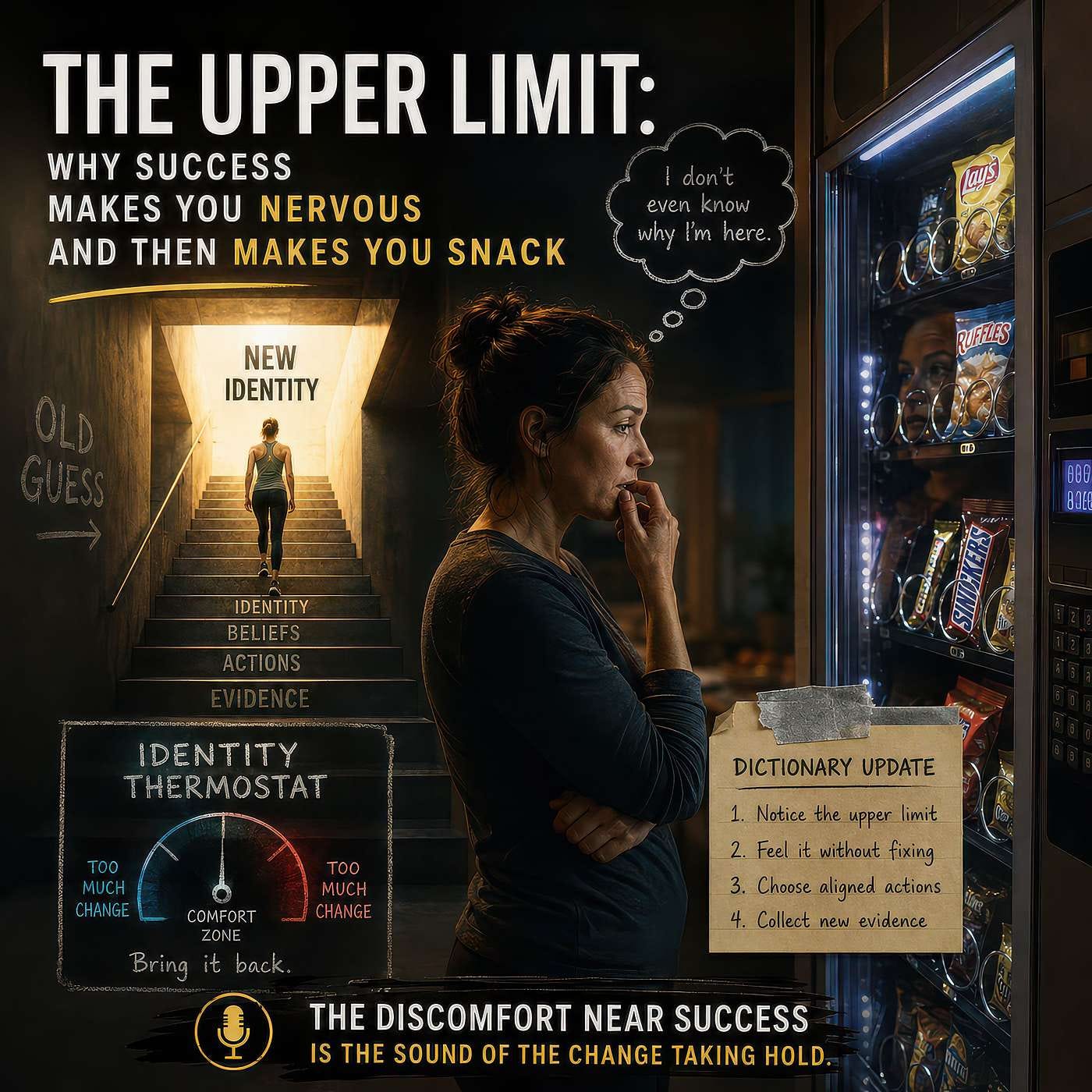 The Upper Limit: Why Success Makes You Nervous And Then Makes You Snack 24.08.2026 15minSomething good happens. Somebody notices you've lost weight, or the scale finally moves, and twenty minutes later you're standing at the vending machine with no memory of deciding to walk there.That's not weakness, and it's not self-sabotage in the way you've been taught to understand it. Your brain runs a guess about who you are, and success contradicts the guess. This episode explains what happens next, why food is the fastest way for your brain to close the gap, and how to hold the discomfort long enough for the guess to update instead.The discomfort near success is the sound of the change taking hold. Once you can hear it that way, it stops being a warning.In this episodeWhy the trouble almost never arrives on the hard daysThe Relapse Prophecy, and who installed itYour brain as a guessing machine, and what the missing stair has to do with your weightThe two ways a brain closes a gap, and why one of them is sitting in your pantryWhat's actually inside the Identity ThermostatThe Dictionary Update: four moves for holding a new self-image steadyWhy deflecting a compliment deletes the evidence you need mostA note on the scienceThis episode leans on predictive processing, the model of the brain as a prediction engine that resolves mismatches either by updating its model or by acting on the world until the world agrees. It's the best account researchers have for this family of behaviour. It's a framework rather than a finding about you specifically, and the episode says so out loud.Go deeperEscape the Willpower Trap is the full course. Thirty lessons, all of them working on the setting itself instead of the food.news.weightlossmindset.co/subscribe Get full access to The Weight Loss Mindset at news.weightlossmindset.co/subscribe
 -
 Why "Knowing Better" Never Made You Do Better 20.08.2026 14minYou already know it. All of it, the calories, the macros, the science behind every craving. And it's Tuesday, nine o'clock, and you're standing in the kitchen anyway. This episode names the sentence every chronic dieter has said out loud at some point, "I know what to do, I just don't do it," and makes the case for why it was never a character flaw. Information and identity live in two different places, and only one of them was ever going to change what happens at nine o'clock.In this episodeThe sentence you already know. Why "I know what to do, I just don't do it" describes something stranger than it sounds, a fully informed person stuck anyway.Who's been selling you the missing piece for twenty years. Every diet, every macro app, every new philosophy, wrapped in the same promise: you haven't learned the right thing yet.The syllabus that keeps rewriting its own answer key. Fat, then carbs, then sugar, then seed oils, then inflammation. You're not failing a class. The class keeps changing the test.Why information and identity don't live in the same place. What a manual can teach you, and what only shows up automatically at eleven at night when nobody's reading anything.Learning to drive. Why you can memorize the whole manual, ace the written test, and still stall out the first time you're actually behind the wheel.What was actually missing. It was never a fact. It's an identity, and that's a completely different job with completely different tools.If you're ready to do that job instead of reading about it one more time, Escape the Willpower Trap is built for exactly this. Not another syllabus, there's nothing left in it to read. It's the doing.https://news.weightlossmindset.co/subscribe Get full access to The Weight Loss Mindset at news.weightlossmindset.co/subscribe
 -
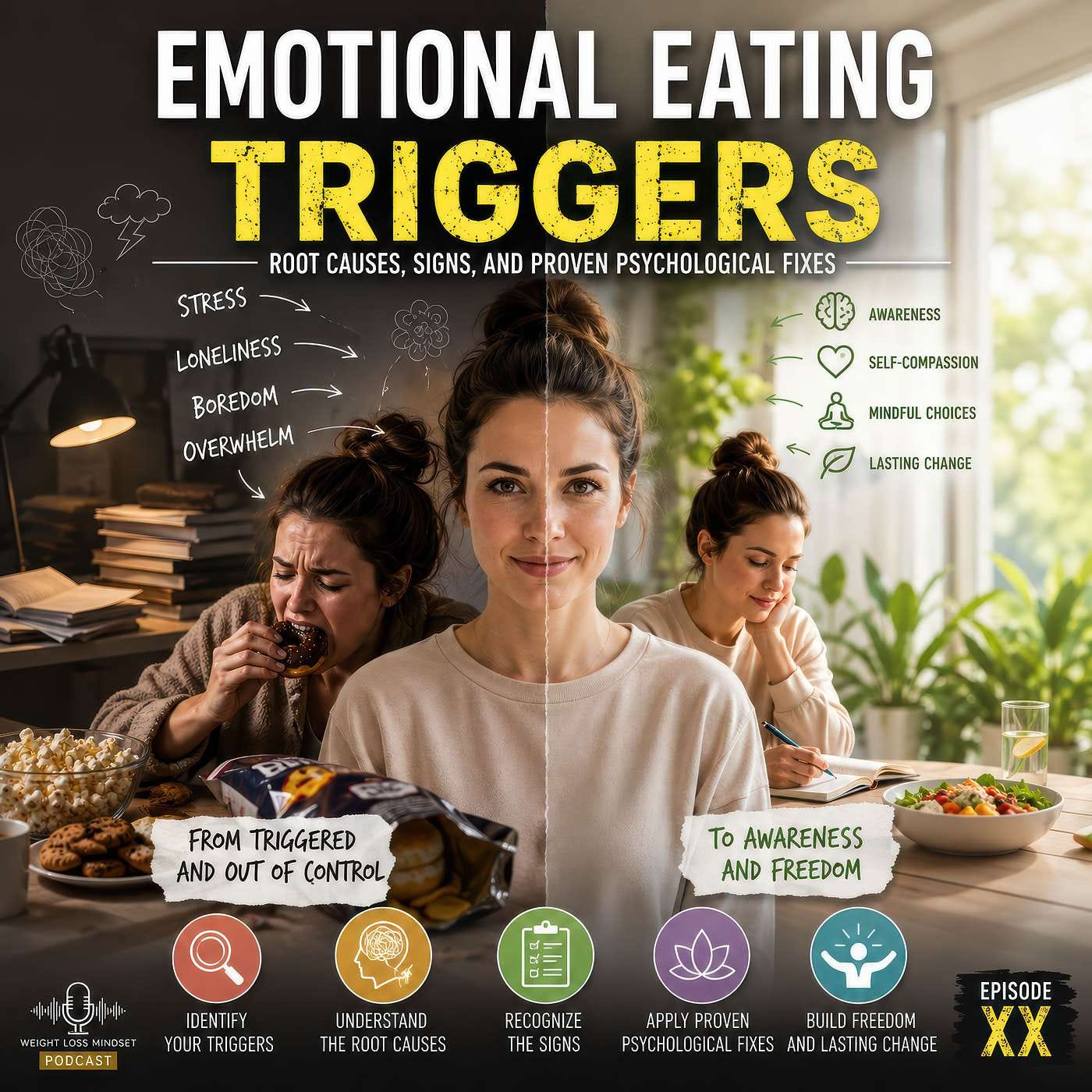 Emotional Eating Triggers: Root Causes, Signs, and Proven Psychological Fixes 10.08.2026 14minMost eating isn't driven by hunger, and if you've spent years assuming that made you uniquely broken, this episode explains why it makes you completely normal. Rick walks through exactly what's happening in the body in the sixty seconds before an emotional-eating episode, why "eat less, move more" was never built to work in that moment, and where the real, fifteen-second window to intervene actually sits.Key points:Roughly three-quarters of eating is driven by emotion, not physical hunger, so the shame that usually follows is misplaced from the start.Real signs of emotional eating: sudden onset, craving something specific, brief relief followed by guilt, eating without registering fullness.The mechanism is hormonal: stress raises cortisol, which raises ghrelin (hunger), suppresses fullness signals, and directs cravings toward sugar and fat, not willpower failure.Hormones shift for everyone in this decade, not just one group: menopause for women, declining testosterone for men, and both make this same stress-eating loop more sensitive, not less.Judging a slip-up builds shame, which feeds the next episode. Getting curious about what preceded it builds a usable map instead.The real point of intervention isn't the craving itself. It's the fifteen-second window right before it fully forms, which is where the Circuit Breaker Protocol is designed to meet you.Ready to find your own fifteen-second window? The Circuit Breaker Protocol is built to help you locate it in real time. https://news.weightlossmindset.co Get full access to The Weight Loss Mindset at news.weightlossmindset.co/subscribe
 -
 Ep Q3: Can You Lose Weight by Mindful Eating? How? 01.08.2026 21minA listener named Diane writes in with the question everyone eventually asks: can mindful eating actually help you lose weight, or is it just another gimmick dressed up in calm language? Rick answers yes, then spends the episode explaining why the fork-down, chew-slowly version she tried was never the real thing. This episode breaks down the difference between mindful eating as a performance and mindful eating as presence, and walks through the five specific mechanisms that turn simple awareness into real, lasting weight loss.Key Points MentionedAutopilot eating: why most overeating happens with the mind somewhere else entirely, and why that makes it a mechanism, not a character flawWhy every diet eventually collapses. Diets hand rules to the conscious mind, but the autopilot never reads the rule bookThe fork-down, chew-slowly version of mindful eating most people try, and why it's diet culture wearing a mindfulness costumeThe five real mechanisms behind mindful eating: breaking the autopilot loop, recovering fullness signals, exposing emotional eating at the source, dismantling the restriction and rebellion cycle, and building self-generated knowledge over timeThe Ocean and Wave technique for the moment a craving rises and doesn't stop, even with full awarenessScientists Not Judges: the protocol for handling a slip without falling into the shame spiral that keeps the whole cycle goingThe one move to start tonight: a single question before the first bite, "Am I here?"Next StepIf tonight's one question is where you want to start, the deeper work of resetting your relationship with food from the inside out lives inside Escape the Willpower Trap. Not another meal plan. The identity work underneath it.https://news.weightlossmindset.co/subscribe Get full access to The Weight Loss Mindset at news.weightlossmindset.co/subscribe
 -
 Your Brain Doesn't Know Who You Are - It's Watching You To Find Out 28.07.2026 16minIn 1966, researchers went door to door in Palo Alto asking people to put a badly hand-painted billboard on their front lawn. On one street 17% said yes. On another, 76%. Same billboard, same man, same script. The only difference was a three inch sticker somebody had asked them to display two weeks earlier. This episode is about why that happened, and why it explains twenty years of diets that died on day nine.Points mentionedThe Palo Alto billboard study, and the detail almost nobody quotesWhy desire is a starter motor, and what happens when you build twenty years of attempts on oneDaryl Bem's 1967 finding that his own field thought was backwardsThe stranger with the clipboard, and why he doesn't take dictationBeth from Roseburg, and the order things happened in for herWhy there's no morning where you wake up transformed and know itEscape the Willpower TrapThirty days of handing your brain new evidence, in the right order, until the file says something different about who you are. https://news.weightlossmindset.co/subscribe Get full access to The Weight Loss Mindset at news.weightlossmindset.co/subscribe
 -
 Ep Q2: What Is The Best Way To Stop A Craving? 24.07.2026 12minRenata from Denver opens her desk drawer at 3:15 every afternoon, eats three pieces of chocolate she can't taste, and wants to know how to stop the craving itself. Not manage it. Stop it.Most advice tells you to out-muscle the thing. Wait fifteen minutes, move the stash to your car, find something else to do with your hands. That advice is built on a broken assumption, and it's why you keep losing at 3:20.In this episode:Why wanting and liking run on separate circuits in your brain, and what that explains about eating something you didn't enjoyThe three-to-five-minute lifespan of a cravingWhy suppression fails the way a beach ball held underwater failsThe Circuit Breaker: stop, name, breathe, feel, chooseWhat happens to your identity on the days you lose, and why that costs more than the chocolateOne assignment at the end, and it takes about four seconds.The Weight Loss Mindset with Rick Taylar. The door is open. Get full access to The Weight Loss Mindset at news.weightlossmindset.co/subscribe
 -
 Willpower Runs Out on Everyone - Identity Doesn't! 21.07.2026 14minWillpower isn't a character trait. It's a battery, and every diet you've ever tried asked you to run on one that was never built to last. In this episode, Rick breaks down why every failed diet was never a discipline problem. It was an identity problem the diet industry never wanted you looking at. You'll learn why most of what you do in a day already runs on autopilot, why "trying harder" against a craving guarantees the rebound, and the one question that actually changes behavior for good.In this episode:Why willpower is a depleting resource, not a personality trait, and why every "eat less, move more" plan was built on a resource with a shelf lifeThe real cost of a failed diet: not the weight that comes back, but the trust you lose in yourself, a debt that compounds faster than the pounds ever couldThe identity mechanism: how most of your daily behavior runs on an automatic system, the same one that decides whether you brush your teeth or grab your keys without a second thoughtThe Beach Ball Underwater metaphor: why holding a craving down through sheer effort guarantees it comes back harder, and why that's physics, not weaknessThe real question, and why "how do I try harder" has to be replaced with "who do I need to become" before anything actually changesWhat it feels like when identity shifts, using the dinner party test: managing food all night versus never having to think about it at allReady to go deeper?If something in this episode landed, that's the identity already starting to move. Escape the Willpower Trap is where we take it from here: https://news.weightlossmindset.co/subscribe Get full access to The Weight Loss Mindset at news.weightlossmindset.co/subscribe
 -
 Ep Q1: How Do I Know If I'm Emotionally Eating? 15.07.2026 13minDanielle wrote in from Halifax asking how to tell if her 9pm pantry habit is emotional eating or just a normal snack. Rick walks through exactly how to read the difference between physical and emotional hunger, and reframes the whole thing as a skill nobody ever taught her rather than a discipline problem.Key points:Diet culture files every kind of non-hunger eating under "weak," which makes it nearly impossible to tell real hunger from an emotional oneSix markers separate the two: how fast it hits, where you feel it, how specific the craving is, whether it stops at full, what triggered it, and how you feel afterwardThe pull toward food that isn't really hunger gets a name: the Invisible Hand, and naming it is what starts to loosen its gripThe fix isn't more willpower. It's one honest question asked in the moment, approached like a Scientist collecting data instead of a Judge handing down a verdictCTAIf this one hit home, share it with the person in your life who eats standing up at the counter after everyone's asleep. New episodes drop weekly at https://news.weightlossmindset.co/podcast Get full access to The Weight Loss Mindset at news.weightlossmindset.co/subscribe
 -
 Weight Loss Mindset for Beginners: First Steps, Programs & Realistic Expectations 11.07.2026 10minMost beginners think the first step is finding the right program. It isn't. This episode breaks down the Right Program Myth, the lie that the perfect plan is out there waiting to be found, and walks through the real first move: deciding who you're becoming before you decide what to eat. Rick shares his own 23-year, $14,247 history of "correct" programs that all failed the same way, then lays out the three actual first steps for anyone starting, or starting over.Key Points MentionedThe Right Program Myth: why searching for "the one" plan that finally works is the wrong first move, and why it quietly sets beginners up to repeat the same cycle The parking lot metaphor: programs are the car, not the destination, and no vehicle gets you anywhere without an address programmed in first Step one: decide the destination. Get specific about who you're becoming before touching a meal plan Step two: set a realistic timeline. Why the industry's 30-day promise is a countdown to disappointment, and what sustainable change actually looks like Step three: pick your structure last. Once the destination and timeline are set, a program becomes a tool, not a rescue A client story (Pam) on what shifted once she understood her identity was never dependent on what she ateNext StepIf you're ready to do the identity work first, that's exactly what Escape the Willpower Trap was built for. Not another program. The destination work.https://news.weightlossmindset.co/subscribe Get full access to The Weight Loss Mindset at news.weightlossmindset.co/subscribe
 -
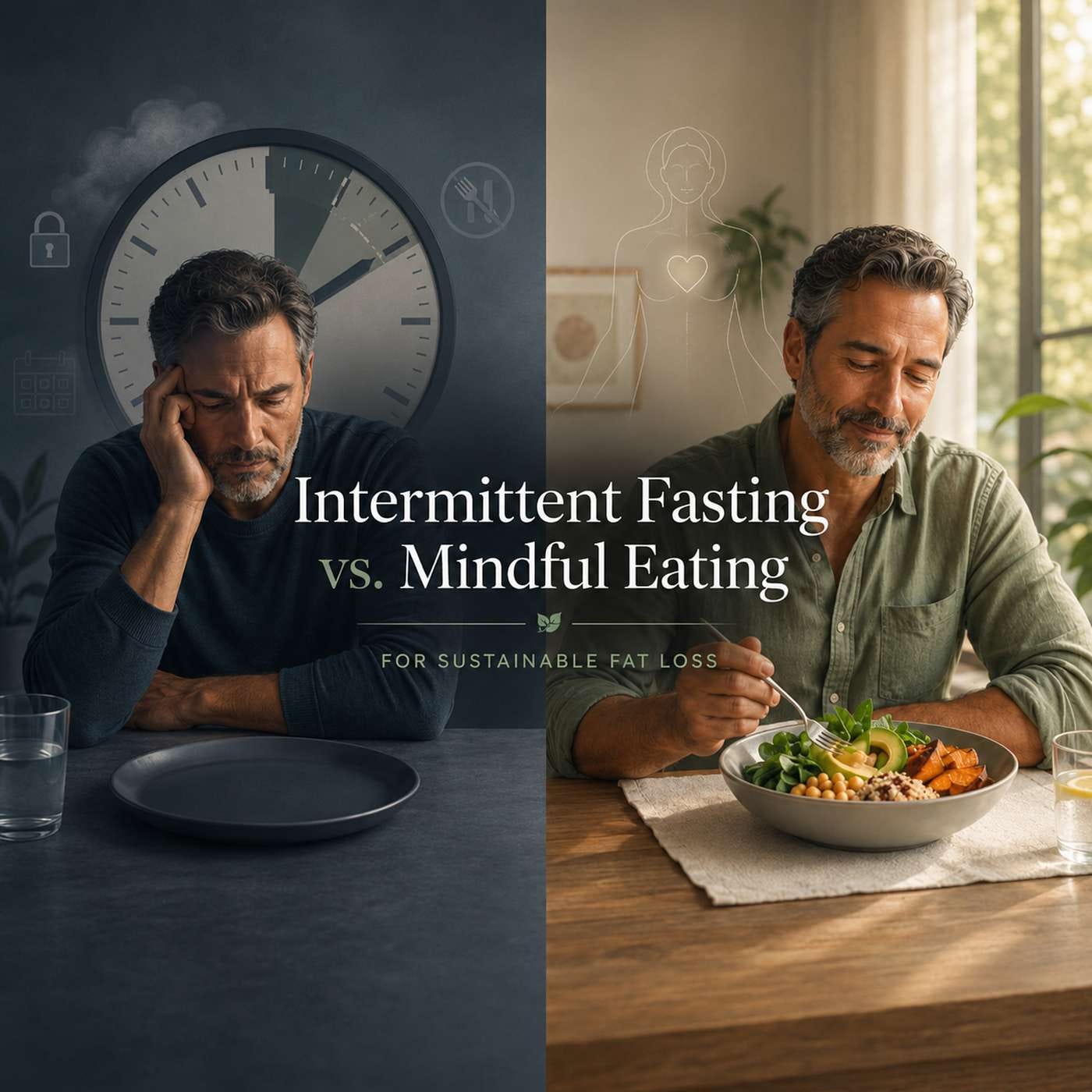 Intermittent Fasting vs. Mindful Eating for Sustainable Fat Loss 21.06.2026 20minThe diet world just picked another champion. This time it's intermittent fasting. The case for it is real, and so is the 38% dropout rate. This episode looks at what the data shows about both approaches, what the neuroscience says about where sustainable fat loss lives, and what question every protocol conversation is actually trying to ask. In This Episode: 1. The debate is a setup. Comparing protocols means staying inside the diet industry's frame. The tool isn't the problem. The relationship underneath it is. 2. Intermittent fasting works for one reason: total calorie reduction. Clinical trials confirm real results and a 38% dropout rate, higher than participants who cut calories with no time-based structure at all.3. The body reads a fasting window as a starvation signal. Cortisol rises. Ghrelin surges. When the eating window opens on a system flooded with hunger chemistry, control doesn't just get harder. Biology takes over. The body is running exactly the software it was designed to run. 4. Years of restriction damage the one skill mindful eating depends on. Interoception: the ability to feel hunger and fullness accurately. Every rule followed in place of an internal signal trains us further from our own bodies. Mindful eating's job is to recalibrate the compass that dieting broke. 5. The neuroscience is direct. Mindful eating doesn't manage cravings from above. It changes the wiring below. Neuroimaging shows it physically quiets the brain's reward pathway and strengthens the circuits where deliberate choice lives. The food noise gets quieter because the brain has changed its response to the signal. 6. Every conversation about fat loss eventually arrives at the same question. Not which protocol to follow. Who do you want to be in relationship with food? The thermostat is always an identity question. Mindful eating works at that level. Everything else reaches around it. Ready to go deeper? If this one landed, the next step isn't another protocol. It's a different target entirely. Escape the Willpower Trap is where we do this work, changing the relationship with food, not the meal schedule. The quiet mind is waiting. The door is open: https://news.weightlossmindset.co/subscribe Get full access to The Weight Loss Mindset at news.weightlossmindset.co/subscribe
 -
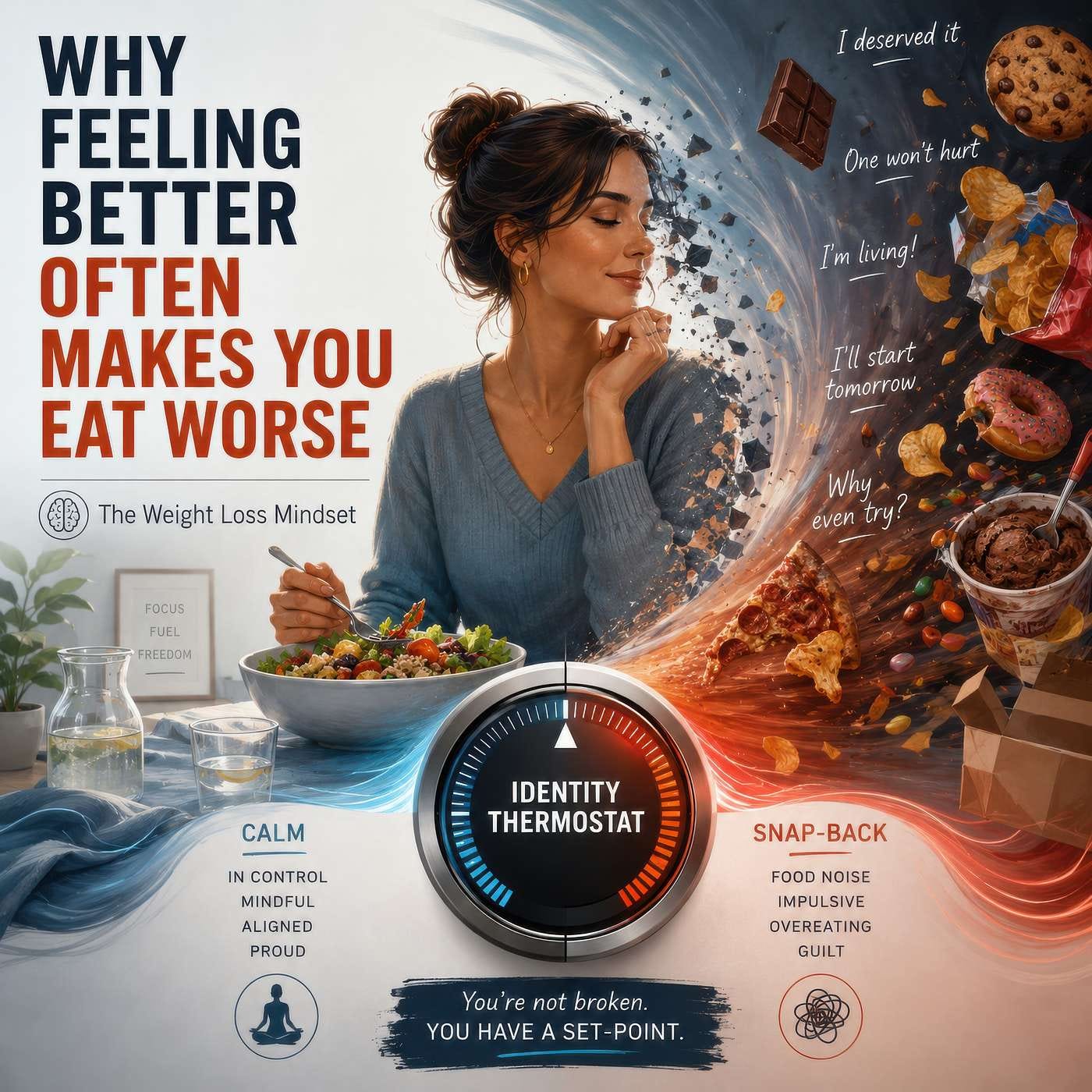 Why Feeling Better Often Makes You Eat Worse 09.06.2026 13minThere's a pattern almost everyone working on their relationship with food hits eventually. You start to feel better, the noise quiets, the fighting stops, and then something snaps. The story you tell yourself is that you destroyed your own progress. Again. In this episode, Rick names what's actually happening in that moment, why it has nothing to do with self-sabotage, and the one shift that changes how you experience it forever.Important points coveredWhy eating worse right after feeling better is one of the most predictable — and least explained — stages of real identity change, and how leaving it unnamed turns it into evidence against you.The Self-Sabotage Myth: why the story "something in me can't tolerate feeling good" is the wrong explanation for a real pattern, and why wrong explanations always point to wrong solutions.How the Identity Thermostat works — and why it fights back hardest not at the beginning of the process, but at the exact moment the new set point starts to take hold.Why the snap-back after progress isn't failure. It's the thermostat's last stand before the set point permanently changes — and what looks like regression is often proof that the change was real.The one shift: how renaming the snap-back in the moment moves the experience out of the moral file and into the data file — from judge to scientist.Why the diet industry needed you to misread this moment, and what it costs you every time you do.If this episode landed for you, Escape the Willpower Trap is the next step. We go deep on how the Identity Thermostat actually works — how to recognize the snap-back in real time, how to respond instead of react, and what it looks like to finally stop fighting it. Get full access to The Weight Loss Mindset at news.weightlossmindset.co/subscribe
 -
 Why Your Brain Fights You Harder the Closer You Get to Your Goal 02.06.2026 12minMost people assume the hardest part of any change is the beginning. The first week. The cold start. But that's not when the brain launches its real attack.In this episode, we name this pattern the Proximity Trap, explain the biological mechanism behind it, and reframe what resistance actually means. Because once you understand why the brain fights hardest when you're nearest to the goal, the attack stops being a verdict. It becomes a signal.What we cover1. The Proximity Trap2. Why the attack gets harder, not easier3. The Immune Response metaphor4. The two failure modes, and why both miss the point5. Resistance as readout, not verdict6. The fever always breaksReady to go deeper?Understanding the mechanism is the first move. The second is building the identity architecture that holds when the fever comes.Escape the Willpower Trap is the complete framework: the thermostat reset, the old software replaced, the new identity integrated at the level that actually sticks. Not habits. Not meal plans. The root-cause work.Join Escape the Willpower Trap: news.weightlossmindset.co/subscribe Get full access to The Weight Loss Mindset at news.weightlossmindset.co/subscribe
 -
 Nobody Taught You to Soothe Yourself. So Your Brain Found Food. 26.05.2026 13minMost people treat emotional eating as a discipline problem. It isn’t. It’s a nervous system that learned to do what it was never properly taught. This episode breaks down why food became your go-to when pressure builds, why that makes complete sense, and what the pattern has actually been pointing toward all along.What we cover* Why food works so reliably when the pressure builds, and why that’s the first thing to understand, not the first thing to fix* The nervous system’s actual job, why it needs a route back to calm when the day presses on you, and how it learned to find one* Co-regulation: what it is, why most of us over 40 never got it, and what that missing education created in its place* The Substitute Teacher: how food stepped in when the real lesson was absent, why it held the room, and why the problem was never the substitute* Why the inner verdict, “I’m just weak when it comes to food,” is built on a premise that was never examined, only collected as evidence* What changes when the kitchen moment becomes a signal instead of a verdict, and what the nervous system has been asking for all alongReady to learn what your nervous system actually needs?The real curriculum is inside The Weight Loss Mindset Membership. Not a meal plan. Not another round of willpower. The actual lesson your nervous system has been waiting for.The door is open: https://news.weightlossmindset.co/subscribeThe Weight Loss Mindset is a reader-supported publication. To receive new posts and support my work, consider becoming a free or paid subscriber. This is a public episode. If you'd like to discuss this with other subscribers or get access to bonus episodes, visit news.weightlossmindset.co/subscribe Get full access to The Weight Loss Mindset at news.weightlossmindset.co/subscribe
 -
 7 Mistakes People Make Trying to Think Their Way Out of a Food Spiral (And the One Shift That Works Instead) 11.05.2026 12minYou know exactly what you’re doing when the spiral starts. You can narrate it in real time. You understand every consequence. And you do it anyway.That gap between knowing and doing isn’t a character flaw. It isn’t weak willpower or a lack of commitment. It’s what happens when you’ve spent years sending the right message to the wrong address.In this episode, Rick breaks down the seven most common ways people try to think their way out of a food spiral: reasoning, shaming, bargaining, analyzing, distracting, waiting, and making more rules, and explains why every single one was built to fail. Not because you failed. Because these tools were aimed at the thinking brain. And the thinking brain isn’t running the spiral.The shift isn’t a new strategy. It isn’t a better technique or a tighter plan. It’s a different relationship to the craving itself. One that stops the fight and lets the feeling pass through instead of launching it harder.If you’ve ever watched yourself do something you didn’t want to do and wondered why knowing better never seems to be enough, this episode is the answer you’ve been waiting for.5 Important Points Covered1. The thinking brain isn’t in charge during a spiral.A food spiral isn’t a prefrontal event. It’s happening in the part of the brain that processes survival, emotion, and habit, a part that doesn’t speak in sentences and doesn’t respond to logic. Reasoning with it is like sending a telegram to someone who doesn’t read. The argument is sound. The audience isn’t listening.2. Shame doesn’t brake the spiral. It accelerates it.Using guilt and self-criticism as a deterrent feels logical. But shame activates the same emotional flooding that drove the spiral in the first place. Every “what is wrong with me” thought isn’t pumping the brakes, it’s pouring fuel on a fire you’re trying to put out.3. The Beach Ball Effect explains why suppression always backfires.Every strategy that pushes the urge down borrows against a debt. The ball goes underwater. The arms tire. And when they do, the ball doesn’t float back up, it launches. The harder the suppression, the bigger the rebound. This is the Slingshot Effect, and it’s why restriction creates binges every time.4. More rules aimed at the wrong target just builds a better version of what never worked.The morning-after plan makes sense on paper. Tighter boundaries, stricter rules, a better system. But every rule targets behavior, what you eat, when, how much. Underneath the behavior is an identity thermostat set to a specific temperature. Until that setting changes, the thermostat kicks in every time. More rules don’t reset it. They just create more friction before the inevitable reset.5. The one shift: stop pushing. Let it surface.The craving isn’t a command. It’s the ball coming back up. The shift is watching it, not engaging it, not reasoning with it, not feeding it and not fighting it. Cravings are temporary by nature. Every one passes when it stops meeting resistance. The goal isn’t to overpower the feeling. It’s to stop giving it something to push against.Ready to Take the Next Step?Understanding this is the beginning. Installing it is the work.Inside the paid subscription, we go deeper into the identity-level shifts that make this stick, not as something you heard about, but as something that’s running in the background every time a craving shows up.If today’s episode landed, this is where the real change happens.Join the paid subscription!The Weight Loss Mindset is a reader-supported publication. To receive new posts and support my work, consider becoming a free or paid subscriber. This is a public episode. If you'd like to discuss this with other subscribers or get access to bonus episodes, visit news.weightlossmindset.co/subscribe Get full access to The Weight Loss Mindset at news.weightlossmindset.co/subscribe
 -
 You Didn't Choose This Identity - A Scared Child Did 07.04.2026 12minBefore you had language, before you could question anything, a part of you made a decision about food. About hunger. About what it means to feel safe.That decision is still running your life.This episode is personal. Rick shares the memory he uncovered through deep analysis work on himself: a baby left to scream between timed feedings, learning that hunger is dangerous and that you'd better take what you can when food arrives.That early imprint became decades of bingeing. Not because of weakness. Because the nervous system doesn't file childhood survival decisions under "old story." It files them under facts.You'll understand why willpower was always going to lose this fight. And you'll leave with the 3 moves that actually break a survival agreement, starting with the one sentence you need to say out loud.This is identity work. It's time.WHAT YOU'LL TAKE AWAY FROM THIS EPISODEWhy childhood identity agreements form before you have any way to question them The real reason diets snap back (it's a nervous system response, not a discipline problem) What "early imprinting" actually means and why it explains so much The 3-move process for breaking a survival agreement for good Why the solution is an identity statement, not a behavior planSubscribe to the newsletterRick goes deeper on the identity work between episodes. It's free. https://news.weightlossmindset.coIF THIS EPISODE RESONATEDShare it with someone who's been in the same cycle. Not because they need motivation. Because they need to understand why the cycle exists in the first place.That's the episode for them.ABOUT THE SHOWThe Weight Loss Mindset is for people 40+ who've done every diet and are finally ready to ask a different question. Rick Taylar coaches identity transformation, not behavior management. New episodes weekly.Subscribe wherever you listen. Leave a review if this one landed. It helps more women find their way here. Get full access to The Weight Loss Mindset at news.weightlossmindset.co/subscribe
 -
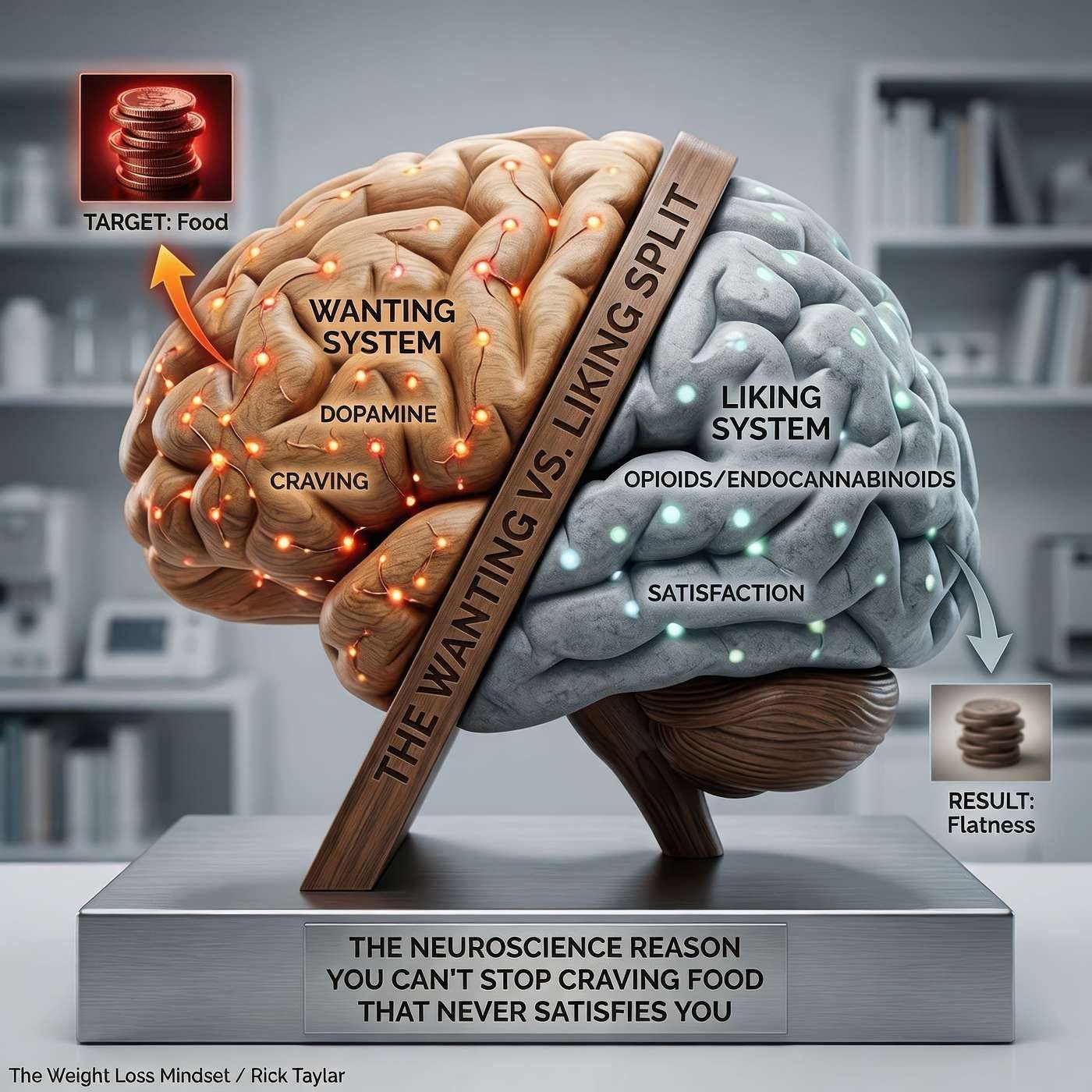 The Wanting vs. Liking Split: The Neuroscience Reason You Can't Stop Craving Food That Never Even Satisfies You 30.03.2026 14minYou've lived this moment. The craving hits, specific and insistent, and no matter what you do it just gets louder. So you give in. You eat it. And then... nothing. Flatness. No satisfaction. Just the quiet, maddening question: why did I even want that?That gap between the intensity of the craving and the emptiness of the payoff is not a willpower failure. It's not a character flaw. It's neuroscience. And once you understand what's actually happening, cravings will never have the same power over you again.In this episode, Rick breaks down the wanting vs. liking split — two completely separate brain systems that the diet industry has never told you about. Understanding them won't just explain why cravings feel like need even when you're not hungry. It'll change how you see yourself every time one hits.What you'll discover:Why dopamine is a molecule of anticipation, not pleasure, and what that means for every craving you've ever hadThe University of Michigan experiments that prove wanting and liking run on entirely separate brain circuitsHow hyperpalatable food was engineered specifically to fire the wanting system while bypassing satisfaction entirelyWhy willpower-based approaches were always fighting the wrong battleThe slot machine principle that reframes every future craving the moment you see itWhat it means to become the cause instead of the effectResources and links mentioned:Get on the early access list for Rick's upcoming program:https://news.weightlossmindset.coIf this episode resonated:Subscribe wherever you listen to podcasts, and leave a review if the show has shifted something for you. Every review helps put this in front of the people who need it most.The Weight Loss Mindset is for people over 40 who are done blaming themselves for a problem that was never about discipline. Identity transformation, not another diet. Get full access to The Weight Loss Mindset at news.weightlossmindset.co/subscribe
 -
 7 Mental Traits of People Who Never Obsess Over Food (And How to Rewire Your Brain to Think the Same Way) 24.03.2026 12minYou've sat across from someone who eats two bites of dessert, puts the fork down, and moves on — no guilt, no quiet negotiation, no 'I'll start again Monday.' And part of you has always assumed they're just built differently.They're not. Their software is different. And in this episode, we break down exactly what's running in that calm eater's brain — seven specific mental traits — and why every one of them is a configuration you can change, not a personality you either have or don't.This is the episode that names the quietest lie the diet industry tells: that how you relate to food is fixed. It isn't. And once you see that clearly, the whole game shifts.WHAT WE COVERThe Personality Myth — the lie that calm eaters are born, not madeWhy the noise around food is an identity problem, not a food problemThe Identity Thermostat — and why fighting the temperature never worksAll 7 mental traits, with the contrast between the hijacked brain and the rewired oneWhy Trait 7 (identity leads the behavior) is the master trait everything else flows fromTHE 7 TRAITS1. Food is neutral — no verdict attached, just fuel and pleasure2. The pause before the pull — observation over reaction3. Hunger as signal, not emergency — data, not a five-alarm fire4. No cleanup eating — food isn't a therapist5. Satisfaction as a real stop signal — eating only for what food can give6. Tomorrow has nothing to do with today — no cascades, no all-or-nothing logic7. Identity leads the behavior — the master trait. The dial that runs the room.KEY CONCEPT"Calm eaters aren't fighting the temperature every day. Their thermostat is set to a different default. When the shift happens, these traits stop requiring discipline. They become how you operate."MENTIONED IN THIS EPISODEEscape the Willpower Trap — the course where we install these traits module by module, identity shift by identity shift. Link below.TAKE THE NEXT STEPIf this episode hit something real, the door is soon to open.Escape the Willpower Trap: sign up for the newsletter here - news.weightlossmindset.coSUBSCRIBE & REVIEWIf The Weight Loss Mindset is helping you think differently about food, a review means more people find it. Takes 30 seconds. Genuinely appreciated. Get full access to The Weight Loss Mindset at news.weightlossmindset.co/subscribe
 -
 5 Reasons Self-Compassion Without Identity Change Keeps You Trapped in the Binge-Forgive-Repeat Cycle 16.03.2026 18minThe wellness world handed you a powerful tool and told you it was the whole answer. It wasn't.Self-compassion is real, and the research behind it is solid. But for a lot of people over 40, practicing self-compassion after a rough moment with food isn't producing change. The cycle keeps repeating. Same triggers, same episodes, just with gentler language around them.In this episode, Rick breaks down the five reasons self-compassion without identity change keeps the binge-forgive-repeat cycle running. Not to discredit self-compassion. To show you the half that's missing. Because the tool isn't the problem. Incomplete use is.By the end, you'll understand why forgiving yourself feels like resolution but often isn't, what real self-compassion actually looks like when it's complete, and why the identity underneath the behavior is the only thing that actually breaks the cycle.Key Points Covered:1. Self-compassion is emotional first aid, not a cureForgiveness treats the wound. It doesn't ask why the wound keeps appearing. Self-compassion addresses the feeling in the moment. Identity change addresses the source. You can forgive the same behavior indefinitely and the identity generating that behavior stays untouched. The thermostat wasn't touched. The reading was just kinder.2. Forgiveness without curiosity is just releaseEvery episode with food contains data: what was happening in your environment, what emotional state you were in, what identity you were living inside in that moment. When the forgiveness arrives without curiosity following it, that data disappears. Real self-compassion doesn't end at the verdict. It asks the scientist's questions: what was I trying to feel? What need was I reaching for? Who was I being in that moment?3. It keeps the identity intact (the Fire Alarm metaphor)Self-compassion without identity work is like pressing the silence button on a fire alarm. The noise stops. The relief is real. But the fire is still burning in the next room. The alarm was pointing to something. Silencing it removed the signal, not the problem. The fire is the identity. The alarm is the episode. Going to find the fire means asking, after the forgiveness: what identity was I living inside when that happened?4. It can become the sophisticated version of giving upPrevious generations said 'it's just who I am.' Some people today say 'I'm practicing radical self-acceptance.' The language is more evolved. The outcome is identical. This isn't a character flaw. It's the logical response to years of trying and failing when shame was the only other option. But there's a third option: identity change. Not self-criticism. Not harder discipline. A different kind of shift entirely.5. Self-compassion operates in time. Identity operates in structure.Self-compassion is repair. Identity is architecture. Repair is necessary and keeps things functional while you do the deeper work. But spending your whole life repairing the same wall, however compassionately, isn't the same as fixing the foundation. Identity work is upstream. It changes the conditions that generate the behavior before it occurs.6. What complete self-compassion actually looks likeReal self-compassion has two movements. The first is forgiveness: I'm human, the episode happened, I release the shame. The second is curiosity: what was I trying to feel, what identity label was running, what would someone with a peaceful relationship with food have done differently? The first movement without the second is emotional maintenance. Both movements together are the beginning of identity work.Enjoyed This Episode?If this landed for you, the best thing you can do is share it with someone who's stuck in the same loop. Someone who's been kind to themselves about food and can't figure out why nothing Get full access to The Weight Loss Mindset at news.weightlossmindset.co/subscribe
Podobni podkasti


Priljubljen v
Ta podkast je tudi v lestvicah podkastov teh držav.

