
Big Brains
University of Chicago Podcast Network
0
Big Brains explores the groundbreaking research and discoveries that are changing our world. In each episode, we talk to leading experts and unpack their work in straightforward terms. Interesting conversations that cover a gamut of topics from how music affects our brains to what happens after we die.
Epizode
-
 Recreating A Sense of Touch, Using Our Minds, with Nicholas Hatsopoulos 17.09.2026 37minWhat if your thoughts could allow you to feel the texture of an object, type a message or move a robotic arm? How does the brain translate thought into physical movement, and can technology bridge the gap for paralyzed patients, whose pathways are broken? University of Chicago neuroscientist Nicholas Hatsopoulos is transforming that fundamental neuroscience into life-changing medical technology. By implanting microelectrode arrays directly into the brain, his team decodes the neural patterns that fire when a person intends to move. This brain-machine interface technology is allowing patients who are paralyzed or have ALS the ability to control robotic limbs, reach for objects, and regain touch sensation through their thoughts.
 -
 Why The Key to Treating Cancer May Be In Your Gut, with Thomas Gajewski 20.08.2026 36minFor decades, traditional cancer treatments like chemotherapy and radiation have targeted tumors directly—often with severe side effects and mixed results. But what if the key to treating cancer was already inside our bodies? Prof. Thomas Gajewski, a renowned oncologist at the University of Chicago, is leading a revolution by using the body’s gut microbiome to fight cancer. His pioneering work in cancer immunotherapy focuses on why some patients with melanoma responded dramatically to immune-based therapies while others do not. In this episode, Gajewski discusses how training T-cells to recognize and attack tumors is transforming oncology, why the microbiome might hold the key to supercharging cancer treatments, and what it will take to make life-saving immunotherapies effective for every patient.
 -
 The Little-Known Secrets To A Good Life, with Shigehiro Oishi 06.08.2026 34minWhat makes a good life? For decades, psychologists have debated whether true fulfillment comes from happiness—a life of comfort and joy—or meaning—a life of purpose and impact. But what if there's a third way? University of Chicago psychology professor Shigehiro Oishi has spent his career studying happiness, meaning, and what truly brings people deep satisfaction. His new research suggests that some of the most fulfilled people don’t prioritize either—they live psychologically rich lives, full of novelty, challenges, and transformative experiences. In this episode, Oishi explains why psychological richness might be the missing piece in our search for fulfillment.
 -
 How to Use Nature to Restore Your Focus, with Marc Berman 23.07.2026 34minWhat if the secret to restoring your focus, improving your mental health, and even reducing crime rates wasn’t found in an app or a pill, but in a tree? In this episode, we speak with University of Chicago psychologist Marc Berman, whose research on “soft fascination” and nature’s cognitive effects is reshaping how we think about everything from urban planning to depression treatment. From groundbreaking hospital studies to surprising results with plastic plants, Berman’s work uncovers the deep—and often invisible—power that natural environments hold over our minds and bodies. Whether you're a city planner, a parent, or just someone feeling mentally fatigued, this conversation may just change the way you think about a walk in the park.
 -
 How to Raise Kids in the Age of AI, with Dana Suskind 09.07.2026 33minAs AI rapidly changes how we work, learn, and communicate, it also raises an urgent question: What does it mean to grow up in a world dominated by smart technology? From smart-baby monitors to stuffed animals embedded with LLMs, kids and parents are increasingly bombarded with AI everywhere they turn. According to Prof. Dana Suskind, a renowned surgeon and pediatrician at the University of Chicago, AI might be able to mimic language, logic, and creativity, but it cannot replace the deeply relational, responsive human interactions that are crucial to a child’s development. In her latest book, Human Raised: Nurturing Connection, Curiosity & Lifelong Learning in the Age of AI, Suskind argues that the earliest years of life are more critical than ever—and that parents and caregivers cannot be replaced or outsourced in building a child's brain. Suskind explains how we can build a society that genuinely supports parents in raising the next generation, so that human connection does not become a “luxury good."
 -
 What Our Trash Problem Says About Our Culture, with Sarah Newman 25.06.2026 36minEvery day, we throw things away, only to be forgotten forever. But society didn’t always work in the same way. In this episode, we speak with University of Chicago scholar and anthropologist Sarah Newman to discuss her book, Unmaking Waste: New Histories of Old Things. An archaeologist by training, Newman discusses the history of trash across time—from the ancient Mayan civilization through today’s disposable culture. She argues that other societies valued objects much more deeply, reusing and recycling items in innovative ways. But will we ever return to this kind of zero-waste mentality? Newman argues that true sustainability requires a radical, systemic overhaul of how products are designed, valued and dismantled. She challenges us to look beyond the recycling bin and imagine a world where waste isn't just managed, but systematically unmade if we are to genuinely rethink our relationship with garbage and reshape our future.
 -
 How Websites Trick You Using ‘Dark Patterns’ with Marshini Chetty 11.06.2026 37minWhy does it seem so difficult to cancel an online subscription, delete an account, or opt out of data tracking? You might think it’s just bad luck or a confusing online interface, but more often than not, it’s by design. In this episode of Big Brains, we speak with Marshini Chetty, Professor in the University of Chicago’s Department of Computer Science. As a leading expert in human-computer interaction, Chetty reveals the science behind "dark patterns” online—the subtle, manipulative design choices woven into the apps and websites we use every day. We explore how these deceptive interfaces weaponize human psychology to keep us clicking, spending and sharing our data.
 -
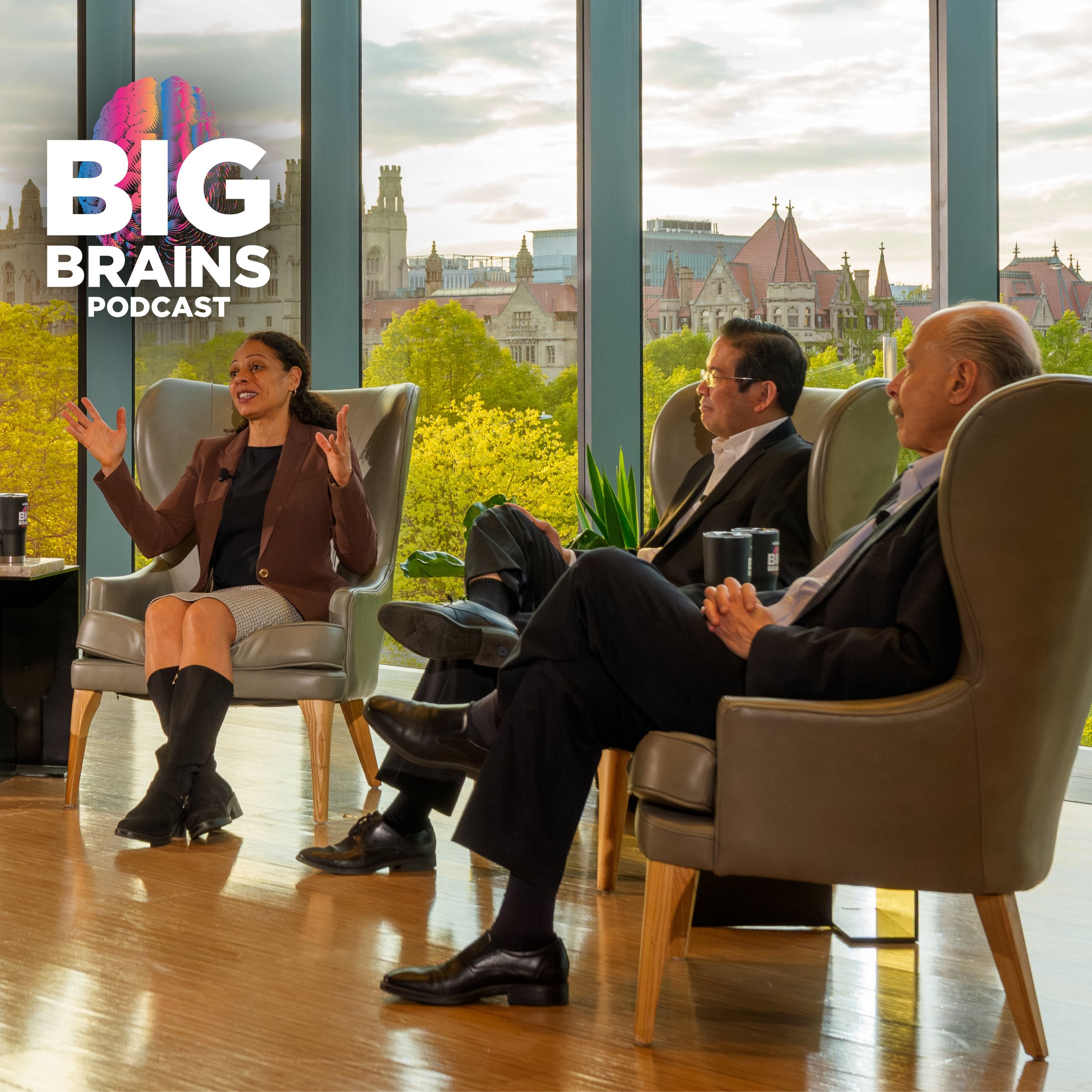 Quantum Technology, Explained: A Big Brains Live Event 28.05.2026 39minQuantum technology is at a pivotal moment. No longer the faraway dream of scientists, the field is rapidly developing across the world, fueled by major investments from governments, industry, and universities racing to lead its promising future. But what exactly is quantum technology? And how will it affect our lives today—and in the coming decades? A recent event at the University of Chicago, hosted by Big Brains in partnership with 1440, sought to demystify quantum, separate the hype from reality and explore how it could transform our daily lives. Three renowned scientists—Prof. David Awschalom, Fred Chong and Nadya Mason—discussed how UChicago was leading innovative research, in partnership with its affiliated labs Argonne and Fermilab, as well as other universities across the Midwest. They explained how quantum has the potential to revolutionize our world—from creating unhackable communications to supercharging quantum computers to detecting disease at the cellular level. They discussed the challenges as well as the opportunities, especially for the next generation of quantum engineers and scientists needed to make these dreams a reality.
 -
 Our Untapped Superpower: Connecting With Others, with Nicholas Epley 14.05.2026 38minAs humans, we have a biological need for connecting with others, but in today's modern world, we tend to avoid it. This paradox is something that Prof. Nicholas Epley of the University of Chicago Booth School of Business has been fixated on in his research. In his new book, A Little More Social: How Small Choices Create Unexpected Happiness, Health, and Connection, Epley shows why we consistently underestimate the positive impact of reaching out to others. From experiments tracking commuters on the train to deep conversations with hedge fund executives, Epley reveals that our beliefs about social interaction are often “precisely backwards” leading us to choose solitude even when engagement would make us happier and healthier.
 -
 Why the Fed Matters Now More Than Ever, with Douglas Diamond 30.04.2026 37minFrom setting interest rates to keeping inflation in check, the Federal Reserve sits at the center of some of the most important economic decisions shaping our daily lives. As the Fed prepares for new leadership, following the tenure of Jerome Powell, many are wondering: What’s next for the Fed, especially when it comes to their financial decisions and their independence? We spoke with Prof. Douglas Diamond, the Nobel Prize-winning economist of the University of Chicago, in order to explain the Fed’s crucial role in our financial system—and why it matters so much for our future. Renowned as one of the founders of modern banking theory, Diamond has conducted groundbreaking research on banking, particularly during financial crises. He described the lessons we can learn from past bank runs, including the 2023 collapse of Silicon Valley Bank, and warns that we must remain on guard to help prevent the next financial crisis from happening.
 -
 Anxious? Avoidant? How to Build More Secure Relationships 16.04.2026 36minWhat if the way you relate to others isn’t fixed—but fundamentally changeable? In this episode, we speak with psychiatrist and neuroscientist Amir Levine, who is an Associate Professor of Clinical Psychiatry at Columbia University Medical Center. He's the author of the best-selling book Attached, which examined how people’s attachment styles—from secure to anxious to avoidant. In his new book, Secure: The Revolutionary Guide to Creating a Secure Life, Levine argues that attachment styles aren’t lifelong labels but actually patterns the brain can relearn. He explores the emerging science of “earned security”—how relationships reshape our neural wiring, why some people feel safe under pressure while others spiral, and what it takes to move from insecurity to stability.
 -
 Could AI Models Forecast Extreme Weather Events? with Pedram Hassanzadeh 02.04.2026 35minWhat if we could predict the world’s most dangerous weather events—not days, but weeks in advance? Extreme events like heat waves, hurricanes, and floods cause massive loss of life and billions in damage, but they’re also some of the hardest events for traditional weather forecasting to predict. In this episode, Assoc. Prof. Pedram Hassanzadeh of the University of Chicago explains why forecasting extreme weather has long pushed science to its limits—and how a new wave of AI models could transform the field at a time when climate change is making these events more common. By learning directly from decades of atmospheric data, these systems can generate forecasts faster, more cheaply, and in some cases more accurately than traditional models—even to predict freak ‘gray swan’ weather events no one has ever seen.
 -
 Are Judges Too Powerful? The Rise of Universal Injunctions, with Samuel Bray 19.03.2026 40minIn recent years, a judge in one state had gained the power to halt policies across the entire United States. Known as nationwide or universal injunctions, these actions have become one of the sweeping tools in the federal court—affecting cases ranging from student loan forgiveness to environmental policies to birthright citizenship. How did universal injunctions become such a central feature of modern constitutional battles? And should one judge really be able to block a policy for the entire country? In this episode, UChicago legal scholar Samuel Bray explains the history and legal debate behind such actions, including his research which was cited more than a dozen times in the 2025 Supreme Court case Trump v. Casa, which examined how courts use this remedy—and whether injunctions fit within the Constitution’s design.
 -
 Could Data Centers Break Our Power Grid? with Andrew Chien 06.03.2026 37minArtificial intelligence may live in “the cloud,” but its footprint is firmly on the ground. As AI systems grow more powerful, the data centers that train and run them are consuming massive amounts of land, water and electricity—as well as reshaping regional power grids. What does this surge in demand mean for the environment, energy infrastructure, and the future of innovation? In this episode, we speak with UChicago computer scientist Andrew Chien, an expert in large-scale computing and cloud computing, about why these data centers require so much power, why they’re stirring such controversy—and whether there are sustainable approaches that could keep our energy use in check.
 -
 Remarkable New Treatments for Spinal Cord Injuries, with Mohamad Bydon 19.02.2026 26minWhen a two-year-old boy suffered a catastrophic injury that severed the connection between his skull and spine, doctors across Europe told his family there was no hope. His spinal cord was completely severed, and the injury was not considered survivable. But University of Chicago neurosurgeon Mohamad Bydon saw a possibility. In this episode of Big Brains, Dr. Bydon walks us through the extraordinary, multi-stage surgery at UChicago that not only saved the boy’s life but helped him regain the ability to breathe, talk and move his fingers and toes. He examines the future of surgery for spinal cord injury patients—from minimally invasive surgery techniques to robotic surgery and AI to stem cell therapy—is even helping some paralyzed patients regain movement and even walk again after their injuries.
 -
 Can You Improve Your Working Memory and Attention? with Edward Awh 05.02.2026 35minIn today’s world, our brains are overloaded with information, making it hard to focus and remember. But what are the true limits of the human mind—and why do they exist? And why are some people seem so much better than remembering things than others? In this episode, we talk with with Edward Awh, a cognitive neuroscientist and professor of psychology at the University of Chicago. Whose lab studies how the brain controls focus, memory and attention. His research explores the connection between attention and working memory, why our conscious awareness is far more limited than it feels, and what those limits mean for life in an information-saturated world. He explains what we can actually do to improve our memory—including one easy thing we can all do every day—and how using the “remote control of your mind” could help you focus your attention, given the limited space in our brains.
 -
 Why Knowing Your True Self Is So Difficult, with Eric Oliver 22.01.2026 31minThe process of understanding who we are is a lifelong journey for many of us. For two decades, that question has been one that University of Chicago scholar Eric Oliver has asked his students in class—and inspired him to write a new book called "How to Know Your Self: The Art & Science of Discovering Who You Really Are." A renowned political scientist, Oliver draws upon science, philosophy, psychology and his personal experiences to better examine the mysteries of the human experience—and explore what it truly means to be “you.”
 -
 The Breakthrough Quantum Sensor That Sees Inside Your Cells, with Peter Maurer 08.01.2026 35minWhat if we could precisely measure a cell at its most fundamental level? In this episode, we talk with the University of Chicago scientist Peter Maurer about how he and his colleagues made the breakthrough discovery of turning a protein found in living cells into the first biological quantum bit, also known as a qubit. Maurer explains how quantum systems—once thought to be too fragile for real-world use—are becoming some of the most powerful sensors ever built, and what they could teach us about the brain, the body and more.
 -
How to Manifest Your Destiny with the Late James Doty 29.12.2025 31minWe've all heard the phrase "Manifest Your Destiny" when it comes to wanting a new promotion, figuring out a new career path or just trying to achieve that long-term goal. It turns out that the act of manifestation is not merely pseudoscience—it actually has a body of research in neuroscience to back it up. James Doty was a clinical professor of neurosurgery at Stanford University, and founder and director of the Center for Compassion and Altruism Research and Education. He wrote several books, including "Mind Magic: The Neuroscience of Manifestation and How It Changes Everything".
-
 What Makes Music Go Viral—From AI to Taylor Swift 11.12.2025 35minThe internet and social media have transformed the way in which we hear and understand music today—and online communities and platforms from YouTube to TikTok have changed how music circulates and ultimately goes viral. Why do some pop stars have more success creating hit songs and building online following than others? In this episode, we speak with Paula Clare Harper, a musicologist and assistant professor at the University of Chicago. Harper co-edited the book Taylor Swift: The Star, The Songs, The Fans, which explores the online musical cultures that produced and propelled the image of megastar Taylor Swift. Harper unpacks how gendered narratives around "the fangirl" continue to influence which musical practices we take seriously—and how studying music on the internet helps us understand contemporary cultural power.
Podobni podkasti


Priljubljen v
Ta podkast je tudi v lestvicah podkastov teh držav.

