
Brain Inspired
Paul Middlebrooks
0
Brain Inspired explores the intersection of neuroscience and artificial intelligence, featuring interviews with experts in computational neuroscience, machine learning, cognitive science, and related fields. The podcast delves into how these disciplines inform each other, covering topics like deep learning, reinforcement learning, neural networks, and the philosophy of mind. Aimed at an audience with some background in the subject, it seeks to educate and inspire those interested in understanding intelligence.
Epizode
-
 BI 246 Andrea Gambarotto: Cognition Requires Agency 16.09.2026 1h 58minSupport the show to get full episodes, full archive, and join the Discord community. The Transmitter is an online publication that aims to deliver useful information, insights and tools to build bridges across neuroscience and advance research. Visit thetransmitter.org to explore the latest neuroscience news and perspectives, written by journalists and scientists. Read more about our partnership. Sign up for Brain Inspired email alerts to be notified every time a new Brain Inspired episode is released. To explore more neuroscience news and perspectives, visit thetransmitter.org. Andrea Gambarotto is a postdoctoral philosopher and researcher at the University of Luxembourg. He is an expert in the philosophy of Georg Wilhelm Friedrich Hegel, most commonly known as Hegel. More recently he has been studying the relation between some of Hegel's ideas and those of modern theoretical biology regarding questions of autonomy and agency. Andrea argues that, where Immanuel Kant believed we should explain biological stuff and inanimate stuff the same way- via mechanistic explanations, Hegel believed to explain the biological stuff, we should leverage the fact the biological organisms have intrinsic purpose… agency. And, Hegel's approach is in line with what's called the enactive approach in cognitive science, which has a long history and continues to thrive. Andrea explains all of that during our discussion. One reason I invited Andrea on is because these issues get the heart of what some of us care about, which is, what are the differences and similarities between our natural intelligence and engineered artificial intelligence? Why should we care about those differences? A large language model isn't alive, but does it have a mind? Should we call what it does cognition? What are the relations between life, mind, cognition, intelligence, consciousness? Those kinds of questions. We even discuss why the famed octopus might be really intelligent but not conscious. Andrea Gambarotto Gambarotto papers Enactivism and the Hegelian stance on intrinsic purposiveness Body plan organization and the evolution of conscious agency Blog: Dialectical Systems Papers also mentioned Weber & Varela 2002: Life after Kant: Natural purposes and the autopoietic foundations of biological individuality. Mossio & Bich 2014: What makes biological organisation teleological? Bechtel & Bich & 2021: Grounding cognition: heterarchical control mechanisms in biology. Pessoa 2026: Beyond networks: Toward adaptive models of biological complexity. Levins 1998: Dialectics and Systems Theory. Barandiaran & Moreno 2006: On What Makes Certain Dynamical Systems Cognitive: A Minimally Cognitive Organization Program. Books mentioned Linguistic Bodies: The Continuity between Life and Language Radical Embodied Cognitive Science An Evolutionary Story of Agency 0:00 - Intro 7:51 - Intrinsic and extrinsic purposiveness 14:39 - Hegel, Kant, and autonomy 28:07 - Constraint closure and enactivism 35:13 - How Hegel and Enactivitsm agree 43:58 - Dialectics 57:44 - Brain activity and enactivism 1:20:02 - Heidegger and cognitive science 1:26:59 - Artificial intelligence and Hegel 1:29:15 - Mind agency decoupling 1:43:38 - Evolution of conscious agency 1:52:42 - Heterarchy via McCulloch
 -
 BI 245 Dan Levenstein: Neuro-AI, Dynamics, and Model Systems 02.09.2026 1h 36minSupport the show to get full episodes, full archive, and join the Discord community. The Transmitter is an online publication that aims to deliver useful information, insights and tools to build bridges across neuroscience and advance research. Visit thetransmitter.org to explore the latest neuroscience news and perspectives, written by journalists and scientists. Read more about our partnership. Sign up for Brain Inspired email alerts to be notified every time a new Brain Inspired episode is released. To explore more neuroscience news and perspectives, visit thetransmitter.org. Daniel Levenstein started his NeuroAI and Dynamics Lab at Yale University about a year ago. We briefly discuss what it's like to transition from a postdoc to a principle investigator, i.e. head of the lab. But most mostly we discuss his work and ideas. Dan studies spontaneous neural activity during sleep, specially in brain areas like hippocampus and cortex, and how this internally generated spontaneous activity is related to learning and memory and navigation. Really, he used to study those processes directly through experimental brain recording datasets. These days he builds and studies models of those processes, using AI models and seeing how their dynamics and functions match what we see in brains. Levenstein Lab Social: @dlevenstein.bsky.social Related papers On the Role of Theory and Modeling in Neuroscience The problem-ladenness of theory Sequential predictive learning is a unifying theory for hippocampal representation and replay 0:00 - Intro 9:12 - Neuro-AI 18:23 - Experiment vs theory 20:36 - Ground vs active state neuron activity 25:38 - Beginning a lab 31:34 - Sleep and Internally generated activity 40:02 - Spiking neural networks 52:13 - Naturalistic neuro-AI 59:52 - Cognitive maps, world models 1:04:16 - Weasel words and motifs 1:08:17 - Transformers and brains 1:18:53 - AI vs biology 1:24:32 - Neuroscience theory
 -
 BI 244 Marco Facchin: Philosophy and Science of Biological Brains 19.08.2026 1h 29minSupport the show to get full episodes, full archive, and join the Discord community. The Transmitter is an online publication that aims to deliver useful information, insights and tools to build bridges across neuroscience and advance research. Visit thetransmitter.org to explore the latest neuroscience news and perspectives, written by journalists and scientists. Read more about our partnership. Sign up for Brain Inspired email alerts to be notified every time a new Brain Inspired episode is released. To explore more neuroscience news and perspectives, visit thetransmitter.org. Marco Facchin is a postdoctoral philosopher of neuroscience and cognitive sciences more broadly at the University of Antwerp. He and his colleague Farid Zahnoun recently hosted a workshop called Beyond Neuro-computationalism with themselves and a handful of speakers, almost all of whom have been on Brain Inspired. In that workshop, they discussed many topics around this sort of forever ongoing reassessment in neuroscience and philosophy about how best to think about cognition, the role of brains, embodied, enactive, embedded, extended - known together as 4E cognition - how much biological detail matters for a good explanation, and so on. The talks from that workshop are online, and I'll link to them in the show notes. So today Marco and I discuss how that all went, and many of the topics and themes I just mentioned, plus his own work and ideas along those lines. Marco Facchin Social: @marcofacchin.bsky.social Beyond neuro-computationalism talks. Why can’t we say what cognition is (at least for the time being) Predictive processing and anti-representationalism Defusing the Representation-Hungry Challenge Structural representations do not meet the job description challenge Structure and function in the predictive brain Read the transcript. 0:00 - Intro 3:30 - Beyond neuro-computationalism 14:02 - Vicente Raja motifs 17:58 - 4E cognition 32:36 - Philosophy and neuroscience 42:18 - The problem with predictive processing 48:56 - Role of AI in understanding brains and minds 54:05 - Metabolic constraints 1:07:58 - A philosopher's view of neuroscience 1:13:27 - A-lieving and AI 1:25:47 - AI consciousness
 -
 BI 243 Alison Barth: Learning as a Window to Cortex 05.08.2026 1h 40minSupport the show to get full episodes, full archive, and join the Discord community. The Transmitter is an online publication that aims to deliver useful information, insights and tools to build bridges across neuroscience and advance research. Visit thetransmitter.org to explore the latest neuroscience news and perspectives, written by journalists and scientists. Read more about our partnership. Sign up for Brain Inspired email alerts to be notified every time a new Brain Inspired episode is released. To explore more neuroscience news and perspectives, visit thetransmitter.org. Alison Barth runs the Barth Lab at Carnegie Mellon University, where they use learning experiments in mice to try to figure out how the cortex works. As you may know, the brain in general but also the cortex itself is made up of a large variety neuron cell types, with different activity properties. Alison has the gritty job of identifying those different cell types in sensory cortex, and seeing how they change when animals learn to associate rewards with sensory stimulation. So unlike many of the guests, who take a much more zoomed out view and look at how populations of neurons carry out some function, Alison is happiest down at the cellular level. So we talk about her work, why she prefers to work at that scale, and a variety of related topics. Barth Lab. Related papers Barth lab publications. Learning, prediction accuracy, and neural plasticity in sensory cortex. Read the transcript. 0:00 - Intro 4:24 - Alison's trajectory to learning and memory 21:02 - Automated mouse learning experiments 25:34 - What is success in this line of work? 32:34 - How many cell types do we need to explain? 34:33 - Current experiments 38:11 - How does cortex work? 45:19 - Predictive processing 1:02:01 - Obstacles 1:10:41 - Role of AI 1:33:38 - Moving forward
 -
 BI 242 Kathryn Nave: How Life Gets its Meaning and Intelligence 15.07.2026 1h 44minSupport the show to get full episodes, full archive, and join the Discord community. The Transmitter is an online publication that aims to deliver useful information, insights and tools to build bridges across neuroscience and advance research. Visit thetransmitter.org to explore the latest neuroscience news and perspectives, written by journalists and scientists. Read more about our partnership. Sign up for Brain Inspired email alerts to be notified every time a new Brain Inspired episode is released. To explore more neuroscience news and perspectives, visit thetransmitter.org. Kathryn Nave is a Leverhulme Trust Early Career Fellow at the University of Edinburgh, and the author of the book A Drive to Survive: The Free Energy Principle and the Meaning of Life. In the book, Kate dives deep into the free energy principle and active inference, which are popular approaches to studying brains, minds, and organisms in general, and which are being used in artificial intelligence. Ultimately, Kate finds these approaches come up short as explanatory frameworks for life, and autonomy, and intelligence. Instead, Kate and many others advocate a framework that Kate calls constraint closure or closure of constraints, but also goes by the name organizational closure. This is a concept from philosophy and theoretical biology that people like Alvaro Moreno and Matteo Mossio have put forth in their 2015 book Biological Autonomy. The core ideas are also found in various forms from people like Robert Rosen, Stuart Kauffman, Alicia Juarrero, Terrence Deacon, and others. We discuss what constraint closure is, why Kate thinks it's a solid foundation to build on, and what if anything it means for cognitive science and brain sciences to embrace this constraint closure view. I highly recommend the book even if you're looking for a primer on the free energy principle and active inference. As we discuss, Kate's journalism experience has helped her become a wonderful communicator of these notoriously difficult concepts. Kathryn Nave @kathrynnave; @kathrynnave.eurosky.social. A Drive to Survive: The Free Energy Principle and the Meaning of Life Related episode: BI 241 Johannes Jaeger: Agency and the Cyborg Myth Mentioned in the episode: We Need To Rewild The Internet Beyond Control: Finding the Purpose of Enactive Cognitive Science Read the transcript. 0:00 - Intro 5:39 - Journalism back to philosophy 15:56 - How Kate got into predictive processing etc. 21:30 - Predictive processing and phenomenology 30:45 - Organizational closure 37:37 - Constraint closure beyond the single cell 45:04 - Brain as metabolic 50:12 - Basal cognition 52:13 - Degeneracy 55:08 - Neutral networks 1:00:33 - AI and autonomy 1:08:12 - Meaning and mind 1:10:02 - Why do we need brains? 1:17:33 - Reframe neuroscience? 1:23:51 - Reifying models 1:27:43 - Free energy principle and active inference 1:37:16 - Tolerating as much variability as possible
 -
 BI 241 Johannes Jaeger: Agency and the Cyborg Myth 01.07.2026 1h 37minSupport the show to get full episodes, full archive, and join the Discord community. Johannes Jaeger is Associate Faculty at the Complexity Science Hub in Vienna. He's also a freelance researcher, a philosopher, and an educator. He's here today to educate us about some of the fundamental differences between living organisms and machines, like AI, and why we should care about those differences. We discuss his paper The Cyborg Myth, an argument for why we can't seamlessly replace ourselves with machine parts over time. We talk about judgment and relevance realization as a fundamental difference between AI and living organisms -the ability to judge what is a relevant problem to solve in the first place, assuming intelligence is about problem solving. We also discuss what agency is in living systems, and why AI agents are something completely different. I think you get the recurring theme here. Yogi is writing a book called Beyond the Age of Machines, a work in progress and you can read it as he writes it on his expanding possibilities website. Untethered in the Platonic Realm (Yogi's website) Expanding Possibilities Book in progress: Beyond the Age of Machines Mastadon: @yoginho Related The Cyborg Myth.(talk version here) Naturalizing relevance realization: why agency and cognition are fundamentally not computational. Artificial intelligence is algorithmic mimicry: why artificial "agents" are not (and won't be) proper agents. Read the transcript. 0:00 - Intro 7:11 - The cyborg myth 15:16 - Judgment 24:22 - Consciousness 28:56 - Agency 36:40 - Relevance realization and energy efficiency 46:44 - Metabolism as a metaphor 1:00:39 - Robert Rosen 1:06:20 - Conceptual engineering 1:12:55 - Dynamics and computation 1:23:07 - Agency book
 -
 BI 240 Cristopher Moore: Cognition and Computational Complexity 17.06.2026 1h 42minSupport the show to get full episodes, full archive, and join the Discord community. The Transmitter is an online publication that aims to deliver useful information, insights and tools to build bridges across neuroscience and advance research. Visit thetransmitter.org to explore the latest neuroscience news and perspectives, written by journalists and scientists. Read more about our partnership. Sign up for Brain Inspired email alerts to be notified every time a new Brain Inspired episode is released. To explore more neuroscience news and perspectives, visit thetransmitter.org. Cristopher Moore is a professor at the Santa Fe Institute in New Mexico, and he is a computation and computational complexity expert. He recently joined a us in my complexity discussion group, and answered a bunch of our questions, but I wasn't done with him regarding what, if anything, computational complexity has to do understanding how brains and minds work. So that's why he's here today, and we discuss a wide variety of topics related to AI, computation, computational complexity, and cognition. Cris's Homepage Book: The Nature of Computation Related papers What Is a Macrostate? Subjective Observations and Objective Dynamics Read the transcript. 0:00 - Intro 4:24 - The Nature of Computation 9:14 - Computational complexity 28:22 - Real mathematics 35:08 - Current state of AI 39:04 - Computational complexity in the AI world 47:53 - Cognition, creation, problems 56:16 - Rugged landscapes and generalization 1:13:52 - What is computation? 1:32:31 - How would you study the brain?
 -
 BI 239 Nedah Nemati: Naturalistic Neuroscience and Lived Experience 03.06.2026 1h 53minSupport the show to get full episodes, full archive, and join the Discord community. he Transmitter is an online publication that aims to deliver useful information, insights and tools to build bridges across neuroscience and advance research. Visit thetransmitter.org to explore the latest neuroscience news and perspectives, written by journalists and scientists. Read more about our partnership. Check out this story: Beyond the algorithmic oracle: Rethinking machine learning in behavioral neuroscience Sign up for Brain Inspired email alerts to be notified every time a new Brain Inspired episode is released. To explore more neuroscience news and perspectives, visit thetransmitter.org. Neuroscience studies in part the relation between brain activity and behaviors. But, what is a behavior? It's a simple question, but there's no simple answer. For example, you're behaving right now, whatever you're doing, even if you're not doing much. When you cross the street, how many behaviors do you use? When you sleep, what behaviors do you do? Hopefully these simple examples make you think about how difficult it can be call some single movement a behavior. Nedah Nemati is a philosopher of neuroscience at Columbia University. I met Nedah at a workshop a few months ago, where we chatted about the growing trend in neuroscience toward what is sometimes being called "naturalistic neuroscience," which really means varying levels of allowing organisms to behave more freely, less constrained, than traditional neuroscience experiments that seek to minimize unrelated to the behavior or cognition you want to isolate to study and explain. In more extreme cases, researches will try in the lab to emulate as much as possible the ecological world a particular organism has evolved to exist in, or even perform the experiments out of the lab, in the wild, so to speak. So a good part of our discussion revolves around this trend, and what counts as a "naturalistic" behavior, and how the tools we use to perform experiments shape the experiments and the scientific questions themselves. Nedah has a neuroscience background, but in her philosophical work she has embedded herself into various neuroscience labs to better understand how the experiences of the researchers themselves, called their lived experiences, shape the assumptions and questions in their science. As an example, we discuss her work looking into the neuroscience of sleep from over a 100 years ago to today. When a modern neuroscientist studies sleep, are they studying the same thing a scientist claimed to be studying 100 years ago, even though they claimed to be studying sleep back then as well? Nedah's website. Transmitter piece: Beyond the algorithmic oracle: Rethinking machine learning in behavioral neuroscience Related papers Rethinking Neuroscientific Methodology: Lived Experience in Behavioral Studies What is ‘Natural’ about Naturalistic Neuroscience? Read the transcript. 0:00 - Intro 5:00 - Philosopher in a lab 20:21 - Sleep as behavior 22:22 - How the study of "sleep" has changed 27:24 - How tools and methods shape definitions 46:07 - Naturalistic neuroscience 1:00:47 - Naturalistic vs experimental 1:14:32 - How tools change theory 1:16:57 - Lived experience 1:26:28 - Lived experience vs. bias 1:37:09 - AI and engineering in neuroscience 1:45:29 - Should a lab hire a philosopher?
 -
 BI 238 James Harrison: Hypnosis as Mental Foraging 20.05.2026 1h 46minSupport the show to get full episodes, full archive, and join the Discord community. James Harrison is a clinical hypnotist, and author of a new book, Mental Foraging and the Evolution of Memory: An Updated Model of Clinical Hypnosis. As you probably know, hypnosis carries some historical baggage, for example, in terms of how it could be used to manipulate people into having false memories that could be damaging to themselves and those around them. That baggage carries over into modern medical and clinical practice, with many people giving the side eye to hypnosis and disregarding it as a useful tool in the toolkit of treating patients with mental disorders or psychological distress. As a clinician, and as someone who has seen clinical hypnosis work for people, James set about exploring how it might be explained in modern neuroscience terms and concepts. What he ended up with is an account of hypnosis grounded in the neuroscience of state changes, interoception, exteroception, and predictive processing. His hope is that if we get the scientific explanation right of how it works, hypnosis might become more accepted as an effective tool among other psychological treatments. James's website. Mental Foraging and the Evolution of Memory: An Updated Model of Clinical Hypnosis. @JamesMHarrison_ 0:00 - Intro 4:23 - Why the book? 15:21 - Hypnosis as mental foraging 21:57 - Freud's unconscious 23:51 - How it all works 30:27 - Memory reconsolidation 36:41 - Historical rejection of hypnosis 48:44 - Old practice, new explanations 51:55 - Clinician is a guide 1:07:31 - Effectiveness 1:22:22 - Aristotle's common sense 1:30:47 - Allostasis and predictive processing
 -
 BI 237 Ehud Ahissar: Consciousness and Perceptual Dualism 06.05.2026 1h 42minSupport the show to get full episodes, full archive, and join the Discord community. The Transmitter is an online publication that aims to deliver useful information, insights and tools to build bridges across neuroscience and advance research. Visit thetransmitter.org to explore the latest neuroscience news and perspectives, written by journalists and scientists. Read more about our partnership. Sign up for Brain Inspired email alerts to be notified every time a new Brain Inspired episode is released. To explore more neuroscience news and perspectives, visit thetransmitter.org. Ehud Ahissar runs the Ahissar Lab at the Weizmann Institute in Israel, where he studies the neuronal and behavioral mechanisms of perception. Ehud sees perception as a closed-loop process, in which organisms actively generate the sensory signals they interpret. Today, we discuss his development of an idea about how this kind of processing can account for our conscious experience. It's a type of dualism Ehud calls "perceptual dualism," different than the dualisms you may already know. I'll use his own words to summarize it here… "The idea is that humans inevitably experience the world through two fundamentally different modes: digital brain–brain (BB) communication and analog brain–world (BW) interaction. In this view, the mind, and consciousness, emerge as social-like phenomena (in the philosophical sense), grounded in BB communication while constrained by BW interaction." Take note of the term brain-brain, shortened as BB, and the term brain-world, shortened as BW, because throughout our discussion you'll often hear just BB and BW to refer to those two distinct domains. So we discuss the ins and outs of his ideas, how came to them via studying active sensing in rodent whisker neurophysiology, how the brain implements this dualism via nested loops of neural circuitry that oppose and interlace with each other at multiple levels, and the idea that attractors, in the dynamical systems sense of attractor, may be the corresponding brain signatures of the digital phenomena that belong to the brain-brain mode of cognition. Ahissar Lab @ehudahissar; @ehudahissar.bsky.social Related papers Digital–Analog Perceptual Duality Closed-loop perception: gaps between artificial intelligence and biology Read the transcript. 0:00 - Intro 5:09 - A new kind of dualism 7:19 - Ehud's whiskers background 14:10 - Digital-analog perceptual dualism 26:08 - Digital communication between humans 32:26 - Attractors as the digital-analog interface 39:50 - Consciousness 50:11 - Dynamics and perceptual bottleneck 51:47 - Language, AI, and digital symbols 1:00:54 - Computation and brains (digital and analog) 1:06:43 - Improving AI with event based activation 1:11:10 - Dualism 1:17:26 - The hard problem of consciousness 1:21:26 - BB and BW interaction 1:24:55 - Tension between BB and BW 1:34:28 - Looking forward 1:37:37 - Srange loops
 -
 BI 236 Liset de la Prida: Neurons, Ripples, and Manifolds 22.04.2026 1h 44minSupport the show to get full episodes, full archive, and join the Discord community. The Transmitter is an online publication that aims to deliver useful information, insights and tools to build bridges across neuroscience and advance research. Visit thetransmitter.org to explore the latest neuroscience news and perspectives, written by journalists and scientists. Read more about our partnership. Check out this story: From genes to dynamics: Examining brain cell types in action may reveal the logic of brain function Sign up for Brain Inspired email alerts to be notified every time a new Brain Inspired episode is released. To explore more neuroscience news and perspectives, visit thetransmitter.org. Liset de la Prida is director of the Centro de Neurociencias Cajal in Madrid, Spain, where she runs the Laboratory of Neural Circuits. Today we discuss two main topics. What drew me to invite Liset was her work on neural manifolds, which we've talked about a lot recently on this podcast. She studies how specific subtypes of neurons affect and control neural manifolds. More on that it in a second, because what drew her to study manifolds was her work on what are known as sharp wave ripples in the hippocampus. Sharp wave ripples are generally quick bursts of oscillatory activity as found in local field potential recordings that accompany little bursty sequences of action potentials fired off by sets of neurons. Those ripples have been associated with a quick replaying of some experience an organism has had, with the thinking that by replaying those sequences of neural activity associated with an event, it's helping to consolidate the memory for that event in the cortex. Like everything else, the story isn't so simple, and we talk about some of the findings that have added to the complexity of understanding what sharp wave ripples are doing, and the varieties of sharp wave ripples. That varieties part is related to the second main thing we discuss, which is the varieties of neuron subtypes and their roles in shaping the manifolds we've discussed a lot recently. As a reminder, manifolds are dynamic structures along which populations of neural activity unfold over time, and they have proved to be one effective way of making sense of how large populations of neurons coordinate their activity to do useful things for our cognition. Liset is interested in the relation between sharp wave ripples and manifolds, and in how specific subtypes of neurons affect manifolds and cognition in general. Neural Circuits Lab @lmprida.bsky.social; @LMPrida Book: Brain, space and time: The neuroscience of how we navigate reality, memory, or the future Related From genes to dynamics: Examining brain cell types in action may reveal the logic of brain function Cell-type-specific manifold analysis discloses independent geometric transformations in the hippocampal spatial code From cell types to population dynamics: Making hippocampal manifolds physiologically interpretable 0:00 - Intro 5:29 - Hippocampus 9:31 - Sharp wave ripples 27:30 - Oscillations and epiphenomena 33:37 - Sharp wave ripples to manifolds 43:54 - Manifolds and single neuron types 49:45 - Hippocampus and granularity of cell types 59:23 - Explanation across levels 1:19:38 - Manifolds and higher cognition 1:29:46 - Brain Space and Time
 -
 BI 235 Romain Brette: The Brain, in Theory 08.04.2026 2h 11minSupport the show to get full episodes, full archive, and join the Discord community. The Transmitter is an online publication that aims to deliver useful information, insights and tools to build bridges across neuroscience and advance research. Visit thetransmitter.org to explore the latest neuroscience news and perspectives, written by journalists and scientists. Read more about our partnership. Sign up for Brain Inspired email alerts to be notified every time a new Brain Inspired episode is released. To explore more neuroscience news and perspectives, visit thetransmitter.org. Brains encode information in representations that perform computations to make predictions, right? No, no, no, and no. That's Romain Brette's response to those ill-conceived notions that neuroscience relies on to try to explain how cognition works. He uses more words to do that in his new book, The Brain, in Theory, which we discuss today. In the book Romain breaks down how many of the common metaphors we use don’t withstand scrutiny, and he offers alternative approaches more in line with what we know about how biological entities work. Along those lines, we discuss his ongoing work understanding the cognition of a single celled organism, the paramecium, and what his views might mean for artificial intelligence. This is a long episode, but there's a lot more to be explored in the book, so I recommend you read it. If you're a patreon supporter, I coaxed Romain back on for another 45 minutes to go deeper on his thoughts about how anticipation is the core of cognition, how predictive processing accounts like active inference miss the mark, and a few other topics. Romain's website. The Brain, in Theory. 0:00 - Intro 4:01 - The Brain, In Theory 7:10 - Influences 13:11 - Process metaphysics 18:39 - Observer vs system perspective 21:24 - Information in the brain? 22:56 - Why this book? 29:52 - Computations in the brain 52:14 - Behavior is not a computation 1:07:20 - Paramecium cognition 1:22:02 - How should neuroscientists proceed? 1:29:09 - Cognition as collective behavior of autonomous cells 1:36:47 - Constraints, causes, and laws 1:52:36 - Hopes for the book to influence the field 1:55:04 - Thoughts about AI 2:02:13 - Computation and goals 2:08:17 - Anticipation vs prediction
 -
 BI 234 Juan Gallego: The Neural Manifold Manifesto 25.03.2026 2h 1minSupport the show to get full episodes, full archive, and join the Discord community. The Transmitter is an online publication that aims to deliver useful information, insights and tools to build bridges across neuroscience and advance research. Visit thetransmitter.org to explore the latest neuroscience news and perspectives, written by journalists and scientists. Read more about our partnership. Check out this story: Neural manifolds: Latest buzzword or pathway to understand the brain? Sign up for Brain Inspired email alerts to be notified every time a new Brain Inspired episode is released. To explore more neuroscience news and perspectives, visit thetransmitter.org. Juan Gallego runs the Neocybernetics Lab at the Champalimaud Centre for the Unknown in Lisbon, Portugal, affiliated with the neuroscience of disease and neuroscience programs, and the centre for restorative neurotechnology. Juan has worked a lot on neural manifolds - the mathematical objects neuroscience is using more and more to describe how big populations of neurons coordinate their activity to do useful things. In fact, he recently gave a short talk that he titled The Manifold Manifesto, because he was asked to be provocative. And he was provocative, suggesting that manifolds are real - as real as chairs and tables are, that they have causal power, and they might be a target of evolution. Of course he talked about his own and others work to support those claims. So today we discuss many of those themes, through the lens of his own and others work, and we talk about what keeps him up at night about the possible limits of using manifolds to connect brain activity with behavior and mental phenomena. He's not just a manifold person, though. Juan is more broadly interested in motor control and how brains do it. We also discuss his work in patients with spinal cord injuries, who don't have enough nerve connections to their muscles to actually move, but have enough nerve connections that some signal gets through. Juan and his colleagues can detect that little bit getting through, and use it to infer what behaviors the patients intend to do, and they can use that information to control actions in a computer simulation. The hope is that this will translate to controlling prosthetics to give spinal cord injury patients their mobility again. Neocybernetics Lab. @juangallego.bsky.social Related papers A neural manifold view of the brain. A neural implementation model of feedback-based motor learning. Conjoint specification of action by neocortex and striatum. Integrating across behaviors and timescales to understand the neural control of movement. Evolutionarily conserved neural dynamics across mice, monkeys, and humans. Read the transcript. 0:00 - Intro 4:37 - Manifolds 14:30 - Strengths and weaknesses 24:32 - Conserved manifolds across animals and species 34:31 - Causality and manifolds 47:29 - Constraints and causes 51:05 - What to measure 58:55 - Complexity and manifolds 1:10:29 - Juan's background 1:14:08 - Prosthetics for spinal cord injuries 1:41:06 - Integrating across behaviors and timescales 1:46:56 - Conjoint specification of action by neocortex and striatum.
 -
 BI 233 Tom Griffiths: The Laws of Thought 11.03.2026 1h 40minSupport the show to get full episodes, full archive, and join the Discord community. The Transmitter is an online publication that aims to deliver useful information, insights and tools to build bridges across neuroscience and advance research. Visit thetransmitter.org to explore the latest neuroscience news and perspectives, written by journalists and scientists. Read more about our partnership. Sign up for Brain Inspired email alerts to be notified every time a new Brain Inspired episode is released. To explore more neuroscience news and perspectives, visit thetransmitter.org. Tom Griffiths directs both the Computational Cognitive Science Lab and the Princeton Laboratory for Artificial Intelligence at Princeton University. He's been on brain inspired before to talk about his previous book Algorithms to Live By: The Computer Science of Human Decisions, which he co-wrote with Brian Christian. Today he's here to talk about his new book, The Laws of Thought: The Quest for a Mathematical Theory of the Mind. In this book, Tom explains how the three pillars of logic, neural networks, and probability theory complement each other to explain cognition, arguing we are on the doorstep to settling what mathematical principles - the so-called "laws of thought" - underly our cognition. So we discuss a little bit about a lot of things, including the concepts themselves, the people who have generated and worked on those concepts. I should also mentioned, Tom recorded a bunch of his interviews with people he writes about, and he's edited and polished those into a podcast called the Cognition Project, which I have enjoyed after reading the book, and I think you'd enjoy it either before or after you read the book. Computational Cognitive Science Lab Princeton Laboratory for Artificial Intelligence Social: @cocosci_lab; @cocoscilab.bsky.social Book: The Laws of Thought: The Quest for a Mathematical Theory of the Mind. Podcast: The Cognition Project Read the transcript. 0:00 - Intro 3:20 - Tom's approach 7:19 - 3 pillars of the laws of thought 28:24 - Logic and formal systems strip away meaning 39:04 - Nature of thought 50:35 - Kahneman and Tversky 1:015:12 - Enabling constraints and inductive bias 1:12:51 - Hidden layers, probability, and hidden markov models 1:20:47 - Conscious vs nonconscious 1:23:43 - Feelings 1:31:26 - Personal
 -
 BI 232 How Should Neuroscience Integrate with Ecological Psychology? 25.02.2026 1h 53minSupport the show to get full episodes, full archive, and join the Discord community. The Transmitter is an online publication that aims to deliver useful information, insights and tools to build bridges across neuroscience and advance research. Visit thetransmitter.org to explore the latest neuroscience news and perspectives, written by journalists and scientists. Read more about our partnership. Sign up for Brain Inspired email alerts to be notified every time a new Brain Inspired episode is released. To explore more neuroscience news and perspectives, visit thetransmitter.org. How does brain activity explain your perceptions and your actions? That's what neuroscientists ask. How does the interaction between brain, body, and environment explain your perceptions and actions? That's what ecological psychologists ask… sometimes leaving the brain out of the equation altogether. These different approaches to perception and action come with different terms, concepts, underlying assumptions, and targets of explanations. So what happens when neuroscientists are inspired by ecological psychology but don't necessarily want take on, or are ignorant of, the fundamental principles underlying ecological psychology? This happens all the time, like how AI was "inspired" by the most rudimentary understanding of how brains work, and took terms from neuroscience like neuron, neural network, and so on, as stand-ins for their models. This has in some sense re-defined what people mean by neuron, and neural network, and how they function and how we should think of them. Modern neuroscience, with better data collecting tools, has taken a turn toward more naturalistic experimental paradigms to study how brains operate in more ecologically valid situations than what has mostly been used in the history of neuroscience - highly controlled tasks and experimental setups that arguably have very little to do with how organisms evolved to interact with the world to do cognitive things. One problem with this turn is that we neuroscientists don't have ready-made theoretical tools to deal with the less constrained massive amounts of data the new approach affords. This has led some neuroscientists to seek those theoretical concepts elsewhere. One of those places that offers those theoretical tools is ecological psychology, developed by James and Eleanor Gibson in the mid-20th century, and continued since then by many adherents of the concepts introduced by ecological psychology. Those concepts are very specific with regard to how and what to explain regarding perception and action. Matthieu de Wit is an associate professor at Muhlenberg College in Pennsylvania, who runst the ECON Lab, as in Ecological Neuroscience. Luis Favela is an associate professor at Indiana University. He's been on before to talk about his book The Ecological Brain. And Vicente Raja is a research fellow at University of Murcia in Spain, and he's been on before to talk about ecological psychology and neuroscience. With their deep expertise in ecological psychology, they are keenly interested in how neuroscience write large adopts various facets of ecological psychology. Do neuroscientists have it right? Do they need to have it right? Is there something being lost in translation? How should neuroscientists adopt ecological psychology for an ecological neuroscience? That's what we're discussing today. More broadly, this is also a story about what it's like doing research that isn't part of the current mainstream approach, in this doing ecological psychology under the long shadow cast by the computational mechanistic neuro-centric dominant paradigm in neuroscience currently. Matthieu de Wit lab. @dewitmm.bsky.social Luis Favela. The Ecological Brain: Unifying the Sciences of Brain, Body, and Environment Vicente Raja @diovicen.bsky.social MINT Lab. Ecological psychology Previous episodes:BI 223 Vicente Raja: Ecological
 -
 BI 231 Jaan Aru: Conscious AI? Not Even Close! 11.02.2026 1h 48minSupport the show to get full episodes, full archive, and join the Discord community. The Transmitter is an online publication that aims to deliver useful information, insights and tools to build bridges across neuroscience and advance research. Visit thetransmitter.org to explore the latest neuroscience news and perspectives, written by journalists and scientists. Read more about our partnership. Sign up for Brain Inspired email alerts to be notified every time a new Brain Inspired episode is released. To explore more neuroscience news and perspectives, visit thetransmitter.org. Jaan Aru is a co-principal investigator of the Natural and Artificial Intelligence Lab at the University of Tartu in Estonia, where he is an associate professor. Jaan's name has kept popping up on papers I've read over the last few years, sometimes alongside other guests I've had on the podcast, like Matthew Larkum and Mac Shine. With those people and others, he has co-authored papers exploring how some of the pesky biological details of brains might be important for our subjective conscious experience, details like dendritic integration, and loops between the cortex and the thalamus. Turns out a recurring theme in his work is to connect lower-level nitty gritty biological details with higher level cognitive functioning. And he has some thoughts about what that might mean for the prospects of consciousness in artificial systems. And we also touch on his more recent interest in understanding the brain basis of insight and creativity, connecting some of the more mundane kinds of insights during problem solving, for example, with some of the more profound kinds of insights during mystical and psychedelic experiences, for example. Natural & Artificial Intelligence Lab Social: @jaanaru.bsky.social Related papers The feasibility of artificial consciousness through the lens of neuroscience On biological and artificial consciousness: A case for biological computationalism Cellular mechanisms of conscious processing. Realization experiences: a convergent account of insight and mystical experiences. 0:00 - Intro 4:21 - Jaan's approach 8:51 - Likelihood of machine consciousness 18:58 - Across-levels understanding 30:23 - Intelligence vs consciousness 36:27 - Connecting low-level implementation to cognition 45:42 - Organization and constraints 52:28 - Thalamocortical loops 1:04:18 - Artificial consciousness 1:14:34 - Theories of consciousness 1:23:16 - Creativity and insight 1:37:26 - Science research in Estonia
 -
 BI 230 Michael Shadlen: How Thoughts Become Conscious 28.01.2026 1h 48minSupport the show to get full episodes, full archive, and join the Discord community. The Transmitter is an online publication that aims to deliver useful information, insights and tools to build bridges across neuroscience and advance research. Visit thetransmitter.org to explore the latest neuroscience news and perspectives, written by journalists and scientists. Read more about our partnership. Sign up for Brain Inspired email alerts to be notified every time a new Brain Inspired episode is released. To explore more neuroscience news and perspectives, visit thetransmitter.org. Michael Shadlen is a professor of neuroscience in the Department of Neuroscience at Columbia University, where he's the principle investigator of the Shadlen Lab. If you study the neural basis of decision making, you already know Shadlen's extensive research, because you are constantly referring to it if you're not already in his lab doing the work. The name Shadlen adorns many many papers relating the behavior and neural activity during decision-making to mathematical models in the drift diffusion family of models. That's not the only work he is known for, As you may have gleaned from those little intro clips, Michael is with me today to discuss his account of what makes a thought conscious, in the hopes to inspire neuroscience research to eventually tackle the hard problem of consciousness - why and how we have subjective experience. But Mike's account isn't an account of just consciousness. It's an account of nonconscious thought and conscious thought, and how thoughts go from non-conscious to conscious His account is inspired by multiple sources and lines of reasoning. Partly, Shadlen refers to philosophical accounts of cognition by people like Marleau-Ponty and James Gibson, appreciating the embodied and ecological aspects of cognition. And much of his account derives from his own decades of research studying the neural basis of decision-making mostly using perceptual choice tasks where animals make eye movements to report their decisions. So we discuss some of that, including what we continue to learn about neurobiological, neurophysiological, and anatomical details of brains, and the possibility of AI consciousness, given Shadlen's account. Shadlen Lab. Twitter: @shadlen. Conscious and nonconscious thought: Insights from the neuroscience of decision-making. Decision Making and Consciousness (Chapter in upcoming Principles of Neuroscience textbook). Talk: Decision Making as a Model of thought Read the transcript. 0:00 - Intro 7:05 - Overview of Mike's account 9:10 - Thought as interrogation 21:03 - Neurons and thoughts 27:05 - Why so many neurons? 36:21 - Evolution of Mike's thinking 39:48 - Marleau-Ponty, cognition, and meaning 44:54 - Naturalistic tasks 51:11 - Consciousness 58:01 - Martin Buber and relational consciousness 1:00:18 - Social and conscious phenomena correlated 1:04:17 - Function vs. nature of consciousness 1:06:05 - Did language evolve because of consciousness? 1:11:11 - Weak phenomenology and long-range feedback 1:22:02 - How does interrogation work in the brain? 1:26:18 - AI consciousness 1:35:49 - The hard problem of consciousness 1:39:34 - Meditation and flow
 -
 BI 229 Tomaso Poggio: Principles of Intelligence and Learning 14.01.2026 1h 41minSupport the show to get full episodes, full archive, and join the Discord community. The Transmitter is an online publication that aims to deliver useful information, insights and tools to build bridges across neuroscience and advance research. Visit thetransmitter.org to explore the latest neuroscience news and perspectives, written by journalists and scientists. Read more about our partnership. Sign up for Brain Inspired email alerts to be notified every time a new Brain Inspired episode is released. To explore more neuroscience news and perspectives, visit thetransmitter.org. Tomaso Poggio is the Eugene McDermott professor in the Department of Brain and Cognitive Sciences, an investigator at the McGovern Institute for Brain Research, a member of the MIT Computer Science and Artificial Intelligence Laboratory (CSAIL) and director of both the Center for Biological and Computational Learning at MIT and the Center for Brains, Minds, and Machines. Tomaso believes we are in-between building and understanding useful AI That is, we are in between engineering and theory. He likens this stage to the period after Volta invented the battery and Maxwell developed the equations of electromagnetism. Tomaso has worked for decades on the theory and principles behind intelligence and learning in brains and machines. I first learned of him via his work with David Marr, in which they developed "Marr's levels" of analysis that frame explanation in terms of computation/function, algorithms, and implementation. Since then Tomaso has added "learning" as a crucial fourth level. I will refer to you his autobiography to learn more about the many influential people and projects he has worked with and on, the theorems he and others have proved to discover principles of intelligence, and his broader thoughts and reflections. Right now, he is focused on the principles of compositional sparsity and genericity to explain how deep learning networks can (computationally) efficiently learn useful representations to solve tasks. Lab website. Tomaso's Autobiography Related papers Position: A Theory of Deep Learning Must Include Compositional Sparsity The Levels of Understanding framework, revised Blog post: Poggio lab blog. The Missing Foundations of Intelligence Read the transcript. 0:00 - Intro 9:04 - Learning as the fourth level of Marr's levels 12:34 - Engineering then theory (Volta to Maxwell) 19:23 - Does AI need theory? 26:29 - Learning as the door to intelligence 38:30 - Learning in the brain vs backpropagation 40:45 - Compositional sparsity 49:57 - Math vs computer science 56:50 - Generalizability 1:04:41 - Sparse compositionality in brains? 1:07:33 - Theory vs experiment 1:09:46 - Who needs deep learning theory? 1:19:51 - Does theory really help? Patreon 1:28:54 - Outlook
 -
 BI 228 Alex Maier: Laws of Consciousness 31.12.2025 1h 57minSupport the show to get full episodes, full archive, and join the Discord community. The Transmitter is an online publication that aims to deliver useful information, insights and tools to build bridges across neuroscience and advance research. Visit thetransmitter.org to explore the latest neuroscience news and perspectives, written by journalists and scientists. Read more about our partnership. Sign up for Brain Inspired email alerts to be notified every time a new Brain Inspired episode is released. To explore more neuroscience news and perspectives, visit thetransmitter.org. Alex is an associate professor of psychology at Vanderbilt University where he heads the Maier Lab. His work in neuroscience spans vision, visual perception, and cognition, studying the neurophysiology of cortical columns, and other related topics. Today, he is here to discuss where his focus has shifted over the past few years, the neuroscience of consciousness. I should say shifted back, since that was his original love, which you'll hear about. I've known Alex since my own time at Vanderbilt, where I was a postdoc and he was a new faculty member, and I remember being impressed with him then. I was at a talk he gave - job talk or early talk - where it was immediately obvious how passionate and articulate he is about what he does, and I remember he even showed off some of his telescope photography - good pictures of the moon, I remember. Anyway, we always had fun interactions, even if sometimes it was a quick hello as he ran up stairs and down hallways to get wherever he was going, always in a hurry. Today we discuss why Alex sees integration information theory as the most viable current prospect for explaining consciousness. That is mainly because IIT has developed a formalized mathematical account that hopes to do for consciousness what other math has done for physics, that is, give us what we know as laws of nature. So basically our discussion revolves around everything related to that, like philosophy of science, distinguishing mathematics from "the mathematical", some of the tools he is finding valuable, like category theory, and some of his work measuring the level of consciousness IIT says a whole soccer team has, not just the individuals that comprise the team. Maier Lab Astonishing Hypothesis (Alex's youtube channel) Twitter: Sensation and Perception textbook (in-the-making) Related papers Linking the Structure of Neuronal Mechanisms to the Structure of Qualia Information integration and the latent consciousness of human groups Neural mechanisms of predictive processing: a collaborative community experiment through the OpenScope program Various things Alex mentioned: “An Antiphilosophy of Mathematics,” Peter J. Freyd youtube video about "the mathematical". David Kaiser's playlist on modern physics. Here's a link to the Integrated Information Theory Wiki. Read the transcript. 0:00 - Intro 4:27 - Discovering consciousness science 11:23 - Laws of perception 15:48 - Integrated information theory and mathematical formalism 23:54 - Theories of consciousness without math 28:18 - Computation metaphor 34:44 - Formalized mathematics is the way 36:56 - Category theory 41:42 - Structuralism 51:09 - The mathematical 54:33 - Metaphysics of the mathematical 59:52 - Yoneda Lemma 1:12:05 - What's real 1:26:22 - Measuring consciousness of a soccer team 1:35:03 - Assumptions and approximations of IIT 1:43:13 - Open science
 -
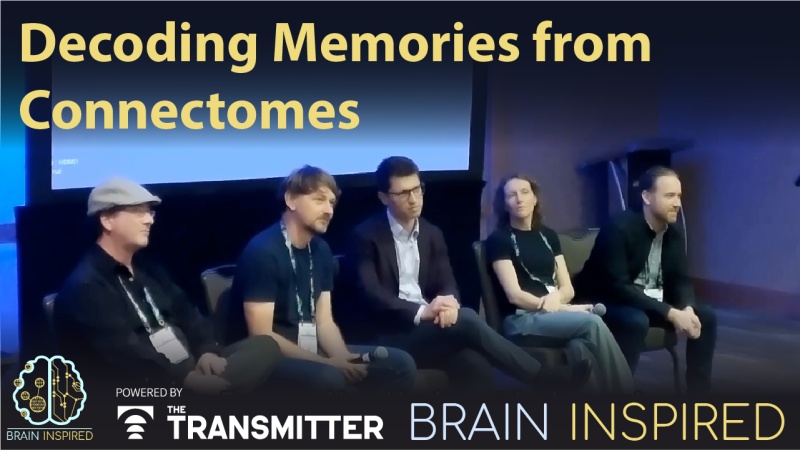 BI 227 Decoding Memories: Aspirational Neuroscience 2025 17.12.2025 1h 15minSupport the show to get full episodes, full archive, and join the Discord community. The Transmitter is an online publication that aims to deliver useful information, insights and tools to build bridges across neuroscience and advance research. Visit thetransmitter.org to explore the latest neuroscience news and perspectives, written by journalists and scientists. Read more about our partnership. Sign up for Brain Inspired email alerts to be notified every time a new Brain Inspired episode is released. To explore more neuroscience news and perspectives, visit thetransmitter.org. Can you look at all the synaptic connections of a brain, and tell me one nontrivial memory from the organism that has that brain? If so, you shall win the $100,000 prize from the Aspirational Neuroscience group. I was recently invited for the second time to chair a panel of experts to discuss that question and all the issues around that question - how to decode a non-trivial memory from a static map of synaptic connectivity. Before I play that recording, let me set the stage a bit more. Aspirational Neuroscience is a community of neuroscientists run by Kenneth Hayworth, with the goal, from their website, to "balance aspirational thinking with respect to the long-term implications of a successful neuroscience with practical realism about our current state of ignorance and knowledge." One of those aspirations is to decoding things - memories, learned behaviors, and so on - from static connectomes. They hold satellite events at the SfN conference, and invite experts in connectomics from academia and from industry to share their thoughts and progress that might advance that goal. In this panel discussion, we touch on multiple relevant topics. One question is what is the right experimental design or designs that would answer whether we are decoding memory - what is a benchmark in various model organisms, and for various theoretical frameworks? We discuss some of the obstacles in the way, both technologically and conceptually. Like the fact that proofreading connectome connections - manually verifying and editing them - is a giant bottleneck, or like the very definition of memory, what counts as a memory, let alone a "nontrivial" memory, and so on. And they take lots of questions from the audience as well. I apologize the audio is not crystal clear in this recording. I did my best to clean it up, and I take full blame for not setting up my audio recorder to capture the best sound. So, if you are a listener, I'd encourage you to check out the video version, which also has subtitles throughout for when the language isn't clear. Anyway, this is a fun and smart group of people, and I look forward to another one next year I hope. The last time I did this was episode 180, BI 180, which I link to in the show notes. Before that I had on Ken Hayworth, whom I mentioned runs Aspirational Neuroscience, and Randal Koene, who is on the panel this time. They were on to talk about the future possibility of uploading minds to computers based on connectomes. That was episode 103. Aspirational Neuroscience Panel Michał [email protected] Research scientist (connectomics) with Google Research, automated neural tracing expert Sven Dorkenwald @sdorkenw.bsky.social Research fellow at the Allen Institute, first-author on first full Drosophila connectome paper Helene [email protected] Group leader at Ernst Strungmann Institute, hippocampus connectome & EM expert Andrew Payne @andrewcpayne.bsky.social Founder of E11 Bio, expansion microscopy & viral tracing expert Randal Koene Founder of the Carboncopies Foundation, computational neuroscientist dedicated to the problem of brain emulation. Related episodes: BI 103 Randal Koene and Ken Hayworth: The Road to Mind Uploading BI 180 Panel Discussion: Long-term Memory Encoding and Connectome Decoding
Podobni podkasti


Priljubljen v
Ta podkast je tudi v lestvicah podkastov teh držav.


