
BEAM There, Done That
Plangora
0
BEAM There, Done That is a podcast about building real systems with Elixir, Erlang, and the BEAM. Each episode dives into practical lessons from shipping software on the BEAM: architecture decisions, scaling challenges, operational failures, and the patterns that actually work. No hype, just hard-won experience from engineers who've been there.
Epizode
-
 Is Your Elixir Code Actually Fast? Tobias Pfeiffer on Benchmarking 18.09.2026 1h 11minEveryone has an opinion about whether the BEAM is fast or slow. Almost nobody has actually measured it properly.Tobias Pfeiffer -PragTob on the internet, benchmarking nerd, real-time engineer at Supabase -came to Elixir from Ruby because Ruby couldn't handle WebSockets at scale. Then he learned the language the way he learns every language: by building a benchmarking library. Ten years later, Benchee is what most of the Erlang and Elixir world reaches for when it wants a number instead of an argument.Topics include:why Tobias writes a benchmarking library every time he learns a new language -and what that discipline actually teaches about how a runtime worksthe production scar: a benchmark that showed one query was faster, deployed it, and discovered the benchmark had been measuring the wrong input entirelythe single most important insight about benchmarking: most people quietly fool themselves and walk away more confident and more wrong than when they startedinputs as a first-class feature -the lesson José Valim taught Tobias within 17 minutes of an open GitHub issuewhy body-recursive map is faster than tail-recursive map for small lists on the BEAM -and what that tells you about the runtimewhat reductions are, why they're a more stable measurement than wall time, and when they divergehow Benchee measures memory: spawning a monitored process, watching GC events, reporting exact bytes -and why deterministic code gives deterministic memorythe JSON benchmarking arms race -built-in OTP JSON, jason, Jiffy, and why comparison benchmarks usually miss the pointwhy Benchee has no macros, no DSL, and deliberately only uses functions -and why that design decision made it composable in ways nobody predictedthe hardest benchmarking mistake to stop making: confusing latency and throughputwhat Toby wishes more Elixir developers understood about BEAM performance before they opened a PR claiming something was fasterRecorded August 21, 2026.Resources mentioned:Benchee on Hex: hex.pm/packages/bencheeBenchee HTML formatter -self-contained HTML output with downloadable graphsBenchee markdown formatterPragTob on GitHub: github.com/bencheeorg
 -
 Louis Pilfold on Building Gleam - Static Types on the BEAM 11.09.2026 1h 11minWhat if the BEAM had a language that felt like talking to a friend instead of fighting a compiler?That's the problem Louis Pilfold set out to solve. He loved the BEAM. He missed static types. Every other option was a tradeoff he couldn't live with. So he built Gleam - and after years of quietly saying no to everything he wasn't sure about, it's gathered a community, found production users, and now runs on servers, browsers, and $2 microcontrollers.Topics include:why every successful language is born from a problem - and what specific frustration made Louis start building rather than just complainingthe discipline of saying no: no if, no currying, no pretending two targets are one worldthe design decision Louis regrets most - the conditional compilation syntax he's now stuck with and desperately doesn't want more people to usewhy Gleam's concurrency model lives in a library rather than the language - and what that buys in terms of flexibility when smarter people eventually improve ithow Gleam solved the problem everyone said was unsolvable: "you can't type message passing on the BEAM"what the JavaScript and BEAM targets share and where they genuinely can't be unified - and why pretending they can leads to terrible architecturewhy Gleam chose Erlang records as its data structure and what that costs at runtimeLustre, Gleam's web framework - beating mainstream JavaScript frameworks in benchmarks while written entirely in Gleamhow Louis funds his work on Gleam: GitHub Sponsors, the Gleam community, and what sustainable open source actually looks like from the insidewhat Gleam will look like in 3–5 years - native records, better JavaScript interop, and why the language's approach to stability makes those changes possibleRecorded August 20, 2026.Resources mentioned:gleam.run - docs, tour, communitytour.gleam.run - interactive language tour running the Gleam compiler compiled to Wasm, takes an afternoonExercism Gleam trackCode Crafters - build Redis/SQLite/Git in GleamGitHub Sponsors: lpil (Louis Pilfold)Lustre - Gleam's web framework
 -
 How WhatsApp Fixed Erlang's Tooling Problem | Roberto Aloi & Michał Muskała 04.09.2026 36minPart one established that Erlang scales. Part two is about what comes after - keeping a codebase that large healthy for years, when most engineers arrive having never written Erlang before.WhatsApp's answer was to invest in the language itself. The formatter, the language server, the type checker. And then to open source almost all of it back to the community - not as charity, but because diverse use cases and external bug reports make the tools better.Roberto Aloi and Michał Muskała are back for the half that doesn't appear on conference posters.Topics include:why the investment in tooling came from a developer survey rather than an engineering instinct - the data showed Erlang developer experience was the weak pointwhat ELP (the Erlang Language Platform) actually is and how it superseded the Erlang LS that Roberto built before joining WhatsApphow eqWAlizer, WhatsApp's type checker, was rolled out without breaking other teams - the team owning the type checker also owned the task of fixing things up when new checks introduced errorswhy types and let it crash aren't in tension: you can never statically verify everything in a dynamic language, so the gap is where supervision and recovery fitthe two biggest misconceptions about static analysis tools: that they're slow (modern tooling is fast) and that you have to commit to them all at once (you can do it incrementally)why WhatsApp open sources tools that took significant engineering investment - keeping them internal would make them worse, not betterwhat's still unsolved: exhaustiveness checks at this scale remain an open problemhow AI is changing the Erlang learning experience - build first, ask AI to review your patterns afterwardthe word that ties both episodes together: trust. Supervision earns it at runtime. Types earn it at compile time.Companion episode: Part 1 on scale and operations.Recorded June 25, 2026.
 -
 Inside WhatsApp with Roberto Aloi & Michał Muskała 28.08.2026 34minEveryone quotes WhatsApp when the topic of Erlang and scale comes up. Fewer people know what it actually looks like from the inside - what was hard, what was never hard, and what the team spent their time on once the concurrency stopped being the problem.Roberto Aloi and Michał Muskała work on the team keeping it running. This is the first of two episodes with them.Topics include:what Roberto's first Erlang moment was - implementing a GenServer for a robot at university and learning binary pattern matching felt like cheatingwhy Michał came to Erlang backwards, from Elixir, and what the tooling gap actually felt likethe column numbers OTP bug that caused cascading failures and taught Roberto what no documentation couldthe optimization that made the JSON Unicode parser slower - binary pattern matching was the wrong tool, and a custom state machine was fasterwhat "let it crash" actually means at WhatsApp scale: letting it crash is the easy part, recovery is where the engineering liveswhy the 30th employee was the first person at WhatsApp with Erlang experience - and what that means for hiringthe most misunderstood thing about Erlang at WhatsApp: scaling isn't the exotic part, keeping the codebase healthy ishow WhatsApp does deployments: 1% of servers first, one region next, monitoring throughout, ready to roll backwhat types of failures become normal at this scale - and why disaster recovery drills are a regular practiceoverly dynamic code as the anti-pattern that creates the most sustained painPart two covers ELP, Equalizer, and the tooling that keeps a codebase this large navigable. You want both.Recorded June 25, 2026.
 -
 Erlang on a Microcontroller: Davide Bettio & Paul Guyot on AtomVM 21.08.2026 54minIn 1952, Marvin Minsky and Claude Shannon built a box with a single switch. When you flip it, the only thing it does is reach out and switch itself back off. Seventy years later, 5,000 of those boxes are sitting on desks worldwide — and the thing making them tick is Erlang, running on a chip smaller than a fingernail.Davide Bettio built AtomVM, the virtual machine that makes this possible. Paul Guyot wrote the Erlang firmware, added SMP support as a weekend project, and shipped 5,000 units.Topics include:what AtomVM is — a from-scratch BEAM-compatible VM for microcontrollers with a few hundred kilobytes of RAM and no OSdebugging a virtual machine with no stack traces: printf everywhere, blindfoldedthe first production batch with a 5–10% return rate that turned out to be a mechanical problem — after Paul rewrote half the software looking for a bug that wasn't therewhy the actor model, let it crash, and binary pattern matching are unusually well-suited to embedded deviceswhat AtomVM actually supports: GenServer, maps, JSON, Erlang distribution, and via the Popcorn project — Phoenix LiveView on a microcontrollerPaul's SMP implementation as a "mixed blessing" — added for purely selfish engineering reasons, then forced the whole team to rewrite their driverswhere AtomVM differs from the BEAM: no dirty schedulers, no hot code unloading, a simpler scheduler model that mostly doesn't surface at the API levelRecorded June 24, 2026.Resources mentioned:atomvm.netGitHub: atomvm/AtomVMPopcorn project — Phoenix LiveView on AtomVMDiscord: AtomVM community
 -
 Mat Trudel on Building Bandit - the Web Server Running Your Phoenix App 14.08.2026 1h 19minBandit quietly became the default web server in Phoenix. Mat Trudel wrote it by hand, in pure Elixir, as a side project - and kept it that way even as AI changed how everyone else writes code.This episode goes two places at once: the engineering of a foundational piece of infrastructure most developers never think about, and an honest conversation about what it means to keep building something by hand when you don't have to.Topics include:how a six-month debugging session - Wireshark, a 30-page RFC, and a single misread line in the HPACK spec - explains why HTTP is genuinely hard to get rightwhat "one process per connection" actually buys you at 3am when something's on fire: a stack trace that's entirely Elixir frames, all the way upwhy HTTP parsers have a million attack vectors that have nothing to do with which language you write them inthe WebSock and WebSock Adapter split - and why a web server depending on another web server is ridiculoushow José Valim looked at Mat's first WebSocket implementation and told him he was doing too muchan AI-generated PR sitting open on the Bandit repo that implements the entire HTTP/3 stack - and why Mat hasn't merged itwhy Mat still writes Bandit entirely by hand while using agents for everything in his day jobthe cabinet maker's son analogy that explains the whole thing: if you want cabinets, go to IKEA; if you want to build them, the journey is the pointwhat it means when "finding bugs got cheap but judging and fixing them didn't"Companion episode: Peter Ulrich and Jonathan Machin on CVEs and security - the same story from the reporting side.Recorded June 22, 2026.Bandit quietly became the default web server in Phoenix. Mat Trudel wrote it by hand, in pure Elixir, as a side project - and kept it that way even as AI changed how everyone else writes code.This episode goes two places at once: the engineering of a foundational piece of infrastructure most developers never think about, and an honest conversation about what it means to keep building something by hand when you don't have to.Topics include:how a six-month debugging session - Wireshark, a 30-page RFC, and a single misread line in the HPACK spec - explains why HTTP is genuinely hard to get rightwhat "one process per connection" actually buys you at 3am when something's on fire: a stack trace that's entirely Elixir frames, all the way upwhy HTTP parsers have a million attack vectors that have nothing to do with which language you write them inthe WebSock and WebSock Adapter split - and why a web server depending on another web server is ridiculoushow José Valim looked at Mat's first WebSocket implementation and told him he was doing too muchan AI-generated PR sitting open on the Bandit repo that implements the entire HTTP/3 stack - and why Mat hasn't merged itwhy Mat still writes Bandit entirely by hand while using agents for everything in his day jobthe cabinet maker's son analogy that explains the whole thing: if you want cabinets, go to IKEA; if you want to build them, the journey is the pointwhat it means when "finding bugs got cheap but judging and fixing them didn't"Companion episode: Peter Ulrich and Jonathan Machin on CVEs and security - the same story from the reporting side.Recorded June 22, 2026.
 -
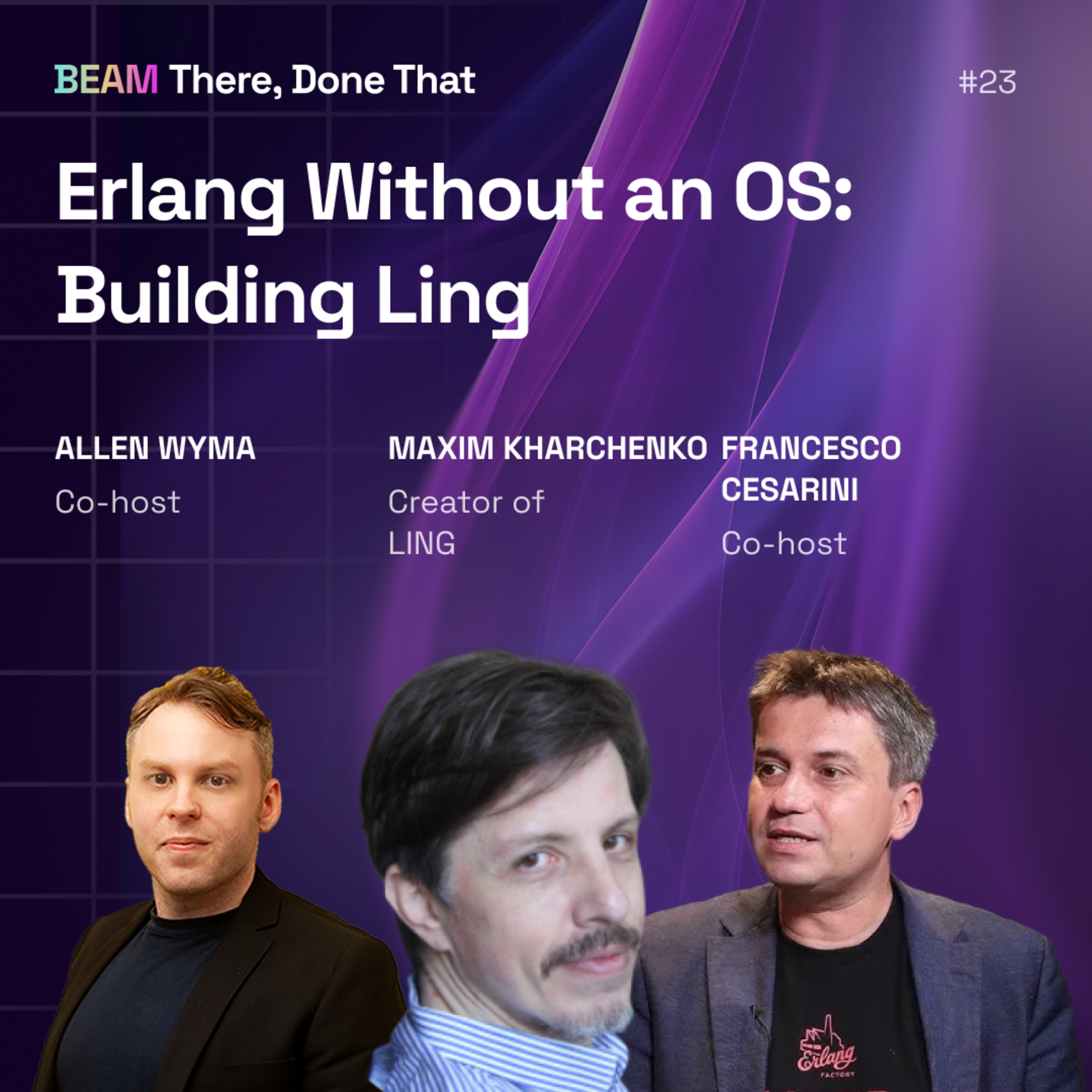 Erlang Without an OS: Maxim Kharchenko on Building LING 07.08.2026 1h 3minBooting OTP without a Linux kernel underneath it. Running Erlang directly on a Xen hypervisor. Implementing a VM where every single out-of-memory condition is explicitly handled — not a single allocation without a recovery path.Maxim Kharchenko spent five to eight years building Ling, a from-scratch Erlang runtime that runs without an operating system. Not a fork of the BEAM. Not a modification. A clean implementation, built to answer one question: can you run a system that never stops?Francesco Cesarini joins Alan Wyma for this episode — he was there when it was built, running the Erlang Solutions team that worked on the other half of the project.Topics include:how Maxim came to Erlang backwards — building his own isolation-based runtime first, then discovering Erlang had already solved the same problemswhat a Xen hypervisor actually is and why it's the right host for a no-OS Erlang VMhow Ling's dynamic instruction set works: analyzing real OTP source code to figure out the optimal instruction set for that specific workload, then generating specialized opcodes — including one that loads the number 17 specifically because 17 appeared frequently enough to warrant itwhy every single memory allocation in Ling has an explicit out-of-memory handler — and how hard that discipline was to maintainthe garbage collector design for bare-metal network applications and why it matters differently there than in regular BEAM workloadsrunning the entire network as an Erlang application: not just a piece of it, but switch firmware, controller, and the full stackwhy the industry was not ready for this ten years ago — and why the problems Ling was solving have come back under different nameswhere unikernels and Linux eBPF fit in the same space todayRecorded June 3, 2026.
 -
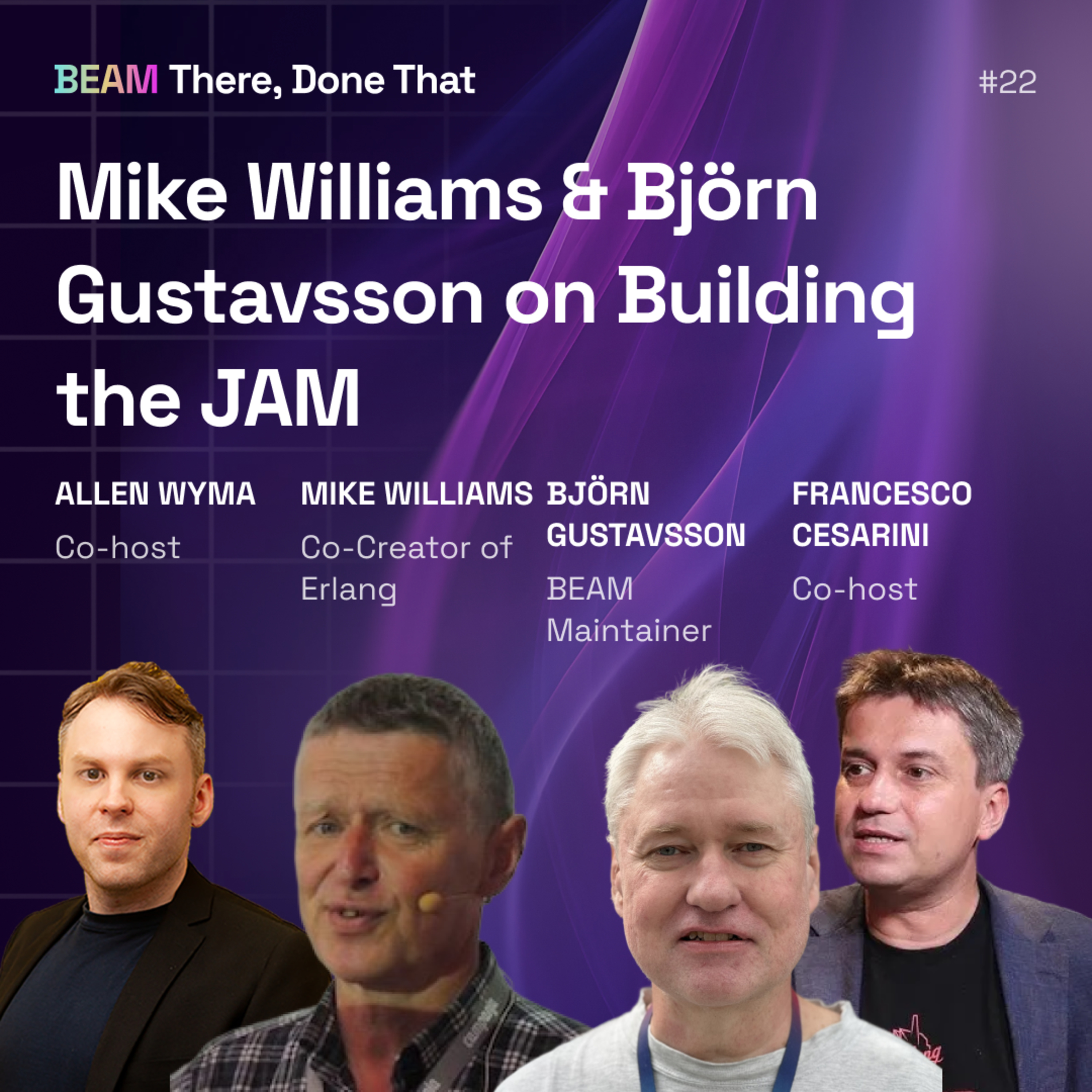 Mike Williams & Björn Gustavsson on Building the JAM 31.07.2026 42minBefore the BEAM, there was the JAM - Joe's Abstract Machine. It was the first virtual machine that made Erlang fast enough to run in production, and it was built by a handful of people at Ericsson's computer science lab who had a mandate to do whatever they wanted.Mike Williams wrote large parts of the emulator. Björn Gustavsson inherited it in 1996 and built what came after. In this episode - the most historically significant we've recorded - Alan Wyma and Francesco Cesarini bring them both together to tell the story of where the BEAM actually came from.Topics include:why Mike looked at Joe Armstrong's first 20 lines of C and said "this is awful, I'll do something about it" - and how he got message passing down to six instructionsthe three numbers that decide whether a concurrent language lives or dies: process creation time, context switch time, and message copy time - and why 70% of VM time was spent on them, not application codewhy keeping concurrency inside the language rather than the OS was "perfectly obvious" to Mike, and why it was a minority view even then - Java removed green threads, early Rust removed lightweight processesthe two-version rule for module hot loading that's still in the BEAM today, 30 years on - and why Björn never wanted to remove itmemory as the binding constraint, not speed: phone switches handling whole cities ran on 16–64 MB of RAMhow distribution was added to the JAM by Claes Wikström - the person whose name is always forgotten in this story, who also invented ETS tables and created the first prototype of Erlang's binary syntaxwhat Björn saw when he first read Mike's code in 1996, why he liked the JAM more than the BEAM at first, and what finally made the JAM obsoletethe computer science lab culture that made Erlang possible: no publish-or-perish pressure, just a mandate to solve a real problemRecorded June 4, 2026.Resources mentioned:"History of Programming Languages" paper, Joe Armstrong (HOPL III)Bjarne Däcker's licentiate thesisEarly Erlang CS lab technical reports (ERN series)
 -
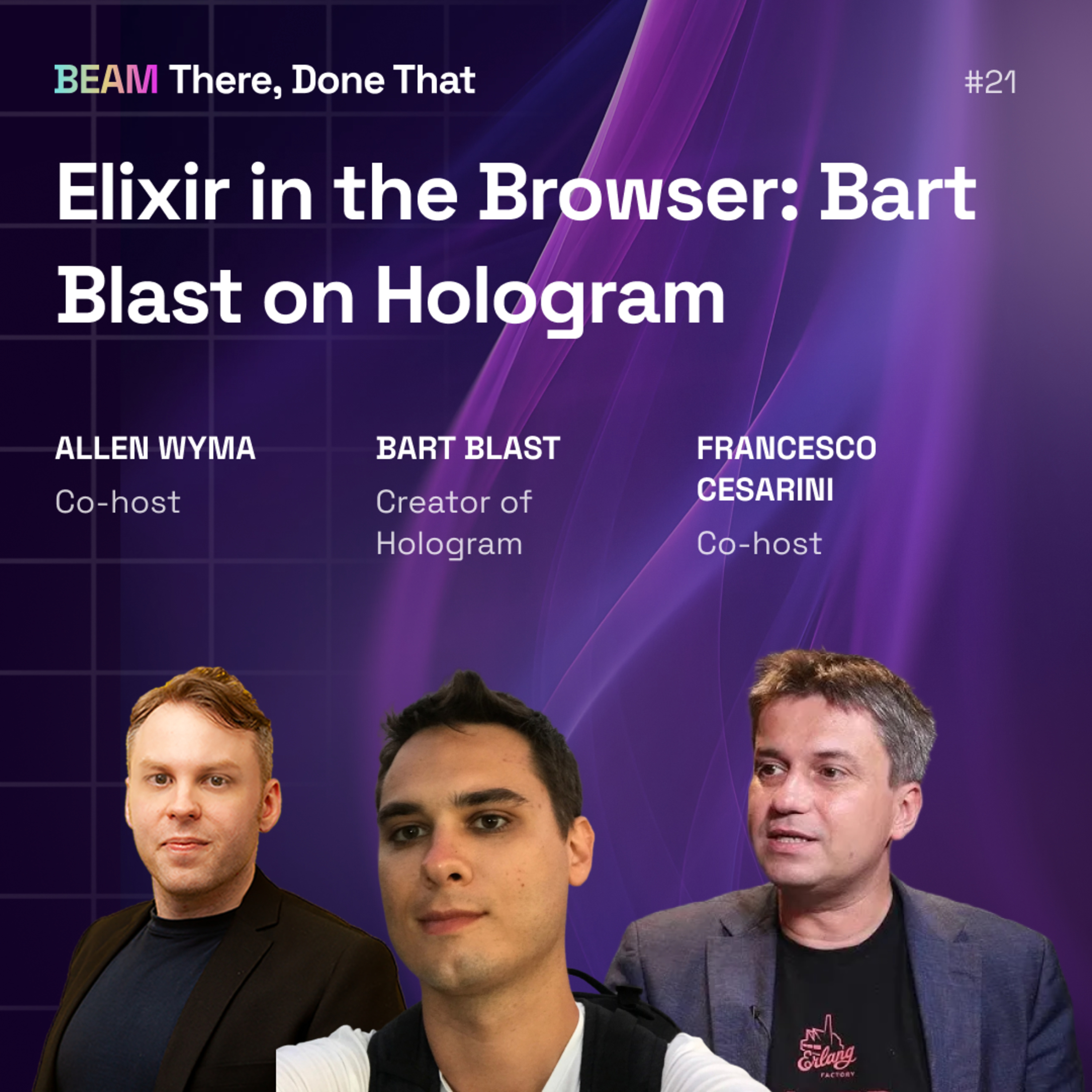 Elixir in the Browser: Bart Blast on Hologram 24.07.2026 45minWhat if instead of making your server smarter to handle the browser, you just ran your Elixir in the browser instead?That's the bet Bart Blast has been making for six years - three of them full time. Hologram is a full-stack web framework that compiles Elixir to JavaScript and rebuilds the Erlang runtime in the browser: pattern matching engine, OTP guarantees, boxed types, all of it. No JavaScript to write. No round trip on every interaction. No inconsistent state between client and server.This is the fourth episode in the podcast's ongoing series on where state should live - following Chris McCord on durable servers, Adi Iyengar on building a web framework, and Brooklyn Zelenka and Robert Virding on local-first. Bart made the opposite bet to Live View.Topics include:why Bart spent six years building this instead of reaching for existing tools - and why the answer is "plain frustration"the latency ceiling you can't engineer past on the server, and why bandwidth improvements don't helphow Hologram actually works: pulling the expanded AST from compiled BEAM files, normalizing it, lowering to an IR, and encoding to a JS runtime - including a real pattern matching engine and boxed typeswhy Hologram doesn't merge front end and back end - there's still a clear separation, just one language crossing itactions vs. commands: the two behavior primitives and which side of the client/server boundary each lives onwhere Live View wins over Hologram - and Bart is honest about this (private logic, data-heavy apps, maturity)how Hologram compares to Luster (Gleam's equivalent) and why neither is competing with the otherwhen you should not use Hologram yetwhere it's all heading: local-first sync layer, mobile, desktop, and eventually a single Elixir codebase for everythingRecorded June 18, 2026.Resources mentioned:hologram.pagehologram.page/newsletterGitHub: barb/hologramDiscord: hologram communityHologram tag on Elixir ForumWebsite: https://hologram.pageGitHub: https://github.com/bartblast/hologramNewsletter: https://hologram.page/newsletterDiscord: https://discord.com/invite/huJWNuqt8JElixir Forum: https://elixirforum.com/hologramX: https://x.com/Bart_BlastLinkedIn: https://www.linkedin.com/in/bartblast/Bluesky: https://bsky.app/profile/bartblast.comSlack: https://elixir-lang.slack.com/channels/hologram
 -
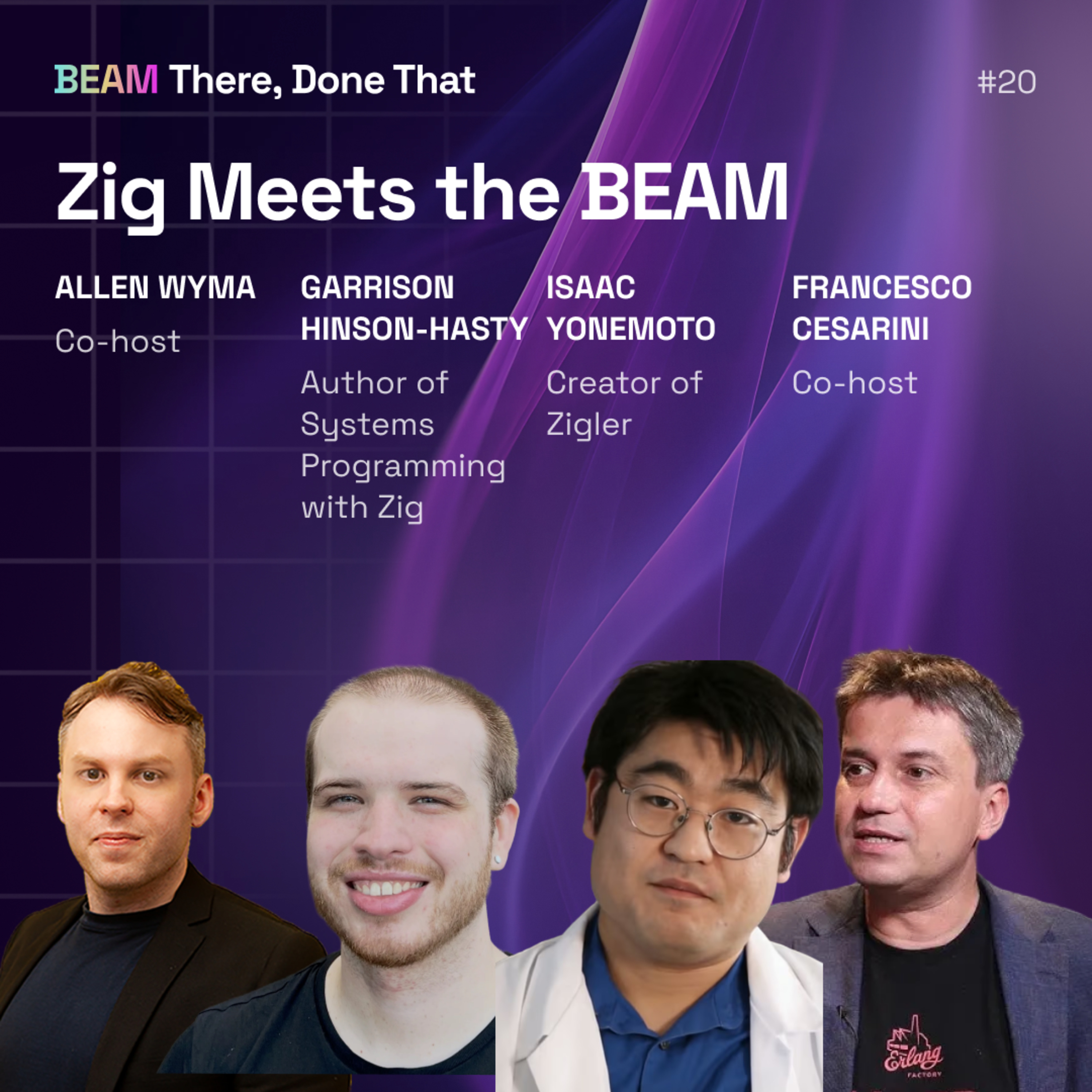 Zig Meets the BEAM: Garrison Hinson-Hasty & Isaac Yonemoto on Safer Native Code 17.07.2026 1h 2minEveryone who's ever written a C NIF for the BEAM knows the story. You have a bottleneck, you reach for native code, it works - until one day it doesn't, and instead of a process crashing, the whole node goes down. A segfault in a NIF takes the entire BEAM with it, bypassing every fault-tolerance guarantee OTP was designed to provide.This episode asks a simple question: do we have to accept that? The answer, increasingly, is no.Allen Wyma and Francesco Cesarini sit down with Garrison Hinson-Hasty, author of Systems Programming with Zig, and Isaac Yonemoto, creator of Zigler - the library that lets you write Zig directly inside Elixir and Erlang modules, with automatic marshalling, scheduler-aware execution modes, and memory tracking that's visible to the BEAM itself.This is part of the podcast's ongoing "right tool for the job" series, following earlier episodes on Rust and native code.Topics include:what Zig is and why it exists - C's simplicity and zero-cost abstractions, without C's footgunshow Zig compares to both C and Rust: where it wins, where it loses, and why they're solving different problemswhy Zig's allocator model is unusually well-suited for BEAM integration - and what it means that Zigler uses the BEAM's own allocator by default, making native memory visible to Erlang's VMhow Zigler works: write Zig in a sigil inside your Elixir module, and the marshalling between BEAM terms and native types is handled automatically at function call boundariesthe four execution modes Zigler gives you - normal, dirty CPU, dirty IO, spawned thread - and how to pick one without changing a single line of your Zig codethe honest answer to the question every BEAM developer wants to ask: can a Zigler NIF still crash the whole node? (Yes. Isaac explains exactly when and why, and what Zig's spatial memory safety actually buys you)why Zig has no hidden control flow and no lexical macros, and why that matters when you're debugging something at the boundary between two runtimeswhere Zig's async story currently stands, and what that means for Zigler's roadmapIsaac's unusual professional position: CEO of a pharma startup who is also writing the software stack for his own lab in Zig and ElixirRecorded June 9, 2026.Resources mentioned:Systems Programming with Zig by Garrison Hinson-HastyZigler on Hex and GitHubZigler docs
 -
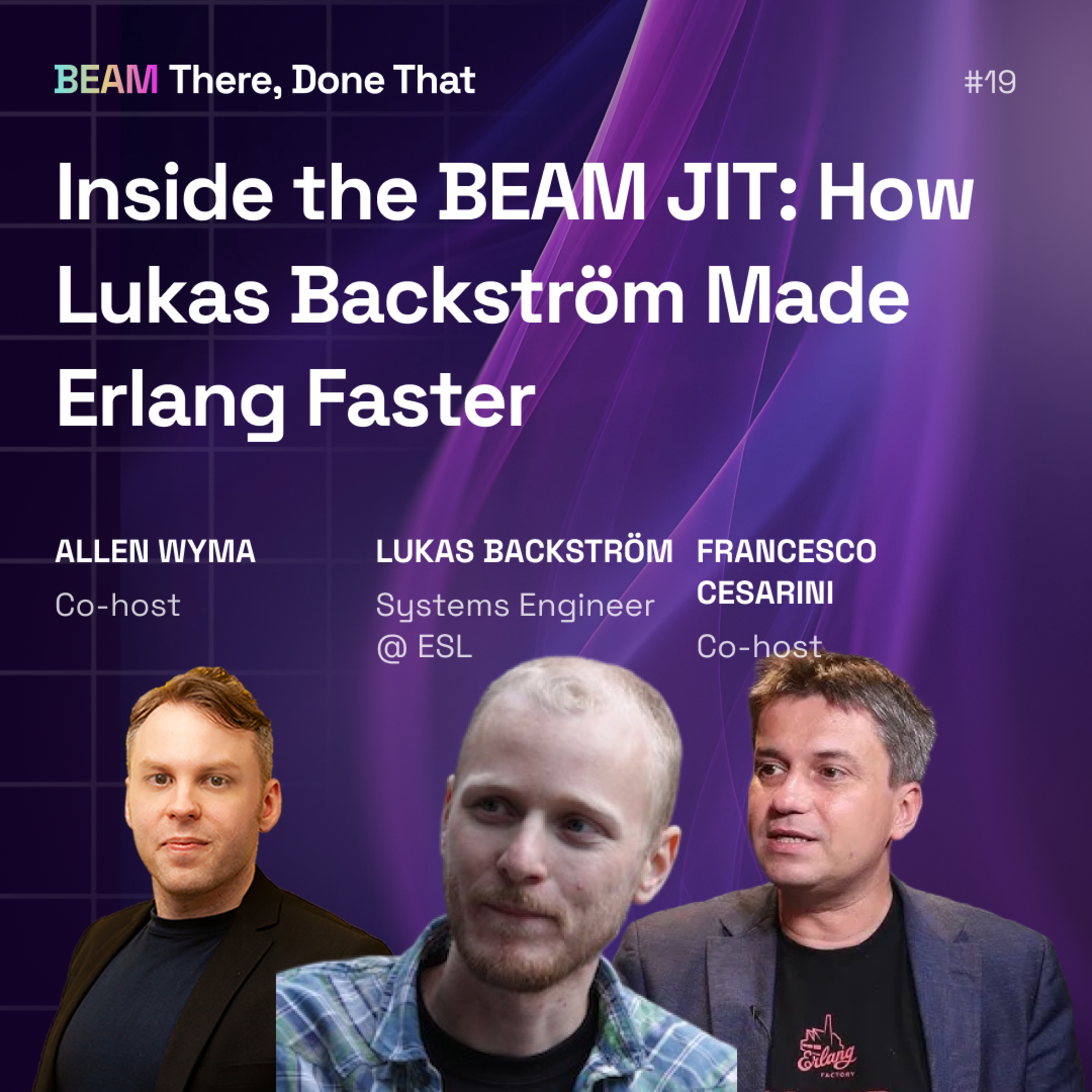 Inside the BEAM JIT: How Lukas Backström Made Erlang Faster 10.07.2026 1h 1minIn 2021, Erlang got something it had been promised for years: a Just-In-Time compiler. The person who built the first working prototype, spent years on failed experiments before it, and quietly shipped it to every Erlang and Elixir system on the planet is Lukas Backström — OTP team member since 2009, Francesco Cesarini's former student, and one of the most consequential engineers in the ecosystem that most people have never heard of.In this episode, Alan Wyma and Francesco Cesarini sit down with Lucas for a deep dive into how the BEAM JIT actually works, what it took to get there, and where it's heading next.Topics include:the difference between interpreter, ahead-of-time compilation, and JIT — and why the BEAM's threaded code interpreter was already unusually fastwhy tracing JITs — the first several approaches Lucas's team tried — worked great on microbenchmarks but failed on real Erlang code, which is highly branchy and unpredictablethe key insight that killed LLVM: faster code generation with AsmJIT was worth more than LLVM's optimizations, once you account for startup timehow the template JIT design — copy-pasting assembly from templates into memory, then specializing a few bits — became the architecture that shippedwhy WhatsApp was running the JIT from the tip of master the day it was released, nine months before the official OTP 24 taghow type-guided optimizations now flow from the Erlang compiler into the JIT — and why a simple integer add can now compile to a single assembly instructionthe Apple M1 announcement that changed the release timeline and forced ARM64 support a year ahead of schedulewhat's actually left to do: smarter code loading, better startup time, and the native records implementation touching every layer of the systemwhy the BEAM JIT is one of the simpler JITs you could read — and how to inspect the assembly it generates for your own codeRecorded May 27, 2026.
 -
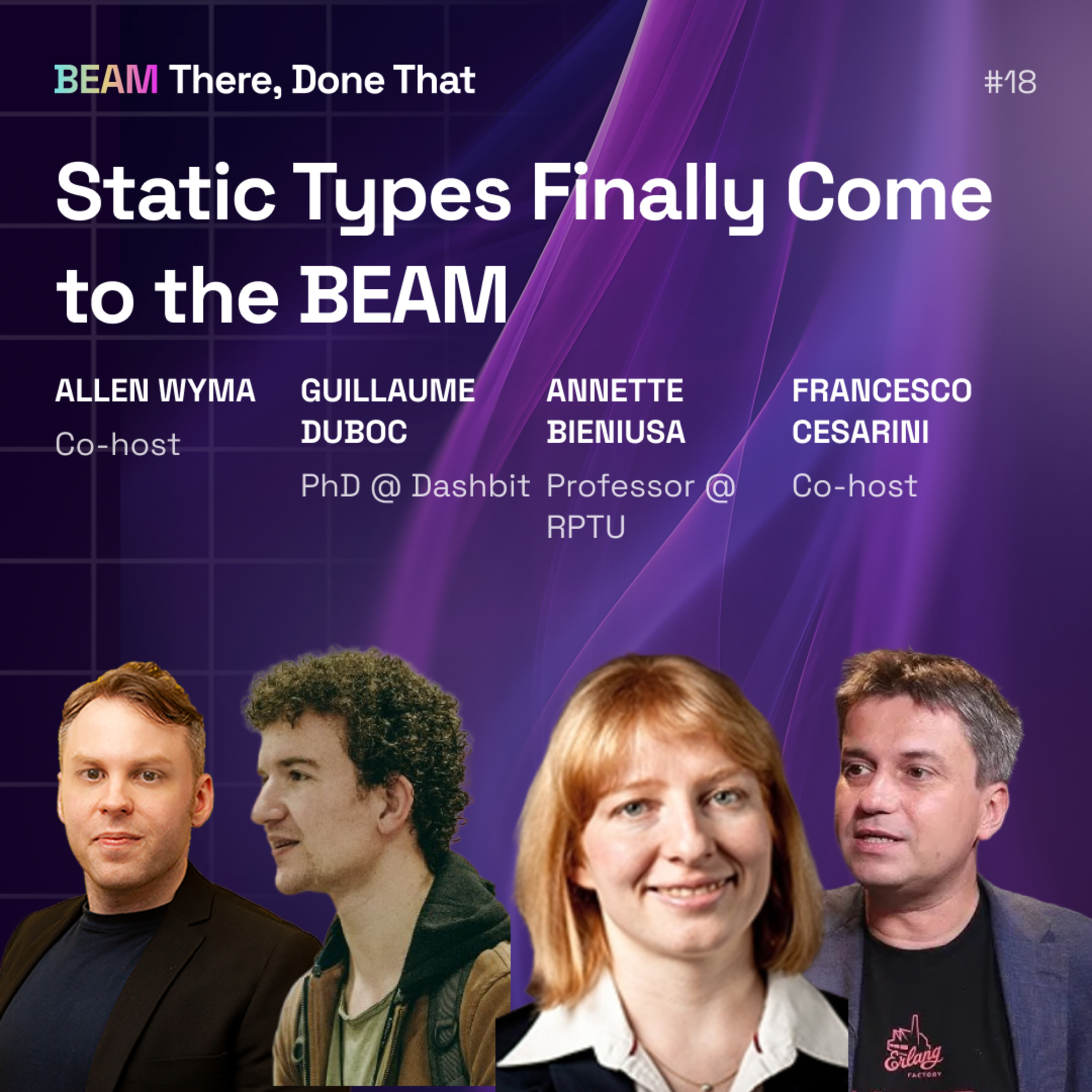 Static Types Finally Come to the BEAM | Annette Bieniusa & Guillaume Duboc 03.07.2026 1h 3minJoe Armstrong once said anyone can write a type system covering 90% of Erlang — it's the remaining 10% that defeats even the brightest minds in computer science. He was referring to Philip Wadler. That was 1995. Thirty years later, the BEAM is finally converging on an answer.In this episode, Alan Wyma and Francesco Cesarini sit down with Annette Bieniusa, professor of software technology at RPTU Germany, and Guillaume Dubois, PhD from IRIF Paris now at Dashbit, to dig into what it actually takes to bring static types to Erlang and Elixir — and why it took this long.Topics include:why every serious attempt at typing Erlang since 1995 — soft types, subtyping, Dialyzer — ran into the same wall, and what's genuinely different nowwhat set-theoretic types are and why they're the foundation Elixir 1.2's type system is built onhow Elixir's gradual type system differs fundamentally from TypeScript or Python's approach — and why baking dynamic in from the start changes everythingwhy the BEAM ran telecoms for 25 years without static types, and what problems types are now actually solvingthe risk nobody talks about: developers getting lulled into false confidence by type checking, writing fewer supervision trees and less defensive codehow Annette's parallel etalizer for Erlang and Guillaume's Elixir work share the same theoretical foundation but make different design choiceswhy "type systems don't mean error-free" — and what types actually buy you on the BEAM specificallywhat Elixir 1.2 ships, what's still being worked on, and the one thing you can do this weekRecorded May 28, 2026.
 -
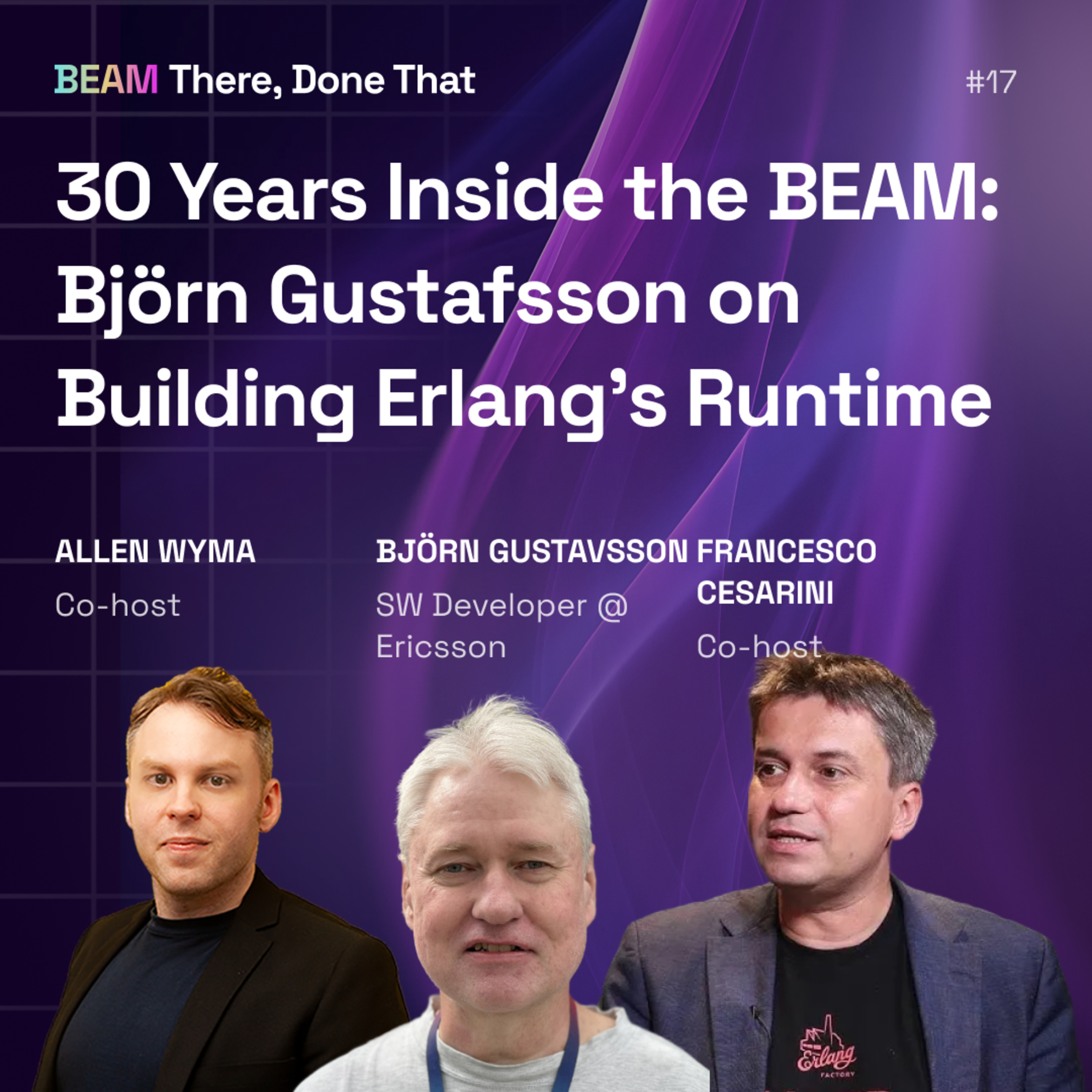 30 Years Inside the BEAM: Björn Gustafsson on Building Erlang's Runtime 26.06.2026 53minThree engineers. Three different virtual machines. One conversation that started with the JAM and ends with the JIT compiler.Allen Wyma and Francesco Cesarini sit down again with Björn Gustafsson — member of the OTP team since 1996, and the person who has personally shepherded the BEAM through every major transition since taking it over from Bogdan Wódzicki — for a deep dive into 30 years of runtime engineering.Topics include:the three competing virtual machines built in parallel at Ericsson's lab — JAM, Robert Virding's V, and Bogdan's BEAM — and why each one's design choices succeeded or faileda compiler bug that caused random crashes and took weeks to find — and the BEAM Validator that was built specifically so it could never happen againwhy "turbo Erlang" compiled-to-C delivered a 10-20x sequential speedup on paper that shrank to 2x once concurrency entered the picture, and why that mattered for chip designthe BEAM loader — Björn's own invention, still in use today — and why decoupling the compiler from hand-written runtime translation matteredhow Björn took over Bogdan's code in 1997 and turned a research prototype into a 30-year production runtime without ever breaking backward compatibilitywhat's coming next: the JIT compiler (next episode), type systems, and a possible episode on the historical and emerging Erlang machines-record(history, { jam, v, turbo_erlang, beam }).If you care about language runtimes, VM design, or how production systems survive three decades of evolution without ever stopping, this episode is for you.Recorded May 26, 2026.
 -
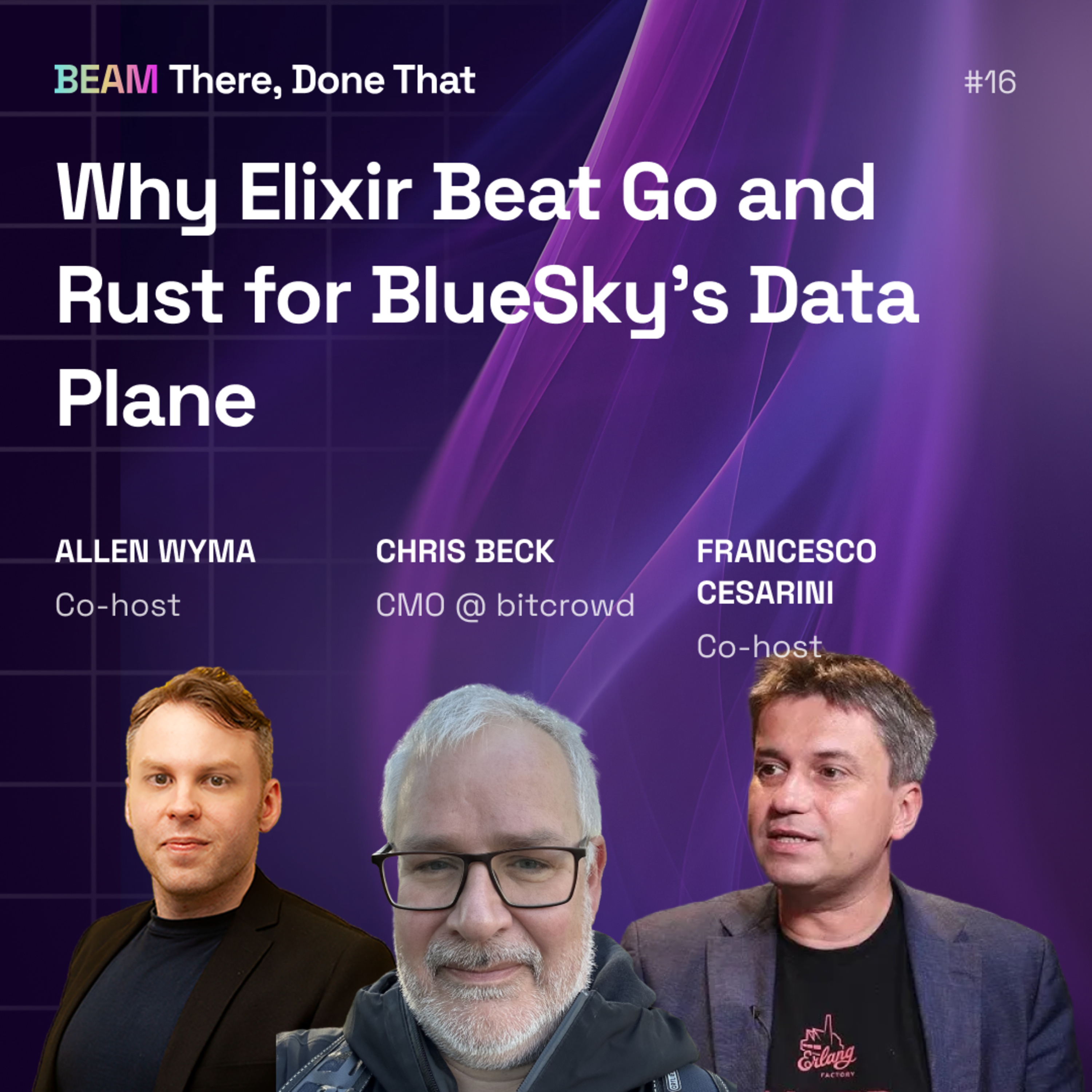 Why Elixir Beat Go and Rust for BlueSky's Data Plane | Chris Beck 19.06.2026 40minThere's a gap between BlueSky's open reference implementation (handles a few hundred thousand users) and BlueSky's own production system (handles millions, but runs on infrastructure most teams can't replicate). Chris Beck and his team at Bitcrowd set out to close it -and ended up somewhere they didn't expect.In this episode, Allen Wyma and Francesco Cesarini talk to Chris Beck, founder of Bitcrowd in Berlin, about building an open source alternative to BlueSky's data plane -the component that turns the AT Protocol firehose into the timeline you actually scroll through.This is the third episode in our "right tool for the job" series, following Rust and Zig.Topics include:what the AT Protocol actually is, and why it's closer to an "operating system for social apps" than a single productwhy BlueSky's own production solution (similar to Discord's MongoDB → Cassandra → ScyllaDB journey) is out of reach for smaller communitiesthe real numbers: 200-500 messages/second on a normal day, 6 million active users during the November 2024 US electionthe hot path vs. cold path split that shaped the entire architecturewhy Go, Rust, and Node were all evaluated and rejected -including why Node's single-threaded event loop was already a dead end for the BlueSky team themselveswhy Elixir wasn't the expected choice, and what ETS gave them for free that they'd have had to hand-build everywhere elseusing a Rust NIF via Rustler for roaring bitmaps to solve the "social proof" (mutual follows) feature -and what that NIF actually costs in terms of crash isolationwhy losing almost every microbenchmark didn't matter once they asked "do we actually need to go there?"the fan-out architecture that pushes messages directly into user mailboxes, and why that made backpressure a non-issuewhat's left to build, and the one sentence Chris wants every team picking a stack to rememberRecorded June 15, 2026.
 -
 Why Multiplayer Games Are Just Distributed Systems | Ellyse Cedeno on BEAM & the Actor Model 12.06.2026 1h 6minEvery player is a process. Every monster is a process. Every zone is a process. Sound familiar?In this episode, Allen Wyma and Francesco Cesarini sit down with Ellyse Cedeno - technology and product leader with 25+ years across online games, distributed systems, and real-time platforms - to explore why the BEAM and the actor model are a natural fit for multiplayer game servers, and why the games industry keeps learning this the hard way.Topics include:why MMORPGs and telecom systems have more in common than most people realizethe N-squared problem: why high player density is so expensive and how classic games solved itwhy Java threads and deadlocks were the original game server nightmarehow the actor model eliminates lock management - and what that means for mob AIevent-sourced vs tick-based architecture and when each makes sensezones, sharding, and the air traffic control analogy for seamless server handoffsbuilding a NetHack-style multiplayer game in LiveView - and what the DOM diffing taught her about game statewhy the games industry is dominated by C++ and Unreal, and what it would take to change thatusing player behavior analytics to catch bugs before ops teams or server logs dothe production horror story of someone pulling the live database drive mid-operationPlus: why Ellyse wants to publish a 100% Elixir game on Steam, and what the open source game_server project on Codeberg is trying to do.Recorded May 25, 2026.
 -
 Who Builds the Next Generation of Senior Devs? Bruce Tate on AI, Juniors, and the Career Path Crisis 05.06.2026 1h 6minThe dashboards are green. PRs are shipping faster than ever. So why are seniors quietly burning out — and juniors not actually learning?In this episode, Allen Wyma and Francesco Cesarini sit down in person with Bruce Tate — author of Seven Languages in Seven Weeks, co-author of 10+ books on Elixir, and founder of Groxio — who just shut down a 10-year mentoring organization because the junior developer career path had become too unclear to sustain.Topics include:why AI has broken the traditional apprenticeship model without replacing itthree scenes from a Tuesday afternoon: Freddie the junior, Martin the senior, and the manager watching the green dashboard — what each is missing about the other twothe five modes of AI-assisted coding (completion, mini tasks, debugging, collaboration, vibing) and which ones a junior should actually live inwhy the pull request is no longer a learning moment — and what to do insteadthe four things a junior must develop to become a senior in 2026what leadership owes the next generation, and the one pledge every team should makewhere BEAM languages fit in all of this — and why Elixir may be the best language for AI-assisted developmentThe productivity dividend is real. The question is whether we invest it or eat it.Resources mentioned:Groxio: grox.ioTidewaveAsh Framework"Tell Me a Story" talk by Sasha (referenced in episode)Recorded May 18, 2026.
 -
 AI Found 5 CVEs in One Afternoon — The BEAM Security Wake-Up Call | Peter Ullrich & Jonathan Machen 29.05.2026 1h 2minThe BEAM ecosystem spent decades flying under the radar - too niche to attract serious attackers. That era is over.In this episode, we sit down with Peter Ullrich, the developer who ran a $10 experiment at ElixirConf EU in Málaga and discovered a vulnerability that could crash the BEAM with a 13-character string - with zero prior security experience. Then we hear from Jonathan Machen, CISO of the Erlang Ecosystem Foundation, whose job is to catch and coordinate everything Peter finds.We cover:How Peter built a simple bash script that scanned the most-downloaded Hex packages - and what he foundWhy LLMs have changed the cost and skill floor for vulnerability research foreverThe CVE disclosure process: what happens from the moment a bug is found to the moment it's publishedHow the EEF's CNA went from 9 CVEs in a year to more in a single weekWhat library maintainers should do right now (spoiler: it's three clicks on GitHub)The AGES initiative, supply chain security, and the gap between what's been built and what the moment demandsWhy paying a vendor like Trivy isn't enough - and what actually needs to happenIf you run Phoenix in production, this episode is required listening.Resources mentioned:Peter's blog post and prompts: github.com/pultrich (linked in post)Linux Foundation's Scrutineer projectReport vulnerabilities: [email protected] the Erlang Ecosystem Foundation: erlef.org
 -
 Inside the BEAM: Björn Gustavsson on Maps, Records, and Runtime Design 22.05.2026 54minFor the first time in over a decade, the Erlang runtime is gaining a new native data type — and on this episode of BEAM There, Done That, hosts Francesco Cesarini and Allan Wyma sit down with Björn Gustavsson, known by many as the “B” in BEAM. Björn takes listeners deep into the history of records, maps, tag bits, and the architectural trade-offs that shaped the Erlang runtime from the 1990s to today. The discussion explores why records were originally implemented as a hack, why maps never fully replaced them, and what finally made native records possible after nearly 30 years. Along the way, the episode becomes a rare tour through BEAM internals, compiler design, runtime tagging, and the practical realities of evolving a production VM used at massive scale. If you care about language design, runtime systems, or the history and future of Erlang/OTP, this is one of the deepest technical conversations the podcast has released.
 -
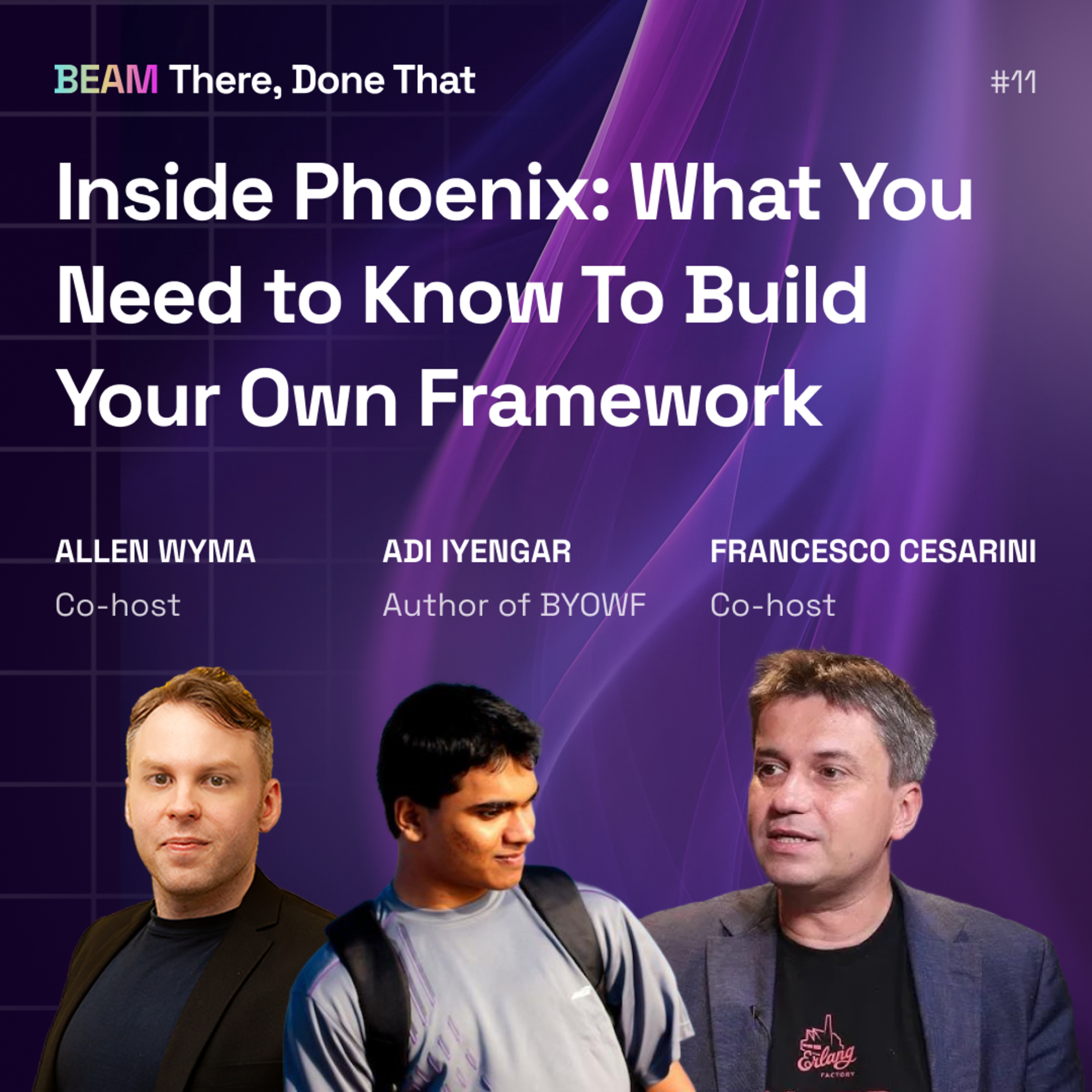 Inside Phoenix: A Plug, a Macro, and What You Need to Know To Build Your Own Framework 15.05.2026 1h 1minThree and a half years, one book, and a clearer answer to what Phoenix is actually doing under the hood.Phoenix makes building web apps in Elixir feel effortless, but how much of that is genuine elegance and how much is metaprogramming hiding the complexity? Adi Iyengar spent three and a half years writing Build Your Own Web Framework in Elixir to find out, and in this episode he sits down with Francesco and Allen to share what he learned by rebuilding Phoenix from the ground up. We dig into Plug as the real heart of the framework, when metaprogramming is the right tool and when it quietly becomes a liability, and why understanding the layers underneath Phoenix is what separates a productive developer from a senior one. Along the way Francesco brings out the BEAM web-server history most listeners have never heard — Yaws, Bluetail, Mochiweb, Inets — and the conversation lands on what coding agents get wrong about Phoenix in 2026.
 -
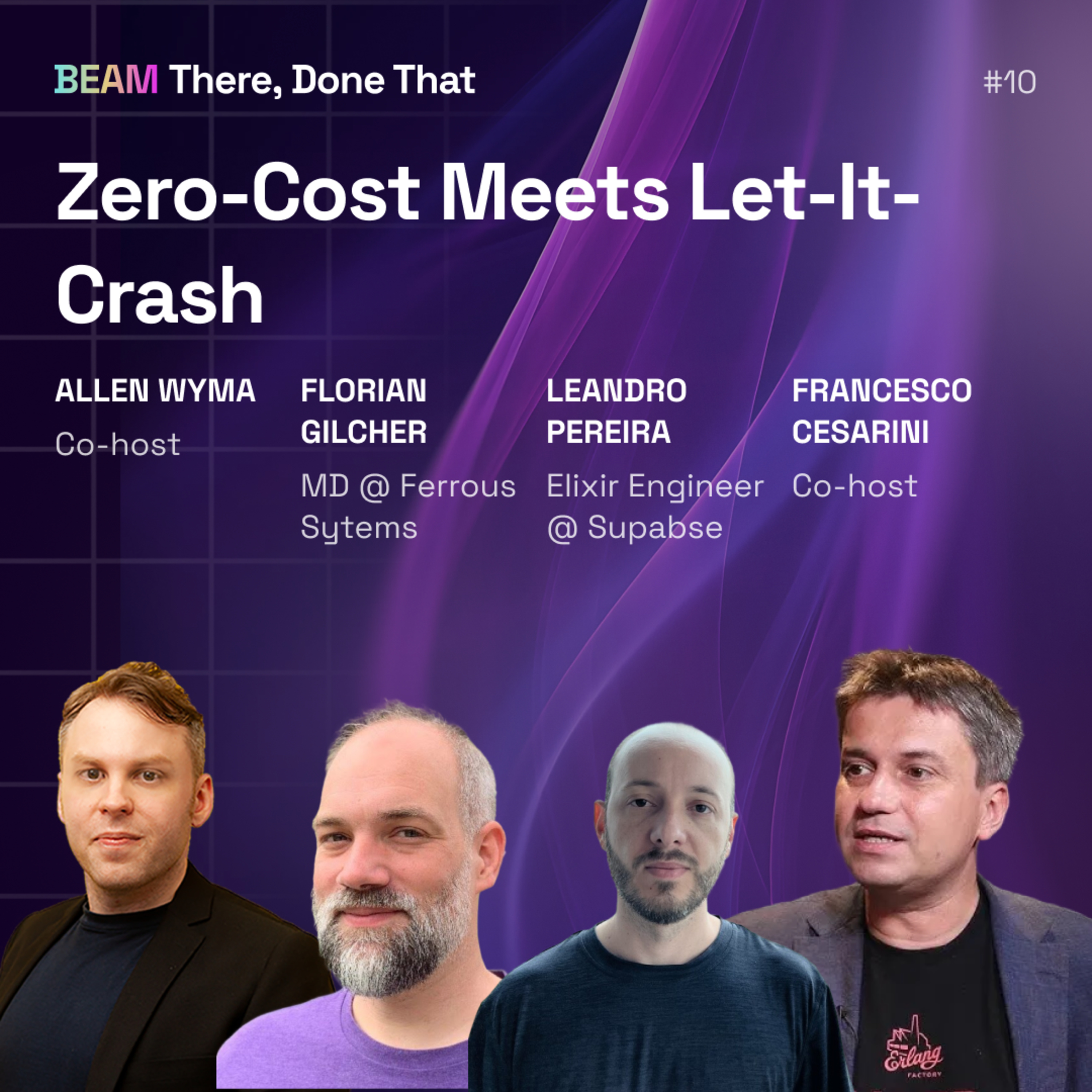 Zero-Cost Meets Let-It-Crash: The Rust + Elixir Power Combo 08.05.2026 58minIn this episode of BEAM There, Done That, hosts explore what really happens when the high-level concurrency and fault-tolerance of Elixir meet the low-level performance and control of Rust. The conversation dives into interoperability patterns—NIFs, ports, and emerging tooling—and where each language shines when building real-world systems that need both resilience and raw speed. Joining the discussion are Florian Gilcher, Co-founder and Managing Director of Ferrous Systems and a key figure in Rust’s community, adoption, and safety-critical systems work, and Leandro Pereira, an Elixir developer behind high-performance, developer-focused tools like MDEx, Lumis, and BeaconCMS. Together, they unpack when to stay on the BEAM, when to reach for Rust, and how combining the two can unlock a powerful hybrid architecture without compromising safety or developer productivity.
Podobni podkasti


Priljubljen v
Ta podkast je tudi v lestvicah podkastov teh držav.
