
Time Across the Solar System
Time Across the Solar system
0
Time Across the Solar System is a science podcast that explores what time means on different planets in our solar system. It compares the lengths of days and years on worlds like Jupiter, Venus, and Earth, turning NASA data into vivid, cinematic storytelling. Each episode blends scientific facts with imaginative narration and cosmic soundscapes, making planetary science personal and engaging. The show aims to make listeners rethink their experience of time through the lens of space.
Epizode
-
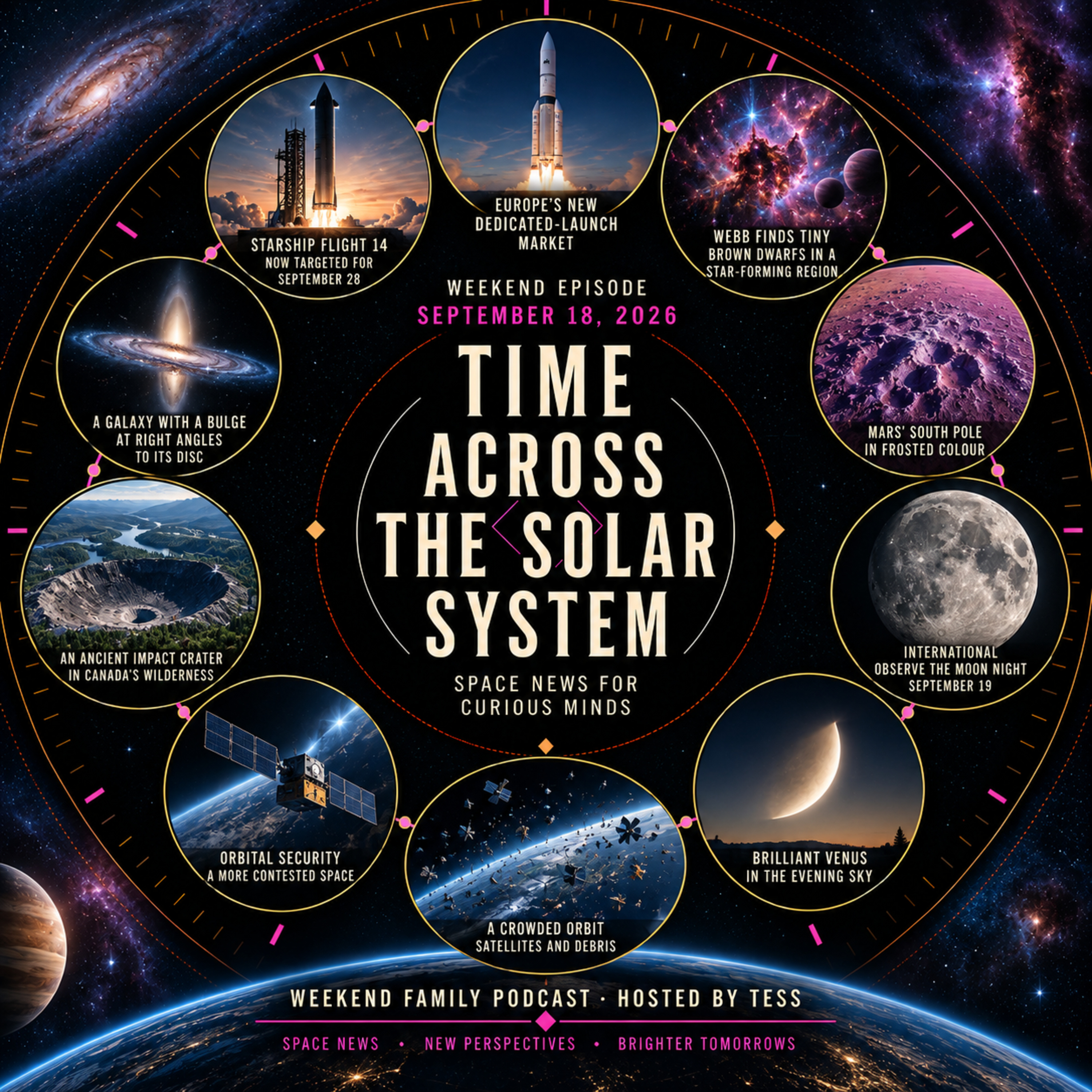 Starship Flight 14, Purple Mars & a Galaxy Spinning Sideways 18.09.2026 13minStarship has a new launch date. Mars has turned purple. And Hubble has found a galaxy whose centre appears to be rotating in a completely different direction from the rest.This week on Time Across the Solar System, Tess explores ten stories showing how space is becoming a place humanity must not only explore, but also schedule, monitor and manage.We look at SpaceX’s next Starship flight, Europe’s growing launch market, tiny brown dwarfs photographed by the James Webb Space Telescope, the strange colours of Mars’ south pole, International Observe the Moon Night and brilliant Venus.We also examine the growing problem of satellites and debris in Earth orbit, the increasing importance of orbital infrastructure, an impact crater discovered in the Canadian wilderness, and Hubble’s remarkable view of NGC 4698.Ten stories. One big idea:Space is not empty. It is active, changing and increasingly crowded.Family-friendly space news, astronomy and planetary science with Tess.More episodes, calculators and educational resources at tatssp.com
 -
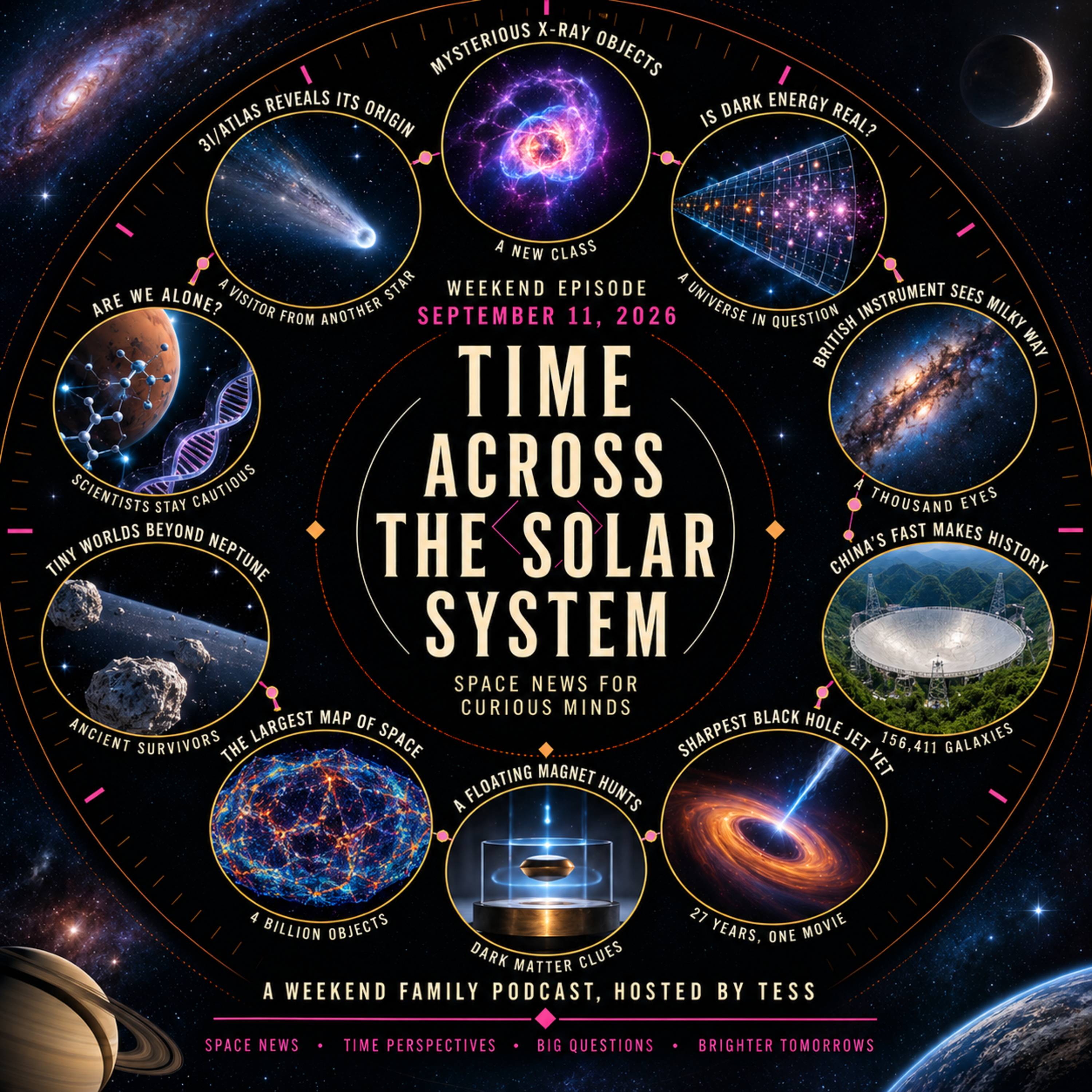 Mysterious X-Ray Objects, 3I/ATLAS & the Dark Energy Question 11.09.2026 18minThis week on Time Across the Solar System, Tess explores ten stories about the records the universe leaves behind.Astronomers uncover a mysterious new class of hypersoft X-ray sources hidden in old Chandra data. Interstellar comet 3I/ATLAS offers clues about the star system where it was born. A new analysis questions whether cosmic expansion is really accelerating. The MOONS instrument begins peering through dust toward the heart of the Milky Way, while China’s FAST telescope releases a vast catalogue of neutral hydrogen sources.We also look at 27 years of black-hole-jet observations transformed into a moving reconstruction, a levitated-magnet experiment searching for dark matter, a huge map containing billions of celestial objects, tiny worlds beyond Neptune preserving the Solar System’s early history, and what scientists really think about recent claims of possible alien life.Ten stories. One big idea: the universe keeps records.Family-friendly astronomy, astrophysics and space science with Tess.More episodes, calculators and lesson plans at tatssp.com
 -
 Roman Launches, Saturn’s Decagon & Mars Gets an Internet 04.09.2026 15minThis week on Time Across the Solar System, Tess explores ten stories showing why timing matters everywhere in space.The Nancy Grace Roman Space Telescope begins its journey toward L2, NASA selects Blue Origin for a future Mars communications network, and astronomers report a remarkable ten-sided atmospheric structure around Saturn’s south pole.We also follow China’s Tiangong space station across the night sky, Rocket Lab’s latest radar satellite, Venus and the September sky, plans for a U.S. Space Academy, a nearly seven-hour spacewalk outside the International Space Station, the delayed Crew-13 mission, and Europe’s push for more frequent rocket launches.From 90-minute orbits to messages that can take more than 20 minutes to cross the distance between Earth and Mars, this episode asks the question at the heart of the series:How does time work up there?Family-friendly astronomy, space science and planetary time with Tess.Explore more episodes, calculators and lesson plans at tatssp.com
 -
Blood Moon Eclipse, Roman Telescope Launch & Artemis Astronaut Honors — Space News for Kids (Aug 28, 2026) 28.08.2026 11minThis week on Time Across the Solar System: a 93% partial lunar eclipse turned the Moon copper-red over the UK and Ireland, NASA's Nancy Grace Roman Space Telescope prepares to launch this weekend, and the Artemis II astronauts receive the Congressional Space Medal of Honor for their historic Moon flyby. Plus: Turkey joins the Artemis Accords, NASA studies whether Earth microbes could survive at the Moon's south pole, a new European weather satellite reaches orbit, and rockets around the world inch toward their next launches.Tess breaks down ten space stories for families and kids, always connecting back to one big idea: space isn't just about distance, it's about timing. Perfect for classroom listening, car rides, or bedtime curiosity.Learn more, explore age calculators, and find lesson plans at tatssp.com.
-
Hidden Stars, Black Hole Stars & the Sun’s Final Bow | Space News 21.08.2026 9minThe James Webb Space Telescope is rewriting the story of the universe — from its earliest galaxies to the eventual fate of stars like our Sun.This week on Time Across the Solar System, Tess explores six remarkable discoveries across cosmic time: JWST finds unexpectedly large populations of hidden, faint stars in ancient galaxies; the Treasure Chest cluster in the Carina Nebula gets a surprising new age; galaxy cluster XLSSC 122 appears far more mature than expected; astronomers investigate a bizarre “black hole star” from only 660 million years after the Big Bang; water is detected around the dying star IRS 3 close to Sagittarius A*; and the Lion Nebula (NGC 2392) offers a glimpse of what may eventually happen to our own Sun.From stellar nurseries to dying stars, gravitational lensing and supermassive black holes, this episode asks the question at the heart of the series: how does looking across space allow us to look across time?A family-friendly journey through astronomy, astrophysics and the latest discoveries from the James Webb Space Telescope.Explore planetary time, calculators, lesson plans and more at tatssp.com.Topics: James Webb Space Telescope, JWST, early universe, ancient galaxies, Carina Nebula, Treasure Chest star cluster, galaxy clusters, gravitational lensing, black hole stars, Sagittarius A*, IRS 3, water in space, planetary nebulae, Lion Nebula, stellar evolution, astronomy, astrophysics, space news.
-
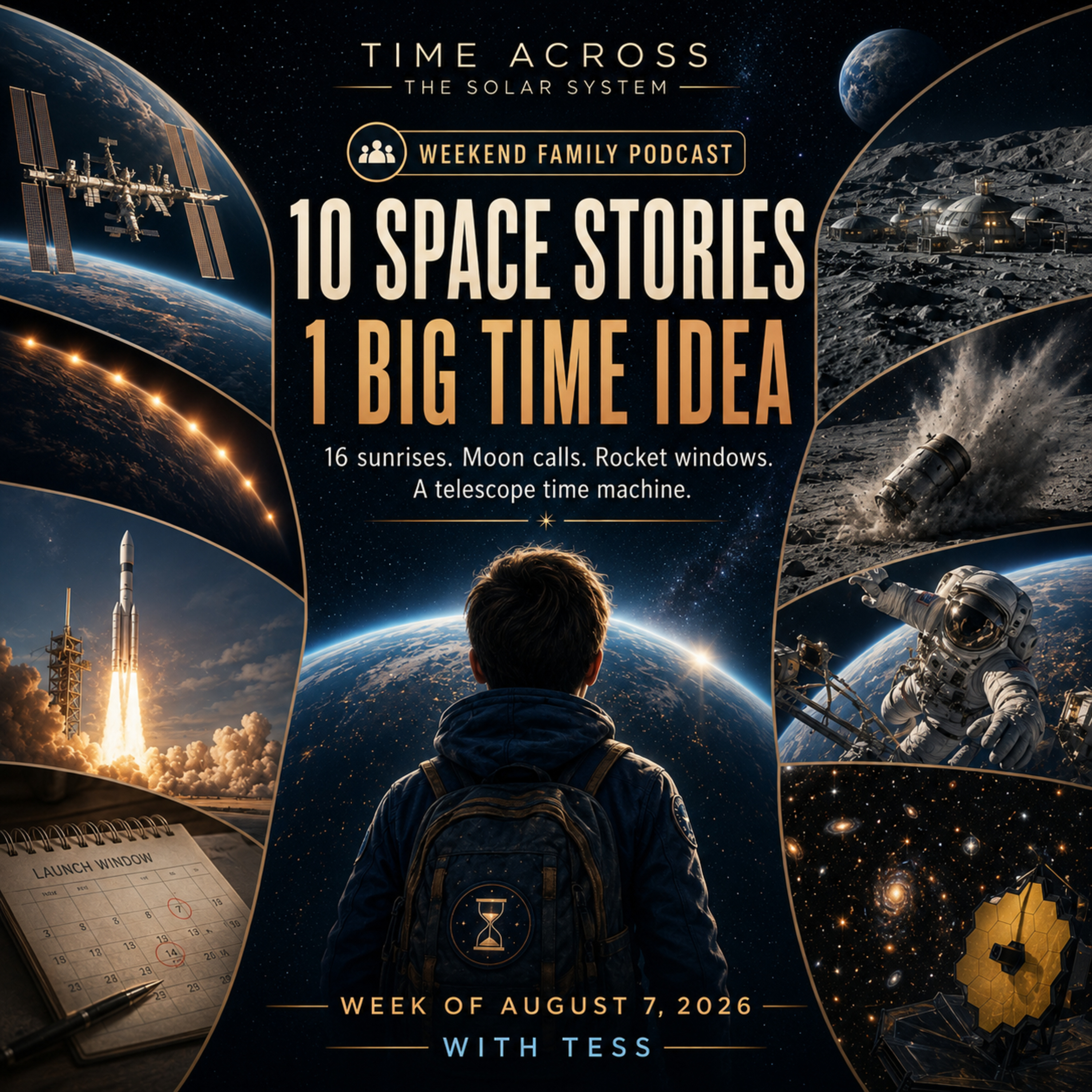 Space News for Kids: Astronauts, a Moon Base & a Photo Billions of Years Old 07.08.2026 12minSpace news the whole family can understand! This week Tess rounds up 10 big space stories and asks one fun question about all of them: how does time actually work up there? 🚀We follow 4 astronauts getting ready to fly to the International Space Station, find out why rockets are booked all the way to 2029, visit a future Moon base, ride along on a 6.5-hour spacewalk, and finish with a brand-new telescope photo that lets us look BILLIONS of years into the past.Perfect for curious kids, families, homeschoolers, and classrooms. Every story ends with a simple takeaway you can try at home. Ever wondered how old you'd be on another planet, or how long a year lasts on Uranus? This is the show for you.⏱️ In this episode:(00:00) Welcome + this week's big question(01:09) SpaceX astronauts head to the ISS on Sept 12(02:48) NASA funds 18 wild future-space inventions(04:18) Why Falcon 9 is booked to 2029 (and Mars launch windows)(06:08) Building a base on the Moon(07:48) How a launch schedule works(09:05) NASA watches a rocket part crash into the Moon(10:40) Crew-13 and the fastest ride humans have(11:53) A 6.5-hour spacewalk = 4 laps of Earth(13:23) Why a space museum is really a time machine(14:43) A telescope photo of galaxies billions of years old(16:50) Your Time Traveller Challenge + goodbyeHost: Tess. A Solar Sisters production about how time and space work across the solar system.New episode every Friday. Follow so you never miss one! 🌍🌙⭐Learn more and calculate your age on every planet at tatssp.com#SpaceForKids #ScienceForKids #KidsPodcast #Astronomy #Homeschool
 -
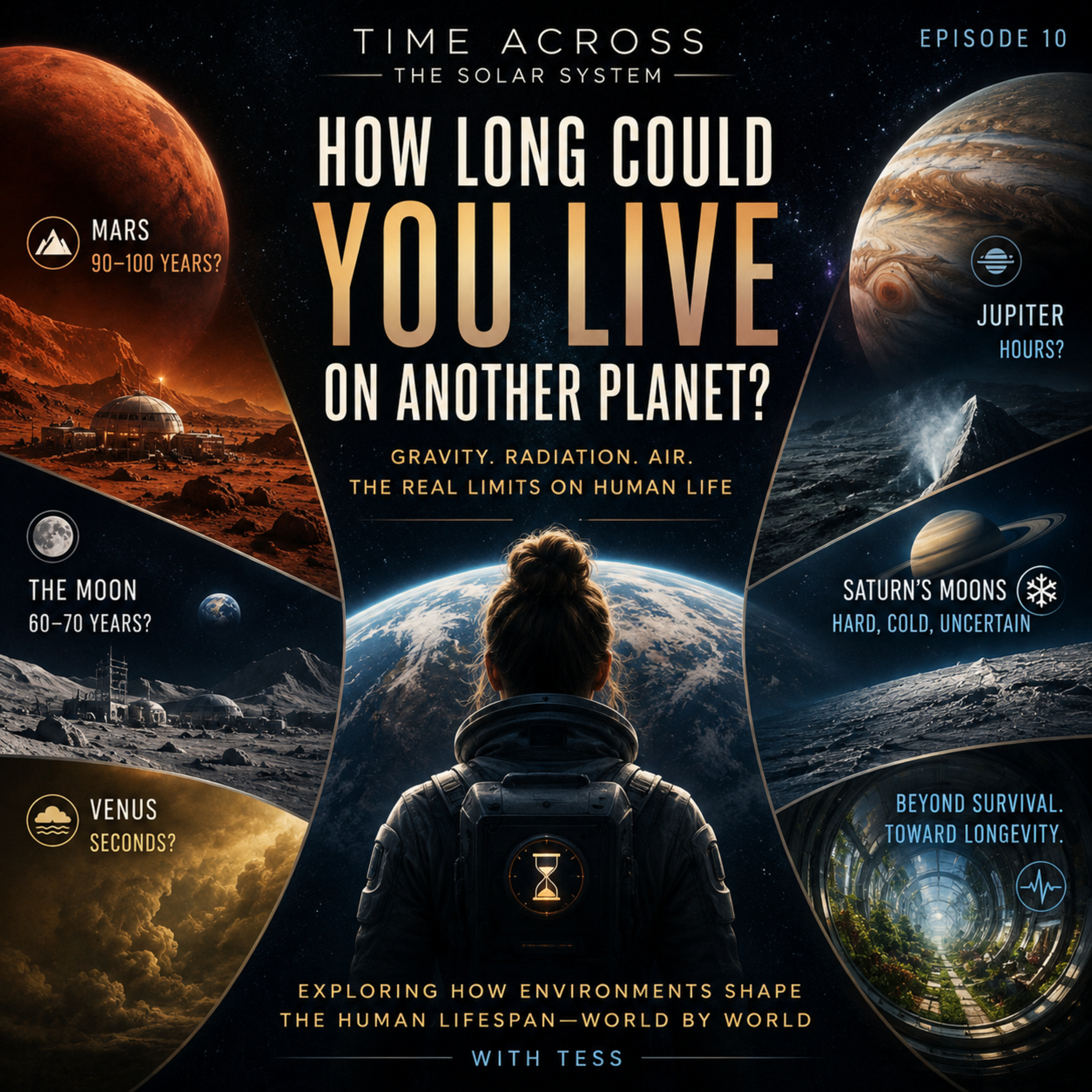 Could You Live Longer on Mars? Human Lifespan Across the Solar System 05.08.2026 8minWould you age slower on Mars, or faster on Jupiter? Tess breaks down how gravity, radiation, and atmosphere on every world would rewrite the human lifespan, planet by planet.Full description:Imagine a hundred-year lifespan on Mars, or one measured in months on Jupiter. In this episode, Tess explores the real biology behind living on other worlds: how Mars's lighter gravity could ease strain on your heart and bones, why the Moon's low gravity is actually a trap rather than a shortcut, and why radiation, not gravity, is the biggest threat to how long we could last across the solar system.We cover:Earth's baseline: why 1G, a magnetic field, and 21% oxygen make 72-80 years possibleMars: the optimistic vs. realistic lifespan scenariosThe Moon: bone loss, muscle atrophy, and 200x radiation exposureJupiter, Saturn, and their moons: survivable or not?Venus: the ultimate hostile environmentThe technology (artificial gravity, radiation shielding, gene therapy) that would actually decide the outcomeCalculate your own age on every planet at tatssp.com/calculator.
 -
 How Old Am I on Mars? The Origin Story of Time Across the Solar System 04.06.2026 12minDiscover how a simple question from an eleven-year-old sparked a global educational movement. Learn about Time Across the Solar System, the interactive platform answering the question millions are searching for: how old am I on Mars? Features real data from two hundred countries, interactive age calculators for every planet and moon, and answers to your solar system questions. Music by Neural Syntax: Orbes Silentes.
 -
Moons of Madness - Where Time Goes Sideways 28.11.2025 10minWhat if the Sun rose in the west? On Mars's moon Phobos, it does — and it happens twice a day.In this episode, we journey to the strangest moons in our solar system, where the rules of time get bent, broken, and turned completely sideways.You'll discover:- Phobos — the moon that rises backwards and orbits faster than Mars rotates- Titan — where a single season lasts 7 Earth years and methane rivers carve the landscape- Io — where Jupiter never sets and volcanoes are powered by gravitational kneading- Europa — the ice moon hiding an ocean with more water than Earth- Our Moon — the familiar stranger with two-week days and a sky where Earth never setsWhether you're a student, teacher, parent, or space enthusiast, this episode will change how you think about time, moons, and what "a day" really means.Explore more at tatssp.com/moons — calculate your age on Titan, read stories about life on these worlds, and discover why the moons are where the solar system gets personal.—Time Across the Solar SystemFree science education for everyone.Every fact NASA-verified. Every episode free, forever.Support us: tatssp.com/sponsor
-
Why Do Astronauts Float in Space? — Zero Gravity Explained 25.11.2025They’re not escaping gravity — they’re riding it.In our first full episode of Time Across the Solar System, we uncover the real reason astronauts appear to float. Discover how orbit works, why the International Space Station is constantly “falling forever,” and what weightlessness truly feels like.This episode connects directly with our mission at tatssp.com — an educational web project making planetary science personal, visual, and engaging.At the site, you can explore interactive tools that show how time, days, and years work differently on every world, calculate your age on other planets, and dive into classroom-ready lessons backed by NASA and JPL data.✨ Highlights• The truth behind “zero gravity” — what scientists really call microgravity• How orbit balances gravity and motion in perfect harmony• The strange physics of floating water, fire, and even tears in space• How astronauts turn science into play — from floating candy to spherical flames🎙 Hosted by: The TATSS AI Narrator🎵 Music: Neural Syntax— Ambient Cosmic Intro Theme🔭 Learn more and try the interactive planetary tools at: tatssp.com
-
 Welcome to Time Across the Solar System: Where Science Meets Wonder 25.11.2025 3minStep into a universe where every world keeps its own clock.In this introduction to Time Across the Solar System, discover the story behind the project — how tatssp.com turns astronomy into wonder, making planetary time personal, visual, and real.Learn why a day on Venus lasts longer than its year, how astronauts float by falling forever, and how time itself changes from planet to planet.Hosted by Tess, our TATSS AI Narrator.Explore more at tatssp.com🎵 Original music by Neural Syntax — Ambient Cosmic Intro Theme🔭 Educational project powered by NASA and JPL data
Podobni podkasti


Priljubljen v
Ta podkast je tudi v lestvicah podkastov teh držav.
