
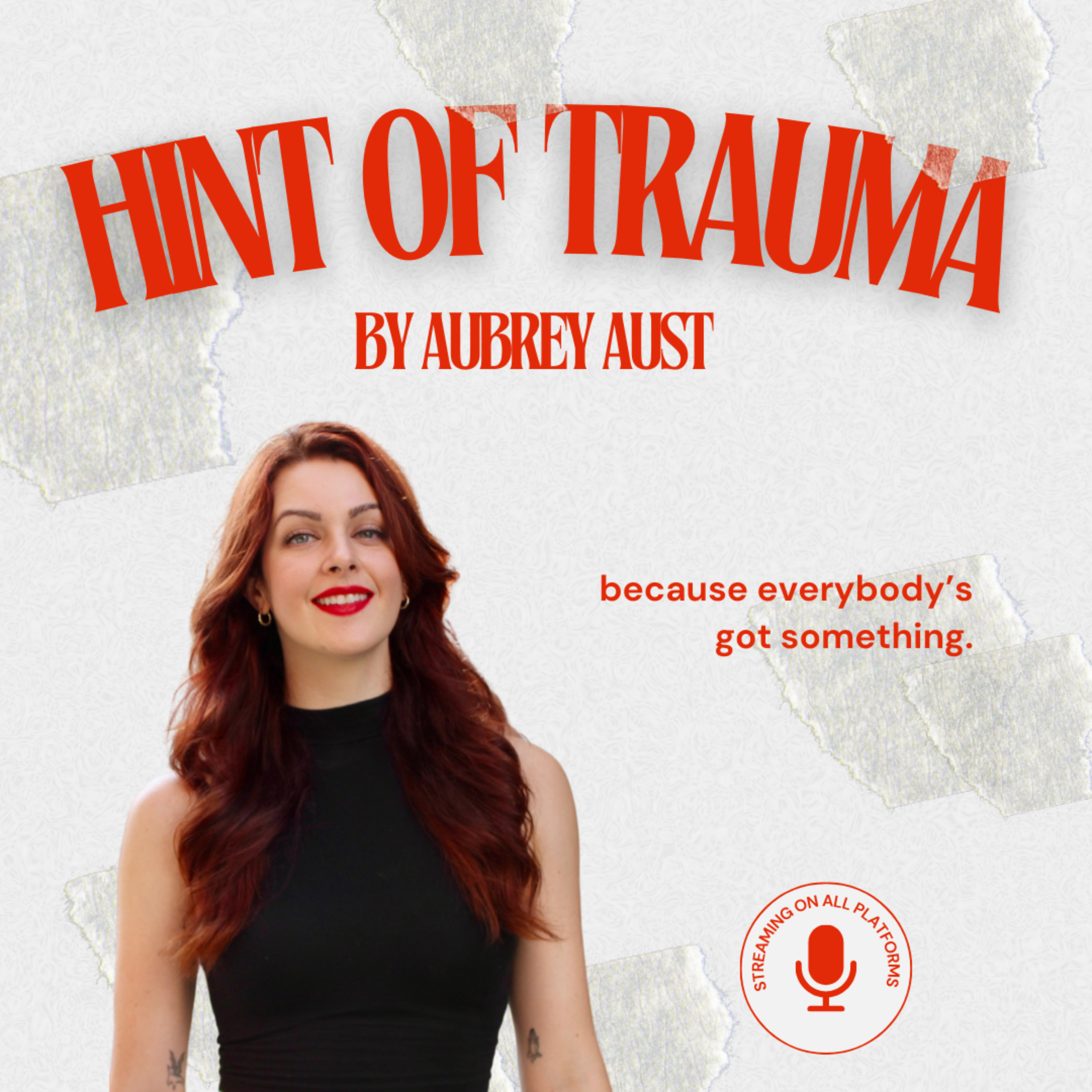
Hint Of Trauma
Aubrey Aust
0
Hint of Trauma explores the psychology and philosophy of relationships, identity, and desire. Hosted by Aubrey Aust, each episode blends research and real life to ask: How do we feel at home in ourselves, even as relationships reshape us? From attachment theory to existential thought, this is a space for reflection, curiosity, and the re-authoring of the stories that make us who we are.
Episodet
-
 The Psychology of New Beginnings 16.01.2026 13minHonestly, it's kind of appropriate this episode is coming two weeks into January. I'm not too great with the whole "resolution" thing exclusively on January 1st. We can place a lot of pressure on starting over in the New Year. But what actually creates sustainable change in our lives? Sure, temporal landmarks help. But new beginnings are psychologically complex. A new beginnings doesn't mean rejecting your past self. It's about integrating it. Chapters00:00 The Psychology of New Beginnings03:41 Understanding Narrative Identity08:54 Common Pitfalls of New Beginnings12:40 Sustainable Change and AgencyHint of Trauma InstagramAubrey's InstagramWork With Me
 -
Weaponize Yoga: Identity, Ego, and the Ruins of Western Yoga Culture 26.12.2025 35minYoga is a state of being. People are drawn to the practice for deeply personal reasons, often carrying grief, trauma, or a sense that something in their life is no longer working. At its core, yoga is a practice of confrontation: with suffering, with illusion, and with the identities we cling to in order to feel safe. In everything I just said, I’m talking about yoga. Western yoga, on the other hand, is it’s own beast. Western yoga culture has developed into something else entirely. In this episode of Hint of Trauma, I’m joined by Keith Partington and Sydney Richter, founders of Weaponize Yoga, to examine how a practice oriented toward self-knowledge became embedded in a commercial system that often reinforces avoidance rather than transformation.We discuss identity, suffering, and the importance of community in yoga, while also looking at Keith and Sydney's vision for a new approach to yoga that emphasizes personal transformation and liberation from societal constructs.Weaponize Yoga IG: https://www.instagram.com/weaponizeyoga/Weaponize Yoga Substack: https://weaponizeyoga.substack.com/Aubrey's IG: https://www.instagram.com/aubrey__aust/Hint of Trauma IG: https://www.instagram.com/hintoftrauma/Website: www.aubreyaust.com
-
Why love makes us insane 19.12.2025 15minNo, you're not just crazy. We're told that the right relationship makes us feel calm and at complete peace. Well, psychoanalytic frameworks have some hot takes on that. Here, we'll explore the complexities of love through a psychoanalytic lens, discussing how love can destabilize our sense of self and the implications of visibility and recognition in intimate relationships. Drawing on theories from Freud, Lacan, and others, we'll the relational nature of identity and the ethical dimensions of love.Maybe love is not a solution to our vulnerabilities but a way to navigate them together.Chapters00:00 The Nature of Love and Insanity03:16 Psychoanalysis and the Formation of Self07:21 Visibility and Recognition in Love11:47 The Ethics of Love and Visibility16:01 Transitional Spaces in Love19:10 Living with Vulnerability in LoveWork with me 1-1: https://www.aubreyaust.com/work-with-meInstagram: https://www.instagram.com/aubrey__aust/Hint of Trauma Instagram: https://www.instagram.com/hintoftrauma/
-
Navigating the Meaning Crisis with Ali Kapadia (The Net Project) 12.12.2025 35minWhat happens when we don't have meaning in our lives? Today, we sit down with Ali Kapadia, founder of Net Project, to delve into the meaning crisis affecting modern society by exploring how technology intersects with human flourishing. They discuss the importance of relationships, the relevance of Maslow's hierarchy in the digital age, and the need for individuals to find fulfillment in their lives. Ali shares insights from his research and the mission of the Net Project, which aims to create a world where the meaning crisis is addressed through community and agency.You can find The Net Project here: https://www.netproject.org/Chapters00:00 Introduction to the Meaning Crisis06:44 Ali's Journey and the Birth of Net Project06:57 Understanding the Meaning Crisis10:40 Maslow's Hierarchy and Modern Digital Life16:55 The Importance of Meaningful Relationships21:40 Creating Fulfillment in Everyday Moments22:03 Key Insights from Research on Fulfillment27:43 Envisioning a World Without the Meaning CrisisAubrey's WebsiteAubrey's InstagramHint of Trauma Instagram
-
Redefining Eroticism with Artist Xixi Wang 05.12.2025 28minWhat is eroticism?Today, we are joined by Xixi Wang, a queer painter and tattoo artist whose work explores eroticism not as spectacle, but as sensation. Through line, gesture, and skin, Xixi's art asks us to reconsider what makes something feel erotic and intimate.This is a conversation about eroticism as aliveness, not performance. Xixi's Tattoo Booking LinkXixi's Art InstagramWork With AubreyAubrey's InstagramHint of Trauma Instagram
-
The Somatic Psychology Holiday Survival Guide 21.11.2025 12min'Tis the season to feel utterly emotionally exhausted. The holidays can bring up a lot for people. They activate everything: memory, longing, old roles, old wounds, and the body’s earliest survival strategies.So how do we return to the present self in those moments?Drawing from somatic psychology, attachment theory, and relational neuroscience, this episode explores how returning to old environments activates implicit memory, survival patterns, and younger versions of the self.We’ll unpack hyper and hypoarousal, fawning, neuroception, somatic boundaries, and evidence-based grounding practices, offering ourselves a compassionate framework for navigating family systems with more regulation, awareness, and self-connection.Cheers, y'all. We got this. Find Me on the Internet:1:1 and Couples WorkAubrey Aust InstagramHint of Trauma InstagramWebsite
-
The Psychology of Play: Creativity and Embodiment with Nasimeh Be 14.11.2025 35minWhat would happen if we moved through the world with just a sliver more of creativity and play? Today I'm joined by Nasimeh Be, a Brooklyn-based coach, artist, and facilitator whose work explores the intersection of creativity, embodiment, and play. Currently a Masters Candidate at Columbia University in Spiritual Psychology, Nasimeh creates workshops, art, and content that help reconnect people to their authenticity, presence, and aliveness.We're talking Somartia, Nasimeh's latest offering combining movement and creativity, and her research and Columbia. Additionally, we cover why we need creativity more than ever before and wonder what it would be like if Congress members just dabbled in mushrooms. So, we covered all of the essentials. You can find Nasimeh here for art, coaching, and all of her incredible workshops:InstagramWebsiteAubrey's links:Work with me 1:1InstagramHint of Trauma InstagramWebsite
-
What Are Your Passionate Attachments? 07.11.2025 15minPsychoanalytically speaking, to to create a sense of self is to attach.Not just to people, but to ideas, ideals, desires, and pain. Yeah, even the tough stuff. Because within that, we construct what we consider to be identity. And that's why losing those attachments feels like your heart ripping out of your chest. In this episode, we explore Judith Butler’s concept of “passionate attachments," or the idea that who we are is shaped by what, and whom, we cannot let go of. Drawing from Freud, Laplanche, Winnicott, Jessica Benjamin, Lacan, and Kristeva, we trace how attachment gives rise to identity, desire, and dependence and how it can both sustain and entrap us.We’ll talk about: How attachment forms the foundation of identityWhy we cling to what hurts usThe paradox of freedom and dependenceHow to live consciously within our attachmentsWe're humans. We're going to trap ourselves. Here's some information to help us trap wisely. 00:00 intro01:00 object relations theory02:33 selfhood is entirely based on attachment03:50 Butler and Psychic Life of Power04:49 intersubjectivity05:06 domination and recognition05:40 what do you orient your life around06:20 Winnicott and the good enough mother07:44 Simone de Beauvoir and freedom10:45 does it feel safer to attach to pain?11:30 Julia Kristeva and objection12:19 cutting ties vs understanding what the ties mean14:25 binding ourselves wisely
-
When The #Healing Obsession Began 31.10.2025 15minWhen did healing become a full-time job?Let's explore the rise of therapy culture: how healing became a modern religion, how peace turned into a performance, and why the pursuit of “wholeness” often leaves us more fragmented than before.Tracing a line from Saint Augustine’s theology of suffering to Freud’s invention of the inner self, from self-help optimism to Instagram therapy, we unpack how our understanding of pain and happiness has evolved and what we might have lost along the way.With the help of Nietzsche, Foucault, Hannah Arendt, Byung-Chul Han, and bell hooks, we ask:When did self-awareness become a moral virtue?What happens when introspection replaces participation?And what might healing look like if it stopped being a performance and started being a practice?Find me on the internet:Website: www.aubreyaust.comInstagram: @aubrey__austHint of Trauma Instagram: @hintoftrauma
-
When You're Afraid Of Feeling A Little Too Good. 24.10.2025 17minWhy is it that the very thing we long for — love, peace, joy — can also feel so unsafe?Through the lenses of trauma psychology, attachment theory, and philosophy, we unpack how the nervous system learns to associate goodness with risk, and why feeling safe in joy can take time.Drawing from polyvagal theory, Simone Weil, Byung-Chul Han, Nietzsche, and relational neuroscience, we look at the body’s instinct to protect itself from vulnerability, the brain’s fear of impermanence, and the learned belief that calm must always precede collapse.We’ll talk about:Why the nervous system can mistake joy for dangerThe “window of tolerance” and how we expand itHow attachment patterns shape our ability to feel goodThe philosophy of joy’s fragility and impermanencePractical ways to build a relationship with joy instead of bracing against itBecause sometimes we need to teach ourselves how to stay with joy.00:00 Intro01:29 The Nervous System and Joy03:34 The Psychology of Joy and Fear04:49 Trauma, Attachment, and the Fear of Good Feelings07:26 The Fragility of Goodness (Simone Weil, Nietzsche, Byung-Chul Han)12:05 You can't schedule guaranteed joy. Kind of.Find me on the internet:Website: www.aubreyaust.comInstagram: @aubrey__austHint of Trauma Instagram: @hintoftrauma
-
The Philosophy Of Desire 17.10.2025 18minWhat does it mean to want?Desire animates everything: our choices, our relationships, and our pursuit of meaning. But it also unsettles us. Maybe something that's both the pulse of life and the source of our restlessness deserves a little examination. In this episode, we explore the philosophy and psychology of desire, or why we want what we want, and what our wanting reveals about who we are. Is desire meant to be satisfied, or to sustain us? What can our longings teach us about the unconscious? And how do we distinguish between the desires that expand us and those that quietly undo us?Because desire isn’t just about having — it’s about becoming. And when we learn to hold it with awareness, it transforms from a source of suffering into a map toward self-understanding.00:00 Opening01:22 What is desire?02:29 Motion and mirror: the two sides of desire03:17 Hannah Arendt and Saint Augustine on love and longing05:09 Love as possession vs love as participation05:50 Restlessness is a sign of vitality06:05 Freud and the desire drive06:52 Lacan and the desire of the Other08:10 Repetition compulsion08:43 Stoicism and desire bondage 10:35 Epicureanism and the three categories of desire13:17 Desire shapes the outline of our becoming14:46 Five steps to actually learn from desire16:52 ClosingFind me on the internet:Website: www.aubreyaust.comInstagram: @aubrey__austHint of Trauma Instagram: @hintoftrauma
-
We Weren't Meant To Heal Alone 10.10.2025 17minWe often talk about healing as something personal: therapy, journaling, self-work, boundaries. But what if healing was never meant to be done alone?In this episode, we dive into collective healing: the idea that we recover in community, not isolation. Here, we’ll look at the myth of independence, the costs of hyper-individualism, and the power of village mentality: the understanding that our healing is bound up in one another.We’ll explore how community care has always existed, from Indigenous talking circles to African community rituals to Asian ancestral lineage practices, and why these ancestral forms of healing offer something modern wellness often forgets. And, let's get into why collective healing is difficult: the weight of history, unprocessed grief, and the deep cultural distrust that makes connection hard.Because trauma doesn’t happen in isolation... and neither does repair.00:00 Intro01:09 We were never meant to heal in isolation01:49 The village mentality04:11 Individualized healing and the myth of independence05:16 Performative self-sufficiency and hyperindependence06:17 Healing happens in community06:40 Cultural examples of community care and healing08:22 And, collective healing is hard11:20 Collective trauma theory13:25 What does collective healing look like in practice?16:23 ClosingFind me on the internet:Website: www.aubreyaust.comInstagram: @aubrey__austHint of Trauma Instagram: @hintoftrauma
-
Why Vulnerability is So Damn Hard 03.10.2025 14minVulnerability is one of the most essential practices for deep, genuine connection. So why does it feel almost impossible at times?To answer that, we need to take a step back and ask ourselves, what is vulnerability, really? Why does it matter? And why does it so often feel unsafe? In this episode, we’ll explore the psychology and philosophy of vulnerability: how it shows up in the body, why it’s tied to shame, and what thinkers like Kierkegaard, Beauvoir, and Levinas can teach us about the paradox of exposure and connection.We’ll also get practical: how do you strengthen your “vulnerability muscle” without collapsing into overwhelm? And what are the first steps toward cultivating openness in a way that actually deepens trust?00:00 Intro01:42 What is vulnerability02:02 Psychologically, what does vulnerability entail?03:30 How vulnerability shows up in the body04:29 Why does vulnerability feel inaccessible at times?05:07 The link to shame05:56 The Philosophy of Vulnerability (Kierkegaard and Beauvoir)06:57 The paradox of risk and possibility07:57 Levinas and interdependence09:16 To Earn Trust10:45 Five steps to strengthen the vulnerability muscle13:47 ClosingFind me on the internet:Website: www.aubreyaust.comInstagram: https://www.instagram.com/aubrey__aust/Hint Of Trauma Instagram: https://www.instagram.com/hintoftrauma/
-
What Does It Mean To Belong? 25.09.2025 19minPsychologically, belonging is one of our deepest human needs. But what actually makes us feel like we belong? And what do we give up in order to fit in? Here, we'll explore the psychology and philosophy of belonging: why our nervous systems are wired for connection, what happens when belonging comes at the cost of self-erasure, and how thinkers like Aristotle, Hannah Arendt, and Kierkegaard help us understand the paradoxes of community. We’ll also talk about the five pillars of belonging and practical ways to cultivate it in your own life.00:00 Intro00:54 The illusion of hyperindependence02:09 My foolish stories of hyperindependence03:05 Why belonging is important04:24 What do we sacrifice to belong?07:20 Environment and belonging07:57 The psychology of belonging08:53 Loneliness is a stress state09:50 The five pillars of belonging11:38 Aristotle and Zoon Politikon12:06 Hannah Arendt and Belonging Through Plurality13:32 Kierkegaard and the paradox of belonging16:03 How do we actually cultivate belonging in our lives?18:18 ClosingFind me on the internet:Website: www.aubreyaust.comInstagram: https://www.instagram.com/aubrey__aust/Hint Of Trauma Instagram: https://www.instagram.com/hintoftrauma/
-
What's Your Roman Empire? 19.09.2025 16minWe all have a moment, a person, or an event that lives in our heads rent-free. And sometimes, we want to kick it out. What do our "Roman Empires" say about ourselves? And how do we integrate those thoughts into our life stories? Here, we'll explore how the loops of thought and memory shape who we are. Drawing from psychology and philosophy, we’ll look at why certain experiences live on in our minds, how memory is less a recording than a reconstruction, and the role the unconscious plays in repeating what we haven’t yet resolved.00:55 What is a "Roman Empire" / the meme the myth the legend02:10 How our thoughts shape us02:48 The neuroscience of memory04:04 How memories change over time04:37 Narrative Identity Theory05:09 Trauma and memory05:40 Freud and repetition compulsion06:32 Remembering is reinterpretation 07:16 What's trapped in the unconscious 09:57 The unconscious and memory11:05 Sartre and bad faith13:07 SummaryFind me on the internet:Website: www.aubreyaust.comInstagram: https://www.instagram.com/aubrey__aust/Hint Of Trauma Instagram: https://www.instagram.com/hintoftrauma/
-
Who Am I Without You? 08.09.2025 19minConnection is a reflection of the self: who we are and who we are becoming. But what even is the self? Does it exist outside of our relationships? Both psychology and philosophy have some hot takes, including important notes on agency, recognition, and expansion. Maybe it's a little less about "do I like them" and a little more about "do I like who I am when I'm with them." Show Notes: 00:00 Welcome to Hint of Trauma01:19: What this podcast is about02:29 Who am I without you?03:00 The self vs the relational self05:25 Lacan and the mirror stage07:46 The self is fixed?08:12 Post-modernism and the changing self09:53 Stop throwing around the word codependency10:27 What is the relational field12:47 The responsibility to the Other13:07 Why relational shifts feel threatening to selfhood14:24 The beauty in the breakup: Byung Chul Han on grief16:43 Who do I become around you?17:45 Dan McAdams and Narrative IdentityFind me on the internet:Website: www.aubreyaust.comInstagram: https://www.instagram.com/aubrey__aust/
Podkaste të ngjashme


I/E popullarizuar në
Ky podkast shfaqet edhe në listat e podkasteve të këtyre shteteve.
