
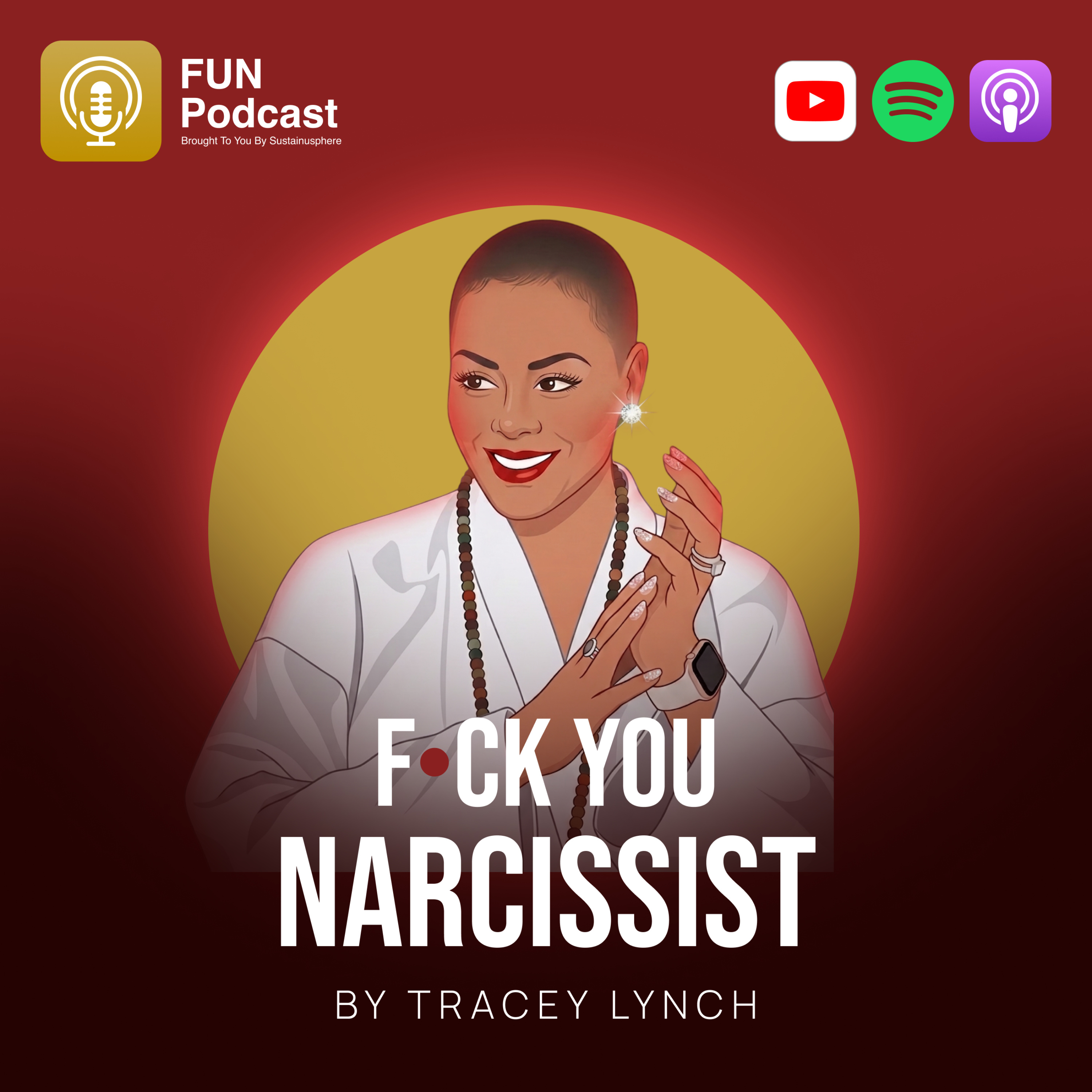
F*ck You Narcissist
Tracey Lynch
0
F*ck You Narcissist is a podcast hosted by author Tracey Lynch exploring narcissistic relationships, estrangement, and the emotional labor many mothers have carried in silence for decades. Through honest reflection and lived experience, Tracey examines what happens when love and harm exist in the same space—and what it takes to choose clarity and self-respect. The podcast is inspired by her forthcoming memoir of the same name.
Епизоде
-
 S2: E10 | Ambiguous Loss: How to Grieve Someone Who Is Still Alive 21.09.2026 17минThere is a kind of grief that has no funeral. No casket. No casserole brigade. No condolence cards. No designated day on the calendar for the rest of the world to remember.It is the grief of loving someone who is still walking around. Who is still technically somewhere in the world. And who, for reasons you cannot fully understand, is no longer walking with you.Today we name that grief. We honor it. And then we begin to learn how to carry it without letting it carry us into the ground.What You'll Hear:→ What ambiguous loss actually is — Pauline Boss identified this category of grief in the 1970s working with families of soldiers missing in action in Vietnam. Ambiguous loss is harder than confirmed loss — not equal to, harder than — because the grief has nowhere to land. Closure is the cultural script for grief. Ambiguous loss refuses to provide it.→ Double ambiguous loss — if you loved a narcissist you likely lived both types simultaneously. Type 2 while the relationship was ongoing — the person was physically present but psychologically inaccessible. Then Type 1 when the estrangement came — physical absence with psychological presence. They live in your head all day while being nowhere near you. That is why it feels heavier than the grief books say it should.→ Why this grief does not move on its own — the standard Kübler-Ross five stages were built for confirmed loss. Ambiguous loss interrupts every stage. Bargaining becomes permanent. Acceptance is structurally inaccessible. If you cannot get over this five years in, ten years in, twenty years in — you are not failing at grief. You are grieving something grief's standard operating system was not built for.→ The Boss principles — four ways to move through ambiguous loss: name the loss specifically out loud, abandon the demand for closure, create ritual, and reconstruct identity. Translated out of clinical language into real life.The Truth This Episode Leaves You With:You can love someone and lock the door. You can grieve them while they are still walking around. You can pray for them and not pick up the phone. None of that makes you a bad mother, a bad sister, a bad daughter.It makes you a living one.June did not get all of her time. You still have some of yours. What are you going to do with it?Next week: Boundaries Aren't Mean.🎧 Subscribe on Spotify & leave a review.Find Tracey Lynch at TraceyLynch.comSubscribe on Apple & leave a reviewSubscribe to the weekly Sunday Reset NewsletterFacts. Not feelings.Fck You Narcissist is hosted by Tracey Lynch — author, founder, and survivor. New episodes every week.*
 -
S2: E9 | Rebuilding Trust in Yourself: The Deeper Wound Nobody Warned You About 14.09.2026 16минWhose voice is in your head when you make a hard decision? Whose voice tells you that you are overreacting, that you are too much, that maybe you are the problem?That is not a rhetorical question. That is the wound this episode is here to name.You can leave the narcissist. You can lock the door. But if the voice in your head still sounds like theirs — you have not finished. You have relocated.This episode is about actually finishing.What You'll Hear:→ The deeper wound — years of gaslighting causes measurable neurological damage to the hippocampus, the interoceptive system, and the prefrontal cortex. Your own voice loses authority with you. No surface healing holds if you don't go here first.→ Why the internet is not enough — trust yourself again sounds like an affirmation. Teaching yourself trustworthiness is actual work. After long-term narcissistic abuse your gut has been trained backwards. Safety feels suspicious. Danger feels familiar.→ Trust is a body event — not a thought, not a mantra, not a decision. It is what happens when the bracing stops, the jaw releases, and the breath drops back into your belly. Rebuilding starts with listening to what your body has been trying to tell you for 20 years.→ Four practices for real life — the daily check-in, the small yes and small no, the consult with your 11-year-old self, and the witness. Start with one. Build slowly. The muscle of self-trust is built the same way any muscle is built. Reps.The Truth This Episode Leaves You With:Rebuilding trust in yourself is not a personal wellness practice. It is generational work. It is being the woman in your line who finally keeps her own energy. Who breaks the transmission. Who does not pass the disappearance on to the next daughter.That is not selfishness. That is legacy.Next week: Episode 18 — The Grief That Has No Grave: Ambiguous Loss.🎧 Subscribe on Spotify & leave a review.Find Tracey Lynch at TraceyLynch.comSubscribe on Apple & leave a reviewSubscribe to the weekly Sunday Reset NewsletterFacts. Not feelings.F*ck You Narcissist is hosted by Tracey Lynch — author, founder, and survivor. New episodes every week.
-
S2: E8 | The War Is Over. Nobody Told Your Body. The Science of Healing After Narcissistic Abuse 07.09.2026 15минYou left. Or they did. Or you locked the door. And you expected to feel better.But your hands still shake when the phone buzzes. You wake at 3AM with your heart racing for no reason. Ordinary kindness makes you cry.Something is not wrong with you. Something is right with you. Your nervous system kept you alive. Nobody has yet told it that the war is over.Today we tell it.What You'll Hear:→ The body science — Dr. Bessel van der Kolk's research confirms chronic narcissistic abuse produces measurable physiological changes. The 3AM racing heart, the shaking hands, the crying in the grocery store — that is not weakness. That is the file finally being opened.→ Polyvagal theory explained simply — Dr. Stephen Porges' three nervous system states: safety, fight or flight, and freeze. Narcissistic abuse keeps you cycling between the last two for years. Healing is teaching your body that safety exists again.→ The bill arriving — cortisol, inflammation, autoimmune flares, cardiac events after you finally leave. Not coincidences. The bill from decades of chronic stress arriving at the door. June paid it with her heart. You still have time.→ What actually helps — vagal toning, co-regulation, rhythmic movement, protected sleep, somatic therapy. Evidence based. Measured in months not weeks. Anyone selling you faster is not selling you science.The Truth This Episode Leaves You With:Your nervous system kept you alive. It paid the price. Treat it like a soldier finally coming home from a war you never knew it was fighting.Be gentle with it. Be slow. The door is locked. The war is over. Now the real work begins.Next week: Rebuilding Trust. Yours, not theirs.🎧 Subscribe on Spotify & leave a review.Find Tracey Lynch at TraceyLynch.comSubscribe on Apple & leave a reviewSubscribe to the weekly Sunday Reset NewsletterFacts. Not feelings.F*ck You Narcissist is hosted by Tracey Lynch — author, founder, and survivor. New episodes every week.
-
S2: E7 | No Contact: Why Locking the Door Is Not the End of Love — It's the Beginning of Survival 31.08.2026 14минPicture a door you have been standing in front of for years. Opening it and closing it every time someone on the other side calls. And every time it opens, something cold comes through. And you spend the next week trying to get warm again.Today we lock that door.Episode 15 of F*ck You Narcissist is the episode I have been building toward since Episode 1.What You'll Hear:→ What no contact actually is — not a tantrum, not punishment, not a chess move. A structural change in the architecture of your life. Full no contact, modified contact, and gray rock explained.→ Why the door has to lock — your body cannot heal while the threat is still in the room. Cortisol stays elevated. The vagus nerve cannot rest. People wonder why five years of therapy hasn't moved the needle. Sometimes it's because the dysregulating phone call happens every Wednesday morning.→ What it will cost you — the flying monkeys, the lost access, the identity loss of no longer being the fixer. And the hardest grief of all: letting go of the fantasy that one day they will apologize. That fantasy is a check that will never clear.→ What it will give you back — sleep. Cortisol drops. The vigilance powers down. You get a version of yourself back that the people who love you have not seen in years.→ The three objections — blood is thicker than water, what kind of mother locks the door, God says forgive. All three answered directly and without apology.→ F*ck you. Yes, me. — the sentence this entire podcast was built around. Not rage. Not revenge. A complete sentence. I see the pattern. I name it. I am no longer pretending it is not there. Yes, me. I matter.The Truth This Episode Leaves You With:You can love someone and lock the door. Carry that sentence. Say it when the guilt arrives at 3AM and tries to convince you that survival is selfish.Survival is not selfish. Survival is the only way you stay alive long enough to matter to anyone.Next week: Episode 16 — Your Nervous System After Narcissistic Abuse. 🎧 Subscribe on Spotify & leave a review.Find Tracey Lynch at TraceyLynch.comSubscribe on Apple & leave a reviewSubscribe to the weekly Sunday Reset NewsletterFacts. Not feelings.F*ck You Narcissist is hosted by Tracey Lynch — author, founder, and survivor. New episodes every week.
-
S2: E6 |The Estrangement Epidemic: 67 Million People Grieving Someone Who Is Still Alive 24.08.2026 15минIt was a sparkling summer afternoon on Spring Street in Aurora, Illinois. I was 11 years old. My little sister June was five.What happened in that driveway was the beginning of an erasure that has taken almost the rest of my life to undo.Episode 14 of F*ck You Narcissist is the episode I have been building toward since the very first word of this podcast. This is everyone's story. And by the end of it, I am going to put a single sentence in your mouth that might be the most important sentence you ever say.What You'll Hear:→ The data — Cornell sociologist Karl Pillemer's landmark 2020 national survey found that 27% of Americans — roughly 67 million people — are currently estranged from a family member. He was, in his own words, absolutely stunned. Recent 2025 and 2026 polling suggests the figure may now be climbing toward 38%. One in four. And almost certainly an underestimate because so many people are too ashamed to admit it.→ The loneliness epidemic on top of the estrangement epidemic — in May 2023 the US Surgeon General Dr. Vivek Murthy released a public advisory framing loneliness and social isolation as a public health emergency. Prolonged loneliness produces health risks equivalent to smoking 15 cigarettes a day. Now layer that on top of 67 million estranged Americans. Most are not making a decisive, healed decision to be free. Most are sitting in the particular loneliness of grieving someone who is technically still alive. The cultural conversation is treating this as a wellness practice. For millions of people it is 15 cigarettes a day.→ The grief with no dictionary — there are casseroles for widows. Condolence cards for the bereaved. A vocabulary, a ritual, a calendar of remembrance for almost every kind of human loss. There is almost nothing for the mother whose adult children have decided she no longer exists. Almost nothing for the grandparent whose grandchildren have been instructed not to call. This is ambiguous loss — grief without closure — and the culture has no container for it.→ Spring Street — two little girls in a driveway who decided that day they would be the ones to hold everything together. June held on. I held on. She kept the door open. I locked it. I made it home. She did not. The difference between us was not love. It was what love cost.→ Say her name — there is a woman in your life, maybe in your mirror, who has been standing in her own driveway for years. Frozen. Waiting. Holding everything together while quietly disappearing. Find her. Say her name. Out loud. Today. Not tomorrow. Today.The Truth This Episode Leaves You With:You can love someone and lock the door. June's name deserves to be said. So does yours.Next week: Episode 7 — No Contact: What It Is, What It Isn't, and the Four Words That Mean Yes, Me, I Matter.🎧 Subscribe on Spotify & leave a review.Find Tracey Lynch at TraceyLynch.comSubscribe on Apple & leave a reviewSubscribe to the weekly Sunday Reset NewsletterFacts. Not feelings.F*ck You Narcissist is hosted by Tracey Lynch — author, founder, and survivor. New episodes every week.
-
S2: E5 | When the Parent is the Target: The Abuse Nobody Talks About 17.08.2026 13минHas someone you brought into the world hurt you so deeply, so deliberately, and for so long that you have wondered whether you would survive it?Has a child you loved drained your finances, attacked your reputation, taken your peace, and walked away calling themselves the victim?You are not the first. You are not alone. And what is happening to you has a name.Episode 13 of F*ck You Narcissist goes where the mental health conversation has been avoiding for decades. Child to parent abuse. The unnamed crime. The dynamic that affects as many as 1 in 10 families and that almost half of its victims cannot bring themselves to report.What You'll Hear:→ The research — CAPVA is finally being documented. A 2025 scoping review found child to parent abuse may affect as many as 1 in 10 families. London's Violence Reduction Unit reported 40% of those experiencing it refused to report it. The crime exists. The crime is documented.→ Why it stays invisible — shame, love, a broken legal landscape, and a public narrative that arrives with the verdict already in. A culture built around parents protecting children has very few words for parents being harmed by them.→ The slow version of parricide — we have a word for what happens when a child takes the life of a parent. We have no word for the daughter who stops calling. The son who dismantles his mother's life through proxies and silence. The door that stays open and never gets walked through. The slow version and the fast version end the same way. One just takes longer.→ Four practical steps — name it correctly, document everything, find a therapist trained in coercive control and narcissistic abuse, and find community built by professionals not competitive grievance.You did not fail at the most important job of your life. You loved someone who was going to take from you in ways you could not have predicted and could not have prevented. And you are still alive. Which is the first miracle.Next week: Episode 6 — The Estrangement Epidemic: 70 million grieving people who cannot find a funeral.🎧 Subscribe on Spotify & leave a review.Find Tracey Lynch at TraceyLynch.comSubscribe on Apple & leave a reviewSubscribe to the weekly Sunday Reset NewsletterFacts. Not feelings.F*ck You Narcissist is hosted by Tracey Lynch — author, founder, and survivor. New episodes every week.
-
S2: E4 | The TikTok Narcissist: How the Algorithm Industrialized Entitlement and Rewrote Your Story 10.08.2026 13минImagine an entire generation raised inside a machine that pays them in dopamine every time they perform a more confident, more aggrieved, more interesting version of themselves.Now ask yourself — is it surprising that narcissism rates are climbing? Or is the only surprising thing that we keep acting surprised?Episode 4 of F*ck You Narcissist goes into the data, the architecture, and the devastating human cost of what the algorithm has done to the people you love.What You'll Hear:→ The numbers — Jean Twenge and W. Keith Campbell's Narcissism Epidemic data, plus a 2025 systematic meta-analysis published in a major mental health journal finding direct associations between problematic TikTok use and narcissism, body image disturbance, anger, and distress intolerance. 25.6% of the global population has a TikTok account. Average daily use: 58 to 95 minutes. The substrate has changed and the change is measurable.→ The architecture of the machine — the algorithm is not malicious. It optimizes for what holds attention. What holds attention: outrage, comparison, conflict, performed authenticity, perceived victimhood. Calm complexity and the slow work of long-term relationships do not perform. The algorithm rewards exactly the soil narcissistic traits grow in.→ NarcTok and the diagnosis as content industry — hundreds of millions of views under #NarcTok. Content identifying and diagnosing narcissistic patterns in family members and strangers filmed by people with no clinical training.→ When your child learns to diagnose you — your adult child sends a message using words you have only heard in clinical terms. Narcissist. Gaslighting. Trauma. Boundaries. Stacked in a sequence that perfectly mirrors influencer scripts you have never seen. → What you can actually do — refuse the framework when it is wrong. Feed your nervous system real life. Do not chase your child through their feed. The algorithm has a five year head start on you. Be radically, consistently, undramatically yourself in the offline world.The Truth This Episode Leaves You With:The phone is not a mirror. It is a megaphone. Many of the people who are currently struggling to know themselves have spent the last decade looking into a megaphone. Some of them are people you love. Some of them will one day be able to put it down. You cannot make them. But you can decline to live inside the same machine.Next week: Episode 5 — When the Parent is the Target: The Reverse Abuse Nobody Talks About.🎧 Subscribe on Spotify & leave a review.Find Tracey Lynch at TraceyLynch.comSubscribe on Apple & leave a reviewSubscribe to the weekly Sunday Reset NewsletterFacts. Not feelings.F*ck You Narcissist is hosted by Tracey Lynch — author, founder, and survivor. New episodes every week.
-
S2: E3 | Therapy Language as a Weapon: When the Words Meant to Heal You Get Used Against You 03.08.2026 12минHave you ever been called toxic for asking a reasonable question? Had a boundary announced that was actually a punishment? Been called a narcissist by the person who has been harming you for years?You are not imagining it. The language of healing has been hijacked.Episode 3 of F*ck You Narcissist breaks down one of the most sophisticated forms of narcissistic manipulation: therapy speak weaponized as a tool of control.What You'll Hear:→ How therapy language escaped containment — trauma, boundaries, toxic, gaslighting, triggered. All real terms. All now repurposed into something they were never meant to do. A 2025 piece from the Counseling and Wellness Center of Pittsburgh documented how these terms are being deployed not to clarify dynamics — but to manipulate them.→ When a boundary is a weapon — real boundaries protect you. Weaponized boundaries control someone else. When a narcissist's boundary requires you to silence yourself or lose a relationship — that is not a boundary. That is leverage in a costume.→ The inflation problem — real clinical terms applied to ordinary discomfort. A difficult conversation becomes traumatic. A mother asking why she hasn't been called becomes a narcissist. A request for accountability becomes abuse. This inflation cheapens the words, provides moral cover for cruelty, and produces a generation that cannot tell the difference.→ The tell — real healing language stays accountable. It includes the speaker's own contribution. Weaponized healing language is one-directional. When someone uses therapy language exclusively to describe other people and never themselves — that is the tell.Ask the question that always cuts through: Does this language stay accountable to anyone, or is it only ever pointed outward?Next week: Episode 4 — The TikTok Narcissist: How the Algorithm Has Industrialized Entitlement.🎧 Subscribe on Spotify & leave a review.Find Tracey Lynch at TraceyLynch.comSubscribe on Apple & leave a reviewSubscribe to the weekly Sunday Reset NewsletterFacts. Not feelings.F*ck You Narcissist is hosted by Tracey Lynch — author, founder, and survivor. New episodes every week.
-
S2:E2 | Flying Monkeys: How Narcissists Recruit Your Entire World Against You 27.07.2026 10минHave you ever told the truth about what happened to you and watched the room go cold?Have you ever watched friends, family, coworkers, even pastors take the side of the person who hurt you? Did you sit in your car afterward wondering why nobody believed you? Why everyone seemed to have already heard a story that didn't match yours?You did nothing wrong. You ran into the flying monkeys.Episode 10 of F*ck You Narcissist — Season 2 Episode 2 — breaks down one of the most painful and least discussed aspects of narcissistic abuse: the smear campaign. How it gets built, how it spreads, and why telling the truth sounds like bitterness when the lie got there first.What You'll Hear in This Episode:→ What flying monkeys actually are — borrowed from The Wizard of Oz, the term describes the people narcissists recruit, consciously or unconsciously, to carry out their agenda against you. Family members, mutual friends, church members, professional contacts, neighbors. People who do the chasing, the smearing, and the social exclusion on the narcissist's behalf — while the narcissist sits on the throne.→ The smear campaign phase by phase — forensic psychologists who study high-conflict family dynamics have documented a predictable four-phase structure. Prepositioning — planting seeds years before any public conflict. The inciting incident — you set a limit, ask a question, or confront them. The recruitment — mutual contacts are informed with grave concern. The loyalty test — your shared network is presented with a choice. You or them. And most people will choose the path of least resistance every time.→ DARVO at scale — in Episode 3 we introduced Dr. Jennifer Freyd's DARVO acronym. Flying monkeys are DARVO deployed at scale. The narcissist denies, attacks through proxies, and reverses the roles until you are the dangerous one and they are the long-suffering victim. And the proxies repeat that frame until it becomes consensus. The people repeating the narrative often genuinely believe it. They are not lying. They are reciting.→ The losses nobody prepares you for — friends you have known for decades. Siblings who took the easier story. Church communities that decided your boundary setting was unchristian. Business contacts who quietly stopped returning calls. A reputation you spent your entire adult life building. Gone. Because the story got there before you knew there was a story being told.The Truth This Episode Leaves You With:The flying monkeys in your story tell you almost nothing about you. They tell you everything about the person who recruited them.Anyone who can mobilize that many people against someone they once claimed to love has revealed something fundamental about their character. Hold that. Not as bitterness. As data.Next week: Episode 3 — Therapy Language as a Weapon: When the Very Tools Designed to Heal You Get Turned Around and Used Against You.🎧 Subscribe on Spotify & leave a review.Find Tracey Lynch at TraceyLynch.comSubscribe on Apple & leave a reviewSubscribe to the weekly Sunday Reset NewsletterFacts. Not feelings.F*ck You Narcissist is hosted by Tracey Lynch — author, founder, and survivor. New episodes every week.
-
S2:E1 | You Didn't Create Them. The Science of How Narcissists Are Made 20.07.2026 12минWelcome to Season 2 of F*ck You Narcissist.If you found this show in Season 1 — welcome back. If this is your first episode — you are exactly where you are supposed to be.Season 2 goes deeper, gets more specific, and pulls no punches. We are still running on the same principle that has driven every episode from the beginning: facts, not feelings. And we are just getting started.Now. Let's get into it.How did they get this way?It's the question that has kept you awake for years. The one everyone in your life has tried to talk you out of asking. The one with no clean answer and no easy resolution.Episode 1 of Season 2 of F*ck You Narcissist goes there. Carefully, scientifically, and without softening a single thing.Because understanding how does not mean excusing what.What You'll Hear in This Episode:→ The genetics — a landmark 2014 twin study published in the Journal of Personality Disorders found that narcissistic traits have a heritability estimate of 50 to 60%. Between half and two-thirds of what we are dealing with is hardwired before the world even touches them. If you have been ranking yourself against a private list of every parenting decision you ever made at 2AM — this is where you start putting that list down.→ The attachment science — John Bowlby's foundational attachment theory and Mary Ainsworth's strange situation studies identify two early attachment patterns that most strongly correlate with narcissistic personality structures: cold, inconsistent overvaluation — a parent who alternates between neglect and performance-based praise — and overindulgence without limits. Both produce a child who is given everything but security. A child whose worth lives in the performance, not the person.→ Why good parents produce narcissistic children — devoted, attentive, deeply loving parents produce narcissistic children all the time. Not because they failed, because the wiring was always there. Cornell sociologist Carrie Pelmer's research across two large national surveys documents that estrangement happens across the full spectrum of family histories — including families where parents did, by every available measure, an extraordinary job.The Truth This Episode Leaves You With:You can be a good mother and have a narcissistic child. You can be a good father and have a narcissistic child. The data is not equivocal on this. The data is clear.The blame is misplaced. Put the list down.Next week: The Flying Monkeys: How Narcissists Recruit Your Entire World Against You. With citations.🎧 Subscribe on Spotify & leave a review.Find Tracey Lynch at TraceyLynch.comSubscribe on Apple & leave a reviewSubscribe to the weekly Sunday Reset NewsletterFacts. Not feelings.F*ck You Narcissist is hosted by Tracey Lynch — author, founder, and survivor. New episodes every week.
-
S1:E8 | June: The Story of What Narcissistic Abuse Literally Kills 13.07.2026 13минMy sister's name was June. June Nicole. Born January 1st. Died January 3rd, 2026. Two days after the birthday she had spent her whole life celebrating with the people she loved.She was 53 years old.Episode 8 of F*ck You Narcissist is the episode this entire podcast was built toward. This is not just grief. This is science. And the science is, in its own way, as devastating as the story.What You'll Hear in This Episode:→ The medical truth about broken heart syndrome — in 1990, Japanese cardiologist Dr. Hikaru Sato identified takotsubo cardiomyopathy, named after an octopus trap because of what the heart looks like during an episode. Takotsubo syndrome is a sudden, temporary weakening of the heart muscle triggered not by arterial blockage or genetic predisposition — but by acute emotional stress. Loss. Grief. Shock. The sudden withdrawal of love. A 2021 study in the European Heart Journal found that over 90% of diagnosed cases are female, and that chronic cumulative grief — a thousand small abandonments knitting together over years — is now documented as a primary trigger.→ What chronic grief does to the body — the hypothalamic-pituitary-adrenal axis releases cortisol under sustained emotional pain. Elevated cortisol over time causes systemic inflammation affecting the cardiovascular, immune, and neurological systems. A Harvard Medical School study found that the risk of cardiac event in the 24 hours following a significant loss is more than 21 times higher than baseline. The body is not metaphorical about grief. The body keeps a literal score.→ June's story — she spent the last decade of her life grieving children who were still alive. Waiting for phone calls that didn't come on her birthday. Making holiday plans that were canceled. Keeping herself ready — a full refrigerator, a clean house, arms open. Carrying it privately because she was a mother. And mothers carry. In the weeks before she died, something shifted in her. A quietness that didn't match who she was. Like a light that had been dimming for a long time had finally started to flicker. And then two days after her birthday, her heart stopped.→ The ACE study and late life adversity — the Adverse Childhood Experiences study, conducted by the CDC and Kaiser Permanente, directly correlates high levels of sustained emotional stress with dramatically increased risk of heart disease, cancer, and early death. Researchers are now applying similar frameworks to adult estrangement, loneliness, and chronic grief in middle-aged and older adults. The preliminary data is alarming. We are not just grieving. We are getting sick. We are dying.→ The cultural narrative that is killing people — the story that says estrangement is always the parent's fault, that adult children who cut off their parents are brave boundary setters, that mothers who are abandoned must have done something wrong. That narrative is a public health crisis wearing a wellness hashtag.→ A medical imperative — chronic grief causes physiological harm that is peer-reviewed, replicated, and undeniable. If you are living with the sustained grief of estrangement, of betrayal, of ambiguous loss — you are in a medically significant situation. Please treat it that way.The Truth This Episode Leaves You With:June's death was not inevitable. It was the result of a grief that was never adequately supported, never publicly legitimized, never given the community container it deserved.Somewhere right now there is a June who hasn't died yet. She needs to know she is not alone. She needs to know her grief is real. She needs to know someone sees her.Go be that someone.Next week: Episode 9 — the conversation continues.🎧 Subscribe on Spotify & leave a review.Find Tracey Lynch at TraceyLynch.comSubscribe on Apple & leave a reviewSubscribe to the weekly Sunday Reset NewsletterFacts. Not feelings.F*ck You Narcissist is hosted by Tracey Lynch — author, founder, and survivor. New episodes every week.
-
S1:E7 | Grandparent Alienation: When They Use the Children to Punish You 06.07.2026 9минThere is a specific kind of grief that doesn't have a casket. It doesn't have a funeral. Nobody brings you a casserole. Nobody sits with you in the dark.It is the grief of a grandparent who has been cut off from a grandchild by a parent who decided that love is leverage.Episode 7 of F*ck You Narcissist goes to one of the darkest corners of narcissistic abuse — grandparent alienation. The cruelest chapter in the playbook. The weapon of last resort. And the grief that society does not know how to hold.What You'll Hear in This Episode:→ The narcissist's hierarchy of weapons — first they try to take your self-worth. Then your sanity. Then your community and professional standing. And when all of that fails, they take the children. Not physically. Relationally. Because they have always known you will tolerate almost anything to maintain access to those grandchildren.→ The clinical research on grandparent alienation — Dr. Richard Warshak, one of the world's foremost researchers on parental alienation, documents that alienated children present with an unreasonable, extreme rejection of a previously beloved grandparent — nearly always the product of deliberate coaching, not organic estrangement. A 2012 study in the Journal of Divorce and Remarriage found that children subjected to alienation campaigns demonstrate higher rates of anxiety, depression, and interpersonal dysfunction in adulthood. The children are not protected by this strategy. They are harmed by it.→ How grandparent alienation unfolds — it starts with visits becoming less frequent. Then the children seem different — stilted, rehearsed, repeating phrases no child that age would generate independently. Then communication stops entirely. And then the most devastating blow: the grandchildren are told you chose to leave. That you don't care. That you were never really there for them.→ Ambiguous loss — family therapist and professor emerita Pauline Boss coined this term to describe a loss without closure, a grief without resolution. The kind of grief that cannot find a container because the person is still alive, still somewhere, still theoretically accessible. Just not to you. According to Boss's research, ambiguous loss is harder in many ways than death — because death provides a cultural container. Ambiguous loss provides nothing.→ What to do — keep a record of every attempt to maintain contact. Every card, every call, every message. Not for manipulation — for the children's future. Because those children will grow up. And when they do, many begin to ask questions about the people they were told not to love. Your record will speak for you.→ Tracey's personal moment — watching her grandchildren at her sister's funeral. Stilted. Rehearsed. One who didn't know whether to hug her. Children who had been coached on how to love — and how not to.The Truth This Episode Leaves You With:Love that is real does not disappear because someone tried to delete it. It goes underground. It waits. And often — not always, but often — it surfaces again.Hold on. Keep the light on. They may yet find their way back to it.Next week: Episode 8 — June and What Narcissism Literally Kills.🎧 Subscribe on Spotify & leave a review.Find Tracey Lynch at TraceyLynch.comSubscribe on Apple & leave a reviewSubscribe to the weekly Sunday Reset NewsletterFacts. Not feelings.F*ck You Narcissist is hosted by Tracey Lynch — author, founder, and survivor. New episodes every week.
-
S1: E6 | Financial Abuse: How Narcissists Use Money to Control, Erase and Destroy You 29.06.2026 8минMoney is complicated in families. We tell ourselves love transcends it. That real family doesn't keep score.And narcissists count on that narrative entirely.Episode 6 of F*ck You Narcissist tackles one of the most underreported and most devastating forms of narcissistic abuse — financial exploitation by the people who were supposed to love you. The crime that rarely gets reported because the victim loves the perpetrator too much to press them.What You'll Hear in This Episode:→ The real scale — the National Council on Aging estimates financial elder abuse by family members costs American seniors $36 billion per year. Financial exploitation of non-elderly parents by adult narcissistic children is a growing, largely invisible epidemic.→ How it begins — not with theft, but with blur. One bill. Then the kids need something. Then a business partnership. The lines between gift and loan, family and transaction, become so blurred you can no longer find where you ended and they began. That blur is intentional. It protects them.→ Tracey's personal experience — erased from a business she helped build, paid a fraction of what was agreed, introduced as a consultant instead of a founder. When she asked reasonable questions, she became the problem.→ The real cost — financial abuse is not only about money. It is about identity, safety, and your sense of security in the world. Dr. Evan Stark's work on coercive control documents financial exploitation as a primary mechanism of domination — not a side effect of narcissistic abuse, a feature of it.→ Four steps to rebuilding — separation, documentation, valuation, and the hardest one: releasing the emotional debt. Acknowledgement from a narcissist is a check that will never clear.You are not greedy. You are grieving what was taken from you in plain sight.Next week: Episode 7 — Grandparent Alienation: When They Use the Children as Weapons.🎧 Subscribe on Spotify & leave a review.Find Tracey Lynch at TraceyLynch.comSubscribe on Apple & leave a reviewSubscribe to the weekly Sunday Reset NewsletterFacts. Not feelings.F*ck You Narcissist is hosted by Tracey Lynch — author, founder, and survivor. New episodes every week.
-
S1:E5 | God, Guilt & Gaslighting: How Narcissists Weaponize Faith to Control You 22.06.2026 10минThink about the hardest sentence you ever heard someone justify with God. The cruelest dismissal. The coldest boundary. The most devastating abandonment — delivered not with cruelty, but with certainty. With chapter and verse. With crossed hands and a serene smile.Did God really authorize that? Or did somebody just borrow his name?Episode 5 of F*ck You Narcissist goes where most podcasts on narcissistic abuse are afraid to go. This week Tracey Lynch — author, founder, woman of faith, and survivor — takes on spiritual abuse: the most underreported, least understood, and most devastating form of narcissistic manipulation in existence. And she does it not as an attack on religion. But as a rescue mission for the God that narcissists have stolen.What You'll Hear in This Episode:→ Why narcissists are drawn to religion like magnets to metal — not for the faith, but for the infrastructure. Authority. Community. Moral language. A hierarchy where some people are elevated above others. And most critically, a narrative framework that cannot easily be challenged. When someone says God told them to do something, the social and spiritual cost of disagreeing is enormous. The narcissist understands this calculus better than any theologian.→ The phrases spiritual abusers use — and why recognising them is the beginning of reclaiming your faith. "God told me to create distance from toxic people — and that includes you." "I can't let your energy contaminate my calling." "I prayed about this and God confirmed it." These are not acts of faith. They are acts of control.→ The clinical definition of spiritual abuse — Dr. Stephen Pattison, theologian and professor of applied theology at the University of Birmingham, defines it as the misuse of a system of belief, spiritual power, or religious practice to control, manipulate, or exploit another person. A 2019 study published in the Journal of Spirituality and Mental Health found that victims of spiritual abuse demonstrated trauma symptom profiles nearly identical to those of complex PTSD survivors — including hypervigilance, dissociation, and profound difficulty trusting their own moral judgment.→ The history of spiritual abuse as a tool of power — from the defence of slavery by clergy in the antebellum American South, to the residential school system that forcibly removed Indigenous children from their families, to the Magdalene laundries in Ireland where women were imprisoned by the Catholic Church. The weaponization of God to control, shame, and silence people who are being harmed is as old as organized religion itself. And it has always been deployed by people who need you to believe that your pain is God's will rather than their choice.→ Tracey's own moment of spiritual reclamation — sitting alone in a quiet room, saying out loud: "God, I do not believe you authorized this. I do not believe you told my daughter to abandon me." And what came back was not thunder. It was peace. The kind that surpasses understanding. The kind the scripture actually promises.The Truth This Episode Leaves You With:God does not cosign abandonment. God does not endorse exploitation. God does not whisper to narcissists that the people who love them are the enemy.Whatever your faith, whatever your practice — this episode is an invitation to take it back. Not from religion. Not from the institution. From the hands of the person who took it from you and used it against you.They were never entitled to him in the first place.Next week: Episode 6 — the conversation continues.🎧 Subscribe on Spotify & leave a review.Find Tracey Lynch at TraceyLynch.comSubscribe on Apple & leave a reviewSubscribe to the weekly Sunday Reset NewsletterFacts. Not feelings.F*ck You Narcissist is hosted by Tracey Lynch — author, founder, and survivor. New episodes every week.
-
S1:E4 | Facts Not Feelings: How to Stop Doubting Yourself and Start Trusting What Actually Happened 15.06.2026 10минSomewhere along the way you were trained to distrust yourself. To second-guess your memory. To apologize for your perception. To believe their version of events was the real one.Episode 4 of F*ck You Narcissist is the signature episode of this series — and it is the one that changes everything. This week Tracey Lynch breaks down the core principle of narcissistic abuse recovery that runs through every episode of this show: facts, not feelings. What it actually means, why it matters, and exactly how to use it to rebuild self-worth and trust in yourself after narcissistic abuse.This is not about dismissing your emotions. Your feelings are sacred data. This episode is about what happens when your feelings have been weaponized against you inside a narcissistic relationship — and how documented facts become the antidote to narcissistic manipulation tactics.What You'll Hear in This Episode:→ Why feelings alone can be a liability in narcissistic relationships — not because they are wrong, but because they have been systematically trained to turn against you. In narcissistic abuse syndrome, your vulnerability becomes ammunition and your love becomes a leash. Understanding this is the first step to healing from narcissistic abuse.→ Cognitive dissonance and narcissism — the real reason it is so hard to trust yourself after narcissistic abuse. Leon Festinger's groundbreaking 1957 research on cognitive dissonance explains the psychological pain of holding two conflicting beliefs at once: this person loves me, and this person is hurting me. Your brain resolved that conflict by discrediting the belief that felt most dangerous. This is not weakness. This is neuroscience — and now you know why.→ The Truth Table — Tracey Lynch's signature facts-based healing tool for rebuilding reality after gaslighting recovery. Two columns. Left: the feeling. Right: the fact. The right column doesn't argue with the left — it places reality next to the feeling and lets them speak for themselves. This episode walks you through exactly how to build one and start the reframing protocol today.→ Emotional judo and coercive control — the most sophisticated tool in the narcissist's arsenal. Dr. Lundy Bancroft, author of Why Does He Do That?, one of the most important books on emotional abuse ever written, identifies how narcissists use the force of your own emotions against you. When you cry, they become the one hurt by your tears. When you set a boundary, you become the abandoner. When you grieve, you become the manipulator. This is not instinct. This is strategy.→ Four facts-based practices to start this week to support your narcissistic relationship recovery: the documentation habit, the pattern log, the witness practice, and the reframing protocol. Each one is practical, neurologically grounded, and designed for people who have been living inside someone else's version of reality for far too long.→ How the inner critic formed during narcissistic abuse — and why you became your own gaslighter. When your feelings are repeatedly called unstable, excessive, and manipulative, you begin to dismiss them yourself. You internalize the abuser's voice. Facts interrupt that cycle and give you back your reality.The Truth This Episode Leaves You With:Truth, even when it hurts, is always more merciful than the lie you've been living in. Facts break the chain of narcissistic manipulation. Facts say — regardless of what I feel in this moment, here is what the evidence shows. Here is the pattern. Here is the history. Here is the truth.Next week: Episode 5 — God, Guilt, and Gaslighting. Because some of the most devastating abuse ever encountered came wrapped in scripture.Facts. Not feelings.F*ck You Narcissist is hosted by Tracey Lynch — author, founder, and survivor. New episodes every week.🎧 Subscribe on Spotify & leave a review.Find Tracey Lynch at TraceyLynch.comSubscribe on Apple & leave a reviewSubscribe to the weekly Sunday Reset Newsletter
-
S1: E3 | Gaslighting: How They Made You Question Your Own Mind 08.06.2026 10минHas someone ever told you something never happened — and you believed them over your own memory? Have you ever felt like your mind was breaking, like you couldn't trust your own perception of reality?That wasn't confusion. That was a crime committed against your mind. And in Episode 3 of F*ck You Narcissist, Tracey Lynch names it, defines it, and dismantles it with clinical research, historical evidence, and zero apology.This episode is about gaslighting — one of the most sophisticated, damaging, and underrecognized forms of psychological abuse. And by the end of it, you will never second-guess your own memory the same way again.What Is Gaslighting?The word comes from a 1938 play — later a 1944 Academy Award-winning film — in which a husband deliberately dims the gaslights in his home and then denies it when his wife notices. He hides things. He isolates her. He tells her she is going mad. Over time, she believes him. Survivors of narcissistic abuse don't call it a psychological thriller. They call it a documentary.Gaslighting is now formally recognized by the American Psychological Association as the manipulation of a person into questioning their own perceptions, memory, or sanity. It is not an argument. It is not a disagreement. It is the systematic dismantling of your ability to trust yourself.What You'll Hear in This Episode:→ The phrases gaslighters use — and why recognizing them is the first step to reclaiming your reality. "That never happened." "You're remembering it wrong." "You're being crazy." "Nobody believes you." One or two of these is a bad day. A pattern of them over time is psychological abuse.→ The neuroscience of gaslighting — what chronic gaslighting actually does to your brain. Dr. Jennifer Freyd's research on betrayal trauma explains why your nervous system chose the relationship over your own reality — and why the confusion outlasts the relationship by years. Because the damage isn't in your spirit. It's in your synapses.→ DARVO — the single most useful acronym you will ever learn. Deny. Attack. Reverse. Victim and Offender. The pattern identified by Dr. Jennifer Freyd that describes exactly what a narcissist does the moment you confront them. You called them out on something real — and within 60 seconds they were the victim and you were the abuser. Now you have a name for it.→ The history of gaslighting as a tool of power — from Stalin's Soviet disinformation campaigns to Nazi propaganda to the mass institutionalization of women in 19th century America diagnosed with "hysteria" for trusting their own suffering. Gaslighting is as old as power. It has always been deployed by people who need you not to trust yourself.→ The Truth Journal — Tracey's practical, neurologically grounded tool for rebuilding trust in your own mind. Not your feelings. Your facts. Dates, words, screenshots, voice memos. You are not building a case for court — though sometimes you should be. You are building a case for yourself.The Line That Changes Everything:There is a profound, clinical, peer-reviewed difference between being crazy and being managed. You were never crazy. You were managed. And this episode proves it.Next week: Episode 4 — Facts, Not Feelings. The signature episode of the series.Facts. Not feelings.F*ck You Narcissist is hosted by Tracey Lynch — author, founder, and survivor. New episodes every week.*🎧 Subscribe to F*ck You Narcissist & leave a review.Find Tracey Lynch at TraceyLynch.comSubscribe on Apple Podcast & leave a review Subscribe to the weekly Sunday Reset Newsletter
-
S1:E2 | Love Bombing: Why It Felt So Real, And Why It Wasn't 01.06.2026 9минIf you've ever wondered why you couldn't just leave, why the beginning felt so perfect, or why you've spent years trying to get back to how it felt at the start — this episode of F*ck You Narcissist will finally give you the answer.Episode 2 is all about love bombing: what it is, how it works neurologically, why narcissists use it, and why intelligent, loving, emotionally healthy people fall for it every single time. Because it was engineered to work on exactly the kind of person you are.What Is Love Bombing?Love bombing is the first phase of narcissistic abuse — a predatory, deliberate deployment of affection, attention, gifts, compliments, and intensity designed to create emotional dependency before the real relationship begins. It is not love. It is a strategy. And in this episode, host Tracey Lynch breaks it down with clinical research, neuroscience, and zero apology.What You'll Learn in This Episode:→ The clinical definition of love bombing and how to recognize it in romantic relationships, friendships, and family dynamics→ The neuroscience of why you couldn't walk away — love bombing triggers oxytocin, dopamine, serotonin, and norepinephrine simultaneously. Neuroimaging studies confirm that early romantic love activates the same brain reward pathways as cocaine. This is not weakness. This is biology.→ The narcissistic abuse cycle: idealize, devalue, discard — what each phase looks like and how to identify where you were in it→ Love bombing in parent-child relationships — the covert, emotionally devastating version of this manipulation that targets parents of adult narcissistic children→ The history of love bombing traced back to cult psychology research in the 1970s — studied by Robert Lifton and documented by the United States military in research on radicalization and political manipulation→ Why the person you fell in love with never existed — and what it means for your healing when you finally accept that→ The difference between genuine intense connection and manufactured emotional dependencyThe Truth This Episode Leaves You With:You were not foolish. You were not weak. You were targeted — by someone who studied you, identified your needs, and became the mirror of everything you were looking for. Traps are designed by hunters. And hunters study their prey.Next week: Gaslighting — the systematic destruction of your memory, your reality, and your sanity. With citations.Facts. Not feelings.🎧 Subscribe to F*ck You Narcissist on Spotify & leave a review.Find Tracey Lynch at traceylynch.comSubscribe on Apple Podcasts & leave a reviewSubscribe to the weekly Sunday Reset Newsletter
-
S1:E1 | You're Not Crazy. What You Survived Has a Name. 25.05.2026 12минYou've been told you were too sensitive. Too dramatic. That you just needed to communicate better, pray more, love harder, give more grace. You believed them — and it cost you years.Episode one of F*ck You Narcissist is where we stop questioning ourselves and start dealing in facts.Host Tracey Lynch — author, founder, and survivor — opens the show with the truth nobody told you: what you lived through has a clinical name, a documented profile, and a body count. This isn't a show about venting. It's not a show about villains. It's a show about you — your healing, your science, your survival.In this episode:→ The DSM-5 definition of Narcissistic Personality Disorder, all nine diagnostic criteria, read slowly and deliberately so you can finally recognize what you were living inside of→ The real scale of narcissistic abuse in America — over 20 million diagnosed narcissists, and an estimated 158 million people in significant, disruptive relationships with one. This is not a personality quirk. This is an epidemic.→ The ancient Greek myth of Narcissus — a 2,000-year-old psychological blueprint that proves humanity has always known this pattern existed, and always paid the price for ignoring it→ Tracey's personal reason for creating this show: her sister June, 53 years old, who died in January 2026 of takotsubo cardiomyopathy — a medically recognized heart failure triggered by acute emotional stress. Her heart gave out because her children had already left her long before her body did.→ What this podcast will cover over 27 episodes: trauma bonding, love bombing, spiritual abuse, financial exploitation, grandparent alienation, parental estrangement, and the neurological science of why you cannot simply "just leave" or "just get over it" — no matter how many people tell you toThis show runs on one principle: facts, not feelings. Your feelings matter deeply — but feelings can be manipulated. Facts cannot. Every episode will arm you with science, research, history, and data so that the next time someone tries to make you question your own reality, you have an answer. Not an emotional response. An answer.If you found this show at 2AM sitting in a parking lot wondering if you're crazy — you're not. You're accurate. And you are exactly where you're supposed to be.Subscribe, leave a review, and share this episode with the person you've been trying to explain this to for years. Let the podcast do the explaining for you.Next week: Love Bombing — the most beautiful trap ever set.Facts. Not feelings.🎧 Subscribe to F*ck You Narcissist on Spotify & leave a review.Find Tracey Lynch at traceylynch.comSubscribe on Apple Podcasts & leave a reviewSubscribe to the weekly Sunday Reset Newsletter
Слични подкасти


Популаран у
Овај подкаст се појављује и у подкаст листама ових земаља.
