
The Modern .NET Show
Jamie Taylor
0
The Modern .NET Show, formerly known as The .NET Core Podcast, is a podcast for .NET developers worldwide. It features engaging interviews with industry leaders covering cross-platform development, cloud innovations, and the modern .NET technology stack. The show aims to keep developers up-to-date and empowered in the evolving .NET ecosystem.
Епизоде
-
 You Are Not Behind: Why You Are Still On .NET Framework 11.09.2026 32минShow Notes Hey everyone, and welcome back to The Modern .NET Show; the premier .NET podcast, focusing entirely on the knowledge, tools, and frameworks that all .NET developers should have in their toolbox. I'm your host Jamie Taylor, bringing you conversations with the brightest minds in the .NET ecosystem. Today's episode is a little different from the norm. There's no guest; it's just me. And it's the first episode of season nine, and the first episode of a series that I have apparently been meaning to make for about seven years without ever noticing that I was meaning to make it. Anyway, without further ado, let's sit back, open up a terminal, type in `dotnet new podcast` and we'll dive into the core of Modern .NET. Full Show Notes The full show notes, including links to some of the things we discussed and a full transcription of this episode, can be found at: https://dotnetcore.show/season-9/you-are-not-behind-why-you-are-still-on-net-framework/ Useful Links: This series Bridging the Gap: Taking It Upstairs, every episode's business case on one page Episodes referenced in this one Episode 18 - The History of .NET with Richard Campbell Episode 24 - Migrating from ASP.NET to ASP.NET Core with Iris Classon Episode 45 - Migrating Stack Overflow to .NET Core with Nick Craver Episode 46 - Migrating Umbraco to .NET Core with Bjarke Berg S08E07 - Hayden Barnes on .NET NES: Why We Need a New Approach to Open Source Maintenance Referenced in the episode Conscious Business: How to Build Value Through Values, the source of the ontological humility definition .NET Rocks .NET Framework lifecycle policy Music created by Mono Memory Music, licensed to RJJ Software for use in The Modern .NET Show Editing and post-production services for this episode were provided by MB Podcast Services Supporting the show: Leave a rating or review Buy the show a coffee Become a patron Getting in Touch: Via the contact page Joining the Discord Remember to rate and review the show on Apple Podcasts, Podchaser, or wherever you find your podcasts, this will help the show's audience grow. Or you can just share the show with a friend. And don't forget to reach out via our Contact page. We're very interested in your opinion of the show, so please get in touch. You can support the show by making a monthly donation on the show's Patreon page at: https://www.patreon.com/TheDotNetCorePodcast. Music created by Mono Memory Music, licensed to RJJ Software for use in The Modern .NET Show. Editing and post-production services for this episode were provided by MB Podcast Services.
 -
 Giving AI Agents Safe Access to Your Data: SQL MCP Server with Jerry Nixon 24.07.2026 1ч 9минStrategic Technology Consultation Services This episode of The Modern .NET Show is supported, in part, by RJJ Software's Strategic Technology Consultation Services. If you're an SME (Small to Medium Enterprise) leader wondering why your technology investments aren't delivering, or you're facing critical decisions about AI, modernization, or team productivity, let's talk. Show Notes "In the agentic world that makes a lot of people really uncomfortable because what ends up happening is the agent has it, the agent has its own ID and then interacts with your data database."— Jerry Nixon Hey everyone, and welcome back to The Modern .NET Show; the premier .NET podcast, focusing entirely on the knowledge, tools, and frameworks that all .NET developers should have in their toolbox. I'm your host Jamie Taylor, bringing you conversations with the brightest minds in the .NET ecosystem. Today, Jerry Nixon returned to the show to talk about SQL MCP Server, something of a new product _and_ the evolution of Data API Builder; which we talked to Jerry about back in episode three of this season (there'll be a link in the show notes). Jerry does a much better job of introducing it than I can, but suffice it to say that SQL MCP Server is an MCP Server which abstracts away intracting with a SQL database... of almost any flavour. SQL Server, CosmosDB, Postgres, you name it. "I mean there is nothing better for any agent than saying "new session." That is how you like create better answers all the time. You might feel like you have this session, you've been training it so long and you've told it so much, it has so much context that now when you ask it, it'll finally have the answer that you're looking for."— Jerry Nixon Along the way, Jerry shared a lot of solid gold nuggets of advice about MCP servers, best practices for interacting with agents and models, and even context management. And, of course, we talk about how simple is almost always the best solution (and how SQL MCP Server might be one of the ways for you to achieve that). Before we jump in, a quick reminder: if The Modern .NET Show has become part of your learning journey, please consider supporting us through Patreon or Buy Me A Coffee. Every contribution helps us continue bringing you these in-depth conversations with industry experts. You'll find all the links in the show notes. So let's sit back, open up a terminal, type in `dotnet new podcast` and we'll dive into the core of Modern .NET. Full Show Notes The full show notes, including links to some of the things we discussed and a full transcription of this episode, can be found at: https://dotnetcore.show/season-8/giving-ai-agents-safe-access-to-your-data-sql-mcp-server-with-jerry-nixon/ Useful Links: Data API Builder & SQL MCP Serverdocumentation Data API Builder on GitHub Book time with Jerry to discuss SQL MCP an your projects Agentic Design Patterns by Antonia Gulli Supporting the show: Leave a rating or review Buy the show a coffee Become a patron Getting in Touch: Via the contact page Joining the Discord Remember to rate and review the show on Apple Podcasts, Podchaser, or wherever you find your podcasts, this will help the show's audience grow. Or you can just share the show with a friend. And don't forget to reach out via our Contact page. We're very interested in your opinion of the show, so please get in touch. You can support the show by making a monthly donation on the show's Patreon page at: https://www.patreon.com/TheDotNetCorePodcast. Music created by Mono Memory Music, licensed to RJJ Software for use in The Modern .NET Show. Editing and post-production services for this episode were provided by MB Podcast Services.
 -
 From Pentest to 1.7 Million Downloads, Part 2: The Lessons Nobody Taught Me 10.07.2026 34минStrategic Technology Consultation Services This episode of The Modern .NET Show is supported, in part, by RJJ Software's Strategic Technology Consultation Services. If you're an SME (Small to Medium Enterprise) leader wondering why your technology investments aren't delivering, or you're facing critical decisions about AI, modernization, or team productivity, let's talk. Show Notes Hey everyone, and welcome back to The Modern .NET Show; the premier .NET podcast, focusing entirely on the knowledge, tools, and frameworks that all .NET developers should have in their toolbox. I'm your host Jamie Taylor, bringing you conversations with the brightest minds in the .NET ecosystem. Today's episode is a little different from the norm. I waned to, temporarily, take you away from the "AI is the best thing ever/worst thing ever" news cycle, and talk to you about an open source project that I work on called "OwaspHeaders.Core" This is the second in a two-part series about OwaspHeaders.Core and focusses on providing a timeline of the evolution of the package; but this isn't going to a be all about how great I am. I'm going to cover the lessons I learned, the choices I made, and the help that I had from the community. Before we jump in, a quick reminder: if The Modern .NET Show has become part of your learning journey, please consider supporting us through Patreon or Buy Me A Coffee. Every contribution helps us continue bringing you these in-depth conversations with industry experts. You'll find all the links in the show notes. Anyway, without further ado, let's sit back, open up a terminal, type in `dotnet new podcast` and we'll dive into the core of Modern .NET. Full Show Notes The full show notes, including links to some of the things we discussed and a full transcription of this episode, can be found at: https://dotnetcore.show/season-8/from-pentest-to-1-7-million-downloads-part-2-the-lessons-nobody-ever-taught-me/ Useful Links: OwaspHeaders.Core NuGet package GitHub repository Documentation Contributors graph Scott Harden's PR #96 mkokabi's derivative for Azure Isolated Functions Companion episodes S07E09 - Modern .NET NuGet Packaging with Scott Harden S08E02 - Compassionate Coding: Safia Abdalla's Insights on Empathy in Open-Source Development Safia Abdalla's website (current role at Warp) Supply chain & trust OpenSSF Best Practices badge for OwaspHeaders.Core (passing, 96%) OpenSSF Scorecard GitHub Build Provenance Attestations CodeQL TanStack npm Supply-Chain Compromise Postmortem (11 May 2026) Scott Harden Scott Harden's website ScottPlot Communities and shows mentioned Coding Blocks Tabs and Spaces (now retired) on Spotify James Studdart (Cynical Developer) Zac Braddy on LinkedIn NuGet packaging references NuGet documentation Source Link Historical references AppVeyor GitHub Actions documentation Part one of this series Supporting the show: Leave a rating or review Buy the show a coffee Become a patron Getting in Touch: Via the contact page Joining the Discord Remember to rate and review the show on Apple Podcasts, Podchaser, or wherever you find your podcasts, this will help the show's audience grow. Or you can just share the show with a friend. And don't forget to reach out via our Contact page. We're very interested in your opinion of the show, so please get in touch. You can support the show by making a monthly donation on the show's Patreon page at: https://www.patreon.com/TheDotNetCorePodcast. Music created by Mono Memory Music, licensed to RJJ Software for use in The Modern .NET Show. Editing and post-production services for this episode were provided by MB Podcast Services.
 -
 From Pentest to 1.7 Million Downloads, Part 1: The Headers I'd Never Heard Of 26.06.2026 25минStrategic Technology Consultation Services This episode of The Modern .NET Show is supported, in part, by RJJ Software's Strategic Technology Consultation Services. If you're an SME (Small to Medium Enterprise) leader wondering why your technology investments aren't delivering, or you're facing critical decisions about AI, modernization, or team productivity, let's talk. Show Notes Hey everyone, and welcome back to The Modern .NET Show; the premier .NET podcast, focusing entirely on the knowledge, tools, and frameworks that all .NET developers should have in their toolbox. I'm your host Jamie Taylor, bringing you conversations with the brightest minds in the .NET ecosystem. Today's episode is a little different from the norm. I waned to, temporarily, take you away from the "AI is the best thing ever/worst thing ever" news cycle, and talk to you about an open source project that I work on called "OwaspHeaders.Core" This is the first in a two-part series about OwaspHeaders.Core and lays the ground work for why I chose to create it. Part two will be more about how I went about creating it, and the lessons I learned along the way, which are not just about HTTP headers and building your own NuGet package, and some of the amazing contributions that the community has put in place. The three main goals for this two-part series are to talk people through the real-world problem that exists in all web frameworks and how we can all work together to solve it, to talk you through what I believe good open source stewardship looks like, and to talk through what creating and publishing a NuGet package looks like. Before we jump in, a quick reminder: if The Modern .NET Show has become part of your learning journey, please consider supporting us through Patreon or Buy Me A Coffee. Every contribution helps us continue bringing you these in-depth conversations with industry experts. You'll find all the links in the show notes. Anyway, without further ado, let's sit back, open up a terminal, type in `dotnet new podcast` and we'll dive into the core of Modern .NET. Full Show Notes The full show notes, including links to some of the things we discussed and a full transcription of this episode, can be found at: https://dotnetcore.show/season-8/from-pentest-to-1-7-million-downloads-part-1-the-headers-id-never-heard-of/ Useful Links: OwaspHeaders.Core documentation OwaspHeaders.Core on NuGet OWASP Secure Headers Project Episodes featuring Tanya Jana: Episode 77 - Application Security Episode 105 - More App Security S07E11 - The Security Expert Speaks Troy Hunt securityheaders.com Abel Wang ("Don't Accept The Defaults") Supporting the show: Leave a rating or review Buy the show a coffee Become a patron Getting in Touch: Via the contact page Joining the Discord Remember to rate and review the show on Apple Podcasts, Podchaser, or wherever you find your podcasts, this will help the show's audience grow. Or you can just share the show with a friend. And don't forget to reach out via our Contact page. We're very interested in your opinion of the show, so please get in touch. You can support the show by making a monthly donation on the show's Patreon page at: https://www.patreon.com/TheDotNetCorePodcast. Music created by Mono Memory Music, licensed to RJJ Software for use in The Modern .NET Show. Editing and post-production services for this episode were provided by MB Podcast Services.
 -
 Beyond the Chatbot: AI-Enabled .NET MAUI Apps with Codrina Merigo 12.06.2026 55минStrategic Technology Consultation Services This episode of The Modern .NET Show is supported, in part, by RJJ Software's Strategic Technology Consultation Services. If you're an SME (Small to Medium Enterprise) leader wondering why your technology investments aren't delivering, or you're facing critical decisions about AI, modernization, or team productivity, let's talk. Show Notes "The common definition of AI is a chatbot. And this is&helip; So something we haven't really mentioned is that .NET MAUI it's an evolution of Xamarin, which was the previous name and the previous platform for cross-platform development. And as a Xamarin developer, I was just, you know, adding the chatbot to an application was really an offline one."— Codrina Merigo Hey everyone, and welcome back to The Modern .NET Show; the premier .NET podcast, focusing entirely on the knowledge, tools, and frameworks that all .NET developers should have in their toolbox. I'm your host Jamie Taylor, bringing you conversations with the brightest minds in the .NET ecosystem. Today, we are joined by Codina Merigo to talk about the cross section of .NET MAUI and AI, her new book "AI-Enabled Apps with .NET MAUI", and some of the scenarios where you might want to include AI in your applications. "To get privacy by design nowadays is really impossible. So if you need to really have something disconnected from the internet maybe you'll need a tiny offline model that just, I don't know, does speech-to-text."— Codrina Merigo Along the way, we discuss the differences between local (on device) AI models and the frontier (online) models, we talk about where models really help with the accessibility of your applications, and we talk about where you can go to get started learning about this new world.. Before we jump in, a quick reminder: if The Modern .NET Show has become part of your learning journey, please consider supporting us through Patreon or Buy Me A Coffee. Every contribution helps us continue bringing you these in-depth conversations with industry experts. You'll find all the links in the show notes. So let's sit back, open up a terminal, type in `dotnet new podcast` and we'll dive into the core of Modern .NET. Full Show Notes The full show notes, including links to some of the things we discussed and a full transcription of this episode, can be found at: https://dotnetcore.show/season-8/beyond-the-chatbot-ai-enabled-net-maui-apps-with-codrina-merigo/ Useful Links: Codrina Merigo on: LinkedIn Bluesky X (formerly Twitter) GitHub AI-Enabled Apps with .NET MAUI Supporting the show: Leave a rating or review Buy the show a coffee Become a patron Getting in Touch: Via the contact page Joining the Discord Remember to rate and review the show on Apple Podcasts, Podchaser, or wherever you find your podcasts, this will help the show's audience grow. Or you can just share the show with a friend. And don't forget to reach out via our Contact page. We're very interested in your opinion of the show, so please get in touch. You can support the show by making a monthly donation on the show's Patreon page at: https://www.patreon.com/TheDotNetCorePodcast. Music created by Mono Memory Music, licensed to RJJ Software for use in The Modern .NET Show. Editing and post-production services for this episode were provided by MB Podcast Services.
 -
 Aspirifying the Enterprise: Building Modern Apps with Aspire with Joydip Kanjilal 29.05.2026 1ч 4минStrategic Technology Consultation Services This episode of The Modern .NET Show is supported, in part, by RJJ Software's Strategic Technology Consultation Services. If you're an SME (Small to Medium Enterprise) leader wondering why your technology investments aren't delivering, or you're facing critical decisions about AI, modernization, or team productivity, let's talk. Show Notes "It is providing you a… unified stack, a cloud ready stack for building distributed applications where the configuration… you can say the configuration files that we usually maintain, like YAML files, XML files, json files. So it is generally taken care of those nitty gritties."— Joydip Kanjilal Hey everyone, and welcome back to The Modern .NET Show; the premier .NET podcast, focusing entirely on the knowledge, tools, and frameworks that all .NET developers should have in their toolbox. I'm your host Jamie Taylor, bringing you conversations with the brightest minds in the .NET ecosystem. Today, Joydip Kanjilal returned to the show to talk about Aspire and where it fits in the modern enterprise application stack. We also talk about how Aspire isn't just for microservices or nanoservices, it will work quite well with modular monoliths, too. As long as your application code isn't highly coupled. "Maintaining large scale distributed systems requires deep visibility into… how the services are interacting, how the services are behaving over a period of time. So that helps enterprises to understand how the applications are behaving. If something goes wrong, what went wrong? Why is it that the application is not being able to scale? why is it not… able to handle, more you know, requests in a specific period? What are the security loopholes and everything?"— Joydip Kanjilal One side note: we recorded this episode shortly before Aspire was rebranded from ".NET Aspire". So if you're listening in wondering, "wait. That's not what it's called," please bear with us because we both used the old branding for half of the episode. Let's hope that the PM for Aspire, Maddy Montaquila, doesn't notice. Sorry Maddy. Before we jump in, a quick reminder: if The Modern .NET Show has become part of your learning journey, please consider supporting us through Patreon or Buy Me A Coffee. Every contribution helps us continue bringing you these in-depth conversations with industry experts. You'll find all the links in the show notes. Anyway, without further ado, let's sit back, open up a terminal, type in `dotnet new podcast` and we'll dive into the core of Modern .NET. Full Show Notes The full show notes, including links to some of the things we discussed and a full transcription of this episode, can be found at: https://dotnetcore.show/season-8/aspirifying-the-enterprise-building-modern-apps-with-aspire-with-joydip-kanjilal/ Useful Links: Joydip's website Joydip's blog Joydip's GitHub Joydip's newsletter Supporting the show: Leave a rating or review Buy the show a coffee Become a patron Getting in Touch: Via the contact page Joining the Discord Remember to rate and review the show on Apple Podcasts, Podchaser, or wherever you find your podcasts, this will help the show's audience grow. Or you can just share the show with a friend. And don't forget to reach out via our Contact page. We're very interested in your opinion of the show, so please get in touch. You can support the show by making a monthly donation on the show's Patreon page at: https://www.patreon.com/TheDotNetCorePodcast. Music created by Mono Memory Music, licensed to RJJ Software for use in The Modern .NET Show. Editing and post-production services for this episode were provided by MB Podcast Services.
 -
 Simplicity First: Why Complexity Is Not Sophistication with Chris Woodruff 15.05.2026 1ч 5минStrategic Technology Consultation Services This episode of The Modern .NET Show is supported, in part, by RJJ Software's Strategic Technology Consultation Services. If you're an SME (Small to Medium Enterprise) leader wondering why your technology investments aren't delivering, or you're facing critical decisions about AI, modernization, or team productivity, let's talk. Show Notes "A lot of people go to conferences and they do conference-driven development. They come back with all these great ideas. And you know what? I'm guilty. I speak at conferences and I give lots of ideas. But they're ideas and you don't have to take every idea and apply it when you get back to the office."— Chris Woodruff Hey everyone, and welcome back to The Modern .NET Show; the premier .NET podcast, focusing entirely on the knowledge, tools, and frameworks that all .NET developers should have in their toolbox. I'm your host Jamie Taylor, bringing you conversations with the brightest minds in the .NET ecosystem. Today, we're joined by Chris Woodruff to talk simplicity, which is his overarching philosophy when it comes to working with code; whether that's developing, architecting, or interacting with decision makers: simplicity matters. "Simplicity also reflects in cost. Because I've found all these studies that say that most companies that start putting solutions out on the cloud pay a lot more than they should."— Chris Woodruff Along the way, we talked about how simplicity goes further than the code we write and into how we choose to host our applications, either in the cloud or on prem. Arguably, most of the time, an application which has a simpler architecture will be cheaper to host. Before we jump in, a quick reminder: if The Modern .NET Show has become part of your learning journey, please consider supporting us through Patreon or Buy Me A Coffee. Every contribution helps us continue bringing you these in-depth conversations with industry experts. You'll find all the links in the show notes. Anyway, without further ado, let's sit back, open up a terminal, type in `dotnet new podcast` and we'll dive into the core of Modern .NET. Full Show Notes The full show notes, including links to some of the things we discussed and a full transcription of this episode, can be found at: https://dotnetcore.show/season-8/simplicity-first-why-complexity-is-not-sophistication-with-chris-woodruff/ Useful Links: Chris' blog Chris on Bluesky Chris on LinkedIn Simplicity First Supporting the show: Leave a rating or review Buy the show a coffee Become a patron Getting in Touch: Via the contact page Joining the Discord Remember to rate and review the show on Apple Podcasts, Podchaser, or wherever you find your podcasts, this will help the show's audience grow. Or you can just share the show with a friend. And don't forget to reach out via our Contact page. We're very interested in your opinion of the show, so please get in touch. You can support the show by making a monthly donation on the show's Patreon page at: https://www.patreon.com/TheDotNetCorePodcast. Music created by Mono Memory Music, licensed to RJJ Software for use in The Modern .NET Show. Editing and post-production services for this episode were provided by MB Podcast Services.
 -
 Measure Twice, Cut Once: Benchmarking, Hot Paths and the Chainsaw of Unsafe Code with Szymon Kulec 01.05.2026 1ч 5минStrategic Technology Consultation Services This episode of The Modern .NET Show is supported, in part, by RJJ Software's Strategic Technology Consultation Services. If you're an SME (Small to Medium Enterprise) leader wondering why your technology investments aren't delivering, or you're facing critical decisions about AI, modernization, or team productivity, let's talk. Show Notes "The first measurement could be actually someone from the, so-called business, stating that, "oh gosh, this is so slow." That would be like the coarse grained measurement that you can sometimes receive for free"— Szymon Kulec Hey everyone, and welcome back to The Modern .NET Show; the premier .NET podcast, focusing entirely on the knowledge, tools, and frameworks that all .NET developers should have in their toolbox. I'm your host Jamie Taylor, bringing you conversations with the brightest minds in the .NET ecosystem. Today, we're joined by Szymon Kulec to talk about systems programming in .NET. But that's just the surface level detail of what we talk about. We do a deep-dive into some of the corners of .NET and C# that a lot of engineers hardly ever get the chance to cover. This is more than your standard, surface level conversation about C# and .NET. "Maybe sometimes you will actually create a thread. Something that you don't do nowadays in .NET, because you know what you are doing and you want to own the specific thread for or your own specific purpose."— Szymon Kulec Along the way, we talked about how developers who are using C# and .NET should think about learning the deeper levels of the language and how things work under the covers. Knowing how the JIT works with your code will help you to write more performant code, for sure. Before we jump in, a quick reminder: if The Modern .NET Show has become part of your learning journey, please consider supporting us through Patreon or Buy Me A Coffee. Every contribution helps us continue bringing you these in-depth conversations with industry experts. You'll find all the links in the show notes. Anyway, without further ado, let's sit back, open up a terminal, type in `dotnet new podcast` and we'll dive into the core of Modern .NET. Full Show Notes The full show notes, including links to some of the things we discussed and a full transcription of this episode, can be found at: https://dotnetcore.show/season-8/measure-twice-cut-once-benchmarking-hot-paths-and-the-chainsaw-of-unsafe-code-with-szymon-kulec/ Useful Links: Szymon on LinkedIn Szymon's blog Supporting the show: Leave a rating or review Buy the show a coffee Become a patron Getting in Touch: Via the contact page Joining the Discord Remember to rate and review the show on Apple Podcasts, Podchaser, or wherever you find your podcasts, this will help the show's audience grow. Or you can just share the show with a friend. And don't forget to reach out via our Contact page. We're very interested in your opinion of the show, so please get in touch. You can support the show by making a monthly donation on the show's Patreon page at: https://www.patreon.com/TheDotNetCorePodcast. Music created by Mono Memory Music, licensed to RJJ Software for use in The Modern .NET Show. Editing and post-production services for this episode were provided by MB Podcast Services.
 -
 Context Is Everything: Getting the Most from GitHub Copilot with Joydip Kanjilal 17.04.2026 47минStrategic Technology Consultation Services This episode of The Modern .NET Show is supported, in part, by RJJ Software's Strategic Technology Consultation Services. If you're an SME (Small to Medium Enterprise) leader wondering why your technology investments aren't delivering, or you're facing critical decisions about AI, modernization, or team productivity, let's talk. Show Notes "Artificial intelligence is nothing new. It enables machines to simulate human cognitive functions such as reasoning, learning, problem solving and all using algorithms and vast data data sets to recognise patterns. And then it makes predictions and performs, you know, language processing, image recognition, and all those stuff."— Joydip Kanjilal Hey everyone, and welcome back to The Modern .NET Show; the premier .NET podcast, focusing entirely on the knowledge, tools, and frameworks that all .NET developers should have in their toolbox. I'm your host Jamie Taylor, bringing you conversations with the brightest minds in the .NET ecosystem. Today, we're joined by Joydip Kanjilal to talk about GitHub Copilot, agentic workflows for developers, and the benefits (and drawbacks) of having an AI agent help you write code. Note that I didn't say, "write all the code for you," because an AI agent is simply helping you to be more productive. "You want to you know, convert, I mean uh migrate a legacy application to a modern-day enterprise application, there will be a lot of redundant code that you will otherwise have to write. So that all that code can be automatically generated by Copilot, provided you have provided the right context."— Joydip Kanjilal Along the way, we talked about the importance of the context that you give to an AI agent, security best practises (spoiler: you wouldn't give a new junior the keys to teh castle on day one, do the same with your AI agents), and the most important things to remember when using AI agents. Before we jump in, a quick reminder: if The Modern .NET Show has become part of your learning journey, please consider supporting us through Patreon or Buy Me A Coffee. Every contribution helps us continue bringing you these in-depth conversations with industry experts. You'll find all the links in the show notes. Anyway, without further ado, let's sit back, open up a terminal, type in `dotnet new podcast` and we'll dive into the core of Modern .NET. Full Show Notes The full show notes, including links to some of the things we discussed and a full transcription of this episode, can be found at: https://dotnetcore.show/season-8/context-is-everything-getting-the-most-from-github-copilot-with-joydip-kanjilal/ Useful Links: Joydip's website Joydip's blog Joydip's GitHub Supporting the show: Leave a rating or review Buy the show a coffee Become a patron Getting in Touch: Via the contact page Joining the Discord Remember to rate and review the show on Apple Podcasts, Podchaser, or wherever you find your podcasts, this will help the show's audience grow. Or you can just share the show with a friend. And don't forget to reach out via our Contact page. We're very interested in your opinion of the show, so please get in touch. You can support the show by making a monthly donation on the show's Patreon page at: https://www.patreon.com/TheDotNetCorePodcast. Music created by Mono Memory Music, licensed to RJJ Software for use in The Modern .NET Show. Editing and post-production services for this episode were provided by MB Podcast Services.
 -
 IoT and .NET nanoFramwork: Andy Clark on Building Beyond the Limits 03.04.2026 1ч 4минStrategic Technology Consultation Services This episode of The Modern .NET Show is supported, in part, by RJJ Software's Strategic Technology Consultation Services. If you're an SME (Small to Medium Enterprise) leader wondering why your technology investments aren't delivering, or you're facing critical decisions about AI, modernization, or team productivity, let's talk. Show Notes "But I was looking for something that I could give to some of my team members as prize for a hackathon that they completed and I basically I didn't want to didn't want to force them down that route of having to solder their own stuff. So I found um a little board with a a display on it um and various other capabilities um and then and realised that I could put the nano framework on it."— Andy Clark Hey everyone, and welcome back to The Modern .NET Show; the premier .NET podcast, focusing entirely on the knowledge, tools, and frameworks that all .NET developers should have in their toolbox. I'm your host Jamie Taylor, bringing you conversations with the brightest minds in the .NET ecosystem. Today, we're joined by Andy Clark to talk about .NET Nanoframework, how he came to find out about it (pro tip: there's a wonderful circular moment in the episode, see if you can spot it), and why he chose to look into embedded systems in the first place. "IAnd I think it's the the same kind of applies to software which is if you're doing the same things over and over again you almost kind of blinker yourself into working in particular ways."— Andy Clark Along the way, we talked about the importance of both constraints on software design, and in looking around at what other systems and frameworks do and use. We also took a walk down memory lane for me, as what we were talking about reminded me of my college days. Before we jump in, a quick reminder: if The Modern .NET Show has become part of your learning journey, please consider supporting us through Patreon or Buy Me A Coffee. Every contribution helps us continue bringing you these in-depth conversations with industry experts. You'll find all the links in the show notes. Anyway, without further ado, let's sit back, open up a terminal, type in `dotnet new podcast` and we'll dive into the core of Modern .NET. Full Show Notes The full show notes, including links to some of the things we discussed and a full transcription of this episode, can be found at: https://dotnetcore.show/season-8/iot-and-net-nanoframwork-andy-clark-on-building-beyond-the-limit/ Useful Links: Andy's Website .NET Nanoframework M5Stack boards .NET Nanoframework docs for ESP32 Supporting the show: Leave a rating or review Buy the show a coffee Become a patron Getting in Touch: Via the contact page Joining the Discord Remember to rate and review the show on Apple Podcasts, Podchaser, or wherever you find your podcasts, this will help the show's audience grow. Or you can just share the show with a friend. And don't forget to reach out via our Contact page. We're very interested in your opinion of the show, so please get in touch. You can support the show by making a monthly donation on the show's Patreon page at: https://www.patreon.com/TheDotNetCorePodcast. Music created by Mono Memory Music, licensed to RJJ Software for use in The Modern .NET Show. Editing and post-production services for this episode were provided by MB Podcast Services.
 -
 From Zero to 3D: Ben Bowen on TinyFFR's Rapid .NET Rendering 20.03.2026 59минStrategic Technology Consultation Services This episode of The Modern .NET Show is supported, in part, by RJJ Software's Strategic Technology Consultation Services. If you're an SME (Small to Medium Enterprise) leader wondering why your technology investments aren't delivering, or you're facing critical decisions about AI, modernization, or team productivity, let's talk. Show Notes "For me it's born out of, I mean the old phrase right, that necessity is the mother of invention. And I want to make games actually, but I think there's a missing middleware in the industry at the moment for certain types of game developers."— Ben Bowen Hey everyone, and welcome back to The Modern .NET Show; the premier .NET podcast, focusing entirely on the knowledge, tools, and frameworks that all .NET developers should have in their toolbox. I'm your host Jamie Taylor, bringing you conversations with the brightest minds in the .NET ecosystem. Today, we're joined by Ben Bowen to talk about TinyFFR - a cross-platform library for .NET which allows developers to render 3D models. TinyFFR came from Ben spotting that there is a gap in the Games Development tools market: somewhere between 3D modelling software and a full-blown game engine. "I, personally, believe that a library or software middleware is only really as good as the documentation that comes with it. You probably drive away 90% of the potentially interested parties if you're just saying to them, 'hey, if you want to learn how to use this, you'd better go spelunking through the source code or looking at examples."— Ben Bowen Along the way, we talked about the importance of really good quality documentation. And it should come as no surprise to you that we talked about this because the documentation for TinyFFR is fantastic. Seriously folks, when you're done listening to this episode, go check out Ben's Hello Cube tutorial for TinyFFR and you'll see what I mean. Before we jump in, a quick reminder: if The Modern .NET Show has become part of your learning journey, please consider supporting us through Patreon or Buy Me A Coffee. Every contribution helps us continue bringing you these in-depth conversations with industry experts. You'll find all the links in the show notes. Anyway, without further ado, let's sit back, open up a terminal, type in `dotnet new podcast` and we'll dive into the core of Modern .NET. Full Show Notes The full show notes, including links to some of the things we discussed and a full transcription of this episode, can be found at: https://dotnetcore.show/season-8/from-zero-to-3d-ben-bowen-on-tinyffrs-rapid-net-rendering/ Useful Links: TinyFFR Ben's links: Website Bluesky Supporting the show: Leave a rating or review Buy the show a coffee Become a patron Getting in Touch: Via the contact page Joining the Discord Remember to rate and review the show on Apple Podcasts, Podchaser, or wherever you find your podcasts, this will help the show's audience grow. Or you can just share the show with a friend. And don't forget to reach out via our Contact page. We're very interested in your opinion of the show, so please get in touch. You can support the show by making a monthly donation on the show's Patreon page at: https://www.patreon.com/TheDotNetCorePodcast. Music created by Mono Memory Music, licensed to RJJ Software for use in The Modern .NET Show. Editing and post-production services for this episode were provided by MB Podcast Services.
 -
 From YAML Chaos to C# Clarity: Mattias Karlsson on Cake Build 06.03.2026 56минStrategic Technology Consultation Services This episode of The Modern .NET Show is supported, in part, by RJJ Software's Strategic Technology Consultation Services. If you're an SME (Small to Medium Enterprise) leader wondering why your technology investments aren't delivering, or you're facing critical decisions about AI, modernization, or team productivity, let's talk. Show Notes "So it essentially is a build orchestration framework. So it doesn't replace the .NET CL or MSBuild or whatever you're using today. It doesn't replace GitHub Actions or Azure pipelines. What it does is that it reduces the complexity of those things"— Mattias Karlsson Hey everyone, and welcome back to The Modern .NET Show; the premier .NET podcast, focusing entirely on the knowledge, tools, and frameworks that all .NET developers should have in their toolbox. I'm your host Jamie Taylor, bringing you conversations with the brightest minds in the .NET ecosystem. Today, we're joined by Matthas Karlsson to talk about Cake (aka C# Make), the build orchestrator built entirely in .NET. "Like, you need to evaluate and see what works for you. Because, like, if you have an open source project and all you do is dotnet pack, then it might be too complicated."— Mattias Karlsson Along the way, we talked about what a build orchestrator is, why you might consider one (and when it might be too complex to have one), the recent single file application changes to .NET (i.e `dotnet run file.cs`), and talk about why it's important to have multiple tools in your development toolbox. Before we jump in, a quick reminder: if The Modern .NET Show has become part of your learning journey, please consider supporting us through Patreon or Buy Me A Coffee. Every contribution helps us continue bringing you these in-depth conversations with industry experts. You'll find all the links in the show notes. Anyway, without further ado, let's sit back, open up a terminal, type in `dotnet new podcast` and we'll dive into the core of Modern .NET. Full Show Notes The full show notes, including links to some of the things we discussed and a full transcription of this episode, can be found at: https://dotnetcore.show/season-8/from-yaml-chaos-to-csharp-clarity-mattias-karlsson-on-cake-build/ Useful Links: Cake Build Mattias' links: Website LinkedIn Bluesky Mastadon Supporting the show: Leave a rating or review Buy the show a coffee Become a patron Getting in Touch: Via the contact page Joining the Discord Remember to rate and review the show on Apple Podcasts, Podchaser, or wherever you find your podcasts, this will help the show's audience grow. Or you can just share the show with a friend. And don't forget to reach out via our Contact page. We're very interested in your opinion of the show, so please get in touch. You can support the show by making a monthly donation on the show's Patreon page at: https://www.patreon.com/TheDotNetCorePodcast. Music created by Mono Memory Music, licensed to RJJ Software for use in The Modern .NET Show. Editing and post-production services for this episode were provided by MB Podcast Services.
 -
 The Paper Cuts Microsoft Actually Fixes: A Deep Dive into .NET 10 with Mark J Price 20.02.2026 1ч 3минStrategic Technology Consultation Services This episode of The Modern .NET Show is supported, in part, by RJJ Software's Strategic Technology Consultation Services. If you're an SME (Small to Medium Enterprise) leader wondering why your technology investments aren't delivering, or you're facing critical decisions about AI, modernization, or team productivity, let's talk. Show Notes "There's so much that we can talk about with. NET 10 and related things like C# 14. So I'm going to try and focus on a few of the highlights that are personal highlights for me So let's start with the language actually, C# 14."— Mark J Price Hey everyone, and welcome back to The Modern .NET Show; the premier .NET podcast, focusing entirely on the knowledge, tools, and frameworks that all .NET developers should have in their toolbox. I'm your host Jamie Taylor, bringing you conversations with the brightest minds in the .NET ecosystem. Today, we're joined by Mark J Price to talk about some of our favourite things in .NET 10 and his new four-part book series on, quite literally, everything .NET. Mark is one of the most prolific authors in the .NET space at the moment, and his new book series is shaping up to be a fantastic resource. "One of the things that I've always appreciated with Microsoft and their culture is that they have a very strong requirement that thing things are as backwards compatible as possible."— Mark J Price Along the way, we talked about the recent changes to the STS (aka Standard Term Support) lifecycle for .NET, brining more support to the odd numbered versions of .NET and giving companies more time to migrate from one version to the next. We also covered a very important point when it comes to either STS or LTS towards the end of the episode: essentially, keep your runtimes up to date, folks. This episode marks the fifth appearance of Mark on the show. Mark has been a wonderful collaborator over the years, and long may that continue. We joke about the fact that Mark deserves an award for the guest with the most episodes, but maybe he does deserve an award. Unless someone out there is willing to beat his record, of course. Before we jump in, a quick reminder: if The Modern .NET Show has become part of your learning journey, please consider supporting us through Patreon or Buy Me A Coffee. Every contribution helps us continue bringing you these in-depth conversations with industry experts. You'll find all the links in the show notes. Anyway, without further ado, let's sit back, open up a terminal, type in `dotnet new podcast` and we'll dive into the core of Modern .NET. Full Show Notes The full show notes, including links to some of the things we discussed and a full transcription of this episode, can be found at: https://dotnetcore.show/season-8/the-paper-cuts-microsoft-actually-fixes-a-deep-dive-into-net-10-with-mark-j-price/ Useful Links: Mark's Books: C# 14 and .NET 10 – Modern Cross-Platform Development Fundamentals Real-World Web Development with .NET 10 Apps and Services with .NET 10 Tools and Skills for .NET 10 Mark on GitHub Packt Publishing Discord .NET Pro newsletter Supporting the show: Leave a rating or review Buy the show a coffee Become a patron Getting in Touch: Via the contact page Joining the Discord Remember to rate and review the show on Apple Podcasts, Podchaser, or wherever you find your podcasts, this will help the show's audience grow. Or you can just share the show with a friend. And don't forget to reach out via our Contact page. We're very interested in your opinion of the show, so please get in touch. You can support the show by making a monthly donation on the show's Patreon page at: https://www.patreon.com/TheDotNetCorePodcast. Music created by Mono Memory Music, licensed to RJJ Software for use in The Modern .NET Show. Editing and post-production services for this episode were provided by MB Podcast Services.
 -
 Jody Donetti on Creating FusionCache and Collaborating with Microsoft on HybridCache 06.02.2026 1чStrategic Technology Consultation Services This episode of The Modern .NET Show is supported, in part, by RJJ Software's Strategic Technology Consultation Services. If you're an SME (Small to Medium Enterprise) leader wondering why your technology investments aren't delivering, or you're facing critical decisions about AI, modernization, or team productivity, let's talk. Show Notes "The idea is that you get you have some sort of source. It's called usually the single source of truth, which is usually a database. In the case of web caching is the remote server that is the authoritative uh source of truth."— Jody Donetti Hey everyone, and welcome back to The Modern .NET Show; the premier .NET podcast, focusing entirely on the knowledge, tools, and frameworks that all .NET developers should have in their toolbox. I'm your host Jamie Taylor, bringing you conversations with the brightest minds in the .NET ecosystem. Today, we're joined by to talk about FusionCache, caching in general, and what in-memory, distributed, and hybrid caching are. Note: hybrid caching ins't the same as the Microsoft library HybridCache. "That's the first problem. The second problem is that by using a distributed cache directly, you pay the price of network calls and deserialization every single cache call that you make."— Jody Donetti Along the way, we talked about open source development, how Jody got started with working in the open, and that listeners should never be scared of working in the open. If you're building something for fun or to learn (rather than to give back or create the next big open source library), then let people know in the readme. Before we jump in, a quick reminder: if The Modern .NET Show has become part of your learning journey, please consider supporting us through Patreon or Buy Me A Coffee. Every contribution helps us continue bringing you these in-depth conversations with industry experts. You'll find all the links in the show notes. Anyway, without further ado, let's sit back, open up a terminal, type in `dotnet new podcast` and we'll dive into the core of Modern .NET. Full Show Notes The full show notes, including links to some of the things we discussed and a full transcription of this episode, can be found at: https://dotnetcore.show/season-8/jody-donetti-on-creating-fusioncache-and-collaborating-with-microsoft-on-hybridcache/ Useful Links: Jody's courses on Dometrain FusionCache HybridCache Supporting the show: Leave a rating or review Buy the show a coffee Become a patron Getting in Touch: Via the contact page Joining the Discord Remember to rate and review the show on Apple Podcasts, Podchaser, or wherever you find your podcasts, this will help the show's audience grow. Or you can just share the show with a friend. And don't forget to reach out via our Contact page. We're very interested in your opinion of the show, so please get in touch. You can support the show by making a monthly donation on the show's Patreon page at: https://www.patreon.com/TheDotNetCorePodcast. Music created by Mono Memory Music, licensed to RJJ Software for use in The Modern .NET Show. Editing and post-production services for this episode were provided by MB Podcast Services.
 -
 BONUS: Jamie's Appearance on Coder Radio 640 - GitHub's Spec-Kit 02.02.2026 17минShow Notes Hey everyone, and welcome back to The Modern .NET Show; the premier .NET podcast, focusing entirely on the knowledge, tools, and frameworks that all .NET developers should have in their toolbox. This episode is a slight departure from the standard episode format, as it's a snippet of an episode of Code Radio. I was invited to discuss GitHub's SpecKit on Coder Radio as I'd been talking about it on the Discord server for the show for a while and really believe in it's transformative power as one of the better Coding-with-AI frameworks. During the episode, I brough up ClawdBot which immediately aged the episode. Clawdbot has gone through two name changes since the episode was recorded and this bonus episode was released: first to MoltBot then to OpenClaw. Another thing to note is that, since the episode went live Michael has opened up his Code for Climate 2026 — The Mad Botter Earth Day Open Source Challenge for anyone in K-12 and college education. So if you know folks who would be interested, send them the link. There are some amazing prizes up for grabs, including a couple of System76 computer systems and even a paid internship at The Mad Botter Inc. Anyway, let's get to the episode. Full Show Notes The full show notes, including links to some of the things we discussed and a full transcription of this episode, can be found at: https://dotnetcore.show/season-8/bonus-coder-radio-episode-640-snippet/ Useful Links: Coder Radio The Modern .Net Shows' Jamie Taylor SpecKit Coder Radio Discord Code for Climate 2026 — The Mad Botter Earth Day Open Source Challenge OpenClaw OWASP Michael's Links Website LinkedIn Getting in Touch: Via the contact page Joining the Discord Music created by Mono Memory Music, licensed to RJJ Software for use in The Modern .NET Show. Editing and post-production services for this episode were provided by MB Podcast Services.
 -
 From Chaos to Control: Anton Moldovan on Load Testing with NBomber 23.01.2026 55минStrategic Technology Consultation Services This episode of The Modern .NET Show is supported, in part, by RJJ Software's Strategic Technology Consultation Services. If you're an SME (Small to Medium Enterprise) leader wondering why your technology investments aren't delivering, or you're facing critical decisions about AI, modernization, or team productivity, let's talk. Show Notes "Another thing which I also observed is that there is some benefit to be able to run your load test in your native... using your native platform, libraries, protocol access; those type of things. Because in our case, for example, we use Orleans and it's a proprietary protocol which doesn't exist in in Java in Scala language. The same about, almost the same, was about Signal R: Microsoft released SignalR for Java, but the quality of this library was different."— Anton Moldovan Hey everyone, and welcome back to The Modern .NET Show; the premier .NET podcast, focusing entirely on the knowledge, tools, and frameworks that all .NET developers should have in their toolbox. I'm your host Jamie Taylor, bringing you conversations with the brightest minds in the .NET ecosystem. Today, we're joined by Anton Moldovan to talk about load testing, advice for testing strategies, and how NBomber can help you to load test your applications. Are you sure that your application can handle 4 million users at once? Better load test it before you start boasting. "We call this type of test, like, "user journey." Like, end-to-end simulating user journey across entire applications. So end-to-end, end-to-end flow, end-to-end tests. But this type of test they they have some downsides."— Anton Moldovan Along the way, we talked the different types of testing involved in getting your application for production, the many different ways that NBomber (or other load testing suites) can help you prepare for that, and Anton helps us understand a little more about functional programming. Before we jump in, a quick reminder: if The Modern .NET Show has become part of your learning journey, please consider supporting us through Patreon or Buy Me A Coffee. Every contribution helps us continue bringing you these in-depth conversations with industry experts. You'll find all the links in the show notes. Anyway, without further ado, let's sit back, open up a terminal, type in `dotnet new podcast` and we'll dive into the core of Modern .NET. Full Show Notes The full show notes, including links to some of the things we discussed and a full transcription of this episode, can be found at: https://dotnetcore.show/season-8/from-chaos-to-control-anton-moldovan-on-load-testing-with-nbomber/ Useful Links: NDepend
 -
 NDepend with Patrick Smacchia: Scaling .NET Code Quality 09.01.2026 1ч 10минStrategic Technology Consultation Services This episode of The Modern .NET Show is supported, in part, by RJJ Software's Strategic Technology Consultation Services. If you're an SME (Small to Medium Enterprise) leader wondering why your technology investments aren't delivering, or you're facing critical decisions about AI, modernization, or team productivity, let's talk. Show Notes "So the interest plays a lot of a huge role. Like for example a security issue, it can take you maybe half a day to fix, or maybe one hour to fix; so it's very easy to fix. But if you don't fix it, you get so... you'll get so many angry users that it may be, it maybe, it will cost you your entire business; you see. So this can be seen as an interest."— Patrick Smacchia Hey everyone, and welcome back to The Modern .NET Show; the premier .NET podcast, focusing entirely on the knowledge, tools, and frameworks that all .NET developers should have in their toolbox. I'm your host Jamie Taylor, bringing you conversations with the brightest minds in the .NET ecosystem. Today, we're joined by Patrick Smacchia to talk about NDepend, technical debt and the interest it accrues (something that's often forgotten about), and how NDepend can help you to keep your tech debt (and it's interest) low. "But the thing we see is that the edge code is usually the code where you get the bugs. So you end up writing some quick tests that can cover 90% of your code, but your 10% here is not tested. And because it's not well implemented and it's likely to contain the bug. So, maybe you should refactor your code and make your class testable."— Patrick Smacchia Along the way, we talked about the common pitfalls that most developers make when writing code, and how to keep your code both testable and easy to maintain. We also took some time to talk about bug reports, the things that you and I can do to ensure that our bug reports are read, providing positive feedback, the Visual Studio teams' velocity, and some of the amazing new features in Visual Studio 2026 like the ... well, I'm getting ahead of myself. You'll have to listen in to the episode to find out what those features are. Before we jump in, a quick reminder: if The Modern .NET Show has become part of your learning journey, please consider supporting us through Patreonor Buy Me A Coffee. Every contribution helps us continue bringing you these in-depth conversations with industry experts. You'll find all the links in the show notes. Anyway, without further ado, let's sit back, open up a terminal, type in `dotnet new podcast` and we'll dive into the core of Modern .NET. Full Show Notes The full show notes, including links to some of the things we discussed and a full transcription of this episode, can be found at: https://dotnetcore.show/season-8/ndepend-with-patrick-smacchia-scaling-net-code-quality/ Useful Links: NDepend
 -
 Unpacking Visual Studio 2026: New Features, Bug Fixes, and What's Coming Next with Mads Kristensen 12.12.2025 1ч 4минStrategic Technology Consultation Services This episode of The Modern .NET Show is supported, in part, by RJJ Software's Strategic Technology Consultation Services. If you're an SME (Small to Medium Enterprise) leader wondering why your technology investments aren't delivering, or you're facing critical decisions about AI, modernization, or team productivity, let's talk. Show Notes "And the first feature we have that take advantage of this deep integration is the Profiler Agent. And this is absolutely bonkers. So you can simply go to the chat window in Visual Studio and you can ask…"— Mads Kristensen Hey everyone, and welcome back to The Modern .NET Show; the premier .NET podcast, focusing entirely on the knowledge, tools, and frameworks that all .NET developers should have in their toolbox. I'm your host Jamie Taylor, bringing you conversations with the brightest minds in the .NET ecosystem. Today, we're joined by Mads Kristensen to talk about all things IDEs, tooling, and the new functionality that Visual Studio 2026 (aka "Dev 18") includes and how it has the chance of greatly impacting your development practice, in a fantastic way! "And we want to make sure that You know, we we do as many of those as we can. We want to remove those paper cuts, make you as happy as possible. And so if you look back at the last 12 months, we have of you know of all the bugs people have opened on us, we fixed almost 4500 user-reported bugs. That's 18 bugs that we fixed every single work day."— Mads Kristensen Did you know that Mads was present for what many see as the inciting incident that lead to .NET being both open source and cross platform: when jQuery was bundled with ASP .NET Framework and Visual Studio.. We also took some time to talk about bug reports, the things that you and I can do to ensure that our bug reports are read, providing positive feedback, the Visual Studio teams' velocity, and some of the amazing new features in Visual Studio 2026 like the ... well, I'm getting ahead of myself. You'll have to listen in to the episode to find out what those features are. It's also worth noting that I recorded this podcast with Mads back in late August 2025, which was way ahead of the public preview of Visual Studio 2026. Whilst we didn't talk about anything that was super secret, things might have changed between recording the episode and you listening in. Before we jump in, a quick reminder: if The Modern .NET Show has become part of your learning journey, please consider supporting us through Patreon or Buy Me A Coffee. Every contribution helps us continue bringing you these in-depth conversations with industry experts. You'll find all the links in the show notes. Anyway, without further ado, let's sit back, open up a terminal, type in `dotnet new podcast` and we'll dive into the core of Modern .NET. Full Show Notes The full show notes, including links to some of the things we discussed and a full transcription of this episode, can be found at: https://dotnetcore.show/season-8/unpacking-visual-studio-2026-new-features-bug-fixes-and-whats-coming-next-with-mads-kristensen/ Useful Links: BlogEngine .NET visualstudio.com Mads on X (formerly Twitter) the Visual Studio team on X Supporting the show: Leave a rating or review Buy the show a coffee Become a patron Getting in touch: via the contact page joining the Discord Podcast editing services provided by Matthew Bliss Music created by Mono Memory Music, licensed to RJJ Software for use in The Modern .NET Show Editing and post-production services for this episode were provided by MB Podcast Services Supporting the show: Leave a rating or review Buy the show a coffee Become a patron Getting in Touch: Via the contact page Joining the Discord Remember to rate and review the show on Apple Podcasts, Podchaser, or wherever you find your podcasts, this will help the show's audience grow. Or you can just share the show with a friend. And don't forget to reach out via our Contact page. We're very interested in your opinion of the show, so please get in touch. You can support the show by making a monthly donation on the show's Patreon page at: https://www.patreon.com/TheDotNetCorePodcast. Music created by Mono Memory Music, licensed to RJJ Software for use in The Modern .NET Show. Editing and post-production services for this episode were provided by MB Podcast Services.
 -
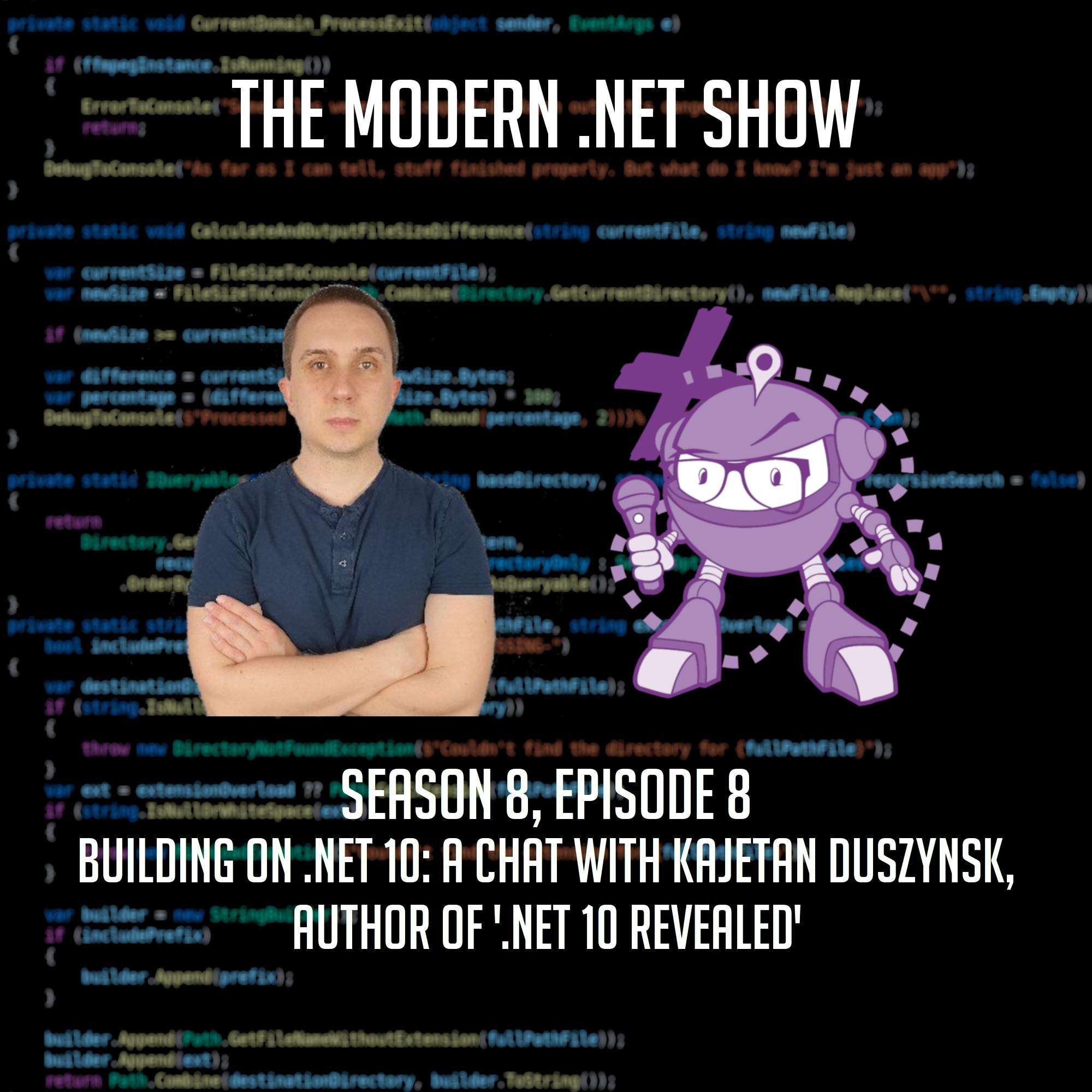 Building on .NET 10: A Chat with Kajetan Duszyńsk, Author of '.NET 10 Revealed' 28.11.2025 1ч 7минStrategic Technology Consultation Services This episode of The Modern .NET Show is supported, in part, by RJJ Software's Strategic Technology Consultation Services. If you're an SME (Small to Medium Enterprise) leader wondering why your technology investments aren't delivering, or you're facing critical decisions about AI, modernization, or team productivity, let's talk. Show Notes "You actually cannot do proper vertical slice if you are bounded to controllers. Because there are some additional dependencies that you can download, like Ardalis [ApiEndpoints] or like Fast Endpoints that will give you actually what Minimal API is giving you. But with the standard controller-based approach you are not able to do the full vertical slice, because every time you'll need to take this, let's say presentation layer, outside your slice because it needs to be, just as you said, in the class that is inheriting from Controller and doing all the actions and stuff like this."— Kajetan Duszyński Hey everyone, and welcome back to The Modern .NET Show; the premier .NET podcast, focusing entirely on the knowledge, tools, and frameworks that all .NET developers should have in their toolbox. I'm your host Jamie Taylor, bringing you conversations with the brightest minds in the .NET ecosystem. Today, we're joined by Kajetan Duszyński to talk about some of the new things that are coming up in .NET 10. We cover some of the big things that you might have missed, some of the optimisations you can make by removing code (listen up for one in a few moments), and we also talk about his new book ".NET 10 Revealed." "So you all need to remember that if you are using Minimal APIs and you've used the extension method WithOpenAPI(), which created a proper OpenAPI schema. Right now it won't be used, so you'll need to delete every usage of this method from your whole application, because it will be um added by default in the pipeline of creating, of starting up the application."— Kajetan Duszyński Along the way we talked about allocations, the importance of learning MSIL (what your C# and F# code is compiled to), memory management, how fast .NET is moving and when we're likely to see the first public preview of .NET 11, and the vertical slice architecture. One of the biggest things that I think will cause some head scratching in .NET 10 is the new local self-signed TLS certificate. I've linked to an article by the folks at Duende about this, and it'll be worth adding it to your reading list. It's a great addition to .NET 10, but it'll catch some folks out. Before we jump in, a quick reminder: if The Modern .NET Show has become part of your learning journey, please consider supporting us through Patreon or Buy Me A Coffee. Every contribution helps us continue bringing you these in-depth conversations with industry experts. You'll find all the links in the show notes. Anyway, without further ado, let's sit back, open up a terminal, type in `dotnet new podcast` and we'll dive into the core of Modern .NET. Full Show Notes The full show notes, including links to some of the things we discussed and a full transcription of this episode, can be found at: https://dotnetcore.show/season-8/building-on-net-10-a-chat-with-kajetan-duszynsk-author-of-net-10-revealed Useful Links: Ardalis ApiEndpoints REPR pattern Fast Endpoints Why You Should Be Using .NET 10's New TLS Certificate Kajetan's .NET school Kajetan on LinkedIn .NET 10 Revealed Supporting the show: Leave a rating or review Buy the show a coffee Become a patron Getting in touch: via the contact page joining the Discord Podcast editing services provided by Matthew Bliss Music created by Mono Memory Music, licensed to RJJ Software for use in The Modern .NET Show Editing and post-production services for this episode were provided by MB Podcast Services Supporting the show: Leave a rating or review Buy the show a coffee Become a patron Getting in Touch: Via the contact page Joining the Discord Remember to rate and review the show on Apple Podcasts, Podchaser, or wherever you find your podcasts, this will help the show's audience grow. Or you can just share the show with a friend. And don't forget to reach out via our Contact page. We're very interested in your opinion of the show, so please get in touch. You can support the show by making a monthly donation on the show's Patreon page at: https://www.patreon.com/TheDotNetCorePodcast. Music created by Mono Memory Music, licensed to RJJ Software for use in The Modern .NET Show. Editing and post-production services for this episode were provided by MB Podcast Services.
 -
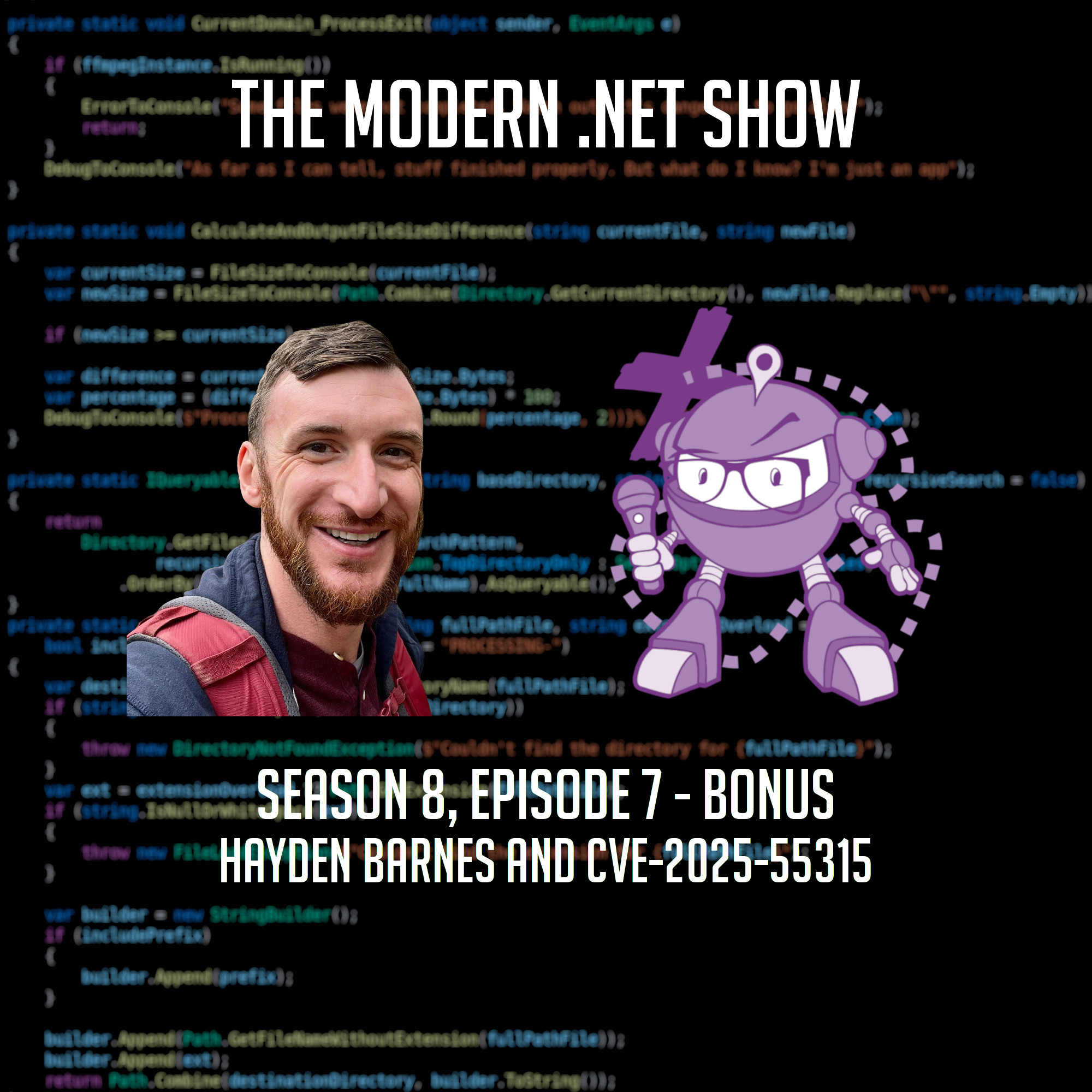 Hayden Barnes and CVE-2025-33515 21.11.2025 36минShow Notes Hey everyone, and welcome back to The Modern .NET Show; the premier .NET podcast, focusing entirely on the knowledge, tools, and frameworks that all .NET developers should have in their toolbox. I'm your host Jamie Taylor, bringing you conversations with the brightest minds in the .NET ecosystem. This episode is a super important, top-of-the-heap, bonus episode that you definitely need to be listening to. I, basically, reached out to Hayden Barnes, who we've just now had on the show to talk about .NET never-ending support and what happens when you drop out of support with Microsoft. The reason that I did that, and the reason that this intro is so raw is because we talked about what is known as "the worst CVE for the internet as a whole. If you want to Google it while we're talking right now, look for "CVE 2025-55315". We'll get into it in a moment, but pretty much everything on the internet is susceptible to this, and only .NET 8, 9, and 10 have a fix. Nothing else has a fix in the. NET space. You will find out in this episode what it is, what problems it can cause you, and how to solve those problems. Please stick around and listen, folks. Thank you, Matt, the editor, for putting this together so quickly. Anyway, on with the episode. I'm not even going to do the dotnet new podcast thing. It's that important. Full Show Notes The full show notes, including links to some of the things we discussed and a full transcription of this episode, can be found at: https://dotnetcore.show/season-8/hayden-barnes-and-cve-2025-55315 About the CVE: Understanding CVE-2025-55315: What CISOs, security engineers, and sysadmins should know ASP.NET Security Feature Bypass Vulnerability Funky chunks: abusing ambiguous chunk line terminators for request smuggling Understanding the worst .NET vulnerability ever: request smuggling and CVE-2025-55315 Hero Devs on X on YouTube on LinkedIn Hayden's links on X on LinkedIn on his blog Supporting the show: Leave a rating or review Buy the show a coffee Become a patron Getting in touch: via the contact page joining the Discord Miscellaneous links: Podcast editing services provided by Matthew Bliss Music created by Mono Memory Music, licensed to RJJ Software for use in The Modern .NET Show Editing and post-production services for this episode were provided by MB Podcast Services Remember to rate and review the show on Apple Podcasts, Podchaser, or wherever you find your podcasts, this will help the show's audience grow. Or you can just share the show with a friend. And don't forget to reach out via our Contact page. We're very interested in your opinion of the show, so please get in touch. You can support the show by making a monthly donation on the show's Patreon page at: https://www.patreon.com/TheDotNetCorePodcast. Music created by Mono Memory Music, licensed to RJJ Software for use in The Modern .NET Show. Editing and post-production services for this episode were provided by MB Podcast Services.
Слични подкасти


Популаран у
Овај подкаст се појављује и у подкаст листама ових земаља.


