
Smart Firefighting
Smart Firefighting
0
Smart Firefighting Podcast covers real-world deployments of smart technologies through conversations with technologists, innovators, companies, and forward-thinking public safety and government agencies. Learn from interviews with leaders as they share their insights and offer their expertise every week. Host Kevin Sofen is a co-founding member of the Smart First Responder Community who loves to explore change management and technology in public safety.
Епизоде
-
 Episode 331: Where Have We Searched? SARCOP, the Common Operating Platform Behind FEMA USAR Teams with Jared Doke 17.09.2026 9минAfter a hurricane, a tornado or a wildfire, search and rescue teams need three answers fast. Where do we need to search? Where have we already searched? Where do we go next? SARCOP, the Search and Rescue Common Operating Platform, exists to answer those questions on a map. Hello Smart Firefighting Community! Welcome to another episode of covering real world innovations via interviews with fire service and technology industry experts that empower YOU to develop your very own Smart Firefighting strategy. Jared Doke is a director at the NAPSG Foundation, the National Alliance for Public Safety GIS. His team built SARCOP on ArcGIS Online and supports all 28 federal FEMA urban search and rescue teams plus teams in 37 states. Recorded at Interschutz, this conversation covers how the platform works, what it looked like on the Eaton fire, how a local agency gets onboarded, and where NAPSG is headed with training and a 24-7 operations branch. Topics covered: What SARCOP is and the three questions it answers Built on ArcGIS Online, configured for urban search and rescue Live layers: weather, flooding, post-event imagery and FEMA analysis Track logs, waypoints, damage observations and hazards The open training sandbox versus the locked deployment side How a local technical rescue or water rescue team gets onboarded All hazards pre-staging: tornado, flood, earthquake and wildfire Surfside to Hurricane Helene and Milton, over 100 teams at once The Eaton fire: pre-staging a week early and secondary searches Ten in-person trainings this year and a 24-7 operations branch SARCOP the product and SARCOP the service So take a listen to hear what he has to share. Head to www.smartfirefighting.com to discover how SFF accelerates innovation for emergency responders, to find out when our next event is, or review our curated resources. Facebook | Instagram | Twitter | LinkedIn
 -
 Episode 330: Building for the City of the Future: CAD Data, Digital Twins and Station Placement with Craig Hiltz – Darkhorse 11.09.2026 19минEvery fire department already owns years of CAD and RMS data. Most of it sits untouched… Hello Smart Firefighting Community! Welcome to another episode of covering real world innovations via interviews with fire service and technology industry experts that empower YOU to develop your very own Smart Firefighting strategy. Craig Hiltz of Darkhorse turns that data into a digital twin of the response system, so a chief can test a station, a roving engine or a staffing change on screen before spending a dollar on it. Recorded at Interschutz, this conversation walks through what a digital twin is in plain language, why a dashboard only tells you what happened yesterday, and what departments in Meridian, Odessa and Toronto found when they asked the what-if questions. Craig also shares his own path from statistician and market researcher to the fire service. Topics covered: Why CAD and RMS data goes unused and what it can answer Dashboards versus the why and the what if Digital twins explained in plain language Meridian, Boise and Eagle in one regional model A roving engine instead of a new station Accreditation data packages: SOC, CRA and the three axes risk model Odessa: two minutes off dispatch equals ten new stations Toronto: a ten percent budget cut and NFPA 1710 compliance ALS to BLS, fleet decisions and firefighter call stress Craig's path from statistics and market research to Dark Horse So take a listen to hear what he has to share. Head to www.smartfirefighting.com to discover how SFF accelerates innovation for emergency responders, to find out when our next event is, or review our curated resources. Facebook | Instagram | Twitter | LinkedIn
 -
 Episode 329: Precision Over Volume: Rethinking the Fire Nozzle with Jason Floyd of HEN Technologies 03.09.2026 29минFor decades the fire service has answered bigger fires with one move: more water. Bigger lines, bigger turrets, bigger flows. Modern fires have outgrown that equation. In wind driven wildfires, traditional fog streams erode before they reach the flame front. Crews end up battling the nozzle instead of the fire. Hello Smart Firefighting Community! Welcome to another episode of covering real world innovations via interviews with fire service and technology industry experts that empower YOU to develop your very own Smart Firefighting strategy. Jason Floyd spent 25 years in the fire service. Now he works with HEN Technologies, the company behind the adjustable smoothbore nozzle. The design started when the founder's wife evacuated her family alone from a California wildfire and challenged him to solve the problem. He was an industry outsider, so he broke the fire stream down to its science. The result merges the best of smoothbore and fog: large wind resistant droplets with an adjustable pattern. The company is now growing from nozzles into a connected system of telemetry, hydraulics, and AI informed command. Topics covered: The origin story: a wildfire evacuation and an industry outsider Superior fluidics in plain language Merging 60 years of smoothbore and fog into one nozzle Pre-distributed water: laser beam versus paintbrush Large space fires and master stream limitations Rethinking brush fire turrets for mega fires The Maui study and wind resistant streams UL research: put water in the right place Nozzle reaction, fatigue, and one firefighter hand lines From HEN Nozzles to HEN Technologies: telemetry, AI, and command So take a listen to hear what he has to share. Head to www.smartfirefighting.com to discover how SFF accelerates innovation for emergency responders, to find out when our next event is, or review our curated resources. Facebook | Instagram | Twitter | LinkedIn
 -
 Episode 328: 300 Firefighters in 3.5 Weeks: How San Diego Built VR Search and Rescue Training with Captain J Harris 28.08.2026 42минMost fire crews get few real repetitions on search and rescue. The calls are rare. The training is expensive. It takes companies out of service, and it adds injury and exposure risk. San Diego Fire-Rescue built a different path. Hello Smart Firefighting Community! Welcome to another episode of covering real world innovations via interviews with fire service and technology industry experts that empower YOU to develop your very own Smart Firefighting strategy. Captain J Harris leads the program. The department partnered with XpertVR and built structured virtual reality training. Every riding position has role based benchmarks. The curriculum ties to UL FSRI research and the Firefighter Rescue Survey's first 3,000 rescues. In the first rollout, more than 300 firefighters trained in three and a half weeks. The schedule filled. Crews asked when they could come back. Topics covered: The four problems VR training solves: time, cost, injury risk, and gear exposure How San Diego worked through fire service skepticism The no fault learning environment Benchmarks built from the first 3,000 rescues data Targeted search and high percentage areas Training is lived, not lectured Shared crew rescue experiences and peer learning Three scenarios: passerby report, text from a trapped victim, single call smoke report The rollout: 300 firefighters in three and a half weeks What comes next: command training and hazmat scenarios So take a listen to hear what he has to share. Head to www.smartfirefighting.com to discover how SFF accelerates innovation for emergency responders, to find out when our next event is, or review our curated resources. Facebook | Instagram | Twitter | LinkedIn
 -
 Episode 327: A Governance Problem, Not a Technology Problem: Inside Pratus with Roger Coleman and Sean Griffin 20.08.2026 1ч 19минEvery disaster review finds the same failure: communication. Crews on 9/11 passed handwritten notes. Agencies at the LA wildfires could not talk across radio bands. During Hurricane Maria, restoration trucks sat at a pier while their ship steamed away. The pattern repeats because the lessons never reach the next operation. Hello Smart Firefighting Community! Welcome to another episode of covering real world innovations via interviews with fire service and technology industry experts that empower YOU to develop your very own Smart Firefighting strategy. Roger Coleman served as a volunteer fire chief in New York's Eighth Battalion. Sean Griffin directed incident management at the White House for ten years across two administrations. Together they built Pratus, the DisasterTech platform that pulls every data source into one view and uses AI to guide decisions. The US Coast Guard adopted it as its all theater common operating platform. The first mission: security for the 2026 World Cup and America 250 events. Topics covered: How a fire chief and a White House incident manager joined forces What administration changes do to institutional knowledge A governance problem, not a technology problem AI checklists that cite the actual plan The single pane of glass: Teams, Azure, Esri, drones, body cams Communication failures from 9/11 to the LA wildfires The Coast Guard contract, the 2026 World Cup, and America 250 Real time sit reps and same day after action reviews The trucks left at the pier during Hurricane Maria Gamified training and the edge hardware play with Darley So take a listen to hear what they have to share. Head to www.smartfirefighting.com to discover how SFF accelerates innovation for emergency responders, to find out when our next event is, or review our curated resources. Facebook | Instagram | Twitter | LinkedIn
 -
 Episode 326: Embrace the Suck a Little Less: Purpose-Built Wildland Tools with Scott Reimann of Vallfirest 11.08.2026 36минWildland fires are bigger and faster than they were 20 years ago. Much of the gear on the line has not kept up. A broken shovel. A pack that does not fit. Standard issue equipment that looks 50 years old because it basically is… Hello Smart Firefighting Community! Welcome to another episode of covering real world innovations via interviews with fire service and technology industry experts that empower YOU to develop your very own Smart Firefighting strategy. Scott Reimann handles technical sales for Vallfirest, the Spanish manufacturer now working across North America with partners like Darley. The company started when founder Javier, a summer hire on fire crews near Barcelona, decided firefighters deserved better and began inventing his own tools. 20 years later the line spans the Gorgui multi-tool, a backpack pump built around real body mechanics, inflatable ground tanks up to 18,000 gallons, and the Dronester remote control masticator. The philosophy has not changed: hand the prototype to a crew, let them beat it into oblivion, and listen to everything they say. Topics covered: The Vallgorguina origin story and how Vallfirest got its name Founder Javier's first inventions: the mini drip torch and the Gorgui tool Solutions versus widgets in wildland equipment design Prototyping with real crews and building from end user feedback How the Gorgui multi-tool covers two thirds of hand crew line work The stages of cutting fire line, from breaking ground to mineral soil Backpack pump ergonomics and the dual action wand Inflatable ground tanks from 800 to 18,000 gallons Remote water supply for red flag days and helicopter operations Drones, the Waterhog bucket, and RC equipment in the next three to five years So take a listen to hear what he has to share. Head to www.smartfirefighting.com to discover how SFF accelerates innovation for emergency responders, to find out when our next event is, or review our curated resources. Facebook | Instagram | Twitter | LinkedIn
 -
 Episode 325: Become Dangerously Competent: Training, Hazmat, and AI in the Fire Service with Jake Ryks - The HazMat Guys 30.07.2026 55минThe fire service has spent years turning hazmat into either a horror movie or a checklist. Jake Ryks thinks both are wrong. Hello Smart Firefighting Community! Welcome to another episode of covering real world innovations via interviews with fire service and technology industry experts that empower YOU to develop your very own Smart Firefighting strategy. Jake Ryks is a firefighter and hazmat specialist with the St. Paul Fire Department, assigned to Squad One and Hazmat One. He writes for Firehouse and builds education for The HazMat Guys. His mission is to strip the mythology out of hazmat and put basic chemistry and pragmatic operations in its place. This conversation moves from what the fire service gets wrong about hazmat, to why preparation beats bravado, to where AI is actually useful on a hazmat scene. Topics covered: Why hazmat reads as scary, and how a knowledge gap creates the fear Going from boring to puzzles, and what makes a good hazmatician Teaching abstract chemistry through tangible metaphors The misunderstood idea that hazmat is slow, and why life safety still comes first Why the fire service comes second to the unprotected civilian Rising to the occasion versus falling to your level of training A 2014 house fire rescue and pride in preparedness Mental health and becoming dangerously competent Owning mistakes, and the training saw that hangs on Jake's locker AI and tech in hazmat training and operations, plus an early look at the Haven app So take a listen to hear what he has to share. Head to www.smartfirefighting.com to discover how SFF accelerates innovation for emergency responders, to find out when our next event is, or review our curated resources. Facebook | Instagram | Twitter | LinkedIn
 -
 Episode 324: Firefighters Are Tactical Athletes: Recovery Debt, Sleep, and the Safe to Talk Culture with Marc Wysocki 23.07.2026 57минSociety wants an Olympic athlete neurosurgeon on every call. That superhero may have already saved the day ten times this week, at two in the morning, on no sleep. Nobody sees the beating on the inside. Hello Smart Firefighting Community! Welcome to another episode of covering real world innovations via interviews with fire service and technology industry experts that empower YOU to develop your very own Smart Firefighting strategy. Captain Marc Wysocki of the Sheffield Volunteer Fire Department won first place in the 2025 Darley Thought Leadership Essay Contest with "Behind the Mask" - an essay on the root causes of mental health challenges in the fire service. He is also the head athletic trainer at Berkshire School and recently finished his doctorate, so he looks at firefighters the way he looks at athletes: as tactical athletes who cannot perform without recovery. This conversation maps the forces his essay names, comparative suffering, the 200 micro traumas packed away, recovery debt, emotional contagion in close quarters, and lays out what a safe to talk culture actually looks like in a firehouse. Topics covered: Treating firefighters, EMS, and police as tactical athletes Comparative suffering and the micro traumas that stack up The superhero myth and taking a beating on the inside Berkshire County's crisis response team and 48-hour debriefs Emotional suppression as a double edged sword The volunteer's double life after a multi-fatality call Emotional contagion and learning to read your crew Sleep disruption, recovery debt, and the sleep riddle A psychological safety leadership certification for officers Military lessons on culture: work with people, not above them So take a listen to hear what he has to share. Head to www.smartfirefighting.com to discover how SFF accelerates innovation for emergency responders, to find out when our next event is, or review our curated resources. Facebook | Instagram | Twitter | LinkedIn
 -
 Episode 323: How a Fire Department Decides What Tech to Buy with Eric Linnenburger 16.07.2026 59минThe biggest constraint most fire departments face is not money. It is being shorthanded. Over 90% of a typical fire budget goes to personnel, which leaves almost nothing for the next great tool and no spare bandwidth to chase every vendor at the trade show. Hello Smart Firefighting Community! Welcome to another episode of covering real world innovations via interviews with fire service and technology industry experts that empower YOU to develop your very own Smart Firefighting strategy. Eric Linnenburger spent roughly twenty-six years climbing every rank at Westminster Fire Department on Colorado's front range, then found out on a Friday that he was a deputy chief starting Monday. He is also the voice behind Ops Talk, where he digs into the people, the work, and the ideas moving the fire service forward. This conversation gets into how a real department decides what technology to buy, what kills a bad idea fast, and the honest state of the playbook around lithium-ion and EV battery fires. Topics covered: The Friday-to-Monday jump from battalion chief to deputy chief The schmedium model: a six-station department that runs like a 35-station region Bringing the right stakeholders to the room before buying anything Force multiplier versus one more screen for an overloaded firefighter The RFID system that looked great on paper and just moved the work Apps that stuck: tablet command and on-scene translation Lithium-ion and EV fires, blankets, and guidelines that have to evolve Data centers and energy storage as the next risk on the horizon Wildfire in the urban interface and the Marshall Fire wake-up call Clean data, open APIs, and avoiding vendor lock-in with CAD to CAD So take a listen to hear what he has to share. Head to www.smartfirefighting.com to discover how SFF accelerates innovation for emergency responders, to find out when our next event is, or review our curated resources. Facebook | Instagram | Twitter | LinkedIn
 -
 Episode 322: Inside Panasonic Tough Command: Connected Vehicles for Emergency Response with Kjeld Lindsted 25.06.2026 42минMost first responder vehicles are full of technology that does not talk to itself. A dash cam here. A radio there. An MDT, a license plate reader, lights and sirens, all from different makers, all siloed. The data exists. It just never lands in one place where anyone can use it. Hello Smart Firefighting Community! Welcome to another episode of covering real world innovations via interviews with fire service and technology industry experts that empower YOU to develop your very own Smart Firefighting strategy. Kjeld Lindsted is the Associate Director of Software Products at Panasonic. His team built Tough Command, a software platform that wraps the Toughbook already sitting in several hundred thousand police and fire vehicles. One device. One cell plan that already exists. Every piece of vehicle data pulled into the cloud one time, then made useful. Where the vehicle is. What its status is. What it is doing right now. Three simple pieces of information that underpin almost everything in connected emergency response. This conversation gets into what that makes possible. A fleet manager who asks a question in plain English and gets an answer. A chief who gets a text the moment a vehicle crosses 80 miles an hour. A green light that clears the intersection before the truck arrives. And the harder questions underneath it all: Who owns the data? How does it stay secure? Where is the V2X mandate really headed? Topics covered: From Toughbook hardware to the Tough Command software platform The three data points behind every connected vehicle Asking fleet data questions in plain English with built in AI Why a logged SQL query matters for security and compliance Fleet managers, command staff, and IT in one platform Real time alerts, from an 80 mph text to a high speed chase Traffic signal preemption and the connected intersection Geofencing for public policy and community presence Data ownership, CJIS, and a zero trust security model The V2X mandate explained, and where it goes in five years So take a listen to hear what he has to share. Head to www.smartfirefighting.com to discover how SFF accelerates innovation for emergency responders, to find out when our next event is, or review our curated resources. Facebook | Instagram | Twitter | LinkedIn
 -
 Episode 321: Building for Chaos, Not Compliance with Bailey Farren – Perimeter 11.06.2026 28минBailey Farren is the co-founder and CEO of Perimeter. In 2017 she was evacuated from the Tubbs Fire, and what she saw that night, people with no way to know where the danger was or where to go, became the problem she has spent the better part of a decade solving. Hello Smart Firefighting Community! Welcome to another episode of covering real world innovations via interviews with fire service and technology industry experts that empower YOU to develop your very own Smart Firefighting strategy. Perimeter is a real-time map that gives first responders, emergency managers, and the public one shared picture of an incident. One link. No app. No training. This conversation is about what it takes to build technology for the worst moment of a person's life, and why the future of public safety depends on getting it right. Topics covered: Why Perimeter is built for the public's worst moment, not their best intentions The Google Maps test: public safety tools that need zero training Miscommunication versus misinformation, and why agencies keep losing the source of truth How one shareable link goes viral during an incident The Davis Fire in Washoe County and a 40% drop in non-emergency 911 calls Where AI actually helps, and where it should stay out of the decision Blue sky events: concerts, parades, and the World Cup What hundreds of investors got wrong about selling tech to the fire service So take a listen to hear what she has to share. Head to www.smartfirefighting.com to discover how SFF accelerates innovation for emergency responders, to find out when our next event is, or review our curated resources. Facebook | Instagram | Twitter | LinkedIn
 -
 Episode 320: He Missed the Hydrant, Then Built the Tool to Ensure No One Else Does. Rapid Response Co with Bobby Banome 21.05.2026 54минBobby Banome is an FDNY firefighter from Staten Island who got tired of arriving at fires without the information his crew needed. So he built something. Hello Smart Firefighting Community! Welcome to another episode of covering real world innovations via interviews with fire service and technology industry experts that empower YOU to develop your very own Smart Firefighting strategy. Eleven years ago, Bobby was a probie on a company with a brand-new chauffeur on his first tour driving. They had a fire in a catering hall. They missed the building. Then they missed their closest hydrant. Nobody died, but the delay in water on the fire and the fire spread that followed did not have to happen. That call became the origin story for Rapid Response Co. Rapid Response Co is a patented AI-powered situational awareness platform that gives engine companies a 360-degree view of the building, the nearest working hydrants, and a plan of attack before anyone steps off the apparatus. It is deployed in Phoenix, Washington DC, New York City, and volunteer departments across the country. In this episode, Kevin and Bobby walk through what it actually takes to go from "this should exist" to "this is on fire trucks." Bobby covers the full feature set: hydrant mapping, 360-degree street views, 3D building data, and the EV Rescue integration for electric vehicle incidents. They also get into the AI layer, the SaaS model, and where the platform is heading. This is a builder story from inside the fire service. So take a listen to hear what he has to share. Head to www.smartfirefighting.com to discover how SFF accelerates innovation for emergency responders, to find out when our next event is, or review our curated resources. Facebook | Instagram | Twitter | LinkedIn
 -
 Episode 319: How Garage Is Fixing the Broken Secondary Market for Fire Apparatus with Martin Hunt 14.05.2026 46минThe secondary market for fire apparatus runs on Facebook groups, newspaper classifieds, and local auctions. A small town in Texas budgeted $100,000 for a used truck sale. Garage got them $1.3 million. That is what happens when you put infrastructure behind a market that has never had any. Hello Smart Firefighting Community! Welcome to another episode of covering real world innovations via interviews with fire service and technology industry experts that empower YOU to develop your very own Smart Firefighting strategy. Martin Hunt, co-founder and CEO of Garage, built what did not exist. He started fighting fires at 15, served 6 years as a Firefighter/EMT, then walked away from Goldman Sachs when a buddy called from the fire service with a problem nobody had solved. In this episode, Kevin sits down with Martin to walk through how the platform works, what it takes to earn trust from risk-averse public sector buyers, and why used apparatus deserves to be taken seriously as a procurement strategy. Topics covered: - The origin story: a buddy's call and a marketplace that didn't exist - How Garage solved the two-sided marketplace problem - Navigating bureaucracy and de-risking for public sector buyers - Freight solved: instant quotes, price lock, and Garage owns the risk - Trust infrastructure: verified organizations, payments, and virtual inspections - AI-powered appraisals: the Kelley Blue Book for fire trucks - Extended warranties and third-party inspections - Why nobody built this before 2023 - The case for buying used: cost, availability, and 1,500-day delivery quotes on new apparatus - Beyond fire trucks: ambulances, EMS equipment, and more - Servant leadership and the Drum Major Instinct as company culture So take a listen to hear what he has to share. Head to www.smartfirefighting.com to discover how SFF accelerates innovation for emergency responders, to find out when our next event is, or review our curated resources. Facebook | Instagram | Twitter | LinkedIn
 -
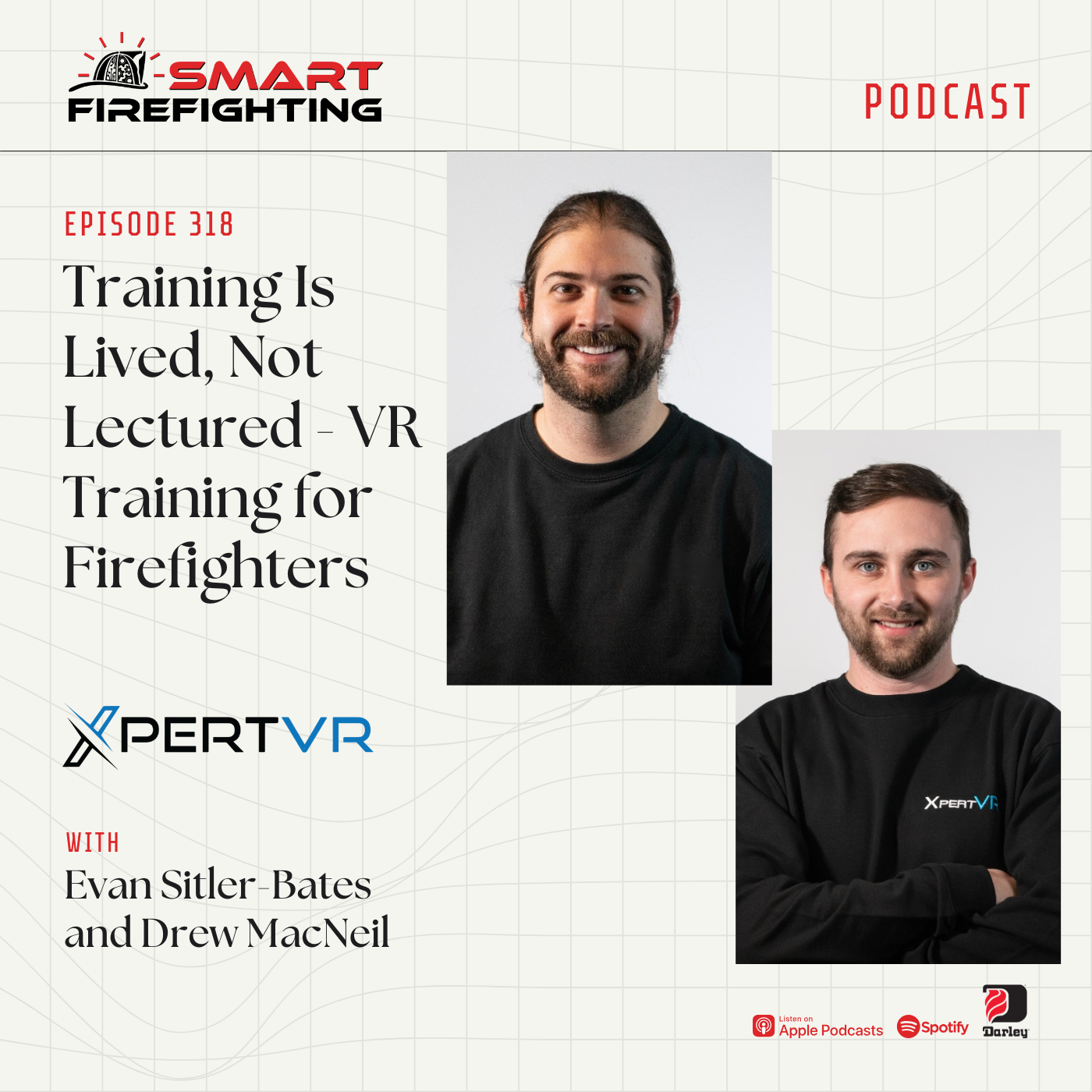 Episode 318: Training Is Lived, Not Lectured - VR Training for Firefighters with Evan Sitler-Bates and Drew MacNeil from XpertVR 07.05.2026 34минFirefighters train all year, but most of it is death by PowerPoint. Evan Sitler-Bates and Drew MacNeil, co-founders of XpertVR, are building a different answer: immersive virtual reality simulations where firefighters actually do the work instead of watching someone describe it. Hello Smart Firefighting Community! Welcome to another episode of covering real world innovations via interviews with fire service and technology industry experts that empower YOU to develop your very own Smart Firefighting strategy. In this episode, Kevin sits down with the XpertVR founders to dig into how their platform works, what fire departments are actually using it for, and why lived experience sticks when lectures don't. Topics covered: - Why XpertVR chose first responders over corporate training - The "training is lived, not lectured" philosophy and what it means in practice - How sandbox environments let departments customize scenarios to their specific community risks - The San Diego Fire Department case study: 350+ firefighters through VR training in 21 days - The Ontario College result: best-prepared pre-service students in 13 years - Memory retention research: 20% from a PowerPoint vs. 80% from VR after a year - Lithium ion fire scenarios and what they reveal about modern fire training gaps - Hardware, software, and data: what XpertVR captures while firefighters train - How to actually implement VR in a department, not just buy it and shelve it - Where VR fits in the training ecosystem: and, not or So take a listen to hear what they have to share. Head to www.smartfirefighting.com to discover how SFF accelerates innovation for emergency responders, to find out when our next event is, or review our curated resources. Facebook | Instagram | Twitter | LinkedIn
 -
 Episode 317: Bridging Firefighters and Engineers Through Leadership and Trust with Mark Reilly 30.04.2026 12минWhat does leadership really look like when lives are on the line? Hello Smart Firefighting Community! Welcome to another episode of covering real world innovations via interviews with fire service and technology industry experts that empower YOU to develop your very own Smart Firefighting strategy. Recorded live at the Institution of Fire Engineers (IFE) 2025 Conference alongside the AFAC, WAFA, and Australian Institute for Disaster Resilience Conference in Perth, Australia. In this episode, Mark Reilly shares perspective shaped by 38 years of service across the military and fire service, along with his new role as International President of the Institution of Fire Engineers. Speaking from the global stage at AFAC 2025, he reflects on the responsibility of guiding both firefighters and fire engineers toward a shared mission of safety. Mark explains how the Institution of Fire Engineers has spent more than a century setting standards that build trust across the profession, from recruit training through executive leadership. He also highlights a critical connection that often goes overlooked, the relationship between those who design buildings and those who enter them during emergencies. The conversation explores the real world consequences when that connection breaks down, and how stronger collaboration can lead to safer outcomes for both responders and the public. Mark also shares how international collaboration, education, and mentorship are helping bring new ideas and global perspectives to fire services across Australia and beyond. At the center of it all is a simple but powerful idea, leadership is not a title, it is something you do every day. So take a listen to hear what he has to share. Head to www.smartfirefighting.com to discover how SFF accelerates innovation for emergency responders, to find out when our next event is, or review our curated resources. Facebook | Instagram | Twitter | LinkedIn
 -
 Episode 316: Why Mental Health Conversations Matter in the Fire Service with Max Cottingham 23.04.2026 21минIt’s okay to not be okay. The question is, who notices? Hello Smart Firefighting Community! Welcome to another episode of covering real world innovations via interviews with fire service and technology industry experts that empower YOU to develop your very own Smart Firefighting strategy. Recorded live at the Institution of Fire Engineers (IFE) 2025 Conference alongside the AFAC, WAFA, and Australian Institute for Disaster Resilience Conference in Perth, Australia. In this episode, Maxwell Cottingham of Fire and Rescue New South Wales shares how his department is building a culture where firefighters feel supported, seen, and safe to speak up. From peer support programs to chaplaincy and professional services, the structure is there, but the real shift is happening at the human level. Max explains why most firefighters do not turn to formal resources first. They turn to each other. That reality is reshaping how departments think about mental health support, placing new focus on the people who receive those first conversations. This discussion explores the continuum of mental health, the weight of self stigma, and the importance of early care before challenges grow into something more serious. Max also breaks down a simple but powerful framework for checking in, listening without judgment, and staying connected over time. In sum, this episode is about culture, trust, and the responsibility firefighters carry not just for their communities, but for each other. So take a listen to hear what he has to share. Head to www.smartfirefighting.com to discover how SFF accelerates innovation for emergency responders, to find out when our next event is, or review our curated resources. Facebook | Instagram | Twitter | LinkedIn
 -
 Episode 315: When Fire Protection Has No Rulebook with Alex Starkey 16.04.2026 12минWhat happens when fire protection standards do not apply? Hello Smart Firefighting Community! Welcome to another episode of covering real world innovations via interviews with fire service and technology industry experts that empower YOU to develop your very own Smart Firefighting strategy. Recorded live at the Institution of Fire Engineers (IFE) 2025 Conference alongside the AFAC, WAFA, and Australian Institute for Disaster Resilience Conference in Perth, Australia. In this episode, Alex Starkey shares what it takes to protect environments that fall outside traditional fire codes. From tunnels to aircraft hangars, these are the risks where standard solutions do not apply and every design requires careful engineering. Alex explains how water mist is gaining ground as a practical option in spaces with limited resources or environmental constraints. He also highlights emerging technologies like fiber optic heat detection and autonomous suppression systems that are changing how teams prevent and control fires. Overall, this conversation is about stepping into complex challenges, continuing to learn, and sharing knowledge to move the industry forward. So take a listen to hear what he has to share. Head to www.smartfirefighting.com to discover how SFF accelerates innovation for emergency responders, to find out when our next event is, or review our curated resources. Facebook | Instagram | Twitter | LinkedIn
 -
 Episode 314: Reducing Risk Before It Becomes Disaster with Emma Whale & Amanda Leck 09.04.2026 18минWhat does risk really mean when the stakes are rising for entire communities? Hello Smart Firefighting Community! Welcome to another episode of covering real world innovations via interviews with fire service and technology industry experts that empower YOU to develop your very own Smart Firefighting strategy. Recorded live at the Institution of Fire Engineers (IFE) 2025 Conference alongside the AFAC, WAFA, and Australian Institute for Disaster Resilience Conference in Perth, Australia. In this episode, Emma Whale & Amanda Leck from the New South Wales Reconstruction Authority share how they are rethinking disaster preparedness through data, community insight, and practical action. As floods, fires, and storms grow in scale and impact, the focus is shifting from reacting after the fact to making smarter decisions before disaster strikes. From home buyback programs in high risk flood zones to long term planning that considers future population growth and climate impact, this conversation highlights what it looks like to turn data into real world outcomes. It also reinforces a hard truth, recovery is costly, and without stronger investment in mitigation, those costs will continue to climb. At its core, this episode is about shared responsibility, leadership at every level, and ensuring that no community is left out of the conversation. So take a listen to hear what they have to share. Head to www.smartfirefighting.com to discover how SFF accelerates innovation for emergency responders, to find out when our next event is, or review our curated resources. Facebook | Instagram | Twitter | LinkedIn
 -
 Episode 313: Why First Responders Need One Global Language for Safety with Kurt Vollmacher 02.04.2026 11минHow do you prepare firefighters for risks that did not exist 10 years ago? Hello Smart Firefighting Community! Welcome to another episode of covering real world innovations via interviews with fire service and technology industry experts that empower YOU to develop your very own Smart Firefighting strategy. Recorded live at the Institution of Fire Engineers (IFE) 2025 Conference alongside the AFAC, WAFA, and Australian Institute for Disaster Resilience Conference in Perth, Australia. After 4 decades in the fire service, Kurt Vollmacher has seen firsthand how quickly the job is changing. What used to be a world of diesel and gasoline has evolved into one filled with lithium ion batteries, hydrogen, ammonia, and a growing list of complex energy sources. For first responders, that shift brings new risks and a critical need for clear, reliable information. In this episode, Kurt shares how his experience led him to focus on one simple but powerful idea: giving responders the right information at the right time. His work on ISO 17840 is helping create a standardized system of symbols, rescue sheets, and guidance that can be understood across countries, languages, and incident types. This conversation explores the growing complexity facing firefighters, the challenge of aligning manufacturers and responders, and the importance of training around consistent, recognizable information. Kurt also reflects on the long road of building global standards, the partnerships driving the effort forward, and the mindset required to keep pushing progress. At its core, this episode is about making emergency response safer through clarity, collaboration, and persistence. So take a listen to hear what he has to share. Head to www.smartfirefighting.com to discover how SFF accelerates innovation for emergency responders, to find out when our next event is, or review our curated resources. Facebook | Instagram | Twitter | LinkedIn
 -
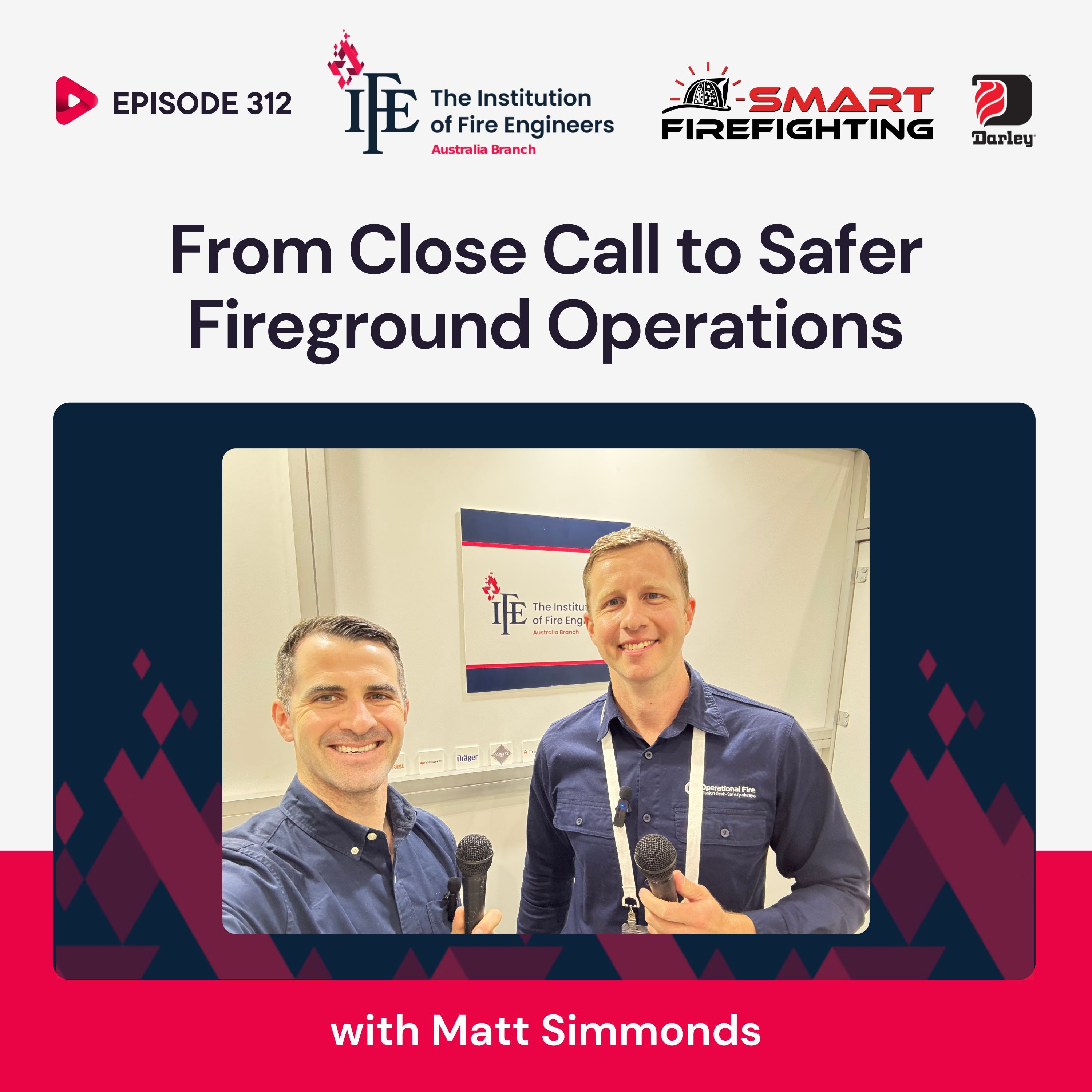 Episode 312: From Close Call to Safer Fireground Operations with Matt Simmonds 26.03.2026 10минWhat starts as a routine task on the fireground can quickly turn into a life threatening moment. For Matt Simmonds, that moment came while rolling hose after a fire, when a passing vehicle nearly struck his crew. That close call sparked a question that many firefighters have quietly accepted for years. Is this really the safest way to do this job, or is there a better way? Hello Smart Firefighting Community! Welcome to another episode of covering real world innovations via interviews with fire service and technology industry experts that empower YOU to develop your very own Smart Firefighting strategy. Recorded live at the Institution of Fire Engineers (IFE) 2025 Conference alongside the AFAC, WAFA, and Australian Institute for Disaster Resilience Conference in Perth, Australia. In this episode, Matt Simmonds, co-founder of Operational Fire and a full time firefighter, shares the story behind building a tool designed to improve safety, reduce physical strain, and protect long term health. What began as a makeshift setup using a child’s bike evolved into a purpose built solution shaped by real operational experience. In this conversation, Matt breaks down the risks firefighters face during post incident cleanup, including back injuries and hidden exposure to harmful contaminants. He also explains how thoughtful design can reduce those risks while improving efficiency on scene. It is a grounded look at how small changes on the fireground can have lasting impact on safety, longevity, and the ability to keep serving the community. So take a listen to hear what he has to share. Head to www.smartfirefighting.com to discover how SFF accelerates innovation for emergency responders, to find out when our next event is, or review our curated resources. Facebook | Instagram | Twitter | LinkedIn
Слични подкасти


Популаран у
Овај подкаст се појављује и у подкаст листама ових земаља.
