
How to English TEFL Podcast
Gav and Em
0
How To English TEFL Podcast is a weekly show offering teaching inspiration for TEFL teachers and English learners. Hosts Gav and Em, two experienced English teachers, discuss practical teaching techniques, learning tips, and real classroom stories. Each episode aims to provide useful and actionable advice for improving teaching and learning.
Епизоде
-
 How Should English Teachers Check Answers, Pronounce Names & Stay Motivated? | TEFL Tips – S07E16 11.09.2026 36минWhy are your students learning English? How should teachers check answers without wasting lesson time? And what should you do when you have no idea how to pronounce a new student’s name?In S07E16 of the How to English TEFL Podcast, Gav and Em explore everyday questions English teachers face.They begin with one deceptively simple word: why? Why do we teach? Why are our students in the lesson? And why is it worth revisiting their goals as a course develops?Drawing on their TEFL experience, Gav and Em discuss what keeps them teaching: language, flexibility, career opportunities and helping learners communicate.Then comes email and admin: homework, timetable changes, cancellations, new classes and those messages sent five minutes before the lesson.They also tackle student names. Should teachers research pronunciation before the first lesson? What happens when the same name is pronounced differently in different countries?Finally, Gav and Em disagree rather spectacularly about checking students’ answers. Should learners compare answers in pairs before whole-class feedback? If everyone already has the correct answers, is checking them again useful confidence-building — or a waste of lesson time?Along the way, they share practical techniques including peer checking, student nomination, varying who answers, testing what learners remember and personalising answers.Whether you teach TEFL, ESL, EFL, Business English or general English, this episode offers practical classroom ideas — and proof that experienced teachers don’t always agree on the “right” way to do things.EPISODE GUIDE + TEACHING RESOURCESEpisode guide:https://howtoenglishpod.wordpress.com/episode-guide-how-should-english-teachers-check-answers-pronounce-names-stay-motivated-tefl-tips-s07e16/How Often Should TEFL Teachers Revisit Learners’ Goals?https://howtoenglishpod.wordpress.com/how-often-should-tefl-teachers-revisit-learners-goals-s07e16/Is TEFL a Good Long-Term Career? What Keeps Teachers in the Jobhttps://howtoenglishpod.wordpress.com/is-tefl-a-good-long-term-career-what-keeps-teachers-in-the-job-s07e16/How Can TEFL Teachers Manage Email and Admin Without Letting It Take Over?https://howtoenglishpod.wordpress.com/how-can-tefl-teachers-manage-email-and-admin-without-letting-it-take-over-s07e16/How Should English Teachers Pronounce Students’ Unfamiliar Names?https://howtoenglishpod.wordpress.com/how-should-english-teachers-pronounce-students-unfamiliar-names-s07e16/What Is the Best Way to Check Students’ Answers in an English Lesson?https://howtoenglishpod.wordpress.com/what-is-the-best-way-to-check-students-answers-in-an-english-lesson-s07e16/More practical TEFL articles, teaching tips and resources:https://howtoenglishpod.comSupport Gav & Em:https://ko-fi.com/howtoenglishpodCONTENTS / TIMESTAMPS00:00 – What’s coming up?01:01 – Welcome to S07E1602:13 – Why are we teachers?03:32 – Why are your students learning English?04:59 – Why Gav and Em still enjoy teaching06:50 – Career opportunities in TEFL09:11 – Why teachers and learners should keep asking “why”10:05 – What emails do TEFL teachers receive?14:20 – When should teachers answer emails?16:33 – The five-minutes-before-class email17:32 – How do you pronounce a student’s name?18:03 – Researching names before a lesson22:10 – How should teachers check students’ answers?22:51 – Should students check with a partner?24:03 – Gav and Em disagree27:04 – Do you need whole-class feedback?29:40 – Checking answers to build confidence31:56 – Who should answer each question?33:25 – Keeping students on their toes34:33 – Stop students simply reading the answers35:03 – Personalising answers35:26 – Ko-fi, teaching resources & goodbye
 -
 Is Your Lesson Becoming the Teacher Show? | How to English TEFL Podcast - S07E15 28.08.2026 32минHow much should a teacher actually talk in an English lesson — and when should they simply get out of the way?In S07E15, Gav and Em discuss what teachers really do in the classroom (and what they don’t!).We explore whether a lesson should ever become “The Teacher Show”, how teachers can guide conversations without dominating them, when to jump into a discussion, and why timing matters when correcting errors.We also talk about supporting lower-level learners, encouraging students to help each other, and remembering that while teachers may think about English all day, an English lesson might be just one small part of a student’s busy week.Plus: a simple tip for learners — keep notes of interesting English you hear, read or see during the week and bring those questions to your teacher.⏱️ KEY MOMENTS00:00 – What do teachers really do in the classroom?02:26 – Why your lesson shouldn’t be “The Teacher Show”03:57 – Do students actually need a teacher?06:26 – Should teachers give their opinions?07:15 – Stepping back and delayed error correction09:54 – The teacher as an orchestra conductor11:43 – When should you correct errors?13:05 – Getting a speaking activity started13:58 – Supporting lower-level learners16:04 – What does “lower-level” actually mean?20:52 – Students teaching students24:01 – The lesson from the student’s perspective☕ Support the show: ko-fi.com/howtoenglishpod🌐 Visit us: howtoenglishpod.comHow to English: Teach & Learn with Gav & Em — a podcast about teaching and learning English as a foreign language.
 -
 Should TEFL Teachers Use the Teacher’s Book? Do Students Really Learn Grammar? | Gav & Em Answer Your TEFL Questions – S07E14 14.08.2026 34минIn this episode, Gav and Em tackle the real questions TEFL teachers ask every day:What exactly is a student’s book supposed to do?Is the teacher’s book worth using — or is it overwhelming?How do you fix confusing coursebook tasks?Do students actually learn grammar from lessons, or somewhere else entirely?Why do learners forget grammar rules even after you’ve taught them?Where does real learning happen — in the book, in conversation, or online?With practical examples, honest stories, and classroom‑tested hacks, this episode helps teachers rethink how they plan, how they use materials, and how they support learners in a more natural, intuitive way.Support the show: ko-fi.com/howtoenglishpodVisit our homepage: https://howtoenglishpod.wordpress.com/Timestamps00:00 – How do TEFL teachers use quiet weeks to get organised? 01:20 – What are TEFL learners actually looking for in a coursebook? 03:00 – What is a student’s book, and how does it support learning? 05:00 – Why do coursebooks teach through topics instead of grammar labels? 06:00 – What’s inside a teacher’s book, and why is it so overwhelming? 09:00 – Should teachers rely on the teacher’s book or trust their instincts? 16:00 – What do you do when a teacher’s book activity is badly designed? 20:00 – How do you adapt confusing listening tasks for real learners? 24:00 – Does teaching grammar actually work, or do students forget it anyway? 30:00 – Where does learning really happen — and how do teachers reinforce it?
 -
 Speak with Confidence: The Mindset Every TEFL Teacher Needs | Helen von Dadelszen - S07E13 31.07.2026 28минBuild Real Speaking Confidence with Helen von Dadelszen | TEFL Tips, Communication Skills & Classroom CourageHow can teachers and English learners become more confident speakers without waiting until they suddenly feel ready?In this episode of How to English: Teach & Learn with Gav & Em, we welcome Helen von Dadelszen, communication coach, vocal trainer, former TEFL teacher and author of Courageous Action.Helen challenges the idea of “I’ll speak when I feel confident” and explains why confidence is built through action. We discuss practical ways to manage nerves, slow your breathing, speak more calmly, shift the focus away from yourself and create a classroom where students feel safer speaking English.Gav and Em also explore helping shy learners, using pair work to reduce pressure, avoiding over-correction and encouraging small courageous actions that gradually build confidence.In this episode:✅ Why confidence often comes after action✅ How to manage nerves before teaching or speaking✅ Simple breathing techniques✅ Why nervous speakers often talk too quickly✅ How slowing down improves communication✅ Helping shy students speak more✅ When not to correct speaking mistakes✅ How real learners build confidence📚 S07E13 Teaching ArticlesBreathing Techniques for Teachers and Learnershttps://howtoenglishpod.wordpress.com/breathing-techniques-for-teachers-and-learners-helens-vocal-coaching-tips/Encouraging Small Courageous Actions in Englishhttps://howtoenglishpod.wordpress.com/encouraging-small-courageous-actions-in-english-inspired-by-helen-von-dadelszen/Helping Shy Students Speak More in Englishhttps://howtoenglishpod.wordpress.com/helping-shy-students-speak-more-in-english-advice-from-helen-gav-em/How can I help my students feel confident speaking English?https://howtoenglishpod.wordpress.com/s07e13-how-can-i-help-my-students-feel-confident-speaking-english/How Real Students Build Confidence in Englishhttps://howtoenglishpod.wordpress.com/how-real-students-build-confidence-in-english-stories-from-gav-ems-classrooms/How Teachers Can Manage Nerves Before Teachinghttps://howtoenglishpod.wordpress.com/how-teachers-can-manage-nerves-before-teaching-helens-science-backed-tips/How to Build Speaking Confidence in the ESL Classroomhttps://howtoenglishpod.wordpress.com/how-to-build-speaking-confidence-in-the-esl-classroom-with-helen-von-dadelszen/How to Teach Speaking Without Over Correctinghttps://howtoenglishpod.wordpress.com/how-to-teach-speaking-without-over-correcting-confidence-friendly-techniques/Shifting the Spotlight: How Teachers Reduce Self Consciousness While Teachinghttps://howtoenglishpod.wordpress.com/shifting-the-spotlight-how-teachers-reduce-self-consciousness-while-teaching/🌐 More TEFL guides and podcast episodes:https://howtoenglishpod.comSupport the show:ko-fi.com/howtoenglishpod⏱ Timestamps00:00 Meet Helen: Why Confidence Isn't What You Think02:01 The Biggest Myth About Confidence05:11 3 Simple Ways to Calm Your Nerves07:25 What Helen's Advice Changed for Us10:03 Why You Should Act Before You Feel Ready11:53 The Breathing Trick That Actually Helps14:02 Why Speaking Slower Makes You Sound More Confident16:23 Stop Thinking About Yourself19:47 How Great Teachers Build Student Confidence24:43 How English Learners Became More Confident26:52 Why English-Only Lessons Really Work27:35 Final Thoughts & Thanks for Listening
 -
 Will AI Replace English Teachers? The Future of TEFL - S07E12 17.07.2026 29минWill AI replace English teachers? What is the future of TEFL in a world of AI language-learning apps, instant translation and artificial intelligence tutors?In this episode of How to English: Teach and Learn with Gav & Em, we explore how AI is changing English language learning and ask what human TEFL teachers can offer that technology can’t. We also share practical teaching ideas for giving clear classroom instructions, using transcripts to improve English, and giving advice to fellow teachers without sounding critical.What is a TEFL teacher?A TEFL teacher teaches English as a foreign language to people whose first language is not English. Students may learn English for work, travel, relationships, entertainment or simply because they enjoy the language.Will AI replace English teachers?Gav thinks AI could eventually replace many human teaching roles, while Em believes future generations may place greater value on real human interaction. We discuss AI teachers, language-learning apps, automated feedback and why students might—or might not—continue choosing human teachers.How can AI help English learners?AI can help learners translate and summarise texts, practise conversations, receive feedback and generate transcripts. Used effectively, these tools can support independent English study alongside lessons with a teacher.How should teachers give clear classroom instructions?Keep instructions slow, clear and staged. Introduce the topic, explain the task before handing out materials, break complicated activities into smaller steps and check that students understand what they need to do before they begin.How can transcripts help students learn English?Transcripts can help learners notice vocabulary, grammar and useful phrases that they may have missed while listening. They can also be used for pronunciation practice, reading activities, language analysis and reviewing difficult sections of authentic spoken English.Should experienced teachers give advice to other teachers?Sometimes—but how the advice is phrased matters. We discuss when feedback is useful, when teachers may need to learn through experience, and how supportive phrases such as “That happened to me too” can be more helpful than simply pointing out what went wrong.In this episode:• What TEFL means and what TEFL teachers do• AI and the future of English language teaching• Human teachers vs AI teachers• How students can use AI to learn English• How to give effective classroom instructions• Concept-checking and setting up activities• Using transcripts for listening, vocabulary and grammar• Pronunciation practice with transcripts• Giving constructive advice to other teachers• Common TEFL teaching challengesWhether you’re an English learner, TEFL teacher, ESL/EFL teacher or someone interested in AI and education, this episode looks at how technology is changing language learning—and where human teachers might fit into its future.Timestamps00:00 – What a TEFL teacher actually is03:01 – Will AI replace human teachers?06:49 – Future generations: tech backlash or tech dependence?11:01 – Em’s method: how to give perfect classroom instructions17:14 – Why transcripts transform student progress21:04 – Using the How To English transcription corpus22:13 – The delicate art of giving advice to fellow teachers28:23 – Support the show: ko-fi.com/howtoenglishpod#TEFL #ESLTeaching #EnglishTeachers #TeachingTips #CELTA #LanguageLearning #TeacherLife #PodcastForTeachers #AITeacherTimestamps00:00 – What a TEFL teacher actually is03:01 – Will AI replace human teachers?06:49 – Future generations: tech backlash or tech dependence?11:01 – Em’s method: how to give perfect classroom instructions17:14 – Why transcripts transform student progress21:04 – Using the How To English transcription corpus22:13 – The delicate art of giving advice to fellow teachers28:23 – Support the show: ko-fi.com/howtoenglishpod
 -
 English Teaching Tips: Correcting Student Mistakes, Lesson Efficiency & Common Errors -TEFL - S07E11 03.07.2026 32минHow can English teachers make lessons more efficient? When should you correct a student’s mistakes? And what do you say when a learner responds, “But you understand me, though?”In this episode, Gav and Em explore practical TEFL and English teaching questions from the classroom. We discuss maximizing valuable teaching time, increasing student participation, lesson planning (and whether not planning could ever be more efficient!), and knowing when subtle language mistakes need to be challenged.We look at real examples of common English learner errors, including the important difference between “I’m not interested” and “I’m not interesting,” and discuss why small mistakes can completely change the meaning of a conversation.We also tackle direct translations and expressions that sound natural to learners but not necessarily to advanced English speakers, such as “My neck is stuck,” “I do Home Office,” and calling a mobile phone a “handy.” What should an English teacher do when they understand the learner perfectly, but someone outside the classroom might not?Finally, Gav and Em compare how they keep track of their teaching hours: Em’s decidedly analogue paper system versus Gav’s new digital Google Sheets approach.In this episode:• How to improve efficiency in English lessons• Maximizing student talking time and participation• How much lesson planning is really necessary?• When English teachers should correct student errors• “But you understand me!” — why correction still matters• Interested vs interesting• Common English mistakes caused by direct translation• Fossilized errors in English learning• How teachers can explain unnatural English expressions• Tracking teaching hours: paper vs digitalHow do you deal with repeated mistakes in your English lessons? And teachers — how do you keep track of your teaching hours? Let us know in the comments.How to English: Teach and Learn with Gav & Em — a podcast about teaching and learning English as a foreign language.#TEFL #EnglishTeaching #LearnEnglish #EnglishTeacher #TeachingEnglish #EnglishLearning #ESL #EFL #ESLteacher #CELTA #EnglishTeacher #TEFLPodcastTimestamps00:00 – Welcome back to How To English (TEFL teacher intro)01:59 – Teaching efficiency: quick wins for busy TEFL teachers05:24 – Em’s practical upgrades for TEFL & ESL classrooms10:24 – Similar words teachers should highlight (classroom examples)13:55 – Confusing English words: how to teach them clearly15:53 – “But you understand me though” — correcting typical learner errors22:06 – Gav’s translation dilemma (false friends in real lessons)24:24 – More false friends English learners struggle with26:33 – Teacher admin: how to track your teaching hours efficiently31:11 – Final thoughts & a surprising TEFL classroom moment
 -
 The Perfect Lesson Recipe: Homework, Holidays & When Students Don’t Get It - S07E10 19.06.2026 39минWhat are the ingredients of a great English lesson? In this episode of How to English TEFL Pod, Gav and Em cook up their perfect lesson recipe — with interesting content, a pinch of challenge, plenty of practice and, of course, a sprinkling of homework.Along the way, they ask what actually makes a good homework task, why taking a holiday can help teachers hear their students with fresh ears, and what to do when learners just don’t get a grammar point. Gav shares a tricky experience teaching wish, while Em explores the surprisingly complicated world of online lesson invitations, time zones and accidentally deleting an entire series of classes.There’s also a zombie apocalypse, an almost endless supply of teaching materials, long articles, cake metaphors and plenty of the usual TEFL chat.Whether you’re an English teacher or learner, grab yourself a slice and enjoy the episode! 🍰👉 Support our podcast https://ko-fi.com/howtoenglishpodTimestamps00:00 – TEFL podcast intro 02:08 – What makes a great homework task? 04:45 – Fun, interesting & relevant homework ideas 09:28 – TEFL holidays & freelance lifestyle 13:32 – Returning to teaching after a break 16:12 – Zombie apocalypse teaching scenario 19:03 – Online teaching invites & Issues 26:00 – When students don’t understand "Wish"33:10 – Lesson cake metaphor38:20 – Outro
 -
 Does CELTA Really Prepare You to Teach English? | TEFL Teacher Reflections - S07E09 05.06.2026 33минWhat stays with you after years of teaching English? And how much of the teacher you become comes from your original training?In this episode of How to English: Teach and Learn with Gav & Em, we look back at our TEFL journeys and the experiences that have shaped us as English teachers.We revisit our CELTA training and talk about what we still use today, what frustrated us, and whether teachers sometimes spend too long eliciting an answer when it would be easier just to tell the students!We also get into the unmistakable influence teachers can have on their students. What happens when you inherit another teacher’s class? Can you immediately spot the habits and classroom culture that have already been established?Then there’s the pressure of the first lesson: making a good impression, dealing with nerves, making mistakes and establishing the kind of classroom you want from the very beginning.Along the way, we also tackle some rather important TEFL questions: unusual places we’ve taught, ridiculously long journeys to lessons, competitive classroom games, student pets and the essential items that keep teachers going.If you’re an English teacher, TEFL/TESOL professional, CELTA trainee or language learner, join us for a relaxed look at how teachers develop—and how our experiences follow us into the classroom.In this episode: CELTA memories • teacher training • eliciting vs giving answers • classroom dynamics • inheriting students • correcting bad habits • first lessons • teacher nerves • making mistakes • TEFL experiencesWhat did your teacher training teach you that you still use today? Let us know in the comments.#TEFL #CELTA #EnglishTeaching #ESLTeacher #ELT #TeachingEnglish #TESOL #EnglishTeachers #TeacherTraining #HowToEnglishResources:Quiz music: https://www.youtube.com/watch?v=proOvlY-WKk⏱️ Timestamps00:00 – Intro with TEFL nostalgia03:17 – Gav’s “true or false” quiz begins 😄03:47 – Weirdest places we’ve taught English04:40 – Cutest (and strangest) student pets06:02 – Longest commutes & travel stories07:09 – Funny things students have called us08:02 – Essential TEFL survival items ☕08:32 – When classroom games get too competitive11:02 – CELTA reflections: love it or hate it?17:05 – Teaching style, classroom vibe & being approachable18:22 – Can you spot another teacher’s influence?23:18 – Bad habits students bring with them25:24 – First lessons, pressure & first impressions26:59 – Surviving the “autopilot” lesson blur31:06 – Being human, making mistakes & wrapping up
 -
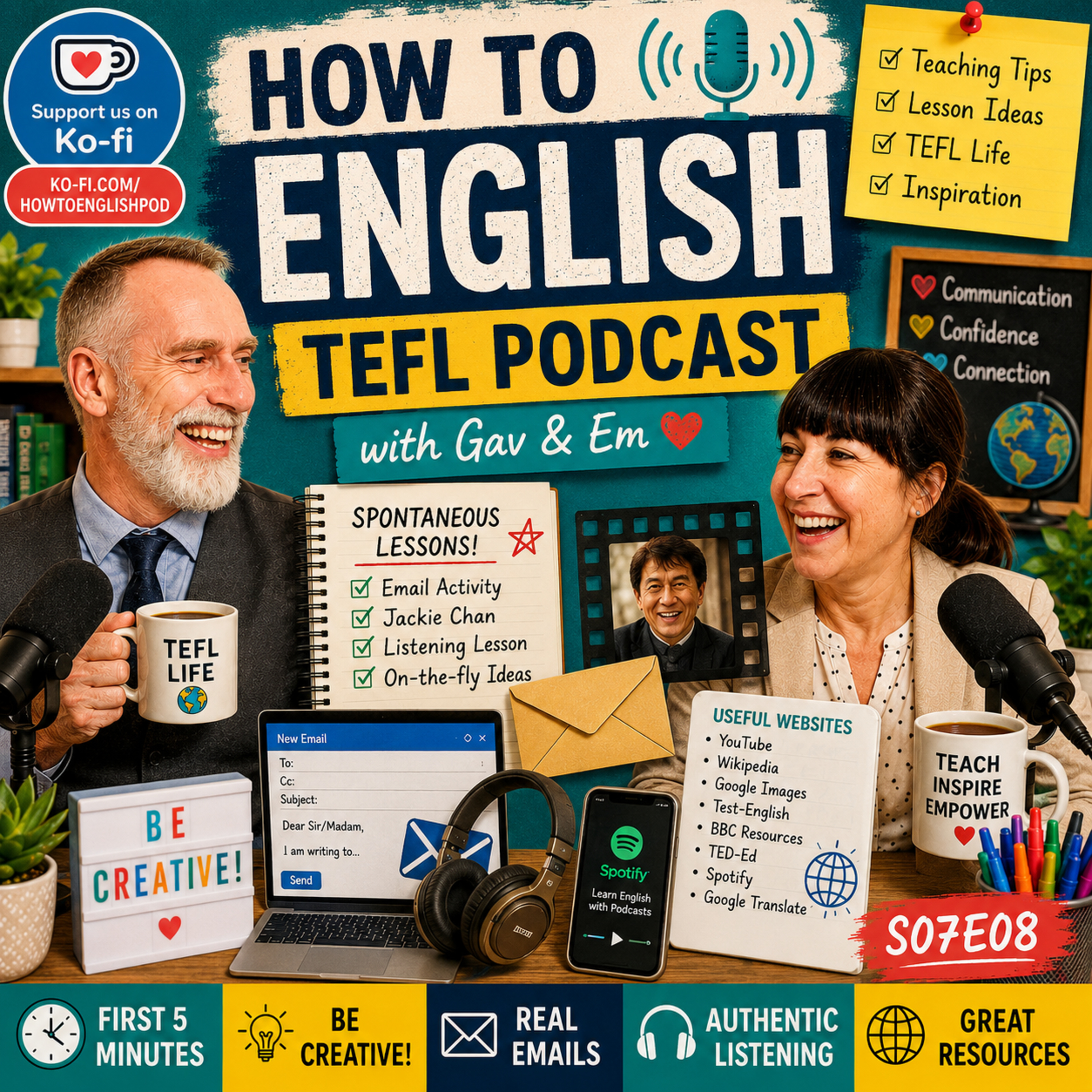 How Can You Make English Lessons More Creative? | Spontaneous TEFL Ideas & Teaching Tips - S07E08 22.05.2026 33минHow can you make your English lessons more creative, spontaneous and engaging? And what should you actually do in the first five minutes of a class?In this episode of How to English TEFL Podcast with Gav & Em, we share practical TEFL ideas for English teachers and learners, including how we start our lessons, how to avoid classroom monotony, and why teaching English gives us so much freedom to experiment.We also look at what happens when you ditch the lesson plan and improvise! Gav shares a spontaneous business English email lesson where students write, analyse and reply to real emails, while Em explains how a student's upcoming meeting led to an unplanned listening lesson using a Jackie Chan interview.Plus, we discuss some of the websites and online resources we use while teaching English, including YouTube, Wikipedia, news sites, Google Images, Test-English, BBC resources, TED-Ed, Spotify and Google Translate.In this episode:🎓 How do you start the first five minutes of an English lesson?💬 Is asking students “How are you?” every week too repetitive?🎨 How can TEFL teachers be more creative and spontaneous?📧 How can you turn real emails into a Business English activity?🎧 How can authentic videos and different accents build listening confidence?💻 Which websites are useful during English lessons?🌳 And is the grass really greener on the other side?Whether you're an English teacher, TEFL teacher, ESL/EFL teacher, trainee teacher or English learner, join Gav and Em for practical teaching ideas, classroom experiences and plenty of laughs.☕ Support How to English Pod: ko-fi.com/howtoenglishpod#TEFL #EnglishTeaching #TeachEnglish #ESL #EFL #EnglishTeacher #TEFLTeacher #LearnEnglish #EnglishLearning #TeachingEnglish #LessonIdeas #LessonPlanning #BusinessEnglish #EnglishListening #TeacherTips #ELT #EnglishPodcastTimestamps00:00 – Intro & episode overview01:28 – Strengths and weaknesses as TEFL teachers09:04 – Exploring teaching weaknesses (and honesty time)20:21 – How to deal with distracted students24:27 – Starting from scratch with new students27:23 – Recognising student progress & using praise32:10 – Listener shout-out & teaching reflections33:11 – Outro & support the pod
 -
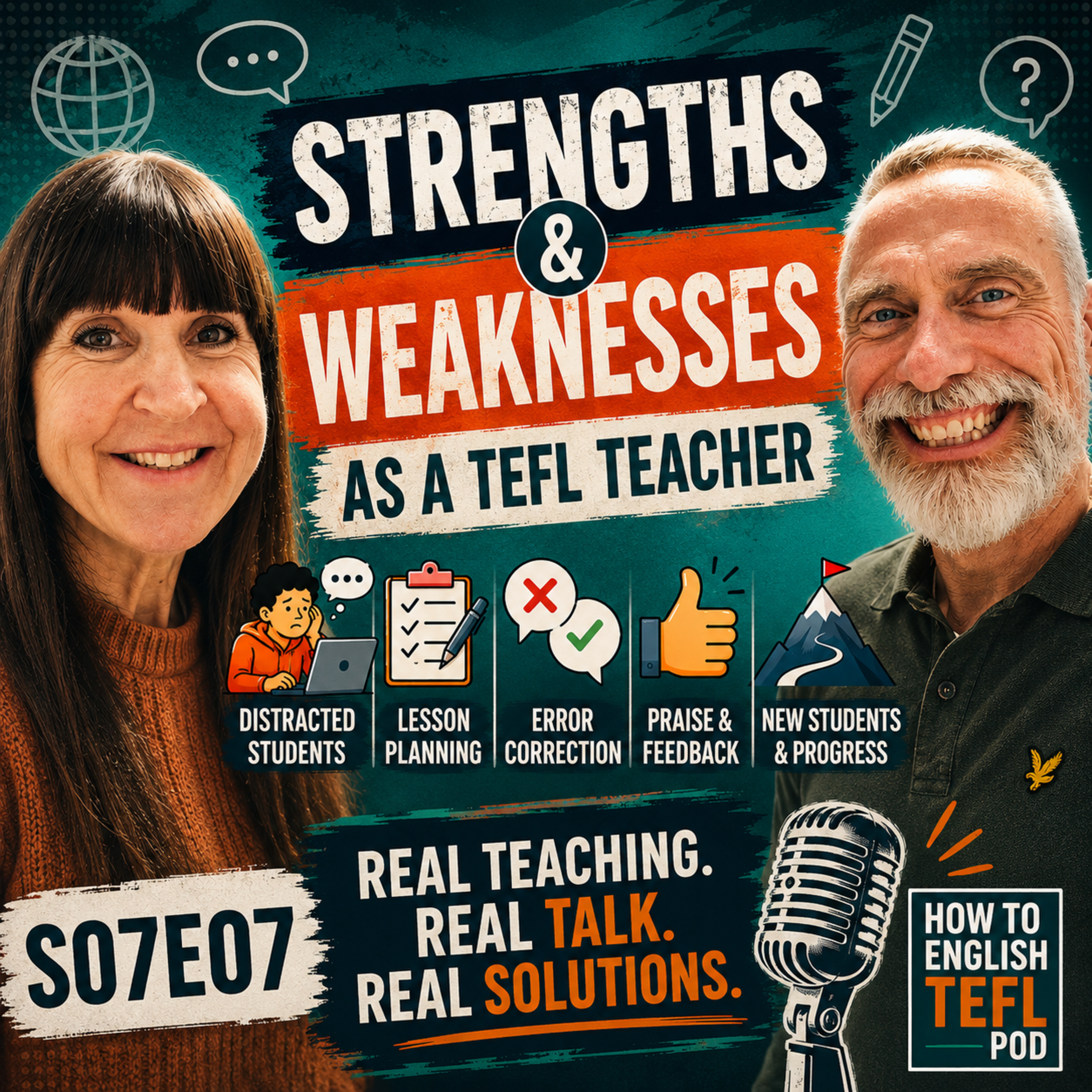 TEFL Teacher Strengths & Weaknesses | Distracted Students, Error Correction & Praise - S07E07 08.05.2026 34минWhat are your biggest strengths and weaknesses as an English teacher? 🎓In this episode of How to English: Teach and Learn with Gav & Em, we take an honest (and occasionally uncomfortable!) look at our own teaching styles. Em loves organisation, structure and a clear plan, while Gav thrives on creativity, flexibility… and sometimes preparing a worksheet just minutes before class. 😅We also tackle some very relatable TEFL teaching challenges: What should you do when a student is distracted? How much should you correct students during speaking activities? Is it better to focus on fluency or accuracy? And how much praise should English learners receive?Plus, we talk about that daunting feeling of starting again with a brand-new student, watching learners make long-term progress, and why genuine praise can be such a powerful part of language learning.Whether you're an EFL teacher, ESL teacher, TEFL professional, English tutor or language learner, join Gav & Em for practical teaching ideas, classroom experiences, humour and plenty of English along the way.☕ Enjoying the podcast? Support Gav & Em:ko-fi.com/howtoenglishpod💬 Join the conversation: What are YOUR biggest strengths and weaknesses as a teacher? And what do you do when a student just isn't paying attention?#TEFL #EnglishTeaching #TeachEnglish #ESL #EFL #EnglishTeacher #TEFLTeacher #ESLTeacher #TeachingEnglish #EnglishLearning #LearnEnglish #EnglishPodcast #TEFLPodcast #TeacherTips #TeachingTips #ClassroomManagement #ErrorCorrection #TeacherDevelopment #LanguageTeaching #HowToEnglishTimestamps00:00 – Intro & episode overview01:28 – Strengths and weaknesses as TEFL teachers09:04 – Exploring teaching weaknesses (and honesty time)20:21 – How to deal with distracted students24:27 – Starting from scratch with new students27:23 – Recognising student progress & using praise32:10 – Listener shout-out & teaching reflections33:11 – Outro & support the pod
 -
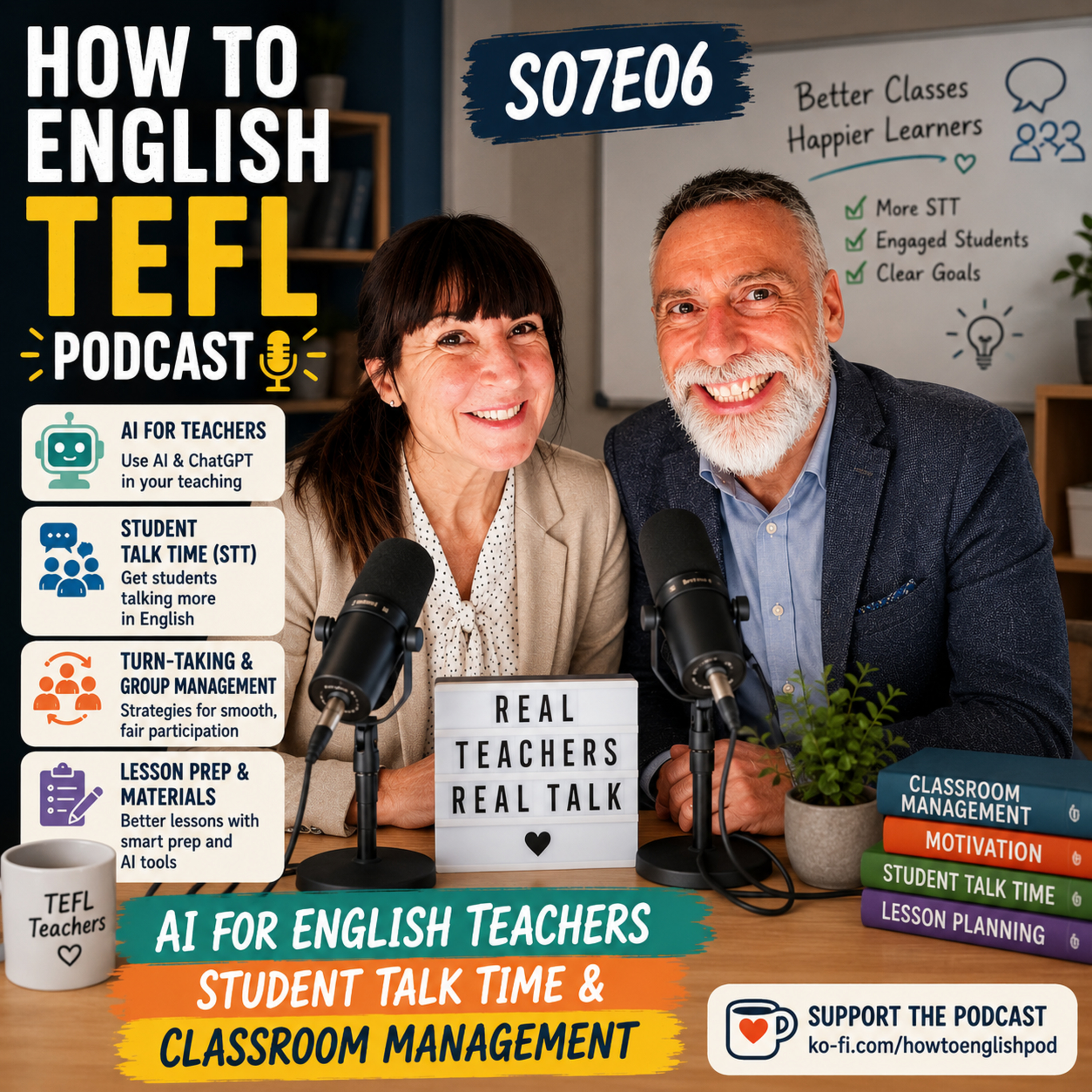 AI for English Teachers, Student Talk Time & Classroom Management | TEFL Podcast - S07E06 24.04.2026 34минWhy do students really come to English classes? How can teachers increase Student Talk Time (STT), reduce Teacher Talk Time (TTT) and make sure everyone gets a chance to speak? And how can AI tools like ChatGPT actually help with everyday English teaching?In this episode of the How to English TEFL Podcast, Gav and Em chat about the practical realities of teaching English as a foreign language (TEFL/ELT) — from understanding student motivation and managing classroom conversations to dealing with students who have the same (or very similar!) names.We discuss ways to encourage quieter learners to participate, manage dominant students, improve turn-taking and create more natural classroom conversations without turning the lesson into an interrogation.We also share how we're using AI in English teaching, including creating industry-specific vocabulary activities, personalised worksheets and materials, and explaining tricky grammar such as defining and non-defining relative clauses. Plus, we look at why teachers still need to check AI-generated language and materials carefully. And finally, Em shares a classroom mishap that proves one simple lesson-planning rule: always check your teaching resources before the lesson starts.In this episode: Why students take English lessons and why motivation matters Student Talk Time (STT) vs Teacher Talk Time (TTT) How to get students talking in English Managing turn-taking in group and online classes Encouraging quieter students and managing dominant speakersRemembering and managing students with similar names Using AI and ChatGPT for TEFL lesson planning Creating personalised English teaching materials with AI Using AI to explain English grammarWhy teachers should double-check AI-generated contentCommon classroom mistakes and what teachers can learn from themHow to English TEFL Podcast is for English teachers, TEFL/TESOL professionals, language educators and anyone interested in teaching and learning English.Support How to English and the podcast: ko-fi.com/howtoenglishpod#TEFL #TESOL #EnglishTeaching #ELT #EnglishTeachers #TeachingEnglish #AIforTeachers #ChatGPT #StudentTalkTime #TeacherTalkTime #LessonPlanning #ClassroomManagement #TEFLPodcastQuiz music: https://www.youtube.com/watch?v=kpSEdFEwCS0Timestamps00:00 – Welcome to How to English TEFL01:50 – Why do students come to English classes?05:24 – Different motivations in the same group07:56 – When students have the same (or similar) names10:14 – What to do when you say the wrong name12:49 – Turn-taking: order, randomness, and balance15:44 – Encouraging quieter students to speak16:22 – Awkward silences and “no questions”22:01 – When students ask the teacher questions23:15 – TTT vs STT: how much should teachers talk?26:18 – Using AI in lesson planning30:34 – Why you should always check your materials
 -
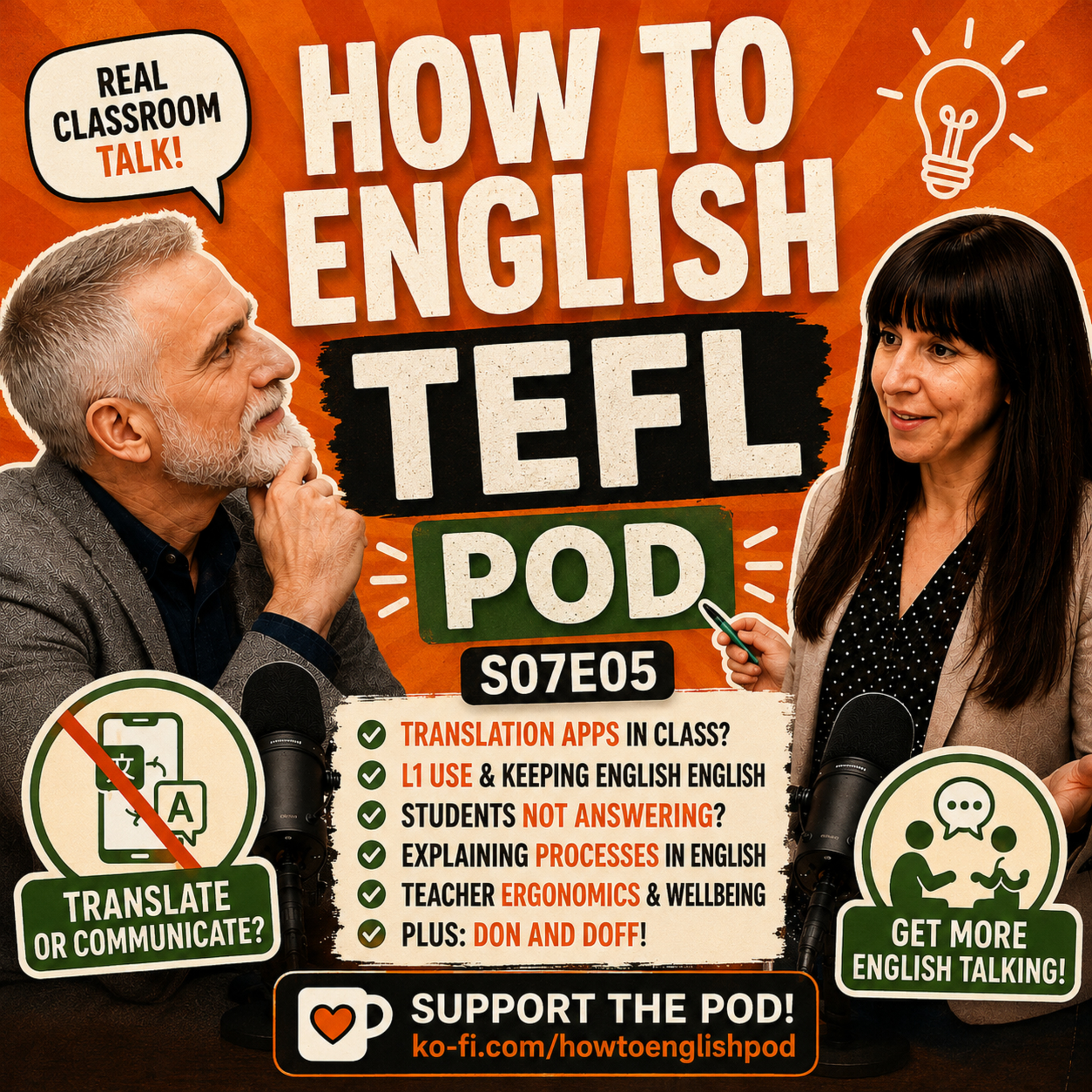 TEFL Teaching Tips: Translation Apps, L1 in Class & Getting Students to Answer Questions - S07E05 10.04.2026 40минWhat should you do when students keep using translation apps in English lessons? How can you encourage learners to speak English instead of switching back to their first language? And why do students sometimes give perfectly good answers — but not actually answer the question you asked?In S07E05 of Gav & Em's How to English TEFL Podcast, we discuss practical TEFL and ESL teaching problems that English teachers face in real lessons.We ask:• Should TEFL teachers allow Google Translate, AI and translation apps in class?• How can you encourage students to think and communicate in English?• Why do students switch back to their first language (L1) when the teacher leaves?• What should a teacher do when a student doesn't answer the question asked?• Should you repeat, simplify or rephrase a question?• How can teachers help learners explain complicated processes in English?• How can online English teachers stay active and comfortable while teaching?• What can teachers do to encourage more meaningful speaking practice?We also talk about standing desks, under-desk exercise machines and staying physically comfortable while teaching online; getting students to explain technical processes step by step; ways to help more teachers and learners discover the podcast; and why the unusual English words “don” and “doff” are opposites.If you're an EFL, ESL, ESOL or TEFL teacher looking for practical teaching ideas, classroom-management discussion and honest conversations about what really happens in English lessons, this episode is for you.☕ SUPPORT THE PODCASTHelp us keep How to English going:ko-fi.com/howtoenglishpod⏱️ TIMESTAMPS00:00 – What are we talking about this week?01:00 – Welcome to How to English: TEFL teaching and learning02:00 – What do teachers actually do while they're teaching?03:00 – Teacher stress, tension and body language05:00 – Staying physically comfortable while teaching06:00 – Exercise while teaching English online08:00 – Standing desks and moving during online lessons09:00 – Can you use a treadmill while teaching online?10:00 – Ergonomics and staying healthy as a teacher11:00 – Why do students switch back to their first language (L1)?12:00 – Why is speaking L1 easier for language learners?14:00 – Should you tell students to keep speaking English?15:00 – Encouraging students to speak English outside class17:00 – Why don't students answer the question you asked?19:00 – What should teachers do when students give the wrong answer?20:00 – Should you repeat or rephrase a question?21:00 – Checking whether students understand your questions22:00 – Asking better questions in English lessons23:00 – Getting students to explain technical topics in English24:00 – Teaching students to explain processes step by step25:00 – Functional English: explaining how things work26:00 – How can we make a TEFL podcast more popular?29:00 – Should students use translation apps in English lessons?30:00 – Google Translate, dictionaries and AI in the classroom31:00 – Should teachers stop students translating?32:00 – Does translation stop students thinking in English?33:00 – Is using your phone now part of natural conversation?34:00 – Why describing an unknown word is valuable speaking practice35:00 – Communication strategies instead of translation36:00 – Difficult vocabulary for low-level English learners38:00 – What do “don” and “doff” mean?39:00 – The surprising history of “don” and “doff”Gav & Em's How to English Pod is a podcast about teaching and learning English as a foreign language, with practical TEFL discussion, teaching ideas, classroom experiences and plenty of opinions along the way.
 -
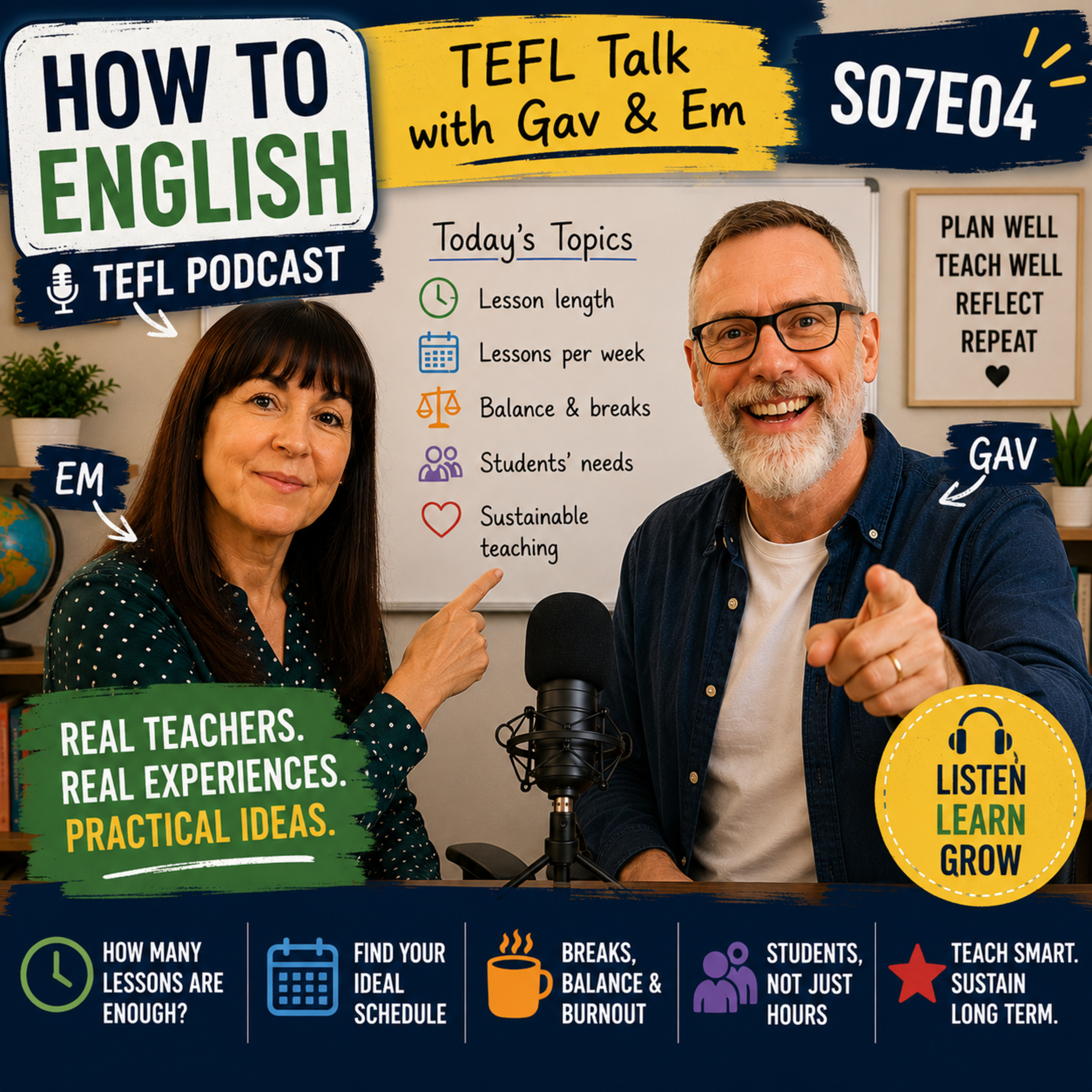 How Long Should English Lessons Be? Small Talk, Teacher Breaks, Grammar, and Classrooms - S07E04 27.03.2026 37минHow long should an English lesson be: 60 minutes or 90 minutes? How much teaching is sustainable in a week? And is spending 30 minutes on small talk valuable language practice — or a waste of lesson time?In S07E04 of the How to English TEFL Podcast, Gav and Em compare their approaches to lesson length and workload. Gav explains why he prefers 60-minute lessons, while Em makes the case for 90 minutes, including time for students to warm up through genuine small talk.They discuss teaching hours vs real hours, back-to-back classes, and why teachers need time to reset. What actually happens between lessons? Reflecting, organising notes, sending homework and materials, doing admin, checking the next class — and hopefully finding time for tea and a bathroom break. Gav shares his digital note-taking system, while Em describes her more analogue approach.Next: how can teachers make grammar example sentences meaningful rather than just another gap-fill? Using I used to live in Spain, Gav suggests building a story and context around grammar, while Em argues for connecting examples to students' lives. Their imaginary character Colin — who used to live in Seville — demonstrates how context, creativity and humour can make language memorable.Why do students sometimes stare silently after a teacher tells them a story? Learners may not know how to react naturally, may view the teacher-student relationship differently, or simply need more processing time. Gav and Em also consider cultural expectations and why lower-level learners sometimes need space to listen.Finally, they reveal how much body language and gesture they use when teaching. They demonstrate gestures for tenses, big vs tall, word order, syllables, vocabulary, pronunciation, uncertainty and error correction — including why online teachers may need to reverse timeline gestures for students on the other side of the screen.If you teach TEFL, ESL, EFL, ELT, Business English or online English, this episode is full of practical classroom experiences, disagreements and ideas to try.☕ Support How to English TEFL Podcast: https://ko-fi.com/howtoenglishpodAs Gav says, only send them a coffee if you want to encourage them. Actually... apparently you should send one even if you want to discourage them.Timestamps00:00 Welcome01:00 Who is the podcast for?02:00 How many lessons per week?03:00 Timetable “floaters”04:00 Teaching hours vs real hours05:00 60 or 90 minutes? Is small talk a waste?06:00 Teaching students to small talk07:00 Why Em prefers 90 minutes08:00 Back-to-back classes09:00 Time to reset10:00 Reflection and notes11:00 What happens during a break?12:00 Gav's digital notes13:00 Reflection with back-to-back classes14:00 Tabs, worksheets and memory15:00 Sending documents and homework16:00 Registers, invoices and admin17:00 Context for example sentences18:00 Does every sentence have context?19:00 The problem with grammar gap fills20:00 I used to live in Spain21:00 Colin in Seville22:00 Humour and memorable sentences23:00 Teachers telling personal stories24:00 Why don't students react?25:00 Teacher-student relationships26:00 Cultural differences?27:00 Why learners need to listen28:00 Processing and response time29:00 The classroom “soap opera”30:00 Gestures for teaching English31:00 Past-simple gestures32:00 Big, tall and present simple33:00 Past-to-present gestures34:00 Word order, vocabulary and syllables35:00 Tear vs tear and facial expressions36:00 Error correction and goodbye37:00 End music🎙️ How to English TEFL Podcast — teaching and learning English as a foreign language with Gav & Em.
 -
 Should TEFL Teachers Use Coursebooks in Every Lesson? – S07E03 13.03.2026 34минWhat should you do when a student is right and you’re wrong? How much should teachers remember about their learners? And are coursebooks useful—or are they destined to become expensive doorstops?In S07E03 of How to English TEFL Podcast, Gav and Em discuss the everyday decisions, surprises and awkward moments that make teaching English so interesting.Gav shares how he adapted a coursebook page to teach anywhere, anyone and anything, while Em explains what she has learned from teaching specialist Medical English. They compare British and American pronunciations of saline, consider how remembering personal details can build rapport, and discuss how teachers should respond when they make mistakes.They also explore the difference between new and long-running classes, why needs analysis should continue throughout a course, and how a new learner can bring fresh energy to an established group. Finally, Gav and Em debate whether coursebooks are useful, how teachers can cherry-pick and adapt them, and whether a yawn means a lesson has failed.☕ Support How to English TEFL Podcast on Ko-fi:https://ko-fi.com/howtoenglishpodWebsite https://howtoenglishpod.wordpress.com/Episode timestamps00:00 Welcome and hungry ears01:00 Teaching anywhere, anyone and anything03:00 Adapting and rearranging a coursebook lesson05:00 Teaching specialist Medical English06:00 British and American pronunciation of saline07:00 Remembering personal details about students10:00 Using lesson notes and online chat to remember vocabulary12:00 What to do when a student is right and the teacher is wrong13:00 Checking sources and correcting mistakes15:00 New classes versus established classes18:00 Keeping long-running classes fresh19:00 Continuing needs analysis throughout a course20:00 Asking learners what they want to study22:00 Preparing students to bring topics to class23:00 New students joining established groups24:00 Correcting new learners without embarrassing them25:00 Seeing long-term learners’ progress through fresh eyes26:00 Are coursebooks a waste of time?28:00 Why some learners say they do not want a coursebook29:00 Cherry-picking coursebook units for learner needs30:00 Using books as structure and support31:00 Choosing what is right for each class31:30 Does a yawn mean the lesson has failed?34:00 Support the podcast and closing thoughts
 -
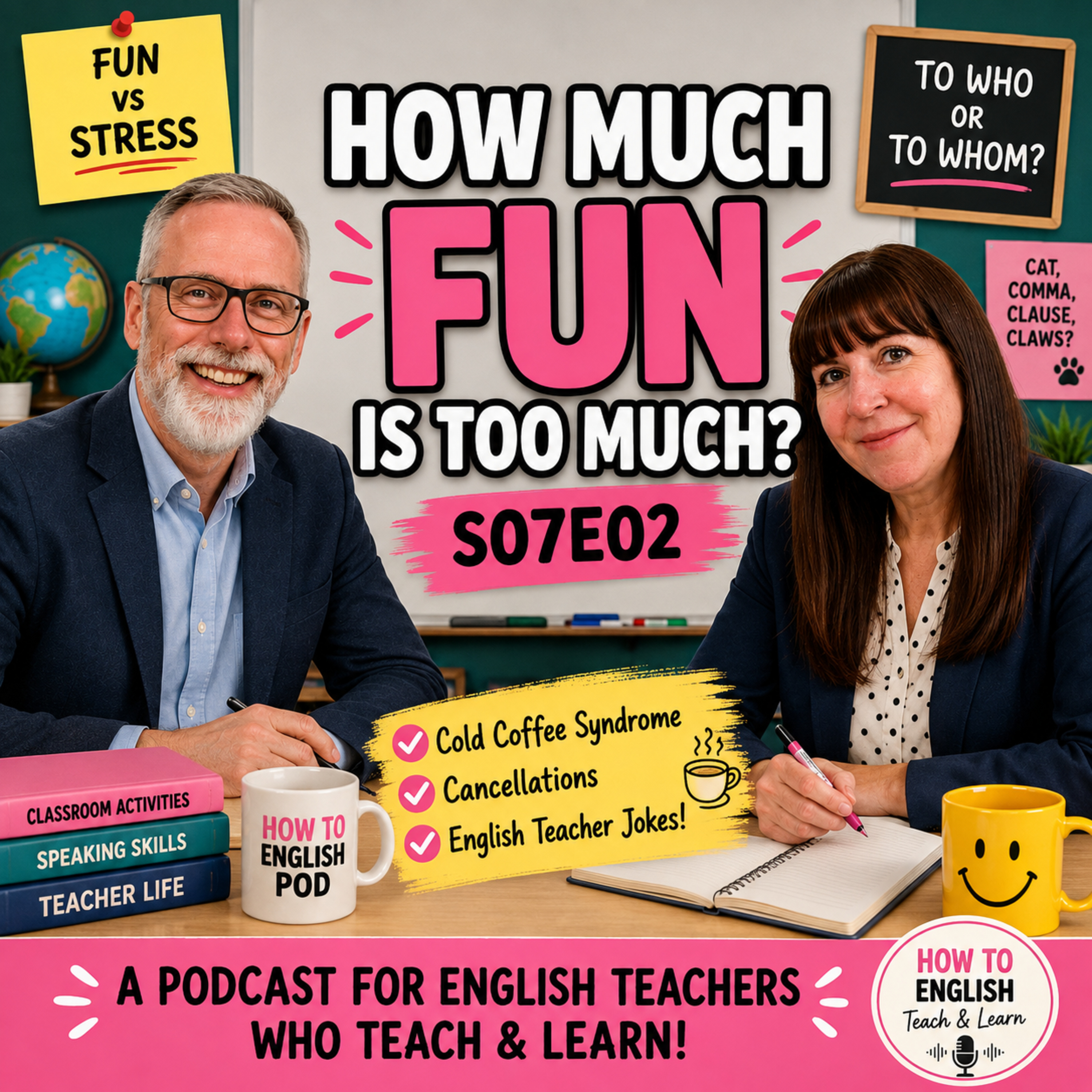 How Much Fun Is Too Much in the English Classroom? - S07E02 27.02.2026 33минCan an English lesson be too much fun? Do fast-paced classroom games actually help students learn — or can they create stress instead? And how do you know when an engaging activity has crossed the line into overload?In S07E02 of How To English: Teach and Learn with Gav & Em, we reflect on what “fun” really means in the English language classroom — and why what feels exciting to one learner might feel stressful to another.Em shares a memorable teaching experience where a competitive, timed grammar activity became overwhelming for one student. We discuss time pressure, different learning speeds, classroom competition and whether fun activities actually help students retain language. Is a successful lesson one students enjoy, or one they learn from — and can it be both?Then Gav introduces his very own TEFL phenomenon: Cold Coffee Syndrome. What does it mean when an English student talks so much during a coffee-shop lesson that their drink goes cold? Is that the ultimate sign of a successful speaking lesson, or should teachers give their students a chance to actually drink their coffee?We also ask: Can English teachers ever really switch off? Gav and Em discuss noticing vocabulary and grammar everywhere, mentally correcting other people's English, finding lesson ideas in everyday life, and how years of teaching can change the way you listen to language.Plus, has online English teaching changed our real-life communication skills? We talk about eye contact, interruptions, conversation timing, body language and the strange habits teachers can develop after spending hours teaching students in little boxes on a screen.Finally, we get into the complicated emotions surrounding cancelled English lessons. Are teachers secretly happy to get an unexpected hour off? Do cancellations cause guilt, concern or financial anxiety? And what happens when a student keeps cancelling?And to finish, Em tests some English grammar and vocabulary jokes on Gav. Can English learners understand jokes involving clauses and claws, grammatical tenses, and to who vs to whom — or are these jokes really only funny to English teachers?00:00 Welcome to How To English01:00 Does “discover” have a prefix?02:00 Can English lessons be too much fun?04:00 When a fun classroom activity becomes stressful06:00 Why time limits can overwhelm students08:00 Does having fun actually help students remember English?09:00 Introducing “Cold Coffee Syndrome”11:00 Is a student talking for 45 minutes a successful lesson?12:00 How to let students drink their coffee — and keep them talking14:00 How teaching English affects your everyday life15:00 Do English teachers mentally correct everyone?17:00 Finding English lesson ideas in the real world18:00 Why authentic materials don't always interest students20:00 Real life vs online teaching22:00 Has online teaching changed our eye contact and conversation skills?24:00 How do teachers really feel about cancelled lessons?26:00 Getting paid for a cancelled lesson — should you feel guilty?28:00 Can English learners understand English jokes?29:00 Cat, comma, clause, claws, paws and pause30:00 A joke about past, present and future tenses31:00 “To who” or “to whom”?32:00 Final thoughts and supporting the podcast☕ Support How To English:https://ko-fi.com/howtoenglishpod🌐 Visit our website: https://www.howtoenglishpod.com/If you're an English teacher, TEFL teacher, ESL/EFL teacher, English learner or language teaching enthusiast, join Gav & Em for an informal discussion about the realities of teaching and learning English — from classroom management and speaking activities to teacher life, online lessons and the things that don't always make it into the methodology books.What do you think? Can a classroom activity be too fun? Do you enjoy competitive or timed activities, or do they make learning more stressful? And teachers — how do you really feel when a student cancels?
 -
 How Can Teachers Balance Conversation, Grammar and Personality in the Classroom? - S07E01 13.02.2026 40минHow confident do you feel teaching a conversation lesson without a detailed plan?In the first episode of season seven, Gav and Em compare two approaches to conversation classes: building discussion from planned grammar activities and allowing useful grammar to emerge naturally from conversation.They explore what teachers can do when a discussion dries up, how short post-lesson reflections can reveal teaching strengths and weaknesses, and how A1–A2 learners can develop more natural conversations through simple everyday phrases and reformulation.Gav and Em also ask how much personality teachers should bring into the classroom. Should teachers always be themselves, or should they adapt their humour, energy and personal stories to different learners, cultures and professional contexts?IN THIS EPISODEPlanning and teaching conversation lessonsBalancing genuine conversation with language instructionMoving naturally between grammar and speakingRecovering when a discussion runs out of momentumUsing teaching journals and “hot feedback”Encouraging authentic conversations with A1–A2 learnersTeaching short, natural everyday expressionsReformulating learners’ language more simplyIntroducing your personality graduallyMaintaining professional teacher–student boundariesTIMESTAMPS00:00 Welcome and the new season format01:40 Planning and confidence in conversation lessons04:20 Conversation-led and grammar-led teaching10:30 Turning grammar exercises into discussion13:30 Hot feedback and teaching journals15:45 What to do when conversation dries up24:10 Authentic conversation with A1–A2 learners30:00 Bringing your personality into the classroom39:40 Closing reflectionsSUPPORT AND FOLLOW HOW TO ENGLISH☕ Support us on Ko-fi: https://ko-fi.com/howtoenglishpod🌐 Visit the How to English website:https://howtoenglishpod.wordpress.com/How to English TEFL Podcast is a podcast about teaching and learning English as a foreign language with Gav and Em.
 -
 How Can You Teach Pronunciation, Grammar & Vocabulary with X, Y & Z? TEFL Activities – S06E24 19.12.2025 45минHow can English teachers turn tricky pronunciation, grammar and vocabulary into activities students actually want to join in with?In the final episode of Season 6 of How to English TEFL Podcast, Gav and Em complete their A–Z of TEFL with X, Y and Z — combining unusual English words, pronunciation challenges, classroom games, grammar practice and practical teaching tips.Gav challenges Em with difficult X, Y and Z words including axolotl, xylophone, ylang-ylang, Ypres, zwieback, xyst and zephyr. Along the way, they explore why English spelling and pronunciation can be so unpredictable and suggest ways teachers can adapt pronunciation activities for different learner levels.Em introduces the Yes/No game, a simple speaking activity that pushes learners to answer questions without saying “yes” or “no”. It encourages longer answers, flexible language and useful alternatives such as “maybe not”, “never”, “I tend not to” and “I’d prefer not to”.They also explore zeitgeist vocabulary from different decades, from groovy and grunge to selfie, hashtag, lockdown, hybrid work and AI — showing how vocabulary can reflect the time and culture in which it is used.Grammar gets its turn too. Em uses superstitions to practise the zero conditional, while Gav tests when English uses the zero article with examples involving school, hospital, music and meals. Finally, they try a sentence-completion activity designed to help learners expand their adjective choices and support each other when they get stuck.Drawing on their classroom experience, Gav and Em keep the focus on activities teachers can adapt rather than grammar rules in isolation.In this episode:• Pronunciation activities using unusual X, Y and Z words• A Yes/No speaking game for longer, more natural answers• Zeitgeist vocabulary and language change• Teaching the zero conditional through superstitions• How to explain the zero article• Sentence-completion activities for vocabulary development• Tips for Zoom fatigue, exploring new topics and learning from errorsTeaching resources, episode guides and practical ideas for busy English teachers:https://www.howtoenglishpod.com/Support How to English TEFL Podcast:https://ko-fi.com/howtoenglishpodResources:AI voice: https://elevenlabs.io/Music: https://www.youtube.com/watch?v=Jt5YsCsv9Sc&list=RDQMRnuMug6asRQ&index=3Chapters00:00 – Welcome & Season 6 finale03:26 – X words and unusual vocabulary05:00 – X, Y & Z pronunciation challenge15:37 – Pronunciation patterns and teaching ideas17:12 – The Yes/No speaking game21:46 – Why the Yes/No game works for learners22:35 – Zeitgeist vocabulary through the decades28:24 – Zero conditional through superstitions34:19 – Zero articles: school, hospital, music & meals38:43 – “It was so…” sentence-completion activity42:26 – Zoom fatigue and Em’s teaching tip43:19 – Gav’s X, Y & Z learning tips44:08 – Season wrap-up & thanks
 -
 How Can English Teachers Teach WH-Questions, Wish & Word Order? Practical Ideas TEFL A-Z W – S06E23 05.12.2025 41минWhat can English teachers do when a lesson starts going wrong? How can you teach WH-questions, wish structures and word order in ways that actually get students using the language?In this episode of How to English TEFL Podcast, Gav and Em continue their A–Z of English teaching with W — moving from worst-case classroom nightmares to practical grammar activities, last-minute lesson ideas, warmers and ways to keep familiar teaching topics feeling fresh.Drawing on their classroom experience, Gav and Em discuss what to do when students look completely lost during an explanation. Should you carry on, simplify the board work, start again or use stronger students to help establish meaning before checking everyone has understood?Gav then demonstrates a WH-question activity built around guessing a mystery celebrity. Learners complete questions with who, what, where, when, why, which and how while practising different tenses and building a fact file.Em explores three useful wish structures:I wish I were taller.I wish I had been better at school.I wish it would stop raining.They discuss how teachers can help learners understand the difference between present wishes, past regrets and situations they want someone or something else to change.There is also a real teaching confession from Gav after mixing up “in time” and “on time” during a lesson — and a discussion of how teachers can recover when a familiar language point suddenly refuses to cooperate.Then comes an emergency cover lesson. With almost no preparation, Em is handed “SVO present simple yes/no questions” and turns it into a student-generated word-order activity involving dragons, bananas, haunted houses, rollercoasters and volcanoes. It becomes a useful reminder that teachers do not always need to provide all the language themselves.Gav and Em also ask whether teaching the same grammar repeatedly can start to wear thin — and how changing the context, examples and student relevance can keep familiar lessons interesting.Finally, Gav revisits WH-questions by making them negative: Which superpower would you not like to have? When would you not want to live in history? What film would you not want to be trapped inside? A small change that can make familiar speaking questions much more interesting.Gav and Em have each spent more than 20 years teaching English across different countries, age groups, levels and teaching contexts. The podcast shares practical classroom ideas, activities and reflections drawn from that experience.More TEFL teaching articles, lesson ideas and practical tips:https://howtoenglishpod.comSupport How to English TEFL Podcast:https://ko-fi.com/howtoenglishpodCHAPTERS00:00 – Welcome to the W episode01:22 – Worst-case English lesson nightmares08:42 – WH-question activity: guess the celebrity13:57 – How to teach wish: present, past and would18:20 – In time vs on time22:13 – Emergency cover lesson: teaching word order30:43 – Does teaching the same grammar wear thin?34:00 – Making WH-questions negative38:20 – Teaching tip: use a good warmer39:30 – Welcome, Wait and Watch: advice for teachers and learners41:00 – Wrapping up W and looking ahead to X, Y and Z
 -
 How Can English Teachers Find Their Teaching Voice? Pronunciation, Vocabulary & Activities - TEFL A-Z V – S06E22 21.11.2025 46минHow do you find your authentic voice as an English teacher — and keep lessons varied, useful and engaging?Welcome back to the A–Z of TEFL! In S06E22 of How to English TEFL Podcast, Gav and Em reach the letter V and explore practical English teaching ideas around variety, voice, visuals, victories, vocabulary and vitality.Drawing on their years of classroom experience, Gav and Em discuss why variety matters in lesson planning and how mixing speaking, listening, reading, writing, energetic activities and quieter reflection can help keep lessons balanced.Then it gets phonological. How can teachers help learners distinguish /v/ and /w/? Gav and Em experiment with mouth position, voiced sounds, fricatives, minimal pairs, flashcards, tongue twisters and pronunciation games — with words including wine/vine, west/vest and wheel/veal.Em brings in a visual-speaking activity based on strange coincidences: identical cars, matching step counts and puppies whose spots appear in numerical order. The pictures demonstrate how one visual can generate description, vocabulary, grammar, personalisation and extended conversation.The discussion then gets more reflective: what does it mean to find your “teacher voice”? Gav and Em compare how they behave with new students, how authority and friendliness can change over time, and the challenge of having a genuine conversation while still listening for opportunities to teach, correct and expand learners’ English.They also ask what counts as a teaching victory. Is it new vocabulary? More accurate language? A confident student? Or simply finishing a lesson with everyone looking forward to the next one?Plus: vocabulary vs lexis, idioms, categorising language, a body-action vocabulary game, staying fresh after thousands of lessons, teacher vulnerability and why the volume of new language matters.☕ Support the podcast and help keep Gav & Em supplied with tea and coffee:https://ko-fi.com/howtoenglishpod🌐 Practical TEFL articles, teaching ideas and resources for busy English teachers:https://howtoenglishpod.comMENTIONED IN THIS EPISODEGrammar Drops:https://www.youtube.com/@GrammarDropsWhizbusters:https://whizbusters.teachable.com/Game music:https://www.youtube.com/watch?v=951ZpDOP9VY&list=PL170TfEhZz-_GstI3bsghBfuD-u8nlHHD&index=13CHAPTERS00:00 – Intro: Welcome to V01:04 – Variety in English lessons04:58 – Valued supporters: Grammar Drops & Whizbusters05:46 – Voiced sounds: teaching /v/ vs /w/08:00 – Minimal pairs, flashcards & tongue twisters11:00 – Plosives, nasals & pronunciation13:06 – Using visuals to generate language15:00 – The identical-car coincidence18:00 – Step counts, data & digital habits21:00 – Puppies, pictures & conversation22:54 – How do you find your authentic teacher voice?29:02 – Big and small teaching victories31:07 – Vocabulary vs lexis32:00 – Categorising idioms and expressions35:14 – Body-action vocabulary game39:48 – How teachers maintain vitality42:00 – Personalisation, values & keeping lessons real43:49 – Gav’s tip: vulnerability in the classroom44:15 – Em’s tip: control the volume of new language45:15 – Outro & W next week
 -
 How Can You Teach Uncountable Nouns and ‘Used To’ Creatively? TEFL A-Z U – S06E21 07.11.2025 34минHow can you make uncountable nouns memorable and help students untangle ‘used to’, ‘be used to’ and ‘get used to’? This week on the How to English TEFL Podcast, we tackle U in our A–Z of teaching English—with unusual holiday packing and quite enough U/you jokes.Join us, Gav and Em, for a playful role play featuring ‘three luggages’ and ‘a happiness’, followed by a sentence-building game you can adapt for your lessons. We explore how humour helps students notice grammar mistakes without putting anyone on the spot.Can AI help students upgrade their writing? We try different versions of ‘The cat sat on the mat’ and discuss vocabulary work, gap fills and matching sentences to styles for different levels.We also practise ‘used to’ through gardening and pet-owning scenarios, explore the surprises of ‘under-’, and compare ‘ultra-’, ‘super-’, ‘mega-’ and ‘hyper-’. Gav shares how a coursebook unit worked with his airport students, while Em reflects on moving learners from repeating sentences to using English independently.Expect practical TEFL activities, real classroom experience and a reminder to stretch your own teaching and learning habits. U first!📚 EXPLORE THE EPISODE GUIDE AND FREE TEFL ARTICLESEpisode Guide: How Can You Teach Uncountable Nouns and ‘Used To’ Creatively? TEFL A-Z U – S06E21How to Teach Uncountable Nouns with a Funny Role Play – S06E21How to Practise Countable and Uncountable Nouns with One Simple Sentence Game – S06E21How to Teach ‘Used To’, ‘Be Used To’ and ‘Get Used To’ Clearly – S06E21How Can Students Use AI to Upgrade Simple English Sentences? – S06E21When Should an English Teacher Use a Coursebook Unit Instead of Planning from Scratch? – S06E21If you find the show useful, you can send us a thanks:https://ko-fi.com/howtoenglishpodVisit https://howtoenglishpod.com for practical teaching ideas and ready-to-use resources.References: English File, OxfordBackground music:https://www.youtube.com/watch?v=Q83yRKmKKYs&list=PLfP6i5T0-DkKSs8G6YbPHYAR70-f5tP9S&index=21TIMESTAMPS00:00 – Welcome and intro banter01:14 – Under-prefix wordplay05:54 – Uncountable nouns role play09:22 – Categories of uncountable nouns10:33 – Countable vs uncountable game14:53 – Upgrading sentences with AI20:09 – ‘Used to’ grammar practice23:42 – Teaching with coursebook units26:40 – Prefixes: ultra, super, mega and hyper30:26 – Tips of the episode
Слични подкасти


Популаран у
Овај подкаст се појављује и у подкаст листама ових земаља.
