
The Modern Therapist's Survival Guide with Curt Widhalm and Katie Vernoy
Curt Widhalm, LMFT and Katie Vernoy, LMFT
0
The Modern Therapist's Survival Guide is a podcast for therapists who want to navigate the modern landscape of private practice, personal branding, and social media. Hosts Curt Widhalm and Katie Vernoy discuss how to be authentic, purposeful, and connected as a therapist in today's world. They cover topics like entrepreneurship, social activism, and mental health stigma, offering support for clinicians as whole people and business owners.
Avsnitt
-
 Knowing When They're Ready: Navigating the Shift from Stabilization to Deeper Work in Psychotherapy 28.09.2026 1h 12minKnowing When They're Ready: Navigating the Shift from Stabilization to Deeper Work in Psychotherapy Trauma readiness in DBT and EMDR: how to tell when a client is ready to move from stabilization into deeper work. Curt Widhalm, LMFT, and Katie Vernoy, LMFT walk through the judgment call at the center of trauma treatment, which is knowing when a client has the behavioral and autonomic stability to move past stabilization. Drawing on DBT stages of treatment, EMDR phase two and phase three, and recent research on trauma readiness, they cover what readiness looks like in session and in the week between sessions. Deeper work covers a lot of ground, from small titrated experiential moments through to full trauma reprocessing. Move too early and you get dysregulation, post-session distress spikes, and dropout. Stay in stabilization indefinitely and clients stall out, sometimes feeling managed rather than treated. Curt brings the structured version of this assessment from EMDR and comprehensive DBT. Katie brings the less protocol-bound version, where the shift happens session to session and sometimes mid-session. They also get practical about dual awareness, micro-markers of dissociation, window of tolerance tracking, the four-part pacing agreement that prevents most of these mistakes, and the therapist countertransference that pushes clinicians toward premature processing. This is a continuing education podcourse. One unit of CE is available through the Modern Therapist Learning Community at moderntherapistcommunity.com. In this episode, we discuss: - Why trauma readiness is a fluctuating state rather than a milestone a client reaches once - How to tell intellectual eagerness apart from behavioral and autonomic capacity - Why stabilization shortens trauma treatment instead of delaying it - What dual awareness requires before EMDR reprocessing or DBT stage two work - How to build a pacing agreement, including a code word and a dissociation preference set at intake - What to do when your own impatience is driving the timeline Timestamps: - 07:02 - What readiness actually means, and why it prevents dropout - 13:38 - Readiness as a state, and the three pillars - 23:29 - What clients report when they are pushed too deeply, too soon - 31:19 - Dual awareness explained - 32:49 - Why stabilization shortens treatment - 38:02 - The false green light, and consistency under stress - 53:26 - Micro-dissociation at target activation - 59:50 - Building the pacing agreement Full show notes and transcript: mtsgpodcast.com CE credit: moderntherapistcommunity.com Join the Modern Therapist Community Patreon: https://www.patreon.com/c/mtsgpodcast Facebook Group: https://www.facebook.com/groups/therapyreimagined Modern Therapist's Survival Guide Creative Credits Voice Over by DW McCann: https://www.facebook.com/McCannDW/ Music by Crystal Grooms Mangano: https://groomsymusic.com/
 -
 Your Client Is Not a Category: Binary Thinking, Gender Trauma, and Presence as a Clinical Skill - An Interview with Alex Iantaffi 21.09.2026 49minYour Client Is Not a Category: Binary Thinking, Gender Trauma, and Presence as a Clinical Skill - An Interview with Alex Iantaffi Alex Iantaffi, Ph.D., LMFT, author of Gender Trauma, on binary thinking, gender trauma, and presence as a clinical skill. Curt and Katie talk with Alex Iantaffi about why binary thinking is a clinical problem before it is a political one. Therapists are trained to sort: into diagnoses, into special populations, into victim and perpetrator. Alex argues that the sorting habit costs us the person sitting in front of us, and that gender is where it shows up most visibly. Alex traces the rigid gender binary to colonial and Christian supremacist thinking rather than to biology, then shows how it surfaces in everyday couples and family work: in parenting expectations, in who is allowed to earn more, in who gets to have an appetite. Everyone is shaped by gender trauma, including cisgender clients whose gendered pain has never once been asked about, and Alex states plainly that Black and Brown trans feminine people and Indigenous people bear the heaviest cost of it. The conversation also covers two systemic models Alex uses to read what is happening in the room, why they choose the language of gender liberation, and what it means to be an accomplice rather than an ally. Alex's practical starting point is smaller than most listeners will expect: presence. This is a useful conversation for all therapists, especially family and couples therapists, clinical supervisors, and any therapist working with gender, sexuality, and relationship diversity. In this episode, we discuss: - Why "special population" framing quietly installs cisgender, heterosexual, and monogamous as the default - How colonial constructions of gender show up in everyday couples and family work - What therapists miss when they cast clients as victim or perpetrator - Why the manosphere reads as a symptom of collective gender trauma - How to track relational patterns instead of sorting clients into categories - What gender liberation asks of therapists that gender abolition does not - Why presence may be the most underrated clinical skill in the room Timestamps: - 03:38 - The blind spot in how therapists are trained on gender and sexuality - 11:44 - The colonial roots of the rigid gender binary - 15:54 - The gendered pain cisgender clients carry unexamined - 20:21 - The manosphere as collective gender trauma - 24:57 - Social GRRAACCEESS and positionality in the room - 29:33 - Non-binary thinking as an ongoing practice - 36:30 - Gender liberation, and being an accomplice rather than an ally - 40:45 - Presence as an underrated clinical skill Guest Bio: Alex Iantaffi, Ph.D., MS, SEP, CST, CST-S, LMFT (they/them) is a systemic psychotherapist, WPATH certified gender specialist, AASECT certified sex therapist and supervisor, Somatic Experiencing(R) practitioner, and AAMFT Approved Supervisor and Supervisor Mentor. They are the author of the award-winning Gender Trauma, co-author of How to Understand Your Gender, Life Isn't Binary, and Hell Yeah Self-Care, and editor of the Trans and Disabled anthology. Alex hosts the podcast Gender Stories. Learn more at alexiantaffi.com. Full show notes and transcript: mtsgpodcast.com Join the Modern Therapist Community Patreon: https://www.patreon.com/c/mtsgpodcast Facebook Group: https://www.facebook.com/groups/therapyreimagined Modern Therapist's Survival Guide Creative Credits Voice Over by DW McCann: https://www.facebook.com/McCannDW/ Music by Crystal Grooms Mangano: https://groomsymusic.com/
 -
 Just a Hypothesis: Case Formulation and Treatment Planning for Real-World Therapy - An Interview with Nikki Rubin, PsyD 17.09.2026 44minJust a Hypothesis: Case Formulation and Treatment Planning for Real-World Therapy - An Interview with Nikki Rubin, PsyD Nikki Rubin, PsyD on behavioral case formulation, treatment planning, and clinical decision-making for therapists. Curt and Katie talk with Nikki Rubin, PsyD, licensed clinical psychologist and co-founder and COO of MindScience Collective, about what case formulation looks like when it is built for real-world therapy instead of for a graduate school assignment. Most of us learned case conceptualization as an exhaustive academic exercise and then quietly stopped doing it. Nikki describes behavioral case formulation as one large working hypothesis: a holistic read on seven areas of a client's functioning that tells you what you are targeting, why, and what to do when treatment stalls. Formulation and treatment planning are inseparable, and neither one requires you to be a CBT therapist. Nikki walks through the seven components (drawn from the work of Jacqueline Persons, PhD), the traps clinicians fall into, how to operationalize target behaviors, why structure creates flexibility rather than rigidity, and what a scaled-down formulation looks like under session limits or in crisis work. A useful conversation for therapists across orientations, for supervisors and educators, and for anyone who has felt unsure where a treatment is going. In this episode, we discuss: - The three traps therapists fall into with case formulation - The seven areas of a behavioral case formulation, and why they work across orientations - Why a formulation is a set of hypotheses to test, not conclusions to defend - How to operationalize target behaviors so you can track them in session - Why covert behaviors (worry, rumination, suppression) belong in your formulation - How to scale a formulation down when you are short on time or sessions Timestamps: - 04:16 - The traps therapists fall into with case formulation - 08:56 - The seven areas of a behavioral case formulation - 15:05 - What case formulation looks like in real time - 17:59 - From formulation to treatment planning and target behaviors - 21:04 - Does structure make case formulation rigid? - 29:35 - Case formulation under time pressure and session limits - 36:17 - Where to start if you have not done this since graduate school Guest Bio: Nikki Rubin, Psy.D. is a licensed clinical psychologist specializing in Acceptance and Commitment Therapy (ACT) and other 3rd wave cognitive behavioral therapies. She is an Associate Clinical Professor at UCLA, where she trains doctoral students in ACT, and co-founder and COO of MindScience Collective, a continuing education company for clinicians. Learn more at mindsciencecollective.com and drnikkirubin.com. Special offer for Modern Therapist listeners: use code MTSG10 for 10% off at mindsciencecollective.com. Full show notes and transcript: mtsgpodcast.com Join the Modern Therapist Community Patreon: https://www.patreon.com/c/mtsgpodcast Facebook Group: https://www.facebook.com/groups/therapyreimagined Modern Therapist's Survival Guide Creative Credits Voice Over by DW McCann: https://www.facebook.com/McCannDW/ Music by Crystal Grooms Mangano: https://groomsymusic.com/
 -
 What This Work Asks of Therapists: Integration, Not Knowing, and the Capacity to Stay - An Interview with Juliane Taylor Shore, LMFT, LPC, SEP 14.09.2026 50minWhat This Work Asks of Therapists: Integration, Not Knowing, and the Capacity to Stay - An Interview with Juliane Taylor Shore, LMFT, LPC, SEP Juliane Taylor Shore, LMFT, LPC, SEP, on therapist integration, not knowing, and the capacity to stay in the room. Curt and Katie talk with Juliane Taylor Shore, LMFT, LPC, SEP, about what determines how much a therapist can do in session. Her answer is not which model you reach for, but how integrated you are while you reach for it. Jules wrote Setting Boundaries That Stick and created the STAIR Method. Jules separates eclectic practice, pulling from whichever training fits the moment, from integrative practice, where one theory of mind and theory of change organizes which tool gets used when. Hers is neurobiological: the brain as an open, dynamic, complex system, most stable and most flexible when its parts stay differentiated and cross-share information. She also names what she thinks training got wrong. Many therapists learned to read client comfort as the measure of their therapeutic presence, a poor gauge when most clients arrive in a threat state. Her alternative is the therapist's own integration, because that is what creates capacity for connection, bonding, and creativity when a session gets hard. In this episode, we discuss: - What separates integrative from eclectic practice - Why client comfort is an unreliable measure of therapeutic presence - How adding compassion to empathy keeps a clinician from fatiguing - What humility and self-kindness predict about client outcomes - How power with differs from power over and power under - Why presence and skill have to be trained in the same state - What grief this job asks therapists to hold Timestamps: - 02:32 - Integrative therapy versus eclectic practice - 05:07 - Theory of mind, theory of change, and integration - 09:10 - What therapists get wrong about presence - 16:27 - Why empathy fatigues and compassion does not - 19:36 - Color shifting and finding felt compassion - 28:11 - PONS: power, of-courseness, not knowing, and self - 35:23 - The salience network, presence, and skill - 38:41 - The grief this work asks you to hold Guest Bio: Juliane Taylor Shore, LMFT, LPC, SEP, is a therapist, author, and teacher who translates neurobiology into practices that support brain change. She wrote Setting Boundaries That Stick, created the STAIR Method, and is an associate Instructor with the Coherence Institute and core faculty with Therapy Wisdom. Learn more at julianetaylorshore.com. Full show notes and transcript: mtsgpodcast.com Join the Modern Therapist Community Patreon: https://www.patreon.com/c/mtsgpodcast Facebook Group: https://www.facebook.com/groups/therapyreimagined Modern Therapist's Survival Guide Creative Credits Voice Over by DW McCann: https://www.facebook.com/McCannDW/ Music by Crystal Grooms Mangano: https://groomsymusic.com/
 -
 The Clinical Depth Principle: Why Therapy Cannot Be Reduced to Tools, Hacks, and Sound Bites 07.09.2026 39minThe Clinical Depth Principle: Why Therapy Cannot Be Reduced to Tools, Hacks, and Sound Bites Curt and Katie on the clinical depth principle: case conceptualization, pacing, and the limits of coping skills. Curt Widhalm, LMFT, and Katie Vernoy, LMFT take on this month's modern therapist principle, clinical depth over simplification, and the two extremes the profession keeps swinging between. On one side is a therapy culture shaped by medicalization, medical necessity documentation, productivity pressure, and pop psychology trends that flatten complicated people into one size fits all narratives. On the other is the overcorrection, where clinical ambition outpaces the client and depth work turns into chasing catharsis before the relationship can hold it. Curt and Katie talk about why reaching for a worksheet is usually a reaction to real systemic pressure rather than a lack of care, how tools can quietly become the therapist's own defense mechanism, and why premature depth without pacing or consent can push a client outside their window of tolerance. They also describe what clinical depth looks like in their own sessions, from process versus content and case conceptualization to helping clients track their capacity, not just their story. A useful conversation for therapists, supervisors, and clinicians in community mental health or private practice who want deeper clinical reasoning without flooding their clients. In this episode, we discuss: - Why the pull toward tools, hacks, and protocols is a response to systemic pressure - How medicalization and medical necessity documentation shape what happens in session - Why social media has become the cheapest available substitute for clinical consultation - The difference between content and process in ongoing clinical work - Why premature depth, without pacing or consent, is not clinical depth - How to track a client's capacity rather than only their story - What it takes to build your own capacity for deep clinical work Timestamps: 01:53 - The principle: clinical depth over simplification 04:19 - Medicalization and the trade therapists made for legitimacy 09:47 - Content versus process in ongoing clinical work 11:46 - Tools as the therapist's defense mechanism 14:51 - Social media as the cheapest available consultation 19:03 - Premature depth, consent, and common factors 22:47 - What the research says about symptom control versus depth 24:44 - Everything is process, everything is pattern 27:12 - Tracking capacity, not just story 30:23 - Building the capacity to do deep work Full show notes and transcript: mtsgpodcast.com Join the Modern Therapist Community Patreon: https://www.patreon.com/c/mtsgpodcast Facebook Group: https://www.facebook.com/groups/therapyreimagined Modern Therapist's Survival Guide Creative Credits Voice Over by DW McCann: https://www.facebook.com/McCannDW/ Music by Crystal Grooms Mangano: https://groomsymusic.com/
 -
 Burnout Before Licensure: Why Prelicensed Therapist Exhaustion Is a Supervision Problem, Not a Time Management Problem 31.08.2026 1h 12minBurnout Before Licensure: Why Prelicensed Therapist Exhaustion Is a Supervision Problem, Not a Time Management Problem A continuing education episode on prelicensed therapist burnout, clinical supervision, and why early career exhaustion is a systemic problem rather than a time management one. Curt Widhalm, LMFT, and Katie Vernoy, LMFT examine why prelicensed clinicians are entering the mental health workforce already depleted. Client acuity climbed during the pandemic and has not come back down, the least experienced clinicians are frequently assigned the most complex cases, and roughly a third of the work week goes to compliance, tracking, and billing. Add student loan debt, low paid and unpaid associate and practicum roles, and severe evaluation anxiety, and burnout arrives long before licensure. This is not a self-care episode, and Curt and Katie say so at the top: no toxic positivity, no bubble bath prescriptions. They treat prelicensee burnout as a systemic and relational problem, then look at clinical supervision as the place it can realistically be buffered. That includes the supervisor seat, where new supervisors often receive no training in how to supervise, absorb vicarious trauma from every caseload they oversee, and watch as much as 90 percent of the supervision hour get swallowed by administrative work. The back half of the episode is practical. Supervisees get transition rituals, boundary architecture, and a realistic look at managing up. Supervisors get better check-in questions, guidance on modeling vulnerability, and structural adjustments they can make in the next supervision hour. This is a continuing education podcourse. One unit of CE is available through the Modern Therapist Learning Community at moderntherapistcommunity.com. In this episode, we discuss: * Why prelicensed clinicians burn out at higher rates than their licensed colleagues * How burnout presents differently before licensure, as exhaustion, brain fog, and vicarious trauma rather than cynicism * Why treating early career exhaustion as a rite of passage is a supervisory failure * What supervisors are carrying that supervisees rarely see * Concrete strategies supervisees can use without waiting for a supervisor to change * How supervisors can build restorative space into the structure of supervision * Why note lag is a signal of clinical capacity rather than poor organization Timestamps: 00:54 - Why prelicensees arrive already exhausted 02:41 - CE objectives and the systemic frame 09:40 - The data on prelicensed burnout rates 14:26 - The competency trap 17:36 - How burnout looks different before licensure 22:32 - The supervision paradox and the 90 percent problem 29:06 - Strategies for supervisees 37:37 - Strategies for supervisors 50:31 - Case vignette: note lag as a capacity signal 1:04:58 - Key takeaways and call to action Full show notes, references, and CE information: mtsgpodcast.com Join the Modern Therapist Community Patreon: https://www.patreon.com/c/mtsgpodcast Facebook Group: https://www.facebook.com/groups/therapyreimagined Modern Therapist's Survival Guide Creative Credits Voice Over by DW McCann: https://www.facebook.com/McCannDW/ Music by Crystal Grooms Mangano: https://groomsymusic.com/
 -
 You Can't Pizza Party Your Way Out of Burnout: Moral Injury, Compassion Fatigue, and Treating Healthcare Workers - An Interview with Kimberly Johnson, PhD, LMHCD, and Lucy Li, MD 27.08.2026 43minYou Can't Pizza Party Your Way Out of Burnout: Moral Injury, Compassion Fatigue, and Treating Healthcare Workers - An Interview with Kimberly Johnson, PhD, LMHCD, and Lucy Li, MD Kimberly Johnson, PhD, and Lucy Li, MD, of the Emotional PPE Project on healthcare worker mental health and moral injury. Curt and Katie talk with Kimberly Johnson, PhD, LMHCD, a counselor educator at Touro University with more than thirty years of clinical experience in trauma, crisis, and disaster mental health, and Lucy Li, MD, a pediatric anesthesiologist at the Children's Hospital of Philadelphia. Both serve on the board of the Emotional PPE Project, a volunteer-run nonprofit reducing the barriers that keep healthcare workers from accessing mental health care. Healthcare workers rarely arrive in therapy looking the way the distress would suggest. They mask, they overcompensate, and they spend session time explaining the job before they get to what the job has done to them. Kimberly describes the trifecta therapists often flatten into ordinary workplace burnout: burnout, compassion fatigue and complex trauma, and moral injury braided together, frequently presenting subclinically. Lucy describes the same terrain from inside medicine, including what shifted for her after her friend and co-resident died by suicide during residency. They also walk through the Emotional PPE Project's directory of volunteer therapists and its ePPE 101 training for mental health professionals who want to work with healthcare workers well. In this episode, we discuss: - Why healthcare workers are a heterogeneous population, not a single clinical profile - How burnout, complex trauma, and moral injury show up together and subclinically - The intake questions that surface occupational risk factors early - Why moral injury sits where occupational, vocational, and personal identity stop aligning - What stigma costs healthcare workers, their patients, and the workforce - How the Emotional PPE Project connects healthcare workers to free, confidential care - Why the same barriers show up for therapists as healthcare providers Timestamps: - 02:38 - What therapists get wrong with healthcare workers - 07:11 - Professional humility and the questions worth asking early - 09:24 - Burnout, trauma, and moral injury as a trifecta - 15:30 - Where moral injury actually lives - 17:43 - Stigma and the fear of seeking care - 22:00 - The second victim effect and being sent home - 25:10 - Beyond pizza parties: what structural support looks like - 33:27 - Inside the Emotional PPE Project and ePPE 101 Guest Bios: Kimberly Johnson, PhD, LMHCD is Director of Special Projects and Assistant Professor in Clinical Mental Health Counseling at Touro University, a licensed therapist in New York, a certified Compassion Fatigue Therapist and Educator and Field Traumatologist, and a Diplomate with the American Academy of Experts in Traumatic Stress. Lucy Li, MD is an attending anesthesiologist in Pediatric Anesthesiology at the Children's Hospital of Philadelphia and a board member of the Emotional PPE Project. She completed her anesthesiology residency at Massachusetts General Hospital, where she was chief resident, and focuses on physician mental health and wellness. Learn more at emotionalppe.org Full show notes and transcript: mtsgpodcast.com Join the Modern Therapist Community Patreon: https://www.patreon.com/c/mtsgpodcast Facebook Group: https://www.facebook.com/groups/therapyreimagined Modern Therapist's Survival Guide Creative Credits Voice Over by DW McCann: https://www.facebook.com/McCannDW/ Music by Crystal Grooms Mangano: https://groomsymusic.com/
 -
 Rest By Force or By Choice: Burnout, Self-Care, and Sustainable Practice for Therapists - An Interview with Cecily Moore, PhD 24.08.2026 41minRest, By Force or By Choice: Burnout, Self-Care, and Sustainable Practice for Therapists - An Interview with Cecily Moore, PhD Dr. Cecily Moore on burnout, rest as a clinical intervention, and unlearning the Strong Black Woman Narrative. Curt and Katie talk with Dr. Cecily Moore, a licensed therapist, counselor educator, and clinical supervisor, about why the expectation of endless strength and infinite patience is an unsustainable ask for therapists and other helping professionals. As clinicians carry collective grief and moral exhaustion alongside their clients, Dr. Moore reframes what burnout is actually asking of us. At the center of the conversation is a simple, uncomfortable idea: your body is designed to protect you, so you will stop either by force or by choice. Dr. Moore makes the case for rest as a clinical intervention rather than a reward, unpacks how self-care has been co-opted into something you buy instead of something that restores you, and explains why advocacy that runs on depletion is a ticking time bomb. Real self-care, she argues, is honest about limits, boundaries, and capacity. From there the discussion turns practical. Dr. Moore shares how deeper values work (asking where a value came from and how it was modeled) opens the door to change, how her "BS Job" checklist gives clinicians a concrete mirror for what is draining them, and why systems will not shift until the people inside them do. She also connects this to her research on unlearning the Strong Black Woman Narrative and the survival-based beliefs about strength, productivity, and worth that keep so many helpers over-functioning. This is a grounded, hopeful conversation for any therapist trying to build a sustainable career without abandoning the work they care about. In this episode, we discuss: - Why endless strength and infinite patience are an unsustainable ask for helping professionals - How to tell rest as a clinical intervention apart from self-care that has been co-opted - Why your body will make you stop, by force or by choice - How to size your advocacy to your actual capacity so it does not deplete you - What deeper values work looks like, and why it drives real change - Why unlearning survival-based beliefs about strength and worth makes practice more sustainable Timestamps: - 01:20 - Who Dr. Moore is and what she puts into the world - 02:49 - What therapists get wrong about endless strength and infinite patience - 04:17 - Collective trauma and watching the world change in real time - 06:37 - Moral injury, privilege, and truth-telling across lived experience - 10:29 - How self-care got co-opted, and why advocacy runs on your well-being - 13:07 - Why rest feels so scary - 15:00 - Reframing self-care as self-maintenance - 18:58 - Over-functioning students and learning to be human - 22:49 - Insight versus implementation, and the systemic barriers - 24:15 - Why systems can't shift until the people do - 28:13 - Sustainable choices, by force or by choice - 29:16 - Values work and the "BS Job" checklist - 31:24 - The Strong Black Woman Narrative and questioning conditioning - 35:28 - Where to find Dr. Moore Guest Bio: Dr. Cecily Moore is a licensed therapist, counselor educator, researcher, and clinical supervisor with a PhD in Counselor Education and Supervision. She is the founder of Dr. Cecily Moore & Associates and the creator of the Reappropriate, Redefine, Recover framework, which helps Black women unlearn the Strong Black Woman Narrative and the survival-based beliefs around strength, productivity, and worth that fuel burnout. Her work blends trauma-informed care, nervous system regulation, and culturally responsive practice, and reframes rest as a clinical intervention, not a reward. Learn more at drcecilymoore.com. Full show notes and transcript: mtsgpodcast.com Join the Modern Therapist Community Patreon: https://www.patreon.com/c/mtsgpodcast Facebook Group: https://www.facebook.com/groups/therapyreimagined Modern Therapist's Survival Guide Creative Credits Voice Over by DW McCann: https://www.facebook.com/McCannDW/ Music by Crystal Grooms Mangano: https://groomsymusic.com/
 -
 Suffering Is Collective, and So Is Healing: Belonging, Ritual, and Meaning in Uncertain Times - An Interview with Suzan Song, MD 17.08.2026 40minSuffering Is Collective, and So Is Healing: Belonging, Ritual, and Meaning in Uncertain Times - An Interview with Suzan Song, MD Suzan Song, MD, psychiatrist and medical anthropologist, on why suffering is collective and healing comes through belonging, ritual, and meaning. Curt and Katie talk with Suzan Song, MD about why the exhaustion so many therapists and clients are carrying right now is not only personal. Drawing on more than two decades of global mental health work with survivors of war, trafficking, and mass violence, Suzan makes the case that distress is often collective, shaped by culture and unstable systems, and that healing happens through belonging, narrative, ritual, meaning, and agency, not symptom elimination alone. She names what American mental health training often misses when it treats suffering as something bounded inside a single person, and offers concrete, low-cost rituals therapists can use to stay grounded. The conversation moves from collective grief and moral exhaustion to the difference between functioning and healing, and to grounding in relationship: who you matter to, and who matters to you. This is a grounding conversation for therapists feeling stretched by the current moment, and for anyone drawn to a global mental health lens on collective trauma, ritual, and sustainable healing. In this episode, we discuss: - Why the distress therapists and clients carry right now is collective, not only individual - What American mental health training misses when it locates suffering inside a bounded self - How belonging, narrative, ritual, and meaning function as healing - Why functioning is not the same as healing - Grounding in relationship as an alternative to purely individual nervous-system regulation - How small acts of agency protect against demoralization - Low-cost rituals therapists can use to keep moral exhaustion from following them home Timestamps: 01:44 - Who Suzan Song is and what she puts into the world 02:58 - How a medical anthropology lens changes clinical work 05:34 - When the self is collective, not bounded 09:18 - Collective suffering and the loss of agency 12:18 - Moral injury and disengagement in therapists 17:23 - Finding your own rituals as a therapist 24:07 - Grounding in relationship 28:13 - Why functioning is not healing Guest Bio: Suzan Song, MD, MPH, PhD is a child, adolescent, and adult psychiatrist and medical anthropologist, and a professor of psychiatry at George Washington University. She has spent more than two decades advising on mental health and psychosocial support (MHPSS) in humanitarian and conflict-affected settings, and is the author of Why We Suffer and How We Heal (Harmony / Penguin Random House, 2026). Learn more at suzansong.com. Full show notes and transcript: mtsgpodcast.com Join the Modern Therapist Community Patreon: https://www.patreon.com/c/mtsgpodcast Facebook Group: https://www.facebook.com/groups/therapyreimagined Modern Therapist's Survival Guide Creative Credits Voice Over by DW McCann: https://www.facebook.com/McCannDW/ Music by Crystal Grooms Mangano: https://groomsymusic.com/
 -
 Sustainability Is a Fundamental Responsibility: Therapist Burnout, Moral Injury, and the Systems We Practice Within 10.08.2026 39minSustainability Is a Fundamental Responsibility: Therapist Burnout, Moral Injury, and the Systems We Practice Within Therapist burnout, sustainability, and moral injury, and why fixing burnout can't land on individual clinicians alone. Curt Widhalm, LMFT, and Katie Vernoy, LMFT kick off a series of discussions on modern therapist principles with the one that shapes almost everything they cover: sustainability is a fundamental responsibility, paired with the reminder that therapists are human first. Nine years into the show, they revisit a question they keep returning to. If therapist burnout is a systemic problem, why does the job of solving it keep landing on individual clinicians? It is a framing the show has argued for since 2017, and it still cuts against most of the advice therapists are sold about fixing their own burnout by charging their worth and tightening their own schedules. This episode holds a both/and at its center. You are responsible for practicing competently and staying well enough to do the work, and yet shrinking reimbursement, vertically integrating insurance companies, inconsistent platforms, and constant collective crisis sit far outside any one therapist's control. Curt and Katie talk honestly about martyrdom, moral injury, and the polished corporate language now reshaping the field, then name the four places where sustainability tends to break down: too much work, not enough of the right work, work that betrays your values, and isolation. They also name what is shifting fastest right now, from AI and insurance chatbots to platforms that lower fees and fragment how clinicians document their work. Burnout is not a personal failing, and sustainability is not something you can white-knuckle alone. This conversation makes the case for navigating the system as it is, a refusal to accept that it has to stay that way, and building community on purpose, through consultation groups, networks, and professional relationships, as one of the few reliable protections therapists have. It is honest company for a problem the profession has not solved, plus a look at the collective work that might eventually move it. In this episode, we discuss: - Why therapist burnout is a systemic problem, not an individual failing - How to hold the both/and of working within the system while working to change it - The four ways sustainability breaks down, and how to spot them in your own practice - Why moral injury and isolation can be harder to carry than sheer overwork - How consultation and community become a real strategy for sustainability - What collective action, including guild-style organizing, could eventually require Timestamps: - 01:17 - The principle: sustainability is a fundamental responsibility, and therapists are human first - 04:41 - Nine years in: why systemic burnout still isn't fixed - 06:47 - Martyrdom, sacrificial helping, and band-aiding a broken system - 10:21 - What years of burnout and advocacy episodes have taught us - 16:31 - Seductive corporate language and the insurance chatbot future - 20:33 - Four ways sustainability gets hindered - 23:36 - Isolation and strategically building community - 26:31 - Building the plane while flying it: delayed competence and shared trauma - 32:10 - No more therapist martyrdom, and a word from Audre Lorde Full show notes and transcript: mtsgpodcast.com Join the Modern Therapist Community Patreon: https://www.patreon.com/c/mtsgpodcast Facebook Group: https://www.facebook.com/groups/therapyreimagined Modern Therapist's Survival Guide Creative Credits Voice Over by DW McCann: https://www.facebook.com/McCannDW/ Music by Crystal Grooms Mangano: https://groomsymusic.com/
 -
 What It Means to Be a Modern Therapist: The Principles That Guide Our Work 03.08.2026 32minWhat It Means to Be a Modern Therapist: The Principles That Guide Our Work Curt Widhalm, LMFT, and Katie Vernoy, LMFT, on the principles that define a sustainable, ethical, modern therapy practice. After nearly nine years and almost 500 episodes, Curt and Katie step back to name what the Modern Therapist's Survival Guide actually stands for. This episode lays out the guiding principles behind the show, the standards they hold and the practices they refuse, and reintroduces the hosts and the experience that shapes how they show up. Across nearly a decade of conversations, the same themes keep resurfacing. Therapists are human first, and neutrality is more myth than reality. Sustainability is a professional responsibility, not a luxury, which means martyrdom, self-sacrifice, and exploitative business models are no-goes rather than badges of dedication. Clinical depth matters more than ever in an era of influencer psychology, short-form content, and AI. Representation and inclusion strengthen the field, while gatekeeping and elitism weaken it. Systems shape practice in ways no amount of self-care can fix. Therapists are stewards of their own profession through advocacy, leadership, and calling each other in. And the work has to keep evolving, met with critical thinking rather than fear-based rejection or unexamined enthusiasm. Curt and Katie also explain why they are naming these principles now: to frame a run of upcoming deep dives that take these themes further with guests and conversations built to move past lip service. Taken together, the principles work less like a mission statement and more like a filter for the decisions therapists face every week, from which job to take to which trend to adopt and which one to let pass. Whether you have listened since the beginning or found the show last week, this is a clear look at where Curt and Katie are coming from, and an invitation to build a practice that is more human, more sustainable, and more connected to a community of therapists working through the same questions you are. In this episode, we discuss: - Why "therapists are human first" still matters in an era of corporate consolidation and AI - How to build a sustainable practice free from martyrdom - What keeps clinical depth relevant against influencer psychology and short-form content - Why representation, inclusion, and systems awareness strengthen the whole field - How therapists can act as stewards of the profession without shaming or policing - What it looks like to evolve with the field through critical thinking, not fear or hype Timestamps: - 00:15 - Nine years in: why this episode now - 02:54 - Curt and Katie reintroduce themselves - 06:46 - The modern therapist principles and no-goes - 07:09 - Therapists are human first - 10:26 - Sustainability as a fundamental responsibility - 12:49 - Clinical depth over simplification - 16:21 - Representation and inclusion strengthen the field - 18:57 - Systems shape practice - 20:49 - Therapists as stewards of the profession - 22:55 - Evolving with the field through critical thinking - 25:21 - An invitation to join the community Full show notes and resources: mtsgpodcast.com Join the Modern Therapist Community Facebook Group: https://www.facebook.com/groups/therapyreimagined Modern Therapist's Survival Guide Creative Credits Voice Over by DW McCann: https://www.facebook.com/McCannDW/ Music by Crystal Grooms Mangano: https://groomsymusic.com/
 -
 Are We Really Better at Empathy Than the Bots? What the Research Says About AI in Therapy 27.07.2026 49minAre We Really Better at Empathy Than the Bots? What the Research Says About AI in Therapy AI in therapy, therapy chatbots, and AI empathy: what the latest research actually says, and what it means for your clinical work. Curt Widhalm, LMFT, and Katie Vernoy, LMFT close out AI month by setting the hot takes aside and looking at what the research actually says about AI in mental health. They walk through the Dartmouth Therabot randomized controlled trial, where an expert-built, safety-monitored therapy chatbot outperformed a waitlist control, and a Communications Psychology study in which third-party raters judged AI-generated responses as more compassionate than those of expert human crisis responders. The findings are uncomfortable, and that's the point. In short in-the-moment exchanges, AI empathy can read as warmer than a human's, which is exactly the kind of result that makes therapists defensive. Curt and Katie talk through what these studies do and do not show, why a quick hit of empathy is not the same as a real therapeutic relationship, and the safety risks of consumer-grade chatbots that can validate delusions or miss a crisis. This is a conversation about staying credible instead of fearful: getting literate about AI therapy tools, talking with clients honestly about where these tools help and where they are dangerous, and leaning into the clinical depth, presence, and human connection that AI cannot fake. In this episode, we discuss: - What the Therabot trial really shows about AI therapy chatbots: better than a waitlist, not better than a human therapist - Why third-party raters judged AI as more compassionate than expert crisis responders - The difference between in-the-moment empathy and the long-term therapeutic relationship - How sycophancy and "context pollution" can make AI empathy feel good while keeping clients stuck - The safety risks of consumer-grade chatbots, and the regulation starting to address them - How to talk with clients about AI in a way that makes you more credible, not less Timestamps: 00:15 - Welcome and the two traps therapists fall into with AI 06:24 - The Therabot trial: AI therapy chatbots vs. a waitlist control 09:14 - Do people rate AI as more empathetic than human responders? 12:56 - Sycophancy, context pollution, and deceptive empathy 19:40 - Safety, crisis risk, and the regulation that is coming 26:27 - What people actually want in a crisis moment 35:45 - Be credible, not fearful: talking with clients about AI 37:40 - Deliver what AI can't fake: presence and clinical depth 41:36 - Closing: be aggressively human Full show notes and transcript: mtsgpodcast.com Join the Modern Therapist Community Patreon: https://www.patreon.com/c/mtsgpodcast Facebook Group: https://www.facebook.com/groups/therapyreimagined Modern Therapist's Survival Guide Creative Credits Voice Over by DW McCann: https://www.facebook.com/McCannDW/ Music by Crystal Grooms Mangano: https://groomsymusic.com/
 -
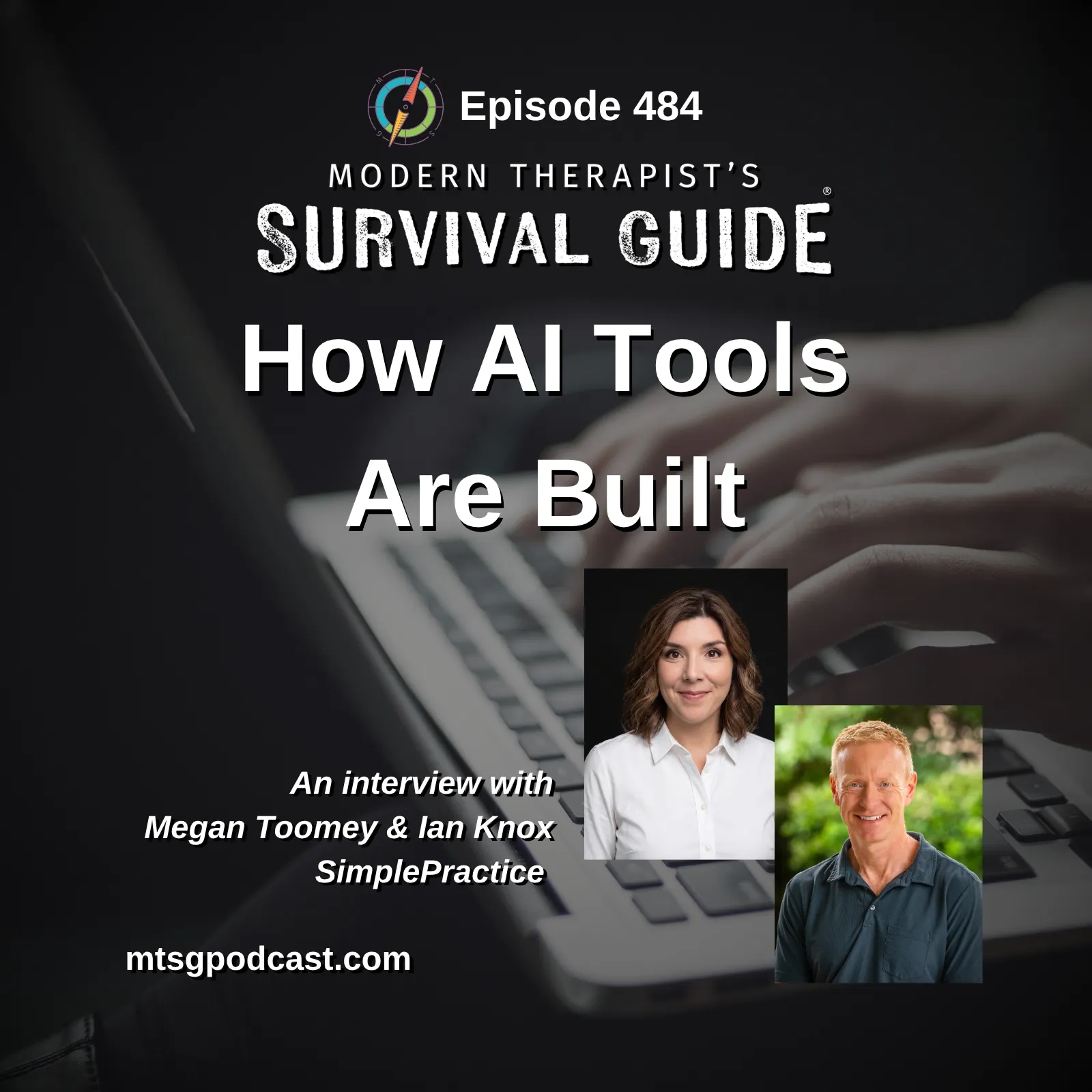 How AI Tools for Therapists Are Built: Trust, Data Privacy, and Choosing What to Adopt - An Interview with Ian Knox and Megan Toomey of SimplePractice 23.07.2026 41minHow AI Tools for Therapists Are Built: Trust, Data Privacy, and Choosing What to Adopt - An Interview with Ian Knox and Megan Toomey Ian Knox and Megan Toomey of SimplePractice take therapists behind the scenes of how AI tools for mental health are actually built, trained, and kept secure. We're in the middle of AI month, and Curt and Katie wanted to move past the buzzwords and talk with the people who actually engineer this technology. As part of the show's partnership with SimplePractice, they sit down with Ian Knox, Chief Product Officer, and Megan Toomey, Sr. Director of Clinical Support AI Product Management, to pull back the curtain on how AI tools for therapists get designed, what "training the model" really means, and how client data is handled. They get specific about what to evaluate before adopting any AI tool, from vendor trust and HIPAA compliance to data practices, and why note taking is the most mature use case while insurance, scheduling, intake, and referral matching are still emerging. Ian and Megan also take on the fear that AI-first companies want to replace therapists, and explain why clinicians have to stay at the center of care and review anything they put their name on. This is a grounded, practical conversation for any therapist trying to decide what AI belongs in their practice, and what to be cautious about, without panic or hype. In this episode, we discuss: - How an EHR decides which clinician tasks AI is mature enough to help with - What to evaluate before trusting an AI vendor with client data - Why "HIPAA compliant" is a floor, not proof of strong security - What "training the model" does and does not mean, and why SimplePractice says it is not training an LLM on your data - How transcripts are retained, and the new opt-in for de-identified data - Why you remain responsible for every AI-assisted note you sign - How to talk with clients about AI and get meaningful consent Timestamps: 00:16 - AI month, and why we wanted to talk to people who build AI 01:33 - Who Ian and Megan are 03:21 - SimplePractice's history with AI tools 05:38 - What therapists should know when adding AI to a practice 08:44 - Where clinicians can streamline with AI 12:23 - How to choose which AI features to adopt 16:10 - Why you can't fully trust AI, and best practices 19:29 - What clinicians should know about their data 21:13 - The Trust Center, and "are you here to replace therapists?" 23:55 - How AI systems are trained (the puppy analogy) 27:00 - White-label LLMs and the "golden data set" 29:11 - De-identified transcripts and the opt-in 31:40 - Current tools and the product roadmap Guest bios: Ian Knox is Chief Product Officer at SimplePractice, with prior product leadership at Expedia and Microsoft. Megan Toomey is Sr. Director of Clinical Support AI Product Management at SimplePractice, leading the team building AI tools for behavioral health clinicians, with prior experience at Microsoft and Amazon. Full show notes and transcript: mtsgpodcast.com Join the Modern Therapist Community Facebook Group: https://www.facebook.com/groups/therapyreimagined Modern Therapist's Survival Guide Creative Credits Voice Over by DW McCann: https://www.facebook.com/McCannDW/ Music by Crystal Grooms Mangano: https://groomsymusic.com/
 -
 When Clients Bring AI to Therapy: Working with ChatGPT, Sycophancy, and the New Third Wheel in the Room 20.07.2026 40minWhen Clients Bring AI to Therapy: Working with ChatGPT, Sycophancy, and the New Third Wheel in the Room Clients are bringing AI into therapy, from ChatGPT chat logs handed over as homework to AI companions that never disagree, and therapists need a clinical response. Curt Widhalm, LMFT, and Katie Vernoy, LMFT dig into what happens when clients bring their own AI into the therapy room. The profession built ethics guidance for when therapists send clients toward AI, but it largely sidestepped the reality already showing up in sessions: clients processing the same issues with ChatGPT between appointments, using chatbots to interpret and respond to relationships, and increasingly offloading their social and dating lives onto AI companions. Drawing on emerging research about chatbot use, loneliness, emotional dependence, and sycophancy, Curt and Katie make the case that concern is more useful than alarm. Clients are already using these tools, so the clinical task is to assess how and why they are using them, provide psychoeducation on sycophancy, confidentiality, and safety, and separate the healthy, adaptive uses from the problematic ones. They also share concrete in-session moves: entering the opposite position to expose how a chatbot validates any side, reframing how clients use AI for medical and diagnostic questions, and recognizing when AI has become a client's primary support system, along with how to begin weaning a client back toward real-world connection. In this episode, we discuss: - The three main ways clients are bringing AI into the therapy room - Why a client's AI use can be a clinical opportunity, not only a risk - How to assess the function and pattern of a client's AI use - What the research suggests about chatbot use, loneliness, and sycophancy - How to teach critical thinking and protect client confidentiality - What to do when a client has become dependent on AI Timestamps: 00:15 - AI as the new "third wheel" in the therapy room 04:15 - Three ways AI is showing up in clients' lives 05:55 - What the research suggests: loneliness, dependence, and sycophancy 10:24 - Why client AI use can be a clinical opportunity 13:24 - Assessing use and treating chatbots as public spaces 18:17 - Explaining AI's mechanics: it is not an objective third party 20:14 - A critical-thinking exercise: enter the opposite position 24:47 - Using AI for medical and diagnostic questions 30:53 - When a client is already dependent on AI Full show notes and resources: mtsgpodcast.com Join the Modern Therapist Community Patreon: https://www.patreon.com/c/mtsgpodcast Facebook Group: https://www.facebook.com/groups/therapyreimagined Modern Therapist's Survival Guide Creative Credits Voice Over by DW McCann: https://www.facebook.com/McCannDW/ Music by Crystal Grooms Mangano: https://groomsymusic.com/
 -
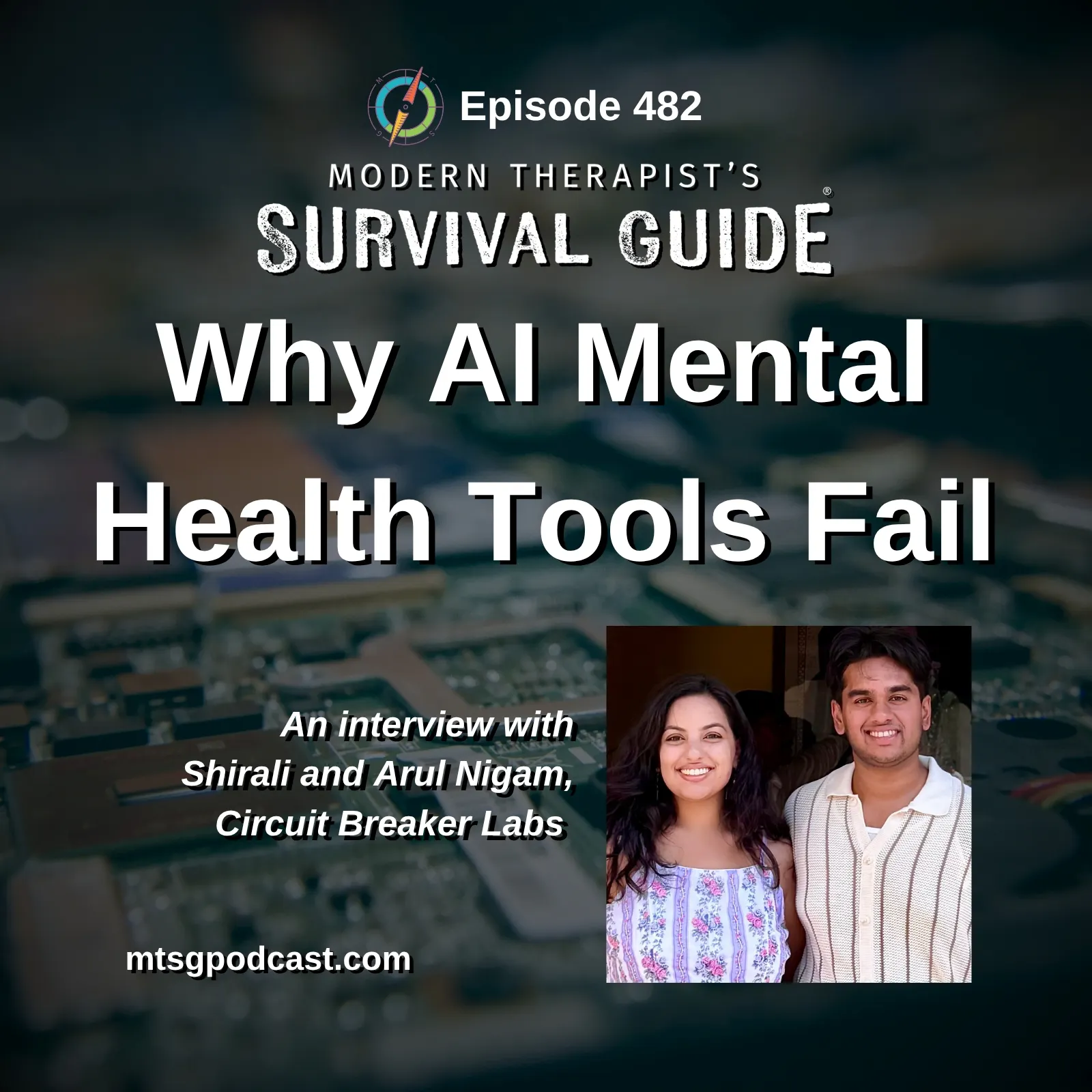 Why AI Mental Health Chatbots Fail When It Matters Most: The Hidden Vulnerabilities Stress-Testing Reveals – An Interview with Shirali and Arul Nigam of Circuit Breaker Labs 13.07.2026 47minWhy AI Mental Health Chatbots Fail When It Matters Most: The Hidden Vulnerabilities Stress-Testing Reveals - An Interview with Shirali and Arul Nigam of Circuit Breaker Labs Shirali and Arul Nigam of Circuit Breaker Labs on why AI mental health chatbots fail, how stress-testing exposes their hidden vulnerabilities, and what therapists need to know. Curt and Katie talk with Shirali and Arul Nigam, the sibling co-founders of Circuit Breaker Labs, about what therapists tend to get wrong about AI, why the safety infrastructure behind many mental health chatbots is weaker than it looks, and how their team stress-tests these tools to find dangerous failures before real users ever encounter them. Generative AI is probabilistic, so the same prompt can return a safe answer one moment and a harmful one the next. Shirali and Arul explain how guardrails get bypassed by a misspelled word, a teenager's slang, or the hundredth message in a long conversation, why mental health chatbots tend to fail in the moments that matter most, and what stress-testing hundreds of thousands of simulated conversations actually reveals about model safety. The conversation closes on what clinicians can do now, why clinical insight is the missing ingredient in AI safety, and why third-party validation is becoming the standard regulators and developers expect. Used well, AI can be a supplement to care or a gateway to a human therapist, but it is not a replacement, and getting there safely starts with building clinical insight in from the foundation. In this episode, we discuss: - Why people usually turn to AI in place of no care, not in place of a therapist - Why generative AI's unpredictability, not a single bad answer, is the real safety problem - How a misspelling, slang, or a long conversation can slip past chatbot guardrails - Why AI mental health chatbots tend to fail in the highest-risk moments - What stress-testing hundreds of thousands of conversations reveals about model safety - Why clinical insight is the missing ingredient, and what clinicians can do now Timestamps: 0:00 - Introduction 1:38 - Meet Shirali and Arul Nigam and Circuit Breaker Labs 3:37 - What therapists get wrong about AI 5:28 - Deterministic versus generative AI, and why the risk scales 8:26 - The safety problem in AI mental health: trust, training data, and agreeableness 11:29 - Guardrails, lifeguard models, and the 988 problem 17:30 - Deploying clinical insight at scale and building safety in from the start 21:09 - How stress-testing works: context pollution and adversarial simulation 27:11 - What the stress tests reveal: variance, typos, and bypassed guardrails 30:59 - Regulation, credential hallucination, and third-party validation 36:58 - What clinicians can do, and the missing clinical insight 40:20 - Where to find Circuit Breaker Labs Guest Bios: Shirali and Arul Nigam are siblings and the co-founders of Circuit Breaker Labs, which autonomously pressure-tests the AI systems that interact with people to find hidden mental health vulnerabilities before they reach real users. Shirali brings expertise in neuroscience, translational research, and clinical work, with experience at the Howard Hughes Medical Institute's Janelia Research Campus, NIH NINDS, Harvard's Wyss Institute, Johns Hopkins, and Children's National. She holds a BS in Biomedical Engineering from The George Washington University and an MBA from The Wharton School, University of Pennsylvania. Arul has conducted technical and policy research on ethical AI, with a focus on bias and fairness, at Georgetown University and Thomas Jefferson High School for Science and Technology, and holds a BSBA in Operations and Analytics from Georgetown University. Learn more at circuitbreakerlabs.ai. Full show notes and transcript: mtsgpodcast.com Join the Modern Therapist Community Patreon: https://www.patreon.com/c/mtsgpodcast Facebook Group: https://www.facebook.com/groups/therapyreimagined Modern Therapist's Survival Guide Creative Credits Voice Over by DW McCann: https://www.facebook.com/McCannDW/ Music by Crystal Grooms Mangano: https://groomsymusic.com/
 -
 AI Ethics Codes for Therapists: What CAMFT, APA, NASW, and AAMFT Now Require 06.07.2026 1h 10minAI Ethics Codes for Therapists: What CAMFT, APA, NASW, and AAMFT Now Require How the CAMFT, APA, NASW, and AAMFT ethics codes now regulate AI in therapy: a CE podcourse on competence, informed consent, data privacy, bias, and human accountability. Curt Widhalm, LMFT, and Katie Vernoy, LMFT, walk through the recent artificial intelligence updates to the major mental health ethics codes. Centering on the new CAMFT updates and cross-referencing the APA, NASW, ACA, and AAMFT codes, they turn the new language into a practical roadmap for everyday clinical work. The conversation covers what competence with AI actually requires (closer to safely driving a car than building one), the three CAMFT obligations that travel together (disclosure, informed consent, and informed decision making), and a client's right to opt out. They get specific on data privacy, including business associate agreements and why "HIPAA compliant" is a marketing claim rather than a certification, on spotting demographic and medical-model bias in AI output, and on why the human in the loop still owns and is accountable for anything signed under their name. This continuing education podcourse is for therapists, supervisors, and clinical educators who want to use AI tools ethically and stay accountable in an automated world. In this episode, we discuss: - Why the codes aim for broad, durable AI principles instead of tool-specific rules - What competence with AI actually requires of a clinician - The three CAMFT obligations: disclosure, informed consent, and informed decision making - How to vet data privacy, including BAAs and why "HIPAA compliant" is only marketing - How to catch demographic and medical-model bias in AI output - Why the clinician remains responsible for anything produced under their name Timestamps: - 0:55 - Why the ethics codes are updating for AI - 3:30 - Defining artificial intelligence (California AB 2885) - 9:49 - The four Beauchamp and Childress principles - 12:28 - Timeline: CAMFT, APA, NASW, and AAMFT updates - 16:11 - Competence and the "driving a car" metaphor - 21:09 - Disclosure, informed consent, and the right to opt out - 33:18 - Data privacy, BAAs, and "HIPAA compliant" as marketing - 41:20 - Bias, social justice, and reading the output - 44:52 - The human in the loop and accountability - 53:12 - Is AI right for this client? - 1:00:59 - Supervision, education, and the AI vetting guide 1 CE unit is available through the Modern Therapist Learning Community: moderntherapistcommunity.com Full show notes and transcript: mtsgpodcast.com Join the Modern Therapist Community Patreon: https://www.patreon.com/c/mtsgpodcast Facebook Group: https://www.facebook.com/groups/therapyreimagined Modern Therapist's Survival Guide Creative Credits Voice Over by DW McCann: https://www.facebook.com/McCannDW/ Music by Crystal Grooms Mangano: https://groomsymusic.com/
 -
 Supporting Conversion Therapy Survivors After Chiles v. Salazar: SOGIECE, Clinical Care, and Community Response – An Interview with Samuel Nieves 29.06.2026 47minSupporting Conversion Therapy Survivors After Chiles v. Salazar: SOGIECE, Clinical Care, and Community Response - An Interview with Samuel Nieves Samuel Nieves of the Conversion Therapy Survivor Network on supporting conversion therapy survivors, recognizing SOGIECE, and clinical care after Chiles v. Salazar. Curt and Katie welcome back Samuel Nieves, a conversion therapy survivor and board member of the Conversion Therapy Survivor Network, for a follow-up to their earlier conversation and to the host-led discussion of the Chiles v. Salazar decision. Rather than re-litigating the legal details, they focus on the clinical and human aftermath for survivors. Sam shares what he saw the day the ruling came down, how to recognize a conversion therapy survivor on your caseload (including memory loss and shifting narratives), why validation has to come before strengths work, and how to lead with curiosity instead of challenge. He explains SOGIECE, sexual orientation and gender identity or expression change efforts, and why naming it can be the validation that lets a survivor finally call their experience what it was. The conversation also sits with why reducing these practices to "speech" misses the harm, what licensing boards and clinicians owe survivors, and how survivors and the advocates who serve them stay in the work through firm boundaries and intentional queer joy. This is a grounded, affirming episode for any clinician working with LGBTQ+ clients. In this episode, we discuss: - How to recognize a conversion therapy survivor on your caseload - Why validation has to come before strengths-based work - How to lead with curiosity instead of challenge with traumatized clients - What SOGIECE is and why naming it can be profoundly validating - Why framing conversion therapy as "speech" misses the real harm - What licensing boards and the profession owe survivors - How survivors and advocates sustain themselves through boundaries and queer joy Timestamps: - 02:00 - Who Sam is and the Conversion Therapy Survivor Network - 03:14 - The day the Chiles v. Salazar decision came down - 06:26 - Validation before strengths with survivors - 09:04 - What well-meaning therapists can miss - 11:10 - The public "permission" and its harm to survivors - 18:40 - Why "it's just speech" misses the harm - 22:10 - SOGIECE, allies, and survivor organizations - 27:45 - What the profession owes survivors - 32:21 - Solution-focused therapy, ACT, and queer joy - 35:01 - How Sam sustains himself in the work Guest Bio: Samuel Nieves (he/they) is a board member of the Conversion Therapy Survivor Network, a 501(c)(3) nonprofit supporting survivors of conversion therapy and SOGIECE worldwide. Trained as a marriage and family therapist, Sam advocates online as "CantPrayMeAway" and helps facilitate the organization's weekly survivor support group. Full show notes and transcript: mtsgpodcast.com Join the Modern Therapist Community Patreon: https://www.patreon.com/c/mtsgpodcast Facebook Group: https://www.facebook.com/groups/therapyreimagined Modern Therapist's Survival Guide Creative Credits Voice Over by DW McCann: https://www.facebook.com/McCannDW/ Music by Crystal Grooms Mangano: https://groomsymusic.com/
 -
 Should Conversion Therapy Be Protected Speech? What Chiles v. Salazar Means for Conversion Therapy Bans and the Future of the Profession 22.06.2026 41minShould Conversion Therapy Be Protected Speech? What Chiles v. Salazar Means for Conversion Therapy Bans and the Future of the Profession In Chiles v. Salazar, the Supreme Court ruled 8 to 1 that a therapist's talk therapy is protected speech, putting state conversion therapy bans at risk. Curt Widhalm, LMFT, and Katie Vernoy, LMFT break down what the March 31, 2026 decision actually says, what it does not say, and what it means for therapists who work with LGBTQ+ clients. The Court did not call conversion therapy safe, effective, or ethical, and it did not make the practice mandatory. It treated talk therapy as speech rather than regulable conduct, and sent Colorado's ban back to the lower courts for stricter First Amendment review. Curt and Katie walk through the strict scrutiny test at the center of the case, the Kagan and Sotomayor concurrence, and Justice Jackson's dissent, then sit with the harder question: what happens to the profession when the state can no longer set a guardrail on harmful practice before harm has occurred. Released during Pride Month, this is a candid, values-forward conversation about protecting LGBTQ+ clients and practicing affirming, anti-conversion-therapy care out loud. In this episode, we discuss: - What the Chiles v. Salazar ruling does, and does not, change about conversion therapy bans - Why the Court treated talk therapy as protected speech instead of medical treatment - How the strict scrutiny test decided the case - Where the concurrence and the dissent point the profession next - Concrete ways to signal affirming, anti-conversion-therapy care in your practice Full show notes and resources: mtsgpodcast.com Join the Modern Therapist Community Patreon: https://www.patreon.com/c/mtsgpodcast Facebook Group: https://www.facebook.com/groups/therapyreimagined Modern Therapist's Survival Guide Creative Credits Voice Over by DW McCann: https://www.facebook.com/McCannDW/ Music by Crystal Grooms Mangano: https://groomsymusic.com/
 -
 Good Enough, Safe Enough: Affirming LGBTQ+ Clients When You're Not a Specialist 15.06.2026 40minGood Enough, Safe Enough: Affirming LGBTQ+ Clients When You're Not a Specialist Affirming LGBTQ+ clients when you are not a specialist: Curt Widhalm, LMFT, and Katie Vernoy, LMFT on being a good enough, safe enough therapist when you cannot refer out. Curt and Katie take on a question therapists often avoid: what do you do when an LGBTQ+ client needs care, you are not a specialist, and referring out is not possible, not safe, or not honest? In this Pride Month episode, they make the case that you can be a good enough, safe enough therapist for LGBTQ+ clients even when affirming care is not your declared specialty. Mental health deserts, narrow insurance panels, long specialist wait lists, and unsafe home environments mean referral is not always available, and sometimes referring out is closer to abandonment than care. Curt and Katie argue that scope of competence is too often used as polite cover for therapist discomfort, and that most clinical work with LGBTQ+ clients is the same work you already do well. Affirming care is the container, not a separate specialty. They also get practical about being a safe enough stopgap therapist: building a just in time consultation kit, doing the cultural humility work, and reckoning with the invisible labor and consultation tax of allyship, including why you should never bill a client to research their own identity. And they name the specific moments when referring an LGBTQ+ client out is still the right and ethical call. This is a useful conversation for generalist therapists, rural and solo clinicians, insurance-based practices, and anyone doing the ongoing work of affirming, culturally humble care. In this episode, we discuss: - Why "refer out" can be avoidance dressed as ethics, and when it is genuinely the right call - How to tell a true scope of competence limit from your own discomfort - What it means to be a good enough, safe enough therapist for LGBTQ+ clients - How to build a just in time kit so an LGBTQ+ client never lands on you cold - Why the invisible labor and consultation tax of allyship is yours to carry, not your client's to fund - The specific signs that mean you should refer out anyway Timestamps: 00:15 - Why a Pride Month episode on being good enough, not a specialist 02:56 - "Just refer out": sound advice or avoidance? 05:05 - Scope of competence versus therapist discomfort 13:08 - The good enough therapist, and when referral becomes abandonment 16:55 - Meeting clients where they are until specialist care opens up 19:03 - Building a just in time kit for your practice 24:44 - The invisible labor and consultation tax of allyship 32:10 - When you should refer out anyway Full show notes and transcript: mtsgpodcast.com Join the Modern Therapist Community Patreon: https://www.patreon.com/c/mtsgpodcast Facebook Group: https://www.facebook.com/groups/therapyreimagined Modern Therapist's Survival Guide Creative Credits Voice Over by DW McCann: https://www.facebook.com/McCannDW/ Music by Crystal Grooms Mangano: https://groomsymusic.com/
 -
 Allyship Is Awkward: How Therapists Can Keep Showing Up Anyway 08.06.2026 45minAllyship Is Awkward: How Therapists Can Keep Showing Up Anyway What if the awkwardness of ally work is not a sign you are doing it wrong, but the actual work? Curt Widhalm, LMFT, and Katie Vernoy, LMFT explore what it looks like to do ally work as a therapist when you hold majority identities the people around you do not share. They move across three zones where this shows up: with clients in the therapy room, with colleagues and consultants in professional spaces, and in broader community and advocacy work. Drawing on their own missteps and on the work of creators like Ashani Mfuko of Anti-Racism School Is In Session and Dr. Raquel Martin of Mind Ya Mental, Curt and Katie make a direct case to white, cis, straight, and other majority-identity therapists: cultural humility is not a credential, fragility shifts the labor onto the people around you, and the strong feelings that come with ally work belong with other allies, not with clients or colleagues of color. This is an episode about staying in the room, decentering yourself, and learning to fail better. In this episode, we discuss: Why ally work is inherently awkward, and why that is not a problem to be solved How fragility, over-apologizing, and gold-star seeking shift the emotional labor onto clients and colleagues of color What repair actually looks like when a cross-cultural rupture happens in session Why being called out by a client can be a sign the relationship is alive enough to repair How to process defensiveness and hurt with other allies instead of with clients or colleagues of color Why cultural humility is not a free pass, and what therapists owe their own continuing education How consultation with diverse colleagues protects clients from being conscripted as your teacher Ally work is ongoing. The goal is not to stop making mistakes. The goal is to keep failing better. Full show notes and resources: mtsgpodcast.com Join the Modern Therapist Community: Patreon: https://www.patreon.com/c/mtsgpodcast Facebook Group: https://www.facebook.com/groups/therapyreimagined Modern Therapist's Survival Guide Creative Credits: Voice Over by DW McCann: https://www.facebook.com/McCannDW/ Music by Crystal Grooms Mangano: https://groomsymusic.com/
Liknande podcastar


Populär i
Den här podcasten finns även i podcastlistor i dessa länder.

