
Exercising Consistency: From Fitness To Flourishing
Korey Samuelson
0
Exercising Consistency: From Fitness to Flourishing explores how physical exercise can serve as a foundation for broader personal growth. The host examines exercise as a holistic lifestyle rather than a set of isolated workouts, arguing that it holds the key to transforming many areas of life. A central theme is choosing consistency over intensity, building sustainable habits instead of chasing short bursts of effort. The show is tied to the Stoic Strength Substack, blending fitness reflection with practical philosophy.
Avsnitt
-
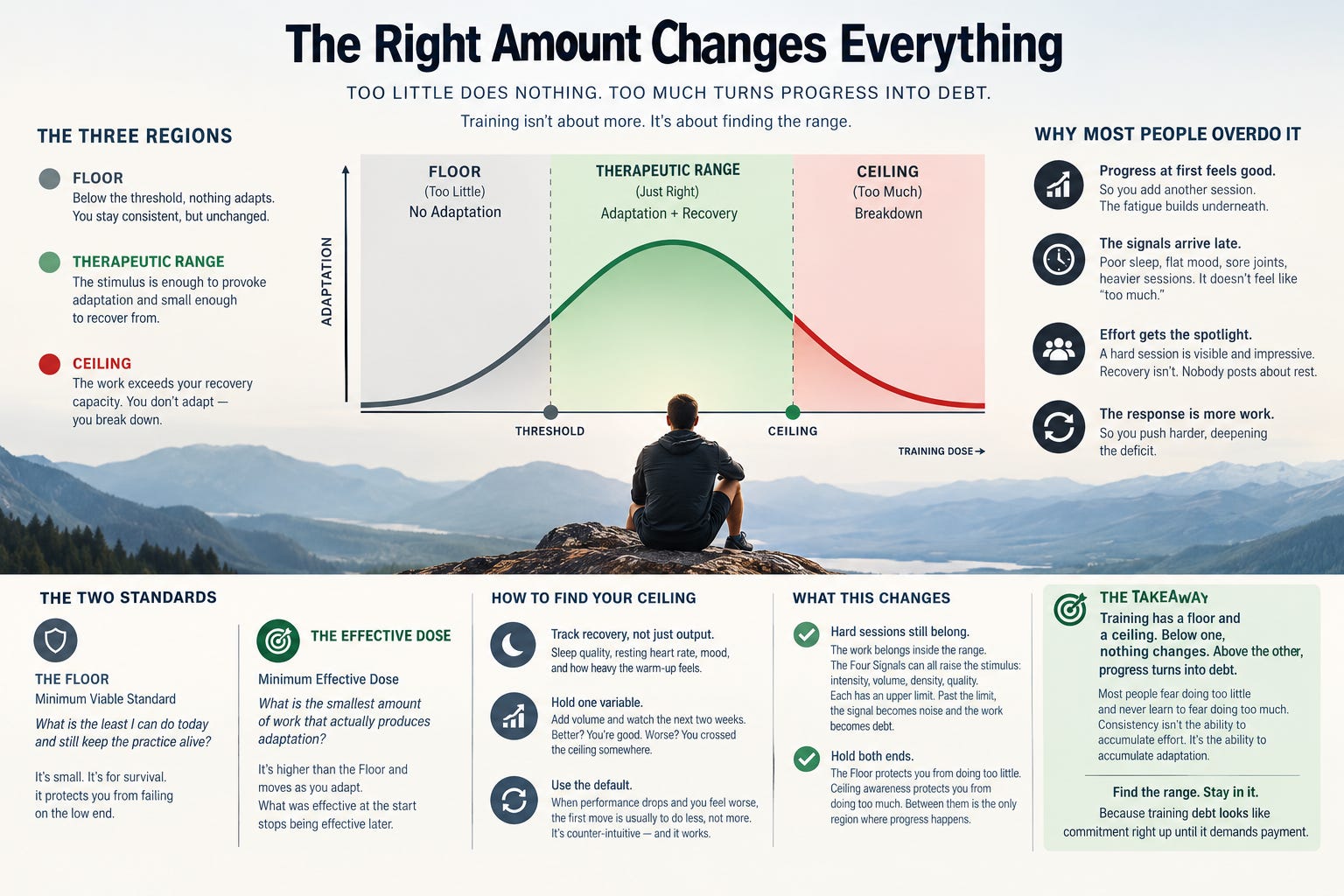 430. The Training Range Where Progress Happens 02.10.2026 7minTo become the person who follows through, go to exercisingconsistency.com and join The ACT Score Challenge today.The main concern with training is doing too little. Almost nobody worries about doing too much.Yet more training practices are ended by excess than insufficiency. The workout that gets skipped feels like the danger. The extra workout feels like commitment. Often, it’s the other way around.Hey there. It’s me, Kore. And you’re listening to Exercising Consistency: From Fitness to Flourishing.You know the advice to do more. More volume, more frequency, more intensity, more discipline.Almost every piece of training advice you have ever received points in the same direction. It assumes the only mistake available is doing too little. There is a second mistake. This second one looks like virtue. It’s training above the point where your body can convert the work into adaptation.Nobody calls that overtraining while it’s happening. They call it commitment.The Dose-Response CurveIn pharmacology, every substance has a threshold and a ceiling. Below the threshold, the drug does nothing. Above the ceiling, it stops helping and starts harming. Between the two is the therapeutic range, and finding it is the whole job.Training has the same shape, and the same three regions. Below the threshold, nothing adapts. This is where a Floor that is too low leaves you: perfectly consistent and perfectly unchanged. Inside the range, the stimulus is enough to provoke a response and small enough to recover from it. Above the ceiling, the work exceeds your recovery capacity and the body responds not with adaptation but with breakdown.The mechanism underneath is adaptation versus recovery. Stimulus without recovery is not more progress. It is debt.Why Most People Train Above the CeilingThe ceiling is easy to cross and hard to notice, because the signals arrive late and look like something else.You add a session. Then another. Progress is real at first, so the addition feels justified. Fatigue accumulates underneath it, invisible, until it surfaces: compromised sleep, flatter mood, nagging joints, sessions that feel heavier than the numbers suggest. None of that reads as “too much.” It reads as needing more discipline, which is the trap. The response to under-recovery is usually more work, which deepens the deficit.There is a cultural reason too. Effort is the focus and rest is not. A hard session is visible, countable, impressive. Recovery occurs in the background. And nobody posts about getting enough rest. So the incentive runs one way and it runs toward the ceiling.The Two Standards, Stated Side by SideHere is where the two standards differ and why you need both.The minimum viable standard is your Floor. It answers: What is the least I can do today and still keep the practice alive? It is deliberately small and its purpose is survival under unfavourable conditions. It protects you from the failure on the low end.The minimum effective dose is a different question. It answers: What is the smallest amount of work that actually produces adaptation? That is a higher figure than the Floor and it moves as you adapt. What was effective at the start stops being effective later, because the body has answered the stimulus and needs a larger one.So the Floor, the effective dose, and the ceiling are three figures, not one. Most people have never separated them, which is why their training is either too small to matter or too large to absorb.How to Find Your CeilingThe ceiling is not a fixed weight or a fixed number of sessions. It shifts with sleep, stress, age, and training history. So the useful thing is not a figure but a method.Track recovery, not just output. Sleep quality, resting heart rate, mood, and how heavy the warm-up feels will all tell you before the logbook does. Those are leading signals, and they arrive before the plateau.Hold one variable and pay attention. If you add volume and the next two weeks get worse, you crossed the ceiling somewhere in between. If they get better, you did not.And there is a simple default: when performance drops and you feel worse, the first move is usually to do less, not more. That’s counter-intuitive and correct far more often than people expect.What This ChangesNone of this is an argument against working hard. Hard sessions belong inside the range.The claim I’m making is about the boundary, not the middle. Peak effort is fine when it can be absorbed, and the Four Signals are all legitimate ways to raise the stimulus: intensity, volume, density, quality. The point is that each of them has an upper limit and past the limit the signal becomes noise and the work becomes debt.So hold both ends. The Floor protects you from doing too little on the day that did not cooperate. Ceiling awareness protects you from doing too much and calling it commitment. Between them is the only region where progress happens.The TakeawayTraining has a floor and a ceiling. Below one, nothing changes. Above the other, progress turns into debt.Most people spend their entire training life solving one problem while creating the other. They fear doing too little and never learn to fear doing too much. But consistency is not the ability to accumulate effort. It’s the ability to accumulate adaptation.The disciplined trainer is not the one who does the most work. They’re the one who keeps finding the dose they can actually absorb.Find the range. Stay in it. Because training debt looks like commitment right up until it demands payment.An InvitationWhen you’re ready to upgrade the quality of your consistency, go to exercisingconsistency.com.That’s it for today. Catch you next time. This is a public episode. If you would like to discuss this with other subscribers or get access to bonus episodes, visit stoicstrength.substack.com
 -
 429. What Your Warm-Up Says About Your Discipline 01.10.2026 7minTo become the person who follows through, go to exercisingconsistency.com and join The ACT Score Challenge today.Ask someone about their training and you will hear about their lifts, their program, their best session. You will not hear about their warm-up. It has no numbers anyone cares about, no personal records, no photograph. It is the only part of the session that produces nothing worth showing anyone.Which is exactly why it’s the most honest part. Everything else can be performed. The warm-up can only be done or skipped, and there is no audience for either.Hey there. It’s me, Kore. And you’re listening to Exercising Consistency: From Fitness to Flourishing.Why the Warm-Up Is the TestStructure matters here. In the exercise practice, the warm-up comes before the workout, and that ordering is what makes it diagnostic.The workout has support. By the time you are under the bar, the plan is in play, the equipment is out, you’re in the gym, and the momentum is real.The warm-up is the prelude to all of that. It’s the first enactment requiring deliberate choice. If your intention is on point the warm-up happens. If it isn’t, the warm-up is where you find out.That’s why the warm-up is the cleanest signal in the session. It’s not the hardest part. It is the earliest part. And the earliest part reports on whether you started with focused intention or drifted as per your conditioning.The workout reveals who you already are. The warm-up is where you practice becoming someone else on purpose.The Warm-Up’s First HijackThe Conditioned Self is the sum of what has been trained, and it runs in response to the circumstances and environment. In training, its telltales are familiar: the shortened warm-up, the boring work skipped, the stretch you decide you don’t need today.This is the earliest opportunity for drift in the session, which makes it the most informative. The effort you cut when fatigue arrives is the Conditioned Self revealing itself late, after the work has extracted a cost. The warm-up you skip reveals it before any cost has been paid.Nothing is heavy yet. Nothing burns with fatigue yet. You skipped parts of the warm-up while fresh, with energy available, which means the reason was different.The shortened warm-up is where you can notice the negotiation begin. The reason does not hold up well, so it arrives early and quietly. It never feels like quitting. It feels like efficiency. And whatever the warm-up skips, the workout pays the price.Low Load Is Where Identity Is TrainedThere is the physical account and there is the behavioural one, and the behavioural one is larger.Physically, the warm-up prepares tissues, temperature, and movement quality. That is real and worth doing for its own sake. But the behavioural function is what makes it worth serious scrutiny.The warm-up runs at low load and low load is where patterns get built. Technique is sharpened. Form is polished. There is nothing to prove and no weight to survive, so the only thing being rehearsed is the quality of the movement and the standard you bring to it.Think about what that means for the harder part. You cannot only practise being yourself under load. If you only ever show up when it’s difficult, you never build the identity that can handle the difficulty. You earn that in the easier moments, when nothing is asking much of you.Then when the pressure arrives, you are far more able to hold the form and the standard you established at low load.The Choice Is Made Before the RewardThe warm-up is also the choice made physical, done before there is any reward to justify it.The workout is reinforcing. There’s the pump, the numbers, the sense of having done something. The warm-up is investing time and effort for the workout. It’s less rewarding upfront. So doing it is a choice made for its own sake, which is exactly what excellence means here: choosing well when there is no audience and no immediate return.That is the order of operations that matters. You warm up and then you train, which means the first thing you did was choose. Then the workout inherits that choice.Start the session with a decision consistent with personal excellence and things have begun well. Start it by skipping the part that seems minor and the workout itself is compromised.The Trap of Overdoing the Warm-UpWarm-ups can be too small and they can be too large. The second failure is harder to spot.Twenty minutes of mobility, three activation circuits, and a long foam-roll is not preparation. It is preparation as the substitute for training. It becomes a comfortable place to stay because it never fails and never hurts. That is postponement.The distinction is function. A warm-up prepares you to work. Done well it improves the quality of the work. But it’s not a substitute for the actual work. The test is whether the session ever gets to the main thing. If the warm-up has expanded to fill the time you used to train in, it has stopped being a warm-up and become a place to hide.Adequate, appropriate, and consistent beats elaborate and occasional, which is the rule that governs everything else.The TakeawayThe warm-up is the part nobody talks about because there’s nothing to show for it. No personal bests or heroic moments. Which is exactly why it matters.The warm-up is the first choice of the session. Before the impressive weights, before the relatable fatigue, before the “real” work, you decide whether to follow your standard or negotiate with it.By the time the training gets hard the choice to be disciplined has already been made. It was made when the weight was light, during the warm-up.The warm-up is the first place you can see whether you showed up disciplined or drifted in and let the day decide.An InvitationTo become the person who follows through on their most important goals, go to exercisingconsistency.com.That’s it for today. Catch you next time. This is a public episode. If you would like to discuss this with other subscribers or get access to bonus episodes, visit stoicstrength.substack.com
 -
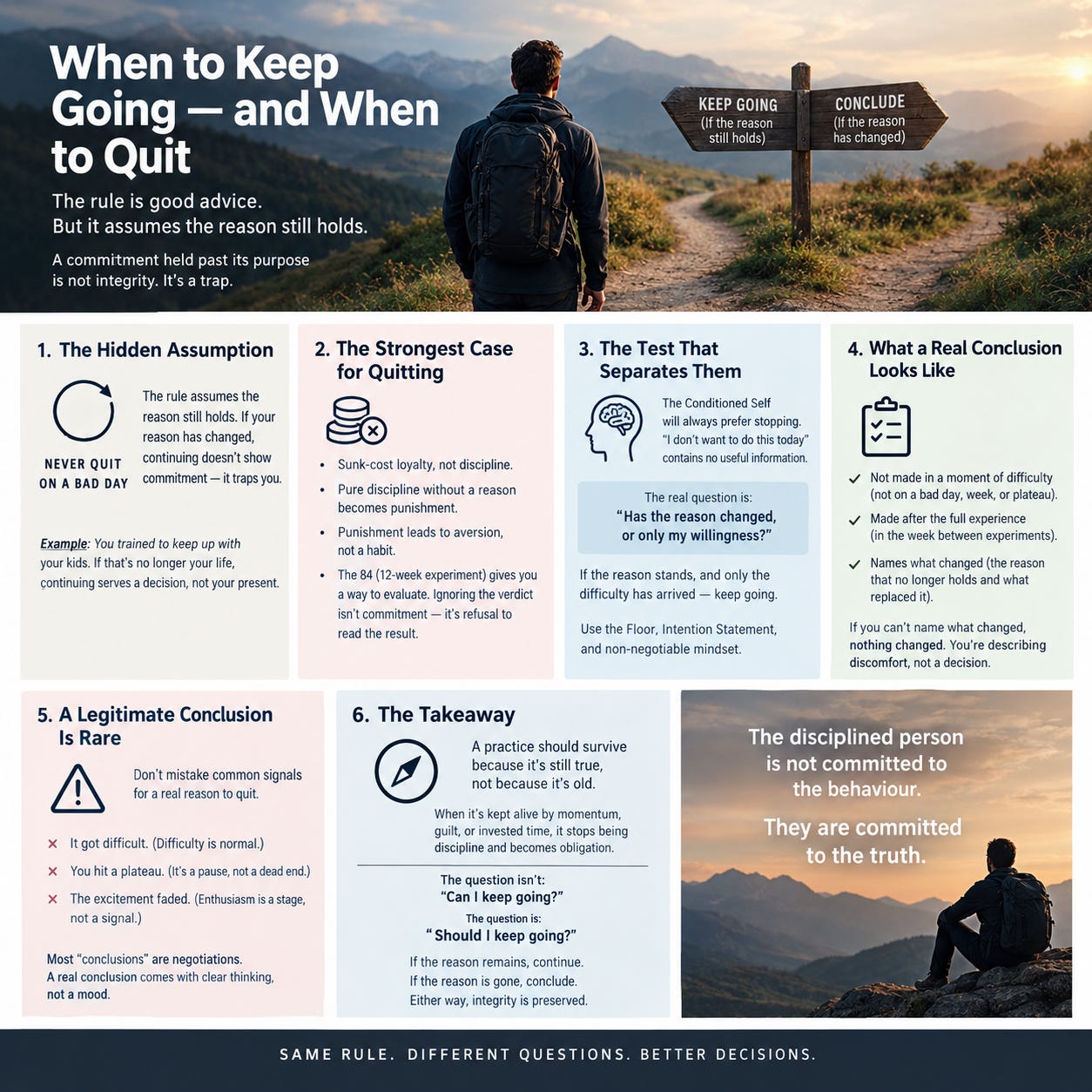 428. When Quitting Is the Disciplined Choice 30.09.2026 7minTo become the person who follows through, go to exercisingconsistency.com and join The ACT Score Challenge today.You’ve heard the rule, and you have probably given it to yourself: never quit on a bad day, keep the commitment, see it through.It’s good advice, but it contains an assumption, and the assumption almost never gets examined. It assumes the reason still holds.If you decided to train so you could keep up with your kids, for example, the rule tells you to keep going. If the reason itself has changed, the rule is telling you to keep serving a decision that no longer describes your life. A rule applied past its assumptions does not guide you. It traps you.Hey there. It’s me, Kore. And you’re listening to Exercising Consistency: From Fitness to Flourishing.The Strongest Case for QuittingTake the opposite position seriously for a moment.A commitment held past its purpose is not integrity. It is sunk-cost loyalty. You have invested months, so you continue, because stopping would mean admitting the investment went somewhere you no longer want to go. That is not discipline. It is a way of protecting a past decision from present evidence.And there is a cost to this. Pure discipline without a reason behind it becomes punishment and punishment decreases the likelihood that a behaviour reoccurs. So continuing for long enough in a practice you do not actually value trains you against the behaviour. You do not come out of that with a habit. You come out of it with an aversion.The framework I suggest already has a door for this. Using The 84, a 12-week experiment, you can discover, through direct action and experience, that what you thought was a good idea needs to be re-evaluated. The evaluation is key. Ignoring its verdict is not commitment. It’s refusing to read the result.The Test That Separates ThemHere is the distinction that resolves this and it is not about how you feel.The Conditioned Self will always prefer stopping. It prefers the path of least resistance and it acts first under stress and fatigue. So “I don’t want to do this today“ carries no information at all. It is the default output of the machinery, your conditioning up to this point, and it will say the same thing whether the commitment is sound or not.The question that does carry information is whether the reason has changed or only your willingness has. The reason is the one bedrock justification, the single answer that stands alone with no need for any backup rationale. Ask whether that answer is still true. Don’t ask whether the work is hard. Don’t ask whether you still feel like it. What you need to know is whether the thing you said this was for is still the thing.If the reason stands, and only the difficulty has arrived, then this is precisely the moment for which the rule was written. Keep going. That’s why we use the Floor, the Intention Statement, and the non-negotiable mindset. They are built for the day the reason is intact, but the willingness is absent.What a Genuine Conclusion Looks LikeIf the reason itself has become invalid, the picture changes, and a genuine conclusion has specific markers.It’s not made in a moment of difficulty. It is not made on a bad day, during a bad week, or during a plateau. It cannot be made there, because those are the conditions under which the Conditioned Self colours your thinking most.It’s made after the full experience, not before it’s over. The evaluation belongs after the 84 days are complete, in the week between experiments, because only then do you have the data. Conclusions drawn before the trial is finished are not conclusions. They are guesses.And it names what changed. A real conclusion can point at the reason that no longer holds and say what replaced it. If you cannot name what changed, nothing changed, and you are describing discomfort rather than a decision.A Legitimate Conclusion Is RareThis argument is easy to abuse, so the abuse needs to be made explicit.Stopping because it got difficult is not a conclusion. Difficult is the normal condition of a practice. This is the thing the rule exists to carry you through.Stopping at the first plateau is not a conclusion. A plateau is where adaptation pauses, not where value disappears, and the fix is a new stimulus rather than an exit.Stopping because the excitement faded is not a conclusion. Early enthusiasm is a stage, not a signal, and it fades in every practice that survives.A legitimate conclusion is rare. Most of what feels like one is a negotiation. The distinction is that a conclusion arrives with clear, well reasoned thinking while a negotiation arrives with a mood.The TakeawayA practice should not survive because it is old. It should survive because it’s still true. The moment a behaviour is kept alive only by momentum, guilt, or invested time, it ceases to be discipline and becomes obligation.That is why the question is not: “Can I keep going?” Almost everyone can. The question is: “Should I keep going?” Answer that honestly and the decision becomes simple.If the reason remains, continue. If the reason is gone, conclude. Either way, integrity is preserved. Because the disciplined person is not committed to the behaviour. They are committed to the truth.An InvitationTo put this practice in place and turn it from an idea into a lived experience, go to exercisingconsistency.com.That’s it for today. Catch you next time. This is a public episode. If you would like to discuss this with other subscribers or get access to bonus episodes, visit stoicstrength.substack.com
 -
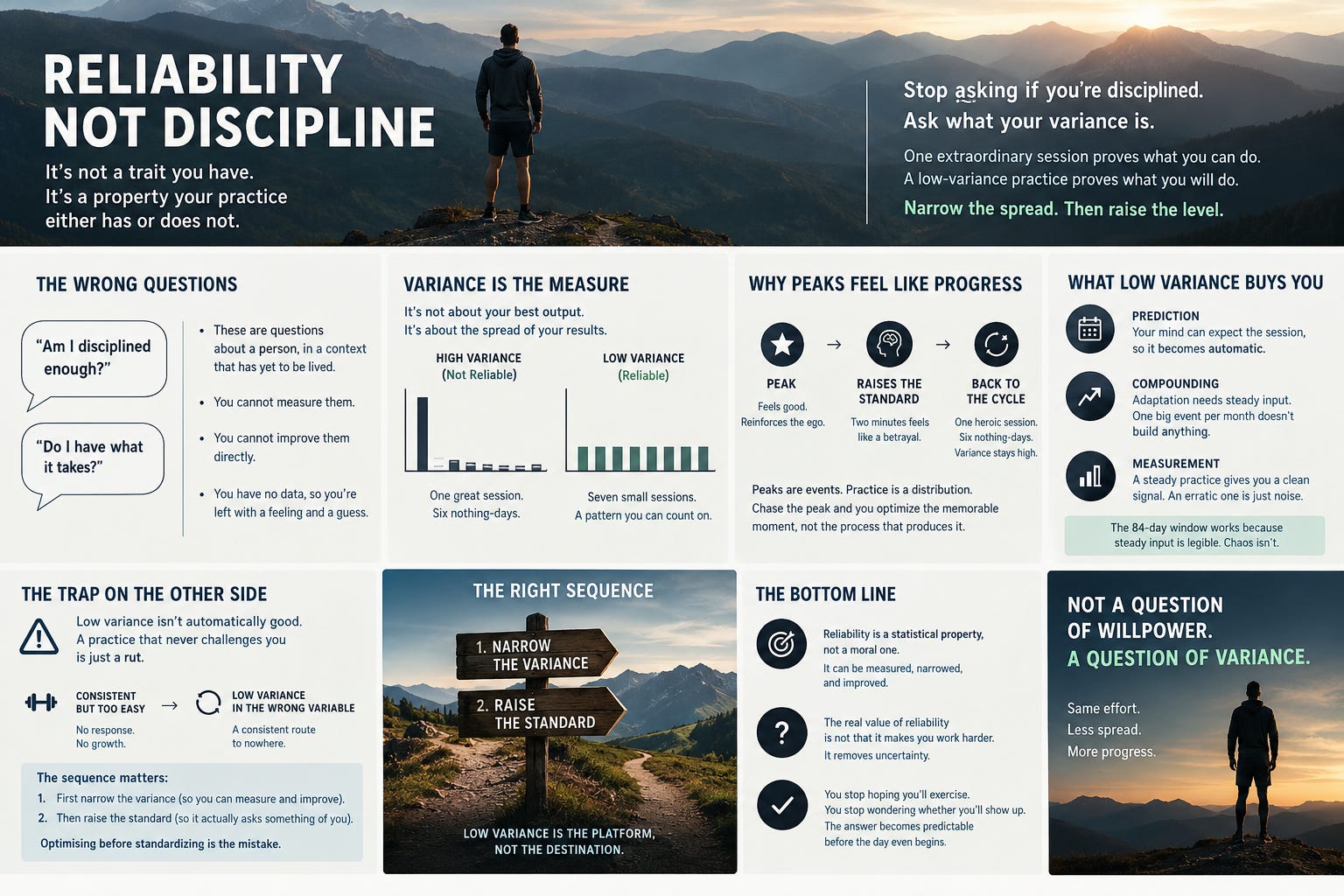 427. You're Not Undisciplined. Your Exercise Habit Has High Variance. 29.09.2026 7minTo become the person who follows through, go to exercisingconsistency.com and join The ACT Score Challenge today.Have you ever asked yourself these questions: “Am I disciplined enough?” or “Do I have what it takes?”These are questions about a person, in a context that has yet to be lived, and they have no answer. You cannot measure them, you cannot improve them directly, and you have no data with which to settle them. So you are left with a feeling and a guess.Meanwhile, the thing you are actually trying to build is perfectly measurable. The thing is you have likely never looked at it as a quantity. Reliability is not a trait you have. It’s a property your practice either has or does not. Let’s find out.Hey there. It’s me, Kore. And you’re listening to Exercising Consistency: From Fitness to Flourishing.Variance Is the MeasureIn quality control, a process is judged by its variation, not by its best output. A manufacturing line that produces one perfect widget a month and nothing else is not reliable. It’s volatile. The measure is the spread of the distribution and the goal is to narrow it.Your exercise practice has the same structure. Every session is an output. The question is how much your outputs vary. If your week contains one heroic session and six nothing-days, your variance is enormous, and your mind has no reason to expect anything from you. If your week contains seven small sessions, your variance is near zero and the expectation forms itself.This is why a two-minute session can outperform one that’s two-hours. The two-hour session is a higher peak. The two-minute session is a lower variance. Only one of those is a property you can build a future on with any reliability.Why Peaks Feel Like ProgressPeaks are reinforcing. A great session feels like evidence of commitment, producing the satisfaction of having done something significant. A two-minute session feels like nothing in comparison.But a peak is an event and a practice is a distribution. The event is what you remember and the distribution is what your behaviour actually does over time. When you chase the peak, you’re optimizing the memorable moment at the expense of the process that produces the memory.There is also a specific failure mode that peaks create: they raise the perceived standard. After a heroic session, two minutes feels like a betrayal of what you proved you could do. So the Floor gets abandoned in favour of trying to repeat the peak. And the peak does not repeat, so the week contains one heroic session and six nothing-days again. The variance stays enormous, keeping progress stagnant.What Low Variance Actually Buys YouLow variance produces three things that high peaks cannot.It produces prediction. Your mind can expect the session, because the session is what actually happens. And once the behaviour is expected, it starts being automatic, and stops being a negotiation.It produces compounding. Adaptation requires accumulated stimulus and accumulation requires the stimulus to arrive regularly. One enormous event per month provides no accumulation, because those peaks are rare by definition.And it produces measurement. Low variance gives you a clean signal. If you train every day at a consistent standard, you can actually read what is changing. If your practice is erratic, you cannot tell improvement from noise.That last one is why the 84-day window works as a review period. A window with steady inputs is legible. A window with three heroic sessions and eighty-one empty days tells you nothing.The Trap on the Other SideLow variance is not automatically good and the principle can be misapplied.A perfectly reliable practice that never challenges you is not reliability. It’s stagnation on repeat. Two minutes daily of a stimulus that no longer produces any response is a rut. Low variance in the wrong variable is just a consistent route to nowhere.So the sequence matters. First narrow the variance, because an erratic practice cannot be assessed or improved. Then raise the standard, because a stable practice has to actually ask something of you. The order is not negotiable. Optimising before standardizing is the mistake that keeps people busy and unchanged.Low variance is the platform, not the destination.The TakeawayReliability is a statistical property, not a moral one. It is not a quality you have or lack. It is a description of how your practice distributes itself over time. It can be measured, narrowed, and improved.So stop asking whether you are disciplined. Ask what your variance is.The real value of reliability is not that it makes you work harder. It is that it removes uncertainty.You stop hoping you’ll exercise. You stop wondering whether you’ll show up. The answer becomes predictable before the day even begins.One extraordinary session proves what you can do. A low-variance practice proves what you will do.Narrow the spread. Then raise the level.An InvitationTo put this practice in place and turn it from an idea into a lived experience, go to exercisingconsistency.com.That’s it for today. Catch you next time. This is a public episode. If you would like to discuss this with other subscribers or get access to bonus episodes, visit stoicstrength.substack.com
 -
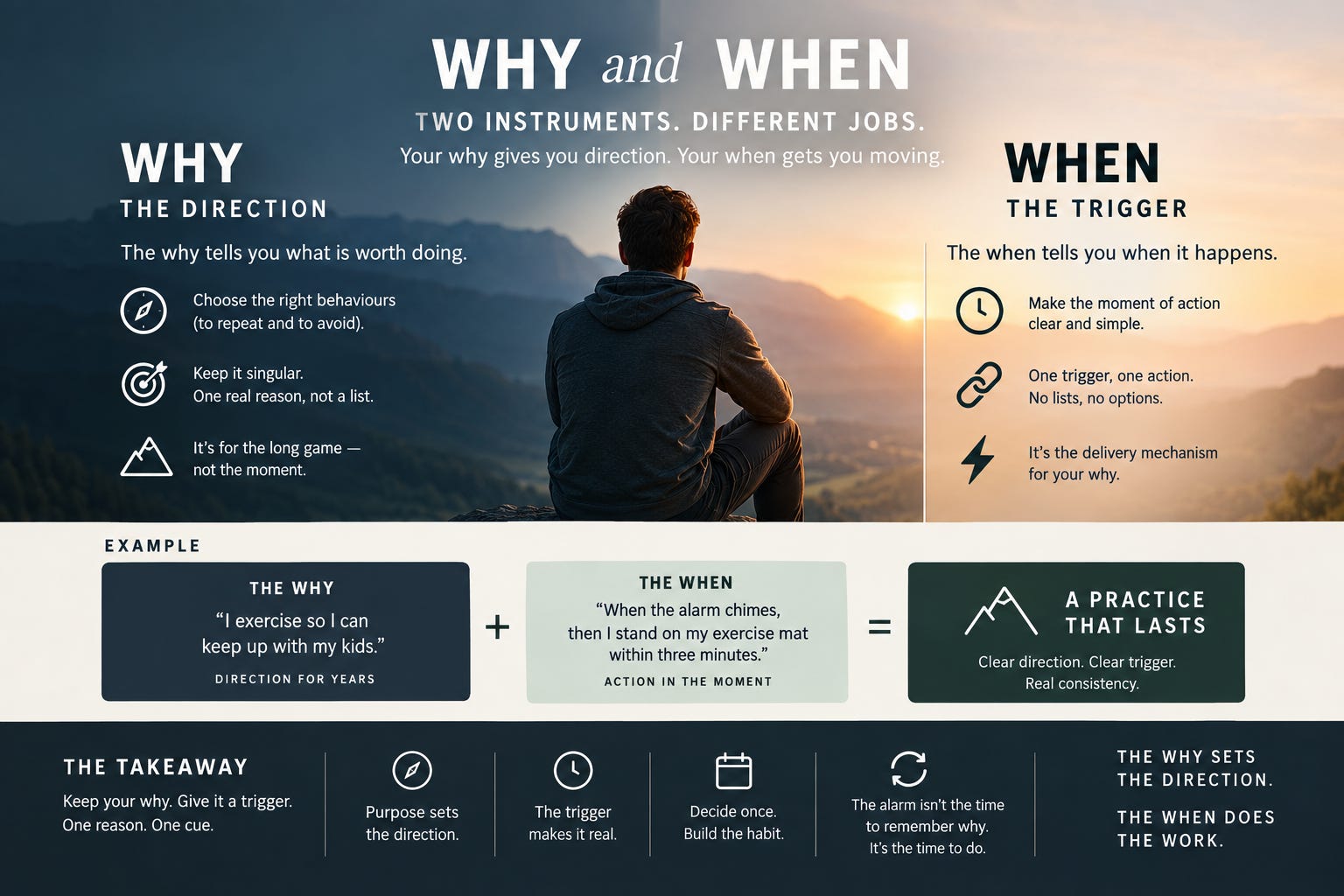 426. Why You Know Exactly Why You Should Exercise and Still Don't Do It 28.09.2026 8minTo become the person who follows through, go to exercisingconsistency.com and join The ACT Score Challenge today.You may think your consistency fails because you’ve lost sight of your why, your purpose. More often, you fail because your why never told you when to begin.You know why you train. You could explain it in detail and the answer would be sincere and true. And yet, on the morning the alarm chimes, the why doesn’t settle anything. You lie there and the question is not “why do I train?” It’s “am I getting up to train right now?”Those are different questions and your why was never built to answer the second one. That’s the gap where most practices get muddled. You’re asking a why to do the job of a when.Let’s clear this up so you not only know what direction you’re moving, but when it’s time to move.Hey there. It’s me, Kore. And you’re listening to Exercising Consistency: From Fitness to Flourishing.Two Instruments, Two ResolutionsThe why and the when are not competing answers to the same question. They operate at different scales and they solve different problems.The why is directional. It tells you which behaviours are worth repeating and which are not. Knowing this matters, because without it you can be perfectly consistent at the wrong thing. But a decision about what your life is worth is not a decision about whether you get up in the next sixty seconds. Asking it to settle that is like using a calendar to tell the time.This is not a failure of the why. It’s a mismatch of units. The why answers what is worth doing. The when answers when it happens. A practice needs both and a practice that has only the first stalls at the moment of execution.The Why Should Be One ThingThere is a second aspect to get right about the why and it’s easy to get wrong.A good why is not a list. If you can recite six reasons why you exercise (health, energy, sleep, longevity, mood, confidence) you have not found your reason. You have found your reasons. The plural is the problem.When a decision requires a web of justifications, it becomes something you have to talk yourself into. Needing several reasons is itself the signal that the choice is not yet obvious. One reason that reaches bedrock is robust. Six reasons sitting side by side are scaffolding and scaffolding comes down when conditions change.The test is not how many reasons you can name. It’s whether the singular one you name can stand alone. “I exercise so I can keep up with my kids” does not need the other five behind it. If your why needs backup, you are still unclear what it is.Why Purpose Alone StallsThis is where the failure actually shows up. It often looks like a discipline problem and that misunderstanding leads to solving the wrong problem.Purpose has no trigger. It has no moment. It does not tell you when to begin. And because the moment is unspecified, the decision gets made fresh every time. You wake up, you weigh the options, you decide.A decision re-opened at the moment of execution is a negotiation, and negotiation is where commitments unravel.The person with a strong why and an unspecified when is not lacking commitment. They are under-specified at the exact point where specification matters: the moment of choice. They know what they value. They have not decided when the value will be enacted. So the enactment depends on how they feel, which returns the whole practice to the mechanism they were aiming to escape.What the When Actually DoesThe when is a delivery mechanism. It works by making clear the moment of action.The Intention Statement clarifies the concretes. For example: “WHEN the alarm chimes, THEN I stand on my exercise mat within three minutes.“ The trigger and the verb are linked in advance, so the moment of execution contains no open question. You are not thinking about what to do. You are executing something already settled.And the same discipline that applies to the why applies here. One trigger, not three. If you need a list of reminders to get yourself moving, you have not set a trigger. You have set a series of options and each one is a chance to drift. Keep it to one cue.That is the division of labour. The why sets the direction; the when makes clear how you move.The Why Still Comes FirstNone of this makes the why optional.The trigger is not a substitute for the reason. It’s the delivery mechanism for the reason. A trigger that fires reliably still needs something to fire toward. If the direction is genuinely absent, if you don’t know why the behaviour matters, no Intention Statement will hold for long, because there’s nothing underneath it to sustain the pattern when the novelty fades.Pure discipline with no reason behind it also has a cost. Pushing yourself through something you ultimately do not care about stops being discipline and becomes punishment. Punishment is the opposite of reinforcement. You’ll be unable to maintain the behaviour long-term.So keep the why. Make it honest, singular, and yours. Then stop asking it to start your day. That is not what it’s for.The TakeawayPurpose and trigger are not rival answers. They are different instruments at different scales. The why tells you what is worth doing for years. The when tells you what happens in the moment of action.Most stalled practices are not short on purpose. They are short on specificity at the moment of execution. So keep your why, pare it down to the one that matters most, and then give it somewhere to land. Write the trigger. Link the moment to the verb. One reason, one cue.The alarm is not the moment to remember why you train. It’s the moment to do what you’ve already decided.People who rely on motivation revisit the decision each day. People who are consistent decide once and build a way of acting on that decision.The why sets the direction. The when does the work.An InvitationWhen you’re ready to turn consistency from an idea into a solid practice, go to exercisingconsistency.com.That’s it for today. Catch you next time. This is a public episode. If you would like to discuss this with other subscribers or get access to bonus episodes, visit stoicstrength.substack.com
 -
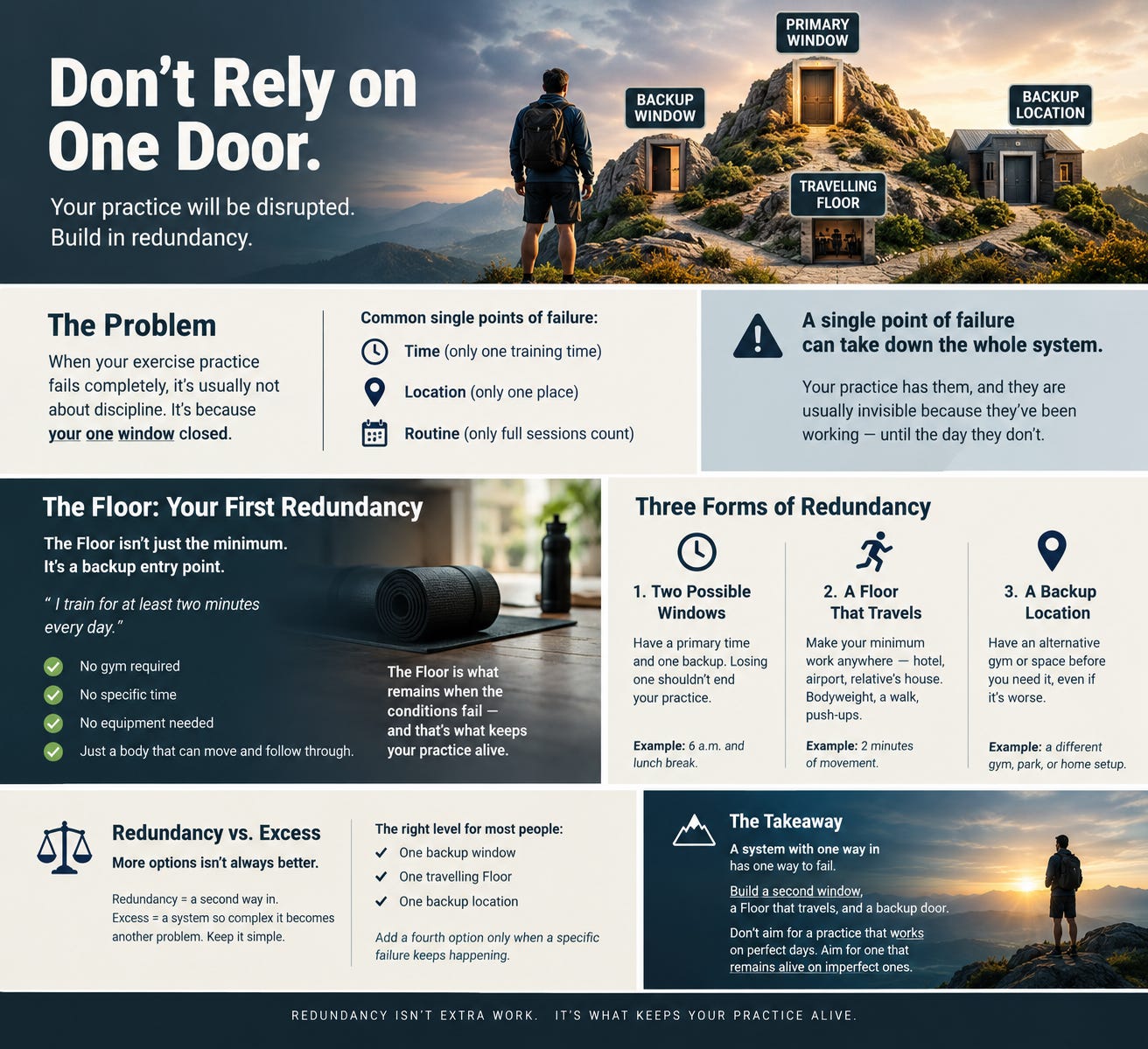 425. Why Your Exercise Routine Keeps Collapsing (And It's Not a Discipline Problem) 27.09.2026 6minTo become the person who follows through, go to exercisingconsistency.com and join The ACT Score Challenge today.Look at the last time your exercise practice failed. Not just a missed day. A complete collapse. The kind that took weeks to recover from.Now look at what caused it. Almost always it’s the same scenario: your one window closed. You were away from your gym; your usual time was taken up by something else; your usual routine did not fit the day.Nothing was wrong with your discipline. The single door you expected your practice to move through got blocked, and you had nowhere else to gain access.Hey there. It’s me, Kore. And you’re listening to Exercising Consistency: From Fitness to Flourishing.A Single Point of FailureIn engineering, a single point of failure is any component whose failure takes down the whole system. Good systems are designed to eliminate them, because it’s not a matter of if a component will fail, it’s when.Your practice has them, and they are usually invisible because they’ve been working. The time of day, if you only train at one time. The location, if you can only train in one place. The routine, if your session only counts when it is full-length and elaborate.Each of these is a dependency. Each one is going to get stress tested at some point: travel, injury, a new job, a sick child, a deadline. A practice that depends on conditions you do not control is not a resilient practice. It’s a bet.The Floor Is Your First RedundancyYou already have the tool for this, and it’s the Floor. You just need to understand it differently.The Floor has usually been explained as the minimum repeatable standard. It’s also a redundancy mechanism. “I train for at least two minutes every day“ does not depend on the gym, the time, the equipment, or the routine. It depends only on a body capable of moving, in some capacity, and follow through. The Floor is a backup entry point that remains open when the main entry point is inaccessible.That is why a Floor is so much more robust than a full session. The full session has a hundred dependencies. The two-minute version has almost none. The Floor is what remains when the conditions fail, and that is what keeps the practice alive during almost any disruption rather than restarting after it.This is reliability engineering applied to behaviour: the small version is the system that survives.Building the Redundancy InA resilient practice has more than one way in. Three forms of redundancy do most of the work.Two possible windows. If your only training time is 6 a.m., one late night jeopardizes follow through. Have a primary window and set one backup, and let the backup count equally. The point is not that you will always have both. It’s that losing one does not preclude the other.A Floor that travels. Your minimum has to work anywhere: a hotel room, an airport, a relative’s living room. Bodyweight movement, a short walk, a set of push-ups. If your minimum requires equipment or a specific room, it’s not a minimum. It’s a second dependency.A backup location. If your only gym is one gym, the day it fails to open is the day your practice is closed. Have one alternative before you need it, even if it’s worse. A worse backup location still beats a closed practice.The Difference Between Redundancy and ExcessDon’t go too far with this. More redundancy is not automatically better, and this is where the principle gets misapplied.Redundancy is having a second way in. Excess is building a system so elaborate that maintaining the options becomes work in itself. If you are tracking four windows, three locations, and six routines, you’ve stopped training and started managing a logistics operation. That is the sophisticated avoidance problem I covered in Episode 421.The right level of redundancy is proportional to the failure modes you actually experience or can realistically expect. One backup window, one travelling Floor, one backup location. That is enough for most disruptions, and small enough to maintain without getting distracted. Add a fourth option only when you find a specific failure that three could not handle.Redundancy is insurance, and the point of insurance is not to cover everything. It’s to cover the losses that would end you.The TakeawayRedundancy is why one practice is not enough. Because a system with one way in has one way to fail.You don’t need more discipline to survive a disrupted week. You need a second window, a Floor that travels, and a backup door. The conditions will fail. That’s not pessimism, that’s life. What is up to you is whether the practice depends on them.Don’t aim to build a practice that works on perfect days. Aim to build a practice that remains alive on imperfect ones. Because your consistency will ultimately be measured by what survives disruption, not by what flourishes when conditions cooperate.An InvitationTo put this practice in place and turn it from an idea into a lived experience, start your Day 1 inside The ACT Score Challenge. Go to exercisingconsistency.com.That’s it for today. Catch you next time. This is a public episode. If you would like to discuss this with other subscribers or get access to bonus episodes, visit stoicstrength.substack.com
 -
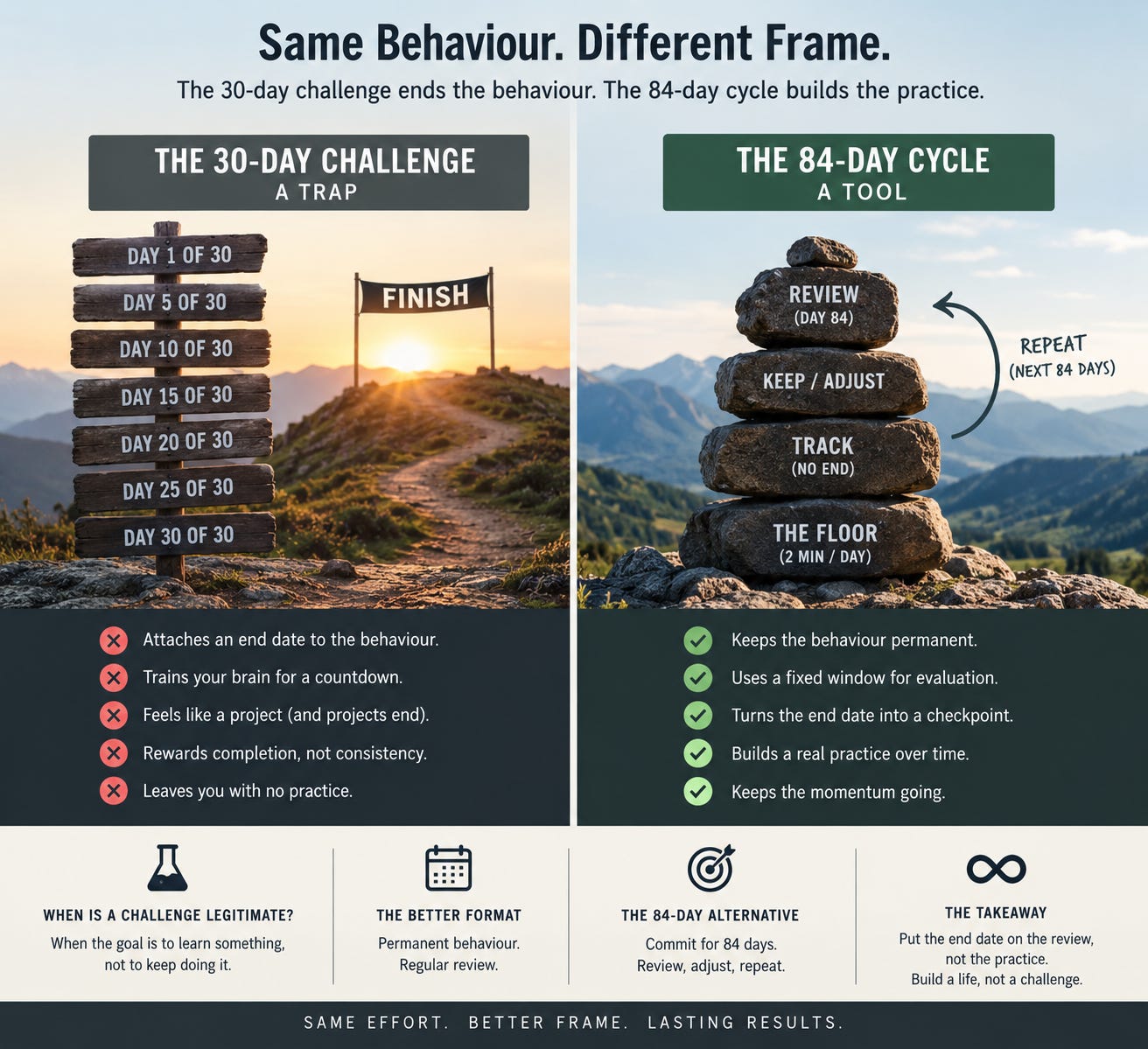 424. Why 30-Day Challenges Fail (Even When You Finish Them) 26.09.2026 9minTo become the person who follows through, go to exercisingconsistency.com and join The ACT Score Challenge today.Think about the last 30-day challenge you finished. Chances are if you’re interested in behaviour change, fitness, and personal development you’ve done at least one.You probably completed it. You probably felt good about it. And then what?The moment you complete a 30-day challenge is often the moment you begin abandoning the behaviour. Two weeks later, most people have stopped entirely, because the challenge was a finite event with a finish line. The behaviour was never framed as permanent. It was framed as a project. And projects end.And that’s the natural outcome. It’s the format working exactly as designed. But if you’re looking for a consistent practice or set of behaviours the 30-day challenge, with the mentality it engenders, is a trap. There are ways to avoid that trap. Let’s get into it.Hey there. It’s me, Kore. And you’re listening to Exercising Consistency: From Fitness to Flourishing.What an End Date TeachesThe Conditioned Self learns from repetition and reinforcement. It also learns from the shape of the thing being repeated. A behaviour with a defined end date gets trained as temporary, no matter how many times you repeat it.Thirty days is long enough to build real momentum. It’s also long enough for the nervous system to home in on the countdown. Every day, the frame is “day 5 of 30,” “day 6 of 30” and so on. You’re not training a practice. You are training a countdown.And the countdown has an end, and the end is the point at which the behaviour stops being required. You have spent 30 days rehearsing that ending, and then you reach it.Completing It Is the QuittingHere’s the part that makes the trap so effective. The 30-day challenge is not abandoned. It is completed.That distinction is clarifying, as far as behaviour change is concerned, because it means the format produces failure without producing the feedback that failure normally provides. When you break a commitment, you learn something. Maybe the standard was too high, the trigger was missing, or the environment was wrong. You get information. You can adjust accordingly.The 30-day challenge is not designed to provide that. You did it. Done. You succeeded by the format’s own measure. And you still have no practice, because the practice was never the goal. The completion was.That’s why the challenge is such an efficient trap. It rewards the exact behaviour that leaves you with none of what you need to establish consistency long-term.The ‘New Job’ Example That Proves the DifferenceConsider the counterexample. When you start a demanding new job, you establish a dozen new behaviours at once, and you keep them, because nobody framed them as a challenge. Nobody called it “day 8 of 30.” It was simply required, and that requirement has no expiry.That’s the whole difference. The new job is permanent in your own framing, so the behaviours are trained as permanent. The challenge is temporary in your own framing, so the behaviours are trained as temporary. The repetition is the same. The frame decides what gets conditioned.What Gets the End DateNow let’s consider the distinction that separates a trap from a tool.A fixed period is not the problem. Attaching the end date to the behaviour is the problem. You can have a defined time horizon without teaching your brain that the practice is temporary, and the difference is entirely about what is being measured.The better format is a long commitment with a short review cycle. Commit to the behaviour permanently. Set a fixed window for evaluating it. When the window closes, you don’t stop. You assess, adjust, and begin the next window.This is the difference between an expiry and a checkpoint. An expiry ends the behaviour. A checkpoint ends one assessment and starts another one.The 84-Day AlternativeEighty-four days is a good length for a checkpoint, and the reason is scale.It’s short enough that it’s not an overwhelming sentence. It’s just the length of a season, so you can commit to it without committing your whole future at once. That gives you permission to follow through in the face of self-doubt, confusion, and failure. You are not promising forever. You’re promising this small window.84 days is long enough to produce significant change and to tell you whether the change is real. Four of them fit in a year, with a week between each to evaluate what happened and plan the next one.Notice what has the end date. Not the training. The evaluation. When day 84 arrives, you do not stop training. You review the window, decide what to keep and what to change, set the new parameters, and commit to the next 84. The practice never lapses. Only the assessment does.That’s the whole framing correction. The 30-day challenge attaches a deadline to the behaviour. The 84-day cycle attaches it to the evaluation. One schedules abandonment. The other schedules focused attention. You can apply the same framework to the 30-day challenge.When a Challenge Is LegitimateSome fixed periods are not traps, and the difference is the goal.A challenge is legitimate when the thing you are testing is not the practice but the question. Thirty days without caffeine to learn how you sleep without it. Thirty days of writing to find out whether you even like writing. Time restricted eating to see whether your energy levels change. In those cases, the limited time is the point. You are running an experiment, and an experiment should end, because you need the result.The trap appears when the challenge format is applied to something you intend to keep doing. Then the end date is not a result. It is a scheduled abandonment.The test is one question: When the last day arrives, is the goal to have learned something, or to still be doing it? The answer determines which format is appropriate.What to Do InsteadIf you want to still be doing the behaviour at the end skip the countdown and set the Floor.Instead of a 30-day commitment, make a permanent one at a size you can hold indefinitely. Two minutes a day. No end date. The standard is deliberately small, because the point is not intensity over a fixed window. The point is permanence.Then track it as a record rather than a countdown. Not “day 12 of 30” but simply “day 12” with the intention to carry on. The record has no end, and there is nothing to complete. You are not sprinting to a finish line. You are adding to something that you want to continue.If you want a milestone, put it on the review rather than on the behaviour. Mark the day you assess what has accumulated. That is a good day to look back. It is a terrible day to stop.The TakeawayThe 30-day challenge is a trap because it’s designed to end. It teaches your nervous system that the practice is temporary, and it rewards you with stopping.You do not build a practice by giving it an expiry. You build it by deciding the behaviour is what you do from now on, with no finish line in sight.So put the end date where it belongs. On the review, not the practice. Set the Floor. Keep the record. If you want consistency the goal is never to reach the last day. The goal is to stop having a last day at all.An InvitationTo put this practice in place and turn it from an idea into a lived experience, go to exercisingconsistency.com.That’s it for today. Catch you next time. This is a public episode. If you would like to discuss this with other subscribers or get access to bonus episodes, visit stoicstrength.substack.com
 -
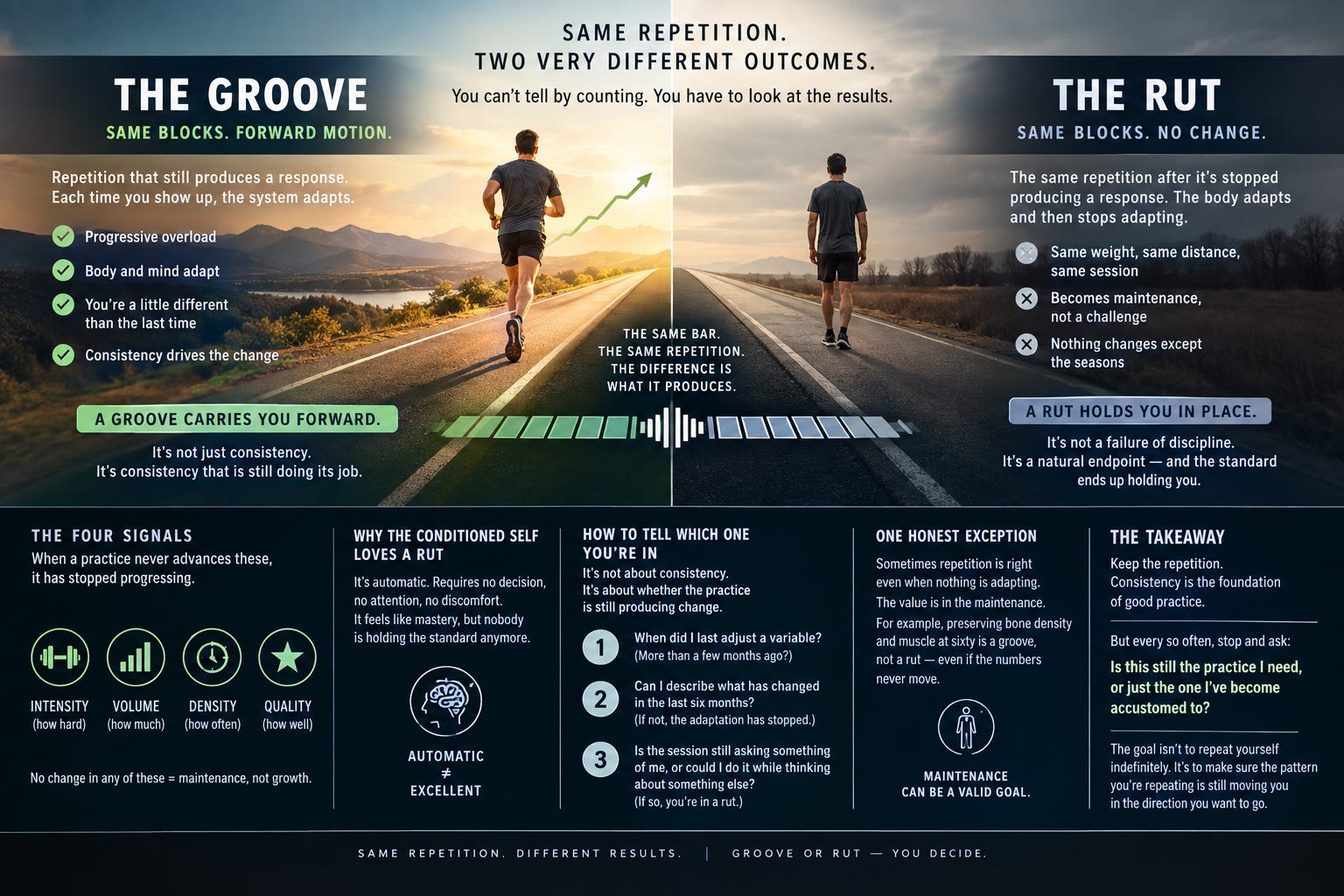 423. When Consistency Stops Working 25.09.2026 7minTo become the person who follows through, go to exercisingconsistency.com and join The ACT Score Challenge today.In music, a groove and a rut are built from identical blocks: the same bar, played over and over.The difference is whether the repetition carries the song forward or makes it stall. One is what you want. The other is the thing that keeps you stuck. And you cannot tell which one you are in by counting repetitions, because both seem the same from the outside.A person who has trained the same way for three years is either in a groove or a rut, and the calendar cannot tell you which.Hey there. It’s me, Kore. And you’re listening to Exercising Consistency: From Fitness to Flourishing.What Makes It a GrooveA groove is repetition that still produces a response. Each time you run the stimulus, the system answers it.That is progressive overload. The body meets the demand, adapts, and is ready for the next higher demand. The repetition carries you, because each cycle leaves you slightly different from the version who ran the last one.This is why consistency is the foundation of everything. Without repetition, there is no predictable adaptation at all. The Floor, the streak, the daily entry: all of it exists to produce the repeated stimulus to which the body and the mind respond.A groove is not just consistency. It’s consistency that is still doing its job.What Makes It a RutA rut is the same repetition after it’s stopped producing a response. The body adapts to a stimulus and then stops adapting to it. The same weight, the same distance, the same session, continuing for long enough, stops being a challenge and becomes maintenance of the status quo. Nothing changes except the seasons.A rut is not a failure of discipline. It’s the natural endpoint of repetition that nobody updated. You did exactly what you planned. You were consistent. You held the standard. And the standard ended up holding you in place.The Four Signals (intensity, volume, density, quality) give you the vocabulary for how this happens. Each is a variable, and a practice that never advances any of them has stopped progressing. It’s still worthwhile, for maintenance, to show up for such a practice, but it is no longer asking anything new of the system.To explore the Four Signals further check out a 20 episode series I did exploring each variable in turn. You can start with the introduction to the series: Episode 310. Why Most People Don’t Actually Improve: The Four Signals of Self‑Competition.Why the Conditioned Self Loves a RutThere is a second layer, and it explains why ruts are so comfortable.The Conditioned Self, what I label your non-conscious processes, is what has been trained. It runs faster than you can think consciously, it runs automatically, and it prefers the path of least resistance. A rut is the Conditioned Self’s ideal endpoint: a behaviour that requires no decision, no attention, and no discomfort. It’s doing what it was trained to do and responds automatically to circumstances in the environment.That is why a rut can feel like excellence. The behaviour is automatic, and automatic feels like mastery. But the Choosing Self, what I label your faculty of choice, is not involved anymore. Nobody is holding the standard, because the standard is holding itself. The repetition continues without anyone deciding whether it should.The groove requires your conscious involvement. The rut just happens. That is the whole difference, and it is invisible from the outside.How to Tell Which One You’re InThe test is not how consistent you are. Consistency is common to both the groove and the rut. The tell is whether the practice is still producing change.Ask yourself three questions:* When did I last adjust a variable? If the answer is more than a few months ago, you may be maintaining rather than training.* Can I describe what has changed in the last six months? If you cannot name it, the adaptation has stopped.* Is the session still asking something of me, or is it something I could do while thinking about something else? If you’re simply going through the motions, no longer paying attention to what you’re doing or aiming to improve in some capacity, you’re in a rut.One Honest ExceptionSometimes repetition is right even when nothing is adapting, because the value is in the maintenance. The status quo is a legitimate goal at certain stages in life, and a practice that holds steady is not a rut in that case. For example, a person training to preserve bone density and muscle at sixty is in a groove, not a rut, even if the numbers never move.The rut is not repetition without growth. It’s repetition that has stopped asking whether growth is still wanted.The TakeawayA groove and a rut are made of the same thing: repetition. From the outside, they look identical. The same sessions, the same habits, the same behaviours, repeated day after day. The difference is whether the repetition is still serving a purpose.A groove carries you forward because it continues to demand something of you. A rut holds you in place because nobody has questioned it in a long time.So keep the repetition. Consistency is the foundation of good practice. But every so often, stop and ask: Is this still the practice I need, or just the one I’ve become accustomed to?Because the goal is not to repeat yourself indefinitely. The goal is to make sure the pattern you’re repeating is still moving you in the direction you want to go.An InvitationIf you’re ready to upgrade the quality of your consistency, go to exercisingconsistency.com.That’s it for today. Catch you next time. This is a public episode. If you would like to discuss this with other subscribers or get access to bonus episodes, visit stoicstrength.substack.com
 -
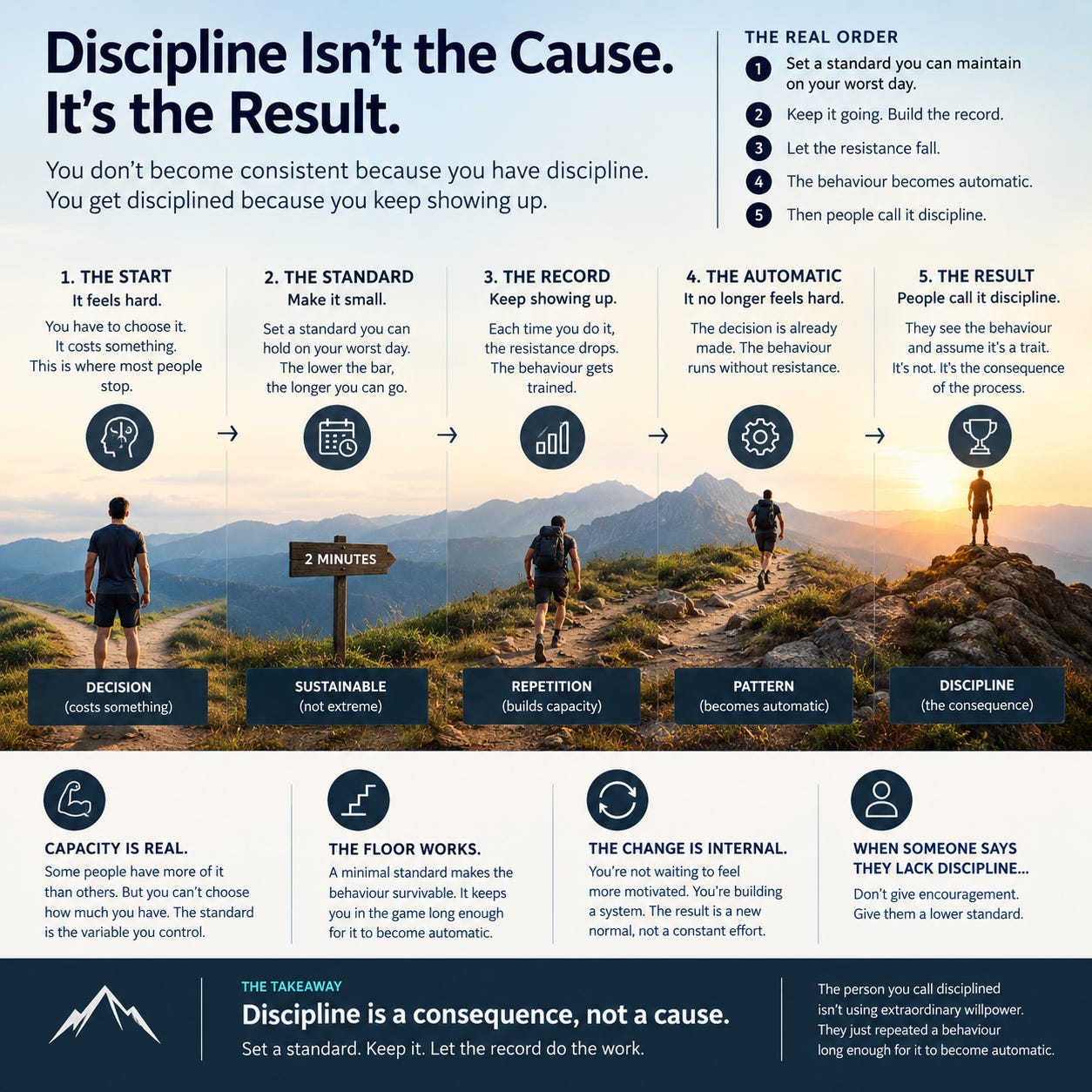 422. The Discipline Myth: Why Lower Standards Create Better Habits 24.09.2026 6minTo become the person who follows through, go to exercisingconsistency.com and join The ACT Score Challenge today.Think about the last time someone started a demanding new job. You likely have at least one experience of this yourself.New wake time. New commute. New skills to learn. New protocols, new schedule, a different set of people to read. They absorbed all of it at once, within a few weeks, and it stuck.Nobody called it discipline. Nobody said they must have incredible willpower. Everyone understands it’s what you do when it’s required.That’s the whole argument in one example. When something is genuinely required, people adapt fast and permanently, and they do it without the trait everyone claims is necessary.So discipline was never the variable. Requirement was. And requirement is a decision you make.Hey there. It’s me, Kore. And you’re listening to Exercising Consistency: From Fitness to Flourishing.Why the Belief PersistsThe belief that discipline comes first survives because of a simple error in observation. You cannot see someone’s system. You can only see their behaviour.When you watch a person who trains every day, you see consistency, and you attribute it to a quality they have. You assume they are doing something hard and enduring it. What you cannot see is that they are not enduring anything. They set the standard low enough that it survived their worst days, and now the behaviour runs without resistance. The hard part is invisible because it happened years ago, in private, and it looked nothing like discipline at the time.So the trait you admire is real, and it is also a lagging indicator. It describes a pattern that already exists. It does not cause the pattern.What Discipline Actually IsDiscipline is the name we give to a behaviour that has stopped requiring a decision.At the start, the behaviour requires effort. You have to choose it, and the choosing costs something. Keep choosing it, and the cost falls. Because the behaviour got trained. The Conditioned Self is shaped by what gets repeated, and eventually the behaviour becomes an automatic response triggered by circumstances.What observers call discipline is that state: the point where the choice no longer needs to be made consciously, because the decision has already been absorbed into the pattern.This is why the trait appears stable, and why it feels like a cause. It’s stable because the training is durable. It looks like a cause because you only ever see the behaviour after the conditioning is solid. The cause was the repetition. The repetition was driven by a standard.The Standard Is the Variable You ControlSome people do start with more capacity than others. That is real, and pretending otherwise would make this argument dishonest.But capacity is not the variable that matters most, because you cannot choose how much of it you have. The standard is the variable you control, and it determines whether the capacity you have gets used.Set the standard at two minutes, and the capacity required is almost nothing. Set it at two hours, and you need a rare amount of starting capacity, which is why most people who set it there end up quitting. The person with modest capacity and a low standard builds a record. The person with great capacity and a high standard usually builds a series of abandoned attempts. Even with great capacity conditions do not cooperate and high standards are difficult to maintain in less than ideal conditions.This is why the Floor, a minimal standard, is the best approach to building consistent follow through. It works because it makes the behaviour survivable long enough to become automatic, and the automatic behaviour is what gets called discipline.What to Do With ThisStop trying to become disciplined before you start. That order doesn’t work. You are waiting for a consequence and calling it a prerequisite.Instead, set a standard you can hold on your worst day, and hold it. Then let the record do the work. The resistance falls on its own schedule, and one day the thing you had to force will be the thing you just do. That’s the day the discipline will have arrived, and you won’t notice it happen, because it won’t feel like anything except continuing.And if someone tells you they lack discipline, the useful answer is not encouragement. It is a lower standard. Discipline was never the thing they were missing.The TakeawayDiscipline is a consequence, not a cause. The person you call disciplined is rarely exerting extraordinary willpower. They simply repeated a behaviour long enough for it to become automatic. The discipline came later.So stop trying to build discipline. Define a standard you can maintain on your worst day. Keep that standard long enough and the behaviour becomes automatic. Keep it longer and it becomes part of your identity. Eventually people will point at the result and call it discipline.They’ll be right about what they see. They’ll just be wrong about what caused it.An InvitationWhen you’re ready to turn consistency from an idea into a solid practice, go to exercisingconsistency.com.That’s it for today. Catch you next time. This is a public episode. If you would like to discuss this with other subscribers or get access to bonus episodes, visit stoicstrength.substack.com
 -
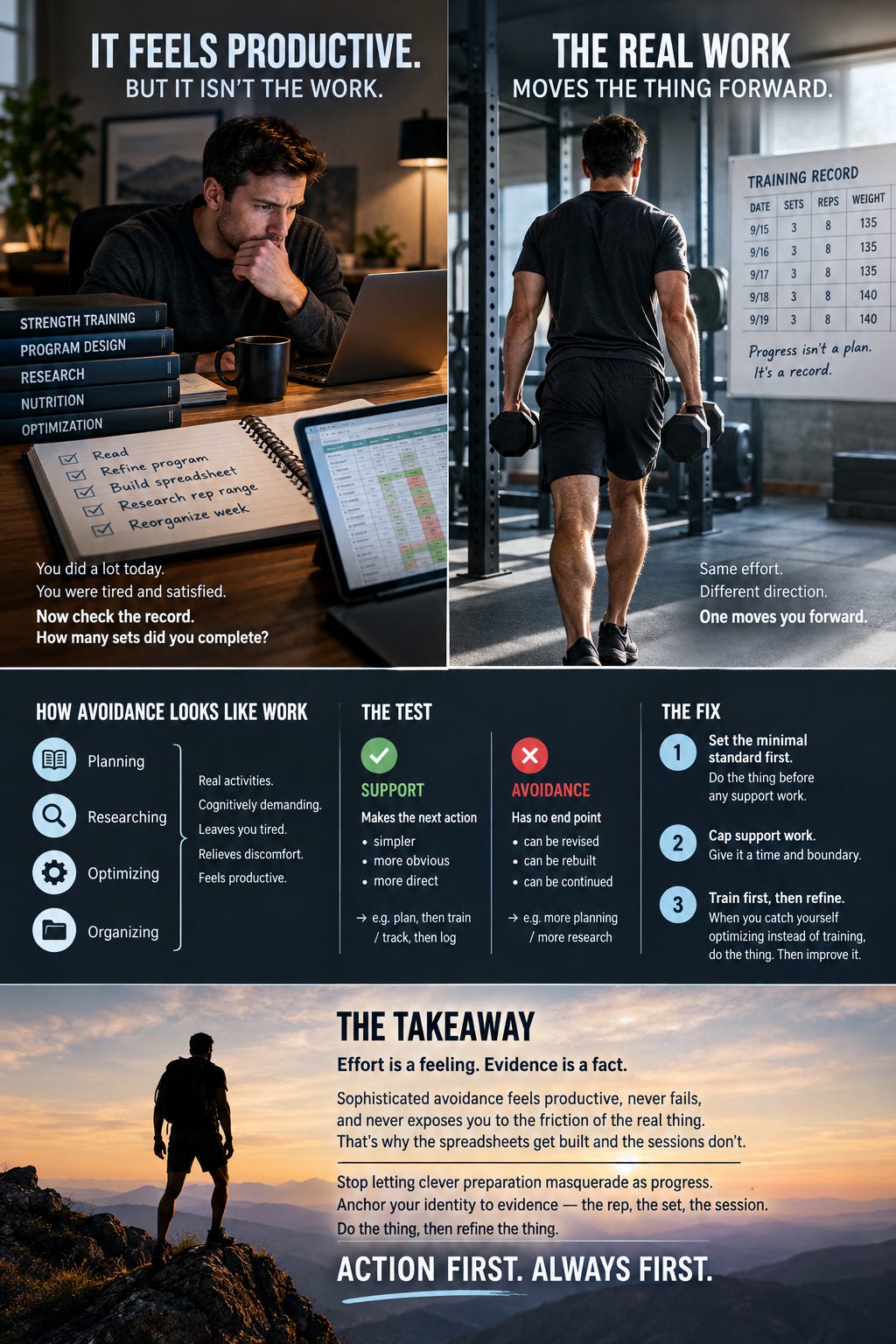 421. Sophisticated Avoidance: When Productivity Becomes Procrastination 23.09.2026 6minTo become the person who follows through, go to exercisingconsistency.com and join The ACT Score Challenge today.You had a productive day. You read about strength training. You refined your program. You built a spreadsheet to track your lifts. You researched the best rep range for your goals and reorganised your week around what you learned.By evening you were tired and satisfied. Now check the record. How many sets did you complete?That’s the whole problem, and it is almost invisible, because everything you did looked like work.Hey there. It’s me, Kore. And you’re listening to Exercising Consistency: From Fitness to Flourishing.Why This Type of Avoidance Seems Like WorkAvoidance is the act of ducking an uncomfortable emotion, and it never looks like avoidance. It looks like a productive substitute. You deep clean the baseboards instead of doing your taxes. You reorganise the pantry instead of making the call.Sophisticated avoidance is the same play, upgraded. The substitute is no longer obviously trivial. It is planning, researching, optimizing, organizing. These are real activities, they are cognitively demanding, and they leave you genuinely tired.That is exactly what makes them work. They relieve the discomfort of the thing you are not doing, and they do it while feeling like diligence.And they arrive at the precise moment. The program gets redesigned right when the training gets hard. The tracking system gets built right when the sessions are being missed.The Tell Is Evidence, Not EffortThis is the test that separates the two, and it’s not how hard you worked.Real work moves the thing forward. Sophisticated avoidance generates motion but in a different direction. The record is the judge, because the record does not care how much you thought about training. It only stores what you did.So, were you productive? Yes. But if you ask yourself what you produced you’ll see it wasn’t what you had committed to doing.What you produced isn’t worthless, but it wasn’t the practice, and only the practice is what moves you in the direction you want to go.This is why the avoidant day is so hard to catch. Effort is a feeling, and this type of avoidance supplies it generously. Evidence is a fact, and it cannot be faked no matter the effort.The Test for What’s LegitimateNot all of it is avoidance, and the argument is not that you should stop striving for better means. Planning, tracking, and environmental design are useful requirements. Without them, the practice runs less efficiently.The test is sequencing. Legitimate support work happens in service of the next action, and it produces one. You plan, and then you train. You build the tracking sheet, and then you use it to log a session. The support has an end point, and that is a behaviour.Avoidance has no end point. The plan can be revised again next week. The spreadsheet can be rebuilt. The research can be continued, because the research is what you are doing instead of the thing. If the support work keeps generating more support work and never a session, it has become the practice, and it’s not the practice you wanted.Here’s another test: if the work you are doing makes the next action simpler, more obvious, or more direct, it’s support. If it moves the next action further away, it’s avoidance.What to Do InsteadYou don’t need to stop working to improve your approach. Just make sure the action precedes the optimization.Set the minimal standard first. Two minutes, today, before any of the supporting work happens. Once you’ve completed the behaviour you want, the planning has something to serve. Before it’s done, the planning is serving the discomfort.Then cap the support work. Give it a time and a boundary, the way you would any other task. Unbounded improvement work expands to fill whatever you give it, because it’s comfortable. It never fails, it never hurts, and it never has to be measured.And when you catch yourself optimizing instead of training, that’s the moment you get the sequence right: train first, even just the two minute minimum if that’s all that’s possible, and the optimizing can follow. That’s reinforcing the behavior you want.The TakeawaySophisticated avoidance is a perfectly engineered response to discomfort and it will keep happening until you change the sequence. The mind will always choose the version of “work” that feels productive, never fails, and never exposes you to the friction of the real thing. That’s why the spreadsheets get built and the sessions don’t.The shift is simple, but it’s not small. You stop letting effort be the metric. You stop letting clever preparation masquerade as progress. You anchor your identity to evidence (the rep, the set, the session) because that shows you’re doing the work consistent with your values and goals.If you want to become someone who trains consistently, keep the sequence straight. Action first. Always first. Do the thing, then refine the thing. When you reverse that order, you’re not improving the practice, you’re avoiding it.An InvitationTo become the person who follows through on their most important goals, go to exercisingconsistency.com.That’s it for today. Catch you next time. This is a public episode. If you would like to discuss this with other subscribers or get access to bonus episodes, visit stoicstrength.substack.com
 -
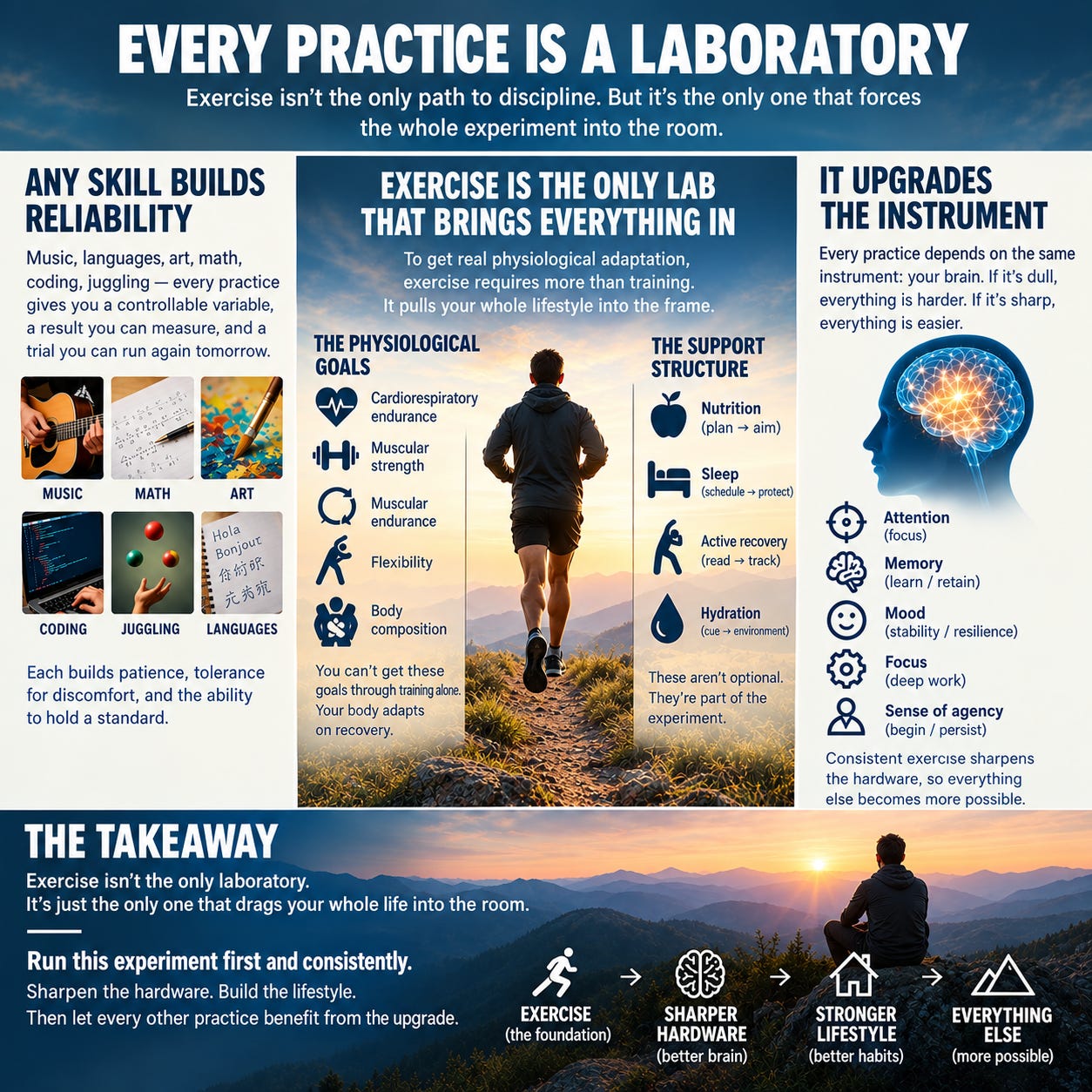 420. Exercise Transforms Your Life More Than Any Other Practice 22.09.2026 6minTo become the person who follows through, go to exercisingconsistency.com and join The ACT Score Challenge today.You’ve heard me say that exercise is the laboratory that builds reliability. The thing is so does learning an instrument or a language or how to juggle. Every practice that demands skill will teach you to show up, tolerate frustration, and improve on purpose.Anyone who tells you exercise is uniquely character-building is usually just advocating for exercise. The interesting, more compelling claim is narrower and harder to dismiss.So, exercise is not the only laboratory. But it is the only laboratory that forces the whole experiment into the room.Hey there. It’s me, Kore. And you’re listening to Exercising Consistency: From Fitness to Flourishing.Every Practice Is a LaboratoryLet’s take the honest position first. Music teaches reliability. So does mathematics, art, poetry, juggling, coding. Each one gives you a controllable variable, a result you can read, and a trial you can run again tomorrow. Each one builds patience, tolerance for discomfort, and the ability to hold a standard.This matters, because it keeps the argument clean. The value of exercise is not that it is the only path to discipline. It’s that it is the only path that arrives with a specific and unavoidable set of additional requirements attached.What Exercise Uniquely Forces Into the FrameHere is the distinction. A skill practice asks for the skill. Exercise, when pursued for genuine adaptation, asks for the whole lifestyle that adaptation depends on.The goals are physiological: cardiorespiratory endurance, muscular strength, muscular endurance, flexibility, and body composition. You cannot realise those goals through training alone. The body does not adapt on effort. It adapts on recovery.So the pursuit pulls the entire support structure into the frame: nutritional support, restorative sleep, active recovery, adequate hydration.That is what no other laboratory forces. You can learn guitar without changing how you sleep. You cannot build genuine endurance without it. The moment the goal is physiological, the experiment stops being about one skill and starts being about the conditions that produce it.What the Support Structure Requires of YouThose four requirements cannot be met by intention. They have to be engineered.Nutrition requires planning, which requires knowing what you are aiming for. Sleep requires a schedule, which requires protecting a boundary. Active recovery requires reading your own state, which requires tracking. Hydration requires a cue, which requires environmental design.So the lifestyle pulls in the meta-skills almost automatically: goal setting, scheduling, tracking, and environmental design. Not as separate disciplines to be learned in a course, but as the practical demands of pursuing a physiological goal honestly. The experiment teaches you how to run experiments.And because these demands recur daily, they train something a single skill practice cannot. You are not only learning to hold one standard. You are learning to build and maintain the system that holds it.The Instrument Everything Else Depends OnThere is a second distinction and it may be the larger one.Every practice depends on the same instrument: the brain. Attention, memory, mood, focus, the sense of agency that lets you begin at all. If the instrument is dull, everything you attempt is harder. If it’s sharp, everything you attempt is easier.If your sleep and nutrition are already in order, the single most powerful thing you can do for that instrument is consistent exercise. Strength training, cardio, martial arts, dance: each demands coordination, attention, and skill acquisition. Each produces better mood, better cognition, and slower cognitive decline with age.Exercise makes everything else more possible, because it upgrades the hardware all of it runs on.That is why it’s the foundation rather than one option among many. It builds the instrument that discipline runs on.The TakeawayExercise isn’t the only laboratory. It’s just the only one that drags your whole life into the room. It’s a forcing function that sharpens the goals, the recovery, the habits, the system, and the instrument itself.Run this experiment first and consistently. Sharpen the hardware. Build the lifestyle. Then let every other practice benefit from the upgrade.An InvitationTo put this practice in place and turn it from an idea into a lived experience, go to exercisingconsistency.com.That’s it for today. Catch you next time. This is a public episode. If you would like to discuss this with other subscribers or get access to bonus episodes, visit stoicstrength.substack.com
 -
 419. The Hidden Habit That Destroys Your Consistency 21.09.2026 5minTo become the person who follows through, go to exercisingconsistency.com and join The ACT Score Challenge today.You made the decision. You know what you are doing and why. And yet, every morning, the same questions present themselves again.Do I train today? Do I feel like it? Is today different?Your values and goals haven’t changed since you decided, but the offer to reconsider arrives anyway. Most people treat that offer as normal and spend time answering it. Considering it’s an option is the mistake. The decision was made once and it’s become a commitment. Every day you are being asked to make the same choice again, and every day you get to refuse.Hey there. It’s me, Kore. And you’re listening to Exercising Consistency: From Fitness to Flourishing.What Negotiation Actually IsNegotiation is not simply thinking things through. It’s re-opening the opportunity to make a decision you’ve already made. That’s an important distinction, because planning is legitimate and re-negotiation is not.You take the time to think clearly and thoroughly before you commit. You choose the program, the standard, the time. That is deliberation, and it happens once, in advance, under good conditions.Negotiation happens later, at the moment of execution, under pressure. It asks whether the decision still holds now that it’s inconvenient or you’re tired or you’re not in the mood. The moment the question re-opens, the commitment has been downgraded from settled to optional.Questioning your commitment is the breakdown of action integrity. It can feel reasonable. Like you’re just being diligent. What’s the harm? Can’t be too careful, right? Actually you can. Every re-visit of your commitment chips away at your confidence. You become slower to act, you find your doubt creeping into every step.What’s going on here?Why the Pressure Returns DailyThe pressure to re-open the negotiation is natural. It’s the Conditioned Self doing what it’s been trained to do. It’s faster and stronger than your ability to think consciously. And it acts first under stress, fatigue, and discomfort. When the moment of execution arrives, the Conditioned Self surfaces the alternative: the easier option, the reason today is different. It’s as if it’s saying, “Hey, this is what we’ve done in these circumstances in the past. It’s a lot easier. It’s familiar and comfortable. I can take care of that, no problem. What do you say?” That’s not malicious. It’s the brain being efficient.That’s why the offer recurs. Because the neurology that produces the offer is still in place. It will make the same offer tomorrow, and the day after, and so on until it’s been conditioned to provide a different response. Your choice to refuse the offer, staying committed to your values and goals, is what trains the response you want.How Identity Settles Without NegotiationSince the identity you want is not trained well by constant negotiation, what’s the strategy? You must simply refuse to negotiate.Every time the offer comes and you decline it, you add to the record. And you decline the offer by directing your attention toward the behaviour you want. You don’t begin mentally itemizing all the reasons why you want what you want. That’s negotiating. Just do the thing that’s consistent with the identity you want.This is why the commitment and the identity are the same act. The decision made once removes the daily question. The daily refusal to re-open it builds the evidence. And the evidence is what makes the identity believable, until the offer stops being persuasive, because it holds no interest.The Intention Statement is the tool that closes the loop. “WHEN the alarm chimes, THEN I stand on my exercise mat within three minutes.” It describes how to execute a decision already made, so there is nothing at the moment of execution left to negotiate.You essentially remove the opening rather than winning the argument.The TakeawayIdentity can be negotiated daily, but only if you entertain the offer.You do not build identity by deciding again each morning. You build it by staying committed, then refusing to re-open what you settled.The offer to reconsider will show up. Decline it. That’s the whole practice. Do that long enough and that’s how the identity you want locks in.An InvitationTo put this practice in place and turn it from an idea into a lived experience, go to exercisingconsistency.com.That’s it for today. Catch you next time. This is a public episode. If you would like to discuss this with other subscribers or get access to bonus episodes, visit stoicstrength.substack.com
 -
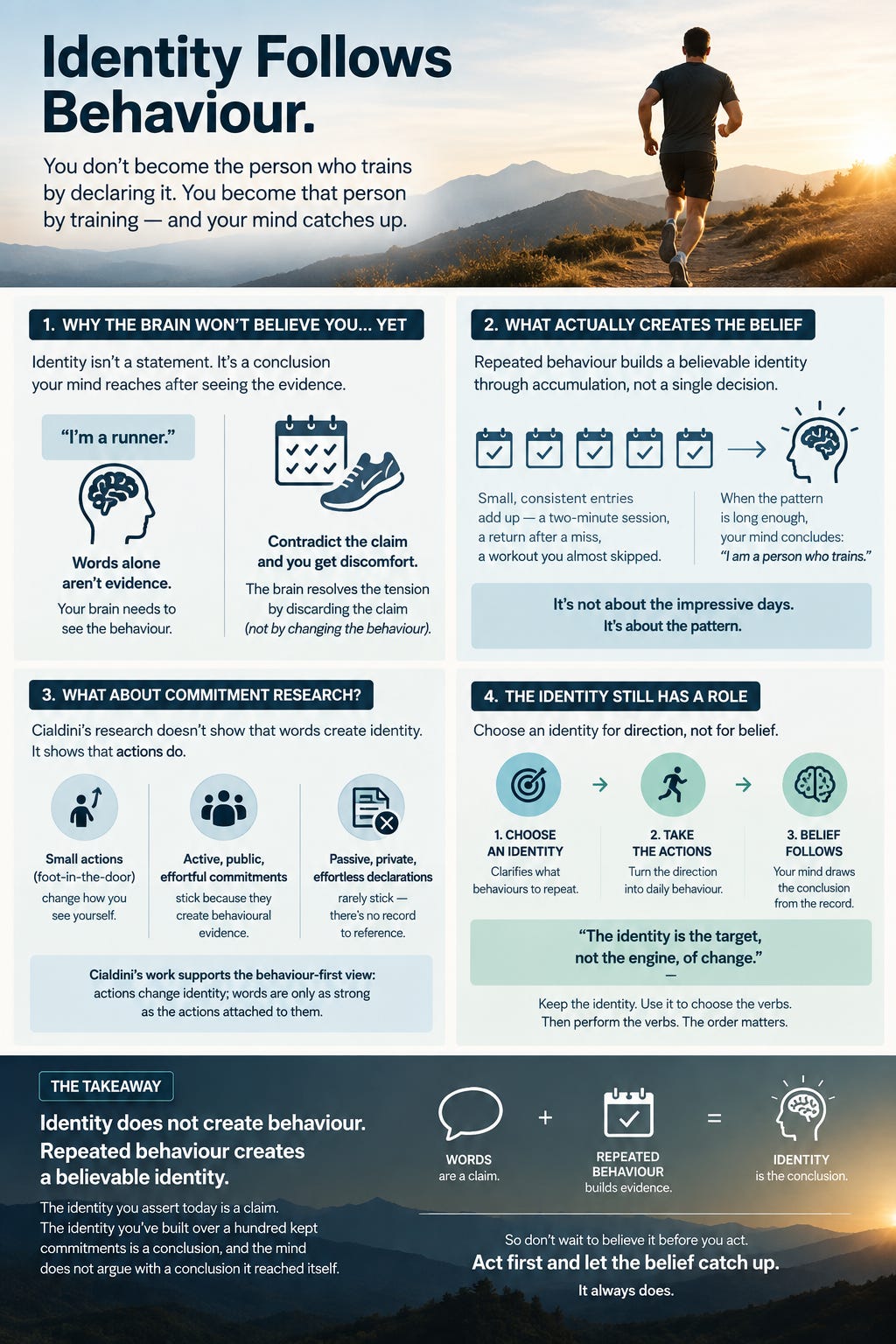 418. The Real Order of Change: Behaviour First, Identity Later 20.09.2026 8minTo become the person who follows through, go to exercisingconsistency.com and join The ACT Score Challenge today.You’ve heard the popular advice in a hundred forms. Decide who you want to be, then act like them. Be the person who trains. Adopt the identity first, and the behaviour will follow.It sounds like a secret and it’s repeated with confidence. It’s also backwards and the people who repeat it usually cannot explain what to do on the morning the identity feels false. Declaring the identity is the easy part. The other part is what actually produces the identity change. And that’s the part the popular advice misses or skips on purpose.Hey there. It’s me, Kore. And you’re listening to Exercising Consistency: From Fitness to Flourishing.Why the Brain Won’t Believe You…YetIdentity is not a statement you make about yourself. It’s a conclusion your mind reaches after reviewing the evidence. And the mind is not swayed by the declaration alone.Psychology has a name for the mechanism. Self-perception theory, developed by Daryl Bem, holds that people infer who they are by observing their own behaviour, much the way an outside observer would. If you watch yourself getting up early to run every day, your brain concludes “I’m a runner.” Without the action, the declaration “I’m a runner” has no credibility, because there is nothing to observe.There is a second mechanism at work, and it explains the specific discomfort the identity-first advice produces. If you declare an identity and then act in ways that contradict it, you create cognitive dissonance. The mind does not tolerate that tension for long and it has two ways to resolve it. It can change the behaviour to match the claim, or it can discard the claim as false. The brain, striving to conserve energy, almost always goes with the least effort option and discards the claim.This is why the popular formula produces that familiar feeling of fraud. You are not lying to anyone else. You are trying to convince yourself of something the record does not support and the brain knows that words alone are cheap and easily rewritten.What Actually Creates the BeliefRepeated behaviour creates a believable identity and it does so through accumulation rather than decision.Each kept commitment is an entry in the record. Not a dramatic one, usually. A two-minute session on a bad day. A return the day after a miss. A session you almost skipped. None of these proves anything on its own. Together they become a pattern and the pattern is what the mind recognizes.Once the pattern is long enough, something shifts. You stop needing to talk yourself into it. The belief is not a decision anymore. It’s become a conclusion your own record has made for you. That’s the difference between an identity you merely assert and an identity that’s been steadily observed over time.This is why the size of the entry does not matter and the consistency of the entries does. The mind is not counting the impressive days. It’s acknowledging the pattern.What About Commitment Research?There is a body of work that seems to point the other way. Robert Cialdini’s research on commitment and consistency is often cited as proof that a statement can change a person. Look closer and it supports the behaviour-first view instead.Cialdini’s most famous finding is the foot-in-the-door technique. Getting someone to agree to a small request makes them far more likely to agree to a larger one later. The reason is not the agreement itself. It’s that the small action consistent with the agreement changes how the person sees themselves. The brain notes what was done and updates the record: “I am someone who cares about this.”His work also shows that commitments are most powerful when they are active, public, and require effort. Notice what all three have in common. They are behaviours. A passive, private, and effortless declaration rarely sticks, because the brain has no behavioural data to reference.Cialdini’s research does not show that words create identity. It shows that actions do and, most importantly for my argument today, that words are only as strong as the actions attached to them.The Identity Still Has a Role To PlayThis is not an argument against choosing an identity. It’s an argument about where the choice does its work.Choosing who you want to be clarifies which behaviours to repeat. The chosen identity, then, can be considered a direction. It answers the question of what to do next and it is genuinely useful for that. Without that direction, any behaviour will suffice. As a proverb based on a conversation in Lewis Carroll’s book, Alice’s Adventures In Wonderland, puts it: “If you don’t know where you’re going, any road will take you there.”What a chosen identity cannot do is substitute for the behavioural repetition. The identity is the target, not the engine, of change. By saying “I am the kind of person who trains” or, even more directly, “I train” you have chosen a direction. Then you have to take the actions that make it true and keep taking them. The belief, the acceptance, the identification arrives later, as a result, rather than earlier, as a cause.So keep the identity. Use it to choose the verbs. Then perform the verbs. The order matters, and it is the reverse of the order most people are taught.The TakeawayIdentity does not create behaviour. Repeated behaviour creates a believable identity. The identity you assert today is a claim. The identity you’ve built over a hundred kept commitments is a conclusion, and the mind does not argue with a conclusion it reached itself.So don’t wait to believe it before you act. Act first and let the belief catch up. It always does. That’s the order of change that works.An InvitationWhen you’re ready to turn consistency from an idea into a solid practice, go to exercisingconsistency.com to start your Day 1 in The ACT Score Challenge.That’s it for today. Catch you next time. This is a public episode. If you would like to discuss this with other subscribers or get access to bonus episodes, visit stoicstrength.substack.com
 -
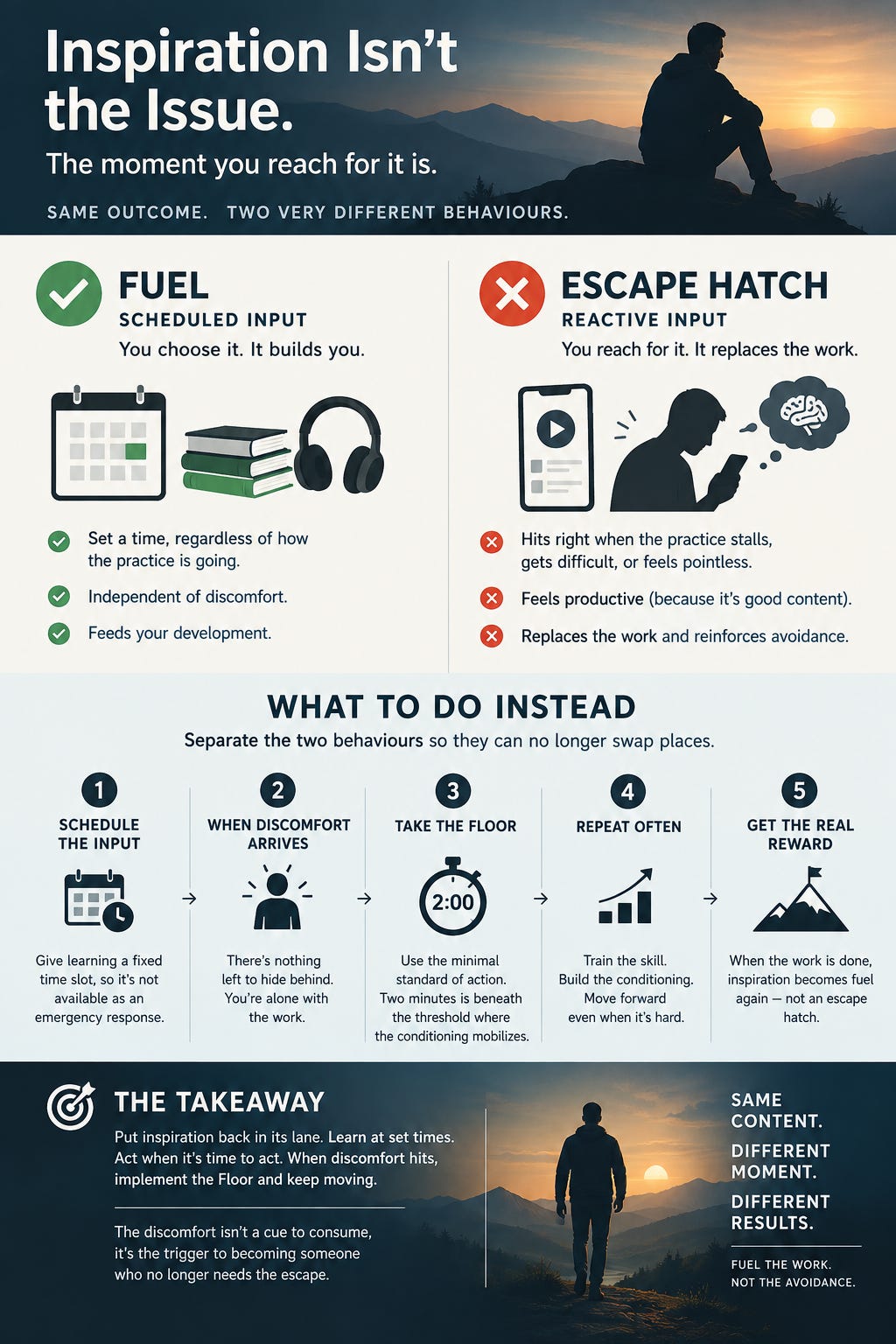 417. Stop Using Inspiration To Escape Discomfort 19.09.2026 5minTo become the person who follows through, go to exercisingconsistency.com and join The ACT Score Challenge today.Think about the last thing you listened to or read.Now think about what you were doing right before you reached for it. Was it scheduled? Or did you reach for your phone the moment the work got uncomfortable?Those are two completely different behaviours producing the same outcome. One is fuel. The other is an escape hatch. And the second one is almost invisible, because it looks exactly like the diligence you admire in yourself.Hey there. It’s me, Kore. And you’re listening to Exercising Consistency: From Fitness to Flourishing.Why the Input Arrives at the Wrong MomentAvoidance is the act of ducking an uncomfortable emotion, and it almost never looks like avoidance. It looks like a substitute activity that feels productive. You deep-clean the baseboards instead of doing your taxes. You suddenly reorganize the pantry instead of making the call.The intellectual version of that is reaching for another podcast, another book, another framework, at the exact moment the practice becomes uncomfortable.The discomfort might be the idea of the upcoming workout, or the blank page, or the flat feeling of not knowing whether you are making progress. Whatever it is, the input relieves it. That relief is the reason the behaviour repeats. And because the material is genuinely good, it feels like diligence rather than what it is.The Tell Is Timing, Not VolumeThis is where the pattern separates from ordinary learning. The tell is not how much you consume. It’s when you consume.Consumption is fuel when it’s scheduled. When you sit down to learn at a set time, regardless of how the practice is going. The input is independent of the discomfort. It’s not responding to anything. It’s just development in the form of learning and study.Consumption is an escape hatch when it’s reactive. When the input arrives only in the moments the practice stalls, gets difficult, or starts to feel pointless, it is not feeding the work. Now, it’s replacing it.The pattern is the signal. Look at the last few times you reached for something to listen to or read. How many of them happened right after a stalled session, a skipped day, or when faced with making a difficult decision?What to Do InsteadThe fix is not to stop consuming. It’s to separate the two behaviours so they can no longer swap places.Schedule the input. Give learning a fixed time slot, so it stops being available as an emergency response to discomfort. Then, when the discomfort arrives, it has nothing to hide behind. You are alone with the workout, the blank page, or the choice, and the only thing available is moving forward with the action.And when the discomfort does arrive, that is the moment for the minimal standard of action (the Floor), not for the escape through podcast. Two minutes is beneath the threshold where the conditioning mobilizes. You do not need to resolve the discomfort. You need to reduce the next step until it’s small enough to take while uncomfortable.That is the whole skill. Do that often enough and you’ll have trained that skill to its own level of conditioning. When things get tough you’ll find yourself moving forward anyway, not reaching for the escape hatch of looking for inspiration.The TakeawayInspiration isn’t the issue. The moment you reach for it is. When it shows up right as the work gets uncomfortable, it trains avoidance even if it looks and feels like diligence. Scheduled input builds you. Reactive input protects you from the very friction that drives your personal development.Put inspiration back in its lane. Learn at set times. Act when it’s time to act. When discomfort hits and you feel like escaping the effort, implement the Floor and keep moving. That’s the identity shift: keeping the commitment to act without seeking relief first.And the reward is simple. When the work is done, inspiration becomes fuel again not an escape hatch. It sharpens your execution instead of softening your follow through. The discomfort isn’t a cue to consume, it’s the trigger to becoming someone who no longer needs the escape.An InvitationTo become the person who follows through on their most important goals, go to exercisingconsistency.com.That’s it for today. Catch you next time. This is a public episode. If you would like to discuss this with other subscribers or get access to bonus episodes, visit stoicstrength.substack.com
 -
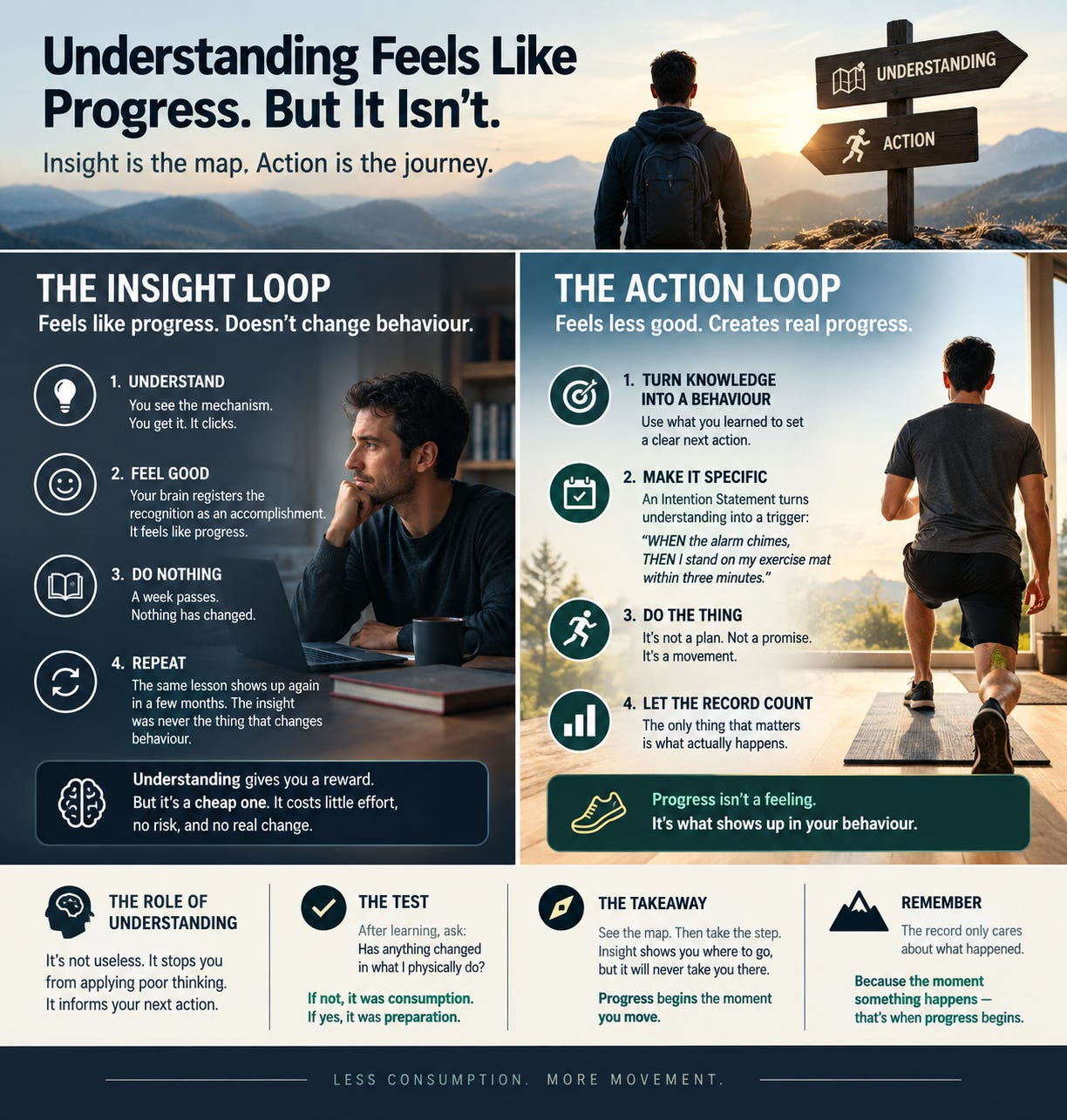 416. Insight Feels Like Progress, But Only Action Moves You Forward 18.09.2026 6minTo become the person who follows through, go to exercisingconsistency.com and join The ACT Score Challenge today.You learn why you’ve been inconsistent. You see the mechanism clearly. You understand the Conditioned Self, the Floor, the Intention Statement, the reason the streak broke last month. Something clicks. And there is a genuine wave of satisfaction, the sense that you have finally arrived at the answer.Then a week passes and nothing has changed.The understanding did not fail. It was never the thing that changes behaviour. It only informed what would need to change. Comprehension is not action. The click was the sound of an idea landing, not of a choice being enacted or a habit being built.Hey there. It’s me, Kore. And you’re listening to Exercising Consistency: From Fitness to Flourishing.Why Insight Pays Out Like ProgressInsight delivers a reward, but it’s poorly timed and misleading. When you recognise the mechanism, the brain registers the recognition as an accomplishment: a pattern identified, a problem understood, an answer located. That recognition is genuinely satisfying. Unfortunately, satisfaction is also what genuine progress feels like.This is the problem: the feelings are nearly indistinguishable. Understanding fires the same satisfaction that doing fires, but it’s cheaper. It costs much less effort, no threat of failure, minimal discomfort, and little risk. You might have to change your mind if you got something wrong, but that’s it.Which is why the person who reads thirty books about discipline can feel like they are further along than the person who exerts two minutes of effort a day, even though the record says the opposite.The feeling of having solved it is real. It’s just not the evidence of real forward progress. It’s the reward for the diagnosis, arriving before any actual treatment has begun.What Actually MovesProgress comes down to what you did. It’s not what you understood, intended, planned, or could explain to someone else. The record does not recognize or store comprehension. It acknowledges and stores behaviour.This is why the same clarity arrives again every six months. If insight changed behaviour, one good understanding would be enough forever. You would never need to learn it twice or more. Relearning the same lesson with fresh surprise is the tell. The knowledge wasn’t going to make the difference. It didn’t then and it hasn’t when rediscovered again. Only action changes things. Nothing changes until something moves, as Albert Einstein put it.An Intention Statement is knowledge describing behaviour. It takes what you understood and reduces it to physical follow through: “WHEN the alarm chimes, THEN I stand on my exercise mat within three minutes.” The trigger does not ask whether you understand. It signals the realization of your enacted choice.That conversion is the whole difference between reading about the Floor and holding it on a bad day.The Role of UnderstandingUnderstanding is not useless, and the argument is not that you should stop learning. Understanding is what stops you from applying poor thinking. It’s the difference between resting when you are fatigued and resting when you are avoiding. It’s why the diagnosis matters before the treatment.But understanding has one job: to inform the next action. The moment it becomes an end in itself, it has stopped serving your purpose and started substituting for the progress you actually want.The test is simple. After reading, writing, or listening to something, ask whether anything has changed in what you physically do. If nothing has changed, the understanding was consumption. If something has changed, it was appropriate preparation.The TakeawayThe real shift happens when you stop treating understanding as progress and finally recognize it for what it is: orientation. Insight shows you where to go, but it will never take you there. The map can be perfect, the diagnosis precise, the clarity refreshing and you can still be standing in the exact same place tomorrow.Progress begins the moment you translate comprehension into a physical act. Not a plan. Not a promise. A movement. One rep. One step. One behaviour that exists in the real world, not just in your head.Understanding does feel good. Just don’t confuse that feeling with movement. Let the insight point you forward, then make it earn its keep by converting it into something you actually do before the day ends.Because the record only cares about what happened. And the moment something happens, the moment you move in the direction you want to go based on your new understanding, that’s the moment progress begins.An InvitationTo put this practice in place and turn it from an idea into a lived experience, start your Day 1 inside The ACT Score Challenge. Go to exercisingconsistency.com.That’s it for today. Catch you next time. This is a public episode. If you would like to discuss this with other subscribers or get access to bonus episodes, visit stoicstrength.substack.com
 -
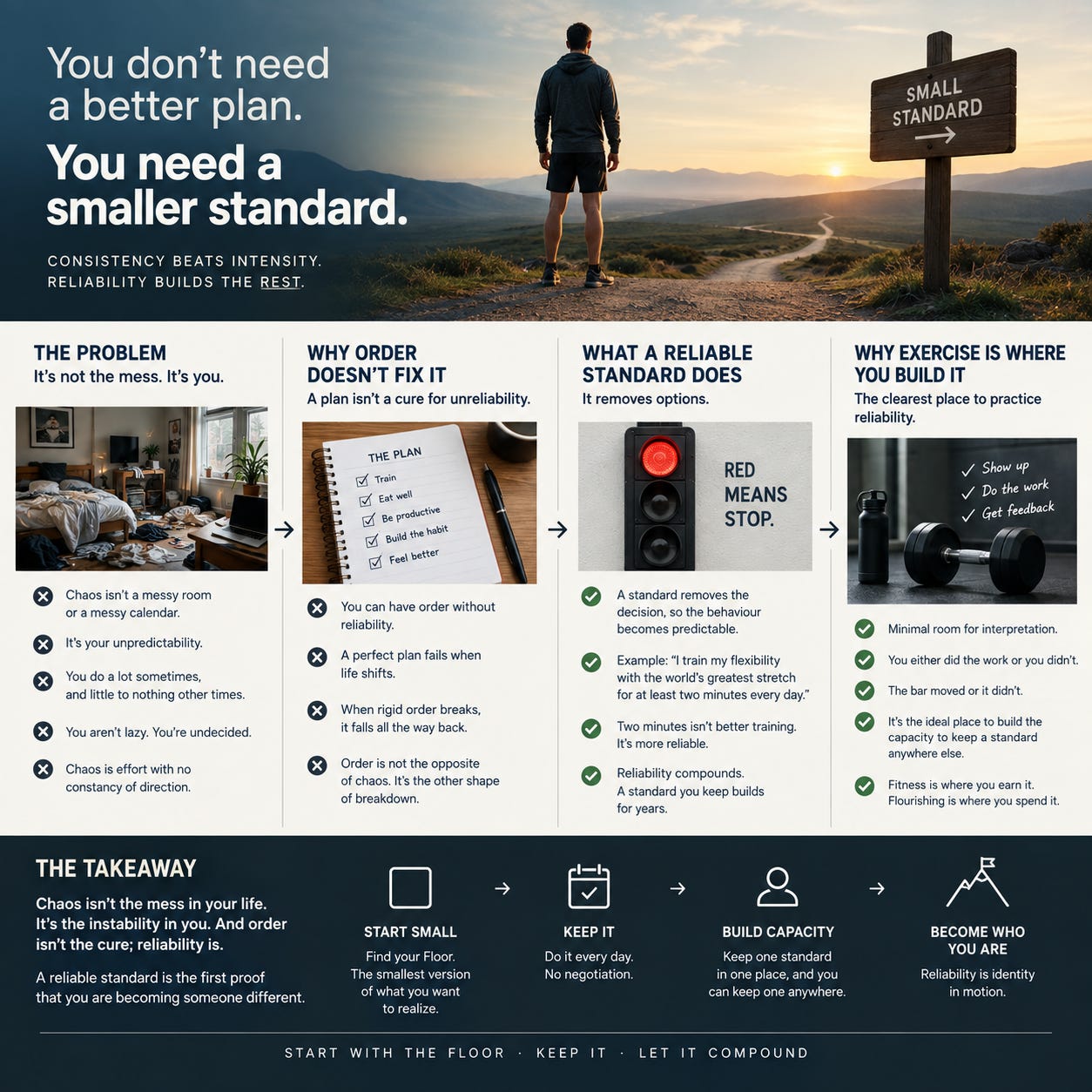 415. Stop Trying to Get Organized. Build Reliability Instead. 17.09.2026 7minTo become the person who follows through, go to exercisingconsistency.com and join The ACT Score Challenge today.You missed a few days of training. Maybe a week. Now you’re standing at the start of a new week, deciding what to do about it.The instinct is to start over, and to start over properly this time. A real schedule. A better plan. A system. This feels like the responsible move. It’s the same move that failed last month, and it will fail again for the same reason. You were organized before. That’s not the problem. The problem is that you could not count on yourself. And a plan is not a cure for that.You need something smaller.Hey there. It’s me, Kore. And you’re listening to Exercising Consistency: From Fitness to Flourishing.Chaos Isn’t MessWe picture chaos as disorganization. A chaotic room. A chaotic calendar. But mess is not the problem. Plenty of people live in a messy apartment and function perfectly well, because the mess is stable and they know where everything is. Mess is not the issue we make it out to be.The issue is your own unpredictability. You cannot count on yourself. Some weeks you do a lot. Some weeks you do little to nothing. You aren’t consistent enough to allow for anything to compound, because nothing is held constant. Whether you train depends on how you feel, on what the day brings, on whatever your conditioned responses default to when nothing has been decided in advance.So the person in chaos is not lazy. They are undecided. And a day of indecision runs itself. Chaos is not the absence of effort. It’s effort with no constancy of direction.Why Order Doesn’t Fix ItThe seemingly obvious correction is to introduce more order. Tighter structure, better systems, a plan with every day mapped. This is where most people spend their energy, year after year, because order feels like the answer. There’s a problem with introducing order directly.You can have order without reliability, and it’s the most common failure there is. A flawless schedule you do not follow. A perfect routine that works on the mornings that cooperate. A beautifully structured plan that falls through the moment one thing shifts. All of that is order. None of it is something you can count on.And when rigid order fails, it does not degrade gracefully. It falls all the way back, because there was no smaller version underneath it to fall back to. Push harder, add more structure, tighten the system. It works briefly, then the cost arrives. Order is not the opposite of chaos. It’s the other shape of break down.What a Reliable Standard DoesA standard works by removing options. Chaos needs room to happen, and every open decision is room.A traffic system works because of one standard: red means stop. Traffic doesn’t work because the roads look tidy. The standard removes the decision, so the behaviour becomes predictable.This is the Floor. For example, “I train my flexibility with the world’s greatest stretch for at least two minutes every day” removes the question of whether today counts. It removes the negotiation. Most people trying to change their behaviour negotiate constantly, every day, and every negotiation is a chance to lose. A reliable standard settles the question once, in advance, so the bad day does not have to be re-argued.This is why a two-minute standard beats a two-hour plan. Two minutes is not better training. But it is reliable, and reliable is what compounds. A standard that flashes brightly and vanishes adds nothing long-term. A standard you keep every day builds, solidly, for years.You build upward from the Floor. You don’t build downward from the ceiling.Why Exercise Is Where You Build ItExercise is the clearest place to build this, because it’s the domain with the least room for interpretation and the most direct feedback.You either did the work or you didn’t. The bar moved or it didn’t. There is no way to argue with it. It is what it is. That makes it the ideal place to practice keeping one standard reliably, before you try to apply that capacity anywhere else.Once you can keep one standard in the gym, or wherever it is you train, you have built the capacity to keep a standard anywhere. The training is the exercise. The reliability is what you carry out of it. Fitness is where you earn it. Flourishing is where you spend it.The TakeawayChaos isn’t the mess in your life. It’s the instability in you. And order isn’t the cure; reliability is. The person who can be counted on, even at the smallest scale, cannot remain in chaos for long. Their life organizes itself around the one thing that never slips.A reliable standard is the first proof that you are becoming someone different. It may not be impressive, but it’s held. When everything else wobbles, the standard is solid. That’s the opposite of chaos: one action that does not negotiate, one behaviour that does not bend, one commitment that does not depend on the weather of your mood.Start with the Floor: the smallest version of the thing you want to realize. Keep at it until it becomes part of you. Reliability is identity in motion. And once you can count on yourself in one place, you can count on yourself anywhere.You’ll have learned how to be the person unmoved by the fluctuations of the day.An InvitationTo put this practice in place and turn it from an idea into a lived experience, start your Day 1 inside The ACT Score Challenge. Go to exercisingconsistency.com.That’s it for today. Catch you next time. This is a public episode. If you would like to discuss this with other subscribers or get access to bonus episodes, visit stoicstrength.substack.com
 -
 414. The Gym Doesn’t Build Character, It Reveals Standards 16.09.2026 7minTo become the person who follows through, go to exercisingconsistency.com and join The ACT Score Challenge today.There are people who claim the gym builds character. The discipline you learn under the bar transforms everything else in your life. I’m one of those people. I’ve said it many, many times. Any time I talk about this in broad terms I still say it. And, in broad terms, it’s true.However, though roughly correct, it’s not literally true. A venue cannot do anything to you. The barbell has no moral power. Put a person in a gym and nothing happens. The iron sits there. It’s indifferent. Not even the practice of exercising itself has that power. The gym’s power is not moral; it’s mechanical. It gives you something almost no other context does: immediate, non‑negotiable feedback.So it’s more accurate to say: the gym doesn’t build character; it reveals standards.Hey there. It’s me, Kore. And you’re listening to Exercising Consistency: From Fitness to Flourishing.What the Gym Strips AwayEvery environment you move through has an audience. Work gives you praise, status, and deference. Those reward the appearance of discipline, not the discipline itself. And reputation, what others think of you, is not yours to determine. It belongs to everyone who forms an opinion of you.The gym removes the effect of the audience. It removes the influence of reputation. It leaves you alone with a standard and a choice.Your reputation cannot do the reps. Your good intentions cannot hit depth. The bar either moves or it doesn’t. There is no loophole, no story you can tell to soften the truth, no way to argue with the work recorded in the logbook. What remains is the standard you actually hold.That is why the gym is revelatory. It’s a mirror. The same person who quits on the last rep is the same person who quits on the thing that matters. The barbell did not make them that way. It showed that they already were.What Gets RevealedThe revealed thing is not vague. It’s your standard, and it shows up in three places.The first is the standard you set: not simply “train hard,” but a specific number, a quality of movement, a tempo.The second is the standard you keep when the effort required gets close to your maximum. The moment the load gets heavy is the moment the claim meets the test. The quality you abandon when fatigue arrives. The tempo you accelerate when you stop paying attention. Your conditioning is not betraying you when it happens. It’s showing you what has been trained so far.The third is the standard you hold on the day you almost did not go. That is the one that separates a performance from a practice. It’s the identity-level standard.None of this builds character on its own. It reveals. It shows you what your conditioning currently defaults to, which is exactly where the next choice begins.What the Gym BuildsHere is the half the “the gym builds character” phrase gets right and the half the “it only reveals” part misses.Once you can see the standard clearly, you can raise it. Character is not revealed and then left alone. It is built. And the gym is where the building happens with unusual clarity.The mechanism is just‑noticeable difficulty. Add two and a half pounds to the bar, not fifty. Choose the slightly harder option, not the existential confrontation. Every time you choose the slightly harder level of excellence, you are not just strengthening a muscle. You are training the skill of choosing the harder level of excellence.That skill is character. And it accumulates the way your logbook record accumulates: compliance → consistency → competence → character. What you repeat gets trained. Your conditioning is gradually rebuilt by thousands of conscious, deliberate decisions until the standard you once had to enforce becomes the standard you carry automatically.The gym does not do this. You do. But the gym is where the practice lives, because the feedback is clear and the standard cannot be fudged.Two Angles, One ActRevelation and construction are not competing claims. They are the same act seen from two angles.The barbell reveals the standard you currently hold. That is the diagnosis. The same barbell gives you the repeated chance to raise it. That is the treatment. Both happen at the same place, in the same rep, and neither one is done to you by the equipment.The TakeawayThe gym does not build character. It reveals standards. And then it gives you the chance to raise them.It shows you the standard you set, the standard you kept when it got hard, and the standard you held on the day you almost did not show up. Those three form the record. And the record is what you chose to do, not what the gym did to you.Character is the shadow cast by your most consistent choices. The gym is simply the brightest light you can use to cast them.An InvitationTo become the person who lives their highest values while realizing their most important goals, go to exercisingconsistency.com.That’s it for today. Catch you next time. This is a public episode. If you would like to discuss this with other subscribers or get access to bonus episodes, visit stoicstrength.substack.com
 -
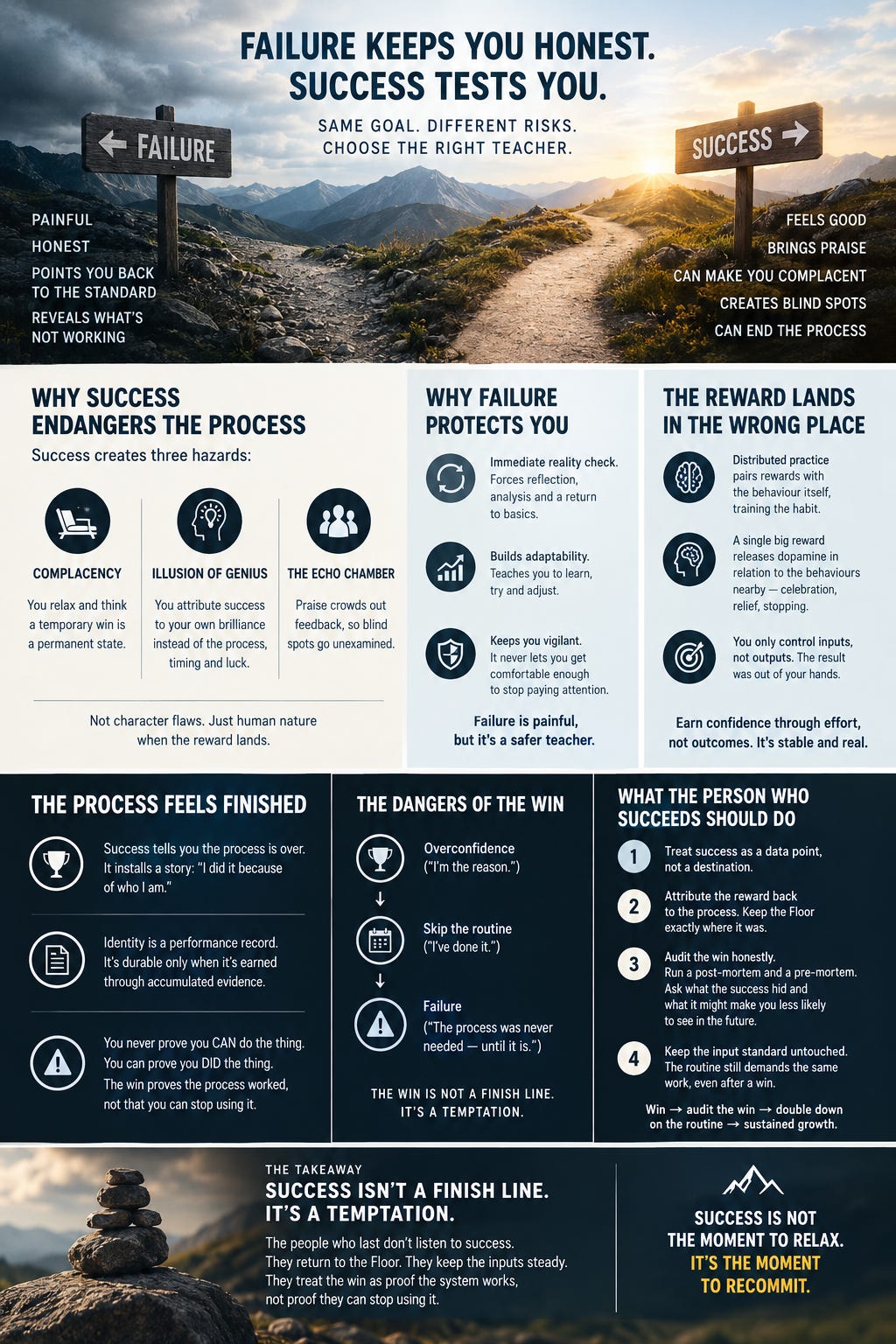 413. When Winning Weakens You 15.09.2026 9minTo become the person who follows through, go to exercisingconsistency.com and join The ACT Score Challenge today.We spend our energy fearing, and preparing to handle, failure. But failure is honest. It’s uncomfortable, but it tells you something useful: the process is not working. It forces you back to the standard. A failed week points at the missed sessions, the broken promises, the days you made poor choices.Failure demands a return to the work. Success seems to demand nothing of you. That is misleading.The dangerous outcome is not the one that hurts. The dangerous outcome is the one that feels like a finish line.Hey there. It’s me, Kore. And you’re listening to Exercising Consistency: From Fitness to Flourishing.Why Success Endangers the ProcessSuccess creates three specific hazards.The first is complacency. When people succeed, they relax. They mistake a temporary win for a permanent state and stop the rigorous daily habits that got them there. The routine that built the result feels optional now that the result exists.The second hazard is the illusion of genius. Winners tend to attribute success to their own innate brilliance rather than a combination of process, fortuitous timing, and luck. This overconfidence leads them to abandon the effective system that was actually doing the work. They credit themselves. The system was the thing that should have been credited.The third hazard is the echo chamber. Success brings praise, and praise crowds out feedback. People stop listening to the signals that once kept them honest, because everything seems to be working. The blind spots that failure would have exposed go unexamined.Notice that none of these are character flaws. They are the natural result of where the reward lands.Why Failure Protects YouFailure is painful, but it acts as an immediate reality check. It forces reflection, analysis, and a return to basics. It teaches you to adapt fluidly, because survival requires continuous learning and trial and error.Success teaches the opposite. It encourages rigid adherence to what worked once. The person riding a win has no incentive to adapt, so they keep doing the thing that produced the result, long after the conditions that made it work have changed.This is why failure is the safer teacher. It never lets you get comfortable enough to stop paying attention.The Reward Lands in the Wrong PlaceReinforcement strengthens the behaviour that most closely precedes it. This is why distributed practice builds robust habits. When the reward arrives across many sessions, it keeps pairing with the behaviour itself, and the behaviour gets trained.A single large reward behaves differently. The brain does not reward the outcome as a detached event. It releases dopamine in relation to the behaviours that produced it, and that release reinforces the behaviour it sits closest to. So when the win arrives months later, it lands far away in time from the daily choices that built it. It reinforces with hardly any strength, and whatever it does reinforce is usually the thing nearest to it: the relief, the celebration, the stopping. The system that built the result never gets fed.There is a deeper reason this matters. You do not control outputs. You only control inputs. The result was out of your hands. The intention, the effort, the consistency to follow through are what you brought to the table.This is the same principle that governs confidence. A confidence resting on outcomes will fluctuate, because outcomes come and go. A confidence resting on effort is stable, because effort is always available. When you credit the outcome, you have built your identity on the one variable you never controlled.The Process Feels FinishedSuccess tells you the process is over. The goal was reached, so the choice to stop becomes available. And the win installs a story: that you did it because of who you are rather than what you did. Once the verdict is declared, the evidence stops accumulating.That is where the fragility lives. Identity is a performance record, and it is durable only when it is earned through accumulated evidence. The person who succeeds can decide they are the person they wanted to be. The record stops growing, and the identity becomes a memory of what was once demonstrated.Recall the distinction that matters here. I covered this in Episode 405. You never prove you CAN do the thing. There is always the possibility of failure. But that you DID the thing? That you can prove. The win proves the process worked. It is, however, not a certificate that the process is no longer needed.What the Person Who Succeeds Should DoTreat success as a data point, not a destination.The move is to attribute the reward back to the process. Keep the Floor exactly where it was. Two minutes on the bad day is still the standard. The success did not raise the Floor. It is a byproduct of the Floor held over time. Keeping it steady after a win keeps the process alive at the moment the outcome is trying to make it feel redundant.Then audit the win honestly. When a project succeeds, run the post-mortem anyway. Ask whether the process was flawless or whether luck carried you. Ask what the success hid. Also, run a pre-mortem from where you are now as a result of the win. Consider how the win might make you less likely to succeed in the future. Ask yourself, “If I fail six months from now, how might this win have caused it?”And keep the input standard untouched. If the business building result came from ten calls a day, the routine still demands ten calls, even when the calendar is full of celebration. The output changed. The input is unchanged.Here is the arc worth choosing: Win→audit the win→double down on the routine→sustained growth.The alternative arc is the one that ends badly: Win→overconfidence→skip the routine→failure.The outcome is not a request to relax. It’s proof that the process worked, and the instruction to continue.The TakeawaySuccess isn’t a finish line. It’s a temptation. It tries to pull you out of the behaviours that built the win. Failure pushes you back into the process. Success tries to convince you the process is no longer required.The people who last don’t listen to success. They return to the Floor. They keep the inputs steady. They treat the win as proof the system works, not proof they can stop using it.Success is not the moment to relax. It’s the moment to recommit.An InvitationTo become the person who follows through on their most important goals, go to exercisingconsistency.com.That’s it for today. Catch you next time. This is a public episode. If you would like to discuss this with other subscribers or get access to bonus episodes, visit stoicstrength.substack.com
 -
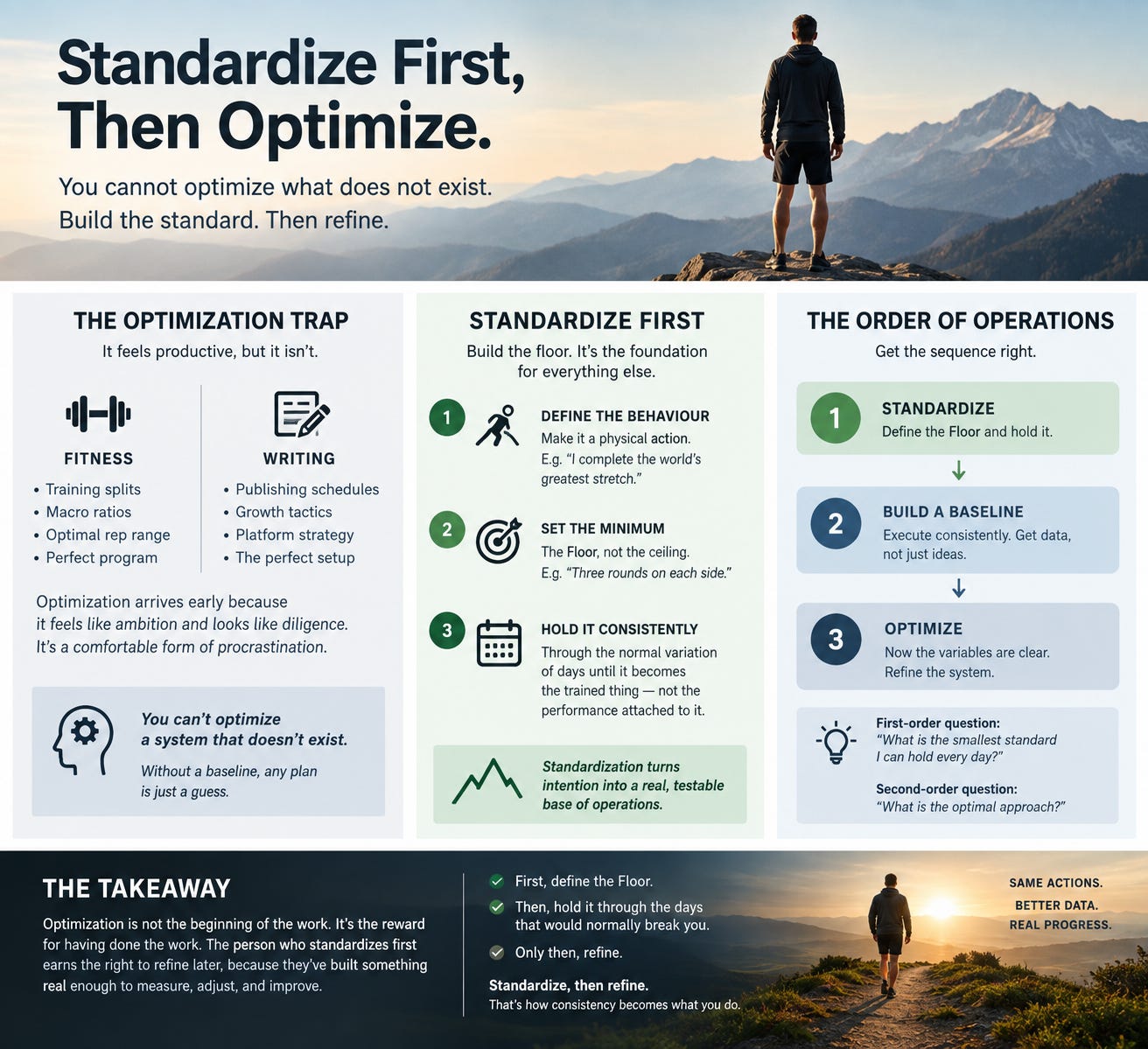 412. Stop Optimizing Too Early: The Hidden Reason Your Training and Habits Never Stick 14.09.2026 6minTo become the person who follows through, go to exercisingconsistency.com and join The ACT Score Challenge today.Often the person just getting started on their fitness journey reads about training splits, macro ratios, and the optimal rep range before they have completed a single week of consistent exercise. The person who wants to write reads about publishing schedules and growth tactics before they’ve even had their first piece published.The optimizing instinct arrives early, and it feels productive though it isn’t. Finding the perfect program is a way of feeling that you are making progress without simply showing up and doing the boring work of building the basic skills of the craft. Optimization is the most comfortable form of procrastination, because it feels like ambition and looks exactly like diligence.Hey there. It’s me, Kore. And you’re listening to Exercising Consistency: From Fitness to Flourishing.You Cannot Optimize What Does Not ExistThere is consistent behaviour and there is the consistency of the standard itself. The standard is the one that does the work. Before the standard exists, optimization has no object. It’s refining a system that has not been built, let alone tested.The body is the model. You cannot optimize a training program if you have not trained. The variables, having never been put in play, are not understood. How much volume can you handle? How much recovery do you need? Which exercises match your structure? None of it can be knowable before you have a baseline. Any program you draw up in advance is a guess. It takes implementation to understand what’s happening.The same is true of a habit. Optimization assumes a stable standard underneath. The person who has not yet established a stable Floor, the minimum, is trying to tune a system that does not exist. Standardization is what makes optimization possible. Reversed, the sequence produces a theory based on no established pattern.Standardize FirstStandardization is the act of defining what the behaviour is, at minimum, and then holding that standard across the ordinary variation of days. This is the Floor. Two minutes, kept on the worst day. Two minutes isn’t the final goal, but it is the standard that can survive the conditions that break a goal.Standardization has three parts.* Define the behaviour as a physical action. E.g. “I complete the world’s greatest stretch.”* Define the minimum standard, the Floor, not the ceiling. E.g. “I complete the world’s greatest stretch for three rounds on each side.”* Then hold it consistently across enough days that the standard itself becomes the trained thing, not the performance attached to it.This is the point of the deeper consistency that underpins every consistent practice. The person who standardizes is building the consistency of the standard, which is what all later refinement rests on. The person who attempts to optimize first is refining a standard that has not yet been set. And the mind, correctly, cannot render a verdict on a standard that exists only as ambition.The Order of OperationsGetting the sequence right is important because optimization only has something to act on after the standard is set. It’s the same principle that governs training progression. You do not tune the details of a program until the program is being executed correctly and consistently. You reach a baseline. You hold it. Only then do the variables become clear, because only then do you have signal instead of noise.The optimizers are answering the wrong question first. “What is the optimal approach?” is a second-order question. “What is the smallest standard I can hold every day?” is the first-order question. Answer the first-order question, and the second answers itself through data. Answer the second question first, and you have a beautifully designed plan with no execution attached.The TakeawayOptimization is not the beginning of the work. It’s the reward for having done the work. The person who standardizes first earns the right to refine later, because they’ve built something real enough to measure, adjust, and improve.The sequence is non‑negotiable. First you define the Floor. Then you hold it through the days that would normally break your intentions. Only after the standard survives reality does optimization become meaningful. At that point refinement isn’t procrastination, it’s precision.Many never reach that stage. They stay trapped in theoretical excellence, forever tuning a plan they never enacted. But the person who builds a standard, however small, is already operating at a different level. They are exercising consistency instead of fantasizing about perfection. They are accumulating signal instead of noise. They’re becoming someone whose actions provide understanding that leads to useful knowledge.The order is simple: standardize, then refine.Get it right and consistency stops being an aspiration and becomes what you do.An InvitationWhen you’re ready to turn consistency from an idea into a solid practice, go to exercisingconsistency.com to start your Day 1 in The ACT Score Challenge.That’s it for today. Catch you next time. This is a public episode. If you would like to discuss this with other subscribers or get access to bonus episodes, visit stoicstrength.substack.com
 -
 411. Stop Saying No: The Real Skill Behind Unbreakable Self‑Control 13.09.2026 6minTo become the person who follows through, go to exercisingconsistency.com and join The ACT Score Challenge today.We treat “no” as the emblem of self-control. The person who can refuse is the disciplined one. Resist the second helping. Decline the scroll. Turn down the easier option. This is the heroic image, but it’s mistaken. The skill isn’t in saying “no” it’s in living in a way you don’t have to.Saying no is not a strength performed well. It is a disadvantaged position entered late. By the time you are saying no, the alternative has already arrived. The impulse already has momentum. You are fighting a live battle you did not need to enter. The skill is not to win that battle. The skill is to have made the choice so early that there was never a battle to fight. Saying no is what happens when the skill has already failed.Hey there. It’s me, Kore. And you’re listening to Exercising Consistency: From Fitness to Flourishing.Why a Real-Time No Loses by DefaultThe Conditioned Self runs most of your life, and it does so quickly. It is the sum of your past reinforcement, your habits, your emotional reflexes, the patterns with thousands of reps of momentum behind them. When stress spikes, when fatigue sets in, when the circumstance demands a response before you have time to think consciously, it acts. It’s not malicious. It’s simply what has been trained so far.The Choosing Self is slower. It’s effortful. It requires attention. It’s the only faculty by which the Conditioned Self can be retrained, but it cannot outrun or outmuscle the Conditioned Self.Now, place them head to head. When you wait until the moment of temptation to make a decision, you are making the slower Choosing Self fight the much faster Conditioned Self at the precise moment the Conditioned Self is strongest. Sometimes you can pull off the win. But every win costs. And the odds are never in your favour, because you’ve chosen to fight at the time and place at which you are clearly outmatched.This is why willpower as a strategy eventually fails for everyone. You keep scheduling the fight at the worst possible moment for the Choosing Self. Stop scheduling that fight.The Decision Happens Once IdeallyThe skilled move is to decide in advance, when the Choosing Self is calm and in charge, and then let the execution be automatic. The Intention Statement is the mechanism that takes care of this. For example, “WHEN I get up at 6 AM, THEN I get dressed and head out the door within 15 minutes for my run.” The trigger does not ask “should I?” It executes.This is the difference between deciding and re-deciding.A decision is made once, under good conditions, and then it’s settled. A re-decision is when you let a settled question re-open at the moment of temptation, so the Choosing Self must negotiate for something it already won. The person who decided once does not reject the snack with a burst of will. The snack was already a settled issue. The person who re-decides keeps re-negotiating. The person who decided once already knows what they’re going to do. It’s a done deal and only a matter of execution.What you cannot decide early, you can remove from consideration entirely through the environment. Structure limits the options, so the alternative is never presented. No junk food in the house means no decision at the cupboard. The choice is not resisted. It’s never offered.Re-Deciding Is the Real EnemyThe cost of saying no is usually counted as depletion: the effort you spend refusing is effort you can’t apply elsewhere. That is real, but there’s a subtler cost that matters more: fragility.Every re-decision re-opens a settled question and exposes it to a fresh swing of mood, fatigue, and circumstance. Even when you win, you have proven the commitment is not settled, that it can be dragged back into the negotiation again. A commitment that is re-decided every day holds only while the Choosing Self happens to be winning. It fails the first day the Choosing Self is tired, distracted, or outclassed.A commitment that was decided once does not need to be defended. It’s already settled.You only ever need to deal with a question that has not been settled. Decide once, and there is nothing left to discuss. The no you never have to say is better than a victory over your Conditioned Self. That’s the sign you are becoming masterful in your exercise of virtuous self-control.The TakeawaySelf-control is not the ability to say no. It is the design that removes the need to say no, because the choice was already made.Saying no is the failure mode of self-control, the moment the skill was late. The trained person does not get better at refusing. They decide earlier, decide once, execute; never re-decide.The person who exemplifies self-control is not the one with the strongest no. They’re the one who never put themselves in the position where they need to say it.An InvitationTo become the person who follows through on their most important goals, go to exercisingconsistency.com.That’s it for today. Catch you next time. This is a public episode. If you would like to discuss this with other subscribers or get access to bonus episodes, visit stoicstrength.substack.com
Liknande podcastar


Populär i
Den här podcasten finns även i podcastlistor i dessa länder.
