
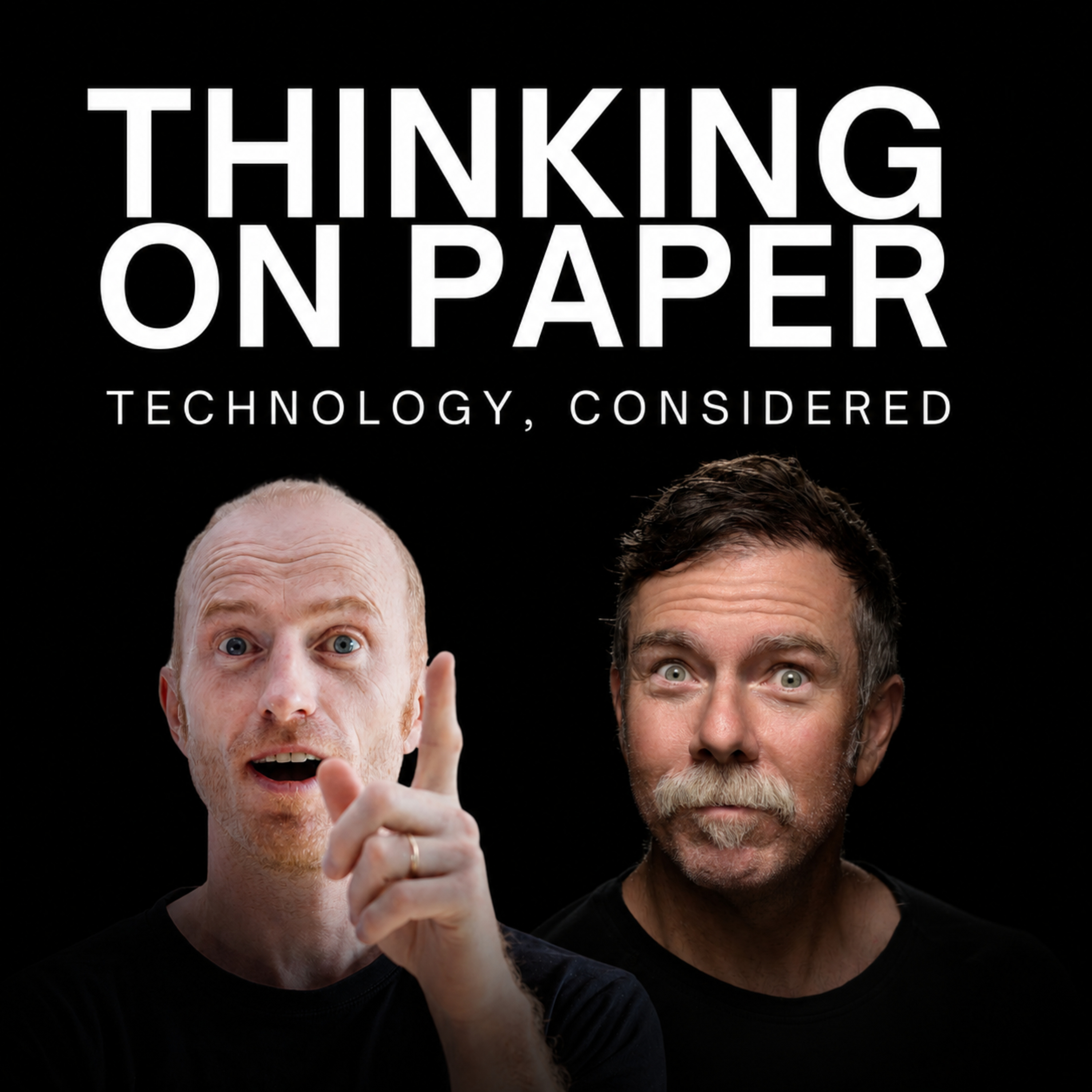
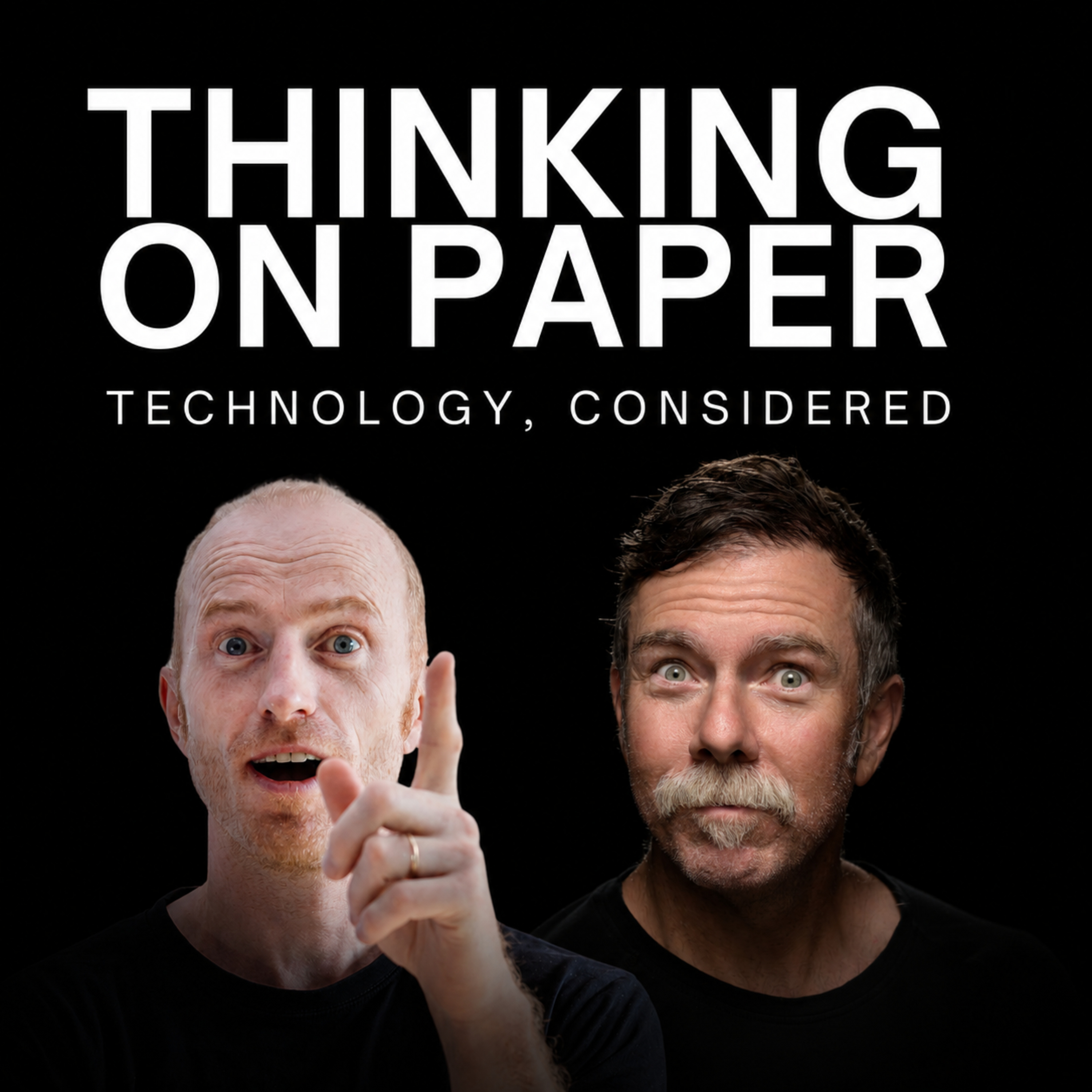
Thinking On Paper: Technology, Considered
Mark Fielding and Jeremy Gilbertson
0
Conversations with founders, CEOs, writers and outliers on how AI and emerging technology are reshaping business, society and human life. Thinking On Paper is a weekly technology podcast hosted by writers and systems thinkers Mark Fielding and Jeremy Gilbertson. It covers the convergence of AI, quantum computing, robotics and space infrastructure. The show is for professionals, parents, creators and curious minds who want to think for themselves about AI and technology. All original. All human.
ตอน
-
 He Quit SpaceX to Make Houses from Grass | Nathan Silvernail, CEO of Plantd 16.09.2026 50นาทีNathan Silvernail quit SpaceX to make wood from grass.Building the first part of a rocket SpaceX ever reused - the nose cone - wasn’t enough. After a decade working for Elon Musk, he quit. Took everything he had learnt.And started Plantd. The plan? Make carbon-negative engineered lumber from fast-growing perennial grass. Climate tech meets space tech. Wood, without trees. Plantd's panels replace OSB, the oriented strand board that sheathes the floors, walls and roofs of almost every new American home. In this hotly anticipated episode, Nathan joins Thinking On Paper to talk about his SpaceX journey, why he thinks Mars is a distraction from the work in front of us, how the lumber industry accounts for the wood it burns, and why building a material stronger than steel turned out to be wrong. You’ll get insight into the nine-month harvest cycle, what it takes to change the culture of an industry without letting it notice, and why he believes the unit economics that let SpaceX displace ULA will do the same to timber.Please enjoy the show.Thinking on Paper connects the dots between technology and what it means to be human. New episodes every week.🏠 Buy us a beer on Substack🫵 Choose your own technology adventure 📺 Watch our beautiful faces on YouTube 🎧 Remember Steve Jobs on APPLE📺 Get clips and exclusive videos on Instagram --Chapters(00:00) Grass building panels that replace wood(04:10) SpaceX: what the job actually cost him(07:56) What a payload fairing is and how SpaceX recovers it(11:52) Lumber: why anger put him in this industry(24:02) OSB alternative: a drop-in structural panel(28:00) Carbon negative building materials explained(29:50) SpaceX and ULA: the same playbook for lumber(35:55) Why hemp, bamboo and mycelium fail as building materials(40:14) Harvest: nine months against fifteen years(46:00) Why the Space Shuttle was retired
 -
New US Space Transportation Policy Demands 1000 Rocket Launches a Year 04.09.2026 24นาทีWe read the National Space Transportation Policy in full. Signed 20 August 2026, it shreds the 2013 directive and rewrites how the US gets into space, moves around up there, and comes back down.The War Department is all over it. Launch ranges, reentry infrastructure, a clause about accommodating launches within 48 hours of need. You don't build a 48-hour capability to do science. Somebody expects to lose a satellite and need a replacement up fast.Here's what we think stops it. Not rockets. Not pads. Demand. Most of what goes up is Starlink, everyone else crams onto rideshares, and a target of 1,000 assumes five times more reason to be up there than anyone currently has. The document is a sales pitch with the government as a customer.We also get into the Mars carve-out and what it says about who America needs, the ISS retiring the same year and China’s plans to land on the moon.--Thinking on Paper is a technology podcast about AI, Space, quantum computing, science, and the systems shaping your life. 🏠 Buy us a beer on Substack🫵 Choose your own technology adventure 📺 Watch our beautiful faces on YouTube 🎧 Remember Steve Jobs on APPLE📺 Get clips and exclusive videos on Instagram --Chapters(00:00) Introduction to the US Space Transportation Policy(03:20) US Launches in 2025 and 2026(04:45) Private Industry and Market Demand(06:24) International Competition and Collaboration(07:55) Infrastructure Needs for Increased Launches(10:00) Government Coordination and Regulatory Frameworks(12:02) Market Opportunities and Ride-Sharing in Space(15:13) Future Missions to Mars and Lunar Surface(18:43) International Efforts and the Race to Mars(20:48) Implications of the 2030 Space Goals(23:22) Summary and Next Steps
-
Fear Is Holding Us Back From Asking Questions │ Pia Lauritzen 03.08.2026 4นาทีWhy do we stop asking questions as adults? Philosopher Pia Lauritzen has analysed 30,000 of them, and says nothing was ever lost.The ability stays. What changes is the price. Every question admits you don't know something, and nobody gets promoted for ignorance. Ask in the wrong room and curiosity starts to feel like an interrogation, which is why most of us learn to keep the question to ourselves.She proves it in keynotes. One minute, two rules, and every person in the audience writes one. They could do it the whole time.Full episode with Pia Lauritzen on questions, curiosity and whether AI can think at www.thinkingonpaper.xyzBe curious, stay disruptive.--Thinking on Paper is a technology podcast about AI, Space, quantum computing, science, and the systems shaping your life. 🏠 Buy us a beer on Substack🫵 Choose your own technology adventure 📺 Watch our beautiful faces on YouTube 🎧 Remember Steve Jobs on APPLE📺 Get clips and exclusive videos on Instagram
-
AI And The Hyper-personalization of Music 28.07.2026 5นาทีNicholas Ponari says AI music makes live performance more valuable, not less. Mark Fielding calls the same future a hellscape.Ponari's scenario: by 2045 his son types a script into a generator, gets a feature film in the style of Kubrick crossed with Tarantino, and hits publish. Everyone becomes a creator in every medium. Nobody can consume a fraction of it, so AI becomes the largest curator in history.Mark's objection is that shared culture dies with it. No song anyone else has heard. No film anyone else has seen. Nothing left to talk about.Ponari's answer is scarcity. When everything is generated, the things that cannot be, a room, a crowd, live music, become more valuable than ever.Who's right?Full episode at thinkingonpaper.xyz.Be curious, stay disruptive.--Thinking on Paper is a technology podcast about AI, Space, quantum computing, science, and the systems shaping your life. Thinking on Paper is a technology podcast about AI, Space, quantum computing, science, and the systems shaping your life. 🏠 Buy us a beer on Substack🫵 Choose your own technology adventure 📺 Watch our beautiful faces on YouTube 🎧 Remember Steve Jobs on APPLE📺 Get clips and exclusive videos on Instagram
-
AI Governance: Where Does Recursive Self Improvement End? 22.07.2026 50นาทีThe US and China are racing to build AI systems that could lead to superintelligence before any enforceable global rules exist to inspect them, limit them or verify what they can do.Mark and Jeremy Think On Paper about The Hard Question of AI, an essay by Planet CEO Will Marshall. Marshall argues that AI governance now needs the same kind of verification, trust and global protection as nuclear weapons.That means more than voluntary safety tests and China and America laying down their AGI swords. And since that is unlikely, it could mean monitoring chips, tracking data-centre construction and energy use, inspecting frontier AI labs, protecting whistleblowers and agreeing international red lines around recursive self-improvement.But the nuclear comparison has many challenges. Weapons-grade material is scarce and difficult to hide. Just ask Iran. AI software can spread quickly and cross borders. Any Tom, Dick or Harry could end up being the first to create superintelligence. At the centre of the episode is one question: what would AI’s Cuban Missile Crisis look like? What event would force the US and China to cooperate? Really cooperate. Lip service won’t calm existential risk. We also discuss Sam Altman, Dario Amodei and Demis Hassabis, the incentives behind AI safety warnings, the limits of voluntary regulation, the RAND verification framework, recursive self-improvement, the Fermi paradox and whether governments can build the institutions required to manage AI superintelligence.Hint: they can’t.Please enjoy the show. And don’t have nightmares.--Thinking on Paper is a technology podcast about AI, Space, quantum computing, science, and the systems shaping your life. 🏠 Buy us a beer on Substack🫵 Choose your own technology adventure 📺 Watch our beautiful faces on YouTube 🎧 Remember Steve Jobs on APPLE📺 Get clips and exclusive videos on Instagram --Chapters00:00 Trailer 01:38 AI And Existential Risk02:40 OpenAI, Anthropic & Google04:40 Nuclear meltdown or sharks?05:50 Why is everyone speaking about the end of humanity08:00 RSI - Closed loop recursive self improvement10:00 A ghostbuster copyright interlude19:39 Why America And China Are In An AI Race23:51 The AI Cuban Missile Crisis28:07 The AI Supply Chain35:09 USA And China And The AI DeadEnd40:36 The Nuclear Framework
-
Make GPUS 25% More Efficient | Moshe Tanach, CEO NeuReality 14.07.2026 41นาทีAI companies are splashing billions on more GPUs before they use the ones they already have. Many sit idle, others use a fraction of their potential. For the hyperscalers, cloud providers and AI companies, buying more GPUs does not solve much if the GPUs already in the rack spend too much time waiting for the rest of the system.The next battle in the AI infrastructure wars is efficiency: GPU utilization, NICs, memory movement, networking, CPUs and software that keeps expensive hardware doing useful work.Moshe Tanach runs NeuReality AI, a company building infrastructure for AI inference. In this conversation, he explains why the next wave of AI infrastructure depends on GPU utilization, NICs, memory movement, networking and software efficiency, not just buying more chips.This is a technical conversation about AI inference, infrastructure efficiency and the hardware layer beneath ChatGPT, Claude, Gemini and the AI tools now being built into business software.Please enjoy the show.Thinking on Paper is a technology podcast about AI, Space, quantum computing, science, and the systems shaping your life. 🏠 Buy us a beer on Substack🫵 Choose your own technology adventure 📺 Watch our beautiful faces on YouTube 🎧 Remember Steve Jobs on APPLE📺 Get clips and exclusive videos on Instagram --Chapters(00:00) The GPU challenge(01:27) Training Vs Inference(05:45) Memory & Keeping The GPU Busy(07:31) Deep Seek, Blackwell & Ruben(09:03) How Ripe Is CPU For Reinvention?(11:03) AI Agents Run On CPUs(12:51) Do We Need All The Computation?(14:35) GPU Utilization Rates(16:50) Tokens In A Context Window(20:59) Data, Knowledge & Wisdom(23:56) Why Are Your GPUs Busy? (A Truck Analogy)(29:07) Hyperscalers(31:59) The Decode Phase(36:47) What More Efficient GPUs Means For The User
-
Is Cultivated Meat The Death Knell For Industrial Animal Farming? - Bruce Friedrich 08.07.2026 53นาทีCould cultivated meat replace industrial farming without asking billions of people to change what they eat? And save all the cows on the way?Bruce Friedrich, founder of the Good Food Institute and author of Meat, explains why the future of food may depend less on changing human behaviour and more on changing how meat is produced.For more than 12,000 years, humans have relied on animal agriculture to produce meat. Bruce argues that this system is reaching its limits. We explore how cultivated meat is made, why it is attracting support from governments and major food companies, and why some of the biggest meat eaters are also the most open to the technology.Along the way, we discuss the environmental cost of livestock, antibiotic resistance, food security, infrastructure, consumer psychology, regulation, and whether this technology could become as transformative as renewable energy or electric vehicles. We also examine what happens to farmers, why culture may be harder to change than technology, and whether cultivated meat can ever reach price parity with conventional meat.If the next agricultural revolution is already underway, it may not begin on a farm.Thinking on Paper is a technology podcast about AI, Space, quantum computing, science, and the systems shaping your life. 🏠 Buy us a beer on Substack🫵 Choose your own technology adventure 📺 Watch our beautiful faces on YouTube 🎧 Remember Steve Jobs on APPLE📺 Get clips and exclusive videos on Instagram --Chapters(00:00) Who Eats Cultivated Meat?(02:37) Cultural Significance of Meat(06:09) What Is Cultivated Meat?(08:25) The Science Behind Cultivated Meat(10:48) How Much Does Cultivated Meat Cost?(14:46) What does cultivated meat taste like?(17:10) Emerging Companies in the Lab Meat Industry(19:08) Industry Support for Alternative Meats(21:06) Government Role in Innovation(24:40) The Future of Animal Agriculture(28:25) Agricultural Policies for Sustainability(31:41) What Are Fermented Meats?(35:48) Meat And Antibiotic Resistance(39:32) The Invisible Costs of Meat Production(42:26) The Future of Cultivated Meat
-
Mining Asteroids For Platinum | Matthew Gialich, CEO Astroforge 23.06.2026 51นาทีAsteroid mining sounds insane until you speak to AstroForge CEO Matthew Gialich. Then it makes perfect sense.Matthew’s team at AstroForge builds spacecraft to mine metallic M-type asteroids for platinum group metals, the unglamorous but essential metals inside phones, cars, chips, electronics and much more.AstroForge is one of the few companies trying to make space mining real, targeting metal-rich asteroids that could contain platinum, palladium, iridium and other PGMs.Why? Earth’s resources are getting harder, deeper and more expensive to reach. The good stuff is not sitting neatly on the surface. A lot of it is buried, depleted, regulated or uneconomic.In this episode, Matthew explains why asteroid mining may now be technically and economically possible, why Planetary Resources may have been too early, how SpaceX changed the capital story for space startups, and why AstroForge’s first deep-space spacecraft failed after travelling nearly a million miles from Earth.Please enjoy the show. --Thinking on Paper is a technology podcast about AI, Space, quantum computing, science, and the systems shaping your life. 🏠 Buy us a beer on Substack🫵 Choose your own technology adventure 📺 Watch our beautiful faces on YouTube 🎧 Remember Steve Jobs on APPLE📺 Get clips and exclusive videos on Instagram --Chapters(00:00) Asteroid Mining Trailer(02:51) The Economic Necessity of Asteroid Mining(08:37) Lessons from Planetary Resources(10:43) Risk and Innovation (15:26) Deep Space Two (19:05) The Quest for Asteroid Exploration(22:20) Aliens & Life Beyond Earth(24:17) Ownership and Ethics in Space Mining(26:21) The Next Challenges in Asteroid Mining(27:56) Changing Earth's Economy (30:13) The Role of Capital(32:32) Matt's Vision for Space Exploration(35:06) The Drive to Explore the Universe(36:55) NASA's Evolution (39:17) Inside Astroforge(42:53) The Complexity of Space Engineering(44:25) Data Centers in Space(47:30) The Limitations of AI in Space Engineering
-
Why Engineering Discipline Matters More Than Quantum Computing Hype 19.06.2026 57นาทีQuantum computers could change medicine, material science and AI. Unfortunately, it's impossible to know how because the industry is buried under hype. In today’s show, Dr. Bob Sutor takes us on a masterclass through the hype and conflicting headlines to the reality of quantum technology today. By the end of the show you’ll know what’s fact and fiction, where the industry is heading and how to protect yourself from AI slop masquerading as insight.We also learn about:Why “quantum supremacy” and “quantum advantage” claims should be treated carefullyWhy quantum computing is still in its prehistoryHow engineering discipline is changing the fieldWhat IBM and Cleveland Clinic’s protein simulation work shows about quantum chemistryWhy money, sovereignty and technology are driving the quantum industryHow governments are funding quantum computing in the United States, France, the UK, Finland and elsewhereWhat China may be doing in quantum computingWhich industries are doing serious quantum researchWhy there are many quantum hardware approaches and no clear winner yetWhether helium-3 supply matters for quantum computingBob also explains why quantum computers will be useful for specific classes of difficult problems where classical computers struggle, especially once systems become larger, more reliable and fault tolerant.The conversation ends with practical advice on separating the quantum noise from the Thinking On Paper signal.Please enjoy the show.--Thinking on Paper is a technology podcast about AI, Space, quantum computing, science, and the systems shaping your life. 🏠 Buy us a beer on Substack🫵 Choose your own technology adventure 📺 Watch our beautiful faces on YouTube 🎧 Remember Steve Jobs on APPLE: 📺 Get clips and exclusive videos on Instagram (00:00) AI Quantum Slop(00:40) Welcome To The Show(06:04) When Quantum Computers Finally Become Useful(10:13) Why Governments Are Throwing Money at Quantum(15:53) Is China Ahead in Quantum? (18:48) Where Quantum Might Actually Matter(27:11) Can Quantum Help Fix Climate Change?(28:35) Why Battery Companies Care About Quantum(30:31) Why Quantum Doesn’t Belong in the IT Department (31:53) Who’s Doing the Real Work in Quantum?(32:40) Why Quantum Companies Need Real Customers(38:19) The Funding Problem Behind Quantum Progress(45:22) Does Quantum Computing Need Helium-3?(48:01) Will We Need a Quantum Computer Matchmaker?(50:38) How to Spot Quantum Hype Before You Share It
-
Goodbye Google: AI & Generative Engine Optimization Is Here 12.06.2026 44นาทีMost companies, and most people, still think about Google when they think about search. They’re still spending heavily to rank there and paying for the ads around it.But more people are asking ChatGPT, Claude and Gemini what to buy, read, use or trust.SEO isn’t disappearing. It’s evolving into GEO.Awad Sayeed, co-founder and CTO of Parsnipp AI, joins Thinking on Paper to explain generative engine optimisation, or GEO, and how companies can become more visible inside ChatGPT, Claude, Gemini and other AI answer engines.Traditional SEO focuses on keywords, backlinks and rankings. GEO is more dependent on context: who the user is, what they’ve already asked, what they’re trying to achieve and how an AI system retrieves and combines information.In this episode, we discuss:How generative engine optimisation differs from SEOWhy context matters more than keywords in AI searchHow ChatGPT, Claude and Gemini use information differentlyWhat persona-based agents reveal about brand visibilityHow structured data helps AI systems understand websitesWhy comparison pages and clear product information matterWhat black-hat GEO could look likeHow AI-generated content could pollute the internetWhether brands should create separate experiences for humans and AI agentsHow advertising may develop inside AI assistantsAwad argues that GEO doesn’t replace SEO. Strong websites, useful content and clear structure still matter. But companies now need to think about whether AI systems can retrieve, interpret and recommend their information in the right context.And as this is Thinking On Paper, we ask about the human impact, the wider change in the structure of the internet, trust, data and consumerism. Please enjoy the show.--🏠 Buy us a beer on Substack🫵 Choose your own technology adventure 📺 Watch our beautiful faces on YouTube 🎧 Remember Steve Jobs on APPLE📺 Get clips and exclusive videos on Instagram --Chapters(00:00) Introduction to Generative Engine Optimization (03:36) Understanding Persona-Based Agents (06:23) The Transition from SEO to GEO(09:06) Context in LLMs and GEO(11:41) Black Hat Strategies in GEO(14:22) The Future of the Internet(16:58) Advertising in the Age of GEO(19:37) The Impact of GEO (28:22) The Evolution of AI Models (29:03) Integrating AI into Business Strategies(29:52) Agents vs. Humans(32:10) The Future of SEO and GEO(34:08) Tools for Visibility and Analytics in AI(36:00) Customer-Driven Development(39:23) The Role of Storytelling in GEO(42:04) Model Transparency and the Future of AI
-
How to Scale a UK Tech Startup 11.06.2026 46นาทีThe UK produces world-class technology and is home to exceptional tech entrepreneurs. All too often it watches them scale in America.Rory Daniels, Head of Emerging Technology and Innovation at techUK, joins Thinking on Paper to discuss whether the United Kingdom can remain competitive as quantum computing, robotics, photonics, AI and advanced computing begin to converge.The UK has strong research institutions, deep technical talent and globally significant companies. Its recurring problem is scale. Promising technologies are often developed in British universities and laboratories, then commercialised or funded elsewhere.In this episode, we discuss:What makes the UK robotics industry different from the US and ChinaWhy British companies often focus on specialised robots for nuclear sites, wind turbines and industrial environmentsHow autonomous driving companies such as Wayve combine AI, sensors and connectivityWhether robotaxis can coexist with London’s black-cab industryWhy UK technology companies struggle to scale after the startup stageHow access to long-term capital affects quantum, robotics and semiconductor companiesThe role of universities, technology-transfer offices and regional innovation clustersWhat is happening in Coventry, Edinburgh, Milton Keynes, Barnsley and other UK technology centresHow digital twins and simulation are used to train robots and autonomous vehiclesWhy photonics matters for quantum computingHow quantum, photonic, neuromorphic and biological computing could convergeWhether AI can develop the judgement and wisdom required to solve complex technical problemsHow techUK connects companies, researchers and policymakersWhy public trust and adoption matter as much as technical performanceRory argues that the UK’s advantage may not lie in dominating a single technology. It may come from combining existing strengths in AI, chip design, robotics, quantum computing, photonics and connectivity.The conversation examines what government, industry, universities and investors must do if the UK is to convert strong research into companies that can scale globally without leaving the country.Please enjoy the show.Thinking on Paper is a technology podcast about AI, Space, quantum computing, science, and the systems shaping the future. 🏠 Buy us a beer on Substack🎧Get Up Close On YouTube 🎧 Remember Steve jobs on APPLE📺 Get the clips and outtakes on Instagram --Chapters(00:00) The UK Technology Landscape(03:14) Robotics: A UK Perspective(05:54) Autonomous Vehicles in the UK(08:39) The UK's Innovation Ecosystem(11:05) Challenges and Opportunities for UK Tech Entrepreneurs(13:27) Regional Innovation and Government Initiatives(16:33) The Role of Universities in Tech Development(19:15) Barnsley: A Blueprint for Tech Towns(21:53) Government Initiatives in Robotics(24:20) Digital Twins and the Future of Robotics(27:12) Quantum Computing and Photonics in the UK(29:24) The Role of Education in Emerging Technologies(30:55) AI and Human Wisdom: A Complex Relationship(38:02) Neuromorphic Computing: The Future of AI(38:23) Convergence of Technologies: Opportunities for the UK(42:42) The Human Element in Technology Adoption
-
AI Is Automating Engineers Out Of A Job 11.06.2026 34นาทีThe Vij brothers join Thinking on Paper to discuss Neo, an autonomous machine learning engineer designed to automate parts of the AI development process.As demand for AI systems grows, companies and governments are competing for a limited pool of experienced machine learning engineers. The challenge isn’t only access to data or computing power. Many organisations also lack the technical expertise required to build, test and deploy effective models.Neo uses a multi-agent system to perform tasks normally handled by machine learning engineers, including analysing datasets, selecting modelling approaches, running experiments and evaluating results. The aim is to automate repetitive technical work while allowing human engineers to concentrate on higher-level decisions and more creative problems.In this episode, we discuss:What an autonomous machine learning engineer isHow Neo’s multi-agent AI system worksWhy skilled machine learning engineers are in such high demandWhich parts of AI development can be automatedHow autonomous agents compare with traditional machine learning workflowsWhy Kaggle Grandmasters are considered leading practitioners in applied machine learningWhether AI agents can match expert human performanceHow automation could affect machine learning jobs and salariesThe evolution of GPUs from graphics hardware to AI infrastructureWhat the Vij brothers learned from working at CERNHow autonomous AI systems could change business, creativity and technical workNeo is intended to expand access to machine learning expertise rather than simply generate code. Its development raises a wider question: what happens when AI systems can perform the specialised work required to build other AI systems?This conversation examines the technical capabilities of autonomous machine learning agents, the shortage of experienced AI talent and how automation could reshape the role of engineers--Timestamps(00:00) Why Are There So Few Machine Learning Engineers?(01:54) Meet Gaurav Vij and Saurabh Vij(02:57) Lessons Learned from Working at CERN(04:45) How to Explain The Importance Of A.I. to Your Parents(07:24) The World’s First Autonomous Machine Learning Engineer: What AI Problem Does NEO Solve?(08:17) AI Competitions and Kaggle Grandmasters(11:06) How Many A.I./ML Engineers Do We Need?(17:30) Fixing The A.I. Hallucination Problem(18:09) Hot Buttons: 5 AI Questions In 30 Seconds(18:46) Hollywood: Doomed by A.I, or Reborn?(20:26) AI News: Nvidia Digits Explained(21:51) Moore's Law And Could AI Models Be Motivated by Rewards?(25:42) AI And Quantum Computing(29:45) The Thinking on Paper Carry-Over Question(30:16) After Hours: Backstage Extra--Check out NEO: https://heyneo.so/Learn more about the show: www.thinkingonpaper.xyzFollow Thinking On Paper On Instagram: https://www.instagram.com/thinkingonpaperpodcast/
-
 NASA Is Building A Moon Base. And That's Just The Start 02.06.2026 33นาทีWe read NASA’s Moon Base User’s Guide and ask what it would take to establish a sustained human presence on the Moon.A permanent lunar base requires far more than rockets, landers and astronauts. NASA and its partners would need to build an integrated infrastructure system covering power generation, communications, navigation, habitats, transportation, logistics, robotics and resource extraction.In this episode, we discuss:How NASA plans to build a permanent Moon baseWhy reliable power is essential for long-term lunar operationsWhether nuclear power will be required on the MoonHow astronauts, vehicles and robots would communicate and navigateWhat lunar habitats need to protect crews from radiation and extreme temperaturesHow autonomous robots could prepare sites and maintain infrastructureWhy lunar dust creates serious engineering problemsHow equipment from different companies and countries could work togetherWhether water, oxygen and construction materials can be extracted from lunar resourcesWhat infrastructure must exist before humans can live and work on the Moon continuouslyThe discussion also examines the gap between NASA’s long-term ambitions and the systems currently available. Many of the technologies exist individually, but they haven’t yet been combined into a reliable, scalable lunar operating environment.This episode asks whether a permanent Moon base is a realistic extension of human spaceflight or a programme whose infrastructure requirements remain badly underestimated.--Chapters00:00 Executive Summary and Vision01:17 Phased Approach to Moon Base Development07:21 Challenges of Lunar Environment09:06 Interoperability and Coordination in Space15:13 Economic Incentives and Future of Space Development17:03 Identifying Gaps in Space Technology20:23 Functional Gaps and Their Implications24:01 Dust Challenges and Solutions29:10 The Moon as a Launchpad for Mars31:08 Human Factors in Lunar Missions--Thinking on Paper is a technology podcast about AI, Space, quantum computing, science, and the systems shaping the future. 🏠 Buy us a beer on Substack🎧 Take us with you on YouTube🎧 Remember steve jobs on APPLE📺 Get the clips and outtakes on Instagram
 -
Space-Based Solar Power Starts With Wireless Power on Earth 27.05.2026 52นาทีSanjay Vijendran of TerraSpark joins Thinking on Paper to explain how space-based solar power could become a practical source of clean energy.TerraSpark is developing wireless power-transmission systems that could eventually collect solar energy in orbit and beam it to receivers on Earth. The company plans to demonstrate the concept by powering a live music event in Portugal and by testing radio-frequency power transfer aboard Dcube’s Arrakis mission.In this episode, we discuss:How space-based solar power worksHow energy can be transmitted wirelesslyTerraSpark’s plan to power a concert in PortugalWhat its in-orbit power-beaming experiment will testThe differences between radio-frequency and laser power transmissionHow near-infrared power beaming worksHow much energy is lost during wireless transmissionWhether orbital data centres could use the same infrastructureHow space-based solar could improve energy securityWhy spectrum regulation and interference testing matterWhat investors and regulators need to see before the technology can scaleSanjay explains the engineering, regulatory and commercial challenges behind power beaming, including transmission efficiency, safety, spectrum allocation and the cost of placing energy infrastructure in orbit.This conversation examines whether space-based solar power can move beyond demonstration projects and become a credible alternative to terrestrial energy generation and fossil fuels.--Thinking on Paper is a technology podcast about AI, Space, quantum computing, science, and the systems shaping the future. 🏠 Buy us a beer on Substack🎧Be With Us On YouTube🎧 Remember steve jobs on APPLE📺 Get the clips and outtakes on Instagram --Chapters(00:00) Introduction to Space-Based Solar Power(01:37) Market Trends and Projections(03:52) Energy Crisis and Global Dependencies(06:26) The Threat to Power Structures(07:39) Innovative Demonstrations of Wireless Power(10:31) Future Plans and Space Missions(20:41) Scaling Power Transmission from Space(22:35) Technologies for Space-Based Solar Power(31:22) Governance and Regulation of Space-Based Solar Power(49:57) The Future of Space-Based Solar Power
-
The Lithium Batteries We Need Are Getting Harder To Recycle 23.05.2026 52นาทีJennifer Dunn, professor of chemical engineering at Northwestern University, joins Thinking on Paper to explain how lithium and copper mining affect water, ecosystems, local communities and the wider energy transition.Lithium and copper are essential to electric vehicles, grid storage, renewable energy, drones and data centres. But the environmental consequences of extracting these minerals vary sharply depending on the mine, location, technology and supply chain.Life cycle assessment offers a way to compare those impacts across different forms of production, from lithium brines and hard-rock mining to copper extraction, refining and recycling.In this episode, we discuss:The environmental impact of lithium miningHow lithium brine mining compares with hard-rock lithium miningWhy copper demand is risingHow mining affects water use and local water stressThe risks of pollution, biodiversity loss and mining wasteHow life cycle assessment compares mines and supply chainsWhy local conditions matter more than global averagesThe role of mine permitting in the energy transitionWhether recycling can reduce demand for new miningHow battery supply chains shift environmental costs between regionsWhat responsible critical-mineral production should look likeJennifer explains why no single measure can capture the full impact of a mine. Carbon emissions matter, but so do water availability, land use, waste, local ecology and the distribution of costs and benefits.This conversation examines whether clean energy can scale without transferring environmental harm from fossil-fuel systems to the communities that supply lithium, copper and other critical minerals.--Thinking on Paper is a technology podcast about AI, Space, quantum computing, science, and the systems shaping the future. 🏠 Buy us a beer on Substack🎧 Take us with you on Spotify🎧 Remember steve jobs on APPLE📺 Get the clips and outtakes on Instagram --Chapters(00:00) Disruptors & Curious Minds(02:10) The Demand for Copper and Lithium(02:57) Environmental Impact of Mining(05:59) Water Consumption and Mining Methods(08:30) Community Concerns and Local Impact(11:29) Recycling and Wastewater Mining(14:04) Life Cycle Assessments in Mining(27:06) Understanding Emissions in Mining(29:45) Life Cycle Assessment: A Comparative Approach(34:05) Stakeholder Perspectives on Mining Impacts(37:42) Technology and Transparency in Mining(42:42) Consumer Awareness and Ethical Sourcing(48:55) Challenges in Quantifying Social Impacts
-
 Humans Will Just Slow Down The AI-Run Economy 18.05.2026 7นาทีAnders Sandberg examines whether artificial general intelligence could manage the global economy more effectively than human institutions.A sufficiently capable AI system might coordinate markets, allocate resources, interpret legal rules and respond to complex global problems faster than governments or companies. Greater efficiency, however, wouldn’t necessarily mean greater freedom.In this short excerpt from a longer Thinking on Paper conversation, Anders discusses:Whether AGI could manage the global economyHow superintelligence might improve global coordinationWhy markets and legal systems are difficult to optimiseWhether AI could make better decisions than human institutionsHow highly efficient systems could concentrate powerThe challenge of keeping advanced AI under human controlHow evolutionary pressures could shape competing software systemsWhether humans could become wealthier while losing political agencyWhat role people would retain in an AI-managed economyThe central question isn’t simply whether AGI could run economic systems better. It’s whether humans would still control the goals, rules and trade-offs behind those systems.This is a short from a much longer conversation with Anders Sandberg about superintelligence, governance and the future of human decision-making.--Thinking on Paper is a technology podcast about AI, quantum, space and their impacts on society, business and culture. It's very good. 🏠 Buy us a beer on Substack🎧 Watch on YouTube 🎧 Remember Steve Jobs on APPLE📺 Get the clips and outtakes on Instagram
 -
 Lunar Landing Becomes Harder as the Moon Gets Busier │ Philip Metzger 15.05.2026 5นาทีNASA scientist Philip Metzger joins Thinking on Paper to explain why Moon dust and rocket exhaust create a major engineering problem for future lunar missions.When a spacecraft lands on the Moon, its engines can accelerate dust and rocks across the surface at high speed. That material can damage nearby equipment, including solar panels, telescopes, antennas, sensors and thermal-control systems.The problem becomes more serious as NASA, SpaceX and other organisations plan larger landers, permanent bases and more frequent missions. Every landing could threaten infrastructure already operating on the lunar surface.In this episode, we discuss:Why lunar landers throw dust and debris across the MoonHow rocket exhaust interacts with lunar soilWhy larger spacecraft such as Starship increase the riskHow Moon dust can damage solar panels, antennas and scientific instrumentsWhat this means for NASA’s Artemis programmeWhy future lunar bases may require dedicated landing padsHow far spacecraft should land from existing equipmentWhether lunar infrastructure needs exclusion zonesHow landing rules could affect Moon governanceWhat engineers still don’t know about repeated lunar landingsPhilip explains why lunar dust isn’t a minor operational inconvenience. It’s a systems-level problem that affects spacecraft design, base planning, scientific equipment and the rules governing activity on the Moon.This conversation examines one of the least visible challenges facing lunar exploration: how to land safely without damaging the infrastructure needed to remain there.--Thinking on Paper is a technology podcast about AI, Space, quantum computing, science, and the systems shaping the future. 🏠 Buy us a beer on Substack: https://thinkingonpaperpodcast.substack.com/🎧 Take us with you on Spotify: https://open.spotify.com/show/00volKqMsQntToeho35W47🎧 Remember steve jobs on APPLE: https://podcasts.apple.com/us/podcast/thinking-on-paper/id1713227258📺 Get the clips and outtakes on Instagram https://www.instagram.com/toptechpodcast/
 -
 The Business (And Politics) Of Space │ Matthew Weinzierl and Brendan Rosseau 13.05.2026 42นาทีMatthew Weinzierl and Brendan Rosseau, authors of Space to Grow, explain the commercial space economy and the role of NASA, Artemis and commercial space stations.From space-based data centers, Starlink and GPS to China’s space program, national security, and space governance, we get into the economics, politics and human story of space.The conversation covers how governments, private companies, and investors build, fund, regulate, and compete in space. From microgravity research and launch markets to lunar exploration, space resources, and the economics of commercial space, we explore it all.We also try and re-write the Space Treaty and look at the politics of the space race. Please enjoy the show. --Thinking on Paper is a technology podcast about AI, Space, quantum computing, science, and the systems shaping the future. Connect with us.🏠 Buy us a beer on Substack🎧 Watch us compete with Lex Fridman on YouTube 🎧 Remember Steve Jobs and listen on APPLE 📺 Watch the clips and shorts on InstagramWatch a random video from Rick Beato. Because we love him.--Chapters(00:00) Government and Markets in Space(03:35) Microgravity (07:43) Economic Incentives (12:14) Political Cycles in Space Policy(17:09) International Collaboration (18:45) National Security in Space(21:36) Space Exploration(24:27) The Importance Of GPS(28:49) Space Investment(30:37) Space-Based Data Centers(33:40) Space Resources(38:26) Governance in Space(40:55) A New Space Treaty
 -
More Qubits Won't Automatically Make Quantum Computers Useful │ IBM 06.05.2026 44นาทีScott Crowder, Vice President of IBM Quantum Adoption, joins Thinking on Paper to explain IBM’s approach to quantum-centric supercomputing.Rather than replacing classical computers, IBM expects quantum processors to work alongside CPUs, GPUs and high-performance computing systems. Each type of hardware handles the parts of a problem it’s best suited to solve.In this episode, we discuss:What quantum-centric supercomputing meansHow quantum processors, GPUs, CPUs and HPC systems work togetherIBM’s roadmap towards fault-tolerant quantum computingWhat IBM Starling is designed to achieve by 2029How superconducting qubits workWhy quantum error correction is essentialThe role of Qiskit and open-source quantum softwareWhich quantum algorithms could deliver practical valueHow quantum computing could support chemistry and materials researchIBM and Cleveland Clinic’s work on protein simulationIBM’s collaboration with RIKENHow Nvidia GPUs fit into hybrid quantum systemsWhy accessibility and real-world adoption matter as much as hardware progressScott explains why useful quantum computing will depend on more than increasing qubit counts. It will require reliable hardware, error correction, strong software tools, integration with existing data centres and developers who can apply quantum systems to real problems.This conversation examines IBM’s plan to move quantum computing from experimental hardware towards fault-tolerant systems that can contribute to scientific and industrial computing.-Thinking on Paper is a technology podcast about AI, computing, science, and the systems shaping the future.🏠 HQ: www.thinkingonpaper.xyz📺 INSTAGRAM: https://www.instagram.com/thinkingonpaperpodcast/🎧 Spotify: https://open.spotify.com/show/00volKqMsQntToeho35W47🎧 APPLE: https://podcasts.apple.com/us/podcast/thinking-on-paper-technology-moves-fast-think-slower/id1713227258--Mark x: https://x.com/markfielding99Jeremy: https://www.linkedin.com/in/jeremygilbertson/–Chapters(00:00) Trailer(01:20) Quantum computing(02:40) IBM Reference Architecture(05:05) Superconducting (06:47) Algorithmic Discovery(12:34) Cleveland Clinic(13:44) IBM's quantum-centric supercomputing architecture(16:07) Quantum computers today(17:58) Quantum and classical converge(22:28) Richard Feynman (25:25) Data centers(32:01) Quantum computers in space(42:19) Qiskit, NVIDIA, and open source
-
 AI Can't Escape Human Behaviour: An Interview With Anders Sandberg 28.04.2026 1ชม. 54นาทีWorld famous Oxford futurist and philosopher Anders Sandberg joins Thinking on Paper to discuss transhumanism, mind uploading, artificial general intelligence and the technologies humans use to extend their capabilities.Human augmentation doesn’t begin with brain implants or uploaded minds. Memory systems, smartphones, language models and AI agents already allow people to outsource parts of thinking, communication and decision-making. More advanced systems could extend that process into brain emulation, digital copies of human minds and AI-managed institutions.In this episode, we discuss:What transhumanism meansHow technology already extends human memory and intelligenceWhether AI agents should be accountable for their decisionsHow AGI differs from existing artificial intelligenceWhether machines can possess consciousness or empathyWhat mind uploading and whole-brain emulation would requireWhether an uploaded mind would still be the same personHow digital copies could affect identity, work and relationshipsWhether AGI could manage economies more effectively than humansHow automation could make people wealthier while reducing their agencyWhat longer lifespans would mean for society and personal identityHow fusion energy could affect human expansion beyond EarthWho should own lunar resources, asteroids and orbital infrastructureWhether existing systems of space governance can manage permanent settlementAnders explains why transhumanism, AI and space expansion shouldn’t be treated as separate technological futures. Each raises the same underlying questions about agency, identity, power and the boundaries of the human individual.The conversation moves from personal augmentation to civilizational governance, asking what humans become when intelligence can be extended, copied, redesigned or delegated to machines.Please enjoy the show.--Thinking on Paper is a technology podcast about AI, computing, science, and the systems shaping the future. Connect with us. 🎧 Listen to every podcast📺 Follow us on Instagram🏠 Follow us on X🏠 Follow Jeremy on LinkedInTo suggest guests or sponsor the show, please email: [email protected](00:00) TRAILER(08:09) Mobile Technology on Humanity(11:51) Accountability in AI Agents(18:25) Empathy(25:35) AGI vs. Alien Life(27:36) Consciousness (35:52) Uploaded Minds(40:33) Parallel Realities (45:16) Human Collaboration (46:24) AGI(51:23) The Dual Economy(57:43) Space Ownership (01:05:18) Human Expansion(01:17:49) The Space Race (01:21:43) Space Exploration(01:24:22) New Forms of Governance(01:26:18) NASA(01:28:41) Breakaway Movements in Space(01:30:16) Space Governance(01:34:18) Fusion Energy(01:42:15) Time and Life Extension(01:48:06) Extended Lifespans(01:52:03) Technology
พอดแคสต์ที่คล้ายกัน


ยอดนิยมใน
พอดแคสต์นี้ปรากฏในชาร์ตพอดแคสต์ของประเทศเหล่านี้ด้วย


