
Traditional Catholic Daily Devotional
SSPX US District, Angelus Press
0
This daily devotional podcast, produced by the SSPX US District and Angelus Press, offers a concise 8-10 minute start to each day. It includes the Collect of the Mass, a reflection on the saint or feast of the day, a Scripture reflection, and updates on Church news or previews of other podcasts and sermons. Each episode closes with a thought from Archbishop Lefebvre.
ตอน
-
 Sep 26 – Ember Sat / N. American Martyrs 26.09.2026 9นาทีIt's the Feast of Ember Sat of Sept, 2nd Class, with the color of Violet. In this episode: the meditation: "Purity of Intention", today's news from the Church: "The SSPX Renews the Consecration of Germany to the Immaculate Heart of Mary", and today's thought from the Archbishop Marcel Lefebvre. Have feedback or questions about the DD or our other shows? [email protected] Sources Used Today: "Purity of Intention" — From the Assumption to Adventhttps://angeluspress.org/products/from-trinity-sunday-to-the-assumption "The SSPX Renews the Consecration of Germany to the Immaculate Heart of Mary" (FSSPX.news) https://fsspx.news/en/news/sspx-renews-consecration-germany-immaculate-heart-mary-61222 The Spiritual Life — Archbishop Marcel Lefebvre (Angelus Press) https://angeluspress.org/products/spiritual-life-archbishop Please support our new project, the Archbishop Lefebvre Biography Audiobook: Learn more:https://www.youtube.com/watch?v=Y-Wp4MQdK2oDonate:https://sspx.gifts/audiobook The North American Martyrs were eight French Jesuit missionaries who entered seventeenth-century North America knowing that the work might kill them. For several of them, it did so in extraordinarily brutal ways. The best known are Saints Isaac Jogues, Jean de Brébeuf, and their six companions. They worked primarily among Indigenous peoples in what is now Canada and the northeastern United States, especially the Wendat, or Huron. Their mission unfolded amid warfare, epidemics, and fierce conflict among Native nations, so their story is inseparable from a very complicated period of North American history. Brébeuf arrived in New France in 1625. He threw himself into learning the Wendat language and culture. He became so fluent that he compiled dictionaries and translated prayers and catechetical material. The famous Christmas hymn known today as the Huron Carol is traditionally attributed to him, originally composed in the Wendat language. Isaac Jogues had an even stranger story. In 1642, he was captured by Mohawk warriors, tortured, and held captive for months. Several of his fingers were mutilated, creating a serious problem for a priest because Church law at the time normally required intact hands for celebrating Mass. Eventually Jogues escaped. He made it back to France. At that point, most people would probably consider the mission complete. Jogues asked to go back. The pope gave him special permission to celebrate Mass despite his damaged hands, and Jogues returned to North America, knowing exactly what might happen. In 1646, he was killed in present-day New York. Brébeuf and Gabriel Lalemant were killed three years later during attacks on the Wendat missions. Others among the eight died at different mission stations during the same violent period. But there are fascinating pieces of their world still visible today. Near Midland, Ontario, the Martyrs' Shrine stands near the reconstructed Jesuit mission of Sainte-Marie among the Hurons. In Auriesville, New York, another shrine remembers Jogues and his companions near the area traditionally associated with his captivity and death. And there is an extraordinary connection to another saint. At the Mohawk settlement where Jogues had once been held prisoner, a girl was born about ten years after his death. Her name was Kateri Tekakwitha. The missionaries died without knowing what would become of their work. Their missions were destroyed, communities scattered, and years of labor seemed lost. Yet the faith they planted didn't disappear. Saints John de Brébeuf, Isaac Jogues, and the Holy North American Martyrs, courageous missionaries of the New World, pray for us. Please Support this Apostolate with 1-time or Monthly Donation >> - - - - - - Explore more: Subscribe to the email version of this Devotional- it's a perfect companion!Subscribe to this Podcastto receive this and all our audio episodesSubscribe to the SSPX YouTube channelfor video versions of our podcast series and SermonsFSSPX News Website:https://fsspx.newsVisit the US District website:https://sspx.org/ What is the SSPX Podcast? The SSPX Podcast is produced by Angelus Press, which has as its mission the fortification of traditional Catholics so that they can defend the Faith, and reaching out to those who have not yet found Tradition. What is the SSPX? The main goal of the Society of Saint Pius X is to preserve the Catholic Faith in its fullness and purity, to teach its truths, and to diffuse its virtues, especially through the Roman Catholic priesthood. Authentic spiritual life, the sacraments, and the traditional liturgy are its primary means of bringing this life of grace to souls. Although the traditional Latin Mass is the most visible and public expression of the work of the Society, we are committed to defending Catholic Tradition in its entirety: all of Catholic doctrine and morals as the Church has always defended them. What people need is the Catholic Faith, without compromise, with all the truth and beauty which accompanies it. https://sspx.org
 -
 Sep 25 – Ember Fri / S Vincent Strambi 25.09.2026 10นาทีIt's the Feast of Ember Fri of Sept, 2nd Class, with the color of Violet. In this episode: the meditation: "Holiness and Charity", today's news from the Church: "The French District of the SSPX Calls for Prayers for the Pope", a preview of this week's episode of The SSPX Podcast: "The Roman Catechism: What Does "He Descended Into Hell" Mean?", and today's thought from the Archbishop Marcel Lefebvre. Have feedback or questions about the DD or our other shows? [email protected] Sources Used Today: "Holiness and Charity" — From the Assumption to Adventhttps://angeluspress.org/products/from-trinity-sunday-to-the-assumption "The French District of the SSPX Calls for Prayers for the Pope" (FSSPX.news) https://sspx.org/en/news/visit-leo-xiv-french-district-sspx-calls-prayers-pope-61267 The SSPX Podcast: "The Roman Catechism: What Does "He Descended Into Hell" Mean?" (SSPX Podcast) View on YouTubeListen & Subscribe on SSPXpodcast.com The Spiritual Life — Archbishop Marcel Lefebvre (Angelus Press) https://angeluspress.org/products/spiritual-life-archbishop Please support our new project, the Archbishop Lefebvre Biography Audiobook: Learn more:https://www.youtube.com/watch?v=Y-Wp4MQdK2oDonate:https://sspx.gifts/audiobook Saint Vincent Strambi is one of those saints whose story becomes especially interesting near the end, when an elderly bishop apparently offered his own life for the pope. He was born in 1745 in Civitavecchia, the port city outside Rome. His father hoped he would marry and continue the family business. Vincent had other plans. He wanted to become a priest, although by his own admission he wasn't naturally very pious as a boy. After ordination, he became increasingly drawn to preaching and eventually met Paul of the Cross. Vincent joined the Passionists. It was a perfect fit. The congregation centered its spirituality on the Passion of Christ, and Vincent became an extraordinary missionary preacher. He traveled throughout Italy giving missions that could last for days or weeks. His preaching was direct, emotional, and practical, and crowds came in enormous numbers. He also became one of Saint Paul of the Cross's closest companions and eventually wrote his biography, giving us much of what we know about the Passionist founder today. Then Vincent was made Bishop of Macerata and Tolentino. He didn't want the job. That seems to happen to saints fairly often. As bishop, Vincent lived simply, visited parishes, improved seminaries, and continued preaching. But his episcopacy happened during one of the most chaotic periods in Italian history: the Napoleonic era. When Napoleon demanded an oath of loyalty that Vincent believed violated his obligations to the Church, he refused. So he was expelled from his diocese. For years, Vincent lived in exile before eventually returning after Napoleon's fall. By then he was elderly and exhausted, and he finally received permission to retire. Then came one last remarkable episode. Vincent moved to Rome and became a close adviser to Pope Leo XII. In 1823, the newly elected pope became gravely ill. According to Passionist tradition, Vincent celebrated Mass and offered his own life to God in exchange for Leo's recovery. The pope recovered. Vincent became ill almost immediately. Within days, he was dead. He was seventy-nine years old. Whether we understand that event as miraculous or as a beautiful act of self-offering, it fits Vincent's entire life. He belonged to a religious community built around the Passion of Christ, and his final act was an attempt to imitate Christ by offering himself for another. His relics are venerated in Macerata, while his memory remains especially strong among the Passionists. Vincent spent decades preaching about the Cross. In the end, he tried to make his own life into one final sermon. Saint Vincent Strambi, Passionist preacher and generous shepherd of souls, pray for us. Please Support this Apostolate with 1-time or Monthly Donation >> - - - - - - Explore more: Subscribe to the email version of this Devotional- it's a perfect companion!Subscribe to this Podcastto receive this and all our audio episodesSubscribe to the SSPX YouTube channelfor video versions of our podcast series and SermonsFSSPX News Website:https://fsspx.newsVisit the US District website:https://sspx.org/ What is the SSPX Podcast? The SSPX Podcast is produced by Angelus Press, which has as its mission the fortification of traditional Catholics so that they can defend the Faith, and reaching out to those who have not yet found Tradition. What is the SSPX? The main goal of the Society of Saint Pius X is to preserve the Catholic Faith in its fullness and purity, to teach its truths, and to diffuse its virtues, especially through the Roman Catholic priesthood. Authentic spiritual life, the sacraments, and the traditional liturgy are its primary means of bringing this life of grace to souls. Although the traditional Latin Mass is the most visible and public expression of the work of the Society, we are committed to defending Catholic Tradition in its entirety: all of Catholic doctrine and morals as the Church has always defended them. What people need is the Catholic Faith, without compromise, with all the truth and beauty which accompanies it. https://sspx.org
 -
 Sep 24 – Feria / Our Lady of Ransom 24.09.2026 10นาทีIt's a Feria, 4th Class, with the color of Green. In this episode: the meditation: "Holiness and Charity", today's news from the Church: "St. Bernard's Birthplace will be Restored", a preview of the Sermon: "Who Are You, O Immaculata?", and today's thought from the Archbishop Marcel Lefebvre. Have feedback or questions about the DD or our other shows? [email protected] Sources Used Today: "Holiness and Charity" — From the Assumption to Adventhttps://angeluspress.org/products/from-trinity-sunday-to-the-assumption "St. Bernard's Birthplace will be Restored" (FSSPX.news) https://fsspx.news/en/news/france-st-bernards-birthplace-will-be-restored-61196 "Who Are You, O Immaculata?" (SSPX Sermons) SSPX YouTube: Sermons PlaylistListen & Subscribe: SSPX Sermons Podcast The Spiritual Life — Archbishop Marcel Lefebvre (Angelus Press) https://angeluspress.org/products/spiritual-life-archbishop Please support our new project, the Archbishop Lefebvre Biography Audiobook: Learn more:https://www.youtube.com/watch?v=Y-Wp4MQdK2oDonate:https://sspx.gifts/audiobook The Feast of Our Lady of Ransom has one of the more dramatic origins among the Church's Marian feasts. It grew out of a very real medieval problem: Christians were being captured, enslaved, and held for ransom around the Mediterranean. In the early thirteenth century, Christian and Muslim powers were constantly fighting across Spain and the Mediterranean. Raids produced captives on both sides, and Christians taken into North Africa could spend years in slavery unless family, religious communities, or charitable organizations could raise enough money to free them. Into that world came Peter Nolasco. Peter had already begun using his own money to ransom Christian captives. According to Mercedarian tradition, however, something extraordinary happened on the night of August 1, 1218. The Blessed Virgin appeared to Peter and asked him to establish a religious order dedicated specifically to freeing captives. And the tradition says he wasn't the only one. Our Lady also appeared separately to King James I of Aragon and to Saint Raymond of Peñafort. When the three men compared what had happened, the mission became clear. The new community became the Order of the Blessed Virgin Mary of Mercy, better known as the Mercedarians. Their members took the usual religious vows of poverty, chastity, and obedience. Then they added a fourth. If necessary, a Mercedarian promised to take the place of a Christian captive whose faith was in danger. Think about that for a moment. These men didn't simply collect donations for prisoners. They promised that if the ransom couldn't be paid another way, they were willing to remain behind themselves. Mercedarian friars traveled repeatedly into Muslim-controlled territories carrying money donated by Christians throughout Europe. They negotiated with captors, located prisoners, paid ransoms, and brought the freed men, women, and children home. Over the centuries, the order traditionally claimed tens of thousands of captives redeemed through its work. Devotion to Our Lady of Ransom, also called Our Lady of Mercy, naturally grew alongside the order. Mary was pictured sheltering captives beneath her mantle or holding broken chains, a powerful image for families waiting at home for someone who might never return. The feast eventually spread beyond the Mercedarians and was placed on September 24 in the Roman calendar. There's something wonderfully concrete about this title of Our Lady. "Ransom" isn't poetic language here. There were actual prisoners. Actual chains. Actual money exchanged. And religious men willing to trade their own freedom for somebody else's. That makes the title point beautifully toward Christ Himself, who said He came "to give His life a redemption for many." Our Lady of Ransom, Mother of Mercy and hope of captives, pray for us. Please Support this Apostolate with 1-time or Monthly Donation >> - - - - - - Explore more: Subscribe to the email version of this Devotional- it's a perfect companion!Subscribe to this Podcastto receive this and all our audio episodesSubscribe to the SSPX YouTube channelfor video versions of our podcast series and SermonsFSSPX News Website:https://fsspx.newsVisit the US District website:https://sspx.org/ What is the SSPX Podcast? The SSPX Podcast is produced by Angelus Press, which has as its mission the fortification of traditional Catholics so that they can defend the Faith, and reaching out to those who have not yet found Tradition. What is the SSPX? The main goal of the Society of Saint Pius X is to preserve the Catholic Faith in its fullness and purity, to teach its truths, and to diffuse its virtues, especially through the Roman Catholic priesthood. Authentic spiritual life, the sacraments, and the traditional liturgy are its primary means of bringing this life of grace to souls. Although the traditional Latin Mass is the most visible and public expression of the work of the Society, we are committed to defending Catholic Tradition in its entirety: all of Catholic doctrine and morals as the Church has always defended them. What people need is the Catholic Faith, without compromise, with all the truth and beauty which accompanies it. https://sspx.org
 -
 Sep 23 – Ember Wed of Sep. / S Adomnan of Iona 23.09.2026 9นาทีIt's the Feast of Ember Wed in September, 2nd Class, with the color of Violet. In this episode: the meditation: "Intimacy with God", today's news from the Church: "The Interior Renewal Effected by the Spiritual Exercises", and today's thought from the Archbishop Marcel Lefebvre. Have feedback or questions about the DD or our other shows? [email protected] Sources Used Today: "Intimacy with God" — From the Assumption to Adventhttps://angeluspress.org/products/from-trinity-sunday-to-the-assumption "The Interior Renewal Effected by the Spiritual Exercises" (FSSPX.news) https://fsspx.asia/en/news/interior-renewal-effected-spiritual-exercises-60355 The Spiritual Life — Archbishop Marcel Lefebvre (Angelus Press) https://angeluspress.org/products/spiritual-life-archbishop Please support our new project, the Archbishop Lefebvre Biography Audiobook: Learn more:https://www.youtube.com/watch?v=Y-Wp4MQdK2oDonate:https://sspx.gifts/audiobook Saint Adomnán of Iona is one of those saints who becomes more interesting the more you dig into him. He was a monk and abbot, but also a historian, biographer, diplomat, traveler, and the driving force behind one of medieval Europe's earliest attempts to protect civilians during warfare. He was born in Ireland around 624 and eventually entered the great monastery of Iona, the island community off the coast of Scotland founded by Columba. About a century after Columba's birth, Adomnán became Iona's ninth abbot. And fortunately for us, he liked to write. His Life of Saint Columba is one of the most valuable works surviving from early medieval Britain and Ireland. Adomnán collected stories from older monks who had known people close to Columba himself. He recorded miracles, voyages, conversations, kings, monasteries, and little details of daily life that otherwise would have disappeared completely. So a surprising amount of what we know about Saint Columba comes from Adomnán. He also wrote a fascinating book about the Holy Land. Adomnán had never been there. Instead, a Frankish bishop named Arculf was apparently shipwrecked near Britain after making a pilgrimage to Jerusalem. He eventually reached Iona and described everything he had seen. Adomnán carefully interviewed him and turned those conversations into On the Holy Places, complete with descriptions of Jerusalem, Bethlehem, and other biblical sites. But perhaps the most remarkable part of Adomnán's story came later. According to Irish tradition, he encountered a woman who had been brutally injured during warfare. The experience deeply disturbed him. Adomnán began pushing Irish kings and churchmen to agree that some people simply should not be legitimate targets in war. In 697, a major gathering at Birr adopted what became known as the Law of Adomnán, or Cáin Adomnáin. It offered special legal protection to women, children, and clerics and established penalties for killing, assaulting, or abusing them. For the seventh century, that's extraordinary. It wasn't modern humanitarian law, of course, but it came from a strikingly familiar conviction: even warfare needs limits, and the vulnerable deserve protection. Adomnán died in 704, leaving behind something unusual for an early medieval saint. We don't just have legends about him. We have his books. You can still visit Iona today and walk the island where he governed the monastery and gathered stories about Columba more than thirteen centuries ago. Saint Adomnán reminds us that preserving history, protecting the vulnerable, and telling the stories of holy people can themselves become works of Christian charity. Saint Adomnán of Iona, keeper of sacred memory and defender of the vulnerable, pray for us. Please Support this Apostolate with 1-time or Monthly Donation >> - - - - - - Explore more: Subscribe to the email version of this Devotional- it's a perfect companion!Subscribe to this Podcastto receive this and all our audio episodesSubscribe to the SSPX YouTube channelfor video versions of our podcast series and SermonsFSSPX News Website:https://fsspx.newsVisit the US District website:https://sspx.org/ What is the SSPX Podcast? The SSPX Podcast is produced by Angelus Press, which has as its mission the fortification of traditional Catholics so that they can defend the Faith, and reaching out to those who have not yet found Tradition. What is the SSPX? The main goal of the Society of Saint Pius X is to preserve the Catholic Faith in its fullness and purity, to teach its truths, and to diffuse its virtues, especially through the Roman Catholic priesthood. Authentic spiritual life, the sacraments, and the traditional liturgy are its primary means of bringing this life of grace to souls. Although the traditional Latin Mass is the most visible and public expression of the work of the Society, we are committed to defending Catholic Tradition in its entirety: all of Catholic doctrine and morals as the Church has always defended them. What people need is the Catholic Faith, without compromise, with all the truth and beauty which accompanies it. https://sspx.org
 -
 Sep 22 - S Thomas of Villanova 22.09.2026 10นาทีIt's the Feast of St. Thomas of Villanova, 3rd Class, with the color of White. In this episode: the meditation: "Charity and Friendship", today's news from the Church: "Leo XIV increases salaries in the Curia", a preview of this week's episode of The Archbishop Lefebvre Audiobook: Ch. 18: "Strongholds of Reconquest", and today's thought from the Archbishop Marcel Lefebvre. Have feedback or questions about the DD or our other shows? [email protected] Sources Used Today: "Charity and Friendship" — From the Assumption to Adventhttps://angeluspress.org/products/from-trinity-sunday-to-the-assumption "Leo XIV increases salaries in the Curia" (FSSPX.news) https://fsspx.news/en/news/rome-leo-xiv-increases-salaries-curia-61195 Lefebvre Audiobook: " Strongholds of Reconquest " (SSPX Podcast) View on YouTubeListen & Subscribe on SSPXpodcast.com The Spiritual Life — Archbishop Marcel Lefebvre (Angelus Press) https://angeluspress.org/products/spiritual-life-archbishop Please support our new project, the Archbishop Lefebvre Biography Audiobook: Learn more:https://www.youtube.com/watch?v=Y-Wp4MQdK2oDonate:https://sspx.gifts/audiobook Saint Thomas of Villanova became an archbishop, but he apparently never got very good at looking like one. He was born in Spain in 1486 and grew up in Villanueva de los Infantes. His family was comfortable but remarkably generous. His father regularly gave food to the poor, and Thomas absorbed that habit early. One story says that when his parents were away, young Thomas gave away several of the family's chickens to people who needed food. That instinct never really left him. Thomas was brilliant. He studied at the University of Alcalá and became a professor of philosophy before entering the Augustinian Order in his thirties. He quickly became known as an exceptional preacher and eventually served in leadership positions within the order. Then, in 1544, he was appointed Archbishop of Valencia. Thomas did not want the job. When obedience finally forced him to accept, the cathedral chapter gave him money to furnish his new residence appropriately. Thomas gave the money to a hospital. Apparently, the old furniture was good enough. That pretty much describes his entire episcopacy. Thomas wore patched clothing, kept a simple household, and distributed enormous amounts of the archdiocese's income to the poor. People sometimes criticized him for giving money too freely, but Thomas was actually quite thoughtful about charity. He didn't want merely to hand someone a coin and send him away. He tried to provide work, tools, education, and opportunities that could help families escape poverty permanently. He also had a particular concern for abandoned babies. Valencia had many infants left without families, so Thomas established programs to provide them with nurses, clothing, food, and eventually apprenticeships or dowries as they grew older. His generosity became so famous that people called him the "Father of the Poor." But Thomas wasn't simply a charitable administrator. He was also trying to reform an archdiocese badly in need of attention. He visited parishes, improved the formation of priests, established a seminary, and preached constantly. His sermons became famous throughout Spain for being direct, practical, and understandable. There's a wonderfully characteristic story from near the end of his life. Thomas knew he was dying and began giving away almost everything remaining in his possession. He even gave away the bed he was lying on, although he borrowed it back long enough to die in it. That's Thomas of Villanova in one image. Even his deathbed wasn't really his anymore. He died in 1555 while Mass was being celebrated nearby. His funeral drew enormous crowds, especially the poor of Valencia, who knew they had lost someone who had treated them not as a problem to manage, but as members of his own family. Saint Thomas of Villanova, father of the poor and humble shepherd of Valencia, pray for us. Please Support this Apostolate with 1-time or Monthly Donation >> - - - - - - Explore more: Subscribe to the email version of this Devotional- it's a perfect companion!Subscribe to this Podcastto receive this and all our audio episodesSubscribe to the SSPX YouTube channelfor video versions of our podcast series and SermonsFSSPX News Website:https://fsspx.newsVisit the US District website:https://sspx.org/ What is the SSPX Podcast? The SSPX Podcast is produced by Angelus Press, which has as its mission the fortification of traditional Catholics so that they can defend the Faith, and reaching out to those who have not yet found Tradition. What is the SSPX? The main goal of the Society of Saint Pius X is to preserve the Catholic Faith in its fullness and purity, to teach its truths, and to diffuse its virtues, especially through the Roman Catholic priesthood. Authentic spiritual life, the sacraments, and the traditional liturgy are its primary means of bringing this life of grace to souls. Although the traditional Latin Mass is the most visible and public expression of the work of the Society, we are committed to defending Catholic Tradition in its entirety: all of Catholic doctrine and morals as the Church has always defended them. What people need is the Catholic Faith, without compromise, with all the truth and beauty which accompanies it. https://sspx.org
 -
 Sep 21 – S Matthew 21.09.2026 10นาทีIt's the Feast of St. Matthew, 2nd Class, with the color of Red. In this episode: the meditation: "The Love of God for Us", today's news from the Church: "The Jesuits leave Liège, 450 years after their arrival", a preview of the Sermon: "The Power of Humility", and today's thought from the Archbishop Marcel Lefebvre. Have feedback or questions about the DD or our other shows? [email protected] Sources Used Today: "The Love of God for Us" — From the Assumption to Adventhttps://angeluspress.org/products/from-trinity-sunday-to-the-assumption "The Jesuits leave Liège, 450 years after their arrival" (FSSPX.news) https://fsspx.news/en/news/belgium-jesuits-leave-liege-450-years-after-their-arrival-61143 "The Power of Humility" (SSPX Sermons) SSPX YouTube: Sermons PlaylistListen & Subscribe: SSPX Sermons Podcast The Spiritual Life — Archbishop Marcel Lefebvre (Angelus Press) https://angeluspress.org/products/spiritual-life-archbishop Please support our new project, the Archbishop Lefebvre Biography Audiobook: Learn more:https://www.youtube.com/watch?v=Y-Wp4MQdK2oDonate:https://sspx.gifts/audiobook Saint Matthew has one of the shortest conversion stories in the Gospel. Jesus walks past a tax booth, sees Matthew sitting there, and says, "Follow Me." Matthew gets up and goes. But there's much more packed into that moment than it first appears. Matthew was a publican, a tax collector working within the Roman system. Tax collectors were deeply disliked, partly because they cooperated with the occupying power and partly because the system gave plenty of opportunity for corruption. To respectable Jewish society, Matthew was not an obvious candidate for an Apostle. Jesus chose him anyway. And Matthew's first reaction is interesting. He threw a dinner. He invited Jesus, the disciples, and a collection of tax collectors and other people respectable society labeled "sinners." Matthew had only just begun following Christ, but he was already bringing his friends along. After Pentecost, Matthew disappears from the New Testament record, and this is where ancient traditions begin to diverge. Early Christian writers agreed that he preached first among the Jews. Papias of Hierapolis, writing in the early second century, recorded a tradition that Matthew compiled sayings of Jesus in the "Hebrew dialect." Exactly how that relates to the Greek Gospel of Matthew we possess today remains debated, but it shows how early Matthew was connected with preserving Christ's teaching in written form. Later traditions send him much farther afield. Some place his missionary work in Persia. Others speak of Syria or lands south of the Caspian Sea. The strongest later tradition associates his martyrdom with Ethiopia, although ancient sources differ enough that we shouldn't pretend we know exactly where or how he died. His relics have an interesting story too. By the Middle Ages, they were believed to have reached southern Italy and eventually the city of Salerno. Today, the Salerno Cathedral is dedicated to Saint Matthew, and his relics are venerated in the crypt beneath the cathedral. His presence became so important to the city that Matthew is still honored as Salerno's patron. There's also a nice bit of symbolism in Christian art. Matthew is represented by a winged man or angel, one of the four creatures associated with the Evangelists. The symbol fits because his Gospel begins with Christ's human genealogy: "The book of the generation of Jesus Christ." But perhaps the most interesting thing about Matthew is still that tax booth. Christ didn't wait for Matthew to clean up his reputation, find better friends, or prove himself worthy. He simply said, "Follow Me." And Matthew stood up. Saint Matthew, Apostle and Evangelist, who left everything at the call of Christ, pray for us. Please Support this Apostolate with 1-time or Monthly Donation >> - - - - - - Explore more: Subscribe to the email version of this Devotional- it's a perfect companion!Subscribe to this Podcastto receive this and all our audio episodesSubscribe to the SSPX YouTube channelfor video versions of our podcast series and SermonsFSSPX News Website:https://fsspx.newsVisit the US District website:https://sspx.org/ What is the SSPX Podcast? The SSPX Podcast is produced by Angelus Press, which has as its mission the fortification of traditional Catholics so that they can defend the Faith, and reaching out to those who have not yet found Tradition. What is the SSPX? The main goal of the Society of Saint Pius X is to preserve the Catholic Faith in its fullness and purity, to teach its truths, and to diffuse its virtues, especially through the Roman Catholic priesthood. Authentic spiritual life, the sacraments, and the traditional liturgy are its primary means of bringing this life of grace to souls. Although the traditional Latin Mass is the most visible and public expression of the work of the Society, we are committed to defending Catholic Tradition in its entirety: all of Catholic doctrine and morals as the Church has always defended them. What people need is the Catholic Faith, without compromise, with all the truth and beauty which accompanies it. https://sspx.org
 -
 Sep 20 – XVII Sun of Pentecost / Korean Martyrs 20.09.2026 9นาทีIt's the Feast of XVII Sun of Pentecost, 2nd Class, with the color of Green. In this episode: the meditation: "Jesus Christ, Son of God", today's news from the Church: "Preconception Genetic Screening: A New Form of Eugenics?", and today's thought from the Archbishop Marcel Lefebvre. Have feedback or questions about the DD or our other shows? [email protected] Sources Used Today: "Jesus Christ, Son of God" — From the Assumption to Adventhttps://angeluspress.org/products/from-trinity-sunday-to-the-assumption "Preconception Genetic Screening: A New Form of Eugenics?" (FSSPX.news) https://fsspx.news/en/news/preconception-genetic-screening-new-form-eugenics-61142 The Spiritual Life — Archbishop Marcel Lefebvre (Angelus Press) https://angeluspress.org/products/spiritual-life-archbishop Please support our new project, the Archbishop Lefebvre Biography Audiobook: Learn more:https://www.youtube.com/watch?v=Y-Wp4MQdK2oDonate:https://sspx.gifts/audiobook The story of the Korean Martyrs begins in a way that's almost unique in Catholic history. Christianity reached Korea before missionaries did. During the eighteenth century, Korean scholars traveling to China encountered Catholic books written by Jesuit missionaries. They brought them home and began studying Christianity on their own. A small group became convinced that the faith was true. There was just one problem. They didn't have any priests. So Korean lay Catholics began teaching one another, baptizing converts, gathering for prayer, and building an underground Church largely by themselves. When they eventually learned more about how the Church actually worked, they wrote to the Bishop of Beijing essentially saying: please send us a priest. That request became increasingly dangerous. Korean society was built around Confucian customs, including ancestral rites that Catholics came to understand they could not participate in as religious worship. Christianity also taught that every person possessed equal dignity before God, an idea that could unsettle a rigid social hierarchy. Persecution followed. Over the next century, thousands of Korean Catholics were killed. Among the best known was Saint Andrew Kim Taegon, the first native Korean Catholic priest. His journey to ordination was incredible. Because there was no seminary in Korea, he secretly traveled hundreds of miles to Macau, studied for the priesthood, was ordained in Shanghai, and then slipped back into Korea to serve Catholics in hiding. He lasted about a year. Andrew was arrested in 1846, tortured, and beheaded at only twenty-five. Another remarkable figure was Saint Paul Chong Hasang, a layman who repeatedly crossed into China seeking priests for Korea. He even wrote directly to the pope asking for help establishing a permanent Catholic mission. He was eventually executed too. What makes the Korean Martyrs especially striking is the variety among them. They included priests and laypeople, nobles and servants, husbands and wives, elderly believers and teenagers. Some families lost several generations. And yet the underground Church survived. When religious freedom finally began emerging in the late nineteenth century, missionaries discovered something astonishing: Catholic communities had continued praying, baptizing children, teaching the faith, and waiting for priests through decades of persecution. Today, several major shrines around Seoul preserve their memory, especially the sites where executions took place along the Han River. The Korean Church wasn't originally built around a missionary arriving from somewhere else. It began with ordinary laypeople reading books, discovering the Catholic faith, and deciding it was worth risking everything to keep it. Holy Martyrs of Korea, courageous priests, families, and lay apostles who kept the faith alive, pray for us. Please Support this Apostolate with 1-time or Monthly Donation >> - - - - - - Explore more: Subscribe to the email version of this Devotional- it's a perfect companion!Subscribe to this Podcastto receive this and all our audio episodesSubscribe to the SSPX YouTube channelfor video versions of our podcast series and SermonsFSSPX News Website:https://fsspx.newsVisit the US District website:https://sspx.org/ What is the SSPX Podcast? The SSPX Podcast is produced by Angelus Press, which has as its mission the fortification of traditional Catholics so that they can defend the Faith, and reaching out to those who have not yet found Tradition. What is the SSPX? The main goal of the Society of Saint Pius X is to preserve the Catholic Faith in its fullness and purity, to teach its truths, and to diffuse its virtues, especially through the Roman Catholic priesthood. Authentic spiritual life, the sacraments, and the traditional liturgy are its primary means of bringing this life of grace to souls. Although the traditional Latin Mass is the most visible and public expression of the work of the Society, we are committed to defending Catholic Tradition in its entirety: all of Catholic doctrine and morals as the Church has always defended them. What people need is the Catholic Faith, without compromise, with all the truth and beauty which accompanies it. https://sspx.org
 -
 Sep 19 – S Januarius 19.09.2026 9นาทีIt's the Feast of St. Januarius and Companions, 3rd Class, with the color of Red. In this episode: the meditation: "Sunday Rest", today's news from the Church: "France: Will Convents Disappear?", and today's thought from the Archbishop Marcel Lefebvre. Have feedback or questions about the DD or our other shows? [email protected] Sources Used Today: "Sunday Rest" — From the Assumption to Adventhttps://angeluspress.org/products/from-trinity-sunday-to-the-assumption "France: Will Convents Disappear?" (FSSPX.news) https://fsspx.news/en/news/france-will-convents-disappear-61083 The Spiritual Life — Archbishop Marcel Lefebvre (Angelus Press) https://angeluspress.org/products/spiritual-life-archbishop Please support our new project, the Archbishop Lefebvre Biography Audiobook: Learn more:https://www.youtube.com/watch?v=Y-Wp4MQdK2oDonate:https://sspx.gifts/audiobook Saint Januarius is one of those early martyrs whose death is remarkable, but what has happened to his blood afterward has made him one of the most famous saints in Italy. Januarius, or San Gennaro as the Italians call him, was Bishop of Benevento during the persecution of Emperor Diocletian around the year 305. When several Christians were arrested near Naples, Januarius didn't keep a safe distance. He went to visit them. That got him arrested too. Among those caught up in the persecution were the deacons Festus and Proculus, the lector Desiderius, and the laymen Sosius, Eutyches, and Acutius. Ancient traditions vary on some details, but all seven came to be remembered together as companions in martyrdom. According to one popular account, they were thrown before wild beasts. The animals refused to attack. So the authorities settled on something considerably more reliable. They beheaded them. Januarius's body was eventually brought to Naples, where he became the city's great patron. But sometime afterward, another tradition appeared. A Christian woman named Eusebia was said to have collected some of Januarius's blood after his execution and preserved it in small glass ampoules. Those ampoules still exist. And this is where the story gets fascinating. Several times each year, the dried substance inside is publicly displayed in the Naples Cathedral. During the ceremony, what normally appears as a dark solid mass frequently becomes liquid. Neapolitans have been watching this happen for centuries. The best-known ceremony takes place around September 19. The cathedral fills with people, including a traditional group of local women known affectionately as the "aunts of Saint Januarius," who pray, call out to the saint, and sometimes become increasingly impatient if the liquefaction takes too long. It's one of those wonderfully human Catholic traditions. When the blood liquefies, bells ring and word quickly spreads through Naples. The Church permits devotion to the phenomenon but has not defined the liquefaction itself as a supernatural miracle. Scientists have proposed various explanations, but because the sealed relic cannot simply be opened for unrestricted testing, the phenomenon remains a fascinating subject of debate. For Neapolitans, however, San Gennaro is much more than a scientific curiosity. His image appears throughout the city. His feast fills the streets. His treasure includes centuries of gifts from kings, queens, popes, and ordinary people. Even Neapolitans who rarely enter a church often speak of him almost like a member of the family. Seventeen centuries after Januarius and his companions were executed, Naples still waits every September to see the blood of its bishop. That's a remarkable afterlife for a martyr Rome intended everyone to forget. Saint Januarius and Companions, martyrs of Campania and courageous witnesses to Christ, pray for us Please Support this Apostolate with 1-time or Monthly Donation >> - - - - - - Explore more: Subscribe to the email version of this Devotional- it's a perfect companion!Subscribe to this Podcastto receive this and all our audio episodesSubscribe to the SSPX YouTube channelfor video versions of our podcast series and SermonsFSSPX News Website:https://fsspx.newsVisit the US District website:https://sspx.org/ What is the SSPX Podcast? The SSPX Podcast is produced by Angelus Press, which has as its mission the fortification of traditional Catholics so that they can defend the Faith, and reaching out to those who have not yet found Tradition. What is the SSPX? The main goal of the Society of Saint Pius X is to preserve the Catholic Faith in its fullness and purity, to teach its truths, and to diffuse its virtues, especially through the Roman Catholic priesthood. Authentic spiritual life, the sacraments, and the traditional liturgy are its primary means of bringing this life of grace to souls. Although the traditional Latin Mass is the most visible and public expression of the work of the Society, we are committed to defending Catholic Tradition in its entirety: all of Catholic doctrine and morals as the Church has always defended them. What people need is the Catholic Faith, without compromise, with all the truth and beauty which accompanies it. https://sspx.org
 -
 Sep 18 – S Joseph of Cupertino 18.09.2026 11นาทีIt's the Feast of St. Joseph of Cupertino, 3rd Class, with the color of White. In this episode: the meditation: "Servile Works", today's news from the Church: "The Priory of Notre-Dame du Pointet Celebrates its 50th Anniversary", a preview of this week's episode of The SSPX Podcast: "Suffered, Crucified, Died, and was Buried", and today's thought from the Archbishop Marcel Lefebvre. Have feedback or questions about the DD or our other shows? [email protected] Sources Used Today: "Servile Works" — From the Assumption to Adventhttps://angeluspress.org/products/from-trinity-sunday-to-the-assumption "The Priory of Notre-Dame du Pointet Celebrates its 50th Anniversary" (FSSPX.news) https://fsspx.news/en/news/priory-notre-dame-du-pointet-celebrates-its-50th-anniversary-61082 The SSPX Podcast: "Suffered, Crucified, Died, and was Buried" (SSPX Podcast) View on YouTubeListen & Subscribe on SSPXpodcast.com The Spiritual Life — Archbishop Marcel Lefebvre (Angelus Press) https://angeluspress.org/products/spiritual-life-archbishop Please support our new project, the Archbishop Lefebvre Biography Audiobook: Learn more:https://www.youtube.com/watch?v=Y-Wp4MQdK2oDonate:https://sspx.gifts/audiobook Saint Joseph of Cupertino may have one of the strangest biographies in the entire calendar. He struggled in school, was considered absent-minded and clumsy, barely made it through his studies for the priesthood, and then became famous because he reportedly flew during prayer. He was born in 1603 in Cupertino, southern Italy, into a poor family. Joseph had difficulty concentrating and learning, and even simple tasks seemed to go wrong. He tried joining religious communities and was dismissed because he wasn't considered capable of handling the work. Eventually, the Conventual Franciscans allowed him to work in their stables. Joseph was good with animals. And slowly, something changed. The friars noticed his humility, obedience, and remarkable life of prayer. They eventually allowed him to become a Franciscan and begin studying for the priesthood. This created another problem. Joseph was terrible at studying. According to the famous story, he managed to learn one Gospel passage particularly well: "Blessed is the womb that bore thee." When his examination for the diaconate arrived, the bishop happened to ask him about exactly that passage. He passed. Later, during the examination for priestly ordination, the candidates questioned before Joseph answered so well that the bishop simply passed the remaining men without examining them individually. Joseph became a priest almost despite himself. Then things got much stranger. During Mass or intense prayer, Joseph would sometimes fall into ecstasy. Witnesses reported that he actually rose from the ground, sometimes remaining suspended for significant periods. These incidents became so frequent that crowds started coming specifically to watch him. Imagine being his superior. You're trying to maintain a quiet Franciscan monastery, and one of your friars keeps levitating during Mass. Church authorities investigated the reports carefully. Joseph was even questioned by the Roman Inquisition. Rather than being celebrated publicly, he was repeatedly moved and eventually ordered to avoid public ceremonies because the crowds had become so disruptive. One particularly famous story says that when Joseph saw a statue of the Blessed Virgin being carried in procession, he suddenly flew toward it in ecstasy. For obvious reasons, he eventually became the patron saint of aviators, pilots, and air travelers. Students also adopted him as a patron, especially students facing examinations. Given the rather unusual way Joseph passed his own exams, that devotion makes perfect sense. But underneath all the extraordinary stories was a remarkably humble man. Joseph never treated these experiences as achievements. In fact, they frequently embarrassed him. He preferred ordinary work, silence, and prayer. He died in 1663 at Osimo, Italy, where his body remains venerated today in the Basilica of Saint Joseph of Cupertino. Joseph's life is a wonderful reminder that God does not necessarily choose the person with the best résumé. Sometimes He chooses the friar who barely passed the exam. And occasionally, apparently, He lets him fly. Saint Joseph of Cupertino, patron of students, aviators, and everyone who has ever struggled through an exam, pray for us. Please Support this Apostolate with 1-time or Monthly Donation >> - - - - - - Explore more: Subscribe to the email version of this Devotional- it's a perfect companion!Subscribe to this Podcastto receive this and all our audio episodesSubscribe to the SSPX YouTube channelfor video versions of our podcast series and SermonsFSSPX News Website:https://fsspx.newsVisit the US District website:https://sspx.org/ What is the SSPX Podcast? The SSPX Podcast is produced by Angelus Press, which has as its mission the fortification of traditional Catholics so that they can defend the Faith, and reaching out to those who have not yet found Tradition. What is the SSPX? The main goal of the Society of Saint Pius X is to preserve the Catholic Faith in its fullness and purity, to teach its truths, and to diffuse its virtues, especially through the Roman Catholic priesthood. Authentic spiritual life, the sacraments, and the traditional liturgy are its primary means of bringing this life of grace to souls. Although the traditional Latin Mass is the most visible and public expression of the work of the Society, we are committed to...
 -
 Sep 17 – Feria / Stigmata of St. Francis 17.09.2026 9นาทีIt's a Feria, 4th Class, with the color of Green. In this episode: the meditation: "Sanctification of the Family Through Mass", today's news from the Church: "Discovery of Two Unpublished Sermons by St. Augustine", a preview of the Sermon: "Friend, Go Up Higher", and today's thought from the Archbishop Marcel Lefebvre. Have feedback or questions about the DD or our other shows? [email protected] Sources Used Today: "Sanctification of the Family Through Mass" — From the Assumption to Adventhttps://angeluspress.org/products/from-trinity-sunday-to-the-assumption "Discovery of Two Unpublished Sermons by St. Augustine" (FSSPX.news) https://fsspx.news/en/news/poland-discovery-two-unpublished-sermons-st-augustine-61081 "Friend, Go Up Higher" (SSPX Sermons) SSPX YouTube: Sermons PlaylistListen & Subscribe: SSPX Sermons Podcast The Spiritual Life — Archbishop Marcel Lefebvre (Angelus Press) https://angeluspress.org/products/spiritual-life-archbishop Please support our new project, the Archbishop Lefebvre Biography Audiobook: Learn more:https://www.youtube.com/watch?v=Y-Wp4MQdK2oDonate:https://sspx.gifts/audiobook The Commemoration of the Stigmata of Saint Francis celebrates one of the strangest and most extraordinary events in the life of one of the Church's best-known saints. It happened in September of 1224, just two years before Francis died. By this point, the Franciscan Order had exploded across Europe. Thousands of friars had joined, and Francis increasingly withdrew from leadership. He was physically exhausted, often sick, and worried that the movement he had begun was becoming something much bigger and more complicated than he had ever intended. So he went somewhere quiet. Francis withdrew to Mount La Verna, a rugged mountain retreat in Tuscany, to spend several weeks fasting and praying in preparation for the feast of Saint Michael the Archangel. According to the earliest Franciscan accounts, Francis prayed for two particular graces before his death: to understand something of the love Christ experienced during His Passion, and something of the suffering He endured on the Cross. Then came the vision. Around the feast of the Exaltation of the Holy Cross, Francis saw what appeared to be a seraph with six wings, bearing the figure of a crucified man. When the vision disappeared, Francis discovered wounds on his own body. His hands and feet bore marks corresponding to the nails of the Crucifixion, and his side carried a wound resembling the wound made by the soldier's lance. Francis tried to hide them. That's an important detail. He wasn't showing people the wounds or using them to prove his holiness. He wrapped his hands, wore footwear when possible, and told very few people what had happened. Brother Leo and a handful of companions eventually saw enough to understand. After Francis died in 1226, however, the wounds were seen openly by many who came to view his body. The event became known as the stigmata, from the Greek word meaning a mark or brand. Francis is traditionally regarded as the first person in Christian history to receive the visible wounds of Christ in this extraordinary way. La Verna remains one of the most moving Franciscan pilgrimage sites in Italy. Pilgrims can still walk through the mountain forest to the rocky place traditionally associated with the event. A chapel now stands there, and each day the friars process from the basilica to the Chapel of the Stigmata, singing and praying along the same cliffs where Francis once sought solitude. The Church eventually gave the event its own liturgical commemoration on September 17. And perhaps the most important part of the feast is easy to miss. Francis had spent his entire Christian life trying to imitate Christ. Near the end of that life, according to Franciscan tradition, that imitation became visible even in his flesh. Saint Francis of Assisi, marked with the wounds of the Crucified Christ, pray for us. Please Support this Apostolate with 1-time or Monthly Donation >> - - - - - - Explore more: Subscribe to the email version of this Devotional- it's a perfect companion!Subscribe to this Podcastto receive this and all our audio episodesSubscribe to the SSPX YouTube channelfor video versions of our podcast series and SermonsFSSPX News Website:https://fsspx.newsVisit the US District website:https://sspx.org/ What is the SSPX Podcast? The SSPX Podcast is produced by Angelus Press, which has as its mission the fortification of traditional Catholics so that they can defend the Faith, and reaching out to those who have not yet found Tradition. What is the SSPX? The main goal of the Society of Saint Pius X is to preserve the Catholic Faith in its fullness and purity, to teach its truths, and to diffuse its virtues, especially through the Roman Catholic priesthood. Authentic spiritual life, the sacraments, and the traditional liturgy are its primary means of bringing this life of grace to souls. Although the traditional Latin Mass is the most visible and public expression of the work of the Society, we are committed to defending Catholic Tradition in its entirety: all of Catholic doctrine and morals as the Church has always defended them. What people need is the Catholic Faith, without compromise, with all the truth and beauty which accompanies it. https://sspx.org
 -
 Sep 16 – Ss Cornelius & Cyprian / S Euphemia 16.09.2026 8นาทีIt's the Feast of Sts. Cornelius and Cyprian, 3rd Class, with the color of Red. In this episode: the meditation: "Sanctification of the Family Through Mass", today's news from the Church: "Small but Important Victory in the Euthanasia Law in France", and today's thought from the Archbishop Marcel Lefebvre. Have feedback or questions about the DD or our other shows? [email protected] Sources Used Today: "Sanctification of the Family Through Mass" — From the Assumption to Adventhttps://angeluspress.org/products/from-trinity-sunday-to-the-assumption "Small but Important Victory in the Euthanasia Law in France" (FSSPX.news) https://fsspx.news/en/news/france-small-important-victory-euthanasia-law-61080 The Spiritual Life — Archbishop Marcel Lefebvre (Angelus Press) https://angeluspress.org/products/spiritual-life-archbishop Please support our new project, the Archbishop Lefebvre Biography Audiobook: Learn more:https://www.youtube.com/watch?v=Y-Wp4MQdK2oDonate:https://sspx.gifts/audiobook Saint Euphemia is one of those early martyrs whose story didn't end with her martyrdom. More than a century after her death, her tomb became connected with one of the most important councils in Church history. Euphemia lived in Chalcedon, across the water from Constantinople, around the beginning of the fourth century. She came from a Christian family and was still a young woman when Emperor Diocletian's great persecution reached the city. According to the ancient accounts, the governor ordered everyone to participate in sacrifices to the pagan god Ares. Euphemia refused. She was arrested with other Christians and subjected to a series of tortures intended to make her abandon the faith. The traditional account describes the rack, fire, and eventually the arena, where she was exposed to wild animals. She died around the year 303. Christians buried her with honor in Chalcedon, and a great basilica eventually rose over her tomb. And that's where the story gets especially interesting. In 451, nearly 150 years after Euphemia's death, hundreds of bishops gathered in Chalcedon to settle an enormous controversy over the Person of Christ. The question was how Christians should speak correctly about Christ being both truly God and truly man. The meetings took place in the basilica dedicated to Euphemia. According to a beloved Eastern Christian tradition, the disagreement became so intense that representatives placed competing statements of faith inside Euphemia's tomb and sealed it. Then everyone prayed. When the tomb was reopened, tradition says the orthodox profession was found in Euphemia's hand, while the rejected statement lay at her feet. Whether we treat that account as miraculous history or later devotional tradition, it tells us how closely Christians associated Euphemia with the Council of Chalcedon. She became not merely a martyr of the early persecutions, but a symbol of the Church's defense of the truth about Christ. Her relics also had quite a journey. After Persian invasions threatened Chalcedon, they were eventually brought across the Bosporus to Constantinople. During the later Iconoclast persecutions, tradition says her relics were thrown into the sea, recovered, and eventually restored. They can still be venerated today in the Church of Saint George in Istanbul, the cathedral of the Ecumenical Patriarchate. That's an extraordinary journey for a young woman killed more than seventeen centuries ago. Euphemia never wrote a theological book. She never attended a council. She simply refused to deny Christ. Yet generations later, bishops debating exactly who Christ is gathered around her tomb to do it. Saint Euphemia, great martyr and witness to the true faith of Christ, pray for us. Please Support this Apostolate with 1-time or Monthly Donation >> - - - - - - Explore more: Subscribe to the email version of this Devotional- it's a perfect companion!Subscribe to this Podcastto receive this and all our audio episodesSubscribe to the SSPX YouTube channelfor video versions of our podcast series and SermonsFSSPX News Website:https://fsspx.newsVisit the US District website:https://sspx.org/ What is the SSPX Podcast? The SSPX Podcast is produced by Angelus Press, which has as its mission the fortification of traditional Catholics so that they can defend the Faith, and reaching out to those who have not yet found Tradition. What is the SSPX? The main goal of the Society of Saint Pius X is to preserve the Catholic Faith in its fullness and purity, to teach its truths, and to diffuse its virtues, especially through the Roman Catholic priesthood. Authentic spiritual life, the sacraments, and the traditional liturgy are its primary means of bringing this life of grace to souls. Although the traditional Latin Mass is the most visible and public expression of the work of the Society, we are committed to defending Catholic Tradition in its entirety: all of Catholic doctrine and morals as the Church has always defended them. What people need is the Catholic Faith, without compromise, with all the truth and beauty which accompanies it. https://sspx.org
 -
 Sep 15 – Seven Sorrows of Our Lady 15.09.2026 8นาทีIt's the Feast of Seven Sorrows of Our Lady, 1st Class, with the color of White. In this episode: the meditation: "Attendance at Mass", a preview of this week's episode of The SSPX Podcast: "Audiobook Chapter 17 "I Adhere to Eternal Rome"", and today's thought from the Archbishop Marcel Lefebvre. Have feedback or questions about the DD or our other shows? [email protected] Sources Used Today: "Attendance at Mass" — From the Assumption to Adventhttps://angeluspress.org/products/from-trinity-sunday-to-the-assumption The SSPX Podcast: "Audiobook Chapter 17 "I Adhere to Eternal Rome"" (SSPX Podcast) View on YouTubeListen & Subscribe on SSPXpodcast.com The Spiritual Life — Archbishop Marcel Lefebvre (Angelus Press) https://angeluspress.org/products/spiritual-life-archbishop Please support our new project, the Archbishop Lefebvre Biography Audiobook: Learn more:https://www.youtube.com/watch?v=Y-Wp4MQdK2oDonate:https://sspx.gifts/audiobook The Feast of Our Lady of Sorrows asks us to look at the life of Christ from a perspective we don't always stop to consider: what was all of this like for His Mother? Catholics have meditated on Mary's suffering since the earliest centuries, especially her presence at Calvary. Simeon had foretold it when Jesus was still an infant: "Thy own soul a sword shall pierce." Medieval Christians eventually began identifying particular moments when that sword seemed especially sharp. These became the Seven Sorrows of Mary: Simeon's prophecy, the Flight into Egypt, losing the Child Jesus in Jerusalem, meeting Christ on the road to Calvary, standing beneath the Cross, receiving His dead body, and watching Him placed in the tomb. And devotion to them became enormous. By the Middle Ages, Christians were meditating on Mary's sorrows through prayers, artwork, processions, and hymns. The most famous is the Stabat Mater, traditionally attributed to the thirteenth-century Franciscan Jacopone da Todi. Its opening image is simple and devastating: Mary standing beside the Cross while her Son dies. The Servite Order made this devotion especially their own. Founded in Florence in the thirteenth century by the Seven Holy Founders, the Servites spread devotion to the Seven Sorrows throughout Europe. The familiar image of Mary's heart pierced by seven swords comes directly from this tradition. Interestingly, the Church eventually had two feasts honoring Mary's sorrows. One developed on the Friday of Passion Week, focusing particularly on Mary's compassion during the Passion. The other was celebrated by the Servites in September. In 1814, after returning to Rome following his captivity under Napoleon, Pope Pius VII extended the September feast to the universal Church in thanksgiving. Pope Pius X later fixed it on September 15, immediately after the Exaltation of the Holy Cross. That placement is almost perfect. September 14: look at the Cross. September 15: look at the Mother standing beneath it. The feast also inspired some striking traditions, particularly in Mediterranean countries. In Spain, Italy, Malta, and parts of Latin America, statues of the Sorrowful Mother are carried through streets dressed in dark robes, sometimes beneath elaborate canopies. During Holy Week, confraternities still carry enormous images of the Dolorosa, surrounded by candles and flowers, while crowds watch in silence. Our Lady of Sorrows isn't really about asking which of Mary's sufferings was worst. It's about remembering that she stayed. At Bethlehem, she held Christ when almost no one knew Him. At Calvary, she remained when almost everyone had left. Our Lady of Sorrows, Mother who stood faithfully beneath the Cross, pray for us. Please Support this Apostolate with 1-time or Monthly Donation >> - - - - - - Explore more: Subscribe to the email version of this Devotional- it's a perfect companion!Subscribe to this Podcastto receive this and all our audio episodesSubscribe to the SSPX YouTube channelfor video versions of our podcast series and SermonsFSSPX News Website:https://fsspx.newsVisit the US District website:https://sspx.org/ What is the SSPX Podcast? The SSPX Podcast is produced by Angelus Press, which has as its mission the fortification of traditional Catholics so that they can defend the Faith, and reaching out to those who have not yet found Tradition. What is the SSPX? The main goal of the Society of Saint Pius X is to preserve the Catholic Faith in its fullness and purity, to teach its truths, and to diffuse its virtues, especially through the Roman Catholic priesthood. Authentic spiritual life, the sacraments, and the traditional liturgy are its primary means of bringing this life of grace to souls. Although the traditional Latin Mass is the most visible and public expression of the work of the Society, we are committed to defending Catholic Tradition in its entirety: all of Catholic doctrine and morals as the Church has always defended them. What people need is the Catholic Faith, without compromise, with all the truth and beauty which accompanies it. https://sspx.org
 -
 Sep 14 – Exaltation of the Holy Cross 14.09.2026 10นาทีIt's the Feast of Exaltation of the Holy Cross, 2nd Class, with the color of Red. In this episode: the meditation: "The Sanctification of Sunday", today's news from the Church: "Could the SSPX still wait for Rome?", a preview of the Sermon: "Trusting Providence", and today's thought from the Archbishop Marcel Lefebvre. Have feedback or questions about the DD or our other shows? [email protected] Sources Used Today: "The Sanctification of Sunday" — From the Assumption to Adventhttps://angeluspress.org/products/from-trinity-sunday-to-the-assumption "Could the SSPX still wait for Rome?" (FSSPX.news) https://fsspx.news/en/news/could-sspx-still-wait-rome-61047 "Trusting Providence" (SSPX Sermons) SSPX YouTube: Sermons PlaylistListen & Subscribe: SSPX Sermons Podcast The Spiritual Life — Archbishop Marcel Lefebvre (Angelus Press) https://angeluspress.org/products/spiritual-life-archbishop Please support our new project, the Archbishop Lefebvre Biography Audiobook: Learn more:https://www.youtube.com/watch?v=Y-Wp4MQdK2oDonate:https://sspx.gifts/audiobook The Feast of the Exaltation of the Holy Cross has one of the most interesting histories on the Catholic calendar because it celebrates not simply Christ's Crucifixion, but the strange journey of the Cross itself through history. The story begins with Helena, mother of Emperor Constantine. Around the year 326, Helena traveled to Jerusalem looking for the places associated with the Passion of Christ. According to ancient tradition, excavations near Calvary uncovered three crosses. That created an obvious problem. Which one was Christ's? Tradition says the True Cross was identified through a miraculous healing when a sick woman touched it. Other versions tell of a dead man being restored to life. Whatever the precise details, devotion to the Cross in Jerusalem developed very early. Constantine soon ordered a magnificent church built over Calvary and Christ's tomb. The complex was dedicated in September of 335 and eventually became the Church of the Holy Sepulchre. The following day, September 14, the relic of the True Cross was solemnly displayed, or "exalted," before the people so everyone could venerate it. That's where our feast gets its name. But the Cross wasn't finished traveling. In 614, Persian armies captured Jerusalem, destroyed churches, and carried away the relic of the True Cross as war booty. Imagine the shock. One of Christianity's holiest relics was now in the hands of an invading army. Years later, the Byzantine emperor Heraclius defeated the Persians and recovered the Cross. In 629, he solemnly returned it to Jerusalem. Then comes one of the feast's most memorable traditions. Heraclius supposedly approached Calvary wearing his imperial robes, jeweled crown, and all the splendor of an emperor. But when he tried to carry the Cross forward, he couldn't move. The Patriarch of Jerusalem pointed out the obvious contrast. Christ had carried that Cross wearing a crown of thorns. Heraclius was carrying it dressed like a king. So the emperor removed his crown, exchanged his rich garments for simple clothing, took up the Cross again, and this time carried it forward. Whether every detail happened exactly that way or not, medieval Christians loved the story because it captures the entire meaning of the feast. The Cross was once an instrument designed to humiliate criminals. Christianity turned it into a throne. That's why Catholics place crosses above altars, wear them around their necks, and raise them over churches. We don't honor suffering for its own sake. We honor the Cross because Christ took the thing meant to destroy Him and made it the instrument of our salvation. We adore Thee, O Christ, and we bless Thee, because by Thy Holy Cross Thou hast redeemed the world. Please Support this Apostolate with 1-time or Monthly Donation >> - - - - - - Explore more: Subscribe to the email version of this Devotional- it's a perfect companion!Subscribe to this Podcastto receive this and all our audio episodesSubscribe to the SSPX YouTube channelfor video versions of our podcast series and SermonsFSSPX News Website:https://fsspx.newsVisit the US District website:https://sspx.org/ What is the SSPX Podcast? The SSPX Podcast is produced by Angelus Press, which has as its mission the fortification of traditional Catholics so that they can defend the Faith, and reaching out to those who have not yet found Tradition. What is the SSPX? The main goal of the Society of Saint Pius X is to preserve the Catholic Faith in its fullness and purity, to teach its truths, and to diffuse its virtues, especially through the Roman Catholic priesthood. Authentic spiritual life, the sacraments, and the traditional liturgy are its primary means of bringing this life of grace to souls. Although the traditional Latin Mass is the most visible and public expression of the work of the Society, we are committed to defending Catholic Tradition in its entirety: all of Catholic doctrine and morals as the Church has always defended them. What people need is the Catholic Faith, without compromise, with all the truth and beauty which accompanies it. https://sspx.org
 -
 Sep 13 – XVI Sun of Pentecost / S Amatus of Remiremont 13.09.2026 9นาทีIt's the Feast of XVI Sun of Pentecost, 2nd Class, with the color of Green. In this episode: the meditation: "The Virtue of Religion", today's news from the Church: "In Salzburg, Artisans Are Building a Church "For Eternity"", and today's thought from the Archbishop Marcel Lefebvre. Have feedback or questions about the DD or our other shows? [email protected] Sources Used Today: "The Virtue of Religion" — From the Assumption to Adventhttps://angeluspress.org/products/from-trinity-sunday-to-the-assumption "In Salzburg, Artisans Are Building a Church "For Eternity"" (FSSPX.news) https://fsspx.news/en/news/austria-salzburg-artisans-are-building-church-eternity-61040 The Spiritual Life — Archbishop Marcel Lefebvre (Angelus Press) https://angeluspress.org/products/spiritual-life-archbishop Please support our new project, the Archbishop Lefebvre Biography Audiobook: Learn more:https://www.youtube.com/watch?v=Y-Wp4MQdK2oDonate:https://sspx.gifts/audiobook Saint Amatus of Remiremont is one of those early medieval saints whose story involves an unusual amount of moving farther and farther away from everyone, only to discover that people kept following him. He was born around the year 560 in the region of Grenoble in southeastern France. As a young man, Amatus entered the famous monastery of Agaunum, today's Saint-Maurice in Switzerland. It was built near the traditional site of the martyrdom of the Theban Legion and had become one of the great monastic centers of the region. Amatus liked monastic life. He just wanted even more silence. So he eventually withdrew to live as a hermit high in the mountains. Tradition places him near a rocky retreat where he spent years praying, fasting, and living largely alone. That worked for a while. Then Eustace of Luxeuil came looking for him. Eustace persuaded Amatus to leave his solitude and join the great monastery of Luxeuil, founded by the Irish missionary Saint Columbanus. Amatus became a preacher there and soon attracted the attention of a wealthy nobleman named Romaric. Romaric listened to Amatus, converted his enormous estate into a religious foundation, and eventually became a monk himself. Together, the two men established a monastery in the Vosges Mountains around the year 620. And this monastery was unusual. Rather than following the arrangement that would later become standard in Western monasteries, Remiremont developed as a double monastery, with communities of men and women living separately but sharing a common spiritual life. According to early tradition, the monks maintained something called the laus perennis, or "perpetual praise," organizing themselves so that the Psalms and prayers continued through the day and night. Imagine building an entire community around the idea that somebody should always be praying. Amatus became its first abbot, while Romaric eventually succeeded him. The monastery became so closely associated with Romaric that the surrounding settlement eventually took his name: Remiremont, essentially "Romaric's mountain." That town still exists in northeastern France. Over the centuries, the monastery changed dramatically. Its community of women eventually became an influential house of noble canonesses, and Remiremont developed into an important religious and political center of medieval Lorraine. Amatus probably would have found all that rather surprising. He had originally gone into the mountains because he wanted to be left alone with God. Instead, his life helped create a religious community, a town, and a tradition of prayer that survived for more than a thousand years. Sometimes God has a funny way of using people who want obscurity. Saint Amatus of Remiremont, hermit of the mountains and father of perpetual prayer, pray for us. Please Support this Apostolate with 1-time or Monthly Donation >> - - - - - - Explore more: Subscribe to the email version of this Devotional- it's a perfect companion!Subscribe to this Podcastto receive this and all our audio episodesSubscribe to the SSPX YouTube channelfor video versions of our podcast series and SermonsFSSPX News Website:https://fsspx.newsVisit the US District website:https://sspx.org/ What is the SSPX Podcast? The SSPX Podcast is produced by Angelus Press, which has as its mission the fortification of traditional Catholics so that they can defend the Faith, and reaching out to those who have not yet found Tradition. What is the SSPX? The main goal of the Society of Saint Pius X is to preserve the Catholic Faith in its fullness and purity, to teach its truths, and to diffuse its virtues, especially through the Roman Catholic priesthood. Authentic spiritual life, the sacraments, and the traditional liturgy are its primary means of bringing this life of grace to souls. Although the traditional Latin Mass is the most visible and public expression of the work of the Society, we are committed to defending Catholic Tradition in its entirety: all of Catholic doctrine and morals as the Church has always defended them. What people need is the Catholic Faith, without compromise, with all the truth and beauty which accompanies it. https://sspx.org
 -
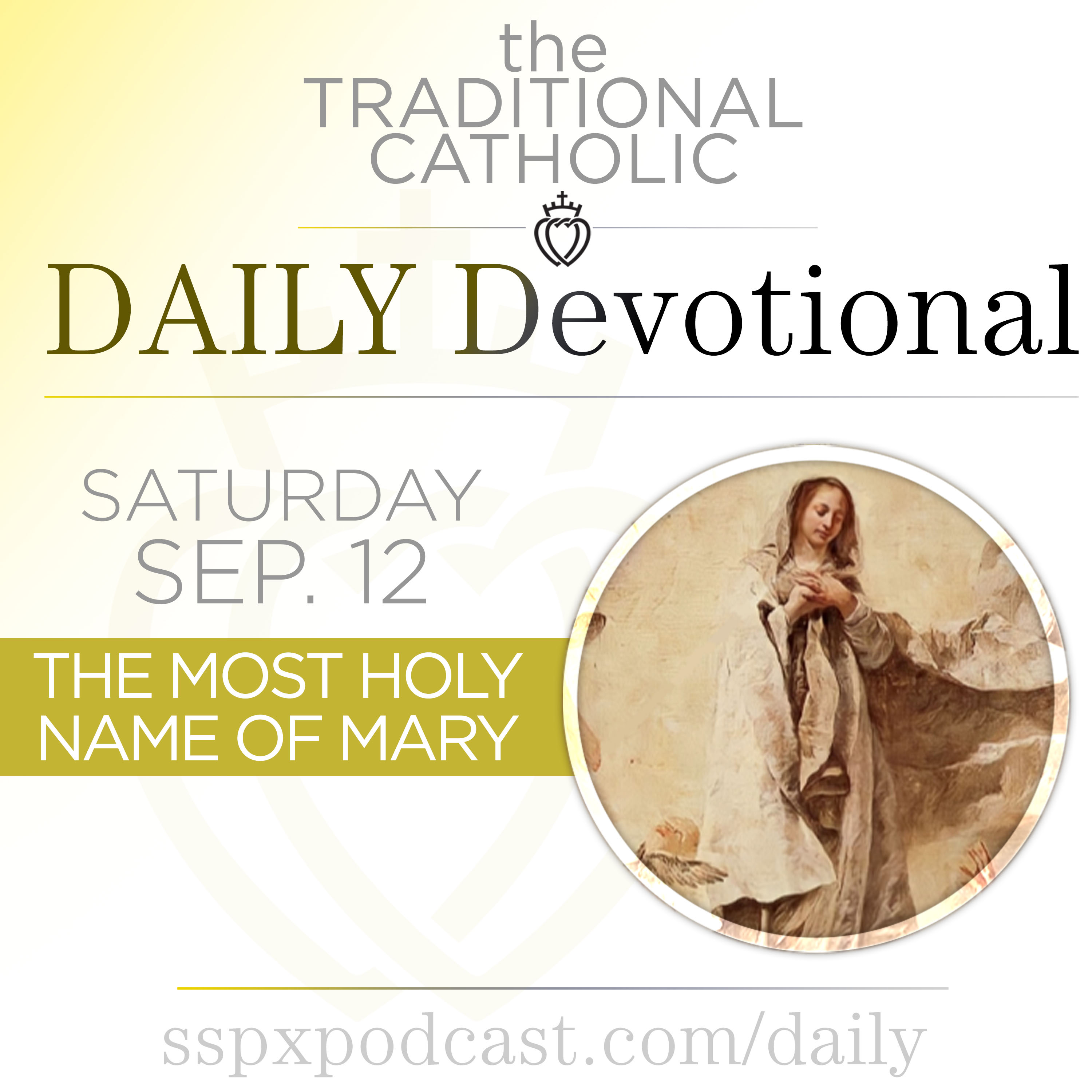 Sep 12 – Holy Name of Mary 12.09.2026 9นาทีIt's the Feast of The Most Holy Name of Mary, 3rd Class, with the color of White. In this episode: the meditation: "The Resurrection of the Body", today's news from the Church: "Freemasonry in France: Thirty days of influence in the open", and today's thought from the Archbishop Marcel Lefebvre. Have feedback or questions about the DD or our other shows? [email protected] Sources Used Today: "The Resurrection of the Body" — From the Assumption to Adventhttps://angeluspress.org/products/from-trinity-sunday-to-the-assumption "Freemasonry in France: Thirty days of influence in the open" (FSSPX.news) https://fsspx.news/en/news/freemasonry-france-thirty-days-influence-open-61041 The Spiritual Life — Archbishop Marcel Lefebvre (Angelus Press) https://angeluspress.org/products/spiritual-life-archbishop Please support our new project, the Archbishop Lefebvre Biography Audiobook: Learn more:https://www.youtube.com/watch?v=Y-Wp4MQdK2oDonate:https://sspx.gifts/audiobook The Feast of the Most Holy Name of Mary celebrates something wonderfully simple: the name by which Christians have called upon the Mother of God for nearly two thousand years. The name Mary comes to us through the Hebrew Miriam, and scholars have proposed several meanings over the centuries. Christian writers have especially loved titles such as "Star of the Sea." Saint Bernard famously developed that image, telling Christians caught in the storms of temptation and suffering to look toward the star and call upon Mary. But the feast itself has a surprisingly dramatic history. Devotion to Mary's name existed long before there was a universal feast. By the Middle Ages, Catholics regularly invoked her name in hymns, prayers, and preaching. A formal feast developed in Spain during the sixteenth century and gradually spread elsewhere. Then came Vienna in 1683. The Ottoman Empire had advanced deep into Europe, and a massive army surrounded Vienna. If the city fell, the road into central Europe would be dangerously exposed. For weeks the defenders held out while relief forces gathered under the Polish king John III Sobieski. Before the battle, Sobieski and his soldiers attended Mass and entrusted themselves to the Blessed Virgin. On September 12, the Christian relief army attacked. Sobieski's famous Polish Winged Hussars joined what is often described as one of the largest cavalry charges in history, sweeping down upon the Ottoman positions. By evening, the siege had been broken. Sobieski reportedly adapted Julius Caesar's famous words afterward: "We came, we saw, God conquered." Pope Innocent XI attributed the deliverance of Vienna to divine assistance obtained through Our Lady's intercession. In thanksgiving, he extended the Feast of the Most Holy Name of Mary to the universal Church, connecting it permanently with September 12. So behind this gentle-sounding feast stands one of the most dramatic moments in European history. The devotion itself, however, is much quieter. Catholics have traditionally been encouraged simply to develop the habit of saying Mary's name with love and confidence, especially during temptation, fear, or suffering. Saints repeatedly recommended it as one of the simplest prayers a person can make. You don't always need many words. Sometimes "Mary, help me" is enough. And perhaps that's why this feast has endured. It celebrates no complicated theological idea and requires no elaborate devotion. It simply reminds us that God has given Christians a Mother, and children naturally call for their mother by name. Most Holy Name of Mary, consolation of Christians and terror of demons, be always on our lips and in our hearts. Please Support this Apostolate with 1-time or Monthly Donation >> - - - - - - Explore more: Subscribe to the email version of this Devotional- it's a perfect companion!Subscribe to this Podcastto receive this and all our audio episodesSubscribe to the SSPX YouTube channelfor video versions of our podcast series and SermonsFSSPX News Website:https://fsspx.newsVisit the US District website:https://sspx.org/ What is the SSPX Podcast? The SSPX Podcast is produced by Angelus Press, which has as its mission the fortification of traditional Catholics so that they can defend the Faith, and reaching out to those who have not yet found Tradition. What is the SSPX? The main goal of the Society of Saint Pius X is to preserve the Catholic Faith in its fullness and purity, to teach its truths, and to diffuse its virtues, especially through the Roman Catholic priesthood. Authentic spiritual life, the sacraments, and the traditional liturgy are its primary means of bringing this life of grace to souls. Although the traditional Latin Mass is the most visible and public expression of the work of the Society, we are committed to defending Catholic Tradition in its entirety: all of Catholic doctrine and morals as the Church has always defended them. What people need is the Catholic Faith, without compromise, with all the truth and beauty which accompanies it. https://sspx.org
 -
 Sep 11 – Feria / S John Gabriel Perboyre 11.09.2026 9นาทีIt's a Feria, 4th Class, with the color of Green. In this episode: the meditation: "Christian Hope", today's news from the Church: "700 Traditional Pilgrims at the Feet of Our Lady of Częstochowa", a preview of this week's episode of The SSPX Podcast: "What Is the Difference Between a Priest and a Bishop?", and today's thought from the Archbishop Marcel Lefebvre. Have feedback or questions about the DD or our other shows? [email protected] Sources Used Today: "Christian Hope" — From the Assumption to Adventhttps://angeluspress.org/products/from-trinity-sunday-to-the-assumption "700 Traditional Pilgrims at the Feet of Our Lady of Częstochowa" (FSSPX.news) https://fsspx.news/en/news/poland-700-traditional-pilgrims-feet-our-lady-czestochowa-60973 The SSPX Podcast: "What Is the Difference Between a Priest and a Bishop?" (SSPX Podcast) View on YouTubeListen & Subscribe on SSPXpodcast.com The Spiritual Life — Archbishop Marcel Lefebvre (Angelus Press) https://angeluspress.org/products/spiritual-life-archbishop Please support our new project, the Archbishop Lefebvre Biography Audiobook: Learn more:https://www.youtube.com/watch?v=Y-Wp4MQdK2oDonate:https://sspx.gifts/audiobook Saint John Gabriel Perboyre spent years dreaming about the missions in China before he ever imagined he would actually go there. He was born in 1802 in a small farming village in southern France, one of eight children. As a boy, John Gabriel wasn't originally planning to become a priest. He accompanied his younger brother to a school run by the Vincentians and intended to stay only long enough to help him settle in. Instead, John Gabriel discovered his own vocation. He entered the Congregation of the Mission, founded by Vincent de Paul, and was ordained in 1826. His great desire was to become a missionary in China, partly inspired by his younger brother Louis, who had volunteered for the Chinese missions but died during the voyage. John Gabriel asked to take his place. His superiors initially refused because his health seemed too fragile. Eventually, they changed their minds. In 1835, he sailed for China. After months at sea, John Gabriel entered the country disguised in Chinese clothing, learned the language, and began traveling between scattered Catholic communities. Missionary life meant long journeys, unfamiliar food, hiding from authorities, hearing confessions, celebrating Mass secretly, and teaching Catholics who might see a priest only occasionally. Then, in 1839, persecution intensified. John Gabriel was betrayed for money, arrested, and dragged from prison to prison. Authorities repeatedly demanded that he renounce Christianity. When he refused, he was beaten and tortured. One detail of his imprisonment is particularly striking. His captors tried to force him to trample on a crucifix. He wouldn't do it. Eventually John Gabriel was condemned to death. On September 11, 1840, he was taken to an execution ground near Wuchang and strangled on a wooden cross-like structure. The resemblance to the Passion of Christ was not lost on later Catholics. His body was eventually recovered by Christians and buried in China. Years later, his remains were returned to France and placed in the Vincentian motherhouse in Paris, where they can still be venerated today. There's also a fascinating family detail. John Gabriel wasn't the only Perboyre drawn toward religious life. Several of his siblings entered religious communities, and the brother whose death opened the way for John's mission to China had wanted exactly the same vocation. John Gabriel finally reached the country he had prayed to serve, but he spent only a few years there. It was enough. In 1996, he became the first canonized saint among the missionaries martyred in China. Saint John Gabriel Perboyre, missionary of China and courageous imitator of the Crucified Christ, pray for us. Please Support this Apostolate with 1-time or Monthly Donation >> - - - - - - Explore more: Subscribe to the email version of this Devotional- it's a perfect companion!Subscribe to this Podcastto receive this and all our audio episodesSubscribe to the SSPX YouTube channelfor video versions of our podcast series and SermonsFSSPX News Website:https://fsspx.newsVisit the US District website:https://sspx.org/ What is the SSPX Podcast? The SSPX Podcast is produced by Angelus Press, which has as its mission the fortification of traditional Catholics so that they can defend the Faith, and reaching out to those who have not yet found Tradition. What is the SSPX? The main goal of the Society of Saint Pius X is to preserve the Catholic Faith in its fullness and purity, to teach its truths, and to diffuse its virtues, especially through the Roman Catholic priesthood. Authentic spiritual life, the sacraments, and the traditional liturgy are its primary means of bringing this life of grace to souls. Although the traditional Latin Mass is the most visible and public expression of the work of the Society, we are committed to defending Catholic Tradition in its entirety: all of Catholic doctrine and morals as the Church has always defended them. What people need is the Catholic Faith, without compromise, with all the truth and beauty which accompanies it. https://sspx.org
 -
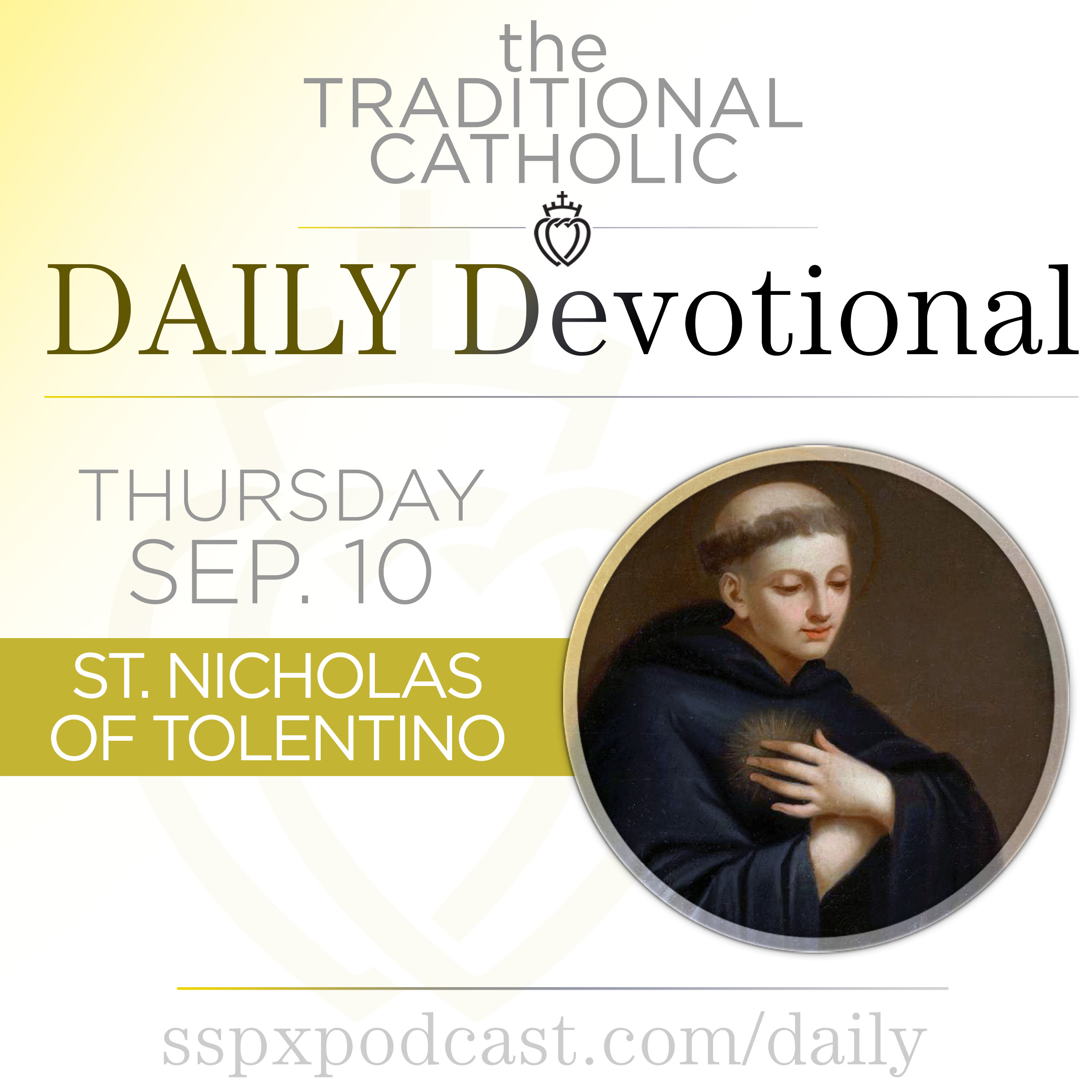 Sep 10 – S Nicholas Tolentino 10.09.2026 9นาทีIt's the Feast of St. Nicholas Tolentino, 3rd Class, with the color of White. In this episode: the meditation: "The Particular Judgement", today's news from the Church: "Pilgrimage to Bourguillon Under the Theme "Francis, Repair My Church"", a preview of the Sermon: "Without Me You Can Do Nothing", and today's thought from the Archbishop Marcel Lefebvre. Have feedback or questions about the DD or our other shows? [email protected] Sources Used Today: "The Particular Judgement" — From the Assumption to Adventhttps://angeluspress.org/products/from-trinity-sunday-to-the-assumption "Pilgrimage to Bourguillon Under the Theme "Francis, Repair My Church"" (FSSPX.news) https://fsspx.news/en/news/switzerland-pilgrimage-bourguillon-under-theme-francis-repair-my-church-60927 "Without Me You Can Do Nothing" (SSPX Sermons) SSPX YouTube: Sermons PlaylistListen & Subscribe: SSPX Sermons Podcast The Spiritual Life — Archbishop Marcel Lefebvre (Angelus Press) https://angeluspress.org/products/spiritual-life-archbishop Please support our new project, the Archbishop Lefebvre Biography Audiobook: Learn more:https://www.youtube.com/watch?v=Y-Wp4MQdK2oDonate:https://sspx.gifts/audiobook Saint Nicholas of Tolentino became one of the most beloved Augustinian saints of the Middle Ages, and his story has a little bit of everything: miraculous bread, visions, souls in Purgatory, and a lifetime spent quietly helping ordinary people. He was born around 1245 in central Italy. His parents had struggled for years to have a child, so they made a pilgrimage to the shrine of Saint Nicholas of Myra in Bari and prayed for a son. When that son finally arrived, there wasn't much debate about the name. Nicholas eventually joined the Augustinians and was ordained a priest. After several assignments, he was sent to the town of Tolentino, where he would spend roughly thirty years. And apparently, he became the priest everybody came looking for. Nicholas preached, heard confessions, visited prisoners, settled arguments, cared for the poor, and spent long hours in prayer. He was especially known for seeking out people who had drifted away from the Church rather than simply waiting for them to return. One of the most unusual traditions about Nicholas concerns blessed bread. During a serious illness, Nicholas was reportedly told in a vision of the Blessed Virgin Mary to eat a small piece of bread dipped in water. He recovered, and afterward he began blessing pieces of bread and giving them to the sick. The custom never really went away. Even today, Augustinians bless what are called the Breads of Saint Nicholas, which are distributed to the faithful and used as a sacramental, especially in prayers for healing and protection. But Nicholas is probably best known for his connection with Purgatory. According to tradition, a deceased friar appeared to him and begged for Masses because he and many other souls were suffering in Purgatory. Nicholas spent the following days offering Mass and prayers for them. The friar later appeared again, this time surrounded by souls who had been released through those prayers. That story spread everywhere. Nicholas became one of the great patrons of the souls in Purgatory, and medieval paintings frequently show him celebrating Mass while souls rise from the flames toward heaven. His relics are still venerated at the Basilica of Saint Nicholas of Tolentino. The basilica's extraordinary medieval frescoes make it one of the most interesting Augustinian shrines in Italy. Nicholas never founded an order or became a bishop. He simply stayed in one town for thirty years, said Mass, heard confessions, fed people, prayed for the dead, and helped whoever showed up. Sometimes that's more than enough for a lifetime. Saint Nicholas of Tolentino, friend of the poor and tireless intercessor for the souls in Purgatory, pray for us. Please Support this Apostolate with 1-time or Monthly Donation >> - - - - - - Explore more: Subscribe to the email version of this Devotional- it's a perfect companion!Subscribe to this Podcastto receive this and all our audio episodesSubscribe to the SSPX YouTube channelfor video versions of our podcast series and SermonsFSSPX News Website:https://fsspx.newsVisit the US District website:https://sspx.org/ What is the SSPX Podcast? The SSPX Podcast is produced by Angelus Press, which has as its mission the fortification of traditional Catholics so that they can defend the Faith, and reaching out to those who have not yet found Tradition. What is the SSPX? The main goal of the Society of Saint Pius X is to preserve the Catholic Faith in its fullness and purity, to teach its truths, and to diffuse its virtues, especially through the Roman Catholic priesthood. Authentic spiritual life, the sacraments, and the traditional liturgy are its primary means of bringing this life of grace to souls. Although the traditional Latin Mass is the most visible and public expression of the work of the Society, we are committed to defending Catholic Tradition in its entirety: all of Catholic doctrine and morals as the Church has always defended them. What people need is the Catholic Faith, without compromise, with all the truth and beauty which accompanies it. https://sspx.org
 -
 Sep 9 – S Peter Claver 09.09.2026 8นาทีIt's the Feast of St Peter Claver, 3rd Class, with the color of White. In this episode: the meditation: "A Salutary Meditation", today's news from the Church: "The Hymn of the Society of Saint Pius X", and today's thought from the Archbishop Marcel Lefebvre. Have feedback or questions about the DD or our other shows? [email protected] Sources Used Today: "A Salutary Meditation" — From the Assumption to Adventhttps://angeluspress.org/products/from-trinity-sunday-to-the-assumption "The Hymn of the Society of Saint Pius X" (FSSPX.news) https://fsspx.news/en/news/hymn-society-saint-pius-x-60879 The Spiritual Life — Archbishop Marcel Lefebvre (Angelus Press) https://angeluspress.org/products/spiritual-life-archbishop Please support our new project, the Archbishop Lefebvre Biography Audiobook: Learn more:https://www.youtube.com/watch?v=Y-Wp4MQdK2oDonate:https://sspx.gifts/audiobook Saint Peter Claver spent nearly forty years meeting ships that most people in seventeenth-century Cartagena wanted nothing to do with. He was born in Spain in 1580 and entered the Jesuits as a young man. While studying on the island of Majorca, he met an elderly Jesuit brother, Saint Alphonsus Rodríguez, who became convinced that Peter's vocation was waiting for him across the Atlantic. So Peter went to Colombia. Cartagena was one of the great ports of the Spanish Empire, and tragically, one of the principal entry points for enslaved Africans brought to South America. Ships arrived carrying hundreds of people who had endured weeks below deck in horrific conditions. Many were sick. Some were dying. Few spoke Spanish. Peter decided this would be his parish. Whenever word came that a slave ship was approaching, he headed for the docks carrying whatever he could gather: water, fruit, bread, medicine, clothing, tobacco, and interpreters who spoke African languages. Then he went below deck. The conditions were awful. Heat, disease, filth, and fear filled the holds. Peter crawled into those spaces anyway, tending wounds and reassuring people who had no idea where they were or what was going to happen next. He called himself "Petrus Claver, Aethiopum servus," Peter Claver, slave of the Africans. And he meant it. Peter understood that preaching Christianity to people while ignoring their suffering would ring hollow. So he cared for bodies first. He washed wounds, fed the starving, embraced people others refused to touch, and then, with interpreters and religious pictures, taught them about Christ and prepared many for baptism. Tradition credits him with baptizing roughly 300,000 people during his ministry. But his work didn't stop at the docks. Peter visited plantations and prisons, confronted slave owners about mistreatment, and insisted that the Africans he baptized be treated as Christians with human dignity. He could not dismantle the enormous slave system surrounding him, but he refused to let that system convince him that the people trapped inside it were anything less than children of God. Near the end of his life, Peter became seriously ill and spent several years largely confined to his room. The man who had cared for thousands was himself often neglected. He died in 1654. Today his remains are venerated in the San Pedro Claver Church and Convent, only a short distance from the harbor where he spent his life meeting those terrible ships. There's something powerful about that location. Cartagena remembers the wealth of an empire. Peter Claver reminds us who paid for it. Saint Peter Claver, servant of the enslaved and defender of forgotten souls, pray for us. Please Support this Apostolate with 1-time or Monthly Donation >> - - - - - - Explore more: Subscribe to the email version of this Devotional- it's a perfect companion!Subscribe to this Podcastto receive this and all our audio episodesSubscribe to the SSPX YouTube channelfor video versions of our podcast series and SermonsFSSPX News Website:https://fsspx.newsVisit the US District website:https://sspx.org/ What is the SSPX Podcast? The SSPX Podcast is produced by Angelus Press, which has as its mission the fortification of traditional Catholics so that they can defend the Faith, and reaching out to those who have not yet found Tradition. What is the SSPX? The main goal of the Society of Saint Pius X is to preserve the Catholic Faith in its fullness and purity, to teach its truths, and to diffuse its virtues, especially through the Roman Catholic priesthood. Authentic spiritual life, the sacraments, and the traditional liturgy are its primary means of bringing this life of grace to souls. Although the traditional Latin Mass is the most visible and public expression of the work of the Society, we are committed to defending Catholic Tradition in its entirety: all of Catholic doctrine and morals as the Church has always defended them. What people need is the Catholic Faith, without compromise, with all the truth and beauty which accompanies it. https://sspx.org
 -
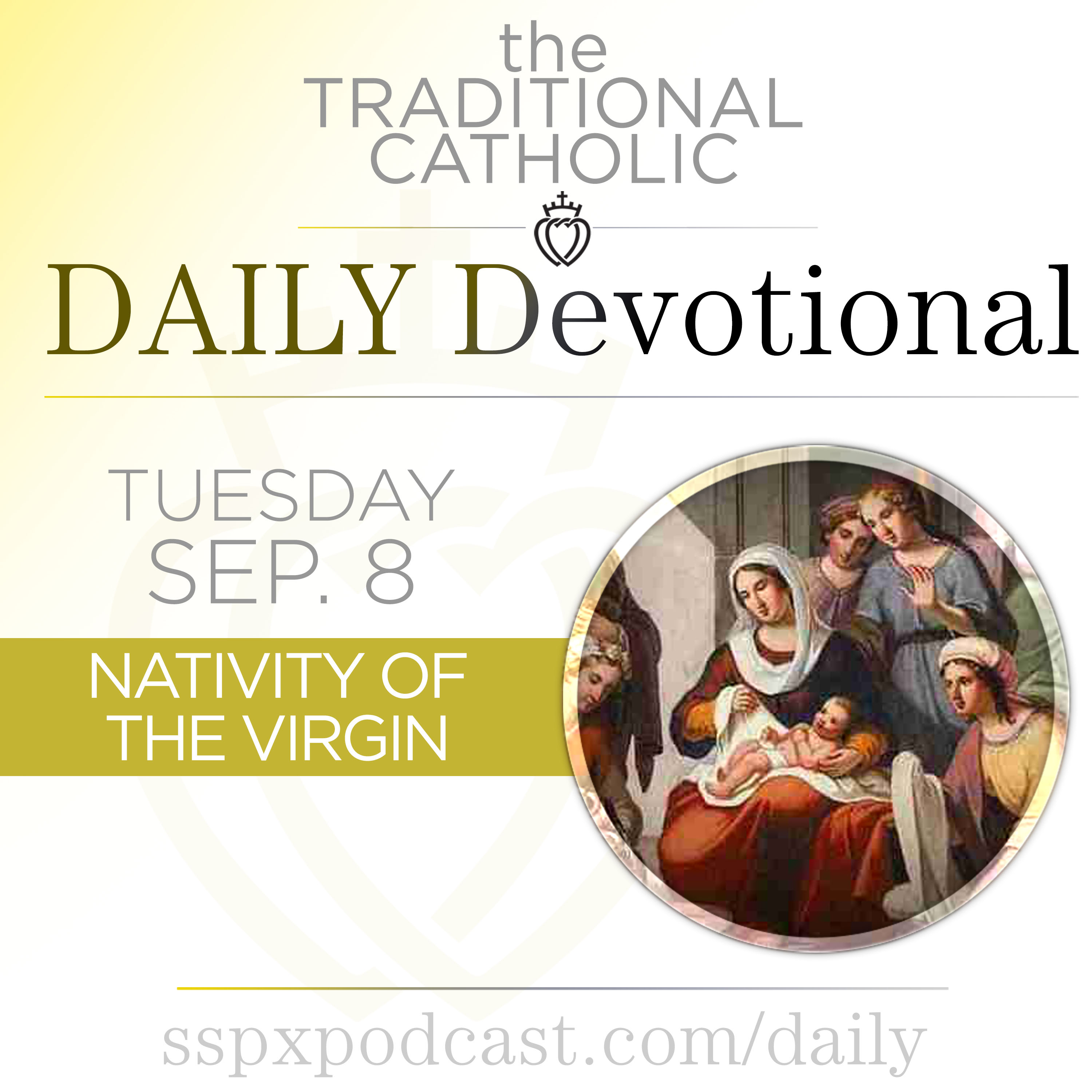 Sep 8 – Nativity of the Blessed Virgin 08.09.2026 8นาทีIt's the Feast of Nativity of the Blessed Virgin, 2nd Class, with the color of White. In this episode: the meditation: "The Thought of Death", today's news from the Church: "Sisters of the Society of Saint Pius X: Their Life in 100 Images", a preview of this week's episode of The SSPX Podcast: "Audiobook Chapter 16", and today's thought from the Archbishop Marcel Lefebvre. Have feedback or questions about the DD or our other shows? [email protected] Sources Used Today: "The Thought of Death" — From the Assumption to Adventhttps://angeluspress.org/products/from-trinity-sunday-to-the-assumption "Sisters of the Society of Saint Pius X: Their Life in 100 Images" (FSSPX.news) https://fsspx.news/en/news/sisters-society-saint-pius-x-their-life-100-images-60865 The SSPX Podcast: "Audiobook Chapter 16" (SSPX Podcast) View on YouTubeListen & Subscribe on SSPXpodcast.com The Spiritual Life — Archbishop Marcel Lefebvre (Angelus Press) https://angeluspress.org/products/spiritual-life-archbishop Please support our new project, the Archbishop Lefebvre Biography Audiobook: Learn more:https://www.youtube.com/watch?v=Y-Wp4MQdK2oDonate:https://sspx.gifts/audiobook The Nativity of the Blessed Virgin Mary is one of only three birthdays celebrated in the Church's liturgical year: the birth of Christ, the birth of Saint John the Baptist, and the birth of Our Lady. Interestingly, the Bible never tells us when Mary was born. Even the names of her parents, Saints Joachim and Anne, come from ancient Christian tradition rather than Scripture. One of the earliest sources is the second-century Protoevangelium of James, which tells the beautiful story of Joachim and Anne as an elderly, childless couple whose long prayers were finally answered with the birth of Mary. The feast itself seems to have developed first in Jerusalem, where Christians honored a church dedicated to Saint Anne near the traditional site of Mary's childhood home. By the sixth century, Mary's birth was being celebrated in the Christian East, and over the following centuries the feast spread westward to Rome. But why September 8? There's actually a wonderfully simple explanation. The Church celebrates Mary's Immaculate Conception on December 8. Count forward nine months. September 8. In fact, historically the Nativity came first. The date of the Immaculate Conception was later calculated backward nine months from Mary's traditional birthday. The feast developed some wonderfully local customs across Catholic Europe. In parts of France, it became associated with the grape harvest, and farmers brought their finest grapes to church to be blessed. In Austria and other Alpine regions, Mary's birthday became connected with thanksgiving for the summer harvest. One of the most colorful celebrations developed in Malta, where September 8 became known as the Bambina, or "Little Mary." Statues of the infant Virgin are carried through decorated streets amid processions, music, fireworks, and enormous crowds. The date gained even greater significance because several major military victories in Maltese history occurred around September 8, including the end of the Great Siege of Malta in 1565. In parts of Italy, devotion focuses on Maria Bambina, Mary as a little child. Small statues show the infant Mary wrapped in swaddling clothes, sometimes resting in an ornate cradle. One of the best-known shrines to Maria Bambina is in Milan, where devotion to the image became especially popular in the nineteenth century. There's something charming about this feast because it celebrates no miracle Mary performed and no words she spoke. She's a baby. That's the whole point. The world didn't know it yet, but the little girl born to Joachim and Anne would become the Mother of God. Salvation history was quietly moving forward in a home where, as far as the neighbors could tell, a perfectly ordinary child had just been born. Holy Mary, whose birth announced the approaching dawn of our salvation, pray for us. Please Support this Apostolate with 1-time or Monthly Donation >> - - - - - - Explore more: Subscribe to the email version of this Devotional- it's a perfect companion!Subscribe to this Podcastto receive this and all our audio episodesSubscribe to the SSPX YouTube channelfor video versions of our podcast series and SermonsFSSPX News Website:https://fsspx.newsVisit the US District website:https://sspx.org/ What is the SSPX Podcast? The SSPX Podcast is produced by Angelus Press, which has as its mission the fortification of traditional Catholics so that they can defend the Faith, and reaching out to those who have not yet found Tradition. What is the SSPX? The main goal of the Society of Saint Pius X is to preserve the Catholic Faith in its fullness and purity, to teach its truths, and to diffuse its virtues, especially through the Roman Catholic priesthood. Authentic spiritual life, the sacraments, and the traditional liturgy are its primary means of bringing this life of grace to souls. Although the traditional Latin Mass is the most visible and public expression of the work of the Society, we are committed to defending Catholic Tradition in its entirety: all of Catholic doctrine and morals as the Church has always defended them. What people need is the Catholic Faith, without compromise, with all the truth and beauty which accompanies it. https://sspx.org
 -
 Sep 7 – Feria / S Magdalene of Nagasaki 07.09.2026 11นาทีIt's a Feria, 4th Class, with the color of Green. In this episode: the meditation: "The Sorrowing Mother", today's news from the Church: "St. Pius X Against Half-Hearted Journalism", a preview of the Sermon: "Total Confidence in God", and today's thought from the Archbishop Marcel Lefebvre. Have feedback or questions about the DD or our other shows? [email protected] Sources Used Today: "The Sorrowing Mother" — From the Assumption to Adventhttps://angeluspress.org/products/from-trinity-sunday-to-the-assumption "St. Pius X Against Half-Hearted Journalism" (FSSPX.news) https://fsspx.news/en/news/st-pius-x-against-half-hearted-journalism-60892 "Total Confidence in God" (SSPX Sermons) SSPX YouTube: Sermons PlaylistListen & Subscribe: SSPX Sermons Podcast The Spiritual Life — Archbishop Marcel Lefebvre (Angelus Press) https://angeluspress.org/products/spiritual-life-archbishop Please support our new project, the Archbishop Lefebvre Biography Audiobook: Learn more:https://www.youtube.com/watch?v=Y-Wp4MQdK2oDonate:https://sspx.gifts/audiobook Saint Magdalene of Nagasaki was only twenty-two when she was killed, but by then she had already watched nearly every spiritual guide in her life suffer for the Catholic faith. She was born around 1611 near Nagasaki, Japan, into a Christian family. This was no longer the hopeful age when Saint Francis Xavier had first brought the Gospel to Japan. Christianity was now outlawed, missionaries were hunted, and Catholic families faced imprisonment, torture, or death. Magdalene's own parents were reportedly martyred while she was still young. She remained Catholic. Later, she came under the spiritual direction of Augustinian missionaries, including Saints Francis of Jesus and Vincent of Saint Anthony. She wanted to belong more completely to God, so she became an Augustinian tertiary, living a consecrated life while helping the underground Church. Then her priests were arrested and killed. Magdalene remained Catholic. She worked with two more missionaries, Saints Martin of Saint Nicholas and Melchior of Saint Augustine. They were killed too. At some point, hiding probably began to feel like simply waiting for the authorities to find her. So Magdalene did something extraordinary. She turned herself in. According to the traditional accounts, she appeared before the authorities wearing her Augustinian habit and openly declared that she was a Christian. She hoped that by publicly defending the faith, she might strengthen Catholics who were frightened into silence. The authorities subjected her to one of the most horrifying punishments used during the Japanese persecution, the ana-tsurushi, or "pit torture." The prisoner was suspended upside down over a pit, often with the body tightly bound and the head lowered into the opening. The torture could continue for days because the authorities wanted apostasy, not simply death. Magdalene endured it for nearly two weeks. Witnesses later remembered her remarkable composure. Even during the torture, she reportedly continued praying and singing hymns. Eventually she died in 1634, probably from suffocation after heavy rain flooded the pit. The authorities burned her body and scattered the ashes into Nagasaki Bay so Christians would have no relics to venerate. That didn't erase her memory. In fact, Nagasaki became home to one of the most astonishing stories in Catholic history. For more than two centuries after the missionaries were expelled, communities of hidden Christians, the Kakure Kirishitan, secretly preserved baptism, prayers, and fragments of Catholic tradition without priests. Magdalene never lived to see that. But she belonged to the generation whose courage made that survival possible. Saint Magdalene of Nagasaki, fearless daughter of Japan's hidden Church, pray for us. Please Support this Apostolate with 1-time or Monthly Donation >> - - - - - - Explore more: Subscribe to the email version of this Devotional- it's a perfect companion!Subscribe to this Podcastto receive this and all our audio episodesSubscribe to the SSPX YouTube channelfor video versions of our podcast series and SermonsFSSPX News Website:https://fsspx.newsVisit the US District website:https://sspx.org/ What is the SSPX Podcast? The SSPX Podcast is produced by Angelus Press, which has as its mission the fortification of traditional Catholics so that they can defend the Faith, and reaching out to those who have not yet found Tradition. What is the SSPX? The main goal of the Society of Saint Pius X is to preserve the Catholic Faith in its fullness and purity, to teach its truths, and to diffuse its virtues, especially through the Roman Catholic priesthood. Authentic spiritual life, the sacraments, and the traditional liturgy are its primary means of bringing this life of grace to souls. Although the traditional Latin Mass is the most visible and public expression of the work of the Society, we are committed to defending Catholic Tradition in its entirety: all of Catholic doctrine and morals as the Church has always defended them. What people need is the Catholic Faith, without compromise, with all the truth and beauty which accompanies it. https://sspx.org
พอดแคสต์ที่คล้ายกัน


ยอดนิยมใน
พอดแคสต์นี้ปรากฏในชาร์ตพอดแคสต์ของประเทศเหล่านี้ด้วย


