
The Discover India Podcast by Professor Pankaj Jain: Bhārat Darśan
Prof Pankaj Jain
0
Bhārat Darśan: The Discover India Podcast explores Indian culture, classical music, sustainability, and Hindu, Buddhist, and Jain studies. Hosted by Dr. Pankaj Jain, director of The India Centre at FLAME University, the show also covers film and diaspora studies. Episodes feature conference presentations and webinars on topics like religion, ecology, and Bollywood.
ตอน
-
 Volkswagen Is Half a Sanskrit Word — But Not the Half You Think 19.09.2026 1นาทีVolkswagen means "the people's car," and one half of that name is cousin to a Sanskrit word — just not the half most people guess. Wagen and वाहन (vāhana) descend from the same ancestral root meaning "to carry," which also gave Latin vehere and English vehicle. Volks and Sanskrit लोक (loka), on the other hand, mean nearly the same thing and sound nearly the same, and are completely unrelated. A sound law worked out by Jacob Grimm — yes, that Grimm — is what decides it. Cousins from a shared ancestor, never borrowings.From Discover India: Decoded with Prof. Pankaj Jain.
 -
Gaṇeśa and ‘Republic’ Share the Same Sanskrit Word 14.09.2026 1นาทีGaṇeśa’s name doesn’t mean “remover of obstacles” — that title came later. Gaṇa + īśa: lord of the many. The samelittle word gave India gaṇita (mathematics), the ancient gaṇa-saṅgha assemblies, and gaṇatantra — the modern word for republic, honored every Gaṇatantra Divas. On the one day that is both Ganesh Chaturthi and Hindi Diwas, a scholar’s quick decode of the word that runs from the Veda to the Constitution.#GaneshChaturthi #GaneshChaturthi2026#GanpatiBappaMorya #Ganesha #HindiDiwas #Sanskrit #Ganeshotsav #Ganpati#IndianKnowledgeSystems #Etymology #Rigveda #DiscoverIndiaDecoded
-
The Highest-Grossing Film in History Has a Sanskrit Title 13.09.2026 1นาทีThe biggest film franchise on earth carries a Sanskrit name, and its director himself said so back in 2007, calling it an incarnation of one of the Hindu gods taking flesh. Notice the vocabulary: incarnation, flesh. That is Christian language, borrowed because English had nothing closer. But avatāra never meant a picture, or a face, or a blue alien. It breaks into ava, "down," and the root tṝ, "to cross over" — a crossing down, a descent. The same root gives tīrtha, a ford in a river and so a place of pilgrimage, and Tīrthaṅkara, the Jain title for one who makes the crossing possible. Its cousins reach as far as Latin trans, hiding inside transit and translate. Three lives of one word: the divine crossing down, a man crossing into a body built for another world, and you, every day, crossing into a screen. A scholar's quick decode. (Box-office rankings here are the standard unadjusted count.)#Avatar #Tirthankar #Tirtha
-
The Complete Life of Mahavira: Prince to Tirthankara — Full Documentary 08.09.2026 53นาทีHe was born a prince — and walked away from everything. This is the complete life of Mahāvīra, the 24th Tīrthaṅkara of Jain dharma: his birth and renunciation, the twelve years of austerity that led to kevala jñāna, the philosophy of anekāntavāda and ahiṃsā, his nirvāṇa — and the 2,500-year story that followed, from the Jain councils and the Digambara–Śvetāmbara divide to temple art, the global diaspora, and Gandhi's nonviolence.A scholar's full documentary, assembled from the 12-part Bhārat Darśan biography series. Released for Paryushana 2026.Prof. Pankaj Jain — scholar of Indian religions, Jain studies, and Indology; Director, The India Centre, FLAME University. Watch the full film and browse sourcing notes on the Bhārat Darśan YouTube channel (@profpankajjain).
-
Krishna's Name Literally Means "The Dark One" — Here's Why That Matters 04.09.2026 1นาทีKṛṣṇa is not a title or a metaphor — in Sanskrit it is simply the word for dark. Born at midnight, in the dark fortnight, on its eighth night: the name is the birth chart. And instead of softening that name, the tradition multiplied it — Śyāma, Ghanaśyāma, dark as the monsoon that ends the heat. This Janmashtami, a scholar's quick decode of the god whose name made darkness beautiful.Which name for him did you grow up hearing at home — Krishna, Kanha, Śyāma, something else? Tell me below.
-
Arise, Walk, Arrive: Three Sanskrit Lines That Map a Whole Life 30.08.2026 8นาทีThree lines of Sanskrit, from three different texts written centuries apart: "Arise, awake" (Kaṭha Upaniṣad), "keep walking — caraiveti" (Aitareya Brāhmaṇa), and "you alone are my refuge — gatistvam" (Bhavānī Aṣṭakam). Read together, in order, they stop being scattered quotes and become a single map of a life: wake, walk, arrive.I trace all three back to their sources — including what Vivekananda's famous rendering leaves out — and follow the two Sanskrit threads that tie them together: uttiṣṭha, "stand up," and the root √gam, "to go," behind both caran and gati.SOURCES & NOTESKaṭha Upaniṣad 1.3.14 · Caraiveti Sūkta, Aitareya Brāhmaṇa (Rohita narrative; verse ordering and numbering vary across editions) · Bhavānī Aṣṭakam, traditionally attributed to Ādi Śaṅkarācārya.On the yuga sequence: the ladder in this verse runs Kali → Dvāpara → Tretā → Kṛta, the reverse of the familiar declining order. That is what the verse does. Here the yugas are postures of a person — lying down, stirring, standing, walking — not ages of the world. Read figuratively.Vivekananda's "Arise, awake, and stop not till the goal is reached" is his rendering of the Kaṭha verse, not a literal translation.WATCHVideo version on YouTube ▸ [LINK]MORECourses, writing and scholar-led journeys ▸ https://linktr.ee/ProfPankajJainABOUTProf. Pankaj Jain — scholar of Indian religions, Hindu ecology and Indology. Director, The India Centre, and Head of Humanities & Languages, FLAME University.
-
Raksha Bandhan and Sanskrit Day Are the SAME Day — That’s Not a Coincidence 28.08.2026 1นาทีRaksha Bandhan and World Sanskrit Day fall on the same day this year — and it's not a coincidence. Rakṣā-bandhana literally means "the bond of protection" (rakṣ, to guard + bandhana, to bind) — and the same full moon, Śrāvaṇa Pūrṇimā, is the day the old Sanskrit schools began their study year, which is why it's now World Sanskrit Day.The thread that protects a person and the day that protects a language — a quick scholar's decode.🔗 Watch/listen: https://youtube.com/shorts/ki1wwoeAWnQ?feature=shareBeyond your siblings — who (or what) deserves a rakṣā thread from you this year?#DiscoverIndia #RakshaBandhan #WorldSanskritDay #Sanskrit
-
Onam: “Kerala’s Biggest Festival Celebrates a ‘Demon’ King — Here’s Why” 26.08.2026 1นาทีKerala’s biggest festival honors Mahābali — a king the texts call an asura, whom the people call their greatest ruler. Vāmana’s three steps, a kingdom surrendered, and one wish granted: to come home once a year. Onam — whose very name descends from the star Śrāvaṇa — is that homecoming. A scholar’s quick decode.#Onam2026 #Thiruvonam #Onam #Mahabali #Maveli #Kerala #Vamana #avatarthreesteps #Trivikrama #pookalam meaning #Shravana #Onamsadya #BaliChakravarthi #Sanskritetymology #BharatDarshan #profPankaj Jain #decodeIndia #disoverindia
-
Why India Has Two Official Names — in One Sentence of the Constitution 15.08.2026 1นาที“India, that is Bharat, shall be a Union of States.” The Constitution’s very first sentence carries two names — one born from a river seen from outside (Sindhu → Hindu → Indos → India), one from a lineage remembered from within (Bharata, from the root bhṛ: to bear, to carry). This Independence Day, a scholar’s quick decode of what each name actually says.#IndiathatisBharat#Bharatmeaning#Indianameorigin#Article1ConstitutionofIndia#Sindhu#Hindu #Indos #India,#Bharata #bharatavarsha #rigvedachanting #Bharatas #bhriSanskritroot#Independence Day2026#15August #ConstituentAssembly1949 #VishnuPuranaBharataverse #bharatDarshan
-
Homer and the Rigveda Use the Same Word for Fame — Kléos & Śravas 06.08.2026 1นาทีEnglish took one word from Homer's Odyssey — odyssey, "the long journey out." But the word that poem is really about has a Sanskrit twin.Greek kléos and Sanskrit श्रवस् (śravas) are the same inherited word, from a root meaning "to hear": fame was never what you achieved, it was what was said about you. Homer's kléos áphthiton and the Rigveda's श्रवः अक्षितम् (śrávaḥ ákṣitam) both reach for "imperishable fame" — a line scholars since 1853 have read as one both traditions inherited from a common ancestor. Then the root parts ways. Greek built it into names — Hēraklês, Periklês, Sophoklês. Sanskrit built it into श्रुति (śruti), "that which is heard" — the name for the Vedas themselves.This is heritage and language, not policy: shared inheritance, not borrowing in either direction. Full sources and the honest scholarly debate (Kuhn 1853; Watkins 1995; and the contested reconstruction of the phrase) are in the pinned notes on the YouTube version.Discover India: Decoded — Bhārat Darśan, with Prof. Pankaj Jain.
-
Friendship Day & the Gita: What Krishna Teaches Us About True Friends 02.08.2026 1นาทีOn Friendship Day, we turn to the oldest wisdom on what real friendship means — the Bhagavad Gita.Krishna didn't rescue Arjuna from the battlefield or hand him easy answers. He stayed beside him in the chaos and helped him find his own clarity. And Sudama, the poor Brahmin who arrived with nothing but a fistful of rice, left with everything — because true friendship keeps no ledger.In this episode, Prof Pankaj Jain unpacks what these timeless stories teach us about loyalty, presence, and the friends who see us clearly and stay anyway.Happy Friendship Day. 🧡🎧 Follow for more on the Gita, Sanatan wisdom, and Indian culture.#BhagavadGita #FriendshipDay #Krishna #Spirituality #IndianCulture
-
The Hymn That Takes Away Everything You Depend On | Gatistvam, Decoded 31.07.2026 1นาทีNot your father. Not your mother. Not your wealth. Not even your knowledge. The Bhavani Ashtakam — traditionally attributed to Adi Shankaracharya — opens by stripping away everything we lean on, and ends every single verse the same way: gatistvam gatistvam tvameka Bhavani. You alone are my refuge.The real surprise sits inside one word. "Gati" comes from the Sanskrit root for "to go" — and it holds three meanings in one breath: the way you travel, the goal you move toward, and the shelter you finally reach. So "You are my gati" says: my way, my destination, my refuge. Everything I lean on can be taken. The one thing that can't — that's my gati.This is Part 3 of 3 in the Arise · Walk · Arrive series — three Sanskrit calls from three layers of the tradition. You woke. You walked. This is where you arrive.▶ Part 1 — ARISE (Uttishthata Jagrata): https://youtube.com/shorts/TCa9ZzeO7Ew▶ Part 2 — WALK (Charaiveti): https://youtube.com/shorts/WxFhBPDDOX4?feature=share▶ Watch on YouTube: https://youtube.com/shorts/tjwQVGyPkag?feature=shareSources note: the Bhavani Ashtakam is traditionally attributed to Adi Shankaracharya; the stotra corpus under his name is vast, and individual authorship is debated by scholars. Bhavani is a form of the Divine Mother (Parvati/Durga).
-
"Guru" Doesn't Mean Teacher. It Means Heavy. | Guru Purnima, Decoded 28.07.2026 5นาทีYou say it constantly — tech guru, business guru — but the Sanskrit word guru doesn't mean teacher. It means HEAVY, and it shares an ancient root with the English word gravity. This Guru Purnima, a scholar's decode of the word, the day, and the guru–śiṣya paramparā: how India transmitted entire libraries mouth-to-ear for a thousand years before printing, why the archetypal guru is a compiler named Vyāsa, why Buddhists and yogis honor the same full moon, and what a civilization that put gratitude on the calendar understood about teachers that credentials can't capture.A note on sources: "guru = heavy" is the linguistic root (Sanskrit guru and Latin gravis share a Proto-Indo-European ancestor); the traditional "gu = darkness, ru = dispeller" explanation comes from later texts and is presented as tradition. This is heritage and language, not policy.Watch the video version and find all platforms: https://linktr.ee/ProfPankajJainDiscover India: Bhārat Darśan with Prof. Pankaj Jain — decoding Indian civilization, one word at a time.
-
Why a 500-Year-Old Hindu Sect Sent Salman Khan to Jail 25.07.2026 6นาที539 years ago, a guru in the Rajasthan desert gave his followers a code: never cut a living tree, never kill an animal. In 1730, 363 Bishnois were beheaded rather than let a king's men fell their sacred khejri trees. That same vow is why Bollywood's biggest star, Salman Khan, has spent 25 years fighting a case he can't defeat.This episode decodes the Bishnois — India's original environmentalists — from the Khejarli sacrifice to the blackbuck case, and how a 500-year-old nonviolent conservation faith ended up sharing a name with a figure in today's crime headlines.A note before you listen: the Bishnoi religious community and the Lawrence Bishnoi gang are not the same thing. This is the story of a nonviolent tradition rooted in dharma — it does not endorse vigilante violence.Chapters:0:00 – The Lawrence Bishnoi connection0:45 – Who founded the Bishnois?2:15 – Khejarli 1730: India's original tree-huggers3:45 – Salman Khan and the blackbuck case6:00 – From dharma to gang warfare6:40 – It's all dharma7:10 – What this teaches usAbout the host: I'm Dr. Pankaj Jain, Professor and Indologist at FLAME University, researching Hindu ecological traditions for over two decades. Follow Discover India: Bhārat Darśan for rigorous, accessible decodes of India's religions, philosophies, and cultural systems.#Bishnoi #SalmanKhan #LawrenceBishnoi #HinduEcology #IndianHistory #Chipko #BlackbuckCase #Indology
-
The Ride Home — Bahuḍā Yātrā & Suna Beṣa 24.07.2026 1นาทีEnglish kept one word from India's biggest chariot festival — "juggernaut," the unstoppable chariot rolling out. But it only kept half the story. Today is Bahuḍā Yātrā, the return journey: Jagannath rides home, pausing at his aunt's temple for a humble fire-scorched rice cake. And the next evening comes Suna Beṣa — from Sanskrit suvarṇa (gold) + veṣa (attire) — the golden attire that temple tradition traces to King Kapilendra Deva in 1460. Why does this tradition save its grandest spectacle for the homecoming, not the send-off? A scholar's quick decode.Heritage and language, not policy. A few precise notes: "Bahuda" is Odia for "return"; Suna Beṣa is the grandest of five annual golden-attire observances; reported figures about the temple's gold ornaments are traditional estimates, so they're kept out of the piece.Discover India: Decoded with Prof. Pankaj Jain — @ProfPankajJain.
-
Aagaman: Why India Named a Rocket Launch "The Arrival" 22.07.2026 1นาทีA rocket is built to leave the Earth — and Skyroot named its mission Aagaman: "the arrival."On July 18, 2026, Vikram-1 became the first privately developed Indian rocket to reach orbit, lifting off from the First Launch Pad at Sriharikota and reaching a 450 km orbit about 15 minutes later. India became the third country — after the US and China — where a private company has achieved orbital launch.The name is the decode. Āgamana comes from the Sanskrit root √gam — to go, to come. The same root gives Sanskrit its word for received scripture: āgama, "that which has come down to us." One root holds both the inheritance that arrives at you and the arrival you make yourself.And the rocket's own name completes the thought: Vikram honors Vikram Sarabhai, founder of India's space program — and vikrama itself means a stride, a step taken. A stride, and an arrival.A note on precision: Vikram-S (2022) reached space but was suborbital; Vikram-1 is the first orbital flight by a private Indian company. "Private" describes the company and vehicle — ISRO provided the launchpad, test facilities, and integration support, with IN-SPACe authorizing access.I'm Pankaj Jain — professor of philosophy and religion. Discover India: Decoded finds the civilizational root inside the news.
-
Why Chess Is Actually Indian | World Chess Day 20.07.2026 1นาทีChess was born in India, not as a metaphor, literally. The game began as chaturanga (चतुरङ्ग): chatur, “four,” anga, “limbs” — the four divisions of an ancient Indian army: elephants,chariots, cavalry, and infantry.The earliest secure reference is in Bāṇa’s Harṣacarita, around 625 CE. From Gupta-era India, the game traveledto Persia as shatranj, then to the Arab world and Europe. And the journey is still on the board: the rook is the ratha, the war chariot, and “checkmate” comes from the Persian shāh māt — “the king is helpless.”The deepest layer: the knight’s -shaped move appears as a Sanskrit verse pattern — the turaga-pada-bandha — described by Rudraṭa in the 9th century, long before Europe treated the knight’s tour as a puzzle.This World Chess Day (July 20), the board is a map of an ancient Indian army — and every move is a Sanskritword still in motion.
-
A billion people, zero FIFA World Cup? 18.07.2026 1นาทีA billion people. Zero World Cup appearances. And the reason we all repeat — that FIFA banned India for playing barefoot — isn't the one historians accept.In 1950, India qualified for the World Cup in Brazil, but withdrew due to the cost of the trip, insufficient preparation, and a federation that valued the Olympics more. And the myth gets one thing backward: India DID play barefoot, brilliantly, but at the 1948 Olympics. What followed was the golden era — four straight Olympics and, in 1956, the first Asian team to reach an Olympic football semi-final. (If you've seen Maidaan, that's the era.)The myth says the world wouldn't let us play our way. The truth is prouder: we chose a different stage, and conquered it. A nation shows itself not in the failures it suffers, but in the myths it builds around them.What myth did your family grow up believing about 1950? 👇A note on the history: the “barefoot ban” is widely repeated but rejected by historians as the primary reason for 1950. India withdrew after qualifying — due to travel costs, preparation, and federation priorities — rather than being barred by FIFA. India did play barefoot at its 1948 Olympic debut vs. France; the golden era peak was 1956 Melbourne — fourth place / first Asian side to reach an Olympic football semi-final (not a medal). Maidaan dramatizes coach Syed Abdul Rahim's era; treat it as a film, not a source.Full decode https://youtube.com/shorts/G2NQ5nMEgHcLonger read in The Times of India: https:// timesofindia.indiatimes.com/blogs/the-india-centre/a-billion-people-zero-world-cups-the-myth-india-chose-to-believe/
-
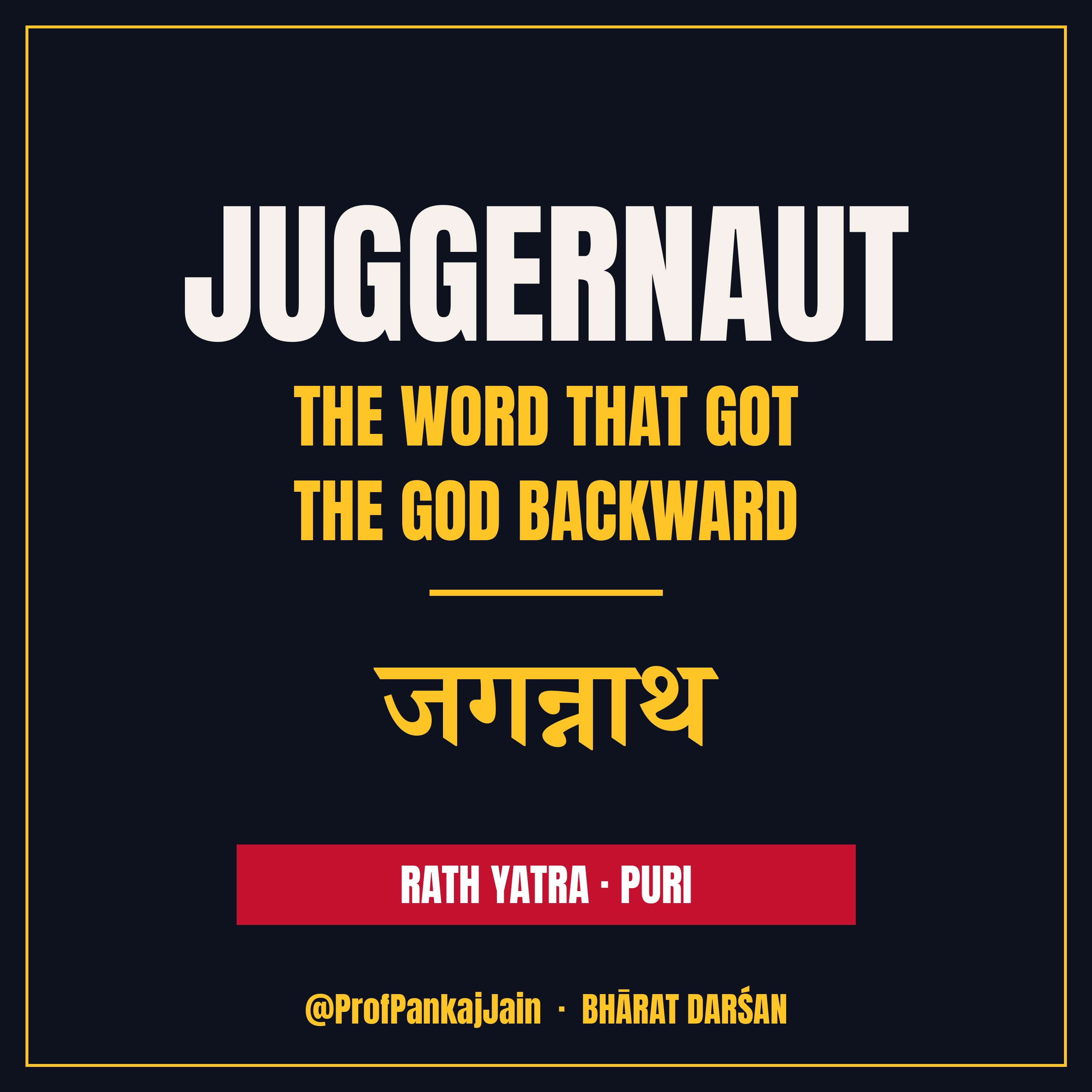 Juggernaut: The Word That Got the God Backward | Rath Yatra Decoded 16.07.2026 1นาทีYou use the word every week — juggernaut: an unstoppable, crushing force. It comes from Jagannātha, "Lord of the Universe," whose chariot festival rolls through Puri, Odisha, today.For centuries, traveler and missionary accounts — from the 1300s through the British era — claimed devotees threw themselves under the massive chariot wheels, and that image hardened into the English word. Historians read those deaths as accidents in immense crowds, not a rite. And the word erased the festival's real meaning: Rath Yatra is the one day of the year the deity leaves the sanctum to come out to everyone — the chariot rope is for any hand that reaches for it.A scholar's quick decode of how one festival became one of English's most misunderstood words.Chapters0:00 The word you already know0:12 Jagannātha and the chariot0:52 What the accounts got wrong1:17 The wheels and the welcomeSources: European traveler accounts (Odoric of Pordenone, 14th c.), British-era missionary writings, and modern scholarship on the Jagannātha tradition. Nuances and caveats in the pinned comment.#RathYatra #Jagannath #Juggernaut #Etymology #DiscoverIndiaFor more such episodes: www.YouTube.com/@ProfPankajJain
 -
Āṣāḍha Amāvasyā: When the Moon Disappears, Turn Inward 14.07.2026Today is Āṣāḍha Amāvasyā — the new moon. When the moon disappears from the night sky, our dhārmic traditions read it as an invitation to turn inward: just as the outer light fades, we are invited to discover our inner light.In this short reflection, I share what the Bhagavad Gītā teaches about cultivating a steady mind, and the Jain reminder that true purification comes from examining our own thoughts, words, and actions — and five small practices for the day: sit in silence, express gratitude to your ancestors if that is your tradition, forgive someone, let go of one habit that no longer serves you, and begin anew.Sometimes the darkest night is simply preparing us for a brighter dawn. Shubh Āṣāḍha Amāvasyā. 🪔A note for the careful listener: Amāvasyā observances vary widely by region, community, and family — I'm describing these traditions, not ranking or correcting anyone's practice.More from Bhārat Darśan: linktr.ee/ProfPankajJain
พอดแคสต์ที่คล้ายกัน


ยอดนิยมใน
พอดแคสต์นี้ปรากฏในชาร์ตพอดแคสต์ของประเทศเหล่านี้ด้วย
