
RobTalk
RobCo
0
RobTalk is the autonomous robotics podcast from RobCo. It features real talks about Physical AI, covering what works and what breaks. Episodes explore topics from first deployments to systems that handle real-world complexity. It offers insights for engineers, operations leaders, and robotics enthusiasts, with new episodes monthly.
ตอน
-
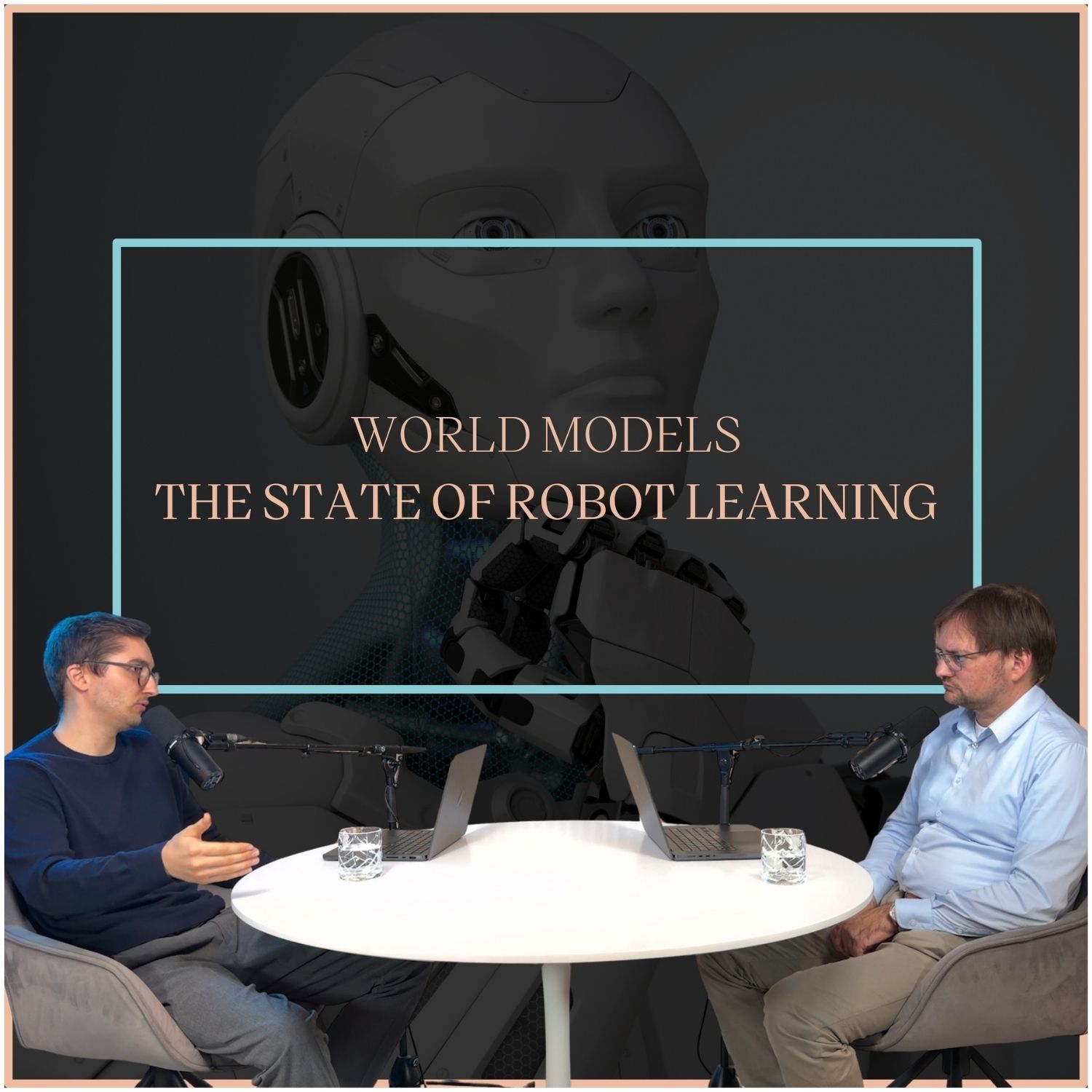 World Models & the next step for Physical AI 24.09.2026 45นาทีIs 2026 the year world models make Physical AI real? Vision-Language-Action models have become the standard approach to robot learning over the last few years. In this episode, Felix Frank from our Robot Intelligence team explains why the next shift is already underway: world models that predict what happens next before a robot decides what to do. We cover how the field moved from small, task-specific models to large pretrained architectures, why memory and context work differently in robotics than in language models, and why robots still need to run at high frequency with very limited context per decision. We also break down the two competing approaches to building a world model: one that generates full video in pixel space, and one that predicts directly in a compressed latent space, closer to the JEPA approach. Finally, we talk about where world models actually help today: generating synthetic training data, predicting the action needed to reach a desired future state, and simulating multiple possible outcomes before choosing one to execute. You'll gain insights into: - Why Vision-Language-Action models became the default approach in robotics - How robots handle memory and context differently than language models - Why control frequency, not context length, is the real constraint in robotics - Two different ways to build a world model, and the trade-offs between them - Why touch and force sensing matter as much as vision for some tasks - Why mechanical and electrical engineering remain the next big bottleneck More about RobCo: Website: https://www.rob.co LinkedIn: https://www.linkedin.com/company/robco-therobotcompany/ Instagram: https://www.instagram.com/robco_therobotcompany/ #physicalAI #robco #robotics #autonomy #podcast #worldmodels 01:38 The 2026 state of Physical AI 02:50 From task-specific models to the ChatGPT moment 07:09 The data bootstrapping problem in robotics 09:21 What goes into a Vision-Language-Action model 11:15 Why "state" matters, and the Markov assumption 17:10 Context length: robotics vs. language models 18:43 Inside the control hierarchy: motors to orchestration 20:05 Onboard GPUs vs. cloud compute 20:44 The human latency baseline 21:11 What is a world model, really? 22:34 Video generation as a world model 25:30 Is a language model already a world model? 27:02 Two ways to build a world model 30:48 Three ways world models help robots today 34:08 What happens in the next six to twelve months 35:35 Handling multiple possible futures 37:52 Beyond vision: touch and force sensing 39:19 The real bottleneck: mechanical engineering 40:46 How fast the field moves, and RobCo's 24/7 goal 42:36 Inside RobCo's experimentation framework
 -
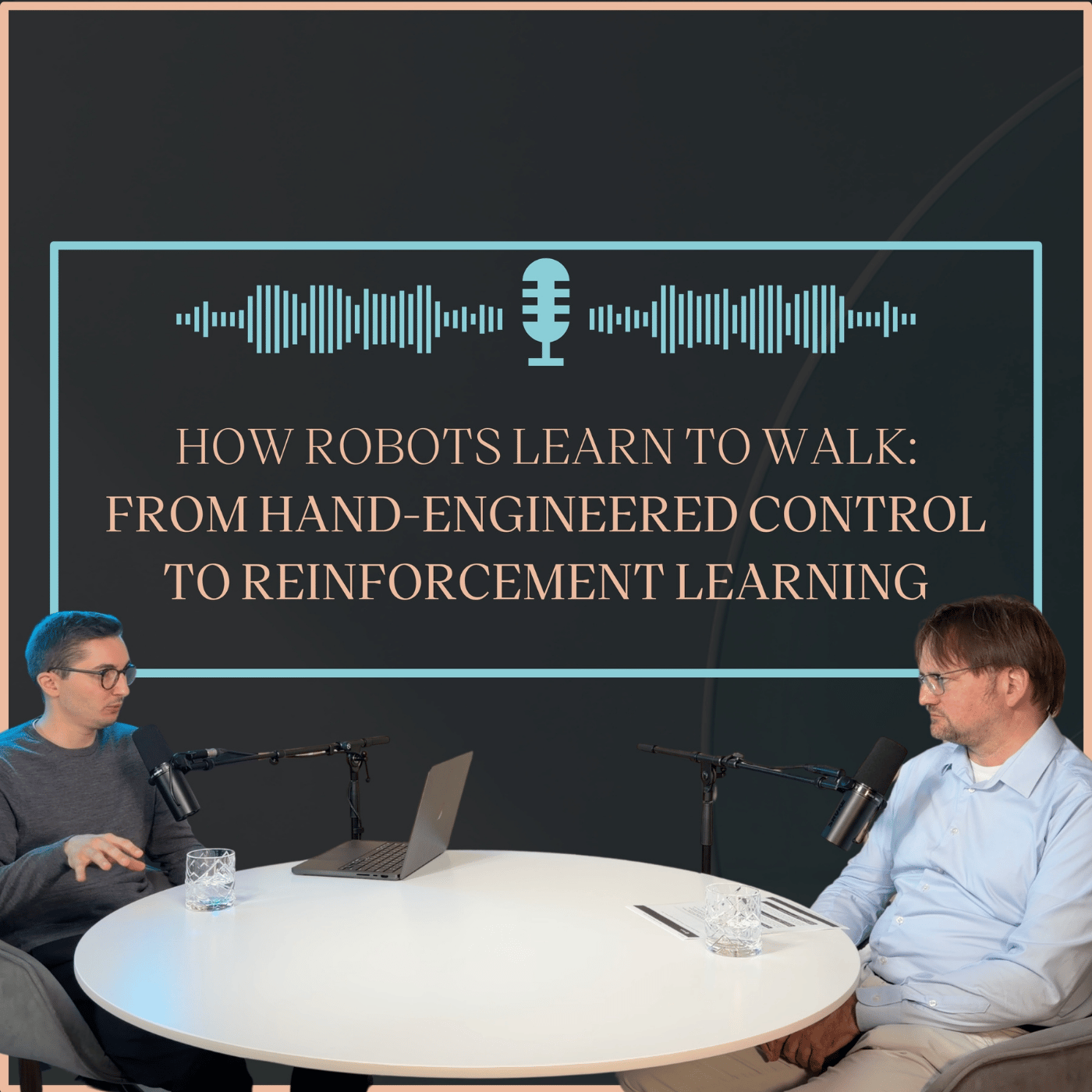 How Robots Learned to Walk: From Hand-Engineered Control to Reinforcement Learning 27.08.2026 42นาทีIs legged locomotion actually a solved problem? In this episode of RobTalk, Felix Frank from our Robot Intelligence team explains how legged robots learn to walk, and why going from an impressive stage demo to a reliable real-world deployment is still one of the hardest open problems in robotics. You'll gain insights into: - Why footstep planning used to mean months of hand-engineered optimization - How GPU-parallelized simulation and domain randomization changed the entire approach - What retargeting means, and why human motion data now trains robot policies - The difference between imitation learning and adversarial motion priors - Why legged robots face real safety and power challenges that fixed robots don't - What is still unsolved: combining blind whole-body control with real terrain understanding More about RobCo: Website: https://www.rob.co LinkedIn: https://www.linkedin.com/company/robco-therobotcompany/ Instagram: https://www.instagram.com/robco_therobotcompany/ 01:14 – Rob Talk intro & welcoming Felix Frank 01:49 – Felix's background 02:38 – Breakout projects at VW (e.g., compressed air control) 03:45 – Move into humanoid robotics (US startup, whole-body control) 04:23 – The classical engineering approach: footstep planning & online optimization 06:33 – Sensor fusion: IMUs, contact sensors & Kalman filtering 08:39 – What is a kinematic tree? 10:08 – Limits of the classical approach (door opening, manipulation) 12:19 – The optimization problem: cost functions & constraints 14:40 – Boston Dynamics' Atlas & the limits of hand-engineering 17:18 – The paradigm shift: GPU-parallel simulation & the Unitree G1 18:11 – Reinforcement learning explained: reward functions & domain randomization 23:50 – Domain randomization in depth 25:26 – Building robustness through external perturbations in training 26:23 – Motion imitation: mocap, retargeting & DeepMimic (2018) 30:57 – The data-centric approach: large-scale datasets & NVIDIA Sonic 33:39 – Why the humanoid form makes sense (locomotion vs. manipulation) 34:54 – Blind locomotion: how far can you get without perception? 36:35 – Terrain awareness & planner components 39:20 – Legged vs. wheeled robots: safety & fail-safe behavior
 -
 Scripted Demos vs. Real Autonomy: The Truth About Dancing Robots 30.07.2026 30นาทีDo dancing robots we see prove that autonomous robotics has been solved? Autonomous Robotics are becoming more impressive every year. They can dance, run marathons and perform movements that seemed impossible just a few years ago. But does that mean they’re ready for real industrial applications? This episode takes an honest look at where the technology actually stands, what those demos can and cannot do, and what the next real milestone looks like. You’ll gain insights into: - Viral robot videos being scripted,, and what that means - Robots having gone from not being able to stand 10 years ago to running marathons today - Movement vs. understanding: the gap nobody talks about - What would actually impress an engineer instead of seeing a backflip - How close we are to robots working in factories for eight hours straight More about RobCo: Website:https://www.rob.co LinkedIn: https://www.linkedin.com/company/robco-therobotcompany/ Instagram: https://www.instagram.com/robco_therobotcompany/ Chapter markers 00:00 Dancing robots: milestone or marketing? 03:15 Why did it take 30 years to get here? 07:02 What finally changed the game 15:49 Can robots do more than just move? 19:00 Where does movement end and intelligence begin? 24:07 What is actually holding robots back? 26:17 How far away is real factory deployment?
 -
 Industry 5.0: Future of Manufacturing? 25.06.2026 44นาทีIndustry 5.0 is not a tech upgrade. It is a different question entirely. Where Industry 4.0 asked what machines can do, Industry 5.0 asks where we want to be as a society. That shift changes everything: Who writes the standards, what factories are optimized for, and what the real role of AI and robotics actually is. You'll gain insights into: - what Industry 5.0 really is, why it comes from a completely different place than 4.0, and what that means for how technology is built and used - the three pillars that define it: human centricity, sustainability and resilience - how RobCo is already putting these principles into practice More about RobCo: Website:https://www.rob.co LinkedIn: https://www.linkedin.com/company/robco-therobotcompany/ Instagram: https://www.instagram.com/robco_therobotcompany/ Chapter markers 00:00 Industry 5.0: Rebranding or real shift? 02:26 Industry 1.0 08:07 Industry 2.0 15:09 Industry 3.0 18:20 Industry 4.0 25:49 Industry 5.0 33:40 Why robots are the only path forward 35:16 RobCo's role in Industry 5.0 41:51 What's happening next?
 -
 How Robots Turn Language into Motion: The AI Stack Behind Physical AI 28.05.2026 43นาทีHow do robots go from human instruction to real movement? Telling a robot to “pick up a box” sounds simple. But behind that command is a complex chain of decisions: understanding language, interpreting the environment, choosing the right action and turning it into physical movement. In this episode, Clemens (Principal Engineer) and Robert (Robotics Engineer & Researcher) explain how RobCo approaches this challenge with ALFIE - combining classical robotics, AI models, sensors, safety systems and real-world industrial requirements. You'll gain insights into: - the three-layer hierarchy (System 2 / System 1 / System 0) that turns language into motor currents - why physical grounding is the hardest unsolved problem in robotics today - how 100-200 demonstrations are enough to fine-tune Alfie on a new use case - why methods that brought man to the moon are now central to physical AI More about RobCo: Website:https://www.rob.co LinkedIn: https://www.linkedin.com/company/robco-therobotcompany/ Instagram: https://www.instagram.com/robco_therobotcompany/ Chapter markers 00:00 Controlling robots with language 00:32 Meet Clemens and Robert 02:22 System 2, 1, 0: How robots think 04:35 The driving analogy explained 06:28 What's the hardest part of the chain? 07:15 Translating language into robot action 08:43 What really happens when you say "pick up the glass" 11:04 Why neural nets find their own language 15:21 Introducing Alfie 21:09 Pre-training + fine-tuning a robot 24:49 How commands become motor currents 28:31 Top 3 questions from Hannover Messe 35:04 The funniest moment at the trade fair 38:02 What makes Alfie different 40:28 World models: The next big unlock?
 -
 How to Teach a Robot: From Moving Arms to Autonomy with Physical AI 30.04.2026 41นาทีHow do you actually teach an AI-powered robot? For decades, robots in industry have followed one principle: You program every single step. Every movement. Every position. Every exception. And if something changes, you start again. That approach is reaching its limits. As environments become less structured and processes more dynamic, the question shifts: How do you move from programming robots… to teaching them? You'll gain insights into: - how to physically guide a robot arm - what a VR headset, a gripper replica, and a helmet camera have in common - why data quality matters more than data quantity - how close we really are to just talking to a robot and getting an answer More about RobCo: Website:https://www.rob.co LinkedIn: https://www.linkedin.com/company/robco-therobotcompany/ Instagram: https://www.instagram.com/robco_therobotcompany/ Chapter markers 00:00 How do you actually teach an AI robot? 01:13 Traditional robot programming 03:08 RobFlow: no-code meets the factory floor 05:30 Overview: Five ways to teach a robot 06:21 Method 1: moving the arm by hand 08:23 Method 2: the leader arm and haptic feedback 10:41 Method 3: VR goggles as a teaching device 15:39 Method 4: the gripper replica in your hand 17:47 Method 5: motion capture and ego data 22:00 Rich data vs. massive data: What works better? 27:09 How far away is voice-controlled robotics? 31:10 Why humanoid hardware is still the bottleneck 35:42 Learning robots open a completely new dimension 39:00 We're using AI like a typewriter, what's next?
 -
 90% of Robot Demos Never Make It to a Real Factory. Here's Why. 31.03.2026 25นาที90% of robot prototypes never make it to real factories. They work in a closed lab. They look impressive on video. And then reality hits. In this episode, we break down what actually separates a convincing prototype from a system that runs reliably in production. And why that gap is much harder to close than most people think. You'll gain insights into: - what makes a prototype fail in real deployment - why 99% reliability is harder than it sounds - how the digital twin works inside a neural net - where humanoid robots really stand today More about RobCo: Website: https://www.rob.co LinkedIn: https://www.linkedin.com/company/robco-therobotcompany/ Instagram: https://www.instagram.com/robco_therobotcompany/ Chapter markers 00:00 Intro 02:00 Why robot prototypes are often misleading 05:41 Reliability beats impressive capabilities 07:46 Why RobCo builds end-to-end solutions 09:27 48-hour testing & real-world data loops 12:23 How closed learning loops actually work 14:09 Digital twins explained simply 17:49 The digital twin as a map of the real world 19:57 How physical AI filters relevant information 22:32 What people will misunderstand about physical AI 24:51 Humanoid robots: hype vs. reality
 -
 Physical AI: The 5 Levels of Robot Autonomy explained 31.03.2026 31นาทีDancing robots. Kung-fu moves. Humanoid acrobatics all over the feed. But does that mean Physical AI has actually arrived? In this episode, Clemens, Principal Engineer at RobCo, shares what Physical AI really means for industrial automation and where the technology stands today. You'll gain insights into: - why Large Language Models are just the starting point and what comes after - how robots are being taught today compared to five years ago - how RobCo approaches Physical AI in real manufacturing environments - where the technology stands today and what accuracy rates actually matter in practice More about RobCo: Website: https://www.rob.co LinkedIn: https://www.linkedin.com/company/robco-therobotcompany/ Instagram: https://www.instagram.com/robco_therobotcompany/ Chapter markers 00:00 Intro 00:48 Where physical AI stands right now 01:41 From chatting to grabbing: the next AI leap 02:43 Why physical data is so hard to collect 04:35 What physical AI actually means at RobCo 06:16 Why 100 years of automation hit a wall 08:18 The five levels of robot autonomy 13:27 Hardware, software, data 15:15 Why end-to-end ownership changes everything 16:19 Teaching a robot in a few hundred moves 18:09 Why software turns a robot into a brain 19:07 Why modular beats fixed automation 22:04 Real use cases already running in factories 24:26 How many nines does a production line need? 28:20 The moment factories realize everything changed
 -
 Why robotics is changing everything right now | Clemens Marschner 31.03.2026 46นาทีHow do you go from being a computer passionate to helping shape an AI-first robotics company? This episode is about Clemens. His journey. His decisions. And why he is exactly where he is today. You’ll gain insights into: - his path from early fascination with computers to working in large-scale tech environments - why he chose to join RobCo - what truly fascinates him about AI (beyond the buzzwords) - how engineering changes when systems start learning instead of just executing rules - how teams at RobCo collaborate, make decisions, and drive innovation forward More about RobCo: Website: https://www.rob.co LinkedIn: https://www.linkedin.com/company/robco-therobotcompany/ Instagram: https://www.instagram.com/robco_therobotcompany/ Chapter markers 00:00 Welcome to the RobCo Podcast 00:35 Clemens' Role as Principal Engineer 01:20 A Computer Kid Since Day One 03:07 PhD, Linguistics & Early Machine Learning 09:14 Microsoft, Bing & Web Search Ranking 11:44 Autonomous Driving: Hype vs. Reality 16:02 Ride-Sharing & Building Lyft's Maps 19:49 Why Clemens Never Left Munich 22:33 How RobCo Clicked Immediately 24:27 Speed, Culture & Everything Under One Roof 30:09 Leading the Autonomy Team 33:26 Rapid Fire Questions 44:41 Final Words & Why RobCo Is Hiring
 -
 RobTalk - Trailer 27.03.2026RobTalk. The autonomous robotics podcast from RobCo. Real talks on Physical AI. What works. What breaks. From first deployments to systems that handle real-world complexity. Insights for engineers, operations leaders, and robotics enthusiasts. New episodes every month. Subscribe on Spotify, Apple Podcasts, or wherever you listen.
พอดแคสต์ที่คล้ายกัน


ยอดนิยมใน
พอดแคสต์นี้ปรากฏในชาร์ตพอดแคสต์ของประเทศเหล่านี้ด้วย
