
Clinical Deep Dives
Med School Audio - Medical Knowledge Reimagined & Learning Made Memorable.
0
Clinical Deep Dives is a podcast for clinicians and learners who want understanding, not just information. Using classic medical and surgical texts as a guide and the generative power of AI, each episode explores ideas with curiosity and clarity. Designed for learning on the move and knowledge that actually sticks.
Bölümler
-
 PSYCH 123: Anxiety Disorders - Somatic Therapies 15.09.2026 42dkMedlock Holmes enters an immense Neo-Victorian treatment complex called The Grand Pharmacological Dispensary of Anxiety.Rows of treatment pathways stretch before him.Some contain SSRIs and SNRIs.Others hold benzodiazepines, pregabalin, buspirone, beta-blockers, older antidepressants, antipsychotics, neurostimulation devices, and emerging experimental therapies.But Holmes immediately notices that the first room contains no medication at all.It is labelled:ASSESS BEFORE YOU PRESCRIBE.Not every anxious person needs pharmacological treatment. Some symptoms are transient or subsyndromal. At the same time, clinically significant anxiety disorders remain frequently under-recognised and undertreated, particularly in primary care. Patients may describe insomnia, palpitations, gastrointestinal symptoms, pain or fatigue rather than saying, “I am anxious.” Screening tools such as the GAD-7 can improve recognition.Treatment therefore begins with diagnostic precision.What is the primary disorder?How severe is it?Are there medical causes?Substance use?Depression?Other anxiety disorders?Psychosocial stressors?Previous treatment response?Drug interactions?Patient preference?Cost and access?The treatment-choice diagram on page 3 captures this broader logic: illness factors, patient factors and medication factors all contribute to the decision.For many anxiety disorders, SSRIs and SNRIs are the first-line pharmacological treatments.Holmes watches clinicians begin low and increase gradually.Why?Because anxious patients can experience an early transient increase in nervousness, agitation or insomnia.The medications also require patience.Some improvement may appear within two to four weeks, but an adequate therapeutic trial generally requires 8–12 weeks, and remission may take considerably longer.The goal is not merely partial improvement.It is remission, because residual symptoms continue to impair functioning and increase relapse risk.Holmes then reaches the Benzodiazepine Chamber.Here the effect is strikingly different.The alarm quietens rapidly.Benzodiazepines enhance GABAergic inhibition and can reduce anxiety quickly.That makes them valuable in selected circumstances - short-term adjunctive treatment, occasional panic, performance-related anxiety, or severe disabling symptoms when alternatives have failed or are not tolerated.But the chamber contains warning plaques:Sedation.Dependence.Withdrawal.Tolerance.Interaction with alcohol.Driving impairment.Their speed is both their strength and their danger.Next comes pregabalin.It has evidence particularly in GAD and can be useful when insomnia or pain coexist.Buspirone occupies another chamber, particularly for chronic generalized anxiety.Beta-blockers sit in a small performance hall.They do not treat generalized social anxiety.Instead, they reduce peripheral manifestations such as tremor and tachycardia during specific performance situations.Older agents remain available but sit farther down the treatment hierarchy.TCAs can work but carry more anticholinergic effects, cardiotoxicity and overdose risk.MAOIs can be highly effective, particularly phenelzine in panic and social anxiety, but dietary restrictions, drug interactions and safety concerns make them second-line options.Holmes then passes through individual disorder galleries.In GAD, SSRIs and SNRIs dominate first-line treatment, with alternatives such as pregabalin, buspirone and selected other agents.In panic disorder, SSRIs and venlafaxine are preferred initial options, while benzodiazepines may provide rapid short-term relief.In social anxiety disorder, SSRIs and SNRIs again feature prominently; pregabalin and clonazepam have evidence, while beta-blockers are mainly relevant to performance anxiety.In specific phobia, however, the shelves are nearly empty.The principal treatment is psychological - especially exposure therapy. Pharmacotherapy has little established role and benzodiazepines may even interfere with exposure learning.This tells Holmes something important:The presence of anxiety does not automatically imply that medication is the best treatment.The next room is labelled:TREATMENT RESISTANCEBefore adding another medication, Holmes checks the foundations.Was the diagnosis correct?Was the dose adequate?Was the trial long enough?Is there thyroid disease?Substance use?Comorbid depression?Poor adherence?Drug interaction?Only then does he consider switching, augmentation, pregabalin, benzodiazepines, atypical antipsychotics or more experimental options.Beyond this room lies the Future Therapies Laboratory.rTMS.tDCS.Neurosteroids.Ketamine.Cannabinoids.Complementary therapies.Some show promise.But Holmes sees a large sign:PROMISING ≠ ESTABLISHEDThe evidence remains preliminary for many of these approaches.Finally, Holmes reaches the maintenance hall.The mistake here is stopping too soon.Anxiety disorders are frequently chronic or recurrent, and relapse after medication discontinuation is common.For many patients with chronic illness, medication may need to continue for 1–2 years after response, followed by gradual tapering rather than abrupt cessation.SSRIs and SNRIs can produce discontinuation symptoms, especially shorter-half-life agents such as paroxetine and venlafaxine.Holmes closes the final treatment ledger.The lesson is not that anxiety should simply be medicated.It is that somatic treatment should be deliberate, collaborative, evidence-based and disorder-specific.The right medication, for the right person, at the right dose, for the right duration, with careful monitoring - often alongside CBT - can transform disabling anxiety into something manageable.Key TakeawaysRecognition before treatment* Anxiety disorders carry substantial personal and societal burden.* Not every anxious symptom requires somatic treatment.* Transient and subsyndromal anxiety should not automatically be medicalised.* Nevertheless, clinically significant anxiety disorders are commonly under-recognised and undertreated.* Detection in primary care has historically been below 50%.* Only a minority of recognised cases receive appropriate evidence-based treatment.* Patients commonly present with physical rather than psychological symptoms.* Reluctance to disclose emotional symptoms can contribute to missed diagnosis.* Clinicians may fail to enquire directly about anxiety.* Detection improves as severity increases and with repeated healthcare attendance.* Structured screening tools such as the GAD-7 improve recognition.* Anxiety can often be effectively managed in primary care when properly identified.* Chronic physical illness and adverse social determinants increase vulnerability and should heighten clinical suspicion.Principles of Pharmacological ManagementThe chapter’s treatment principles can be summarised as:DIAGNOSE → ASSESS → EDUCATE → SELECT → MONITOR → OPTIMISEImportant elements include:* establish the primary diagnosis* identify psychiatric comorbidity* identify medical comorbidity* review current medications and substances* assess psychosocial stressors* document baseline severity and frequency* perform appropriate physical examination and laboratory investigation* discuss treatment options* incorporate patient preference* consider previous personal and family treatment response* check drug interactions* consider affordability and access* monitor progress using validated scales.The figure on page 3 groups treatment selection into three broad domains:Illness Factors* severity* frequency* chronicity* comorbidity* situational versus generalized symptoms.Patient Factors* preference* adherence* insight* psychological-mindedness.Medication Factors* previous response* family response* drug interactions* access* cost.Pharmacotherapy versus Psychotherapy* Initial evidence-based options include pharmacotherapy, CBT, or both.* Acute efficacy of medication and psychological therapy may be similar in many anxiety disorders.* Long-term comparative evidence is less complete.* Combination treatment is intuitively attractive but has not consistently been proven superior to either treatment alone.* Sequential addition of CBT after partial medication response is often a pragmatic strategy.* Patient preference should meaningfully influence treatment choice.SSRIs and SNRIsThese are the principal first-line pharmacological treatments across anxiety disorders.Common SSRIs include:* fluoxetine* sertraline* paroxetine* fluvoxamine* citalopram* escitalopram.Common SNRIs include:* venlafaxine* desvenlafaxine* duloxetine* levomilnacipran.Most guidelines favour an SSRI or venlafaxine as an initial antidepressant option.Start low, go slowAnxious patients can be particularly sensitive to early adverse effects.Initial treatment may temporarily increase:* nervousness* agitation* insomnia* tremor* gastrointestinal symptoms* headache* dizziness.Treatment is therefore usually started at a low dose and titrated gradually.Do not judge treatment too early* Early improvement may occur within 2–4 weeks.* A proper therapeutic trial generally requires 8–12 weeks at an adequate dose.* Some patients require substantially longer before remission.* The chapter notes that response or remission may sometimes take up to six months.Remission is the goalPartial response is not enough when substantial residual symptoms remain.Residual symptoms are associated with:* ongoing functional impairment* poorer quality of life* greater relapse risk.Treatment should therefore aim for:REMISSION + FUNCTIONAL RECOVERYrather than mere reduction in symptom score.SSRI/SNRI adverse effectsCommon effects include:* gastrointestinal disturbance* insomnia* nervousness* agitation* tremor* headache* dizziness* sexual dysfunction.Sexual dysfunction may involve:* reduced desire* impaired arousal* erectile dysfunction* delayed ejaculation* orgasmic dysfunction.The table on page 6 highlights meaningful differences between agents, with sexual adverse effects generally more frequent with several traditional SSRIs than with agents such as buspirone, mirtazapine or some newer antidepressants.Less common but clinically important SSRI/SNRI risksPotential serious complications include:* serotonin syndrome* seizures* induction of mania* hyponatraemia* gastrointestinal bleeding, particularly with NSAIDs* increased fracture risk in some older patients.These events are uncommon but clinically important.VenlafaxineVenlafaxine is among the most widely used SNRIs.Common adverse effects include:* dry mouth* sweating* constipation* insomnia* headache* sexual dysfunction.At higher doses, noradrenergic effects become more prominent.Dose-related hypertension occurs in a minority of patients, so blood pressure monitoring is appropriate at higher therapeutic doses.DuloxetineDuloxetine has broadly similar efficacy and tolerability to venlafaxine.Important considerations include:* discontinuation syndrome* gastrointestinal effects* avoidance or caution in significant hepatic dysfunction.Antidepressant discontinuation syndromeAbrupt cessation of SSRIs or SNRIs can produce:* anxiety* irritability* tearfulness* dizziness* light-headedness* malaise* sleep disturbance* concentration difficulty.Symptoms commonly emerge within 2–4 days.They are particularly associated with shorter-half-life medications such as:paroxetineandvenlafaxine.Gradual tapering is preferred.Fluoxetine’s long half-life can sometimes make it useful as a bridging strategy during difficult discontinuation.Antidepressants and suicidality* Regulatory warnings exist regarding treatment-emergent suicidal thoughts and behaviour in children and younger adults.* In adults aged 24 and above, short-term analyses reviewed in the chapter did not demonstrate a clear increased suicidality signal.* In younger patients, meta-analyses suggest an increase in suicidal thoughts and behaviours of roughly 1.5–2-fold, but not a corresponding increase in completed suicide.* The absolute increase in risk is small.* This must be balanced against the significant morbidity of untreated anxiety.* Medication can therefore remain appropriate in younger patients when clinically indicated, with careful monitoring.TCAsExamples include:* imipramine* clomipramine* amitriptyline* nortriptyline* desipramine* doxepin.TCAs inhibit monoamine reuptake but also affect:* muscarinic receptors* histamine receptors* α1 adrenergic receptors.This produces adverse effects such as:* dry mouth* constipation* blurred vision* sedation* weight gain* orthostatic hypotension.More serious issues include:* lowered seizure threshold* cardiotoxicity* toxicity in overdose.They are therefore usually second-line despite efficacy in some anxiety disorders.MAOIsCommon examples include:phenelzineandtranylcypromine.They can be highly effective, especially in:* social anxiety disorder* panic disorder.But their use is limited by:* dietary restrictions* tyramine-related hypertensive crisis* drug interactions* washout requirements* postural hypotension* weight gain* overdose concerns.They are generally reserved for refractory illness.RIMAsMoclobemide is the principal example discussed.Potential advantages over irreversible MAOIs include:* fewer dietary restrictions* generally better tolerability.It has evidence particularly in social anxiety disorder.Availability differs internationally.MirtazapinePotential advantages:* low propensity for sexual dysfunction* sedative properties can help insomnia* potential utility in panic and GAD.Limitations include:* increased appetite* weight gain* sedation* dry mouth* dizziness.Bupropion* Not generally a first-line treatment for primary anxiety disorders.* There is clinical concern that it may initially increase agitation or anxiety.* It is more often used to treat depression or as an adjunct to address antidepressant-associated sexual dysfunction.Vortioxetine* Multimodal serotonergic antidepressant.* Anxiety evidence has focused mainly on GAD.* Results remain preliminary or inconsistent.* Its use for anxiety is not as well established as SSRIs or SNRIs.AgomelatineActs via:* MT1/MT2 melatonin agonism* 5-HT2C antagonism.Potential advantages include:* low sexual dysfunction* little weight gain* minimal discontinuation syndrome.Evidence suggests possible benefit in GAD.Liver-function monitoring is recommended.VilazodoneCombines:SSRI activity + partial 5-HT1A agonismSome trials suggest benefit in GAD, but evidence remains insufficient to establish it alongside standard first-line treatments.BenzodiazepinesBenzodiazepines enhance GABAergic inhibition.They possess:* anxiolytic* sedative* anticonvulsant* muscle-relaxant properties.Common examples include:* clonazepam* lorazepam* alprazolam* diazepam* oxazepam* temazepam.Liver metabolismMost benzodiazepines undergo hepatic oxidative metabolism.Lorazepam, oxazepam and temazepam undergo conjugation and may therefore be preferable when hepatic function is impaired.A useful memory aid is:LOTLorazepamOxazepamTemazepamBenzodiazepine strengths* rapid onset* strong acute anxiolytic effect* predictable symptom relief* useful adjunct while antidepressants take effect* can be effective even in longer-term carefully selected use.Benzodiazepine limitationsImportant concerns include:* sedation* psychomotor impairment* driving risk* interaction with alcohol* dependence* withdrawal* misuse* potential tolerance.Avoid or use very cautiously in people with significant substance-use histories.Short-term adjunctive useBenzodiazepines may be prescribed for approximately 3–4 weeks when initiating an antidepressant to help manage:* severe anxiety* insomnia* jitteriness* delayed antidepressant onset.PRN benzodiazepinesMay be useful in selected situations such as:* occasional panic attacks* discrete performance anxiety.Frequent panic attacks are generally better treated preventively rather than repeatedly attempting to abort attacks with PRN benzodiazepines.PregabalinPregabalin has meaningful evidence in anxiety disorders, particularly GAD.Potential advantages include use where:* pain is comorbid* insomnia is prominent.Adverse effects include:* dizziness* drowsiness* weight gain.Pregabalin is primarily renally cleared, so renal impairment is an important consideration.Other anticonvulsantsAgents sometimes used include:* gabapentin* topiramate* tiagabine* lamotrigine* levetiracetam.Evidence is generally weaker or inconsistent compared with pregabalin.Atypical antipsychoticsAgents include:* quetiapine* olanzapine* risperidone* aripiprazole* ziprasidone* lurasidone.Evidence in primary anxiety disorders is limited.Quetiapine has demonstrated efficacy in GAD, but adverse effects limit its use.Key concerns include:* weight gain* metabolic syndrome* diabetes risk* lipid abnormalities.They are therefore generally later-line or augmentation strategies.Beta-blockersCommon options:* propranolol* atenolol.They reduce peripheral adrenergic symptoms such as:* tremor* tachycardia.Their principal role is performance anxiety.They are not effective treatments for generalized social anxiety disorder.Relevant contraindications include some:* cardiac disease* pulmonary disease* diabetes* angle-closure glaucoma.BuspironeBuspirone is an azapirone with serotonergic activity.It is primarily useful for:GADImportant characteristics:* not immediately acting* usually taken in divided doses* response develops over time* does not provide benzodiazepine-like rapid relief.HydroxyzineHydroxyzine is an antihistamine with evidence for GAD.Potential advantages:* relatively rapid early symptom relief* alternative to benzodiazepines in selected patients.Common adverse effects:* sedation* dry mouth* tremor.Tolerance to anxiolytic effects may develop.Treatment-resistant anxietyBefore labelling anxiety treatment-resistant:RECHECK THE CASESpecifically assess:* diagnosis* medical causes* thyroid disease* substance use* comorbid psychiatric disorders* adherence* drug interactions* adequate dose* adequate duration* access to effective CBT.Augmentation strategiesPossible augmentation agents include:* pregabalin* benzodiazepines* selected anticonvulsants* atypical antipsychotics.The evidence base is limited relative to first-line treatments.Treatment-resistant GAD is sometimes treated by adding pregabalin or a benzodiazepine to an SSRI/SNRI.For treatment-resistant panic disorder, clonazepam augmentation may be considered when CBT is unavailable or unsuitable.Novel TreatmentsrTMSEvidence for pure anxiety disorders remains limited.Some preliminary benefit has been reported for:* GAD* SAD* panic disorder.A small fMRI-guided GAD study reported promising results, but larger controlled trials are required.tDCSTranscranial direct-current stimulation is another non-invasive neuromodulation technique.Early reports suggest possible benefit in GAD and panic disorder, but evidence remains preliminary.NeurosteroidsIntranasal neurosteroidal compounds such as PH94B have shown promising results in social anxiety disorder.These remain investigational.KetamineKetamine has demonstrated substantial efficacy in treatment-resistant depression.Small studies suggest possible rapid anxiolytic effects in:* social anxiety disorder* GAD.The evidence remains insufficient to establish ketamine as standard treatment for primary anxiety disorders.CannabinoidsCannabinoids are increasingly used by patients seeking relief from anxiety.Some evidence suggests possible anxiolytic effects in GAD and SAD.However, the chapter emphasises major limitations:* heterogeneous preparations* inconsistent dosing* limited long-term data* methodological problems* publication bias.No firm therapeutic conclusions can therefore be drawn.Complementary and Alternative TherapiesPatients commonly use:* herbal preparations* acupuncture* yoga* biofeedback* supplements.Clinicians should actively ask about these treatments because herbal agents can cause clinically important drug interactions.KavaKava has some evidence for mild-to-moderate anxiety.However:* efficacy in specific anxiety disorders remains uncertain* hepatotoxicity is a concern* CYP-mediated drug interactions can occur.ExerciseAerobic exercise has evidence for reducing anxiety symptoms and provides substantial broader health benefits.The chapter supports routinely recommending physical exercise when appropriate.Yoga also has preliminary evidence, particularly in performance and other anxiety states.Duration of PharmacotherapyAn adequate acute trial generally requires:8–12 weeks at a therapeutic doseFor chronic anxiety disorders, continuing medication after response is usually necessary.Relapse studies report approximately:20–50% relapse within several months of antidepressant discontinuation.The chapter recommends maintenance therapy for many patients for approximately:1–2 yearsbefore considering discontinuation.TaperingDiscontinuation should be slow.The chapter describes dose reductions of roughly:10–25% every 1–2 monthswith monitoring for recurrence.Tapering must be individualised.Abrupt cessation should generally be avoided.Expected Pharmacotherapy ResponseApproximate response rates described in the chapter include:Panic disorder: 60–70%GAD: 50–60%Social anxiety disorder: 50–60%Panic disorder is therefore among the more pharmacologically responsive anxiety disorders.Agoraphobia may reduce response rates when comorbid with panic disorder.Evidence-Based Monotherapy PatternThe table on pages 17–18 provides a useful broad hierarchy.SSRIsFirst-line: SAD, GAD, PDSNRIsFirst-line: SAD, GAD, PDTCAs* not recommended in SAD* second-line in GAD* second-line in PDMAOIs* second-line in SAD* second-line in PD* limited evidence in GADBenzodiazepinesGenerally second-linePregabalin* strong role in SAD* second-line in GAD in the source’s summary table* insufficient evidence in PDQuetiapineSecond-line in GAD but limited by adverse effects.Generalized Anxiety DisorderPreferred pharmacological options include:SSRIsandSNRIsAlternatives include:* pregabalin* buspirone* quetiapine* mirtazapine* selected newer antidepressants.SSRIs are generally the preferred initial option.Pregabalin is another important option.Benzodiazepines are effective but usually restricted because of dependence and tolerance concerns.Quetiapine works but is generally second-line because of metabolic adverse effects.Propranolol has not demonstrated meaningful efficacy for GAD.Panic DisorderFirst-line pharmacological treatments include:SSRIsandvenlafaxineEffective older treatments include:* clomipramine* imipramine* phenelzine* tranylcypromine.Their adverse-effect burden places them later in the hierarchy.Benzodiazepines such as:* alprazolam* lorazepam* diazepam* clonazepamcan provide rapid short-term relief.Maintenance antidepressant treatment can prevent relapse for years in responsive patients.AgoraphobiaPharmacological evidence for pure agoraphobia is limited.Most pharmacological improvement occurs through treatment of:* panic disorder* depression* other comorbid anxiety disorders.CBT, especially exposure therapy, has a stronger direct evidence base.Social Anxiety DisorderFirst-line treatments described include:* SSRIs* SNRIs* pregabalin* clonazepam.Phenelzine is highly efficacious but generally second-line because of adverse effects and dietary restrictions.Other options include:* mirtazapine* moclobemide* selected benzodiazepines* gabapentin.Beta-blockers are useful for:PERFORMANCE ANXIETYbut not generalized social anxiety disorder.Specific PhobiaThis is the major exception to the medication-focused approach.Best-established treatment:EXPOSURE-BASED PSYCHOTHERAPYMedication evidence is very limited.SSRIs may occasionally be considered when psychotherapy fails or cannot be used.Benzodiazepines have not demonstrated clear benefit and may interfere with exposure-based learning.Therefore:SPECIFIC PHOBIA → THINK EXPOSURE FIRSTSeparation Anxiety DisorderEvidence is strongest in younger populations.SSRIs show benefit in studies of mixed paediatric anxiety populations including:* GAD* SAD* separation anxiety disorder.TCAs and clonazepam have not shown convincing benefit.Adult pharmacological data remain sparse.Selective MutismPsychosocial treatment is generally preferred.SSRIs such as:* fluoxetine* fluvoxaminemay be considered in more severe or treatment-resistant cases.Evidence remains considerably smaller than for other anxiety disorders.Children and AdolescentsAnxiety disorders are highly prevalent in young people.SSRIs and SNRIs have evidence in paediatric:* GAD* social anxiety disorder* separation anxiety disorder.Psychological treatment is often preferred initially, particularly for milder cases.Combination treatment may provide greater benefit in some paediatric anxiety disorders.Antidepressant treatment requires appropriate monitoring for treatment-emergent suicidal thoughts or behaviours.The chapter emphasises that the absolute risk is small and should be balanced against the morbidity of untreated anxiety.Optimising TreatmentThe chapter’s pharmacotherapy checklist can be condensed into:Aim for remission.Choose an evidence-based first-line drug.Start low.Increase gradually.Educate about adverse effects.Allow 8–12 weeks at an adequate dose.Use benzodiazepines selectively and usually short-term.Maintain successful treatment long enough to reduce relapse.Taper gradually.Add CBT when appropriate.The Central Clinical PrincipleSomatic treatment of anxiety is not:“The patient is anxious → prescribe an anxiolytic.”It is:Diagnosis → Severity → Comorbidity → Preference → Evidence → Safety → Adequate Trial → Monitoring → Remission → Maintenance → Careful DiscontinuationMedication should therefore be understood not as a universal antidote to anxiety, but as one component of a broader treatment strategy. This is a public episode. If you'd like to discuss this with other subscribers or get access to bonus episodes, visit drmanaankarray.substack.com/subscribe
 -
 PSYCH 122: Anxiety Disorders - Cognitive-Behavioural Therapy 14.09.2026 50dkMedlock Holmes enters an immense Victorian experimental laboratory called The Institute of Fear and Learning.Around him, patients are trapped within apparently different mysteries.One avoids dogs. Another fears crowded trains because a panic attack might occur. Another rehearses every sentence before speaking, terrified of humiliation. Another spends hours worrying about disasters that may never happen.Yet Holmes notices the same mechanism running beneath them all.Threat → Anxiety → Escape or Safety Behaviour → Relief → Stronger Future Fear.Avoidance works remarkably well in the short term. That is precisely why it becomes such a problem.Each escape produces relief. Relief negatively reinforces avoidance. And every avoided encounter prevents the person from discovering something potentially transformative:Perhaps the predicted catastrophe would not have happened.Cognitive-behavioural therapy breaks this cycle.At its centre lies the concept of the fear structure: interconnected representations of stimuli, responses, and meanings. A dog becomes associated with danger. Palpitations become associated with heart attack. Social attention becomes associated with humiliation. Uncertainty becomes associated with intolerable catastrophe.The fear itself is not necessarily pathological. The problem is that the structure inaccurately represents reality.For therapeutic change to occur, two things are required. The fear structure must first be activated. Then the patient must encounter information incompatible with its pathological predictions. Modern formulations describe this in terms of prediction error: the brain predicts catastrophe, encounters a different outcome, and is given an opportunity to update its model.This explains why exposure sits at the heart of CBT for anxiety disorders.Exposure may be in vivo - entering the avoided lift, touching the feared animal, speaking in front of others.It may be imaginal - deliberately approaching distressing memories, images, thoughts, or feared future scenarios.Or it may be interoceptive - deliberately producing the bodily sensations that have themselves become feared, such as dizziness, breathlessness or a racing heart.But exposure is not simply a test of endurance.Its purpose is learning.The patient predicts:“If my heart races, something terrible will happen.”The experiment produces a racing heart.The catastrophe does not occur.Or perhaps something uncomfortable does happen - embarrassment, anxiety, uncertainty - and the patient discovers that even this is tolerable.The prediction begins to change.Holmes therefore realises that falling anxiety during a single exposure is not the ultimate objective. Someone may feel better because they distracted themselves, escaped psychologically, performed a ritual, sought reassurance, or relied upon another safety behaviour.The more important question is:What did they learn?That distinction also explains why safety behaviours matter. The patient who survives a feared situation while gripping a bottle of water, checking their pulse, rehearsing every sentence or staying beside a trusted companion may conclude:“I survived because my protection worked.”The old fear remains intact.CBT therefore combines exposure with cognitive work: identifying catastrophic predictions, examining evidence, using Socratic questioning, uncovering deeper meanings, and designing behavioural experiments that allow beliefs to collide with reality.Different anxiety disorders require different experiments.In panic disorder, treatment targets the fear of fear itself. Interoceptive exposure deliberately produces feared sensations so that palpitations, dizziness or breathlessness can be experienced without catastrophe.In specific phobia, the person progressively approaches the feared object or situation.In social anxiety disorder, exposure targets feared scrutiny and rejection while attention is shifted outward and safety behaviours are dropped.In generalized anxiety disorder, where there may be no single feared object, treatment focuses more heavily upon worry, intolerance of uncertainty, cognitive work, problem-solving and sometimes imaginal exposure to uncertain future outcomes.Acceptance and mindfulness can also be incorporated - not as methods of making anxiety disappear, but as ways of reducing the struggle against internal experience.By the end of the investigation, Holmes understands the paradox.The anxious person has often spent years becoming exceptionally skilled at preventing feared outcomes.CBT asks them to relinquish enough protection to discover whether that protection was ever necessary.The therapeutic question therefore changes from:“How can I make sure I never feel afraid?”to:“What happens when I approach what matters, allow anxiety to be present, and discover for myself what is actually dangerous?”That is the central experiment of cognitive-behavioural therapy.Key Takeaways1. Anxiety disorders share a common CBT architectureDespite different symptom presentations, anxiety disorders commonly involve three interacting elements:Threat cognition → anxiety response → avoidance or defensive behaviour.The feared outcome differs by disorder:* Panic disorder: catastrophic consequences of anxiety or bodily sensations - the “fear of fear”.* Social anxiety disorder: embarrassment, negative evaluation and rejection.* Specific phobia: harm associated with a circumscribed object or situation.* GAD: uncertainty regarding future negative outcomes.* Similar CBT principles also extend to OCD and PTSD despite their classification outside the DSM-5 anxiety-disorders grouping.2. The fear structureEmotional processing theory conceptualises fear as an interconnected structure containing:STIMULUS + RESPONSE + MEANINGFor example:Dog → tachycardia/urge to flee → “Dogs are dangerous and uncontrollable.”The structure is adaptive when it accurately identifies danger and generates effective protective behaviour.It becomes pathological when safe or relatively harmless stimuli, responses or situations acquire unrealistic meanings.3. Emotional processing requires activation plus corrective informationTwo conditions are central:1. Activate the fear structure.The patient must encounter or meaningfully represent what they fear.2. Introduce incompatible information.Experience must provide evidence inconsistent with the pathological associations.Thus:Prediction → Experience → Prediction Error → UpdatingExposure provides an especially powerful environment for this process.4. Exposure is not simply about “getting used to anxiety”Exposure deliberately confronts feared but objectively safe:* objects* situations* activities* thoughts* memories* images* physiological sensations.Its therapeutic purpose is to alter the meaning attached to these experiences.The patient can learn:“Anxiety is uncomfortable, but tolerable.”“My prediction was exaggerated.”“The catastrophe did not occur.”“Even when something unpleasant happened, I could cope.”5. Between-session learning matters more than simply feeling calmer during one exposureEarlier models emphasised within-session habituation - anxiety progressively declining during an exposure.The chapter cautions that this is neither necessary nor sufficient for successful treatment.Anxiety may decline because the patient:* distracts themselves* performs a compulsion* uses reassurance* engages in a safety behaviour* mentally disengages.The more meaningful evidence of emotional processing is enduring change that transfers beyond the immediate exercise, particularly between-session reductions in fear and pathological cognitions.6. Avoidance is maintained by negative reinforcementThe mechanism is simple:Fear → Escape → ReliefRelief rewards escape.Therefore:Fear → Escape → Relief → More Escape Next TimeAvoidance also prevents exposure to corrective information.The person concludes:“Nothing bad happened because I avoided it.”rather than discovering:“Perhaps it was safe.”This makes avoidance one of the central maintaining mechanisms of anxiety disorders.7. Safety behaviours can preserve fearSafety behaviours are actions intended to prevent catastrophe during feared situations.Examples include:* reassurance seeking* checking* carrying “protective” objects* remaining near exits* rehearsing speech* monitoring bodily sensations* relying excessively on another person.The difficulty is misattribution.Instead of learning:“The feared situation was safe,”the patient learns:“I survived because I protected myself.”CBT therefore frequently requires dropping subtle safety behaviours during exposure.8. Benzodiazepines can interfere with exposure learningThe chapter describes research in fear of flying in which benzodiazepine use reduced anxiety during the initial exposure but impaired later learning when the medication was absent.The broader principle is important:Immediate reduction in distress is not synonymous with therapeutic learning.If medication, distraction or another safety strategy becomes the explanation for survival, the underlying fear prediction may remain unchanged.9. Distraction is more nuancedDistraction does not invariably undermine exposure.Its effects depend upon factors such as:* intensity of distraction* divided versus complete attention* interpersonal involvement* severity of anxiety* number and duration of exposures.When emotion is overwhelming, some distraction may make engagement possible.The clinically important question remains whether sufficient processing and corrective learning occur.Three complementary models of exposureEmotional Processing TheoryPathological fear structures must be activated and modified through incompatible corrective information.Belief DisconfirmationMaladaptive beliefs generate emotional and behavioural responses.Treatment tests those beliefs against evidence.Inhibitory LearningExposure creates inhibitory learning that competes with the original fear association rather than necessarily deleting it.This explains why fear can return.Modern exposure therefore attempts to maximise:expectancy violation, prediction error, removal of safety signals, variability of exposure and learning across contexts.These models use different terminology but substantially overlap in clinical practice.The four major procedural families of CBTThe chapter describes four broad components:* Exposure* Anxiety/stress-management strategies* Cognitive therapy* Specific skills trainingTreatment usually begins with:Assessment → Psychoeducation → Individual formulation → Treatment targets → Collaborative plan → Homework and monitoringCBT is therefore structured without being mechanically standardised.The Three Forms of Exposure1. In Vivo ExposureDirect confrontation with feared real-world situations.Examples:Spider phobia: photograph → spider behind glass → approaching spider → touching spider.Social anxiety: initiating conversations, speaking publicly, allowing visible anxiety.Panic/agoraphobia: queues, lifts, public transport, crowded environments.Exposure can be graduated, but contemporary approaches do not require rigid progression from the easiest item to the hardest.2. Imaginal ExposureThe patient vividly approaches feared:* thoughts* images* memories* scenarios* consequences.It is particularly useful when the feared event cannot safely or practically be reproduced.Imaginal exposure can also help distinguish:Remembering danger ≠ being in danger now.It may also reveal that an imagined catastrophe is less probable, less severe or more manageable than assumed.3. Interoceptive ExposureThe feared stimulus is generated inside the body.Exercises deliberately reproduce sensations such as:* dizziness* tachycardia* breathlessness* tingling* nausea* derealisation-like sensations.Examples include spinning, aerobic exercise or controlled hyperventilation.The purpose is not simply symptom provocation.It is learning:Sensation ≠ catastrophe.This is particularly important in panic disorder.Imagery RescriptingImagery rescripting extends imaginal approaches.A distressing memory is revisited while new perspectives or responses are incorporated into the representation of the event.The person may imagine their current self entering the old memory and providing protection, understanding or unmet needs.The purpose is not to pretend the historical event changed.It is to alter its current emotional meaning.Cognitive TherapyCognitive therapy begins from the proposition that emotional reactions depend substantially upon how events are interpreted.Important distortions include:* probability overestimation* catastrophising* all-or-nothing thinking* overgeneralisation* selective attention to confirming evidence.Three traditional techniques highlighted are:Socratic dialogueQuestions help the patient examine assumptions rather than simply being told that they are wrong.Downward arrowRepeated questioning uncovers the deeper meaning beneath an automatic thought.Thought recordsThe patient records beliefs, evidence for and against them, cognitive distortions and more realistic alternatives.Behavioural Experiments: where cognition meets exposureBehavioural experiments integrate cognitive and behavioural approaches.The patient makes a specific prediction:“If I become very dizzy, I will lose control.”The experiment intentionally creates dizziness.The actual outcome is observed.The discrepancy becomes evidence.This can be conceptualised as:Prediction → Test → Observation → ReappraisalThe goal is not therapist reassurance.It is patient-generated evidence.Acceptance and MindfulnessAcceptance-based approaches challenge another form of avoidance:avoidance of internal experience itself.Trying desperately to suppress anxiety can paradoxically strengthen the struggle with it.Acceptance involves acknowledging anxiety and observing it without automatically attempting to eliminate it.The principle fits naturally with exposure:“I can experience this feeling without escaping from it.”ACT, mindfulness-based approaches and related methods can therefore be integrated with conventional CBT.Anxiety Management and Stress InoculationAnxiety can be understood through interacting:CognitivePhysiologicalandBehaviouralchannels.Management strategies may include:* coping self-statements* diaphragmatic breathing* progressive muscle relaxation* behavioural rehearsal* role-play* problem-solving.These approaches can improve perceived competence, although strategies intended purely to suppress anxiety should not become safety behaviours that undermine exposure learning.Interpersonal SkillsSome people with social anxiety have genuine interpersonal skill deficits in addition to fear.Treatment may therefore include:* assertiveness* initiating conversations* maintaining conversations* ending conversations* interpersonal practice.Importantly, social interaction should not become another performance test.A more adaptive goal may be:connection rather than perfect performance.CBT for Specific PhobiasExposure is the core intervention and is strongly supported.Historically, treatment evolved from:Systematic desensitisationtowards more direct:In vivo exposureand guided mastery/participant modelling.In vivo exposure is generally more effective than imaginal exposure when safe direct exposure is feasible.Virtual-reality exposure also has evidence of effectiveness.CBT for Panic DisorderThe core vicious cycle is:Bodily sensation → Catastrophic interpretation → Anxiety → More bodily sensation → PanicTreatment commonly includes:* psychoeducation* cognitive restructuring* interoceptive exposure* in vivo exposure where avoidance/agoraphobia exists.Interoceptive exposure is particularly important because panic disorder involves fear of the anxiety response itself.The chapter reports substantial evidence supporting CBT, including durable outcomes after treatment cessation.Relaxation and breathing retraining were historically prominent but are not necessary components and may sometimes interfere when used defensively.CBT for Social Anxiety DisorderThe central fear involves:scrutiny → perceived poor performance → humiliation/rejectionEffective contemporary treatment emphasises:* exposure to social situations* cognitive restructuring* specific predictions before exposure* dropping safety behaviours* shifting attention away from excessive self-monitoring* external attention* feedback after exposure* video feedback where useful.Individual CBT has particularly strong evidence.Internet-based CBT has also produced promising outcomes.CBT for Generalized Anxiety DisorderGAD differs because the feared stimulus is diffuse.The central problem is:excessive and difficult-to-control worry about uncertain future outcomes.Treatment has traditionally included:* cognitive therapy* relaxation* worry-focused exposure* problem-solving.More recent formulations increasingly target:intolerance of uncertaintyand:meta-worry - worrying about worry itself.A useful distinction is between:Current solvable problem → Problem-solvingversusUnknown future possibility → Learning to tolerate uncertaintyImaginal exposure can be used for feared uncertain outcomes.CBT is effective for GAD, although treatment effects have historically been less robust than for some more circumscribed anxiety disorders.Treatment Delivery MattersKnowing the name of a technique is not equivalent to delivering it competently.Effective CBT requires the therapist to identify:* the patient’s actual core fear* overt avoidance* covert avoidance* safety behaviours* the appropriate exposure target* the prediction being tested* the corrective information available.Therapeutic warmth, empathy and alliance remain important because they facilitate engagement and adherence.But nonspecific therapeutic qualities alone do not substitute for technical competence.Internet-Based CBTTherapist-supported internet interventions have increasingly demonstrated efficacy across disorders including:* panic disorder* social anxiety disorder* GAD.This is particularly important because one of CBT’s limitations is access to clinicians with adequate specialist expertise.Digital delivery may therefore substantially expand treatment availability.CBT and MedicationCombining medication with CBT does not automatically produce superior outcomes.The chapter’s overall interpretation is that adding medication to effective CBT generally produces either a small additional advantage or none, whereas adding CBT to medication can improve medication outcomes.Sequential augmentation may sometimes be more informative than beginning both simultaneously.Treatment should therefore be strategically combined rather than assuming:more treatment = better treatment.The enduring lessonThe aim of CBT is not to convince the patient intellectually that nothing bad will ever happen.Nor is it to guarantee permanent calm.The deeper objective is to change the relationship between:PredictionFearAvoidanceExperienceandLearning.The therapist does not simply tell the patient:“You are safe.”Instead, treatment creates conditions in which the patient can discover:“I predicted catastrophe. I approached rather than escaped. I relinquished the behaviours I believed were protecting me. I experienced what actually happened. And now I have new evidence.”That is the engine of cognitive-behavioural therapy for anxiety disorders. This is a public episode. If you'd like to discuss this with other subscribers or get access to bonus episodes, visit drmanaankarray.substack.com/subscribe
 -
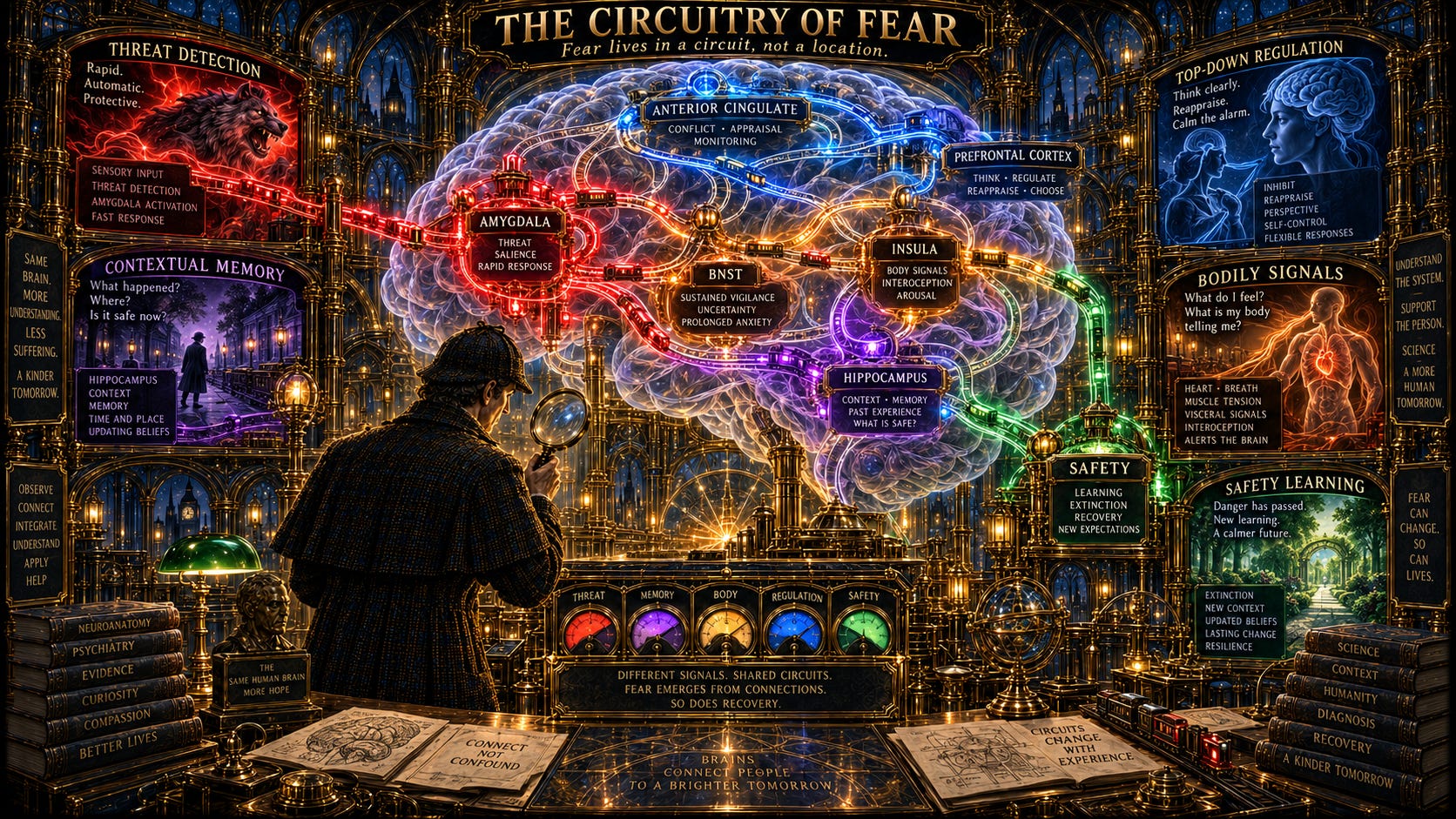 PSYCH 121: Anxiety Disorders - Neuroimaging and Neuroanatomical Circuits 13.09.2026 45dkMedlock Holmes enters the Grand Neuroanatomical Theatre of Fear.At the centre hangs an enormous transparent brain.The amygdala glows brightly.But Holmes does not stop there.Around it are the hippocampus.The medial and orbital prefrontal cortex.The anterior cingulate cortex.The insula.The thalamus.The hypothalamus.The bed nucleus of the stria terminalis.The periaqueductal grey.The locus coeruleus.Sensory association cortices.White-matter pathways.Every structure is connected.The chapter begins with an important methodological principle.To understand the circuitry of anxiety, investigators move step by step:First, identify the clinical phenomenon.Then identify the brain systems that normally perform that function.Then determine whether those systems behave differently in people with anxiety disorders.Finally, ask whether those abnormalities relate to symptoms, course, or treatment response.The functional problems are familiar:Persistent learning about threat.Exaggerated fear.Poor extinction.Difficulty suppressing attention to danger.Overgeneralisation from one threat to similar safe stimuli.Heightened perception of threat.Increased sensitivity to bodily sensations.Neuroimaging attempts to map these phenomena onto circuits.Holmes enters the Fear Learning Laboratory.A neutral cue appears.Then an aversive event.Again.And again.Eventually the cue alone produces fear.The cue has become the CS+.Another cue that was never paired with danger becomes the CS−.The amygdala learns the association.But then the experiment changes.The CS+ is repeatedly presented without the aversive event.Fear gradually decreases.This is extinction.Holmes notices something crucial.Extinction does not erase the original fear memory.It creates a new competing safety memory.That means extinguished fear can return.After time.In another context.After an unexpected aversive event.The fear memory was not destroyed.It was inhibited.The chapter distinguishes this from memory reconsolidation.When a fear memory is retrieved, it temporarily becomes unstable.During a reconsolidation window, new information may modify the original memory itself.This raises the possibility that future interventions might not simply suppress old fear, but update it.The clinical relevance is immediate.Exposure therapy works through these same learning principles.The therapeutic challenge is therefore not merely helping the patient endure fear.It is helping the brain encode and retain safety.Holmes now enters the Amygdala Chamber.Sensory information arrives through two major routes.The first is fast.The thalamus sends relatively crude information directly towards the lateral amygdala.Danger can be detected before the cortex has fully analysed what is happening.The second is slower.Sensory cortex processes the stimulus in greater detail before communicating with the amygdala.The lateral amygdala receives converging information about the conditioned and unconditioned stimuli.The basal and accessory basal nuclei help shape learning and memory.The central nucleus becomes the major output station.From there, signals descend towards the hypothalamus, brainstem, and motor systems.Heart rate rises.Blood pressure changes.Breathing accelerates.The body freezes or prepares to flee.Stress hormones are released.Facial expression changes.The figure on page 6 maps this architecture beautifully: external threat enters through sensory and thalamic pathways, converges upon the amygdala, and then recruits systems controlling endocrine, autonomic, behavioural, and motor responses.But Holmes notices another structure beside the amygdala:The Bed Nucleus of the Stria Terminalis.The distinction becomes fundamental.The amygdala is strongly involved in acute fear.The BNST is particularly important for sustained anxiety.An obvious danger appears.The amygdala responds.An uncertain threat may appear sometime soon.The BNST keeps the organism vigilant.This distinction becomes especially important in generalized anxiety disorder.Holmes then reaches the Prefrontal Control Room.The medial prefrontal cortex and anterior cingulate are not passive observers.They regulate fear.Interpret context.Predict consequences.Modify behaviour.Help determine whether the amygdala should continue sounding the alarm.The prelimbic and infralimbic regions in animal models provide an important conceptual framework.Prelimbic circuitry can support fear expression.Infralimbic circuitry contributes to extinction.In humans, the ventromedial prefrontal cortex performs an analogous regulatory role.The source’s figure on page 9 places fear expression and fear extinction beside one another.During fear expression, amygdala output activates downstream physiological responses.During extinction, hippocampal contextual information and infralimbic/vmPFC pathways recruit inhibitory interneurons within the amygdala, suppressing central-amygdala output.The same fear cue can therefore produce a very different response depending on which circuit dominates.Holmes sees anxiety as a problem of balance.Threat detection must be fast enough to protect.But cortical regulation must be strong enough to stop fear when the danger is no longer relevant.The next chamber belongs to the hippocampus.The amygdala asks:“Is this dangerous?”The hippocampus adds:“Where are we?”Context matters.A person bitten by a dog may learn fear.But whether that fear is expressed later depends partly on whether the current environment resembles the original context.The hippocampus helps distinguish:This place was dangerous.This place is safe.This cue used to predict harm.Here, it no longer does.Without contextual discrimination, fear generalises.The same signal spreads across places and situations that were never dangerous.The hippocampus therefore helps determine whether the original fear memory or the newer extinction memory should dominate.Holmes then encounters the Orbitofrontal Chamber.The orbitofrontal cortex tracks changing reinforcement.What used to predict danger may no longer do so.What used to be safe may now carry risk.Behaviour must change accordingly.Damage to orbitofrontal systems produces perseveration.The person continues using an old strategy despite changed circumstances.In anxiety, dysfunctional orbitofrontal regulation may contribute to continued fearful thoughts and behaviours even when reinforcement no longer supports them.The next room belongs to the insula.Here, Holmes hears the body.Heartbeat.Breathing.Nausea.Chest tightness.Internal temperature.Visceral sensations.The insula plays a central role in interoception.This is particularly relevant to panic disorder.The person does not merely experience bodily sensations.They monitor them.Interpret them.Amplify them.A harmless change in heart rate becomes evidence of catastrophe.The brain’s representation of internal bodily state becomes part of the threat itself.Holmes enters the Imaging Observatory.Different instruments examine different dimensions of brain structure and function.Structural MRI measures regional size and shape.Voxel-based morphometry compares grey-matter architecture.Diffusion tensor imaging estimates white-matter organisation through measures such as fractional anisotropy.PET examines blood flow or metabolism.fMRI measures BOLD signal.EEG records electrical activity.MEG measures magnetic fields generated by neuronal activity.But Holmes quickly learns that brain imaging is always state dependent.A resting brain.A brain viewing fearful faces.A brain recalling panic.A brain anticipating shock.A brain undergoing treatment.These are not equivalent experiments.Neuroimaging therefore depends as much on the task as on the scanner.The next chamber examines healthy fear learning.Human studies repeatedly show increased amygdala activity to a CS+ compared with a CS−.During extinction, vmPFC activation becomes important.Stronger vmPFC activation predicts better retention of extinction.The hippocampus becomes particularly active when context determines whether fear or safety should be expressed.Together, the amygdala, vmPFC, and hippocampus form a central circuit for human fear acquisition and extinction.Holmes then enters the Emotional Face Gallery.Hundreds of faces look towards him.Fearful.Angry.Happy.Neutral.Surprised.The amygdala responds to many emotionally salient expressions, but fearful and ambiguous faces can produce particularly strong responses.Why?A fearful face says:“Something dangerous is nearby.”But it does not reveal what the danger is.Uncertainty itself becomes salient.Even when fearful faces are presented too briefly for conscious recognition, the amygdala can still respond.Threat processing can therefore occur before explicit awareness.The anterior cingulate detects conflict.The lateral prefrontal cortex helps redirect attention.The insula monitors bodily state.The amygdala enhances memory for emotionally salient events.Holmes sees why anxiety can become so persistent.The brain not only detects threat.It can preferentially remember it.The investigation now turns to individual disorders.The first chamber is Panic Disorder.Holmes must explain something unusual.Why does panic sometimes appear to occur without any trigger?One theory suggests a false alarm.Normal fear circuitry activates inappropriately because of abnormalities in internal homeostatic systems.Another theory suggests failed regulation.A small anxiety response begins but cortical systems fail to contain it.A third possibility is that the trigger exists, but is processed outside conscious awareness.The patient experiences the attack as spontaneous.The brain may have detected something the conscious mind did not.Neuroimaging in panic disorder shows abnormalities across hippocampal and parahippocampal regions, temporal cortex, amygdala, insula, ACC, orbitofrontal cortex, and prefrontal systems.Resting-state abnormalities are found even when no panic attack is occurring.During panic-related provocation, the insula, frontal cortex, cingulate cortex, hippocampus, and striatum may become unusually active.Emotional-face studies often show increased amygdala and insula activation alongside reduced vmPFC and ACC recruitment.The overall pattern suggests excessive bottom-up alarm combined with insufficient top-down regulation.Treatment begins to alter this architecture.Following CBT, activity in frontal regions can decrease while functional connectivity with the amygdala, hippocampus, and prefrontal systems improves.Stronger baseline negative ACC–amygdala connectivity has even been associated with better later response to pharmacotherapy or CBT.Holmes writes:Treatment does not merely reduce symptoms. It can reorganise the circuitry supporting those symptoms.The next chamber contains Specific Phobias.Here the neurobiology becomes more stimulus-specific.Show a spider to someone with spider phobia.The amygdala activates.The insula activates.The anterior cingulate activates.Present an unrelated emotional stimulus.The same exaggerated response may disappear.The hypersensitivity is closely tied to the feared category.The source describes an elegant distinction.During brief, predictable exposure to a phobic stimulus, the amygdala is particularly active.During prolonged, uncertain threat, the BNST and ACC become more involved.The finding mirrors the larger distinction between immediate fear and sustained anxiety.The source also shows that successful exposure therapy changes brain function.Before treatment:High amygdala.High insula.High ACC activity.Shortly after treatment:Amygdala activation falls.Prefrontal engagement rises.Months later:Amygdala reactivity remains lower, even though the prefrontal system no longer needs to work as hard.The brain has not simply learned to suppress fear consciously.The threat representation itself has become less reactive.Holmes moves next to Social Anxiety Disorder.The feared stimulus is no longer a spider.It is another human being.A face.A judgement.A stare.A critical comment.An audience.Social-anxiety imaging repeatedly shows heightened amygdala responses to socially relevant stimuli.The threshold for perceiving social threat appears lower.The insula also becomes hyperresponsive.Frontolimbic connectivity may be weaker.Most strikingly, the abnormality is selective.A socially anxious patient may show heightened amygdala activity to a human face but not to an aversive smell.Self-referential criticism produces particularly strong amygdala and medial prefrontal responses.The brain is not overreacting equally to everything unpleasant.It is selectively tuned to social evaluation.CBT again changes the circuitry.After treatment, patients show greater dorsolateral and dorsomedial prefrontal engagement during cognitive reappraisal and stronger negative coupling between dmPFC and amygdala.The cortex becomes more effective at regulating limbic response.Pretreatment imaging can even improve prediction of who responds to CBT beyond clinical measures alone.The possibility of personalised psychiatry begins to emerge.The next chamber belongs to Generalized Anxiety Disorder.Here the threat has no single object.The problem is sustained uncertainty.Worry.Overgeneralisation.Failure to distinguish danger from safety.The amygdala findings are therefore less straightforward.Some studies show hyperactivity.Some do not.Some show responses even to neutral stimuli.But the BNST becomes especially important.The source’s figure on page 30 shows delayed but sustained BNST activation during threat anticipation in GAD.The amygdala responds more rapidly.The BNST response emerges later and persists.The brain has moved from:“Danger now.”to“Danger may be coming.”The distinction maps closely onto the clinical difference between fear and anxiety.GAD also shows persistent activity in the dACC and dmPFC after worry induction.Healthy individuals activate these regions during worry, then return towards baseline.People with GAD continue activating them even after the provoking task ends.The worry circuit does not disengage.Fear-generalisation experiments reveal another clue.When a harmless stimulus resembles the original threat cue, people with GAD are more likely to generalise fear towards it.At the same time, vmPFC recruitment is reduced.The brain becomes less effective at saying:“This looks similar, but it is not the danger.”Connectivity between ACC and amygdala is also impaired.The uncinate fasciculus - a major white-matter pathway connecting frontal and temporal regions - shows reduced integrity in some studies.The disorder therefore appears to involve not simply an overactive fear centre, but impaired communication between regulation and threat systems.Holmes now steps back and compares the disorders.The amygdala appears across all of them.But not in the same way.In panic disorder, hyperreactivity may extend across both specific and general threat cues.In specific phobia, the response is particularly tied to the phobic stimulus.In social anxiety, it is especially strong for socially relevant threat.In GAD, the pattern is less consistently amygdala-dominated, with the BNST becoming especially important for sustained anticipatory anxiety.The anterior insula appears across several disorders.The hippocampus seems particularly important in panic disorder.The prefrontal cortex and ACC contribute varying degrees of deficient control.There is therefore both shared circuitry and disorder-specific circuitry.The final major chamber is labelled:DEVELOPMENTHolmes sees the same brain changing across childhood, adolescence, and adulthood.The amygdala develops relatively early.The hippocampus also matures earlier.But prefrontal regulatory systems develop slowly.They do not achieve mature organisation until early adulthood.That creates an important developmental imbalance.The alarm system becomes powerful before the regulatory system has fully matured.Adolescence may therefore represent a particularly vulnerable period for fear regulation.The capacity to extinguish conditioned fear appears reduced during adolescence compared with childhood and adulthood.At the same time, social stimuli become increasingly important.This may help explain why many anxiety disorders peak during adolescence.The source’s figure on page 35 demonstrates something even more important.Amygdala–vmPFC connectivity differs not only by anxiety diagnosis, but by age.Adults and young people with anxiety do not necessarily show the same neural pattern.The biology of anxiety changes across development.That means we cannot simply take a circuit identified in anxious adults and assume it operates identically in children.The developmental context changes everything.Social anxiety provides a striking example.During adolescence, peer evaluation becomes biologically salient.Adolescents with social anxiety show increased amygdala activation when anticipating evaluation from peers they do not want to interact with.They may show reduced nucleus accumbens activation when anticipating feedback from desirable peers.Threat becomes stronger.Reward becomes weaker.The social world becomes organised around potential rejection.In paediatric GAD, amygdala and prefrontal abnormalities are also evident.Some studies suggest increased amygdala reactivity alongside altered vlPFC–amygdala connectivity.The ventrolateral prefrontal cortex may serve a compensatory role.Higher activation can be associated with lower symptom severity.Even treatment response may depend on these developmental circuits.Holmes reaches the final gallery.A child with behavioural inhibition stands before an unfamiliar face.The amygdala responds strongly.Years later, the same pattern may be found in an adult with an anxiety disorder.But Holmes refuses to assume that the abnormality is caused by the illness.Perhaps it existed before the illness.Perhaps it was a risk marker.Perhaps another brain compensates successfully and the disorder never develops.This is one of neuroimaging’s greatest challenges.A difference between patients and controls may represent:Cause.Consequence.Risk.Compensation.Treatment effect.Development.Or an unrelated epiphenomenon.Only longitudinal research can disentangle them.Holmes closes the imaging atlas.The chapter leaves him with a more sophisticated understanding of anxiety.The amygdala matters.But anxiety cannot be reduced to the amygdala.The hippocampus tells the brain where fear belongs.The BNST sustains uncertainty.The insula listens to the body.The prefrontal cortex regulates interpretation and response.The anterior cingulate monitors conflict.The orbitofrontal cortex updates reinforcement.White-matter pathways determine whether these regions can communicate efficiently.And development determines how the entire system is organised at a particular age.The mystery therefore lies not in finding the one place where anxiety lives.It lies in understanding how the network decides what is dangerous, what is safe, and whether the difference can still be learned.Key Takeaways* Neuroimaging has greatly expanded understanding of the circuitry underlying normal and pathological fear and anxiety.* Anxiety neurocircuitry is best understood through interactions among cortical, limbic, sensory, autonomic, and neuroendocrine systems.* Major structures include the amygdala, hippocampus, medial and orbital PFC, ACC, thalamus, hypothalamus, BNST, PAG, insula, locus coeruleus, and sensory association cortices.* Research commonly bridges phenomenology to circuitry in a stepwise fashion.* Investigators first identify the clinical functional domain that appears abnormal.* They then identify the normal neural circuitry supporting that function.* They test whether abnormalities exist in those circuits in anxiety disorders.* Finally, they examine whether those abnormalities relate to symptoms or treatment response.* Important functional domains include persistent threat learning, exaggerated fear, impaired extinction, impaired extinction retention, threat overgeneralisation, attentional bias, emotional interference, perceptual hypersensitivity, and anxiety sensitivity.* Classical fear conditioning remains a major experimental model.* A neutral conditioned stimulus becomes a CS+ when repeatedly paired with an aversive unconditioned stimulus.* A stimulus not paired with the aversive event functions as the CS−.* Fear responses to the CS+ can include startle, freezing, autonomic activation, and preparation for danger.* Fear extinction occurs when the CS+ is repeatedly presented without the aversive outcome.* Extinction does not erase the original fear memory.* Instead, extinction creates a competing safety memory.* Because the original fear memory remains, extinguished fear can return.* Spontaneous recovery refers to return of fear after passage of time.* Reinstatement refers to return of fear after exposure to an unsignalled aversive event.* Context can determine whether the original fear memory or extinction memory dominates.* Extinction learning is often strongest in the context where extinction occurred.* Return to the original conditioning context can restore fear.* Context dependence has important implications for exposure therapy.* Exposure learning should ideally generalise across multiple situations and environments.* Memory reconsolidation differs conceptually from classical extinction.* Retrieved memories temporarily enter a labile state.* New information presented during the reconsolidation window may modify the original memory.* Reconsolidation research may eventually provide alternative ways to update maladaptive fear.* Exposure-based therapy relies heavily on principles derived from fear extinction.* Effective treatment may therefore depend upon extinction acquisition, retention, and generalisation.* Emotional processing can be divided into evaluation, expression, experience, and modulation.* Emotional evaluation involves assessing valence, significance, prior experience, and context.* Emotional expression includes behavioural, autonomic, and endocrine responses.* Emotional experience refers to subjective feelings.* Emotional modulation prevents responses from becoming persistent, excessive, or maladaptive.* Fear circuitry allows both rapid responses to simple threats and slower responses to complex contextual information.* The amygdala plays a central role in fear learning and organisation of fear responses.* The amygdala comprises multiple nuclei with distinct functions.* The lateral amygdala acts as a major sensory interface.* It receives information from the thalamus and sensory cortex.* Conditioned and unconditioned information converge within the lateral amygdala.* Direct thalamus-to-amygdala pathways permit rapid processing of simple potential threats.* Cortical sensory pathways provide slower but more detailed stimulus analysis.* Rapid threat processing can occur before conscious recognition.* The basal and accessory basal nuclei contribute to fear-memory learning.* The central nucleus of the amygdala is a major output structure.* The central amygdala coordinates behavioural, autonomic, endocrine, and motor manifestations of fear.* The source’s circuitry diagram on page 6 shows sensory and thalamic input converging upon the amygdala and projecting onwards to systems controlling fear expression.* Central-amygdala projections influence the hypothalamus, PAG, facial motor systems, autonomic nuclei, and neuroendocrine pathways.* Amygdala output contributes to cardiovascular responses, hyperventilation, freezing, startle, facial expression, and endocrine activation.* Amygdala plasticity contributes to rapid learned-fear responses.* Cortical plasticity contributes particularly to higher-order and declarative components of emotional learning.* The amygdala can strengthen long-term memory of emotionally significant events.* Noradrenergic signalling in the basolateral amygdala contributes to emotional-memory consolidation.* Glucocorticoids interact with noradrenergic systems during emotional learning.* The BNST is particularly important in sustained anxiety.* Central-amygdala systems are especially involved in acute fear responses to explicit threat.* BNST activity is particularly associated with longer-lasting responses to uncertain or poorly defined threat.* This distinction supports the conceptual separation between acute fear and sustained anxiety.* The medial and orbital PFC regulate emotional responses.* Prefrontal systems interpret higher-order significance and consequences of emotional stimuli.* The PFC and amygdala communicate through extensive reciprocal projections.* The mPFC can regulate amygdala output through basal-amygdala and intercalated-cell pathways.* Prelimbic circuitry in animals contributes to fear expression.* Infralimbic circuitry contributes importantly to fear extinction.* The infralimbic cortex is often considered analogous to parts of the human vmPFC.* The prelimbic cortex has functional parallels with dorsal ACC regions.* Damage to extinction-related prefrontal circuitry impairs later recall that the threat is safe.* The figure on page 9 contrasts circuitry of fear expression with circuitry of extinction.* During extinction, contextual information from the hippocampus and vmPFC-like systems recruits inhibitory mechanisms within the amygdala.* GABAergic intercalated cells can suppress central-amygdala output.* Pregenual ACC activity increases during experimentally induced anxiety.* Electrical stimulation of related ACC regions can produce fear, panic, or foreboding.* Subgenual ACC abnormalities have been described in GAD and other affective and stress-related disorders.* mPFC lesions can disrupt autonomic responses and the ability to use probabilistic information about rewarding and aversive outcomes.* Rostral mPFC activity may help attenuate cardiovascular and behavioural responses to threat.* The hippocampus is particularly important for contextual fear.* Hippocampal projections allow the organism to identify where danger was encountered.* Contextual information helps determine whether a fear memory or extinction memory should be expressed.* Hippocampal impairment can weaken contextual discrimination.* Poor contextual discrimination may contribute to inappropriate generalisation of fear.* Hippocampal-vmPFC interactions contribute to context-dependent extinction.* The hippocampus may contribute directly to consolidation and maintenance of contextual fear memory rather than simply supplying contextual information to the amygdala.* The perirhinal cortex contributes to processing complex sensory stimuli associated with fear.* The anterior insula and vlPFC contribute to contextual and emotional processing.* The temporopolar cortex contributes to evaluation of emotionally salient visual stimuli and autonomic modulation.* The orbitofrontal cortex helps update behaviour when reinforcement contingencies change.* OFC dysfunction can produce perseveration and failure to stop previously reinforced behaviours.* Abnormal OFC function may therefore contribute to persistent maladaptive emotional or behavioural responses in anxiety.* Posterior cingulate and retrosplenial regions participate in affective salience and contextual memory.* The medial cerebellum shows activation across several normal and pathological anxiety states.* Cerebellar circuits may contribute to autonomic regulation as well as broader cortical processing.* The amygdala is involved in more than fear.* It responds to biologically salient positive and negative information.* It contributes to uncertainty, novelty, violations of expectation, emotional memory, social information, and arousal.* Amygdala lesions impair recognition of fear in faces and fear or anger in voices.* Amygdala responses to emotional faces can occur without conscious awareness.* Emotional arousal strengthens amygdala-mediated memory encoding.* The hypothalamus and autonomic nervous system convert neural threat signals into peripheral physiological responses.* Lateral hypothalamic activation contributes to sympathetic responses.* These include increased heart rate, blood pressure, sweating, piloerection, and pupillary dilation.* The PVN contributes to HPA-axis activation.* CRH stimulates ACTH.* ACTH promotes adrenal cortisol secretion.* Limbic circuitry also influences parasympathetic pathways producing visceral symptoms.* The vagus and splanchnic nerves contribute to visceral manifestations of anxiety.* Prefrontal regions also modulate heart rate, blood pressure, and glucocorticoid secretion.* Structural MRI provides measures of brain size, shape, and tissue characteristics.* Voxel-based morphometry can identify regional structural differences.* Cortical-thickness analysis provides another measure of structural variation.* Diffusion tensor imaging assesses organisation of white-matter tracts.* Fractional anisotropy is commonly used as an index of white-matter organisation.* PET can measure regional blood flow or glucose metabolism.* fMRI measures changes in blood oxygenation through the BOLD signal.* EEG measures electrical activity.* MEG measures magnetic fields generated by neuronal activity.* Imaging results depend on the individual’s cognitive and emotional state during acquisition.* Resting-state paradigms assess brain function without specific symptom provocation.* Symptom-provocation paradigms deliberately induce disorder-relevant states.* Cognitive or behavioural activation paradigms probe defined neural processes.* Longitudinal imaging can assess development or treatment-related change.* Pretreatment imaging may help identify predictors of treatment response.* Human fear-conditioning studies show increased amygdala activation to CS+ compared with CS−.* Greater amygdala activation during acquisition often corresponds with stronger conditioned responses.* vmPFC activation is particularly important during extinction and extinction recall.* vmPFC activity can predict how well extinction learning is retained.* Greater medial OFC thickness has been associated with better extinction recall in some studies.* Hippocampal activation occurs during contextual conditioning and context-dependent extinction.* Humans with hippocampal lesions show impairment in contextually mediated reinstatement.* Amygdala, vmPFC, and hippocampus therefore form a core human circuit for fear conditioning and extinction.* Emotional-face paradigms reliably recruit the amygdala.* Fearful faces tend to produce particularly strong amygdala activation.* Fearful faces may be especially salient because they communicate threat without specifying its source.* Surprised faces also strongly recruit the amygdala because they are ambiguous.* Backward-masked faces can activate the amygdala without explicit awareness.* Repeated emotional-face presentations can be used to examine habituation.* Anxiety disorders are associated with attentional bias towards threat.* The dorsal ACC is strongly involved in cognitive conflict.* The ventral ACC contributes particularly to emotional conflict.* The lateral PFC contributes to cognitive control and redirection of attention.* The amygdala and hippocampus participate in enhanced memory for emotionally arousing information.* The insula is strongly implicated in interoception.* Interoceptive processes include perception and interpretation of heartbeat, visceral sensations, and internal bodily states.* Altered interoceptive processing is particularly relevant to panic disorder.* A broad model of anxiety disorders involves excessive amygdala reactivity and/or deficient cortical regulation.* Abnormal amygdala-mPFC and amygdala-hippocampal connectivity appears across multiple anxiety disorders.* Panic disorder must account for both spontaneous panic attacks and learned avoidance following attacks.* One theory conceptualises panic as aberrant recruitment of normal fear circuitry because of homeostatic disturbance.* The false suffocation alarm model is one example.* Another model proposes deficient regulation that allows minor anxiety to escalate into panic.* A third model proposes that apparently spontaneous panic may be triggered by stimuli processed without conscious awareness.* Amygdala hyperresponsivity to implicit cues could therefore generate attacks perceived as spontaneous.* Hippocampal or parahippocampal dysfunction may impair conscious contextual recognition.* Panic disorder has been associated with abnormalities in brainstem systems, monoaminergic function, lactate metabolism, hippocampus, parahippocampus, amygdala, insula, ACC, and PFC.* Resting-state imaging shows abnormalities even between panic attacks.* Altered hippocampal, parahippocampal, and superior temporal activity has been described.* Increased ACC–precuneus connectivity has also been reported.* Whether resting abnormalities cause chronic anticipatory anxiety or result from it remains unclear.* Panic-provocation imaging studies have produced heterogeneous findings.* Reported changes include frontal reductions and increased putamen or ACC activity.* Insula findings during panic are inconsistent.* Spontaneous-panic imaging studies are rare and based on very small samples.* Panic-related cognitive and visual stimuli can produce exaggerated frontal, cingulate, OFC, hippocampal, insular, and striatal responses.* Emotional-face studies often show increased amygdala and insula activation with reduced vmPFC and ACC recruitment.* Unpredictable aversive stimuli may produce particularly strong insula activation in panic disorder.* CBT-related remission in panic disorder has been associated with altered frontal activity and stronger frontolimbic connectivity.* Baseline ACC-amygdala connectivity may predict response to both pharmacotherapy and CBT.* Structural imaging in panic disorder has reported smaller OFC, putamen, and temporal-lobe volumes in some studies.* Increased insula and brainstem volumes have also been reported.* Reduced parahippocampal grey-matter density has been described.* Amygddala-volume findings in panic disorder remain inconsistent.* Overall, temporal and hippocampal abnormalities may contribute to deficient top-down regulation after an initial panic attack.* Specific phobias involve neural hypersensitivity to specific feared stimuli.* Meta-analyses consistently show increased insula and amygdala activation during phobic-stimulus exposure.* ACC, OFC, thalamic, and cerebellar activation may also increase.* Acute predictable phobic threat is especially associated with amygdala activation.* Sustained unpredictable phobic threat is more strongly associated with BNST and ACC activation.* BNST-amygdala connectivity may be increased in specific phobia.* Amygdala hyperreactivity is generally specific to the phobic stimulus rather than to all emotional stimuli.* Reduced vmPFC activity may contribute to impaired automatic regulation of phobic fear.* Reduced dACC/dmPFC recruitment may impair effortful regulation.* Different phobia subtypes may have partly distinct neural signatures.* Spider phobia may involve stronger dACC and insula abnormalities.* Blood-injection-injury phobia may involve greater PFC, thalamic, and occipito-temporo-parietal alterations.* Sensory association cortices involved in a particular sensory modality may become selectively sensitised.* Exposure therapy changes the neural representation of phobic stimuli.* Successful exposure reduces limbic and frontal activation.* Immediately after exposure therapy, reduced amygdala activity may be accompanied by increased prefrontal control.* Months later, reduced amygdala response can persist without continued excessive prefrontal recruitment.* This suggests lasting reorganisation rather than permanent effortful suppression.* Lower visual-cortex activation after exposure has predicted better later outcome in spider phobia.* Structural abnormalities reported in specific phobias include altered cortical thickness and regional grey-matter volume.* Findings differ among animal, dental, blood-injection-injury, and spider phobias.* Social anxiety disorder involves heightened neural sensitivity to socially relevant threat.* Potential mechanisms include excessive threat sensitivity, sensitivity to scrutiny, and reduced reward value of positive social stimuli.* Public-speaking and contemptuous-face paradigms consistently produce heightened amygdala activity in SAD.* Amygdala activation correlates with social-anxiety severity in some studies.* The amygdala may activate at a lower threshold of social threat in SAD.* Increased insula activation is also common.* Reduced striatal responses during implicit learning have been reported.* Alterations in OFC, ACC, mPFC, and parahippocampal function may also occur.* Weaker frontolimbic connectivity may contribute to heightened social-threat reactivity.* Neural abnormalities in SAD can be selective for social rather than nonsocial threat.* Human faces may provoke amygdala hyperreactivity whereas aversive odours do not.* Self-referential criticism particularly activates the amygdala and mPFC.* The neural response therefore appears tuned to personal social judgement.* CBT can increase dlPFC and dmPFC engagement during cognitive reappraisal.* CBT may strengthen negative dmPFC-amygdala coupling.* Earlier recruitment of regulatory prefrontal systems may accompany successful treatment.* Pretreatment PFC and amygdala activity can help predict CBT response.* Amygdala-ACC connectivity may also predict outcome.* Neural measures can improve treatment-response prediction beyond clinical variables in some studies.* Structural imaging in SAD has found reduced uncinate-fasciculus FA.* This supports impaired structural connectivity between frontal and limbic regions.* Increased cortical thickness has been reported in ACC, insula, dlPFC, and parietal cortex.* Lower grey-matter volume has been described in lateral OFC, parahippocampus, and cerebellum.* Generalized anxiety disorder requires a model that explains excessive worry and fear overgeneralisation.* Amygdala findings in GAD are less consistent than in several other anxiety disorders.* Some studies show normal or reduced amygdala activation to fearful faces.* Others suggest nonspecific hyperreactivity to both negative and neutral stimuli.* The BNST appears particularly important in sustained anxiety in GAD.* GAD can involve brief phasic amygdala responses followed by delayed sustained BNST activation.* The figure on page 30 demonstrates elevated sustained BNST activity during threat anticipation in GAD.* The BNST response in the study shown was delayed by approximately 6–7 seconds.* This temporal distinction supports a model of amygdala-mediated acute fear followed by BNST-mediated sustained anxiety.* GAD is also associated with persistent dACC and dmPFC activation during and after worry induction.* Healthy individuals may return towards baseline after worry, whereas individuals with GAD maintain activity.* dACC/dmPFC activation correlates with subjective worry.* GAD patients show greater fear generalisation to stimuli resembling a conditioned threat.* Reduced vmPFC recruitment accompanies poor threat-versus-safety discrimination.* vmPFC dysfunction may therefore contribute to overgeneralisation.* GAD is associated with impaired cortical-limbic connectivity.* Healthy subjects show negative pgACC-amygdala coupling during emotional regulation.* Patients with GAD may fail to recruit the pgACC or develop this inhibitory connectivity.* Abnormal resting amygdala connectivity has also been described.* Pretreatment ACC and amygdala activity may predict response to venlafaxine.* Citalopram treatment can reduce prefrontal and limbic responses to worry-related stimuli.* CBT can reduce amygdala and sgACC activation to threatening faces.* CBT can increase responsiveness to positive stimuli.* Reduced FA in the bilateral uncinate fasciculus has been reported in GAD.* Lower uncinate FA is associated with weaker negative cingulate-amygdala connectivity.* Structural and functional connectivity abnormalities may jointly contribute to poor threat-safety discrimination.* Across anxiety disorders, the amygdala is one of the most consistently implicated structures.* However, the nature of amygdala dysfunction differs by diagnosis.* Panic disorder may show responses to both disorder-specific and general threat.* Specific phobia shows particularly stimulus-specific amygdala reactivity.* SAD shows particularly socially specific amygdala reactivity.* GAD shows less consistent amygdala abnormality and stronger evidence for sustained BNST dysfunction.* Increased anterior-insula activity occurs across multiple anxiety disorders.* Hippocampal abnormalities appear particularly relevant to panic disorder.* Prefrontal and ACC dysfunction varies across disorders.* Shared and disorder-specific circuitry supports both the grouping and separation of anxiety diagnoses.* Far less neuroimaging research exists for separation anxiety disorder and selective mutism.* Development is essential to understanding anxiety circuitry.* Anxiety disorders are extremely common in childhood and adolescence.* The amygdala develops relatively early.* The hippocampus also matures earlier than the PFC.* The PFC undergoes prolonged development extending into early adulthood.* Amygdala connections with PFC and hippocampus continue developing through childhood and adolescence.* Earlier maturation of threat-reactivity systems than regulatory prefrontal systems may create a developmental imbalance.* Adolescence may therefore be a period of altered fear regulation.* Basic discrimination between threat and safety improves with age.* Fear expression and extinction show nonlinear developmental trajectories.* Adolescence may be associated with reduced cued-fear extinction compared with childhood and adulthood.* Youth with anxiety disorders generally show stronger fear responses than nonanxious youth even where overall acquisition and extinction patterns appear similar.* Age modifies the relationship between anxiety and amygdala-vmPFC connectivity.* The figure on page 35 shows that anxious adults and anxious youths can exhibit different or even opposite amygdala-vmPFC connectivity patterns.* Developmental neuroimaging therefore warns against assuming that adult anxiety circuitry applies unchanged to children.* Sensitive developmental periods represent both vulnerability and opportunity.* Environmental influences may have greater impact during periods of heightened neuroplasticity.* Stress during sensitive periods can alter neurodevelopmental trajectories.* The same plasticity may also make early intervention particularly powerful.* Behavioural inhibition is a childhood temperament associated with increased later anxiety risk.* Behavioural inhibition is associated with heightened amygdala response to novelty.* Similar amygdala patterns are found in adult anxiety disorders.* Cross-sectional studies therefore cannot determine whether an imaging abnormality represents disease or pre-existing risk.* Risk markers must ideally be studied in people who carry the vulnerability but have not developed the disorder.* Age, sex, medication, menstrual phase, and diurnal variation can influence brain-based measures.* Developmental neuroimaging in children primarily uses fMRI to avoid radiation exposure associated with PET.* Child fear-conditioning paradigms use developmentally appropriate aversive stimuli such as noises, air puffs, or images.* High comorbidity means many paediatric studies examine mixed anxiety groups rather than isolated diagnoses.* Greater frontal activation has been associated with better treatment response in anxious youth.* Social anxiety in adolescence must be understood within increasing developmental salience of peer evaluation.* Adolescents with SAD show increased amygdala activity when anticipating evaluation by undesirable peers.* Greater positive vmPFC-amygdala connectivity in this context correlates with symptom severity.* Socially anxious adolescents may show reduced nucleus-accumbens activity when anticipating feedback from desirable peers.* This suggests a combination of enhanced social-threat processing and reduced positive social-reward processing.* Unexpected positive feedback can produce abnormal striatal and frontostriatal responses in adolescents with SAD.* Some neural markers of social processing may precede later social-anxiety symptoms.* Paediatric GAD also involves altered amygdala and prefrontal function.* Youth with GAD may show increased amygdala responses when attending to their own fear.* Heightened amygdala activity to masked angry faces has also been demonstrated.* Greater amygdala reactivity correlates with higher anxiety severity in some studies.* Youth with GAD show weaker vlPFC-amygdala connectivity.* Increased vlPFC activity may play a compensatory role.* Greater vlPFC activation is associated with lower symptom severity in some studies.* Paediatric GAD may involve larger amygdala volume and increased cortical thickness in several regions.* Higher pretreatment amygdala activity may predict greater improvement with CBT or pharmacotherapy in some young people.* Treatment may increase vlPFC recruitment.* Neuroimaging abnormalities cannot automatically be interpreted as causes of anxiety.* They may represent vulnerability, illness effects, compensation, developmental variation, treatment effects, or epiphenomena.* Longitudinal studies are essential for distinguishing these possibilities.* Future research should integrate neuroimaging with genetics and neurochemistry.* Psychiatric diagnoses remain neurobiologically heterogeneous.* Integrated approaches may identify more biologically meaningful anxiety phenotypes.* Neuroimaging may eventually contribute to personalised treatment selection.* The most useful overarching model is not one of an isolated fear centre but of dynamic communication among threat-detection, contextual-memory, interoceptive, regulatory, autonomic, and extinction systems.* Anxiety disorders arise when these systems become poorly calibrated to one another.* The central neuroanatomical problem is therefore not simply excessive fear, but impaired ability to discriminate danger from safety and update the brain when circumstances change. This is a public episode. If you'd like to discuss this with other subscribers or get access to bonus episodes, visit drmanaankarray.substack.com/subscribe
 -
 PSYCH 120: Anxiety Disorders - Neurobiology and Neuroscience 12.09.2026 1sa 21dkMedlock Holmes enters the Neurobiological Citadel of Fear.At its centre stands an enormous transparent brain.It is not silent.Signals move constantly between the amygdala, hippocampus, prefrontal cortex, thalamus, hypothalamus, locus coeruleus, and brainstem.Some pathways detect threat.Others generate autonomic responses.Others encode memories.Others decide whether a stimulus is dangerous.Others determine whether the alarm can finally be switched off.Holmes immediately sees the problem.Anxiety is not produced by a single fear centre.It is produced by a network.The central diagram on page 4 captures this clearly. The thalamus contributes to autonomic and endocrine regulation. The hippocampus and amygdala participate in salience detection and associative learning. The locus coeruleus projects widely to cortex and helps regulate attention, arousal, and pain evaluation. The prefrontal cortex helps coordinate higher-order regulation of these responses.The first chamber belongs to norepinephrine.The locus coeruleus sits in the pons like an emergency broadcasting tower.When danger appears, norepinephrine surges.Heart rate increases.Pupils dilate.Breathing accelerates.Attention narrows.Vigilance rises.The organism becomes ready to fight or flee.In the short term, this is adaptive.But when the noradrenergic system becomes excessively active, the same protective response can become pathological.The person remains hyperaroused when danger has passed.Startle becomes excessive.Attention remains locked onto threat.Autonomic symptoms themselves become frightening.This is particularly relevant to panic disorder and phobic states.Holmes sees the paradox.Drugs that increase norepinephrine acutely may provoke anxiety.Yet SNRIs and tricyclic antidepressants can treat anxiety disorders over time.The explanation lies in adaptation.Their therapeutic effects emerge not from the immediate increase in monoamine signalling, but from longer-term receptor and network changes.The next chamber is the HPA Axis Observatory.Stress activates the hypothalamus.CRH rises.ACTH follows.The adrenal glands release cortisol.Again, the system is protective.Cortisol mobilises energy.Sharpens vigilance.Modifies memory.Suppresses nonessential processes.Helps the organism survive an acute threat.But Holmes watches what happens when the system stays active for too long.Persistently elevated glucocorticoids affect the hippocampus.Cell survival changes.Morphology changes.Memory becomes impaired.Metabolic and cardiovascular effects accumulate.The source describes hypertension, osteoporosis, immunosuppression, insulin resistance, dyslipidaemia, coagulation abnormalities, and cardiovascular disease among the possible consequences of prolonged glucocorticoid exposure.Yet when Holmes compares patients with different anxiety disorders, he does not find one uniform HPA abnormality.Panic disorder shows mixed findings.GAD may show increased, decreased, or dysregulated cortisol activity.Some studies of long-term hair cortisol in GAD even suggest lower concentrations, raising the possibility that chronic anxiety can eventually downregulate the stress axis.Social anxiety also shows inconsistent findings influenced by age and sex.Specific phobias, however, can produce clear cortisol increases during exposure to the feared stimulus.The lesson is important:The stress system is dysregulated in anxiety, but not in one identical direction across all disorders.Holmes then enters the chamber of corticotropin-releasing hormone.CRH does more than activate cortisol.It operates throughout the brain.Amygdala.Prefrontal cortex.Cingulate cortex.Bed nucleus of the stria terminalis.Nucleus accumbens.Periaqueductal grey.Locus coeruleus.Raphe nuclei.CRH therefore coordinates behavioural as well as endocrine responses to stress.Early-life stress may alter CRH signalling for years.High CRH exposure can contribute to allostatic load.CRH-1 and CRH-2 receptors appear to have partly opposing functions.CRH-1 activation tends to increase anxiety-like behaviour in animal models.CRH-2 may contribute to more adaptive or anxiolytic responses.It appears biologically compelling.But clinical translation has been disappointing.CRH-1 antagonists have not yet produced reliable therapeutic success in anxiety disorders.Holmes writes another principle in his notebook:Biological plausibility does not guarantee clinical efficacy.The next chamber belongs to dopamine.Dopamine is usually associated with reward and motivation.But during stress it also changes.The medial prefrontal cortex is particularly sensitive.Moderate stress increases prefrontal dopamine.This can improve adaptive responding.Too much dopamine impairs cognition.Too little may delay extinction of conditioned fear.Holmes sees an inverted-U-shaped control system.Optimal dopamine allows flexible learning.Excessive dopamine destabilises cognition.Insufficient dopamine makes the brain slow to update when danger is no longer present.This becomes especially important in fear extinction.The person may know intellectually that the situation is now safe, but the defensive system fails to learn it.The next chamber is serotonin.Here the biology becomes even more complex.Serotonin can both promote and reduce anxiety depending on where in the brain it acts.In the prefrontal cortex and amygdala, serotonin can enhance awareness of threat.In the dorsal periaqueductal grey, it can suppress fight-or-flight behaviour.This dual role helps explain why serotonin can participate in panic, anticipatory anxiety, and generalized worry.The 5-HT1A and 5-HT2 receptor families are particularly important.Imaging studies show reduced 5-HT1A receptor binding in several regions in panic disorder and social anxiety.Early-life changes in serotonergic systems may have persistent effects on anxious behaviour.SSRIs eventually alter these circuits and remain among the most effective treatments for panic disorder, social anxiety disorder, and GAD.But again, the effect is delayed.The immediate neurochemical change is not the same as the final therapeutic change.Holmes then enters the GABA Chamber.Here everything becomes quieter.GABA is the major inhibitory neurotransmitter in the brain.It reduces neuronal excitability.It restrains the alarm.The GABA-A receptor sits at the centre of the chamber.Benzodiazepines bind allosterically to this receptor complex and amplify inhibition.Anxiety falls quickly.The person relaxes.Panic diminishes.But the chamber contains a warning.Tolerance.Dependence.Sedation.Memory effects.Abuse potential.This explains why benzodiazepines, despite their clear anxiolytic efficacy, are no longer considered first-line treatment for panic disorder, social anxiety disorder, or GAD.Holmes also notices something interesting.Flumazenil - a benzodiazepine antagonist - can provoke panic in people with panic disorder but not reliably in healthy controls.This suggests that the GABA system is not merely a target for treatment.It may already be altered within the disorder itself.The next chamber belongs to glutamate.The excitatory counterpart to GABA.Holmes watches the balance shift:GABA inhibition ↓Glutamate excitation ↑The alarm system becomes easier to trigger.Glutamate also interacts with norepinephrine and serotonin.NMDA receptors become particularly important because they are involved in both fear acquisition and fear extinction.Block NMDA receptors and fear learning can be impaired.But extinction can also be impaired.That produces a therapeutic puzzle.How do we reduce pathological fear without preventing the brain from learning safety?One answer emerged through D-cycloserine.Rather than acting as a traditional anxiolytic, it partially stimulates the glycine site of the NMDA receptor.The hope was that it could enhance the learning that occurs during exposure therapy.Early trials were promising.Acrophobia.Social anxiety.Panic disorder.But larger studies produced inconsistent findings.Again, Holmes sees the translational challenge:A molecule may enhance learning.But the quality and timing of the learning experience still matter.If exposure goes badly, enhancing learning could theoretically reinforce the wrong memory.Ketamine enters the story from another direction.Small preliminary studies suggest rapid reductions in refractory social anxiety and generalized anxiety symptoms.But this evidence remains limited.Other glutamatergic drugs have produced similarly mixed or preliminary results.The source repeatedly reminds Holmes not to confuse promising mechanism with established treatment.The next room is filled with hormones derived from cholesterol.These are neurosteroids.Allopregnanolone.Pregnanolone.Other progesterone metabolites.They modulate GABA-A receptors and may provide endogenous anxiolytic effects.The biology becomes particularly striking during pregnancy and the postpartum period.Progesterone and allopregnanolone rise during pregnancy.Some women with panic disorder experience improvement.Hormone concentrations fall rapidly after delivery.Anxiety may rebound.The source explores this as one example of how endogenous neurosteroid systems may influence fear and anxiety.Holmes moves onward.The next chambers contain an expanding collection of neuropeptides.Vasopressin.Oxytocin.Neuropeptide Y.Galanin.Cholecystokinin.Each modifies the stress system differently.Oxytocin is particularly associated with social behaviour, social cognition, and attenuation of stress responses.Intranasal oxytocin has reduced amygdala responses to fearful faces and altered social-anxiety circuitry in experimental studies.It may facilitate extinction of social fear.But clinical implementation remains uncertain.Neuropeptide Y appears to play a different role.Resilience.Stress buffering.Fear-memory modulation.Higher NPY activity can reduce anxiety-like behaviour in animal models.Early human work suggests potential anxiolytic effects, but clinical evidence remains preliminary.Galanin interacts closely with the noradrenergic system of the locus coeruleus and may become especially important under high stress.Again, human treatment studies are sparse.Cholecystokinin presents the opposite picture.CCK-4 can provoke panic.In both healthy people and those with panic disorder, administration can generate intense panic-like responses.This made CCK an attractive drug target.But CCK antagonists repeatedly failed to become effective anxiolytic treatments.Another compelling biological mechanism had failed the clinical test.Holmes reaches the Endocannabinoid Chamber.CB1 receptors are distributed through the prefrontal cortex, amygdala, hippocampus, and periaqueductal grey.Endocannabinoid activity increases during threat and may counteract fear responses.But dose matters.Low CB1 activation may reduce anxiety.High activation may worsen it.THC can therefore be anxiolytic at low doses and panicogenic at higher doses.CBD has shown anxiolytic effects in experimental public-speaking paradigms and in some studies of social anxiety.But the chapter treats this as an evolving research area rather than established standard treatment.The final biological chamber is labelled:INFLAMMATIONStress activates the sympathetic nervous system and HPA axis.Catecholamines influence immune cells.Cytokines may change.But unlike in some models of depression, the evidence in anxiety disorders is inconsistent.Some panic studies show higher inflammatory markers.Others show lower concentrations.Some GAD studies show elevated CRP.Social anxiety may show lower CRP in some groups.Age.Sex.BMI.Medication.Stress.All can confound the findings.Holmes refuses to create certainty where the evidence does not support it.The final chamber contains no neurotransmitter.It contains learning.A harmless stimulus was once associated with danger.Fear developed.Then the fear spread.A sound.A place.A bodily sensation.A facial expression.Eventually the alarm generalised far beyond the original threat.Anxiety disorders may therefore involve not only excessive fear acquisition, but also fear generalisation and impaired fear extinction.This insight connects neuroscience directly to psychotherapy.Exposure therapy is not merely making someone tolerate discomfort.It is a biological learning process.The patient discovers:“The feared outcome did not occur.”“The bodily sensation is survivable.”“The context is safe.”“I can remain here without escaping.”New learning competes with old fear memory.The chapter’s future direction therefore becomes clear.The goal is not simply to discover another sedative.It is to understand the precise circuits responsible for fear acquisition, generalisation, extinction, resilience, and recovery.Optogenetics.Chemogenetics.Genomics.Neuroimaging.Circuit-specific interventions.Drugs designed to enhance psychotherapy.The future lies in identifying the biological mechanism operating in the particular patient.Holmes returns to the enormous brain at the centre of the citadel.He finally understands the deeper principle.Anxiety is not an alarm that should never sound.The alarm evolved for survival.The disorder emerges when threat detection becomes exaggerated, fear spreads beyond the original danger, inhibition weakens, stress systems remain activated, or the brain fails to learn that the world has become safe again.Key Takeaways* Anxiety disorders arise from interacting neurochemical, neuroendocrine, neural-circuit, genetic, developmental, and environmental processes.* No single neurotransmitter or brain region explains all anxiety disorders.* Animal studies provide important information about defensive responses but cannot fully model the subjective human experience of fear and anxiety.* Translational work requires close collaboration between basic and clinical neuroscience.* Neuroimaging has improved understanding of human fear and anxiety circuitry.* Genetic research increasingly examines vulnerability to anxiety disorders and treatment response.* Overgeneralisation of learned fear to harmless stimuli is an important model of pathological anxiety.* Severe or prolonged stress can produce chronic alterations across multiple biological systems.* Early-life stress or trauma may increase later anxiety vulnerability through neuroendocrine, neural, epigenetic, or neurotoxic mechanisms.* Individual differences in susceptibility and resilience remain central areas of investigation.* The major fear-and-anxiety circuitry illustrated on page 4 involves the prefrontal cortex, thalamus, hypothalamus, amygdala, hippocampus, and locus coeruleus.* The thalamus contributes to autonomic and endocrine regulation.* The hippocampus and amygdala contribute to salience detection and associative learning.* The hippocampus also contributes to learning, memory, and plasticity.* Locus-coeruleus projections to cortex contribute to attention, arousal, and pain evaluation.* Norepinephrine is released centrally primarily from the locus coeruleus.* Acute threat activates the noradrenergic system as part of the fight-or-flight response.* Norepinephrine increases vigilance, arousal, autonomic activation, and readiness to respond.* Acute noradrenergic activation is adaptive when danger is real.* Excessive or sustained noradrenergic output may contribute to pathological anxiety.* The locus coeruleus projects extensively to cortical and limbic structures.* Norepinephrine modulates dopamine, serotonin, glutamate, and GABA systems.* Sympathetic norepinephrine also contributes to peripheral physiological responses.* α1 adrenergic receptors are principally postsynaptic.* α2 adrenergic receptors are principally presynaptic and contribute to negative feedback regulation.* α2 agonists such as clonidine and guanfacine reduce noradrenergic activity.* α2 antagonists such as yohimbine and idazoxan increase norepinephrine release.* Yohimbine can provoke panic in patients with panic disorder.* Idazoxan can also provoke panic responses.* Panic disorder shows evidence of altered noradrenergic responsivity.* Phobic individuals may show elevated catecholamine release in response to feared stimuli.* GAD has been associated with increased plasma norepinephrine and MHPG in some studies.* Beta-blockers reduce peripheral autonomic symptoms such as tremor and tachycardia.* Propranolol can therefore be helpful in performance anxiety.* Beta-blockers do not directly remove anticipatory social anxiety.* Alcohol, opioids, and benzodiazepines reduce noradrenergic activation and may be used maladaptively as self-medication.* Drugs such as SNRIs and tricyclic antidepressants initially increase norepinephrine but treat anxiety through delayed adaptive receptor and circuit changes.* The HPA axis is a central stress-response system.* CRH stimulates ACTH.* ACTH stimulates adrenal cortisol release.* Cortisol increases arousal, vigilance, attention, memory formation, and energy mobilisation during acute stress.* Cortisol also inhibits growth, reproductive, and immune processes during stress.* Cortisol regulates hippocampal, amygdala, and prefrontal function.* Glucocorticoids can enhance emotional-memory encoding.* Noradrenergic activation within the amygdala interacts with cortisol in memory formation.* Cortisol has biphasic effects on cognition and memory.* Moderate cortisol activity can be adaptive.* Persistent excessive glucocorticoid exposure can be harmful.* Chronic glucocorticoid exposure is associated with hypertension, osteoporosis, immunosuppression, insulin resistance, dyslipidaemia, coagulation abnormalities, and cardiovascular disease.* The hippocampus contains high concentrations of glucocorticoid and mineralocorticoid receptors.* The hippocampus plays an important role in negative feedback regulation of the HPA axis.* High glucocorticoid levels can impair hippocampal cell survival and alter cell morphology.* Stress-related hippocampal damage may contribute to cognitive and memory problems.* HPA findings in panic disorder are inconsistent.* Some studies show elevated cortisol or ACTH, while others show normal values.* Naturally occurring panic attacks may produce modest cortisol increases.* Pharmacologically provoked panic does not always activate the HPA axis in the same way.* Yohimbine-induced panic is more consistently associated with cortisol elevation than lactate-induced panic.* HPA activation may depend partly on environmental novelty and context.* GAD also shows HPA-axis abnormalities, but findings are heterogeneous.* Some studies show increased cortisol, others reduced cortisol, and others normal levels.* Reduced HPA negative-feedback sensitivity has been reported in GAD.* Long-term hair cortisol studies have found concentrations approximately 50–60% lower in some GAD samples than controls.* This may indicate downregulation of the HPA axis during chronic anxiety.* Successful GAD treatment has been associated with reduced cortisol alongside reduced anxiety symptoms.* Social anxiety disorder does not show one consistent basal cortisol abnormality.* Age and sex may influence HPA findings in social anxiety.* Specific-phobia exposure can increase cortisol.* Successful psychotherapy for specific phobia has been associated with reduced cortisol responses to the feared stimulus.* Glucocorticoids may interfere with retrieval of fear memories.* Experimental cortisol administration has reduced social fear and specific-phobia responses in some studies.* Cortisol has also been studied as an adjunct to exposure therapy.* CRH coordinates behavioural and physiological responses to stress.* CRH acts both through the HPA axis and through widespread extrahypothalamic pathways.* CRH neurons are found in the prefrontal cortex, cingulate cortex, amygdala, BNST, nucleus accumbens, PAG, locus coeruleus, and raphe nuclei.* Amygdala CRH activation can produce fear-related behaviour.* Cortical CRH activity may reduce reward expectation.* Early-life stress may produce lasting changes in CRH concentrations.* Persistent CRH activation contributes to allostatic load.* CRH-1 and CRH-2 receptors appear to have different functions.* CRH-1 activation tends to promote anxiety-like behaviour in animal models.* CRH-2 signalling may contribute to anxiolytic or adaptive stress responses.* CRH-1 knockout animals show less anxiety-like behaviour.* CRH-2 knockout animals show greater anxiety-like behaviour.* Genetic variation in CRH systems has been associated with behavioural inhibition and panic disorder.* Despite promising preclinical rationale, CRH-1 antagonists have not demonstrated convincing clinical efficacy in anxiety disorders.* Pexacerfont failed to outperform placebo in GAD.* This illustrates the difficulty of translating compelling animal mechanisms into effective psychiatric treatments.* Dopamine contributes to reward, motivation, goal-directed behaviour, and stress responses.* Stress increases dopamine release in the medial prefrontal cortex.* The mPFC dopaminergic system is especially sensitive to relatively low-intensity stress.* Greater-intensity stress recruits mesolimbic and striatal dopamine systems.* Amygdala activity influences stress-induced prefrontal dopamine release.* Prefrontal dopamine contributes to fear extinction.* Too little prefrontal dopamine may delay extinction.* Excessive stress-related prefrontal dopamine can impair cognition.* Optimal dopamine activity therefore appears to follow an inverted-U relationship.* Extreme mesocortical dopamine activity may inhibit subcortical reward processes and contribute to helpless responses.* Reduced dopamine-transporter and D2-receptor density has been reported in social anxiety disorder.* Dopamine-agonist withdrawal can produce anxiety.* Dopamine abnormalities in panic disorder remain inconsistent.* Serotonin is released primarily from the dorsal raphe system and participates extensively in stress and anxiety.* Serotonin has a dual role in defensive behaviour.* Serotonergic activity in the prefrontal cortex and amygdala can increase threat awareness.* Serotonergic activity in the dorsal periaqueductal grey can inhibit fight-or-flight responses.* This model may help explain both anticipatory anxiety and panic.* 5-HT1A and 5-HT2A receptors are particularly relevant to anxiety.* 5-HT1A receptors are distributed in cortex, hippocampus, amygdala, PAG, and raphe nuclei.* Reduced 5-HT1A binding has been reported in panic disorder.* Reduced 5-HT1A receptor binding has also been reported in social anxiety disorder.* Early-life serotonergic disruption may produce long-lasting anxious phenotypes.* Early stress may reduce 5-HT1A receptor expression through CRH and cortisol mechanisms.* SSRIs may affect different serotonergic circuits depending on the anxiety disorder.* In panic disorder, SSRIs may eventually enhance serotonergic modulation of the dorsal PAG.* In GAD, SSRIs may act partly through 5-HT2C desensitisation and 5-HT1A stimulation.* Peripheral serotonin findings in anxiety disorders are inconsistent.* Tryptophan-depletion studies have produced mixed results.* Reduced serotonin can increase sensitivity to panic provocation in some patients.* Serotonergic medications remain among the most effective pharmacological treatments for panic disorder, social anxiety disorder, and GAD.* SSRIs and SNRIs have the strongest established roles among these agents.* Buspirone acts partly through 5-HT1A mechanisms.* Newer 5-HT1A agents have shown inconsistent results.* GABA is the principal inhibitory neurotransmitter in the brain.* GABA-A receptors are fast ligand-gated ion channels.* GABA-B receptors operate more slowly.* Benzodiazepines, barbiturates, alcohol, anaesthetics, neurosteroids, and some anticonvulsants enhance GABA-A function.* Benzodiazepines bind to an allosteric site associated with the GABA-A receptor complex.* Benzodiazepines produce rapid anxiolytic effects.* GABA inverse agonists can produce anxiety.* Flumazenil can provoke panic in patients with panic disorder.* Imaging studies have reported reduced GABA-A or benzodiazepine-receptor binding in panic disorder.* Reduced GABA has been reported in anterior cingulate and basal-ganglia regions in panic disorder.* Benzodiazepines remain effective anxiolytic drugs.* They are no longer considered first-line treatment for panic disorder, social anxiety disorder, or GAD.* Concerns include tolerance, dependence, misuse, sedation, and possible cognitive and memory effects.* Appropriate prescribing can nevertheless provide safe and effective symptom relief in selected patients.* Newer GABA-A subtype-selective compounds aim to retain anxiolysis while reducing sedation and dependence.* Neurosteroids are also being investigated as GABA-A modulators.* Gabapentin and pregabalin are structurally related to GABA but act primarily through voltage-sensitive calcium channels rather than GABA receptors.* Glutamate is the principal excitatory neurotransmitter in the CNS.* Panic may partly reflect imbalance between glutamatergic excitation and GABAergic inhibition.* Glutamate also regulates serotonergic and noradrenergic systems.* Major ionotropic glutamate receptors include NMDA, AMPA, and kainate receptors.* NMDA receptors participate in fear conditioning.* NMDA-receptor blockade can impair acquisition of fear.* NMDA receptors are also important for fear extinction.* Fear extinction therefore requires intact excitatory plasticity rather than simple suppression of all glutamate.* D-cycloserine is a partial agonist at the glycine modulatory site of the NMDA receptor.* D-cycloserine was investigated as a pharmacological enhancer of exposure-based learning.* Early studies suggested benefit when augmenting exposure therapy in acrophobia, social anxiety, and panic disorder.* Later trials were inconsistent.* Larger studies have not consistently replicated initial D-cycloserine findings.* The efficacy of learning-enhancing drugs may depend critically on the quality of the exposure session.* Glycine-transporter inhibition has also been investigated as an exposure-augmentation strategy without convincing clinical benefit.* Metabotropic glutamate receptor modulators show anxiolytic effects in animal models.* Translation into human treatment has been limited.* Some compounds demonstrated safety concerns or failed to outperform placebo.* Ketamine has shown preliminary rapid anxiolytic effects in small studies of treatment-refractory social anxiety and GAD.* These findings remain early and are not equivalent to an established first-line treatment.* Pregabalin has demonstrated efficacy in multiple GAD trials.* Pregabalin is recommended as a first-line option for GAD when comorbid epilepsy is present in the source.* Riluzole has shown preliminary benefit in GAD.* Its analogue troriluzole failed to distinguish itself from placebo in a large Phase III GAD trial.* Neurosteroids are steroids synthesised within the CNS that regulate neuronal excitability.* Allopregnanolone and pregnanolone positively modulate GABA-A receptors.* Neurosteroids may have endogenous anxiolytic properties.* Progesterone can increase allopregnanolone.* Animal studies suggest increased progesterone during pregnancy may contribute to reduced anxiety-like behaviour.* Some women with panic disorder show improvement during pregnancy and worsening postpartum.* Rapid postpartum reductions in progesterone and allopregnanolone provide one possible biological explanation.* Altered neurosteroid concentrations have been reported in panic disorder.* Neurosteroid findings in GAD and social anxiety remain inconsistent.* Arginine vasopressin contributes to stress regulation through V1a and V1b receptors.* Vasopressin interacts with CRH in ACTH release.* Animal work suggests increased vasopressin signalling can promote anxiety-like behaviour.* Genetic variation in vasopressin receptors has been associated with panic disorder.* Clinical trials of vasopressin antagonists in GAD have not demonstrated clear efficacy.* Oxytocin is produced in hypothalamic nuclei and released centrally and through the posterior pituitary.* Oxytocin modulates social-emotional processing, reward, and stress responses.* It can attenuate HPA-axis activity.* Lower CSF oxytocin has been associated with greater anxiety in some studies.* Oxytocin-receptor polymorphisms may interact with early-life stress.* Intranasal oxytocin can reduce amygdala responses to fearful faces.* Oxytocin may improve aspects of emotion recognition and social cognition.* Intranasal oxytocin has reduced anxiety during experimental social-stress tasks.* Preliminary studies suggest possible benefit in GAD and social anxiety.* Oxytocin may facilitate extinction of social fear.* Oxytocin has altered amygdala-frontal and amygdala-insula connectivity in social anxiety studies.* Sex differences may influence oxytocin effects.* Evidence is not yet sufficient for routine clinical use in anxiety disorders.* Neuropeptide Y is widely distributed in the locus coeruleus, hypothalamus, septum, PAG, hippocampus, amygdala, and brainstem.* NPY has strong anxiolytic effects in animal models.* NPY appears involved in stress resilience.* NPY may impair retention of traumatic memories.* NPY can reduce anxiety during stressful tasks.* Reduced NPY expression is associated with increased anxiety-like behaviour in some animal models.* Intranasal NPY has shown preliminary anxiolytic effects in small human studies outside the currently defined anxiety disorders.* Further clinical trials are needed.* Galanin is coexpressed with norepinephrine neurons in the locus coeruleus.* Galanin projects to amygdala, hippocampus, and prefrontal cortex.* It can reduce locus-coeruleus firing.* Galanin may have anxiolytic effects particularly during states of high noradrenergic activation.* Human evidence remains very limited.* Cholecystokinin, particularly CCK-4, can provoke panic.* CCK receptors are densely distributed in cortex, hypothalamus, substantia nigra, PAG, amygdala, and hippocampus.* CCK-4 and pentagastrin can produce panic attacks experimentally.* Panic disorder may involve heightened sensitivity to CCK challenge.* Despite strong panicogenic effects, CCK-2 antagonists have repeatedly failed to demonstrate clear clinical anxiolytic efficacy.* This again illustrates the gap between mechanistic models and successful treatment.* The endocannabinoid system contributes to sleep, appetite, pain, emotional memory, fear, and anxiety.* Major endogenous ligands include anandamide and 2-AG.* CB1 receptors are widely distributed throughout prefrontal, limbic, and subcortical fear circuitry.* Endocannabinoid activity increases during threat and may counteract fear responses.* CB1 activation has dose-dependent effects.* Low levels of cannabinoid activation may be anxiolytic.* Higher levels can be anxiogenic and panicogenic.* THC can therefore reduce anxiety at low doses and worsen anxiety at higher doses.* CBD has reduced anxiety during simulated public-speaking paradigms.* Small studies suggest possible benefit for social anxiety.* FAAH inhibition may enhance endogenous anandamide signalling and facilitate fear extinction.* Reduced FAAH expression has been associated with stronger fronto-amygdala connectivity and improved extinction learning.* Cannabinoid modulation of fear-memory consolidation and reconsolidation is complex.* Endocannabinoid treatments remain experimental for anxiety disorders.* Inflammation may contribute to anxiety biology, but evidence remains inconsistent.* Stress activates HPA and sympathetic systems that can influence immune signalling.* Some panic studies show elevated cytokines, while others show reduced concentrations.* CRP may be elevated in some GAD samples.* CRP may be lower in some social-anxiety groups.* Age, sex, BMI, medication, and other confounders complicate interpretation.* There is not yet sufficient evidence to define anxiety disorders broadly as inflammatory illnesses.* Fear conditioning remains one of the most important experimental models in anxiety neuroscience.* Fear acquisition, fear generalisation, and fear extinction represent distinct but interacting processes.* Pathological anxiety may involve excessive generalisation of fear to safe stimuli.* It may also involve impaired extinction of previously learned fear.* Exposure therapy can be understood as a form of new inhibitory or safety learning.* Successful exposure does not necessarily erase the original fear memory.* It teaches a competing prediction that the feared outcome does not occur.* Pharmacological augmentation of psychotherapy aims to strengthen this corrective learning.* Optogenetics and chemogenetics increasingly allow researchers to study highly specific anxiety circuits in animal models.* Work in the central amygdala has identified somatostatin-expressing neurons and dynorphin-related mechanisms as possible contributors to anxiety.* Future research may identify increasingly precise circuit-based targets.* Biomarker development remains a major goal.* Future work is likely to combine neural circuitry, genomics, intermediate phenotypes, and treatment-response data.* The eventual goal is more individually tailored treatment.* Anxiety disorders are therefore best understood not as the product of one abnormal chemical, but as disorders of threat detection, stress regulation, inhibitory control, learning, generalisation, and extinction across interacting biological systems. This is a public episode. If you'd like to discuss this with other subscribers or get access to bonus episodes, visit drmanaankarray.substack.com/subscribe
 -
 PSYCH 119: Anxiety Disorders - Epidemiology 11.09.2026 54dkMedlock Holmes enters the Global Atlas of Anxiety.At the centre floats an enormous illuminated globe.Every continent is marked.Every age group is represented.And across the map, the same message appears:Anxiety disorders are everywhere.Epidemiology asks more than how many people are affected.It asks:Who develops anxiety?When does it begin?Which disorders persist?What travels with them?Which people receive treatment - and which remain invisible?Holmes begins with a warning.Clinical populations show only the tip of the iceberg.People reaching specialist services are often more severely ill, more impaired, and more likely to have multiple disorders than people with anxiety in the wider community.To understand the true magnitude of anxiety disorders, Holmes must leave the clinic and investigate entire populations.The first chamber contains the world’s largest epidemiological surveys.The WHO World Mental Health initiative spans more than 25 countries and over 130,000 participants.Across studies, anxiety disorders repeatedly emerge as the most prevalent class of mental disorders.But rates vary considerably between countries.The international table on page 5 illustrates this clearly.Panic disorder, agoraphobia, social anxiety disorder, specific phobia, and GAD all show substantial cross-national variation. For example, 12-month social anxiety estimates range from around 0.2% in Nigeria to 7.1% in one United States survey, while lifetime specific-phobia estimates range from approximately 1.5% in Italy to 10.8% in New Zealand.Holmes is careful not to assume that every difference is biological.Language.Translation.Diagnostic thresholds.Cultural interpretation.Interview technique.Sampling.All can change measured prevalence.Epidemiology therefore measures not only illness.It also measures the instruments used to detect it.The next gallery belongs to children and adolescents.Here the finding is even more striking.A meta-analysis across 27 countries estimated a pooled 12-month prevalence of any anxiety disorder at approximately 6.5% in young people.The US National Comorbidity Adolescent Supplement found lifetime anxiety rates of 31.9% in adolescents, compared with 28.8% in adults.The comparison table on page 7 shows that adolescents actually had higher aggregate 12-month anxiety prevalence than adults: 24.9% versus 18.1%.Holmes realises why.Anxiety disorders begin early.The median age of onset across the major anxiety disorders is approximately 12 years in adult retrospective surveys, while adolescent data suggest an even earlier median around 6 years.But each anxiety disorder has its own developmental clock.Separation anxiety and specific phobias often emerge in middle childhood.Social anxiety becomes prominent in adolescence.Agoraphobia and panic disorder peak from late adolescence into young adulthood.GAD tends to emerge later, often in young adulthood.The disorders therefore unfold like different constellations appearing at different points in development.The investigation next turns to sex differences.Women have approximately twice the lifetime rates of panic disorder, GAD, agoraphobia, and specific phobia compared with men in many community studies.Girls also show higher rates of most anxiety disorders.The difference persists across the lifespan, becoming particularly pronounced in early and middle adulthood.But epidemiology cannot yet fully explain why.Biology.Hormonal influences.Temperament.Stress exposure.Social roles.Behavioural conditioning.Cultural expectations.All may contribute.Holmes then enters the Risk Observatory.One instrument is labelled:Behavioural InhibitionSome children react strongly to novelty.They withdraw.Freeze.Watch carefully.Show increased physiological arousal.Behavioural inhibition can represent an early vulnerability to later anxiety.Another instrument measures:Anxiety SensitivityThis is not simply anxiety.It is fear of the sensations of anxiety themselves.A racing heart becomes:“I am having a heart attack.”Dizziness becomes:“I will faint.”Visible trembling becomes:“Everyone will see that I cannot cope.”Anxiety sensitivity predicts later anxiety symptoms and disorders more specifically than depression.The chapter then turns to families and genes.Anxiety disorders aggregate within families.Twin and family studies show meaningful genetic contributions.But heritability is moderate rather than absolute.Environment matters greatly.Genes may influence autonomic reactivity.Behavioural inhibition.Startle.Respiratory sensitivity.Social fear.But what ultimately emerges depends upon development and experience.Holmes sees anxiety as neither inherited destiny nor learned behaviour alone.It is an interaction.The next chamber is labelled:COMORBIDITYThe room is crowded.Anxiety disorders cluster with one another.They also overlap with:Mood disorders.Substance-use disorders.Eating disorders.Disruptive behaviours.Physical illnesses.The relationship with depression is particularly important.Anxiety frequently appears first.Depression follows later.Family and twin studies suggest that panic disorder, GAD, and depression may share part of their familial and genetic liability.Anxiety may therefore sometimes represent an early developmental expression of a vulnerability that later appears as depression.Holmes then enters the Medical Wing.Diabetes.Cardiovascular disease.Respiratory illness.Epilepsy.Migraine.Multiple sclerosis.Parkinson disease.Medical comorbidity is especially strong for panic disorder and GAD.But causality is complicated.Anxiety may share biological vulnerability with the medical disorder.It may develop in response to disability.It may arise from treatment.Or the presence of both illnesses may simply increase the likelihood that a patient reaches medical care.The epidemiologist must distinguish association from explanation.The next chamber concerns life experience.Trauma and stressful events can precipitate anxiety.But the relationship is not simple.Some phobias appear after frightening experiences.Others arise without any obvious precipitating event, possibly reflecting evolutionary preparedness.Humans may be biologically easier to condition towards certain ancient threats.Snakes.Spiders.Heights.Dangerous environments.Yet another person can encounter the same threat and recover completely.The ability to extinguish fear may therefore be just as important as the ability to acquire it.Stressful events can also interact with inherited vulnerability.The event is not always the cause.Sometimes it is the trigger.Holmes now reaches the Course Observatory.Not all anxiety disorders behave alike.Phobic disorders, particularly social anxiety, tend to show greater stability.GAD and panic symptoms fluctuate more over time.Persistence is more likely when anxiety is severe, longstanding, poorly responsive to treatment, and accompanied by particular psychological vulnerabilities.Longitudinal studies reveal another uncomfortable truth:Anxiety beginning in childhood can shape adult life.The 15-year Smoky Mountains follow-up found that childhood anxiety predicted later difficulties in health, finances, and relationships.The pattern differed by diagnosis.Young people with GAD showed broad impairment.Those with social phobia showed particularly strong interpersonal difficulty.Those with separation anxiety showed more later health problems.Anxiety is therefore not simply a childhood phase when it becomes clinically significant.It can alter the trajectory of development.The final chamber contains an enormous brass balance labelled:GLOBAL BURDENOne side carries:Years Lived with DisabilityThe other:Years of Life LostThe source reports approximately 370 years lived with disability per 100,000 population attributable to anxiety disorders.Total disability-adjusted life-year estimates are approximately 459 for females and 282 for males, with peak disability concentrated between ages 10 and 24 years.Anxiety is described as the eighth leading cause of years lived with disability in the global burden estimates discussed in the chapter.Holmes looks beyond the numbers.Missed school.Reduced educational achievement.Absence from work.Restricted relationships.Substance use.Physical illness.Lost opportunities.And, for a minority, suicide.The burden is amplified because anxiety begins so early and can persist for so long.Yet the final mystery is the most frustrating.Effective treatments exist.CBT works.Pharmacological treatments work.But enormous numbers of people never receive them.The treatment gap remains global.Holmes closes the atlas.Epidemiology has revealed that anxiety disorders are not peripheral illnesses.They are among the central public-health problems of psychiatry.The most important discovery may therefore be not how common anxiety is.It is how early it begins, how long its consequences can persist, and how many people remain untreated despite living for years within reach of effective care.Key Takeaways* Epidemiology examines the distribution and determinants of disease within populations.* Descriptive epidemiology studies disease according to person, place, and time.* Analytic epidemiology examines determinants and potential causal factors.* Case-control studies compare people with and without a disorder to identify associated exposures or risk factors.* Cohort studies follow exposed and unexposed groups over time to compare disease incidence.* Community samples are essential because clinical samples often represent only the tip of the iceberg.* People seen in specialist settings generally have more severe illness, more comorbidity, and greater impairment than untreated community cases.* Epidemiology has contributed structured and semistructured diagnostic interviews to psychiatry.* Population studies have clarified prevalence, correlates, natural history, risk factors, and treatment gaps.* Community studies repeatedly demonstrate substantial subthreshold anxiety that causes impairment despite failing to meet full categorical diagnostic criteria.* High rates of comorbidity challenge the assumption that psychiatric diagnoses have completely distinct boundaries.* Anxiety disorders are the most prevalent class of mental disorders in population studies.* The WHO World Mental Health initiative includes nationally or regionally representative surveys from more than 25 countries and over 130,000 individuals.* DSM-5 removed PTSD and OCD from the anxiety-disorder category.* DSM-5 added separation anxiety disorder and selective mutism to the anxiety-disorders section.* Panic disorder and agoraphobia are diagnosed separately in DSM-5.* DSM-5 no longer requires adults to recognise explicitly that their anxiety is excessive or unreasonable.* International prevalence estimates vary substantially across regions.* Most studies report 12-month panic-disorder prevalence between approximately 0.2% and 1.1%.* The source reports a higher 12-month panic-disorder prevalence of 3.1% in the US NESARC-III study.* Lifetime panic-disorder prevalence ranges approximately 0.2–4.7% across the studies reviewed.* GAD prevalence varies substantially between countries.* US studies described 12-month GAD prevalence of approximately 4.0–5.3%.* International 12-month GAD estimates ranged from approximately 0% in Nigeria to 4.3% in Murcia, Spain.* Lifetime GAD estimates ranged from approximately 0.1% in Nigeria to 8.0% in Australia.* Agoraphobia prevalence is generally relatively low across international community studies.* Lifetime agoraphobia estimates ranged from approximately 0.2% in China to 2.9% in Brazil, with a median around 0.9%.* Social-anxiety prevalence varies widely across countries.* Twelve-month social-anxiety estimates ranged from approximately 0.2% in Nigeria to 7.1% in one US survey.* Lifetime social-anxiety estimates ranged from approximately 1.2% in East Mediterranean countries to 12.1% in the United States.* Specific-phobia prevalence also varies substantially across surveys.* Twelve-month prevalence estimates ranged from approximately 1.9% in China to 9.1% in the United States.* Lifetime specific-phobia estimates ranged from approximately 1.5% in Italy to 10.8% in New Zealand, with a median near 6%.* The international prevalence table on page 5 demonstrates marked cross-national variation across panic disorder, agoraphobia, social anxiety, specific phobia, GAD, and aggregate anxiety.* Apparent cross-national differences may reflect genuine cultural variation, methodological differences, translation, sampling, diagnostic thresholds, or combinations of these factors.* DSM-5 separation anxiety disorder no longer contains an age-of-onset restriction.* Mean 12-month separation-anxiety prevalence across 20 countries was approximately 1.0%.* Mean lifetime separation-anxiety prevalence was approximately 3.1%.* Separation-anxiety rates varied substantially between countries.* Childhood anxiety prevalence estimates vary more than adult estimates because of developmental and methodological differences.* Important methodological influences include age, sex, informant source, assessment method, disorder definitions, and which diagnoses are included.* A meta-analysis of 41 studies across 27 countries estimated pooled 12-month prevalence of any childhood or adolescent anxiety disorder at approximately 6.5%.* The NCS-A estimated lifetime prevalence of any anxiety disorder in adolescents at 31.9%.* The corresponding NCS-R lifetime estimate in adults was 28.8%.* Twelve-month aggregate anxiety prevalence was 24.9% in adolescents versus 18.1% in adults.* The adult-versus-adolescent comparison table on page 7 illustrates these differences across major anxiety subtypes.* Severe impairment is substantially less common than the presence of lifetime diagnostic criteria alone.* The similarity of lifetime rates between adolescents and adults supports the conclusion that many anxiety disorders begin early in life.* Adult lifetime prevalence is nevertheless greater for GAD, panic disorder, and social anxiety in the NCS-R/NCS-A comparison.* Longitudinal studies reveal much higher cumulative incidence than is evident from one-time cross-sectional assessments.* The Zurich Cohort Study found cumulative lifetime anxiety prevalence of approximately 30%.* In the Zurich cohort, specific phobia was most common at 26.9%, followed by GAD at 20.8%, social anxiety at 12.6%, agoraphobia at 6.8%, and panic disorder at 6.1%.* Inclusion of subthreshold anxiety further increases the population burden.* The EDSP longitudinal study reported cumulative incidence of approximately 31.3% for all anxiety disorders by young adulthood.* Projected prevalence by age 33 was almost twice that observed at initial assessment.* Late adolescence and early adulthood represent major periods of emergence for several anxiety disorders.* The Great Smoky Mountains Study found cumulative anxiety incidence of approximately 22.7% between childhood and young adulthood.* Longitudinal birth-cohort research suggests that parental mood and anxiety disorders and childhood sleep problems are associated with persistence of anxiety into adulthood.* Women have greater rates of almost all major anxiety disorders.* Women have approximately twice the lifetime rates of panic disorder, GAD, agoraphobia, and specific phobia compared with men in many studies.* Girls also show higher rates of most anxiety disorders.* Female predominance persists across adult life and is particularly pronounced in early and middle adulthood.* Anxiety disorders generally begin earlier than mood and substance-use disorders.* The NCS-R estimated median onset of anxiety disorders at approximately 12 years.* The NCS-A estimated an even earlier median onset of approximately 6 years.* Separation anxiety disorder and specific phobias commonly begin in middle childhood.* Social anxiety commonly begins in middle adolescence.* Agoraphobia and panic disorder commonly begin between late adolescence and young adulthood.* GAD commonly begins in young adulthood.* Social anxiety and specific phobias tend to demonstrate greater stability across development.* GAD and panic symptoms show greater fluctuation and overlap with depressive episodes.* Lower socioeconomic status and lower educational attainment are associated with anxiety in some but not all studies.* Associations between anxiety and socioeconomic status are complex and inconsistent across surveys.* Anxiety disorders have been reported more commonly among unemployed people, those with disability, homemakers, and certain student groups in some studies.* Research examining anxiety prevalence across race and ethnicity has produced inconsistent findings.* Methodological factors, socioeconomic interactions, education, and differential exposure to stress may contribute to apparent ethnic differences.* Anxiety disorders frequently co-occur with one another.* Comorbidity between anxiety and other mental disorders is already evident in childhood and adolescence.* Anxiety disorders are associated with mood disorders, disruptive-behaviour disorders, eating disorders, and substance-use disorders.* Anxiety may precede depression developmentally in some individuals.* Family and twin studies suggest shared familial and genetic liability between panic disorder, GAD, and depression.* Anxiety and depressive symptoms may partly arise from a common genetic diathesis.* Anxiety and substance-use disorders show more evidence of independent underlying etiologies despite frequent comorbidity.* Familial aggregation has been demonstrated for all major anxiety subtypes.* Genetic factors contribute substantially to familial transmission but do not fully account for it.* Moderate heritability highlights the importance of environmental factors.* Inherited components may include physiological responses such as pulse, respiration, autonomic reactivity, and galvanic skin response.* Offspring of parents with anxiety disorders show increased rates of anxiety symptoms and disorders.* Childhood vulnerability may manifest through behavioural inhibition, autonomic reactivity, somatic symptoms, social fear, enhanced startle, and respiratory sensitivity.* Anxiety and fear are biologically heterogeneous rather than single uniform traits.* Behavioural inhibition is an early vulnerability marker characterised by physiological reactivity and withdrawal in novel or challenging situations.* Behavioural inhibition may represent a biologically influenced predisposition towards later anxiety.* Anxiety sensitivity refers to believing that anxiety sensations themselves have dangerous physiological, psychological, or social consequences.* Anxiety sensitivity may precede anxiety disorders.* Anxiety sensitivity appears to predict anxiety more specifically than depression.* Anxiety disorders frequently coexist with medical illnesses.* Medical associations include diabetes, cardiovascular disease, respiratory illness, epilepsy, migraine, multiple sclerosis, and Parkinson disease.* Medical comorbidity is particularly strong for GAD and panic disorder compared with phobic disorders.* Medical-anxiety associations may reflect shared vulnerability, disability-related anxiety, medication effects, or treatment-seeking bias.* Comprehensive medical assessment is important in people presenting with anxiety.* Life events and environmental exposures can contribute to anxiety development.* Some phobias develop after direct frightening experiences.* Other phobias may emerge without obvious exposure, suggesting evolutionary preparedness.* Humans may possess biologically prepared fear tendencies towards historically dangerous stimuli.* Successful extinction of acquired fears may protect against clinically significant phobia.* Stressful events such as parental divorce or unemployment may precipitate both anxiety and depressive symptoms.* Life events should be considered separately across anxiety subtypes rather than assumed to operate identically.* Stress can interact with familial vulnerability to precipitate panic or other anxiety symptoms.* Anxiety disorders vary considerably in longitudinal course.* GAD and panic attacks fluctuate more over time.* Phobic disorders, particularly social anxiety, tend to be more persistent.* Persistence is associated with poorer treatment response, greater symptom severity, and longer illness duration.* Psychological characteristics also influence persistence.* Anxiety disorders may be associated with increased mortality, potentially involving cardiovascular and respiratory comorbidity.* Global disease-burden studies increasingly recognise anxiety as a major source of disability.* Disability-adjusted life years combine disability and premature mortality.* Years lived with disability are a particularly important component of anxiety burden.* The source reports approximately 370 YLDs per 100,000 population attributable to anxiety disorders.* Total DALY estimates are approximately 459 for females and 282 for males in the global figures described.* Disability related to anxiety peaks between approximately 10 and 24 years of age.* Anxiety is described as the eighth leading cause of YLDs in the global burden estimate reviewed.* The early onset of anxiety magnifies its lifetime consequences.* Childhood anxiety predicts later impairment in health, finances, and interpersonal functioning.* Long-term outcomes differ by anxiety subtype.* Childhood GAD was associated with broad impairment across multiple adult domains in the Smoky Mountains follow-up.* Social phobia was especially associated with later interpersonal impairment.* Separation anxiety was associated with increased later health problems.* Anxiety disorders increase risk of later mood, behavioural, and substance-use disorders.* Suicide contributes to the burden in a smaller proportion of affected individuals.* Anxiety disorders reduce educational and occupational attainment.* They contribute to missed school and work days.* They impair relationships and social functioning.* Effective behavioural and pharmacological treatments exist.* Despite this, the gap between prevalence and treatment remains substantial worldwide.* Low treatment rates remain a major public-health challenge.* Integrating psychiatry more closely with paediatrics and general medicine may improve detection and treatment.* Future epidemiology will increasingly draw upon biobanks, treatment registries, insurance databases, pharmacological datasets, genetics, and neuroscience.* These new datasets require careful evaluation because they may not represent the untreated general population.* Future classification may increasingly move beyond simple diagnostic codes towards underlying dimensions and biological processes.* Epidemiology shows that anxiety disorders should be viewed through a life-course perspective, because their onset commonly precedes adulthood and their consequences can persist for decades.* The major public-health challenge is therefore not only that anxiety disorders are common, but that they are early, persistent, impairing, highly comorbid, and still frequently untreated. This is a public episode. If you'd like to discuss this with other subscribers or get access to bonus episodes, visit drmanaankarray.substack.com/subscribe
 -
 PSYCH 118: Anxiety Disorders - Clinical Features 10.09.2026 1sa 6dkMedlock Holmes enters the Grand Gallery of Anxious Minds.At the entrance, every patient appears to have the same complaint:“I am anxious.”But Holmes knows that this is only the beginning of the investigation.Anxiety is found across psychiatry.The diagnosis depends not simply on the presence of fear, but on what is feared, when it occurs, what the person predicts will happen, and what they do to prevent it.The gallery therefore separates into several chambers.The first is the Panic Chamber.A patient is sitting quietly when a warning bell suddenly erupts.Heart pounding.Sweating.Trembling.Breathlessness.Chest discomfort.Dizziness.Paresthesias.Derealisation.Fear of losing control.Fear of dying.A panic attack is an abrupt surge of intense fear or discomfort that peaks within minutes and includes at least four characteristic physical or cognitive symptoms.But Holmes writes an important distinction:Panic attack ≠ Panic disorder.Panic attacks occur in many psychiatric and medical conditions.Panic disorder requires recurrent unexpected attacks accompanied by persistent concern about future attacks or maladaptive behavioural change lasting at least a month.Patients may stop exercising because a rapid heartbeat reminds them of panic.Avoid unfamiliar places.Repeatedly attend emergency departments.Request medical investigations.The first attack lasts minutes.The fear of the next attack can reorganise an entire life.Holmes then enters the Agoraphobia Chamber.Here the anxiety is not necessarily about panic itself.It is about being somewhere from which escape may be difficult or help unavailable if something distressing occurs.Public transport.Open spaces.Enclosed places.Crowds.Queues.Being outside the home alone.The person begins calculating exits.Routes.Distances.Availability of help.DSM-5 separated agoraphobia from panic disorder because many people with agoraphobia have no history of recurrent panic attacks.The diagnostic clue is therefore not merely avoidance.It is the reason for the avoidance.A bridge may be avoided because of heights - specific phobia.Because escape feels difficult - agoraphobia.Because other people might notice anxiety - social anxiety disorder.Because it reminds someone of trauma - PTSD.Holmes repeatedly asks:“What do you think will happen if you stay?”The answer often reveals the diagnosis.The next chamber is the Social Theatre.A patient stands beneath the gaze of an audience.They fear humiliation.Embarrassment.Negative evaluation.Appearing foolish.Or visibly anxious.Social anxiety disorder persists for more than six months and causes significant impairment.Sometimes the fear centres on public speaking.But it can extend to ordinary acts:Writing a signature while watched.Eating in front of others.Meeting unfamiliar people.Entering a room.Speaking to authority figures.The person may fear not only performing badly, but being seen to be anxious.Avoidance then becomes self-reinforcing.The person never discovers that the feared judgement may not occur.Social anxiety often begins early, with peak incidence in adolescence, and may become chronic if untreated. The source reports approximately 8% 12-month prevalence and 13% lifetime prevalence in the United States.Holmes moves into a smaller chamber.A spider sits beneath glass.Another patient stands beside an aeroplane.Another beside a needle.Another at the edge of a height.This is specific phobia.The fear is tightly linked to a particular object or situation, occurs almost every time the stimulus is encountered, is out of proportion to actual danger, and leads to avoidance or intense distress.The source distinguishes animal, natural-environment, blood-injection-injury, situational, and other phobias.Most provoke sympathetic arousal.But blood-injection-injury phobia is unusual.Instead of the typical tachycardia and hypertension, some patients develop bradycardia and hypotension, creating the possibility of fainting.The treatment principle is equally distinctive:approach rather than avoidance.Exposure-based behavioural treatment is the treatment of choice, with virtual-reality exposure emerging as another method in selected situations.The next chamber contains no single feared object.Instead, every wall is covered with future possibilities.Money.Work.Health.Family.Time.Mistakes.Appointments.Ordinary responsibilities.This is generalized anxiety disorder.The defining feature is excessive, difficult-to-control worry occurring more days than not for at least six months across multiple areas of life.The worry is accompanied by symptoms such as:Restlessness.Fatigue.Poor concentration.Irritability.Muscle tension.Sleep disturbance.Holmes notices that the content of the worries is often ordinary.The abnormality lies in their breadth, persistence, catastrophic interpretation, and uncontrollability.The person treats every possible problem as though it deserves immediate priority.Minor uncertainty competes with genuine emergencies.The mind becomes unable to rank threats.GAD is often persistent, frequently presents in primary care through physical symptoms, and commonly coexists with depression and other anxiety disorders. The source estimates lifetime prevalence at approximately 5%.Holmes then enters the Silent Classroom.A child talks freely at home.At school, they cannot speak.This is selective mutism.The silence is not deliberate defiance.It occurs in particular social contexts despite intact capacity for speech elsewhere and causes educational or social impairment.The disorder often presents around age five and frequently overlaps with social anxiety.Behavioural and CBT approaches - especially those involving parents and schools - can produce substantial improvement, with long-term studies reporting full remission in more than half of treated children in some cohorts.The final major chamber is the Attachment Hall.A child refuses school because something might happen to their parent.An adult cannot travel because they fear harm may come to their partner while they are away.Another cannot sleep alone.Nightmares revolve around separation.This is separation anxiety disorder.DSM-5 removed the assumption that it belongs only to childhood.The source reports a lifetime prevalence of approximately 4.8%, with 43% of affected individuals experiencing onset after age 18.The fear resembles agoraphobia, panic, or GAD.Again, Holmes asks what the anxiety is about.In agoraphobia:“What if I cannot escape or obtain help?”In separation anxiety:“What if something happens to the person I need while we are apart?”The investigation then reaches a corridor marked:NOT EVERY ANXIETY DISORDER IS PRIMARY.Stimulants.Caffeine.Cannabis.Alcohol withdrawal.Medications.Hyperthyroidism.Cardiopulmonary illness.Neurological disease.Endocrine disorders.All can produce anxiety or panic.Temporal relationship is therefore crucial.Did symptoms begin after a substance was started?During intoxication?During withdrawal?With a new medical illness?If anxiety persists long after the physiological cause has resolved, Holmes reconsiders whether a primary anxiety disorder has emerged.At the end of the gallery, Holmes notices that every chamber is connected by hidden passageways.Panic appears in phobias.Agoraphobia overlaps with panic.Social anxiety overlaps with avoidant patterns.GAD coexists with depression.Separation anxiety accompanies other anxiety disorders.Comorbidity is the rule rather than the exception.The diagnostic categories remain useful.But the borders are porous.Holmes closes the final case file.The essential clinical task is not simply to identify anxiety.It is to identify its architecture:What is feared?How close is the threat?How predictable is it?What catastrophe is anticipated?What is avoided?And what does that avoidance prevent the person from learning?Key Takeaways* DSM-5 reorganised the former anxiety spectrum into anxiety disorders, trauma- and stressor-related disorders, and obsessive-compulsive and related disorders.* The DSM-5 anxiety-disorders section includes separation anxiety disorder, selective mutism, specific phobia, social anxiety disorder, panic disorder, agoraphobia, GAD, substance/medication-induced anxiety disorder, anxiety disorder due to another medical condition, other specified anxiety disorder, and unspecified anxiety disorder.* PTSD is now classified among trauma- and stressor-related disorders.* OCD is classified among obsessive-compulsive and related disorders.* Despite separate diagnostic categories, anxiety symptoms occur across much of psychiatry.* Differential diagnosis depends strongly on the content, context, and function of fear and avoidance.* Panic attacks are abrupt surges of intense fear or discomfort that peak within minutes.* A panic attack includes at least four characteristic physical or cognitive symptoms.* Panic symptoms may include palpitations, sweating, trembling, dyspnoea, choking, chest discomfort, nausea, dizziness, temperature sensations, paresthesias, derealisation, depersonalisation, fear of losing control, and fear of dying.* Culture-specific panic symptoms may occur but do not replace the required core DSM symptoms.* A single panic attack does not establish panic disorder.* Panic attacks can occur in numerous psychiatric and medical conditions.* DSM-5 therefore permits a panic attack specifier to be applied to other disorders.* Panic disorder requires recurrent unexpected panic attacks.* At least one attack must be followed by at least one month of persistent concern about further attacks or maladaptive behavioural change.* Avoidance of exercise, unfamiliar environments, or other situations associated with feared panic sensations can occur.* Repeated emergency presentations and reassurance-seeking medical investigations may form part of panic-related behaviour.* Some attacks in panic disorder may be triggered, but at least some must occur unexpectedly or “out of the blue.”* Predictable panic occurring only in response to a specific feared stimulus does not establish panic disorder.* Panic disorder has a lifetime prevalence of approximately 1 in 25 people.* Panic attacks themselves are far more common, occurring in at least 1 in 7, with some estimates approaching one-third of the population.* Panic disorder commonly begins in the late teenage years or early twenties.* Women are affected approximately twice as often as men.* Panic disorder is highly comorbid with mood, substance-use, trauma-related, and other anxiety disorders.* Panic-like symptoms can be caused by temporal-lobe epilepsy, brain tumours, hyperthyroidism, pheochromocytoma, myocardial infarction, arrhythmia, asthma, and pulmonary embolism.* Corticosteroids, stimulants, some hormones, asthma medications, caffeine, marijuana, illicit stimulants, and hallucinogens can produce panic symptoms.* Estimated heritability of panic disorder is approximately 35–40%.* Stressful life events may trigger panic disorder in genetically vulnerable individuals.* Childhood trauma and anxious temperament are associated with greater risk.* Panic disorder often follows a chronic but fluctuating course.* Relapse may occur after apparently successful treatment.* Naturalistic studies cited in the source show relapse rates greater than 50% within 12 months after discontinuing an effective antidepressant.* Serotonergic antidepressants are a pharmacological mainstay of panic-disorder treatment.* Benzodiazepines are effective but carry risks that require careful consideration.* CBT has substantial evidence in panic disorder.* Agoraphobia is now diagnostically independent of panic disorder.* Agoraphobia involves fear, anxiety, or avoidance of situations where escape may be difficult or help unavailable if distressing symptoms occur.* Agoraphobic symptoms must persist for approximately six months or longer.* Agoraphobia may occur without full panic attacks.* More than half of some community samples with agoraphobia may have no clear history of panic attacks.* Agoraphobia can occur in children and adolescents.* Agoraphobia can produce profound functional restriction, including becoming largely or completely housebound.* Women are more commonly affected than men.* Onset commonly peaks in the late teens and early twenties.* Anxiety-disorder comorbidity in agoraphobia often exceeds 50%.* Depressive disorders occur in approximately 33–52% of cases in the source.* Differential diagnosis depends on why public situations are avoided.* Specific phobia involves fear of a circumscribed stimulus.* Agoraphobia requires a broader pattern involving at least two types of public situations.* Social anxiety disorder involves fear of judgement or humiliation.* Separation anxiety involves fear related to attachment figures.* PTSD avoidance centres on trauma reminders.* OCD avoidance may relate to obsessional concerns such as contamination.* Behavioural treatments have demonstrated efficacy for agoraphobia independent of panic disorder.* Social anxiety disorder involves persistent fear of negative evaluation in social or performance situations.* The fear or avoidance must produce clinically significant impairment.* Symptoms generally persist for at least six months.* Patients may fear embarrassment, humiliation, appearing incompetent, or visibly showing anxiety.* Social anxiety can involve ordinary activities such as writing, eating, meeting strangers, or speaking while observed.* The patient may develop anxiety about appearing anxious, amplifying self-consciousness.* DSM-5 removed the old “specific” versus “generalized” distinction.* Performance only is the principal DSM-5 specifier.* Avoidant personality disorder and social anxiety disorder overlap substantially but remain distinct diagnoses.* The source reports approximately 8% 12-month prevalence and 13% lifetime prevalence of social anxiety disorder in the United States.* Social anxiety commonly begins in early adolescence.* Women are affected more commonly than men.* Mood disorders and substance use commonly coexist with social anxiety disorder.* Alcohol, cannabis, sedatives, and nonprescribed anxiolytics may be used as self-medication.* Social anxiety is associated with autism-spectrum disorder at above-baseline rates.* Social anxiety also occurs more frequently among people with schizophrenia.* Risk factors include female sex, family history, and behavioural inhibition in childhood.* Parenting style may contribute alongside familial and genetic influences.* The Mini-SPIN can be used as an adult screening instrument.* A crowded party may be avoided in social anxiety because of fear of judgement, in agoraphobia because escape feels difficult, or in PTSD because hypervigilance is overwhelmed by multiple stimuli.* Suicide-attempt risk is elevated in social anxiety disorder.* CBT and IPT have demonstrated efficacy, with stronger evidence for CBT.* Serotonergic agents are first-line pharmacological treatments.* Beta-blockers can be useful for selected performance-only presentations.* Social anxiety is often chronic and may recur after treatment discontinuation.* Specific phobia involves marked fear of a particular object or situation.* The feared object or situation almost always produces immediate fear or anxiety.* The stimulus is actively avoided or endured with intense distress.* The fear is disproportionate to actual danger and sociocultural context.* Symptoms generally persist for six months or longer.* Specific phobia must cause clinically significant distress or impairment.* Main categories include animal, natural environment, blood-injection-injury, situational, and other phobias.* Multiple specific phobias commonly coexist.* Lifetime prevalence in older US data is approximately 9%.* Prevalence peaks in adolescence.* Female sex and younger age are associated with increased risk.* Specific phobia must be distinguished from PTSD, panic disorder, agoraphobia, social anxiety, OCD, and separation anxiety.* Panic occurring only during exposure to a particular phobic stimulus does not establish panic disorder.* Animal phobias may reflect evolutionary preparedness more strongly than traumatic learning.* Blood-injection-injury phobia has distinctive physiology.* Rather than the usual tachycardia and hypertension, blood-injection-injury phobia may produce bradycardia and hypotension.* This physiological response helps explain fainting in some patients.* Family and twin studies demonstrate familial risk for phobic disorders generally but not necessarily for the exact phobic subtype.* Conditioning, trauma, cognition, and environmental learning contribute to specific phobias.* Exposure-based behavioural therapy and systematic desensitisation are treatments of choice.* Virtual-reality exposure has demonstrated efficacy in selected phobias.* Pharmacological evidence for specific phobia is comparatively limited.* Generalized anxiety disorder involves excessive and difficult-to-control worry about multiple domains.* Worry occurs more days than not for at least six months.* Adults require at least three associated symptoms; children require only one.* Associated symptoms include restlessness, fatigue, poor concentration, irritability, muscle tension, and sleep disturbance.* GAD worries often involve ordinary life domains such as finances, health, punctuality, school, or work.* The pathology lies in excessive probability estimation, catastrophic expectation, persistence, and difficulty controlling the worry.* Patients with GAD may have difficulty prioritising genuine immediate problems over less important hypothetical concerns.* GAD has an estimated lifetime prevalence of approximately 5%.* Incidence is elevated in both early adulthood and older adulthood.* Women are affected more frequently than men.* GAD commonly coexists with depression, other anxiety disorders, and substance-use disorders.* GAD often presents in primary care through physical symptoms.* Distinguishing GAD from anxiety occurring solely during major depression may require longitudinal observation during euthymic periods.* GAD can be persistent rather than episodic, although severity fluctuates.* Genetic associations have been described but do not currently guide treatment.* Childhood maltreatment and abuse increase risk.* New-onset or markedly changing GAD-like symptoms should prompt consideration of medical, neurological, medication, and substance causes.* Atypical age of onset, marked functional deterioration, or treatment resistance may warrant broader medical evaluation.* TCAs, SSRIs, and SNRIs have demonstrated efficacy in GAD.* Benzodiazepines and buspirone have historical evidence but should be understood in the context of changing diagnostic criteria and safety considerations.* GAD frequently relapses.* Greater baseline severity, prolonged avoidance, and high behavioural inhibition predict persistence.* Short follow-up after treatment can overestimate long-term remission.* Stepped-care and collaborative-care approaches can improve outcomes.* The GAD-7 is useful for screening and treatment monitoring.* GAD is associated with increased risk of suicide attempts.* CBT, relaxation, imagery exposure, and meditation-based strategies have evidence in GAD.* Long-term follow-up supports sustained benefit from CBT.* Selective mutism primarily affects children who can speak normally in some settings but cannot speak in particular social contexts.* The absence of speech commonly becomes apparent at school.* Symptoms must impair educational or social functioning for more than one month.* Mutism related solely to adjustment to a new school or unfamiliar language does not establish the diagnosis.* The historical term elective mutism was replaced by selective mutism to remove the implication that the child was deliberately refusing to speak.* DSM-5 placed selective mutism within anxiety disorders because anxiety, particularly social anxiety, commonly accompanies it.* Selective mutism usually presents around age five.* Prevalence is approximately 1% in many child studies.* Social anxiety disorder is probably its most common comorbidity.* Communication disorders, autism spectrum disorder, and developmental delay should be considered in the differential.* Genetic, temperamental, environmental, and neurodevelopmental factors may contribute.* CBT and behavioural interventions can be effective.* Parent and school involvement may strengthen treatment.* Some long-term CBT studies report full remission in more than 50% of children.* People with childhood selective mutism remain at increased later risk for phobic disorders.* SSRIs may provide partial benefit, but the evidence base is small.* Separation anxiety disorder involves excessive distress related to actual or anticipated separation from significant attachment figures.* Patients may fear that harm will occur to themselves or loved ones during separation.* Avoidance of school, work, travel, or independent activity may follow.* Patients may fear sleeping alone or experience nightmares involving separation.* Somatic anxiety symptoms can accompany separation fears.* Childhood symptoms need persist for only four weeks.* Adult symptoms generally need to persist for six months.* DSM-5 removed the previous requirement that separation anxiety begin before age 18.* Separation anxiety disorder can begin in adulthood.* The source reports a lifetime prevalence of approximately 4.8%.* Approximately 43% of affected individuals in the cited worldwide study experienced onset after age 18.* Childhood-onset separation anxiety is more common in girls.* Adult-onset cases have a more balanced female-to-male ratio.* More than half of affected people show remission within the first decade after onset.* Separation anxiety is associated with later or concurrent major depression, bipolar disorder, panic disorder, OCD, social anxiety, and specific phobia.* Comorbid separation anxiety may reduce CBT response in panic disorder, GAD, and social anxiety.* Treatment may therefore need to address separation fears directly rather than assuming they will resolve automatically.* Separation anxiety differs from agoraphobia because the feared catastrophe concerns the attachment figure rather than inability to escape or receive help.* Separation-related panic is usually context-linked rather than unexpected.* GAD involves broader worry themes than separation anxiety.* Some adult-onset separation anxiety may overlap phenomenologically with complicated grief or trauma-related disorders.* Separation anxiety aggregates in families, although genetic and environmental contributions remain uncertain.* Oxytocin, serotonin, dopamine, and other biological systems are being investigated.* Both adult separation anxiety disorder and panic disorder show associations with carbon-dioxide sensitivity.* Traumatic experience is associated with increased separation-anxiety prevalence.* CBT is commonly used for both childhood and adult presentations, although adult treatment evidence remains limited.* Childhood CBT may incorporate parental education and social-skills work.* SSRIs are sometimes used in children who do not respond adequately to CBT, but pharmacological evidence is mixed.* Substance/medication-induced anxiety disorder can present with generalized anxiety or panic.* Diagnosis requires a plausible temporal relationship between anxiety and intoxication, withdrawal, or medication exposure.* Relevant substances include alcohol, caffeine, cannabis, PCP, hallucinogens, inhalants, opioids, sedatives, stimulants, cocaine, and other agents.* Anxiety should generally resolve following removal of the offending substance or resolution of withdrawal.* Persistent anxiety months later should prompt consideration of an independent primary anxiety disorder.* Evidence for extremely prolonged toxic or withdrawal effects extending well beyond physiological exposure is limited in the source.* Anxiety disorder due to another medical condition requires a recognised medical condition capable of causing anxiety or panic.* Possible causes include endocrine, metabolic, neurological, cardiopulmonary, infectious, and oncological disorders.* Temporal relationship between medical illness and anxiety symptoms is an important diagnostic clue.* Modern anxiety nosology remains based primarily on clinical phenomenology rather than biomarkers.* Genetics, neuroimaging, epigenetics, pharmacogenetics, and other neuroscience tools have not yet been incorporated directly into routine DSM classification.* High comorbidity suggests that anxiety-disorder categories do not represent completely isolated biological entities.* Transdiagnostic CBT protocols can be effective across different anxiety disorders.* The boundaries between anxiety disorders remain clinically useful while also being biologically porous.* The most important diagnostic question is often not “Does this person have anxiety?” but “What exactly is the person afraid will happen, and what behaviour has developed to prevent it?” This is a public episode. If you'd like to discuss this with other subscribers or get access to bonus episodes, visit drmanaankarray.substack.com/subscribe
 -
 PSYCH 117: Anxiety Disorders - Introduction and Overview 09.09.2026 40dkMedlock Holmes enters the Grand Observatory of Fear and Anxiety.At the centre stand two enormous warning systems.One is labelled:FEARThe other:ANXIETYAt first they appear identical.Both activate the body.Both sharpen attention.Both pull behaviour towards avoidance.Both exist to protect the organism from harm.But Holmes quickly sees the difference.Fear is immediate.A threat is here.A predator appears.A car swerves towards the pedestrian.A dangerous person approaches.The brain mobilises rapidly.Anxiety is different.The threat is not yet present.It may be distant.Ambiguous.Possible.The organism prepares for what might happen.The chapter distinguishes them across both time and space.Fear is the acute response to proximal, overt danger.Anxiety is the sustained response to distal, anticipated, or uncertain threat.Holmes walks into a laboratory where a simple conditioning experiment is underway.A tone predicts an aversive event.When the tone appears, the animal freezes.That is the analogue of fear.But later, when the animal is returned to the same environment without the tone, its body remains vigilant.Nothing dangerous is currently happening.Yet the context itself has become threatening.That is closer to anxiety.The distinction is not perfect.When an immediate threat becomes especially intense, the acute state may be better understood as panic.Holmes therefore draws three circles:Anxiety → Fear → PanicNot as separate diseases, but as increasingly immediate forms of defensive response.The chapter then asks a more difficult question:When does normal anxiety become abnormal?The answer cannot come from intensity alone.Humans are supposed to feel anxious.A student before an examination.A parent waiting for medical results.Someone walking alone through an unsafe environment.Anxiety becomes clinically significant when it produces substantial distress or interferes with normal functioning.But Holmes notices a complication.Impairment depends partly upon environment.Two people could have similar internal fear responses, yet one has greater resources, social support, financial security, or environmental flexibility.The same neural response may therefore create very different levels of disability.Clinical definitions and neuroscience do not always draw their boundaries in exactly the same place.This becomes one of the chapter’s central ideas:Anxiety exists at the intersection of brain, behaviour, and context.Holmes then enters the Hall of Classification.The DSM-5 anxiety-disorder family includes:* Panic disorder* Agoraphobia* Specific phobia* Social anxiety disorder* Generalized anxiety disorder* Separation anxiety disorderBut two familiar conditions have moved elsewhere.Obsessive-compulsive disorder is now classified among obsessive-compulsive and related disorders.Post-traumatic stress disorder belongs among trauma- and stressor-related disorders.Agoraphobia has become independently diagnosable rather than being defined only through panic disorder.Social phobia has become social anxiety disorder.And separation anxiety disorder is no longer restricted conceptually to childhood.Holmes recognises what classification is trying to achieve.Not perfect biological truth.A practical structure for identifying recurring clinical patterns.The next chamber is devoted to assessment.Anxiety can be measured at several levels.Symptoms.Traits.Disorders.Behaviour.Physiology.Adults may be assessed using structured or semistructured interviews such as the CIDI, DIS, SCID, or ADIS.Children often require information from several observers.The child.Parents.Teachers.Clinicians.This matters because anxiety is context dependent.A child who appears calm at home may be incapacitated at school.Another may conceal anxiety from parents but show avoidance to teachers.No single informant sees the entire picture.Holmes then enters the Physiology Laboratory.Here anxiety becomes visible through the body.Heart rate rises.Pulse changes.Skin conductance increases.Temperature regulation shifts.Blushing appears.Facial expression changes.The chapter notes that experimental tasks such as public speaking or threat-of-shock paradigms can be used to induce and measure anxiety.These measures remind Holmes that anxiety is not merely a thought.It is a coordinated state involving cognition, physiology, emotion, and behaviour.The investigation then widens towards public health.Anxiety disorders are among the most prevalent psychiatric syndromes.The source reports that approximately 17% of adults have a lifetime history of a major anxiety disorder, while around 1 in 10 experience a current anxiety disorder.Their burden begins early.Many anxiety disorders emerge in childhood or adolescence.That means they can interfere with education.Friendships.Development of independence.Employment.Relationships.And the gradual accumulation of confidence that comes from successfully approaching the world.The consequences can therefore stretch across decades.At a global level, anxiety disorders account for approximately 10% of disability-adjusted life years among mental, neurological, and substance-use disorders, second only to major depression in the burden estimate described by the source.Yet Holmes discovers a paradox.Despite being common.Despite being disabling.Despite having effective treatments.Anxiety disorders have among the lowest rates of professional treatment across major classes of mental disorder.Some people interpret anxiety as personality.Others avoid treatment because avoidance itself is part of the disorder.Some never realise that what they experience is treatable.Others reach primary care repeatedly through bodily symptoms but remain undiagnosed.The treatment gap becomes part of the burden.The final chamber is not dedicated to one diagnosis.It is an enormous map of the entire anxiety-disorder field.Clinical phenomenology.Epidemiology.Genetics.Neuroimaging.Neurochemistry.Cognitive behavioural therapy.Somatic treatment.Every pathway returns to the same fundamental defensive system.The fear system evolved because danger is real.The anxiety system evolved because anticipating danger can improve survival.The problem begins when prediction loses proportionality.When safe situations become threatening.When uncertainty becomes intolerable.When avoidance prevents corrective learning.When physiological defence activates without sufficient danger.Holmes closes the casebook.The central mystery of anxiety is therefore not why humans possess fear.Without fear, humans would not survive.The mystery is how an adaptive alarm system becomes calibrated to signal danger when danger is absent, distant, exaggerated, or no longer relevant.Key Takeaways* Anxiety disorders are among the most prevalent psychiatric syndromes.* The source reports that approximately 17% of adults have a lifetime history of a major anxiety disorder.* Approximately 1 in 10 adults experience a current anxiety disorder.* Anxiety disorders are associated with substantial subjective distress and social impairment.* Their frequent onset in childhood and adolescence can interfere with educational, occupational, social, and developmental functioning.* Anxiety disorders account for approximately 10% of disability-adjusted life years among mental, neurological, and substance-use disorders in the burden estimate cited by the source.* In that estimate, anxiety disorders rank second only to major depression in disability burden.* Despite their prevalence and treatability, anxiety disorders have among the lowest proportions of professional treatment among major psychiatric disorder classes.* Fear and anxiety are both core negative emotions.* Emotions can be conceptualised as brain states generated by motivationally salient stimuli that require action.* Motivational stimuli can broadly be divided into rewards and punishments.* Rewards promote approach behaviour.* Punishments promote avoidance behaviour.* Danger refers to stimuli or situations capable of producing harm.* A threat is an encountered or anticipated dangerous stimulus or situation.* Fear is not necessarily one unitary state; different forms of danger may elicit distinguishable fear responses.* Innately dangerous stimuli, social threats, and learned threats can activate partly different defensive responses.* Fear generally refers to an acute response to overt, immediate danger.* Anxiety generally refers to sustained responding to anticipated, uncertain, or more distant danger.* Fear can therefore be understood as relatively proximal and anxiety as relatively distal.* Fear is also more immediate temporally, whereas anxiety may persist before the threat actually appears.* Panic can be conceptualised as an especially intense acute response to an immediate threat.* Fear-conditioning paradigms help model defensive responses experimentally.* In classical conditioning, a neutral cue becomes a conditioned stimulus when it predicts an aversive unconditioned stimulus.* The immediate response to the conditioned cue provides an experimental analogue of fear.* Anxiety can be modelled as sustained defensive responding to the broader context in which danger was previously encountered.* Fear and anxiety therefore differ both temporally and spatially.* Animal models help clarify basic defensive circuitry but do not map perfectly onto clinical human anxiety.* Clinical definitions of abnormal anxiety depend heavily on distress and functional impairment.* Anxiety can be intense without necessarily being pathological.* Normal anxiety is an adaptive response to genuine risk, uncertainty, challenge, or anticipated difficulty.* Pathological anxiety involves disproportionate, persistent, distressing, or impairing responses.* Functional impairment is strongly influenced by environmental context.* Two people with similar neural anxiety responses may experience very different levels of disability depending on available resources and environmental demands.* This creates an important distinction between neuroscience-based and clinically based definitions of abnormal anxiety.* Future understanding of anxiety disorders will depend on integrating brain function with environmental context.* DSM-5 reorganised the anxiety-disorder category.* Major DSM-5 anxiety disorders include panic disorder, agoraphobia, specific phobia, social anxiety disorder, generalized anxiety disorder, and separation anxiety disorder.* Obsessive-compulsive disorder was removed from the anxiety-disorders chapter and placed within obsessive-compulsive and related disorders.* Post-traumatic stress disorder was moved into trauma- and stressor-related disorders.* Agoraphobia became an independently codable disorder rather than being diagnosed only in relation to panic disorder.* Social phobia was renamed social anxiety disorder.* Separation anxiety disorder was moved from the childhood-only grouping into the broader anxiety-disorders category.* Diagnostic wording was revised to improve consistency, clarity, and objectivity.* Anxiety can be assessed at both symptom and disorder levels.* Adult anxiety assessment can include state and trait anxiety scales, fear and avoidance measures, and clinician-administered symptom scales.* Structured diagnostic interviews include the CIDI and DIS.* Clinician-administered structured or semistructured interviews include the SCID and ADIS.* The ADIS-R is described as a particularly comprehensive interview for anxiety and affective disorders.* Assessment of anxiety in children should often include information from multiple informants.* Parents, caregivers, teachers, clinicians, and the child may each observe different manifestations of anxiety.* Structured child assessments include the DISC, adolescent CIDI, K-SADS, and child versions of the ADIS.* Anxiety can also be studied using psychophysiological measures.* Experimental anxiety tasks include public speaking and threat-of-shock paradigms.* Physiological indicators include pulse, heart rate, skin conductance, temperature regulation, blushing, facial expression, and other autonomic changes.* Physiological measures can complement self-report because subjective recall may incompletely capture actual defensive responding.* Anxiety disorders are heterogeneous in presentation and underlying mechanisms.* The broader anxiety-disorders section examines phenomenology, epidemiology, genetics, neurobiology, imaging, CBT, and somatic treatments.* Panic disorder, GAD, phobic disorders, and social anxiety disorder remain linked by shared fear/anxiety processes despite their distinct clinical presentations.* Epidemiological evidence shows that anxiety disorders are common worldwide.* A major public-health problem is the mismatch between high prevalence and low treatment uptake.* Neurobiological models increasingly emphasise interactions between cortical and subcortical fear circuits.* Neurochemical systems implicated in anxiety include serotonin and norepinephrine, but also neurosteroids, opioid peptides, neuropeptide Y, and other modulators.* Neuroimaging studies increasingly focus on interactions among the amygdala, hippocampus, and medial and orbital prefrontal cortex.* Neurodevelopmental processes are especially important because many anxiety disorders begin early in life.* Cognitive behavioural therapy is effective across multiple anxiety disorders and across age groups.* Exposure to feared but safe stimuli is a central component of many effective CBT programmes.* Imaginal exposure can be used for distressing thoughts or feared scenarios.* Reduction of safety behaviours and subtle avoidance is essential because avoidance prevents corrective learning.* Interoceptive exposure is particularly relevant to panic disorder.* Cognitive interventions help patients attend to evidence that feared outcomes do not occur as expected.* Behavioural experiments combine cognitive testing with real-world exposure.* Anxiety-management training and cognitive therapy are useful particularly in GAD.* Somatic treatment should follow comprehensive diagnostic assessment rather than symptom prescribing alone.* Physical examination, laboratory investigation, comorbidity, and contextual factors may influence treatment choice.* Treatment adherence, adverse effects, and medication discontinuation should be actively managed.* Primary care plays an important role in detection and management because many patients with anxiety disorders first present outside specialist psychiatry.* The anxiety-disorder field still faces major challenges involving phenotypic heterogeneity and uncertain diagnostic boundaries.* The boundary between normal fear and pathological anxiety cannot be established purely from biological response.* Anxiety disorders are best understood as disorders in which an evolutionarily adaptive defensive system becomes disproportionate, persistent, maladaptive, or functionally impairing.* The central clinical question is therefore not whether fear exists, but whether the alarm system remains appropriately calibrated to the actual level of danger. This is a public episode. If you'd like to discuss this with other subscribers or get access to bonus episodes, visit drmanaankarray.substack.com/subscribe
 -
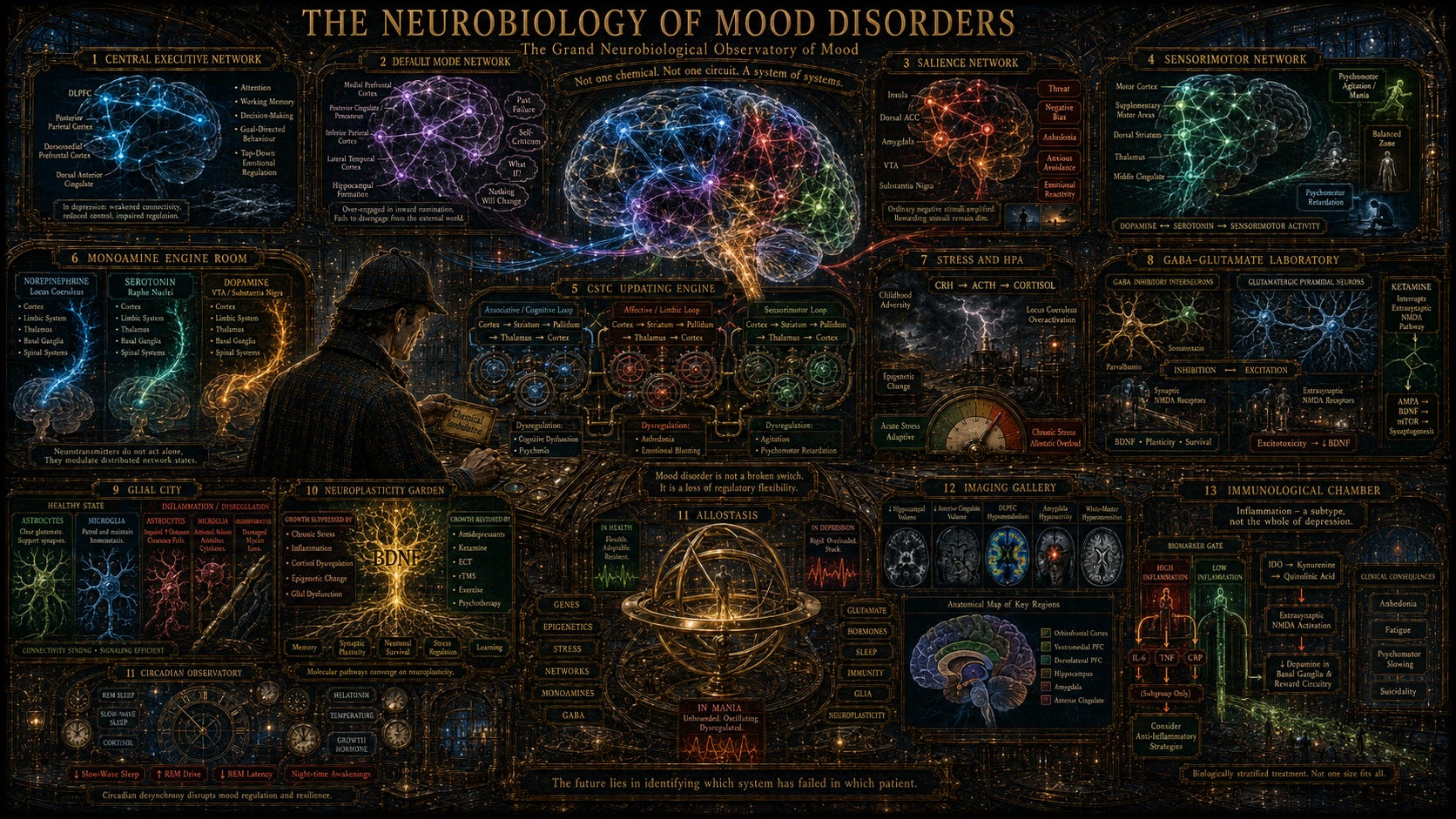 PSYCH 116: Mood Disorders - Neurobiology 08.09.2026 25dkMedlock Holmes enters the Grand Neurobiological Observatory of Mood.At its centre is not one brain map, but an enormous interconnected city of systems.One district controls attention and executive function.Another processes salience and threat.Another turns inward towards memory, self-reflection, and rumination.Another regulates movement.Another tracks reward and motivation.Above them all, stress hormones, immune signals, monoamines, glutamate, GABA, and neurotrophic factors move like weather systems across the city.Holmes quickly realises that the old search for a single biological cause of depression is inadequate.The modern question is different:How do multiple systems lose their ability to regulate one another?The investigation begins with clinical phenomenology.Depression alters cognition, reward, movement, sleep, appetite, libido, energy, and biological rhythms.Negative cognitive bias implicates prefrontal, hippocampal, amygdala, and limbic circuitry.Anhedonia points towards reward circuits involving the ventral tegmental area, nucleus accumbens, anterior cingulate, thalamus, hypothalamus, and prefrontal cortex.Psychomotor slowing and agitation implicate subcortical and sensorimotor systems.Sleep and circadian disturbance draw attention towards hypothalamic, thalamic, and brainstem regulation.The symptoms themselves therefore offer clues to the underlying neural architecture.Holmes then enters the Network Chamber.The first structure is the Central Executive Network, centred on the dorsolateral prefrontal and posterior parietal cortices.It supports working memory, attention, decision-making, goal-directed behaviour, and top-down regulation of emotion.The diagram on page 8 maps this network across the dlPFC, posterior parietal cortex, dorsomedial prefrontal cortex, dorsal anterior cingulate, and inferior temporal regions. When this system underfunctions, indecisiveness, poor working memory, impaired attention, and weak emotional control can emerge.The next chamber is the Default Mode Network.Its hubs include the medial prefrontal cortex, posterior cingulate/precuneus, inferior parietal regions, lateral temporal cortex, and hippocampal formation.The figure on page 10 shows the network underlying self-reflection, autobiographical memory, future planning, social cognition, and internally directed thought.In depression, abnormal DMN connectivity may promote rumination, negative self-focus, and difficulty disengaging from internal thought to solve external problems.Holmes then examines the Salience Network.The insula, dorsal anterior cingulate, amygdala, ventral tegmental area, and substantia nigra help determine what deserves attention and emotional significance.The page 12 diagram links dysfunction here with anhedonia, anxious avoidance, negative emotional bias, inattention, and impaired emotional control.A fourth system is the Sensorimotor Network.Its disturbances may help explain why depression can physically slow a person while mania can accelerate them.The source proposes that mania may involve elevated salience and sensorimotor activity with reduced default-mode self-monitoring, whereas depression may involve reduced sensorimotor activity alongside greater internally focused processing.The psychomotor balance diagram on page 29 captures this beautifully: changes in sensorimotor activity and the balance between dopamine and serotonin are shown along a continuum from severe psychomotor retardation to agitation.Holmes reaches a key conclusion.Mood disorders may involve less a failure of individual brain regions than a failure of dynamic coupling between networks.The brain loses flexibility.It becomes trapped in particular patterns.Rumination persists.Reward circuits fail to engage.Movement slows.Or, in mania, activation overwhelms reflection and self-monitoring.The investigation then descends into the Monoamine Engine Room.Serotonin.Norepinephrine.Dopamine.These neurotransmitters remain important, but the chapter explicitly rejects the old idea that depression is simply a deficiency of one monoamine.Recent studies show that many depressed patients do not demonstrate clear monoamine abnormalities.Monoamines are better understood as neuromodulators that fine-tune the activity and connectivity of large functional networks.Norepinephrine from the locus coeruleus regulates arousal, attention, stress responsivity, and externally directed coping.Serotonin from the raphe nuclei influences sleep, appetite, anxiety, aggression, pain, circadian rhythm, reward, and network regulation.Dopamine regulates motivation, reward, motor activity, concentration, and goal-directed behaviour.Too little or too much activity can be maladaptive.Dopamine in particular shows an inverted-U relationship with executive function: both deficient and excessive signalling can impair working memory, attention, and decision-making.The source’s dopaminergic pathway diagram on page 31 maps the nigrostriatal and mesocorticolimbic systems, linking the substantia nigra and ventral tegmental area with striatum, limbic structures, and prefrontal cortex.Holmes then enters the Stress Laboratory.The hypothalamic–pituitary–adrenal axis activates.CRH rises.ACTH stimulates cortisol.The locus coeruleus increases noradrenergic arousal.Glutamate amplifies excitation.The acute stress response is adaptive.But persistent stress changes the system.Feedback becomes less effective.Monoamines may decline.Neurogenesis may be suppressed.Epigenetic changes can stabilise maladaptive responses.The chapter describes early maltreatment as particularly important.Childhood abuse and neglect increase later depression risk approximately two- to threefold and may leave enduring changes in HPA responsivity, hippocampal structure, and gene expression.Stress therefore becomes biologically embedded.Holmes moves next into the Glutamate and GABA Chamber.Here the old monoamine story becomes even more incomplete.GABA interneurons help regulate cortical signal-to-noise and the output of glutamatergic pyramidal neurons.Depression has been associated with reductions in GABA activity, particularly involving somatostatin-expressing interneurons.Glutamate, meanwhile, is the brain’s major excitatory neurotransmitter.Too much extrasynaptic NMDA activity may suppress BDNF, promote excitotoxicity, and contribute to structural and functional impairment.This is one reason ketamine and esketamine became so important.By antagonising NMDA receptors, they may trigger glutamatergic bursts through AMPA pathways, increase BDNF signalling, activate mTOR pathways, and promote synaptogenesis.The mechanism diagram on page 43 illustrates this shift from NMDA modulation towards BDNF synthesis and synaptic growth.The next chamber belongs not to neurons, but to glia.Astrocytes.Microglia.Oligodendrocytes.These cells regulate glutamate, GABA, inflammation, myelination, neurotrophic support, and connectivity.The glia–synaptic diagram on page 44 shows how inflammation, cytokines, oxidative stress, glutamate, kynurenine metabolites, and neurotrophic factors interact at the synapse.The old image of the brain as neurons communicating while glia merely support them has become obsolete.Mood disorders may involve pathology of the entire cellular ecosystem.Holmes enters the Neuroplasticity Chamber.At its centre is BDNF.Brain-derived neurotrophic factor supports neuronal survival, differentiation, synaptic plasticity, memory, HPA regulation, and neurotransmitter function.Stress, inflammation, epigenetic changes, cortisol dysregulation, and glial dysfunction can all reduce BDNF signalling.Many successful treatments - antidepressants, ketamine, ECT, rTMS, exercise, and psychotherapy - can increase BDNF-related activity.This creates a powerful unifying idea:Perhaps effective treatment works partly by restoring the brain’s capacity to change.The investigation then reaches the Hormonal Observatory.Hypercortisolism is one of the most reproducible biological findings in severe depression, particularly melancholic and psychotic depression.But it is not diagnostically specific.Thyroid abnormalities are also important.A clinically relevant proportion of depressed patients have previously unrecognised hypothyroidism, and thyroid dysfunction can impair treatment response.Growth hormone, prolactin, and other endocrine systems also show abnormalities in subgroups.No single hormonal test diagnoses depression.Instead, endocrine findings reveal how deeply mood disorders are embedded in whole-body physiology.Holmes then enters the Sleep Laboratory.The architecture of sleep has changed.Slow-wave sleep is reduced.Nocturnal awakenings increase.REM sleep becomes more intense.REM latency shortens.These abnormalities may persist beyond symptomatic recovery and can function more like vulnerability markers than simple state effects.The chapter emphasises that biological rhythm is not merely an accompaniment to depression.It is part of its neurobiology.Finally, Holmes reaches the Immunological Chamber.Inflammatory markers such as IL-6, TNF, and CRP are elevated in a subgroup of people with depression.But the source is careful:Depression is not simply an inflammatory disease.Only a subgroup - approximately 30–45% depending on the population and threshold - shows elevated peripheral inflammation.This distinction matters because anti-inflammatory strategies appear most promising in those with demonstrably increased inflammation rather than across all patients with depression.Inflammation particularly appears to influence:Anhedonia.Psychomotor slowing.Fatigue.Suicidal behaviour.It may do so by reducing dopamine synthesis and release, activating the kynurenine pathway, increasing glutamatergic excitotoxicity, altering glial function, and disrupting reward circuitry.Holmes sees the future of biological psychiatry emerging.Not one biomarker for depression.Not one neurotransmitter.Not one circuit.Instead:biotypes.Different combinations of genetics, inflammation, stress responsivity, network connectivity, neurotransmission, neuroplasticity, sleep, and clinical phenotype may eventually identify biologically meaningful subgroups.At the centre of the observatory, Holmes finds no broken switch.He finds a network struggling to maintain allostasis - dynamic stability through constant adaptation.Mood disorder occurs when adaptation becomes overload.The system no longer flexes.Stress responses remain active.Reward circuits disengage.Rumination persists.Sleep loses rhythm.Movement slows or accelerates.Inflammation amplifies vulnerability.Neuroplasticity narrows.Holmes closes the casebook.The neurobiology of mood disorders is not the story of a single chemical deficiency.It is the story of a living system that has lost its capacity to regulate itself.Key Takeaways* Mood disorders are associated with disturbances across multiple neurobiological systems rather than a single lesion or neurotransmitter abnormality.* Neurobiology should be linked to clinical phenomenology, illness course, and treatment response.* Depressive cognition implicates the prefrontal cortex, hippocampus, amygdala, and other limbic structures.* Anhedonia implicates reward circuitry involving the VTA, nucleus accumbens, anterior cingulate, hypothalamus, thalamus, and prefrontal cortex.* Psychomotor retardation and agitation implicate subcortical and sensorimotor circuits.* Sleep, appetite, libido, energy, and circadian symptoms indicate dysfunction in hypothalamic, thalamic, and brainstem regulatory systems.* Melancholia historically refers to depression characterised by anhedonia, loss of mood reactivity, psychomotor disturbance, weight loss, terminal insomnia, and diurnal mood variation.* Melancholic depression is often recurrent and relatively responsive to ECT.* Atypical depression includes reverse vegetative symptoms such as hypersomnia, increased appetite, and weight gain.* Atypical depression is associated in some studies with immune-metabolic features including obesity, insulin resistance, elevated CRP, leptin abnormalities, and altered insula responses to appetitive stimuli.* Bipolar disorder is more heritable than unipolar depression.* Early-onset mood disorder is generally associated with greater heritable loading.* Identical twins show greater shared risk than fraternal twins, but concordance is not 100%, demonstrating the importance of non-genetic influences.* Genetic susceptibility to mood disorder is polygenic.* More than 100 genes have been associated with risk, but each contributes only a small effect.* Some genes may influence resilience rather than vulnerability.* Genes affecting cytochrome P450 enzymes can influence antidepressant metabolism without necessarily affecting depression risk.* Temperamental traits such as neuroticism, harm avoidance, behavioural inhibition, and introversion are partly heritable and can increase vulnerability.* Epigenetic mechanisms allow environmental experience to alter gene expression without changing DNA sequence.* Chronic stress and early adversity can induce lasting epigenetic changes.* Childhood maltreatment increases later depression risk approximately two- to threefold.* Early adversity can produce enduring alterations in HPA-axis responsivity, hippocampal function, and gene expression.* The neurobiology of emotion involves several major large-scale brain networks.* The Central Executive Network supports working memory, attention, decision-making, goal-directed behaviour, and top-down emotional control.* The figure on page 8 places the CEN around the dlPFC, posterior parietal cortex, dorsomedial PFC, dorsal ACC, and inferior temporal gyrus.* CEN dysfunction may contribute to indecisiveness, impaired attention, poor working memory, disorganisation, and reduced emotional regulation.* The Default Mode Network supports self-referential thinking, autobiographical memory, future planning, social cognition, and internal mentation.* The page 10 figure shows the DMN centred on medial prefrontal and posterior cingulate/precuneus regions with temporal and hippocampal components.* DMN dysfunction is associated with rumination, inward orientation, mind wandering, impaired goal-directed behaviour, and disturbed self-processing.* MDD may involve both hyperconnectivity and hypoconnectivity within different DMN components.* DMN-core hypoconnectivity has been described as a moderate risk marker for MDD.* Increased internal DMN activity can contribute to persistent rumination.* The Salience Network helps assign emotional significance and coordinate switching between internal and external cognitive states.* Key salience-network regions include the insula, dorsal ACC, amygdala, VTA, and substantia nigra.* The page 12 diagram links salience-network dysfunction to low motivation, anhedonia, negative emotionality, anxious avoidance, inattention, and impaired emotional control.* The Sensorimotor Network supports sensory processing and motor planning and execution.* Reduced SMN activity may contribute to psychomotor retardation.* Increased SMN activity may contribute to psychomotor agitation and mania.* Internal hypoconnectivity within the SMN has emerged as a relatively stable imaging finding in MDD.* The balance between DMN and SMN activity correlates with depression severity.* The source increasingly frames mood disorders as disorders of dynamic network coupling rather than static regional abnormalities.* The cortico-striatal-thalamo-cortical loop provides a major updating system linking cognitive, affective, and sensorimotor networks.* Its associative, affective, and sensorimotor divisions may contribute respectively to cognitive dysfunction, anhedonia, and psychomotor abnormalities.* Elevated dopaminergic transmission in associative striatum may contribute to psychotic symptoms during bipolar mania.* Reduced ventral limbic CSTC activity may contribute to anhedonia and emotional blunting.* Acute stress activates both the HPA axis and sympathomedullary systems.* CRH stimulates ACTH and subsequent cortisol release.* Acute stress also activates locus coeruleus noradrenergic systems.* Glutamate can amplify arousal during stress.* Prolonged uncontrollable stress can lead to adaptive changes including reduced monoamine and GABA signalling.* Learned helplessness models illustrate how chronic stress can produce persistent behavioural withdrawal.* Antidepressants can attenuate or reverse learned helplessness in animal models.* Social status alters serotonergic and HPA function in primates, illustrating the biological embedding of social experience.* Monoamine hypotheses played a major historical role in mood-disorder neurobiology.* Simple “low serotonin” or “low norepinephrine” explanations of depression are no longer adequate.* Modern evidence suggests many depressed patients do not have clear primary monoamine abnormalities.* Monoamines are better understood as large-scale neuromodulatory systems that regulate network activity and coupling.* The locus coeruleus is the principal source of cerebral norepinephrine.* Norepinephrine contributes to arousal, cognition, sensory processing, stress response, emotional memory, and externally directed coping.* Some depressed patients may demonstrate increased rather than decreased norepinephrine activity.* Excessive locus-coeruleus activity may impair prefrontal top-down regulation despite increasing overall arousal.* Depression may therefore include both hyperaroused and hypoaroused noradrenergic phenotypes.* Elevated norepinephrine is also associated with mania and dysphoric manic symptoms.* Serotonergic neurons project from brainstem raphe nuclei throughout cortex, thalamus, basal ganglia, hippocampus, hypothalamus, and other regions.* Serotonin regulates sleep, appetite, temperature, metabolism, anxiety, aggression, pain, cognition, reward, libido, and circadian rhythms.* The page 25 diagram illustrates widespread serotonergic projections from rostral and caudal raphe nuclei.* Serotonin helps regulate the balance between excitation and inhibition through interactions with GABA and glutamate.* Acute stress may transiently increase 5-HT release, while chronic stress can eventually reduce serotonin activity.* Serotonin plays an important role in neurodevelopment and network connectivity.* Increased serotonin tends to suppress sensorimotor-network activity.* This may partly explain fatigue and sensory blunting associated with SSRIs.* SNRIs and bupropion may improve psychomotor symptoms more strongly than SSRIs in some patients.* SSRIs may normalise amygdala activity and alter abnormal network connectivity.* The dopaminergic system includes tuberoinfundibular, nigrostriatal, mesolimbic, and mesocortical pathways.* Dopamine regulates reward, motivation, motor behaviour, cognition, reinforcement, and goal-directed activity.* The page 31 figure demonstrates projections from substantia nigra and ventral tegmental area to striatum, limbic regions, and prefrontal cortex.* Reduced mesocortical and mesolimbic dopamine may contribute to anhedonia, low motivation, cognitive impairment, and psychomotor slowing.* Increased striatal dopamine may contribute to agitation, psychosis, and mania.* Dopamine follows an inverted-U relationship with executive performance: both deficient and excessive signalling can impair attention and working memory.* Depression may contain distinct psychomotor biotypes, including agitated depression and depression with retardation.* Monoamines influence large-scale networks indirectly through glutamate and GABA regulation.* The chapter presents monoaminergic signalling as part of a broader allostatic regulatory system.* Acetylcholine interacts with monoaminergic systems and may influence sleep, HPA activity, psychomotor slowing, and mania.* A high cholinergic-to-adrenergic ratio has historically been associated with depression, whereas a lower ratio has been associated with mania.* GABA is the major inhibitory neurotransmitter in much of the brain.* Reduced GABA has been reported in plasma, CSF, and brain tissue in depression.* Somatostatin-expressing GABA interneurons appear particularly relevant to MDD.* These interneurons help regulate signal-to-noise and pyramidal-neuron output.* Large ENIGMA-type analyses have linked depression with altered astrocytes and SST GABA interneurons.* Reduced GABA activity may impair emotional regulation, endocrine control, arousal modulation, and network switching.* Allopregnanolone is a neurosteroid that modulates GABA-A receptors.* Brexanolone is approved for major depressive episodes with peripartum onset.* Glutamate is the principal excitatory neurotransmitter.* NMDA and AMPA receptor activity are central to synaptic plasticity.* Synaptic NMDA activity can support BDNF synthesis and neuroprotection.* Extrasynaptic NMDA activation can suppress BDNF, promote mitochondrial dysfunction, and contribute to excitotoxicity.* Glutamate abnormalities have been reported in hippocampus, vmPFC, ACC, and basal ganglia in mood disorders.* Elevated basal-ganglia glutamate has been associated with anhedonia and psychomotor retardation.* Ketamine and esketamine produce rapid antidepressant effects through NMDA modulation.* The page 43 diagram illustrates the proposed pathway from NMDA antagonism through glutamate burst, AMPA activation, BDNF, mTOR, and synaptogenesis.* Ketamine may increase CEN activity and reduce dysfunctional DMN and salience-network activity.* Lateral habenula burst firing has been associated with negative affect and suppression of monoamine release.* Glial cells play central roles in mood-disorder pathophysiology.* Astrocytes regulate glutamate, GABA, inflammation, and neurotrophic support.* Oligodendrocytes regulate myelination and long-range connectivity.* Microglia regulate immune signalling within the CNS.* Postmortem studies show reductions in glial density in several prefrontal and limbic regions in MDD and bipolar disorder.* Oligodendrocyte reductions may contribute to impaired white-matter connectivity.* Microglial activation has been described particularly in some individuals dying by suicide.* The page 44 glia–synaptic figure illustrates interactions among astrocytes, microglia, inflammatory cytokines, glutamate, GABA, BDNF, kynurenine metabolites, and NMDA receptors.* Inflammation can activate the kynurenine pathway through IDO.* This diverts tryptophan away from serotonin synthesis towards kynurenine metabolites.* Quinolinic acid acts as an NMDA agonist and may contribute to excitotoxicity.* Inflammation can increase monoamine reuptake and impair dopaminergic signalling.* BDNF is a major neurotrophic factor involved in neuronal survival, differentiation, memory, plasticity, HPA regulation, and neurotransmitter function.* BDNF levels are often reduced in MDD and bipolar mood episodes.* Lower BDNF has been associated with persistent illness, suicidality, and greater symptom severity in some studies.* Many successful treatments can increase BDNF-related signalling.* These include antidepressants, ketamine, ECT, rTMS, exercise, and psychotherapy.* Neuroplasticity provides a possible common downstream mechanism across otherwise very different treatments.* Second-messenger systems translate receptor activation into intracellular change.* G proteins, adenylate cyclase, phospholipase C, cAMP, calcium signalling, and protein kinases influence receptor function and gene transcription.* Antidepressants and mood stabilisers may exert delayed therapeutic effects partly through intracellular and gene-expression changes.* HPA-axis hyperactivity is one of the most replicated biological findings in severe depression.* Approximately 20–40% of depressed outpatients and 40–60% of depressed inpatients show evidence of elevated HPA activity.* HPA abnormalities are more common in older patients and severe, recurrent, melancholic, or psychotic depression.* Hypercortisolism is not specific enough to serve as a diagnostic test.* Persistent HPA dysregulation after symptomatic recovery is associated with increased relapse risk.* Approximately 5–10% of people assessed for depression may have previously unrecognised hypothyroidism.* Thyroid abnormalities can compromise antidepressant response.* Blunted TSH response to TRH is found in a larger subgroup of depressed patients but is not diagnostically specific.* Thyroid augmentation may be clinically useful in selected treatment-resistant cases.* Growth-hormone responses are frequently blunted in depression.* Somatostatin levels may be reduced in depression and increased in mania.* Prolactin abnormalities are less consistent.* Sleep disturbance is deeply integrated with mood-disorder neurobiology.* Depression is associated with reduced slow-wave sleep, increased nocturnal arousal, increased REM activity, and shortened REM latency.* Reduced REM latency and slow-wave deficits may persist after recovery and function as vulnerability markers.* EEG sleep abnormalities are more common in severe and recurrent depression.* Abnormal sleep profiles may predict poorer response to psychotherapy and greater relapse risk.* Structural imaging studies describe reduced hippocampal, medial orbital, and anterior cingulate volumes in some patients.* Hippocampal volume reduction is associated with illness chronicity in some studies.* Subcortical hyperintensities are particularly common in older adults and bipolar I disorder.* Some late-onset depression may reflect interaction between vascular disease and mood regulation.* Functional imaging commonly shows reduced anterior and prefrontal metabolism in depression.* Reduced dorsolateral PFC function correlates with impaired executive control and difficulty regulating negative emotion.* Amygdala and paralimbic hyperactivity may act as an “emotional amplifier” in severe depression.* Imaging abnormalities can partially normalise with successful treatment.* The figure on page 53 highlights the orbital and ventromedial PFC, dorsolateral PFC, hippocampus, amygdala, and anterior cingulate as key regions in affective regulation.* Depression is associated with elevated inflammatory mediators in a subgroup of patients.* The most consistently elevated peripheral markers include IL-6, TNF, and CRP.* Inflammation can prospectively increase risk of later depression.* Chronic interferon-alpha treatment produces major depressive syndromes in approximately 30–50% of exposed individuals.* This supports a causal role for inflammation in at least some depressive states.* MDD is not best understood as a universally inflammatory disorder.* Approximately 30–45% of depressed individuals demonstrate elevated peripheral inflammation depending on the sample and threshold.* Elevated inflammation is more common with obesity, childhood adversity, socioeconomic disadvantage, and treatment resistance.* Inflammation disproportionately promotes anhedonia, psychomotor slowing, fatigue, and suicidal behaviour.* Inflammatory effects on reward and movement may be mediated particularly through impaired dopamine signalling in basal ganglia.* Inflammation may impair effort-based motivation and reward anticipation more than consummatory pleasure.* Suicidal ideation and behaviour have repeatedly been associated with increased inflammatory signalling.* Peripheral inflammation can influence the brain through circumventricular organs, transporters, sensory afferent nerves, immune-cell trafficking, and disruption of the blood–brain barrier.* Inflammation reduces dopamine synthesis, release, and receptor function.* It activates the kynurenine pathway and alters glutamatergic transmission.* It can impair astrocytic glutamate clearance and promote extrasynaptic NMDA activation.* Increased inflammation is associated with reduced ventral-striatal and prefrontal connectivity and greater anhedonia.* Anti-inflammatory treatments do not show uniform antidepressant effects across all patients with MDD.* Cytokine antagonists appear most promising in patients with clearly elevated inflammatory biomarkers.* Infliximab and other cytokine antagonists have shown little benefit in depressed patients with low baseline inflammation.* Some evidence suggests patients with increased inflammation may respond relatively poorly to purely serotonergic antidepressants and better to agents with catecholaminergic or dopaminergic activity.* Inflammation may therefore represent one route towards biologically stratified treatment.* Future neurobiology will increasingly seek biotypes rather than one universal mechanism of depression.* Biotypes may integrate genetics, epigenetics, inflammation, network function, neurotransmission, neuroplasticity, endocrine regulation, sleep, and clinical phenotype.* Some neurobiological abnormalities are state-dependent and resolve with treatment.* Others are trait-like and persist during remission.* Still others may accumulate over time as consequences of chronic illness, stress, ageing, or vascular disease.* The most useful overarching model is one of disrupted allostasis: the brain and body lose the flexibility required to maintain stability through changing circumstances.* Mood disorders are therefore best understood neurobiologically as failures of dynamic regulation across interconnected systems rather than as simple chemical imbalances. This is a public episode. If you'd like to discuss this with other subscribers or get access to bonus episodes, visit drmanaankarray.substack.com/subscribe
 -
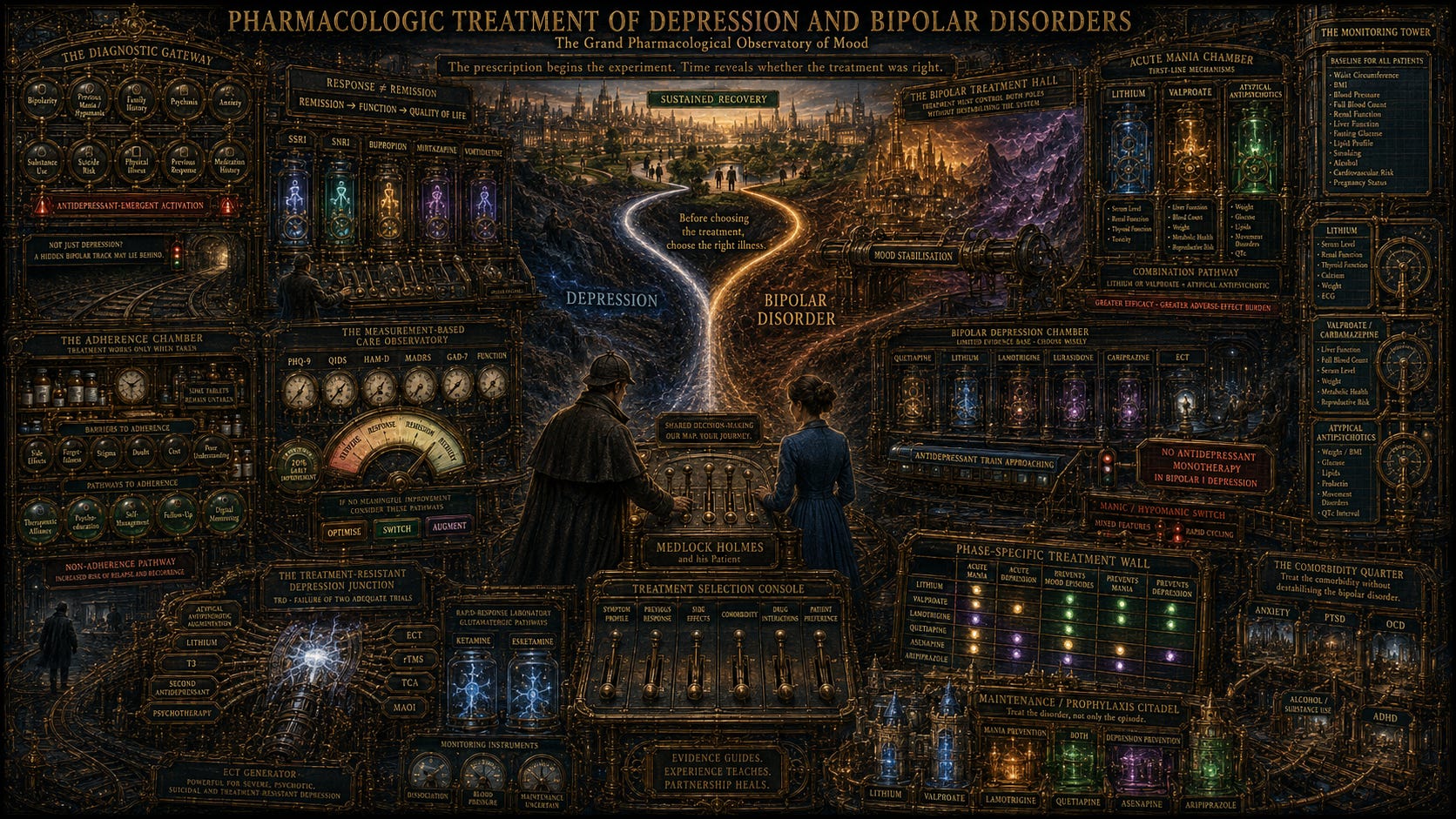 PSYCH 114: Mood Disorders - Pharmacologic Treatment of Depression and Bipolar Disorders 06.09.2026 40dkMedlock Holmes enters the Grand Pharmacological Observatory of Mood.At its centre stands an enormous control table.Two major pathways emerge from it.One is labelled:MAJOR DEPRESSIVE DISORDERThe other:BIPOLAR DISORDERAt first, the pathways appear similar.Both contain depression.Both contain impaired function.Both may involve suicidality, anxiety, sleep disturbance, and psychotic features.But Holmes quickly discovers that the treatment logic is very different.The first lesson is therefore diagnostic.Before prescribing an antidepressant, the clinician must ask whether the apparent depressive episode might actually belong to bipolar disorder.Family history.Previous hypomania.Psychotic features.Reverse vegetative symptoms.Mood lability.Antidepressant-induced activation.All may raise suspicion.The source emphasises that bipolar disorder is frequently misdiagnosed initially as major depressive disorder, partly because patients are more likely to seek help when depressed than when hypomanic or manic.Holmes moves first into the Depression Treatment Chamber.Here the immediate goal is not simply improvement.It is remission.Response means that symptoms have reduced.Remission means that the depressive syndrome has largely resolved.This distinction matters because residual symptoms are associated with a greater risk of relapse and recurrence.But Holmes notices another instrument beside the symptom scales.It measures:Function.Can the person work?Study?Care for children?Maintain relationships?Enjoy life?The chapter repeatedly emphasises that symptom reduction alone is not enough.Patients often care most about restoration of function and quality of life.The next section of the chamber contains the familiar first-line antidepressant pathways.SSRIs.SNRIs.Bupropion.Mirtazapine.Vortioxetine.Other second-generation agents.Their overall efficacy is broadly comparable.The art lies in matching treatment to the individual.An activating antidepressant may suit someone dominated by fatigue and low drive.A sedating antidepressant may help when severe insomnia accompanies depression.A patient worried about weight gain may prefer one profile.Another troubled by sexual dysfunction may prefer another.Holmes realises that pharmacology becomes useful only when translated into the language of the patient’s actual life.The source then introduces measurement-based care.Standardised measures such as the PHQ-9, QIDS, HAM-D, MADRS, GAD-7, Sheehan Disability Scale, and LEAPS can help track symptom change and function.Early improvement matters.A reduction of approximately 20% in symptom severity early in treatment predicts a greater likelihood of later response.Failure to improve should trigger a question:Is the dose adequate?Has the medication been taken?Has enough time passed?Is the diagnosis correct?Should the treatment be optimised, switched, or augmented?Holmes enters the Adherence Chamber.Here, half-empty medicine bottles sit beside treatment charts.Many apparent medication failures are not true pharmacological failures.Patients miss doses.Stop medication when they begin to feel better.Stop because of side effects.Stop because they fear dependence.Stop because they do not believe the treatment is helping.The clinician must therefore examine adherence before declaring resistance.Therapeutic alliance, psychoeducation, self-management, regular follow-up, and digital monitoring can all help.The next junction is labelled:OPTIMISE - SWITCH - AUGMENTThis is the heart of treatment sequencing.If a first-line antidepressant produces little or no improvement after an adequate trial, the clinician may increase the dose, switch to another antidepressant, or add an adjunctive treatment.STAR*D demonstrated how difficult sustained remission can be.Only around one-third of patients achieved remission after the initial antidepressant trial, and remission rates fell as successive treatment steps failed.Importantly, switching to another drug class was not clearly superior to switching within the same class, and augmentation was not universally superior to switching.Holmes sees the message clearly:There is no magical algorithm.Treatment must remain iterative.For treatment-resistant depression, the pathways broaden.Second-generation antipsychotic augmentation may be considered.Lithium.Triiodothyronine.A second antidepressant with a different mechanism.Psychotherapy.ECT.rTMS.Older antidepressants such as TCAs and MAOIs may also have a role in more difficult-to-treat illness, although their adverse-effect and toxicity profiles limit their routine use.Then Holmes encounters a newer section of the observatory.A rapid-response chamber.Here sit ketamine and esketamine.Rather than waiting weeks for improvement, these glutamatergic treatments may produce rapid antidepressant effects in treatment-resistant depression.But rapidity brings new responsibilities.Dissociation.Blood-pressure changes.Monitoring.Uncertainty about maintenance.The source also discusses emerging strategies involving inflammation, pramipexole, psychedelics, and precision approaches, although these remain less established than conventional treatments.Holmes then turns towards the second great pathway:BIPOLAR DISORDERThe architecture changes immediately.This is not merely depression plus episodes of mania.It is a recurrent illness requiring treatment across several phases:Acute ManiaAcute Bipolar DepressionMaintenance / ProphylaxisThe first principle is to treat the disorder, not simply the current episode.A medication that improves today’s mania but increases tomorrow’s depression may not be the best long-term strategy.A treatment that improves depression but destabilises mood may create a larger problem than the one it solves.The source emphasises that bipolar disorder is highly recurrent and that prevention of future episodes should be considered from the beginning of treatment.The source’s monitoring diagram on page 23 makes this longitudinal approach especially clear. It places baseline physical-health parameters at the top - including waist circumference, BMI, blood pressure, full blood count, renal function, liver function, fasting glucose, fasting lipids, smoking status, alcohol use, cardiovascular risk factors, and pregnancy status - before branching into treatment-specific monitoring for lithium, valproate, carbamazepine, and atypical antipsychotics.Holmes enters the Acute Mania Chamber.First-line treatments include lithium, valproate, and several atypical antipsychotics.Combination treatment may be more effective than monotherapy in more severe mania, although this comes at the cost of more adverse effects.Lithium is particularly associated with classical euphoric, grandiose mania.Valproate may be preferred when mania is dysphoric, irritable, mixed, associated with substance use, or occurs following brain injury.Atypical antipsychotics are especially useful when rapid behavioural control is required.Treatment choice therefore depends not simply on diagnosis, but on phenotype.Lithium requires serum-level monitoring and attention to renal, thyroid, and toxicity risks.Valproate requires hepatic, haematological, metabolic, and reproductive consideration.Carbamazepine introduces enzyme induction and interaction problems.Antipsychotics carry varying metabolic, neurological, and cardiovascular burdens.There is no treatment without trade-offs.The source’s table on page 34 visually reinforces this by comparing atypical antipsychotics across acute mania, acute depression, prevention of mood episodes, prevention of mania, and prevention of depression. The important message is that efficacy is phase-specific: a drug effective for mania may not necessarily treat bipolar depression or prevent depressive recurrence.Holmes moves into the Bipolar Depression Chamber.Here the therapeutic challenge becomes harder.Only a limited number of treatments have robust efficacy.Quetiapine.Lithium.Lamotrigine.Lurasidone.Cariprazine.Some combinations.ECT.The source is particularly cautious about antidepressants.Antidepressant monotherapy is not recommended for bipolar I depression because of the risk of manic or hypomanic switch and possible illness destabilisation.Adjunctive antidepressants may sometimes be used, but especially cautiously in those with rapid cycling or mixed features.This is one of the most important pharmacological distinctions in psychiatry:A treatment that is ordinary in unipolar depression can become destabilising in bipolar disorder.The next chamber is the largest.It is labelled:MAINTENANCEHolmes finds that the true treatment of bipolar disorder happens here.The acute episode may last weeks.The illness lasts years.Lithium remains central.Valproate.Lamotrigine.Quetiapine.Asenapine.Aripiprazole.Selected combinations.Each has a different prophylactic profile.Some prevent mania better.Some prevent depression better.Some do both.Lamotrigine, for example, is particularly useful in preventing depressive recurrence but has much less antimanic strength.Lithium remains one of the most broadly effective long-term agents and may also carry anti-suicidal benefit.The source emphasises that maintenance treatment should generally begin early because recurrence is so common.Residual symptoms matter.Poor adherence matters.Comorbid anxiety and substance use matter.Cognition matters.Physical health matters.Suicide risk remains relevant even during maintenance.The aim is no longer simply:“Stop the episode.”It becomes:“Protect the life between episodes.”The final section of the observatory contains multiple smaller chambers.Bipolar II disorder.Anxiety.PTSD.OCD.Substance use.ADHD.Each introduces another pharmacological tension.Treat the comorbidity too aggressively and bipolar disorder may destabilise.Ignore the comorbidity and overall outcome worsens.The solution is careful sequencing and choosing treatments that improve one problem without worsening another.Holmes steps back from the enormous control table.He finally understands the central principle.Psychopharmacology is not the pursuit of the most powerful drug.It is the pursuit of the most appropriate treatment for this person, in this phase of illness, with this pattern of risk, at this point in time.A medicine can only be judged by what happens next.Does the episode remit?Does function return?Do side effects remain tolerable?Does the person stay well?Does treatment preserve autonomy and quality of life?Does it prevent the next episode?The prescription is therefore not the end of clinical reasoning.It is the beginning of a longitudinal experiment conducted collaboratively with the patient.Key Takeaways* Pharmacological treatment of mood disorders begins with accurate diagnosis and careful differentiation between major depressive disorder and bipolar disorder.* Bipolar disorder is commonly misdiagnosed initially as major depressive disorder because patients often present during depressive rather than hypomanic or manic episodes.* Family history, psychotic features, reverse vegetative symptoms, mood lability, and antidepressant-emergent hypomania or mania should raise suspicion of bipolar disorder.* A thorough biopsychosocial assessment should include safety, comorbidity, substance use, physical health, medication history, family history, and functional impairment.* Treatment planning should be collaborative and should incorporate patient preferences, expectations, concerns, and previous treatment experience.* The acute goal of antidepressant treatment is remission, not merely partial response.* Response is typically defined as a 50% or greater reduction in symptom severity.* Remission represents near-resolution of the depressive syndrome.* Failure to achieve remission is associated with greater risk of recurrence.* Functional recovery and quality of life are important treatment outcomes alongside symptom improvement.* The source divides antidepressant treatment into acute/continuation and maintenance phases.* Acute and continuation treatment typically lasts around 8–12 weeks.* Maintenance treatment may continue for 6–24 months or longer depending on recurrence risk.* Measurement-based care can improve longitudinal monitoring of symptoms and function.* Common instruments include PHQ-9, QIDS, HAM-D, MADRS, GAD-7, Sheehan Disability Scale, and LEAPS.* Early symptom improvement of approximately 20% predicts a greater likelihood of later response.* Failure to show early improvement should prompt reconsideration of dose, adherence, diagnosis, switching, or augmentation.* Adherence should be assessed before declaring a treatment ineffective.* Approximately half of patients report reduced adherence by three months.* Therapeutic alliance, psychoeducation, self-management, follow-up contact, and digital tools may improve adherence.* Common first-line antidepressants include SSRIs, SNRIs, bupropion, mirtazapine, vortioxetine, and other second-generation agents.* First-line antidepressants generally have comparable efficacy, so tolerability and patient-specific factors are important determinants of choice.* Bupropion is relatively activating and may be useful where low energy and fatigue predominate.* Mirtazapine is sedating and may be useful where severe insomnia accompanies depression.* Mirtazapine is associated with increased appetite and weight gain.* SSRIs commonly produce gastrointestinal, CNS, and sexual adverse effects.* SNRIs may increase blood pressure, particularly venlafaxine.* Citalopram and some other antidepressants may prolong QTc at higher doses.* Important antidepressant adverse effects include serotonin syndrome, hyponatraemia, gastrointestinal bleeding, seizure-threshold reduction, and treatment-emergent mood elevation.* Antidepressant-induced hypomanic or manic symptoms require careful reassessment for bipolar disorder.* Course specifiers can influence treatment selection.* Seasonal depression may benefit from light therapy.* Psychotic depression may require antidepressant plus antipsychotic treatment or ECT.* Mixed features require particular caution because of possible bipolarity and risk of antidepressant-induced activation.* Approximately half of patients with MDD do not respond adequately to the first prescribed antidepressant.* Approximately 20–30% remain unresponsive after at least two adequate antidepressant trials.* Treatment-resistant depression is commonly defined as failure to respond to at least two adequate antidepressant trials.* STAR*D demonstrated remission of roughly one-third of patients after initial citalopram treatment.* Remission rates fall substantially after repeated treatment failures.* STAR*D did not show that switching antidepressant class was clearly superior to switching within the same class.* STAR*D also did not demonstrate universal superiority of augmentation over switching.* After inadequate response, clinicians should consider optimisation, switching, or augmentation.* Optimisation is generally appropriate when a medication is well tolerated but has not yet been adequately dosed.* Slow but progressive improvement may justify extending a treatment trial.* Switching can reduce polypharmacy and may improve adherence.* Cross-tapering can reduce discontinuation symptoms when pharmacologically appropriate.* Hazardous drug interactions must be considered when switching, especially with MAOIs.* Second-generation antipsychotics can be effective augmentation treatments in treatment-resistant depression.* Aripiprazole, brexpiprazole, quetiapine, and olanzapine–fluoxetine have evidence in selected contexts.* Adjunctive antipsychotics can produce weight gain, dyslipidaemia, hyperglycaemia, akathisia, extrapyramidal symptoms, and QTc prolongation.* Lithium remains an evidence-based augmentation strategy for resistant depression.* Triiodothyronine is another possible augmentation strategy.* ECT is highly effective in treatment-resistant depression, with response rates approaching 70% in some groups.* ECT is particularly important in severe suicidal or psychotic depression.* rTMS is an established neurostimulation option in resistant depression.* TCAs and MAOIs remain effective but are usually reserved for more difficult-to-treat depression because of tolerability, toxicity, and interaction concerns.* Irreversible MAOIs require dietary precautions because tyramine interactions can precipitate hypertensive crisis.* Ketamine and esketamine have rapid antidepressant effects in treatment-resistant depression.* Ketamine and esketamine require monitoring for dissociation and physiological adverse effects such as hypertension.* Maintenance strategies after ketamine and esketamine remain incompletely defined.* Psychedelic therapies, anti-inflammatory treatments, pramipexole, and precision approaches are emerging areas of research rather than established universal treatments.* Recurrent MDD and persistent depressive disorder may require prolonged maintenance treatment.* Patients with multiple episodes, residual symptoms, psychotic episodes, strong family history, or recurrent relapse after discontinuation may require longer-term therapy.* Discontinuation of long-term treatment should generally be gradual and followed by careful monitoring.* Bipolar disorder should be treated as a recurrent longitudinal illness rather than as isolated episodes.* Patients with bipolar I disorder spend considerably more time depressed than manic.* Bipolar II disorder is even more dominated by depressive symptoms.* Early recognition of bipolarity may reduce inappropriate antidepressant exposure and improve long-term outcomes.* The monitoring diagram on page 23 emphasises baseline assessment of weight, waist circumference, blood pressure, full blood count, renal function, liver function, glucose, lipids, smoking, alcohol use, cardiovascular risk, and pregnancy status before bipolar pharmacotherapy.* Lithium, valproate, carbamazepine, and atypical antipsychotics require treatment-specific safety monitoring.* The source stresses that the disorder should be treated, not merely the current episode.* Prevention of recurrence should influence treatment selection from the beginning.* Residual subsyndromal symptoms strongly predict earlier relapse.* Psychiatric comorbidity is extremely common in bipolar disorder.* Anxiety disorders and substance-use disorders are particularly frequent and worsen prognosis.* Cognitive impairment can persist during euthymia and contribute to functional disability.* Treatment non-adherence in bipolar disorder is common and contributes to relapse, hospitalisation, suicide risk, and disability.* Psychoeducation improves treatment adherence.* Suicide risk should be monitored during both acute and maintenance treatment.* Acute mania may require hospitalisation when severe agitation, aggression, psychosis, or lack of insight compromises safety.* Verbal de-escalation and a low-stimulation environment should be used where possible.* Antidepressants and other activating medications should generally be stopped during acute mania.* Lithium, valproate, and several atypical antipsychotics are first-line treatments for acute mania.* Combination treatment with lithium or valproate plus an atypical antipsychotic may produce higher response rates than monotherapy.* Combination treatment also produces more adverse effects.* Lithium is particularly associated with good response in classical euphoric, grandiose mania.* Valproate may be particularly useful in dysphoric or irritable mania, mixed features, substance-use comorbidity, or brain injury.* Lithium requires serum-level monitoring and vigilance for toxicity.* Lithium toxicity is a medical emergency.* Carbamazepine is effective in acute mania but has important tolerability and drug-interaction disadvantages.* Carbamazepine induces hepatic microsomal enzymes and can reduce concentrations of other medications.* Valproate has demonstrated efficacy in acute mania and can have a relatively rapid onset when appropriately loaded.* Lamotrigine, gabapentin, and topiramate are not effective treatments for acute mania.* First-generation antipsychotics such as haloperidol are effective in mania but carry greater extrapyramidal and depressive-switch concerns.* Atypical antipsychotics including risperidone, olanzapine, quetiapine, aripiprazole, asenapine, paliperidone, and cariprazine have evidence for acute mania.* The efficacy table on page 34 demonstrates that antipsychotic efficacy differs across acute mania, acute depression, and prevention of manic and depressive episodes.* Acute bipolar depression has fewer well-established pharmacological treatments than acute mania.* Quetiapine has strong evidence for bipolar I and bipolar II depression.* Lurasidone is effective both as monotherapy and adjunctive treatment in acute bipolar depression.* Cariprazine has demonstrated efficacy in bipolar I depression.* Lamotrigine has limited acute antidepressant efficacy but is valuable in longer-term prevention of depressive recurrence.* Lithium remains important in bipolar depression partly because of its broad longitudinal efficacy and potential anti-suicidal effect.* Antidepressant monotherapy is not recommended for bipolar I depression.* Antidepressants can precipitate manic or hypomanic switch and may destabilise illness course.* Switch risk is higher with TCAs, older MAOIs, and possibly SNRIs such as venlafaxine.* Adjunctive antidepressants may have a limited role in selected bipolar depression patients.* Antidepressants should generally be avoided in rapid cycling and mixed features.* ECT is one of the most effective treatments for severe or treatment-resistant bipolar depression.* ECT may be considered earlier when suicidality, psychosis, catatonia, poor oral intake, or severe deterioration is present.* rTMS and tDCS have emerging evidence in bipolar depression.* The aim of bipolar depression treatment is full remission without destabilising the illness.* Psychological treatments such as CBT, IPSRT, and family-focused therapy are important adjuncts.* Lithium remains a major long-term maintenance treatment for bipolar disorder.* Lithium is effective in preventing both mania and depression.* Abrupt lithium discontinuation substantially increases recurrence risk compared with gradual tapering.* Valproate is widely used for maintenance treatment, particularly in patients who previously responded to it.* Lamotrigine is particularly effective in preventing depressive recurrence but is less effective in preventing mania.* Quetiapine has evidence for prevention of both manic and depressive episodes.* Aripiprazole is stronger in prevention of mania than depression.* Olanzapine is effective in maintenance but limited by metabolic burden.* Maintenance treatment should generally begin after the first manic episode because recurrence is common.* The goals of maintenance include preventing recurrence, reducing subthreshold symptoms, reducing suicidal behaviour, improving adherence, and restoring cognitive, social, and occupational function.* Psychoeducation can reduce relapse rates in bipolar disorder.* Treatment selection in maintenance should consider predominant polarity, previous treatment response, tolerability, comorbidity, and patient preference.* Bipolar II disorder remains comparatively under-researched.* Quetiapine has the strongest evidence among pharmacological treatments for acute bipolar II depression.* Modern antidepressants may sometimes be used more cautiously in bipolar II than bipolar I, but monotherapy remains controversial.* Comorbid anxiety, PTSD, OCD, substance-use disorder, and ADHD complicate bipolar treatment.* Psychological approaches are often preferred initially for anxiety comorbidity because they do not destabilise mood.* When antidepressants are used to treat anxiety or OCD in bipolar disorder, adequate mood stabilisation is important.* Around half of people with bipolar disorder may have alcohol or substance-use comorbidity.* Valproate may be useful in bipolar disorder with alcohol-use comorbidity.* ADHD should be considered when attentional and impulsive symptoms persist during euthymia.* Stimulant treatment in bipolar disorder requires prior mood stabilisation and careful monitoring for emerging mania.* Future treatment aims increasingly towards personalised, stratified, faster-acting, and function-focused care.* No validated biomarker currently determines routine medication choice in mood disorders.* Pharmacological treatment remains fundamentally a process of repeated clinical assessment, individualisation, monitoring, collaboration, and longitudinal adjustment. This is a public episode. If you'd like to discuss this with other subscribers or get access to bonus episodes, visit drmanaankarray.substack.com/subscribe
 -
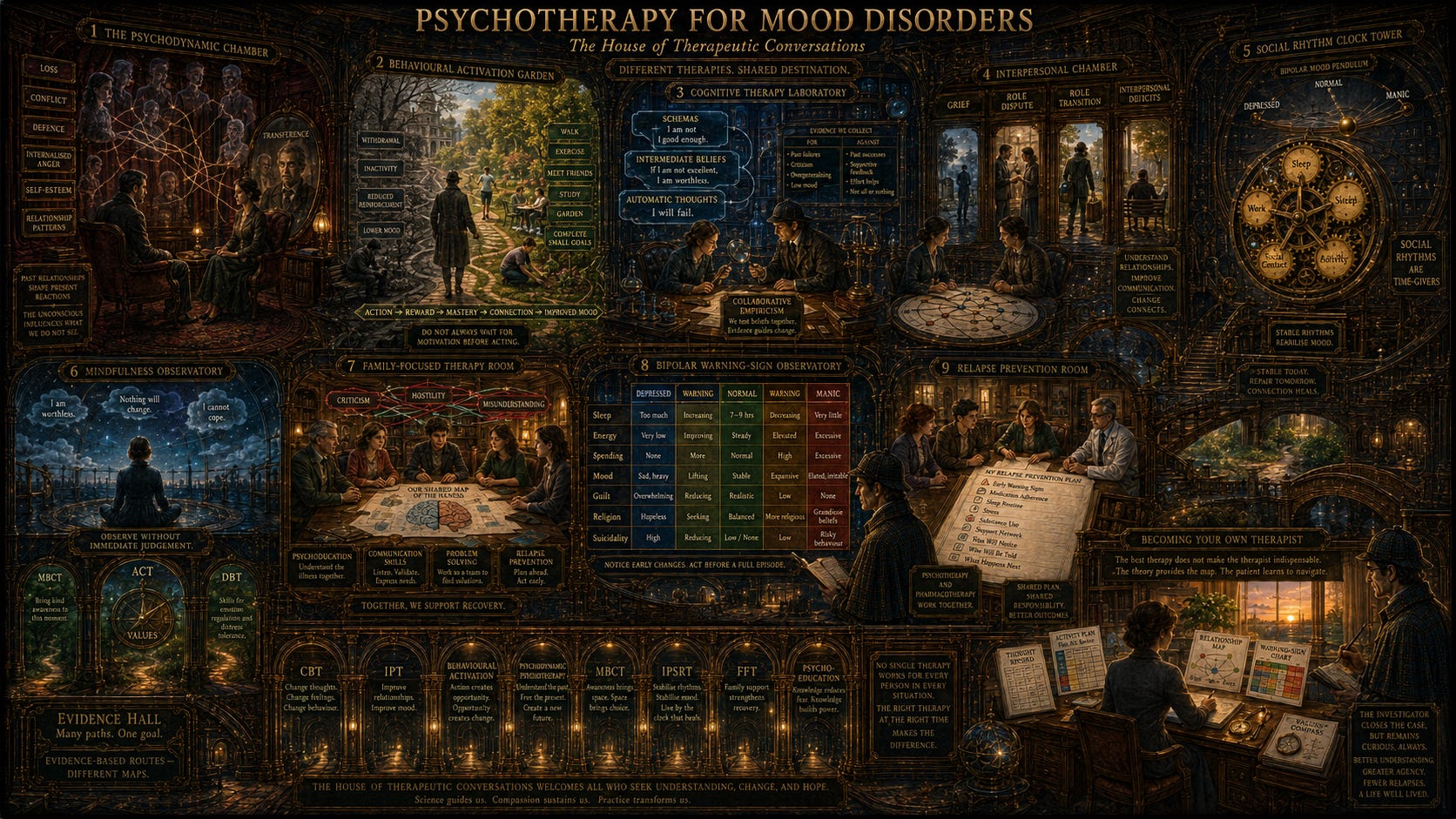 PSYCH 115: Mood Disorders - Psychotherapy 07.09.2026 38dkMedlock Holmes enters the House of Therapeutic Conversations.Unlike the pharmacological observatory, there are no bottles, serum levels, or receptor maps here.Instead, there are rooms.Each room represents a different way of understanding and changing mood disorder.One contains memories, conflicts, and unresolved relationships.Another contains automatic thoughts and deeply held beliefs.Another contains grief, role transitions, and interpersonal disputes.A fourth is filled with routines, clocks, families, values, mindfulness, and behavioural experiments.Holmes quickly realises that psychotherapy is not one treatment.It is a family of treatments built upon different theories of how suffering is maintained and how change occurs.The historical journey begins with psychoanalytic and psychodynamic therapy.Early models conceptualised depression as arising from unconscious conflict, internalised anger, loss, and disturbed object relationships. Therapy was long term and aimed at insight through free association, interpretation, and examination of transference.Modern psychodynamic treatments are often much more focused and time limited, but retain the central idea that current symptoms may be shaped by patterns of relationship, defence, and meaning that are not fully conscious.The next chamber belongs to behavioural therapy.Here the model becomes concrete.Depression is associated with withdrawal.Withdrawal reduces access to pleasure, achievement, social contact, and reinforcement.Reduced reinforcement worsens mood.Worsened mood drives further withdrawal.The treatment therefore aims to interrupt the cycle.Get up.Re-engage.Schedule meaningful activity.Reconnect with people.Test whether action can precede motivation rather than waiting for motivation to appear first.From behavioural therapy emerges one of the most influential approaches in psychiatry:Cognitive Behavioural Therapy.Holmes stands before three levels of cognition.At the surface are automatic thoughts.Beneath them lie intermediate beliefs.At the deepest level are schemas.A student receives a poor mark and thinks:“I will never succeed.”Behind the thought may lie a rule:“If I am not excellent, I am a failure.”And beneath that:“I am not good enough.”CBT teaches the patient to observe these thoughts, examine their accuracy, test them against evidence, and develop more balanced alternatives.The therapist does not simply tell the patient they are wrong.Instead, therapist and patient become joint investigators.Beck called this collaborative empiricism.The patient learns to conduct experiments in everyday life.The thought record shown on page 18 of the source captures this process clearly: a situation, emotion, automatic thought, rational response, and resulting emotional shift are tracked systematically so that assumptions can be tested rather than merely believed.Holmes then enters the Interpersonal Chamber.Here depression is viewed within relationships.Unresolved grief.Role disputes.Role transitions.Interpersonal deficits.Interpersonal psychotherapy, or IPT, is time limited and focuses on one or more of these current relational problem areas.The aim is not to prove that relationships caused the depression.It is to identify a tractable interpersonal problem through which recovery can begin.Another doorway leads to Interpersonal and Social Rhythm Therapy.Here the interpersonal world is connected to biological rhythm.Sleep.Meals.Activity.Work.Social contact.Regularity matters particularly in bipolar disorder, where disruption of daily rhythms may destabilise mood.IPSRT therefore combines interpersonal work with deliberate stabilisation of social rhythms.A further chamber is quieter.Holmes encounters mindfulness.Thoughts are still present.Sadness remains.But the patient learns to observe internal experience without immediately reacting to it.Mindfulness-based cognitive therapy helps patients relate differently to negative thoughts rather than becoming absorbed by them.Acceptance and commitment therapy adds another element:values.Instead of making symptom elimination the only goal, ACT asks what kind of life the patient wishes to move towards even while distress is present.Dialectical behaviour therapy similarly combines behavioural change with acceptance and mindfulness, particularly where emotional dysregulation and suicidal behaviour complicate treatment.Holmes then enters the Family Room.Here the patient is no longer treated as an isolated individual.Family-focused therapy recognises that criticism, hostility, misunderstanding, and high emotional expression can increase relapse risk, particularly in bipolar disorder.The family is educated about the illness.Warning signs are identified.Communication is practised.A relapse-prevention plan is agreed.The family becomes part of the therapeutic system.The source emphasises that psychotherapy has strong evidence in major depressive disorder.CBT, IPT, behavioural activation, and time-limited psychodynamic psychotherapy can all be effective.Across many studies, differences between validated psychotherapies are often modest.This leads Holmes to an important insight.Perhaps specific techniques matter.But so do common therapeutic ingredients:A positive therapeutic relationship.Shared goals.A coherent treatment rationale.Repeated practice.Behavioural change.Hope.Attention.Accountability.The evidence also suggests that psychotherapy can have enduring effects after treatment ends, particularly because patients acquire skills they can continue to use themselves.In depression, combined psychotherapy and pharmacotherapy may be particularly valuable in chronic, severe, recurrent, or treatment-resistant illness.In bipolar disorder, however, the role is different.Psychotherapy is adjunctive.It does not replace mood-stabilising pharmacotherapy for mania or mixed states.Instead, therapies such as CBT, IPSRT, FFT, and psychoeducation improve adherence, identify warning signs, stabilise routines, improve relationships, and reduce relapse risk.The warning-sign table on page 27 illustrates this beautifully. It compares depressed, normal, warning, and manic states across sleep, energy, spending, mood, guilt, religion, and suicidality, demonstrating how relapse prevention depends upon recognising a person’s movement away from baseline before a full episode emerges.Holmes reaches the final room.There is no label on the door.Inside sits a therapist with a formulation.The therapist understands the model they are using.But they also understand the patient.That distinction matters.The source ends with a central principle:Excellent psychotherapy requires both a conceptual framework and the capacity to adapt that framework to the unique person in front of the clinician.The theory provides the map.The relationship makes the journey possible.The skills change the path.And successful psychotherapy eventually helps the patient become their own therapist.Key Takeaways* Psychotherapy has been a cornerstone of treatment for mood disorders for decades.* Modern psychotherapy increasingly emphasises structured, time-limited, manualised, and empirically tested approaches.* Major evidence-based approaches include behavioural therapy, CBT, IPT, psychodynamic psychotherapy, mindfulness-based approaches, ACT, DBT, IPSRT, and FFT.* Early psychodynamic models conceptualised depression in terms of unconscious conflict, internalised anger, loss, and object relationships.* Traditional psychoanalytic treatment emphasised free association, interpretation, insight, and transference.* Contemporary psychodynamic psychotherapy can be time limited and focused while retaining attention to unconscious processes and relationship patterns.* Behavioural theories emphasise reduced access to rewarding activity and positive reinforcement.* Behavioural activation aims to reverse withdrawal by increasing meaningful and rewarding activity.* Behavioural activation may be particularly effective in more severe depression.* CBT integrates behavioural strategies with systematic examination of cognition.* Beck’s cognitive therapy focuses on automatic negative thoughts, intermediate beliefs, and deeper schemas.* Depressive automatic thoughts frequently concern failure, worthlessness, rejection, hopelessness, and incompetence.* Intermediate beliefs often take the form of assumptions or rules such as “If I fail, I am worthless.”* Schemas are deeper organising cognitive structures that influence attention, memory, interpretation, and behaviour.* Depression-related schemas may remain relatively silent until activated by relevant stressors.* Beck’s model contains a stress–diathesis formulation in which life events activate underlying cognitive vulnerabilities.* Collaborative empiricism describes therapist and patient working together to test beliefs rather than the therapist simply correcting the patient.* Socratic questioning is used to help patients examine evidence and generate alternative perspectives.* Homework is a central component of CBT because skills must generalise into everyday life.* Activity scheduling, graded tasks, thought monitoring, behavioural experiments, and cognitive restructuring are common CBT techniques.* The thought record on page 18 demonstrates how a situation, emotion, automatic thought, rational response, and new emotional state can be systematically examined.* Behavioural experiments can produce stronger evidence against dysfunctional beliefs than discussion alone.* A major long-term aim of CBT is for patients to become capable of applying therapeutic skills independently.* Case formulation is central to CBT because interventions should be matched to the individual’s underlying beliefs and patterns.* Assessment should include symptoms as well as interpersonal, occupational, health, recreational, and functional domains.* Standardised measures may include diagnostic interviews and depression rating scales.* CBT sessions are typically structured and include collaborative agenda setting.* Initial CBT sessions aim to establish rapport, orient the patient to the model, identify problems, assess severity, provide early symptom relief, and introduce homework.* Treatment gradually moves from surface automatic thoughts towards deeper core beliefs.* Termination includes relapse-prevention planning and ensuring that the patient can use skills without the therapist.* IPT emerged as a major evidence-based alternative to CBT.* IPT draws from interpersonal theory, attachment theory, and pragmatic case-management principles.* Core IPT problem areas include unresolved grief, role disputes, role transitions, and interpersonal deficits.* IPT may use psychoeducation, empathic support, role play, communication analysis, and interpersonal problem solving.* IPT and CBT appear broadly comparable in efficacy for many outpatients with depression.* IPT has particularly strong evidence in depression during and after pregnancy.* IPSRT adapts IPT for recurrent mood disorders and bipolar disorder.* IPSRT combines interpersonal treatment with stabilisation of daily social rhythms.* Sleep, meal times, activity, work, and social contact function as important social zeitgebers.* Rhythm disruption can contribute to mood instability in bipolar disorder.* Mindfulness emphasises observing and accepting internal experiences nonjudgmentally.* Mindfulness can help patients experience negative thoughts as transient mental events rather than unquestioned truths.* Mindfulness-based cognitive therapy was developed particularly to reduce relapse in recurrent depression.* Acceptance and commitment therapy emphasises values-guided action rather than making symptom elimination the sole goal.* ACT may be particularly relevant to chronic depression.* DBT combines behavioural methods, mindfulness, acceptance, and emotion-regulation strategies.* DBT has evidence for reducing suicidal ideation and behaviour.* Family support is generally a favourable prognostic factor in mood disorders.* High levels of family criticism and emotional expression are associated with increased relapse risk.* Family-focused therapy was developed particularly for bipolar disorder.* FFT includes psychoeducation, relapse-prevention planning, communication training, and problem-solving work.* Family members can assist with early identification of symptom exacerbation.* Validated psychotherapy is effective in outpatient major depressive disorder across a range of settings.* Evidence suggests that CBT can produce response and remission rates comparable with antidepressant treatment across approximately 8–16 weeks.* Time-limited psychodynamic psychotherapy is also efficacious for depression.* Differences in efficacy between validated psychotherapies are often modest.* No reliable markers consistently identify which patient will respond preferentially to one psychotherapy over another.* Psychotherapy may produce benefits that persist after formal treatment ends.* Continuation CBT can reduce relapse in incompletely remitted patients at high risk of recurrence.* MBCT and CBT may improve residual symptoms and reduce relapse risk after antidepressant discontinuation.* Group CBT and behavioural therapies can be effective and may offer cost advantages.* Group therapy may be particularly useful for subsyndromal depressive symptoms.* Behavioural marital therapy can improve depressive symptoms and marital functioning in depressed patients with relationship distress.* Combined psychotherapy and pharmacotherapy may offer additional benefit in severe, chronic, recurrent, or treatment-resistant depression.* The advantage of combined treatment may be greater as illness severity and chronicity increase.* Focused psychotherapy can also improve outcomes when added to inpatient treatment.* Sequential treatment with pharmacotherapy followed by psychotherapy may help sustain recovery.* No psychotherapy has been established as an effective monotherapy for acute mania or mixed states.* Psychotherapy in bipolar disorder should generally be viewed as adjunctive to pharmacotherapy.* Evidence-based adjunctive bipolar interventions include psychoeducation, CBT, IPSRT, and FFT.* Adjunctive psychotherapy can increase time well and reduce relapse and recurrence.* Group psychoeducation is a cost-effective adjunctive intervention in bipolar disorder.* Psychoeducation improves treatment adherence and relapse prevention.* CBT for bipolar disorder targets beliefs that worsen symptoms or reduce adherence.* CBT and IPSRT both emphasise routine stability and reduction of triggers for mania.* FFT brings the family system directly into relapse prevention.* Acute bipolar depression may also benefit from adjunctive focused psychotherapy.* STEP-BD demonstrated benefits of adjunctive FFT, IPSRT, and CBT for depressive symptoms and social functioning.* Psychotherapy should be guided by an explicit case formulation.* Theoretical models are useful, but they extend beyond what empirical data alone can prove about the causes of depression.* Shared therapeutic factors may account for part of the effectiveness across different models.* Important common factors include therapeutic alliance, shared goals, coherent rationale, and facilitated behavioural change.* The therapist’s ability to apply a conceptual model flexibly to the individual patient may be as important as allegiance to a specific school.* Psychotherapy for bipolar disorder should include assessment of routines, activity level, social supports, and beliefs about medication.* Beliefs that mania is beneficial or that medication destroys identity may undermine adherence.* Psychotherapy can help patients identify early warning signs of relapse.* Supportive family members or trusted others may detect changes that the patient does not recognise.* The warning-sign table on page 27 maps movement from depression through normality and warning signs to mania across sleep, energy, spending, mood, guilt, religion, and suicidality.* Relapse-prevention plans should specify how warning signs will be communicated and what actions will follow.* Coordination between psychotherapist and prescribing clinician is essential when different professionals provide psychotherapy and pharmacotherapy.* Later therapy can address core beliefs about identity, stigma, rejection, and the possibility of living a meaningful life with bipolar disorder.* By the end of therapy, patients should ideally be able to monitor symptoms, recognise warning signs, use therapeutic skills independently, communicate effectively with clinicians, and participate actively in relapse prevention.* Psychotherapy is most effective when the therapist holds a clear model while remaining responsive to the individuality of the patient.* The ultimate aim is not permanent dependence on the therapist, but increasing the patient’s capacity for self-observation, self-correction, and self-directed recovery. This is a public episode. If you'd like to discuss this with other subscribers or get access to bonus episodes, visit drmanaankarray.substack.com/subscribe
 -
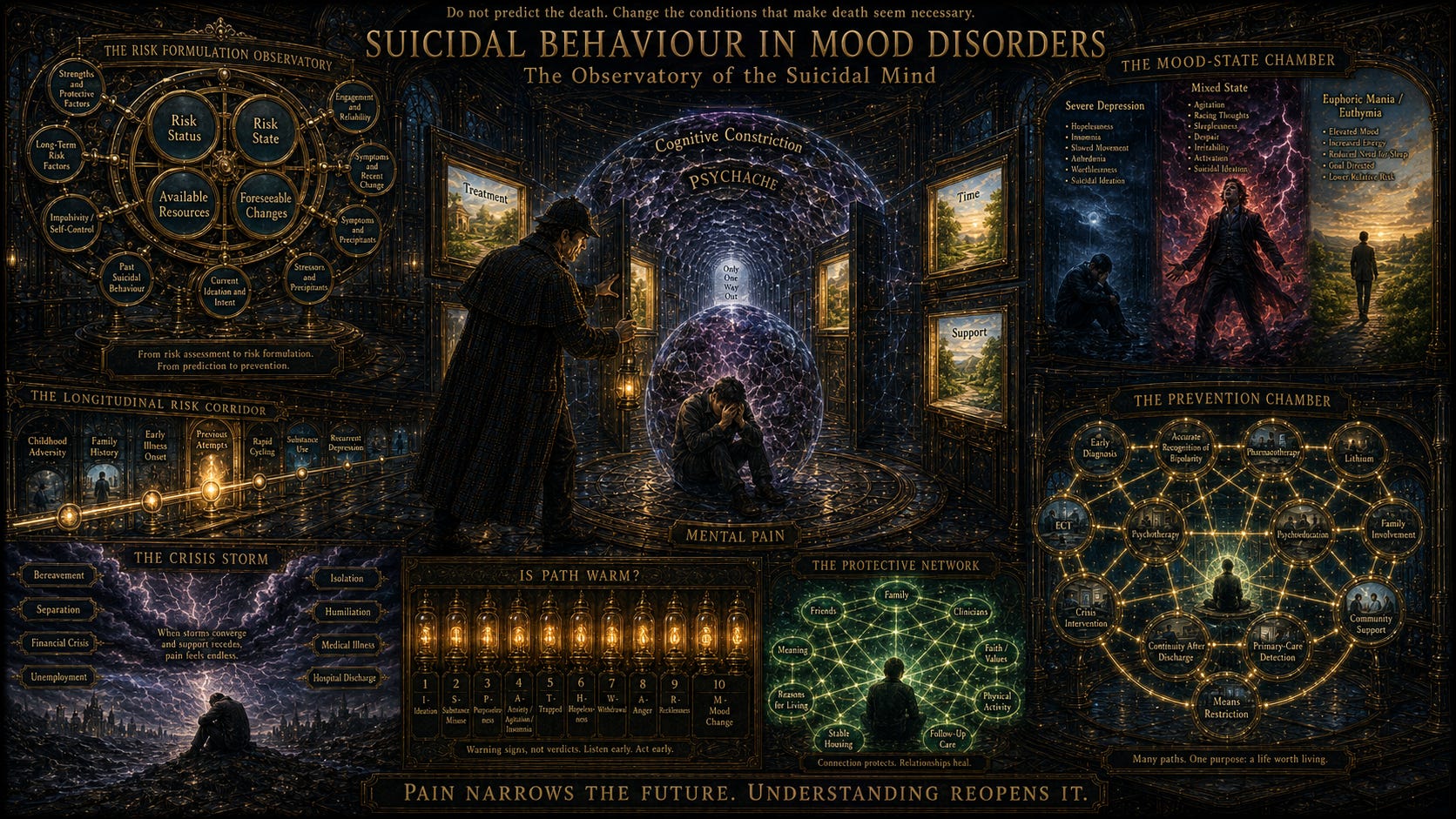 PSYCH 113: Mood Disorders - Suicidal Behaviou 05.09.2026 37dkMedlock Holmes enters the Observatory of the Suicidal Mind.At first, the room appears to contain a familiar psychiatric chart:Depression → Suicide RiskHolmes immediately rejects it.The relationship is far more complex.Mood disorders are among the strongest contributors to suicidal behaviour, but most people with depression do not die by suicide, and suicidal crises can occur outside formal diagnostic thresholds. What matters is not simply the presence of depression, but the interaction between illness severity, hopelessness, agitation, mixed affective states, impulsivity, previous attempts, family history, adversity, substance use, social support, and rapidly changing life circumstances.The central concept Holmes encounters is psychache: unbearable psychological pain.For some people, suicide is not experienced primarily as a movement towards death, but as an imagined escape from intolerable consciousness. The person becomes cognitively constricted, unable to perceive alternatives, and increasingly convinced that the suffering cannot change.This is why understanding the suicidal mind requires more than counting risk factors.The clinician must ask:Where is the pain coming from?Why has it become intolerable now?What has changed?What still connects this person to life?The chapter moves from traditional risk assessment towards suicide risk formulation.Rather than assigning a simplistic label of low, medium, or high risk, formulation integrates four questions:* What is this person’s risk status relative to others in a similar population?* What is their current risk state compared with their own baseline?* What resources and protective factors are available?* What foreseeable changes could rapidly increase danger?The prevention-oriented model shown on page 3 of the source visually reinforces this shift. It brings together enduring factors such as prior suicidal behaviour and long-term vulnerability with dynamic factors such as current ideation, stressors, suffering, engagement, available resources, and foreseeable change.Holmes then examines mood states themselves.The greatest danger usually lies not in euthymia or euphoric mania, but in severe depressive episodes and mixed states.Hopelessness.Insomnia.Anxiety.Agitation.Worthlessness.Guilt.Appetite loss.Psychosis.Substance use.A person may be severely depressed yet lethargic. Another may be equally hopeless but agitated, sleepless, impulsive, and internally accelerated.The second presentation may be especially dangerous because despair has acquired energy.Mixed depressive states therefore deserve particular attention.The investigation then turns backwards in time.A previous suicide attempt is one of the strongest predictors of future suicidal behaviour.Early illness onset, rapid cycling, predominantly depressive course, prior suicidal ideation, family history of suicide, childhood adversity, cyclothymic or irritable temperament, and impulsive–aggressive traits may further increase vulnerability.But these factors are not destiny.They are the landscape upon which the current crisis unfolds.Life events frequently supply the trigger.Bereavement.Separation.Financial collapse.Unemployment.Isolation.Humiliation.Illness.Hospital discharge.Relationship breakdown.Yet even severe events rarely act alone. They become dangerous when they interact with psychiatric illness, personality, reduced support, and an individual’s sense that there is no escape.Holmes then enters the chamber of warning signs.The source highlights the mnemonic IS PATH WARM:* Ideation* Substance misuse* Purposelessness* Anxiety, agitation, insomnia* Trapped* Hopelessness* Withdrawal* Anger* Recklessness* Mood changeThese signs are not a prediction algorithm.They are prompts to investigate a rapidly changing crisis.The source is equally clear that clinicians should ask directly about suicidal thoughts and plans. Asking does not create suicidal behaviour. Avoidance protects the clinician from discomfort, not the patient from risk.The final chamber concerns prevention.Holmes finds that suicide prevention in mood disorders is built from multiple layers:Early diagnosis.Accurate recognition of bipolarity.Rapid treatment of severe depression, agitation, anxiety, and insomnia.Mood stabilisation where indicated.Long-term treatment to prevent recurrence.Psychological intervention.Family involvement.Regular follow-up.Restriction of access to lethal means.Primary-care education.Community awareness.Continuity after discharge.Lithium stands out in the source as having particularly strong evidence for reducing suicidal behaviour in recurrent mood disorders. Effective treatment of the underlying illness remains one of the most powerful modifiable protective factors.Holmes leaves the observatory with one central lesson.Suicide prevention is not the prediction of an unknowable future.It is the disciplined recognition of suffering, change, vulnerability, and opportunity for intervention in the present.The task is not to determine with certainty who will die.It is to understand what can be changed now so that dying no longer feels like the only answer.Key Takeaways* Mood disorders are major contributors to suicidal behaviour but are not sufficient explanations on their own.* Suicide is multifactorial and reflects interactions among psychiatric, genetic, personality, developmental, psychosocial, and demographic factors.* Hopelessness may be more strongly associated with suicide risk than the diagnosis of depression alone.* Distal risk factors include family history, childhood adversity, personality traits, early substance misuse, and developmental vulnerabilities.* Proximal factors include current psychopathology, suicidal ideation, hopelessness, and recent life events.* Psychache refers to unbearable mental pain and provides an important phenomenological model of the suicidal state.* Suicidal thinking may involve cognitive constriction, in which alternatives become increasingly difficult to perceive.* Suicide may be experienced as an escape from intolerable suffering rather than a simple wish for death.* Suicide risk assessment should progress towards suicide risk formulation.* Risk formulation considers risk status, risk state, available resources, and foreseeable changes.* The prevention-oriented formulation on page 3 integrates enduring and dynamic clinical data rather than relying on static categories.* Psychological autopsy studies suggest that a large majority of people who die by suicide have a diagnosable psychiatric disorder, often a mood disorder.* Previous suicide attempt is one of the strongest predictors of future attempted or completed suicide.* About half of people who die by suicide have made a previous attempt, meaning many also die during a first suicidal act.* Bipolar disorder carries particularly high levels of suicidal behaviour.* Suicide risk in bipolar disorder is often greatest early in the illness.* Delayed diagnosis of bipolar disorder may increase exposure to untreated depressive and mixed states.* Severe depressive episodes are high-risk states.* Mixed depressive and manic features further increase concern.* Dysphoria, agitation, insomnia, anxiety, hopelessness, guilt, and worthlessness are particularly important acute clinical signals.* Suicidal behaviour is comparatively uncommon during euthymia and pure euphoric mania.* Psychotic mood episodes may carry additional risk.* Substance-use disorders, including alcohol, can increase both impulsivity and lethality.* Acute alcohol use may precipitate suicidal behaviour even in people without alcohol dependence.* Cigarette smoking is also associated with suicidal behaviour beyond its relationship with psychiatric morbidity.* Painful, disabling, or life-threatening medical illness can increase suicide risk, particularly when depression coexists.* Early onset, predominantly depressive polarity, rapid cycling, and past suicidal ideation increase longitudinal vulnerability.* Cyclothymic, irritable, depressive, and anxious temperaments are associated with greater risk.* Hyperthymic temperament may be relatively protective.* Impulsivity, aggression, pessimism, cognitive rigidity, rumination, and poor decision-making may contribute to suicidal behaviour.* The stress–diathesis model conceptualises suicidal behaviour as interaction between acute stress and enduring vulnerability.* Family history of suicidal behaviour is an important risk factor.* Familial transmission of suicide risk may partly reflect impulsive–aggressive traits and shared environments as well as psychiatric illness.* Childhood abuse, neglect, and disrupted attachment may increase later vulnerability.* Recent bereavement, separation, financial crisis, isolation, unemployment, and humiliation may precipitate crises in vulnerable individuals.* Mood episodes can themselves generate adverse life events, producing vicious cycles of illness and stress.* The period immediately after psychiatric discharge is particularly important for monitoring and follow-up.* Suicide risk factors are cumulative rather than independently deterministic.* Illness-related and dynamic factors generally have more immediate clinical utility than demographic factors.* IS PATH WARM is a mnemonic for warning signs: Ideation, Substance misuse, Purposelessness, Anxiety/agitation/insomnia, Trapped, Hopelessness, Withdrawal, Anger, Recklessness, Mood change.* Direct questioning about suicide does not increase suicidal behaviour.* Withdrawal, putting affairs in order, giving away valued possessions, and sudden behavioural change may signal increased danger.* Family and collateral information may reveal warning signs not disclosed directly by the patient.* Protective factors include social support, strong relationships, reasons for living, resilience, regular physical activity, and effective treatment.* Restricting access to lethal means is an important preventive strategy.* Acute management should address severe depression, agitation, anxiety, insomnia, psychosis, and mixed features promptly.* ECT can be particularly useful in severe or psychotic suicidal depression.* Appropriate long-term pharmacotherapy substantially reduces suicidal morbidity and mortality.* Lithium has particularly strong evidence for reducing suicidal behaviour in recurrent mood disorders.* Antidepressant treatment overall is associated with lower suicide mortality than untreated depression, although close monitoring is essential in vulnerable younger patients and those with emerging mixed or activated states.* Recognition of underlying bipolarity is important when suicidality worsens during antidepressant treatment.* Esketamine may rapidly reduce depressive symptoms, although evidence for a specific independent anti-suicidal effect is less clear in the source.* Pharmacotherapy alone is insufficient; psychosocial intervention, psychoeducation, psychotherapy, family involvement, and continuity of care are also needed.* Primary care is a major setting for suicide prevention because many people who die by suicide have recently consulted healthcare services.* Training clinicians to recognise and treat depression can reduce suicide rates.* Multilevel community approaches are more effective than isolated educational interventions.* Regular planned follow-up is especially important after a suicide attempt or hospital discharge.* The source emphasises that many suicides in mood disorders are potentially preventable through earlier diagnosis, treatment, continuity, and coordinated care.* Suicide risk formulation should ultimately be prevention-oriented rather than prediction-oriented. This is a public episode. If you'd like to discuss this with other subscribers or get access to bonus episodes, visit drmanaankarray.substack.com/subscribe
 -
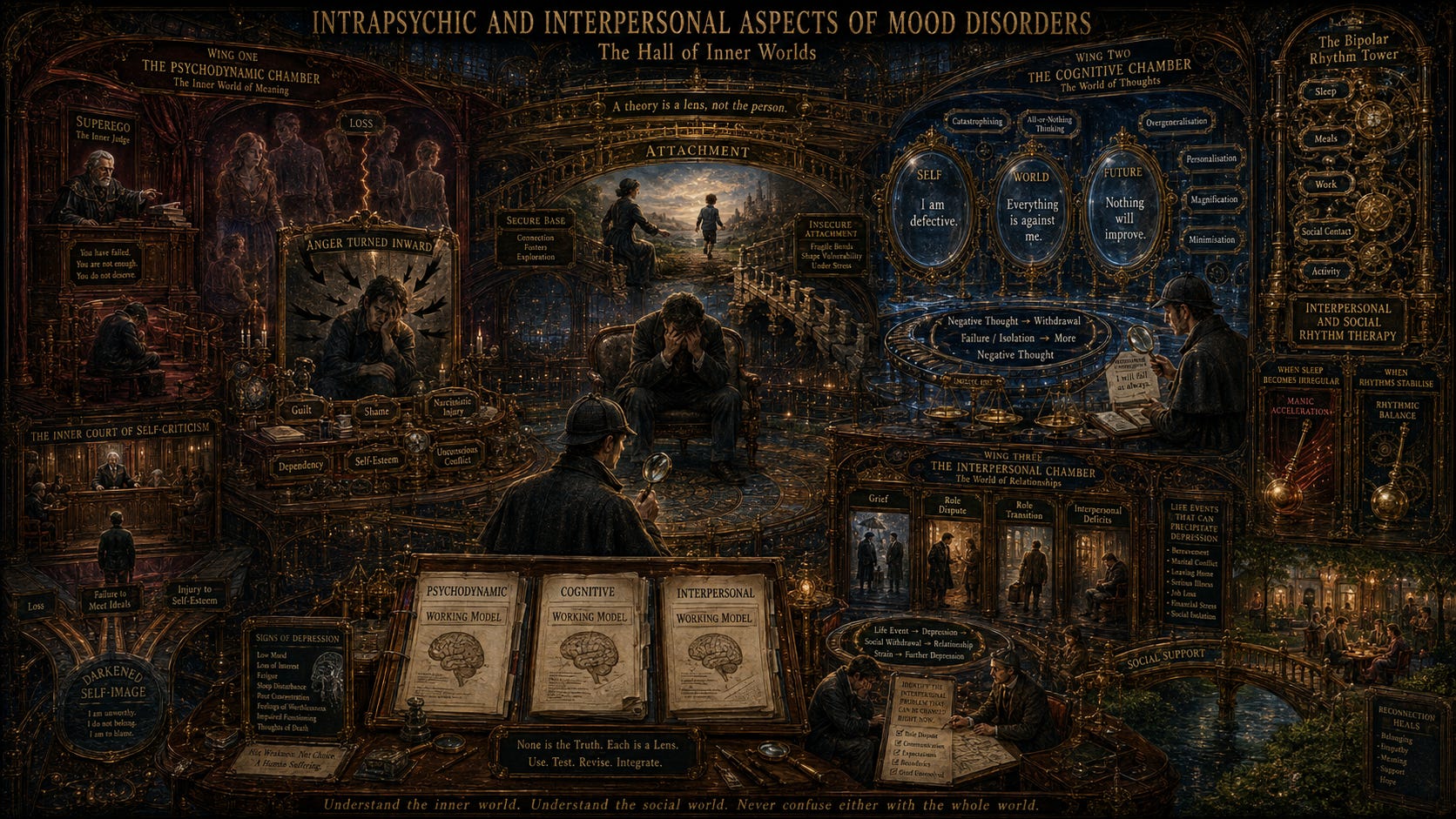 PSYCH 112: Mood Disorders - Intrapsychic and Interpersonal Aspects 04.09.2026 41dkMedlock Holmes enters the Hall of Inner Worlds, where three different investigative rooms attempt to explain the same depressed patient.The first is the Psychodynamic Chamber.Here, the focus is on what lies beneath conscious experience: loss, unconscious conflict, guilt, anger turned inward, injured self-esteem, and the enduring influence of early relationships.Freud’s classic account of melancholia proposed that after a painful loss, hostility towards an ambivalently loved person may be redirected towards the self. The patient attacks themselves instead of the lost or disappointing other.Later psychoanalytic thinkers broadened this picture.Some emphasised guilt.Others narcissistic injury.Others the effects of emotionally unavailable or depressed caregivers.Across many psychodynamic formulations, one theme repeatedly appears: the depressed person experiences themselves as damaged, inadequate, unlovable, or morally deficient. Self-esteem collapses, and aggression is directed inward.Holmes then enters the second room.Three enormous mirrors are labelled:SELFWORLDFUTUREThis is Aaron Beck’s cognitive triad.The depressed patient sees themselves as defective.The world appears hostile or overwhelming.The future seems hopeless.Around the mirrors appear familiar cognitive distortions:* all-or-nothing thinking;* catastrophising;* overgeneralisation;* selective attention to failure;* minimising success;* personalisation.These automatic thoughts reinforce withdrawal and inactivity, which then generate further evidence for the patient’s negative beliefs.Cognitive therapy intervenes by making these thoughts visible, examining the evidence for them, testing them behaviourally, and replacing unquestioned assumptions with more balanced appraisals.Holmes notices that cognitive theory does not explain all of depression.Nor does psychodynamic theory.Each illuminates a different part of the same room.He now enters the third chamber.There are no mirrors.There are people.A grieving spouse.A couple locked in conflict.A student leaving home.A patient adjusting to illness.A lonely person without support.This is the Interpersonal Chamber.Interpersonal theory focuses less on the hidden inner world and more on the person’s present relationships and life events.Loss, interpersonal conflict, role transitions, social isolation, and inadequate support can precipitate or perpetuate depressive episodes in vulnerable individuals.Once depression begins, symptoms themselves damage relationships and functioning, creating a vicious cycle:Life event → Depression → Impaired relationships → More life events → Deeper depressionInterpersonal psychotherapy, or IPT, uses this model pragmatically.The therapist identifies a current interpersonal focus and helps the patient work towards change in areas such as grief, role disputes, role transitions, or interpersonal deficits.The aim is not to prove that relationships caused the illness.It is to identify a meaningful point where treatment can intervene.Holmes sees that all three theories are useful, but none is absolute truth.Psychodynamic theory asks:What unconscious meanings and conflicts are shaping this suffering?Cognitive theory asks:How is the person interpreting themselves, the world, and the future?Interpersonal theory asks:What is happening in this person’s relationships and social world?The wisest clinician does not become a prisoner of one theory.Theory should organise understanding, not replace it.The chapter’s central lesson is therefore one of disciplined pluralism.Use a coherent model.Understand its assumptions.Know its limits.And remember that the patient is always larger than the theory used to explain them.Key Takeaways* Symptom criteria define mood disorders reliably but do not fully explain how patients experience them.* Three major psychotherapeutic frameworks discussed are psychodynamic, cognitive, and interpersonal.* No single theory fully explains the aetiology of mood disorders.* Theories are best treated as working models rather than absolute truths.* A coherent theoretical framework helps organise clinical formulation and psychotherapy.* Clinicians should avoid rigid dogmatism and understand multiple theoretical perspectives.* Psychodynamic theory focuses on unconscious processes, conflict, defence, guilt, self-esteem and internalised relationships.* From a psychoanalytic perspective, mood states may reflect unconscious meaning as well as biological processes.* Freud’s Mourning and Melancholia conceptualised depression partly as hostility towards a lost or ambivalently loved object redirected towards the self.* Loss, real or imagined, is a central theme in several psychoanalytic theories of depression.* Some psychodynamic models emphasise excessive dependency and difficulty tolerating separation.* Melanie Klein highlighted guilt and fear of damaging or triumphing over loved internal objects.* Bibring emphasised helplessness, failure and collapse of self-esteem rather than aggression as the primary mechanism.* Narcissistic injury and failure to meet personal ideals can contribute to depressive states.* Early caregiver inadequacy or lack of empathy may contribute to vulnerability through disturbed self-esteem regulation.* Psychoanalytic writers distinguish between dependent or anaclitic forms of depression and self-critical or introjective forms.* Chronic depression can be mistaken for character pathology because long-standing mood symptoms become woven into identity and relationships.* Across many psychodynamic formulations, low self-regard, shame, guilt and self-directed aggression are recurring themes.* Psychoanalytic theories of mania often conceptualise mania as involving denial, regression, omnipotence and defence against painful affect.* Psychotherapy alone is not sufficient treatment for true mania; pharmacological treatment is required.* Beck’s cognitive model focuses on distorted thinking about the self, world and future.* The cognitive triad is a central feature of depressive thinking.* Common cognitive distortions include dichotomous thinking, arbitrary inference, selective abstraction, overgeneralisation, magnification, minimisation, personalisation and catastrophising.* Depressive automatic thoughts are involuntary, negative and often highly believable to the patient.* Negative cognitions can inhibit action and reinforce behavioural withdrawal.* Withdrawal then creates more opportunities for self-criticism and further strengthens the depressive cycle.* Underlying schemas or core beliefs are broader patterns of self-evaluation that shape automatic thoughts.* Cognitive therapy helps patients examine, test and modify distorted thoughts.* CBT has substantial evidence for efficacy in major depression.* Behavioural activation can also improve depression, suggesting that therapeutic benefit may extend beyond the specific mechanisms proposed by cognitive theory.* Cognitive and psychodynamic theories overlap in their interest in self-critical thinking but differ in how they understand its origins and meaning.* Interpersonal theory focuses primarily on current relationships, social roles and life events.* Important interpersonal precipitants include bereavement, relationship conflict, role transition and social isolation.* Social support can protect against depression.* Depression itself can worsen relationships and create additional negative life events.* Attachment theory provides an important bridge between early relationships and later interpersonal vulnerability.* Interpersonal psychotherapy is a structured, time-limited treatment developed specifically for depression.* IPT does not claim that interpersonal events are the sole cause of depression.* Instead, it pragmatically links depressive symptoms with a current interpersonal focus for treatment.* Core IPT problem areas include grief, role disputes, role transitions, and interpersonal deficits.* IPT seeks to improve communication, assertiveness, expression of anger, negotiation and social confidence.* Dysthymic or chronic depression may require particular emphasis on entrenched passivity, resignation and interpersonal skill deficits.* For bipolar disorder, psychotherapy is usually adjunctive to pharmacotherapy.* Interpersonal and Social Rhythm Therapy combines interpersonal work with stabilisation of daily rhythms and sleep.* Regular sleep and social rhythms are particularly important in preventing manic relapse.* Psychodynamic, cognitive and interpersonal approaches each capture different dimensions of mood disorder.* No framework should be treated as complete or infallible.* The clinician’s task is to choose a coherent model that fits the patient while remaining open to revising it when the facts no longer fit. This is a public episode. If you'd like to discuss this with other subscribers or get access to bonus episodes, visit drmanaankarray.substack.com/subscribe
 -
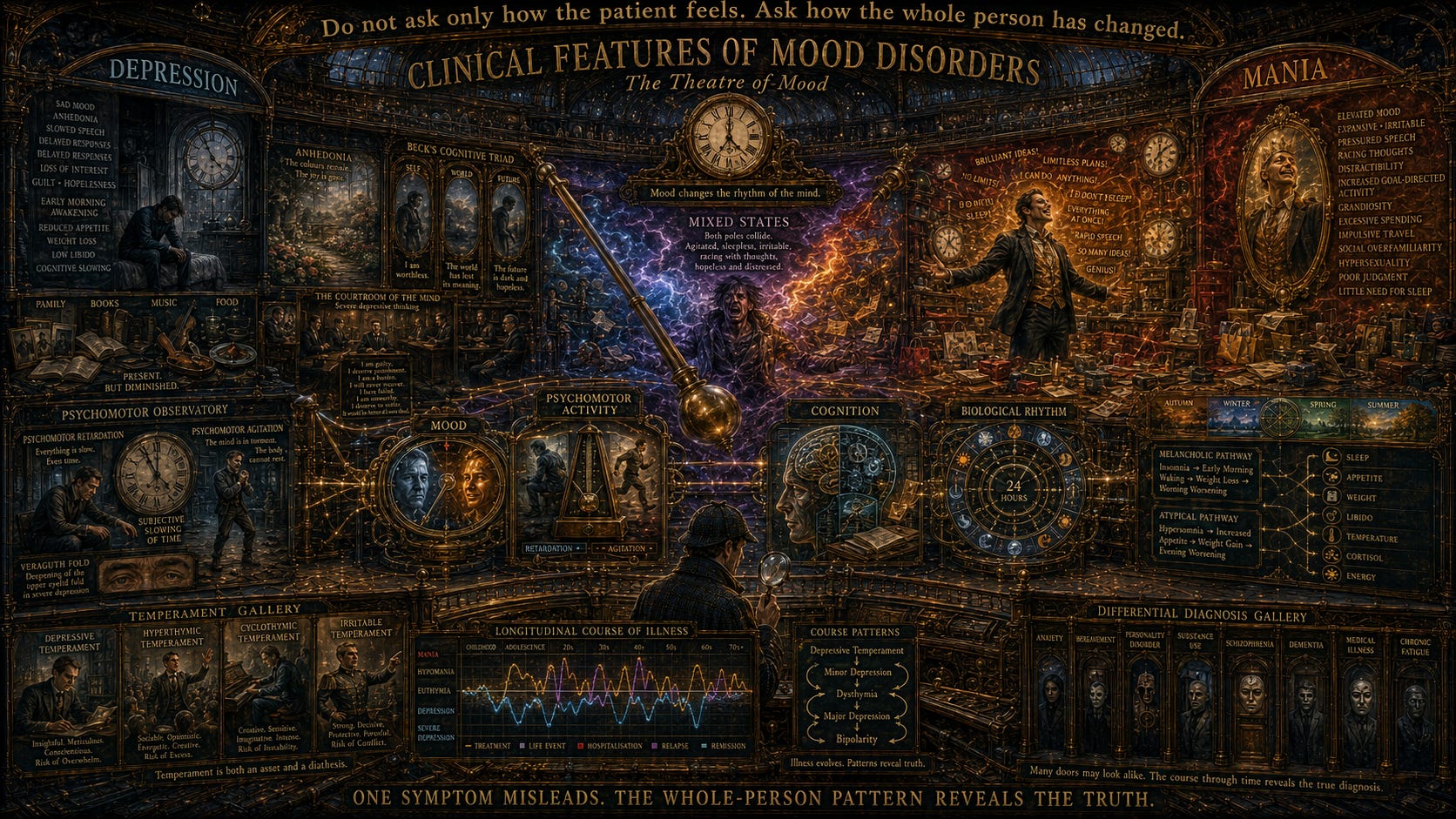 PSYCH 111: Mood Disorders - Clinical Features 03.09.2026 34dkMedlock Holmes enters the Theatre of Mood.At first, the stage appears simple.One side is darkened by depression.The other glows with mania.But as the lights rise, Holmes realises that mood is only one part of the performance.Behind every emotional state lies an entire orchestra of change.Movement slows or accelerates.Sleep contracts or expands.Appetite disappears or increases.Thought becomes constricted or races.Self-esteem collapses or inflates.Time itself seems to change speed.This chapter explores the clinical phenomenology of mood disorders: how depression, mania, hypomania, mixed states, dysthymia, cyclothymia, psychosis, cognition, vegetative disturbance, and temperament appear in real patients.Holmes begins with an essential distinction.Affect is what the observer sees.Facial expression.Tone of voice.Gesture.Posture.Mood is what the person experiences within.The two may agree.Or they may not.A person may smile while profoundly depressed.Another may claim to feel fine while their behaviour communicates despair.Clinical understanding therefore begins not with a checklist, but with careful observation and empathic enquiry.Holmes moves next into the gallery of normal emotion.Sadness is universal.Grief is universal.Joy and elation are universal.These states are not illnesses simply because they are intense.The boundary is crossed when mood becomes disproportionate, autonomous, sustained, recurrent, and impairing.The source describes pathological mood states as endoreactive: they may begin in response to an event, but once released, they can continue under their own momentum even after the precipitating event has faded.This distinction matters.Normal grief remains responsive to the environment.Pathological depression becomes increasingly sealed from it.The same applies to elation.Ordinary happiness follows success.Mania does not require success to sustain itself.It creates its own internal momentum.Holmes then enters the Hall of Temperament.Before illness fully develops, many people have enduring affective styles.Depressive temperament.Hyperthymic temperament.Cyclothymic temperament.Irritable temperament.These are not diagnoses in themselves.They may carry both strengths and vulnerabilities.The depressive temperament can bring dependability, conscientiousness and sensitivity.The hyperthymic temperament may confer energy, extroversion, humour and leadership.The cyclothymic temperament may carry emotional intensity and creativity.The irritable temperament may confer assertiveness and forcefulness.But the same traits can become unstable.Temperament is therefore not simply pathology.It is the terrain upon which pathology may later emerge.Holmes now enters the depressive chamber.The first thing he notices is that depression is not synonymous with sadness.Some patients describe unbearable psychic pain.Others feel emotionally numb.Some cannot cry.Some deny feeling depressed altogether and instead present with headache, abdominal discomfort, chest pain, fatigue, or vague bodily distress.Others primarily complain that they have lost the capacity to enjoy anything.Anhedonia becomes one of the most important clues.A patient stops reading.Stops gardening.Stops listening to music.Stops enjoying food.Stops feeling warmth towards people they love.The world has not become objectively empty.The patient’s ability to resonate with it has disappeared.The depressive syndrome then reveals itself across four major domains:MoodPsychomotor activityCognitionVegetative functionA diagnosis made from mood alone is therefore incomplete.Holmes observes the body.Some depressed patients are agitated.They pace.Wring their hands.Pull at their hair.Speak anxiously.Others slow dramatically.Speech becomes sparse.Movement becomes reduced.Responses are delayed.The posture collapses.The gaze turns downward.The source even illustrates the classical Veraguth fold on page 9: a triangular fold at the nasal corner of the upper eyelid historically associated with depression, alongside the broader emphasis on altered facial musculature and psychomotor expression.Psychomotor retardation can become profound.The patient describes inertia.Thought itself feels slowed.Simple tasks feel impossible.Time seems to stop.Concentration collapses.Decision-making becomes exhausting.At its extreme lies depressive stupor.On page 10, the source contrasts the appearance of a woman during severe retarded depression with her appearance after recovery, visually demonstrating how profoundly mood illness can alter posture, facial expression, grooming and vitality.Holmes then enters the chamber of depressive cognition.The mind has become a courtroom.The patient is simultaneously defendant, prosecutor and judge.Everything is interpreted negatively.Failure becomes global.Mistakes become unforgivable.The future becomes hopeless.The self becomes worthless.Depressive thinking commonly centres on:* loss and deprivation;* low self-esteem;* guilt and self-reproach;* helplessness;* hopelessness;* death and suicide.In severe depression, these ideas may become psychotic.A patient may believe they have financially ruined the family.That they are dying from an undiagnosed illness.That their organs have disappeared.That they deserve punishment.That catastrophe is inevitable.Mood-congruent psychotic symptoms amplify the emotional logic of depression until metaphor becomes conviction.Yet mood-incongruent psychotic experiences can also occur and do not automatically imply schizophrenia.Holmes learns again that isolated symptoms mislead.The pattern matters more.Then comes the issue of suicide.Depressive despair may create the wish to die.But risk is not static.The source highlights a clinically important observation: when psychomotor activity begins to improve while mood and thinking remain profoundly dark, a patient may regain sufficient energy to act on suicidal thoughts. Hopelessness during apparent early recovery therefore demands careful attention.Holmes writes in bold:Improvement in movement is not always improvement in risk.He then examines the vegetative system.Classic melancholic depression often produces:* reduced appetite;* weight loss;* insomnia;* early morning waking;* reduced libido;* morning worsening;* loss of energy.But not every depression follows this pattern.Atypical depression may reverse the biological signs:* increased appetite;* weight gain;* hypersomnia;* leaden fatigue;* rejection sensitivity;* mood reactivity;* sometimes evening worsening.The contrast between melancholic and atypical patterns is clinically important because atypical features may raise suspicion of bipolar II disorder in some patients.Sleep becomes one of the richest clues.Depression may shorten REM latency.Slow-wave sleep may reduce.Sleep becomes fragmented.Some younger depressed patients, particularly those with bipolar tendencies, sleep excessively and struggle to get out of bed.Others wake at 4 am and cannot return to sleep.The same disorder family can disturb biological rhythm in opposite directions.Seasonality adds another temporal layer.Autumn–winter depression may bring hypersomnia, overeating, carbohydrate craving and fatigue, followed by increased energy or hypomanic activation in spring.The mind is not merely emotional.It is rhythmic.The chapter then turns to mania.The theatre lights blaze.Psychomotor activity accelerates.Speech becomes pressured.Ideas race.Sleep requirement collapses.Self-confidence expands.Social inhibition falls away.The patient becomes energetic, intrusive, distractible and impulsive.At first, this may appear joyful.But mania is not simply happiness amplified.The elevated mood is often unstable.Elation can rapidly become irritability.Humour can become hostility.Confidence can become grandiosity.Sociability can become overfamiliarity.Energy can become dangerous disorganisation.Manic cognition is expansive.The person feels unusually powerful, gifted or important.Insight falls.Judgement deteriorates.Spending may become reckless.Sexual behaviour may become impulsive.Business decisions become unrealistic.Travel becomes sudden.Relationships become destabilised.The clinical danger comes partly from the fact that the person may feel better than ever while objectively functioning far worse.The source strongly emphasises psychomotor acceleration as a hallmark of mania, with increased energy, rapid speech, impulsivity, social disinhibition and decreased need for sleep.Psychosis may accompany mania.Grandiose delusions.Persecutory ideas.Hallucinations.Even Schneiderian-like phenomena.Again, these do not automatically indicate schizophrenia.The entire affective pattern must be understood.Holmes then enters the chamber marked Mixed States.Here the lighting is neither blue nor gold.It is violet.Manic activation and depressive suffering occupy the same person.The patient is energised but hopeless.Agitated but despairing.Unable to sleep.Irritable.Racing with thoughts.Possibly suicidal.Mixed states are among the most clinically dangerous presentations because activation may coexist with depressive cognition.The old image of bipolar disorder as clean alternation between cheerful mania and sad depression is therefore inadequate.Real illness is often messier.The next distinction is between mania and hypomania.Hypomania is not merely weaker mania.It is a qualitatively different clinical state.Mood elevation or irritability is present.Energy increases.Sleep need falls.Confidence and sociability rise.But there is no marked functional impairment, psychosis or need for hospitalisation.Indeed, patients may experience hypomania as productive and desirable.That creates a diagnostic problem.People often report depression spontaneously.They rarely complain about periods when they felt unusually energetic, confident, creative and socially alive.Collateral history therefore becomes crucial.Holmes does not simply ask:“Have you ever been manic?”He asks:“Have there been periods when you needed much less sleep?”“Were you unusually driven?”“Did people tell you that you were talking more?”“Did you feel sharper, faster or more confident than usual?”“Did you become unusually sociable or impulsive?”The key diagnostic clue is often behavioural activation, not the patient’s label for mood.The chapter then moves to the enduring forms.Persistent depressive disorder is not simply a long major depressive episode.Often it begins insidiously in childhood or adolescence.The person may say:“I have always been this way.”Mood is chronically low-grade.Joy is scarce.The person may function adequately but invest most available energy into duty and work, leaving little for relationships, leisure or pleasure.When major depressive episodes occur on top of this chronic baseline, the result resembles what has historically been called double depression.The source’s course diagram on page 50 illustrates this visually: complete remission, partial remission, and major depression superimposed upon a dysthymic baseline are shown as distinct longitudinal patterns.Holmes then studies cyclothymia.Here the baseline itself oscillates.The person moves repeatedly between subthreshold depressive and hypomanic states.Neither pole reaches full syndromal severity.Yet the instability itself may damage relationships, employment and judgement.Cyclothymia can be mistaken for personality disorder because mood instability becomes woven into the individual’s biography.But Holmes learns to ask a different question:Is the instability truly characterological-or is it affective?The source’s spectrum diagram on page 56 depicts depressive temperament, minor or brief depression, dysthymic disorder, major mood episodes and interpersonal sequelae as interconnected rather than isolated boxes, reinforcing the idea that mood disorders may exist along continua rather than in perfectly discrete categories.That continuum becomes even more important when Holmes examines the border between major depressive disorder and bipolar disorder.Some people initially diagnosed with recurrent depression later develop hypomania or mania.Clues that should raise suspicion of bipolarity include:* early onset;* recurrent episodes;* psychotic depression in youth;* postpartum episodes;* abrupt onset and offset;* hypersomnia;* marked psychomotor retardation;* atypical features;* seasonality;* cyclothymic temperament;* hyperthymic temperament;* bipolar family history;* antidepressant-induced hypomania;* mixed depressive features.The diagnosis therefore lives in the longitudinal history, not simply the current episode.The chapter repeatedly returns to this principle.Mood disorders unfold over time.A single consultation gives only a snapshot.The illness is a film.This is why life-charting becomes so powerful.The source’s life-chart illustration on page 59 maps mania, depression, treatments, life events and hospitalisations across years, showing how diagnosis becomes clearer when episodes are viewed longitudinally rather than separately.Holmes next examines rapid cycling.At least four mood episodes occur within a year.The patient moves repeatedly through depression, hypomania or mania, sometimes with little stable time between them.The result can be devastating.Occupational functioning collapses.Relationships destabilise.Treatment becomes difficult.Substances, caffeine, endocrine factors and antidepressants may all complicate cycling in vulnerable individuals.Then comes the differential diagnosis.Mood disorders can masquerade as anxiety disorders.Personality disorders.Substance-related disorders.Schizophrenia.Dementia.Chronic fatigue.Neurological illness.Endocrine disease.Medication effects.Bereavement.Holmes must therefore resist diagnostic shortcuts.A depressed older person complaining of memory loss may have depression rather than dementia.A young person with rapid speech and bizarre behaviour may have mania rather than schizophrenia.A chronically unstable person may have cyclothymia rather than a primary personality disorder.A cocaine user may have an underlying bipolar disorder rather than purely substance-induced symptoms.A patient with physical complaints may have depression.And a patient with depression may still have genuine physical disease.The clinical task is to keep both possibilities alive.At the end of the theatre, Holmes discovers the master control room.It contains four interconnected systems:MoodMovementThinkingBiological RhythmEvery major mood syndrome changes all four.Depression slows or distorts them.Mania accelerates them.Mixed states pull them in opposing directions.Temperament sets the baseline.Time reveals the pattern.Holmes closes the final chart.Mood disorders are not simply diseases of sadness and happiness.They are disorders of regulation.The whole organism shifts.The whole life shifts.And the clinician’s task is not merely to ask how the patient feels-but to understand how the person’s entire internal rhythm has changed.Key Takeaways* Mood disorders involve pervasive dysregulation of mood, psychomotor activity, cognition and biological rhythms.* Affect and mood are related but distinct: affect is externally expressed, while mood is the sustained internal emotional state.* Accurate assessment requires empathic observation because outward affect and inner mood may not always match.* Sadness, grief, joy and elation are normal human experiences and should not automatically be pathologised.* Pathological mood states are distinguished by disproportion, persistence, autonomy, recurrence and functional impairment.* The source describes pathological mood states as endoreactive: once triggered, they may persist autonomously beyond the precipitating event.* Mood disorders exist on a spectrum from temperamental variation and subthreshold states to full syndromal depression and mania.* Subthreshold symptoms may persist between major episodes and remain clinically important.* Affective temperaments include depressive, hyperthymic, cyclothymic and irritable patterns.* Temperaments can represent both assets and vulnerabilities.* Depressive temperament may be associated with dependability, conscientiousness and sensitivity.* Hyperthymic temperament may be associated with energy, extroversion and leadership.* Cyclothymic temperament involves mood lability and may precede bipolar-spectrum illness.* Pathological mood disorders are characterised by recurrence or chronicity as well as severity.* Major depression should be assessed across mood, psychomotor, cognitive and vegetative domains.* Depressed mood may be experienced as profound psychic pain rather than ordinary sadness.* Some patients deny sadness and instead present with somatic symptoms.* Anhedonia is a central feature and should be assessed behaviourally by asking what activities the patient has stopped enjoying or pursuing.* Severe depression can include emotional numbing, depersonalisation and derealisation.* Psychomotor agitation and psychomotor retardation can both occur in depression.* Psychomotor retardation may include reduced movement, slowed speech, fatigue, impaired concentration, indecisiveness and altered perception of time.* Severe retardation can progress to depressive stupor.* The source illustrates classical physical signs of depression, including the Veraguth fold on page 9.* The before-and-after images on page 10 demonstrate the profound observable change in posture, expression and vitality between severe depression and recovery.* Depressive cognition commonly includes loss, low self-esteem, guilt, helplessness, hopelessness and thoughts of death.* Cognitive slowing, poor attention, memory difficulty and executive dysfunction may accompany depression.* So-called depressive “pseudodementia” represents genuine cognitive impairment rather than fabricated symptoms.* Cognitive symptoms may persist beyond improvement in mood and may influence recurrence.* Psychotic depression may include mood-congruent delusions of guilt, poverty, illness, worthlessness or nihilism.* Hallucinations may also occur in severe depression.* Mood-incongruent psychotic symptoms do not automatically imply schizophrenia.* Suicide enquiry does not provoke suicide and should form part of depressive assessment.* Suicide risk may remain high or increase when psychomotor activity improves before hopelessness and depressive cognition resolve.* Melancholic depression commonly includes reduced appetite, weight loss, insomnia, early morning waking, reduced libido, psychomotor disturbance and morning worsening.* Atypical depression may show reverse vegetative features such as hypersomnia, increased appetite, weight gain, rejection sensitivity and mood reactivity.* Atypical features may raise suspicion of bipolar-spectrum illness in some patients.* Sleep disturbance is a cardinal feature of mood disorders.* Depression may involve reduced slow-wave sleep and shortened REM latency.* Hypersomnia is particularly important in younger depressed patients with possible bipolar tendencies.* Circadian dysregulation can persist across episodes and may contribute to recurrence.* Seasonal depression may show autumn–winter worsening with spring activation.* Sexual dysfunction is common in depression, although increased sexual drive can occur in some mixed or bipolar-spectrum presentations.* Mania involves mood elevation or irritability, psychomotor acceleration, reduced need for sleep, pressured speech, racing thoughts, increased activity and poor judgement.* Lability and irritability are as important as euphoria in mania.* Pathological overfamiliarity and social disinhibition are important clinical features.* Manic impulsivity may lead to reckless spending, gambling, sexual indiscretion, travel and damaging interpersonal behaviour.* Insight is often impaired in mania.* Grandiose and persecutory delusions may occur in mania.* Psychotic symptoms in mania do not necessarily indicate schizophrenia.* Decreased need for sleep is a core manic feature and differs from insomnia because the patient remains energetic despite little sleep.* Severe mania can progress to delirious mania, a medical emergency.* Catatonic features can occur in mood disorders as well as schizophrenia and medical illness.* Mixed states combine depressive and manic features within the same episode.* Agitation, insomnia, racing thoughts, irritability and suicidality may coexist in mixed states.* Hypomania is characterised by activation without the marked impairment, psychosis or hospitalisation associated with mania.* Hypomania is often ego-syntonic and may not be spontaneously reported by patients.* Collateral history is essential when assessing possible hypomania.* Behavioural activation may be easier to elicit than asking directly about “high mood”.* Persistent depressive disorder is typically chronic, lower-grade and often begins early in life.* Patients with persistent depressive disorder may experience their low mood as part of their habitual identity.* Major depressive episodes may superimpose upon persistent depressive disorder, historically termed double depression.* The source’s page 50 diagram demonstrates complete remission, partial remission and depression superimposed upon dysthymia as distinct longitudinal courses.* Cyclothymic disorder involves recurrent subthreshold depressive and hypomanic periods over prolonged periods.* Cyclothymia can produce substantial interpersonal and occupational instability despite the absence of full syndromal episodes.* Cyclothymia may be confused with personality disorder.* The depressive spectrum diagram on page 56 illustrates continuity between temperament, minor depression, dysthymia, major episodes and interpersonal consequences.* Bipolar I disorder requires a manic episode.* Bipolar II disorder involves major depressive episodes and hypomania without a history of full mania.* Bipolar II disorder is frequently missed because patients present during depression and may not recognise hypomania as pathological.* Early age of onset, recurrent depression, atypical features, seasonality, psychomotor retardation and family history increase suspicion of bipolarity.* Postpartum and psychotic depression in younger patients should heighten vigilance for bipolar disorder.* Antidepressant-associated hypomania may indicate underlying bipolar vulnerability.* Depressive mixed states may represent part of the bipolar spectrum.* Rapid cycling is defined by at least four mood episodes in one year.* Rapid cycling is associated with severe functional impairment and treatment complexity.* Mood episodes are best understood longitudinally rather than cross-sectionally.* Life-charting can reveal relationships between depression, mania, treatments, life events and recurrence.* The page 59 life-chart illustration demonstrates how longitudinal mapping can expose patterns otherwise missed in isolated consultations.* Normal bereavement differs from major depression through greater emotional reactivity, absence of marked psychomotor retardation, limited pathological guilt and lower rates of active suicidal ideation.* Severe or prolonged grief can nevertheless progress into depressive disorder.* Depression and anxiety frequently coexist and may be difficult to differentiate.* Bipolar disorder may be mistaken for schizophrenia, personality disorder, anxiety disorder or substance-use disorder.* Mood disorders should be considered before attributing affective instability entirely to personality pathology.* Substance use may represent self-medication of an underlying mood disorder.* Affective symptoms persisting after detoxification should prompt reassessment for primary mood disorder.* Medical illnesses and medications can cause or precipitate depressive and manic syndromes.* Somatic symptoms in depression should not lead clinicians to ignore genuine physical disease.* Depressive cognitive impairment in older people may resemble dementia.* Prospective follow-up is sometimes necessary to distinguish mood disorder from neurodegenerative disease.* There is no single routinely useful biomarker, scan or laboratory test that establishes the diagnosis of a mood disorder.* Diagnosis still depends primarily on careful phenomenology, longitudinal history, family history, course and treatment response.* The most useful clinical model is to assess mood disorders as disturbances across emotion, psychomotor function, cognition and biological rhythm rather than as simple changes in happiness or sadness. This is a public episode. If you'd like to discuss this with other subscribers or get access to bonus episodes, visit drmanaankarray.substack.com/subscribe
 -
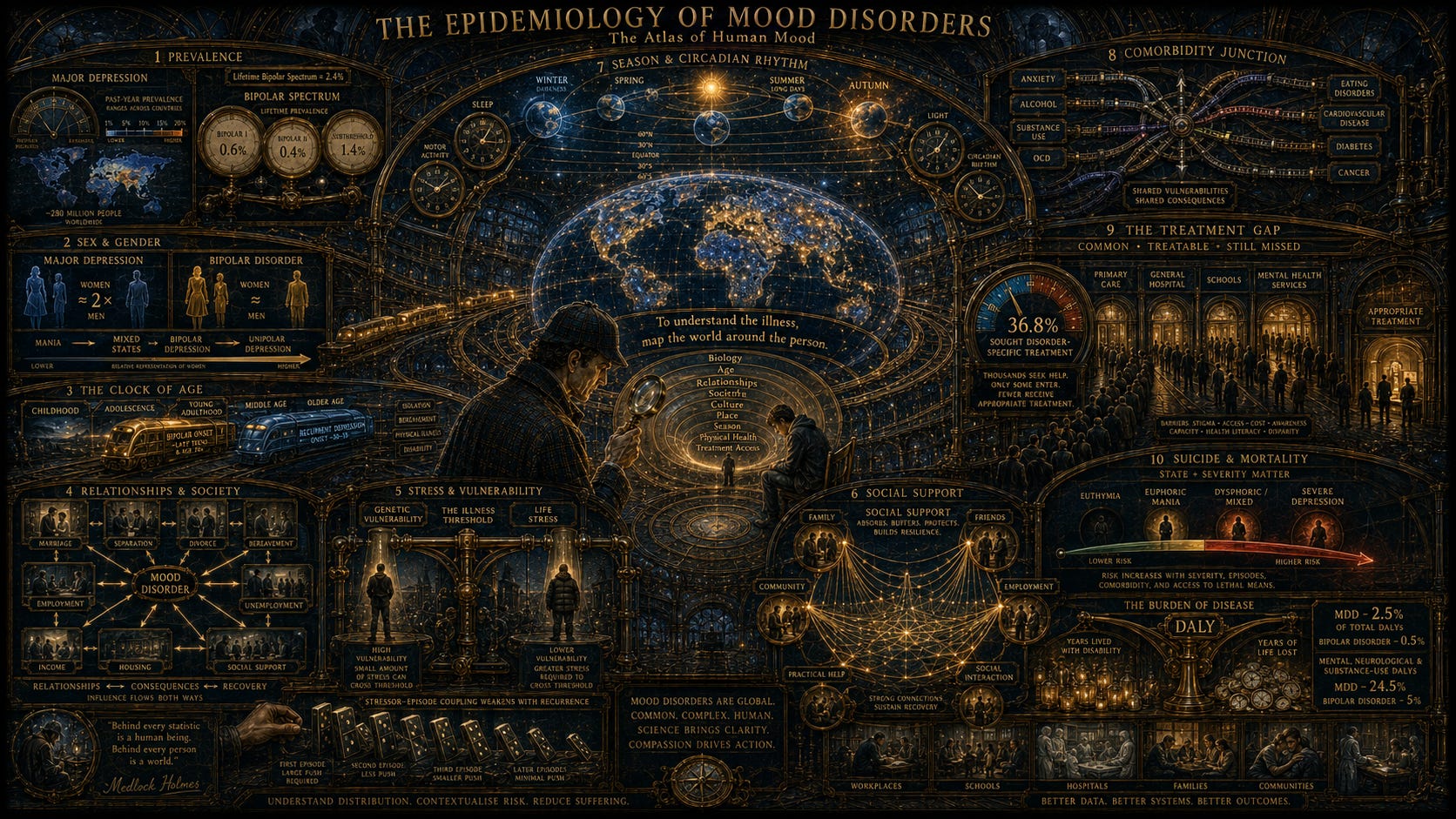 PSYCH 110: Mood Disorders - Epidemiology 02.09.2026 34dkMedlock Holmes enters the Atlas of Human Mood.It is an extraordinary observatory.Suspended at its centre is an enormous illuminated globe. Across every continent, thousands of small lights pulse between blue and gold.Blue represents depression.Gold represents mania and hypomania.But the lights are not distributed randomly.Holmes notices patterns.They cluster differently according to sex.Age.Social circumstances.Relationships.Latitude.Season.Comorbidity.And access to treatment.This is the domain of epidemiology.Its task is not simply to ask:Who develops a mood disorder?It asks something more ambitious:Where does illness occur, when does it emerge, who is most vulnerable, what travels alongside it, what protects against it, and what happens when societies fail to recognise or treat it?The investigation begins with bipolar disorder.Historically, the lifetime prevalence of bipolar I disorder has generally been estimated at around 1%.But the number changes depending upon where investigators draw the diagnostic boundary.The WHO World Mental Health surveys estimated a cross-national lifetime prevalence of the broader bipolar spectrum at approximately 2.4%:0.6% bipolar I0.4% bipolar II1.4% subthreshold bipolar disorderOther studies using broader definitions have produced still higher estimates.Holmes immediately encounters one of epidemiology’s central principles:Prevalence depends partly upon where we draw the diagnostic frontier.Move the boundary outward and more human experience enters the territory called illness.The same principle applies to depression.Across the WHO World Mental Health surveys, lifetime major depressive disorder averaged approximately 11.1% in low- and middle-income countries and 14.6% in high-income countries.Twelve-month prevalence was approximately 5.9% and 5.5%, respectively.On page 5 of the source, the international bar chart makes the point visually: prevalence varies considerably between individual countries, yet major depression is clearly present across both lower/middle- and higher-income settings.But beneath the threshold of major depression lies a much larger territory.Some people experience recurrent brief depression.Others have minor depressive syndromes.Others experience subthreshold hypomania.These states may not satisfy the duration or severity requirements of formal diagnostic systems.Yet they can still produce considerable suffering and disability.When spectrum definitions are used, estimates can reach approximately 5% for bipolarity and 20% for depression.Holmes therefore draws the first epidemiological lesson into his notebook:Diagnostic thresholds create categories; human suffering remains continuous.He turns next towards sex and gender.Here one of psychiatry’s most reproducible epidemiological findings emerges.Major depressive disorder is approximately twice as common in women as in men.The difference develops around early adulthood, becomes particularly pronounced between approximately 30 and 45 years, and persists into older age.No single explanation accounts for it.Biological and hormonal factors may contribute.So may differences in stress exposure and sensitivity.Coping.Social roles.Earlier anxiety disorders.And differences in how depressive symptoms are expressed or recognised.Bipolar disorder presents a fascinating contrast.Across bipolar disorder as a whole, the sex ratio is approximately 1:1.Yet women become increasingly represented as the depressive component of the phenotype increases - including bipolar II disorder, rapid cycling, mixed or dysphoric states, atypical bipolar depression and winter depression.At the other extreme, rare forms of unipolar mania show a predominance of men.Holmes looks again at the great globe.Perhaps epidemiology is not merely counting diagnoses.It is revealing the architecture hidden beneath them.The next gallery is Age.Depression and bipolar disorder have different temporal signatures.The average onset of recurrent major depressive episodes falls around 30–35 years.Single-episode major depression often begins somewhat later.Bipolar disorder typically arrives considerably earlier.Its onset is commonly around 20 years, with more than half of cases beginning before 20, frequently during late adolescence.Men with bipolar disorder may begin approximately four to five years earlier than women.First-onset mania in later life is comparatively unusual.Family history changes the clock again.Individuals with a familial loading for mood disorder tend to develop illness earlier and may require less environmental stress to precipitate an episode.Holmes sketches a simple equation:Genetic vulnerability lowers the threshold at which experience becomes illness.But age changes the nature of vulnerability too.In younger people, social stressors may play a greater role.Later in life, isolation, loss of relationships, disability and physical illness become increasingly important.Depression is therefore not epidemiologically identical across the lifespan.The same syndrome may emerge from a changing ecology of risk.Holmes walks onwards into the Hall of Relationships.Here the statistics become entangled with causality.Mood disorders are more common among people who are divorced, separated or widowed.Recently bereaved people carry particularly high risk of major depressive episodes.But Holmes notices arrows travelling in both directions.Relationship breakdown may precipitate depression.Depression may damage relationships.Mania may generate behaviours that contribute to separation.Divorce then becomes another stressful life event.The consequence becomes another cause.This is one of epidemiology’s great difficulties:Risk factors can become outcomes, and outcomes can manufacture new risk factors.The same circularity appears in socioeconomic status.Depressive symptoms are associated with social disadvantage.Lower income, poorer housing, unemployment and homelessness cluster with mood disorder.The source reports that major depressive episodes were approximately three times more frequent among people without employment than among those with a workplace.But again the arrow is bidirectional.Unemployment can contribute to depression.Depression can contribute to unemployment.Illness can therefore create the very environment that perpetuates it.Holmes calls this the social feedback loop of illness.He enters another chamber labelled Place.Urban environments generally show higher rates of major depression than rural environments in Western studies.Yet “urban” is probably not itself the causal agent.It may instead represent density, stress, social fragmentation, socioeconomic conditions and other environmental exposures.Geography becomes more intriguing when Holmes looks upwards.Above him is an enormous model of the Earth tilted towards the Sun.Mood has a calendar.Spring and autumn are statistical peaks for depression.Summer is a peak for mania.Seasonal affective patterns occur in a substantial minority of people with recurrent mood disorders.Winter depression tends to become more common farther from the equator, although latitude explains only part of the phenomenon.Photoperiod.Climate.Genetics.Culture.Social behaviour.Circadian biology.All may contribute.Holmes realises that mood disorders exist not merely in psychological time but in astronomical time.Earth rotates.Seasons change.Light exposure changes.Sleep changes.Human biology follows.And for some vulnerable brains, mood follows too.The investigation now reaches social stress.Acute negative events can precipitate depressive or manic episodes.But chronic adversity - unemployment, difficult relationships, persistent social strain - may be even more important.Accumulation matters.Multiple adverse events create greater vulnerability than isolated events.Yet something interesting happens as episodes accumulate.The relationship between acute stress and subsequent episodes becomes progressively weaker.Early episodes may require substantial environmental provocation.Later episodes can appear increasingly autonomous.In those with strong genetic vulnerability, episodes may arise without an obvious preceding negative event.Holmes sees a row of dominoes.The first requires a firm push.Later ones fall more easily.This is one way of conceptualising the recurrent nature of mood disorders.But stress is not simply what happens.The source emphasises that subjective perception of the event may matter more than the objective event itself.Two people can inhabit the same external circumstance and experience profoundly different psychological worlds.Epidemiology therefore eventually reaches the boundary of meaning.The next chamber provides the counterweight:Social Support.Strong social networks can modify stress.Relationships can provide emotional support.Practical assistance.Information.Belonging.Perspective.And opportunities for coping.Weak social support, living alone, unemployment and socioeconomic disadvantage are associated with mood disorder.Poor support is related not only to onset but also to relapse and recurrence.Holmes writes:Risk is rarely merely inside the individual.Sometimes resilience lives between people.He now reaches the Comorbidity Junction.Railway lines converge from every direction.Major mood disorders commonly coexist with:Alcohol and other substance-use disordersPanic disorderObsessive-compulsive disorderSocial anxiety disorderEating disordersMen with mood disorders more often show substance-use comorbidity.Women more often show anxiety and eating-disorder comorbidity.Bipolar disorder generally carries greater psychiatric comorbidity than unipolar major depression, with particularly high levels described in bipolar II disorder.These additional disorders matter because they worsen prognosis.And they increase suicide risk.The relationship with alcohol is particularly tangled.The source reports that among people with alcohol-use disorders in the NESARC study, 41% had primary depression, 17% concurrent depression and 42% secondary depression.Holmes sees three arrows:Depression → AlcoholAlcohol → DepressionShared vulnerability → BothClinical assessment must determine which pathway - or combination of pathways - is operating.The railway then enters its darkest tunnel.Suicide.Untreated major mood disorders, particularly bipolar disorder, carry substantial risk of attempted and completed suicide.But the risk is not evenly distributed across mood states.Suicidal behaviour occurs predominantly during severe depressive episodes and, less frequently, mixed affective states or dysphoric mania.It is comparatively rare during euphoric mania or euthymia.Suicide risk is therefore partly state-dependent and severity-dependent.This carries an immediate clinical implication.Treating the mood disorder is itself an intervention in suicide prevention.Yet Holmes writes an important warning beneath it:Risk factors help identify danger; they do not permit perfect prediction of individual suicide.The investigation then widens beyond psychiatry.Mood disorders coexist with cardiovascular disease.Diabetes.Cancer.Other chronic medical illnesses.Several possible bridges connect them:Inflammation.Stress biology.Smoking.Alcohol.Drug use.Sedentary behaviour.Other shared risk factors.The epidemiological association is clear.The precise causal architecture is much less so.Holmes enters the Treatment Observatory.Here he discovers perhaps the most disturbing statistic in the museum.We know mood disorders are common.We know they are treatable.Yet many people never receive adequate treatment.North American and European surveys suggest that roughly half of people developing mood disorders seek treatment, while only a fraction receive appropriate care.The NESARC study found that only 36.8% of people with a current mood disorder had sought disorder-specific treatment.People experiencing mania were less likely than those experiencing major depressive episodes to seek such care.And many people with depression present not to psychiatrists but to primary care.Current major depression in primary-care populations is estimated at approximately 10–15%.In acute medical and surgical hospital settings, prevalence is also above 10%.Physical illness can obscure depression.Depression can worsen physical illness.It reduces adherence.Slows recovery.Increases morbidity.And increases mortality.The patient presenting with diabetes, cardiovascular disease or chronic pain may therefore carry another illness that remains invisible unless somebody deliberately looks for it.Holmes writes:The epidemiology of depression is partly the epidemiology of missed diagnosis.The problem is particularly stark in young people.Despite significant depression and impairment, only a minority receive specialist mental-health services.Schools often become the first point of entry.Yet movement from educational services into specialist mental-health care may be poor.A stepped-care approach - beginning with psychosocial interventions and progressing towards pharmacological treatment and combined approaches according to need - has therefore become increasingly important.Holmes finally enters the largest chamber.Above its doors are the words:BURDEN OF DISEASEAn enormous brass balance carries two weights.One represents premature death.The other represents years lived with disability.Together they form:DALYs - Disability-Adjusted Life Years.Mood disorders weigh enormously upon the scale.The source reports that 2.5% of total DALYs were attributable to major depressive disorder and 0.5% to bipolar disorder in the WHO estimates it discusses.Within mental, neurological and substance-use disorders, approximately 24.5% of DALYs were attributed to MDD and 5% to bipolar disorder.The consequences spread far beyond symptoms.Lost education.Reduced employment.Relationship breakdown.Physical illness.Reduced productivity.Healthcare utilisation.Suicide.Premature mortality.The burden belongs not simply to patients but to families, employers, health systems and societies.Holmes approaches one final exhibit.It asks:Is depression becoming more common?Popular narratives often suggest that modern society is experiencing an unprecedented epidemic of depression.The epidemiological evidence presented in the source is more cautious.Although earlier studies appeared to demonstrate strong birth-cohort effects, retrospective and prospective evidence did not demonstrate a clear marked increase in the incidence and prevalence of depression over preceding decades.Apparent increases can arise through changing awareness, diagnostic definitions, ascertainment, recall, age distribution and recognition of childhood-onset illness.Holmes closes the atlas.Epidemiology has transformed the question.Mood disorder is not merely something happening inside one person’s brain.It occurs within an ecology.A person has genes.A sex.An age.A developmental history.Relationships.Employment.Culture.Physical health.A geographical location.A season.A social network.And access - or lack of access - to treatment.Each alters the probability that vulnerability becomes illness.And illness, once established, changes the ecology around the person.The epidemiology of mood disorders is therefore not merely a map of where illness is found.It is a map of how human beings and their worlds continuously shape one another.Key Takeaways* Epidemiology has transformed understanding of the prevalence, correlates, comorbidity, course, treatment and burden of mood disorders.* WHO World Mental Health surveys provide important cross-national estimates.* Traditional lifetime prevalence estimates for bipolar I disorder have been around 1%.* Broader bipolar-spectrum definitions produce higher prevalence estimates.* WHO WMH data estimated lifetime bipolar-spectrum prevalence at approximately 2.4%: 0.6% bipolar I, 0.4% bipolar II and 1.4% subthreshold bipolar disorder.* Bipolar-spectrum prevalence in some studies reaches approximately 5%.* Bipolar disorder occurs in children and adolescents, with meta-analytic prevalence around 1.8%.* Bipolar disorder tends to be persistent and recurrent.* WHO WMH surveys estimated lifetime MDD prevalence averaging 11.1% in low/middle-income countries and 14.6% in high-income countries.* Corresponding 12-month estimates were approximately 5.9% and 5.5%.* The international prevalence chart on page 5 demonstrates substantial variation between individual countries rather than a simple high-income/low-income divide.* Subthreshold depression and bipolar symptoms can cause substantial suffering and disability despite failing to satisfy full diagnostic criteria.* Spectrum approaches can produce depression prevalence estimates approaching 20%.* Major depression is approximately twice as common among women as men.* The sex difference probably reflects interacting biological and psychosocial factors rather than a single cause.* Bipolar disorder overall has an approximately 1:1 sex ratio.* Women are relatively overrepresented in bipolar II disorder, mixed/dysphoric presentations, rapid cycling, atypical bipolar depression and winter depression.* The greater the depressive component across the depression–mania spectrum, the greater the relative representation of women described in the source.* Bipolar disorder generally begins earlier than unipolar depression.* Recurrent MDD commonly begins around 30–35 years.* Bipolar disorder commonly begins around 20 years, frequently during adolescence.* Positive family history is associated with earlier onset and potentially less environmental stress being required to precipitate illness.* Risk factors for depression change across the lifespan.* Social adversity may be particularly important in younger people, whereas isolation, interpersonal loss, physical illness and disability become increasingly important later in life.* Mood disorders are associated with divorce, separation and widowhood.* Causality is bidirectional: relationship disruption can precipitate illness, while illness can damage relationships.* Socioeconomic disadvantage is associated with mood disorders.* Major depressive episodes were approximately three times more common among people without employment in the data described.* Depression can contribute to unemployment and social decline, creating feedback loops between illness and disadvantage.* Western studies generally report higher major-depression prevalence in urban than rural environments.* Urban residence probably acts as a marker for multiple social and environmental exposures rather than a simple causal variable.* Mood disorders demonstrate seasonal patterns.* Spring and autumn are statistical peaks for depression, while summer is a peak for mania in the source.* Seasonal affective patterns occur in a substantial minority of people with recurrent mood disorders.* Winter depression tends to become more prevalent farther from the equator, although latitude explains only part of the phenomenon.* Circadian rhythms, motor activity, sleep and mood regulation are increasingly studied together.* Acute and chronic social stressors influence mood-disorder risk.* Chronic adversity and accumulation of negative life events may be particularly important.* The relationship between acute stressful events and episode onset may weaken after repeated episodes.* Highly genetically vulnerable individuals can develop episodes without an identifiable negative life event.* Subjective interpretation of life events can be more important than the objective event itself.* Even positive life events can precipitate mania or depression in vulnerable individuals.* Social support can buffer stress and its consequences.* Poor social support is associated with onset, relapse and recurrence of depression.* Mood disorders frequently coexist with anxiety, substance-use and other psychiatric disorders.* Men with mood disorders more commonly show substance-use comorbidity; women more commonly show anxiety and eating-disorder comorbidity.* Bipolar disorder generally carries greater psychiatric comorbidity than unipolar depression.* Bipolar II disorder shows particularly high anxiety and substance-use comorbidity in the evidence presented.* Comorbidity worsens prognosis and contributes to suicide risk.* Among people with alcohol-use disorders in NESARC, depression could precede, coincide with or follow the alcohol disorder, illustrating complex causal relationships.* Untreated major mood disorders carry substantial suicide risk.* Suicide risk in mood disorders is strongly related to current mood state and illness severity.* Severe depressive episodes account for much suicidal behaviour, followed by mixed and dysphoric states.* Suicidal behaviour is comparatively uncommon during euthymia and euphoric mania.* Effective recognition and acute and long-term treatment of mood disorders are therefore central components of suicide prevention.* Epidemiological risk factors improve clinical recognition of risk but cannot perfectly predict individual suicides.* Mood disorders are associated with major chronic medical illnesses.* Possible mechanisms include inflammatory and stress pathways alongside shared behavioural risk factors.* Mood disorders remain substantially underdiagnosed and undertreated.* Approximately half of affected people in North American and European surveys seek treatment.* Only 36.8% of people with current mood disorder in NESARC had sought disorder-specific treatment.* People experiencing mania may be less likely to seek disorder-specific care than people experiencing depression.* Primary care is a crucial setting for detecting mood disorders.* MDD prevalence in primary-care populations is approximately 10–15% in the source.* Depression is also common among medical and surgical hospital patients.* Comorbid depression can worsen medical morbidity, mortality, adherence and recovery.* Depression in physically ill patients is therefore both a psychiatric and general medical concern.* Mental-health service utilisation among young people remains inadequate.* Schools frequently provide the first route into services for children.* Stepped-care approaches can escalate from psychosocial interventions towards medication and combined treatment according to clinical need.* Disability, rather than symptoms alone, is essential for understanding the societal burden of mood disorders.* DALYs combine disability and premature mortality into a measure of disease burden.* The source reports MDD accounting for 2.5% of total DALYs and bipolar disorder 0.5% in the WHO estimates discussed.* Within mental, neurological and substance-use disorders, MDD accounted for approximately 24.5% of DALYs and bipolar disorder approximately 5%.* Mood disorders generate major indirect costs through impaired education, employment, relationships and productivity.* Bipolar disorder is associated with increased all-cause and suicide mortality.* Current major depression was associated with an almost threefold increase in mortality in the prospective CoLaus|PsyCoLaus study described.* Mortality risk can be particularly high soon after initial psychiatric admission.* Evidence reviewed in the source did not demonstrate a straightforward major increase in depression incidence or prevalence over preceding decades.* Apparent historical increases may partly reflect recall, awareness, diagnostic definitions and improved case identification.* Epidemiology reveals mood disorders as disorders occurring within biological, developmental, interpersonal, cultural and socioeconomic systems, rather than within isolated individuals. This is a public episode. If you'd like to discuss this with other subscribers or get access to bonus episodes, visit drmanaankarray.substack.com/subscribe
 -
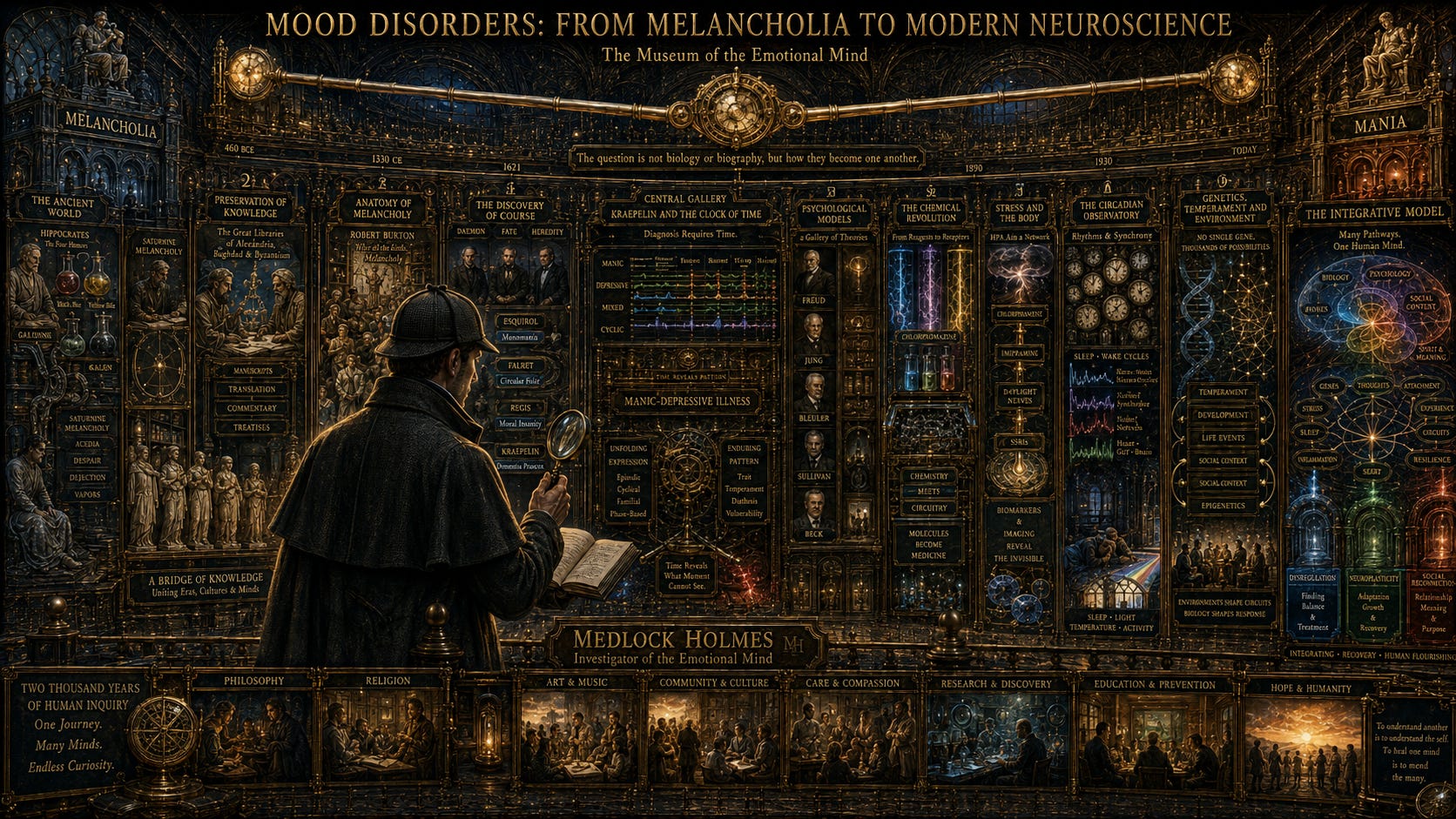 PSYCH 109: Mood Disorders - Historical Introduction and Conceptual Overview 01.09.2026 38dkMedlock Holmes enters the Great Museum of the Emotional Mind.It is unlike any museum he has visited before.Instead of paintings, its galleries contain theories.Instead of fossils, there are abandoned explanations of human suffering.And running through the centre of the building is an enormous pendulum.At one extreme is engraved:MELANCHOLIAAt the other:MANIAThe pendulum has been swinging for more than two millennia.Holmes soon discovers that the history of mood disorders is not simply the history of old psychiatric diagnoses.It is the story of psychiatry itself attempting to answer one enduring question:How do biology, temperament, experience, relationships, thought, environment, and time combine to alter human mood?The investigation begins not in a modern laboratory, but in ancient Greece.Hippocrates described melancholia as a state characterised by despondency, disturbed sleep, reduced appetite, irritability, fear, and restlessness.The explanation was black bile.The theory was wrong.But the intellectual move was revolutionary.Mental suffering was being placed within nature rather than attributed solely to supernatural forces.The ancient physicians also recognised something remarkably modern: depression was not simply sadness.It affected sleep.Appetite.Activity.Thought.Emotion.Behaviour.And sometimes the wish to remain alive.They also recognised the relationship between anxiety and melancholia and described agitated forms of depression in which distress, fear, excessive speech, restlessness, and behavioural activation coexisted with depressive mood.The boundaries between depression and mania were already becoming complicated.The Greeks and Romans described mania as a state of excitement, increased activity, altered mood, grandiosity, reduced sleep, disinhibition, aggression, and sometimes psychosis.Aretaeus of Cappadocia made the crucial observation that melancholia and mania might not be separate diseases.They could be different expressions of the same underlying disorder.The pendulum had been discovered.Ancient medicine also introduced another idea that would survive for centuries:temperament.The melancholic temperament was contemplative, brooding, and sombre.The sanguine temperament was energetic, sociable, and active.The choleric temperament was irritable and explosive.The phlegmatic temperament was inhibited and passive.Disease emerged when balance was lost.The four-humour biology disappeared, but the deeper idea survived: enduring temperamental traits might create vulnerability to particular forms of psychopathology.The knowledge then travels through the Islamic Golden Age.Holmes finds manuscripts belonging to scholars including Ishaq Ibn Imran and Avicenna.They preserve and elaborate earlier descriptions of melancholia and temperament.Avicenna describes different combinations of inactivity, anger, restlessness, and excitement and recognises transitions from melancholic states towards mania.Ishaq Ibn Imran considers inherited vulnerability, temperament, mental overexertion, and disturbances of sleeping and waking.The language is ancient.The architecture of the idea is strikingly contemporary:predisposition + environment + disturbed biological rhythms → illness.Holmes moves forward to Oxford in 1621.There he finds Robert Burton’s monumental Anatomy of Melancholy.The actual frontispiece reproduced on page 12 of the source resembles a visual map of melancholia itself: Burton sits centrally, surrounded by symbolic scenes representing solitude, jealousy, superstition, hypochondriasis and madness.Burton’s conception is broad.Melancholia may arise from inheritance, temperament, excessive contemplation, disturbed biological rhythms, diet, alcohol, passions, loneliness, and environment.Once again, psychiatry oscillates between competing explanations.Is depression biological?Psychological?Social?Temperamental?Holmes notices that every generation seems tempted to choose one.The history repeatedly teaches the same lesson:the human mind refuses to fit inside a single explanatory box.The nineteenth century brings a decisive transformation.Psychiatric hospitals allow clinicians to observe patients not merely at one moment but over time.That changes everything.Jean-Philippe Esquirol proposes that disturbance of mood itself may lie beneath forms of melancholia and paranoid illness.Jean-Pierre Falret describes circular insanity.Jules Baillarger describes folie à double forme.Depression and mania are increasingly understood longitudinally rather than as isolated snapshots.Then Emil Kraepelin enters the museum.He carries no new laboratory test.His instrument is something more powerful:time.Kraepelin follows patients across episodes.He notices familial aggregation.He observes transitions between mania and depression.He sees recurrent episodes separated by periods of recovery.He recognises mixed states in which depressive and manic features coexist.And he observes that episodes may emerge against enduring temperamental backgrounds.From these observations he constructs manic-depressive illness.For Kraepelin, depression involves lowered mood accompanied by slowing of mental and physical processes.Mania represents accelerated mental and physical activity with altered or elevated mood.Yet the two can coexist.The apparent opposites belong to the same family.Later investigators increasingly distinguish unipolar depression from bipolar disorder, particularly because bipolar illness demonstrates stronger familial loading.The pendulum is becoming a spectrum.But another question remains.What role does life experience play?Adolf Meyer attempts to bridge the divide between mind and body through psychobiology.Rather than viewing depression as purely endogenous or purely psychological, he considers constitutional and biological vulnerability interacting with a person’s biography and life circumstances.The patient’s story becomes part of the disease model.Then Sigmund Freud and Karl Abraham propose another explanation.Perhaps depression reflects aggression directed inward following conflict involving an internalised loved object.The theory becomes enormously influential.But Holmes places a question mark beside it.Depressed people are not universally deficient in outward aggression.Many are irritable or hostile.Recovery does not necessarily produce greater aggression.The model is historically important, but the source emphasises that evidence does not support it as a universal mechanism of depressive illness.The investigation therefore moves from anger towards loss.John Bowlby’s attachment work provides another framework.Early disruption of attachment may create vulnerability.Later bereavement, separation, rejection, or loss may precipitate illness.But loss alone cannot explain depression.Most bereaved people do not develop major depressive disorder.The crucial question becomes:Why does the same loss overwhelm one person but not another?The answer begins to require predisposition.Genetics.Temperament.Previous experience.Social support.Meaning.And biology.Another gallery is labelled Self-Esteem.Here depression is conceptualised as collapse of the individual’s ability to sustain valued roles, identity, purpose, status, aspirations, or ideals.Then Holmes enters Aaron Beck’s laboratory.Three mirrors surround the patient.One reflects the self.One reflects the world.One reflects the future.All three have darkened.This is the cognitive triad.The person sees themselves as powerless or worthless.Events are interpreted negatively.The future appears hopeless.The model provides something earlier theories struggled to offer:a mechanism that can be identified clinically and deliberately modified through therapy.Nearby, Martin Seligman’s experimental chamber contains an animal that has learnt that escape is impossible.Eventually it stops trying even when escape becomes available.Learned helplessness proposes that repeated uncontrollable adversity can create expectations that personal action is futile.Yet Holmes again refuses reductionism.Helplessness can occur in many forms of adversity and psychopathology.It cannot alone explain the biological richness of melancholia-the profound disturbances of appetite, sleep, circadian rhythm, autonomic function, and psychomotor activity.The next room contains a machine labelled REWARD.Peter Lewinsohn’s behavioural model proposes that inadequate access to meaningful reinforcement may contribute to depressive behaviour.Loss of rewarding relationships.Reduced activity.Poor social skills.Fewer positive experiences.Withdrawal then further reduces reinforcement.A vicious circle develops.Psychology is beginning to converge on something biology will soon rediscover:the circuitry of reward.Holmes enters the twentieth-century neuroscience wing.Three chemical messengers illuminate the ceiling:NOREPINEPHRINESEROTONINDOPAMINEThe biogenic amine hypotheses propose that altered monoaminergic function contributes to mood disorders.The clues originally come partly from pharmacology.Reserpine depletes monoamines and can precipitate depression.Antidepressants modify monoaminergic signalling and can alleviate depressive illness.But Holmes notices an important inscription beneath the display:Correlation is not causation.Decades of research have failed to demonstrate that a simple deficiency or excess of a single monoamine is necessary or sufficient to produce depression.The monoamines remain important.But they are not the whole story.Modern models therefore descend deeper.Receptors.Second-messenger systems.G proteins.Signal transduction.Gene transcription.BDNF.Neuroplasticity.The question changes from:“Which chemical is missing?”to:“How does the brain regulate itself across time, stress and experience?”The next gallery contains an enormous stress-response system.The hypothalamic–pituitary–adrenal axis is activated.Cortisol rises.Feedback regulation becomes disturbed.Corticotropin-releasing factor increases.The endocrine system reveals that depression is not simply an emotion occurring inside the skull.It involves regulatory systems linking brain and body.Holmes enters the Circadian Observatory.Dozens of clocks have drifted out of synchrony.Deep sleep is reduced.Nocturnal awakenings increase.REM sleep arrives earlier.Total sleep time decreases.Core temperature rhythms alter.Mood disorders begin to look like disorders not simply of emotion but of biological timing.Bright light and sleep manipulation can influence certain depressive states.Sleep loss can precipitate mania.The ancient physicians who noticed relationships between mood, seasons, sleep, and rhythms had glimpsed something real long before circadian neuroscience existed.The next room is marked Neuroplasticity.Chronic stress increases glucocorticoid exposure.BDNF expression may decrease.Neurons may undergo atrophic changes.The hippocampus appears particularly vulnerable.Brain imaging reveals abnormalities involving hippocampal, prefrontal, cingulate, striatal, thalamic, amygdala, and other limbic networks.Functional imaging demonstrates altered responses to negative emotional stimuli and disturbances of cortical-limbic regulation.Depression is increasingly understood not as a lesion in one place but as dysregulation across interconnected systems.Then Holmes reaches the genetic archive.Family and twin studies demonstrate familial vulnerability.The source reports an increased odds ratio of 2.84 for major depressive disorder among first-degree relatives and estimates heritability at approximately 37%.Yet there is no single depression gene.The genetic architecture appears complex and polygenic.Many variants may contribute small effects.And genes do not act alone.They influence temperament.Stress responsivity.Environment.Behaviour.Relationships.Perhaps even the likelihood of encountering particular life events.Holmes now sees the investigation differently.Genes may shape temperament.Temperament influences relationships.Relationships generate experiences.Experiences alter stress systems.Stress affects sleep.Sleep influences mood regulation.Mood changes behaviour.Behaviour changes environment.Environment feeds back upon biology.The arrows form a circle.The old question-Nature or nurture?-has become almost meaningless.The final chamber contains an enormous three-dimensional model of the limbic system connected to the prefrontal cortex, endocrine system, circadian clocks, reward pathways, social world, and genetic machinery.Above it appears the integrative model.Psychological and biological processes converge upon neural systems governing pleasure, reward, motivation, arousal, emotion and biological rhythms.Loss can reach those systems.Trauma can reach them.Genes can reach them.Hormones can reach them.Sleep disruption can reach them.Illness can reach them.Thought can reach them.Medication can reach them.Psychotherapy can reach them.Different roads may therefore converge upon a similar clinical syndrome.This is why depression can look recognisably similar in people whose pathways into illness are very different.It also explains why treatment should resist ideological purity.Medication and psychotherapy are not rival philosophies.Somatic treatments may be necessary for severe melancholic or psychotic depression.Psychological treatments can modify demoralisation, attribution, relationships, behaviour, and cortical-limbic functioning.Social interventions can restore support, roles, meaning, and stability.Circadian interventions can protect biological rhythms.Maintenance treatment can reduce recurrence.The correct question is not:“Is this depression biological or psychological?”It is:“Which interacting systems have become dysregulated in this particular person, and what combination of interventions can restore them?”Holmes returns to the great pendulum.Melancholia.Mania.Biology.Biography.Genes.Temperament.Loss.Cognition.Reward.Stress.Sleep.Neuroplasticity.Society.None provides the whole answer.Together they form something far more powerful:a model of mood disorder as dynamic dysregulation within an adaptive human system.The pendulum continues to swing.But Holmes now understands that psychiatry’s task was never merely to stop it.It is to understand what governs its rhythm.Key Takeaways* Mood disorders are syndromes characterised by pathological alterations of mood accompanied by vegetative, cognitive, behavioural and psychomotor disturbances.* Major depressive disorder is common, disabling and frequently recurrent.* The source reports international estimates of 12.9% point prevalence, 7.2% one-year prevalence and 10.8% lifetime prevalence for depression across a large meta-analysis.* Mood disorders account for substantial morbidity, mortality and societal cost.* Mood disorders underlie a large proportion of suicides, making their detection and effective treatment an important public-health intervention.* Depression remains substantially underdetected and undertreated.* Mood disorders can be conceptualised categorically or dimensionally.* The relationship between recurrent depression and bipolar disorder remains important to contemporary concepts of the bipolar spectrum.* Major depressive disorder may occur as a single episode or recurrent episodes.* Bipolar disorders involve hypomanic, manic or mixed episodes, usually alongside depressive episodes across the longitudinal course.* Persistent depressive disorder represents a chronic depressive substrate, while cyclothymia involves alternating subthreshold depressive and hypomanic states.* Subthreshold affective states can produce substantial impairment even without meeting full syndromal thresholds.* Ancient Greek and Roman physicians described recognisable syndromes of melancholia, mania and mixed affective states.* Hippocrates’ black-bile hypothesis was biologically incorrect but historically important because it framed mental illness in naturalistic terms.* Aretaeus recognised an intimate relationship between melancholia and mania.* Ancient medicine introduced the idea that temperament may predispose individuals towards affective illness.* Islamic scholars including Ishaq Ibn Imran and Avicenna preserved and extended classical thinking about melancholia, mania, temperament and biological rhythms.* Robert Burton’s Anatomy of Melancholy integrated inherited, temperamental, behavioural and environmental explanations of melancholia.* Nineteenth-century longitudinal observation transformed understanding of mood disorders.* Falret described circular insanity and Baillarger folie à double forme.* Kraepelin unified many depressive and manic presentations into manic-depressive illness.* Kraepelin emphasised familial aggregation, recurrence, polarity shifts, symptom-free intervals, temperament and mixed states.* Later classification increasingly distinguished unipolar depression from bipolar disorder.* Adolf Meyer introduced psychobiology as an attempt to integrate biological constitution with biography and life experience.* Psychoanalytic models proposed aggression turned inward as a mechanism of depression, although this does not adequately explain all depressive illness.* Object-loss theories emphasise attachment disruption, bereavement and interpersonal separation.* Loss does not inevitably cause depression; vulnerability modifies its effect.* Loss of self-esteem provides another psychological framework involving identity, roles, status, ideals and purpose.* Beck’s cognitive model describes negative views of the self, environment and future.* The cognitive model provided a clinically modifiable mechanism and contributed to cognitive therapy.* Learned helplessness proposes that repeated uncontrollable adversity can create expectations that action is futile.* Reinforcement models emphasise reduced access to rewarding experiences and relationships.* Psychological models cannot alone account for the full biological and psychomotor manifestations of severe melancholia.* Norepinephrine, serotonin and dopamine are involved in functions profoundly altered during mood disorders.* Simple monoamine-deficiency explanations of depression are insufficient.* Monoamines may explain aspects of antidepressant action better than the fundamental cause of depression.* Contemporary biological research increasingly focuses on receptors, intracellular signalling, gene expression and neuroplasticity.* BDNF has an important role in neuronal survival, growth and differentiation.* HPA-axis dysregulation and altered glucocorticoid signalling have been extensively investigated in depression.* Neuroendocrine abnormalities are informative biologically but lack sufficient specificity to function as simple diagnostic tests.* Depression is associated with characteristic disturbances of sleep and circadian regulation.* Reduced REM latency, increased nocturnal awakening, reduced total sleep and reduced slow-wave sleep have been described.* Circadian disruption may persist beyond symptomatic recovery and contribute to recurrence.* Stress can interact with biological vulnerability and influence neurotransmitter, endocrine and neuroplastic systems.* Chronic stress and glucocorticoid exposure may contribute to neuronal atrophy and reduced hippocampal volume.* Brain imaging suggests abnormalities across distributed cortical, limbic and subcortical networks rather than a single depression centre.* Depression aggregates within families.* The source estimates MDD heritability at approximately 37%.* The genetic architecture of depression is likely complex and polygenic rather than attributable to one gene.* Temperament may represent part of inherited vulnerability to mood disorders.* Life events are particularly important when acting upon an underlying affective diathesis.* Stressful events may be more influential during earlier episodes, with some recurrent illnesses becoming increasingly autonomous.* Physical illness and medications can also precipitate depressive or manic episodes in vulnerable individuals.* Women experience a greater burden of depression, with differences emerging around puberty and diminishing later in life.* Hormonal factors, temperament, genetics and psychosocial processes may all contribute to sex differences.* No single psychological or biological model adequately explains mood disorders.* Integrative models conceptualise depression as a final common clinical pathway produced by multiple interacting vulnerabilities and stressors.* Reward, motivation, limbic regulation, circadian rhythms, endocrine function, cognition and interpersonal relationships are interconnected.* Biological and psychosocial treatments should therefore be viewed as complementary rather than competing approaches.* Severe melancholic and psychotic depression often require somatic treatment.* Psychotherapy can address demoralisation, maladaptive attribution, interpersonal difficulties and functional impairment.* Maintenance treatment is important because many mood disorders are recurrent or lifelong.* The history of mood disorders demonstrates a recurring lesson: psychiatric explanations become weakest when one level of understanding is mistaken for the whole person. This is a public episode. If you'd like to discuss this with other subscribers or get access to bonus episodes, visit drmanaankarray.substack.com/subscribe
 -
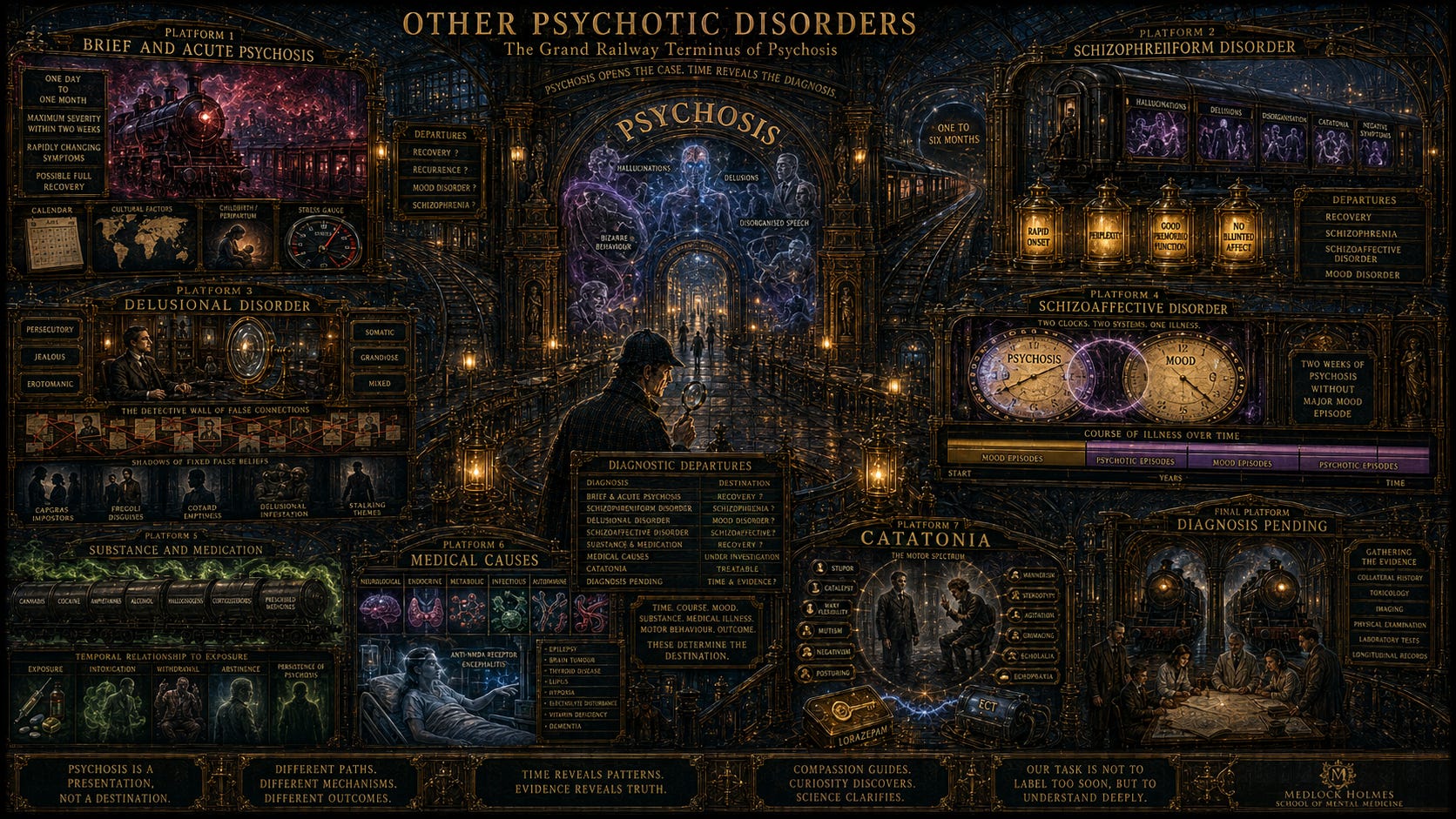 PSYCH 108: Other Psychotic Disorders 31.08.2026 41dkMedlock Holmes enters the Grand Railway Terminus of Psychosis.Every platform begins in the same central hall.A patient may arrive with hallucinations.Another with delusions.Another with disorganised speech, bizarre behaviour, perplexity, agitation, or catatonic stillness.At first glance, all appear to be travelling towards the same destination.But the departures board tells a different story.Some journeys last days.Others months.Some are driven by mood.Some by drugs, prescribed medicines, neurological disease, endocrine disturbance, or autoimmune inflammation.Some leave thinking and personality largely intact except for one immovable belief.Holmes realises that the diagnosis cannot be solved from the psychotic symptom alone.He must investigate time, context, consciousness, mood, medical causation, substances, function, and longitudinal course.The first train arrives without warning.A woman who had been functioning normally becomes perplexed, frightened, and intensely psychotic over several days. Her hallucinations and delusions shift rapidly. At one moment she is terrified; hours later she appears ecstatic. Her behaviour changes just as quickly.This is the territory of acute and transient psychotic disorder and brief psychotic disorder.Descriptions of such episodes have appeared throughout psychiatric history under names including cycloid psychosis, bouffée délirante, reactive psychosis, amentia, and oneirophrenia. Across languages and traditions, the shared pattern is striking:Acute onset.Rapidly changing symptoms.Short duration.The possibility of full recovery.Under DSM terminology, brief psychotic disorder lasts at least one day but less than one month, followed by complete return to the premorbid level of functioning. A marked stressor may be present, but it is no longer required. Episodes may also arise during pregnancy or shortly after childbirth.Under ICD terminology, acute and transient psychotic disorder reaches maximum severity within two weeks, often includes confusion, mood disturbance, or rapidly changing polymorphic symptoms, and may last up to three months.The prognosis is often favourable-but Holmes remains cautious.The diagnosis can only be confirmed retrospectively.During the first days of psychosis, no one knows whether it will remit next week, persist for four months, or become the first episode of schizophrenia or bipolar disorder.The apparent destination changes as the journey continues.The next platform is marked One to Six Months.Here Holmes meets a man with hallucinations, delusions, disorganised speech, and social withdrawal. His presentation is indistinguishable from schizophrenia, but the illness has not lasted long enough.This is schizophreniform disorder.It meets the core symptom requirements of schizophrenia but lasts at least one month and less than six months. Functional decline is not mandatory. When the diagnosis is made before recovery, it remains provisional.Certain signs suggest a more favourable course:Rapid onset of prominent symptoms.Confusion or perplexity.Good premorbid functioning.Absence of blunted affect.Yet the diagnosis is unstable. Many patients initially diagnosed with schizophreniform disorder later meet criteria for schizophrenia or schizoaffective disorder. A smaller proportion develop a mood disorder, while others recover and never experience another episode.Again, time is not merely a measurement.It is part of the diagnostic instrument.Holmes then enters a quiet chamber occupied by a successful accountant.The man works, pays bills, dresses carefully, and speaks coherently.Yet he is absolutely convinced that his neighbours have installed hidden devices to monitor him.Every event fits the theory.A passing car is surveillance.A delayed parcel is interference.A colleague’s glance is evidence.Outside the delusion, much of his life remains organised.This is delusional disorder.Unlike schizophrenia, it is dominated by one or more persistent delusions lasting at least a month, without the broader syndrome of prominent hallucinations, disorganisation, negative symptoms, or marked global deterioration.The belief may be plausible or bizarre.Its power lies not necessarily in its content, but in its unshakeable certainty and its consequences.Holmes walks through the galleries of delusional themes.In the Persecutory Gallery, individuals believe they are being conspired against, poisoned, monitored, cheated, obstructed, or harassed. The beliefs are often coherent and systematised, leading to anger, litigation, confrontation, or violence.In the Jealous Gallery, a partner’s ordinary behaviour becomes proof of infidelity. Receipts, clothing, phone records, and facial expressions are examined like forensic evidence. The danger is considerable because the delusion may arm anger with moral certainty.In the Erotomanic Gallery, an individual becomes convinced that another person-often of higher status-is secretly in love with them. Rejection is reinterpreted as coded affection, and stalking may follow.In the Somatic Gallery, the body becomes the centre of the delusion. The person may believe they are infested, emit a foul odour, possess a deformity, or suffer from an undetected bodily abnormality. They often seek dermatologists, dentists, surgeons, or other specialists rather than psychiatrists.In the Grandiose Gallery, the person believes they possess extraordinary talent, insight, status, power, or a world-changing discovery.Other chambers contain misidentification syndromes.In Capgras syndrome, a familiar person is believed to have been replaced by an identical impostor.In Fregoli syndrome, different strangers are believed to be one persecutor appearing in disguise.In Cotard syndrome, the individual may believe they have lost their organs, possessions, identity, or even existence itself.Holmes knows that unusual beliefs cannot simply be declared delusional because they sound improbable.Some extraordinary claims are true.Cultural and spiritual frameworks differ.Overvalued ideas and obsessions may be held with great conviction.The investigator must establish whether the belief reflects psychopathology through collateral history, behavioural consequences, degree of flexibility, cultural context, and the broader clinical picture.Before diagnosing delusional disorder, Holmes searches for medical explanations.Basal ganglia disease, epilepsy, dementia, stroke, metabolic disturbance, endocrine illness, vitamin deficiency, and focal brain lesions can all produce delusions or misidentification phenomena.Stimulants, medications, and toxins can do the same.The psychiatric diagnosis comes only after these possibilities have been considered.The next platform contains two clocks running simultaneously.One measures psychosis.The other measures mood.A woman experiences severe depression alongside hallucinations and delusions. Yet Holmes discovers that psychosis also persisted for several weeks when the depressive syndrome was absent. Over the total course of illness, major mood episodes occupied most of the active and residual period.This pattern suggests schizoaffective disorder.It occupies one of psychiatry’s most difficult borders.To meet DSM criteria, a major depressive or manic episode must occur alongside the schizophrenia syndrome. There must also be at least two weeks of hallucinations or delusions without a major mood episode. At the same time, mood episodes must occupy the majority of the illness duration.The bipolar type includes mania.The depressive type includes only major depressive episodes.The diagnosis sounds precise, but in practice it is difficult to establish. Patients may struggle to remember exactly when mood and psychotic symptoms began or ended. Negative symptoms may resemble depression. Irritable psychosis may be mistaken for mania. Clinicians may use schizoaffective disorder as a compromise when uncertain between schizophrenia and bipolar disorder.Holmes therefore reconstructs the entire longitudinal timeline rather than relying on one admission.The central question is not simply whether mood and psychosis both occurred.It is how they related across the whole illness.The next train arrives from the Chemical District.A young man develops persecutory delusions, anxiety, and depersonalisation after high-dose cannabis use.Another feels insects crawling beneath the skin during cocaine intoxication.A third hears threatening voices after prolonged heavy alcohol use.An older adult becomes psychotic after starting corticosteroids.These presentations may represent substance- or medication-induced psychotic disorder.The core requirement is prominent hallucinations or delusions developing during, or soon after, intoxication, withdrawal, or exposure to a substance or medication capable of producing psychosis.The investigation is often difficult because substance use and primary psychotic disorders frequently coexist.A positive toxicology screen does not prove causation.The substance may have precipitated psychosis.It may have worsened a primary disorder.It may have been used in an attempt to cope with emerging symptoms.Holmes studies the chronology.Did psychosis begin before the substance exposure?Has it occurred repeatedly during abstinence?Does it continue for a substantial period after intoxication or withdrawal has resolved?Is there a family history of psychosis?Did the person retain insight into the perceptual disturbance?When the person recognises a drug-related visual distortion as unreal, the appropriate diagnosis may be intoxication with perceptual disturbance rather than a psychotic disorder.When reality testing is lost and the person believes the experience is true, the diagnosis changes.The prognosis is often favourable once the offending agent is removed, but not always. Stimulant-, cocaine-, PCP-, and cannabis-related psychoses may persist, recur, or reveal an underlying primary psychotic disorder.The next platform leads away from psychiatry and into the Hospital of Hidden Causes.A middle-aged woman develops hallucinations, agitation, memory change, and catatonic behaviour. Her presentation initially resembles schizophrenia.But the age of onset is unusual.The symptoms fluctuate.Visual experiences predominate.Neurological signs begin to appear.Holmes finds the true cause: autoimmune encephalitis.This is psychotic disorder due to another medical condition.The diagnosis requires evidence that hallucinations or delusions are directly caused by a medical illness and are not better explained by a primary psychiatric disorder or delirium.The list of possible causes is vast:Epilepsy.Brain tumour.Head trauma.Stroke.Hypoxia.Huntington disease.Multiple sclerosis.Central nervous system infection.Thyroid and parathyroid disease.Adrenal dysfunction.Electrolyte disturbance.Kidney or liver failure.Vitamin deficiencies.Systemic lupus erythematosus.Anti-NMDA receptor encephalitis.Holmes learns to treat certain clues as alarms:First psychosis at an atypical age.Visual, olfactory, or multimodal hallucinations.Seizures.Focal neurological signs.Autonomic instability.Cognitive fluctuation.Rapid progression.Abnormal movements.Olfactory hallucinations may suggest temporal lobe epilepsy. Visual hallucinations are more frequent in medical psychosis than in schizophrenia. But no single symptom proves the cause.The diagnosis depends on history, examination, laboratory testing, imaging, and the temporal relationship between medical illness and psychosis.Treatment begins with the underlying condition.When the disease improves, the psychosis often recedes.Holmes then enters the most silent chamber in the terminus.A patient sits motionless.They do not speak.One arm remains suspended after the examiner moves it.Their body resists repositioning with wax-like flexibility.Elsewhere, another patient is intensely agitated, repetitive, grimacing, echoing words, and imitating movements.These are different faces of catatonia.Once treated as a subtype of schizophrenia, catatonia is now recognised as a psychomotor syndrome occurring across mood disorders, psychotic disorders, autism, neurological disease, metabolic illness, autoimmune encephalitis, and other medical conditions.The syndrome may include:Stupor.Catalepsy.Waxy flexibility.Mutism.Negativism.Posturing.Mannerisms.Stereotypy.Agitation.Grimacing.Echolalia.Echopraxia.At least three characteristic signs are required for diagnosis.Catatonia can shift rapidly between immobility and excitement. It can be mistaken for severe depression, psychosis, medication-induced rigidity, behavioural refusal, delirium, or neuroleptic malignant syndrome.This mistake can be dangerous.Untreated immobility may lead to dehydration, malnutrition, aspiration, pressure injury, contractures, thrombosis, infection, and death.Benzodiazepines and electroconvulsive therapy can produce dramatic improvement.High-potency antipsychotics may worsen the condition, particularly when neuroleptic malignant syndrome is a concern.Holmes therefore treats catatonia not as a descriptive curiosity, but as a medical and psychiatric emergency.The final platforms carry incomplete labels.Other Specified Psychotic Disorder.Unspecified Psychotic Disorder.These are not careless diagnoses.They acknowledge the limits of available information.Other specified psychotic disorder is used when the clinician knows why the presentation does not meet criteria for a more specific disorder-for example, persistent auditory hallucinations without the broader schizophrenia syndrome, attenuated psychotic symptoms, or shared delusional beliefs.Unspecified psychotic disorder is used when psychosis is clearly present but there is not yet enough information to determine its cause or category.This is common in emergency care.A patient may arrive agitated, intoxicated, frightened, and unable to provide a history. Family may be unavailable. Medical testing may be incomplete.The correct response is not premature certainty.It is a provisional diagnosis, immediate safety, careful assessment, and revision as evidence emerges.Holmes encounters two final mysteries.The first is attenuated psychosis syndrome.The person experiences suspiciousness, mild hallucination-like phenomena, or unusual beliefs, but symptoms are less intense, more transient, and accompanied by greater insight than in frank psychosis.The distress and functional impairment are real.The future is uncertain.Most will not develop a full psychotic disorder in the near term, so routine antipsychotic treatment may expose many people to harm without benefit. Careful monitoring, treatment of anxiety, depression, sleep disturbance, substance use, and functional decline may be more appropriate.The second is shared delusional belief, historically called folie à deux.Two people in a close and often isolated relationship come to share the same delusional system. Usually one person develops the original belief and the other gradually adopts it within a relationship marked by dependence, submission, social isolation, or limited alternative perspectives.Sometimes the delusion spreads through an entire household.The content is often persecutory, but religious, grandiose, and somatic themes may occur.The relationship itself becomes part of the pathogenesis.As the investigation concludes, Holmes returns to the departure board.The destinations have changed several times during the night.Brief psychosis became bipolar disorder.Schizophreniform disorder became schizophrenia.Substance-induced psychosis persisted after abstinence.An apparent primary psychosis became autoimmune encephalitis.A mute patient thought to be refusing care responded to lorazepam.Holmes understands the central lesson.In psychosis, the first diagnosis is often a hypothesis.The symptom tells us that reality has fractured.The course tells us why.Key Takeaways* Psychosis occurs in several disorders beyond schizophrenia.* Accurate diagnosis depends on duration, mood relationship, substances, medical causes, consciousness, function, and longitudinal course.* Early diagnoses in first-episode psychosis are often provisional.* Brief psychotic disorder lasts at least one day but less than one month and is followed by full return to premorbid functioning.* A marked stressor may precipitate brief psychosis but is not required.* Brief psychotic disorder may have peripartum onset or catatonic features.* Acute and transient psychotic disorder reaches maximum severity within two weeks and lasts no more than three months.* Rapidly changing polymorphic symptoms, confusion, perplexity, and mood disturbance may occur in acute and transient psychosis.* Brief and acute psychotic disorders often have favourable outcomes but may recur or later be reclassified.* Schizophreniform disorder has schizophrenia-like symptoms lasting at least one month but less than six months.* Schizophreniform disorder is provisional when the final duration and outcome are not yet known.* Good prognostic features include rapid onset, confusion or perplexity, good premorbid functioning, and absence of blunted affect.* Many cases initially diagnosed as schizophreniform disorder later become schizophrenia or schizoaffective disorder.* Delusional disorder involves one or more persistent delusions without the broader syndrome of schizophrenia.* Functioning in delusional disorder is relatively preserved apart from consequences of the delusion.* Hallucinations, when present in delusional disorder, are not prominent and are related to the delusional theme.* Delusional disorder subtypes include persecutory, jealous, erotomanic, somatic, grandiose, mixed, and unspecified types.* Persecutory and jealous delusions may carry significant risks of aggression or violence.* Erotomanic delusions may lead to stalking and intrusive contact.* Somatic delusions often present to medical specialists rather than psychiatric services.* Capgras, Fregoli, and Cotard syndromes are important forms of delusional misidentification or nihilistic belief.* Before diagnosing delusional disorder, clinicians must consider medical disease, dementia, substances, obsessive–compulsive disorder, body dysmorphic disorder, illness anxiety, and personality disorder.* Schizoaffective disorder requires both schizophrenia symptoms and a major mood episode.* DSM criteria require at least two weeks of hallucinations or delusions without a major mood episode.* Major mood episodes must be present for most of the total active and residual illness.* Schizoaffective disorder may be bipolar type or depressive type.* A detailed longitudinal timeline is essential when diagnosing schizoaffective disorder.* Schizoaffective disorder is often overdiagnosed as a compromise between schizophrenia and mood disorder.* Substance- or medication-induced psychotic disorder involves delusions or hallucinations developing during or soon after exposure, intoxication, or withdrawal.* Cannabis, stimulants, cocaine, alcohol, hallucinogens, PCP, corticosteroids, antiparkinsonian drugs, antimicrobials, and many other medicines may cause psychosis.* A positive toxicology result does not by itself prove that psychosis was substance-induced.* Psychosis predating substance use or persisting long after intoxication or withdrawal suggests a primary psychotic disorder.* Preserved insight into drug-related perceptual changes favours intoxication or withdrawal with perceptual disturbance rather than psychotic disorder.* Psychotic disorder due to another medical condition requires evidence of direct physiological causation.* Medical causes include neurological, endocrine, metabolic, infectious, autoimmune, vascular, and nutritional disorders.* Visual, olfactory, or multimodal hallucinations and atypical age of onset should heighten concern for a medical cause.* Psychosis occurring only during delirium should not receive a separate psychotic-disorder diagnosis.* Catatonia is a psychomotor syndrome rather than a subtype of schizophrenia.* Catatonia occurs in mood, psychotic, neurodevelopmental, neurological, metabolic, and autoimmune disorders.* Diagnosis requires at least three characteristic catatonic signs.* Benzodiazepines and electroconvulsive therapy are major treatments for catatonia.* Antipsychotics may worsen some cases of catatonia.* Severe catatonia can cause dehydration, malnutrition, aspiration, thrombosis, pressure injuries, and death.* Other specified psychotic disorder is used when the reason criteria are not met can be clearly stated.* Unspecified psychotic disorder is appropriate when psychosis is evident but available information is insufficient.* Attenuated psychosis syndrome involves subthreshold symptoms with distress or impairment and relatively preserved insight.* Most individuals with attenuated psychosis do not develop a full psychotic disorder in the short term.* Shared delusional beliefs may arise within close, dependent, and socially isolated relationships.* Reassessment over time is one of the most important diagnostic tools in psychosis. This is a public episode. If you'd like to discuss this with other subscribers or get access to bonus episodes, visit drmanaankarray.substack.com/subscribe
 -
 PSYCH 107: Psychosis as a Defining Dimension in Schizophrenia 30.08.2026 52dkMedlock Holmes enters the Grand Archive of Psychiatric Boundaries.The building is divided into rigid rooms.One is labelled Schizophrenia.Another Bipolar Disorder.Another Psychotic Depression.Beyond them lie chambers for substance-induced psychosis, psychosis caused by medical illness, delusional disorder, schizotypal personality disorder, and brief psychotic states.Each room appears separate.Yet from beneath every door, Holmes sees the same strange light.Psychosis is moving between them.He follows it into the central hall and discovers that hallucinations, delusions, disorganised thought, and grossly disorganised or catatonic behaviour are not unique possessions of schizophrenia. They occur across numerous psychiatric, neurological, medical, and substance-related conditions.Even within schizophrenia, no single psychotic symptom is essential.A person may meet diagnostic criteria without hallucinations or delusions if severe thought disorder, disorganisation, catatonia, and negative symptoms form the clinical picture.The diagnosis is therefore not defined by one pathognomonic sign.It is built from combinations of symptoms.This makes schizophrenia clinically recognisable-but biologically heterogeneous.Holmes turns towards an enormous map of the disorder.Instead of one uniform syndrome, it contains overlapping domains:* Psychosis* Disorganisation* Negative symptoms* Cognitive dysfunction* Mood and affective dysregulationPsychosis includes distortions of perception and inferential thinking.Disorganisation involves disrupted thought, speech, and behaviour.Negative symptoms involve diminished emotional expression, speech, motivation, and goal-directed activity.Cognitive dysfunction affects attention, memory, processing speed, and executive function.Mood symptoms range from depression to mania.These dimensions overlap, but they are not identical.A patient may have severe psychosis with relatively preserved cognition.Another may have fewer hallucinations but profound negative and cognitive symptoms.A third may combine psychosis with mania.Holmes realises that the categorical label hides these differences.Dimensional assessment reveals them.The investigation expands beyond schizophrenia.In psychotic depression, mood disturbance dominates while psychosis appears at its most severe points.In bipolar disorder, mania may become psychotic.In substance-induced states, hallucinations and delusions arise in temporal relationship to exposure.In medical and neurological disorders, psychosis may accompany altered brain function.The clinical form overlaps even when the underlying causes differ.This raises a provocative question:Is psychosis itself a disease?Or is it a shared clinical dimension produced by many diseases?Holmes examines family records.Schizophrenia and bipolar disorder do not segregate neatly across generations. Families may contain schizophrenia, schizoaffective disorder, bipolar disorder, depression with psychotic features, and substance-related psychoses.The inherited liability appears broader than the diagnostic categories.Twin studies reinforce the same conclusion. Identical twins show substantially greater concordance than non-identical twins, confirming a strong genetic contribution. Yet when one twin has schizophrenia, the other may develop an affective psychosis rather than the same diagnosis.The vulnerability may be to psychosis and related dimensions-not to one perfectly bounded disorder.Holmes then enters the genomic vault.There is no single psychosis gene.Instead, thousands of small genetic effects interact with neurodevelopment, epigenetic regulation, environment, trauma, obstetric events, substance exposure, and social adversity.Candidate genes and genomic regions once considered specific to schizophrenia also appear in bipolar disorder, autism, epilepsy, mood disorders, and other neurodevelopmental phenotypes.The genetic architecture ignores the walls constructed by diagnostic manuals.But genes are still too distant from symptoms to explain an individual case.Holmes therefore turns to intermediate phenotypes-measurable biological features lying between inherited vulnerability and clinical illness.He enters the Laboratory of Hidden Signals.The first station examines eye movement.Healthy eyes follow a moving target smoothly and can suppress reflexive movements when instructed.Across psychotic disorders, pursuit may become irregular and inhibitory control impaired. Similar abnormalities appear in schizophrenia, psychotic bipolar disorder, schizotypal traits, and unaffected relatives.The next station tests sensory gating.Two clicks are presented in rapid succession.A healthy brain reduces its response to the second click because the information is no longer novel.In psychosis, this suppression may fail.The brain continues responding as though every stimulus is equally important.The world becomes difficult to filter.An oddball task produces a related clue. Rare stimuli usually generate a P300 response as the brain recognises significance and updates attention. In psychotic disorders, the response may be delayed or reduced.A prepulse-inhibition chamber tests whether a weak warning signal can dampen a later startle response.When this gating mechanism fails, irrelevant stimulation intrudes and the startle response remains excessive.These findings suggest that psychosis may involve not only false perceptions and beliefs but a deeper difficulty deciding which internal and external signals deserve attention.Cognition provides another biomarker.Working memory, verbal learning, attention, processing speed, problem-solving, and executive function are impaired across psychotic disorders, though generally more severely in schizophrenia.Patients with bipolar disorder who have experienced psychosis often resemble schizophrenia more closely than those who have never been psychotic.Once again, the psychosis dimension reorganises the clinical map.Brain imaging adds further evidence.Schizophrenia is often associated with widespread grey-matter reductions and ventricular enlargement.Psychotic bipolar disorder may show overlapping but usually less extensive changes, particularly in anterior limbic and frontotemporal regions.Relatives with mild psychosis-spectrum features may show subtler versions of the same abnormalities.The burden of psychosis seems to leave graded traces in the brain.Yet no biomarker is currently specific enough for routine diagnosis.Single measures cannot capture the complexity of psychosis.The future may require multimodal batteries combining cognition, EEG, eye tracking, imaging, genetics, and clinical dimensions-analysed computationally at the level of the individual patient.Holmes then reaches the final chamber.It contains no diagnostic cabinets.Instead, it is built like a rising landscape.At the lowest level are fleeting experiences common in the general population:A name heard when no one called.A momentary illusion.Magical thinking.A brief idea of reference.Most do not become illness.Higher on the slope lie persistent but subthreshold symptoms, schizotypal traits, brief psychotic experiences, and clinically high-risk states.At the summit stand frank psychotic disorders.The transition is governed not by a single boundary but by severity, persistence, breadth, distress, functional impairment, and loss of insight.Risk factors push the person upwards:* Genetic vulnerability* Obstetric complications* Childhood trauma* Social adversity* Cannabis and other substances* Stress* Neurodevelopmental disturbanceProtective factors push in the opposite direction:* Strong premorbid functioning* Stable relationships* Structured environments* Early support* Cognitive and psychosocial intervention* Reduced substance exposureHolmes understands that subthreshold psychotic experiences signify proneness-not destiny.Some high-risk individuals progress to schizophrenia.Some develop bipolar or depressive psychosis.Some remain stable.Some recover completely.The early symptoms predict a spectrum of possible outcomes, not one inevitable diagnosis.The case ends where it began: at the Archive of Psychiatric Boundaries.Holmes removes the rigid walls between the rooms and replaces them with transparent partitions.The categories remain useful.But they are no longer mistaken for nature itself.Psychosis is not a single destination.It is a dimension that can emerge through many pathways, at many levels, within many disorders.The detective’s task is therefore not merely to ask whether psychosis is present.It is to ask:What form does it take?How severe is it?What other dimensions accompany it?What mechanism may be producing it?And what keeps this particular person moving towards illness-or back towards health?Key Takeaways* Psychosis includes delusions, hallucinations, disorganised thought, and grossly disorganised or catatonic behaviour.* Psychosis occurs across schizophrenia, mood disorders, substance-related states, medical conditions, personality disorders, and neurodevelopmental conditions.* No single psychotic symptom is unique to schizophrenia.* Hallucinations and delusions are common but not obligatory for a schizophrenia diagnosis.* Auditory hallucinations are most typical in schizophrenia.* Tactile, olfactory, and gustatory hallucinations should raise suspicion of medical, neurological, or substance-related causes.* Schizophrenia is clinically heterogeneous and is better understood through overlapping symptom dimensions.* Major dimensions include psychosis, disorganisation, negative symptoms, cognitive dysfunction, and mood dysregulation.* Disorganisation is a distinct domain and is associated with poorer prognosis.* Cognitive dysfunction frequently precedes the first psychotic episode and strongly predicts functional outcome.* Dimensional profiles may predict course and treatment needs better than diagnosis alone.* Psychosis cuts across traditional schizophrenia–bipolar boundaries.* Mania is often a better discriminator between schizophrenia and mood disorders than psychosis itself.* Family studies show shared liability across schizophrenia, schizoaffective disorder, bipolar disorder, and psychotic depression.* Twin studies confirm strong heritability but also demonstrate cross-diagnostic expression.* Psychosis is polygenic and reflects many small genetic effects interacting with development and environment.* Candidate genes and genomic regions overlap across psychiatric and neurodevelopmental disorders.* Intermediate phenotypes may lie closer to disease mechanisms than broad diagnostic categories.* Candidate biomarkers include abnormal eye movements, impaired sensory gating, reduced P300 responses, deficient prepulse inhibition, cognitive impairment, and structural brain changes.* P50 suppression deficits reflect impaired filtering of repeated sensory information.* Reduced or delayed P300 responses indicate abnormalities in attention and salience processing.* Prepulse-inhibition deficits suggest impaired sensorimotor gating.* Cognitive abnormalities overlap across schizophrenia and psychotic bipolar disorder but are usually more severe in schizophrenia.* Structural brain abnormalities overlap across psychotic diagnoses but vary in distribution and severity.* No single biomarker currently has sufficient specificity for clinical diagnosis.* Future classification may require multimodal biomarker batteries and computational biotyping.* Psychosis exists on a continuum from fleeting experiences to severe persistent illness.* Mild psychotic-like experiences are relatively common in the general population.* Severity, persistence, breadth, distress, functional impact, and insight distinguish subclinical experiences from disorder.* Prodromal symptoms predict risk for a range of psychotic disorders, not schizophrenia alone.* Approximately one-third of clinically high-risk individuals may progress, one-third remain persistently subthreshold, and one-third improve.* Schizotypal personality disorder represents an important subthreshold psychosis-spectrum phenotype.* Psychotic symptoms in borderline personality disorder are typically transient and stress-related.* Subthreshold psychotic experiences indicate vulnerability, not inevitability.* The emergence of psychosis reflects the balance between pro-psychotic risks and protective resilience factors. This is a public episode. If you'd like to discuss this with other subscribers or get access to bonus episodes, visit drmanaankarray.substack.com/subscribe
 -
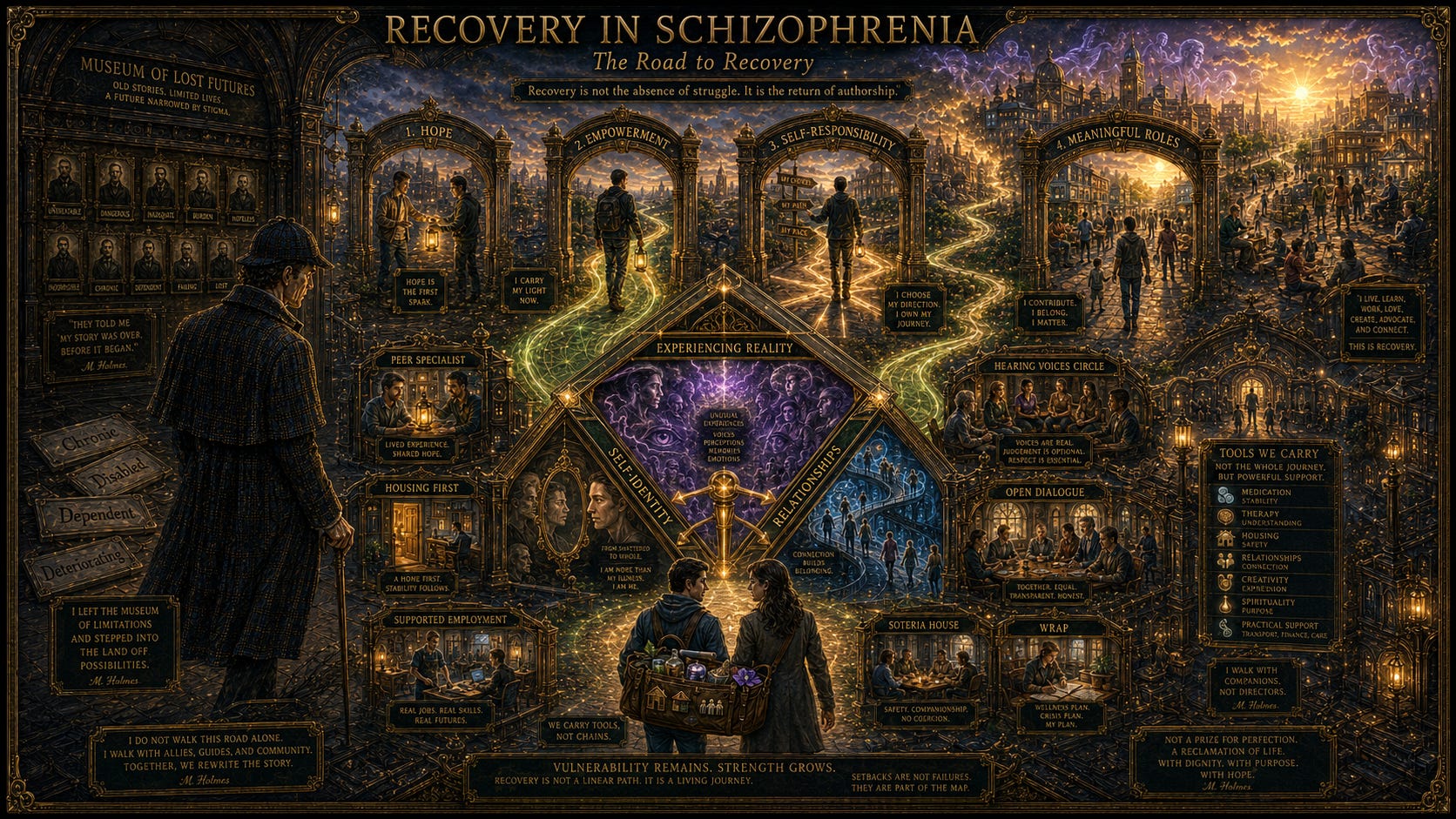 PSYCH 106: Recovery in Schizophrenia 29.08.2026 58dkMedlock Holmes enters the Museum of Lost Futures.The walls are lined with portraits of people diagnosed with schizophrenia. Beneath each portrait is the same inscription:Chronic. Disabled. Dependent.The museum presents these outcomes as inevitable.Holmes is immediately suspicious.He opens the historical ledgers and discovers that long-term studies tell a different story. Many people diagnosed with schizophrenia improve substantially. Some recover completely. Others continue to experience symptoms while living meaningful, connected, and productive lives.The diagnosis describes a condition.It does not issue a sentence.Holmes follows a corridor out of the museum and into the Road to Recovery, where the investigation shifts from illness to personhood.Traditional care asks:What symptoms remain?What medication is required?How can relapse be prevented?Recovery-oriented care asks different questions:What happened to this person?What matters to them?What strengths remain?What kind of life do they hope to build?What support will help them move towards it?At the beginning of the road stands the first milestone:Hope.Hope is not vague optimism. It is an image of a future worth pursuing. It may begin when someone else believes in the person before they can believe in themselves.For one person, hope means returning to university.For another, reconnecting with family.For another, cooking, making music, having a relationship, or simply living without shame.Without a personally meaningful future, treatment becomes mere containment.The second milestone is Empowerment.Recovery cannot be performed upon someone.A clinician can prescribe, advise, accompany, and support-but cannot recover on another person’s behalf.People need opportunities to make choices, take risks, experience success, and discover that their own actions can influence their lives.Readiness often does not appear before action.It emerges after someone has done something they were told they could not do.The third milestone is Self-Responsibility.This does not mean blame.It means authorship.The person begins to recognise that professionals, families, peers, and services may help, but no one else can determine the direction of the journey. Goals become personally chosen. Decisions become collaborative. Setbacks become lessons rather than proof of failure.The fourth milestone is Meaningful Roles.Recovery eventually requires an identity larger than patienthood.Worker.Student.Parent.Partner.Artist.Neighbour.Advocate.Friend.Peer specialist.Citizen.A person may still hear voices or experience unusual beliefs, but these experiences no longer occupy the whole landscape of identity.Holmes then encounters the Psychosis Triangle.Its three sides are labelled:* Experiencing Reality* Self-Identity* RelationshipsThe medical model often focuses primarily on distorted reality: hallucinations, delusions, paranoia, and disorganisation.The recovery model examines all three dimensions.Psychosis may emerge when changes in reality-testing interact with a fragmented sense of self and deteriorating relationships. Recovery may also begin through any side of the triangle.Medication may reduce the force of voices.A trusted relationship may restore belonging.A meaningful role may strengthen identity.Improvement in one dimension can help rebuild the others.Holmes realises that persistent symptoms do not necessarily prevent recovery.Someone may continue hearing voices but understand them differently.They may learn which voices are trustworthy, which are harmful, how to reduce their power, and how to continue living despite them.Success is not always silence.Sometimes it is freedom from domination.The road then divides into two service models.On one side is illness-centred care.Professionals diagnose, prescribe, monitor, and attempt to prevent deterioration. Rehabilitation is added later, once symptoms are controlled.On the other side is person-centred recovery care.Clinicians begin by building trust, learning the person’s goals, creating a shared formulation, and deciding together how medication and other tools might support those goals.The distinction is profound.Illness-centred prescribing asks whether a medicine reduced symptoms.Person-centred prescribing also asks whether it helped the person sleep, think, feel safer, maintain relationships, work, create, or move towards the future they value.Medication becomes one tool among many.Others include peer support, family connection, sleep, housing, employment, trauma-informed care, motivational interviewing, cognitive behavioural strategies, self-management, spirituality, exercise, and community belonging.Holmes enters a peer-support hall where people with lived experience work alongside clinicians.Their expertise does not come despite their histories.It comes partly because of them.Peer specialists disclose selectively, offer hope through example, reduce power imbalances, and engage people whom traditional services may not reach. Their presence challenges the assumption that psychosis permanently disqualifies someone from competence, responsibility, or professional contribution.The investigation then moves through several recovery-oriented approaches.Wellness Recovery Action Planning helps people identify what keeps them well, recognise early warning signs, and create their own responses to crisis.Housing First treats stable housing as a right and foundation rather than a reward for compliance.Supported Employment helps people enter real jobs rapidly rather than waiting indefinitely to become ready.Hearing Voices groups create spaces where people can understand and change their relationship with voices without being forced into one explanation.Open Dialogue brings families and social networks into transparent conversations while tolerating uncertainty.Soteria offers a calm, relational alternative to coercive hospital environments, often using little or no medication when safe and chosen.Trauma-informed care asks not only what is wrong, but what has happened-and ensures that treatment does not repeat powerlessness, humiliation, or fear.Holmes notices that recovery cannot be separated from social context.Poverty, racism, migration, violence, discrimination, housing insecurity, and exclusion shape both distress and the possibilities for recovery.A formulation that ignores these forces may locate every problem inside the individual while leaving the surrounding causes untouched.Recovery equity therefore requires structural competence: understanding how policies, institutions, communities, and history influence who is diagnosed, who is coerced, who is believed, and who receives the opportunity to heal.Near the end of the road, Holmes meets a woman whose life has passed through psychosis, homelessness, trauma, rejection, medication refusal, employment, relapse, reconciliation, and renewed purpose.Her recovery is not a smooth ascent.It is a long relationship with loss, trust, identity, faith, work, family, and choice.The clinicians around her resist the urge to control every setback. They help her build a home, learn to read, find work, use medication in a way that makes personal sense, reconnect with family, and eventually move beyond intensive services.At her farewell, she leaves behind a simple message:A door can be opened.The person must still walk through it.Holmes returns to the Museum of Lost Futures.He removes the old inscriptions beneath the portraits.In their place he writes:Uncertain. Individual. Possible.Recovery does not mean returning to the person who existed before schizophrenia.It means becoming someone new without surrendering ownership of the life ahead.Key Takeaways* Recovery in schizophrenia is possible and should not be treated as exceptional.* Recovery is broader than symptom remission.* A person may recover while continuing to experience psychotic symptoms.* Recovery involves health, home, purpose, and community.* It is a personal process rather than something professionals can perform on someone.* Hope is the starting point and must be connected to a personally meaningful future.* Empowerment develops through choice, action, success, and self-efficacy.* Self-responsibility means authorship and agency, not blame.* Meaningful roles help build an identity beyond illness and patienthood.* Recovery-oriented care is person-centred, client-driven, and strengths-based.* The medical model focuses primarily on illness and symptom control.* The recovery model also prioritises identity, relationships, meaning, and community participation.* The Psychosis Triangle describes interactions among experiencing reality, self-identity, and relationships.* Any side of the triangle may become a route towards recovery.* Persistent voices or unusual beliefs need not prevent a meaningful life.* Treatment success may involve changing the person’s relationship with symptoms rather than eliminating them.* Shared decision-making is central to recovery-oriented prescribing.* Medication should be linked to the person’s goals, experiences, and preferred outcomes.* Assertive Community Treatment can reduce hospital use but should avoid coercive or professionally dominated practices.* Supported employment improves access to competitive work.* Housing First treats stable housing as a foundation rather than a reward.* Wellness Recovery Action Planning promotes self-management, hope, and personalised crisis planning.* Motivational interviewing helps resolve ambivalence while preserving autonomy.* Hearing Voices groups emphasise understanding, acceptance, coping, and peer expertise.* Open Dialogue includes the person’s natural network and tolerates uncertainty.* Soteria provides a small, relational, minimally coercive therapeutic environment.* Trauma-informed care prioritises safety, trust, collaboration, voice, choice, and prevention of retraumatisation.* Peer support specialists use lived experience to build hope, engagement, and belonging.* Recovery must address social determinants such as poverty, housing, racism, exclusion, and discrimination.* Antiracist and structurally informed practice is essential for recovery equity.* Recovery is nonlinear and may include relapse, grief, growth, and renewed direction.* The clinician’s role is to walk alongside the person without taking ownership of their journey. This is a public episode. If you'd like to discuss this with other subscribers or get access to bonus episodes, visit drmanaankarray.substack.com/subscribe
 -
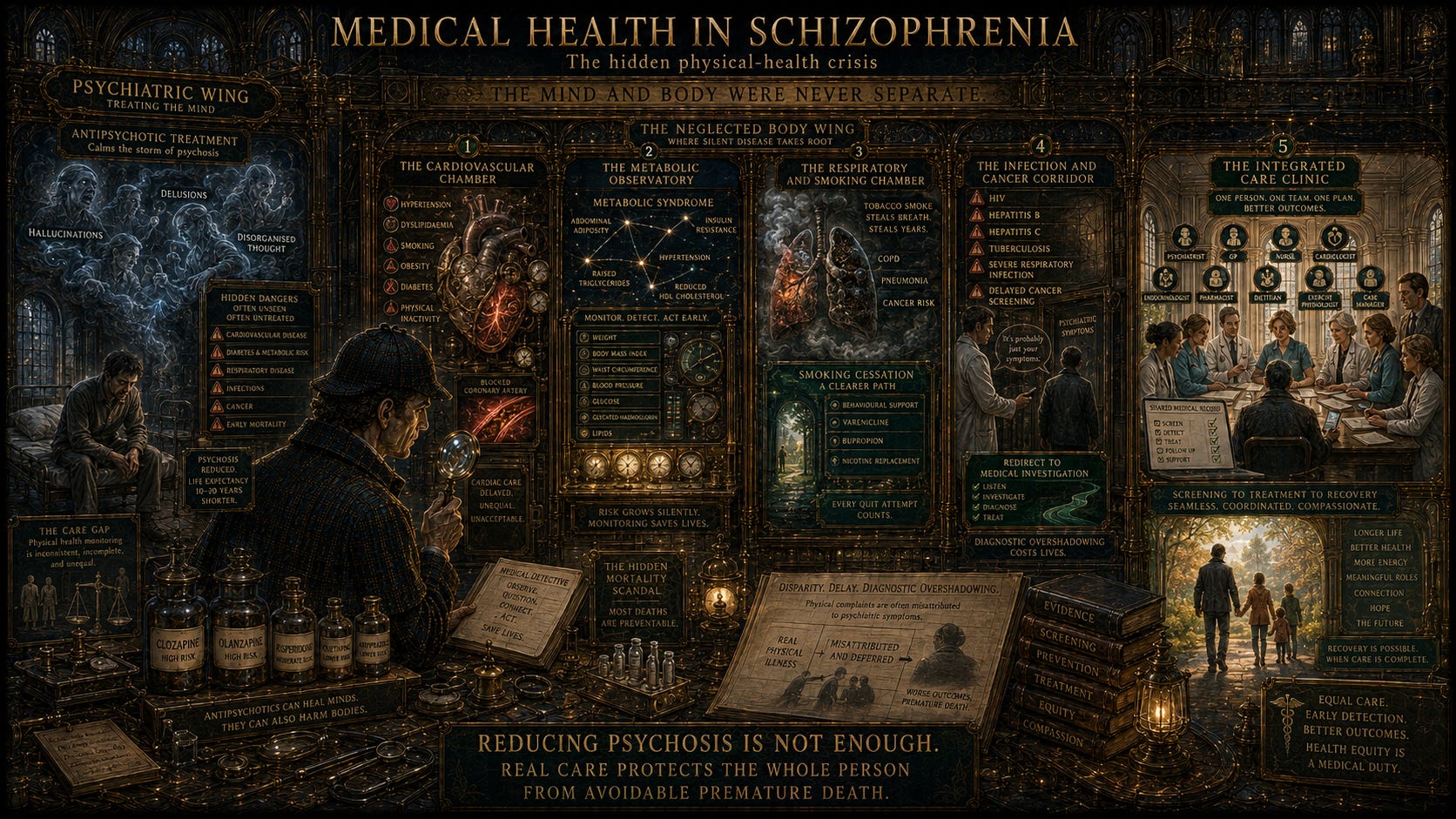 PSYCH 105: Medical Health in Schizophrenia 28.08.2026 47dkMedlock Holmes is called to investigate a disturbing pattern.The records appear unrelated.A man with schizophrenia dies from a myocardial infarction in his fifties.A woman develops diabetes that remains undetected for years.Another patient is repeatedly treated for anxiety while an underlying respiratory illness worsens.Someone else survives psychosis but dies from a preventable infection.Holmes spreads the files across a long forensic table.The pattern is unmistakable.People with schizophrenia die approximately a decade or more earlier than the general population. Their mortality is two to four times higher, and most of the excess deaths arise not from suicide, violence, or accidents, but from ordinary physical diseases that should often be detectable and treatable.The investigation begins in the Hall of Premature Death.Above the entrance are four warnings:* Earlier mortality* Greater medical comorbidity* Reduced access to appropriate treatment* Poorer medical outcomesHolmes first enters the cardiovascular chamber.Heart disease is the leading cause of death in schizophrenia. Obesity, smoking, hypertension, dyslipidaemia, diabetes, physical inactivity, poverty, stress, and medication effects converge like tributaries feeding the same river.Yet risk alone does not explain the whole mystery.When people with schizophrenia experience acute coronary syndromes, they may be less likely to receive proven treatments, invasive investigations, angioplasty, or bypass surgery. Their symptoms may be dismissed, overlooked, or attributed to mental illness.This is diagnostic overshadowing.The psychiatric label becomes so large that everything else disappears behind it.The next chamber contains glucose monitors, waist measurements, and lipid profiles.Type 2 diabetes is substantially more common in schizophrenia than in the general population. Insulin resistance, obesity, inactivity, poor diet, smoking, socioeconomic disadvantage, and antipsychotic treatment all contribute.Some antipsychotics carry greater metabolic risk than others. Clozapine and olanzapine are strongly associated with weight gain and abnormalities in glucose and lipid metabolism. Other agents generally carry lower risk, though no medication is entirely free from concern.Holmes discovers that the danger often begins quietly.Weight increases.Waist circumference expands.Triglycerides rise.High-density lipoprotein falls.Blood pressure creeps upwards.Fasting glucose becomes abnormal.Together these changes form the constellation known as metabolic syndrome-a powerful predictor of cardiovascular disease and type 2 diabetes.Yet the true failure often occurs before treatment is needed.Screening is simply not done.The recommended measurements are straightforward:Weight.Body mass index.Waist circumference.Blood pressure.Glucose or glycated haemoglobin.Lipids.Personal and family history.Still, many patients are never monitored adequately.Holmes moves into the respiratory wing.Smoking rates are extraordinarily high among people with schizophrenia. Many smoke heavily, increasing their risk of chronic obstructive pulmonary disease, pneumonia, cardiovascular illness, lung cancer, and premature death.For years, clinicians assumed smoking was too difficult to treat in schizophrenia or that stopping might destabilise mental health.The evidence does not support such therapeutic pessimism.People with schizophrenia can quit smoking. Medications such as varenicline and bupropion, alongside behavioural support, can help. Smoking cessation may improve not only physical health but also mood and quality of life.The infectious disease chamber reveals another layer.Rates of HIV, hepatitis B, hepatitis C, tuberculosis, pneumonia, and severe respiratory infections are elevated. During the COVID-19 pandemic, people with schizophrenia experienced greater infection risk and higher mortality.The reasons are multiple: poverty, crowded housing, reduced healthcare access, lower vaccination rates, smoking, chronic illness, and delayed treatment.The cancer chamber is more complicated.Cancer incidence may not always be dramatically higher, but cancer mortality often is. Screening may occur late. Symptoms may be poorly communicated or dismissed. Treatment may be less aggressive. Smoking adds further risk, particularly for lung cancer.Once again, the problem is not only biology.It is access.It is prejudice.It is fragmentation.It is a healthcare system divided into mental and physical worlds, as though the same person cannot inhabit both.Holmes then enters the room labelled Modifiable Risk.Here, unlike the earlier chambers, the atmosphere changes.The clues are actionable.Smoking can be treated.Weight can be monitored.Exercise can be supported.Dietary interventions can be offered.Hypertension can be managed.Dyslipidaemia can be treated.Diabetes can be detected earlier.High-risk antipsychotics can be reconsidered when appropriate.Metformin may help with antipsychotic-associated weight gain and metabolic dysfunction. Newer glucagon-like peptide-1 receptor agonists offer emerging promise. Structured physical activity can improve cardiovascular fitness, symptoms, and quality of life.The problem is not that medicine lacks interventions.The problem is that patients with schizophrenia often do not receive them.At the centre of the investigation stands the psychiatrist.Some may believe physical health belongs entirely to general practice.Holmes rejects this division.The psychiatrist is often the clinician with the strongest and most enduring therapeutic relationship. That relationship can be used to encourage screening, coordinate referrals, challenge therapeutic nihilism, support adherence, and ensure that medical problems receive the same standards of care offered to everyone else.The final chamber is the Integrated Health Clinic.Psychiatry, primary care, nursing, endocrinology, cardiology, pharmacy, dietetics, exercise physiology, and case management work in the same system.Medical records communicate.Screening is scheduled.Results are followed up.Abnormalities trigger treatment.No symptom is dismissed merely because the patient has schizophrenia.Holmes closes the mortality ledger.The mystery was never simply why people with schizophrenia become physically unwell.It was why predictable illness remained unseen, untreated, and accepted as inevitable.The solution is not another psychiatric intervention alone.It is equal medicine.To treat schizophrenia properly, clinicians must protect not only the mind from psychosis, but the heart, lungs, metabolism, teeth, and body from neglect.A life saved from hallucinations should not then be lost to hypertension.Key Takeaways* People with schizophrenia die approximately 10 to 15 years earlier than the general population.* All-cause mortality is roughly two to four times higher.* Most excess deaths arise from physical illness rather than suicide or other unnatural causes.* Cardiovascular disease is the leading cause of premature mortality.* Many patients have multiple coexisting physical illnesses.* Medical comorbidities are frequently underdiagnosed and undertreated.* Diagnostic overshadowing occurs when physical symptoms are incorrectly attributed to mental illness.* People with schizophrenia are less likely to receive appropriate cardiovascular screening and treatment.* Type 2 diabetes is approximately two to four times more common than in the general population.* Cardiometabolic risk factors include obesity, hypertension, dyslipidaemia, hyperglycaemia, insulin resistance, smoking, and physical inactivity.* Metabolic syndrome is highly prevalent and substantially increases cardiovascular and diabetes risk.* Clozapine and olanzapine are associated with particularly high metabolic risk.* Antipsychotic choice should consider both psychiatric benefit and physical-health burden.* Weight, body mass index, waist circumference, blood pressure, glucose, glycated haemoglobin, and lipids should be monitored routinely.* Smoking affects a large proportion of people with schizophrenia and remains a major preventable cause of illness and death.* Smoking cessation treatments can be effective and do not generally worsen psychosis.* Substance-use disorders are common and worsen adherence, physical health, and functional outcomes.* Respiratory illnesses, including chronic obstructive pulmonary disease, asthma, and pneumonia, are more common.* Rates of HIV, hepatitis, tuberculosis, and severe respiratory infection are elevated.* Cancer mortality may be increased through delayed diagnosis, inadequate screening, smoking, and treatment inequality.* Oral health is frequently poor and should form part of routine care.* Lifestyle interventions combining diet and exercise can improve weight and metabolic outcomes.* Switching from a high-risk to a lower-risk antipsychotic may reduce metabolic burden when clinically appropriate.* Metformin can be useful for antipsychotic-associated weight and metabolic problems.* Glucagon-like peptide-1 receptor agonists are emerging as promising options for cardiometabolic management.* Physical exercise may improve cardiovascular health, psychiatric symptoms, and quality of life.* Psychiatrists should remain actively involved in physical-health monitoring and care coordination.* Integrated mental and physical healthcare offers the best opportunity to reduce preventable mortality.* Patients with schizophrenia should receive the same evidence-based medical treatment as the general population. This is a public episode. If you'd like to discuss this with other subscribers or get access to bonus episodes, visit drmanaankarray.substack.com/subscribe
 -
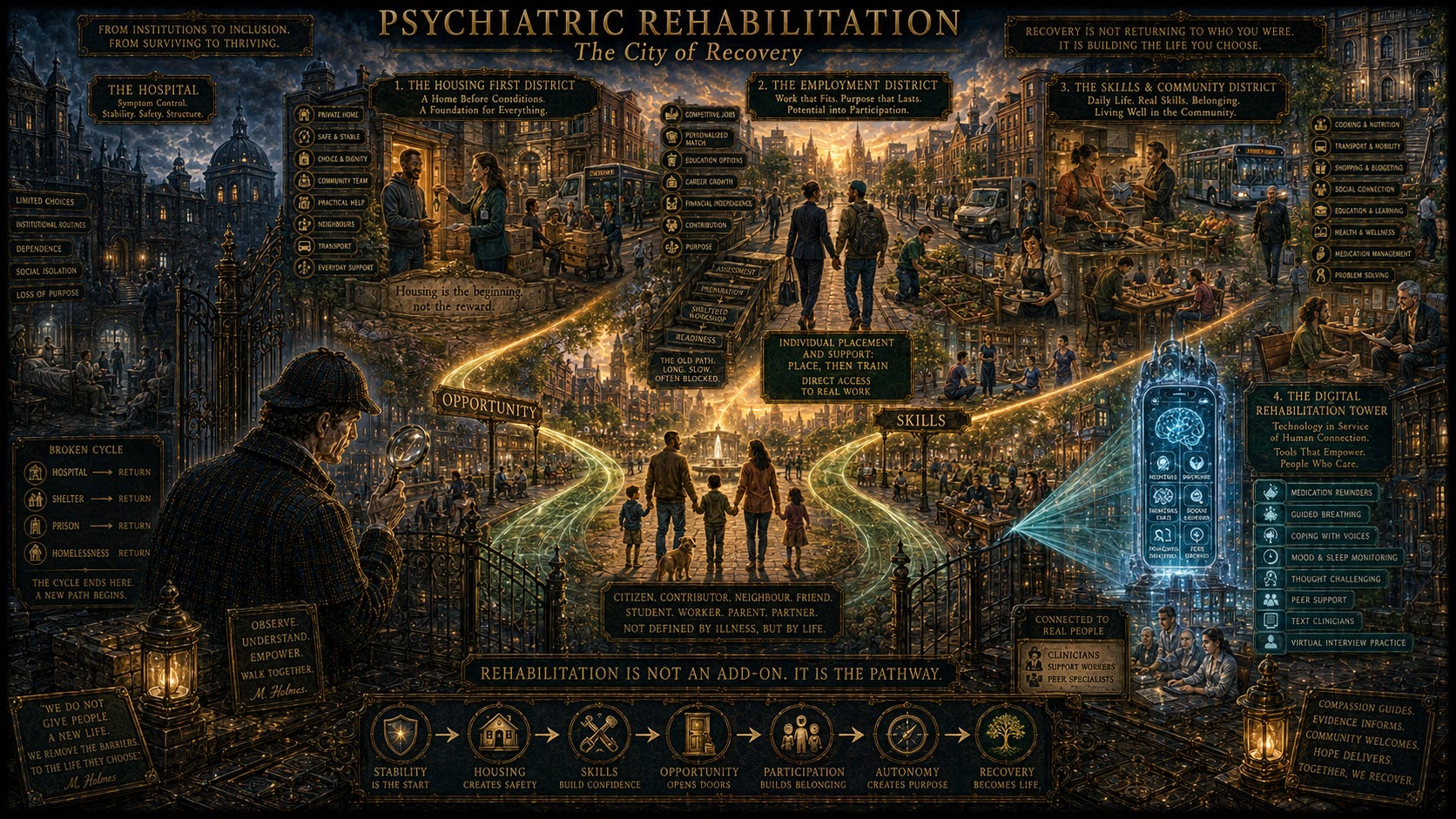 PSYCH 104: Psychiatric Rehabilitation in Schizophrenia 27.08.2026 51dkMedlock Holmes enters a psychiatric hospital expecting to find the next mystery inside the consulting room.Instead, the patient is waiting at the front gate.His hallucinations have improved.His delusions are less intense.His medication is stable.Yet he has nowhere secure to live, no employment, few relationships, and no meaningful reason to wake each morning.The treatment has reduced the illness.It has not restored the life.Holmes follows the man beyond the hospital walls and discovers the City of Interrupted Lives.Its streets contain empty apartments, locked workplaces, abandoned classrooms, silent social clubs, and train platforms leading nowhere. Each represents an ordinary adult role that severe mental illness can disrupt: tenant, student, employee, friend, partner, parent, neighbour, and citizen.At the centre of the city stands the Office of Psychiatric Rehabilitation.Its purpose is not simply to make patients less symptomatic.It is to help people live successfully in the environments they choose.Psychiatric rehabilitation therefore focuses on three essential elements:Opportunity. Support. Skills.The first district Holmes enters is the Quarter of Opportunity.Here he finds barriers that medication cannot remove.Landlords refuse applications.Employers assume incompetence.Educational systems offer no flexibility.Services segregate people into psychiatric spaces rather than helping them enter ordinary community life.Stigma has built walls around the city.Rehabilitation begins by opening doors: access to housing, education, competitive employment, relationships, recreation, and full community participation.The second district is the Bridge of Support.People recovering from schizophrenia may need practical assistance to succeed in ordinary roles, especially at the beginning.A clinician may help someone negotiate with a landlord.A case manager may teach them to use public transport.An employment specialist may accompany them to an interview.A family worker may help relatives support rather than discourage a return to study or work.Support is not intended to create dependence.Its purpose is to make independence possible.The third district is the Workshop of Skills.Here people practise managing symptoms, organising medication, shopping, cooking, communicating, resolving conflict, maintaining routines, and coping with stress.Yet Holmes notices an important change from older rehabilitation models.The skills are no longer taught only inside clinics.They are learned where they will actually be used.A person learns to shop in the supermarket.To travel on the bus.To prepare meals in their own kitchen.To manage anxiety in the workplace.The community itself becomes the classroom.Holmes first investigates housing.For decades, services assumed that people with schizophrenia had to become stable, abstinent, compliant, and treatment-ready before they could earn the right to an independent home.The Housing First model reverses this sequence.Housing is not the reward at the end of treatment.It is the foundation upon which treatment and recovery can begin.People are offered safe, affordable accommodation without requiring sobriety or compulsory treatment as a precondition. Flexible community support is then offered according to their needs and choices.Holmes meets a man who has moved repeatedly between hospitals, shelters, prisons, and the streets. His psychosis remains persistent and substance use has complicated his life. Previous programmes required him to prove readiness.Housing First gives him an apartment.The team helps with furniture, neighbours, shopping, conflict, and boundaries. They listen respectfully to his beliefs while solving practical problems.The hallucinations do not vanish.But homelessness does.The man remains housed, avoids prison, and begins making choices that protect the home he now values.The next investigation concerns employment.Traditional vocational rehabilitation followed a train-and-place model. Patients attended readiness assessments, sheltered workshops, counselling sessions, and prolonged preparation programmes before being considered suitable for competitive work.Many never reached the workplace.The process designed to prepare them became the barrier that stopped them.Individual Placement and Support, or IPS, takes the opposite approach:Place first. Train and support within the real job.Anyone who wants to work is eligible.There is no exclusion because of symptoms, substance use, poor work history, or cognitive difficulty.The job search begins rapidly and focuses on competitive employment matched to the person’s preferences. Support continues for as long as needed and is integrated with mental health care.Holmes meets a father who believes schizophrenia means he cannot work. He also needs to be home when his children return from school.An employment specialist learns that he loves driving and is dependable when others rely upon him. A part-time meal-delivery job provides the perfect match.The hours suit his family.The work feels meaningful.He earns a wage.His children see him leaving for work like other parents.Employment becomes more than income.It restores identity.Holmes reviews the evidence and finds that IPS consistently outperforms traditional vocational programmes. Across numerous trials, participants are substantially more likely to obtain competitive employment, earn more, work longer, and remain satisfied with their jobs. Importantly, employment does not destabilise them. It often improves confidence, self-esteem, quality of life, and community participation.The final district is unlike any rehabilitation centre Holmes has previously seen.It exists inside a smartphone.Digital tools now extend rehabilitation beyond scheduled appointments.Web programmes can teach coping strategies for voices.Online communities can connect people with peers and families.Text messaging can provide support between visits.Virtual reality can help practise social situations and job interviews.Mobile applications can prompt medication, monitor symptoms, guide breathing exercises, challenge distressing thoughts, and deliver support at the precise moment it is needed.Holmes examines FOCUS, a smartphone intervention designed specifically for people with schizophrenia. It asks users about symptoms, mood, medication, sleep, and social functioning, then provides brief personalised strategies. Every tool remains available on demand.For someone frightened to use public transport or enter a crowded clinic, the intervention travels with them.Technology does not replace human care.It carries care into the places where life actually happens.At the end of the investigation, Holmes returns to the hospital gate.The same patient is waiting.But now, beyond the gate, three roads are open:A home.A workplace.A community.Holmes understands the central principle of psychiatric rehabilitation.A person does not need to become symptom-free before beginning to live.Recovery is not the final stage after treatment has succeeded.Living itself can become part of the treatment.Key Takeaways* Psychiatric rehabilitation aims to improve functioning, quality of life, community integration, and personal recovery.* Its goals include independent living, education, competitive employment, relationships, leisure, and participation in ordinary adult roles.* Antipsychotic medication often improves positive symptoms but has limited effects on cognition, negative symptoms, and psychosocial functioning.* Symptom reduction alone does not guarantee functional recovery.* Psychiatric rehabilitation combines three central approaches: creating opportunities, providing support, and developing skills.* Rehabilitation is strengths-based, person-centred, and directed by individual goals and preferences.* Community integration requires challenging stigma, segregation, discrimination, and structural barriers.* Supports should promote independence rather than long-term dependence on professionals.* Skills are often learned most effectively in the natural environments where they will be used.* Assertive Community Treatment provides intensive multidisciplinary support in community settings.* Supported housing separates access to housing from compulsory participation in treatment.* Housing First offers safe, affordable housing rapidly and without requiring treatment adherence or abstinence as a precondition.* Stable housing can reduce homelessness, emergency-service use, and hospitalisation.* Housing improvement does not automatically produce equivalent improvements in symptoms or substance use, so ongoing support remains important.* Traditional train-and-place vocational programmes have generally produced poor competitive employment outcomes.* Individual Placement and Support uses a place-and-train approach.* IPS principles include zero exclusion, rapid job search, competitive employment, client choice, integrated services, ongoing support, targeted job development, and benefits counselling.* IPS substantially improves competitive employment, earnings, hours worked, and job tenure.* Competitive employment does not increase relapse or clinical instability.* A good job match should reflect the person’s interests, strengths, family responsibilities, coping style, and preferences.* People with schizophrenia commonly use smartphones, the internet, social media, and digital communication.* Digital rehabilitation can provide psychoeducation, peer support, self-management tools, symptom monitoring, and real-time interventions.* FOCUS delivers smartphone-based support for medication, mood, sleep, social functioning, and psychotic symptoms.* Text messaging, web-based interventions, virtual reality, and telehealth can extend rehabilitation beyond clinics.* Technology should supplement rather than replace therapeutic relationships and community services.* Personal recovery includes hope, meaning, self-efficacy, choice, and creating a life that is not dominated by illness. This is a public episode. If you'd like to discuss this with other subscribers or get access to bonus episodes, visit drmanaankarray.substack.com/subscribe
Benzer podcastler


Şurada popüler
Bu podcast şu ülkelerin podcast listelerinde de yer alıyor.


