
Sketchplanations - The Podcast
Bell Boy Productions
0
Big Ideas explored through Little Pictures. This podcast offers conversations about ideas based on simple and insightful sketches from the Sketchplanations online collection. Topics include science, behavioral economics, wellbeing, nature, psychology frameworks, business models, cognitive biases, and domestic life-hacks. Hosted by Jono Hey, Tom Pellereau, and Rob Bell, the show aims to give listeners something fun and interesting to discuss.
Bölümler
-
 The Diderot Effect 02.06.2026 33dkAre you a slave to your possessions?Do your possessions form part of your identity?How easy is it to fall into a trap where one new purchase begets another, and another, and another...?We explore the Diderot Effect - so called after an essay written in 1769 by French philosopher, writer, and art critic who served as one of the most influential figures of the Age of Enlightenment. "Regrets On Parting With My Old Dressing Gown" details how receiving a luxurious scarlet robe as a gift made his existing belongings look shabby, sparking an out-of-control spending spiral to replace all his old furniture to match the new garment. In the episode Jono references that he first heard about it from James Clear who went on to include it in his highly successful book, Atomic Habits.Episode Summary00:00 Summer Break Notice00:51 What Is the Diderot Effect04:09 Diderot and the Dressing Gown06:05 When Stuff Owns You09:47 Our Diderot Moments13:45 Tools Cars and Tech Spirals20:23 Business Growth and Office Upgrades28:00 How to Master the Effect31:18 Final Quotes and Wrap Up Hosted on Acast. See acast.com/privacy for more information.
 -
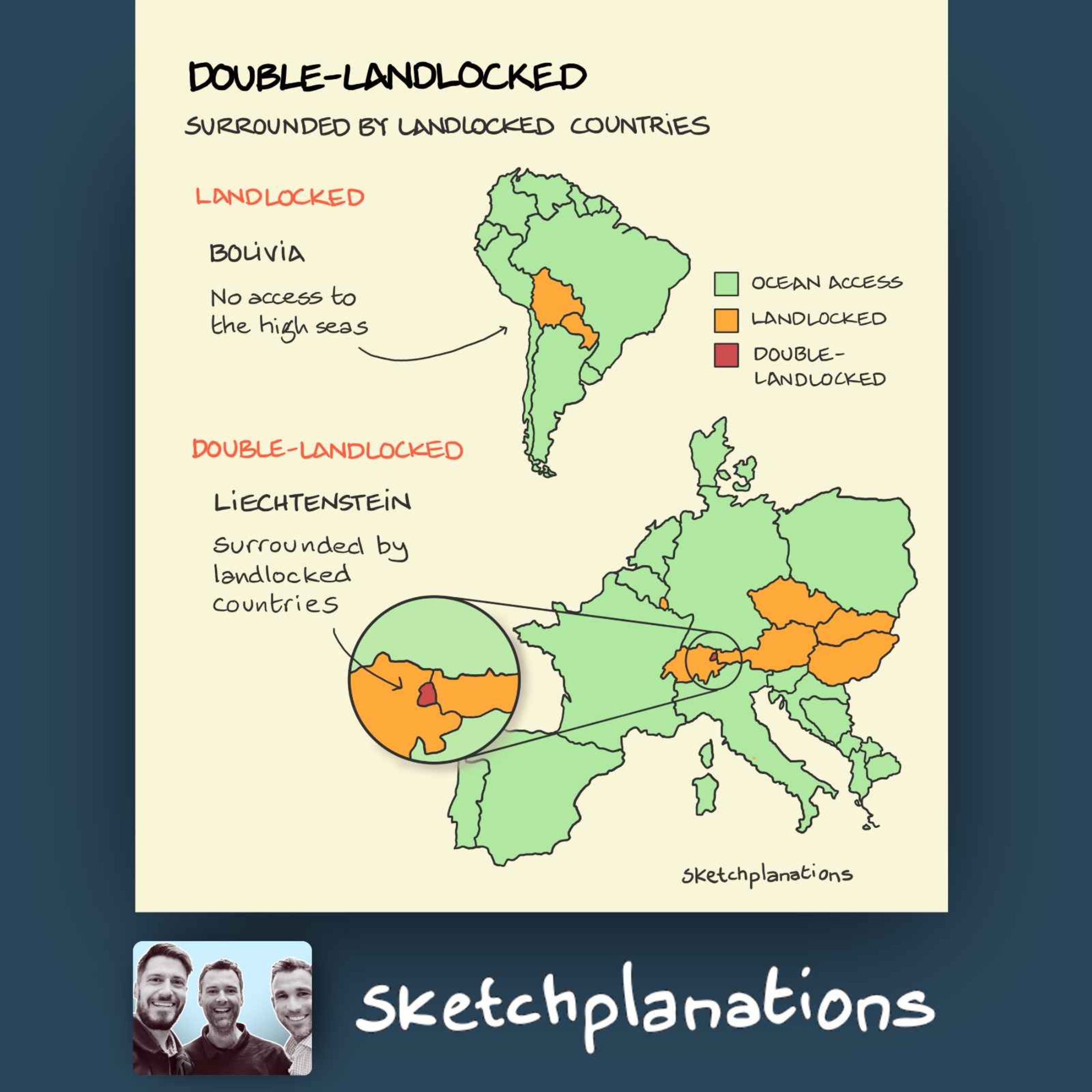 Why Only 2 Countries Are Double-Landlocked 19.05.2026 31dkIn a double-landlocked country you must cross at least two national borders to reach a coastline connected to the world’s oceans.In this episode we talk about the nuances of landlocked definitions (including why the Caspian Sea doesn’t count) and identify the only two double-landlocked countries: Liechtenstein, surrounded by Switzerland and Austria, and Uzbekistan, surrounded by landlocked “stans.”We talk about why ports and sea access matter for trade and geopolitics. We also explore the ideas and definitions for landlocked US states (including Nebraska as “triple landlocked”), the furthest points from the sea, disputed borders, recursive islands, and a Google Maps oddity between the Shetlands and Faroe Islands. It's definitely one for maps and geography nerds!References: Tom mentions Tim Marshall's book, Prisoners of GeographyJono also references some of his other sketches: Recursive Islands and Triple Landlocked StatesWe also reference the previous podcast episode on Antipodes for how so much of the Earth is water.Episode Summary:00:00 What Double Landlocked Means04:17 The Only Two Countries05:45 Caspian Sea and Definitions06:53 Recursive Borders in UAE08:33 Why Ports Matter12:13 Bolivia and Africa Surprise13:52 Distance From the Sea18:02 Landlocked US States Debate25:23 More Geography Oddities28:48 Shetlands to Faroes Map Quirk30:06 Closing Thoughts Hosted on Acast. See acast.com/privacy for more information.
 -
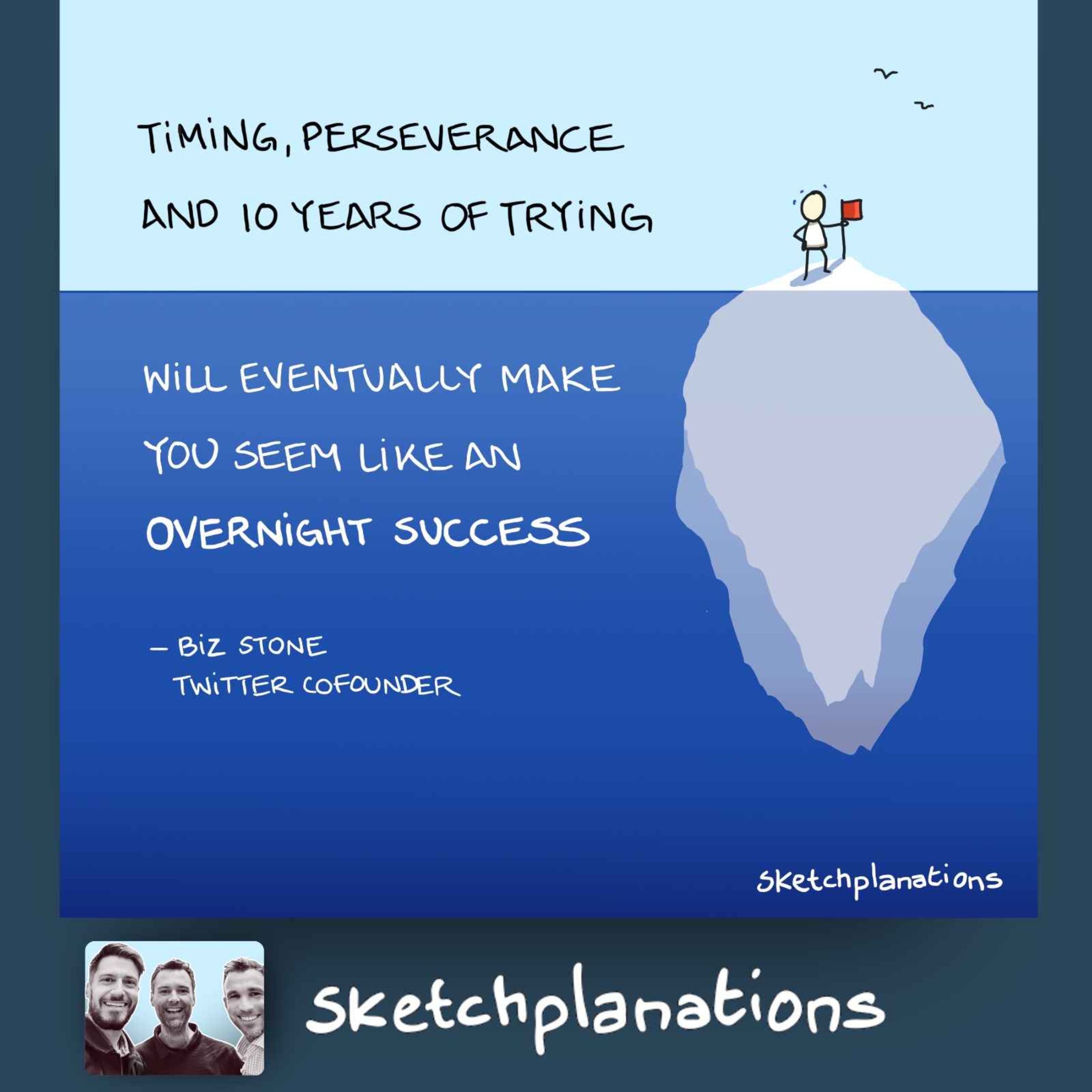 How To Become An Overnight Success. 05.05.2026 35dkThis discussion centres on “overnight success” as an illusion; prompted by Jono’s sketch of Twitter Cofounder, Biz Stone’s quote: “Timing, perseverance, and 10 years of trying will eventually make you seem like an overnight success.”Using an iceberg metaphor (most work hidden below the surface), we explore how Twitter, Uber, Airbnb, GoPro, Pinterest and other “sudden” hits were built through long periods of effort, failed attempts, near-bankruptcies and luck-driven timing.Tom shares his own journey from inventing the curved nail file in 2004 to major success after winning The Apprentice, plus later product launches, illustrating visible turning points built on years of groundwork. We also look at creative fields and sport, survivorship bias, and belief, persistence, readiness, and timing.External LinksIn the conversation, we referenced these items which you can find more information on here:Our Listener SurveyBiz Stone's book: Things A little Bird Told MeJono's sketches on Iceberg Orientation & Survivorship BiasOur previous episode on Optimism BiasEpisode Summary00:00 Introduction01:13 Biz Stone Quote03:10 Iceberg Metaphor04:09 Biz Stone Backstory04:36 From Blogger to Twitter07:37 Myth of Viral Success09:59 Tom's Real World Examples12:31 Sketchplanations Slow Burn16:06 Perseverance and Belief18:52 Timing and Viral Moments20:59 The Turning Point21:35 Apprentice Timing Advantage24:43 Jono on Luck and Timing26:34 Sports Overnight Success28:42 Survivorship Bias Reality29:47 Do Overnight Successes Exist32:15 Advice Perseverance Mindset34:29 Wrap Up and Credits Hosted on Acast. See acast.com/privacy for more information.
 -
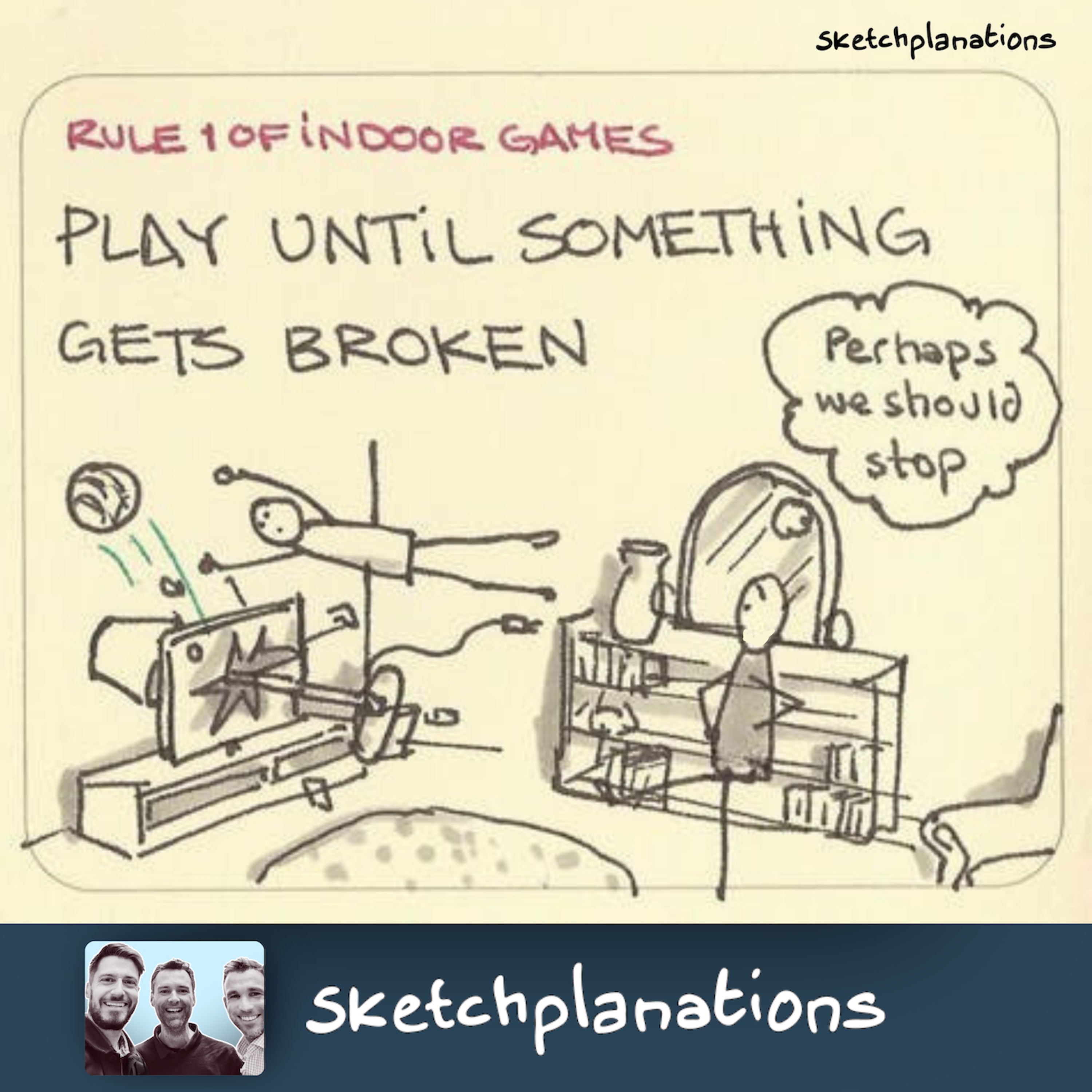 Play Until Something Gets Broken 21.04.2026 22dkIn this fun and nostalgic conversation, we discuss Jono's observation that with indoor games especially, as the momentum builds, you keep playing until something gets broken!There's a cheeky inevitability to it. It's a situation we've almost all certainly been in - whether you were the protagonist or not!We share our childhood and adult stories of hallway ball games, broken lamps and mirrors, a university corridor culture of improvised sports, Nerf-gun firing ranges ending with a foam dart to the eye, and a school-trip pillow fight that took out a light fitting. The conversation expands to similar “stop conditions” in outdoor games and with sports injuries, and connects the idea to the Generalised Peter Principle: anything that works is pushed into progressively more challenging situations until it fails. What are you experiences with this?Links to items we discussed:Jono's impossible "lamp thru TV" sketch has connotations of Escher's Impossible StaircaseJono's sketch and our past podcast episode about The Peter PrincipleJono's sketch on The Generalised Peter PrincipleRob referenced a visit to the Belleek Pottery factory whilst filming in Northern Ireland.Episode Summary:00:00 Podcast popularity in USA01:12 The Indoor Games Rule02:48 Ball Games Banned04:40 Injuries End The Game08:09 Uni Corridor Games08:58 Sketch Breakdown10:37 Why Indoor Play Matters11:00 Messy Space Dreams14:02 Adult Injuries End Games14:58 Pillow Fight Lamp Smash16:05 Hide Underwater Tactic16:40 Generalized Peter Principle17:32 Sacrificial Breakables21:11 Anger Smashing Question21:44 Closing Hosted on Acast. See acast.com/privacy for more information.
 -
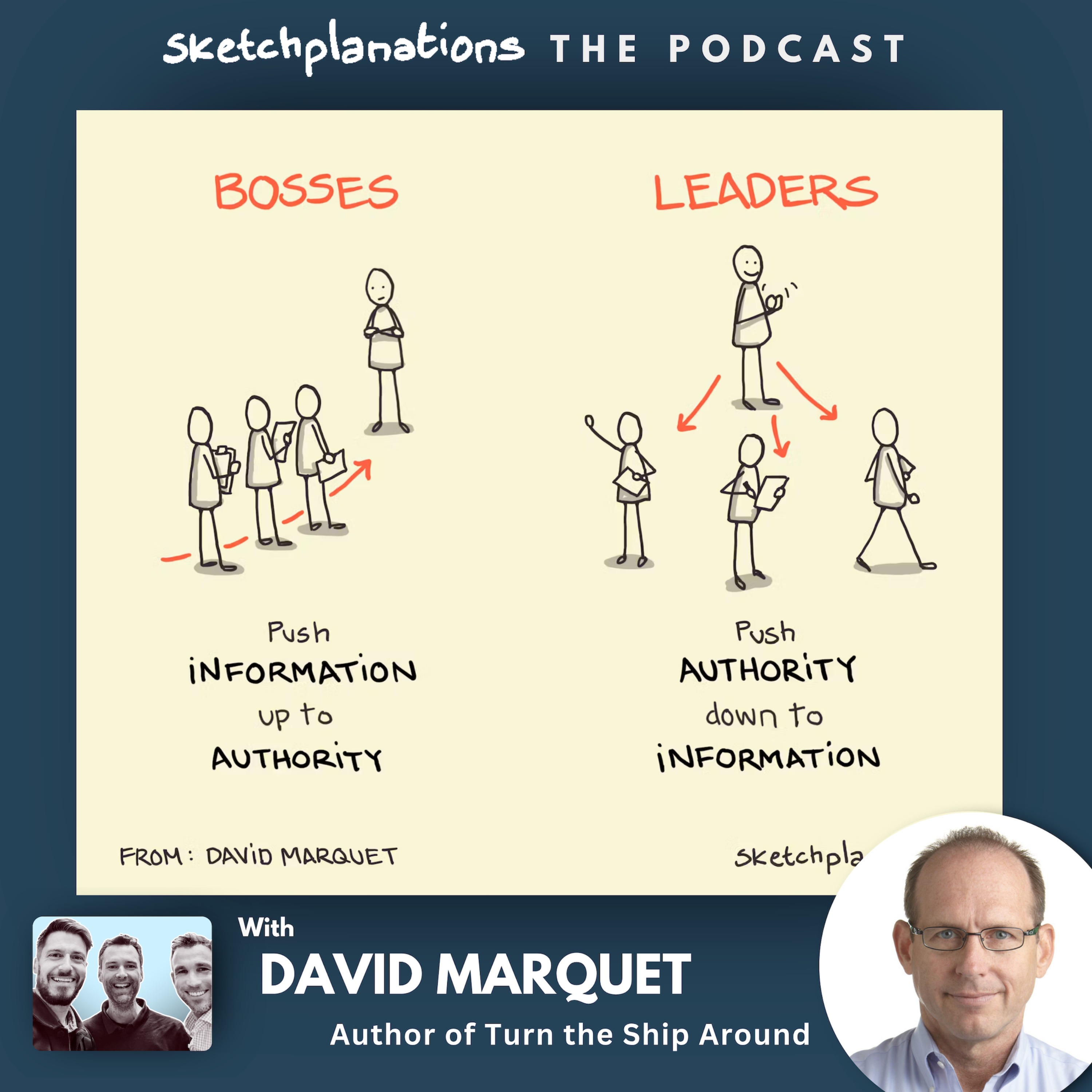 Submarine Lessons for Business Leadership 07.04.2026 52dkUS Navy submarine captain and author David Marquet discusses leadership lessons from turning the USS Santa Fe from worst to best, focusing on “pushing authority to information” rather than pushing information up a hierarchy. Marquet critiques industrial-age leadership language that seeks obedience and creates “bobblehead” agreement, arguing that real engagement comes from giving people decision-making authority,He also explains “distancing,” as a leadership and decision-making tool: viewing oneself from a third-person, from a different time, and/or from a different place to reduce ego and defensiveness over previous decisions. A thoroughly fascinating chat with a very talented and fun individual. External Links for items referenced in the conversation:David’s 3 books can be found here: Turn the Ship Around (+ workbook), Leadership is Language, and DistancingHere are two of many of David's talks to be found on YouTube: What is leadership? and Turn the Ship Around at the World Web ForumHere's the YouTube video of David rating submarine movies for how realistic they portray life under the waves.David talks about advice given to him by Simon SinekSome of Jono's other skecthes references in this podcast include: Solvitor Ambulando (it is solved by walking); 9 windows (problem solving tool); Anchors and Tugboats (self-talk)David talks about ultra-runner extraordinaire Courtney DauwalterSummary00:00 From Cold War Kid to Submariner03:02 Life Aboard a High-Performing Sub03:53 The Arbitrary Officer Divide04:40 Student Not "Expert"05:51 Words That Kill Curiosity08:44 What Leadership Was Taught12:37 Pushing Authority to Information16:03 Submarine Leave Approval Hack20:02 Authority in Everyday Workplaces21:59 Bias for Action and Excellence22:46 Distancing to Decide Better25:41 Put Them In Your Chair26:12 Distancing In Space & Time27:45 Inviting Feedback Culture28:52 Nine Windows Thinking Tool30:25 You Can Do It Self Talk32:28 Regret Proof Decisions38:04 Journaling Into A Book39:41 Be Your Own Coach45:50 Team Reviews Without Defensiveness47:19 Live Big Bold Lives48:14 Submarine Movies And Ambiguity50:55 Wrap Up Hosted on Acast. See acast.com/privacy for more information.
 -
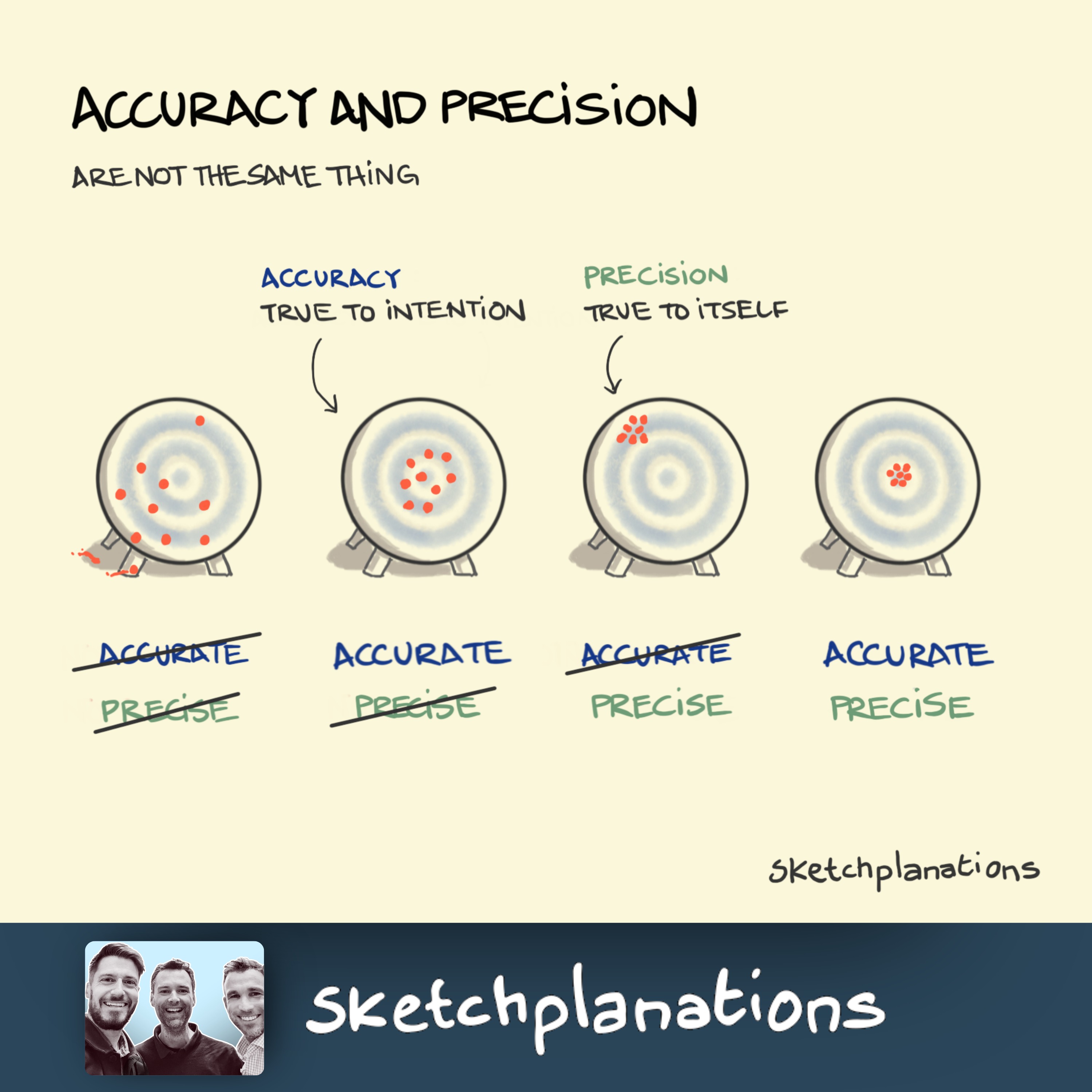 Hitting the Target: Accuracy vs. Precision 24.03.2026 29dkUsing Jono’s sketch of four archery targets, we discuss why and how accuracy and precision differ.Using many different examples, we frame the distinction as “accuracy being true to intention and precision being true to itself,” also phrased as doing the right thing versus doing it right.The sketch is inspired by Simon Winchester's book, Exactly, where precision and accuracy are connected to the industrial revolution via Henry Maudsley’s innovative screw-cutting lathe, micrometer, and the concept of interchangeable parts. The conversation broadens to explore examples in food (McDonald’s vs artisan meals), recipes, recruiting, IQ tests (validity vs reliability), indoctrinated beliefs, gut feelings, culture’s return to individual craftsmanship, AI’s variable answers, LED mask wavelength tolerances, and targeting weapons.External linksAlso referenced in this episode:Jono's sketch that describes the difference between Reliability and Validity.Jono's sketch inspired by Roger Martin's Knowledge Funnel.Jono's sketch outlining The Beard Cycle.Episode Outline00:00 Accuracy vs Precision: the Four Target Sketch03:23 True to Intention04:11 Ball Through Window05:44 Precision Built World09:45 Food and Recipes13:27 Calibration and Scales14:47 Manufacturing Tolerances16:51 Hiring and Testing19:16 Beliefs and Education23:01 Culture and Craft26:09 Doctors Robots and AI29:03 Wrap Up and CreditsAll music on this podcast series is provided by the very talented Franc Cinelli and you can find more tracks at franccinelli.com Hosted on Acast. See acast.com/privacy for more information.
 -
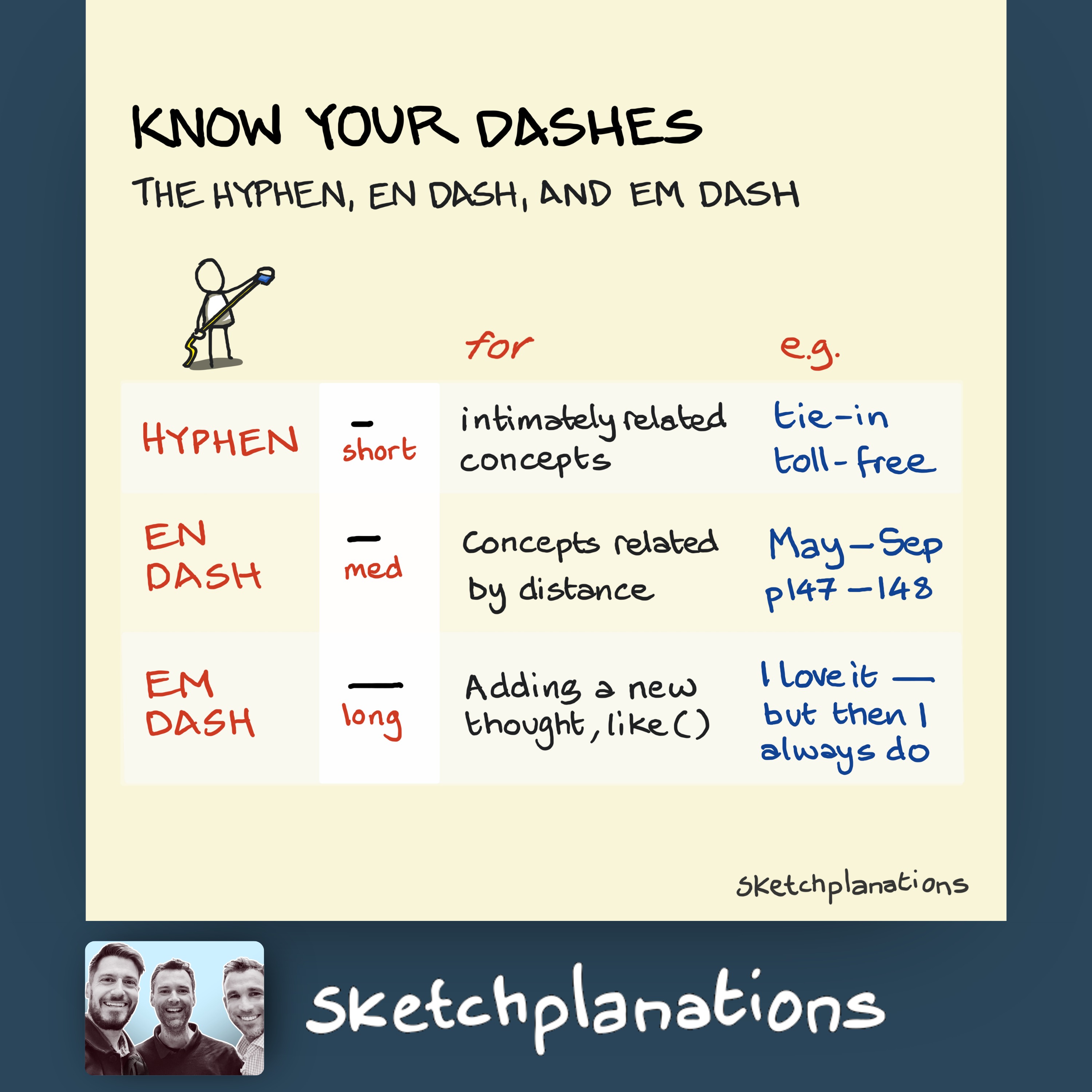 Do you Know Your Dashes? 10.03.2026 33dkIf you like the finer details of grammar and punctuation, then you're gonna love this episode.We geek out on the subtle, but incredibly important and occasionally crucial differences between three little horizontal lines: the hyphen - the En Dash – and the Em Dash —Jono explains hyphens for line breaks and compound terms, how usage can evolve into single words (e.g., wildlife, wellbeing), and why hyphen placement can change meaning (e.g., five-dollar bills). The en dash is described as linking ranges and relationships (pages, dates, times, scores, routes, debates, partnerships, negotiations), with notes on how to type it. The em dash is framed as a stronger-than-comma interruption for added thoughts, with style cautions and typing methods. They discuss underscore origins from typewriters, punctuation differences across countries, and how AI popularized em dashes as a telltale sign of machine-written text.Most importantly though, we discuss why this matters and that if used correctly, they can help avoid misunderstandings.Episode Summary00:00 Welcome to Sketchplanations00:40 What Are Dashes03:09 Hyphen Basics04:32 Hyphenated Words05:35 Language Evolves07:00 Hyphen Pitfalls07:31 Tom on Hyphens10:38 Meet the En Dash11:41 Typing En Dashes12:32 En Dash Use Cases14:47 Spacing and Style15:30 Introducing Em Dash15:33 Em Dash Basics16:15 Style Guide Rules18:08 Brackets vs Speech18:57 Where Names Come From20:32 Underscore Origins22:05 Reading Dashes Aloud24:39 Does It Matter26:04 Oxford Comma Stakes28:36 AI Em Dash Tell29:59 Typing Em Dashes30:32 Punctuation By Country31:41 Morse Code And Minus32:43 Final Sign OffExternal LinkThere's only one link this week:Jono referenced the book Strunk and White : The Elements of StyleAll music on this podcast is provided by the very talented Franc Cinelli. Hosted on Acast. See acast.com/privacy for more information.
 -
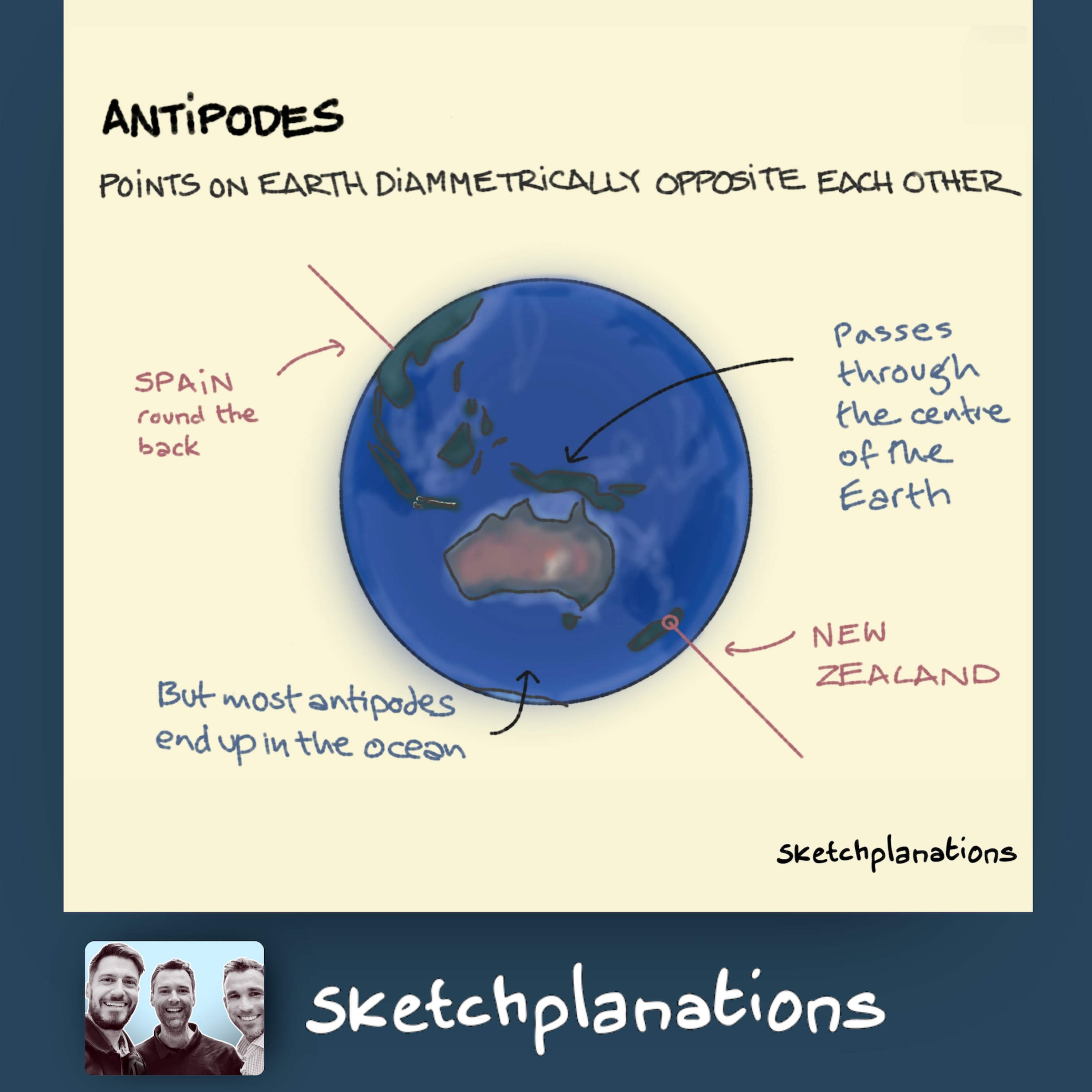 Digging Through the Planet: The Geography of Antipodes 24.02.2026 17dkHave you ever wondered what's happening on the exact opposite side of the world to you?Wherever you are on our planet, there's a good chance you'd need a snorkel.In this episode, we explore the concept of antipodes—the exact point on the opposite side of Earth from wherever you're standing. We discover why most antipodes end up in the ocean rather than on land and cover a whole host of fascinating geographic facts, including how the Northern Hemisphere contains the vast majority of Earth's land and population, how map projections distort our view of the planet, and why Earth's oblate spheroid shape means some antipode distances are longer than others.Along the way, we also raise the big questions like how deep have humans ever dug into Earth and how long it would take to fall through a frictionless tunnel to your antipode.External Links and mentions on the show:Jono's sketch that explains the Mercator Map Projection Jono references the Antipodal Map in the book Marvellous Maps by Simon KuestenmacherThe 7.6 mile deep hole Jono talks about is the Kola Superdeep Borehole in Russia, initiated by Soviet scientists in 1970, primarily to better understand the earth’s crust. Here's Jono's sketch about the thickness of the earth's crust being proportionally similar to the thickness of an apple's skin. And finally, if you want to know your exact antipode, you can look here on AntipodeMap.comEpisode Summary00:00 What Are Antipodes03:23 Land Distribution on Earth04:14 Map Projections and Perspectives07:19 Antipodal Map Overlay08:56 Cultural References Worldwide10:15 Etymology of Antipode10:41 Digging Through Earth12:44 UK Antipodes13:29 Great Circle Routes14:20 Earth's Oblate Shape15:25 Tunnel Through Earth16:34 Closing RemarksAll music on this podcast series is provided by the very talented Franc Cinelli Hosted on Acast. See acast.com/privacy for more information.
 -
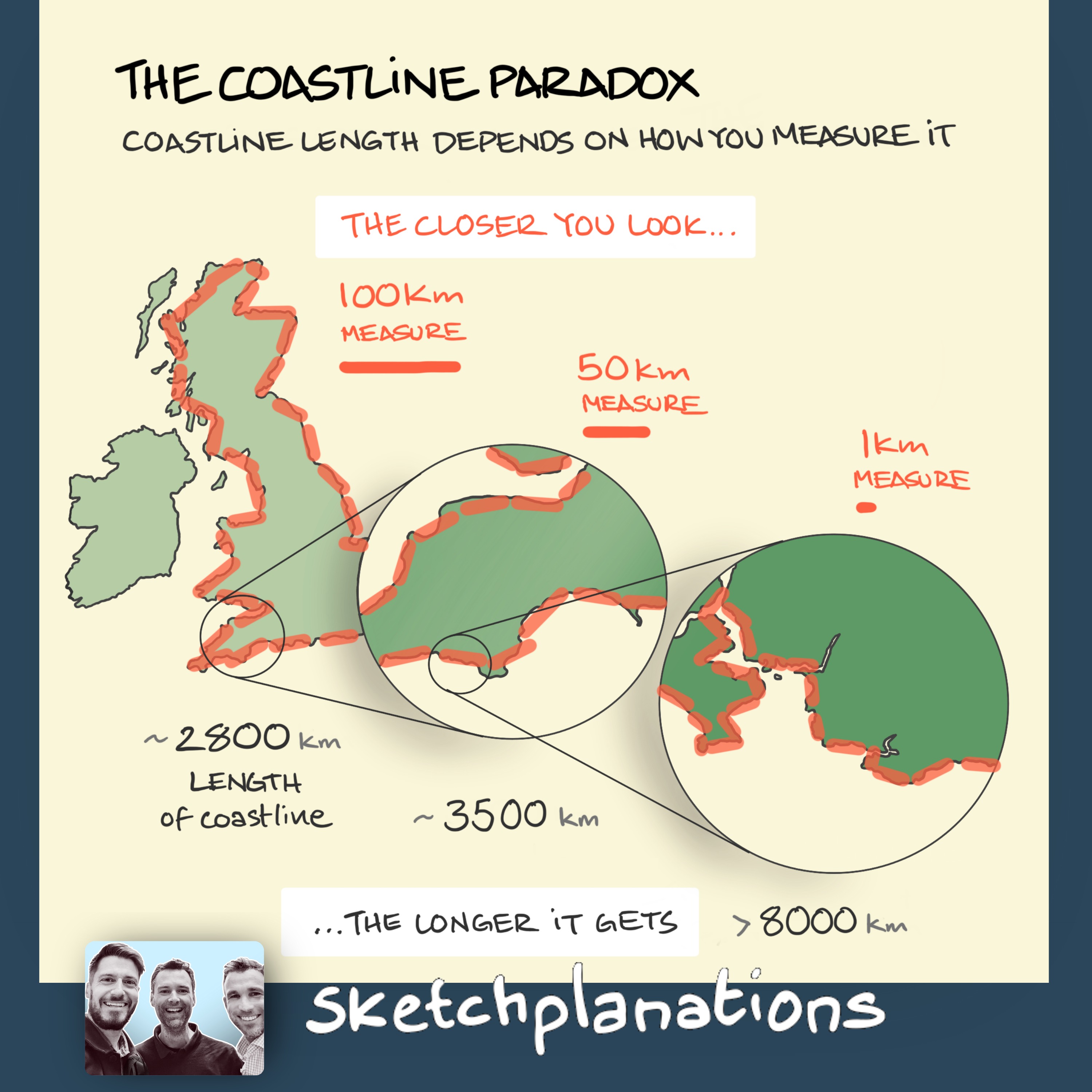 The closer you look, the longer it gets: The Coastline Paradox 10.02.2026 26dkWhen you want to measure something you take your ruler or tape measure and read off the length right?But when it comes to measuring the length of a coastline, things get a bit tricky and totally counter intuitive. 🌊The science and maths of measuring wiggly coastlines reveal that the smaller the unit of measure, the longer the coastline becomes. Jono recounts the origins of this phenomenon from polymath, Lewis Fry Richardson and its further exploration by Benoit B. Mandelbrot. The trio also relate the concept to various other real-world examples, including the surfaces of the brain and lungs, Romanesco cauliflower, and stock market patterns. Additionally, they touch on the philosophical implications of measurement and delve into the concept of infinity.Episode Summary:00:00 Introduction the Coastline Paradox04:12 Historical Context and Discovery14:10 Fractals and Natural World Applications17:26 Modern Implications and Analogies24:36 Conclusion and Final ThoughtsExternal Links and mentions on the show:Jono refers to and leans heavily on the writing of Geoffrey West in his book "Scale" to tell the story of how this was discovered.Rob's half-baked fact about The Standardised Meter can be expanded on here.This is what the self-similarity of a Romanesco Cauliflower looks likeHere is the avenue of trees in Bushy Park, in Southwest London that Jono slalomed.Here are more facts on who originally defined the number 'zero' as we know it today.All music on this podcast series is provided by the very talented Franc Cinelli Hosted on Acast. See acast.com/privacy for more information.
 -
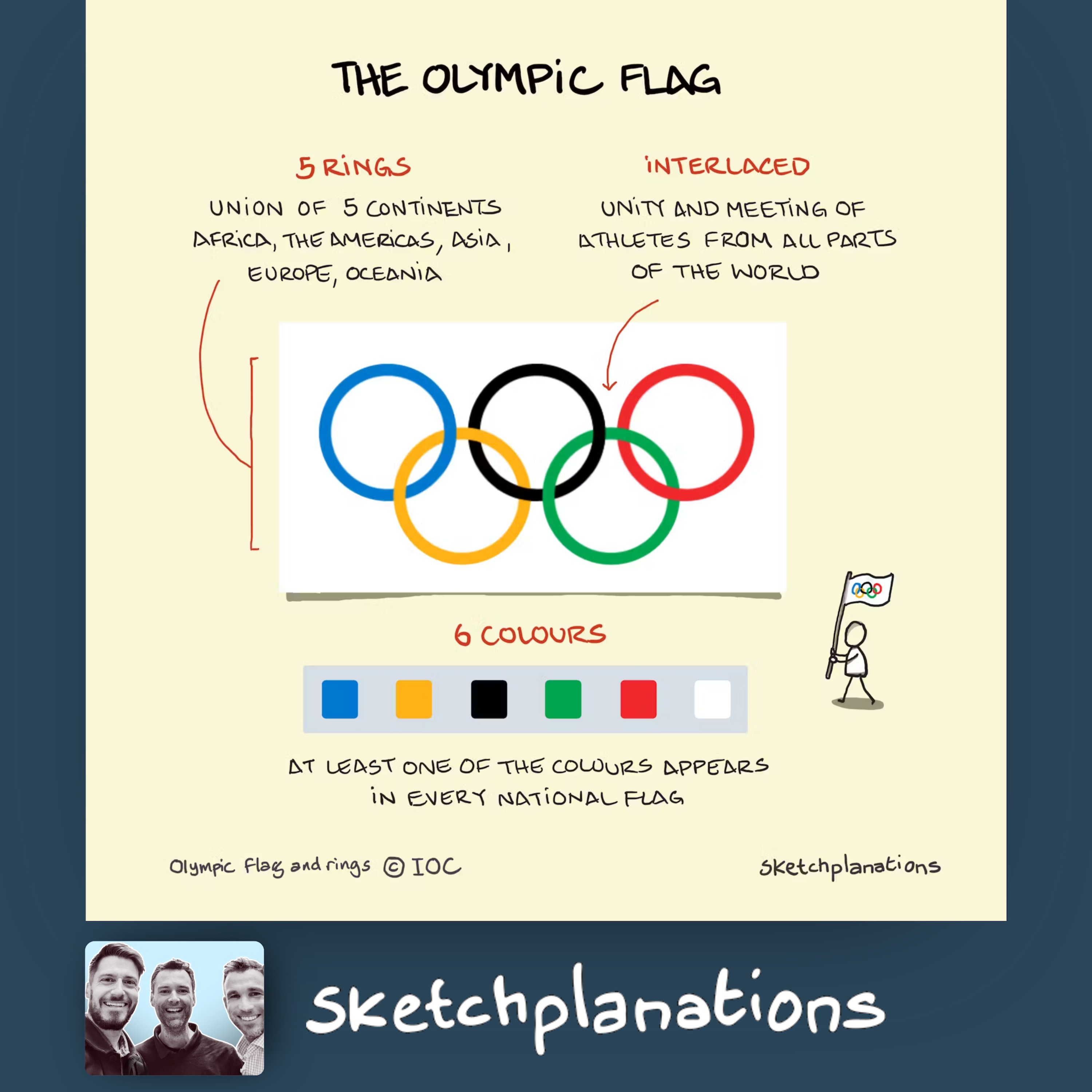 More Than Just Rings: Unity, History, and Ambition. 27.01.2026 23dkHave you ever wondered what the colours on the Olympic flag represent?The Olympic logo is a globally recognised brand and remarkably, it was designed over 100 years ago by the founder of the modern Olympic Games, Pierre de Coubertin.This time, we discuss the history and symbolism of this design icon ahead of the Winter Olympic Games in Milano Cortina, Italy. We find out about its representation of unity among the five (?) continents (one for each ring), and the careful selection of the flag's colours. The episode also delves into fascinating Olympic trivia, including the evolution of the games, historical moments, and the development of the Olympic motto. Rob also shares insights from filming at the Olympic Museum in Lausanne, Switzerland, for his series 'The Vault,' which explores Olympic history through artefacts found in their archives.You can watch all 10 episodes of The Vault for free here on the Olympics Channel.Episode Summary00:00 Introduction and Excitement for the Winter Olympics01:42 The Genesis of the Olympic Flag02:50 Symbolism and Design of the Olympic Flag05:06 Pierre de Coubertin: The Visionary Behind the Olympics05:21 Exploring Olympic History and Artifacts09:35 Evolution of the Olympic Games and Flag22:28 Conclusion and FarewellAll music on this podcast series is by the very talented Franc Cinelli. Hosted on Acast. See acast.com/privacy for more information.
 -
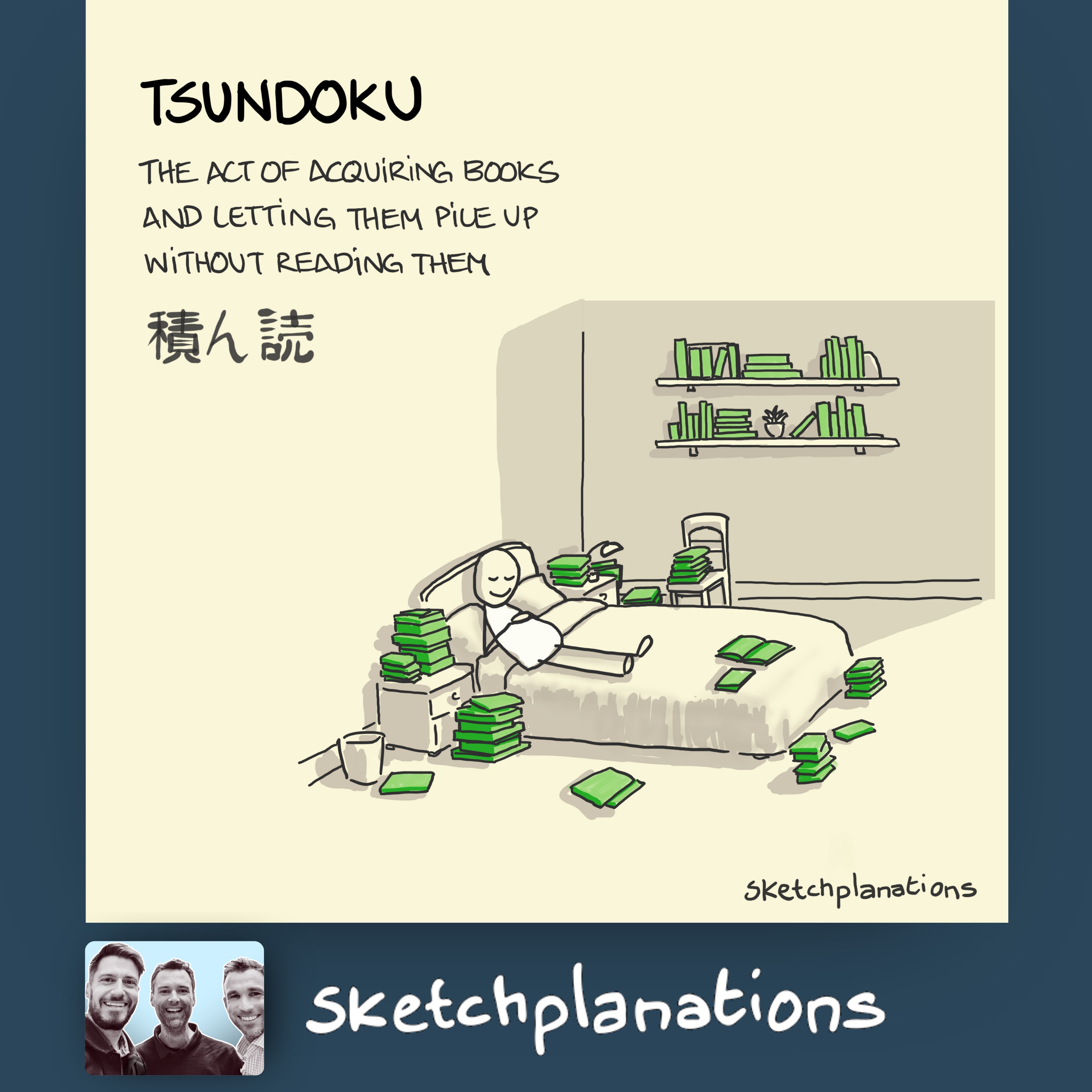 Tsundoku: Do you buy books faster than you can read them? 📚🤔 13.01.2026 20dkHow big is that pile of books next to your bed?Tsundoku is a Japanese word for buying books and letting them pile up unread. It’s a familiar habit to book lovers everywhere — that growing stack of books you intend to read but haven’t yet. In this episode of Sketchplanations The Podcast, we explore why we buy books we don’t read, why unread books don’t always feel like a bad thing, and what this habit says about curiosity, identity, and our relationship with reading.In this episode we embrace Tsundoku and our conversation ranges from buying too many books to the joy and guilt of collecting unread books, and how tsundoku can extend to audiobooks, hobbies, and other unread things. If you’ve ever wondered why you buy books faster than you can read them — or felt conflicted about your own unread pile — this episode is for you.Links to items (mainly books) that we discussed:The book that changed Tom's life: Rocket Fuel by Gino Wickman and Mark WintersThe book from Jono's pile he next wants to start: A few short sentences about writing by Verlyn KlinkenborgRobbie is most looking forward to getting started on: Whatever will be will be by Felix WhiteJono recommends cartoons about books and reading by Tom GauldBig Ideas, Little Pictures is the Sketchplanations book by Jono HeySummary: 00:00 Introduction to Tsundoku: The Act of Collecting Unread Books02:52 Personal Stories and Reflections on Tsundoku05:20 The Broader Implications of Tsundoku07:49 Books as Gifts and Their Value10:03 The Joy and Guilt of Collecting Books17:14 Final Thoughts and Reflections19:34 Conclusion and FarewellAll music on this podcast series is by the very talented Franc Cinelli Hosted on Acast. See acast.com/privacy for more information.
 -
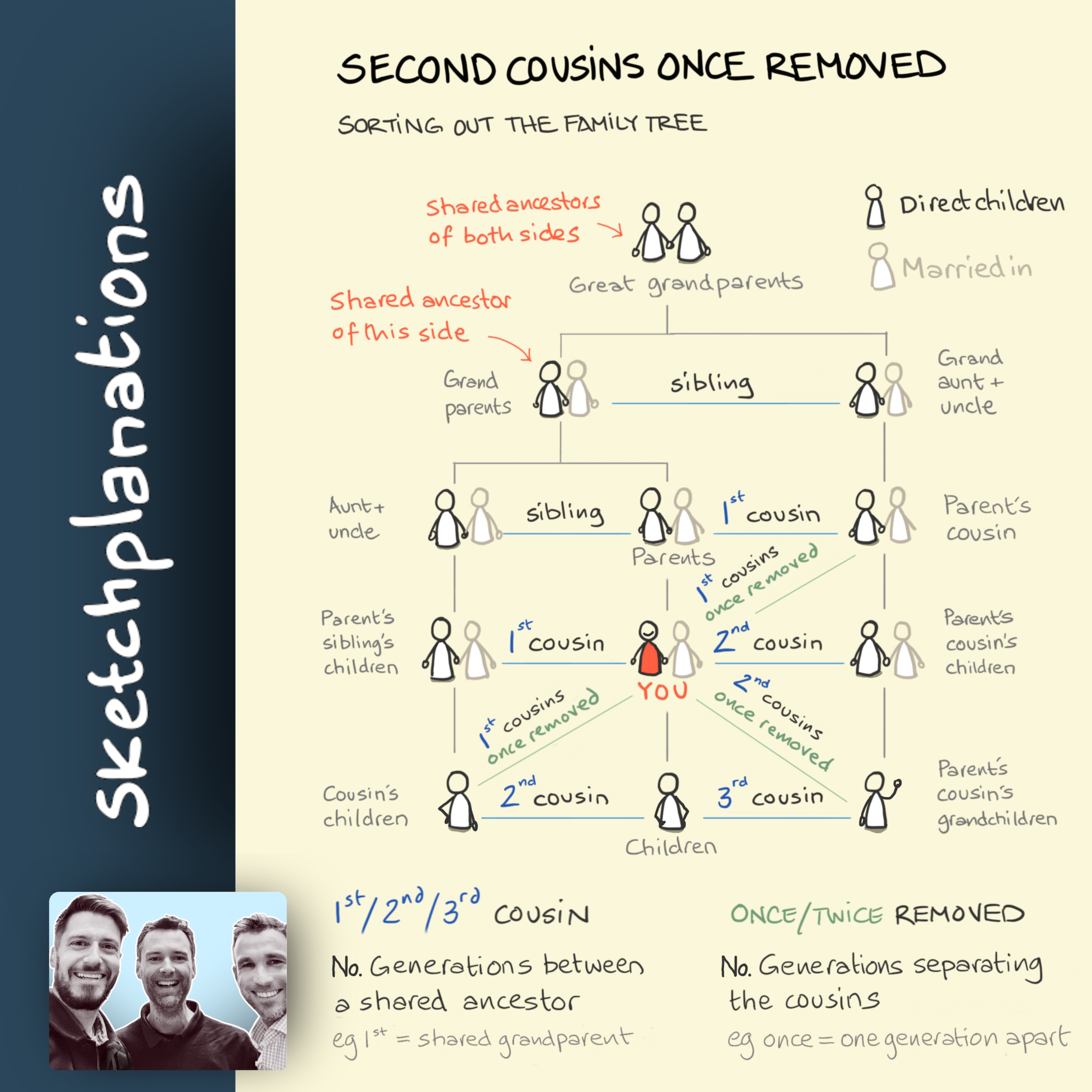 Family Tree Explainer 30.12.2025 28dkDo you know who your second cousins are or if you even have any? And what does "once removed" mean anyway?Tune in to this episode as we unravel the mysteries of family relations—which we figured would be particularly helpful at the festive time of year.We explore the subtleties of family trees, making our way to 'Second Cousins Once Removed'. We dig into the confusion around generational terms and the importance of knowing your extended family. We share a few family-related anecdotes and cultural differences, such as the Chinese family tree and Icelandic naming conventions. We strongly encourage you to follow along with the sketch at Sketchplanations.com to better understand your own family connections.Here are the Chinese family tree names mentioned.Episode Summary 00:00 Welcome to Sketchplanations00:47 Understanding Family Relations02:13 Exploring Second Cousins06:06 Generational Differences Explained11:48 Cultural Perspectives on Family Trees14:57 Famous Families and Their Connections15:08 The Mayflower Ancestor Story15:55 Family Trees and Their Complexity16:43 The Importance of Family Connections18:01 Tracing Family History21:07 Unique Family Names and Their Origins22:28 Surname Origins and Commonality25:58 Gender-Neutral Family Terms27:07 Concluding ThoughtsAll music on this podcast series is provided by the very talented Franc Cinelli Hosted on Acast. See acast.com/privacy for more information.
 -
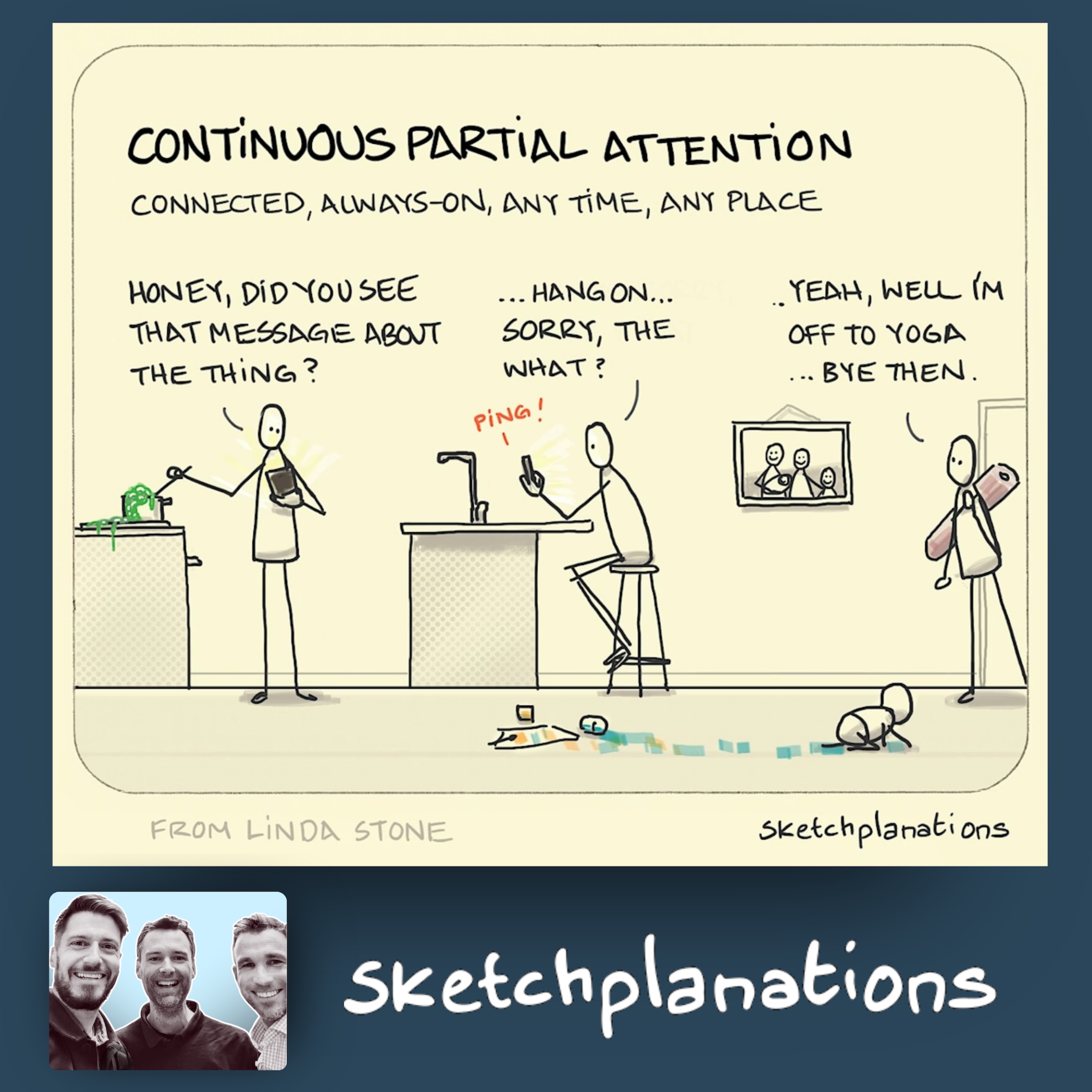 Continuous Partial Attention 16.12.2025 38dkCoined in the 1990s by Linda Stone, Continuous Partial Attention describes the state of being constantly connected; trying to do multiple things at once, which often leads to an ever-present, low-level form of stress. We explore how this phenomenon affects modern life, compare it to multitasking, and discuss both its positive and negative aspects. The podcast also highlights how technology has exacerbated this issue and considers potential solutions, such as mindfulness and turning off notifications, to better manage one's attention.Links to stuff we discussed:Dan KahnemanMind Over TechVideo of Woman who Walks into Fountain Whilst TextingThe Film: Her, starring Joaquin Phoenix.Other Sketches and podcast episodes referenced:Phubbing episode and sketchPhone Zombie sketchHegel's Dialectic: Thesis, Antithesis, Synthesis sketchYak Shaving episode and sketch5 Ways to Wellbeing episode and sketchEveryone's a Geek About Something episode and sketchHow to Instantly Feel Better episode and sketchPicking the Perfect Present episode and sketchBuy Jono's Book: Big Ideas, Little Pictures, for a loved one this Christmas - The Perfect Present and then some...Summary00:00 Introduction to Continuous Partial Attention01:31 Depicting Continuous Partial Attention in a Sketch04:25 Personal Experiences with Continuous Partial Attention05:54 The Impact of Technology on Attention08:49 Multitasking vs. Continuous Partial Attention11:15 The Challenge of Staying Focused17:05 The Role of Continuous Partial Attention in Different Professions20:38 The Dilemma of Turning Off Notifications21:15 Balancing Work and Family Life22:03 The Art of Multitasking22:59 The Pitfalls of Continuous Partial Attention23:49 Turning Cognition into Automation25:25 The Rise of Single Tasking27:54 The Productivity of Focused Work32:07 The Future of AI and Continuous Partial Attention34:20 Final Thoughts and RecommendationsAll music on this podcast is provided by the very talented Franc Cinelli. Hosted on Acast. See acast.com/privacy for more information.
 -
 Microlives & The Art of Uncertainty with Sir David Spiegelhalter 02.12.2025 53dkWhat's your life expectancy trade-off for enjoying a crispy bacon sandwich? 🥓Sir David Spiegelhalter is a celebrated Professor of Statistics at the University of Cambridge; widely accepted as one of the UK's foremost statisticians. He explains the concepts of 'micromorts' and 'microlives', which quantify risk and the impact of lifestyle choices on life expectancy. The discussion delves into acute vs. chronic risks, with practical examples such as the dangers of skydiving or how regular smoking affects longevity of life. The conversation also covers the application of statistics in medicine, the importance of randomisation in clinical trials, and the philosophical underpinnings of uncertainty. Additionally, David highlights the human capacity to judge risks, the pitfalls of intuition, and offers practical advice on dealing with uncertainty in everyday life. Lively anecdotes, insightful explanations, and practical takeaways make this episode a compelling listen for anyone interested in the intersection of statistics, risk, and daily decision-making.David's latest book, The Art of Uncertainty is available in all good bookshops and online.Here are some useful links to further explore some topics raised:The work of Ron Howard at Stanford UniversityJono's sketch on Word SpectrumsDavid's many other books - including Sex by NumbersPoisson Distribution explainedDavid tells the tale of Persi Diaconis - the Mathemagician.Episode Summary:00:00 Introduction, David's Background & Achievements01:43 The Wipeout Experience03:13 Understanding Micro-Morts04:27 Acute vs. Chronic Risks05:29 Micro-Morts in Everyday Activities12:05 Introduction to Micro-Lives18:03 Medical Applications of Data and Statistics21:27 The Role of Uncertainty in Life27:52 Building Resilience Over Robustness29:18 Embracing Uncertainty in Life33:35 Misuse of Statistics in Media and Politics40:30 The Gamblers Fallacy and Intuition42:29 The Uniqueness of Card Shuffles45:43 Common Misconceptions About Probability48:02 Practical Tips for Dealing with Uncertainty51:33 Final Thoughts and ReflectionsAll music is provided by Franc Cinelli. Hosted on Acast. See acast.com/privacy for more information.
 -
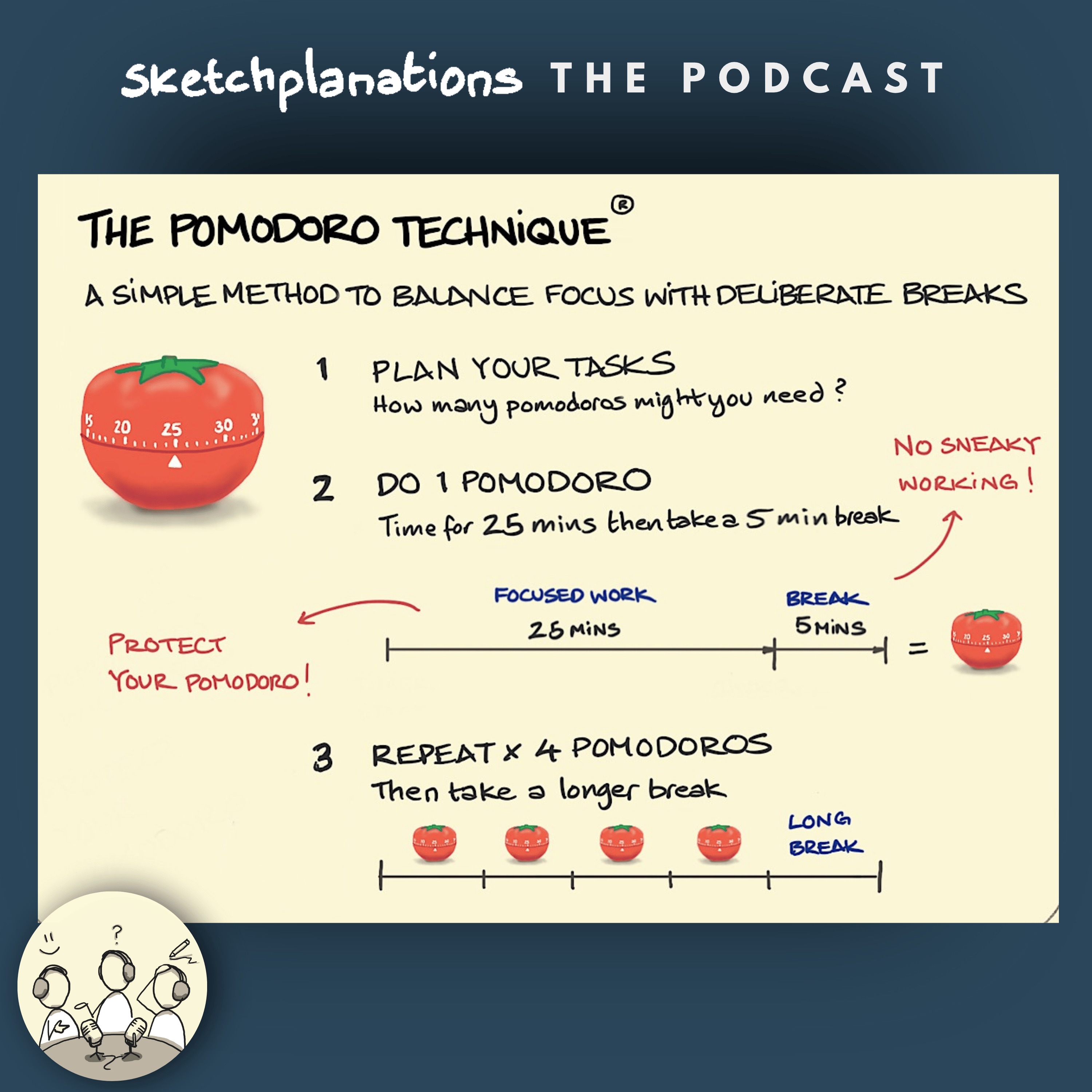 The Pomodoro Technique 18.11.2025 37dkThis genius time management hack was conceived by Francesco Cirillo. The technique involves working for 25 minutes followed by a mandatory 5-minute break, repeating this cycle three to four times before taking a longer break. We share our personal attempts at using the method, explore the psychology behind productive work cycles, the importance of taking breaks and reflect on its effectiveness in both office and home environments. We also discuss the broader context of productivity obsession and share insights from using related tools eg. online "focus buddies". The session concludes with a follow-up on how the Pomodoro Technique has worked for them a week after recording the episode, reenforcing a lot of the theory we originally set out. Could this be our favourite procrastination buster yet!?!External linksIn the episode we reference a number of items you can find out more on here: Previous podcast episodes came up a lot (procrastination is a recurring theme for us): How to Instantly Feel Better; Yak Shaving; Goldilocks Tasks & The Fresh Start EffectRemarkably, there's currently no sketch for it, but Jono talks about The Red Queen Effect or Hypothesis - the concept of having to run to stay still.The Bear Focus Timer (used by Jono and now Tom as well). Available on Apple Store Examples of Focus Buddy or Accountability Partner websites include Focus Mate and Flow Club.Episode Summary00:00 Introduction to Sketchplanations Podcast00:29 Exploring the Pomodoro Technique01:03 Origins and Basics of the Pomodoro Technique02:57 Implementing the Pomodoro Technique in the Office07:23 Challenges and Adaptations of the Pomodoro Technique17:10 Alternative Productivity Methods18:53 Accountability and Shame in Productivity19:40 Origins of the Pomodoro Technique20:17 Applying Pomodoro in Different Environments21:32 Psychological Benefits of Time Blocking22:38 Challenges and Adaptations in the Office23:01 Personal Admin and Procrastination23:22 Flow and Creative Tasks26:16 Post-pod Findings on Pomodoro Technique Usage28:44 Final Thoughts and OutroAll music on this podcast series is kindly provided by the very talented Franc Cinelli. Hosted on Acast. See acast.com/privacy for more information.
 -
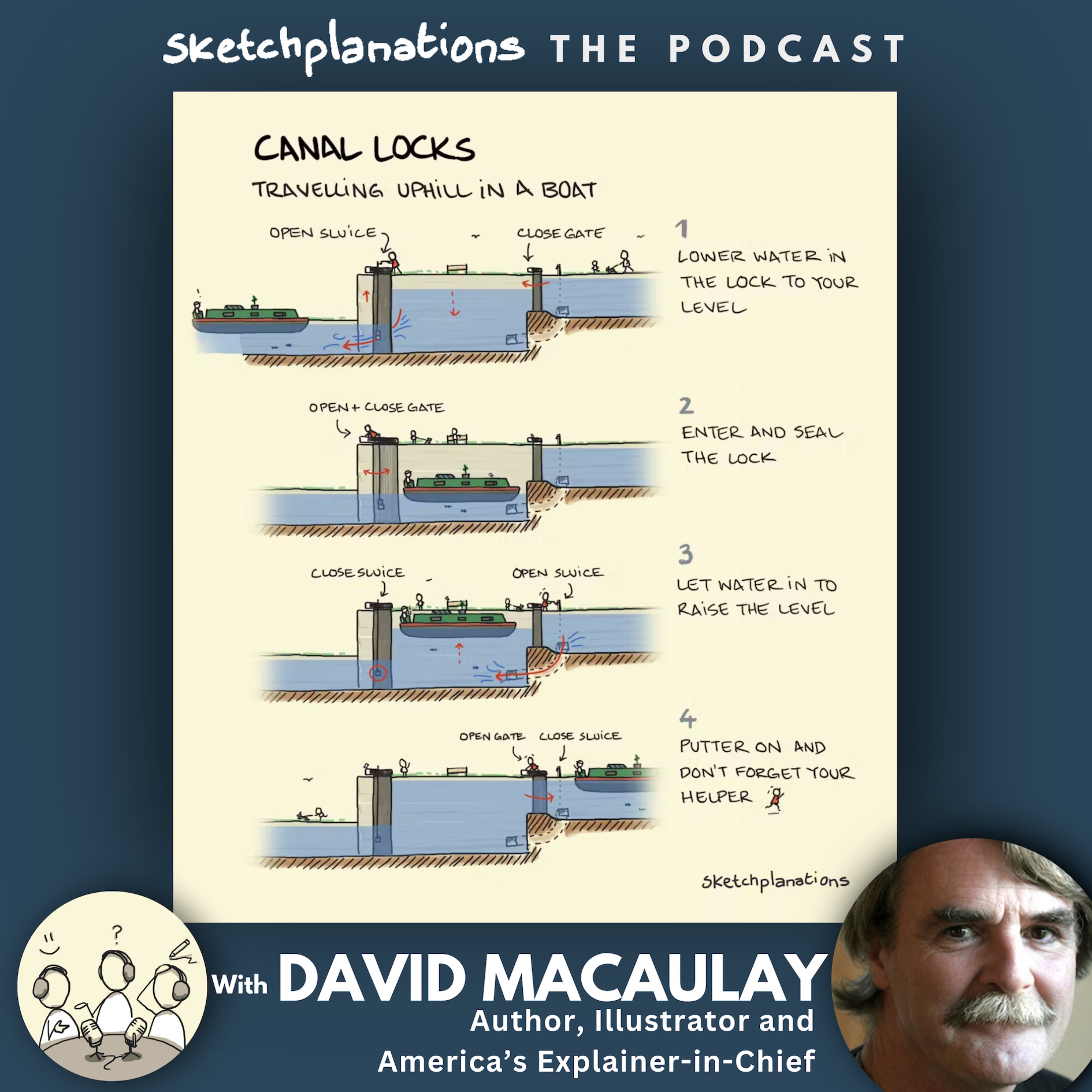 Canal Locks with David Macauley 04.11.2025 41dkIn this episode, Jono meets one of his heroes, as we engage in a conversation with acclaimed author, illustrator and explainer, David Macaulay.We talk about David's journey from architecture to creating educational illustrations that make complex concepts understandable and engaging - and the Canal Lock is a great example of this from Jono's collection.We discuss the significance of sketching for understanding and teaching intricate ideas, and reflect on some of David's famous works, including his book, 'The Way Things Work.'David shares insights into his creative process, the importance of curiosity, and how integrating humour and playfulness in his illustrations can enhance learning.This conversation would not be complete without questioning David about his famous woolly mammoths - used in his illustrations to help explain machines, mechanics, physics and science. LinksSee here for more information about David as well as his bibliography.Jono specifically references David's maths book, Mammoth Maths, when comparing his own sketch on "Parts of a Circle".When addressing humour in Architecture, David talks about his book "Great Moments in Architecture".Summary00:00 Welcome to Sketchplanations - introducing David Macaulay01:30 David's Journey into Explanations03:42 The Way Things Work04:35 The Joy of Learning and Teaching04:47 Collaborating on The Way Things Work09:54 Exploring Canal Locks15:24 The Art of Sketching and Curiosity20:05 The Importance of Sketching20:34 Humour in Learning25:07 The Origin of the Woolly Mammoth in David’s drawings26:37 Balancing Humour and Information30:07 Encouraging Sketching in Education33:30 Everyday Wonders and Final Thoughts Hosted on Acast. See acast.com/privacy for more information.
 -
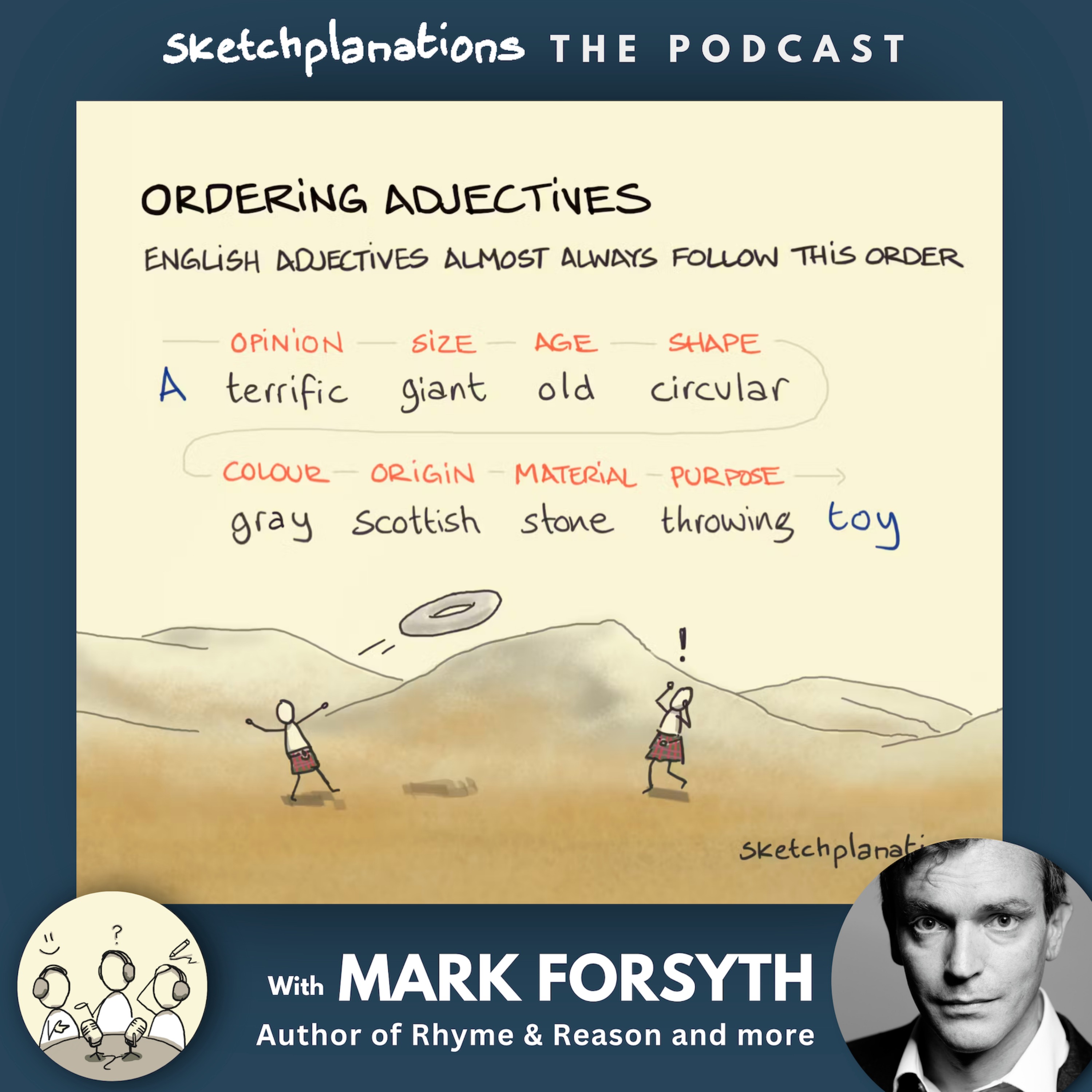 Ordering Adjectives with Author Mark Forsyth 21.10.2025 58dkWhen describing something with numerous adjectives (eg. the big brown dog, the heavy square steel door) there's a natural order we all instinctively follow as english speakers. I don't remember ever being taught it, nor would I be able to explain it to you, but my ear can definitely tell if someone gets it wrong!English adjectives follow a specific order. Who Knew?!?Well, there's one person for sure:What our special guest on this episode, award-winning author, journalist, and etymologist, Mark Forsyth, doesn't know about the English language, simply isn't worth knowing.In our conversation, Mark breaks down the correct traditional ordering of adjectives. And Mark's passion for the English language becomes clear as he walks us through other nuances of English, such as Ablaut Reduplication (why it's Zig Zag and Splish-Splash rather than Zag-Zig or Splash-Splish), Chiasmus (inverting phrases in a speech eg. “Ask not what your country can do for you — ask what you can do for your country.” — John F. Kennedy, Inaugural Address (1961)) and many more.Additionally, in celebration of Mark's latest book; "Rhyme and Reason : A short history of Poetry and People (for people who don’t usually read poetry)" we talk about the history of poetry and its impact on readers from medieval times to the present. We learn how poetry was once widely shared and enjoyed socially (a bit like sharing memes on social media today) and how English has natural cadences and rhythm to it, that we all make use of every day - again, without having a clue that we're doing it. And we also learn why most of us have been thinking about poetry all wrong ever since school.In the episode, we also reference Mark's other books such as The Etymologist and The Elements of Eloquence, which can all be found here.And you can follow Mark's musings and love of language on his blog as The Inky Fool, on Twitter, and on Instagram.Episode Summary00:00 Welcome & Introduction to Mark Forsyth: Wordsmith Extraordinaire01:05 Mark Forsyth's Journey with the English Language01:44 The Fascinating World of Words and Their Origins02:27 Mark Forsyth's Books and Their Unique Insights06:32 The Popularity of Poetry Through the Ages11:06 The Decline of Poetry and Rise of Pop Lyrics12:48 Exploring English Syntax and Adjective Order15:03 The Intricacies of English Grammar21:38 Fun with Language: Reduplication and Compounds27:38 Rhyme and Reason: Poetry in Society29:27 The Unsung Heroes of Songwriting30:42 The Evolution of Poetry's Popularity41:33 The Rhythms of English Language50:54 The Charm of Limericks54:49 The Joy of Reading Poetry Aloud56:45 Closing Thoughts and FarewellAll music on this podcast series is provided by the wonderfully talented Franc Cinelli. Hosted on Acast. See acast.com/privacy for more information.
 -
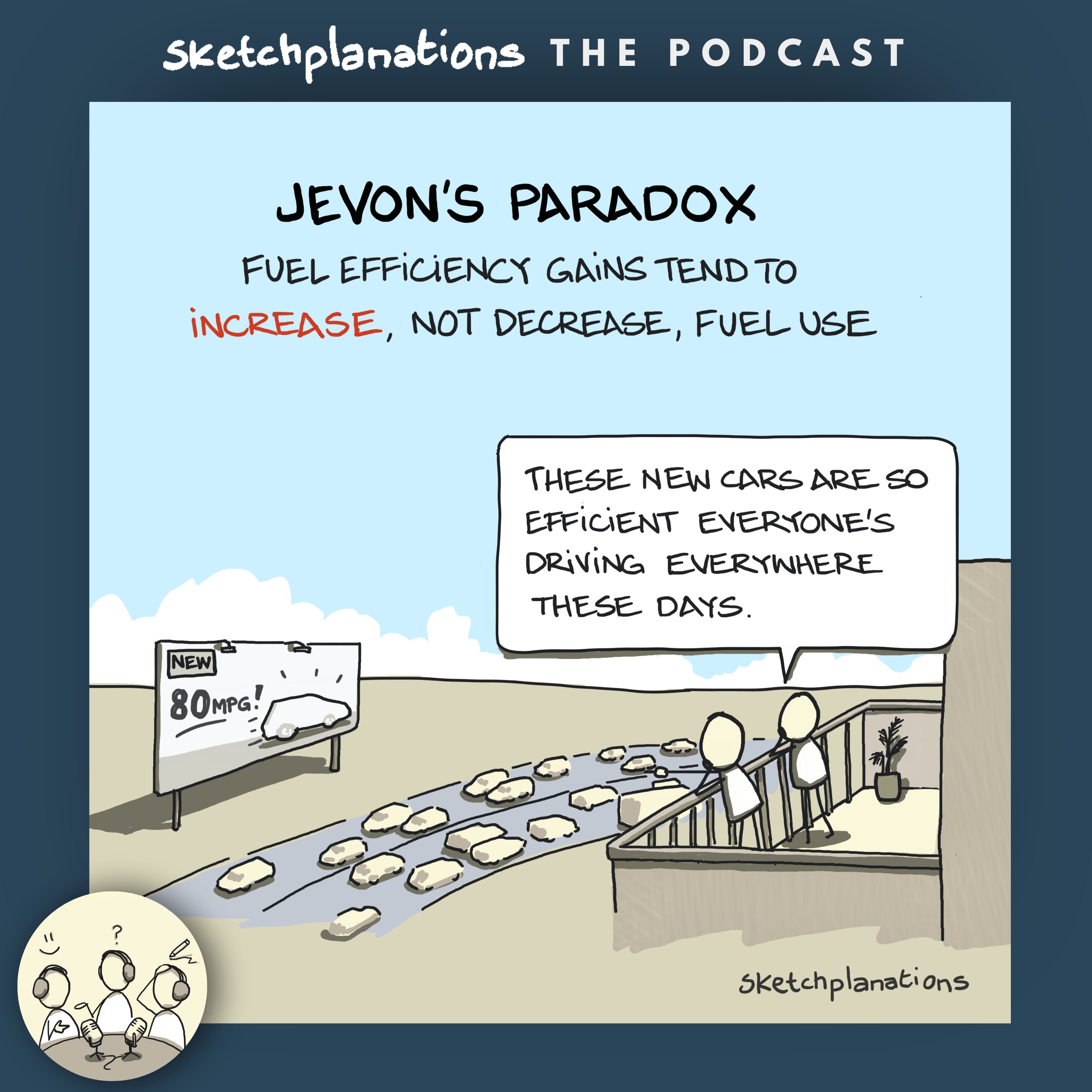 Jevon's Paradox 09.10.2025 30dkThis time we discuss Jevons' Paradox, the counterintuitive concept that improvements in fuel efficiency can lead to increased overall fuel use. We explore the origin of this idea, dating back to 1865 by British economist William Stanley Jevons, and discuss its relevance today in areas such as car fuel efficiency, advances in battery technology, and even the proliferation of LED lighting in homes. Inevitably, the impact of emerging technologies like AI also arise. We also talk about the broader implications of Jevons' Paradox in everyday life and business, and how it can be managed through policies and smart design.Quick LinksSome links are included below to certain topics we reference in the chat:Other Sketchplanations referenced include: The Generalised Peter Principle, The Peter Principle, The Laws of ExpansionYou can also listen to our previous podcast on The Peter Principle.More Work For Mother book by Ruth CowanSummary00:00 Introduction to Sketchplanations Podcast00:33 Exploring Jevons Paradox01:11 Historical Context of Jevons Paradox02:37 Modern Examples of Jevons Paradox05:14 Personal Anecdotes and Parallels10:12 AI and Future Implications15:29 Energy Demands of AI and Nuclear Facilities15:51 The Evolution of Spreadsheets and Work Efficiency17:07 Jevons Paradox and Environmental Concerns17:29 Advancements in Battery and Water-Saving Technologies19:33 The Impact of Video Compression on the Internet21:47 LED Lights and Household Energy Consumption24:27 Government Policies and Behavioral Incentives26:10 Reflections on Jevons Paradox and Human Nature28:26 William Stanley Jevons' Insights and Predictions30:06 Conclusion and FarewellAll music on this podcast series is provided by the very talented Franc Cinelli. Hosted on Acast. See acast.com/privacy for more information.
 -
 Words of Wonder: Apricity - with Grant Snider 25.09.2025 41dkDo you like using interesting words in your conversations? We do. And there's one that's a tip top favourite...You're guaranteed* to learn loads of interesting words from this episode.Special guest Grant Snider - author, illustrator, poet (and orthodontist) talks about the illustration of interesting words, particularly obscure, outdated or esoteric ones. We kick off with a word both Jono and Grant have illustrated: 'apricity,' which means the warmth of the sun in winter and is a big favourite of ours - now that we know it. Grant shares his fascination with words and his 'Words of Wonder' series, where he illustrates intriguing words from his readings. We touch on the emotional connection words can create through compelling illustrations and delve into the creative processes behind these illustrations as well as the influence of childhood comics like Calvin and Hobbes.Links for further investigationApricity sketches: Jono's Sketchplanation & Grant's Words of WonderSome other of Jono's word-related Sketchplanations we reference are: Snerdle & GreeblePrevious podcast episodes we bring up include: Schadenfreude and we also talk about Apophenia in the episode on Crossmodal PerceptionSusie Dent's Word of the Day thread on X.Jono mentions the fun he had reading Etymologicon by Mark ForsythGrant's latest book Thinking About Thinking is available now. Episode Summary00:00 Introduction and Grant Snider's Background02:18 Exploring the Word 'Apricity'04:34 Grant's Words of Wonder Series07:24 The Joy of Learning New Words11:24 Favourite Words and Their Illustrations20:28 Exploring Obscure Words and Their Origins21:16 The Fascinating Concept of 'Greeble'22:50 The Joy of Discovering New Words23:52 Sketching Words and Their Meanings28:22 The Beauty of Children's Language Development30:35 Grant's New Book: Thinking About Thinking33:46 The Influence of Calvin and Hobbes37:04 Grant's Unique Use of Colour in Comics39:26 Final Thoughts and Upcoming Projects*We make no actual guarantees.All music on this podcast series is provided by the highly talented Franc Cinelli Hosted on Acast. See acast.com/privacy for more information.
 -
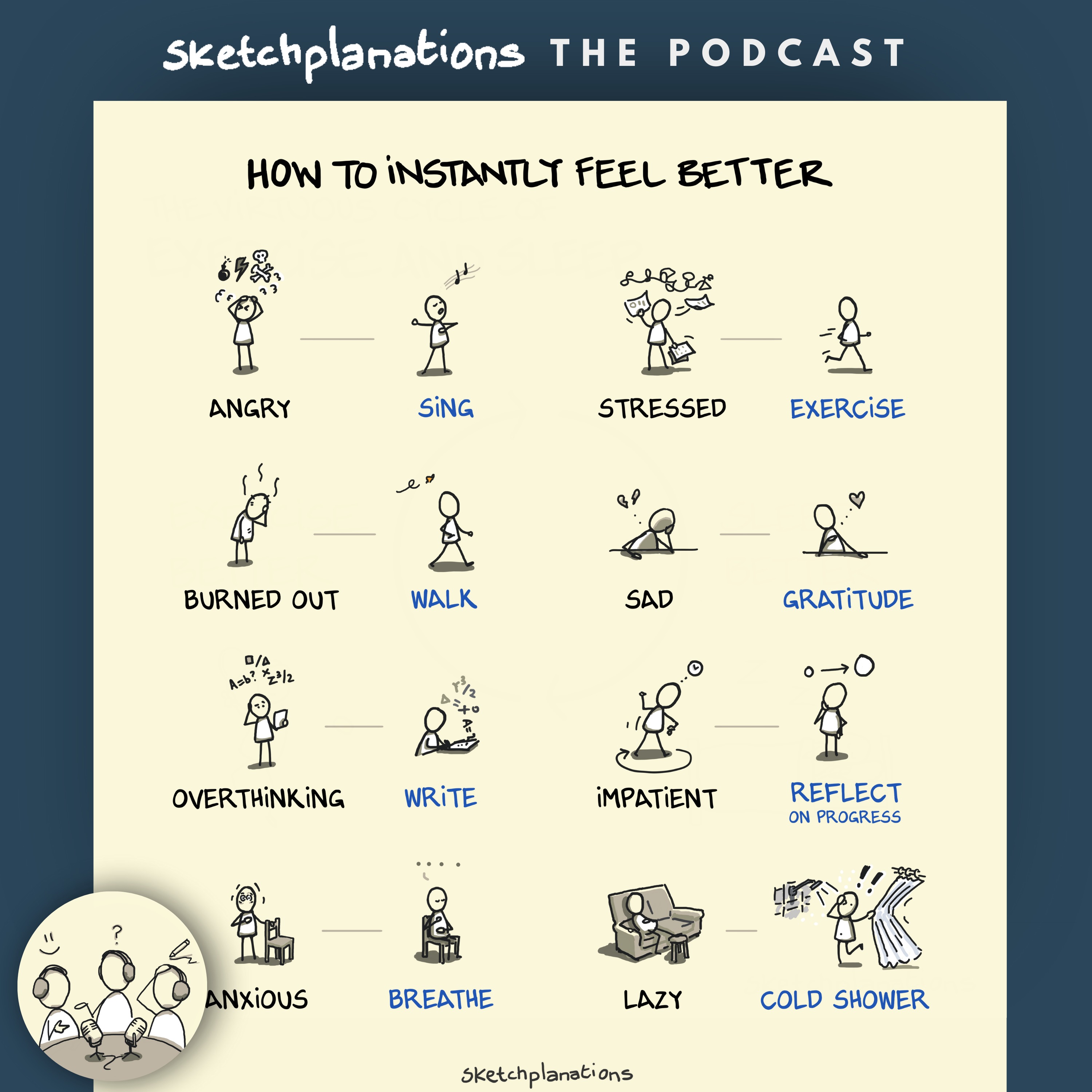 How to Instantly Feel Better 11.09.2025 38dkAs we return from our summer break we discuss various ways to instantly feel better - timely perhaps for the Big Back to Work / School / Normality of September. We explore eight emotions—anger, burnout, overthinking, anxiety, stress, sadness, impatience, and laziness—and suggest instant proactive remedies to each. We highly encourage you to try these out whenever you're feeling any of the emotions discussed. Let us know if they work. Here are links to a few items we refer to in the chat:We reference a couple of previous podcast episodes: The Awkwardness Vortex, 5 Ways to WellbeingIn reference to when you're feeling anxious you can try Box Breathing. If all else fails, with any of these emotions you can instantly make yourself feel better by Walking in Nature. Gorefest: The Dutch (not Belgian as wrongly I said in the podcast) Death Metal band from the 90s who to the casual listener, their singing might sound like screaming. The Artist's Way by Julia Cameron. in reference to writing your "morning pages". Episode Summary00:00 Welcome Back to Sketchplanations00:53 Instant Ways to Feel Better03:16 The Power of Singing to Dispel Anger08:19 Walking Off Burnout11:46 Writing to Stop Overthinking16:20 Breathing Techniques for Anxiety20:49 The Power of Exercise for Stress Relief25:22 Gratitude as a Remedy for Sadness28:18 Reflecting on Progress to Combat Impatience30:56 Cold Showers to Overcome Laziness33:50 Final Thoughts and TakeawaysAll music on this podcast series is provided by the highly talented Franc Cinelli Hosted on Acast. See acast.com/privacy for more information.
Benzer podcastler


Şurada popüler
Bu podcast şu ülkelerin podcast listelerinde de yer alıyor.
