
UAV News Talk – Drone News, eVTOLs, UAS Policy & Air Mobility
Max Trescott | Aviation News Talk Network
0
UAV News Talk, formerly The UAV Digest, is your go-to source for drone, UAV, UAS, and eVTOL news. It covers the latest developments in drone regulations, pilot certification, emerging tech, advanced air mobility (AAM), and real-world use cases across industries. The podcast is aimed at drone pilots, developers, policy makers, and aviation enthusiasts, discussing both commercial and military applications.
Bölümler
-
 Thermal Drone Pet Rescue, Drone Business & Orlando Drone Show Crash 16.09.2026 51dkCan you build a real business around drones? Michael Parziale has done it in more ways than one.Michael, founder and team leader of the U.S.A.R. Drone Team, explains how thermal imaging has helped him locate more than 150 missing pets. We talk about how he conducts a nighttime search, identifies animals with thermal cameras, chooses altitudes and search patterns, and what owners pay for a professional drone search.But pet rescue is only part of Michael's operation. He's trained police drone pilots, worked with agricultural spraying drones, provided free career training for veterans, started a youth drone school, and is now investing heavily in drone light shows.That last topic leads directly into a major drone-safety story. The NTSB has released its final report on the 500-drone holiday show in Orlando where dozens of drones collided and fell from the sky and one struck a seven-year-old boy, seriously injuring him.We examine how an incorrect show center, a seven-degree heading error, inconsistent programming among the drones, geofence settings, and inadequate cross-checking combined to produce the accident—and the major safety changes implemented afterward. It's a look at both the opportunities and responsibilities that come with operating drones professionally.Max and David also discuss a Zipline Drone that came down under a parachute, and a Drone possession ban in Beijing.
 -
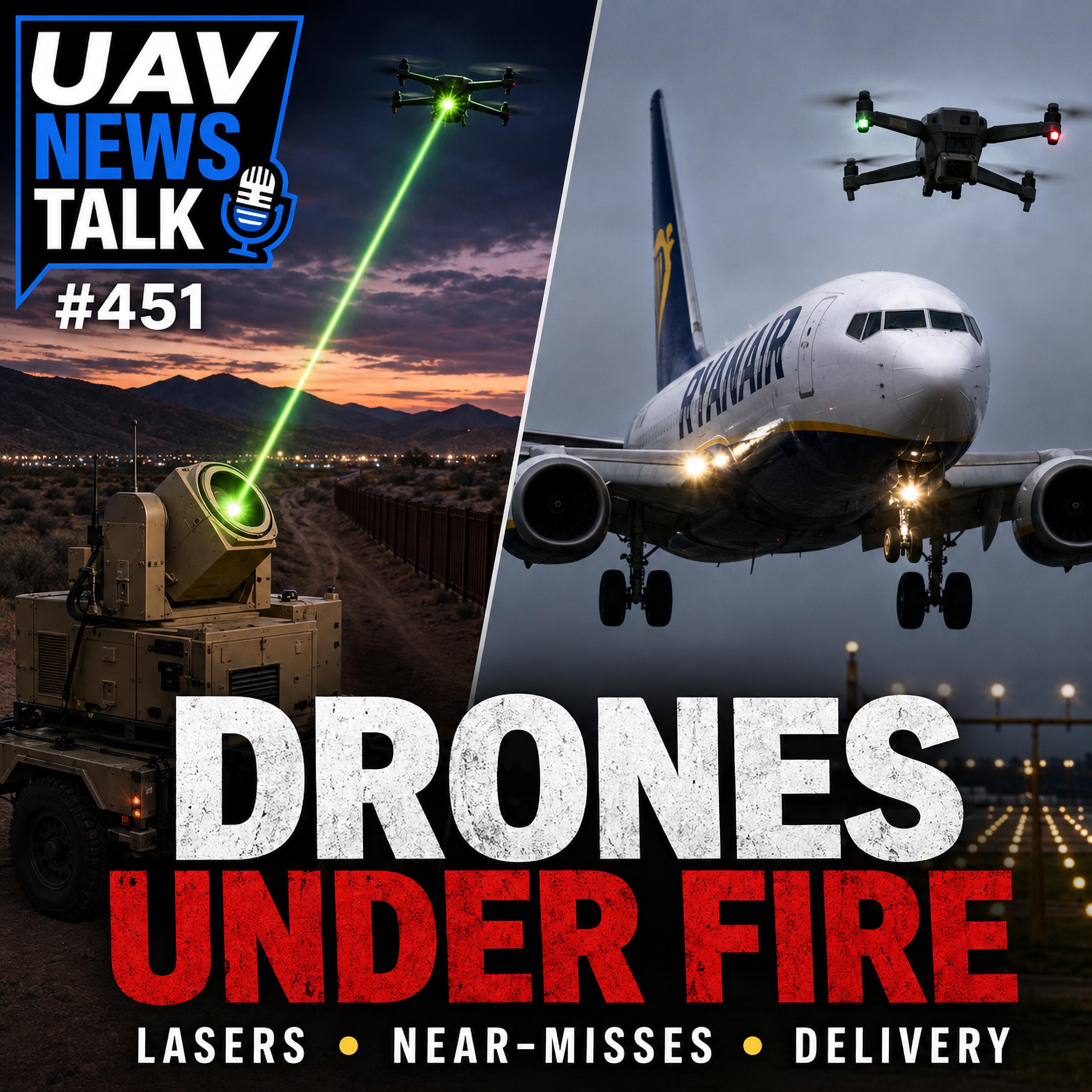 U.S. Laser Downs Cartel Drones, 737 Drone Near-Miss & Amazon Expands 09.09.2026 26dkThe U.S. military has used a high-energy laser to shoot down three drones allegedly operated by drug cartels along the southern border. Max Trescott and David Vanderhoof discuss what the drones may have been doing, the growing use of counter-UAS technology, and the risk of identifying the wrong target.Video of the Week: Shark Superhighway” Off a North Carolina BeachThen, a German military counter-drone exercise creates the very kind of aviation hazard it was intended to prevent. A small drone operating near Cologne/Bonn Airport passed only about 92 feet vertically and 30 feet horizontally from a landing Ryanair 737 after a breakdown in coordination between the military and air traffic control.Amazon is also moving quickly to expand Prime Air drone delivery, with new plans involving Tracy, California, and Richmond, Virginia. The hosts examine Amazon’s enormous MK30 drone and the economics and logistics of drone delivery.Other stories include SiFly raising $20 million to manufacture its record-setting Q12 quadcopter, DJI maintaining overwhelming dominance among construction-industry drone users, Wing evaluating Nvidia’s newest onboard AI hardware, and a new autonomous-aircraft vertiport at Hollister Municipal Airport.Finally, Max and David examine what could become a major eVTOL bottleneck: getting enough electrical power to vertiports to recharge multiple aircraft during peak operations.
 -
 Drone Delivery Explodes: Amazon Targets 500 Locations as New Drone Fees Spread 01.09.2026 39dkDrone delivery may finally be moving from an interesting experiment to a mainstream business. Amazon is preparing a major expansion into 500 new locations, while Alphabet’s Wing plans hundreds of delivery locations of its own and Walmart is already delivering by drone from dozens of stores. Max Trescott and David Vanderhoof discuss why 2027 could become a breakout year for drone delivery—and why suburban neighborhoods are likely to see it long before dense urban areas.Video of the Week: Epic Amazon Drone Delivery FailBut as drone operations expand, states are starting to see another opportunity: fees. Washington State has increased its commercial drone registration fee and added an aircraft excise tax, bringing the annual cost to roughly $150 per drone. Max examines which other states already impose similar requirements and why operators with large fleets should pay attention.Also in this episode: Florida develops a massive eVTOL testing and manufacturing hub at SunTrax; Archer plans a downtown Los Angeles vertiport; CoolFly proposes a standing single-person eVTOL; Motorola Solutions spends $1.5 billion on counter-drone company Defend Solutions; the Pentagon tests directed-energy counter-UAS systems; drones seed clouds at 15,000 feet; and rescuers use a drone to locate a dog stranded on a Tennessee cliff.
 -
 Uber & Zipline Target 1 Million Drone Deliveries a Day + DARPA’s Extreme-Lift Drone Challenge 18.08.2026 39dkUber is making its biggest drone-delivery bet yet, partnering with Zipline as it works toward an extraordinary goal: one million drone deliveries per day. Max Trescott and David Vanderhoof trace Uber Eats' long and sometimes surprising history with drones and discuss why Uber's latest strategy may be to provide the customers while companies such as Zipline, Flytrex and Manna provide the aircraft.Video of the week: Sports camera drone discovers that hurdles really are obstaclesThen it's on to DARPA's Lift Challenge, where competitors attempted to build aircraft capable of carrying four times their own weight. AVIDrone won with a 3.84-to-1 payload-to-weight ratio, while an unusual DefendTex design demonstrated an astonishing 9.63-to-1 ratio but failed to complete a scored run.Max and David also examine new U.S. tariffs on imported drones, a Florida program delivering whole blood to emergency scenes by drone, and a Swedish AED drone that arrived before the ambulance and helped save a man's life.In eVTOL news, Joby makes a $500 million defense acquisition, Eve achieves an important transition-flight milestone, a Pivotal BlackFly carries a paramedic to real 911 calls, and Florida redirects EV-charging funds toward an aerial-highway network.
 -
 Archer Aviation Goes Beyond eVTOL: Boeing, Wisk, Insitu & SkyGrid Deep Dive 10.08.2026 34dkArcher Aviation has agreed to acquire Boeing’s Wisk Aero, Insitu and SkyGrid businesses in a transaction that could transform Archer from primarily an eVTOL startup into a diversified drone, defense, autonomy and aviation-AI company.In this special single-topic episode, Max Trescott and David Vanderhoof examine why Insitu may actually be the jewel of the deal. The longtime military UAS manufacturer has fielded more than 3,500 aircraft in roughly 35 countries, accumulated approximately 1.6 million operational flight hours and, according to Archer, generates more than $200 million in annual revenue while operating profitably.That revenue is particularly noteworthy as Archer continues spending heavily while its Midnight eVTOL moves toward certification. Max and David discuss Archer’s latest financial results, its remarkable ability to raise capital, and Boeing’s decision to take a significant equity position rather than simply walk away from these businesses.They also explore the unanswered future of Wisk’s autonomous Gen 6 eVTOL, Archer’s ZEE aviation AI effort, SkyGrid’s airspace-management technology, Archer Defense and the possibility that all these pieces could eventually form an integrated autonomy ecosystem.Finally, they consider integration risks, industry consolidation and one unavoidable question for Archer’s biggest eVTOL rival: Joby, what’s your next move?
 -
 DoorDash Air Takes Flight as Motorola Enters Police Drone Market 03.08.2026 38dkMax reports from EAA AirVenture’s new Vertical Lift Center, where he gets an up-close look at Joby’s surprisingly large air taxi, the hybrid-electric DTA JP1, SkyFly’s winged personal eVTOL, and Zipline’s steerable delivery pod. His biggest takeaway: advanced air mobility is no longer merely theoretical, and hybrid propulsion is emerging as an important industry trend.Video of the Week: NYPD drone captures teen subway surfers on videoIn the news, two enormous established companies make potentially transformative moves into drones. DoorDash has received an FAA Part 135 certificate and is developing its own delivery aircraft through DoorDash Labs. Max predicts that the company’s restaurant relationships, customer base, logistics network, and increasing vertical integration could eventually make it a dominant force in U.S. drone delivery. Meanwhile, Motorola is using its decades-long relationships with police and fire agencies to enter the Drone as First Responder market.The episode also examines Archer and Anduril’s military Thunder aircraft, BETA Technologies’ hybrid MV250, Joby’s expanded Virgin Atlantic partnership, and Electra’s planned Ohio manufacturing facility. Federal actions may further accelerate drone delivery and domestic manufacturing. Finally, James City County, Virginia, begins a trial using drones to deliver automated external defibrillators, demonstrating how unmanned aircraft could reach cardiac-arrest patients before conventional emergency responders arrive when every second truly matters.Buy an AED (automated external defibrillator) for your home.
 -
 AirVenture 2026 Vertical Lift Center: Joby, Beta, Wing, Zipline and More 20.07.2026 40dkEAA AirVenture 2026’s new Vertical Lift Center will feature Joby Aviation, Beta Technologies, Wing, Zipline, and other drone and eVTOL innovators. Max Trescott and David Vanderhoof preview the aircraft, demonstrations, and companies bringing advanced air mobility, drone delivery, personal flight, public-safety systems, and agricultural UAS technology to Oshkosh. Beta is scheduled to fly, while Wing, Jetson ONE, and agricultural-drone operators are also expected to demonstrate their aircraft.The Video of the Week examines a dramatic drone wire strike after a pilot flies beneath a bridge and encounters nearly invisible wires on the far side. Max and David explain why wires remain a serious hazard for drone, helicopter, and low-flying aircraft pilots.They then discuss a security failure that exposed San Francisco Police Department drone video through a publicly accessible link. The conversation covers privacy, data protection, Skydio’s approval for one operator to supervise four drones, and Minneapolis City Council’s rejection of a free drone-as-first-responder trial.Another story features an experimental drone that becomes difficult to see by spinning 25 times per second. Finally, Max and David consider whether one serious eVTOL accident could damage public confidence, restrict operations near major airports, and reshape the future of electric air taxis.
 -
 FAA BVLOS Right-of-Way, DJI Rescue Drones, and eVTOL Certification Delays 16.07.2026 37dkThe FAA’s proposed framework for routine beyond-visual-line-of-sight drone operations moves closer to publication, raising a controversial question: Could some BVLOS drones receive presumptive right-of-way over crewed aircraft? Max Trescott and David Vanderhoof examine the proposed Part 108 rules, UAS traffic management, detect-and-avoid technology, and the risks posed by low-flying agricultural aircraft and helicopters that may not be electronically visible.DJI appears throughout the episode. For the Video of the Week: In China, a heavy-lift DJI agricultural drone rescues two people trapped on top of a nearly submerged tanker truck during severe flooding. DJI also tests its winged EV50 electric aircraft near Mount Everest and introduces a parachute system, the Matrice 400, that shuts down the rotors before lowering the drone under canopy.In eVTOL and advanced-air-mobility news, Electra receives an FAA Part 23 certification basis for the nine-passenger EL9 ultra-short-takeoff aircraft. Vertical Aerospace, however, postpones anticipated certification of its Valo eVTOL from 2028 to 2029.Additional stories include Zipline prescription deliveries for Cleveland Clinic, an LAPD helicopter collision with a drone, Australian shark-patrol drones, FAA approval for drone-assisted avalanche control, and DJI FlyCart operations carrying supplies and removing more than 20,000 pounds of waste from Mount Everest.
 -
 Joby Toyota eVTOL Deal, Archer Salinas Factory, Pentagon Drone Czar & Disaster Response Drones 08.07.2026 34dkIn episode 444 of UAV News Talk, Max Trescott and David Vanderhoof announce that the show is returning to a weekly schedule, then dive into a packed week of drone and eVTOL news. Video of the Week: Max taxiing by the Archer Midnight during testing at Salinas, CA. They begin with how aerial robotics supported Venezuela after devastating earthquakes, including bridge inspections, thermal imaging for search and rescue, medical supply delivery, communications relay, LIDAR scanning, gas-leak detection, and traffic management.They then discuss the Pentagon’s move to appoint a drone czar to coordinate drone programs across the military services, followed by the UK’s major new counter-UAS investment to protect British bases after drone surveillance incidents linked to Russian activity.On the eVTOL side, Max covers Archer Aviation’s new Salinas manufacturing and test hub, plus a proposed four-airport California test corridor linking Salinas, Marina, Hollister, and Watsonville. David highlights Beta Technologies’ electric aircraft demonstration work in Hawaii with Surf Air Mobility and Hawaiian Airlines, and the two discuss Joby and Toyota’s new manufacturing joint venture.The episode wraps with Sora Aviation’s subscale 30-seat eVTOL demonstrator and a fun final story: drones dropping one million baby oysters in Galveston Bay.
 -
 Drone Delivery, Flock Drones, eVTOL Forecasts, World Cup Drone Busts & Flying Into a Tornado 02.07.2026 36dkMax Trescott and David Vanderhoof open episode 443 with their Video of the Week. It's a remarkable Sacramento Sheriff’s Office video showing a drone carrying a magnet into a cluttered house to remove a knife from the hand of an apparently unconscious armed suspect. They discuss the flying challenges of carrying a suspended load indoors and whether the magnet could affect the drone.The episode then turns to eVTOLs, where a new Valour Consultancy forecast projects a much smaller future fleet than earlier air taxi predictions. Max compares the hype to the very light jet boom that never fully materialized, while David points out the continuing problems of infrastructure, regulation, and public acceptance. They also discuss growing eVTOL litigation involving Joby, Archer, Vertical Aerospace, and Wisk, and compare it to historic patent fights in early aviation and other emerging industries.Drone stories include the FAA breaking ground on an advanced air mobility research facility in Oklahoma City, hundreds of unauthorized drone flights around World Cup-related TFRs, and NASA’s drone transport test using a non-viable human kidney. Both encourage listeners to register now to become an organ donors at RegisterMe.org. They also discuss a drone flown into a tornado, Flock Safety adding drones to license plate camera systems, Irvine police using a drone to find a shoplifter, and Ohio’s first commercial drone-delivered deli lunch.
 -
 Can American Drone Technology Compete with DJI? HYFIX H1D, AI Drones, RTK GPS & U.S.-Made Chips 22.06.2026 37dkCan American drone technology compete with DJI? In this episode of UAV News Talk, Max Trescott and David Vanderhoof talk with Mike Horton, CEO and co-founder of HYFIX Spatial Intelligence, about U.S.-made drone chips, AI drones, RTK GPS, and the HYFIX H1D drone module.Mike explains that one of DJI’s biggest advantages is deep electronics integration. Many American drone manufacturers still build drones from separate components: flight controllers, companion computers, radios, IMUs, motor-control boards, GNSS receivers, and AI processors. That approach can work, but it adds weight, cost, complexity, power consumption, and time to market. Mike says DJI’s integrated drone technology helps explain why small, capable DJI drones are so difficult for U.S. companies to match.The conversation then turns to HYFIX’s H1 chip family, including the H1P positioning and flight-control module and the H1D, which Mike describes as a more complete drone module supporting long-range video, RTK precision positioning, dual-antenna GNSS heading, AI capability, PX4, ROS 2, and GPS-denied visual inertial odometry.They also discuss U.S. semiconductor manufacturing, drone-in-a-box systems, LEO satellite tracking, FCC rules for tiny Chinese toy drones, and how large drone shows use RTK corrections.
 -
 Drone Delivery Expands, Pentagon’s Drone Arsenal & Honda eVTOL – UAV News Talk 441 16.06.2026 37dkIn this episode of UAV News Talk, Max Trescott and David Vanderhoof cover a wide range of drone, UAS, counter-drone, and eVTOL stories. They begin with their video-of-the-week: an unusual drone-assisted police story from Louisiana, where officers used a drone to locate a fleeing suspect after he was bitten by an alligator in a swamp.The show then turns to Wing and Walmart, which are adding seven new drone delivery markets, including Philadelphia and the San Francisco Bay Area. Max and David discuss why dense urban areas and apartment deliveries may be harder than suburban drone delivery.They also look at the Pentagon’s reported $54 billion drone push, including interest in low-cost, disposable drones from former hobbyists and small companies. Motorola’s $1.5 billion counter-drone acquisition leads to a discussion of rogue drone threats around major events.Safety takes center stage with Shield AI’s V-BAT after two reported finger-injury incidents involving rotating blades. The episode also covers Vancouver police using Skydio drones linked to body cameras, Honda’s first full-scale eVTOL flight, Volocopter’s light-sport eVTOL plans, BETA’s CTOL strategy, and a feel-good Ukrainian drone rescue of a cat and four kittens.
 -
 DJI Drone Ban, World Cup No-Drone Zones, and Archer Joby eVTOL Air Taxi Plans 03.06.2026 32dkMax Trescott and David Vanderhoof cover a packed week of drone and eVTOL news, starting with Eve Air Mobility’s latest hover and low-speed flight testing. They discuss how Eve’s Embraer connection and fixed-lift-rotor design differ from Archer and Joby, and why eVTOL certification, infrastructure, and public acceptance may be harder than the aircraft technology itself.The episode also looks at Archer and Joby’s plans to begin commercial air taxi operations, including the challenge of moving from flight-test success to real-world passenger service. Max and David then shift to drones, including FAA no-drone zones for the FIFA World Cup, possible $100,000 fines, and New York City’s $6.5 million investment in drone mitigation equipment.They also discuss DJI’s independent security assessment, the potential impact of U.S. restrictions on public safety agencies and drone businesses, and the Department of Defense’s directed-energy counter-drone program using lasers and high-powered microwave systems.The episode wraps with two unusual drone stories: the Vivid Sydney drone show failure that sent dozens of drones into Darling Harbour, and a Reddit story about a drone returning with a swarm of bees.
 -
 Counter-Drone Security: Shahed Drones in Cuba, World Cup Defense & eVTOL Air Taxis 20.05.2026 32dkDavid Vanderhoof returns to UAV News Talk after a six-month medical hiatus, joining Max Trescott for a wide-ranging discussion of drones, counter-UAS challenges, and the future of eVTOL air taxis.Max and David begin with David’s kidney transplant story and his return to the American Helicopter Museum, then move into the Air Force’s planned retirement of the MQ-9 Reaper and the military’s shift toward cheaper, attritable drones. They discuss Shahed-style drones reportedly heading to Cuba, their potential range, and why that raises uncomfortable echoes of the Cuban Missile Crisis.The episode then turns to counter-drone security, including FBI preparations for the 2026 World Cup, the difficulty of protecting stadiums, and a drone report near the Dumbarton Bridge at 4,200 feet near San Francisco arrival traffic. Max and David explain why detecting a drone is often easier than safely stopping one.On the eVTOL side, they discuss Archer and Joby air taxi predictions, powered-lift pilot training, New York vertiport infrastructure, and the estimated $16.6 billion advanced air mobility infrastructure gap. The episode closes with a Florida couple accused of burning a neighbor’s DJI drone, proving once again that drone privacy disputes can get expensive fast.
 -
 Counter-UAS Drone Defense: Capturing Drones with LiDAR, Nets, and Parachutes 26.12.2025 35dkMax Trescott talks with David Hall, founder and CEO of Velodyne Space, about a new approach to counter-UAS defense that focuses on capturing drones using LiDAR, nets, and parachutes instead of destroying them.Hall begins by explaining LiDAR—Light Detection and Ranging—and how it measures distance by timing how long it takes for pulses of light to travel out and return. While LiDAR has existed for decades, Hall describes how his work during the DARPA Grand Challenge helped transform LiDAR from slow, single-beam mapping tools into spinning, multi-beam systems capable of real-time 3D perception. Those systems made it possible for autonomous vehicles to reliably understand their surroundings and plan motion in real time.Initially, Hall experimented with camera-based vision systems for self-driving vehicles, but he found they were easily confused by reflections, shadows, and visual artifacts. Writing software to compensate for every failure mode quickly became impractical. LiDAR offered a fundamentally different solution by providing direct distance measurements rather than inferred depth. By stacking dozens of laser beams vertically and rotating the entire sensor to achieve 360-degree coverage, Hall created a top-down, real-time view of the environment that proved autonomy was achievable.That experience—combining sensing, computation, and mechanical systems—eventually led Hall into the world of counter-UAS. Roughly a decade ago, he began exploring electromagnetic launch technology as an alternative to rockets for space launch. While studying high-power coil-based systems, Hall realized the same technology could be applied to a much more immediate problem: stopping drones.As drones have become more capable and more accessible, they’ve also become harder to defeat. Hall explains that many counter-UAS systems rely on electronic warfare techniques such as RF jamming, GNSS interference, or cyber takeover. These approaches can fail against autonomous drones or drones controlled via fiber-optic cables, which are increasingly common in conflict zones. Kinetic approaches, on the other hand, risk sending heavy debris falling into populated areas.Hall’s solution is a capture-based counter-UAS system. Instead of disabling a drone and letting it fall, the system fires a net that physically entangles the aircraft. Once captured, a parachute deploys, slowing the descent so the drone can fall safely even in populated environments. This makes the system particularly attractive for airports, cities, and other civilian infrastructure, where safety and liability are critical concerns.The system relies on a layered sensing approach. Cameras combined with AI identify drones and distinguish them from birds, while LiDAR provides precise range information needed to time the net deployment. Hall explains that LiDAR doesn’t need millimeter-level precision in this application; knowing distance within a few feet is sufficient to ensure the net opens at exactly the right moment. This combination allows the system to engage drones at distances approaching a thousand feet or more.A key advantage of the electromagnetic launcher is its rate of fire. Because the launcher can fire multiple low-cost nets per second, it can repeatedly engage a drone until one net successfully captures it. This capability also makes the system viable against drone swarms, which Hall believes represent one of the most serious emerging threats. Instead of relying on a single, high-value interceptor, the system overwhelms the problem with volume and repetition.Hall discusses the markets most likely to adopt capture-based counter-UAS systems, including airports—where a single drone sighting can shut down operations at enormous cost—prisons facing contraband delivery by drone, border security operations, and large public venues vulnerable to coordinated drone attacks. He also notes that visible counter-UAS defenses can act as a deterrent, discouraging drone operators from attempting incursions in the first place.The current system is vehicle-mounted, with a turret that deploys from the roof and draws power from an onboard electric battery system. Hall estimates that a fully equipped system could cost under one million dollars, with ongoing costs driven primarily by the expendable nets rather than the launcher itself.This episode explores why capturing drones with LiDAR, nets, and parachutes may fill a critical gap between electronic and kinetic counter-UAS systems—and why civilian-safe drone defense is becoming an urgent priority.Aviation News Talk Network ShowsAviation News Talk PodcastNTSB News Talk Podcast UAV News Talk Podcast Rotary Wing Show Podcast
 -
 Ukraine to Build Drones for the U.S., and Hobby Drone Bans Threaten STEM Education 29.10.2025 23dkMax Trescott and David Vanderhoof tackle an unexpected reversal in global drone production and a growing crisis for the hobbyist drone community. The show opens with a headline few would have predicted a decade ago: Ukraine negotiating to produce drones for the U.S. military.David explains that after years of battlefield innovation, Ukrainian engineers have become world leaders in low-cost first-person-view (FPV) and kamikaze drone design. The proposal, reported by The War Zone, envisions a five-year, $50 billion program to produce up to 10 million drones annually. These aren’t large Predator-style aircraft but lightweight, single-use drones capable of swarming and overwhelming defenses. Max notes that instead of replacing airplanes, these weapons replace artillery shells, changing the economics and tactics of warfare. Both hosts see the deal as a remarkable symbol of Ukraine’s technical maturity—and a reminder that the U.S. may now be learning from a nation at war rather than supplying it.The second story turns domestic and controversial. Several California cities used drones to catch illegal fireworks, leading to fines exceeding $300,000 for one homeowner whose show produced 300 explosions. Each was recorded and counted by a city-operated drone at $1,000 per violation. David raises constitutional questions about warrantless aerial surveillance, while Max points out the state’s wildfire risk that motivates strict enforcement. They compare cities such as Brea and Anaheim, which issued much smaller or even zero citations, and wonder how long it will take before courts define what’s legal when drones are used for neighborhood enforcement.Next, Max introduces a topic from his home state of Pennsylvania. A local hunter used a drone to locate a wounded deer, prompting fines that were later dismissed. A state senator now proposes changing wildlife regulations to permit drone searches for downed game. David, also from Pennsylvania, notes that under current law, using “artificial means” such as a drone for tracking is prohibited. Max jokes that a drone large enough to lift a hundred-pound deer out of the woods would certainly attract attention—but admits it could save hunters’ backs and even lives.The duo then contrasts Pennsylvania’s reform effort with Kentucky’s new ban on using drones for any hunting or fishing activity. Kentucky allows UAVs only for research, enforcement, or removing invasive carp. David observes that ranchers in Texas and Oklahoma already use drones to herd cattle, highlighting how every state is creating its own patchwork of rules. Max predicts that, just as right-on-red traffic laws eventually became standardized, federal guidance will probably harmonize drone-wildlife laws within a decade.Humor keeps the conversation lively—Max quips that the FAA’s jurisdiction over fishing would only apply to “flying fish.” But their closing story is no joke. They discuss an article warning that the American drone-hobby industry faces an accessibility crisis. With DJI products banned from federal use and dwindling retail stock, newcomers are finding it harder to buy affordable, high-quality drones. The lack of alternatives, combined with strict FAA rules, could shrink the pipeline of young pilots and engineers who might otherwise build future aerospace systems.Max reads data showing that high-school drone programs help students master UAV systems within hours once they enter military service. David adds that at his local helicopter museum, “Learn to Fly a Drone” classes remain their most popular STEM offering, teaching kids to handle quadcopters safely and even take one home. Both agree that restricting hobby drones doesn’t just affect weekend flyers—it threatens STEM education, workforce development, and national innovation.By episode’s end, David’s cold has nearly silenced him, but the discussion leaves listeners energized about the future of drones—from Ukraine’s mass-production lines to the next generation of American technologists. Max and David signs off and remind listeners why UAV News Talk remains the go-to podcast for drone technology, policy, and the people shaping the sky ahead.
 -
 Germany’s Drone Crackdown, Sikorsky’s Autonomous Black Hawk, and FAA Shutdown Fallout — UAV News Talk 436 25.10.2025 29dkEpisode 436 of UAV News Talk dives into global security, emerging automation, and the effects of Washington’s budget stalemate on the future of flight. Hosts Max Trescott and David Vanderhoof examine how nations, defense contractors, and innovators are redefining drone policy and autonomy at the same moment that the FAA’s own progress is slowed by the ongoing government shutdown.Germany authorizes police to counter rogue dronesThe show opens with the news that Germany has approved new counter-UAS authority allowing police to neutralize unmanned aircraft threatening airports and public safety. Max and David debate whether “shoot down” literally means gunfire or refers to electronic jamming and interceptor drones. Max notes that rogue drones have forced multiple Munich Airport closures—172 incidents in 2025 alone—leaving thousands of passengers stranded. David links the policy to Germany’s proximity to the Ukraine conflict, where drone incursions have heightened sensitivity across Europe. The hosts agree that while the measure feels drastic, persistent incursions make formal counter-drone rules inevitable.Drone-in-a-box systems chase shopliftersNext, the discussion turns to a futuristic retail-security concept: autonomous drones that pursue shoplifters once they leave a store. The hosts describe how “drone-in-a-box” platforms—similar to systems now deployed for school-campus emergencies—could track suspects until police arrive. Max imagines Apple Stores or high-end jewelers using such tools, while David questions cost and privacy implications. They joke about criminals splitting up so a single drone can follow only one thief. The takeaway: aerial surveillance is extending from military to consumer sectors, and regulation will soon need to catch up.Sikorsky’s fully autonomous U-Hawk - Video of the Week #1In one of the episode’s most popular segments, Sikorsky unveils the U-Hawk, an autonomous variant of the UH-60 Black Hawk helicopter. The cockpit has been removed entirely, replaced by cargo-bay clamshell doors for vehicles or supplies. David calls it “a major step beyond optionally piloted,” while Max compares it with Skyryse Aviation’s SkyOS, which retrofits existing aircraft for unmanned flight. Drawing from his own visit to Skyryse’s Southern California facility, Max explains how their flight-automation suite can be adapted to both helicopters and fixed-wing platforms. The hosts discuss potential missions—resupply, firefighting, and hazardous evacuations—and note that Boeing is exploring similar automation for the CH-47 Chinook. The ability to deploy heavy-lift helicopters without pilots, they say, could transform both logistics and combat operations.Mystery drones over New Jersey explainedA long-running puzzle also gets closure: the mysterious nighttime drone sightings over New Jersey that drew public complaints and congressional attention. New reports reveal that a private defense contractor conducted classified U.S. Army UAS demonstrations, accounting for many of the sightings. The hosts appreciate finally having an answer but point out that such secrecy fuels conspiracy theories and misidentifications. Still, it’s a reminder that rapid testing is happening just beyond public view.Archer Aviation’s big wins in Korea and L.A.From defense to commercial innovation, the conversation shifts to Archer Aviation’s new partnerships. In Korea, Archer and Korean Air will run urban-air-mobility (UAM) trials, marking one of Asia’s most advanced eVTOL collaborations. In the U.S., Archer becomes the official air-taxi partner for the Los Angeles Sports & Entertainment Commission, aligning the company with the 2026 World Cup, 2027 Super Bowl LXIX, and 2028 Olympics. Max notes that Los Angeles—with vast geography and hundreds of heliports—offers better infrastructure for eVTOLs than compact, high-rise cities like New York. David recalls the 1984 Olympics’ traffic gridlock and imagines VIPs flying above the congestion in Archer’s Midnight aircraft by the time the next Games arrive.The foldable Janus 1 “backpack helicopter” - Video of the Week #2Then comes a lighter story: the Janus 1, a foldable, man-portable tandem-rotor helicopter weighing 70 kilograms (154 lbs). You can watch a video of it flying here. It’s essentially a “flying lawn chair,” says David, but one that could aid isolated troops or appeal to experimental aviators. Max dissects its teetering two-blade rotor—similar to Robinson helicopters—for its simplicity and low cost, while speculating that its symmetrical design inspired the name Janus, after the Roman god who looks both forward and back. The hosts agree that even if it never goes commercial, it showcases the creative energy surging through small-scale VTOL design.FAA shutdown slows eVTOL certificationFinally, Max explains how the ongoing U.S. government shutdown is affecting aviation oversight. Essential safety functions continue, but rulemaking and certification for new aircraft have slowed. FAA engineers, committees, and inter-agency partners are furloughed, delaying type certificates, airworthiness approvals, and BVLOS waivers. David warns that Europe and Asia could gain a competitive edge if the backlog persists. Even after reopening, he says, catching up could take months. Both hosts remain optimistic that Congress will resolve funding soon, allowing innovation to resume.TakeawayEpisode 436 captures the global pulse of UAVs and advanced air mobility in late 2025—Europe tightening laws, the U.S. pushing autonomy, Asia expanding UAM, and Washington’s gridlock slowing progress. With equal parts insight and humor, Max Trescott and David Vanderhoof continue to make complex drone news accessible for pilots, engineers, and enthusiasts worldwide.Check out our other Aviation Podcasts:NTSB News Talk Podcast Aviation News Talk Podcast Rotary Wing Show Podcast
 -
 FAA eVTOL Approvals, Drone-in-a-Box Tech, HALE Solar UAVs, and EHang’s African Debut 12.09.2025 30dkMax talks with David Vanderhoof in Episode 435 of UAV News Talk about an especially busy week in drone, eVTOL, and military UAV news. The episode covers new FAA certifications, autonomous launch systems, solar-powered endurance flights, Chinese technology in Africa, U.S. counter-drone readiness, and even a domestic security case involving explosives and drones. Together, these stories paint a vivid picture of how fast the unmanned aviation sector is evolving — and where the biggest opportunities and threats lie.AIR eVTOL gains FAA Experimental CertificateThe first headline is the Israeli company AIR receiving an FAA experimental airworthiness certificate for its AIR One eVTOL. This isn’t the final approval needed for commercial operations, but it marks a critical milestone. The certificate allows AIR to expand its flight envelope testing in Florida — flying higher, faster, and with more maneuvering limits than before. Max explains that with this certificate, companies can begin validating systems under real-world conditions and build marketing buzz through legitimate flight footage.However, limitations remain: only essential crew can be onboard. No journalists, investors, or passengers are allowed until type certification and a production certificate are granted. David points out discrepancies in reported pre-orders — one source cites 150, another 2,500 — and the hosts remind listeners that early order numbers in this industry often need to be taken with caution.Max ties the discussion to the FAA’s MOSAIC rules for light-sport aircraft, which broaden certification pathways. These rules may make it easier for eVTOL manufacturers like AIR to secure final certification. For UAV enthusiasts and future pilots, this means the barriers to entry are slowly lowering, even if the process is still measured in years rather than months.Germany’s “Drone-in-a-Box”The second story introduces a “drone in a box” platform from Germany’s Skycar. This portable autonomous launch and recovery system can be mounted on trucks, ships, or rigid-hulled inflatable boats. Inside the box: a drone, charging system, and comms suite. Two models are supported, including the R70 SkyRanger, which can fly at up to 100 km/h.Max and David highlight how this technology, initially aimed at military markets, could quickly spill into commercial applications. Imagine delivery companies like UPS or Amazon mounting these on vehicles, enabling drones to launch, deliver, and recharge without human intervention. First responders could also benefit, deploying drones at wildfire scenes, active shooter incidents, or rescue operations. Even lifeguards or cruise ships might one day use such systems for rapid deployment of flotation devices or surveillance.The takeaway is that “drone in a box” technology represents a turnkey UAV ecosystem — plug it into any vehicle, and suddenly it’s drone-enabled.HALE Solar UAV Achieves 73-Hour FlightNext, the hosts discuss the U.S. Navy and SkyDweller Aero’s successful high-altitude long-endurance (HALE) UAV test at Patuxent River Naval Air Station. Powered by solar energy, the UAV stayed aloft for more than 73 continuous hours. Max compares this to Solar Impulse’s world-circumnavigation, noting that daytime solar climbs and nighttime battery descents make such endurance possible.David emphasizes the military significance: persistent surveillance over a battlespace for three days straight. Unlike satellites, which pass overhead only periodically, HALE UAVs can loiter over a target area for extended periods, making them invaluable for ISR (intelligence, surveillance, reconnaissance).Challenges remain: the huge wings required for solar panels limit where the UAV can operate, and structural fragility makes turbulence a risk. But the Navy’s test demonstrates that solar endurance UAVs could fill roles once reserved for P-3 Orions or P-8 Poseidons — at a fraction of the cost.Hang’s First Passenger Flight in AfricaThe show then turns to China’s EHang, which completed its first autonomous passenger eVTOL demonstration in Rwanda. Government officials, including Rwanda’s president, observed the flight. While it was largely symbolic, it underscores China’s push to expand its low-altitude economy influence beyond Asia and into Africa.Max notes that although EHang claims over 73,000 safe flights, questions remain about how many involved passengers. Still, it’s clear EHang is ahead of U.S. companies in terms of international demos. David adds that Rwanda’s relatively uncongested airspace may make it easier to adopt pilotless eVTOLs than in places like New York or London.Both hosts admit they’d eventually like to ride in one — but only after many others have tested it first.Counter-Drone Warfare and APKWSThe next topic is sobering: a new report says the U.S. military is not prepared for large-scale low-cost drone threats like those seen in Ukraine and the Middle East. Expensive systems like Sidewinders aren’t cost-effective against $2,500 quadcopters.Fortunately, innovations are underway. At Eglin AFB, the Air Force tested the APKWS (Advanced Precision Kill Weapon System) on F-15s. By converting unguided Hydra rockets into guided weapons, each fighter can carry dozens of low-cost munitions instead of only a handful of high-end missiles. Max calls this a smart adaptation for asymmetric warfare, where cheap drones can overwhelm even the most advanced aircraft.FBI Sting Foils Domestic Drone AttackThe final major story covers a chilling domestic case. A 24-year-old man pled guilty after plotting to use a C-4-laden drone to attack power substations. The FBI, using undercover operatives, allowed the plan to progress to the point where the drone was powered up before stepping in. Thankfully, no attack occurred, but the case highlights how dual-use UAV technology can be weaponized.David reflects on how easily hobby drones can be repurposed for harm, echoing lessons from Ukraine where small quadcopters wreak havoc. Max recalls seeing early RC drone battles and feeling uneasy about technology designed to destroy itself rather than innovate for good.Closing ThoughtsThe episode ends with lighter anecdotes: an RC plane accident at a California airshow and the benefits of AMA membership for insurance. Max shares how his wife encouraged him to take up RC flying — the hobby that led him into drones and, eventually, UAV News Talk itself.
 -
 Joby Buys Blade, China’s 2-Ton eVTOL, FAA Powered-Lift Rules & Drone Rescues 25.08.2025 25dkMax and David reunite for UAV News Talk episode 434, bringing listeners a wide-ranging discussion on the latest UAV, eVTOL, and rotorcraft developments.FAA Advisory Circular on Powered-LiftThey start with the FAA’s release of AC 21-17-4, the long-awaited certification guidance for powered-lift aircraft. Max explains how this 64-page document emphasizes performance-based outcomes rather than prescriptive design rules. Much of the content resides in Appendix A, covering equipment from cockpit voice recorders to flight data recorders. The standout requirement: aircraft must withstand impacts from a four-pound bird—a test historically performed with frozen chickens fired from “chicken guns.” David points out that eVTOLs, operating at lower altitudes, will likely encounter more bird strikes than traditional aircraft, making the requirement especially relevant.Joby Acquires Blade Passenger BusinessThe hosts then dive into Joby Aviation’s $125 million acquisition of Blade’s passenger business. Blade, known for helicopter and charter flights around Manhattan, gives Joby an existing customer base, operational infrastructure, and valuable experience. Max and David consider how quickly wealthy corporate travelers might switch from Sikorsky and Bell helicopters to Joby’s quieter eVTOLs. They expect a mixed fleet for years, with pricing likely used as an incentive to encourage adoption. The acquisition excludes Blade’s medical transport division but secures its premium commuter routes.China’s Two-Ton eVTOLChina’s aviation industry stunned observers with the unveiling of a two-ton eVTOL. Although the aircraft carries 880 pounds of payload—comparable to a Robinson R44—Max notes the figure is underwhelming relative to the aircraft’s size. David highlights its 124 mph cruising speed and one-hour endurance, branding it part of China’s new “low-altitude economy.” Max contrasts U.S. and European reserve requirements for electric aircraft, noting that European operators can fly with only a 10-minute reserve, boosting usable endurance. They also reference the FAA’s MOSAIC rules, which propose pilot certificates requiring just 20 hours of training for simplified eVTOL controls—though both hosts believe real-world training times will be closer to 40 hours.Ukraine’s Drone Bicycle RescueIn a dramatic wartime innovation, Ukraine used drones to deliver electric bicycles to a soldier trapped behind enemy lines. After multiple attempts, including one foiled by a landmine, the soldier finally escaped thanks to the unusual delivery. Max appreciates this rare “good news” drone story, contrasting it with the common use of UAVs as weapons. David likens the aerial surveillance role to Vietnam-era A-1 Skyraiders providing overwatch during rescues.Boeing Lawsuit and Startup DisputeThe discussion shifts to Boeing’s legal troubles with Zunum Aero, a Seattle-based hybrid-electric startup. After bankruptcy, Zunum sued Boeing for intellectual property theft. Though the case has bounced between rulings, the Ninth Circuit reinstated a $72 million verdict against Boeing, highlighting concerns about the aerospace giant’s corporate practices.Waterfall Rescue with Drones and HelicoptersFinally, the hosts cover a California hiker who spent days trapped behind a waterfall in the Sequoia National Forest. Drones first located him before a sheriff’s helicopter hoisted him to safety. David jokes about future quadcopters equipped with hoists, while Max cautions hikers about the Seven Teacups Trail. The story reinforces the growing synergy between UAVs and helicopters in rescue operations.Please check out these other podcasts in the Aviation News Talk Network:Aviation News TalkRotary Wing Show Podcast NTSB News Talk
 -
 BVLOS Rules, School Safety Drones, Mars Helicopters & Michigan Drone Skyway – UAV News Talk 10.08.2025 28dkBVLOS rules, school safety drones, NASA’s Mars helicopters, and Michigan’s 40-mile drone research skyway take center stage in UAV News Talk episode 433, hosted by Max Trescott and David Vanderhoof. The discussion begins with the newly introduced LIFT Act—short for Leading Innovation in Flight Technology Act—proposed by Representative Jen Kiggans of Virginia on July 24, 2025. The bill would compel the Department of Transportation to accelerate FAA rulemaking for Beyond Visual Line of Sight (BVLOS) drone operations. The hosts explore how AI could be used to speed approvals, contrasting deterministic AI rule-checking with generative AI’s potential for errors, and weighing how this fits—or clashes—with the FAA’s traditionally deliberate safety-first approach.Next, the conversation shifts to Florida’s plan to trial armed drones for school security. Developed by Campus Guardian Angel, these drones would be stored on-site in protective boxes and launched within seconds to engage an active shooter—potentially firing powder pellets to incapacitate the suspect. Max and David raise practical questions about launch authority, piloting, targeting in chaotic conditions, and operational control from a central dispatch center. They note the program’s $1,000-per-month cost and early deployments in four Florida school districts and one Texas university.Video of the Week: A vivid example of drones aiding law enforcement—a Scottsboro, Alabama thermal video showing the nighttime capture of an attempted murder suspect hiding beside railroad tracks. The video’s bright, detailed imagery stands out from typical black-and-white thermal feeds, illustrating drones’ growing value in search and apprehension.From terrestrial policing to interplanetary exploration, the episode dives into NASA’s ambitious proposal to send six helicopters to Mars. Building on the Ingenuity mission’s unexpected 72-flight success, the new fleet could haul 11 pounds each, operate autonomously, and even act as communication relays to extend range. The hosts discuss rotor speed adjustments for Mars’ thin atmosphere, coaxial rotor benefits, and lessons from Ingenuity’s final hard landing caused by a rotor strike.Back on Earth, Michigan unveils its M Air Research Skyway—a 40-mile-long drone corridor enabling BVLOS operations, swarm testing, and drone traffic management (UTM) development. The University of Michigan’s engineering programs, private partners, and state agencies will collaborate to test delivery drones, advanced operations, and multi-drone coordination in a controlled yet realistic environment. Max notes the unique scale compared to most U.S. university programs, and David speculates on potential eVTOL or medical delivery applications.The episode wraps with a look at China’s booming “low-altitude economy” and its newly recognized profession: drone flight planner. With over 247,000 licensed drone operators and 2.17 million drones registered, China sees structured planning roles as key to safety and efficiency. Max compares these figures with the United States’ 460,000 Part 107 pilots and 822,000 registered drones, and the hosts discuss differences in regulatory pace and industry growth.Packed with policy developments, technology advances, and global industry insights, UAV News Talk 433 delivers essential updates for drone pilots, UAS professionals, and anyone tracking the future of unmanned aviation.


