
Ask A Vet Podcast
Curious Humanography
0
Ask A Vet Podcast is a long-form conversation where veterans share their service experiences in their own words, with respect and control over what they choose to talk about.
Bölümler
-
 What You Never Heard About Vietnam’s Combat Radiomen 14.09.2026 1sa 17dkLarry grew up in and out of foster homes across the West and landed in San Francisco's Haight-Ashbury during the Summer of Love — homeless, drifting, and certain he was headed nowhere good. He enlisted in the Army looking for structure. He got Vietnam instead.Assigned as a radio operator (RTO) with the 1st Battalion, 12th Cavalry, S2 Intelligence, Larry humped a 20-pound PRC-25 through the jungle near the DMZ, took part in the relief of the siege of Khe Sanh, moved into the A Shau Valley, and later shifted south to Tay Ninh near Black Virgin Mountain. He survived combat, multiple bouts of malaria (including the nearly fatal falciparum strain), and losing close friends in the field — then came home in 1969 to an Army that had no name yet for what he was going through, and no plan beyond antipsychotic medication.This is a conversation about all of it: the war, the radio, the friends he lost, coming home to a country in upheaval, addiction, 31 years of service as a VA employee, activism with Vietnam Veterans Against the War, recovery work that took him as far as Moscow and St. Petersburg, and the long, ongoing work of healing.Content note: This episode includes a firsthand account of an interrogation Larry witnessed in Vietnam. Listener discretion advised.⏱️ CHAPTERS: 00:36 — Growing up in Salt Lake City, foster homes 01:06 — Haight-Ashbury, San Francisco, 1966–6705:22 — Enlisting in the Army 06:22 — Boot camp, Fort Lewis 07:48 — AIT at Fort Ord, orders to Vietnam 09:50 — Arrival in-country, Camp Radcliffe 13:19 — Joining the 1st Battalion, 12th Cavalry 14:45 — Becoming an RTO, first days in the field 17:08 — The interrogation 19:47 — Search-and-destroy patrols, snakes, helicopter insertions 21:49 — Relief of Khe Sanh and the A Shau Valley 22:19 — Moving south to Tay Ninh, Black Virgin Mountain 23:18 — First bout with malaria 26:36 — Radio relay duty, isolation on the mountain 33:54 — Losing a friend — the Claymore mine 37:01 — Coming home, May 1969 39:47 — PTSD before it had a name 42:07 — An interracial marriage in the Deep South 43:29 — Transfer to Germany 47:56 — Discharge and the search for work 50:31 — Hired at the VA — the start of 31 years 54:34 — Protest and activism in Salt Lake City 59:02 — Addiction and getting clean 01:02:05 — The birth of his daughter and a turning point 01:05:00 — Recovery work in Russia 01:09:55 — Family, aging, and loss 01:13:51 — Final reflections on Vietnam, enemies, and peace🎖️ SUBSCRIBE for new veteran interviews every week.Listen on Spotify: https://open.spotify.com/show/4UvdMjkOkOgoHM2yIckhlh Listen on Apple Podcasts: https://podcasts.apple.com/gb/podcast/ask-a-vet-podcast/id1854840136Read the blog: https://curioushumanography.com/ Follow us: https://www.instagram.com/curioushumanography/If you're a veteran with a story to tell, or you know someone who should be on the show, reach out at [email protected]
 -
 What They Don't Tell You About Being a Blackwater Contractor 08.09.2026 1sa 30dkMorgan Lerette joined the Air National Guard in 1999 for one reason: his grandfather told him the Air Force had the best food. Two years later, September 11th changed everything. Morgan deployed to Oman, Jordan, Kuwait, and Iraq during the ground offensive — then walked away from active duty and into one of the most controversial jobs in modern warfare: private military contractor for Blackwater.In this episode, Morgan takes us inside the world most people only know from headlines — protecting U.S. diplomats and senators in Baghdad's Red Zone, the total absence of rules of engagement, meeting Erik Prince and Iraq's sitting president, and the moment that got him fired from Blackwater. He also opens up about the slow build of PTSD, why he eventually rejoined the military as an Army Intelligence officer, writing a book Blackwater's leadership wasn't thrilled about, and what he's learned about finding purpose after the uniform comes off.This is a raw, funny, and at times heavy conversation about war, money, loyalty, and what it actually costs to come home.Timestamps:1:40 – Meet Morgan Lerette: Joining the Air Force for the Food 3:59 – Basic Training at Lackland AFB 7:00 – Security Forces Training & Community College 9:01 – Where He Was on September 11th 12:00 – Activated: First Deployments to Oman & Jordan 17:07 – Scud Missiles, Kuwait & the Ground Offensive Into Iraq 22:59 – Coming Home & Hearing About Blackwater 24:39 – The $500-a-Day Call That Changed His Life 31:32 – Selection & Training in Moyock, NC 47:34 – First Missions Protecting Diplomats in Baghdad 55:55 – Rocket Attacks & the Market Bombing 59:05 – A Divided Iraq & Becoming Jaded 1:06:30 – Meeting Diplomats: John Bolton, Colin Powell & Charlie Daniels 1:12:26 – The Truth About Erik Prince 1:18:30 – No Rules of Engagement: Driving Through Baghdad 1:24:39 – Meeting the President of Iraq & Seeing Babylon 1:28:17 – The Scariest Moments Overseas 1:40:28 – Getting Fired From Blackwater 1:44:51 – Coming Home & His Dog Shelby 1:49:02 – Back to Iraq as an Army Intelligence Officer 1:54:06 – What Does "Winning" Even Look Like? 1:57:15 – Coming to Terms With PTSD 2:00:12 – Writing the Book 2:03:24 – Why Blackwater Wasn't Happy About It 2:07:02 – Private Military Contractors Today 2:08:31 – Life Now: Family & Finding Purpose After WarConnect with Morgan: Instagram: https://www.instagram.com/blackwaterdude1?igsi=MXVvaXAyeno0MXd6dg%3D%3D&utm_source=qrTikTok: @BlackwaterDude1 Morgan’s Book: https://www.amazon.com/Guns-Girls-Greed-Blackwater-Mercenary/dp/B0C7P83DL6/ref=tmm_hrd_swatch_0?_encoding=UTF8&dib_tag=se&dib=eyJ2IjoiMSJ9.mkEEmt-2FfH-9tCi7QeOEPCZa-IpA_7bFHYQGqsrC8TGjHj071QN20LucGBJIEps.mq8h2uvyyrYUNuA75Kke3F64R8r2RhdO2CALCiNnymk&qid=1788289472&sr=8-1ASK A VET Listen on Spotify: https://open.spotify.com/show/4UvdMjkOkOgoHM2yIckhlhListen on Apple Podcasts: https://podcasts.apple.com/us/podcast/ask-a-vet-podcast/id185484https://www.amazon.com/Guns-Girls-Greed-Blackwater-Mercenary/dp/B0C7P83DL6/ref=tmm_hrd_swatch_0?_encoding=UTF8&dib_tag=se&dib=eyJ2IjoiMSJ9.mkEEmt-2FfH-9tCi7QeOEPCZa-IpA_7bFHYQGqsrC8TGjHj071QN20LucGBJIEps.mq8h2uvyyrYUNuA75Kke3F64R8r2RhdO2CALCiNnymk&qid=1788289472&sr=8-1Read the blog: https://curioushumanography.com/Follow us: https://www.instagram.com/curioushumanography/If you're a veteran with a story to tell, or you know someone who should be on the show, reach out at [email protected]#AskAVetPodcast #Veteran #Blackwater #PrivateMilitaryContractor #Iraq #AirForce #Army #PTSD #VeteranStories #MilitaryPodcast
 -
 What They Don't Tell You About Life on a Nuclear Submarine 01.09.2026 2sa 2dkHe served on Cold War fast-attack submarines, surfaced through Arctic ice, and spent up to 85 days underwater breathing recycled air — all without his family knowing if he was alive. Retired Navy Commander Henry Rausch joins the show to talk about his time as a submarine officer, the true story behind his bestselling memoir Submerged, and why the submarine force may be America's most important — and most overlooked — line of defense.Henry was the son of a Navy Master Chief, turned down a path to medical school at Stanford, and instead went straight into the Navy's nuclear submarine program during the Reagan-era buildup. Two tours on 637-class fast-attack submarines later, he'd surfaced through polar ice, tracked Soviet boats in the North Atlantic, missed the birth of his son, and lived through a near-collision in the Strait of Gibraltar that still shows up in his dreams.📖 Get Henry's book, Submerged: https://henryrausch.com/my-books/submerged-life-on-a-fast-attack-submarine-in-the-last-days-of-the-cold-war/Henry Rausch served on classified submarine missions during the Cold War. Before publishing his memoir, Submerged, he submitted the book to the Department of Defense for a pre-publication security review, where it was vetted and approved with certain information redacted. The information Henry shares in this episode has been cleared for publication.👍 If you enjoyed this one, subscribe and leave a review — it helps more veterans' stories reach people who need to hear them.Chapters:00:00 – Meet Henry Rausch05:00 – Why He Joined the Navy10:00 – Becoming a Nuclear Submarine Officer15:00 – Training to Serve on a Submarine20:00 – Inside a Nuclear Submarine25:00 – How Submarines Stay Hidden30:00 – The Secrets of Submarine Warfare35:00 – Life Before Going to Sea40:00 – Learning to Hunt Soviet Submarines45:00 – Reporting for Duty50:00 – The Mission to the North Pole55:00 – Life on a Cold War Submarine1:00:00 – The Pressure to Qualify1:05:00 – What Can Go Wrong Underwater1:10:00 – Becoming a Submariner1:15:00 – A Day in the Life Underwater1:20:00 – Food, Movies & Life at Sea1:25:00 – 85 Days Underwater1:30:00 – Communicating With Home1:35:00 – Being Hunted by the Enemy1:40:00 – Weapons of the Cold War1:45:00 – Under the Arctic Ice1:50:00 – “It’s Kind of Game Over”1:55:00 – Surfacing at the North Pole2:00:00 – The Cost of Being Away From Home2:05:00 – Why Submariners Don't Talk2:10:00 – Lessons From a Life Underwater2:11:44 – Final ThoughtsSubscribe for more interviews with the men and women who served.If you or a Veteran you know has a story that should be heard, we'd love to hear from you at [email protected].
 -
 What They Didn’t Tell You About Being a 19-Year-Old Vietnam Combat Pilot 26.08.2026 2sa 2dkHerman "Butch" Peace enlisted in the Army at 19 and became a Huey pilot in Vietnam — flying troop insertions, taking fire, and watching men he served with die, all before he could legally rent a car back home. At 77, he finally put that year into words in his memoir, One Year: Or the Rest of Your Life. In this episode, Butch walks us through flight school, his first solo flight, arriving in-country, the crew that became his second family, a midair collision that changed everything, and the long, slow process of coming home. He also opens up about the year he spent training pilots in Iran during the fall of the Shah, and how he eventually became a classically trained portrait painter after studying in France.This is a raw, funny, and deeply human conversation about war, brotherhood, and what it means to carry that year for the rest of your life.📖 Get Butch's book, One Year: Or the Rest of Your Life: https://www.amazon.com/ONE-YEAR-Vietnam-Helicopter-Pilots-ebook/dp/B0FXPD6Z7K?ref_=ast_author_mpb 🎨 See Butch's artwork: https://hlpeace.com/TIMESTAMPS 01:06 – Family history: his father, a WWII ball turret gunner shot down after D-Day 04:43 – Boot camp at Fort Polk 06:56 – Flight school shenanigans 07:40 – First helicopter: the Hiller OH-23 07:56 – His first solo flight 11:19 – Flight school culture vs. basic training 16:56 – Shipping out 18:27 – Arriving in Vietnam 22:14 – Meet the "Robin Hoods" 23:55 – Life at the base, rockets, and "Rocket City" 27:43 – First assignment: flying the smoke ship 33:09 – Crew roles: aircraft commander, Peter pilot, crew chief, door gunner 34:57 – What made the Huey special 36:43 – Accidents in-country 54:20 – The midair collision, in his own words 1:03:36 – A sling-load accident and its aftermath 1:13:00 – Base camp life, C-rations, and R&R stories 1:40:11 – Comparing the UH-1D and UH-1H 1:45:26 – The flight surgeon and a sergeant's act of humanity 1:49:38 – Coming home on the "Freedom Bird" 1:53:16 – Adjusting to life after Vietnam 1:59:08 – Teaching pilots in Iran during the fall of the Shah 2:06:49 – Looking back on the warAsk a Vet brings you unfiltered conversations with veterans about their service, their struggles, and their lives after the uniform.If you or a Veteran you know has a story that should be heard, we'd love to hear from you at [email protected]. #Vietnam #Huey #HelicopterPilot #VeteranStory #MilitaryHistory #AskAVet
 -
 What They Didn't Tell You About the First Black Sniper in Iraq 20.08.2026 1sa 55dkRoderick "Roger" Pugh grew up hunting and fishing in rural Alabama — and ended up living through 9/11 in basic training, the initial invasion of Iraq, an IED explosion that nearly killed him, and a front-row seat to the execution of Saddam Hussein. Along the way, he became — by his own research — the first African American sniper in the Iraq campaign and U.S. Army history.In this episode, Roger opens up about the invasion of Baghdad, clearing the Baghdad Zoo, sniper school, his years fighting PTSD, and the brothers he's lost along the way. He's also the author of the memoir 2 Lives, based on true events from his life and career.📖 Roger's memoir, 2 Lives: Memoir of the 1st African American Sniper in the Iraq Campaign & US Army History (Based on true events), is available now on Amazon: https://www.amazon.com/Lives-African-American-Campaign-History/dp/B0FM4BF8YZ🌐 Follow more of Roger's story at The Bama Mist: https://thebamamist.com/⚠️ This episode contains descriptions of combat, injury, and discussion of PTSD and suicide. If you or someone you know is struggling, the Veterans Crisis Line is available 24/7 — dial 988 then press 1, or text 838255.Chapters: 2:52 – Basic training at Fort Benning the day 9/11 happened 8:43 – Shipped to Germany, stationed where Elvis Presley once served 10:59 – The night a bar fight turned into an international brawl 18:47 – The call to deploy: crossing the berm into Iraq 25:37 – Tarantulas, sidewinders, and a camel he'll never forget 29:58 – The Karbala Gap and his first brush with a sniper team 37:37 – Taking Baghdad International Airport & sleeping on a pallet of cash 40:45 – The mission to clear the Baghdad Zoo 56:22 – Selected for sniper school 1:08:33 – Deployed again — this time as a sniper team leader 1:14:41 – The IED explosion that nearly ended his life 1:15:41 – Losing a soldier & witnessing Saddam Hussein's execution 1:26:05 – South Korea, and meeting President Obama on duty 1:34:35 – The weight of PTSD, therapy, and a hard conversation about suicide 1:38:44 – His claim to history: the Army's first Black sniper 1:43:09 – Remembering a fallen brother, Chris Cowell 1:45:08 – Final thoughts & his memoir, 2 LivesIf you or a Veteran you know has a story that should be heard, we'd love to hear from you at [email protected]. 👉 If you’re a Veteran struggling with VA benefits, click this link to schedule a free consultation: https://ameconsultation.com/ref/AVPP1211J20A26YXODisclosure: This is a referral partnership with American Medical Experts. We may receive compensation if you book through our link.🎖️ Curious Humanography is proud to partner with Utah Honor Flight, helping veterans visit memorials built in their honor. To learn more or support their mission, visit UtahHonorFlight.org and honorflight.org.If this story moved you, please consider liking, commenting, and subscribing — it helps us continue sharing stories that deserve to be heard.#AskAVetPodcast #VeteranStories #Army #IraqWar #Sniper #PTSDAwareness #MilitaryHistory
 -
 What They Don't Tell You About Guarding Nuclear Weapons in Cold War Germany 13.08.2026 1sa 12dkFrom civil engineer to Cold War nuclear weapons officer to Vietnam advisor — Bob Echols' journey through the Army is anything but a straight line. In this episode of Ask A Vet, Bob shares what it was like growing up as the son of a WWII transport pilot who rarely spoke about the war, getting turned away from West Point over his eyesight, standing guard over atomic demolition munitions in Cold War Germany, mapping every bridge on the Rhine for a demolition plan that (thankfully) was never used, advising the Vietnamese Chief of Engineers during the final years of the war, and the hardest decision of his career — resigning his Regular Army commission to go back to the woods with the U.S. Forest Service. Bob also opens up about the leadership philosophy that carried him through both careers: respect and trust, no matter someone's rank, and a family legacy that carried into the Navy, the National Guard, and the Navy SEALs.Thank you, Bob, for your service — and for so generously sharing your story with us.⏱️ Episode Chapters: 2:16 – Growing up an Army brat with a WWII pilot for a father 3:58 – Turned away from West Point 7:38 – Commissioned into the Army — and into his other dream, the Forest Service 9:38 – Boot camp and Ranger School at Fort Benning 12:54 – The leadership lesson that shaped his whole career: respect and trust 14:41 – Assigned to a Cold War atomic demolition unit in Germany 29:05 – Training alongside the German Army at the height of the Cold War 34:50 – Mapping every bridge on the Rhine for a nuclear demolition plan 39:30 – Orders for Vietnam and language school at Fort Bragg 42:18 – Landing in-country and settling into MACV headquarters 44:02 – Advising the Vietnamese Chief of Engineers 52:09 – The hardest decision: resigning his Army commission 55:04 – Back to the Forest Service, then back into the National Guard 1:00:04 – A father's pride: sons in the Navy, the Guard, and the SEALs 1:03:02 – Building training grounds and giving back through the Guard 1:08:44 – Final reflections on leadership, respect, and a life well served🎙️ Ask A Vet is a podcast dedicated to preserving and honoring the stories of America's veterans. New episodes weekly.👍 If you enjoyed this episode, please like, subscribe, and leave a comment — it helps us bring more veterans' stories to a wider audience.#AskAVet #VeteranStories #ColdWar #VietnamWar #USArmy #MilitaryHistory #VeteranPodcast
 -
 What They Don't Tell You About the Hospital That Treated 45,000 Vietnam Casualties 07.08.2026 2sa 7dkFor three years, Michael Reeder treated the wounded of the Vietnam War without ever setting foot in Vietnam.Drafted in 1966 and trained as a combat medic, Michael expected to deploy in-country. Instead, because his younger brother was already serving in Vietnam, the Army sent him to the 106th General Hospital at Kishine Barracks in Japan — one of the primary evacuation hospitals for the most severely wounded American troops. Over the next three years, he estimates more than 45,000 patients passed through that hospital alone.In this episode, Michael takes us inside the burn ward and the orthopedic ward: the amputees, the burn victims, the booby-trap electrocutions, the quiet humor patients used to survive, and the letters he read aloud to men who couldn't hold a pen. He talks about what it meant to be "Doc" to thousands of young men whose names he never learned — and what it cost him to carry that for over five decades before finally being diagnosed with PTSD, despite never having been in combat himself.This is a story about a part of the Vietnam War rarely discussed: the evacuation hospitals of Japan, and the corpsmen who held the line between the battlefield and the world these soldiers were trying to get back to.Michael Reeder served as a U.S. Army combat medic at the 106th General Hospital, Kishine Barracks, Japan, from 1967–1970.01:43 — Drafted, and enlisting to try to control his fate 03:10 — Basic training at Fort Bliss 08:31 — Combat medic training in San Antonio 13:35 — His first exposure to racism 18:12 — Orders to Japan instead of Vietnam — and why 19:44 — Arriving at Kishine Barracks, the 106th General Hospital 21:18 — Inside the wards: burns, orthopedics, and the septic ward 24:27 — The dust-off helicopters and the six-hour flight from Vietnam 27:04 — The scale: over 45,000 patients in three years 28:27 — How triage decided who stayed in Vietnam and who came to Japan 32:05 — First days on the Burn Ward 34:32 — Accidental burns and Viet Cong booby-trap electrocutions 37:40 — Transferred to Orthopedics — "I've waited 56 years for this" 41:51 — Who ran the ward: doctors, nurses, corpsmen 43:22 — Draftees vs. enlisted men, and who got the hardest cases 50:17 — The letter: "I can't stay married to a man without arms" 55:02 — Dark humor on the ward — the auctioneer and the urinal 56:04 — The patient he couldn't save: his hardest memory 1:00:31 — Why rank meant nothing once you were a patient 1:04:04 — The Purple Heart policy that showed "no empathy" 1:09:22 — Isolation, marriage, and fatherhood in the middle of it all 1:12:37 — Extending his tour: three deployments back to back 1:14:26 — Coming home to protestors — and silence from his own family 1:20:16 — Small mercies: wheeling patients outside, carrying men to the shower 1:25:37 — Four visits to the Vietnam Veterans Memorial Wall 1:32:52 — Losing a friend, and the moment the war became personal 1:44:00 — The years after: anger, a marriage that couldn't survive it 1:51:11 — Diagnosed with PTSD — as a man who was never in combat 1:57:09 — Healing through art: 25 years of mosaic work, turning 80 and returning to Japan 2:05:38 — Michael’s message to younger veterans⚠️ Content note: This episode includes candid discussion of war trauma, injury, and suicidal ideation as part of Michael's healing journey. If you or someone you know is struggling, the Veterans Crisis Line is available 24/7 — dial 988, then press 1, or text 838255.💬 Know a veteran with a story to tell? Reach out to [email protected]
 -
 What They Don't Tell You About Flying B-52s Over Vietnam 28.07.2026 2sa 8dkFrom a small farm town in Georgia to the cockpit of a C-7 Caribou over Vietnam, to eleven years flying B-52 Stratofortresses at the height of the Cold War — Buddy Herrington's story is one of the most remarkable we've covered on Ask A Vet. In this episode, Buddy walks us through four years at the Air Force Academy, two tours in Vietnam, a career that touched Guam, the Pentagon, and Space Command, and the unexpected call that led him from the cockpit to the pulpit as a Methodist minister in St. George, Utah.CHAPTERS: 01:30 Growing up in Alabama & rural Georgia11:24 The roommate who introduced him to the Air Force Academy14:47 Arriving at the Academy and basic training30:20 Graduation — Nixon, and backpacking across Europe42:18 Pilot training begins45:29 Learning to fly the C-7 Caribou50:35 First tour: flying into Cam Ranh Bay, Vietnam1:02:26 Dodging ground fire in a plane with no defenses1:09:03 The jump from Caribou to B-521:12:09 Inside the B-52 "Stratofortress"1:14:06 Water-injection takeoffs and life on Guam1:24:16 Aerial refueling — "a planned collision"1:42:18 The scariest moment: SAM missiles over Hanoi1:48:23 Alert duty and the Middle East crisis2:01:01 Looking back on Vietnam and the Wall2:04:44 Space Command, GPS, and the Cold War2:10:11 Retiring — and the call to ministry2:10:47 Flood relief and building community in St. George2:18:07 Closing thoughts🎖️ Thank you to Buddy Herrington for his 28 years of service and for sharing his story with us.
 -
 What They Don't Tell You About Taking Fire in the Kiowa Warrior 22.07.2026 2sa 38dkJoe Priester never planned on the Army. He joined the Air Force at 18, spent six years flying on AWACS radar planes, and watched 9/11 unfold from a locked-down base — and walked out of that day determined to become a pilot. Twenty-four days after leaving the Air Force, he was back in basic training, this time headed for Army flight school.In this episode, Joe walks us through flying the OH-58D Kiowa Warrior — the Army's smallest, fastest, most maneuverable scout attack helicopter — through tours in Iraq and Afghanistan. Iraq was quiet for him (his call sign was literally "the White Dove"). Afghanistan wasn't. He takes us inside the two-day stretch in August 2008 that changed everything: a vehicle-borne IED at the gate, a danger-close CASEVAC mission that pulled five wounded soldiers out under fire, and an engagement the next day that lasted over 20 hours.We also talk about what came after — retiring in 2017, flying helicopter EMS today, and what he tells his own son, now an airborne infantryman, about carrying all of this.TIMESTAMPS: 01:50 – Wanting to be military since childhood (GI Joe, grandfather)03:18 – Joining the Air Force out of high school (1997)04:18 – Air Force basic training, Lackland AFB06:39 – Operation Northern/Southern Watch deployments08:14 – What a typical AWACS mission looked like09:08 – 9/11 and Operation Noble Eagle12:43 – Airborne school & Air Traffic Control course14:17 – Where he was on 9/11 (Keesler AFB lockdown)18:21 – Leaving the Air Force, walking away from a $35K bonus19:xx – Army basic training at Fort Jackson28:24 – Candidate school at Fort Rucker33:17 – Flight school begins45:57 – Selecting the Kiowa Warrior59:40 – Choosing the 101st Airborne, Fort Campbell1:03:11 – Deploying to Iraq, stuck in a supply job first1:07:44 – First flight in Iraq — straight into a firefight1:16:17 – The "White Dove" nickname1:22:27 – Coming home, learning Afghanistan is next1:26:30 – Arriving in Afghanistan (Jalalabad / FOB Fenty)1:29:34 – First Afghanistan mission — RPGs on day one1:39:08 – Life on rotation, moving to FOB Salerno1:39:08 – Aug 17, 2008: VBIED attack at the gate1:46:49 – Aug 18: FOB attacked overnight → CASEVAC mission begins2:07:41 – Aug 19: engaging the two vehicles2:18:43 – Rest of deployment, becoming instructor pilot / Fort Riley2:22:02 – Retiring in 2017, flying helicopter EMS today2:24:33 – Hardest part of coming home 2:30:59 – Legacy of Vietnam-era Army aviators2:34:18 – The Kiowa Warrior's retirement from service👉 If you’re a Veteran struggling with VA benefits, click this link to schedule a free consultation: https://ameconsultation.com/ref/AVPP1211J20A26YXODisclosure: This is a referral partnership with American Medical Experts. We may receive compensation if you book through our link.If you or a Veteran you know has a story that should be heard, we'd love to hear from you at [email protected]. 🎖️ Curious Humanography is proud to partner with Utah Honor Flight, helping veterans visit memorials built in their honor. To learn more or support their mission, visit UtahHonorFlight.org and honorflight.org.If this story moved you, please consider liking, commenting, and subscribing — it helps us continue sharing stories that deserve to be heard.If you're a veteran with a story to tell, or know someone who is, reach out to [email protected]— we'd love to have you on.#Veterans #ArmyAviation #KiowaWarrior #MilitaryPodcast #CombatVeteran
 -
 What They Don’t Tell You About Giving Up Everything at 32 to Become a Green Beret 16.07.2026 2sa 23dkHe gave up two businesses and a comfortable life at 32 years old to become a Green Beret — then spent six months in the Congo hunting one of the world's most wanted warlords, Joseph Kony.In this episode, Josh Nacey takes us from a small painting company in Rock Springs, Wyoming, through Special Forces selection, the Q Course, and multiple deployments — including a split-team operation in the Congo where his unit fought alongside Congolese forces, dealt with poachers and elephant killings, and lived alongside a warlord's brutal reach. He also opens up about what almost nobody in Special Operations wants to talk about: transitioning home, operator syndrome, divorce, and the suicide statistics that are 30% higher for special operations veterans than the rest of the military.Josh now runs the CharlieMike Foundation and is launching Mend the Drift, a new initiative using fly fishing to help special operations veterans heal.⏱️ TIMESTAMPS1:27 – Military roots: two grandfathers, two wars3:14 – Enlisting at 3210:00 – The recruiter's 8-month test12:15 – Arriving at basic training22:26 – The hardest part: Q Course & Small Unit Tactics41:40 – What is a Green Beret, really?44:35 – Inside a 12-man ODA46:13 – Becoming an 18 Charlie (demolitions)57:16 – Graduation day: earning the Green Beret1:01:10 – First deployment: the Philippines1:15:20 – The mission: hunting Joseph Kony1:16:07 – Deploying to the Congo1:18:37 – First impressions of the Congo1:21:31 – Hunting the LRA1:23:46 – The village and the two men1:29:25 – Patrolling the jungle with Congolese forces1:33:52 – Poachers, elephants, and a warzone for wildlife1:37:36 – The hippo story1:43:07 – A tragic firefight1:49:52 – Coming home: "operator syndrome"1:55:21 – Hitting bottom and asking for help1:58:50 – Ketamine, SGB, and resetting fight-or-flight2:04:58 – Founding the CharlieMike Foundation2:06:52 – Fly fishing and Operation Pay It Forward2:11:15 – Mend the Drift: his new mission2:12:48 – The suicide numbers no one talks about2:16:30 – The real cost of service🤝 SUPPORT THE MISSIONCharlieMike Foundation & Mend The Drift: https://mendthedrift.org/Operation Pay It Forward: https://opif4ourvets.org/IF YOU'RE STRUGGLINGThis episode includes candid discussion of combat, military transition, and veteran suicide statistics. If you or someone you know is a veteran in crisis, the Veterans Crisis Line is available 24/7: call 988 then press 1, text 838255, or chat at VeteransCrisisLine.net.#GreenBeret #SpecialForces #Veteran #JosephKony #Congo #MentalHealth #Podcast
 -
 What They Don't Tell You About Vietnam Artillery 09.07.2026 1sa 34dkRobert Williams grew up in Colville, Utah, and followed three generations of his family into the military: commissioning through Army ROTC at the University of Utah before serving as an artillery officer in Vietnam. In this episode of Ask A Vet, Robert takes us from basic training at Fort Lewis through his time as a battery commander on a remote firebase in the Vietnamese highlands — the boredom, the terror, the firefights, a helicopter crash, and the split-second decision that came closest to costing a life. He also opens up about the reception he received coming home, the PTSD he didn't recognize until decades later, and what finally started to heal on an Honor Flight to Washington, D.C. with his son.This is Episode 50 of Ask A Vet — thank you for fifty episodes of listening to these stories.CHAPTERS:00:28 – Meet Robert: growing up in Colville, Utah, and a family history of service 02:53 – ROTC, a failed physical, and fighting to stay in 04:59 – Basic training at Fort Lewis 07:28 – Fort Sill: learning the guns and the M101 howitzer 09:33 – Night training and a scare on aggressor detail 11:55 – Firepower demonstrations and "time on target" 14:20 – Orders to Vietnam: leaving a pregnant wife behind 16:49 – Landing in-country on New Year's Day 19:13 – Camp Red Horse and life in the rear 21:38 – Taking command on LZ Linda / Hill 270 26:30 – Under fire: flechette rounds and a 20-minute firefight 28:47 – The drug problem on the hill 31:09 – Urinalysis, discipline, and hard calls as a young officer 33:35 – Inside the Fire Direction Center 36:00 – Contaminated water takes down the whole battery 38:26 – Getting sick, and leading men barely out of high school 40:23 – Keeping men sane: cockroach races and homemade games 44:49 – Going down in a helicopter 47:10 – The rocket attack they weren't allowed to stop 49:33 – B-52 strikes and danger-close air support 51:58 – Witnessing a midair collision 53:58 – Reassigned to Quinyon as base defense officer 56:02 – The closest he came to killing someone — and becoming the "whore control officer" 58:30 – Discipline duty during off-base entertainment nights 1:00:41 – A Montagnard farewell dinner: a crossbow, poison, and pigeon heads 1:02:38 – A body on the shore and the final weeks in-country 1:05:05 – Riding with a Korean convoy 1:07:19 – Two of the hardest things he saw in Vietnam 1:09:45 – A close call with incoming mortars 1:11:55 – Notes for the colonel and the province chief 1:13:44 – Learning his daughter was born — and had emergency surgery 1:15:18 – R&R in Hawaii, and the hardest part: going back 1:17:29 – Wheels up for home 1:19:51 – Coming home to a hostile crowd in San Francisco 1:21:49 – Assignments in Germany and Minnesota, finishing a master's degree 1:24:14 – Leaving the Army and his takeaway from Vietnam 1:25:38 – Recognizing PTSD — decades later 1:28:44 – What lingers: sights, sounds, and smells that don't go away 1:30:26 – Agent Orange, burn pits, and the health costs that show up later 1:32:00 – The Honor Flight with his son 1:33:24 – A welcome home, decades overdue 1:34:06 – Final thoughts & ReflectionsIf you or a Veteran you know has a story that should be heard, we'd love to hear from you at [email protected]. 🎖️ Curious Humanography is proud to partner with Utah Honor Flight, helping veterans visit memorials built in their honor. To learn more or support their mission, visit UtahHonorFlight.org and honorflight.org.If this story moved you, please consider liking, commenting, and subscribing — it helps us continue sharing stories that deserve to be heard.
 -
 What They Didn't Tell Me About Being a Marine Door Gunner 03.07.2026 1sa 29dkLarry Winters served as a Marine helicopter mechanic and door gunner in Vietnam, stationed at Phu Bai and Marble Mountain outside Da Nang in 1969. He grew up in a house with no electricity or running water in upstate New York, ran away from an abusive father at 16, and joined the Marines at 19 trying to "become a man." What he found in boot camp and Vietnam set him on a 56-year journey to understand what war actually does to the people who fight it.In this conversation, Larry talks about the brutal turning points of boot camp at Parris Island, his attempted AWOL into Mexico, the day he refused an order to fire on Vietnamese fishermen, and the concept that's defined his life's work as a therapist: moral injury. His take on why veterans are dying by suicide will challenge everything you've been told about PTSD.Larry is the author of "The Making and Unmaking of a Marine" and is currently finishing his second book.⚠️ Content warning: This episode contains discussion of war, combat, violence against civilians, suicide, and moral injury. If you or a veteran you know is in crisis, call the Veterans Crisis Line at 988 and press 1, or text 838255.CHAPTERS00:30 Growing up in Newpaltz, NY02:30 Signing up for the Marines at 1905:00 Parris Island — the yellow footprints09:30 Boot camp turning points: the hot sauce and the rifle bolt13:30 Coming home, ITR training, and shoe polish in the barracks22:30 Metalsmith school and shipping out to Vietnam29:30 Landing at Phu Bai — 126 degrees and Marston matting32:30 Tet, the move to Marble Mountain, and a sergeant's chilling words35:30 Locals on the base, peace symbols under shirts37:00 Becoming a door gunner — and getting in trouble first39:30 Three months on perimeter guard, the starlight scope42:30 The sandpan incident: "I'm not firing this"47:30 Flying missions, napalm, and the bulldozer that wouldn't lift52:00 The Freedom Bird home and protesters in San Diego58:30 College, poetry, and the long road to becoming a therapist1:10:00 Moral injury vs. PTSD — what's really killing veterans1:16:00 Presence as the best treatment1:20:00 Creativity, spontaneity, and finding his voice1:24:00 Final Reflections📕 Larry's first book "The Making and Unmaking of a Marine" — https://www.amazon.com/Making-Making-Marine-Larry-Winters/dp/0979229340📕 Larry's upcoming book: https://www.koehlerbooks.com/book/the-tug-of-war-a-reckoning-with-moral-injury-and-telling-the-truth/Larry's Substack: https://larrywinters.substack.com/
 -
 What They Never Told You About Playing Rock & Roll in a War Zone 29.06.2026 1sa 51dkStephen Davy was drafted out of a Toys R Us toy gun department in 1967, joined the Air Force to avoid the Army, and ended up loading napalm, two-thousand-pound bombs, and 2.75 rockets at the Pleiku Air Base bomb dump in the Central Highlands of Vietnam. But the part of his story you've never heard is what happened on the weekends: Stephen and his buddy Tom Glenn formed a rock band that played Camp Holloway, Engineer Hill, Fifth Special Forces, and just about every Army camp within reach of Pleiku, often going AWOL to do it, and sometimes catching helicopter rides back to base from pilots who wanted to do loops with the band gear in the cargo hold.In this episode, Stephen shares the close calls (rocket attacks, a tunneled-in VC sapper team, a leopard outside the rehearsal door), the absurdity (a pet macaque named Colonel Spiker who got drunk in the Airmen's Club), and the quieter moments that stayed with him most — visiting the orphanage outside Pleiku with clothes his parents shipped from the States. He also talks honestly about coming home to Andrews Air Force Base, the PTSD no one was naming yet, getting robbed at gunpoint multiple times working nights at a 7-Eleven, and how a Washington Post want ad eventually led him to a 50-year career as a master violin maker in Laguna Beach.CHAPTERS00:30 Growing up — Navy dad, Boonville to Florida to DC 07:00 The draft notice08:30 Basic training at Lackland — getting punched, losing a spleen 12:00 Munitions school in Denver and meeting Tom Glenn 14:00 Learning to load bombs, fuse rockets, and mix napalm 20:00 Arriving in Pleiku — Central Highlands, Fifth Special Forces, MIKE Force 26:00 First rocket attack and the bunker in the tall grass 38:00 Forming the New Generations Band 50:00 Pleiku City, the Montagnards, and the orphanage 58:00 Going AWOL to play Camp Holloway and Engineer Hill 1:08:00 Flat tire on the way back from a gig 1:11:00 The colonel who saved the band from being broken up 1:20:00 Two GIs straight out of the field singing "Hold On, I'm Comin'" 1:25:00 Helicopter loops with the band gear 1:28:00 Leaving Pleiku under ground fire 1:32:00 Coming home — Andrews AFB, security details, and a bank robbery 1:47:00 Apprenticing under violin masters Tom Nerado and Albert Mollier 1:51:00 Vietnam, Agent Orange, and looking back 1:55:00 Colonel Spiker the monkeySubscribe for more interviews with the men and women who served.If you or a Veteran you know has a story that should be heard, we'd love to hear from you at [email protected]. 🎖️ Curious Humanography is proud to partner with Utah Honor Flight, helping veterans visit memorials built in their honor. To learn more or support their mission, visit UtahHonorFlight.org and honorflight.org.If this story moved you, please consider liking, commenting, and subscribing — it helps us continue sharing stories that deserve to be heard.#AskAVet #VietnamVeteran #VietnamWar #USAirForce #Pleiku #OralHistory
 -
 What They Don’t Tell You About Taking Fire on the Mekong River Delta 23.06.2026 59dkGary Howard grew up in Atlanta and joined the Navy in 1968 to stay one step ahead of the draft. A few months later he landed at Tan Son Nhut on the night of Tet '69 – the whole countryside on fire, Intel telling everyone this year would be worse than last. It wasn't. What followed was a year as a Naval advisor with the Vietnamese Marines in the Mekong Delta: helicopter landings, MEDCAPs in remote villages, climbing telephone poles to lay phone lines, sleeping topside under a mosquito net with his M16 next to his head, and yes, waterskiing on the Mekong behind a mail-order Johnson 75 outboard.In this episode Gary walks us through OCS at Newport, gunnery school, the bus ride into Saigon, the rocket that missed because his hat fell off, the mortar attack that interrupted a winning poker hand on his birthday, the overturned boat that gave him lifelong claustrophobia, and the moment a young woman spit on him at SFO when he finally made it home. After Vietnam he ran a nuclear weapons rework plant in Yorktown, went to law school in Texas, and tried jury cases in Arizona for forty years.CHAPTERS 00:48 — Drafted, so I joined the Navy 02:06 — OCS at Newport (and getting caught asleep) 03:30 — Gunnery school in Virginia Beach 07:09 — Amphibious and small arms training 08:25 — Landing in Vietnam on Tet '69 13:16 — Bus ride into Saigon 16:25 — Aboard the USS Mercer 19:36 — A 40-foot boat and 13 crew 22:51 — MEDCAPs, DENTCAPs, and winning hearts and minds 23:57 — Waterskiing on the Mekong 26:36 — The rocket that missed 27:58 — The telephone pole story 30:24 — Mortars on my birthday 35:42 — Food, heat, and the mosquitoes 36:12 — R&R in Hawaii 36:46 — Emergency leave home 40:11 — The girl at SFO who spit on me 43:22 — Two and a half years at a nuclear weapons plant 45:43 — Law school and forty years of trials 49:46 — What Vietnam taught me 51:05 — The overturned boat and lifelong claustrophobia 57:23 — Adjusting to "thank you for your service"Subscribe for more interviews with the men and women who served.👉 If you’re a Veteran struggling with VA benefits, click this link to schedule a free consultation: https://ameconsultation.com/ref/AVPP1211J20A26YXODisclosure: This is a referral partnership with American Medical Experts. We may receive compensation if you book through our link.If you or a Veteran you know has a story that should be heard, we'd love to hear from you at [email protected]. 🎖️ Curious Humanography is proud to partner with Utah Honor Flight, helping veterans visit memorials built in their honor. To learn more or support their mission, visit UtahHonorFlight.org and honorflight.org.If this story moved you, please consider liking, commenting, and subscribing — it helps us continue sharing stories that deserve to be heard.#VietnamWar #VietnamVeteran #USNavy #AskAVet #BrownWaterNavy #MekongDelta #Tet69 #OralHistory
 -
 What They Don't Tell You About Life on a Nuclear Submarine 17.06.2026 1sa 42dkIn 1963, a kid from Las Vegas with no money and a father enlisted in the Air Force earned appointments to all three service academies. A retired Army colonel teaching high school math gave him one piece of advice: "if you want choices, go to Annapolis" and it set Tim Martin on a path into the most secretive community in the U.S. military: the Silent Service.In Episode 46 of Ask A Vet, Tim takes us deep inside the Cold War nuclear Navy. Hand-picked for Admiral Rickover's legendary nuclear power program, Tim served aboard the USS John Adams (SSBN-620), a Polaris missile boat carrying 160 nuclear warheads — more destructive power than every bomb dropped in World War II — and later aboard the fast attack USS Permit (SSN-594), the "Steely-Eyed Killer of the Deep."He tells the stories submariners rarely tell: trailing a brand-new Soviet missile submarine for 38 straight days without being detected. Surviving the exact same casualty that sank the USS Thresher, a seawater flange blowout at 1,300 feet. Snagging a fishing net with his periscope at 2:30 in the morning. Watching Apollo 13 launch through the periscope. A swim call in the middle of the Panama Canal. And the day his captain made him the boat's official Shark Control Officer.Tim went on to a career in nuclear power and today serves on the USS Utah (SSN-801) Commissioning Committee — and he's the first submariner ever featured on this show.If you enjoy these stories, subscribing is free and it genuinely helps us preserve more of them.CHAPTERS00:30 — A Las Vegas Kid Gets Appointments to All Three Academies07:15 — Plebe Year, the Chronometer Answer & Falling for Submarines12:45 — Rickover's Nuclear Program: Sawed-Off Chairs, Nuke School & the Idaho Prototype19:00 — USS John Adams (SSBN-620): 16 Polaris Missiles, 160 Atom Bombs22:30 — Earning His Dolphins: Thrown Over the Side in Guam28:43 — THE DRAGNET STORY: 2:30 AM, Periscope Up Under Two Spotlights35:45 — Life at 300 Feet: Six On, Twelve Off, Movie Night & Fixing Everything40:30 — USS Permit, "Steely-Eyed Killer of the Deep": Trailing a Soviet Sub for 38 Days49:00 — Nuclear Torpedoes & the 1974 Anti-Nuclear Protest in Japan59:00 — The Thresher, the Scorpion & Surviving a Flange Blowout at 1,300 Feet1:06:49 — Creaking Hulls, Angles & Dangles, and How You Evade a Torpedo1:19:40 — Ice Cream Over Sonar, the Army-Navy Game Heist & Apollo 13 Through the Periscope1:30:30 — THE SHARK STORY: "You're the Shark Control Officer"1:35:30 — Rickover's Legacy, the USS Utah & Life After the Silent Service👉 If you’re a Veteran struggling with VA benefits, click this link to schedule a free consultation: https://ameconsultation.com/ref/AVPP1211J20A26YXODisclosure: This is a referral partnership with American Medical Experts. We may receive compensation if you book through our link.If you or a Veteran you know has a story that should be heard, we'd love to hear from you at [email protected].
 -
 What They Don't Tell You About Your First Firefight in Afghanistan 12.06.2026 1sa 52dkIn Episode 45 of Ask A Vet, we sit down with Aaron Hinds, a Georgia kid who turned down a Navy SEAL contract and a nuclear program to do the one thing he'd wanted since he was fourteen: be an infantryman.Aaron takes us from Sand Hill at Fort Benning to the 10th Mountain Division at Fort Drum, through brutal pre-deployment "tryouts" where only two dozen men made the cut, and into Afghanistan's fighting season at FOB Shank, better known as Rocket City. He shares what it's really like the first time rounds snap over your head, the frustrating reality of rules of engagement, the 45-minute firefight that made it into Ricky Schroder's docuseries "The Fighting Season," and the unforgettable Special Forces soldier in a Captain America t-shirt.But the heart of this episode is what came after. Aaron opens up about losing more friends at home than he did overseas, finding a therapist through the nonprofit HickStrong, getting his service dog Ace through Healing for Heroes, and learning that the same mind that survived a war can be pointed at helping people. As Aaron puts it: "I can do great things and I can do terrible things…and I have to decide which one I'm gonna let control my actions."If you're a veteran who's struggling, you are not alone. Reach out to the resources below or dial 988 and press 1 for the Veterans Crisis Line.🎖️ Resources mentioned in this episode: • HickStrong (free therapy for veterans & first responders): https://www.hicksstrong.org/• Healing for Heroes (service dogs for veterans): https://www.healing4heroes.org/• Veterans Crisis Line: Dial 988, then press 1“The Fighting Season” (2015): https://www.imdb.com/title/tt4006826📺 Subscribe for a new veteran's story every episode. 🎧 Also available on Spotify, Apple Podcasts, and everywhere you listen.CHAPTERS 00:33 – Growing up in Stapleton, Georgia 03:11 – Turning down a SEAL contract to join the infantry 06:05 – Fort Benning: Drill sergeants, weather machines & "Chuck Norris" 15:10 – Fort Drum & the 10th Mountain Division 19:18 – Training to fight: glass houses & complex simplicity 21:30 – Tryouts: competing for a slot to deploy 27:03 – Shipping out: Ireland, Romania & landing at Bagram 29:23 – FOB Shank, a.k.a. Rocket City 36:46 – Rules of Engagement39:22 – Fighting Season 51:00 – The 45-minute firefight & the B-1 show of force 1:02:04 – The A-10 pilot with the angelic voice 1:04:37 – Pitch Perfect, surf & turf Fridays and badminton diplomacy 1:12:01 – The frustration of ROE 1:14:34 – Coming home 1:31:51 – Therapy, HickStrong & a service dog named Ace 1:43:17 – Final Thoughts & Reflections #AskAVet #Veterans #Afghanistan #10thMountain #Infantry #VeteranStories #MilitaryPodcast
 -
 What They Don't Tell You About Being a Combat Medic Turned Infantry Officer 09.06.2026 1sa 57dkStephan Wolfert enlisted as a medic in 1986, became an infantry officer, trained for elite special operations, and was on a fast track to a full military career…until two devastating losses in the same year broke something in him. A chance encounter with Shakespeare's Richard III in a small Montana theater changed the course of his life forever.Today, Stephan is a licensed psychotherapist, Shakespeare actor, and founder of De-Cruit, a groundbreaking program using Shakespeare's verse to help military veterans heal from PTSD and trauma. With over 20 peer-reviewed journal articles backing his work, what started as one veteran's personal catharsis has helped thousands find language for the unspeakable.In this episode, Stephan talks candidly about growing up on the rough north side of La Crosse, Wisconsin, fleeing to the Army as his only way out, the rapid rise through elite military training, the grief that broke him, and why he believes we recruit soldiers but never truly "decruit" them — and what that costs all of us.🔗 Learn more about De-Cruit: www.decruit.orgCHAPTERS:3:02 – Why He Joined the Army5:45 – Becoming a Combat Medic7:06 – Basic Training & What Surprised Him12:40 – Advanced Training & Becoming an Officer18:05 – Iran-Contra, Central America & Shifting Beliefs22:55 – Getting His History Degree & Turning Down Regular Army28:47 – JRTC & National Training Center: Elite Field Training34:33 – Ranger School & What Almost Ended It37:42 – The Arctic Training Story (A Favorite Army Memory)42:53 – The Losses That Broke Him: Deaths in Training & a Soldier's Suicide49:49 – Going AWOL: A PTSD Episode on an Amtrak Train54:14 – Whitefish, Montana & a Shakespeare Play That Changed Everything58:31 – Turning Down the Military for Good1:02:12 – Ranger School: The Concussion That Cost Him the Tab1:13:19 – Graduate School & the Birth of Cry Havoc1:16:36 – Creating DeCruit: Shakespeare as Medicine for Veterans1:29:02 – The Research: What the Data Actually Shows1:37:43 – Veterans, Childhood Trauma & ACE Scores1:46:44 – How to Find DeCruit & What's Coming Next1:48:35 – The Real Cost of War & What We Choose Not to Fix1:55:34 – Final Thoughts & Reflections If you or a Veteran you know has a story that should be heard, we'd love to hear from you at [email protected].
 -
 Veteran Podcast What They Don't Tell You About Being a JAG Officer in Vietnam Combat 04.06.2026 1sa 6dkIn EP 43 of Ask a Vet, Ron Holdaway shares a remarkable journey from growing up in Wyoming to serving as a senior Army lawyer involved in historic cases during Vietnam and beyond. Discover his perspectives on military justice, the Vietnam War, and the lessons learned from a lifetime of service.CHAPTERS: 01:00 - Growing up in Wyoming & becoming a lawyer02:37 - ROTC, JAG Corps & early military career07:21 - First assignments & court-martial work12:04 - Postings in Hawaii, Germany & Vietnam14:39 - First war crime case & combat refusals16:10 - Deployment to Vietnam21:36 - Arrival & life in Vietnam27:15 - Living under fire & shrapnel injuries31:00 - Soldier shoots fellow soldier on drugs33:01 - The 1st Cavalry Division36:20 - War crimes, mutilation & drug enforcement43:53 - The Mealy incident45:07 - Lieutenant Calley's court-martial & media fallout48:18 - Leaving Vietnam & anti-war sentiment back home51:33 - Pentagon, Europe & promotion to Colonel59:38 - Chief Judge & career reflections63:43 - Final thoughts on Vietnam & life lessons🎖️ Ask A Vet is dedicated to documenting and preserving veterans' stories in their own words, on their own terms, before their stories are gone forever. If you believe these stories matter, please subscribe, like, comment, and share. Your support helps us preserve the voices of those who served.✈️ Ask A Vet is proud to partner with Utah Honor Flight — giving veterans a free trip to Washington D.C. to visit the memorials built in their honor. Every flight is free to veterans and made possible by generous donors. Learn more or support the mission at utahonorflight.org or find your local hub at honorflight.org.
 -
 What They Don't Tell You About Hunting Soviet Submarines in the Vietnam Era 29.05.2026 2sa 11dkIn Episode 42 of Ask a Vet, we sit down with Navy veteran Tom Hopkins: a man who spent 20 years chasing submarines across the Pacific, Atlantic, and Mediterranean, surviving fire control lock-ons off the coast of China, harrowing carrier landings, cold catapult shots, and engine failures that nearly put him in the water. And somehow, he never stopped loving every minute of it.Tom grew up in Salida, Kansas, the son of an Air Force bomber pilot who flew unarmed DC-3s over the Himalayas in WWII — and who died in a B-47 crash when Tom was just 12. That loss shaped everything that came after: the draft, the Navy, the jets, the submarines, and the psychological reckoning in his final year of service that taught him PTSD is very, very real.From the flight line at Kingsville, Texas to carrier operations on the USS Ticonderoga and USS Kennedy, from S-2 Trackers to computerized S-3 Vikings, from a night aboard the USS Sabalo diesel submarine to Civil Air Patrol missions near Hill Air Force Base — this is a story of service, sacrifice, and a lifelong love of flight.
 -
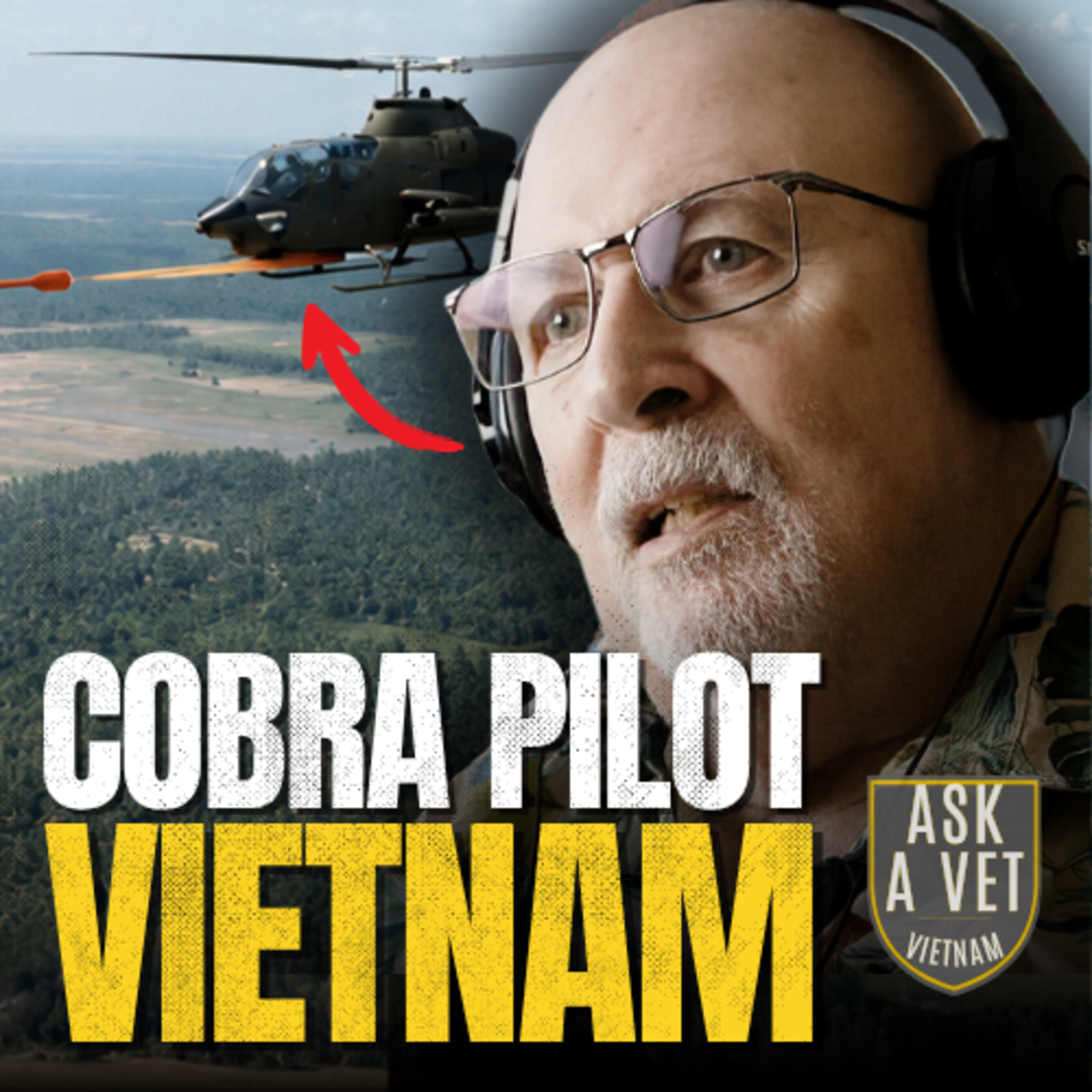 What They Don't Tell You About Being a Cobra Pilot in the Vietnam War 25.05.2026 1sa 20dkIn Episode 41 of Ask a Vet, we sit down with Walter Cox, Vietnam-era Army warrant officer, helicopter pilot, and Price, Utah native.Walter flew both Cobra gunships and Huey slicks with the 7th/17th Air Cavalry and Alpha 2/27 at Camp Holloway in Pleiku, South Vietnam. He walks us through what it was like to learn to fly in the tiny TH-55 trainer, transition to the sleek and lethal AH-1 Cobra, and ultimately find his calling in the Huey — hauling troops, supplies, and ARVN advisors across the Central Highlands. He recalls his first time being fired upon, the B-40 rockets that barely missed his crew, a bullet hole discovered in his rotor head days after a mission, and the devastating loss of fellow pilots that still stays with him.Walter is also open about the silence he kept for decades after coming home — the airport with no welcome, the PTSD he still navigates, and the memories he's had to push down just to get through. This episode is a remarkable window into the everyday heroism of a generation of veterans who served quietly and came home to even quieter streets.🎙️ Ask a Vet is a podcast dedicated to honoring and preserving the stories of veterans.
Benzer podcastler


Şurada popüler
Bu podcast şu ülkelerin podcast listelerinde de yer alıyor.

