
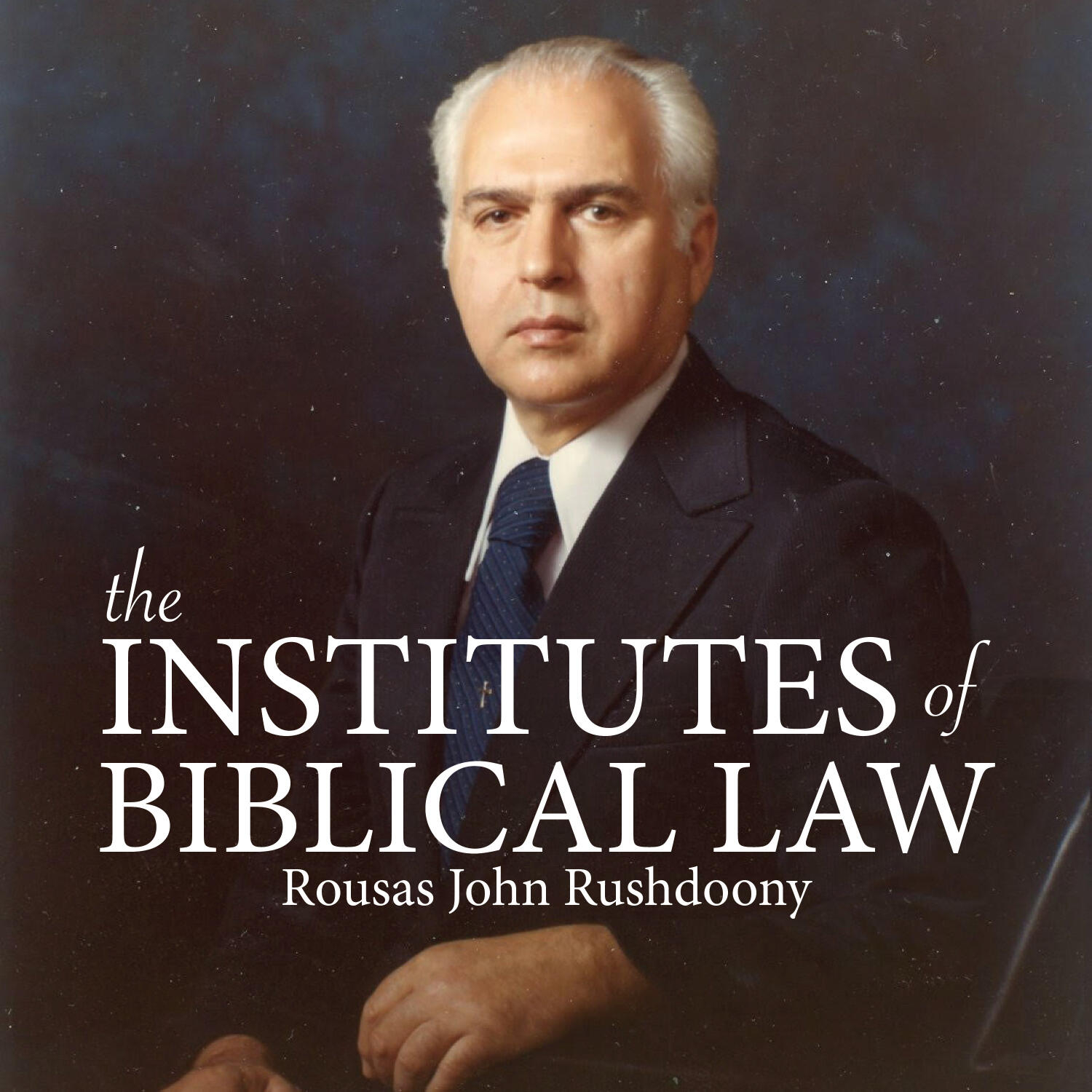
The Institutes of Biblical Law
R. J. Rushdoony
0
This podcast examines the theological importance of biblical law, arguing that studying Scripture inherently requires studying its legal teachings. Hosted by R. J. Rushdoony, it explores how these laws should govern both personal conduct and the broader structures of society. Episodes offer a detailed analysis of scriptural principles and their application to modern life and governance.
Bölümler
-
 Appendix: Law in Western Society (Remastered) 21.06.2026 57dkNotes on the Law in Western Society – The early church regarded biblical law as binding on believers, applying Levitical regulations to clergy, observing sabbath and moral law, and enforcing discipline, penance, and restitution (Ancyra, Basil, Gregory Thaumaturgus). Canon law reflected Scripture even while navigating Roman law, bureaucracy, and societal decay. The Theodosian Code and later Justinian’s Corpus Juris Civilis integrated Christianity with Roman law, while common law, medieval codes, and urban law drew heavily on biblical principles. Jewish communities, grounded in Scripture, contributed significantly to commercial, urban, and civic order in Europe, influencing figures like Maimonides and shaping Western legal culture. Puritans and New England colonists codified laws based on biblical precepts (Massachusetts Body of Liberties, New Haven Colony Laws), emphasizing God as Judge, Lawgiver, and King (Isa. 33:22). Humanistic or state-centered law, divorced from God’s law, fails to restore social order; true law is Scripture-based, ensuring moral, social, and civil flourishing. The decline of Roman and humanistic law demonstrates that only obedience to God and His law provides enduring justice, order, and salvation. #BiblicalLaw #CanonLaw #WesternCivilization #PuritanLaw #Maimonides #CommonLaw #DivineJustice #GodsOrder #ScriptureBasedLaw #SocialOrder
 -
Peace (Remastered) 14.06.2026 52dkPeace in the biblical sense is the wholeness, prosperity, and well-being that flow from reconciliation with God and restoration under His order. It is more than the absence of conflict; it encompasses peace with God, with oneself, with others, and with creation, reflecting the Edenic harmony lost in the Fall and progressively restored through Christ. Messianic prophecies, such as living under one’s vine and fig tree (Mic. 4:4; Zech. 3:10), symbolize this holistic peace, encompassing security, prosperity, and personal fulfillment, while Jesus Himself embodies and grants this peace (John 14:27). Statist or humanistic peace, limited to the suppression of conflict, cannot achieve true shalom, for only God-centered regeneration produces enduring communion, joy, and righteous order. Biblical peace thus integrates salvation, victory, and well-being: it is both present in the believer’s life and future in the consummation of God’s Kingdom. #BiblicalPeace #Shalom #ChristThePeacemaker #KingdomOfGod #RestorationInChrist #MessianicPeace #GodCenteredOrder #SpiritualWellbeing
-
Power and Authority (Remastered) 07.06.2026 56dkPower and authority are inseparable from God’s law: power is mere force, but authority is the lawful right to rule, and only where both are grounded in God’s word can true order exist. Scripture teaches that the saints are called to govern the world not through humanistic coercion, miracles designed to compel belief, or institutional dominance but through obedience to Christ’s law and faithful self-government under Him. Humanism offers only two outcomes, anarchism or totalitarianism, because it lacks a transcendent law; biblical authority alone restrains both chaos and tyranny. Christ possesses all power and perfectly embodies authority, and the church grows strong only as it submits its power to His commands rather than pursuing peace, security, or success on human terms. When power divorces itself from godly authority it becomes destructive, but when authority rests firmly on God’s law, power rightly serves the advance of His Kingdom even when that purpose overturns human empires rather than preserving them. #PowerAndAuthority #BiblicalLaw #KingdomOfGod #ChristTheKing #ChurchAndCulture #GodlyGovernment #ChristianDominion #AuthorityUnderGod
-
Rebuke and Excommunication (Remastered) 31.05.2026 46dkBiblical rebukes and excommunication are not institutional tools to protect the church’s prestige but covenantal acts aimed at restoring God’s order in faith, morals, and authority under His law. Rebuke is the first step of correction, grounded in Scripture and applied relationally, while persistent rebellion whether false doctrine, immorality, or refusal to fulfill basic covenant duties like family provision and just wages leads to rejection and excommunication. The church’s discipline addresses real-life obedience, not merely church offenses, because God’s Kingdom, not the institution, is the goal. Within a biblical view of government, self-government and family responsibility are primary, the church exercises moral and spiritual jurisdiction, and the state is only one limited sphere among many. Where men deny God’s law in conduct, discipline must proceed; where they repent, restoration follows always in submission to God’s authority rather than human preference. #ChurchDiscipline #RebukeAndRestoration #BiblicalLaw #Excommunication #CovenantalAuthority #ChristianEthics #KingdomOfGod #BiblicalGovernment"
-
Discipline (Remastered) 24.05.2026 48dkTrue discipline is not punishment but systematic training under God’s authority, producing learning, growth, and submission to His law-word; chastisement is only a corrective tool when discipline has failed. Churches often confuse the two, boasting of “strict discipline” while neglecting faithful teaching of Scripture, which alone empowered by the Holy Spirit creates real discipleship. Matthew 18 does not define discipline itself but tests whether a person is subject to God’s Word and therefore capable of correction; refusal to hear that Word reveals apostasy and leads to separation. Without the law-word of God there can be no discipline, only human control, false order, or chaos. True order flows from God’s law, not from procedures, punishments, or institutional authority, and in some cases biblical separation not judicial action is the faithful remedy. #ChurchDiscipline #BiblicalAuthority #LawAndOrder #Discipleship #WordOfGod #ChristianFormation #ChurchGovernment #FaithfulCorrection"
-
The Priesthood of All Believers (Remastered) 17.05.2026 41dkThe priesthood of all believers is not a New Testament novelty but an Old Testament doctrine rooted in God’s covenant declaration that His people are a kingdom of priests (Ex. 19:5–6), a royal calling conditioned on obedience to His law and directed toward the establishment of His Kingdom. This priesthood is not sacerdotal or sacrificial in the atoning sense Christ alone fulfills that but royal and practical: every believer is called to rule under God as His vicegerent, exercising dominion in family, vocation, and society according to God’s law. Worship is not confined to church services but permeates daily life, and the church exists not as an end in itself but as a training ground that equips believers for mature, responsible service. True faith therefore cannot be reduced to profession alone; it must bear fruit in obedience and works, for a royal priesthood that does not act denies its calling. Properly understood, this doctrine resists institutional tyranny, undermines false democracy, decentralizes power, and provides a program not merely for Christian survival but for covenantal victory in history under Christ the King. #PriesthoodOfAllBelievers #RoyalPriesthood #KingdomOfGod #BiblicalTheology #CovenantFaithfulness #ChristianDominion #FaithAndWorks #ChristTheKing"
-
Circumcision and Baptism (Remastered) 10.05.2026 45dkBaptism succeeds circumcision as the covenant sign, preserving the same covenantal meaning while unfolding it in Christ: both testify that fallen human nature cannot save itself, that salvation comes only through death and regeneration, and that covenant membership brings both blessing and judgment. Circumcision symbolized the cutting off of the old nature and pointed forward to Christ’s atoning blood; baptism now proclaims participation in Christ’s death and resurrection, entrance into the new creation, and incorporation into the covenant people. As a sign and seal not grace itself baptism witnesses to God’s electing mercy while placing the recipient under heightened covenant responsibility, for covenant breakers face intensified judgment. In Scripture and the early church alike, baptism was understood as both cleansing and consecration, echoing the Flood and Red Sea judgments while promising a renewed world under the rule of the new Adam, Jesus Christ, whose own baptism marked His submission to covenant judgment and His vindication as Son and King. #CircumcisionAndBaptism #CovenantTheology #InfantBaptism #NewCreation #DeathAndResurrection #SignOfTheCovenant #JudgmentAndGrace #ChristTheNewAdam #BiblicalContinuity
-
The Christian Passover (Remastered) 03.05.2026 53dkThe Lord’s Supper is the Christian Passover, deliberately instituted within the Jewish Passover to proclaim the continuity of God’s covenant and to declare salvation as victory: just as Israel celebrated deliverance from Egypt and the death of the firstborn, so the church celebrates Christ, God’s Firstborn, who bears the covenant death-sentence to deliver His people and inaugurate the new creation. Both Passovers are covenantal and family-centered, designed to instruct children, require preparation through self-examination (the purging of leaven), and celebrate election by grace with sanctification by obedience. The Supper is not a mournful ritual of retreat but a forward-looking proclamation of triumph Christ’s death until He comes announcing victory in time and eternity, judgment on the enemies of God, and inheritance of the promised land. To observe the Table without this note of conquest is to deny its meaning, for “Christ our Passover is sacrificed for us; therefore let us keep the feast” (1 Cor. 5:7–8). #ChristianPassover #LordsSupper #CovenantTheology #ContinuityOfScripture #SalvationAsVictory #ChristOurPassover #KingdomOfGod #BiblicalWorship #CovenantFamily #NewCreation
-
Office of Elder in the Church 26.04.2026 53dkThis section contends that the biblical office of elder has been hollowed out reduced from an active, pastoral arm of Christ’s kingship into a largely passive, managerial, or judicial role whereas in Scripture and the early church elders functioned as extensions of the pastor/bishop, advancing the gospel, caring for souls, and governing Christ’s people under His authority. Drawing on Ignatius, Polycarp, Irenaeus, and later Reformed standards, the argument shows that early bishops were essentially missionary pastors, presbyters were local ruling shepherds, and deacons served under them, all within a monarchic (not democratic) church order where authority flows from Christ the King, not from popular vote. Elders were never meant to be mere voters, building supervisors, or standing judges of pastors, but ruling servants who visit the sick, restore wanderers, teach, plant congregations, arbitrate disputes when necessary, and actively extend Christ’s reign into homes, education, mercy, and mission. Judicial discipline is real but secondary; the church is fundamentally a ministry of grace, not a court of law. True reform therefore requires reviving eldership as a functioning, outward-moving, pastoral office men bearing up the arms of their pastors, advancing Christ’s lordship in every sphere so that the church may again act as a living instrument of the Kingdom rather than a stalled institution. #Eldership #ChurchReform #RulingElder #PastoralLeadership #KingshipOfChrist #ChurchGovernment #NotDemocracy #MinistryOfGrace #EarlyChurch #Patristics #ReformedTheology #KingdomOfGod
-
The Eldership (Remastered) 19.04.2026 40dkThis section argues that eldership is an older, covenantal office that the church inherits rather than invents rooted in Israel’s family-and-tribal order, where “elders” governed household, synagogue, and civil life under the one standard of God’s law. In the New Testament, elders (presbyters) become the governing-teaching officers of the “new Israel,” marked by ordination/laying on of hands (1 Tim. 4:14) and qualified especially by proven household rule (1 Tim. 3:2–5). Because persecution and pagan courts made the church function as a “total society,” elders also served as a court of discipline and arbitration among believers (Matt. 18:15–17; 1 Cor. 6:1–3), shaping a responsible community that cares for its needy (1 John 3:17) without excusing idleness (2 Thess. 3:10) and that strengthens family provision (1 Tim. 5:8). The author then widens the concept: since law = rule/reign, elders are officers of Christ’s kingship tasked with applying God’s law-word across life, not merely inside Sunday structures so “eldership” is presented as a calling that can extend into education, civil governance, and vocations, with Revelation’s “twenty-four elders” (Rev. 4:10) symbolizing the crowned, enthroned rule of God’s people under God’s supreme kingship.
-
Law in Acts and Epistles (Remastered) 12.04.2026 52dkThis section argues that the New Testament never buries God’s law but repositions it: the Decalogue and moral demands are reaffirmed and intensified (especially inwardly, as Watson notes), while the church rejects only the misuse of law as a means of justification. Acts 15 is framed not as abolishing the law, but as refusing circumcision and rabbinic “law of Moses” as a saving yoke, while still presupposing obedience and issuing boundary instructions to Gentile converts for holiness and fellowship. Paul’s “not under law but under grace” (Rom. 6:14) means believers are no longer under the law as a condemning covenant-of-works death sentence, because that sentence is satisfied in Christ the law doesn’t die; the old man dies judicially in Christ so the regenerate can truly “delight in the law” (Rom. 7:22) and aim at sanctification “that the righteousness of the law might be fulfilled in us” (Rom. 8:4). In short, grace delivers from law-as-condemnation and law-as-salvation-method, but establishes law as the Spirit-enabled norm for life, holiness, and the Kingdom’s ethical order. #LawAndGrace #Acts15 #JustificationByFaith #Sanctification #MoralLaw #Decalogue #Romans6 #Romans7 #Romans8 #NewTestamentEthics #KingdomLiving
-
The Cultural Mandate (Remastered) 05.04.2026 55dkThe cultural mandate isn’t a distraction from the gospel it’s the outworking of Christ’s victory in the world. From Genesis to the Great Commission, God calls His covenant people to subdue the earth under His law, not surrender it to chaos, empire, or fate. To deny this calling is to hand culture, law, education, and nations over to humanism and statism and then to wonder why disorder follows. In Christ, the Second Adam, the mandate is restored: regenerate men, tear down rebellious ideas, disciple nations, and bring every sphere of life into obedience to Him. This is not empire-building or worldly triumphalism; it’s faithful obedience to the risen King who now possesses all authority in heaven and on earth. Refuse the mandate, and the world fills the vacuum with tyranny. Embrace it, and the meek inherit the earth. #CulturalMandate #DominionUnderChrist #GreatCommission #ChristianWorldview #BiblicalLaw #KingdomOfGod #PostmillennialHope #ChristTheKing #DisciplingNations #NoSurrender
-
The Tribute Money (Remastered) 29.03.2026 45dkThey thought they had Jesus trapped with a political “gotcha”: Is it lawful to pay Caesar’s tax or not? Say no, and Rome arrests Him. Say yes, and the crowd calls Him a fraud. But Jesus flips the trap back on them with one coin. Whose image is on it? Caesar’s. Then His answer lands like a thunderclap: Give back to Caesar what’s owed and give back to God what’s owed. In other words: yes, pay the tax, because you’re living under Rome’s real-world rule by God’s providence but don’t confuse taxes with worship. Caesar may claim authority, even divine pretensions, but God’s claim is absolute: everything belongs to Him. This isn’t a tidy “church vs. state” slogan it’s a kingdom confrontation: refuse Caesar-worship, obey lawful authority, and render to God your whole life tithes, praise, loyalty, conscience, and worship. Jesus exposes both deadly ditches: the empire’s salvation-by-control and the revolutionary’s salvation-by-revolt. The Christian way is deeper, harder, and freer: honor rulers without idolizing them, and belong wholly to God. #RenderToCaesar #RenderToGod #KingdomOfGod #BiblicalLaw #ChristianWorldview #Idolatry #Obedience #TithesAndWorship #JesusWisdom #PoliticsUnderGod
-
The Kingdom of God (Remastered) 22.03.2026 50dkThe Kingdom of God teaches that Christ’s proclamation of the Kingdom does not abolish the law but confirms it in its fullest authority, revealing the law as the rule of the reigning King. When Jesus declared that “the law and the prophets were until John,” He marked not their expiration but the transition from promise to presence the Kingdom is now preached because the King Himself has come, summoning all peoples to press into His rule. Far from relaxing God’s standards, Christ affirmed that it is easier for heaven and earth to pass away than for the smallest part of the law to fail, exposing the Pharisees as lawbreakers who replaced obedience with tradition. Entry into the Kingdom is by grace, but life within it is governed by God’s law, making Christ’s yoke easy not by lowering righteousness but by restoring the law as a gracious, life-giving rule under the sovereignty of God. #KingdomOfGod #ChristTheKing #LawAndGrace #BiblicalAuthority #GodsRule #GospelOfTheKingdom #ScriptureTruth #KingdomEthics #GraceAndObedience
-
The Transfiguration (Remastered) 15.03.2026 32dkThe Transfiguration reveals the unbreakable unity of Christ with the law and the prophets, identifying Jesus unmistakably as the Greater Moses and the incarnate Lawgiver. On the mountain echoing Sinai Jesus is transfigured in glory alongside Moses and Elijah, showing that the law and the prophets do not stand apart from Him but bear witness to Him in perfect harmony. Their conversation about His coming exodus at Jerusalem declares that Christ’s redemptive work fulfills the true deliverance of God’s people, not by abolishing the law but by accomplishing its purpose through atonement and resurrection. The Father’s command, “Hear ye him,” does not replace Moses but confirms that to hear Christ is to hear the totality of God’s Word; to reject Him is to reject the law, the covenant, and God Himself. The Transfiguration thus stands as a decisive condemnation of antinomianism, affirming that grace and law are inseparable in Christ, and that salvation by grace leads necessarily to sanctification under God’s law. #Transfiguration #ChristTheGreaterMoses #LawAndProphets #HearYeHim #BiblicalLaw #CovenantGrace #AntinomianismRefuted #ExodusFulfilled #JesusChrist #ScriptureUnity
-
Antinomianism Attacked (Remastered) 08.03.2026 1saAntinomianism Attacked shows that Jesus’ conflict with the religious leaders centered on their substitution of human tradition for God’s law, a move that He identified not as faithfulness but as lawlessness. By exposing ceremonial washings and practices like Corban as man-made commandments that nullified God’s Word, Jesus declared that only laws planted by the Father have authority, and that both antinomianism and legalism rejecting God’s law or replacing it with human rules stand condemned. Against the Pharisaic belief that defilement comes from the environment, Christ taught that lawlessness flows from the human heart, making regeneration, not ritual or social conditioning, the true remedy. In this way, Jesus dismantled every attempt to evade responsibility before God’s law and made clear that any “Christianity” that rejects God’s law is no Christianity at all. #Antinomianism #TraditionVsScripture #LawOfGod #HeartIssue #JesusTeaches #BiblicalAuthority #Regeneration #FalseReligion #ScriptureTruth
-
The Woman Taken in Adultery (Remastered) 01.03.2026 53dkThe Woman Taken in Adultery demonstrates not the setting aside of God’s law but its decisive confirmation by Christ, who exposes the hypocrisy and antinomianism of the scribes and Pharisees while upholding the law’s full authority. By invoking the requirements of Numbers 5 and demanding honest witnesses, Jesus placed the accusers themselves on trial, affirming the death penalty in principle while showing that no lawful case could proceed once the guilty witnesses withdrew. His refusal to condemn the woman was therefore judicial, not moral: the law stood, the charge collapsed, and the woman was dismissed with a command to repent “go, and sin no more.” Far from abolishing the law, Christ revealed Himself as its true champion, distinguishing civil judgment from spiritual forgiveness and exposing Pharisaism as a religion of self-righteous tradition that denied conversion, distorted the law, and stood condemned by the very standard it claimed to uphold. #WomanTakenInAdultery #BiblicalLaw #ChristAndTheLaw #JusticeAndMercy #NoAntinomianism #Repentance #PharisaismExposed #ScriptureTruth #LawUpheld
-
Christ and the Law (Remastered) 22.02.2026 45dkChrist and the Law explains that Jesus did not come to abolish the law but to fill it full to establish it in its true force and carry it forward as the abiding standard of God’s kingdom (Matt. 5:17–18). In the Sermon on the Mount, Christ speaks not as a commentator but as the King and Lawgiver “I say unto you” reinforcing that even the “least commandments” matter, and that kingdom citizenship is proven by doing and teaching His words (Matt. 5:19–20; 7:24). His resistance to Satan is framed by direct appeals to Deuteronomy, showing that history and righteousness must be governed by God’s law, not autonomous human will; and His exposition presses the law inward to the heart anger as murder-seed, lust as adultery-seed, integrity in speech, faith-filled trust in the Father’s rule (Matt. 5–7). The leaders’ conflicts with Jesus were therefore conflicts over authority: He was claiming to be the very measure of blessing and curse, the “rock” foundation, and the incarnate “way,” so His judgments against law-perverting rulers and His promised shaking of the ungodly were the lawful acts of the enthroned King whose authority is total (Matt. 23–24; 28:18; John 14:6). #ChristTheKing #FulfillTheLaw #SermonOnTheMount #KingdomEthics #Lawgiver #BiblicalAuthority #ObedienceAndFaith #TorahFulfilled #JesusIsTheWay #CovenantLife
-
The Law and the Covenant (Remastered) 15.02.2026 53dkThe Law and the Covenant presents Scripture’s unified testimony that God’s law and covenant are inseparable and universally binding on all men and nations, whether in blessing or judgment. From Isaiah to Malachi, from Jeremiah and Ezekiel to Hebrews, God indicts individuals and empires alike not merely for immorality but for covenant-breaking rejecting His law and attempting to live as though meaning, causality, and authority can exist apart from Him. The covenant of grace brings life, order, and an unshakable kingdom in Christ, while the covenant of death man’s attempt to escape God’s law results inevitably in curse, judgment, and overthrow. Law is thus not opposed to grace but is revelational of God Himself: to reject the law is to reject the knowledge of God, to deny Christ’s lordship, and to invite divine judgment, for there is no escape from God’s covenantal order. #LawAndCovenant #BiblicalTheology #CovenantFaithfulness #GodsJudgment #CovenantOfGrace #CovenantOfDeath #KingdomOfGod #ScriptureTruth #ChristTheMediator
-
Natural and Supernatural Law (Remastered) 01.02.2026 52dkAccording to Scripture, the result isn’t neutrality it’s chaos. When man’s reason, experience, or majority opinion becomes the source of law, God is quietly dethroned, the state takes His place, and truth is reduced to compromise and expediency. This episode exposes how even well-meaning theologians traded Moses for Plato, revelation for rationalism, and ended up empowering statism, relativism, and moral collapse. The Bible offers no middle ground: either God’s revealed law governs life, society, and science or there is no law at all. To reject Moses is to reject the God who orders the world. #BiblicalLaw #NaturalLawDebate #Theonomy #Rushdoony #VanTil #ChristianWorldview #Statism #Humanism #GodsLaw #TruthOverCompromise
Benzer podcastler


Şurada popüler
Bu podcast şu ülkelerin podcast listelerinde de yer alıyor.
