
Annals of Family Medicine Podcast
Annals of Family Medicine
0
This podcast presents innovations from the cutting edge of family medicine research. It is associated with the Annals of Family Medicine, an open access, peer-reviewed research journal that serves scientists, practitioners, policymakers, and the communities they serve. The journal is a collaborative effort of seven family medicine organizations and has been in publication since 2003. Each episode likely highlights recent studies and advances in primary care and family practice.
Bölümler
-
 Ep. 13: Fall-Related Emergency Department Visits Among Adults With and Without Intellectual and Developmental Disabilities or Cerebral Palsy, featuring Teal Benevides, PhD, and Michael McKee, MD, MPH 27.05.2026 33dkDr. Teal Benevides and Dr. Michael McKee join host Dr. Sherri Eldin to discuss their research brief, “Fall-Related Emergency Department Visits Among Adults With and Without Intellectual and Developmental Disabilities or Cerebral Palsy” (https://doi.org/10.1370/afm.250058). Dr. Benevides and Dr. McKee explain their findings that adults with intellectual and/or developmental disabilities (IDD) or cerebral palsy (CP) were more likely to visit the emergency department for a fall-related injury than adults without these conditions, and that this risk appears at earlier ages than is seen in the general population. They also discuss the barriers these populations face in accessing preventive care, and what primary care clinicians can do, from earlier fall risk screening to multidisciplinary care and medication review, to reduce falls, morbidity, and mortality in these patients. Teal Benevides, PhD, MS, OTR/L, FAOTA, is a professor in the Department of Community and Behavioral Health Sciences in Augusta University’s School of Public Health. She has a passion for describing, understanding, and addressing disparities among individuals on the autism spectrum and those with intellectual and/or developmental disabilities. Dr. McKee is an Associate Professor and board-certified in family medicine with an expertise in disability health. His research focus includes health disparities for individuals with various disabilities, health information accessibility, health literacy, and telemedicine applications. The video interview will be available on the Annals of Family Medicine YouTube channel. As usual, the audio-only episode will also be available on Spotify, Apple Podcasts, Amazon Music, and the Podbean App, as well as on the Annals of Family Medicine website.
 -
 Ep. 12: Leveraging the Role of Chaplaincy to Enhance Care for Patients With Opioid Use Disorder, featuring Seth Hunter, MD, and Chaplain Dustin Hite 24.03.2026 58dkIn this episode, authors Dr. Seth Hunter and Chaplain Dustin Hite join host Dr. Sherri Eldin to discuss their Innovation in Primary Care article, “Leveraging the Role of Chaplaincy to Enhance Care for Patients With Opioid Use Disorder,” by April D. Newton, PT, DPT, PhD, Dustin Hite, MDiv, Seth Hunter, MD, and Maeg Sauers, Ann Fam Med 2026;24. https://doi.org/10.1370/afm.25048. In this episode: In this episode: Many patients in early recovery face emotional distress and social isolation. To address these unmet needs, the Buprenorphine Clinic at Indiana University (IU) Health Primary Care in Indianapolis integrated a chaplain trained in recovery coaching into its interprofessional collaborative care team. The chaplain provides non-clinical, whole-person support, helping patients explore meaning, process emotions, and identify personal strengths. This role supports patients regardless of spiritual beliefs and complements the medical management of OUD by addressing emotional and existential concerns.
 -
 Ep. 11: Live from NAPCRG 2025: A Conversation with the Annals of Family Medicine Staff 15.01.2026 20dkDr. Eldin is joined by her very own co-workers: the invaluable staff that is the driving force behind Annals of Family Medicine. Listeners can look forward to hearing about the team’s respective roles, their work at NAPCRG (including their acclaimed conference workshop), and the opportunity that the Annual Meeting provides to further foster relationships with authors and researchers at all stages of their careers. Sign up to be a peer reviewer with Annals of Family Medicine by clicking the link here!
 -
 Ep. 10: Live from NAPCRG 2025: Dr. José Rodríguez 16.12.2025 22dkEpisode #10 is a relaxed and informative conversation between Dr. Eldin and Dr. José Rodríguez, who stepped down as an Associate Editor for Annals of Family Medicine earlier this year. In this episode, they discuss the fun of attending NAPCRG, the importance of keeping the joy alive in one’s work (and what to do when it’s gone), and the road that led Dr. Rodríguez to his new position as the Frank S. Royal Professor and Chair of Family & Community Medicine at Meharry Medical College. Resources Mentioned: STFM Leadership Through Scholarship Fellowship: https://www.stfm.org/facultydevelopment/fellowships/leadershipthroughscholarship/overview/
 -
 Ep. 9: Live from NAPCRG 2025: Dr. Felicity Goodyear-Smith 05.12.2025 25dkIn this first episode of the 2025 Live from the North American Primary Care Research Group (NAPCRG) conference series, we interview Dr. Felicity Goodyear-Smith. She received her undergraduate and medical degrees from the University of Auckland, where she now serves as Professor and Goodfellow Postgraduate Chair of General Practice and Primary Care. A prolific author with more than 360 peer-reviewed publications, 11 books, and 30 book chapters, she joined the Annals of Family Medicine Editorial Advisory Board in 2024 and has delivered several NAPCRG plenaries, including this year’s. Recorded the day before her plenary, the episode previews the talk she and her research collective were about to give, which tells the story of a Pacific co-design research journey that began with a 2016 PaCE workshop and led to the formation of a Pacific community group and a Pacific Practice-Based Research Network in South Auckland, Aotearoa New Zealand. Guided by Pacific research frameworks such as fa’afaletui and the Fonofale model of holistic health, their work involves community groups in every step of the research process and includes projects addressing gout and rheumatic fever. Resources Mentioned: NAPCRG's PaCE (Patient and Clinician Engagement): https://napcrg.org/programs/pace/ "View from the Canoe: Co-Designing Research Pacific Style" https://www.annfammed.org/content/18/2/172 "Travelling companions: a story told by a patient and her doctor": https://bjgp.org/content/68/671/282 or https://pmc.ncbi.nlm.nih.gov/articles/PMC6002010/ Joseph Tuala RNZ article w/ news segment video: https://www.rnz.co.nz/national/programmes/insight/audio/2018686731/nz-s-heart-breaker-rheumatic-fever-rates-on-the-rise Fa'afaletui: A Pacific Research Framework: https://journals-sagepub-com.revproxy.brown.edu/share/2X7Q2ZPPTNV99BMSRYWM?target=10.1177/1558689820985948
 -
 Ep. 8: Body Mass Index vs Body Fat Percentage as a Predictor of Mortality in Adults Aged 20-49 Years feat. Arch G. Mainous III, PhD, and Frank A. Orlando, MD (Vol. 23 Iss. 4) 19.08.2025 32dkIn this episode, researchers Arch G. Mainous III, PhD, and Frank A. Orlando, MD, discuss their recently published study, “Body Mass Index vs Body Fat Percentage as a Predictor of Mortality in Adults Aged 20-49 Years.” The study found that body fat percentage is a stronger predictor of 15-year mortality risk among U.S. adults than body mass index (BMI). Although BMI is widely used in clinics as the standard measure of body composition, it can potentially misclassify muscular individuals as overweight and miss cases of ”normal-weight obesity,” masking serious metabolic and heart disease risks. The study findings support reexamining how body composition is measured in clinical settings.
 -
 Ep. 7: Prescribing Cascades Among Older Community-Dwelling Adults feat. Ann Sinéad Doherty, PhD, and Emma Wallace, PhD (Vol. 23 Iss. 4) 29.07.2025 31dkIn this episode, researchers Ann Sinéad Doherty, PhD, and Emma Wallace, PhD discuss their recently published study, “Prescribing Cascades Among Older Community-Dwelling Adults: Application of Prescription Sequence Symmetry Analysis to a National Database in Ireland.” The study identified five potential prescribing cascades in Ireland’s national population of older adults, highlighting yet another contributor to potentially inappropriate prescribing.
 -
 Ep. 6: Neighborhood Determinants of Primary Care Access in Virginia, feat. Hannah Shadowen, PhD, and Dr. Alexander Krist(Vol. 23 Iss. 3) 28.05.2025 35dkPrimary care improves the health of communities and decreases health inequities, yet workforce shortages have worsened in the United States. This study, titled "Neighborhood Determinants of Primary Care Access in Virginia," aimed to identify geographic disparities of the primary care workforce in Virginia and identify factors associated with primary care physician (PCP) access. In this episode, authors Hannah Shadowen, third-year medical student, and Alexander Krist, MD, MPH discuss the study in detail. Researchers used the 2019 Virginia All-Payers Claims Database to identify PCPs and the number of patients seen by each physician. They then measured how many PCPs each census tract could reach within a 30‑minute drive, flagging tracts with too few as having poor access. Associations between PCP access and predisposing (age, race), enabling (income, insurance), need and structural (rurality, segregation) factors were assessed. Main Results: Nearly half (44%) of Virginia’s census tracts lacked adequate PCP access. Racial segregation and rurality had the greatest associations with PCP access: tracts with higher proportions of Black residents had significantly greater PCP access than those with higher proportions of White residents, while rural tracts had significantly less access.
 -
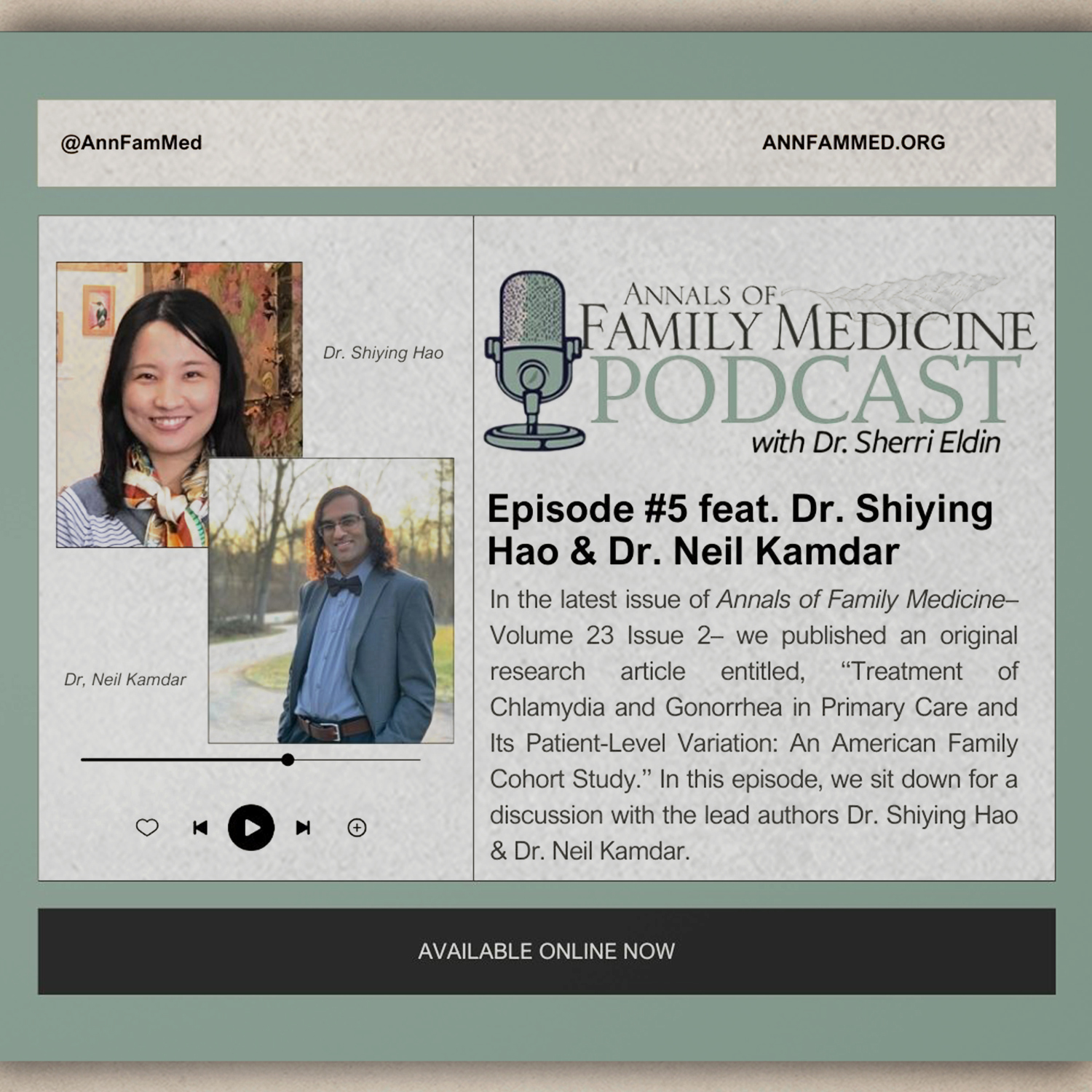 Ep. 5: Utilization of Treatment for Chlamydia and Gonorrhea and Practice-Level Variation in Treatment in the Primary Care Setting, feat. Dr. Shiying Hao & Dr. Neil Kamdar (Vol. 23 Iss. 2) 25.03.2025 28dkAuthors Shiying Hao, PhD, and Neil Kamdar, MA, discuss their original research study titled "Utilization of Treatment for Chlamydia and Gonorrhea and Practice-Level Variation in Treatment in the Primary Care Setting Using the American Family Cohort.” They talk about barriers to guideline adherence for chlamydia and gonorrhea treatment across primary care practices and recommend efforts to develop management plans for better quality of care.
 -
 Ep. 4: A Qualitative Study of Primary Care Physicians’ Approaches to Caring for Adult Adopted Patients, feat. Student Dr. Jade Wexler & Dr. Elizabeth Toll (Vol. 23, no. 1) 28.01.2025 33dkIn this episode, lead author Jade Wexler, a fourth-year medical student at Brown University, and co-author Dr. Elizabeth Toll, a professor of pediatrics and medicine and clinician educator at Brown University, discuss their study, A Qualitative Study of Primary Care Physicians’ Approaches to Caring for Adult Adopted Patients. They share insights into their findings and the implications for primary care practice.
 -
 Ep. 3: The Day I Almost Walked Away: Trust, Gratitude, & the Power of Teamwork, feat. Dr. Colleen Fogarty & Rebecca Schiano (Vol. 22, no. 5) 23.09.2024 14dkFamily medicine is demanding, often taking an emotional toll on physicians as they share in their patients' distress and trauma. This essay recently published in Annals of Family Medicine titled "The Day I Almost Walked Away: Trust, Gratitude, and the Power of Teamwork," recounts a moment when a family physician, overwhelmed by the complexities of patient care, felt ready to step away from her duties. When she reached out to a team nurse for support, the nurse's encouragement helped her regain focus and continue caring for her patients. The story illustrates how emotional support and solidarity within health care teams can serve as a powerful antidote to burnout, enabling professionals to navigate the challenges of patient care. The essay advocates for fostering such connections in the workplace, ultimately leading to improved patient care and a more resilient health care workforce.
 -
 Ep. 2: Structural Racism in Newborn Drug Testing, feat. Dr. Carol Shetty and Dr. Lauren Oshman (Vol. 22, no. 4) 22.07.2024 28dkBlack parents and their newborns are more likely to undergo drug testing for prenatal substance exposure by health care professionals, which contributes to Child Protective Services (CPS) reporting, family separation, and termination of parental rights. In this episode, lead authors Dr. Carol Shetty and Dr. Lauren Oshman discuss their study, “Structural Racism in Newborn Drug Testing: Perspectives of Health Care and Child Protective Services Professionals.”
 -
 Ep.1: The Role of Primary Care in the Social Isolation & Loneliness Epidemic, feat. Dr. Sebastian Tong (Vol. 22, no. 3) 29.05.2024 13dkEpisode 1: Translating the Surgeon General’s Framework on Social Isolation and Loneliness to Actionable Steps in Primary Care Before COVID-19, 20% of adult primary care patients felt lonely, linked to higher health care use and chronic conditions. Social isolation’s health impact rivals smoking 15 cigarettes a day. This episode offers critical strategies for primary care to address this growing epidemic. Dr. Sebastian Tong, lead author of the special report titled ”The Role of Primary Care in the Social Isolation and Loneliness Epidemic,” discusses the U.S. Surgeon General’s advisory and outlines practical steps for primary care, including training, patient support, and public health interventions. Listen now to learn about innovative solutions for combating social isolation and improving patient care.
Benzer podcastler


Şurada popüler
Bu podcast şu ülkelerin podcast listelerinde de yer alıyor.
