
AI Coach - Anil Nathoo
Anil Nathoo
0
This podcast, hosted by Anil Nathoo, serves as a resource for those interested in artificial intelligence. Each episode delivers actionable insights, expert advice, and creative strategies to help listeners reach their AI-related objectives. Whether the goal is career advancement, skill enhancement, or personal development, the host offers guidance throughout the journey, aiming to foster growth and learning together with the audience.
Bölümler
-
 Karpathy Method for Building a Second Brain 11.04.2026 55dkClick here for more.This podcast explores the evolution of external memory systems, tracing the journey from 1945's Memex to modern digital frameworks. It identifies a "structural failure mode" in traditional methods like Tiago Forte’s Second Brain, where the manual effort required to maintain notes eventually becomes unsustainable. The podcast introduces the Karpathy Method, a breakthrough approach that utilizes Large Language Models (LLMs) to act as automated librarians. By delegating the tasks of summarising, cross-referencing, and filing to AI, the system removes the maintenance burden from the user. This transition from human-led organisation to self-maintaining markdown wikis allows personal knowledge bases to scale indefinitely. The source provides a practical guide for building a resilient digital brain that compounds knowledge automatically rather than collapsing under its own weight.Resources:1 Hour GuideAI CoachTwinlabs
 -
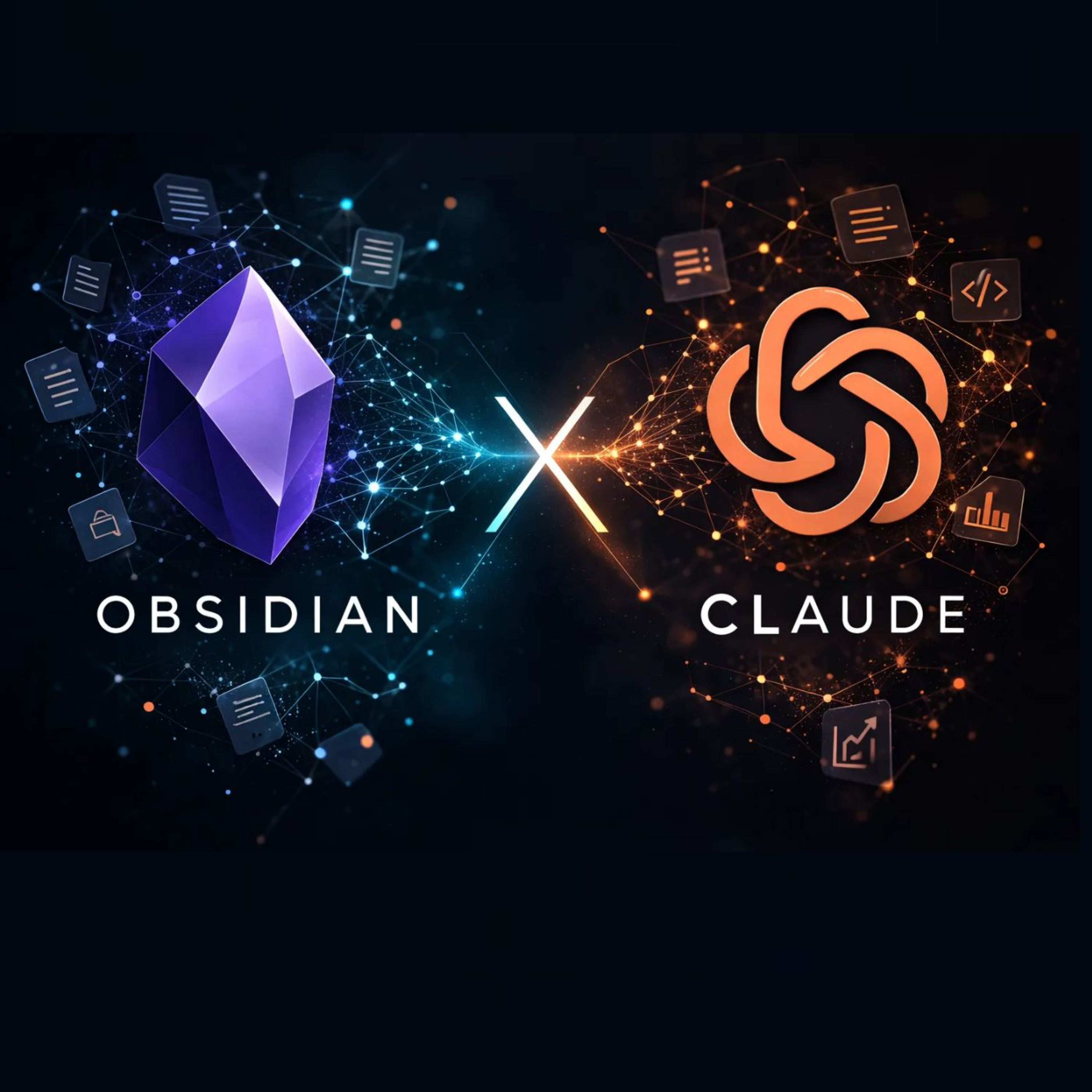 Claude: 33 Obsidian Rules To Cut Your Costs By 80% 22.03.2026 38dkClick here to read the article.This guide provides 33 practical rules for restructuring an Obsidian knowledge base to significantly reduce the operational costs and latency of using the Claude AI assistant. By focusing on token optimisation, the podcast explains how specific file naming conventions, shallow folder hierarchies, and concise note-writing techniques prevent the AI from processing redundant data. A central recommendation is the implementation of Maps of Content (MOCs), which synthesise information into single, dense briefings to avoid expensive multi-file scanning. The podcast also highlights the importance of prompting discipline and the exclusion of high-cost attachments like images to preserve the AI's limited context window. These systematic adjustments aim to cut overhead by up to 80%, ensuring a more efficient and affordable collaboration between human users and large language models.Picture credit: Mohit Aggarwal
 -
 Claude Cowork: Getting Started and Feature Overview 14.03.2026 30dkClick here to read the article.Anthropic has introduced Claude Cowork, a new research preview designed to bring autonomous agent capabilities to general desktop productivity. Unlike standard chat interfaces, this tool can directly access local files, manage complex multi-step projects, and even schedule recurring automated tasks. It is currently available on the Claude Desktop app for users on paid subscription tiers, including Pro, Team, and Enterprise plans. Users can leverage specialized plugins and connectors to help Claude organize folders, generate professional slide decks, or synthesize research across various platforms. While the system operates in a secure virtual environment, it requires explicit user permission before modifying files to ensure safety and control.
 -
 Google Antigravity: Comprehensive Guide to AI Agent Development 29.12.2025 34dkClick here to read the article.The podcast provides a comprehensive overview of Google Antigravity, a newly released agentic development platform that aims to revolutionise software development by employing autonomous AI helpers (agents) to handle complex tasks. Built as an AI-powered IDE forked from Visual Studio Code and driven by Gemini 3 Pro, the system uses a four-stage process—Plan, Execute, Verify, and Feedback—along with an Artifact-Driven Verification system to ensure transparency. While praised for dramatically improving productivity and offering multi-model support, the platform faces significant challenges, including stability issues, restrictive rate limits for free users, and serious concerns regarding security vulnerabilities and the long-term ethical implications of increasing AI autonomy. Ultimately, the podcast positions Antigravity as a highly disruptive technology still in its early stages, promising to shift the developer role from coding to high-level orchestration.
 -
 102 - Smart Vector Databases: Tools and Techniques 09.09.2025 1sa 3dkClick here to read more.Vector databases are emerging as critical enablers for intelligent AI applications, moving beyond basic similarity searches to support complex understanding and reasoning. These databases store and manage high-dimensional vector data, representing the semantic meaning of information like text, images, and audio. To achieve smarter functionality, it's essential to use high-quality, domain-specific, and multimodal embedding models, alongside techniques for managing dimensionality and enabling dynamic updates.Advanced retrieval methods in vector databases go beyond simple k-Nearest Neighbor searches by incorporating hybrid search (combining vector and keyword methods), LLM-driven query understanding, and re-ranking for enhanced precision. Furthermore, vector databases act as AI orchestrators, serving as the backbone for Retrieval-Augmented Generation (RAG) pipelines, enabling context-aware LLM responses, and integrating with knowledge graphs for structured reasoning. Continuous improvement is facilitated through human-in-the-loop feedback, active learning, A/B testing, and performance monitoring.Key tools in this evolving landscape include popular vector databases like Pinecone, Weaviate, Milvus, Qdrant, and ChromaDB, supported by retrieval frameworks and rerankers. However, implementing these solutions at an enterprise level presents challenges such as ensuring scalability, addressing security and privacy concerns (including federated search over sensitive data), optimizing costs, and adopting a phased implementation strategy.
 -
 101 - Why Language Models Hallucinate? 08.09.2025 43dkClick here to read more.This podcast discusses the OpenAI paper “Why Language Models Hallucinate” by Adam Tauman Kalai, Ofir Nachum, Santosh S. Vempala, and Edwin Zhang.It examines the phenomenon of “hallucinations” in large language models (LLMs), where models produce plausible but incorrect information. The authors attribute these errors to statistical pressures during both pre-training and post-training phases. During pre-training, hallucinations arise from the inherent difficulty of distinguishing correct from incorrect statements, even with error-free data.For instance, arbitrary facts without learnable patterns, such as birthdays, are prone to this. The paper further explains that hallucinations persist in post-training due to evaluation methods that penalise uncertainty, incentivising models to “guess” rather than admit a lack of knowledge, much like students on a multiple-choice exam. The authors propose a “socio-technical mitigation” by modifying existing benchmark scoring to reward expressions of uncertainty, thereby steering the development of more trustworthy AI systems.For the original article, click here.
 -
 100 - Mastering RAG: Best Practices for Enhanced LLM Performance 05.09.2025 44dkClick here to read more.This podcast investigates best practices for enhancing Retrieval-Augmented Generation (RAG) systems, aiming to improve the accuracy and contextual relevance of language model outputs. It is based on the paper "Enhancing Retrieval-Augmented Generation: A Study of Best Practices" by Siran Li, Linus Stenzel, Carsten Eickhoff, and Seyed Ali Bahrainian, all from the University of Tübingen.The authors explore numerous factors impacting RAG performance, including the size of the language model, prompt design, document chunk size, and knowledge base size. Crucially, the study introduces novel RAG configurations, such as Query Expansion, Contrastive In-Context Learning (ICL) RAG, and Focus Mode, systematically evaluating their efficacy. Through extensive experimentation across two datasets, the findings offer actionable insights for developing more adaptable and high-performing RAG frameworks. The paper concludes by highlighting that Contrastive ICL RAG and Focus Mode RAG demonstrate superior performance, particularly in terms of factuality and response quality.For the original article click here.
 -
 99 - Swarm Intelligence for AI Governance 04.09.2025 56dkClick here to read more.This podcast introduces swarm intelligence as a transformative paradigm for AI governance, positioning it as an alternative to the prevailing reliance on centralized, top-down control mechanisms. Traditional regulatory approaches—anchored in bureaucratic oversight, static compliance checklists, and national or supranational legislation—are portrayed as inherently slow, rigid, and reactive. They struggle to keep pace with the exponential and unpredictable trajectory of AI development, leaving them vulnerable to both technical obsolescence and sociopolitical risks, such as single points of failure, regulatory capture, or geopolitical bottlenecks.In contrast, the proposed model envisions a distributed ecosystem of cooperating AI agents that continuously monitor, constrain, and correct one another’s behavior. Drawing inspiration from natural swarms—such as the coordinated movement of bird flocks, the foraging strategies of ant colonies, or the self-regulating dynamics of bee hives—this approach emphasizes emergent order arising from decentralized interaction rather than imposed hierarchy.Such a multi-agent oversight system could function as an adaptive "immune system" for AI, capable of detecting anomalies, malicious behaviors, or systemic vulnerabilities in real time. Instead of relying on infrequent regulatory interventions, governance would emerge dynamically from the ongoing negotiation, cooperation, and mutual restraint among diverse agents, each with partial perspectives and localized authority.The benefits highlighted include:Agility – the capacity to respond to unforeseen threats or failures far more quickly than centralized bureaucracies.Resilience – the avoidance of catastrophic collapse due to decentralization, where no single node or regulator can be compromised to bring down the system.Pluralism – governance that reflects multiple values, incentives, and cultural norms, reducing the risk of dominance by any single political, corporate, or ideological actor.Ultimately, the podcast reframes AI governance not as a static regulatory apparatus, but as a living, evolving ecosystem, capable of learning, adapting, and self-correcting—much like the natural swarms that inspired it.
 -
 95 - Infosys Agentic AI Playbook 03.09.2025 58dkClick here to read more.The Infosys Agentic AI Playbook, offers a comprehensive overview of agentic AI, highlighting its evolution from traditional AI to systems capable of autonomous decision-making and process redesign. The podcast explores the architecture and blueprints of agentic AI, detailing various types of AI agents and the layered structure that enables their functionality. It addresses AgentOps, a critical framework for managing the entire lifecycle of these systems, ensuring their scalability, reliability, and responsible deployment. It also examines the challenges and risks associated with agentic AI, such as reasoning limitations and resource overuse, while proposing responsible AI practices and governance frameworks to mitigate these issues and foster trustworthy implementation.
 -
 98 - Foundations of Large Language Models ( Tong Xiao and Jingbo Zhu) 02.09.2025 2sa 1dkClick here to read more.This podcast is based on the paper "Foundations of Large Language Models" by Tong Xiao and Jingbo Zhu.It offers a comprehensive exploration of Large Language Models (LLMs), beginning with an examination of pre-training methods in Natural Language Processing, including both supervised and self-supervised approaches like masked language modeling, and using models like BERT. It then transitions to a detailed discussion of LLMs, covering their architecture, training challenges, and the critical concept of alignment with human preferences through techniques like Supervised Fine-tuning (SFT) and Reinforcement Learning from Human Feedback (RLHF). A significant portion of the podcast focuses on LLM inference, explaining fundamental algorithms such as prefilling and decoding, and various methods for improving efficiency and scalability, including prompt engineering and advanced search strategies. The podcast also touches on crucial considerations like bias in training data, privacy concerns, and the emergent abilities and scaling laws that govern LLM performance.
 -
 97 - AI Agents Versus Agentic AI 31.08.2025 55dkClick here to read more.This podcast provides a comprehensive analysis distinguishing between AI Agents and Agentic AI, two related but fundamentally different approaches to artificial intelligence automation and decision-making. The discussion offers a structured taxonomy that clarifies the unique characteristics and capabilities of each paradigm, providing listeners with essential framework for understanding these rapidly evolving technologies.AI Agents represent modular, task-specific systems that are primarily powered by Large Language Models (LLMs) and Large Image Models (LIMs). These systems are designed for narrow automations with limited adaptability, operating within single-purpose, defined operational boundaries. In contrast, Agentic AI represents a more advanced paradigm characterized by sophisticated multi-agent collaborative systems that feature dynamic task decomposition, persistent memory systems, and orchestrated autonomy across multiple agents. This enables them to tackle complex, high-level objectives through coordinated intelligence and broad, adaptive problem-solving across diverse domains.The podcast traces the architectural evolution from simple AI Agents to sophisticated Agentic AI systems, highlighting the technological advances that enable more complex behaviors and interactions. It provides a detailed examination of how each system processes information, makes decisions, and executes tasks, with particular emphasis on the collaborative nature of Agentic AI versus the isolated functionality of traditional AI Agents. Both paradigms are analyzed across various real-world applications, demonstrating their respective strengths and optimal deployment scenarios.Critical challenges facing both systems are thoroughly explored, including common limitations such as hallucinations, where both systems struggle with generating inaccurate or fabricated information, and coordination failures, which are particularly relevant for multi-agent Agentic AI systems. The review proposes several solutions to advance their development, including Retrieval-Augmented Generation (RAG) for enhanced accuracy through real-time information retrieval, and causal modeling for improved decision-making through better understanding of cause-and-effect relationships.The comprehensive review positions these technologies within the broader AI landscape, offering valuable insights for organizations considering implementation and researchers advancing the field. This taxonomy provides an essential framework for understanding the current state and future trajectory of autonomous AI systems, from simple task-specific agents to complex collaborative intelligence networks that represent the cutting edge of artificial intelligence development.
 -
 96 - Synergy Multi-Agent Systems 30.08.2025 1sa 2dkClick here to read more.The podcast covers the research paper "Synergy Multi-Agent Systems" by Adam Kostka and Jarosław A. Chudziak.It introduces SynergyMAS, a novel framework designed to enhance Large Language Model (LLM) capabilities in complex problem-solving. This system integrates multi-agent techniques with logical reasoning, knowledge management through Retrieval-Augmented Generation (RAG), and Theory of Mind (ToM) capabilities. By establishing optimized communication protocols and a hierarchical team structure, SynergyMAS aims to overcome common LLM limitations like hallucinations and knowledge gaps, fostering collaborative teamwork. The effectiveness of this approach is demonstrated through a product development team case study, highlighting its potential for real-world applications. The authors emphasize that the system excels in multi-perspective analyses and iterative improvement, contributing to the advancement of multi-agent LLM research.
 -
 94 - Accenture's Technology Vision 2025 Report 29.08.2025 1sa 30dkClick here to read more.This podcast covers Accenture's Technology Vision 2025 Report. It explores the transformative impact of Artificial Intelligence (AI), particularly its evolution towards autonomy, across various business dimensions. The podcast introduces the concept of "AI cognitive digital brains" that will reshape enterprise technology. It highlights four key trends:"The Binary Big Bang" detailing how foundation models are revolutionising software development with abundance, abstraction, and autonomy; "Your Face, in the Future" which examines the importance of personified AI for customer experience and brand differentiation"When LLMs get their Bodies" discussing how large language models (LLMs) are granting robots advanced reasoning and physical autonomy; and "The New Learning Loop" focusing on the virtuous cycle between people and AI that enhances skills and drives innovation within the workforce. A central theme throughout is the critical role of trust in successfully integrating these autonomous AI systems into businesses and society.
 -
 93 - AI Maturity Index 2025 28.08.2025 51dkClick here to read more.The "AI Maturity Index 2025," is a comprehensive report authored by Vijay Kotu, Richard McGill Murphy, Brian Solis, and Dorit Zilbershot. It analyses the current state of AI adoption and maturity within private and public sector organisations globally, highlighting a surprising decline in average maturity scores from the previous year. The report identifies a leading group, "Pacesetters," who demonstrate more effective AI deployment and outlines a roadmap for other organisations to follow. Key sections cover the AI-driven future, the strategies of Pacesetters, and industry and regional snapshots of AI maturity. It also emphasises the critical role of human talent and robust governance in successful AI transformation, moving towards an "AI-first" mindset.
 -
 92 - Thomson Reuters - Agentic AI Guide 27.08.2025 41dkClick here to read more.This podcast covers the guide from Thomson Reuters and introduces Agentic AI as a powerful evolution beyond Generative AI. It explains their fundamental differences and how they complement each other in a business context. It highlights that while Generative AI creates content based on specific prompts, Agentic AI autonomously makes decisions and executes multi-step tasks after minimal input, acting as a proactive assistant. The guide explores the practical applications and benefits of professional-grade Agentic AI across various industries, emphasising its ability to reduce mundane tasks, increase productivity, and improve work quality. In addition, it provides essential evaluation criteria for selecting Agentic AI solutions, focusing on crucial aspects like security, integration, reliable data sources, and measurable ROI, and addresses common questions regarding its implementation and impact on the workforce.
 -
 91 - Google AI Agent Handbook 27.08.2025 1saClick here to read more.This handbook from Google outlines the transformative potential of AI agents in the workplace, positioning them as a significant advancement over traditional automation. It highlights how these agents can execute complex workflows, automate routine tasks, and access vast internal and external information to enhance employee productivity and decision-making. The podcast details ten practical applications across various business functions, from effortlessly searching enterprise data and transforming documents into engaging podcasts to streamlining HR workflows and personalising customer experiences. The podcast encourages organisations to embrace AI agents to boost efficiency, create value, and even enable employees to build their own bespoke agents.
 -
 90 - Claude Code 26.08.2025 1sa 24dkClick here to read more.Anthropic’s Claude AI is rapidly emerging as a powerful tool in the field of coding and software development, offering developers advanced capabilities such as Python API integrations, text and vision processing, and custom tool creation. Its specialized assistant, Claude Code, introduces structured workflows—using tools like CLAUDE.md files for context management and headless mode for automation—that enhance developer productivity and streamline complex tasks.However, alongside its strengths, Claude presents notable vulnerabilities and limitations. Reports highlight risks such as path restriction bypasses and command injection flaws, underlining the importance of robust prompt engineering and security safeguards. At a broader level, Claude is also being examined through AI governance frameworks like the NIST AI Risk Management Framework and the EU AI Act, raising critical concerns around bias, transparency, and third-party data usage.When positioned against competitors like ChatGPT and Gemini, Claude distinguishes itself with strengths in handling complex coding challenges and replicating writing styles. Nonetheless, drawbacks such as higher cost and lack of persistent memory features remain barriers to adoption at scale.Claude AI represents a high-potential but high-responsibility technology—its success in coding and development will depend not only on its raw capabilities, but also on how responsibly it is deployed and governed.
 -
 89 - Can we trust AI Agents? 25.08.2025 1sa 12dkClick here to read more.This episode explores a striking paradox in AI adoption: while agentic AI systems are rapidly advancing to handle complete business processes independently, organizational trust in fully autonomous AI agents is actually declining. CapGemini's Research shows these AI agents can generate significant economic value by 2028, particularly in customer service and IT operations, yet businesses remain hesitant to fully embrace them.The trust deficit stems from ethical concerns about AI decision-making, insufficient organizational knowledge, and questions about technological readiness. Organizations want the efficiency gains but struggle with relinquishing control over critical processes. The solution isn't choosing between humans and AI, but creating collaborative partnerships where AI handles routine operations while humans maintain strategic oversight and complex decision-making.
 -
 88 - KPMG Agentic AI - The Next Level 24.08.2025 1sa 45dkClick here to read more.This podcast covers the paper from KPMG, "The Agentic AI Advantage," and details the significant shift toward AI agents beyond current generative AI applications, highlighting their independent action capabilities and goal-oriented operation across complex workflows. It defines AI agents as digital tools that blend advanced reasoning with planning, orchestration, and data mining to achieve organizational objectives, adapting and learning in real-time. The podcast emphasizes the substantial value AI agents can unlock, predicting trillions in corporate productivity improvements by enabling continuous operation, wider automation, knowledge conversion into action, and adaptability to change. Furthermore, it introduces the KPMG TACO Framework (Taskers, Automators, Collaborators, and Orchestrators) to classify agents based on their complexity and application, offering guidance for organizations to navigate this evolving technological landscape. Finally, the podcast outlines crucial steps for businesses to prepare for this transformation, focusing on strategy, workforce adaptation, robust governance, and strengthening technology and data foundations to ensure a successful and trustworthy integration of agentic AI.
 -
 87 - IBM Agentic AI in Financial Services 23.08.2025 54dkClick here to read more.The "IBM Agentic AI in Financial Services" document explores the opportunities and challenges of integrating agentic AI within the financial sector. It defines agentic AI as autonomous systems capable of complex problem-solving and decision-making, distinguishing them from traditional AI and chatbots. The paper identifies key risks such as goal misalignment, data privacy concerns, and security vulnerabilities, while also proposing comprehensive mitigation strategies including robust governance frameworks, real-time monitoring, and ethical considerations. Furthermore, it discusses the evolving regulatory landscape in Australia and the EU, emphasizing the need for compliance-by-design and a proactive approach to AI procurement and literacy. Finally, it outlines practical steps for organizations to implement agentic AI responsibly, ensuring both business value and risk management.Source: click here.
Benzer podcastler


Şurada popüler
Bu podcast şu ülkelerin podcast listelerinde de yer alıyor.
