
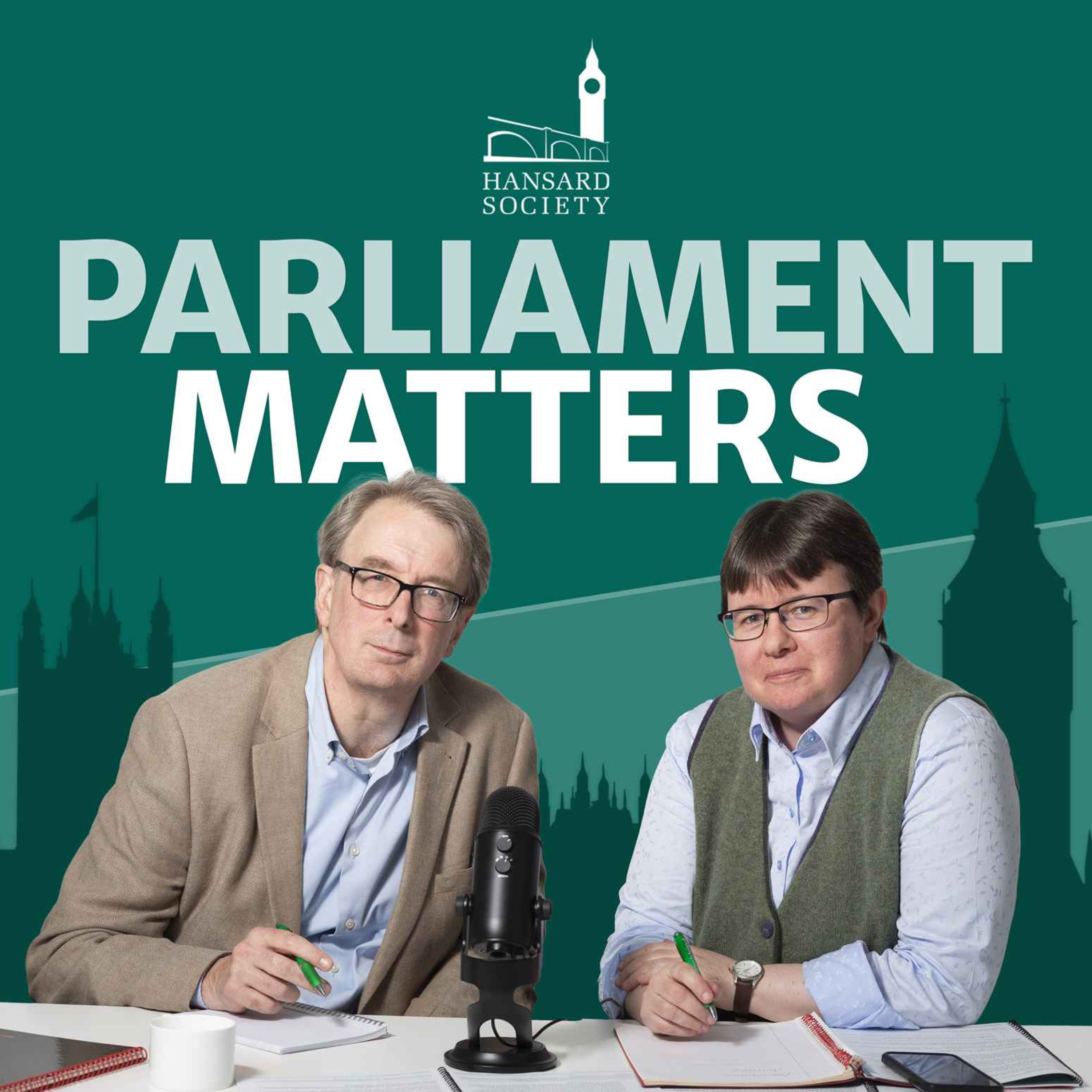
Parliament Matters
Hansard Society
0
Join two of the UK's leading parliamentary experts, Mark D'Arcy and Ruth Fox, as they guide you through the often mysterious ways our politicians do business and explore the running controversies about the way Parliament works. Each week they analyse how laws are made and ministers held accountable by the people we send to Westminster. They debate topical issues, look back at key historical events, and discuss the latest research on democracy and Parliament.
Επεισόδια
-
 PMQs: Parliament Matters Questions 17.09.2026 1ώ 9λRecorded at Queen Mary University of London as part of Student Week, welcoming students at the start of the new academic year, this special live edition features three expert guests: historian Dr Robert Saunders; Private Members’ Bill specialist Dr Daniel Gover; and historian Dr Catherine Haddon, a senior fellow at the Institute for Government and former Queen Mary student.The panel begins by assessing the new Burnham Government. Has the Prime Minister’s more optimistic, personable style marked a substantive break with Keir Starmer or merely improved the presentation? They consider the fiscal and geopolitical constraints facing the Government; Burnham’s management of Labour MPs; the balance of power among senior ministers and advisers; relations with the civil service; and whether experience as a metro mayor is useful preparation for Downing Street.The students then put the questions. Should Britain cap political donations after Reform UK received unprecedented sums from two billionaires, and would retrospective legislation be justified? Is the emerging five-party system here to stay, and can Parliament’s rules properly accommodate smaller parties? Will social media displace traditional journalism, or make trusted scrutiny and fact-checking more important?The discussion also covers whether Parliament has too many recesses; the tension between national infrastructure needs and local opposition; devolution, separatism and the future of the Union; and reform of Private Members’ Bills. Finally, the panel recommends essential reading for students of Parliament, from political diaries and Anthony Trollope to contemporary accounts by Rory Stewart and Jess Phillips._____🎓 Learn more using our resources for the issues mentioned in this episode. ❓ Send us your questions about Parliament: ✅ Subscribe to our newsletter. 📱 Follow us across social media @HansardSociety / @hansardsociety.bsky.social £ - Support the Hansard Society and this podcast by making a donation today. Parliament Matters is a Hansard Society production supported by the Joseph Rowntree Charitable Trust. Presenters: Mark D’Arcy and Ruth FoxProducer: Richard TownsendSound mixing: Matthew Kowalczuk, Queen Mary University of London Hosted on Acast. See acast.com/privacy for more information.
 -
MPs reject the assisted dying bill: What happened, and what next? 11.09.2026 53λMPs have rejected the assisted dying bill – but why did a proposal they had previously supported lose this time, and what happens now? Andrew Lewin MP, a supporter of the bill, hot-foots it from the Chamber to give us his immediate reaction. He describes the atmosphere when the result was announced, offers his explanation for the bill’s defeat and considers whether and how the campaign to change the law might continue. Back in the studio, Hansard Society researcher Matthew England joins us to crunch the numbers. Turnout proved crucial to the final result: was the bill defeated because MPs changed their minds, or because previous supporters stayed away? We explore why support has slowly ebbed in the Commons and examine the substantive and procedural problems that confronted the bill. Could there now be a backlash against the House of Lords over the role Peers played in derailing the legislation? Might the Commons seek to curb the Upper House’s powers or was the Lords simply doing its job by scrutinising a deeply consequential and technically complex bill? And with this latest proposal defeated, is assisted dying now off Parliament’s agenda for the foreseeable future? Plus, Nigel Farage told Reform UK’s conference that he would declare a “national emergency” over the small boats crisis. But would such a declaration actually give a Prime Minister any additional legislative powers? And Lee Anderson accused MPs of being lazy and suggested that, under a Reform government, Parliament would sit seven days a week to force through its legislative programme. What would that mean in practice for the management – and, more importantly, the scrutiny – of parliamentary business? Would MPs, officials and the wider parliamentary machinery be able to sustain it? And even if legislation were driven rapidly through the Commons, what would happen when it reached the House of Lords?______ 🎓 Learn more using our resources for the issues mentioned in this episode. ❓ Send us your questions about Parliament: ✅ Subscribe to our newsletter. 📱 Follow us across social media @HansardSociety / @hansardsociety.bsky.social £ - Support the Hansard Society and this podcast by making a donation today. Parliament Matters is a Hansard Society production supported by the Joseph Rowntree Charitable Trust. Presenters: Mark D’Arcy and Ruth Fox Producer: Richard Townsend Hosted on Acast. See acast.com/privacy for more information.
-
Andy Burnham’s rewired state: Can Parliament provide the circuit breaker? 03.09.2026 56λAndy Burnham made his despatch box debut as Prime Minister in the House of Commons this week with one of the longest ministerial statements on record and a promise to strengthen the Prime Minister’s grip on Whitehall while transferring power and resources away from it. We examine the new Office of the Prime Minister and Cabinet and No. 10 North. Are they instruments of genuine decentralisation or a more powerful prime-ministerial centre with a Manchester outpost? If Burnham wants Parliament to become the country’s “circuit breaker”, what powers, information and resources will MPs need to do the job? We also ask whether “Parliament, not the courts” means clearer ministerial responsibility or executive power that is harder to challenge and what it all might mean for the future of judicial review. And will devolution without stronger scrutiny simply create powerful mayors and council leaders with weak legislative checks? Plus: Keir Starmer leaves Parliament, Labour MPs contest three select committee chairships, and more than 6,000 written parliamentary questions land after the summer recess. At an estimated £219 each, why are a handful of MPs generating such a large bill and is it time for a recess cap?_____ 🎓 Learn more using our resources for the issues mentioned in this episode. ❓ Send us your questions about Parliament: ✅ Subscribe to our newsletter. 📱 Follow us across social media @HansardSociety / @hansardsociety.bsky.social £ - Support the Hansard Society and this podcast by making a donation today. Parliament Matters is a Hansard Society production supported by the Joseph Rowntree Charitable Trust. Presenters: Mark D’Arcy and Ruth Fox Producer: Richard Townsend Hosted on Acast. See acast.com/privacy for more information.
-
Joanna Cherry: The SNP, Westminster, and a decade of political battles 20.08.2026 41λJoanna Cherry joins us this week to discuss her newly published memoir, in which she looks back on some of the most contentious battles in British and Scottish politics in the last two decades. She arrived at Westminster in 2015 as one of 56 SNP MPs elected in a historic landslide that transformed Scottish politics and made the SNP the third-largest party in the House of Commons. She describes the excitement – and occasional hostility – that greeted the new contingent and explains why her experience at Westminster left her believing that the Scottish Parliament could learn a lot from the Commons, particularly when it comes to cross-party working, debate, dissent, and committee scrutiny. One of the central arguments of Cherry’s memoir is that the SNP repeatedly failed to exploit moments of political leverage and that it pursued the wrong strategy for securing another Scottish independence referendum after the loss in 2014. She sets out what she thinks the party could have done differently and why she believes support for independence has now become increasingly detached from support for the SNP itself. Her national profile grew dramatically during the Brexit years. As a constitutional lawyer, Cherry became the lead petitioner in the Scottish legal challenge to Boris Johnson’s 2019 prorogation of Parliament. She explains why the case was brought in Scotland, why she believed the challengers would ultimately win, and what it felt like when the Supreme Court unanimously ruled the prorogation unlawful. The conversation also turns to the bitter internal disputes that marked Cherry’s later years in the SNP. She discusses her relationship with Nicola Sturgeon, her concerns about the SNP’s governance and finances, the treatment of her former mentor Alex Salmond, and the fierce arguments over reform of Scotland’s gender recognition laws. Having lost her seat at Westminster in 2024 and subsequently left the SNP, is Joanna Cherry finished with frontline politics? Perhaps not. She doesn’t rule out a return under a new party leader and a new culture of independent thinking.🎓 Learn more using our resources for the issues mentioned in this episode. ❓ Send us your questions about Parliament: ✅ Subscribe to our newsletter. 📱 Follow us across social media @HansardSociety / @hansardsociety.bsky.social £ - Support the Hansard Society and this podcast by making a donation today. Parliament Matters is a Hansard Society production supported by the Joseph Rowntree Charitable Trust. Presenters: Mark D’Arcy and Ruth Fox Producer: Richard Townsend Hosted on Acast. See acast.com/privacy for more information.
-
Unparliamentary: Colourful tales from the Canadian Parliament 06.08.2026 39λCanada’s Parliament shares its Westminster roots with the UK, but it has developed its own distinctive traditions, procedures and political culture. In this episode, Charlie Feldman – former President of the Canadian Study of Parliament Group and author of Unparliamentary, a collection of stories from the stranger corners of Canadian political history – explains how the federal Parliament in Ottawa reflects its British inheritance while developing a character all of its own. The conversation moves beyond constitutional structures to the parliamentary incidents that never quite make it into procedural textbooks. From fistfights between MPs that left chunks torn from a Victorian beard to a full-size salmon being carried across the chamber and deposited on the Prime Minister’s desk, these stories are entertaining in their own right, while illustrating that even the grandest legislatures are not immune to moments of absurdity or behaviour that falls well short of the dignity their proceedings are meant to embody. Charlie also explores some of the more unusual chapters in the Canadian Parliament’s history, including the era when senators were required to adjudicate divorce petitions, with medically trained members examining evidence in an intrusive manner that would be unimaginable today. He discusses the quirks of bilingual parliamentary proceedings and reveals the truth behind the famous story of an MP who allegedly read his entire book into Hansard to secure a free French translation. The episode also examines Parliament Hill’s more unconventional residents. Charlie recounts the contrasting fortunes of its well-loved colony of feral cats and an infestation of rabbits that reportedly survived repeated gunfire from the window of the Speaker’s office. Finally, the discussion looks beyond procedure to Parliament’s physical home. Drawing on visits to legislatures across Europe, Charlie reflects on the challenge of preserving historic parliamentary buildings while creating safe, accessible and modern workplaces. Canada’s ambitious restoration of Parliament Hill offers valuable lessons for Westminster as it confronts the long-term renewal of its own ageing estate.🎓 Learn more using our resources for the issues mentioned in this episode. ❓ Send us your questions about Parliament: ✅ Subscribe to our newsletter. 📱 Follow us across social media @HansardSociety / @hansardsociety.bsky.social £ - Support the Hansard Society and this podcast by making a donation today. Parliament Matters is a Hansard Society production supported by the Joseph Rowntree Charitable Trust. Presenters: Mark D’Arcy and Ruth Fox Producer: Richard Townsend Hosted on Acast. See acast.com/privacy for more information.
-
Labour’s last chance saloon? Burnham’s new Cabinet faces familiar parliamentary problems 23.07.2026 1ώ 2λAndy Burnham has unveiled his ministerial team. So, we assess what his appointments reveal about the Government’s priorities, the political calculations behind them, and the parliamentary tests that lie ahead. We begin with the appointment of the new Chief Whip, Anneliese Midgley MP, who takes on one of Westminster’s toughest jobs despite having just two years’ parliamentary experience and no experience on the front bench. We also consider the return of familiar faces to Cabinet, the promotion of newer MPs, the creation of a Cabinet-level role for artificial intelligence, and the implications of the reshuffle for select committees, the House of Lords and the Opposition front benches. Andy Burnham has also reorganised the machinery of government. Professor Jon Davis, Professor of Government at King’s College London, joins us to explain why changes to Whitehall departments matter, how they shape decision-making at the heart of government, and why reorganising government can have consequences that last long after individual ministers have moved on. With Parliament now in summer recess, Ruth and Mark also recommend a selection of political books to keep you entertained over the holidays – whether you’re heading for the beach, relaxing in the garden or simply taking shelter from the latest heatwave. Although Parliament is taking a break, Parliament Matters isn't. Keep an eye on your podcast feed throughout August for several special episodes. Unless Parliament is recalled or major political developments demand an emergency edition, we'll return with our regular weekly analysis when Parliament reconvenes in September.____ 🎓 Learn more using our resources for the issues mentioned in this episode. ❓ Send us your questions about Parliament: ✅ Subscribe to our newsletter. 📱 Follow us across social media @HansardSociety / @hansardsociety.bsky.social £ - Support the Hansard Society and this podcast by making a donation today. Parliament Matters is a Hansard Society production supported by the Joseph Rowntree Charitable Trust. Presenters: Mark D’Arcy and Ruth FoxProducer: Richard Townsend Hosted on Acast. See acast.com/privacy for more information.
-
How do we protect politicians in a dangerous age? 17.07.2026 1ώ 11λFollowing the murder of Ann Widdecombe, we reflect on the dangers facing those in Parliament and public life. Earlier this year, former Lord Chancellor Sir Robert Buckland was appointed to lead the independent review into the circumstances surrounding the murder of Sir David Amess MP, examining whether any opportunities to prevent his death were missed. He joins us to discuss the risks facing politicians today, what more can be done to improve their safety, and how those protections can be strengthened without undermining the close relationship between MPs and the constituents they serve. We also look back at Ann Widdecombe's parliamentary career, including her memorable appearance at the Hansard Society's 2009 House of Commons Speaker election hustings, where she demonstrated the wit, independence and commitment to Parliament that defined her public life. As Sir Keir Starmer names 26 new Peers, we examine the future of the House of Lords. This week, the Hansard Society hosted the first major speech by the Lord Speaker since his election earlier this year. In a wide-ranging address, he warned of the constitutional risks of embarking on poorly conceived reform of the Upper House, describing the Lords as a "constitutional trip switch" capable of forcing a rethink of flawed legislation that has not received adequate scrutiny in the Commons. Anyone seeking to rewire the system, he argued, must consider whether a reformed second chamber would continue to provide that safeguard – or instead "blow a constitutional fuse". We also discuss the newly published report on Retirement and Participation in the House of Lords, which proposes a phased mandatory retirement age, requiring all Peers to retire at 80 by 2034, alongside a minimum participation requirement that could see inactive members removed from the House. And with the new Burnham Government expected to emerge from its chrysalis next week, we ask whether the House of Commons should have postponed its summer recess to scrutinise the incoming Prime Minister. We explore the constitutional mechanics and political realities of appointing a new Government and consider what Parliament's priorities should be when MPs return in September to begin holding the new administration to account.___ 🎓 Learn more using our resources for the issues mentioned in this episode. ❓ Send us your questions about Parliament: ✅ Subscribe to our newsletter. 📱 Follow us across social media @HansardSociety / @hansardsociety.bsky.social £ - Support the Hansard Society and this podcast by making a donation today. Parliament Matters is a Hansard Society production supported by the Joseph Rowntree Charitable Trust. Presenters: Mark D’Arcy and Ruth Fox Producer: Richard Townsend Hosted on Acast. See acast.com/privacy for more information.
-
Nigel Farage leaves Parliament: What now happens to the standards investigation? 09.07.2026 1ώ 14λNigel Farage has quit the House of Commons to force a by-election in his constituency. In a blistering attack on what he called the media “pile-on” and a political stitch-up by the Westminster establishment, he insisted that the “people of Clacton should be the judge of my actions.” So, this week we dissect his “resignation” statement and ask whether he has a point. Is Farage the victim of an establishment determined to bring him down, or is he simply struggling under the weight of mounting scrutiny? We compare his case with other high-profile political controversies and examine whether his arguments stand up. We also explain what his departure means for the Parliamentary Commissioner for Standards’ investigation into his conduct. We explore the standards process, why the investigation is now paused, what happens if Farage wins or loses the by-election, and the range of possible outcomes if the investigation resumes. Just before we began recording, Andy Burnham sent Labour MPs a lengthy leadership pitch promising a different style of government: a stronger voice for backbenchers, a more collaborative approach to policymaking, changes in the approach of the Whips' Office, and a renewed focus on Parliament itself. We analyse what he's proposing and what it might mean in practice. Plus, we sit down with Labour MP Alex Sobel, Chair of the Fair Votes All-Party Parliamentary Group, to discuss his bid to amend the Representation of the People Bill to establish a National Commission on Electoral Reform. He explains why he believes proportional representation is essential to restoring trust in British politics, assesses the prospects for winning Labour over to electoral reform, and argues that the Government should go even further than the Rycroft Review recommendations to tighten the rules on political donations.____ 🎓 Learn more using our resources for the issues mentioned in this episode. ❓ Send us your questions about Parliament: ✅ Subscribe to our newsletter. 📱 Follow us across social media @HansardSociety / @hansardsociety.bsky.social £ - Support the Hansard Society and this podcast by making a donation today. Parliament Matters is a Hansard Society production supported by the Joseph Rowntree Charitable Trust. Presenters: Mark D’Arcy and Ruth FoxProducer: Richard Townsend Hosted on Acast. See acast.com/privacy for more information.
-
New PM, new Clerk of the House of Commons: A new chapter at Westminster? 02.07.2026 1ώ 8λWith a new Prime Minister preparing to take office and the Commons appointing its first female Clerk, we discuss these two pivotal appointments that will help shape how Parliament works in the years ahead. We explore the challenges they will face in managing Parliament, examine fresh warnings from the Lord Speaker that Westminster’s restoration plans risk stalling for lack of political support, and hear from Baroness Hayter about her bid to close a loophole in the lobbying laws. ______ As Sir Keir Starmer prepares to hand over power to Andy Burnham, attention is turning to the shape of the incoming government. Beyond the headline Cabinet appointments, who will take on the key parliamentary management roles in No 10 and the Commons – and why do those choices matter? Meanwhile, speculation continues that former Foreign Secretary David Miliband could return to his old job in government, but this time from the House of Lords. If so, how could MPs scrutinise a Foreign Secretary who cannot speak in the Commons? Ruth and Mark revisit proposals considered when David Cameron held the post and ask whether Parliament is any closer to resolving the problem. The Commons has also announced its first female Clerk of the House. Eve Samson will take up the role in October as the Commons’ most senior official. We trace her clerkly career and look at the formidable challenges awaiting her, from supporting MPs through political change to overseeing one of Westminster’s biggest institutional headaches. The headache is, of course, the Restoration and Renewal of the Palace of Westminster. The Lord Speaker, Lord Forsyth, has warned that there is no political consensus – across parties or both Houses - to support the scale and cost of the programme. But in a letter published this week he highlights the “eye-watering” costs of delaying decisions about the renovation programme. Finally, while the bill to legalise assisted dying continues to dominate attention, there are many other Private Members Bills starting their journey through Parliament. Among them is one from the Labour peer Baroness Hayter, who wants to close a loophole in lobbying rules. She joins the podcast to explain why reform is needed and what she hopes her Bill will achieve. ____ 🎓 Learn more using our resources for the issues mentioned in this episode. ❓ Send us your questions about Parliament: ✅ Subscribe to our newsletter. 📱 Follow us across social media @HansardSociety / @hansardsociety.bsky.social £ - Support the Hansard Society and this podcast by making a donation today. Parliament Matters is a Hansard Society production supported by the Joseph Rowntree Charitable Trust. Presenters: Mark D’Arcy and Ruth Fox Producer: Richard Townsend Hosted on Acast. See acast.com/privacy for more information.
-
The Burnham question: A new approach to whipping Westminster? 25.06.2026 47λWhat would an Andy Burnham government actually look and feel like? This week we explore how Andy Burnham might govern, drawing on his experience as a Cabinet minister, his time as Mayor of Greater Manchester, and his own writings on constitutional reform. We ask whether a Burnham government would take a fundamentally different approach to Parliament – particularly the use of the party whip – and what that could mean for MPs and the balance of power at Westminster. We also explore why dozens of Presentation Bills were introduced this week, how this legislative procedure works, and whether any of these bills have a realistic chance of becoming law. _________ Andy Burnham has long been a critic of the parliamentary whipping system, arguing that it concentrates power in too few hands and weakens the role of elected MPs. Could a Burnham government take a more relaxed approach to party discipline? Might MPs be given greater freedom to represent their constituents, or would the realities of governing quickly outweigh the case for reform? Drawing on newly published research by parliamentary rebellions expert Professor Philip Cowley, we explore what parliamentary management might look like under a Burnham premiership.The parliamentary whip is about far more than securing votes in the division lobbies. Might it allow greater scope for MPs with relevant expertise or constituency interests to serve on legislative committees, invest more in the pastoral management and wellbeing of Labour MPs, and place greater emphasis on career development and job satisfaction within the Parliamentary Labour Party? Could a Burnham government take a more collegiate approach to these responsibilities? Or would the practical demands of governing mean that traditional methods of party management prevail?We also turn our attention to one of Westminster’s lesser-known legislative procedures: Presentation Bills. These are bills that are often never debated and, in some cases, are never even drafted. While they rarely become law, they provide MPs with a valuable opportunity to raise the profile of an issue, signal political intent, and build support for future reform. We discuss how MPs use Presentation Bills strategically, what they can – and cannot – achieve, how many have become law in recent years, and why they remain an important part of an MP’s parliamentary toolkit.____ 🎓 Learn more using our resources for the issues mentioned in this episode. ❓ Send us your questions about Parliament: ✅ Subscribe to our newsletter. 📱 Follow us across social media @HansardSociety / @hansardsociety.bsky.social £ - Support the Hansard Society and this podcast by making a donation today. Parliament Matters is a Hansard Society production supported by the Joseph Rowntree Charitable Trust. Presenters: Mark D’Arcy and Ruth FoxProducer: Richard Townsend Hosted on Acast. See acast.com/privacy for more information.
-
Andy Burnham’s March on Westminster: How Could He Become Prime Minister? 19.06.2026 1ώ 6λThree by-elections delivered three very different results this week. To discuss the implications, we are joined by Professor Philip Cowley, a leading expert on MPs, party discipline and the realities of parliamentary power. The Conservatives secured their first Scottish by-election victory since 1967, taking Aberdeen South from the SNP. Meanwhile, the SNP held on in Arbroath and Broughty Ferry, limiting the damage from what could have been a bruising night. But it is Andy Burnham’s Labour victory in Makerfield that could have the biggest long-term consequences for British politics. We examine the political and parliamentary choreography required as Burnham begins his march back to Westminster, and we assess whether a carefully managed transition from Keir Starmer is possible, or even desirable. Are we witnessing the opening moves in a political dance of death between a sitting Prime Minister and the man many now see as his likely successor? And if Labour’s leadership question is approaching a decisive moment, which historical precedent is most relevant? Will it resemble the swift but dignified end of Margaret Thatcher’s premiership; the chaotic collapse of Boris Johnson’s government; or the slower, more managed departure of Theresa May? We explore the strategic arguments for and against a full Labour leadership contest. Would a competitive election strengthen Burnham’s authority and legitimacy, or expose divisions within the party at precisely the wrong moment? How much influence will Labour’s members, affiliates, and MPs have over the process? And would Burnham be better served by assuming the leadership quickly, or by using a managed transition to develop a governing programme and build a team around him? We also discuss the challenges Burnham could face if he does reach Number 10. Despite his prominence, relatively little is known about how he would govern nationally. What difficulties might he encounter in managing the parliamentary party? And what would a change in leadership mean for the wider workings of Parliament, from ministerial reshuffles to the balance of power across the select committee corridor? Finally, attention turns to Parliament’s agenda. The priority order for Private Members’ Bills in both the Commons and Lords is now clear. MPs will return to the assisted dying bill on 11 September, but it enters the new session only second in the queue rather than first. What difference could that make to the parliamentary tactics surrounding the legislation? And which other Private Members’ Bills deserve close attention in the months ahead?_______________ 🎓 Learn more using our resources for the issues mentioned in this episode. ❓ Send us your questions about Parliament: ✅ Subscribe to our newsletter. 📱 Follow us across social media @HansardSociety / @hansardsociety.bsky.social £ - Support the Hansard Society and this podcast by making a donation today. Parliament Matters is a Hansard Society production supported by the Joseph Rowntree Charitable Trust. Presenters: Mark D’Arcy and Ruth FoxProducer: Richard Townsend Hosted on Acast. See acast.com/privacy for more information.
-
Brexit, 10 years on: Parliament and the democratic crisis 11.06.2026 52λThis month marks the tenth anniversary of the Brexit referendum – a vote that unleashed four years of extraordinary political turmoil. Judges were branded "enemies of the people", MPs denounced as "saboteurs", political parties fractured, and Prime Ministers rose and fell amid relentless parliamentary drama. Historian Dr Robert Saunders of Queen Mary University of London has written a new paper arguing that Brexit was more than a bitter political dispute: it amounted to a full-blown democratic crisis. In this episode, Robert joins Ruth and Mark to explore why Britain’s political system struggled to interpret and implement the referendum instruction, and why Parliament and the major parties appear to have learned so little from the experience. The conversation then turns to current events. In the wake of the horrific attacks in Southampton and Belfast, they ask whether the same political and social forces that fuelled the Brexit revolt are now at play over immigration. Robert last appeared on the podcast at Christmas to discuss why the job of Prime Minister increasingly looks impossible. With Sir Keir Starmer now facing fresh turmoil following the resignation of the Defence Secretary, John Healey, the discussion returns to that theme: could this latest setback prove fatal to Starmer’s premiership, or might he survive as a “Zombie Prime Minister”, still in office but with his authority destroyed? _____ 🎓 Learn more using our resources for the issues mentioned in this episode. ❓ Send us your questions about Parliament: ✅ Subscribe to our newsletter. 📱 Follow us across social media @HansardSociety / @hansardsociety.bsky.social £ - Support the Hansard Society and this podcast by making a donation today. Parliament Matters is a Hansard Society production supported by the Joseph Rowntree Charitable Trust. Presenters: Mark D’Arcy and Ruth Fox Producer: Richard Townsend Hosted on Acast. See acast.com/privacy for more information.
-
The Cabinet Manual: Why Britain's constitutional "highway code" needs updating 04.06.2026 1ώ 3λThe Cabinet Manual has been described as the “highway code” of the UK constitution, a guide that brings together the laws, conventions, precedents and procedures under which the Government operates. First published in 2011, it has not been updated since, despite a decade and a half of constitutional change. So why is the Government revising it now? What needs updating? Should Parliament have a role in approving it? And how important is the Manual as a guide to the UK’s unwritten constitution? The Government has described its response to the Mandelson Humble Address as an “unprecedented piece of Government transparency”. But after publishing more than 1,500 pages of documents relating to Lord Mandelson’s appointment as Ambassador to the United States, what have MPs and the public actually learned? Has the disclosure shed any light on the key questions that prompted Parliament to demand the papers in the first place? And, with the exercise costing at least £1 million, what lessons should be learned about how Humble Addresses are handled in future? The House of Commons Administration has been tasked with delivering significant savings through its new Savings and Improvement Programme. But could cost-cutting come at the expense of Parliament’s connection with the public? We examine proposals affecting Parliament’s outreach and participation work and ask whether a shift towards digitally focused engagement is the right approach. We also look at how staffing priorities have changed across Parliament over the last decade and explore what those choices reveal about Parliament’s evolving demands and priorities. _____ 🎓 Learn more using our resources for the issues mentioned in this episode. ❓ Send us your questions about Parliament: ✅ Subscribe to our newsletter. 📱 Follow us across social media @HansardSociety / @hansardsociety.bsky.social £ - Support the Hansard Society and this podcast by making a donation today. Parliament Matters is a Hansard Society production supported by the Joseph Rowntree Charitable Trust. Presenters: Mark D’Arcy and Ruth Fox Producer: Richard Townsend Hosted on Acast. See acast.com/privacy for more information.
-
The £5m question: Who funds our politicians? 28.05.2026 21λIn this episode, we explore the rules governing MPs’ financial interests, gifts and donations, as Reform UK leader Nigel Farage faces questions over a £5 million gift from cryptocurrency billionaire Christopher Harborne. Ruth and Mark are joined by Duncan Hames, a former MP and now Director of UK Policy at Transparency International, to ask whether the current transparency regime is working, whether a requirement to declare large gifts is enough on its own to protect public confidence, and whether a fixed cap on donations should also be put in place. At a time when political donations, gifts and hospitality are under intense scrutiny, we look at what the House of Commons Code of Conduct says MPs must declare, and why the rules require members to register financial interests and benefits that might reasonably be thought to influence their actions, speeches or votes. We also examine the wisdom of moving from a rules-based system to a principles-based system. Duncan Hames says that transparency matters because it offers a crucial safeguard against corruption and dependency. But while transparency is essential, he argues that it is no longer sufficient. With political parties and individual politicians increasingly reliant on wealthy donors, he says the real question is not just whether money is declared, but whether gifts and donations of this scale should be permitted at all. He points to international examples of donation caps and argues that the case for limits applies to domestic as well as overseas donors. We also explore the practical dilemmas MPs face when deciding what to register, the role of advice from parliamentary authorities, and whether the sanctions for breaches of the rules in both Houses are strong enough. 🎓 Learn more using our resources for the issues mentioned in this episode. ❓ Send us your questions about Parliament: ✅ Subscribe to our newsletter. 📱 Follow us across social media @HansardSociety / @hansardsociety.bsky.social £ - Support the Hansard Society and this podcast by making a donation today. Parliament Matters is a Hansard Society production supported by the Joseph Rowntree Charitable Trust. Presenters: Mark D’Arcy and Ruth Fox Producer: Richard Townsend Hosted on Acast. See acast.com/privacy for more information.
-
Is the Government censoring the Mandelson Papers? 21.05.2026 1ώ 10λThe row over Lord Mandelson’s appointment as Britain’s ambassador to Washington flared up again this week after the Intelligence and Security Committee (ISC) accused the Government of improperly redacting documents linked to his appointment. Back in February, ministers were forced to release papers under a Humble Address to the King, with the ISC tasked with deciding what could be withheld on national security or diplomatic grounds. But the Committee now says material has been removed for other reasons not covered by the agreement. Senior ISC member Sir Jeremy Wright MP challenged ministers in the Commons through an Urgent Question, before speaking to us about his concerns and the Government’s response. The annual Private Members’ Bill ballot – Westminster’s version of legislative bingo – has also taken place, with MPs jostling for one of the precious top spots that can offer a realistic chance of changing the law. The big question now is whether one of those successful MPs will choose to bring back the assisted dying bill. And we untangle the Government’s latest Russia sanctions announcement, after ministers caused confusion over whether the UK was finally banning oil products refined in third countries using Russian crude. We explain how the Russia sanctions regime works, and why – at the very moment the new sanctions came into force – ministers also issued a general trade licence exempting diesel and jet fuel from the restrictions. The Government insists the exemption is only temporary but cannot say when it will end. We explore why Parliament gets a vote on the sanctions regulations themselves, but not on the general licences that can effectively water them down, and what that says about the gap between headline sanctions announcements and the quieter reality of how they are implemented in practice. The discussion also raises wider questions about how often these behind-the-scenes exemptions are being used, including in areas such as legal services, diamonds, steel, software and technology._____🎓 Learn more using our resources for the issues mentioned in this episode. ❓ Send us your questions about Parliament: ✅ Subscribe to our newsletter. 📱 Follow us across social media @HansardSociety / @hansardsociety.bsky.social £ - Support the Hansard Society and this podcast by making a donation today. Parliament Matters is a Hansard Society production supported by the Joseph Rowntree Charitable Trust. Presenters: Mark D’Arcy and Ruth FoxProducer: Richard Townsend Hosted on Acast. See acast.com/privacy for more information.
-
Labour’s leadership tangle: What does it mean for Parliament? 15.05.2026 1ώ 13λA battle for Downing Street touched off by a ministerial resignation, a chunky new King’s Speech, and an increasingly unpredictable political environment provide plenty for us to discuss with our special guest, Professor Meg Russell, the former Director of the Constitution Unit.We begin with the Labour leadership contest, which was unfolding in real time as the podcast was recorded. With Labour Party rules, parliamentary rules and election law tangling together in the intricate battle to be Prime Minister, we explore how Labour’s rulebook could shape the outcome and the prospects for the Mayor of Greater Manchester, Andy Burnham to win a by-election, return to Westminster and enter the leadership race.Meg Russell asks a broader question: in an era of devolved politics, should parties make it easier for big figures such as metro mayors to stand for the leadership without the upheaval of first fighting a by-election?We also cast a preliminary eye over the legislation unveiled in the King’s Speech. Could the NHS Reform Bill give Wes Streeting a parliamentary platform to strengthen his credentials as a future Prime Minister? How will the new bill to remove peerages navigate the difference between a seat in the House of lords and a peerage? Should the Representation of the People Bill be amended to impose penalties on councillors who resign within hours of being elected? And Meg – a former advisor to Blair-era Leader of the House of Commons, Robin Cook MP – describes how governments assemble a legislative programme behind the scenes.Finally, with Britain entering an era of fragmented five, or even six-party politics, the discussion turns to the future of the constitution itself. Do Westminster parties now share an interest in recasting parliamentary rules and strengthening constitutional safeguards?Meg Russell, stepping down after a decade leading the Constitution Unit, argues that the unpredictability of the electoral situation means any party could emerge dominant, diminished or anywhere in between, after the next election. If that is the case, she suggests, it is now in the interests of all the parties to update the rules of our parliamentary system so that it treats all parties fairly. Some of these issues, including how parties select their leaders and the way legislation is developed, will be discussed next month (24-25 June) at the Constitution Unit's annual online conference, The Constitution under Labour. You need to sign up to get the online link to watch each of the sessions. Parliament Matters will be represented as Ruth will be speaking on a panel with Lord Falconer about developing policy and legislating for difficult issues. ____ 🎓 Learn more using our resources for the issues mentioned in this episode.❓ Send us your questions about Parliament: ✅ Subscribe to our newsletter. 📱 Follow us across social media @HansardSociety / @hansardsociety.bsky.social £ - Support the Hansard Society and this podcast by making a donation today. Parliament Matters is a Hansard Society production supported by the Joseph Rowntree Charitable Trust. Presenters: Mark D’Arcy and Ruth FoxProducer: Gareth Jones Hosted on Acast. See acast.com/privacy for more information.
-
What now? The local election fallout hits Westminster 09.05.2026 41λAfter an awful set of elections for Labour across England, Scotland and Wales, are the Prime Minister’s days numbered? Could the Cabinet revolt? Might a rival formally launch a leadership challenge? Or might it take another defining crisis – a further final straw – to trigger a revolt by the parliamentary foot soldiers? We also examine how Labour’s leadership rules operate, including the nomination requirements for a leadership challenger to trigger a race. A key decision would be timing: would any contest timetable give Greater Manchester Mayor, Andy Burnham, the opportunity to attempt a return to the Commons. The elections have demonstrated that Labour is beset by political rivals on all sides – Reform on the right flank, the Greens, Lib Dems and SNP on the left, and now Plaid Cymru in what historically was its Welsh heartland. So, would an alternative leader offer a more effective response to these multiple threats than Sir Keir Starmer? Meanwhile the Scottish and Welsh results raise fresh political and constitutional tensions for the UK Government and Parliament to address. Will invigorated nationalist governments in Edinburgh and Cardiff start picking more fights with Westminster over policy, money and legislative consent? And in Cardiff, will the process of installing a new and non-Labour Welsh Government go smoothly? With no party winning an overall majority in Wales, it looks like there will be a Plaid-led administration: but it may find itself mired in week-to-week deal-making with smaller parties, and subject to professional fouls at key moments like the Budget. Could that provide a taste of things to come at Westminster, after the next general election?_____ 🎓 Learn more using our resources for the issues mentioned in this episode. ❓ Send us your questions about Parliament: ✅ Subscribe to our newsletter. 📱 Follow us across social media @HansardSociety / @hansardsociety.bsky.social £ - Support the Hansard Society and this podcast by making a donation today. Parliament Matters is a Hansard Society production supported by the Joseph Rowntree Charitable Trust. Presenters: Mark D’Arcy and Ruth Fox Producer: Richard Townsend Hosted on Acast. See acast.com/privacy for more information.
-
Keir Starmer’s week of parliamentary torture over Mandelson appointment 24.04.2026 1ώ 11λKeir Starmer has faced “ordeal by Parliament” this week. A tense statement in the House of Commons over his handling of Peter Mandleson’s nomination as Ambassador to the United States was followed by an emergency debate and then an awkward session of PMQs. Meanwhile the Foreign Affairs Committee held a series of hearings to pick over the PM’s account of what he knew about Mandelson’s security vetting, and when he knew it.We are joined this week by veteran parliamentary lobby journalist Tony Grew (the founder of @PARLYapp on Twitter/X) to dissect a rapidly unfolding political drama that’s beginning to resemble a full-blown parliamentary crisis.We examine Starmer’s account, the Foreign Affairs Committee’s performance, and the testimony of its key witness, recently sacked Foreign Office Permanent Secretary Sir Ollie Robins, alongside the growing unease among Labour MPs.With prorogation looming, questions remain over timing. Could the suspension of Parliament be used to sidestep another PMQs on Wednesday 29 March? Will the Opposition try to prolong proceedings on remaining legislation to force Starmer back to the Despatch Box. Or might they prefer to be able to accuse him of being “frit.”And as the first session of the 2024 Parliament draws to a close, we discuss the emerging personalities shaping the Commons. Spoiler: one of them is a dog!____ 🎓 Learn more using our resources for the issues mentioned in this episode. ❓ Send us your questions about Parliament: ✅ Subscribe to our newsletter. 📱 Follow us across social media @HansardSociety / @hansardsociety.bsky.social £ - Support the Hansard Society and this podcast by making a donation today. Parliament Matters is a Hansard Society production supported by the Joseph Rowntree Charitable Trust. Presenters: Mark D’Arcy and Ruth FoxProducer: Richard Townsend Hosted on Acast. See acast.com/privacy for more information.
-
Dynamic alignment and Henry VIII powers: What will the Government’s EU reset mean for Parliament? 17.04.2026 1ώA bill to deliver the Government’s proposed “EU reset” is set to be a centrepiece of May’s King’s Speech. It will reportedly give Ministers powers to update UK law in line with certain EU rules (so-called “dynamic alignment”) in areas such as animal and plant health (known as Sanitary and Phytosanitary (SPS)), energy co-operation and emissions trading. Much of this is likely to be done through delegated legislation, including the use of controversial Henry VIII powers, allowing Ministers to amend primary legislation with limited parliamentary scrutiny. We are joined by Professor Catherine Barnard (University of Cambridge) to explore what dynamic alignment really means, why the UK is already tracking some EU rules, and whether this approach is a pragmatic economic necessity or a sidestepping of Parliament. We also discuss how Westminster and the devolved legislatures will need to adapt if they are to spot and shape policy before it is set in legislative stone by the European Commission.In a rare show of resistance, Parliament’s usually low-profile Ecclesiastical Committee has blocked a package of reforms to Church of England governance. What’s behind the clash over accountability and safeguarding and why have delegated powers become a sticking point here too?As the parliamentary session draws to a close, attention turns to prorogation. Once Parliament is prorogued, MPs and Peers cannot be recalled except in the most exceptional circumstances. In an increasingly volatile world, is it wise to shut down accountability for a fortnight? We explore the risks and suggest a possible way around the problem._____ 🎓 Learn more using our resources for the issues mentioned in this episode. ❓ Send us your questions about Parliament: ✅ Subscribe to our newsletter. 📱 Follow us across social media @HansardSociety / @hansardsociety.bsky.social £ - Support the Hansard Society and this podcast by making a donation today. Parliament Matters is a Hansard Society production supported by the Joseph Rowntree Charitable Trust. Presenters: Mark D’Arcy and Ruth FoxProducer: Gareth Jones Hosted on Acast. See acast.com/privacy for more information.
-
Will key Government bills pass by the end of the parliamentary Session? 27.03.2026 1ώ 7λThe Government has announced that the State Opening of Parliament and King’s Speech will take place on Wednesday 13 May - just as we predicted last Autumn!However, Ministers have not confirmed when prorogation – marking the end of the current Session – will take place. It is likely to be the last week in April but could slip into the week of the local elections. That means when Parliament returns after the Easter recess there will potentially be just 12 sitting days left for the Government to get all its remaining Bills through to Royal Assent, a period of legislative scramble known as the “wash-up”.This week Mark and Ruth are joined by the Hansard Society’s researcher, Matthew England, to explore the legislative loose ends still hanging in the balance. Any Bills not agreed by both the Commons and the Lords before the Session ends will fall — raising the stakes for last-minute negotiations.The pressure is on. Peers have made significant amendments on a range of high-profile issues, including revenge porn, restricting social media access for under-16s, victims’ access to court transcripts, and AI and online safety. This is the House of Lords’ moment of maximum leverage – so expect intense deal-making and potential Government concessions.But there’s also high political drama in play. Will opposition in the Lords kill the Bill to implement the UK’s treaty to transfer the Chagos Islands – home to the strategically vital Diego Garcia airbase – to Mauritius? Might the Government try and revive it later using the Parliament Act – or quietly let it drift?And what about the Hillsborough Law , now stranded in the Commons? While the Government could carry it over into the next Session, unresolved questions remain – particularly whether a “duty of candour” should apply to the security services. Could failure to pass the Bill this Session come at a political cost for the Prime Minister?We then turn to listener questions where we:explain what a “dilatory motion” is;explore what’s happening with the stalled Northern Ireland Troubles Bill;discuss retirements from the House of Lords;break down how select committee chairs and members are chosen; anddebate whether Parliament should move out of Westminster.Finally, why are MPs asking so many more Written Parliamentary Questions than before? Is it ambitious new MPs – or even AI tools like ChatGPT? Drawing on new data and analysis, Matthew digs into what’s driving the surge, what it means for parliamentary scrutiny, and whether the system needs reform.____ 🎓 Learn more using our resources for the issues mentioned in this episode. ❓ Send us your questions about Parliament: ✅ Subscribe to our newsletter. 📱 Follow us across social media @HansardSociety / @hansardsociety.bsky.social £ - Support the Hansard Society and this podcast by making a donation today. Parliament Matters is a Hansard Society production supported by the Joseph Rowntree Charitable Trust. Presenters: Mark D’Arcy and Ruth FoxProducer: Richard Townsend Hosted on Acast. See acast.com/privacy for more information.
Παρόμοια podcasts


Δημοφιλές σε
Αυτό το podcast εμφανίζεται και στις λίστες podcasts αυτών των χωρών.


