
Dementia Researcher Vodcast
Dementia Researcher
0
This biweekly vodcast is aimed at early career researchers in the dementia field. It brings together guests to discuss their research, careers, and other topics. The show is dedicated to sharing science, encouraging collaborations, and attracting more people to Alzheimer's and dementia research. It comes from University College London and is supported by organizations like the Alzheimer's Association, Alzheimer's Research UK, and Alzheimer's Society. Listeners are invited to register for weekly bulletins with news, funding opportunities, jobs, and events.
Επεισόδια
-
 Happy 200th: How UCL is Changing Dementia Research 21.09.2026 55λIn this special episode, recorded to mark UCL's 200th birthday and released on World Alzheimer's Day, three UCL researchers working at very different ends of dementia research come together to talk about what the university has contributed, and where the field goes next.Professor Selina Wray hosts, joined by Dr Aygun Badalova, a neuropsychologist working on digital neurorehabilitation at the UCL Queen Square Institute of Neurology, Professor Tammaryn Lashley, Professor of Neuroscience and past president of the British Neuropathological Society, and Professor Andre Altmann, Professor of Biomedical Data Science and AI, who leads the COMBINE Lab.Their three approaches could hardly be further apart. Aygun works with people living with dementia and a therapy app built around photographs of the people who matter to them. Tammaryn works with donated post-mortem brain tissue and the pathology that no scan can yet see. Andre works with datasets large enough to assemble a disease timeline nobody has lived long enough to observe directly. The conversation moves between all three, taking in why no two brains with the same diagnosis look the same, what blood-based biomarkers can and cannot tell us yet, where non-drug interventions sit alongside the new anti-amyloid treatments, and what it actually takes to hold that breadth of work inside a single institution.This year's World Alzheimer's Month campaign is built around the idea that the earlier you know, the more you can do, and diagnosis runs through much of the discussion. Along the way there are some UCL landmarks worth knowing about, including the 23rd letter in a pile of replies to an Alzheimer's Society newsletter appeal and what it set in motion, Sea Hero Quest, the Lancet Commission's modifiable risk factors, the tau gene silencing trial, Insight 46, and the UK DRI. The episode closes on what each guest hopes we will find strange about dementia research by the time UCL turns 220.In this episode:What two hundred years of UCL has actually contributed to dementia research, told through three very different kinds of work rather than a roll call.Why each of the guests has stayed, and what their research would have lost elsewhere, from Queen Square Brain Bank and three thousand characterised brains to the Hawkes Institute sitting alongside the Dementia Research Centre.How the full pipeline in one institution changes the questions people ask, with cells, tissue and clinic from the same individual, and neurologists now bringing cases to the lab rather than the other way round.Where UCL has changed the field, including letter number 23 and the Jennings family, Sea Hero Quest, the Lancet Commission risk factors, TREM2, the tau gene silencing trial, Insight 46 and the UK DRI.Diagnosis as the theme of World Alzheimer's Day, and what still stands in the way, from co-pathologies that no blood test can yet see to deciding who is suited to the new treatments.What none of this can do inside one building, and why rare dementias, genetic risk and a therapy app all depend on people well beyond UCL.Why disease modification and support for people living with dementia today are answering different questions, and the case for funding both.What the guests want to look strange by UCL's 220th birthday, and what they are asking listeners to do now.--A transcript of this show, links and show notes and profile on all our guests are available on our website at https://www.dementiaresearcher.nihr.ac.uk.If you prefer to watch rather than listen, you will find a video version of this podcast on Apple Podcasts, YouTube, and on our website.Leave us a tip:https://dementia-researcher.captivate.fm/supportFollow us on social media:https://www.instagram.com/dementia_researcher/ https://www.facebook.com/Dementia.Researcher/https://www.twitter.com/demrescommunityhttps://www.linkedin.com/company/dementia-researcher https://bsky.app/profile/dementiaresearcher.bsky.socialDownload and Register with our Community App:https://www.onelink.to/dementiaresearcherWe gratefully acknowledge the support of our funders: Alzheimer’s Association, Race Against Dementia, Alzheimer’s Research UK, Alzheimer’s Society, and the National Institute for Health and Care Research.The views and opinions expressed by guests in this podcast are their own and do not necessarily reflect those of the producers, funders, or sponsors.Subscribe to our sister show 'Dementia Researcher The Blogs':https://podfollow.com/dementia-researcher-blogs
 -
 XXplored - Why Women's Sleep Is Different 11.09.2026 1ώ 3λSleep, the menstrual cycle and women's brain health rarely line up the way people expect. Women report worse sleep than men, yet objective recordings often show them sleeping longer and spending more time in deep sleep, and nobody has fully explained the gap.Host Dr Laura Stankeviciute, a postdoctoral researcher at the University of Gothenburg working on sleep and sex differences in brain ageing, is joined by Professor Christian Benedict, Professor of Pharmacology at Uppsala University and scientific spokesperson for the Swedish Sleep Research Society, and Dr Alana Brown, a postdoctoral fellow at the Rotman Research Institute at Baycrest, whose research looks at how ovarian hormone loss changes sleep and memory.The conversation moves from sleep architecture through the four phases of the menstrual cycle, into why insomnia is three times more common in women from puberty onwards and why obstructive sleep apnea is so often missed when the textbook symptoms were written from male patients. There is a straight assessment of melatonin, magnesium and creatine along the way, and a case for treating sleep as part of the treatment rather than a symptom that will sort itself out.Key takeawaysThe subjective and objective sleep paradox sits at the centre of the episode: women report worse sleep, but recordings often show longer total sleep time and more deep slow wave sleep than age-matched men.Longer REM sleep latency in older women is raised as a possible early marker of brain vulnerability, with links to amyloid-beta and phosphorylated tau build-up.Sleep does shift across the menstrual cycle, with the luteal phase most consistently linked to poorer sleep, but the guests push back on how certain social media makes this look.HRT can ease vasomotor symptoms without fixing sleep, because years of failed nights build a psychological pattern that needs unlearning through CBT for insomnia.Obstructive sleep apnea in women often presents without the loud snoring and witnessed apneas of the male picture, and prevalence climbs after menopause until the sex gap narrows.The episode argues sleep is a physiological need rather than a lifestyle factor, and belongs inside the intervention rather than being left to improve on its own.--A transcript of this show, links and show notes and profile on all our guests are available on our website at https://www.dementiaresearcher.nihr.ac.uk.If you prefer to watch rather than listen, you will find a video version of this podcast on Apple Podcasts, YouTube, and on our website.Leave us a tip:https://dementia-researcher.captivate.fm/supportFollow us on social media:https://www.instagram.com/dementia_researcher/ https://www.facebook.com/Dementia.Researcher/https://www.twitter.com/demrescommunityhttps://www.linkedin.com/company/dementia-researcher https://bsky.app/profile/dementiaresearcher.bsky.socialDownload and Register with our Community App:https://www.onelink.to/dementiaresearcherWe gratefully acknowledge the support of our funders: Alzheimer’s Association, Race Against Dementia, Alzheimer’s Research UK, Alzheimer’s Society, and the National Institute for Health and Care Research.The views and opinions expressed by guests in this podcast are their own and do not necessarily reflect those of the producers, funders, or sponsors.Subscribe to our sister show 'Dementia Researcher The Blogs':https://podfollow.com/dementia-researcher-blogs
 -
 Fellowship vs Lectureship: Which Is Right for You? 28.08.2026 48λShould you pursue a fellowship or apply for a lectureship? The choice is often framed as protected research time versus a permanent contract, but the reality is more complicated.Dr Fiona McLean hosts Dr Warren Donnellan from University of Liverpool, Dr Kamar Ameen-Ali from Teesside University, and Dr Sarah-Naomi James from University College London, to compare the jobs as they are actually experienced. They discuss teaching, hidden administration, research independence, institutional support, pay, promotion and what happens when funding ends. They also ask whether any academic role can now be considered secure, and share the questions candidates should ask before accepting a post.Their routes show that fellowships and lectureships are not separate tracks: teaching can strengthen a fellow's next move, lecturers can still win fellowships, and careers rarely follow the tidy sequence shown on a CV.In this episode:What teaching-and-research and teaching-and-scholarship lectureships involve day to dayHow fellowships create independence, and where institutional control still appliesWhy teaching, administration and student support often consume more time than workload figures suggestWhat happens when a fellowship ends, including tenure-track promises and the need for further fundingHow salary bands, spine points and contribution points affect payWhether any academic role can now be considered secureThe interview questions that reveal expectations and departmental cultureWhy teaching experience, mentorship and resilience can keep more than one career route open--A transcript of this show, links and show notes and profile on all our guests are available on our website at https://www.dementiaresearcher.nihr.ac.uk.If you prefer to watch rather than listen, you will find a video version of this podcast on Apple Podcasts, YouTube, and on our website.Leave us a tip:https://dementia-researcher.captivate.fm/supportFollow us on social media:https://www.instagram.com/dementia_researcher/ https://www.facebook.com/Dementia.Researcher/https://www.twitter.com/demrescommunityhttps://www.linkedin.com/company/dementia-researcher https://bsky.app/profile/dementiaresearcher.bsky.socialDownload and Register with our Community App:https://www.onelink.to/dementiaresearcherWe gratefully acknowledge the support of our funders: Alzheimer’s Association, Race Against Dementia, Alzheimer’s Research UK, Alzheimer’s Society, and the National Institute for Health and Care Research.The views and opinions expressed by guests in this podcast are their own and do not necessarily reflect those of the producers, funders, or sponsors.Subscribe to our sister show 'Dementia Researcher The Blogs':https://podfollow.com/dementia-researcher-blogs
 -
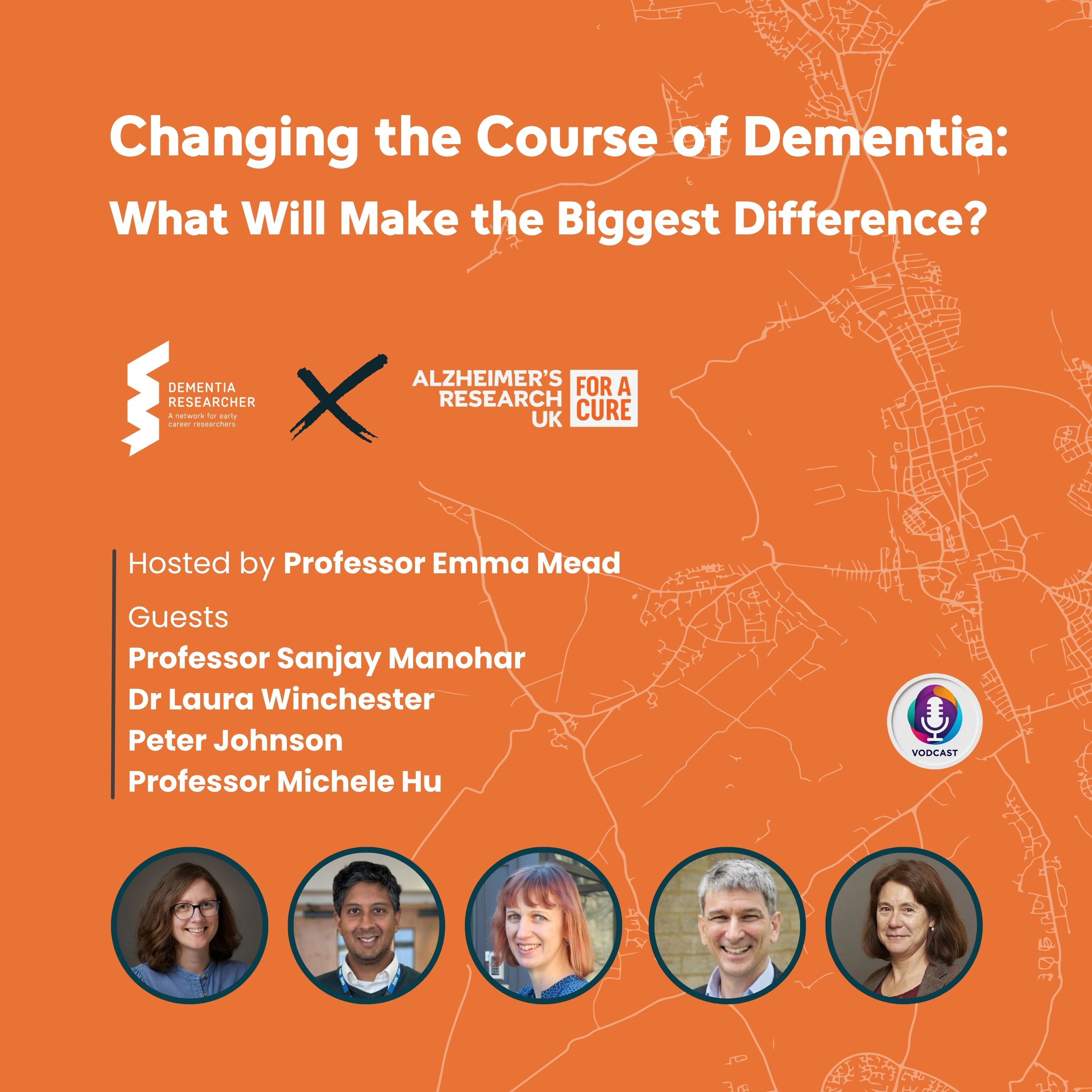 Changing the Course of Dementia: What Will Make the Biggest Difference? 14.08.2026 47λChanging the course of dementia depends entirely on where you are standing, and this panel is standing in four different places.Recorded in front of a live audience at the Alzheimer's Research UK Thames Valley Network Dementia Research Day 2026, Professor Emma Mead, Chief Scientific Officer at the ARUK Oxford Drug Discovery Institute, puts the question to four people who see the problem from very different ends: Associate Professor Sanjay Manohar, computational neuroscientist and lead of the Cognitive Disorders Clinic at the John Radcliffe; Professor Michele Hu, consultant neurologist at Oxford, who runs the 1,600 person Oxford Discovery Parkinson's cohort; Associate Professor Laura Winchester, bioinformatician in Oxford's Department of Psychiatry; and Peter Johnson, head of service at Dementia Oxfordshire. They cover precision diagnosis, adaptive trial design, blood biomarkers, exercise and diet, digital monitoring at home, and what patients say frightens them most, plus audience questions on genetic testing and the biomarker gap. It closes with a quick fire round where four specialists name four different priorities, and not one of them is a drug.Key takeawaysOf roughly 500 patients seen with Alzheimer's, only about 10 have typical Alzheimer's and nothing else. Everyone else carries a different combination, and that fingerprint matters now that treatments target specific molecules.Until this year, getting a biological diagnosis meant a lumbar puncture, so around 70% of patients never had one. Blood markers change who gets tested, and raise the harder question of what you tell people afterwards.Multi-arm multi-stage designs, borrowed from prostate cancer, run several treatment arms against one placebo group and force go or no go calls at 6 to 12 months. ACT-PD is doing it for Parkinson's.In the exenatide trial the placebo group improved over two years simply from being in a trial. Regular contact and something to aim at has a measurable effect you have to design around.Once the survival figure and the monitoring burden are explained, most patients conclude the new Alzheimer's therapies are not yet for them. What they ask for is quality of life, not longer decline.Asked what would make the biggest impact, the panel chose home digital monitoring, opening up trial data after studies close, AI as a support for thinking, and joined up hospital and community care. Not one of them named a drug.--A transcript of this show, links and show notes and profile on all our guests are available on our website at https://www.dementiaresearcher.nihr.ac.uk.If you prefer to watch rather than listen, you will find a video version of this podcast on Apple Podcasts, YouTube, and on our website.Leave us a tip:https://dementia-researcher.captivate.fm/supportFollow us on social media:https://www.instagram.com/dementia_researcher/ https://www.facebook.com/Dementia.Researcher/https://www.twitter.com/demrescommunityhttps://www.linkedin.com/company/dementia-researcher https://bsky.app/profile/dementiaresearcher.bsky.socialDownload and Register with our Community App:https://www.onelink.to/dementiaresearcherWe gratefully acknowledge the support of our funders: Alzheimer’s Association, Race Against Dementia, Alzheimer’s Research UK, Alzheimer’s Society, and the National Institute for Health and Care Research.The views and opinions expressed by guests in this podcast are their own and do not necessarily reflect those of the producers, funders, or sponsors.Subscribe to our sister show 'Dementia Researcher The Blogs':https://podfollow.com/dementia-researcher-blogs
 -
 XXplored - The Neuroscience of Motherhood 31.07.2026 1ώ 7λAround 80% of women worldwide will become mothers, and pregnancy triggers the largest hormonal shift the body will ever experience. So what does it do to the brain, and does any of it last?In this episode of XXplored, host Dr Laura Stankeviciute, University of Gothenburg is joined by Dr Magdalena Martínez-García, Scientific Director of Maternal Health at the Ann S. Bowers Women's Brain Health Initiative, University of California Santa Barbara, and Dr Laura Pritschet, an NIH funded postdoctoral scholar at the University of Pennsylvania who leads the Maternal Brain Mapping Project.They get into the hormonal cascade that drives the whole process, what those widely reported grey matter reductions actually mean, and how one volunteer scanned 26 times from IVF to two years postpartum filled in the gap between before and after. They also take on baby brain, whether repeat pregnancies stack up in the brain, what the UK Biobank data hints at for later life dementia risk, the near total absence of miscarriage and stillbirth from this research, and where postpartum care falls short. Both guests are living through matrescence themselves while studying it, and they talk openly about what that has been like.Key takeawaysPregnancy brings hormone surges into the hundreds and thousandfold, far beyond anything seen across the menstrual cycle, and sensitivity to those shifts matters more than the absolute levels.Grey matter reductions across pregnancy are among the most replicable findings in neuroscience, and larger reductions are linked to stronger postpartum bonding rather than damage.Follow-up work found some of those changes still present six years after birth, suggesting they may be long-lasting or permanent.A second pregnancy produces the same pattern of change but less pronounced, and UK Biobank data suggests a trace of parity in the brain that levels off around four or five births.Baby brain gets reframed rather than dismissed: subjective reports are real, objective differences are slight and temporary, and increased cognitive load may carry later advantages.Miscarriage, stillbirth and abortion are almost entirely missing from maternal brain research, and both guests believe those women would be among the most motivated participants.Research now treats the perinatal period as a neurological transition, but healthcare has not caught up, with a single six week check standing in for what should be ongoing postpartum care.--A transcript of this show, links and show notes and profile on all our guests are available on our website at https://www.dementiaresearcher.nihr.ac.uk.If you prefer to watch rather than listen, you will find a video version of this podcast on Apple Podcasts, YouTube, and on our website.Leave us a tip:https://dementia-researcher.captivate.fm/supportFollow us on social media:https://www.instagram.com/dementia_researcher/ https://www.facebook.com/Dementia.Researcher/https://www.twitter.com/demrescommunityhttps://www.linkedin.com/company/dementia-researcher https://bsky.app/profile/dementiaresearcher.bsky.socialDownload and Register with our Community App:https://www.onelink.to/dementiaresearcherWe gratefully acknowledge the support of our funders: Alzheimer’s Association, Race Against Dementia, Alzheimer’s Research UK, Alzheimer’s Society, and the National Institute for Health and Care Research.The views and opinions expressed by guests in this podcast are their own and do not necessarily reflect those of the producers, funders, or sponsors.Subscribe to our sister show 'Dementia Researcher The Blogs':https://podfollow.com/dementia-researcher-blogs
 -
 AAIC Day Four 2026 Highlights 20.07.2026 1ώIn this episode, we share highlights from the fourth day of the 2026 Alzheimer’s Association International Conference (AAIC).Adam Smith chats with Dr Niying Li, Assistant Professor at the University of Georgia; Dr Natasha Anita, a Research Fellow at Harvard Medical School and Massachusetts General Hospital; and Lillian Morgado, Research Coordinator at Georgia State University.The AAIC brings together researchers from all areas of research to share their work, theories and breakthroughs while exploring opportunities to accelerate work and elevate careers.Key topicsThe practical barriers to delivering new anti-amyloid treatmentsRural and international inequalities in access to diagnosis and careWhat p-tau217 could tell us about future cognitive declinePromising results from new tau-targeting therapiesBehavioural and personality changes as possible early signs of neurodegenerationWomen’s brain health, inflammation and Alzheimer’s riskThe ethical and legal questions surrounding biomarker disclosureWhy research must include more countries and underrepresented populationsFind out more about the conference at https://aaic.alz.org/ and on social media with #AAIC26--A transcript of this show, links and show notes and profile on all our guests are available on our website at https://www.dementiaresearcher.nihr.ac.uk.If you prefer to watch rather than listen, you will find a video version of this podcast on Apple Podcasts, YouTube, and on our website.Leave us a tip:https://dementia-researcher.captivate.fm/supportFollow us on social media:https://www.instagram.com/dementia_researcher/ https://www.facebook.com/Dementia.Researcher/https://www.twitter.com/demrescommunityhttps://www.linkedin.com/company/dementia-researcher https://bsky.app/profile/dementiaresearcher.bsky.socialDownload and Register with our Community App:https://www.onelink.to/dementiaresearcherWe gratefully acknowledge the support of our funders: Alzheimer’s Association, Race Against Dementia, Alzheimer’s Research UK, Alzheimer’s Society, and the National Institute for Health and Care Research.The views and opinions expressed by guests in this podcast are their own and do not necessarily reflect those of the producers, funders, or sponsors.Subscribe to our sister show 'Dementia Researcher The Blogs':https://podfollow.com/dementia-researcher-blogs
 -
 AAIC Day Three 2026 Highlights 15.07.2026 45λIn this episode, we share highlights from the third day of the 2026 Alzheimer’s Association International Conference (AAIC).Adam Smith chats with Cari Randa-Beaulieu, Provincial Coordinator, Knowledge Mobilization at the Alzheimer Society of British Columbia and Yukon; and Abrar AbuHamdia, a PhD candidate at Hamad Bin Khalifa University in Qatar.The AAIC brings together researchers from all areas of research to share their work, theories and breakthroughs while exploring opportunities to accelerate work and elevate careers.Key topicsAlzheimer's disease subtypes and precision medicineBiomarkers and diagnostic accuracy in dementiaMicroglia and neuroinflammation therapiesGlobal efforts in brain health promotionCo-design and lived experience in researchFind out more about the conference at https://aaic.alz.org/ and on social media with #AAIC26Note: We apologise for issues with the sound quality in the first part of this recording.--A transcript of this show, links and show notes and profile on all our guests are available on our website at https://www.dementiaresearcher.nihr.ac.uk.If you prefer to watch rather than listen, you will find a video version of this podcast on Apple Podcasts, YouTube, and on our website.Leave us a tip:https://dementia-researcher.captivate.fm/supportFollow us on social media:https://www.instagram.com/dementia_researcher/ https://www.facebook.com/Dementia.Researcher/https://www.twitter.com/demrescommunityhttps://www.linkedin.com/company/dementia-researcher https://bsky.app/profile/dementiaresearcher.bsky.socialDownload and Register with our Community App:https://www.onelink.to/dementiaresearcherWe gratefully acknowledge the support of our funders: Alzheimer’s Association, Race Against Dementia, Alzheimer’s Research UK, Alzheimer’s Society, and the National Institute for Health and Care Research.The views and opinions expressed by guests in this podcast are their own and do not necessarily reflect those of the producers, funders, or sponsors.Subscribe to our sister show 'Dementia Researcher The Blogs':https://podfollow.com/dementia-researcher-blogs
 -
 AAIC Day Two 2026 Highlights 13.07.2026 53λIn this episode, we share highlights from the second day of the 2026 Alzheimer’s Association International Conference (AAIC).Adam Smith chats with Nathania from Universitas Airlangga in Indonesia, Dr Arezoo Talebzadeh from Ghent University in Belgium, and Dr Suelyn Koerich from the University of Texas Health Science Center at HoustonThe AAIC brings together researchers from all areas of research to share their work, theories and breakthroughs while exploring opportunities to accelerate work and elevate careers.Key topicsAnti-amyloid immunotherapies and personalized medicineCultural sensitivity in dementia assessmentThe role of environment and architecture in dementia careNeuroinflammation and neuroprotective factorsBiomarker validation and minimally invasive testingImpact of social determinants on dementia riskSoundscape and sensory health in dementia managementFind out more about the conference at https://aaic.alz.org/ and on social media with #AAIC26--A transcript of this show, links and show notes and profile on all our guests are available on our website at https://www.dementiaresearcher.nihr.ac.uk.If you prefer to watch rather than listen, you will find a video version of this podcast on Apple Podcasts, YouTube, and on our website.Leave us a tip:https://dementia-researcher.captivate.fm/supportFollow us on social media:https://www.instagram.com/dementia_researcher/ https://www.facebook.com/Dementia.Researcher/https://www.twitter.com/demrescommunityhttps://www.linkedin.com/company/dementia-researcher https://bsky.app/profile/dementiaresearcher.bsky.socialDownload and Register with our Community App:https://www.onelink.to/dementiaresearcherWe gratefully acknowledge the support of our funders: Alzheimer’s Association, Race Against Dementia, Alzheimer’s Research UK, Alzheimer’s Society, and the National Institute for Health and Care Research.The views and opinions expressed by guests in this podcast are their own and do not necessarily reflect those of the producers, funders, or sponsors.Subscribe to our sister show 'Dementia Researcher The Blogs':https://podfollow.com/dementia-researcher-blogs
 -
 AAIC Day One 2026 Highlights 13.07.2026 49λIn this episode, we share highlights from the first day of the 2026 Alzheimer’s Association International Conference (AAIC).Adam Smith chats with Sarah Graef from Rush University Medical Center and Muthia Huda Islami from the National Brain Centre Hospital Mahar Mardjono in Jakarta.The AAIC brings together researchers from all areas of research to share their work, theories and breakthroughs while exploring opportunities to accelerate work and elevate careers.Key topicsBiomarkers for Alzheimer's diseaseGenetic epidemiology in diverse populationsLifestyle interventions and dementia preventionInnovative drug delivery methods for neurodegenerative diseasesGlobal research collaborations and underrepresented populationsFind out more about the conference at https://aaic.alz.org/ and on social media with #AAIC26--A transcript of this show, links and show notes and profile on all our guests are available on our website at https://www.dementiaresearcher.nihr.ac.uk.If you prefer to watch rather than listen, you will find a video version of this podcast on Apple Podcasts, YouTube, and on our website.Leave us a tip:https://dementia-researcher.captivate.fm/supportFollow us on social media:https://www.instagram.com/dementia_researcher/ https://www.facebook.com/Dementia.Researcher/https://www.twitter.com/demrescommunityhttps://www.linkedin.com/company/dementia-researcher https://bsky.app/profile/dementiaresearcher.bsky.socialDownload and Register with our Community App:https://www.onelink.to/dementiaresearcherWe gratefully acknowledge the support of our funders: Alzheimer’s Association, Race Against Dementia, Alzheimer’s Research UK, Alzheimer’s Society, and the National Institute for Health and Care Research.The views and opinions expressed by guests in this podcast are their own and do not necessarily reflect those of the producers, funders, or sponsors.Subscribe to our sister show 'Dementia Researcher The Blogs':https://podfollow.com/dementia-researcher-blogs
 -
 Relay Podcast - Clinical Trials Advancement and Methods PIA 2026 04.07.2026 33λWelcome to the seventh season of the Dementia Researcher X ISTAART PIA Relay Podcast. Across six episodes, leading early career and senior researchers hand the mic from one ISTAART PIA to the next, giving you an honest, peer-to-peer tour of where dementia research is actually heading, from wearables and biomarkers to policy and trial design, in the run-up to AAIC.Series closer, and the relay comes full circle: Carla Abdelnour, who hosted episode one, returns as the guest. Carla is a clinician scientist in Barcelona and incoming Chair of the ISTAART Clinical Trials Advancement and Methods PIA, working on mixed neurodegenerative disease, particularly Lewy body and Alzheimer's pathology together. With host Sindhuja Tirumalai Govindarajan she explains why co-pathology is so common and what it means for treatment: does someone with both alpha-synuclein and Alzheimer's pathology respond to an anti-amyloid drug the same way as someone without? They discuss why she leans on fluid biomarkers, the wish for a synuclein PET tracer, and how trials might stratify or include people by co-pathology. Carla makes a useful point for anyone designing research, that clinical trial methods translate straight to observational studies, and previews the CTAM PIA's AAIC programme, including a panel and featured session on global representation in trials.TakeawaysMixed pathology is common, and co-occurring alpha-synuclein and Alzheimer's pathology may change how people respond to treatment.Trials could stratify or include people by co-pathology, but alpha-synuclein is currently detectable only in CSF, which limits that.Fluid biomarkers offer the specificity to track different proteinopathies and, potentially, response to treatment.Clinical trial design transfers straight to observational research: the same inclusion criteria, outcomes and sample-size thinking.Global representation in trials is a live priority, with a CTAM panel launching at AAIC.--The Alzheimer’s Association International Society to Advance Alzheimer’s Research and Treatment (ISTAART) convenes the global Alzheimer’s and dementia science community. Members share knowledge, fuel collaboration and advance research to find more effective ways to detect, treat and prevent Alzheimer’s and other dementias. Professional Interest Areas (PIA) are an assembly of ISTAART members with common subspecialties or interests.There are currently 30 PIAs covering a wide range of interests and fields, from Neuroimaging to Diversity and Disparities and everything in between.Find out more at https://istaart.alz.org/--A transcript of this show, links and show notes and profile on all our guests are available on our website at https://www.dementiaresearcher.nihr.ac.uk.If you prefer to watch rather than listen, you will find a video version of this podcast on Apple Podcasts, YouTube, and on our website.Leave us a tip:https://dementia-researcher.captivate.fm/supportFollow us on social media:https://www.instagram.com/dementia_researcher/ https://www.facebook.com/Dementia.Researcher/https://www.twitter.com/demrescommunityhttps://www.linkedin.com/company/dementia-researcher https://bsky.app/profile/dementiaresearcher.bsky.socialDownload and Register with our Community App:https://www.onelink.to/dementiaresearcherWe gratefully acknowledge the support of our funders: Alzheimer’s Association, Race Against Dementia, Alzheimer’s Research UK, Alzheimer’s Society, and the National Institute for Health and Care Research.The views and opinions expressed by guests in this podcast are their own and do not necessarily reflect those of the producers, funders, or sponsors.Subscribe to our sister show 'Dementia Researcher The Blogs':https://podfollow.com/dementia-researcher-blogs
 -
 Relay Podcast - PIA to Elevate Early Career Researchers 03.07.2026 33λWelcome to the seventh season of the Dementia Researcher X ISTAART PIA Relay Podcast. Across six episodes, leading early career and senior researchers hand the mic from one ISTAART PIA to the next, giving you an honest, peer-to-peer tour of where dementia research is actually heading, from wearables and biomarkers to policy and trial design, in the run-up to AAIC.Most people with hypertension after 50 never develop dementia, so what separates those who do? That is the question driving Dr Sindhuja Tirumalai Govindarajan, a neuroimaging researcher and outgoing Chair of the ISTAART PEERs PIA, recorded as she moves from a postdoc at the University of Pennsylvania to an assistant professorship at the Karolinska Institute. With host Dr Joe Kane she explains how machine learning on tens of thousands of MRI scans can pick up subtle brain changes years before symptoms, and why scans from different scanners have to be harmonised first. The conversation then turns to PEERs itself, a PIA built not around one research area but around early career researchers everywhere, and the work of levelling opportunity across borders through local routes like Neuroscience Next, WYLD and INTERDEM Academy. Sindhuja runs through the PIA's AAIC workshops, from narrative CVs to social bingo for ECRs, and closes with practical advice on getting people involved: make the ask specific.TakeawaysMachine learning on large MRI datasets can detect brain changes years before any cognitive symptoms show.Scans from different scanners must be harmonised first, stripping out machine noise so only the biology remains.PEERs exists to level opportunity for early career researchers wherever they are, across every research area.Local routes such as Neuroscience Next, WYLD and INTERDEM Academy widen access for those who cannot get to the big conference.Interest among ECRs is common but clarity often is not, so make the ask specific and people will step up.--The Alzheimer’s Association International Society to Advance Alzheimer’s Research and Treatment (ISTAART) convenes the global Alzheimer’s and dementia science community. Members share knowledge, fuel collaboration and advance research to find more effective ways to detect, treat and prevent Alzheimer’s and other dementias. Professional Interest Areas (PIA) are an assembly of ISTAART members with common subspecialties or interests.There are currently 30 PIAs covering a wide range of interests and fields, from Neuroimaging to Diversity and Disparities and everything in between.Find out more at https://istaart.alz.org/--A transcript of this show, links and show notes and profile on all our guests are available on our website at https://www.dementiaresearcher.nihr.ac.uk.If you prefer to watch rather than listen, you will find a video version of this podcast on Apple Podcasts, YouTube, and on our website.Leave us a tip:https://dementia-researcher.captivate.fm/supportFollow us on social media:https://www.instagram.com/dementia_researcher/ https://www.facebook.com/Dementia.Researcher/https://www.twitter.com/demrescommunityhttps://www.linkedin.com/company/dementia-researcher https://bsky.app/profile/dementiaresearcher.bsky.socialDownload and Register with our Community App:https://www.onelink.to/dementiaresearcherWe gratefully acknowledge the support of our funders: Alzheimer’s Association, Race Against Dementia, Alzheimer’s Research UK, Alzheimer’s Society, and the National Institute for Health and Care Research.The views and opinions expressed by guests in this podcast are their own and do not necessarily reflect those of the producers, funders, or sponsors.Subscribe to our sister show 'Dementia Researcher The Blogs':https://podfollow.com/dementia-researcher-blogs
 -
 Relay Podcast - Lewy Body Dementias PIA 02.07.2026 36λWelcome to the seventh season of the Dementia Researcher X ISTAART PIA Relay Podcast. Across six episodes, leading early career and senior researchers hand the mic from one ISTAART PIA to the next, giving you an honest, peer-to-peer tour of where dementia research is actually heading, from wearables and biomarkers to policy and trial design, in the run-up to AAIC.Lewy body pathology shows up in roughly 30% of the brains of people who had dementia, yet it gets diagnosed in only about 5% of cases. Closing that gap has shaped much of Dr Joe Kane's career. Joe is a geriatric psychiatrist at Queen's University Belfast and outgoing Chair of the ISTAART Lewy Body Dementias PIA, and with host Dr Patrick Lao he traces his work from the Diamond Lewy programme to consensus diagnostic guidelines built by Delphi process. They discuss the symptoms clinicians often miss because they don't think to ask, from constipation to loss of smell, the cardiac scans and seed amplification assays now detecting pathology in CSF and even skin, and the TOP HAT trial repurposing an anti-sickness drug for hallucinations. Joe makes the case for a Lewy body specific rating scale, explains why the prodrome may be psychiatric or delirium rather than cognitive, and runs through the PIA's biggest AAIC programme in years, including a PIA Day panel on seed amplification assays.TakeawaysLewy body dementia is heavily underdiagnosed: pathology appears in about 30% of brains but is diagnosed in around 5%.Much of the disease shows outside the brain, in constipation, blood pressure and smell, so it gets missed if nobody asks.Seed amplification assays, now usable on CSF and even a small skin biopsy, are changing how the pathology is detected.Trials can fail on the wrong yardstick, which is why the PIA is building a Lewy body specific rating scale.The prodrome is not only cognitive; the first sign can be depression, psychosis or delirium, and those gaps need data.--The Alzheimer’s Association International Society to Advance Alzheimer’s Research and Treatment (ISTAART) convenes the global Alzheimer’s and dementia science community. Members share knowledge, fuel collaboration and advance research to find more effective ways to detect, treat and prevent Alzheimer’s and other dementias. Professional Interest Areas (PIA) are an assembly of ISTAART members with common subspecialties or interests.There are currently 30 PIAs covering a wide range of interests and fields, from Neuroimaging to Diversity and Disparities and everything in between.Find out more at https://istaart.alz.org/--A transcript of this show, links and show notes and profile on all our guests are available on our website at https://www.dementiaresearcher.nihr.ac.uk.If you prefer to watch rather than listen, you will find a video version of this podcast on Apple Podcasts, YouTube, and on our website.Leave us a tip:https://dementia-researcher.captivate.fm/supportFollow us on social media:https://www.instagram.com/dementia_researcher/ https://www.facebook.com/Dementia.Researcher/https://www.twitter.com/demrescommunityhttps://www.linkedin.com/company/dementia-researcher https://bsky.app/profile/dementiaresearcher.bsky.socialDownload and Register with our Community App:https://www.onelink.to/dementiaresearcherWe gratefully acknowledge the support of our funders: Alzheimer’s Association, Race Against Dementia, Alzheimer’s Research UK, Alzheimer’s Society, and the National Institute for Health and Care Research.The views and opinions expressed by guests in this podcast are their own and do not necessarily reflect those of the producers, funders, or sponsors.Subscribe to our sister show 'Dementia Researcher The Blogs':https://podfollow.com/dementia-researcher-blogs
 -
 Relay Podcast - Down Syndrome and Alzheimer's Disease PIA 01.07.2026 32λWelcome to the seventh season of the Dementia Researcher X ISTAART PIA Relay Podcast. Across six episodes, leading early career and senior researchers hand the mic from one ISTAART PIA to the next, giving you an honest, peer-to-peer tour of where dementia research is actually heading, from wearables and biomarkers to policy and trial design, in the run-up to AAIC.Almost everyone born with Down syndrome overproduces the amyloid precursor protein from birth, which makes it one of the clearest natural windows we have into how Alzheimer's begins. Dr Patrick Lao, Assistant Professor at Columbia and Programmes Chair of the ISTAART Down Syndrome and Alzheimer's Disease PIA, comes from a medical physics background and uses multimodal neuroimaging to map the disease across its genetic and sporadic forms. With host Lillian Morgado, he explains amyloid and tau PET, Thal phases and Braak staging, and how chronological age can stand in for disease stage in this population, with a typical symptom onset around 54. They talk about why people with Down syndrome were long left out of anti-amyloid trials and how that is now changing, and the risk and resilience research asking why some people fall off the expected timeline. Patrick also previews the PIA's AAIC PIA Day session on returning results, plus the separate DSAD/ADAD conference coming to London next year.TakeawaysGenetic forms of Alzheimer's, including Down syndrome, let researchers study the earliest disease pathways before symptoms appear.In Down syndrome, chronological age can approximate disease stage, with symptoms typically expected around age 54.Imaging shows where amyloid and tau sit in the brain, the spatial detail a blood test cannot give.People with Down syndrome were historically excluded from anti-amyloid trials; that is shifting, with a lecanemab safety extension now underway.Not everyone follows the population timeline, and risk and resilience work asks what pushes onset earlier or later.--The Alzheimer’s Association International Society to Advance Alzheimer’s Research and Treatment (ISTAART) convenes the global Alzheimer’s and dementia science community. Members share knowledge, fuel collaboration and advance research to find more effective ways to detect, treat and prevent Alzheimer’s and other dementias. Professional Interest Areas (PIA) are an assembly of ISTAART members with common subspecialties or interests.There are currently 30 PIAs covering a wide range of interests and fields, from Neuroimaging to Diversity and Disparities and everything in between.Find out more at https://istaart.alz.org/--A transcript of this show, links and show notes and profile on all our guests are available on our website at https://www.dementiaresearcher.nihr.ac.uk.If you prefer to watch rather than listen, you will find a video version of this podcast on Apple Podcasts, YouTube, and on our website.Leave us a tip:https://dementia-researcher.captivate.fm/supportFollow us on social media:https://www.instagram.com/dementia_researcher/ https://www.facebook.com/Dementia.Researcher/https://www.twitter.com/demrescommunityhttps://www.linkedin.com/company/dementia-researcher https://bsky.app/profile/dementiaresearcher.bsky.socialDownload and Register with our Community App:https://www.onelink.to/dementiaresearcherWe gratefully acknowledge the support of our funders: Alzheimer’s Association, Race Against Dementia, Alzheimer’s Research UK, Alzheimer’s Society, and the National Institute for Health and Care Research.The views and opinions expressed by guests in this podcast are their own and do not necessarily reflect those of the producers, funders, or sponsors.Subscribe to our sister show 'Dementia Researcher The Blogs':https://podfollow.com/dementia-researcher-blogs
 -
 Relay Podcast - Health Policy PIA 30.06.2026 28λWelcome to the seventh season of the Dementia Researcher X ISTAART PIA Relay Podcast. Across six episodes, leading early career and senior researchers hand the mic from one ISTAART PIA to the next, giving you an honest, peer-to-peer tour of where dementia research is actually heading, from wearables and biomarkers to policy and trial design, in the run-up to AAIC.If we cured Alzheimer's tomorrow but did no work on cost, distribution or access, we would have cured it only for the richest people in the world. That line from Lillian Morgado sits at the centre of this episode. Lillian is a research coordinator at Georgia State University and Communications Chair of the ISTAART Health Policy PIA, working mainly in qualitative research and legal epidemiology. With host Dr Vanessa Young, she talks through what qualitative work actually involves, her research on caregivers and people with dementia in the justice system, and the question that opened up next: what happens to someone with no caregiver to advocate for them. They get into why AI and blood-based biomarkers are as much policy problems as scientific ones, how regulation differs across borders, and why policy is the bridge that decides whether science reaches the people it was meant for. Lillian also runs through the Health Policy PIA's busy week at AAIC, from PIA Day to a featured research session on dementia care across countries.TakeawaysPolicy is the bridge from the lab to the patient; without it, a breakthrough only reaches the few who can already afford care.Qualitative interviews and coding surface the right questions before the big quantitative money goes in.Caregivers matter enormously when someone with dementia meets the justice system, which raises the question of those who have none.AI and blood-based biomarkers carry legal and access questions, and the rules differ between, say, the US and Europe under GDPR.You do not join a PIA because you already belong; you belong because you get involved, and you need not be an expert to contribute.--The Alzheimer’s Association International Society to Advance Alzheimer’s Research and Treatment (ISTAART) convenes the global Alzheimer’s and dementia science community. Members share knowledge, fuel collaboration and advance research to find more effective ways to detect, treat and prevent Alzheimer’s and other dementias. Professional Interest Areas (PIA) are an assembly of ISTAART members with common subspecialties or interests.There are currently 30 PIAs covering a wide range of interests and fields, from Neuroimaging to Diversity and Disparities and everything in between.Find out more at https://istaart.alz.org/--A transcript of this show, links and show notes and profile on all our guests are available on our website at https://www.dementiaresearcher.nihr.ac.uk.If you prefer to watch rather than listen, you will find a video version of this podcast on Apple Podcasts, YouTube, and on our website.Leave us a tip:https://dementia-researcher.captivate.fm/supportFollow us on social media:https://www.instagram.com/dementia_researcher/ https://www.facebook.com/Dementia.Researcher/https://www.twitter.com/demrescommunityhttps://www.linkedin.com/company/dementia-researcher https://bsky.app/profile/dementiaresearcher.bsky.socialDownload and Register with our Community App:https://www.onelink.to/dementiaresearcherWe gratefully acknowledge the support of our funders: Alzheimer’s Association, Race Against Dementia, Alzheimer’s Research UK, Alzheimer’s Society, and the National Institute for Health and Care Research.The views and opinions expressed by guests in this podcast are their own and do not necessarily reflect those of the producers, funders, or sponsors.Subscribe to our sister show 'Dementia Researcher The Blogs':https://podfollow.com/dementia-researcher-blogs
 -
 Relay Podcast - Technology and Dementia PIA 29.06.2026 36λWelcome to the seventh season of the Dementia Researcher X ISTAART PIA Relay Podcast. Across six episodes, leading early career and senior researchers hand the mic from one ISTAART PIA to the next, giving you an honest, peer-to-peer tour of where dementia research is actually heading, from wearables and biomarkers to policy and trial design, in the run-up to AAIC.Sleep might be one of the earliest windows we have into brain health, and Dr Vanessa Young thinks the way we measure it is about to change. Fresh from finishing her PhD in May, Vanessa is a postdoc at the Glenn Biggs Institute and Communications Chair of the Technology and Dementia PIA. She studies sleep and the ageing brain, where the relationship seems to run both ways: as dementia develops, sleep gets worse, and poor sleep may feed back into the disease. With host Dr Carla Abdelnour, she gets into digital biomarkers, why wearables let you capture sleep continuously at home rather than in a one-off sleep study, and the move from wearables to "nearables", bed sensors and room radar that ask nothing of the participant at all. They also cover the analysis headache that comes with years of continuous data, the equity problem when a study needs home Wi-Fi, and what the PIA has planned for its full-day AAIC preconference on AI.TakeawaysSleep and dementia feed each other, so sleep is worth studying as somewhere we might actually step in and help.Wearables capture sleep night after night at home, which reaches people who live nowhere near a big sleep centre.The field is shifting from wearables to "nearables", sensors in the mattress or radar in the room, to cut participant burden and bias.Years of continuous data brings its own problem: telling meaningful signal apart from background noise.If a study needs Wi-Fi to send its data, it quietly excludes people, so digital equity has to be designed in.--The Alzheimer’s Association International Society to Advance Alzheimer’s Research and Treatment (ISTAART) convenes the global Alzheimer’s and dementia science community. Members share knowledge, fuel collaboration and advance research to find more effective ways to detect, treat and prevent Alzheimer’s and other dementias. Professional Interest Areas (PIA) are an assembly of ISTAART members with common subspecialties or interests.There are currently 30 PIAs covering a wide range of interests and fields, from Neuroimaging to Diversity and Disparities and everything in between.Find out more at https://istaart.alz.org/--A transcript of this show, links and show notes and profile on all our guests are available on our website at https://www.dementiaresearcher.nihr.ac.uk.If you prefer to watch rather than listen, you will find a video version of this podcast on Apple Podcasts, YouTube, and on our website.Leave us a tip:https://dementia-researcher.captivate.fm/supportFollow us on social media:https://www.instagram.com/dementia_researcher/ https://www.facebook.com/Dementia.Researcher/https://www.twitter.com/demrescommunityhttps://www.linkedin.com/company/dementia-researcher https://bsky.app/profile/dementiaresearcher.bsky.socialDownload and Register with our Community App:https://www.onelink.to/dementiaresearcherWe gratefully acknowledge the support of our funders: Alzheimer’s Association, Race Against Dementia, Alzheimer’s Research UK, Alzheimer’s Society, and the National Institute for Health and Care Research.The views and opinions expressed by guests in this podcast are their own and do not necessarily reflect those of the producers, funders, or sponsors.Subscribe to our sister show 'Dementia Researcher The Blogs':https://podfollow.com/dementia-researcher-blogs
 -
 Supporting Dementia at Home: Insights from PALLDEM 19.06.2026 1ώ 4λMost people with dementia live, and many die, at home. The person who knows them best in those final months is often not a clinician but a home care worker coming through the door several times a day, doing some of the hardest work in the dementia pathway with little training and almost no research behind them. This episode asks what good home care actually looks like, why it is so hard to deliver, and what one study is doing about it.Host Dr Alice Carstairs is joined by the PALLDEM Homecare team from the Cicely Saunders Institute at King's College London: Dr Lesley Williamson, who co-leads the study; research assistant Annika Dhawan, who runs the engagement work; and Dr Clare Ellis-Smith, who developed the IPOS Dem outcome measure. They are joined by lived experience expert Alan Richardson, who cared for his mother for 15 years, and Tony O'Flaherty, director at Home Instead Wandsworth, Lambeth and Dulwich.Together they cover what IPOS Dem is, why home care gets so little attention, what it really takes to get a tool used on the ground, and why recognition for this workforce is overdue.Essential Links:Famileo - https://bit.ly/FamileoDR26PALLDEM-Homecare - https://bit.ly/4e6bdvdIPOS-Dem - https://bit.ly/4vJgkaAKey topics:Role of home care workers in dementia supportImplementation of iPOSDEM in home care settingsChallenges and solutions in home care for dementiaResearch and innovation in community dementia careThis episode is sponsored by Famileo. Helping families living with dementia stay close with a personalised printed magazine, delivered monthly. Over a quarter of a million families already use Famileo to stay connected. First month free with code DR26. https://bit.ly/FamileoDR26--A transcript of this show, links and show notes and profile on all our guests are available on our website at https://www.dementiaresearcher.nihr.ac.uk.If you prefer to watch rather than listen, you will find a video version of this podcast on Apple Podcasts, YouTube, and on our website.Leave us a tip:https://dementia-researcher.captivate.fm/supportFollow us on social media:https://www.instagram.com/dementia_researcher/ https://www.facebook.com/Dementia.Researcher/https://www.twitter.com/demrescommunityhttps://www.linkedin.com/company/dementia-researcher https://bsky.app/profile/dementiaresearcher.bsky.socialDownload and Register with our Community App:https://www.onelink.to/dementiaresearcherWe gratefully acknowledge the support of our funders: Alzheimer’s Association, Race Against Dementia, Alzheimer’s Research UK, Alzheimer’s Society, and the National Institute for Health and Care Research.The views and opinions expressed by guests in this podcast are their own and do not necessarily reflect those of the producers, funders, or sponsors.Subscribe to our sister show 'Dementia Researcher The Blogs':https://podfollow.com/dementia-researcher-blogs--This podcast is sponsored by Famileo. The sponsor had no involvement in the planning, production, editorial decisions, or content of this episode.
 -
 Agentic AI and the Future of Dementia Research 05.06.2026 56λIn this episode, Professor Louise Serpell brings together Dr Niranjan Bose from the Alzheimer's Disease Data Initiative, Jonathan Hoover from the AI company Prima Mente, and Dr Kexin Huang from Stanford University and Biomni AD. They discuss the Alzheimer’s Insights AI Prize and what agentic AI could mean for the future of dementia research.We hear about the Alzheimer’s Disease Data Initiative and AD Workbench, and their role in making research data more accessible, usable and secure. The conversation also looks at how the Alzheimer’s Insights AI Prize could help researchers make better use of that data, turning complex resources into practical tools for discovery.Kexin introduces Biomni AD, an AI research assistant designed to help scientists develop questions, bring data together and move from ideas to results more efficiently. Jonathan introduces Parthenon and Athena, a virtual wet lab system that helps researchers model cell states, test perturbations and plan experiments.Together, the guests consider how AI can support researchers without replacing human judgement, and why confidence in using these tools is likely to become an important skill for dementia researchers.Essential Links:Sign up for AD WorkbenchLearn more about the AD Data InitiativeLearn more about the Alzheimer's Insights AI Prize Prima MenteBiomni-ADIn this episode:AI can support researchers by helping with data, workflows and experimental planning, but it still needs human judgement, review and validation.AD Workbench from Alzheimer's Disease Data Initiative is helping make dementia research data more accessible, usable and secure, giving researchers better ways to work across complex datasets.Agentic AI could help researchers move more quickly from a research question to an analysis plan, useful evidence or a possible experiment.Biomni AD, Parthenon and Athena show how AI tools are becoming more specialised, from research assistants to virtual wet lab systems.AI literacy is likely to become an important skill for dementia researchers, including those without coding or data science backgrounds.--A transcript of this show, links and show notes and profile on all our guests are available on our website at https://www.dementiaresearcher.nihr.ac.uk.If you prefer to watch rather than listen, you will find a video version of this podcast on Apple Podcasts, YouTube, and on our website.Leave us a tip:https://dementia-researcher.captivate.fm/supportFollow us on social media:https://www.instagram.com/dementia_researcher/ https://www.facebook.com/Dementia.Researcher/https://www.twitter.com/demrescommunityhttps://www.linkedin.com/company/dementia-researcher https://bsky.app/profile/dementiaresearcher.bsky.socialDownload and Register with our Community App:https://www.onelink.to/dementiaresearcherWe gratefully acknowledge the support of our funders: Alzheimer’s Association, Race Against Dementia, Alzheimer’s Research UK, Alzheimer’s Society, and the National Institute for Health and Care Research.The views and opinions expressed by guests in this podcast are their own and do not necessarily reflect those of the producers, funders, or sponsors.Subscribe to our sister show 'Dementia Researcher The Blogs':https://podfollow.com/dementia-researcher-blogs
 -
 Leaving Academia, Staying in Research 22.05.2026 1ώ 4λWhat happens when academia no longer feels like the right fit, but research still does?In this episode, Adam Smith is joined by Dr Ellice Parkinson from Health Innovation East, Elizabeth 'Lizzie' English from the British Heart Foundation, and Dr Alice Carstairs from Alzheimer’s Society to talk about leaving academia while staying connected to research.Together, they explore the career turns that took them from PhDs and lab work into roles in health innovation, charity, policy, evaluation, public engagement and research communications. They discuss what helped them make the move, what felt difficult, and how skills built in academia can be used in many different settings.The conversation covers identity, confidence, networking, mentoring, transferable skills, and the quiet pressure many researchers feel to stay on a traditional academic path. It also challenges the idea that leaving academia means leaving research behind.For PhD students, early career researchers, and anyone wondering what else might be possible, this episode offers practical advice, reassurance, and examples of careers where research still sits at the centre of meaningful work.In this episode:Explore how researchers transition from academia to impactful roles in health innovation, research impact analysis, and science communication.Discover the metaphor of "doors" in academic careers and how choosing different paths can sustain meaningful research.Hear personal stories from former PhD students who found success and fulfillment outside traditional university settings.Learn about the transferable skills that ease the transition into non-academic roles and how to leverage them.Gain insights into the importance of networking, mentorship, and aligning career choices with personal passions and societal needs.--A transcript of this show, links and show notes and profile on all our guests are available on our website at https://www.dementiaresearcher.nihr.ac.uk.If you prefer to watch rather than listen, you will find a video version of this podcast on Apple Podcasts, YouTube, and on our website.Leave us a tip:https://dementia-researcher.captivate.fm/supportFollow us on social media:https://www.instagram.com/dementia_researcher/ https://www.facebook.com/Dementia.Researcher/https://www.twitter.com/demrescommunityhttps://www.linkedin.com/company/dementia-researcher https://bsky.app/profile/dementiaresearcher.bsky.socialDownload and Register with our Community App:https://www.onelink.to/dementiaresearcherWe gratefully acknowledge the support of our funders: Alzheimer’s Association, Race Against Dementia, Alzheimer’s Research UK, Alzheimer’s Society, and the National Institute for Health and Care Research.The views and opinions expressed by guests in this podcast are their own and do not necessarily reflect those of the producers, funders, or sponsors.Subscribe to our sister show 'Dementia Researcher The Blogs':https://podfollow.com/dementia-researcher-blogs
 -
 XXplored - Women, Hormones & Mental Health: Rethinking Psychiatric Disorders 08.05.2026 44λGlobally, women are twice as likely as men to experience depression and anxiety, and the risk peaks at moments of hormonal change: postpartum, the luteal phase, perimenopause. Why?In this episode of XXplored, host Dr Laura Stankeviciute, University of Gothenburg is joined by Professor Vibe Gedsø Frøkjær, a leading researcher on serotonin and sex hormones at the University of Copenhagen, and Franziska Weinmar, a psychoneuroendocrinology PhD researcher at the University of Tübingen and host of the Let's Talk About Women podcast.They get into the biology behind hormone shift sensitivity, what oestrogen actually does to the serotonin system, and why the gut-brain axis might matter more for women's mental health than most clinicians appreciate. They also tackle hormonal contraception and depression risk, why suicide statistics look so different by gender, and where the field still has big gaps to close.Key takeawaysWomen are twice as likely as men to experience depression and anxiety, with risk clustering around hormonal transitions.The serotonin system is built to respond to sex hormones, which makes it a likely route by which hormonal shifts affect mood.Women differ in how sensitive their brains are to hormone shifts, and that sensitivity helps explain why some experience mood symptoms and others don't.The gut-brain axis is a real frontier for women's mental health, and may open up new treatment options through drug repurposing.Hormonal contraception works well for most women but carries a small heightened risk of depression that clinicians should counsel on more openly.Emotion regulation is a trainable skill and a useful clinical target across hormonal transitions.Gender differences in suicide reflect both how distress is expressed and how the care system recognises and responds to it.--A transcript of this show, links and show notes and profile on all our guests are available on our website at https://www.dementiaresearcher.nihr.ac.uk.If you prefer to watch rather than listen, you will find a video version of this podcast on Apple Podcasts, YouTube, and on our website.Leave us a tip:https://dementia-researcher.captivate.fm/supportFollow us on social media:https://www.instagram.com/dementia_researcher/ https://www.facebook.com/Dementia.Researcher/https://www.twitter.com/demrescommunityhttps://www.linkedin.com/company/dementia-researcher https://bsky.app/profile/dementiaresearcher.bsky.socialDownload and Register with our Community App:https://www.onelink.to/dementiaresearcherWe gratefully acknowledge the support of our funders: Alzheimer’s Association, Race Against Dementia, Alzheimer’s Research UK, Alzheimer’s Society, and the National Institute for Health and Care Research.The views and opinions expressed by guests in this podcast are their own and do not necessarily reflect those of the producers, funders, or sponsors.Subscribe to our sister show 'Dementia Researcher The Blogs':https://podfollow.com/dementia-researcher-blogs
 -
 Reimagining Dementia with XR and Digital Therapeutics 25.04.2026 39λExtended reality is starting to find a real place in dementia research and care. In this episode, host Dr Byron Creese is joined by David de Jong-Bambagioni, Dr Emilie Brotherhood, and Alice Rowe to explore how virtual, augmented, and mixed reality tools are being used in practice.Together, they discuss how XR is helping to standardise cognitive assessments, simulate clinical environments, and support earlier and more accurate diagnosis. The conversation also looks at how immersive tools are being used to build empathy, giving clinicians and carers a better sense of what it might feel like to live with dementia.The panel share examples from their own work, including virtual simulations to distinguish delirium from dementia, and digital environments designed to capture subtle behavioural changes in conditions like frontotemporal dementia. These approaches are opening up new ways to study cognition, behaviour, and patient experience in more realistic and scalable settings.This episode offers a practical look at where XR is already making a difference, and where it might go next.In this episode:How XR is being used in dementia research and careUsing immersive environments for assessment and empathyWhy co design and lived experience matterVirtual, augmented, and mixed reality explained simplyEthical risks and safeguards in vulnerable groupsHow researchers are moving into digital healthGetting started with XR and finding collaboratorsInclusion, global perspectives, and reducing bias--A transcript of this show, links and show notes and profile on all our guests are available on our website at https://www.dementiaresearcher.nihr.ac.uk.If you prefer to watch rather than listen, you will find a video version of this podcast on Apple Podcasts, YouTube, and on our website.Leave us a tip:https://dementia-researcher.captivate.fm/supportFollow us on social media:https://www.instagram.com/dementia_researcher/ https://www.facebook.com/Dementia.Researcher/https://www.twitter.com/demrescommunityhttps://www.linkedin.com/company/dementia-researcher https://bsky.app/profile/dementiaresearcher.bsky.socialDownload and Register with our Community App:https://www.onelink.to/dementiaresearcherWe gratefully acknowledge the support of our funders: Alzheimer’s Association, Race Against Dementia, Alzheimer’s Research UK, Alzheimer’s Society, and the National Institute for Health and Care Research.The views and opinions expressed by guests in this podcast are their own and do not necessarily reflect those of the producers, funders, or sponsors.Subscribe to our sister show 'Dementia Researcher The Blogs':https://podfollow.com/dementia-researcher-blogs
Παρόμοια podcasts


Δημοφιλές σε
Αυτό το podcast εμφανίζεται και στις λίστες podcasts αυτών των χωρών.
