
New Books in Western European Studies
New Books Network
0
This podcast is a channel on the New Books Network, an academic audio library dedicated to public education. In each episode, scholars discuss their recently published research with another expert in their field. The podcast covers topics in Western European studies. Listeners can explore over 150 channels and 28,000 episodes on the New Books Network website.
Épisodes
-
 An Unchosen People: Jewish Political Reckoning in Interwar Poland 06.09.2026 1hThe story of Polish Jewry, pre-Holocaust Europe’s largest Jewish community, is often told as one of creativity and contestation. In his new book, An Unchosen People: Jewish Political Reckoning in Interwar Poland, University of Chicago professor Kenneth B. Moss traces instead a complex and painful story of Polish Jewish reckoning with diasporic vulnerability, nationalism’s terrible potencies, Zionism’s promises, and the necessity of choice. Moss examines the works of Polish Jewry’s most searching thinkers as they confronted political irrationality, state crisis, and the limits of resistance. He reconstructs the desperate creativity of activists seeking to counter despair where they could not redress its causes. And he recovers a lost grassroots history of critical thought and political searching among ordinary Jews, young and powerless, as they struggled to find a viable future for themselves – in Palestine if not in Poland, individually if not communally. Join Kenneth Moss in conversation with Stanford professor Steven Zipperstein for a discussion on this new publication and the history it unveils. Buy the book: here This book talk originally took place on March 2, 2022. Learn more about your ad choices. Visit megaphone.fm/adchoices Support our show by becoming a premium member! https://newbooksnetwork.supportingcast.fm/european-studies
 -
Tom Trier, "Blue Sea, Black Gold, Red Banner: The South Caucasus and Scandinavia, 1880s–1920s" (Northern Illinois UP, 2026) 30.08.2026 1h 3minBlue Sea, Black Gold, Red Banner: The South Caucasus and Scandinavia, 1880s–1920s (Northern Illinois University Press, 2026) tells the story of the historical connections between two geographically distant and culturally distinct regions on the edges of Europe: Scandinavia and the South Caucasus. From the late nineteenth century, maritime trade fostered new commercial links and consular relations. Scandinavian merchants, particularly in Batumi and Baku, played key roles. The discovery of oil along the Caspian Sea shores attracted Scandinavian entrepreneurs, notably the Swedish Nobel family, helping to develop Baku into a booming industrial hub. Tom Trier focuses on the years of upheaval surrounding World War I and the collapse of the Russian Empire, when Georgia—along with Armenia and Azerbaijan—briefly emerged as an independent republic. The four-decade relationship ended abruptly during the Bolshevik Red Army's invasion of the South Caucasus from 1920 to 1921. Drawing on both Scandinavian and Georgian perspectives, Blue Sea, Black Gold, Red Banner examines how Nordic merchants, consuls, and diplomats navigated the shifting political landscape and how Georgia's social democratic leadership looked to neutral Scandinavia as a gateway to broader European political, diplomatic, and economic engagement. This interview was conducted by Dr. Miranda Melcher whose book focuses on post-conflict military integration, understanding treaty negotiation and implementation in civil war contexts, with qualitative analysis of the Angolan and Mozambican civil wars. You can find Miranda’s interviews on New Books with Miranda Melcher, wherever you get your podcasts. Learn more about your ad choices. Visit megaphone.fm/adchoices Support our show by becoming a premium member! https://newbooksnetwork.supportingcast.fm/european-studies
-
Educating for an Uncertain Future in Interwar Poland 29.08.2026 56minIn the two decades between the First and Second World Wars, Jewish parents in Poland faced a proliferation of choices when it came to educating their children. Each choice offered a vision of what future Polish Jews desired, what they expected, and the gap between the two. State schools taught in Polish (sometimes with a schedule to accommodate traditional religious observance), secularist Yiddish schools with strong ties to Jewish socialism and the labor movement, Hebraist schools promoting political and cultural Zionism, and religious schools that retained--or innovated upon--traditionalist educational models reflected different opinions for what Jewish children in interwar Poland would need in the present to secure their future. In this lecture, Elena Hoffenberg draws upon materials held by YIVO to explore how projections about the future in terms of work, culture, and politics guided parents, educational activists, and young people themselves. Choices as reflections of competing political and religious commitments, as well as material constraints, to better understand what Polish Jews expected for their individual and communal futures. This lecture originally took place on March 2, 2026. Learn more about your ad choices. Visit megaphone.fm/adchoices Support our show by becoming a premium member! https://newbooksnetwork.supportingcast.fm/european-studies
-
John Davie, "Greek To Us: The Fascinating Ancient Greek That Shapes Our World" (Bloomsbury, 2026) 27.08.2026 1h 9minAncient Greek lives on in our culture in surprising ways. Sometimes funny - the word for an actor, hupokrites, gives us 'hypocrite'; sometimes beautiful - an astronaut is literally a sailor of the skies. And that's before we get to the myths which gave us our Achilles heel or our Midas Touch. And what about crocodile tears, which comes from the Greek's belief that crocodiles cried while eating their victims! Greek To Us: The Fascinating Ancient Greek That Shapes Our World (Bloomsbury, 2026) is a learned but always entertaining journey through the world of the Ancient Greeks, their extraordinary language and how it has shaped our own understanding of the world today. After all, what is language but the frame through which we understand the world? Davie aims to bring more than just humour, he seeks to trace the thread of ancient Greek thought that runs through our own civilization, always with the lightness of touch and fascinating etymology. We meet Eros and Aphrodite, Alexander the Great and Oscar Wilde, the stoics, Epicurus and Sparta.While this is a book about language and the touching and illuminating presence of the ancient Greeks in our current words, it's also about how Ancient Greece shapes our culture today. Learn more about your ad choices. Visit megaphone.fm/adchoices Support our show by becoming a premium member! https://newbooksnetwork.supportingcast.fm/european-studies
-
Chenchen Zhang, "Easting the West: Theorizing the Postliberal Conjuncture from China" (Oxford UP, 2026) 25.08.2026 1h 10minWith commentary on the emergence of a ‘multipolar’ world, of transatlantic rifts and the rise of ‘middle powers’ ubiquitous, tales of the decline of something called ‘the West’ seem to be everywhere. Yet the meanings the idea of ‘the West’ acquires in spaces beyond it tell us at least as much about the state of the world as portents of its demise. Based on a combination of cultural analysis of historical writings and—most strikingly—deep immersion in often very spicy Chinese social media fora, Chenchen Zhang’s new book Easting the West: Theorizing the Postliberal Conjuncture from China (Oxford University Press, 2026) theorises the shifting significations ascribed to ‘the West’ in China since the late-imperial collision with European empires. Whether imagined as a source of modernity, a colonial exploiter, geopolitical rival or—most recently—a civilisation sunk into decadence and decay, ‘the West’—Zhang shows—is a foil for China-based worldviews which, whatever their anticolonial or anti-Western sentiments, are also entangled with Eurocentric hierarchies of race, nation and gender whose patriarchal and civilisational histories are rooted at least partly that very same ‘West’. Learn more about your ad choices. Visit megaphone.fm/adchoices Support our show by becoming a premium member! https://newbooksnetwork.supportingcast.fm/european-studies
-
A.J.A. Woods, "The Cultural Marxism Conspiracy: Why the Right Blames the Frankfurt School for the Decline of the West" (Verso, 2026) 24.08.2026 53minThe Cultural Marxism Conspiracy: Why the Right Blames the Frankfurt School for the Decline of the West (Verso Books, 2026) is the definitive history of a dangerous right-wing conspiracy theory. “Cultural Marxism” is one of the far right’s favorite buzzwords. But despite its currency, the meaning and origins of the term are rarely investigated. This book uncovers the bizarre story of the cult leaders, right-wing intellectuals, and White House officials who believe a coterie of left-wing scholars and students is plotting to undermine Western civilization. Drawing on years of archival research and using the tools of critical theory, A.J.A. Woods reveals how a group of German thinkers known as the Frankfurt School was recast as the sinister orchestrators of a global conspiracy. Instead of simply debunking this conspiracy theory, Woods offers a sharp analysis and critique of the political movements that have declared war on all that passes for Cultural Marxism in the US, the UK, and Brazil. Only when we understand the practices and weaknesses of those reactionaries committed to fighting this illusory threat—a conflict causing real-world damage—can we effectively resist. This is an essential book for anyone seeking to understand the ideological currents shaping politics in the twenty-first century. A.J.A. Woods is an intellectual historian who lives in Brighton, England. In 2022, Woods received a PhD from the Centre for the Study of Theory and Criticism at Western University, Canada. Their writings on conspiracy theories and reactionary politics have been translated into four languages and appeared in Open Democracy, Patterns of Prejudice, and Marx & Philosophy Review of Books. Morteza Hajizadeh is a Ph.D. graduate in English from the University of Auckland in New Zealand. His research interests are Cultural Studies; Critical Theory; Environmental History; Medieval (Intellectual) History; Gothic Studies; 18th and 19th Century British Literature. Learn more about your ad choices. Visit megaphone.fm/adchoices Support our show by becoming a premium member! https://newbooksnetwork.supportingcast.fm/european-studies
-
Claudia Kreklau, "The Making of Modern Eating: How the German Middle Class Forged the Way We Eat, 1780–1910" (Berghahn, 2026) 20.08.2026 43minNineteenth-century Germany invented the way we eat. Women experimenting in households, French chefs fleeing guillotines, and one of the most rapidly evolving food industries in the world forged recognizably modern eating practices between 1780 and 1910. While central Europeans merely aimed to survive long winters, experiment with translated recipes and curious ingredients from abroad, and embrace the conveniences of industrial life, their consumption habits and cooking practices created a new product landscape. Throughout this transitional era of history, individuals visibly communicated their self-understandings through food. The Making of Modern Eating: How the German Middle Class Forged the Way We Eat, 1780–1910 (Berghahn, 2026) by Dr. Claudia Kreklau provides a study of central European food modernity and middle-class identity aims to provide fresh footing for discussions in our own changing global era. This interview was conducted by Dr. Miranda Melcher whose book focuses on post-conflict military integration, understanding treaty negotiation and implementation in civil war contexts, with qualitative analysis of the Angolan and Mozambican civil wars. You can find Miranda’s interviews on New Books with Miranda Melcher, wherever you get your podcasts. Learn more about your ad choices. Visit megaphone.fm/adchoices Support our show by becoming a premium member! https://newbooksnetwork.supportingcast.fm/european-studies
-
Roderick Beaton, "Europe: A New History" (Allen Lane, 2026) 19.08.2026 1h 4minWhat do we talk about when we talk about Europe? Is it defined by geography? Or is it politics, or shared culture? In Europe: A New History (Allen Lane, 2026), award-winning historian Roderick Beaton tells the story of Europe as never before—as the history of an idea, and a collective identity. Since its dramatic birth in ancient Greece, 'Europe' has been defined, and redefined, by its people. Through this powerful lens, and with the narrative drive and scope of a novelist, Beaton deftly surveys Europe’s major historical developments: the rise and fall of Rome; the explosion of Christianity; the intellectual ferment of the Renaissance and the Enlightenment; the arrival of Europeans in the Americas; the violent upheavals of the nineteenth and twentieth centuries; and the uncertainties of the present. Throughout, original sources allow the voices of the past, from Tacitus to Thatcher, to speak for themselves. Grappling with the multilayered identities that have always come with being European, Europe places the Europe of today in a long arc of history stretching back more than 2,500 years. Roderick Beaton is Emeritus Koraes Professor of Modern Greek and Byzantine History, Language and Literature at King's College London and Chair of Trustees of the British School at Athens, an institute of advanced research. He is a four-time winner of the Runciman Award, for his books An Introduction to Modern Greek Literature, George Seferis: Waiting for the Angel: A Biography, Byron's War: Romantic Rebellion, Greek Revolution, and Greece: Biography of a Modern Nation, published by Penguin in 2019. He is also the author of The Greeks: A Global History. He is a Fellow of the British Academy, Commander of the Order of Honour of the Hellenic Republic, and an honorary citizen of Greece. He was knighted in 2025. Morteza Hajizadeh is a Ph.D. graduate in English from the University of Auckland in New Zealand. His research interests are Cultural Studies; Critical Theory; Environmental History; Medieval (Intellectual) History; Gothic Studies; 18th and 19th Century British Literature. Learn more about your ad choices. Visit megaphone.fm/adchoices Support our show by becoming a premium member! https://newbooksnetwork.supportingcast.fm/european-studies
-
Jon Mackenzie, "The Spectre of Pep: How Guardiola Haunts Modern Football Tactics" (Seven Dials, 2026) 16.08.2026 1h 38minThe Spectre of Pep: How Guardiola Haunts Modern Football Tactics (Seven Dials, 2026) by Jon Mackenzie A spectre is haunting European football. Watch almost any game, no matter the level, and you will notice it. From inverted full backs to extreme high lines, the tactical threads of the match will eventually converge onto a singular point: Pep Guardiola. For some though, his near total dominance has come at the cost of the game itself, with modern football's protagonists caught between acknowledging Guardiola's greatness and wanting to evolve the sport beyond him. In The Spectre of Pep, acclaimed tactics writer Jon Mackenzie explores this contradiction. But this is much more than the story of just one man. After tracing Guardiola's ascendancy, displacing giants like Jose Mourinho and Antonio Conte, it examines how other elite coaches have fought to establish their own legacies within this landscape - including the likes of Jurgen Klopp, Roberto De Zerbi, Luis Enrique and Mikel Arteta. And with his time at Manchester City coming to an end - in a world where his influence is arguably diminishing - it also speculates on what the next generation of tactics may look like, and how Guardiola's legacy will be viewed in the future. If you want to understand football today, you have to understand the tactical spectre of Pep Guardiola. To do that, you need this book. Jon Mackenzie is a writer and presenter working for The Athletic. Samee Siddiqui is Assistant Professor of World History at Drury University. Learn more about your ad choices. Visit megaphone.fm/adchoices Support our show by becoming a premium member! https://newbooksnetwork.supportingcast.fm/european-studies
-
Sarah Ellen Zarrow, "Displays of Belonging: Polish Jewish Collecting and Museums, 1891–1941" (Cornell UP, 2025.) 14.08.2026 1h 2minDisplays of Belonging: Polish Jewish Collecting and Museums, 1891–1941 (Cornell UP, 2025.) illuminates the lives and work of Polish Jewish collectors and museologists, who sought to preserve the treasures of the Jewish past while demonstrating Jewish belonging on Polish soil. As Jews comfortable in the Polish language and within Polish artistic and academic society, they saw themselves as intermediaries between less-integrated Jews and the Polish cultural elite. At the turn of the century, Jewish ethnographers and museum creators staked their claim to belonging to the civic nation though the display of Jewish folk art, fine art, and Judaica. After the First World War, the nearly three million Jews in the Second Polish Republic were suddenly challenged with finding a place for themselves in a state that increasingly defined itself as a creation of the ethnic Polish nation, to which Jews, by many accounts, did not belong. By tracing emergent documentation and display practices in partitioned Poland and in the interwar Second Polish Republic, Sarah Ellen Zarrow offers a better understanding of how integrated Jews identified with Polish culture and history and with non-Jewish Poles, and how they conceived of, negotiated, and argued their collective place within Poland. This is not a case of assimilation, nor of acculturation, but rather of displaying a parallel culture that was at once similar and yet distinctive. Displays of Belonging offers a nuanced understanding of the multiplicity of ways in which Jews in Poland saw their present and dreamed of their future. It places Jewish ethnographic practice and art collection within a Polish context, and sheds light on ways in which ideas about belonging and national identity were negotiated in the space of museums. Paul Lerner is Chair of the History Department at the University of Southern California where he directs the Max Kade Institute for Austrian-German-Swiss Studies. Book here Faculty page here Email & Social Media: [email protected] @plerner.bsky.social Learn more about your ad choices. Visit megaphone.fm/adchoices Support our show by becoming a premium member! https://newbooksnetwork.supportingcast.fm/european-studies
-
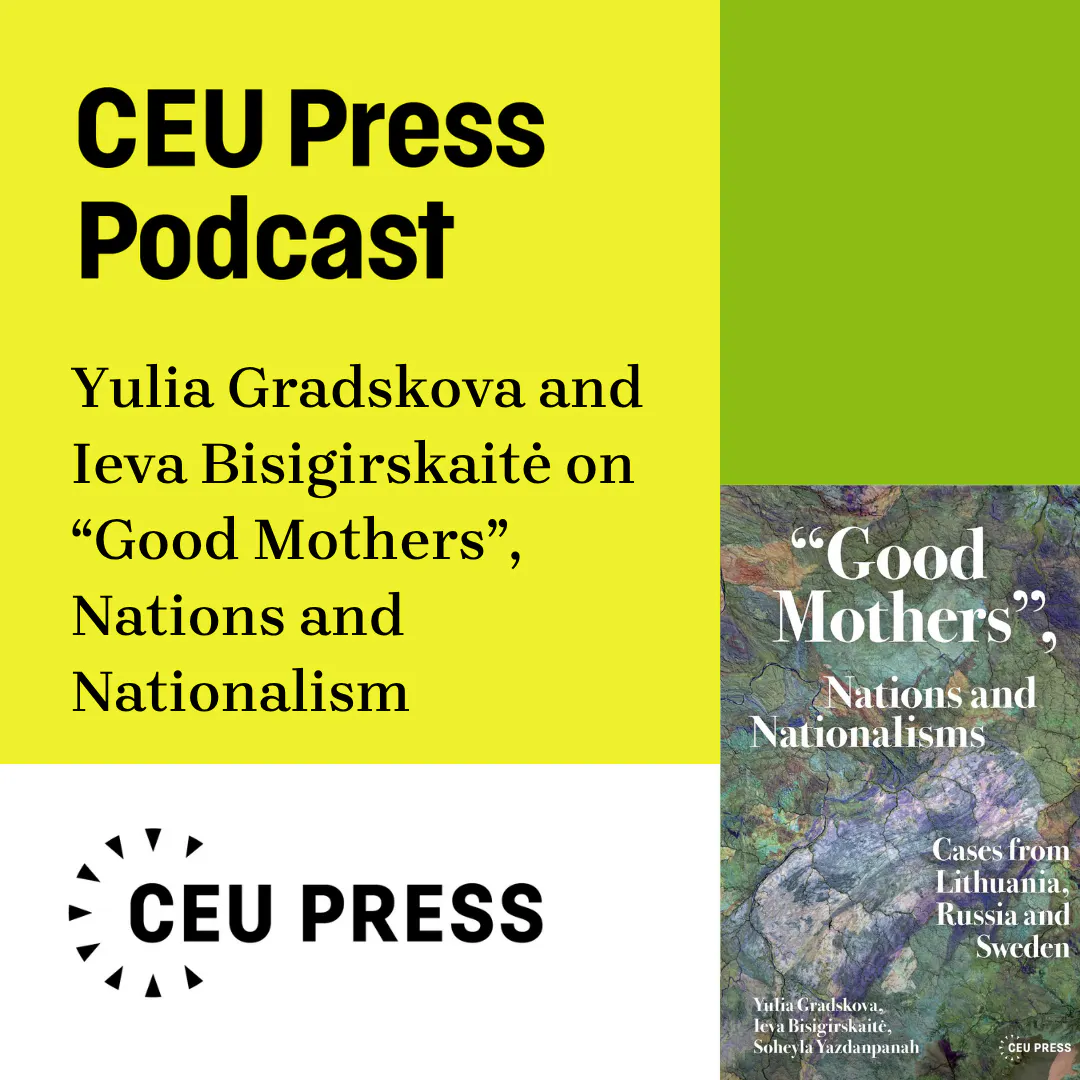 Yulia Gradskova et al., "Good Mothers, Nations and Nationalisms: Cases from Lithuania, Russia and Sweden" (CEU Press, 2026) 13.08.2026 56minIn this episode, host Andrea Talabér (CEU Press, 2026) talks with Yulia Gradskova and Ieva Bisigirskaitė, two of the three authors behind Good Mothers, Nations and Nationalisms: Cases from Lithuania, Russia and Sweden. Together with Soheyla Yazdanpanah, they explore what nationalists mean by "good mothers," demographic anxiety, and maternal activism in Lithuania, Russia and Sweden. You can purchase a copy here. The CEU Press Podcast delves into various aspects of the publishing process: from crafting a book proposal, finding a publisher, responding to peer review feedback on the manuscript, to the subsequent distribution, promotion and marketing of academic books. We also talk to series editors and authors, who will share their experiences of getting published and discuss their series or books. Interested in CEU Press’s publications? Click here to find out more: Stay tuned for future episodes and subscribe to our podcast to be the first to be notified. Learn more about your ad choices. Visit megaphone.fm/adchoices Support our show by becoming a premium member! https://newbooksnetwork.supportingcast.fm/european-studies
 -
Steven Veerapen, "Overlord: A New History of the Life and Reign of Henry VIII" (Simon & Schuster, 2026 06.08.2026 37minHenry VIII is England’s most famous king. He is simultaneously the virtuous Renaissance prince gone wrong, the psychopathic, paranoid tyrant, the religious disruptor and the much-married glutton. Overlord: The Life and Reign of Henry VIII (Birlinn, 2026) is a groundbreaking study of Henry’s life examines and destroys many of the long-repeated myths about this complex monarch: he was not particularly gluttonous, not particularly prudish, and not particularly messy in his religious changes. Nor did he see himself as simply King of England. Drawing on archival sources from across the British Isles, Dr. Steven Veerapen reveals how Henry fashioned an image of himself as a law-abiding and benevolent emperor who dreamed of uniting England, Scotland, Ireland, Wales and swathes of France under Tudor rule. Yet the image was false and the dream a nightmare for his queens, his ministers and many of his subjects. This new portrait shows Henry for what he really was: a self-aggrandising actor who, by fair means and foul – murder plots, marriage negotiations and military ventures – did all he could to realise his imperial fantasy. This interview was conducted by Dr. Miranda Melcher whose book focuses on post-conflict military integration, understanding treaty negotiation and implementation in civil war contexts, with qualitative analysis of the Angolan and Mozambican civil wars. You can find Miranda’s interviews on New Books with Miranda Melcher, wherever you get your podcasts. Learn more about your ad choices. Visit megaphone.fm/adchoices Support our show by becoming a premium member! https://newbooksnetwork.supportingcast.fm/european-studies
-
Laura Jockusch on Jewish Revenge after the Holocaust (JP) 06.08.2026 50minAfter a great human-wrought tragedy, how are victims and their kin made right? What does it mean to take revenge, to exact vengeance, to seek redress, to go vigilante in seeking justice? What counts as the proper or sufficient retaliation or retribution--and what can or should be left to the impartial third-person mechanisms of a justice system? To ask about those troubling topics from a new angle, Brandeis University's Laura Jockusch (author, previously, of Collect and Record and Jewish Honor Courts) has written about Jewish revenge on genocide perpetrators in her searching, and shocking Jewish Revenge and the Holocaust. Drawing on her great erudition and painstaking archival research, she explores how views changed during and after the war--and in following decades when justice and vengeance came to seem potentially compatible, especially if revenge could be rendered an aesthetic or imaginative phenomenon. Mentioned in the episode Quentin Tarantino's Inglourious Basterds Seekers for vengeance and also justice: Eli Wiesel and Simon Wiesenthal The killing of Ernst Vom Rath (pretext for the Night of Broken Glass) Aeschylus, The Oresteia (5th century B.C.) Hannah Arendt, Eichmann in Jerusalem (1963, no episode of RTB would be complete without it...) Bruce Robbins, Atrocity: A Literary History Howard Zinn, A People's History of the United States (1980) Tony Judt Postwar (2005) Recallable Books: Zalman Gradovsky, The Last Consolation Vanished Jean Amery, At the Mind's Limit: Contemplations by a Survivor on Auschwitz and Its Realities Filip Müller Eyewitness Auschwitz: Three Years in the Gas Chambers Kleist, Michael Kohlhass (1810) Read a transcript here. Learn more about your ad choices. Visit megaphone.fm/adchoices Support our show by becoming a premium member! https://newbooksnetwork.supportingcast.fm/european-studies
-
Katie Barclay, "The Kiss: A History of Passion and Power" (Reaktion Books, 2025) 01.08.2026 31minThe Kiss: A History of Passion and Power (Reaktion, 2026) by Professor Katie Barclay tells the surprising history of our most intimate gesture: the kiss. Richly illustrated, it explores a millennium of kisses, asking how and why the kiss has retained its power over the centuries, and what it might mean today. From the furtive kisses of fated lovers Heloise and Abelard to The Godfather’s ‘kiss of death’, Professor Barclay shows how the kiss can be romantic, peaceful, transgressive, intimate, erotic and more. There are kisses that are bad ideas, dangerous kisses and funny ones. New kisses are invented and old ones fall out of favour. While the kiss continues to change, Professor Barclay shows that we kiss fewer people, and less often, than we used to. The Kiss reveals a cultural inheritance transmitted in story and song, art and literature, and through the everyday kisses that we receive from our parents, or reserve for our lovers; when we kiss, we kiss with the weight of history. This interview was conducted by Dr. Miranda Melcher whose book focuses on post-conflict military integration, understanding treaty negotiation and implementation in civil war contexts, with qualitative analysis of the Angolan and Mozambican civil wars. You can find Miranda’s interviews on New Books with Miranda Melcher, wherever you get your podcasts. Learn more about your ad choices. Visit megaphone.fm/adchoices Support our show by becoming a premium member! https://newbooksnetwork.supportingcast.fm/european-studies
-
Andrew N. Buchanan and Ruth Lawlor eds., "The Greater Second World War: Global Perspectives" (Cornell UP, 2025) 28.07.2026 1h 15minAndrew Buchanan and Ruth Lawlor, The Greater Second World War: Global Perspectives (Cornell University Press, 2025) This ambitious edited collection encourages readers to think in bigger ways about the global Second World War. That includes a wider frame in space and time, but also a larger geopolitical perspective of the war as a world-system crisis and an expanded social perspective on who fought the war and why. A team of international scholars take on this task in chapters ranging from the global alliance system and colonial mobilization to studies of particular cities and dockyards. In a wide-ranging conversation with both editors, we discuss questions of imperialism, the rise and limits of US global hegemony, the 'ragged ends' of the war, and the social movements of a window of global possibility in 1945–46. Learn more about your ad choices. Visit megaphone.fm/adchoices Support our show by becoming a premium member! https://newbooksnetwork.supportingcast.fm/european-studies
-
Patrick Nunn, "Whispers from Celtic Seas: The True Meanings of Ancient Stories from Northwest Europe" (Reaktion, 2026) 26.07.2026 48minWhat if the legends of submerged cities, land-making witches and sea-crossing bishops are not mere inventions but echoes of real events? Whispers from Celtic Seas: The True Meanings of Ancient Stories from Northwest Europe (Reaktion Books, 2026) by Professor Patrick Nunn at the University of the Sunshine Coast in Australia revisits coastal traditions from the Celtic fringes of northwest Europe, showing how they preserve memories of dramatic environmental change—floods, land loss and shifting shorelines—carried forward through oral storytelling for generations. Drawing on cutting-edge geological and archaeological research, this book recasts these tales not as fantasy, but as historical testimony grounded in lived experience. With clarity and insight, it also brings to life the tellers and collectors of these stories, tracing how oral knowledge endured even as literacy spread. A compelling invitation to listen again to old stories, and to hear what the land and sea remember. This interview was conducted by Dr. Miranda Melcher whose book focuses on post-conflict military integration, understanding treaty negotiation and implementation in civil war contexts, with qualitative analysis of the Angolan and Mozambican civil wars. You can find Miranda’s interviews on New Books with Miranda Melcher, wherever you get your podcasts. Learn more about your ad choices. Visit megaphone.fm/adchoices Support our show by becoming a premium member! https://newbooksnetwork.supportingcast.fm/european-studies
-
Elisabeth van Houts, "Empress Matilda: Queen of the Romans, Ruler of the English" (Yale UP, 2026) 25.07.2026 56minBorn in 1102, Empress Matilda combined the blood of two dynasties: the house of Wessex and their conquerors, the dukes of Normandy. As a widowed German empress, she was named as heir successor by her father, Henry I. But, after his death in 1135, Matilda’s place on the English throne was usurped by her cousin, Stephen of Blois. Civil war followed, and she ruled the south-west of England in opposition. In Empress Matilda: Queen of the Romans, Ruler of the English (Yale University Press, 2026), Professor Elisabeth van Houts explores the remarkable life of medieval England’s only queen regnant. Van Houts examines female rulership in the Middle Ages, from Matilda’s relationships with her husbands, to her self-identification as granddaughter of William the Conqueror. Matilda used her persuasiveness effectively with the men who surrounded her, including her father, husbands, half-brothers and cousins. This is a fascinating account, which reveals Matilda to be an assertive, if on occasion disappointed, woman who made the best of her position with intelligence and stamina. This interview was conducted by Dr. Miranda Melcher whose book focuses on post-conflict military integration, understanding treaty negotiation and implementation in civil war contexts, with qualitative analysis of the Angolan and Mozambican civil wars. You can find Miranda’s interviews on New Books with Miranda Melcher, wherever you get your podcasts. Learn more about your ad choices. Visit megaphone.fm/adchoices Support our show by becoming a premium member! https://newbooksnetwork.supportingcast.fm/european-studies
-
 Mikuláš Pešta, "Student Internationalism and the Global Cold War: The International Union of Students in Socialist Prague" (Bloomsbury, 2026) 24.07.2026 42minIn this episode of the CEU Review of Books Podcast, I sat down with Mikuláš Pešta to talk about his new book, Student Internationalism and the Global Cold War: The International Union of Students in Socialist Prague (Bloomsbury, 2026). During our discussion we touched upon how the International Union of Students ended up being headquartered in Prague, the organisation's various activities, and the life of the Secretariat, amongst other topics. You can purchase the book from Bloomsbury here. The book is also available Open Access here. The CEU Review of Books Podcast Series explores the questions that affect us all through in-depth talks with researchers, policy makers, journalists, academics and others. We showcase the most current research linked to Central Europe through these discussions. At the CEU Review of Books, we encourage an open discussion that challenges conventional assumptions to foster a vibrant debate. Visit our website to read our latest reviews, long reads and interviews. Learn more about your ad choices. Visit megaphone.fm/adchoices Support our show by becoming a premium member! https://newbooksnetwork.supportingcast.fm/european-studies
 -
Martin Shaw, "The New Age of Genocide: Intellectual and Political Challenges After Gaza" (Agenda Publishing, 2025) 22.07.2026 1h 17minThe Israeli destruction of Gaza has returned the idea of genocide to the center of world politics, with sharp conflicts between the protesters and lawyers who invoke it and the governments and media that deny it. The New Age of Genocide: Intellectual and Political Challenges After Gaza (Agenda Publishing, 2025), by the foremost sociological theorist of genocide, Martin Shaw, defends the idea against thinkers who have questioned it, and argues that it is essential to the understanding of mass atrocities. It maintains that Gaza has opened a new age in which the West not only fails to prevent, but also participates in genocide. As well as discussing the genocide idea, the book analyses the Gaza genocide in the context of the longer histories of the problem, both globally and in Palestine. Further chapters deal with "forgotten genocides," the attempted Russian elimination of Ukraine, and the history of British complicity. Learn more about your ad choices. Visit megaphone.fm/adchoices Support our show by becoming a premium member! https://newbooksnetwork.supportingcast.fm/european-studies
-
Lucy D. Curzon, "Art and Citizenship in Conflict: British Women War Artists, 1939–45" (Manchester UP, 2025) 20.07.2026 1h 7minArt and Citizenship in Conflict: British Women War Artists, 1939-45 (Manchester UP, 2026) by Dr. Lucy Curzon examines the work of women war artists in order to highlight the complexity of citizenship and gender in Britain during the Second World War. Evelyn Dunbar, Mary Kessell, Ethel Gabain, Stella Schmolle, and Laura Knight, among others, were commissioned by the War Artists' Advisory Committee (WAAC) to document the millions of women who took up sometimes unconventional roles-in agriculture, the auxiliary services, and manufacturing, among others-to support the British war effort. Indeed, their prints, drawings, and paintings were part of a broader scheme to uphold morale and promote much-needed citizen involvement on the home front. While there is growing interest, the importance of their remit in the history of the Second World War and the quality of their artistry have nonetheless not yet secured them a significant place in scholarship. Art and Citizenship in Conflict seeks to amend this gap. This interview was conducted by Dr. Miranda Melcher whose book focuses on post-conflict military integration, understanding treaty negotiation and implementation in civil war contexts, with qualitative analysis of the Angolan and Mozambican civil wars. You can find Miranda’s interviews on New Books with Miranda Melcher, wherever you get your podcasts. Learn more about your ad choices. Visit megaphone.fm/adchoices Support our show by becoming a premium member! https://newbooksnetwork.supportingcast.fm/european-studies
Podcasts similaires


Populaire dans
Ce podcast figure aussi dans les classements de podcasts de ces pays.
