
Urgent Futures with Jesse Damiani
Jesse Damiani
0
Welcome to the Urgent Futures Podcast, the show that finds signal in the noise. Each episode, I sit down with leading thinkers for dialogues that clarify the chaos, from culture to the cosmos.
Épisodes
-
 AI’s Climate Footprint: New Report Argues We’ve Been Dramatically Underestimating the Energy & Emissions Toll - Erald Kolasi | Rapid Response #31 13.08.2026 1h 5minAI's actual energy & emissions footprint is a fiercely debated subject. Today's guest, Erald Kolasi, led a report that I coauthored that proposes new estimates...which are much worse than has been previously reported. Listen on...Support the show by checking out: ProtonVPN (gold-standard VPN—fast and safe. Click the link to get 55% off VPN Plus: $4.49/mo). ZBiotics (Decrease impact of hangovers. Code: JESSEDAMIANI for 10% off), MUD\WTR (43% off starter kits), 1Password (simplify your life and increase digital safety), Mission Farms CBD (healthy, effective CBD for relief, sleep, and wellbeing—25% off with email).Back in January I hosted Erald on Urgent Futures for the first time, and he offered a lucid, powerful argument for decarbonization, including actual proposals for how we get there, even in the face of the immense obstacles in the way.Later this spring, he reached out to me about a piece he’d been researching, generously inviting me to join him as a co-author. The fruits of that work now live in our recent report, “The Global Energy and Emissions Footprint of AI Diffusion.”It’s the first—to our knowledge!—comprehensive lifecycle analysis of the AI industry’s climate footprint, focusing on energy and emissions but also getting into water, downstream consumption, and rebound effects. It’s a beast of a report so it’d be foolish to try to recap it all here, but the headline numbers are that we estimate the AI industry is producing 1.1% of all global energy demand & 1.2% of GHG emissions in 2026.We break down how we got there and explain our methodology in this conversation, so I hope it makes for an accessible invitation into the report.BIO: Erald Kolasi is a writer and independent researcher focusing on the nexus between energy, technology, economics, complex systems, and ecological dynamics. His first book, The Physics of Capitalism, came out from the Monthly Review Press in February 2025. He received his PhD in Physics from George Mason University in 2016.CREDITS: This podcast is produced & edited by Adam Labrie & me, Jesse Damiani. Adam Labrie also edited the video version, which is available on YouTube.Find more episodes of Urgent Futures at: youtube.com/@UrgentFutures. Get full access to Reality Studies at www.realitystudies.co/subscribe
 -
 The Future of Free Speech & Censorship - Karen Attiah | Rapid Response #30 01.07.2026 1h 40minIn September, then-Washington Post Global Opinions Editor Karen Attiah was fired from the Washington Post for expressing her opinions about gun violence. What has happened since is the real story.Support the show by checking out: ProtonVPN (gold-standard VPN—fast and safe. Click the link to get 55% off VPN Plus: $4.49/mo). ZBiotics (Decrease impact of hangovers. Code: JESSEDAMIANI for 10% off), MUD\WTR (43% off starter kits), 1Password (simplify your life and increase digital safety), Mission Farms CBD (healthy, effective CBD for relief, sleep, and wellbeing—25% off with email).BIO: Karen Attiah is an award-winning journalist, columnist, and global thought leader whose work explores the intersections of race, culture, gender, and international affairs. She was born and raised in DeSoto, Texas, and began her journey in media and advocacy at 19 through an internship at the Dallas Public Defender’s Office. A formative summer in Spain studying Spanish ignited her lifelong commitment to international storytelling and human rights.A former Fulbright Scholar to Ghana, Karen has reported from across the globe—including Nigeria, Germany, Curaçao, and beyond. Her reporting and commentary have appeared in Voice of America, Al Jazeera, the Associated Press, Haitian Times, and other international outlets. She is also a frequent contributor to broadcast media, with appearances on CNN, MSNBC, BBC, NPR, and CBC.In 2016, Karen became the founding editor of The Washington Post’s Global Opinions section, where she commissioned commentary from some of the world’s most influential thinkers and dissidents. She became a staff columnist in 2021. Her writing—widely recognized for its clarity, courage, and impact—focuses on global justice, human rights, and the Black diaspora.Karen’s work has earned her numerous accolades, including the 2019 George Polk Special Award, the Harriet Beecher Stowe Freedom Writer Award, the National Association of Black Journalists’ Journalist of the Year Award, and recognition in Essence’s “Woke 100” and The Root 100. Washingtonian magazine named her a “Star to Watch” in 2021.She is the author of the forthcoming book Say Your Word, Then Leave, about the life and assassination of Saudi journalist and Washington Post columnist Jamal Khashoggi, whom she worked with closely during the last year of his life.In addition to her work as a writer and commentator, Karen is an amateur Muay Thai fighter and boxing enthusiast, having trained and competed both in the U.S. and abroad. She was the 2021 U.S. Muay Thai Open Silver Medalist in the 125-132 pound division.CREDITS: This podcast is produced & edited by Adam Labrie & me, Jesse Damiani. Adam Labrie also edited the video version, which is available on YouTube.Find more episodes of Urgent Futures at: youtube.com/@UrgentFutures. Get full access to Reality Studies at www.realitystudies.co/subscribe
 -
 On 'Withnessing': Storytelling, Spirituality, & Healing Toward Freedom - Maytha Alhassen | Rapid Response #29 25.06.2026 1h 33minI love when a conversation on Urgent Futures feels truly hybrid—that my guest has an irrepressibly curious mind and expansive practice. This is one such conversation. Dr. Alhassen weaves together her committed practices as a writer, historian, activist, academic, and somatic teacher (among others…see her bio). To try to sum this up in a pithy context paragraph would be a fool’s errand, so please just enjoy the conversation.Support the show by checking out: ProtonVPN (gold-standard VPN—fast and safe. Click the link to get 55% off VPN Plus: $4.49/mo). ZBiotics (Decrease impact of hangovers. Code: JESSEDAMIANI for 10% off), MUD\WTR (43% off starter kits), 1Password (simplify your life and increase digital safety), Mission Farms CBD (healthy, effective CBD for relief, sleep, and wellbeing—25% off with email).BIO: Dr. Maytha Alhassen is a writer, producer, journalist, professor, and Pop Culture Collaborative Senior Fellow, authoring the Haqq and Hollywood: Illuminating 100 Years of Muslim Tropes and How to Transform Them (2018) report. She has appeared as a co-host on The Young Turks’ main hour, as well as a guest co-host and digital producer on Al Jazeera English’s The Stream. Alhassen is the co-executive producer, writer, and social impact advisor for Hulu’s award-winning series Ramy; a lecturer in Comparative Studies in Race and Ethnicity at Stanford; a 2021–2024 Harvard Religion and Public Life Fellow in Art + Pop Culture; Executive Producer of the docuseries American Muslims: A History Revealed; a Pillars Muslim Narrative Change Fellow; a USC 2022–23 Civic Media Fellow; host of the educational web series Key Terms (part of the Office Hours series); co-host of Amazon Music and SALT Audio’s meditation podcast Become; and a former TED Resident (2017).In 2012, Alhassen co-edited the collection Demanding Dignity: Young Voices from the Front Lines of the Arab Revolutions. She has also written for CNN, Boston Review, HuffPost, Los Angeles Review of Books, The Baffler, Mic, and CounterPunch. Alhassen has appeared on CNN, HuffPost Live, Fusion Network, and WNYC’s The Brian Lehrer Show. From 2019 to 2020, Alhassen served as Visiting Assistant Professor of Peace and International Studies at Chapman University and as an Associate Professor teaching graduate courses in social justice and community organizing at Prescott College. As a social justice organizer, she helped launch abolitionist organizations and collectives including the Social Justice Institute at Occidental College, the Muslim Anti-Racism Collaborative, Believers Bail Out, and Arabs for Black Lives.Alhassen received her Ph.D. and M.A. in American Studies and Ethnicity from USC, a B.A. in Political Science and Arabic and Islamic Studies from UCLA in 2004, and an M.A. in Anthropology from Columbia University in 2008. While at Columbia, she conducted research for the university’s Malcolm X Project and facilitated arts-based workshops with incarcerated youth at Rikers Island through the Blackout Arts Collective. Alhassen has decades of experience in education, arts-based social justice organizing, media and journalism, global travel, healing practices—including yoga, Reiki, doula work, and meditation—and poetry writing and performance.CREDITS: This podcast is produced & edited by Adam Labrie & me, Jesse Damiani. Adam Labrie also edited the video version, which is available on YouTube.Find more episodes of Urgent Futures at: youtube.com/@UrgentFutures. Get full access to Reality Studies at www.realitystudies.co/subscribe
 -
 The Geopolitical Crisis Hasn’t Even Started Yet - Adames Global (Juanita Adames & Michelle Sucameli) | Rapid Response #28 16.06.2026 1h 4minWhat does Strait of Hormuz Crisis fallout mean for you? What does the Donroe Doctrine means for the emerging world order? American soft power on the decline & more from former USAID Project Directors, Adames Global.Support the show by checking out: ProtonVPN (gold-standard VPN—fast and safe. Click the link to get 55% off VPN Plus: $4.49/mo). ZBiotics (Decrease impact of hangovers. Code: JESSEDAMIANI for 10% off), MUD\WTR (43% off starter kits), 1Password (simplify your life and increase digital safety), Mission Farms CBD (healthy, effective CBD for relief, sleep, and wellbeing—25% off with email).BIO:Juanita M. Adames, Chief Strategy Officer at Adames Global, writes and works on one question: what does it actually take to make change stick?Over 15+ years, she’s led humanitarian and development programs across Latin America, Africa, the Middle East, and Asia - directing multi-country portfolios exceeding $75M, building public-private partnerships from the ground up, and operating in some of the world’s most unforgiving environments. Post-conflict Uganda and DRC. Fragile states like El Salvador, Kenya, and Myanmar. Places where the systems are broken and the stakes are real.Michelle Adames-Sucameli, Chief Executive Officer of Adames Global, leads the firm’s work at the intersection of strategy, systems transformation, and global impact, helping individuals and organizations navigate complexity, scale responsibly, and build institutions designed to endure.With more than 15 years of experience across international development, strategic partnerships, communications, and operations, Michelle has led high-impact initiatives spanning government, nonprofit, and private sector environments across Latin America, Africa, the Middle East, and Asia. Her work has focused on translating ambitious ideas into executable strategy for media and business partners, building cross-sector coalitions, and strengthening organizations operating in politically, socially, and operationally complex environments.(Read their longer bios at the full episode page here)CREDITS: This podcast is produced & edited by Adam Labrie & me, Jesse Damiani. Adam Labrie also edited the video version, which is available on YouTube.Find more episodes of Urgent Futures at: youtube.com/@UrgentFutures. Get full access to Reality Studies at www.realitystudies.co/subscribe
 -
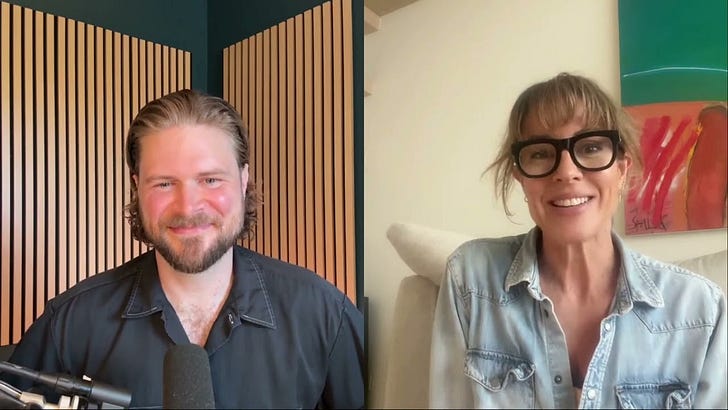 How to Live Fully in the Face of Collapse - Sarah Wilson | Rapid Response #27 04.06.2026 1h 8minA lot of writing about collapse ends up feeling abstract—like the authors are writing from a remove about an alien species. But today's guest, Sarah Wilson, has written a collapse book that does something incredibly rare. Listen on to find out, and of course:Grab your copy of I Eat The Stars now!Support the show by checking out: ProtonVPN (gold-standard VPN—fast and safe. Click the link to get 55% off VPN Plus: $4.49/mo). ZBiotics (Decrease impact of hangovers. Code: JESSEDAMIANI for 10% off), MUD\WTR (43% off starter kits), 1Password (simplify your life and increase digital safety), Mission Farms CBD (healthy, effective CBD for relief, sleep, and wellbeing—25% off with email).BIO: Sarah Wilson is a multi-New York Times and Amazon best-selling author, podcaster, social philosopher, international keynote speaker, philanthropist and climate change advisor.Sarah is known globally for founding the I Quit Sugar movement – a digital wellness program with 13 award-winning books that sell in 52 countries – which saw millions around the world transform their health. In 2022 Sarah sold the business and gave everything to charity.Sarah is an experienced journalist and broadcaster. She was previously the editor of Cosmopolitan Australia at age 29; host of MasterChef Australia; was a News Corp journalist and columnist; and has hosted ABC’s Compass, Ten’s The Project and has been a regular panelist and news commentator on Australian, UK and US screens for two decades.Her New York Times bestseller First, We Make the Beast Beautiful is described by bestselling author (The Subtle Art of Not Giving a F**k) Mark Manson as, “The best book on living with anxiety that I’ve ever read,” and was featured as the book of the year on NBC’s Today Show. It’s published in 27 countries. Sarah’s book, This One Wild & Precious Life, won the 2021 US Gold Nautilus Prize.Sarah is the host of the thought-leading podcast Wild with Sarah Wilson and writes the popular Substack newsletter This is Precious, which has an engaged community of 60,000 subscribers.Most recently, she serialized her book I Eat The Stars on Substack – an exploration of system collapse and how we navigate it, which was acquired by Penguin US and will be released globally across May and June.CREDITS: This podcast is produced & edited by Adam Labrie & me, Jesse Damiani. Adam Labrie also edited the video version, which is available on YouTube.Find more episodes of Urgent Futures at: youtube.com/@UrgentFutures. Get full access to Reality Studies at www.realitystudies.co/subscribe
 -
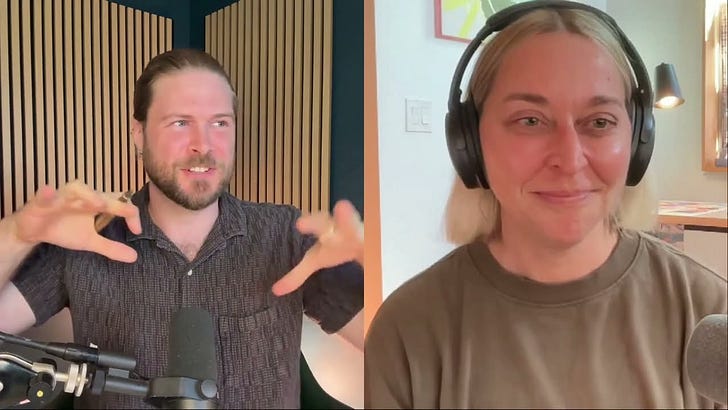 Decoding Systems of Power & Meaning: Military AI, Epstein, Necropolitics...& Backrooms - Cy Canterel | Rapid Response #26 28.05.2026 1h 9minI was lucky to meet today's guest, Cy Canterel, a few years ago during the downslope of hype around NFTs and web3—a moment we actually dive into during the episode—fully aware of the ways many people will hear those terms an instantly tune out. My hope here isn’t to valorize the aforementioned (though we do discuss how there were seeds of something meaningful that were drowned out by all the grift and greed); I bring it up because it highlights the intellectual curiosity and expansiveness that threads all of Cy’s work across tech, art, culture, power, and philosophy. More than most people I’ve met, Cy trusts her intuition to lead her to new ways of thinking and perceiving, and her intense research practice then creates the scaffolding and texture to give her ideas weight.Support the show by checking out: ProtonVPN (gold-standard VPN—fast and safe. Click the link to get 55% off VPN Plus: $4.49/mo). ZBiotics (Decrease impact of hangovers. Code: JESSEDAMIANI for 10% off), MUD\WTR (43% off starter kits), 1Password (simplify your life and increase digital safety), Mission Farms CBD (healthy, effective CBD for relief, sleep, and wellbeing—25% off with email).All of which is why it’s especially fun for me that Cy has emerged as a leading media theorist and communicator on Substack, with a particular eye toward decoding systems of power and meaning. As you can gather from the title, that includes a whole lot of contemporary concerns as well as more evergreen ones. When I say this conversation is free-wheeling, I mean it; but I’ll let you experience it for yourself.BIO: Cy Canterel, in her own words: Artist. Feral scholar. Raised by computers. Ex-tech (infrastructure, IoT, AI/ML). Alumna: Institute for the Future of the Book. Fmr. visiting scholar @NYU. Decoding systems of power and meaning. Big time crayon fan.CREDITS: This podcast is produced & edited by Adam Labrie & me, Jesse Damiani. Adam Labrie also edited the video version, which is available on YouTube.Find more episodes of Urgent Futures at: youtube.com/@UrgentFutures. Get full access to Reality Studies at www.realitystudies.co/subscribe
 -
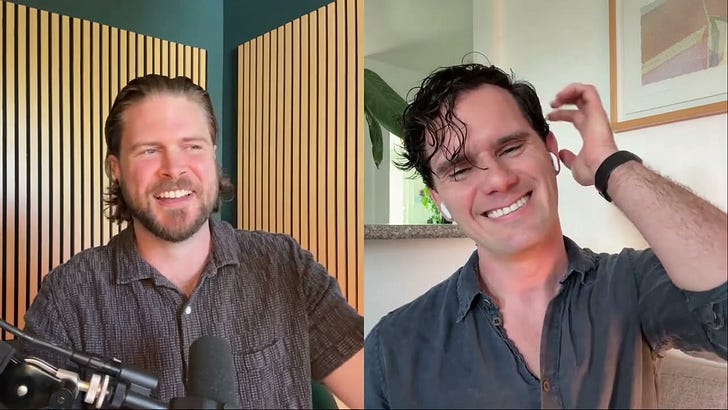 Apocalypse Early Warning System? Track the Oligarchs. Creative Tech as Crisis Intervention - Kyle McDonald | Rapid Response #25 20.05.2026 1h 24minHow can art—especially new media art—be used to intervene in polycrisis? Across projects like Apocalypse Early Warning System, ICEspy, & more, artist Kyle McDonald charts a path.Support the show by checking out: ProtonVPN (gold-standard VPN—fast and safe. Click the link to get 55% off VPN Plus: $4.49/mo). ZBiotics (Decrease impact of hangovers. Code: JESSEDAMIANI for 10% off), MUD\WTR (43% off starter kits), 1Password (simplify your life and increase digital safety), Mission Farms CBD (healthy, effective CBD for relief, sleep, and wellbeing—25% off with email).BIO: Kyle McDonald is an artist working with code. He crafts interactive installations, sneaky interventions, playful websites, workshops, andtoolkits for other artists working with code. Exploring possibilities of new technologies: to understand how they affect society, to misuse them, and build alternative futures; aiming to share a laugh, spark curiosity, create confusion, and share spaces with magical vibes. Working with machine learning, computer vision, social and surveillance tech spanning commercial and arts spaces. Previously adjunct professor at NYU’s ITP, member of F.A.T. Lab, community manager for openFrameworks, and artist in residence at STUDIO for Creative Inquiry at CMU, and YCAM in Japan. Work commissioned and shown around the world, including: the V&A, NTT ICC, Ars Electronica, Sonar, Todays Art, and Eyebeam.CREDITS: This podcast is produced & edited by Adam Labrie & me, Jesse Damiani. Adam Labrie also edited the video version, which is available on YouTube.Find more episodes of Urgent Futures at: youtube.com/@UrgentFutures. Get full access to Reality Studies at www.realitystudies.co/subscribe
 -
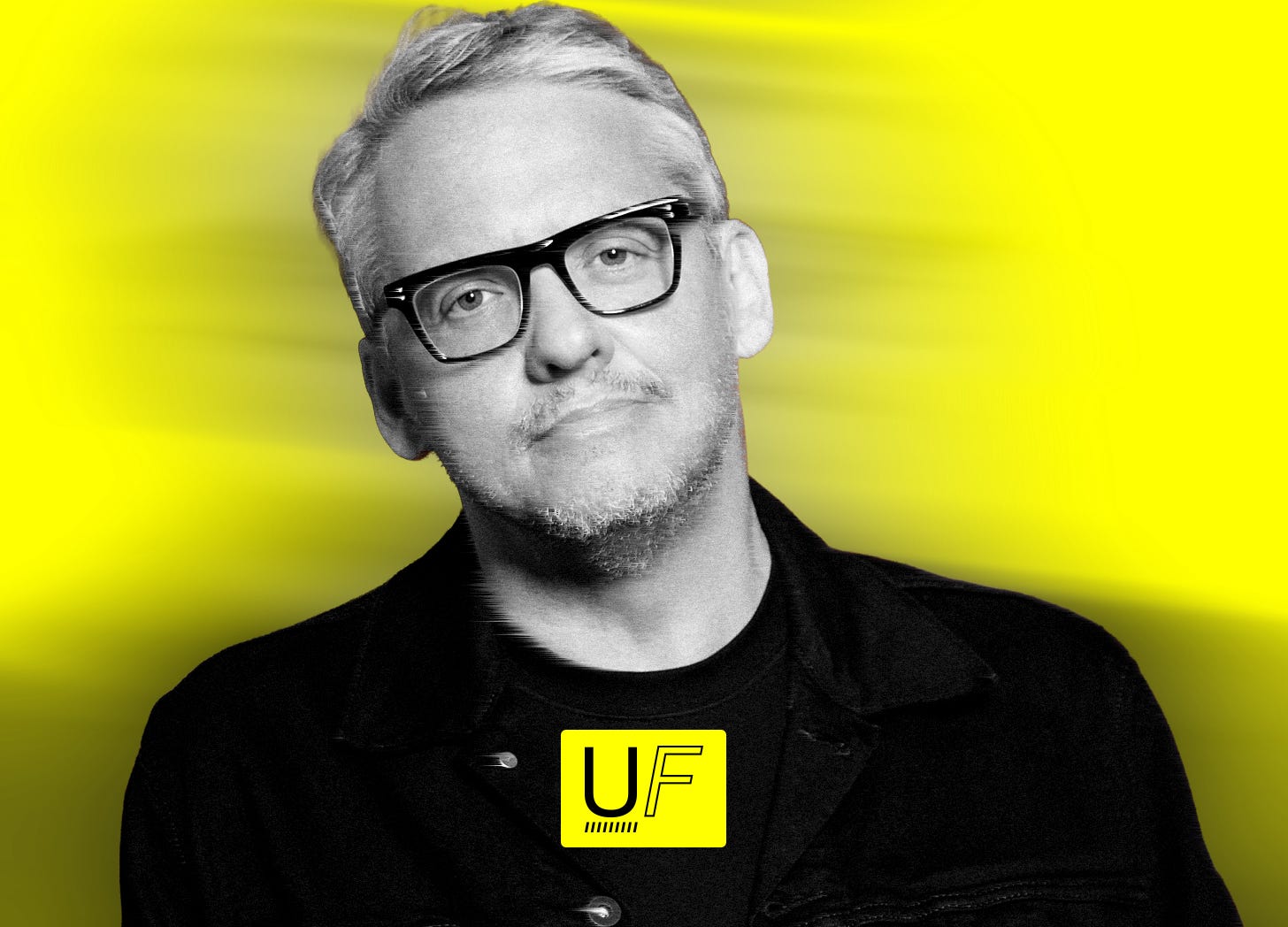 How Storytelling & Comedy Expose Corruption & Depict Climate Collapse - Adam McKay | #73 13.05.2026 1h 36minFrom comedies like Anchorman and Step Brothers to The Big Short, Vice, and 2C—a forthcoming film about climate apocalypse—Adam McKay's evolution as a storyteller and public figure epitomizes the journey we will need many other creative folks to undertake if we're going to survive what's coming. We get into all of it (including teasers about forthcoming projects).Support the show by checking out: ProtonVPN (gold-standard VPN—fast and safe. Click the link to get 55% off VPN Plus: $4.49/mo). ZBiotics (Decrease impact of hangovers. Code: JESSEDAMIANI for 10% off), MUD\WTR (43% off starter kits), 1Password (simplify your life and increase digital safety), Mission Farms CBD (healthy, effective CBD for relief, sleep, and wellbeing—25% off with email).BIO: Adam McKay is an Academy Award-winning writer, director, and producer whose work spans comedy, film, television, documentaries, and podcasting. He won the Oscar for Best Adapted Screenplay for The Big Short and earned additional Academy Award nominations for Vice and Netflix’s global hit Don’t Look Up. His producing credits also include The Menu, Booksmart, Hustlers, The Chair Company, and HBO’s acclaimed series Succession, for which he directed the pilot and won a Directors Guild Award.Before becoming one of Hollywood’s most influential filmmakers, McKay made his name in the comedy world as a founding member of the Upright Citizens Brigade. In 1995, McKay and Will Ferrell happened to start on the same day at Saturday Night Live, where he became Head Writer. McKay and Ferrell’s time at SNL led to collaborations that established their unique absurdist style on Anchorman: The Legend of Ron Burgundy (2004) followed by Talladega Nights: The Ballad of Ricky Bobby (2006), Step Brothers (2008), The Other Guys (2010) and Anchorman 2: The Legend Continues (2013).Beyond film and television, McKay is also an active producer of documentaries and podcasts focused on politics, culture, sports, and social issues. In 2023, he founded Yellow Dot Studios, a nonprofit media organization dedicated to combating climate misinformation through comedy and storytelling.In 2016, McKay joined the Creative Council of Represent Us, the largest grassroots anti-corruption campaign in the US to pass laws that stop political bribery, end secret money and give voters a stronger voice. He is passionate about the climate crisis and is affiliated with numerous climate organizations, including the Climate Emergency Fund to whom he donated $4M in 2022. In addition to aiding the movement General Strike for Resignations (GS4R), a group that helps finance strike-support platforms across labor unions, climate organizations and social justice groups, McKay supports DSA LA, Homeless Health Care LA and Amnesty International.CREDITS: This podcast is produced & edited by Adam Labrie & me, Jesse Damiani. Adam Labrie also edited the video version, which is available on YouTube.Find more episodes of Urgent Futures at: youtube.com/@UrgentFutures. Get full access to Reality Studies at www.realitystudies.co/subscribe
 -
 From Palantir Employee to Digital Rights Advocacy: Starting a People’s Movement Against AI Risks - Juan Sebastián Pinto | Rapid Response #24 12.05.2026 51minBy now, the company Palantir has probably entered your field of view—but many still don’t quite get the scope and scale of what they’re building and why. Juan, today's guest, formerly worked at Palantir and other AI companies, and has now emerged as leading advocate for a people’s movement to regulate AI and promote liberatory futures. So listen/watch on to understand into the invisible dangers of Palantir’s tools and what we can do to keep them (and other harmful aspects of AI rollout) in check.Support the show by checking out: ProtonVPN (gold-standard VPN—fast and safe. Click the link to get 55% off VPN Plus: $4.49/mo). ZBiotics (Decrease impact of hangovers. Code: JESSEDAMIANI for 10% off), MUD\WTR (43% off starter kits), 1Password (simplify your life and increase digital safety), Mission Farms CBD (healthy, effective CBD for relief, sleep, and wellbeing—25% off with email).BIO: Juan Sebastián Pinto is a designer and writer currently working at the intersection of civil rights and technology. His writing appears in The Guardian, Forbes, Dwell Magazine, and Substack. His work and advocacy has been featured in WIRED, NPR, The Washington Post, Democracy Now!, and the BBC.In the past Juan led content/creative for various leading AI startups and worked and collaborated with many architecture firms as a strategist, writer, and graphic designer. He completed his BA and MA in English at the University of Pennsylvania.Juan also runs Ziggurat on Substack—be sure to subscribe!CREDITS: This podcast is produced & edited by Adam Labrie & me, Jesse Damiani. Adam Labrie also edited the video version, which is available on YouTube.Find more episodes of Urgent Futures at: youtube.com/@UrgentFutures. Get full access to Reality Studies at www.realitystudies.co/subscribe
 -
 The Most Consequential Story in Earth's History - Peter Brannen | #72 06.05.2026 1h 27minIf you spend enough time learning about climate change, you come to regard the molecule carbon dioxide—abbreivated to CO2—with fear and frustration. After all, the long accumulation of CO2 is behind roughly 75% of Earth’s warming. Leaving aside the fact that we’re the species that put all that CO2 in the air, we’re also not viewing the bigger picture. That bigger picture is the subject of today's guest's modestly titled new book, The Story of CO2 is the Story of Everything. Read on...Support the show by checking out: ProtonVPN (gold-standard VPN—fast and safe. Click the link to get 55% off VPN Plus: $4.49/mo). ZBiotics (Decrease impact of hangovers. Code: JESSEDAMIANI for 10% off), MUD\WTR (43% off starter kits), 1Password (simplify your life and increase digital safety), Mission Farms CBD (healthy, effective CBD for relief, sleep, and wellbeing—25% off with email).The book amply earns the big claim of the title, helping readers like me understand that the carbon cycle is one of the most miraculous things on Earth—and also one of the most consequential.Buy The Story of CO2 is the Story of Everything here.Don’t get the wrong idea: Story of CO2 is not a starry eyed greenwashing affair. If anything, the book is asking us to approach the subject with humility. The carbon cycle may be miraculous, and a driving part of why life emerged on Earth, but that doesn’t mean it’s unchangeable. In continuing to burn fossil fuels, we’re tampering with that system, and at an alarming rate. Insofar as we’re already witnessing some of the consequences, we also have no way of knowing the full regimen of changes that might be occurring across the Earth system. To that, Peter employs some of the same time travel he used in The Ends of the World—which we discussed in an earlier episode—taking us on a journey through deep time to understand how the story of CO2 really did become the story of everything—at least as we understand it on our one precious planet.BIO: Peter Brannen is an award-winning science journalist whose work has appeared in The New York Times, The New Yorker, The Atlantic, Scientific American, and The Guardian among other publications. He is the author of The Story of CO2 is the Story of Everything and The Ends of the World. Peter was a 2023 visiting scholar at the Kluge Center at the Library of Congress, and is an affiliate at the Institute of Arctic and Alpine Research at the University of Colorado-Boulder. He was formerly a 2018 Scripps Fellow at CU-Boulder, a 2015 journalist-in-residence at the National Evolutionary Synthesis Center at Duke University, and a 2011 Ocean Science Journalism Fellow at the Woods Hole Oceanographic Institution in Woods Hole, MA. His essays have been featured in the Best American Science and Nature Writing series and in The Climate Book by Greta Thunberg. Peter is particularly interested in geology, ocean science, deep time, the carbon cycle and the Boston Celtics. Peter splits time between Cambridge, MA and Damariscotta, ME and is a placental mammal.CREDITS: This podcast is produced & edited by Adam Labrie & me, Jesse Damiani. Adam Labrie also edited the video version, which is available on YouTube.Find more episodes of Urgent Futures at: youtube.com/@UrgentFutures. Get full access to Reality Studies at www.realitystudies.co/subscribe
 -
 Extreme Heat: What City-Dwellers Need to Understand - Vivek Shandas | #71 29.04.2026 1h 3minWhen you think of threats from heat, your mind probably goes to wildfire threats. And don’t get me wrong, having lived through wildfires firsthand, they’re not to be underestimated! But the headline-grabbing nature of fires might overshadow the fact that plain old heat can be a real threat to your health. In fact, extreme heat is the leading cause of weather-related deaths in the U.S.; more than hurricanes and floods.Support the show by checking out: ProtonVPN (gold-standard VPN—fast and safe. Click the link to get 55% off VPN Plus: $4.49/mo). ZBiotics (Decrease impact of hangovers. Code: JESSEDAMIANI for 10% off), MUD\WTR (43% off starter kits), 1Password (simplify your life and increase digital safety), Mission Farms CBD (healthy, effective CBD for relief, sleep, and wellbeing—25% off with email).And this is pronounced in urban spaces, where a deadly cocktail of heat-exacerbating building materials and careless urban planning has created a situation in which, during heat events, cities can become especially dangerous. Today’s guest is an expert in the phenomenon of urban heat islands, areas that are significantly warmer than surrounding rural areas. Tree cover is one of the key interventions, but unfortunately, US cities are actually losing tree cover. A study from the Forest Service in 2018 found that US cities were losing trees at a rate of 36 million per year. And worse, what Vivek has found in his research is that many of the hottest neighborhoods in cities—those that already lack sufficient tree cover—are also losing trees at the fastest rates. While I absolutely hate this fact, it’s why I especially appreciate Vivek’s approach, weaving together sustainability, environmental justice, and urban planning—and doing so in such a clear-eyed, accessible way.I know this is not light fare, but given that we’re also potentially heading into what experts have literally called a “super-duper” El Niño, which they believe will produce new record-setting temperatures, I feel strongly that you need to familiarize yourself with this subject so that you’re best able to prepare and help do what you can to advocate for better heat planning in your hometowns. BIO: Vivek Shandas is a researcher, professor at Portland State University, and advisor helping cities navigate climate and public health challenges. Over two decades, he has worked with governments and communities to improve urban environments through data-driven, equitable strategies. He has authored 100+ journal articles and five books, and his work on urban heat, air quality, and environmental justice has been featured in major outlets including The New York Times and National Geographic. In 2023, he was appointed to the USDA’s National Urban and Community Forestry Advisory Council. He is also the lead scientific advisor to CAPA Strategies and enjoys the mountains and water of the Pacific Northwest, where he lives with his family.CREDITS: This podcast is produced & edited by Adam Labrie & me, Jesse Damiani. Adam Labrie also edited the video version, which is available on YouTube.Find more episodes of Urgent Futures at: youtube.com/@UrgentFutures. Get full access to Reality Studies at www.realitystudies.co/subscribe
 -
 Prepper Camp, But Make it Fun & Community-Focused - Sam Bloch (DoomsDaddy) | #70 23.04.2026 1h 8minWhat happens when a veteran humanitarian and disaster relief specialist founds a camp for building resilience and community? Listen on...Support the show by checking out: ProtonVPN (gold-standard VPN—fast and safe. Click the link to get 55% off VPN Plus: $4.49/mo). ZBiotics (Decrease impact of hangovers. Code: JESSEDAMIANI for 10% off), MUD\WTR (43% off starter kits), 1Password (simplify your life and increase digital safety), Mission Farms CBD (healthy, effective CBD for relief, sleep, and wellbeing—25% off with email).As I’ve discussed in a few other episodes, I’m of the mind that we need to reclaim the notion of prepping and shift it away from a stock stereotype about loner survivalists (though, hey, good for them). Rather, I’m excited by the version of prepping that’s growing out of the mutual aid movement, which foregrounds community care and self-empowerment. I did a collaborative video with forecasting agency Death to Stock outlining some of these ideas, which went a little viral, and beyond vanity, I’m glad it did; it led me to meet Sam Bloch, founder of Camp DoomsDaddy. What Sam is doing is precisely what I see as the potential of turning preparedness and resilience into commonplace aspects of our lives. Essentially, he moves from the twinned premise that community is a superpower and resilience should be fun. He’s run two camps already—and has one coming up in May that, if you can go, you really should!—and if the documentation of their time is to be believed, they really did have a blast. All while learning critical skills to navigate volatile futures.And Sam is the perfect person to do this; he’s a sort of preparedness and disaster relief auto-didact, having kicked off his career in Southeast Asia two decades ago, and becoming a leading figure in humanitarianism along the way. He sensed—rightly, in my estimation—that while disaster relief remains critical, a missing piece is building communities of people who have learned how to prepare in advance.BIO: Sam Bloch is the founder and lead trainer at Camp DoomsDaddy. Sam comes with 20+ years of emergency response experience at the front-lines of disasters worldwide, from tsunamis and earthquakes to wildfires and war zones. A co-founder of Communitere International and former Director of Emergency Response at World Central Kitchen, he has led response efforts in more than 50 countries and worked at the epicenter of them in more than 30 U.S. disasters alone. After decades helping people who weren’t prepared, Sam is now focused on ensuring individuals and communities have the skills they need to take care of themselves and each other before disaster strikes. Sam is also on the Advisory Board of Watch Duty, and a trained wild land firefighter.CREDITS: This podcast is produced & edited by Adam Labrie & me, Jesse Damiani. Adam Labrie also edited the video version, which is available on YouTube.Find more episodes of Urgent Futures at: youtube.com/@UrgentFutures. Get full access to Reality Studies at www.realitystudies.co/subscribe
 -
 Orbán’s Loss is a Big Deal. Explaining the Future of Hungary, the EU, & Geopolitics - Eric Czuleger | Rapid Response #23 21.04.2026 56minViktor Orbán is widely regarded as having written the playbook for 'illiberal democracy' that has been used by those aspiring to turn democracies into autocracies—including Donald Trump. But last week, he lost the election—and miraculously, actually stepped down. What should we make of all this? What does it mean for Hungary, the EU, and the world? I chat with friend of the pod Eric Czuleger to find out.Support the show by checking out: ProtonVPN (gold-standard VPN—fast and safe. Click the link to get 55% off VPN Plus: $4.49/mo). ZBiotics (Decrease impact of hangovers. Code: JESSEDAMIANI for 10% off), MUD\WTR (43% off starter kits), 1Password (simplify your life and increase digital safety), Mission Farms CBD (healthy, effective CBD for relief, sleep, and wellbeing—25% off with email).BIO: Eric Czuleger is a geopolitical analyst and journalist who has worked across 45+ countries. Trained under George Friedman at Stratfor, he holds a Master's in National Security from the RAND School of Public Policy and an MSt in Creative Writing from Oxford. He is the author of You Are Not Here: Travels Through Countries That Don't Exist. A returned Peace Corps volunteer (Albania, 2011–2013) and former ambassador from Liberland to Somaliland, he splits his time between Tirana, Albania and Los Angeles.Find more episodes of Urgent Futures at: youtube.com/@UrgentFutures. Get full access to Reality Studies at www.realitystudies.co/subscribe
 -
 How Solar Power Could Change Everything - Lee Buck | #69 15.04.2026 1h 16minI don't think people fully understand how incredible solar power has gotten—and what it would mean for the future of our planet (and species) if we pursued an aggressive solar effort.Today's guest, Lee Buck, explains what solar futures might hold—and why we should be doing everything we can to bring them about.Support the show by checking out: ProtonVPN (gold-standard VPN—fast and safe. Click the link to get 55% off VPN Plus: $4.49/mo). ZBiotics (Decrease impact of hangovers. Code: JESSEDAMIANI for 10% off), MUD\WTR (43% off starter kits), 1Password (simplify your life and increase digital safety), Mission Farms CBD (healthy, effective CBD for relief, sleep, and wellbeing—25% off with email).I had the good fortune to meet Lee last summer in Maine while my partner was in residency at Reach Projects in Blue Hill. It’s a really lovely community of people up there, and Lee is an esteemed member, a great host, and grills a mean burger to boot—and we quickly bonded over both our commitment to climate-related work and our background in tech.Lee’s perspective on climate progress (or lack thereof) stems from his work as an investor and philanthropist, which gives him a unique view into what’s afoot in ClimateTech, as well as the struggles that startups and even more established companies face in implementing effective responses under current social, cultural, political, and economic conditions. It’s a perspective I haven’t yet had the chance to feature on the show, so I’m glad Lee agreed to sit down with me.You’ll also hear his reflections on solar power, on what Silicon Valley felt like during the dot-com boom, and his advocacy for Apple vs. Android products, and much more. BIO: Leonard Buck is an investor and philanthropist focused on the challenges and opportunities presented by climate change.He previously supported the regional entrepreneurial ecosystem as an early-stage investor, mentor, and board member. He has served on dozens of boards, including NC IDEA, CED, and the UNC Board of Visitors, and was a Blackstone Entrepreneur-in-Residence.Earlier in his career, Buck founded a succession of software companies that partnered with leading technology firms such as Apple, Oracle, Microsoft, and Sun Microsystems. He also contributed to early internet standards through a working group of the W3C.Buck lives in Hillsborough, North Carolina, with his wife, Libby.CREDITS: This podcast is produced & edited by Adam Labrie & me, Jesse Damiani. Adam Labrie also edited the video version, which is available on YouTube.Find more episodes of Urgent Futures at: youtube.com/@UrgentFutures. Get full access to Reality Studies at www.realitystudies.co/subscribe
 -
 Enshittification: The Rot at the Heart of Big Tech - Cory Doctorow | #68 07.04.2026 1h 8minRemember when the Internet was a fun place, not where you were hypersurveilled while doomscrolling?Enshittification. It’s a word that captures what's happened to the Internet—and critically, why. It has taken the world by storm, dubbed the 2023 Word of the Year by the American Dialect Society and the 2024 Word of the Year by the Macquarie Dictionary. It’s a delicious word—playfully naughty and piercingly descriptive.Grab your copy of Enshittification: Why Everything Suddenly Got Worse and What to Do About It here!Support the show by checking out: ProtonVPN (gold-standard VPN—fast and safe. Click the link to get 55% off VPN Plus: $4.49/mo). ZBiotics (Decrease impact of hangovers. Code: JESSEDAMIANI for 10% off), MUD\WTR (43% off starter kits), 1Password (simplify your life and increase digital safety), Mission Farms CBD (healthy, effective CBD for relief, sleep, and wellbeing—25% off with email).Today’s guest is the man behind the word, and he’s something of an expert in crystallizing complex ideas with memorable turns of phrase. What started as a blog post a few years back has become a full-blown book (and a great one, at that, so pick your copy now!). The concept describes the process by which tech products degrade over time—specifically through economic and political pressures and incentive structures—and the book breaks this down in page-turning detail, with case studies that make your stomach turn. If you’ve interacted with tech products at all over the past couple decades, everything about this book will ring painfully true to you.But all hope is not lost; Cory also outlines how we fight against these enshittificatory processes. It’s truly a must-read, and in the meantime, I hope this conversation is an invitation into this vital body of ideas. So without further ado, please enjoy this illuminating conversation with Cory Doctorow.BIO: Cory Doctorow is a blogger, journalist, and activist. For more than twenty years, he has worked with the Electronic Frontier Foundation on campaigns to safeguard and further our human rights online. He was coeditor of the weblog Boing Boing for nineteen years and now maintains a daily(ish) newsletter at Pluralistic.net. He has written more than thirty books, including nonfiction books, many science fiction novels, collections of short stories and essays, young adult novels, graphic novels, and even a picture book. Born in Toronto, he now lives in Burbank, California. He was awarded an honorary doctorate in laws by York University and an honorary doctorate in computer science by the Open University. He has been inducted into the Canadian Science Fiction and Fantasy Association Hall of Fame and was awarded the Sir Arthur C. Clarke Award for Imagination in Service to Society. He holds visiting professorship and research appointments at MIT, the University of North Carolina, Cornell University, and the Open University.CREDITS: This podcast is produced & edited by Adam Labrie & me, Jesse Damiani. Adam Labrie also edited the video version, which is available on YouTube.Find more episodes of Urgent Futures at: youtube.com/@UrgentFutures. Get full access to Reality Studies at www.realitystudies.co/subscribe
 -
 Quantum Computing 101 - Dr. Bob Sutor | #67 22.03.2026 1h 25minOver the years, you’ve probably heard many references to quantum computing. In geopolitics and tech matters, it’s considered an area of extreme interest, and yet it remains a subject that many don’t fully understand (even within the tech commentariat). What is it, how does it work, and what are the implications of a world suffused with this technology?Today's guest, Dr. Bob Sutor, breaks it down.Support the show by checking out: ProtonVPN (gold-standard VPN—fast and safe. Click the link to get 55% off VPN Plus: $4.49/mo). ZBiotics (Decrease impact of hangovers. Code: JESSEDAMIANI for 10% off), MUD\WTR (43% off starter kits), 1Password (simplify your life and increase digital safety), Mission Farms CBD (healthy, effective CBD for relief, sleep, and wellbeing—25% off with email).BIO: Dr. Bob Sutor has been a technical leader and executive in the computer and DeepTech industry for over 40 years. He is a theoretical mathematician by training, with a Ph.D. from Princeton University and an undergraduate degree from Harvard College.During his career, Dr. Sutor has spoken to and briefed government legislators and policymakers around the world, such as his 2022 testimony before the United States Senate Committee on Commerce, Science, and Transportation on “Securing U.S. Leadership in Emerging Compute Technologies.” He was a co-author of the 2024 Quantum Economy Blueprint from the World Economic Forum.Dr. Sutor is the CEO and Founder of Sutor Group Intelligence and Advisory. He helps clients and investors understand sophisticated technologies such as quantum computing and use them effectively to succeed in their organizations and industries. Bob is a member of the Board of Directors of Nu Quantum and an advisor to the Forma Prime venture capital firm. He is also an Adjunct Professor in the Department of Computer Science and Engineering at the University of Buffalo, New York, and spent over two decades at the IBM Thomas J. Watson Research Center. Dr. Sutor is the author of the bestselling 2019 quantum computing book Dancing with Qubits.CREDITS: This podcast is produced & edited by Adam Labrie & me, Jesse Damiani. Adam Labrie also edited the video version, which is available on YouTube.Find more episodes of Urgent Futures at: youtube.com/@UrgentFutures. Get full access to Reality Studies at www.realitystudies.co/subscribe
 -
 Attacks on Section 230 & ‘Age Verification’ Laws Are Critical Threats to Internet Privacy & Security - Noelle Perdue | Rapid Response #22 11.03.2026 46minThis marks Noelle’s—count it!—fourth time on Urgent Futures, and I continue to be grateful to have her as a dialogue partner on all things Internet freedoms. This conversation most directly builds on our Aug. 2025 episode, which focused foremost on the threats to privacy and security smuggled in with ‘age verification’ laws. That conversation is as timely and relevant today, so if you want to learn more, be sure to check that episode out as well.Support the show by checking out: ProtonVPN (gold-standard VPN—fast and safe. Click the link to get 55% off VPN Plus: $4.49/mo). ZBiotics (Decrease impact of hangovers. Code: JESSEDAMIANI for 10% off), MUD\WTR (43% off starter kits), 1Password (simplify your life and increase digital safety), Mission Farms CBD (healthy, effective CBD for relief, sleep, and wellbeing—25% off with email).In today’s episode, we jump off from her recent founding of the Anti-Censorship Coalition with Taylor Lorenz. They’ve both been doing great work explaining the stakes, particularly involving a possible repeal of Section 230, part of the 1996 Communications Decency Act, which protects online platforms (websites, apps, ISPs) from liability for content generated by users on said platforms.I recognize this might feel too tech-centric or legalistic for some folks, but I feel obligated to encourage you to think otherwise; our ability to communicate freely on the Internet is a baseline need for intervening in the polycrisis, and moreover, pushing against the ongoing surveillance creep occurring in much of the “modern” world.BIO: Noelle Perdue is a writer, producer, and Internet porn historian with nearly ten years of experience working platform-side for multiple mainstream and independent adult companies. Having written everything from Food Network porn parodies to legally binding terms and conditions, much of her current work explores obscenity law and how pornography’s history can influence our digital and political futures. Noelle’s writing work has been published on Wired, Washington Post, Pornhub, Slate, Brazzers, Input, etc., she’s also been featured as an industry expert on multiple programs including the BBC, CBC, The Guardian, Rolling Stone, and on Netflix’s 2023 documentary Money Shot. Find more episodes of Urgent Futures at: youtube.com/@UrgentFutures. Get full access to Reality Studies at www.realitystudies.co/subscribe
 -
 The Most Dangerous Technology in the World? - Wim Carton | #66 04.03.2026 1h 17minGeoengineering might sound nice in theory, but the consequences could be disastrous. Today's guest, Wim Carton, co-wrote The Long Heat with Andreas Malm, which helps paint the full picture.Grab your copy of The Long Heat here!Support the show by checking out: ProtonVPN (gold-standard VPN—fast and safe. Click the link to get 55% off VPN Plus: $4.49/mo). ZBiotics (Decrease impact of hangovers. Code: JESSEDAMIANI for 10% off), MUD\WTR (43% off starter kits), 1Password (simplify your life and increase digital safety), Mission Farms CBD (healthy, effective CBD for relief, sleep, and wellbeing—25% off with email).BIO: Wim Carton is Associate Professor of Sustainability Science at Lund University, Sweden. He’s the author of over 20 academic articles and book chapters on climate politics. His work has appeared in top journals such as Nature Climate Change, WIRES Climate Change and Antipode. He co-wrote both Overshoot: How the World Surrendered to Climate Breakdown and The Long Heat: Climate Politics When It’s Too Late with Andreas Malm.It is a loud, chaotic time. There are so many worrying developments that demand our immediate attention, action, and solidarity. I know that we all have limits to how much depressing information we can withstand. The not-so-awesome followup here is that there are things unfolding in the background that are also worthy of your attention, but they get virtually zero airplay because they’re not immediate disasters. If you’ve followed my channel for a while, you’re already familiar with a bunch of these, so I won’t belabor this point.One of the most critical ones you need to be aware of is solar geoengineering, an umbrella term for speculative technologies designed to temporarily cool the Earth by reflecting sunlight back into space, typically through dispersing large quantities of sulfates in the atmosphere. At first blush, this may not sound like the worst idea. We know from researching the aftermath of volcanic eruptions that the cooling effect is real, not hypothetical, and especially given the unprecedented heat of the past three years, finding a seemingly straightforward way to cool the planet down might seem like a no-brainer. Unfortunately, it’s too good to be true, which is what today’s guest Wim Carton—along with his co-author Andreas Malm—go to great lengths to demonstrate in their absolute must-read book, The Long Heat. This book is something of a sequel to their likewise superb Overshoot (and for an invitation into that book, be sure to check out my earlier episode with the two of them).Grab your copy of Overshoot here!Having learned from folks like Wim, I think this issue is one of the single most important topics we need to be discussing right now, before it spirals out of control. Because make no mistake: even though we aren’t yet witnessing much geoengineering—and therefore not seeing its knock-on effects—interest is increasing. Israeli-US startup Stardust Solutions announced it had raised $60 million last year, claiming they would begin with experiments in April 2026. And of course, as the impacts of climate change and extreme weather become more pronounced—and we emit ever more greenhouse gases into the atmosphere—desperate times might cause many to turn to desperate measures.After reading The Long Heat, I could spend all day explaining all the ways this go wrong, but instead, I’m going to let you hear it from the author himself. Please enjoy this vital conversation with Wim Carton.CREDITS: This podcast is produced & edited by Adam Labrie & me, Jesse Damiani. Adam Labrie also edited the video version, which is available on YouTube.Find more episodes of Urgent Futures at: youtube.com/@UrgentFutures. Get full access to Reality Studies at www.realitystudies.co/subscribe
 -
 The Next Civil War, Mark Carney's Davos Speech, & Canada's View of the US - Stephen Marche | RR #21 19.02.2026 1h 30minMy guest this week is Stephen Marche. Stephen is the author of The Next Civil War and On Writing and Failure. He frequently experiments with literary AI.Support the show by checking out: ProtonVPN (gold-standard VPN—fast and safe. Click the link to get 55% off VPN Plus: $4.49/mo). ZBiotics (Decrease impact of hangovers. Code: JESSEDAMIANI for 10% off), MUD\WTR (43% off starter kits), 1Password (simplify your life and increase digital safety), Mission Farms CBD (healthy, effective CBD for relief, sleep, and wellbeing—25% off with email).That modest bio doesn’t do justice to Stephen’s extensive writing and public intellectualism across culture, politics, and technology. We’ve been connected for a few years because of his early experiments with AI in writing—and as you’ll hear in the episode, he actually holds a number of historical firsts in this regard. In 2022, he published The Next Civil War, a book that is exactly what it sounds like: speculative scenarios rooted in rigorous research—including roughly 200 interviews with subject matter experts—about how the next American Civil War might transpire. It’s a bracing read, and unfortunately, much of what he put in that book is coming true.Grab your copy of The Next Civil War here!So it might also come as a surprise to discover that Stephen is Canadian, though he lived in the US for many years. This insider-outsider perspective is critical for discussing such a fraught topic. And his Canadian-ness is also what led me to host this rapid response episode—I’d been meaning to invite him on the show for a while to discuss the aforementioned, but then Canadian Prime Minister Mark Carney gave his address at the World Economic Forum. Fans of the channel will know that I have closely tracked the prospect of the “rules based” international order’s collapse, and Carney pretty baldly named this.If you haven’t watched the address or read about it, I encourage you to do so now. Suffice to say, it felt critical to foreground Stephen’s analysis. And then, toward the end of the episode, we also discuss his literary AI experiments, his take on the current state of affairs, and much more.CREDITS: This podcast is produced & edited by Adam Labrie & me, Jesse Damiani. Adam Labrie also edited the video version, which is available on YouTube.Find more episodes of Urgent Futures at: youtube.com/@UrgentFutures. Get full access to Reality Studies at www.realitystudies.co/subscribe
 -
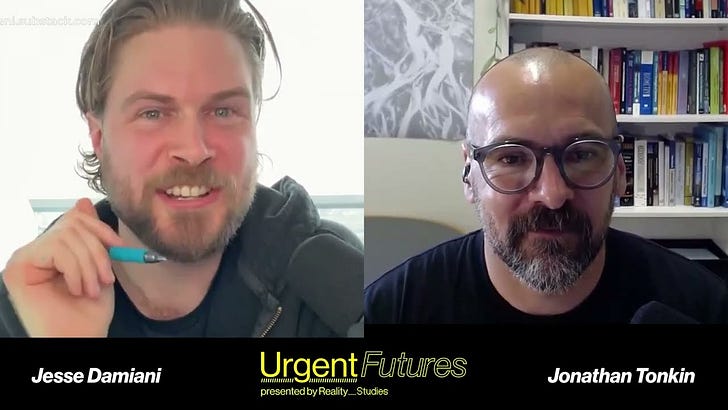 Biodiversity on the Brink: Ecological Rhythms & Human Urgency - Jonathan Tonkin | Rapid Response #20 16.02.2026 1hFor as much as I bemoan the attention fracture that occurs on social media, there are times I’m so grateful for it; I discovered the work of Jonathan Tonkin through a Substack Note about ecosystem services—the financial value that the natural world provides, which is vast and yet is barely ever accounted for under capitalist economics (on that note: please be sure to bookmark my conversation with Alyssa Battistoni on the ‘free gifts’ of nature).While we’re at it, please subscribe to his incredible newsletter, Predirections, right now: https://predirections.substack.com/Fast forward and I was lucky that he agreed to join me for a discussion on biodiversity, and in particular his research on freshwater biodiversity. This is one of those subjects that is massively important (to put it mildly!), yet doesn’t get quite as much airtime as more “charismatic” crises like climate change. As Jono explains: it's the "foundation for our very existence."Support the show by checking out: ProtonVPN (gold-standard VPN—fast and safe. Click the link to get 55% off VPN Plus: $4.49/mo). ZBiotics (Decrease impact of hangovers. Code: JESSEDAMIANI for 10% off), MUD\WTR (43% off starter kits), 1Password (simplify your life and increase digital safety), Mission Farms CBD (healthy, effective CBD for relief, sleep, and wellbeing—25% off with email).There’s a lot here, including a discussion about the wonder of braided rivers and broader questions around how we balance “human urgency” and “ecological rhythms,” advocating for what he calls “patient urgency.” We also get into his journey on Substack, and how he balances the differing demands of being an academic and a public communicator. Also he just got a new dog! All to say: if you’re like me, you’ll leave this conversation feeling both inspired and ready to take action in your own life to protect what is precious on this planet.BIO: I love that Professor Tonkin shares his bio in the first person, so I’m copying that here for you:I’m Jonathan Tonkin (Jono for short) — an ecologist and biodiversity scientist at the University of Canterbury in New Zealand, where I’m a Professor and Rutherford Discovery Fellow.My research has spanned continents and ecosystems, but I’ve always returned to one core question: How do we predict and adapt to environmental change in a way that supports life — all life?I’ve spent much of my career documenting biodiversity loss, especially in freshwater ecosystems. Now, I’m pivoting toward solutions: redirecting effort, exploring policy levers, and amplifying the science that can help us adapt. After publishing 100 peer-reviewed papers — including in Nature and Science — I want to share what I’ve learned beyond academia: translating the latest science into plain language, before it even reaches the headlines, to inform, inspire, and equip a wider community.I’m also a parent of two young kids. That perspective shapes everything I write.You can learn more about my research and lab at tonkinlab.org — we focus on biodiversity science for a changing world.🏆 Recently, I was honoured with the New Zealand Prime Minister’s MacDiarmid Emerging Scientist Prize.Find more episodes of Urgent Futures at: youtube.com/@UrgentFutures. Get full access to Reality Studies at www.realitystudies.co/subscribe
Podcasts similaires


Populaire dans
Ce podcast figure aussi dans les classements de podcasts de ces pays.
