
YaleCourses
YaleCourses
0
YaleCourses provides access to lectures and academic programs from Yale University, including complete sets from the Open Yale Courses initiative. The channel aims to train a broadly based, highly disciplined intellect without prescribing how it will be used. Students can also find complementary syllabi, transcripts, and other resources on the Open Yale Courses website. The podcast offers a window into the core of the university's classrooms and academic offerings.
Épisodes
-
 Class 9: Capital Chapters 10-13: Relative Surplus-Value, Division of Labor, Machinery, part 1 20.09.2026 57minCenter of the book, the ABCs of Capital. What is relative surplus value?A chapter by chapter study of Marx’s powerful analysis in Capital: Critique of Political Economy, Volume 1. This book from 1872 is still the best guide to the predatory economic and social system within which we live. The book solves five basic mysteries in our social world. The mysteries are: why social classes struggle against one another, why human beings are in the thrall of things, how a quantity of money turns into more money without seeming to add anything, why some people are forced to work and the more they work the less they make proportional to their effort, and finally, and why it is so hard to transform the system for the better. This course is taught by Paul North, Maurice Natanson Professor of German, Yale University. Prof. North is co-editor of the new English translation and critical edition of Capital Volume 1 by Karl Marx published in 2024 by Princeton University Press. https://press.princeton.edu/books/hardcover/9780691190075/capital To view other videos in this course, visit this link. https://youtube.com/playlist?list=PLh9mgdi4rNewd_0qe4c2lkzXZZQka_QnZ&si=CHOgjCcVD0K378kl Learn more about your ad choices. Visit megaphone.fm/adchoices
 -
 Class 2: Capital Chapter 1: The Commodity, part 2 20.09.2026 1h 3minWhat is value? A chapter by chapter study of Marx’s powerful analysis in Capital: Critique of Political Economy, Volume 1. This book from 1872 is still the best guide to the predatory economic and social system within which we live. The book solves five basic mysteries in our social world. The mysteries are: why social classes struggle against one another, why human beings are in the thrall of things, how a quantity of money turns into more money without seeming to add anything, why some people are forced to work and the more they work the less they make proportional to their effort, and finally, and why it is so hard to transform the system for the better. This course is taught by Paul North, Maurice Natanson Professor of German, Yale University. Prof. North is co-editor of the new English translation and critical edition of Capital Volume 1 by Karl Marx published in 2024 by Princeton University Press. https://press.princeton.edu/books/hardcover/9780691190075/capitalTo view other videos in this course, visit this link. https://youtube.com/playlist?list=PLh9mgdi4rNewd_0qe4c2lkzXZZQka_QnZ&si=CHOgjCcVD0K378kl Learn more about your ad choices. Visit megaphone.fm/adchoices
 -
 6. Microlensing, Astrometry and Other Methods 20.09.2026 54minFrontiers/Controversies in Astrophysics (ASTR 160)The class begins with a discussion on transits important astronomical events that help astronomers to find new planets. The event occurs when a celestial body moves across the face of the star it revolves around and blocks some of its light. By calculating the amount of light that is being obscured astronomers can obtain important information about both star and planet, such as size, density, radial velocity and more. The concept of planetary migration is explained in order to better understand the dramatic differences between bodies in the Inner and Outer Solar System. Finally, potential problems in the Solar System that may occur as a result of migration are addressed.00:00 - Chapter 1. Complexities and New Observations on Hot Jupiters07:38 - Chapter 2. Discovery of Planetary Transits19:53 - Chapter 3. Limits of Finding Planets Directly from Transits28:54 - Chapter 4. Metallicity and Planetary Migration43:32 - Chapter 5. Consequences and Limits of the Idea of Planetary MigrationComplete course materials are available at the Open Yale Courses website: http://open.yale.edu/courses This course was recorded in Spring 2007. Learn more about your ad choices. Visit megaphone.fm/adchoices
 -
 6. The Greek "Renaissance" - Colonization and Tyranny 20.09.2026 1h 15minIntroduction to Ancient Greek History (CLCV 205)In this lecture, Professor Donald Kagan discusses the emergence of a new style of warfare among the Greeks, the hoplite phalanx. After discussing the panoply of the hoplite solider and the method of fighting, he argues that this style of fighting came about early in the life of the polis. In addition, he shows that the phalanx was almost invincible on the field. At the lecture's conclusion, he answers several questions from students about hoplite warfare in the Greek world.00:00 - Chapter 1. An Introduction to the Hoplite Phalanx06:33 - Chapter 2. The Hoplite12:09 - Chapter 3. The Phalanx29:47 - Chapter 4. Fighting Style, Casualties, Winning and Losing43:51 - Chapter 5. Question and Answer on the Hoplite Phalanx01:02:17 - Chapter 6. Closing Remarks and Critiques of Orthodox InterpretationComplete course materials are available at the Open Yale Courses website: http://open.yale.edu/coursesThis course was recorded in Fall 2007. Learn more about your ad choices. Visit megaphone.fm/adchoices
 -
 802 | Demystify Financing: Funding Sources for Your Social Venture - Social Entrepreneurship Course 20.09.2026 14minNavigating the myriad of funding options can be overwhelming. In this lesson, we systematically explore the primary sources of capital available for social enterprises, from government grants to private investments and individual contributions. Discover the diverse avenues to secure financial backing and learn how to identify funders whose values align with your mission, ensuring not just financial support but also valuable resources like mentorship.🎯 Learning Objectives• Identify the four main categories of funding sources for social enterprises.• Distinguish between different types of government, non-governmental, private sector, and individual funding options.• Understand the typical characteristics and examples of funding mechanisms like grants, venture capital, and crowdfunding.• Recognize the importance of aligning your enterprise's values with potential funders and exploring non-financial support.📚 About the Course Have you ever wondered what it would be like to create real change? You don't have to start your own organization to make a difference in the world. Everyone can learn the social entrepreneurship mindset and skillset to build social impact. In this course, you will immerse yourself in a social or environmental challenge you want to tackle. You'll start by researching your topic of choice, talking to people, and ideating a potential solution that you can contribute. Then, you'll build a business model around that solution, understanding concepts like measuring social change, ensuring financial viability, funding and pitching. This course is a safe space to experiment and explore. You'll be guided by a ten stage framework to help structure your journey. Along the way, you'll hear from social entrepreneurs around the world through case studies and campus conversations. These include Yale alumni, members of the New Haven community, and global changemakers. Everyone is welcome to join this course! You can apply your lived, learned, or professional experience to discover how you're going to make a difference. 📺 Watch the full playlist on YouTube: https://www.youtube.com/playlist?list=PLh9mgdi4rNezbi0aRJeVnt99ynTVZG1PL🎓 Enroll on Coursera for assessments and a certificate: https://online.yale.edu/courses/creating-change-through-social-entrepreneurship🌐 Explore more learning opportunities on Yale Online: https://online.yale.edu/courses/creating-change-through-social-entrepreneurship#SocialEntrepreneurship #YaleCourse #Impact #Changemakers #BusinessPlan #DesignThinking Learn more about your ad choices. Visit megaphone.fm/adchoices
 -
 18. The badness of death, Part III; Immortality, Part I 20.09.2026 57minDeath (PHIL 176)The discussion of the badness of death continues by asking whether it is bad that we do not exist before our birth. The views of a number of contemporary philosophers, such as Tom Nagle, Fred Feldman, and Derek Parfit, are introduced. Then Professor Kagan turns to the subject of immortality. Would it be desirable to live forever, and if so, under what circumstances one might enjoy such a prolonged existence? The lecture concludes with Bernard Williams' take on immortality which posits that no kind of human life can continue to be enjoyable and attractive for eternity.00:00 - Chapter 1. The Modest Existence Clause 08:46 - Chapter 2. "Schmoss" of Life: Is it Bad? 22:01 - Chapter 3. Feldman and Parfit on Nonexistence before Life 33:45 - Chapter 4. Is Immortality the Antidote to Deprivation-Based Death? 49:26 - Chapter 5. Conclusion: A "Best" Immortal State? Complete course materials are available at the Yale Online website: online.yale.eduThis course was recorded in Spring 2007. Learn more about your ad choices. Visit megaphone.fm/adchoices
 -
 6. Nash equilibrium: dating and Cournot 20.09.2026 1h 18minGame Theory (ECON 159)We apply the notion of Nash Equilibrium, first, to some more coordination games; in particular, the Battle of the Sexes. Then we analyze the classic Cournot model of imperfect competition between firms. We consider the difficulties in colluding in such settings, and we discuss the welfare consequences of the Cournot equilibrium as compared to monopoly and perfect competition.00:00 - Chapter 1. Coordination Games: Scope for Leadership and Strategic Complements04:59 - Chapter 2. Coordination Games: The Battle of the Sexes 18:37 - Chapter 3. Cournot Duopoly: Math53:28 - Chapter 4. Cournot Duopoly: Real World ExamplesComplete course materials are available at the Yale Online website: online.yale.eduThis course was recorded in Fall 2007. Learn more about your ad choices. Visit megaphone.fm/adchoices
 -
 Low-Cost, High-Nutrition Eating for Graduate Students: Healthy Recipes 20.09.2026 28minIn this video, discover easy and nutritious recipes designed for busy students. Dr. Nate Wood shares meals that are both affordable and quick to prepare, ensuring you eat well without breaking the bank.Managing your finances as a student is challenging. Yale’s Graduate and Professional Student Senate collaborated with Dr. Nate Wood, Assistant Professor and Director of Culinary Medicine at the Yale School of Medicine, to create this video series aimed at helping our community to shop and eat affordably and nutritiously. According to a 2024 Senate report, 30% of Yale's graduate and professional students experience food insecurity. Our goal is to provide tangible support through practical tips, recipes, and strategies. For more resources or to share your thoughts, use our contact form!https://www.gpsenate.yale.edu/contact Learn more about your ad choices. Visit megaphone.fm/adchoices
 -
 17. Hubble's Law and the Big Bang (cont.) 20.09.2026 58minFrontiers/Controversies in Astrophysics (ASTR 160)Class begins with a review of magnitudes and the problem set involving magnitude equations. Implications of the Hubble Law and Hubble Diagram are discussed. Professor Bailyn elaborates on the Big Bang theory of cosmology and addresses controversial questions related to the age, development, and boundaries of the universe. The fate of the universe, and possibly its end (known as the Big Crunch) are addressed. Imagining an expanding three-dimensional universe is proposed. The lecture ends with a question-and-answer session during which students inquire about a variety of topics related to cosmology, such as the center of the universe, its current expansion, and hypothetical collapse.00:00 - Chapter 1. Review of Magnitudes07:38 - Chapter 2. Implications of Hubble's Discoveries on the Aging Universe26:36 - Chapter 3. Conceptualizing a Three-Dimensional Universe34:22 - Chapter 4. Q&A: The Big Bang, the Expansion, and the Big CrunchComplete course materials are available at the Open Yale Courses website: http://open.yale.edu/courses This course was recorded in Spring 2007. Learn more about your ad choices. Visit megaphone.fm/adchoices
 -
 Class 6: Capital Chapters 5-9: Absolute Surplus-Value, Valorization, the Working Day 20.09.2026 52minOn the general formula of capital and its constant movement.A chapter by chapter study of Marx’s powerful analysis in Capital: Critique of Political Economy, Volume 1. This book from 1872 is still the best guide to the predatory economic and social system within which we live. The book solves five basic mysteries in our social world. The mysteries are: why social classes struggle against one another, why human beings are in the thrall of things, how a quantity of money turns into more money without seeming to add anything, why some people are forced to work and the more they work the less they make proportional to their effort, and finally, and why it is so hard to transform the system for the better. This course is taught by Paul North, Maurice Natanson Professor of German, Yale University. Prof. North is co-editor of the new English translation and critical edition of Capital Volume 1 by Karl Marx published in 2024 by Princeton University Press. https://press.princeton.edu/books/hardcover/9780691190075/capitalTo view other videos in this course, visit this link. https://youtube.com/playlist?list=PLh9mgdi4rNewd_0qe4c2lkzXZZQka_QnZ&si=CHOgjCcVD0K378kl Learn more about your ad choices. Visit megaphone.fm/adchoices
 -
 4. Newton's Laws (cont.) and Inclined Planes 20.09.2026 1h 14minFor more information about Professor Shankar's book based on the lectures from this course, Fundamentals of Physics: Mechanics, Relativity, and Thermodynamics, visit http://bit.ly/1jFIqNu.Fundamentals of Physics (PHYS 200)The lecture begins with the application of Newton's three laws, with the warning that they are not valid for objects that move at speeds comparable to the speed of light or objects that are incredibly small and of the atomic scale. Friction and static friction are discussed. The dreaded inclined plane is dealt with head on. Finally, Professor Shankar explains the motion of objects using Newton's laws in specific problems related to objects in circular motion, such as roller coasters and a planet orbiting the Sun.00:00 - Chapter 1. Continuation of Types of External Forces14:50 - Chapter 2. Kinetic and Static Friction31:34 - Chapter 3. Inclined Planes49:04 - Chapter 4. Pulleys57:30 - Chapter 5. Friction and Circular Motion: Roundabouts, Loop-the-LoopComplete course materials are available at the Yale Online website: online.yale.eduThis course was recorded in Fall 2006. Learn more about your ad choices. Visit megaphone.fm/adchoices
 -
 Class 14 Capital Unpublished Chapter 6: Results of the Immediate Production Process 19.09.2026 51minWhat is the subsumption of labor into capital?A chapter by chapter study of Marx’s powerful analysis in Capital: Critique of Political Economy, Volume 1. This book from 1872 is still the best guide to the predatory economic and social system within which we live. The book solves five basic mysteries in our social world. The mysteries are: why social classes struggle against one another, why human beings are in the thrall of things, how a quantity of money turns into more money without seeming to add anything, why some people are forced to work and the more they work the less they make proportional to their effort, and finally, and why it is so hard to transform the system for the better. This course is taught by Paul North, Maurice Natanson Professor of German, Yale University. Prof. North is co-editor of the new English translation and critical edition of Capital Volume 1 by Karl Marx published in 2024 by Princeton University Press. https://press.princeton.edu/books/hardcover/9780691190075/capital To view other videos in this course, visit this link. https://youtube.com/playlist?list=PLh9mgdi4rNewd_0qe4c2lkzXZZQka_QnZ&si=CHOgjCcVD0K378kl Learn more about your ad choices. Visit megaphone.fm/adchoices
 -
 Music and Social Action - Greene Part 2 19.09.2026 8minLearn more about your ad choices. Visit megaphone.fm/adchoices
 -
 What does it really mean to be a "leader"? | Connected Leadership 19.09.2026 14minBefore diving into the framework, Peter unpacks the two words at the heart of the course: leader and connected. He invites you to claim your own definition of leadership — one that's inspiring, comfortable, and shed of unhelpful baggage — and contrasts the connected leader with isolated, authoritarian models.Key topics:- Why associations with "leader" can be positive, neutral, or negative- Manager vs leader: getting things done right vs doing the right things- Four leadership positions: from the front, side, behind, and within- Leading from within, anchored to your individual purpose- The connected leader vs the window/mirror schools of management- Connecting authentically at the system level📚 About the Course:This course is designed to maximize your ability to create change at the individual, team and system levels. Through study, reflection, and deploying practical tools, you will establish a firm connection between your clearly articulated Purpose, effective Priorities, visualized Potential for success, and pathway to maximized Progress. But, what does that mean in practice?When you take this course, you will:Improve your ability to get the most out of life: Learn a simple practice to reflect on your purpose, clarify priorities, visualize your potential, and maximize your effectiveness at progressing towards your goals.Strengthen your leadership toolkit: Tap into your unique leadership style and strengths and join or create a community of others to maximize your potential as a team.Create change through systems thinking: Become a more effective agent of positive change and appreciate the power and complexity of system thinking.Course Takeaways:Improve your ability to get the most out of lifeStrengthen your leadership toolkitPractice and apply systems thinking to plan for change📺 Watch the full playlist on YouTube: https://www.youtube.com/playlist?list=PLh9mgdi4rNezZEnhZC8dS3AvTnzOiB0Ij🎓 Enroll on Coursera for assessments and a certificate: https://www.coursera.org/learn/connected-leadership🌐 Explore more learning opportunities on Yale Online: https://online.yale.edu/courses/connected-leadership Learn more about your ad choices. Visit megaphone.fm/adchoices
 -
 Class 5: Capital Chapters 2-4: Exchange, Money, Capital, part 2 19.09.2026 56minWhat is money? How does circulation change everything?A chapter by chapter study of Marx’s powerful analysis in Capital: Critique of Political Economy, Volume 1. This book from 1872 is still the best guide to the predatory economic and social system within which we live. The book solves five basic mysteries in our social world. The mysteries are: why social classes struggle against one another, why human beings are in the thrall of things, how a quantity of money turns into more money without seeming to add anything, why some people are forced to work and the more they work the less they make proportional to their effort, and finally, and why it is so hard to transform the system for the better. This course is taught by Paul North, Maurice Natanson Professor of German, Yale University. Prof. North is co-editor of the new English translation and critical edition of Capital Volume 1 by Karl Marx published in 2024 by Princeton University Press. https://press.princeton.edu/books/hardcover/9780691190075/capitalTo view other videos in this course, visit this link. https://youtube.com/playlist?list=PLh9mgdi4rNewd_0qe4c2lkzXZZQka_QnZ&si=CHOgjCcVD0K378kl Learn more about your ad choices. Visit megaphone.fm/adchoices
 -
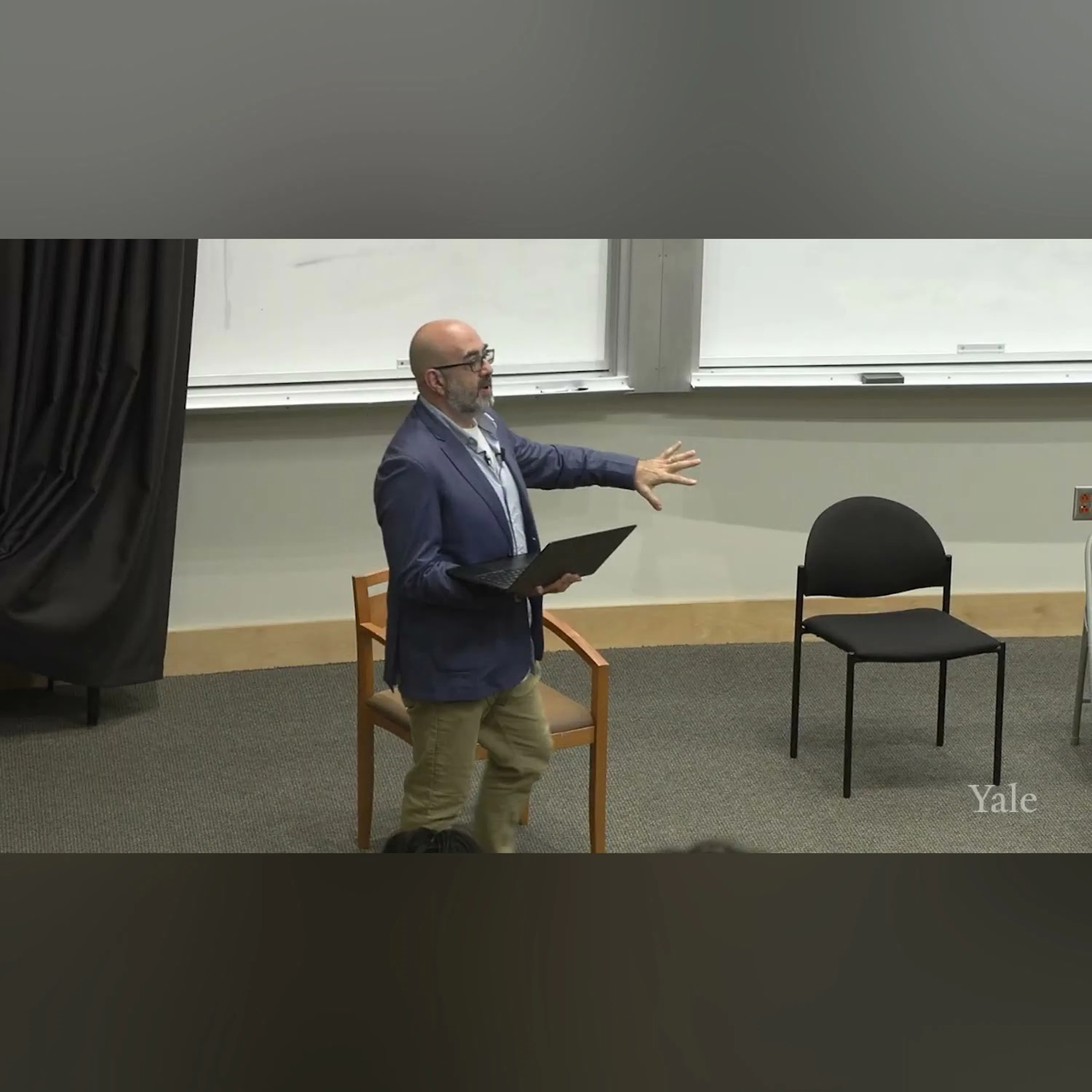 Class 11: Capital Chapter 12 and 13: Changes in the Division of Labor, Machinery 19.09.2026 52minHow do the division within labor and the new cooperation change labor and life?A chapter by chapter study of Marx’s powerful analysis in Capital: Critique of Political Economy, Volume 1. This book from 1872 is still the best guide to the predatory economic and social system within which we live. The book solves five basic mysteries in our social world. The mysteries are: why social classes struggle against one another, why human beings are in the thrall of things, how a quantity of money turns into more money without seeming to add anything, why some people are forced to work and the more they work the less they make proportional to their effort, and finally, and why it is so hard to transform the system for the better. This course is taught by Paul North, Maurice Natanson Professor of German, Yale University. Prof. North is co-editor of the new English translation and critical edition of Capital Volume 1 by Karl Marx published in 2024 by Princeton University Press. https://press.princeton.edu/books/hardcover/9780691190075/capital To view other videos in this course, visit this link. https://youtube.com/playlist?list=PLh9mgdi4rNewd_0qe4c2lkzXZZQka_QnZ&si=CHOgjCcVD0K378kl Learn more about your ad choices. Visit megaphone.fm/adchoices
 -
 5.1 | Unlocking Medical Software: Life Cycles and the IEC 62304 Standard - Medical Software Course 19.09.2026 15minIn this lesson, we dive into the foundational concept of the medical software life cycle, the essential organizing principle for any medical software project. We'll introduce the international standard IEC 62304, which governs these life cycles, and explore why a defined life cycle model is not just recommended, but mandated, integrating seamlessly with quality and risk management systems. The lesson also distinguishes between various software risk classifications and their implications for development rigor, along with different life cycle models such as waterfall, incremental, and evolutionary approaches.🎯 Learning Objectives• Understand the medical software life cycle and its significance as an organizing principle.• Learn about the IEC 62304 international standard governing medical device software development.• Differentiate between software risk classifications (Class A, B, C) and their impact on project requirements.• Explore various software life cycle models, including waterfall, incremental, and evolutionary.• Recognize the importance of quality and risk management systems in medical software development. Learn more about your ad choices. Visit megaphone.fm/adchoices
 -
 506 | Develop Your Social Enterprise with SWOT and PESTEL Analysis - Social Entrepreneurship Course 19.09.2026 8minIn this lesson, we delve into the essential analytical frameworks of SWOT and PESTEL to help you thoroughly assess and develop your social enterprise idea. Understanding your internal strengths and weaknesses, along with external opportunities and threats, is crucial for both refining your concept and effectively communicating it to potential supporters.🎯 Learning Objectives• Understand the components and purpose of SWOT analysis for evaluating your idea's internal and external factors.• Utilize the PESTEL framework to break down external opportunities and threats into political, economic, social, technological, environmental, and legal aspects.• Recognize how SWOT and PESTEL analyses are vital for assessing your idea's viability and communicating its potential and limitations to stakeholders.• Learn why transparency about your idea's strengths and weaknesses helps garner support for implementation.📚 About the Course Have you ever wondered what it would be like to create real change? You don't have to start your own organization to make a difference in the world. Everyone can learn the social entrepreneurship mindset and skillset to build social impact. In this course, you will immerse yourself in a social or environmental challenge you want to tackle. You'll start by researching your topic of choice, talking to people, and ideating a potential solution that you can contribute. Then, you'll build a business model around that solution, understanding concepts like measuring social change, ensuring financial viability, funding and pitching. This course is a safe space to experiment and explore. You'll be guided by a ten stage framework to help structure your journey. Along the way, you'll hear from social entrepreneurs around the world through case studies and campus conversations. These include Yale alumni, members of the New Haven community, and global changemakers. Everyone is welcome to join this course! You can apply your lived, learned, or professional experience to discover how you're going to make a difference. 📺 Watch the full playlist on YouTube: https://www.youtube.com/playlist?list=PLh9mgdi4rNezbi0aRJeVnt99ynTVZG1PL🎓 Enroll on Coursera for assessments and a certificate: https://online.yale.edu/courses/creating-change-through-social-entrepreneurship🌐 Explore more learning opportunities on Yale Online: https://online.yale.edu/courses/creating-change-through-social-entrepreneurship#SocialEntrepreneurship #YaleCourse #Impact #Changemakers #BusinessPlan #DesignThinking Learn more about your ad choices. Visit megaphone.fm/adchoices
 -
 21. Dark Energy and the Accelerating Universe and the Big Rip 19.09.2026 52minFrontiers/Controversies in Astrophysics (ASTR 160)Class begins with a review of the mysterious nature of dark matter, which accounts for three quarters of the universe. Different models of the universe are graphed. The nature, frequency, and duration of supernovae are then addressed. Professor Bailyn presents data from the Supernova Cosmology Project and pictures of supernovae taken by the Hubble Space Telescope. The discovery of dark energy is revisited and the density of dark energy is calculated. The Big Rip is presented as an alternative hypothesis for the fate of the universe.00:00 - Chapter 1. Review of Dark Matter04:51 - Chapter 2. Supernovae20:53 - Chapter 3. Finding Supernovae: The Supernovae Cosmology Project34:41 - Chapter 4. The Constant Density of Dark Matter and the Big RipComplete course materials are available at the Open Yale Courses website: http://open.yale.edu/courses This course was recorded in Spring 2007. Learn more about your ad choices. Visit megaphone.fm/adchoices
 -
 803 | Funding Vehicles Explained: Gifts, Loans, Equity and Bonds - Social Entrepreneurship Course 19.09.2026 10minNavigating the financial landscape as a social entrepreneur can be challenging. In this lesson, we demystify the spectrum of common funding vehicles, from philanthropic gifts like donations and grants, to repayable options such as loans, equity investments, and the innovative mechanism of social impact bonds (SIBs). Discover the unique characteristics, advantages, and potential drawbacks of each funding type to make informed decisions for your venture.🎯 Learning Objectives• Identify the four main categories of funding vehicles: gifts, loans, equity, and bonds.• Distinguish between different types of gifts, including donations, grants, and awards, and their implications.• Evaluate the pros and cons of utilizing loans and equity investments for social ventures.• Understand the structure and purpose of Social Impact Bonds (SIBs) as a performance-based funding mechanism.• Recognize the importance of aligning values with funders across all funding types.📚 About the Course Have you ever wondered what it would be like to create real change? You don't have to start your own organization to make a difference in the world. Everyone can learn the social entrepreneurship mindset and skillset to build social impact. In this course, you will immerse yourself in a social or environmental challenge you want to tackle. You'll start by researching your topic of choice, talking to people, and ideating a potential solution that you can contribute. Then, you'll build a business model around that solution, understanding concepts like measuring social change, ensuring financial viability, funding and pitching. This course is a safe space to experiment and explore. You'll be guided by a ten stage framework to help structure your journey. Along the way, you'll hear from social entrepreneurs around the world through case studies and campus conversations. These include Yale alumni, members of the New Haven community, and global changemakers. Everyone is welcome to join this course! You can apply your lived, learned, or professional experience to discover how you're going to make a difference. 📺 Watch the full playlist on YouTube: https://www.youtube.com/playlist?list=PLh9mgdi4rNezbi0aRJeVnt99ynTVZG1PL🎓 Enroll on Coursera for assessments and a certificate: https://online.yale.edu/courses/creating-change-through-social-entrepreneurship🌐 Explore more learning opportunities on Yale Online: https://online.yale.edu/courses/creating-change-through-social-entrepreneurship#SocialEntrepreneurship #YaleCourse #Impact #Changemakers #BusinessPlan #DesignThinking Learn more about your ad choices. Visit megaphone.fm/adchoices
Podcasts similaires


Populaire dans
Ce podcast figure aussi dans les classements de podcasts de ces pays.

