
Investing Legends
Investing Wisdom
0
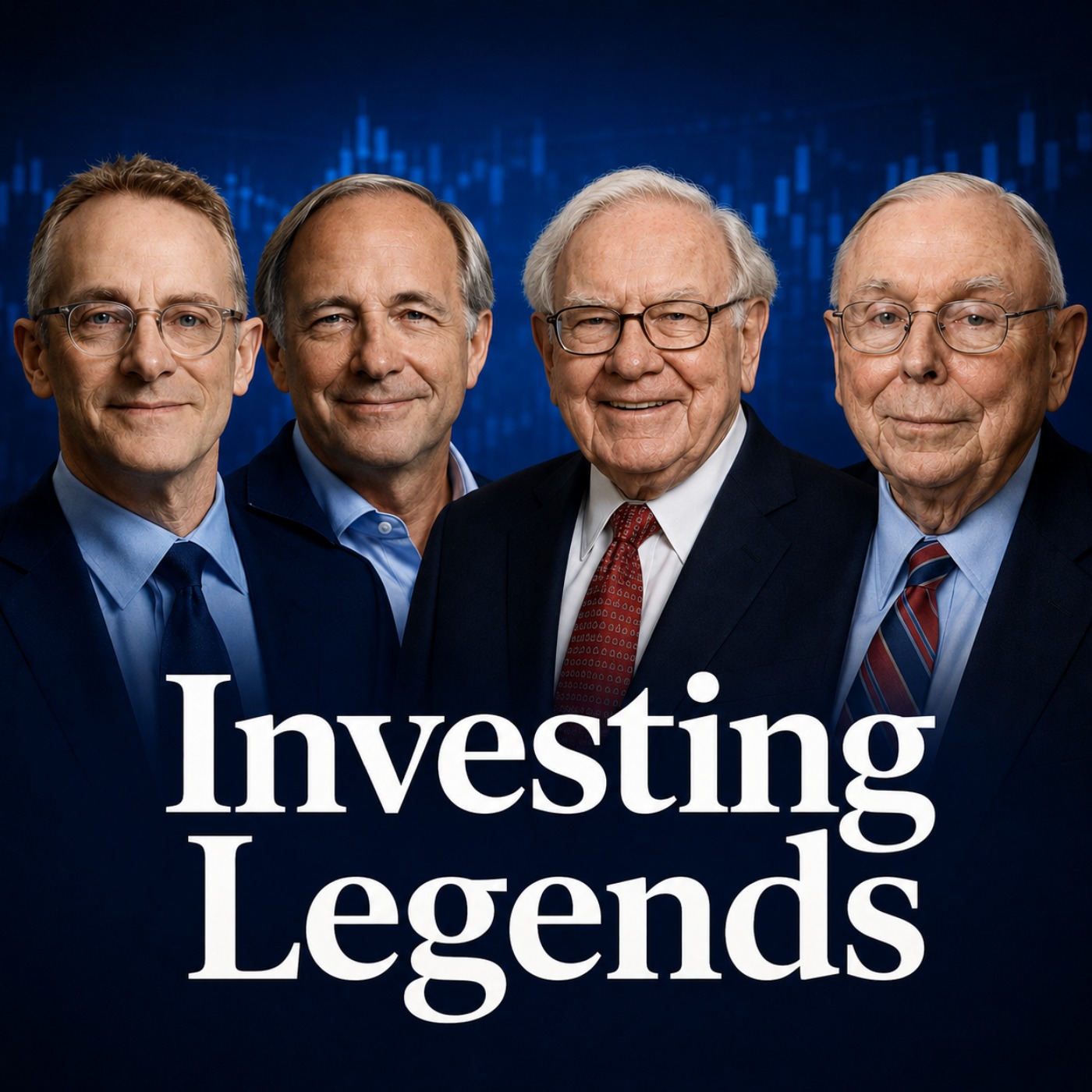
Investing Legends is a long-form podcast that examines the thinking, principles, and decision-making frameworks of some of the world's most respected investors. Episodes dig into figures such as Warren Buffett, Charlie Munger, Howard Marks, Ray Dalio, Jim Simons, and Stanley Druckenmiller. Rather than offering quick tips, the show explores how these investors approach risk, valuation, and long-term compounding. It is aimed at listeners who want to learn from the mental models and habits behind legendary investing track records.
Épisodes
-
 Berkshire Hathaway Annual Meeting 1995 Part 2 Afternoon Session 24.09.2026 2h 18minChapters below.Warren Buffett and Charlie Munger take shareholder questions at the 1995 Berkshire Hathaway annual meeting, covering intrinsic value, capital allocation, and the circle of competence that keeps them out of businesses they can't understand. They explain why cash on the balance sheet is an admission of failure, why Graham and Fisher differ less than people assume, and what made Wells Fargo worth owning when every bank with that much real estate exposure looked doomed. Along the way they cover Salomon pay, Lloyd's of London, the national debt, the USAir mistake, and why Berkshire has never split the stock.0:11 - Bank stocks 2:51 - Writing a book 3:20 - Dividends 6:21 - Salomon pay 13:37 - Cash as residual 15:02 - Newspapers 18:36 - Hostile takeovers 20:38 - Graham vs Fisher 25:58 - Munger's stock sales 27:12 - Suspect accounting 30:23 - Lloyd's of London 34:29 - Global investing and buybacks 39:00 - Media attention 41:53 - GEICO returns 43:03 - Guinness 45:00 - The shirt 45:33 - Meeting date 46:33 - Foreign securities 48:15 - Helzberg 51:48 - Intrinsic value 55:50 - Stock price and Microsoft 57:48 - Business school education 1:03:55 - Ten years on 1:05:30 - Manager bonuses 1:09:00 - Foreign exchange 1:10:18 - Small-cap opportunities 1:14:36 - Lawyers and lawsuits 1:18:12 - A second Borsheims 1:21:46 - Return on equity 1:24:51 - What Berkshire adds 1:28:10 - Growth, size and reading 1:33:51 - Wells Fargo vs PNC 1:36:35 - Negative equity and buybacks 1:40:29 - Credit cards and banking 1:45:31 - Moats at SunTrust and PNC 1:46:11 - The Salomon casino remark 1:47:42 - National debt and more Coca-Cola 1:57:32 - Berkshire vs a money manager 2:00:27 - Insurance returns and judging management 2:04:25 - P/E and interest rates 2:08:33 - USAir 2:10:12 - Book recommendations 2:11:22 - The stock split question Hosted on Acast. See acast.com/privacy for more information.
 -
Berkshire Hathaway Annual Meeting 1995 Part 1, Morning Session 22.09.2026 2h 18minChapters below.Warren Buffett and Charlie Munger open the 1995 Berkshire Hathaway annual meeting with the vote to authorize preferred stock, then take shareholder questions on capital allocation, insurance float, and how they actually value the operating businesses. They explain the Helzberg acquisition, why technology sits outside the circle of competence, and what went wrong at USAir. Along the way they cover derivatives, stock option accounting, the culture problem at Salomon, and why reluctance to sell a wonderful business is a feature rather than a flaw.0:00 - Opening remarks 3:09 - The preferred stock proposal 9:49 - Preferred stock and dilution 16:02 - Shareholder votes on the preferred 19:17 - Preferred share rights 21:41 - Hybrid preferred structure 25:29 - The vote and adjournment 27:41 - Helzberg Diamonds announcement 34:19 - Family members on the board 38:26 - Chrysler 39:10 - Capital allocation to subsidiaries 43:14 - Multi-year insurance policies 49:01 - Catastrophe insurance competition 52:46 - Technology investing 56:22 - Writing down USAir 1:01:30 - Economic value added 1:06:16 - Derivatives 1:12:46 - Salomon's outlook 1:17:46 - American Express 1:23:34 - Stock option accounting 1:29:12 - Meeting videotapes 1:31:25 - Borsheims sales 1:31:54 - Succession planning 1:37:01 - The discounting period 1:40:18 - Future use of preferred stock 1:42:40 - Insurance float 1:45:01 - The Beardstown Ladies 1:46:05 - Economic rules of thumb 1:52:04 - Valuing the operating businesses 1:56:41 - Salomon's culture 2:01:52 - Ben Graham editions 2:04:35 - Future returns and reluctance to sell 2:16:45 - Screening a first investment Hosted on Acast. See acast.com/privacy for more information.
-
Berkshire Hathaway Shareholder Letters 1984 17.09.2026 1h 19minIn his 1984 letter to Berkshire Hathaway shareholders, Warren Buffett admits that the company's historic 22% returns are "just that — history." He then explains why a growing capital base demands big ideas rather than small ones. The letter is one of the richest in Berkshire Hathaway history. Buffett makes his classic case for share repurchases at prices below intrinsic value, attacks greenmail, and tells the story of Mrs. B at Nebraska Furniture Mart, who received a $55 million check for her business on nothing but a handshake. He also explains why a dominant newspaper prospers whether it is good or bad, and makes a frank confession of Berkshire's insurance reserving errors, illustrated by the unforgettable "rented suit" story. Along the way, he analyzes the WPPSS bonds as if they were a business, warns about inflation and long-term bonds, and sets out one of his clearest frameworks on dividend policy and capital allocation. This is essential listening for anyone interested in value investing, long-term investing, and the thinking that built Berkshire Hathaway. Hosted on Acast. See acast.com/privacy for more information.
-
Berkshire Hathaway Annual Meeting 1994 15.09.2026 2h 56minChapters see below.Warren Buffett and Charlie Munger take shareholder questions at the 1994 Berkshire Hathaway annual meeting, covering intrinsic value, capital allocation, and why they will not step outside the businesses they can actually understand. Buffett opens on derivatives, warning that combining ignorance with borrowed money has always produced interesting consequences, and points to Procter and Gamble as the early evidence. He explains how they discount future cash at a rate set by their certainty about the business, why he would pay two million dollars not to read a seller's projections, and how to judge a management team by how they played the hand they were dealt and how they treat their owners. He rejects volatility as a measure of risk, arguing that a business returning between twenty and eighty percent is treated by the academic world as riskier than one returning five percent every year, and describes pricing catastrophe reinsurance to exposure rather than to recent experience. He also talks about holding more than a billion dollars in cash as an index of management failure, why he has never sold a good business because of a guess about the market, and why he and Munger allocate every dollar themselves with no staff to help them.1:45 - The use of derivatives 4:37 - Investment in Cap Cities 6:37 - After-tax free cash flow value 9:21 - Intrinsic value of the insurance operations 11:30 - Splitting the shares 13:57 - Buffett's use of The Indefensible 14:59 - Management and life goals 18:22 - Question on Ajit Jain 23:36 - Question on Guinness 26:02 - Berkshire after Buffett 28:53 - Reverse splits, 100x returns and stamps 33:41 - Greenspan, the Fed and interest rates 35:26 - Opinions on Berkshire's value 37:31 - Banks and buybacks 42:10 - Leverage at Salomon 47:14 - Sale of a mutual savings and loan 48:56 - Munger on changing his mind 49:41 - The shoe industry 51:25 - The tobacco business 52:40 - Business acquisition considerations 55:13 - The LA quake and insurance 1:00:02 - Recommended books 1:02:35 - Uncertainties for global brand leaders, Nike and Reebok 1:08:15 - Airlines and USAir 1:11:35 - Munger's retirement 1:12:38 - Sale of Cap Cities shares 1:13:53 - Structured settlements 1:14:53 - Wrigley 1:15:58 - Global diversification 1:18:43 - Explaining insurance losses 1:21:02 - Bullish or bearish? 1:25:23 - Private versus public markets 1:30:32 - Berkshire's intrinsic value relative to market price 1:33:59 - The view of risk 1:38:37 - Tax rates 1:42:54 - Interest rate sensitivity in certain businesses 1:45:40 - Retroactive insurance 1:48:34 - Berkshire's preparation for times of distress 1:51:13 - Freddie Mac and Fannie Mae 1:53:14 - Faster information and the cost of a missed opportunity 1:55:39 - Berkshire buybacks and intrinsic value 1:59:40 - Peter Lynch 2:00:47 - Reinsurance 2:06:20 - Guinness 2:06:53 - World Book and the Buffalo News 2:09:18 - Breaking Berkshire into smaller entities 2:11:08 - Sale of General Dynamics 2:12:30 - Volatility in the Berkshire share price 2:16:05 - Question about cash 2:18:09 - Question about Salomon 2:19:14 - The use of puts at Berkshire 2:21:06 - Stories about Berkshire not in the annual report 2:23:11 - Berkshire ending up on an index 2:24:52 - Position sizing in a given security 2:28:16 - Growth at Coca-Cola 2:29:20 - Question on convertible bonds 2:31:02 - Market impact when Berkshire sells a security 2:32:11 - Key-man insurance for Berkshire 2:32:48 - Currency risk in the Guinness investment 2:38:20 - Question on Berkshire's intrinsic value 2:39:31 - Succession at Coca-Cola 2:39:42 - Question on Salomon 2:41:25 - Merits of the different Berkshire holdings 2:43:30 - Method for arriving at an intrinsic value 2:46:49 - Growth rates in companies 2:49:06 - Capital allocation decisions at Berkshire 2:54:18 - Two or three investment lessons from Maynard Keynes Hosted on Acast. See acast.com/privacy for more information.
-
Berkshire Hathaway Shareholder Letters 1983 (Appendix) Goodwill and its Amortization: The Rules and The Realities 14.09.2026 18minA special deep-dive from Warren Buffett's 1983 Berkshire Hathaway annual report: his famous appendix on Goodwill. Using See's Candies as the real-world example, Buffett explains the crucial difference between "accounting Goodwill," which gets amortized away year after year, and "economic Goodwill," which can actually grow stronger with inflation. He shows why businesses that need little in the way of physical assets — factories, inventory, equipment — often make far better long-term investments than asset-heavy businesses, even when the accounting numbers suggest otherwise. Essential listening for anyone into Warren Buffett, value investing, and how to really judge whether a business is a good purchase. Hosted on Acast. See acast.com/privacy for more information.
-
Berkshire Hathaway Shareholder Letters 1983 14.09.2026 58minWarren Buffett's 1983 Berkshire Hathaway shareholder letter is one of the richest in the series. He lays out his famous "Owner-Related Business Principles" — the rules governing how Berkshire treats shareholders — and tells the remarkable story of Rose Blumkin, the Russian immigrant who built Nebraska Furniture Mart from $500 into America's largest furniture store. He explains the crucial difference between book value and true "intrinsic business value," and makes a sharp case against stock splits and high trading turnover, calling a hyperactive stock market "the pickpocket of enterprise." A must-listen for fans of Warren Buffett, value investing, and the history of Berkshire Hathaway. Hosted on Acast. See acast.com/privacy for more information.
-
Stan Druckenmiller: The Market as an Economic Predictor 10.09.2026 1h 7minStanley Druckenmiller talks with John Collison about inflation, bear markets, and why he thinks the odds of a soft landing are remote. He explains the two historical records that have never been broken once inflation passes five percent, argues the Fed's slowness through 2021 and 2022 was enormously costly, and describes a setup he has never faced in forty five years, with eight percent inflation, three percent bond yields, and a weakening economy all at once. He walks through how he reads the economy from inside the stock market rather than from macro statistics, using housing, trucking, and retail as leading indicators, and why the bond market stopped signalling anything after a decade of central bank buying. He also tells the long version of the 2000 story, from shorting ten internet stocks and losing three times his money in four weeks, through the tech position that put him down eighteen percent, to the four-month sabbatical in Africa that let him come back and make forty percent in a single quarter. Along the way he explains why sizing is most of the game, why he tracks whether he is hot or cold before deciding how big to bet, and why he buys first and does the analysis afterward. Hosted on Acast. See acast.com/privacy for more information.
-
Berkshire Hathaway Shareholder Letters 1982 08.09.2026 52minWarren Buffett's 1982 Berkshire Hathaway shareholder letter introduces one of his most important ideas: the difference between "accounting earnings" and "economic earnings" why a company's true value includes profits it doesn't even get to report. He explains why insurance industry economics had permanently shifted, praises GEICO's Jack Byrne with the memorable line "Let Jack Do It," and delivers a masterclass on why using company stock to fund acquisitions so often destroys shareholder value, worked through with vivid analogies from toads to farms. He closes by laying out his exact acquisition criteria and paying tribute to two longtime managers on their retirement. Essential listening for fans of Warren Buffett, value investing, and Berkshire Hathaway's history. Hosted on Acast. See acast.com/privacy for more information.
-
Ray Dalio - The Principles for Investing and Economics 03.09.2026 42minRay Dalio walks through the economic and investment principles behind Bridgewater, laying out how he thinks debt cycles, monetary policy and productivity actually drive markets. He frames the economy as a perpetual motion machine of four forces, three equilibriums and two levers, then applies that template to where the world stood at the time: late in the business cycle, with central banks running out of room and populism rising on both the left and the right. He draws the parallel to the 1930s, explains why the wealth gap became a market issue rather than just a political one, and traces the arc of reserve currencies from the Dutch guilder to the pound to the dollar. On the investment side he covers the difference between alpha and beta, why the assets that just performed well are simply the more expensive ones, and why balancing by risk rather than by dollars matters. The talk closes on what he calls the holy grail of investing, the case that fifteen uncorrelated return streams cut risk by roughly eighty percent without cutting return. Hosted on Acast. See acast.com/privacy for more information.
-
Berkshire Hathaway Shareholder Letters 1981 01.09.2026 41minHosted on Acast. See acast.com/privacy for more information.
-
Berkshire Hathaway Shareholder Letters 1980 31.08.2026 45minWarren Buffett's 1980 Berkshire Hathaway shareholder letter introduces one of his most enduring ideas: "look-through earnings," his argument that a company's true value includes the retained profits of businesses it partly owns, even when accounting rules don't show them. He revisits his warning on inflation as an "investor's misery index" that quietly erodes real returns, and gives a deep, admiring look at GEICO, comparing its recovery to American Express's after the salad oil scandal. He also warns of a brewing crisis in the insurance industry over hidden bond losses, details the spin-off of the Illinois National Bank, and closes with a heartfelt tribute to longtime banker Gene Abegg. Essential listening for fans of Warren Buffett, value investing, and Berkshire Hathaway's history. Hosted on Acast. See acast.com/privacy for more information.
-
Howard Marks: AI, Value Investing, Market Cycles, Investor Psychology 27.08.2026 36minHoward Marks in conversation about market cycles, investor psychology, and where the current market sits on the swing from optimism to fear. He works through three of his memos, explaining why cognitive dissonance lets markets ignore bad news until a critical mass of it arrives, why waiting for the bottom is the wrong question, and how Oaktree came to invest four hundred and fifty million dollars a week in the weeks after Lehman failed. He also revisits the growth versus value divide he now thinks is a false one, argues that selling should be treated as a decision to un-buy, and uses Amazon and the Nifty Fifty to show how much money is lost by getting off a good idea too soon. The conversation closes with the tennis analogy behind his whole philosophy, and why avoiding losers works in credit but not everywhere.Recorded in april 2026. Hosted on Acast. See acast.com/privacy for more information.
-
Berkshire Hathaway Shareholder Letters 1979 25.08.2026 42minWarren Buffett's 1979 Berkshire Hathaway shareholder letter, one of his most philosophical. He introduces the "investor's misery index" how inflation and taxes can erode real returns even when a business is thriving and confesses a rare mistake, the Waumbec Mills textile acquisition, with the memorable lesson that "turnarounds seldom turn." He makes a detailed case against long-term bonds during high inflation, closing with "neither a short-term borrower nor a long-term lender be," and lays out his now-famous philosophy on shareholder communication, using Phil Fisher's restaurant analogy to explain why Berkshire seeks long-term owners over short-term traders. A rich listen for anyone into Warren Buffett, value investing, inflation, and Berkshire Hathaway's history. Hosted on Acast. See acast.com/privacy for more information.
-
Stan Druckenmiller (2009) : Investing, Economics, Soros, Risk, Trading 23.08.2026 1h 18minStanley Druckenmiller sits down for a wide-ranging conversation about how he actually trades: position sizing, technical analysis, and the risk management instincts he built over three decades. He covers the trade that broke the Bank of England, the losses that nearly ended his career, and why he thinks diversification is overrated. Along the way, he traces his path from a Pittsburgh bank training program to running Soros's Quantum Fund, explains how 272 nightly charts shape every decision he makes, and describes the two years he spent whipsawed by the tech bubble before a four-month sabbatical reset his head. He talks candidly about the rupiah position that cost him over a billion dollars, why he has never used a stop loss, and why he plays bigger when he is winning rather than booking the year. The conversation closes with his read on the aftermath of the financial crisis, his case for gold, and the sovereign debt reckoning he believed was coming.The interview is from 2009. Hosted on Acast. See acast.com/privacy for more information.
-
Warren Buffett - Investing Principles, Intrinsic value, Opportunity Costs, Compounding, Leadership & Character 20.08.2026 1h 12minBuffett opens with a thought experiment for the students. If you could buy ten percent of one classmate's lifetime earnings, who would you pick? Not the one with the best grades, he argues, but the one whose character you'd bet on. That leads into the three qualities he hires for: intelligence, energy, and integrity, and why the third makes the other two dangerous when it's missing.The Q&A runs wide. He explains the circle of competence using the two thousand American car companies that didn't survive, and the airplane makers whose combined earnings since Kitty Hawk added up to less than nothing. He defines intrinsic value as simply the cash a business will hand you between now and judgment day, discounted properly, and traces the idea back to Aesop.He's candid about his failures: buying Berkshire Hathaway itself, the cigar butt years, the US Air preferred, and the filling station stake he calculates has cost him billions in foregone compounding. But the costliest mistakes, he insists, never show up in any accounting. They're the opportunities he understood and sat on anyway.Also covered: why the Dow went nowhere for seventeen years while the economy kept improving, why the Fed's brake works better than its gas pedal, how he instructs his trustees to give the money away, and the story of Rose Blumkin, who walked out of Russia in 1921, couldn't read or write, and built the largest home furnishings store in the world. Hosted on Acast. See acast.com/privacy for more information.
-
Berkshire Hathaway Shareholder Letters 1978 19.08.2026 26minWarren Buffett's 1978 Berkshire Hathaway shareholder letter, the first written after merging with Diversified Retailing Company. He explains why return on equity, not earnings per share, is the real measure of a good year, and lays out his case for buying small pieces of great businesses through the stock market, highlighted by a deep dive into SAFECO Corporation and his argument for "passive participation in excellent management." He also covers the strong insurance underwriting results led by National Indemnity, the struggling textile operation, the Illinois National Bank, and Associated Retail Stores under Ben Rosner. A must-listen for fans of Warren Buffett, value investing, and Berkshire Hathaway's early history. Hosted on Acast. See acast.com/privacy for more information.
-
Berkshire Hathaway Shareholder Letters 1977 18.08.2026 18minWarren Buffett's 1977 Berkshire Hathaway shareholder letter, the first of his famous annual letters, read in full. In it, Buffett explains why return on equity, not earnings per share, is the real measure of a company's performance, and lays out his timeless four-part test for buying a stock: a business you understand, with strong long-term prospects, run by honest and able people, at an attractive price. He walks through Berkshire's booming insurance operation, the struggling textile mills, the Illinois National Bank, and the growth of See's Candies under Blue Chip Stamps. A foundational listen for anyone interested in Warren Buffett, value investing, Berkshire Hathaway history, and long-term business thinking. Hosted on Acast. See acast.com/privacy for more information.
-
Warren Buffett Partnership Letter 1969/1970 - Winding down the partnership 15.08.2026 37minThe final chapter of the Buffett Partnership, told through five letters from 1969 and 1970 as Warren Buffett wound the partnership down and returned capital to his partners. He explains why he's retiring — bargains gone, the market too speculative, his own motivation shifted — and personally recommends Bill Ruane as an alternative money manager. He walks partners through their choices: take cash, or keep their proportional stakes in his two controlled companies, Berkshire Hathaway and Diversified Retailing, which he clearly intends to hold for the long term. The episode closes with his candid case for tax-free bonds over stocks at that moment, and a plain-spoken primer on how to buy them. Hosted on Acast. See acast.com/privacy for more information.
-
Warren Buffett Partnership Letter 1968 Full Year 13.08.2026 17minWarren Buffett's 1968 annual letter, capping his best year ever — up 58.8% against the Dow's 7.7%, a result he waves off as "a freak, like picking up thirteen spades in a bridge game." He skewers the era's collapsing "go-go" funds and the mania for minute-by-minute money management, breaks down where the year's gains came from across his four categories, and delivers the line "Price is what you pay; value is what you get" while updating his controlled companies Berkshire Hathaway and Diversified Retailing. He warns that good ideas are now at an all-time low, and closes with a nostalgic look back at the partnership's twelve-year rise from $105,000 to over $104 million. Hosted on Acast. See acast.com/privacy for more information.
-
Warren Buffett Partnership Letter 1968 H1 11.08.2026 8minWarren Buffett's mid-1968 letter to partners. The partnership rose 16% while the Dow was essentially flat. He updates his growing family of controlled businesses — Berkshire Hathaway, National Indemnity, Hochschild Kohn, and Associated Cotton Shops — and their capable operators. But the heart of the letter is his warning about "The Present Environment": a speculative "chain-letter" mania fueled by "bold, imaginative accounting," which he predicts history will look back on as a bubble. He admits his own results have indirectly benefited from the frenzy even as it dries up genuine bargains, and points partners to Adam Smith's The Money Game for a portrait of the era. Hosted on Acast. See acast.com/privacy for more information.
Podcasts similaires


Populaire dans
Ce podcast figure aussi dans les classements de podcasts de ces pays.
