
Mises Institute
Mises Institute
0
The Mises Institute, founded in 1982, is an educational institution dedicated to advancing Austrian economics, freedom, and peace in the classical-liberal tradition. The website provides thousands of free books, hours of audio and video, and rare journals, biographies, and bibliographies of great economists. This podcast likely features lectures and discussions from the institute's resources.
Epizode
-
 Will AI Bonds Doom Humanity? 19.09.2026 1h 13minMark Thornton opens with a recap of inflation, commodity prices, interest rates, and stagnant real wages before turning to “bubble bonds”: the explosion of borrowing by AI hyperscalers to finance data centers, chips, and infrastructure with assets whose useful lives may be far shorter than the bonds issued to fund them. Mark connects the AI boom to the Austrian business cycle, comparing it to earlier technology-driven bubbles in public utilities, telecom, dot-coms, and housing finance. On Side B, Mark discusses global financial stress, war-driven energy disruptions, diesel and food prices, strained consumers, government debt, the Treasury market, and the danger that fiat-money governments will try to print their way out. He also contrasts today’s debt problem with the post–World War II demobilization and closes with thoughts on gold, silver, central-bank buying, and the possibility of a monetary reset. 2026 is the Year of Rothbard—Murray’s 100th birthday—and we’re celebrating by giving away free copies of Economic Depressions: Their Cause and Cure through September 30. Grab yours today at https://mises.org/issuesfree 20% off listener offer on the insulated Minor Issues tumbler and three of Mark’s books: https://mises.org/MinorIssuesTumbler. Use coupon code Thornton. Be sure to follow Minor Issues at https://Mises.org/MinorIssues
 -
 The Real AI Threat 18.09.2026 48minOn this episode of Power and Market, Ryan, Connor, and Tho discuss what appears to be a coordinated call to regulate AI. Is this a benevolent plea to save humanity, or a thinly veiled attempt to establish a cartel? Celebrate Murray Rothbard’s 100th birthday with a free copy of Economic Depressions: Their Cause and Cure, our September giveaway. Get yours at https://Mises.org/PMPodFree
 -
 9/11 and the Idealized “War on Terror” 18.09.2026 22minTwenty-five years after 9/11, many seek to rehabilitate the War on Terror by appealing to the horror of 9/11, the right to respond, and the ideal of fighting terrorism. Many now demand that we judge an idealized “War on Terror” by its intentions rather than the war that actually occurred. Original article: https://mises.org/mises-wire/911-and-idealized-war-terror
 -
 Why the AI CEOs Really Want to Be Regulated 17.09.2026 11minThe top AI CEOs aren’t acting like they genuinely believe their technology will soon cause human extinction. But they are acting like the successful cartelizers of history, who recognized that state power is the best way to protect market dominance. Read the article here: https://mises.org/mises-wire/why-ai-ceos-really-want-be-regulated 2026 is the Year of Rothbard—Murray’s 100th birthday—and we’re celebrating by giving away free copies of Economic Depressions: Their Cause and Cure through September 30. Grab yours today at https://mises.org/gabfreebook Be sure to follow the Guns and Butter podcast at https://Mises.org/GB
 -
Slavery Was Not the Difference: How Legal Innovations Made America a Superpower While Brazil Stagnated 17.09.2026 15minBoth Brazil and the US had slavery in the 1800s, but the US economy flourished while Brazil’s languished. If slavery was the engine for US economic growth, as leftists claim, then why didn’t Brazil’s economy match that of the US? Original article: https://mises.org/mises-wire/slavery-was-not-difference-how-legal-innovations-made-america-superpower-while-brazil-stagnated
-
Price Inflation Has Been above the Two-Percent Target for 65 Months in a Row 17.09.2026 7minThe latest reminder of the Federal Reserve’s record of failure, which now extends longer than five years, comes with the most recent inflation measure. Original article: https://mises.org/mises-wire/price-inflation-has-been-above-two-percent-target-65-months-row
-
Congress Tries to Replace Anarcho-Tyranny in College Sports with Its Own Brand of Tyranny 17.09.2026 15minIn the name of “saving” college sports, Congress steps well past its bounds to micromanage the NCAA. Original article: https://mises.org/mises-wire/congress-tries-replace-anarcho-tyranny-college-sports-its-own-brand-tyranny
-
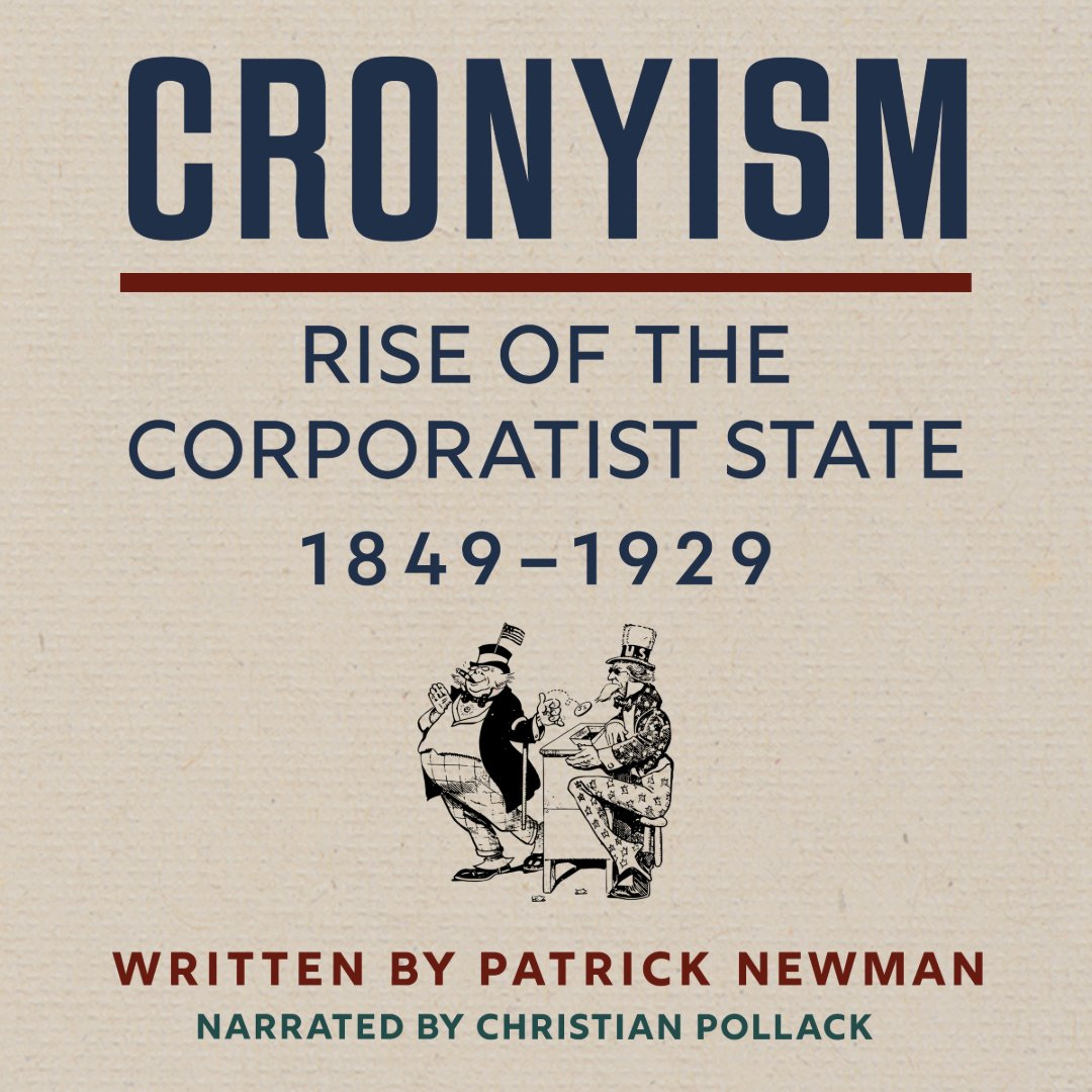 Conclusion 16.09.2026 5minBy the close of the 1920s, business elites led by Wall Street had secured government enforcement of their cartels across banking, industry, transportation, and health—always advocated in the name of the public interest, always intended to serve private ones. The party that lost was the broader public belonging to no interest group; the growth of 1849 to 1929 came from free-market forces, which the corporatist network inhibited, delayed, and distorted.
 -
Chapter 6. Wall Street’s Central Bank 16.09.2026 50minBy the new century the power elite was Morgan, Kuhn Loeb, Baker’s First National, and Stillman’s National City, yet New York’s share of central reserve city deposits was slipping as Chicago and St. Louis gained. Patrick Newman covers Jekyll Island, the National Citizens’ League organized as a front to manufacture grass-roots support, and the pivot once Congress refused the Aldrich plan: if the central bank had to look decentralized, then control its personnel instead.
-
Introduction 16.09.2026 23minPatrick Newman defines cronyism as government intervention that benefits special interests at the expense of the public interest, and argues the corporatist state was built in stages over eight decades rather than arriving at once. He explains why his earlier “Liberty versus Power” framework stops applying after 1849: parties no longer divided over liberty and favoritism, only over which special interests they would reward.
-
Chapter 8. Capturing the Regulations 16.09.2026 56minThe Federal Trade Commission’s first chairman institutionalized “advance advice” and uniform cost accounting, letting businessmen define what counted as unfair competition and making it harder to sell below a given margin. Patrick Newman then tracks the reversal as Wilson appointed opponents of big business, and the recapture under Harding and Coolidge, when the commission enforced cartel agreements and Hoover’s Commerce Department added subsidies and patent restrictions.
-
Chapter 7. A Trade Commission for Industry 16.09.2026 1h 1minAfter the merger wave of 1898 and 1899, big business wanted relief from antitrust suits and protection from price-cutting. Patrick Newman shows the Morgan concerns working to neutralize an unexpectedly hostile Theodore Roosevelt and securing preferential treatment, then the years of lobbying for a trade commission that would restrain competition under the banner of promoting it.
-
Chapter 10. Purifying the Competition 16.09.2026 1h 16minThree campaigns waged in the name of public health. Patrick Newman covers the Beef Trust turning federal meat inspection into taxpayer-subsidized cartelization, the pure-food coalition in which sugar producers, straight-whiskey distillers, and a cream-of-tartar baking powder maker each sought to handicap a cheaper rival, and the American Medical Association’s drive to restrict the supply of doctors and suppress homeopathic and eclectic competitors.
-
Chapter 9. Fighting Over Railroad Regulation 16.09.2026 1h 7minBarred from rate associations after 1897, the railroads formed communities of interest by buying their competitors’ stock—cartels in a disguised form. Patrick Newman details the reversal of the 1910s, when the ICC shifted to delivering cronyism to shippers and unions and regulation caught the lines in a cost-price squeeze, followed by wartime federalization under McAdoo and the 1920s overhaul that finally secured pools and minimum rates.
-
Chapter 5. Wall Street’s National Banks 16.09.2026 1h 5minPatrick Newman traces the National Banking System from Salmon P. Chase’s wartime bond sales and initially hostile relations with New York financiers through the pyramid of bankers’ balances that concentrated reserves on Wall Street. He follows J. P. Morgan and George Baker’s First National Bank, the defense of monopolistic restraints after the Panic of 1873, and the silver fight that fractured the Democrats and culminated in the election of 1896.
-
Chapter 11. Wall Street’s World Reserve Currency 16.09.2026 1h 8minThe Great War wrecked European finance and opened the door for the dollar to displace the pound. Patrick Newman follows Thomas Lamont and Paul Warburg’s ambitions for an imperial banking system, the Federal Reserve’s first inflationary boom and bust in the Depression of 1920 to 1921, and the 1920s high tide of the “Money Lords,” when Benjamin Strong’s easy money reshaped monetary systems across Europe and Latin America.
-
Chapter 3. Cartelizing the Railroads 16.09.2026 36minCompetition among the trunk lines meant lower rates and better service, so the railroads tried pools to stop it—and the pools kept collapsing, because without government coercion some member always defected with a secret rebate. Patrick Newman shows how the Interstate Commerce Commission supplied the enforcement common law would not, with commissioners reading their mandate in the railroads’ favor and cartelization temporarily strengthened at the shippers’ expense.
-
Foreword 16.09.2026 12minThomas Sargent places Patrick Newman in a tradition of American historians—Charles Beard, Forrest McDonald, Richard Hofstadter, and Murray Rothbard—who compress data and look for patterns in how the state is designed and managed. He draws the dividing line between those who read bad policy as unintended error correctable by better administration and those who see a government constituted with excessive powers that will inevitably serve some private interests at the expense of others, closing on Argentina’s industrial policies and their growing appeal among leaders of both US parties.
-
Chapter 2. Railroading the Nation 16.09.2026 48minA transcontinental railroad was unprofitable on market terms—“1800 miles of railroad through an uninhabited country”—but attractive once Congress supplied land and subsidies. Patrick Newman follows the four Sacramento merchants who saw the opportunity and the Republicans who justified it as a wartime necessity, then the reversal of the 1870s, when the subsidized lines moved from the Great Barbecue’s dinner table onto the menu.
-
Chapter 1. The Republican Ascendancy 16.09.2026 53minPatrick Newman shows how liberty-minded reformers, once holding the levers of power, were pulled toward favoritism of their own—beginning with Jefferson, who could not refuse five hundred million acres. He traces the 1850s scramble over land grants, bailouts, and transcontinental subsidies, the slavery-extension fight that stalled the parceling of the spoils, and the Panic of 1857, which turned the Republicans into a supercharged Federalist-Whig coalition reviving Henry Clay’s American System.
Slični podcasti


Popularan u
Ovaj podcast pojavljuje se i na podcast ljestvicama ovih zemalja.

