
Law School
The Law School of America
0
The Law School of America podcast is designed for listeners who want to expand and enhance their understanding of the American legal system. It provides legal principles in small, digestible bites to make learning easy. If you're willing to put in the time, these podcasts can take you from novice to knowledgeable in a reasonable amount of time.
Epizódok
-
 Law School Midterm Command Center: Correction Day and the Midterm Command Center — Error Repair, Targeted Review, Exam-Day Strategy, and the Rest-of-Semester Plan 04.10.2026 57p⚖️ MIDTERM CHALLENGE: Can you apply the law when it counts?⚖️📖 FREE BOOK — Review the material📖 🎮 GAME 1 — Start the challenge🎮🎯 GAME 2 — Test yourself again🎯🏁 GAME 3 — Complete the set🏁🎧 EPISODE SUMMARY 🎧Correction begins by naming the cause of an error: rule gap, doctrine confusion, recognition failure, weak application, or execution failure. Each requires a different repair and a retest on fresh facts. Compact sheets, oral and blank-page recall, and mixed practice make corrected rules usable under time limits. Exam-day preparation removes avoidable friction; later feedback sharpens the plan. The one-page dashboard carries course status, performance measures, priority weaknesses, and scheduled actions through the remainder of the semester.ℹ️ INFORMATION, PRIVACY POLICY & TERMS OF USE ℹ️The Podcast and Website PurposeThe Law School Podcast and 1L Study Aide webpage supplements law-school and Bar Exam study with strategies, condensed rules, quizzes, and flashcards.Educational DisclaimerContent is for educational and informational purposes only. It is not legal advice, creates no attorney-client relationship, and does not guarantee law-school or Bar Exam success.Privacy PolicyNo account or login is required.This webpage uses no forms or analytics to collect personal information.Quiz and flashcard activity stays in your browser and may clear when local site data is removed.Terms of UseBy using this webpage, you agree to use its content only for lawful, personal, noncommercial educational purposes. It supplements—not replaces—courses, textbooks, official materials, or qualified instruction.
 -
 Midterm Law School Lab: Full Simulation and Performance Review 04.10.2026 1ó🧪 MIDTERM LAB: Can you turn what you’ve learned into exam points?🧪📖 FREE BOOK — Prepare for the challenge📖🎮 FREE GAME 1 — Put your knowledge to work🎮 🎯 FREE GAME 2 — Test yourself again🎯🏁 FREE GAME 3 — Complete the set🏁 🎧 EPISODE SUMMARY 🎧The simulation combines eighty-four objective questions and two essays across seven subjects. Timed and untimed modes report their different conditions. Review records accuracy, doctrine patterns, blanks, flags, answer changes, and time use. Each question receives a rule-based explanation of the correct choice and distractors. Essays receive issue checklists and model analysis, with human judgment for evaluation. Test remediation on a fresh variation.ℹ️ INFORMATION, PRIVACY POLICY & TERMS OF USE ℹ️The Podcast and Website PurposeThe Law School Podcast and 1L Study Aide webpage supplements law-school and Bar Exam study with strategies, condensed rules, quizzes, and flashcards.Educational DisclaimerContent is for educational and informational purposes only. It is not legal advice, creates no attorney-client relationship, and does not guarantee law-school or Bar Exam success.Privacy PolicyNo account or login is required.This webpage uses no forms or analytics to collect personal information.Quiz and flashcard activity stays in your browser and may clear when local site data is removed.Terms of UseBy using this webpage, you agree to use its content only for lawful, personal, noncommercial educational purposes. It supplements—not replaces—courses, textbooks, official materials, or qualified instruction.
 -
 Law School Midterm Command Center: Full Simulation Day — Timed Midterms, Mixed Subjects, Performance Analytics, and Examination Conditioning 03.10.2026 59p⚖️ MIDTERM CHALLENGE: Can you apply the law when it counts?⚖️📖 FREE BOOK — Review the material📖 🎮 GAME 1 — Start the challenge🎮🎯 GAME 2 — Test yourself again🎯🏁 GAME 3 — Complete the set🏁🎧 EPISODE SUMMARY 🎧A useful simulation reproduces the real assessment's content, format, resource rules, and clock as closely as practicable. During the test, students answer, flag, recover, and continue. Afterward, they examine coverage, accuracy, application, and execution, using issue grids and cautious multiple-choice analytics. Rule-recall categories, timing records, and physical observations explain what a score alone cannot. The final product is a short, prioritized plan grounded in the student's actual performance under pressure.ℹ️ INFORMATION, PRIVACY POLICY & TERMS OF USE ℹ️The Podcast and Website PurposeThe Law School Podcast and 1L Study Aide webpage supplements law-school and Bar Exam study with strategies, condensed rules, quizzes, and flashcards.Educational DisclaimerContent is for educational and informational purposes only. It is not legal advice, creates no attorney-client relationship, and does not guarantee law-school or Bar Exam success.Privacy PolicyNo account or login is required.This webpage uses no forms or analytics to collect personal information.Quiz and flashcard activity stays in your browser and may clear when local site data is removed.Terms of UseBy using this webpage, you agree to use its content only for lawful, personal, noncommercial educational purposes. It supplements—not replaces—courses, textbooks, official materials, or qualified instruction.
 -
 Midterm Law School Lab: Evidence 03.10.2026 1ó 17p🧪 MIDTERM LAB: Can you turn what you’ve learned into exam points?🧪📖 FREE BOOK — Prepare for the challenge📖🎮 FREE GAME 1 — Put your knowledge to work🎮 🎯 FREE GAME 2 — Test yourself again🎯🏁 FREE GAME 3 — Complete the set🏁 🎧 EPISODE SUMMARY 🎧Name the item and its offered purpose first. Test relevance and unfair prejudice, then specialized exclusions and character rules. For words, identify an assertion, declarant, truth use, any nonhearsay classification, each applicable exception, and every nested layer. Check witness competence and impeachment, privilege, authentication, original-content requirements, and expert reliability independently. In a criminal case, add the confrontation inquiry for testimonial assertions offered against the accused. The best answer states both a plausible route to admission and the objection or factual gap that may block it.ℹ️ INFORMATION, PRIVACY POLICY & TERMS OF USE ℹ️The Podcast and Website PurposeThe Law School Podcast and 1L Study Aide webpage supplements law-school and Bar Exam study with strategies, condensed rules, quizzes, and flashcards.Educational DisclaimerContent is for educational and informational purposes only. It is not legal advice, creates no attorney-client relationship, and does not guarantee law-school or Bar Exam success.Privacy PolicyNo account or login is required.This webpage uses no forms or analytics to collect personal information.Quiz and flashcard activity stays in your browser and may clear when local site data is removed.Terms of UseBy using this webpage, you agree to use its content only for lawful, personal, noncommercial educational purposes. It supplements—not replaces—courses, textbooks, official materials, or qualified instruction.
 -
 Law School Midterm Command Center: Essay Command — Issue Spotting, Rule Statements, IRAC, Fact Application, Counterarguments, Organization, and Time Management 02.10.2026 1ó 22p⚖️ MIDTERM CHALLENGE: Can you apply the law when it counts?⚖️📖 FREE BOOK — Review the material📖 🎮 GAME 1 — Start the challenge🎮🎯 GAME 2 — Test yourself again🎯🏁 GAME 3 — Complete the set🏁🎧 EPISODE SUMMARY 🎧A strong essay begins with the call and party map, uses a brief issue checklist, and treats each contested point through a usable rule and concrete application. Descriptive headings make the structure visible. Counterarguments and policy help when connected to the facts and doctrine; case labels never replace explanation. Conclusions should reflect the strength of the analysis. Time, word, and resource limits determine how much to write, while post-exam review reveals whether the writer recognized issues and actually applied the law.ℹ️ INFORMATION, PRIVACY POLICY & TERMS OF USE ℹ️The Podcast and Website PurposeThe Law School Podcast and 1L Study Aide webpage supplements law-school and Bar Exam study with strategies, condensed rules, quizzes, and flashcards.Educational DisclaimerContent is for educational and informational purposes only. It is not legal advice, creates no attorney-client relationship, and does not guarantee law-school or Bar Exam success.Privacy PolicyNo account or login is required.This webpage uses no forms or analytics to collect personal information.Quiz and flashcard activity stays in your browser and may clear when local site data is removed.Terms of UseBy using this webpage, you agree to use its content only for lawful, personal, noncommercial educational purposes. It supplements—not replaces—courses, textbooks, official materials, or qualified instruction.
 -
 Midterm Law School Lab: Property and Constitutional Law 02.10.2026 1ó 35p🧪 MIDTERM LAB: Can you turn what you’ve learned into exam points?🧪📖 FREE BOOK — Prepare for the challenge📖🎮 FREE GAME 1 — Put your knowledge to work🎮 🎯 FREE GAME 2 — Test yourself again🎯🏁 FREE GAME 3 — Complete the set🏁 🎧 EPISODE SUMMARY 🎧Property analysis begins by naming the interest, its holder, the event that changes it, and the remedy. Possession, easements, covenants, recording, mortgages, and land-use restrictions have distinct creation and priority rules. Constitutional analysis begins by identifying a proper plaintiff, the governmental actor, and a specific source of power. Judicial review, congressional authority, executive action, federalism, preemption, and Dormant Commerce Clause limits then follow in order. In both courses, a classification supported by the facts does more work than a memorized rule recited before the problem is understood.ℹ️ INFORMATION, PRIVACY POLICY & TERMS OF USE ℹ️The Podcast and Website PurposeThe Law School Podcast and 1L Study Aide webpage supplements law-school and Bar Exam study with strategies, condensed rules, quizzes, and flashcards.Educational DisclaimerContent is for educational and informational purposes only. It is not legal advice, creates no attorney-client relationship, and does not guarantee law-school or Bar Exam success.Privacy PolicyNo account or login is required.This webpage uses no forms or analytics to collect personal information.Quiz and flashcard activity stays in your browser and may clear when local site data is removed.Terms of UseBy using this webpage, you agree to use its content only for lawful, personal, noncommercial educational purposes. It supplements—not replaces—courses, textbooks, official materials, or qualified instruction.
 -
 Law School Midterm Command Center: Multiple-Choice Command — Question Anatomy, Distractor Elimination, Rule Precision, Timing, and Error Analysis 01.10.2026 1ó 4p⚖️ MIDTERM CHALLENGE: Can you apply the law when it counts?⚖️📖 FREE BOOK — Review the material📖 🎮 GAME 1 — Start the challenge🎮🎯 GAME 2 — Test yourself again🎯🏁 GAME 3 — Complete the set🏁🎧 EPISODE SUMMARY 🎧Multiple-choice analysis begins with the call, moves through a provisional rule and the decisive facts, and ends with a comparison of responsive choices. True but irrelevant rules, omitted exceptions, overstated results, altered facts, and premature conclusions are recurring distractors. A two-pass schedule protects time; a concrete reason justifies changing an answer. Confidence codes and an error log turn missed questions into specific rule rewrites, issue triggers, and new-question retests. The value of a score lies in understanding both why the wrong answer was tempting and why the better answer fits the law and the facts.ℹ️ INFORMATION, PRIVACY POLICY & TERMS OF USE ℹ️The Podcast and Website PurposeThe Law School Podcast and 1L Study Aide webpage supplements law-school and Bar Exam study with strategies, condensed rules, quizzes, and flashcards.Educational DisclaimerContent is for educational and informational purposes only. It is not legal advice, creates no attorney-client relationship, and does not guarantee law-school or Bar Exam success.Privacy PolicyNo account or login is required.This webpage uses no forms or analytics to collect personal information.Quiz and flashcard activity stays in your browser and may clear when local site data is removed.Terms of UseBy using this webpage, you agree to use its content only for lawful, personal, noncommercial educational purposes. It supplements—not replaces—courses, textbooks, official materials, or qualified instruction.
 -
 Midterm Law School Lab: Criminal Law and Criminal Procedure 01.10.2026 1ó 31p🧪 MIDTERM LAB: Can you turn what you’ve learned into exam points?🧪📖 FREE BOOK — Prepare for the challenge📖🎮 FREE GAME 1 — Put your knowledge to work🎮 🎯 FREE GAME 2 — Test yourself again🎯🏁 FREE GAME 3 — Complete the set🏁 🎧 EPISODE SUMMARY 🎧A criminal analysis begins with the charged offense's elements and proof beyond a reasonable doubt. Match a voluntary act or legally significant omission to the required culpability, test concurrence and causation when a result is charged, and classify homicide through each available murder, manslaughter, and felony-murder path. Analyze each participant's assistance and mental state; keep incomplete crimes distinct from completed offenses. Then evaluate justification and excuse under the governing rule. Criminal Procedure enters when investigation or evidence facts raise a separate constitutional question, and any remedy must be tied back to the proof remaining. The strongest exam answer states both the governing distinction and the fact on which it turns.ℹ️ INFORMATION, PRIVACY POLICY & TERMS OF USE ℹ️The Podcast and Website PurposeThe Law School Podcast and 1L Study Aide webpage supplements law-school and Bar Exam study with strategies, condensed rules, quizzes, and flashcards.Educational DisclaimerContent is for educational and informational purposes only. It is not legal advice, creates no attorney-client relationship, and does not guarantee law-school or Bar Exam success.Privacy PolicyNo account or login is required.This webpage uses no forms or analytics to collect personal information.Quiz and flashcard activity stays in your browser and may clear when local site data is removed.Terms of UseBy using this webpage, you agree to use its content only for lawful, personal, noncommercial educational purposes. It supplements—not replaces—courses, textbooks, official materials, or qualified instruction.
 -
 Law School Midterm Command Center: Rule Compression II — Criminal Law, Property, Constitutional Structure, and Evidence 30.09.2026 1ó 23p⚖️ MIDTERM CHALLENGE: Can you apply the law when it counts?⚖️📖 FREE BOOK — Review the material📖 🎮 GAME 1 — Start the challenge🎮🎯 GAME 2 — Test yourself again🎯🏁 GAME 3 — Complete the set🏁🎧 EPISODE SUMMARY 🎧The Wednesday command center turns four extensive courses into usable decisions. Criminal Law starts with conduct, culpability, and offense grading. Property tracks present possession, future interests, transfer, and priority. Constitutional Structure distinguishes judicial power, enumerated power, executive authority, and federalism limits. Evidence starts with purpose and proceeds through independent admissibility gates. Each outline should help a student recognize the governing issue, explain its exception, and apply it to unfamiliar facts within the time allowed.ℹ️ INFORMATION, PRIVACY POLICY & TERMS OF USE ℹ️The Podcast and Website PurposeThe Law School Podcast and 1L Study Aide webpage supplements law-school and Bar Exam study with strategies, condensed rules, quizzes, and flashcards.Educational DisclaimerContent is for educational and informational purposes only. It is not legal advice, creates no attorney-client relationship, and does not guarantee law-school or Bar Exam success.Privacy PolicyNo account or login is required.This webpage uses no forms or analytics to collect personal information.Quiz and flashcard activity stays in your browser and may clear when local site data is removed.Terms of UseBy using this webpage, you agree to use its content only for lawful, personal, noncommercial educational purposes. It supplements—not replaces—courses, textbooks, official materials, or qualified instruction.
 -
 Midterm Law School Lab: Civil Procedure 30.09.2026 1ó 36p🧪 MIDTERM LAB: Can you turn what you’ve learned into exam points?🧪📖 FREE BOOK — Prepare for the challenge📖🎮 FREE GAME 1 — Put your knowledge to work🎮 🎯 FREE GAME 2 — Test yourself again🎯🏁 FREE GAME 3 — Complete the set🏁 🎧 EPISODE SUMMARY 🎧Civil Procedure exams reward accurate sequencing. Establish the court's authority over the case and parties, test service and venue independently, choose the governing law, then follow the pleadings, motions, amendments, joinder, discovery, adjudication, appeal, and preclusion in the order the facts present them. At each stage, identify the rule's source, actor, deadline, and consequence. The most revealing diagnostic mistakes are often not failures to recall a rule, but failures to notice that a second procedural problem survives the first answer.ℹ️ INFORMATION, PRIVACY POLICY & TERMS OF USE ℹ️The Podcast and Website PurposeThe Law School Podcast and 1L Study Aide webpage supplements law-school and Bar Exam study with strategies, condensed rules, quizzes, and flashcards.Educational DisclaimerContent is for educational and informational purposes only. It is not legal advice, creates no attorney-client relationship, and does not guarantee law-school or Bar Exam success.Privacy PolicyNo account or login is required.This webpage uses no forms or analytics to collect personal information.Quiz and flashcard activity stays in your browser and may clear when local site data is removed.Terms of UseBy using this webpage, you agree to use its content only for lawful, personal, noncommercial educational purposes. It supplements—not replaces—courses, textbooks, official materials, or qualified instruction.
 -
 Law School Midterm Command Center: Rule Compression I — Contracts, Torts, and Civil Procedure 29.09.2026 1ó 9p⚖️ MIDTERM CHALLENGE: Can you apply the law when it counts?⚖️📖 FREE BOOK — Review the material📖 🎮 GAME 1 — Start the challenge🎮🎯 GAME 2 — Test yourself again🎯🏁 GAME 3 — Complete the set🏁🎧 EPISODE SUMMARY 🎧The full outline stores the course; the attack outline runs the examination. In Contracts, classify the transaction and trace an offer through acceptance and enforcement. In Torts, test intentional wrongs and privileges before moving through duty, breach, two kinds of causation, harm, and defenses. In Civil Procedure, separate the court's power over the case, its power over the defendant, the proper district, and the governing rules for pleadings. The useful compressed rule is the one a student can retrieve, qualify, and apply to a new fact pattern under time pressure.ℹ️ INFORMATION, PRIVACY POLICY & TERMS OF USE ℹ️The Podcast and Website PurposeThe Law School Podcast and 1L Study Aide webpage supplements law-school and Bar Exam study with strategies, condensed rules, quizzes, and flashcards.Educational DisclaimerContent is for educational and informational purposes only. It is not legal advice, creates no attorney-client relationship, and does not guarantee law-school or Bar Exam success.Privacy PolicyNo account or login is required.This webpage uses no forms or analytics to collect personal information.Quiz and flashcard activity stays in your browser and may clear when local site data is removed.Terms of UseBy using this webpage, you agree to use its content only for lawful, personal, noncommercial educational purposes. It supplements—not replaces—courses, textbooks, official materials, or qualified instruction.
 -
 Midterm Law School Lab: Contracts and Torts 29.09.2026 1ó 16p🧪 MIDTERM LAB: Can you turn what you’ve learned into exam points?🧪📖 FREE BOOK — Prepare for the challenge📖🎮 FREE GAME 1 — Put your knowledge to work🎮 🎯 FREE GAME 2 — Test yourself again🎯🏁 FREE GAME 3 — Complete the set🏁 🎧 EPISODE SUMMARY 🎧Contracts analysis begins with governing law and moves through formation, enforceability, terms, conditions, performance, breach or excuse, and remedy. Torts analysis identifies the theory and parties, then tests duty, breach, causation, harm, and defenses while screening intentional and strict-liability claims when the course has reached them. The strongest midterm answers use each significant fact to prove or contest a particular element. Mixed questions, timed essays, complete explanations, and targeted flashcards convert that method into a measurable practice routine.ℹ️ INFORMATION, PRIVACY POLICY & TERMS OF USE ℹ️The Podcast and Website PurposeThe Law School Podcast and 1L Study Aide webpage supplements law-school and Bar Exam study with strategies, condensed rules, quizzes, and flashcards.Educational DisclaimerContent is for educational and informational purposes only. It is not legal advice, creates no attorney-client relationship, and does not guarantee law-school or Bar Exam success.Privacy PolicyNo account or login is required.This webpage uses no forms or analytics to collect personal information.Quiz and flashcard activity stays in your browser and may clear when local site data is removed.Terms of UseBy using this webpage, you agree to use its content only for lawful, personal, noncommercial educational purposes. It supplements—not replaces—courses, textbooks, official materials, or qualified instruction.
 -
 Law School Midterm Command Center Triage: Diagnose What You Know, What You Think You Know, and What You Cannot Yet Use 28.09.2026 1ó⚖️ MIDTERM CHALLENGE: Can you apply the law when it counts?⚖️📖 FREE BOOK — Review the material📖 🎮 GAME 1 — Start the challenge🎮🎯 GAME 2 — Test yourself again🎯🏁 GAME 3 — Complete the set🏁🎧 EPISODE SUMMARY 🎧Midterm preparation begins by defining the course actually examinable and testing what the student can do with it. The coverage map sets the boundaries; green, yellow, and red record demonstrated performance; the professor profile clarifies the expected answer; previous feedback and the error log identify why points are lost; and a closed-book baseline exposes weaknesses before studying hides them. Monday ends with five prioritized repairs and six days of scheduled practice. Study time then follows evidence of lost points and the legal tasks the student must perform on the examination.ℹ️ INFORMATION, PRIVACY POLICY & TERMS OF USE ℹ️The Podcast and Website PurposeThe Law School Podcast and 1L Study Aide webpage supplements law-school and Bar Exam study with strategies, condensed rules, quizzes, and flashcards.Educational DisclaimerContent is for educational and informational purposes only. It is not legal advice, creates no attorney-client relationship, and does not guarantee law-school or Bar Exam success.Privacy PolicyNo account or login is required.This webpage uses no forms or analytics to collect personal information.Quiz and flashcard activity stays in your browser and may clear when local site data is removed.Terms of UseBy using this webpage, you agree to use its content only for lawful, personal, noncommercial educational purposes. It supplements—not replaces—courses, textbooks, official materials, or qualified instruction.
 -
 Midterm Law School Lab: Midterm Diagnostic and the Law-School Examination Method 28.09.2026 53p🧪 MIDTERM LAB: Can you turn what you’ve learned into exam points?🧪📖 FREE BOOK — Prepare for the challenge📖🎮 FREE GAME 1 — Put your knowledge to work🎮 🎯 FREE GAME 2 — Test yourself again🎯🏁 FREE GAME 3 — Complete the set🏁 🎧 EPISODE SUMMARY 🎧A strong midterm answer begins with the task and the parties, identifies the controlling issues, states usable rules, and explains how the material facts satisfy or fail each disputed requirement. IRAC and CRAC are ways to expose that reasoning, not rigid scripts. Counterarguments deserve attention when the facts genuinely support them, and conclusions should state the condition on which uncertainty turns. Time should follow points and complexity. Finally, a diagnostic becomes valuable when its subject and skill scores lead to a specific repair and a new attempt on unfamiliar facts. The examination method is learned by performing it, reviewing the reasoning, and performing it again.ℹ️ INFORMATION, PRIVACY POLICY & TERMS OF USE ℹ️The Podcast and Website PurposeThe Law School Podcast and 1L Study Aide webpage supplements law-school and Bar Exam study with strategies, condensed rules, quizzes, and flashcards.Educational DisclaimerContent is for educational and informational purposes only. It is not legal advice, creates no attorney-client relationship, and does not guarantee law-school or Bar Exam success.Privacy PolicyNo account or login is required.This webpage uses no forms or analytics to collect personal information.Quiz and flashcard activity stays in your browser and may clear when local site data is removed.Terms of UseBy using this webpage, you agree to use its content only for lawful, personal, noncommercial educational purposes. It supplements—not replaces—courses, textbooks, official materials, or qualified instruction.
 -
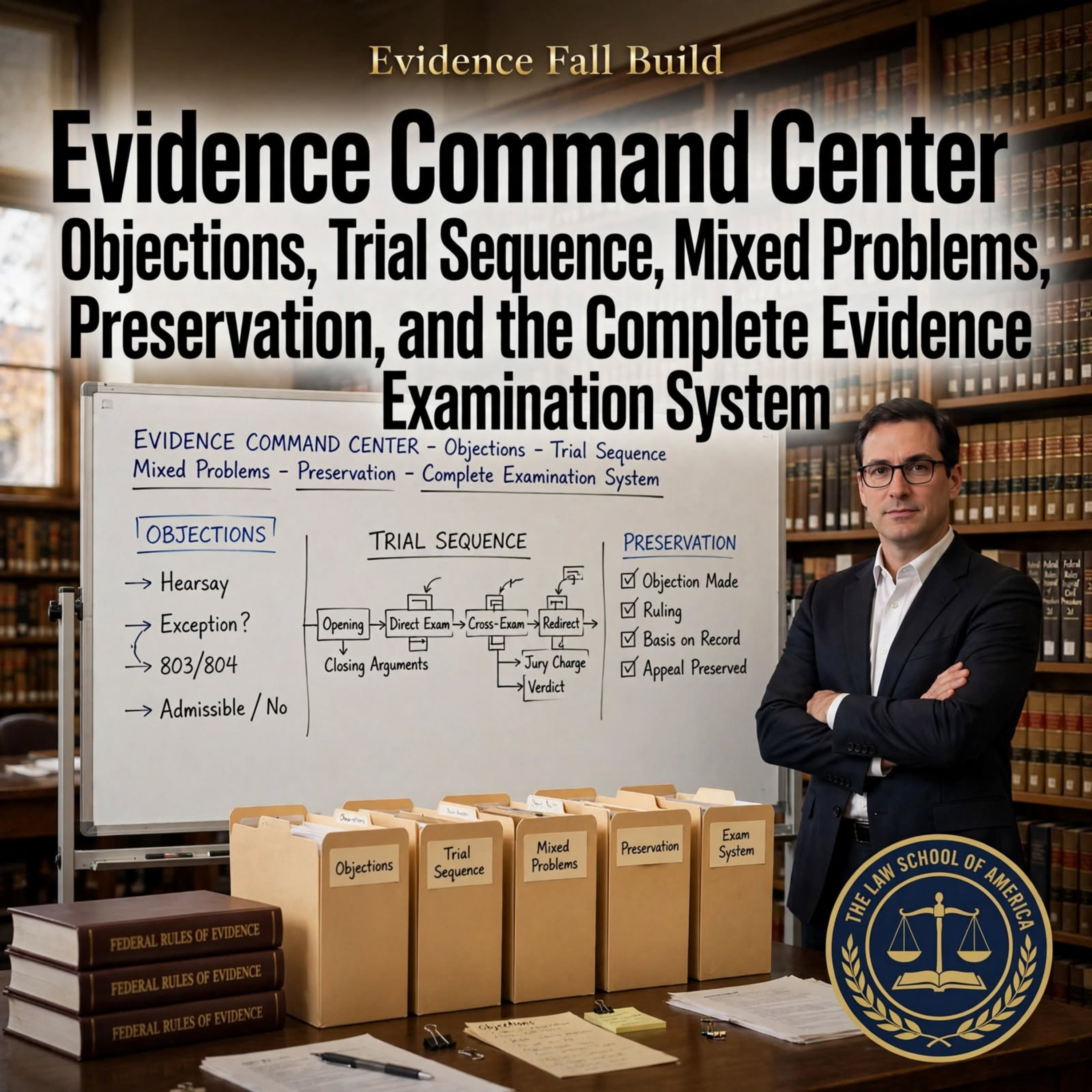 Evidence Fall Build: Evidence Command Center Objections, Trial Sequence, Mixed Problems, Preservation, and the Complete Evidence Examination System 27.09.2026 54p👉Turn this episode into a free Game or Book Chapter.👈 🎧 EPISODE SUMMARY 🎧Evidence should be approached as an integrated system rather than as a collection of isolated doctrines.Begin by identifying the evidence and the proponent. Then state the precise purpose for which the evidence is offered.Apply relevance first. If the evidence is relevant, consider Rule 403 and any specific policy exclusion.If character or prior-act evidence is involved, identify whether the reasoning depends on propensity and whether an exception or legitimate nonpropensity purpose applies. Distinguish character from habit.For witness testimony, establish competency, personal knowledge, proper questioning, and any necessary opinion foundation. Expert testimony requires qualification, helpfulness, sufficient facts or data, reliable methods, and reliable application.If credibility is challenged, identify the exact impeachment doctrine.For every out-of-court statement, identify the declarant, the assertion, and the purpose. Then move through the hearsay structure: nontruth purpose, Rule 801(d), Rule 803, Rule 804, Rule 807, and multiple hearsay.In a criminal case, separately analyze the Confrontation Clause when testimonial statements are offered against the accused.Consider privilege as an independent restriction.Authenticate documents, objects, recordings, photographs, and digital evidence. Determine whether self-authentication applies and whether chain of custody or digital attribution is necessary.If the proponent seeks to prove the contents of a writing, recording, or photograph, consider the original-writing rules. Distinguish Rule 1006 evidentiary summaries from Rule 107 illustrative aids.Consider limited admissibility, redaction, conditional admission, and limiting instructions.Finally, preserve the issue through the appropriate objection, offer of proof, motion, or renewed objection, and always state the ruling.The complete Evidence method can be reduced to one discipline:Identify the item, identify the purpose, apply every independent admissibility rule that matters, and finish with a ruling.ℹ️ INFORMATION, PRIVACY POLICY & TERMS OF USE ℹ️The Podcast and Website PurposeThe Law School Podcast and 1L Study Aide webpage supplements law-school and Bar Exam study with strategies, condensed rules, quizzes, and flashcards.Educational DisclaimerContent is for educational and informational purposes only. It is not legal advice, creates no attorney-client relationship, and does not guarantee law-school or Bar Exam success.Privacy PolicyNo account or login is required.This webpage uses no forms or analytics to collect personal information.Quiz and flashcard activity stays in your browser and may clear when local site data is removed.Terms of UseBy using this webpage, you agree to use its content only for lawful, personal, noncommercial educational purposes. It supplements—not replaces—courses, textbooks, official materials, or qualified instruction.
 -
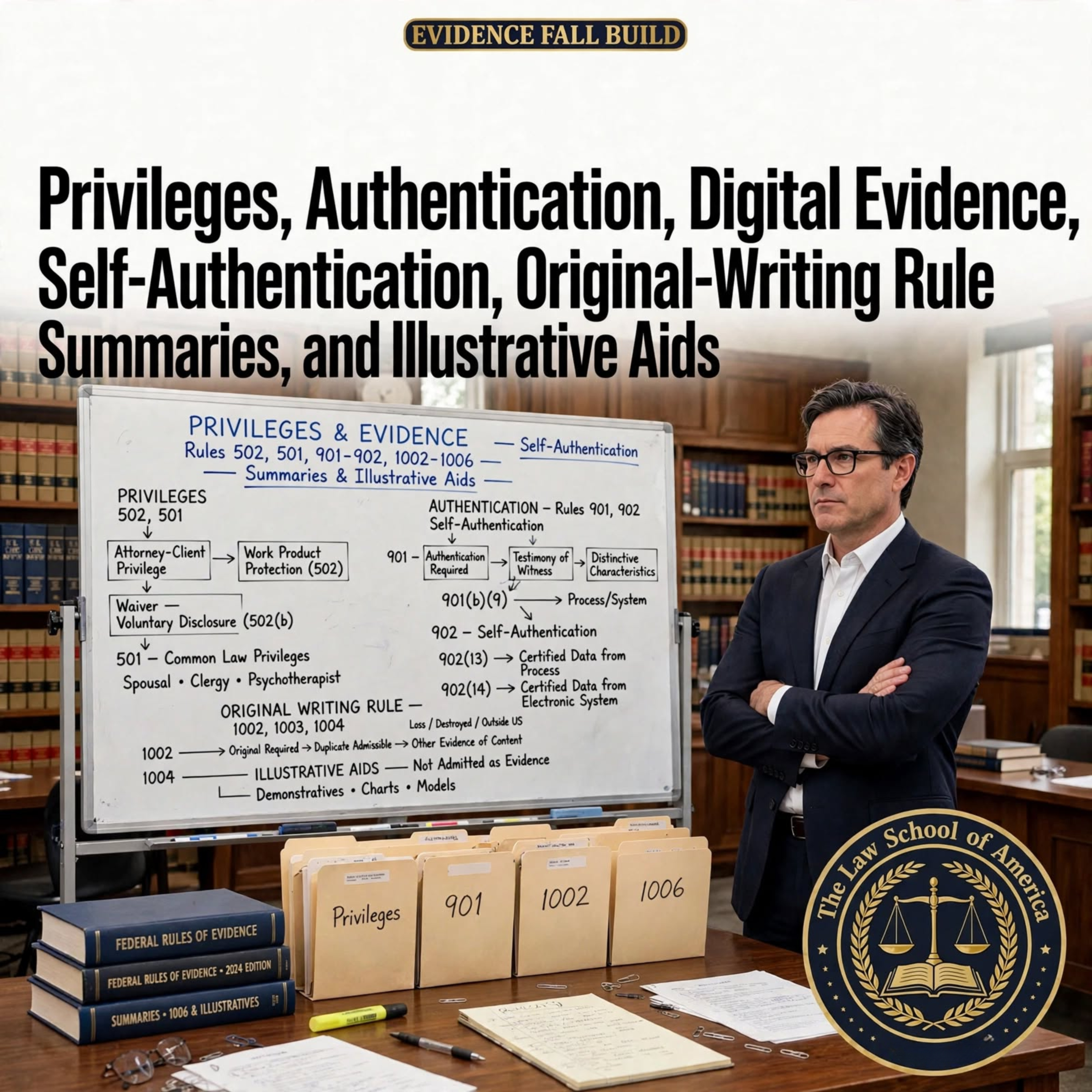 Evidence Fall Build: Privileges, Authentication, Digital Evidence, Self-Authentication, Original-Writing Rule, Summaries, and Illustrative Aids 26.09.2026 1ó 12p👉Turn this episode into a free Game or Book Chapter.👈 🎧 EPISODE SUMMARY 🎧Privilege excludes relevant evidence to protect key relationships and values.Attorney-client privilege protects confidential communications for legal advice. Confidentiality is essential; necessary third parties do not destroy protection.Corporate privilege covers communications between counsel and employees regarding job responsibilities when confidentiality is kept.The crime-fraud exception applies when seeking legal aid for future crimes or fraud, not past wrongdoing.Privilege is waived by disclosure, lost confidentiality, litigation use, or subject-matter disclosure.Work product protects materials prepared in anticipation of litigation.Federal common law recognizes marital privileges and psychotherapist-patient privilege.Rule 901 authentication requires sufficient evidence that an item is what the proponent claims.Authentication uses witness knowledge, characteristics, comparison, voice/handwriting ID, system evidence, or chain of custody.Photos require witness testimony of accurate depiction. Video uses system operation, timestamps, custody, or metadata.Chain of custody is vital for fungible evidence like drugs, blood, and digital storage.Digital posts and messages connect to authors via account info, writing style, metadata, reply patterns, or testimony.Synthetic or AI media follows ordinary evidentiary rules.Rule 902 self-authentication avoids separate authentication evidence, but other objections remain.Original-writing rules apply to prove contents. Duplicates are generally admissible unless authenticity is disputed.Rule 1006 allows summaries of voluminous admissible materials.Rule 107 illustrative aids help clarify evidence but are not evidence themselves.The controlling lesson is:Proponents must establish what evidence is and satisfy admissibility rules before persuading the jury.ℹ️ INFORMATION, PRIVACY POLICY & TERMS OF USE ℹ️The Podcast and Website PurposeThe Law School Podcast and 1L Study Aide webpage supplements law-school and Bar Exam study with strategies, condensed rules, quizzes, and flashcards.Educational DisclaimerContent is for educational and informational purposes only. It is not legal advice, creates no attorney-client relationship, and does not guarantee law-school or Bar Exam success.Privacy PolicyNo account or login is required.This webpage uses no forms or analytics to collect personal information.Quiz and flashcard activity stays in your browser and may clear when local site data is removed.Terms of UseBy using this webpage, you agree to use its content only for lawful, personal, noncommercial educational purposes. It supplements—not replaces—courses, textbooks, official materials, or qualified instruction.
 -
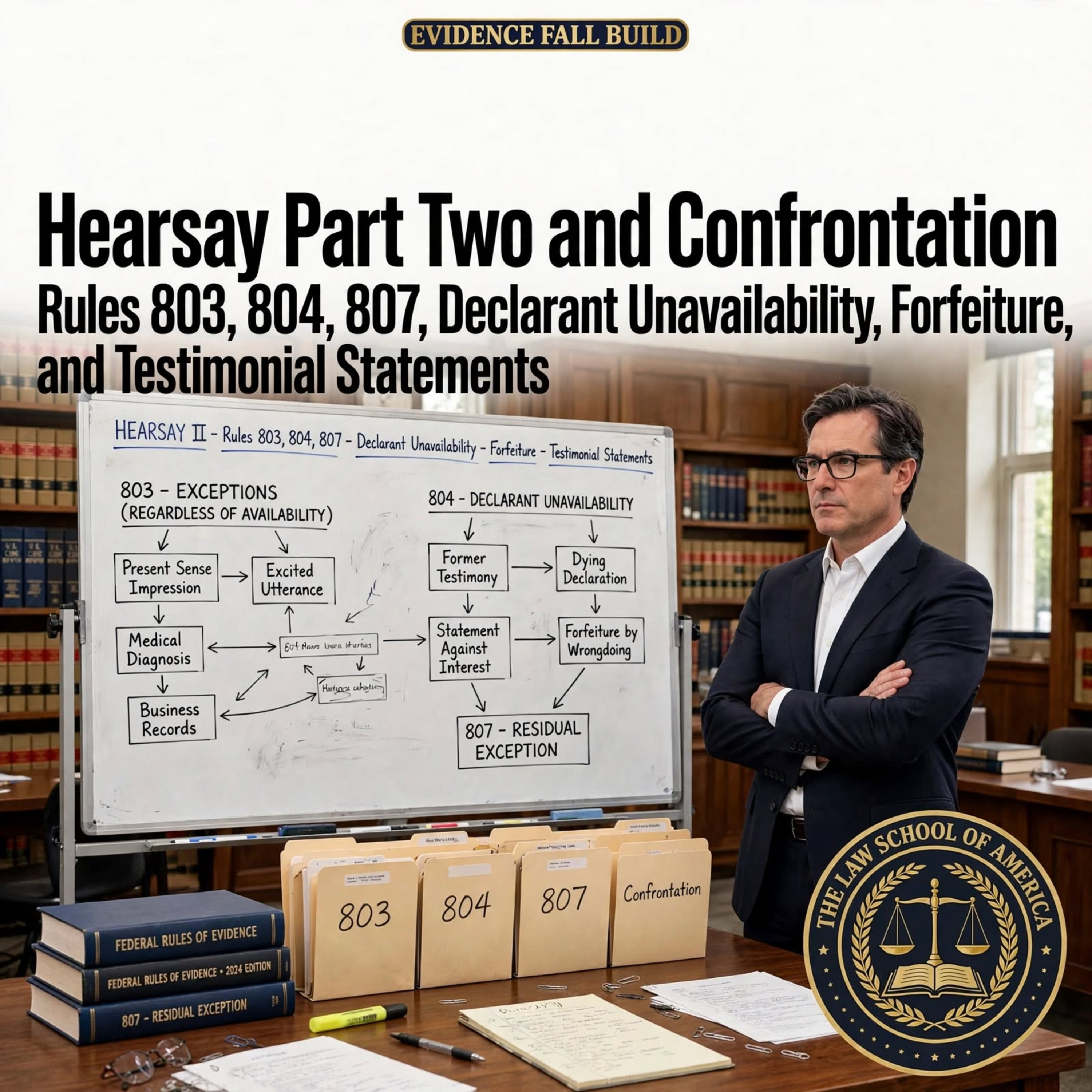 Evidence Fall Build: Hearsay Part Two and Confrontation - Rules 803, 804, 807, Declarant Unavailability, Forfeiture, and Testimonial Statements 25.09.2026 1ó 9p👉Turn this episode into a free Game or Book Chapter.👈 🎧 EPISODE SUMMARY 🎧Hearsay analysis begins with purpose. Out-of-court statements offered to prove the truth of the matter asserted constitute hearsay.A statement requires a person's oral, written, or intended nonverbal assertion; nonassertive conduct usually does not qualify.Automated machine data involves reliability or authentication rather than hearsay, though electronic human assertions still require hearsay analysis.A testifying witness's prior statements remain out-of-court statements, though specific ones qualify as nonhearsay under Rule 801(d)(1).Statements offered for nontruth purposes—such as effect on listener, notice, motive, or verbal acts—fall outside hearsay.Statements showing state of mind or used solely for impeachment are not hearsay; substantive use requires an independent basis.Under Rule 801(d)(1)(A), substantive prior inconsistent statements must be made under penalty of perjury at a proceeding or deposition.Prior consistent statements may rehabilitate credibility, while prior identifications are admissible if the testifying witness is subject to cross-examination.Rule 801(d)(2) covers opposing-party statements, including adoptive and authorized agent statements.Co-conspirator statements must be made during and in furtherance of the conspiracy; post-conspiracy narrations or casual boasting do not qualify.Rule 805 requires every layer of hearsay within hearsay to independently satisfy an admissibility exception.Identify the statement and its offered purpose before concluding it is hearsay.ℹ️ INFORMATION, PRIVACY POLICY & TERMS OF USE ℹ️The Podcast and Website PurposeThe Law School Podcast and 1L Study Aide webpage supplements law-school and Bar Exam study with strategies, condensed rules, quizzes, and flashcards.Educational DisclaimerContent is for educational and informational purposes only. It is not legal advice, creates no attorney-client relationship, and does not guarantee law-school or Bar Exam success.Privacy PolicyNo account or login is required.This webpage uses no forms or analytics to collect personal information.Quiz and flashcard activity stays in your browser and may clear when local site data is removed.Terms of UseBy using this webpage, you agree to use its content only for lawful, personal, noncommercial educational purposes. It supplements—not replaces—courses, textbooks, official materials, or qualified instruction.
 -
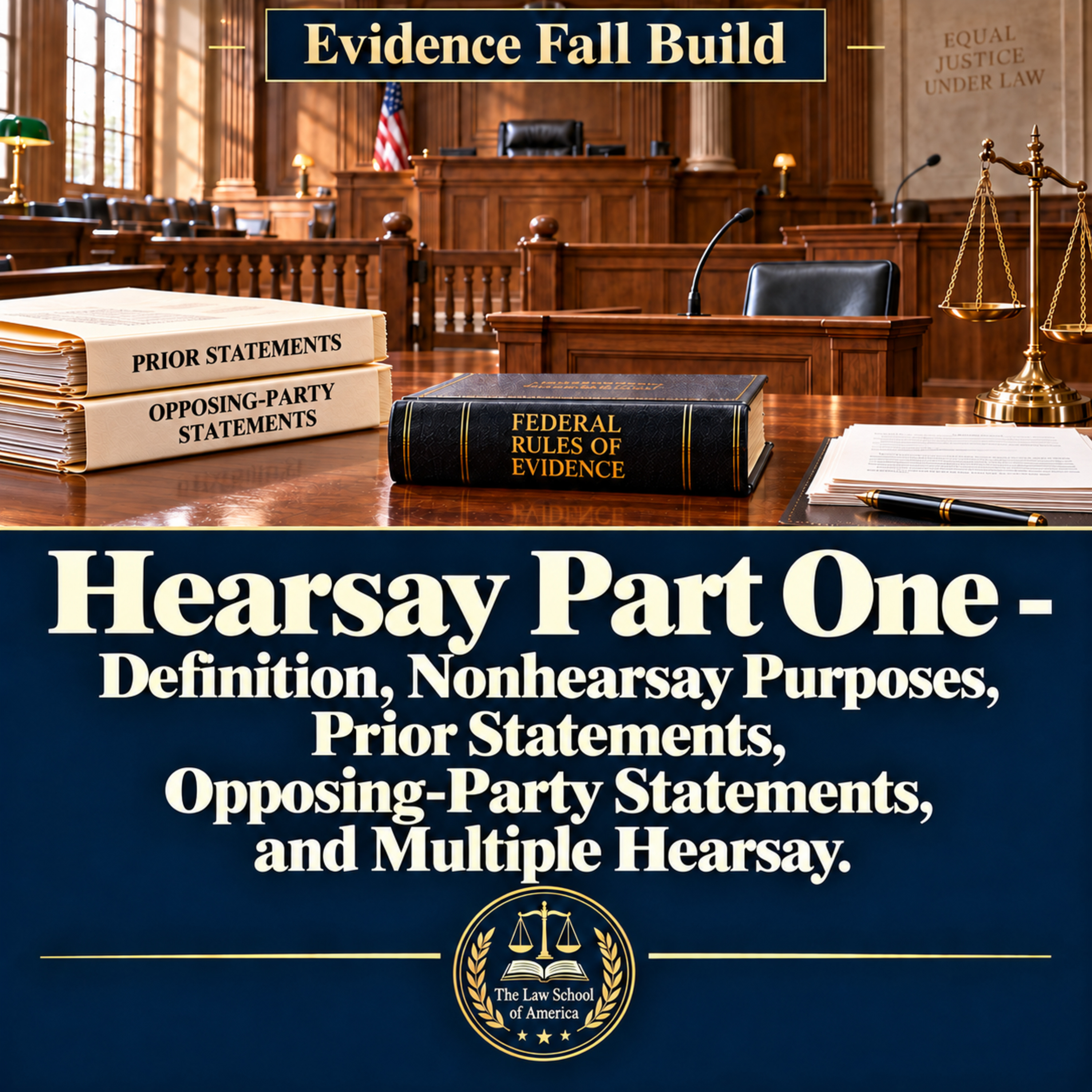 Evidence Fall Build: Hearsay Part One - Definition, Nonhearsay Purposes, Prior Statements, Opposing-Party Statements, and Multiple Hearsay 24.09.2026 1ó 9p⚖️ One objection. One ruling. Would you get it right? Put your evidence knowledge to the test—then dig into the rules behind the answer.🎮 Take the FREE Evidence Game Challenge →📖 Sharpen Your Knowledge: Read the FREE Book Chapter → 🎧 EPISODE SUMMARY 🎧Hearsay analysis begins with purpose.Out-of-court statements are not automatically hearsay. Hearsay requires a statement made outside trial offered to prove the truth of what it asserts.A statement requires an assertion by a person. Oral assertions, written assertions, and intended nonverbal assertions may qualify. Nonassertive conduct ordinarily does not.Machine-generated data raises authentication, reliability, or system-accuracy issues rather than traditional hearsay. Human assertions entered electronically require separate analysis from automated outputs.A witness's own prior statement is still an out-of-court statement merely because the witness later appears at trial. Specific prior statements may nevertheless qualify as nonhearsay under Rule 801(d)(1).The key question is whether the statement is offered for truth. Statements showing effect on listener, notice, motive, verbal acts, or other nontruth purposes fall outside hearsay.Statements may also be offered as circumstantial evidence of a declarant's state of mind or solely for impeachment. If a prior inconsistent statement is used only to challenge credibility, its truth may be irrelevant. Substantive use requires an independent basis.Under Rule 801(d)(1)(A), substantive use of a prior inconsistent statement requires it to be made under penalty of perjury at a trial, hearing, proceeding, or deposition.Prior consistent statements may be substantively admissible in specified rehabilitative circumstances, but repetition alone is not enough. Prior identifications may qualify when the witness made the identification after perceiving the person, now testifies, and is subject to cross-examination.Rule 801(d)(2) covers opposing-party statements, which need not be against interest when made. Adoptive statements arise via agreement, conduct, or silence. Authorized agent statements are also admissible.A co-conspirator statement may qualify when made by a co-conspirator during and in furtherance of the conspiracy. Statements merely narrating past events after the conspiracy has ended generally do not satisfy that framework, and casual boasting may not further the conspiracy.Finally, Rule 805 requires separate treatment of hearsay within hearsay. Every layer of a multi-level statement must independently satisfy an admissibility rule.The controlling lesson is:Never say “hearsay” until you identify the statement and explain the purpose for which it is offered.ℹ️ INFORMATION, PRIVACY POLICY & TERMS OF USE ℹ️The Podcast and Website PurposeThe Law School Podcast and 1L Study Aide webpage supplements law-school and Bar Exam study with strategies, condensed rules, quizzes, and flashcards.Educational DisclaimerContent is for educational and informational purposes only. It is not legal advice, creates no attorney-client relationship, and does not guarantee law-school or Bar Exam success.Privacy PolicyNo account or login is required.This webpage uses no forms or analytics to collect personal information.Quiz and flashcard activity stays in your browser and may clear when local site data is removed.Terms of UseBy using this webpage, you agree to use its content only for lawful, personal, noncommercial educational purposes. It supplements—not replaces—courses, textbooks, official materials, or qualified instruction.
 -
 Evidence Fall Build: Witnesses and Experts - Competency, Personal Knowledge, Lay Opinion, Expert Reliability, Examination, Impeachment, and Rehabilitation 23.09.2026 1ó 12p⚖️ Put your evidence knowledge on trial. You’ve heard the episode—now see what you can do with it.🎮 Play the FREE Evidence Game →Think you know the rules? Put your knowledge to the test.📖 Open Your FREE Book Chapter →Go beyond the episode. Study the rules at your own pace—and return whenever you need a refresher. 🎧 EPISODE SUMMARY 🎧The Federal Rules presume witness competency. Capacity, memory, and perception go to weight rather than categorical competency.Rule 602 requires personal knowledge, barring speculation and secondhand information.Witnesses testify under oath, and interpreters must be qualified to translate accurately.Rule 611 gives judges control over examinations. Leading questions are restricted on direct but generally allowed on cross.Refreshing recollection restores present memory. Recorded recollection supplies content under Rule 803(5) when memory fails.Rule 701 allows lay opinions if rationally based on perception, helpful, and non-specialized.Expert testimony requires qualifications, reliable principles/methods, sufficient data, and proper fit. Reliability factors remain flexible.Under Rule 703, experts may rely on observed facts, trial evidence, or customary field data.Expert opinions may touch ultimate issues but cannot direct legal conclusions.Impeachment methods include bias, prior inconsistent statements, untruthful character, convictions, specific acts, contradiction, and sensory limits.Rules 608 and 609 govern character, specific truthfulness acts, and criminal convictions, while bias reveals motives to favor a party.Contradiction impeaches facts, though extrinsic evidence on collateral matters is restricted. Sensory defects attack perception reliability.Rehabilitation follows attacks. Prior consistent statements may rebut claims of recent fabrication, improper influence, or motive.A witness requires proper foundation, and credibility attacks have specific permissible rules.ℹ️ INFORMATION, PRIVACY POLICY & TERMS OF USE ℹ️The Podcast and Website PurposeThe Law School Podcast and 1L Study Aide webpage supplements law-school and Bar Exam study with strategies, condensed rules, quizzes, and flashcards.Educational DisclaimerContent is for educational and informational purposes only. It is not legal advice, creates no attorney-client relationship, and does not guarantee law-school or Bar Exam success.Privacy PolicyNo account or login is required.This webpage uses no forms or analytics to collect personal information.Quiz and flashcard activity stays in your browser and may clear when local site data is removed.Terms of UseBy using this webpage, you agree to use its content only for lawful, personal, noncommercial educational purposes. It supplements—not replaces—courses, textbooks, official materials, or qualified instruction.
 -
 Evidence Fall Build: Character, Other Acts, Habit, and Policy Exclusions 22.09.2026 1ó 5p⚖️ Put your evidence knowledge on trial. You’ve heard the episode—now see what you can do with it.🎮 Play the FREE Evidence Game →Think you know the rules? Put your knowledge to the test.📖 Open Your FREE Book Chapter →Go beyond the episode. Study the rules at your own pace—and return whenever you need a refresher. 🎧 EPISODE SUMMARY 🎧Character evidence is restricted when used to prove propensity—that a person acted consistently with a trait.However, character is admissible when the trait itself is an essential element of a claim or defense.Criminal defendants may introduce pertinent character traits, opening the door to prosecution rebuttal. Victims' traits may also be introduced, including peacefulness in homicide cases to rebut first-aggressor claims.Rule 405 allows proof by reputation or opinion. Specific instances are restricted to cross-examination or when character is an essential element.Rule 404(b) bars prior acts to show bad character, but allows them for nonpropensity purposes like motive, intent, plan, identity, or absence of mistake with a clear logical link.Identity requires distinctive similarity, while intent and knowledge require a connection to the act. Rule 403 balancing and limiting instructions still apply.Rule 406 habit evidence shows a specific, regular, automatic response to a recurring situation to prove conduct on a specific occasion.Rule 407 excludes subsequent remedial measures to prove liability, encouraging safety improvements, though allowed for disputed ownership, control, or feasibility.Rule 408 excludes compromise offers and negotiation statements regarding disputed claims when offered to prove liability or claim value.Rule 409 protects medical expense payment offers from proving liability, but does not protect accompanying factual statements.Rule 410 excludes specified withdrawn pleas and plea discussions to encourage negotiations.Rule 411 bars liability insurance to prove negligence, but permits it for bias, agency, or control.Rule 412 limits evidence of a victim's sexual behavior or predisposition in sexual-misconduct cases, balancing relevance, privacy, and constitutional rights.Rules 413–415 allow prior acts of sexual assault and child molestation under specific statutory rules rather than standard Rule 404 restrictions.Relevance is only the start: evidence may be logically probative yet excluded due to unfair prejudice or public policy.ℹ️ INFORMATION, PRIVACY POLICY & TERMS OF USE ℹ️The Podcast and Website PurposeThe Law School Podcast and 1L Study Aide webpage supplements law-school and Bar Exam study with strategies, condensed rules, quizzes, and flashcards.Educational DisclaimerContent is for educational and informational purposes only. It is not legal advice, creates no attorney-client relationship, and does not guarantee law-school or Bar Exam success.Privacy PolicyNo account or login is required.This webpage uses no forms or analytics to collect personal information.Quiz and flashcard activity stays in your browser and may clear when local site data is removed.Terms of UseBy using this webpage, you agree to use its content only for lawful, personal, noncommercial educational purposes. It supplements—not replaces—courses, textbooks, official materials, or qualified instruction.
Hasonló podcastok


Népszerű itt:
Ez a podcast ezeknek az országoknak a podcast-listáin is szerepel.


