
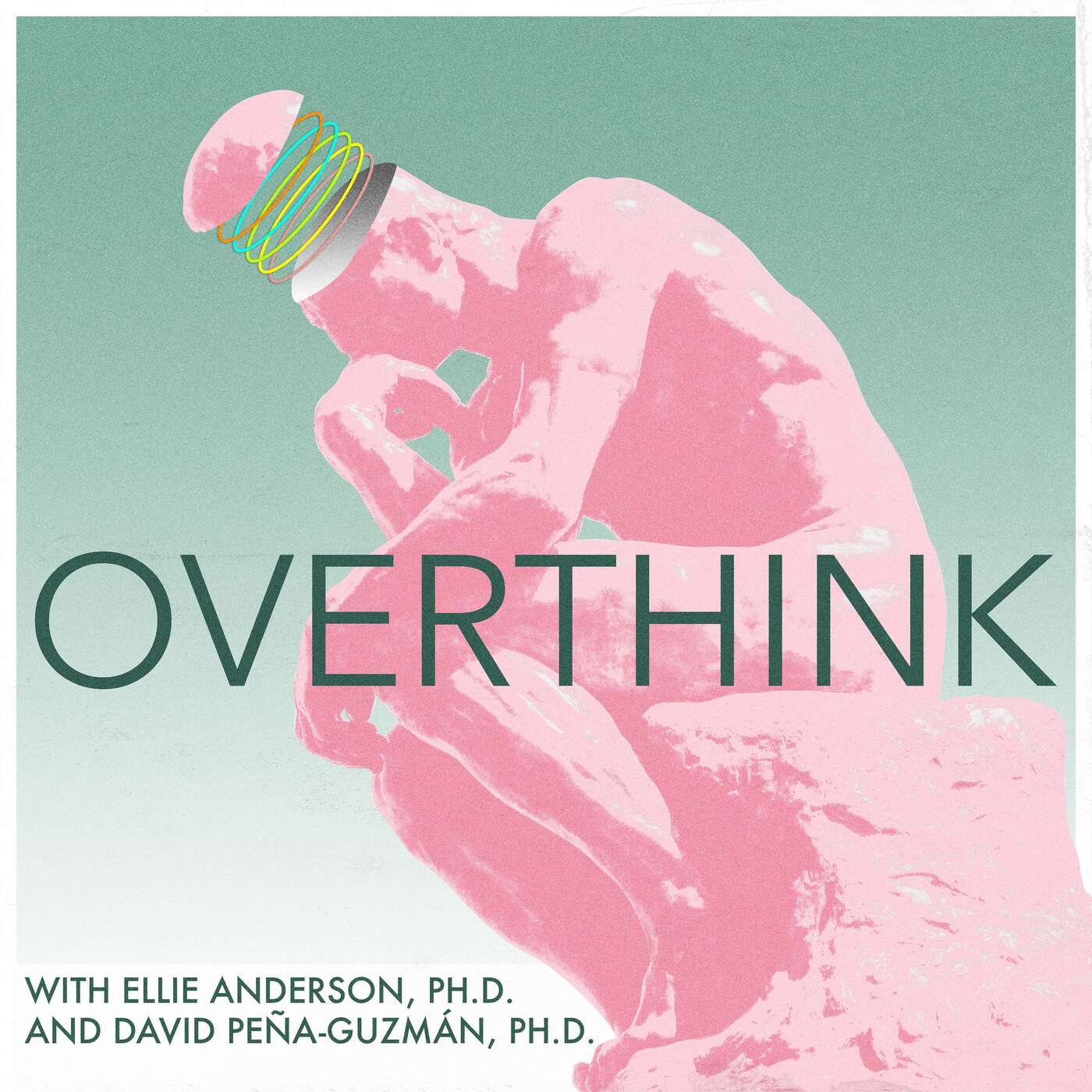
Overthink
Ellie Anderson, Ph.D. and David Peña-Guzmán, Ph.D.
0
Overthink is a philosophy podcast that makes big ideas accessible and relevant to everyday life. Hosted by professors Ellie Anderson and David Peña-Guzmán, it offers fresh takes on philosophical topics with enthusiasm and expertise.
Epizódok
-
 Reflection 25.08.2026 55pAs Overthink comes to a close, why not take a look back? In Episode 182, Ellie and David tackle the concept of reflection and explain why it is so central to philosophy. What is the value of reflection, and what are its drawbacks? How does philosophy go astray when it treats the self as a product of reflection, and how can phenomenology and existentialism shed light on the proper role of reflection in our lives? Your hosts analyze the myth of Narcissus, discuss studies on reflection among animals such as rats and dolphins, and consider reflection as a visual metaphor for thinking. In the Substack bonus segment, Ellie and David reflect on Overthink and give some final thoughts before its end.Works Discussed:Ellie Anderson, Self-Relation: A Phenomenology of Ambiguity (forthcoming May 2027)Hans-Johann Glock, “Do Animals Have Thoughts?”Dieter Henrich, “Fichte’s Original Insight”Maurice Merleau-Ponty, The Phenomenology of PerceptionGabriel Marcel, The Mystery of BeingOvid, MetamorphosisDavid Peña-Guzmán, When Animals DreamJD Smith et al. “The uncertain response in the bottlenosed dolphin (Tursiops truncatus)”Elevate your summer wardrobe. Go to Quince.com/overthink for free shipping on your order and 365-day returns. Now available in Canada, too.If you’re ready to stop talking yourself out of finding care and making progress, then head to rula.com and take the first step. See Privacy Policy at https://art19.com/privacy and California Privacy Notice at https://art19.com/privacy#do-not-sell-my-info.
 -
Mourning 11.08.2026 59pNothing can devastate us more than the loss of a loved one. In this episode of Overthink, David and Ellie talk about mourning. What kinds of losses hurl us into a state of mourning? Are there healthy and unhealthy ways of mourning? Or does this distinction not apply in cases when we are dealing with irreparable loss? And how do we deal with the loss of someone when the feeling of loss doesn't naturally resolve but rather stays with us like “an open wound,” as Freud says? To shed light on this difficult experience, your hosts explore Sigmund Freud’s distinction between mourning and melancholia, Roland Barthes’ account of grieving the death of his mother, as well as Emilio Uranga’s analysis of the role that culture plays in our experience of death. In the Substack bonus segment, Ellie and David discuss how Freud’s notion of ambivalence can help to make sense of mourning.Works Discussed:Roland Barthes, Mourning DiaryJulie Alev Dilmaç, “The new forms of mourning: Loss and exhibition of the death on the internet”Martin Heidegger, Being and TimeCorina Sas and Alina Coman, “Designing personal grief rituals: An analysis of symbolic objects and actions”Sigmund Freud, “Mourning and Melancholia”Emilio Uranga, “Dos teorias de la muerte: Sartre y Heidegger”Emilio Uranga, “Notas para un estudio del mexicano”Emilio Uranga, Analysis of Mexican BeingElevate your summer wardrobe. Go to Quince.com/overthink for free shipping on your order and 365-day returns. Now available in Canada, too.If you’re ready to stop talking yourself out of finding care and making progress, then head to rula.com and take the first step. See Privacy Policy at https://art19.com/privacy and California Privacy Notice at https://art19.com/privacy#do-not-sell-my-info.
-
Weddings 28.07.2026 59pSomething old, something new, something borrowed, something blue! In this episode, Ellie and David talk about weddings. What kind of celebration is a wedding? And what social function do these festivities serve? Do weddings necessarily legitimize the institution of marriage? Or can weddings be dissociated from this legal institution and its problematic history? As they ponder these issues, your hosts walk you down the aisle of history by considering how early Christians developed their views about weddings by embracing some aspects of Roman weddings while rejecting others as vain and contrary to virtue. They also explore the meaning of weddings symbols that are still with us today and look at how weddings can challenge exclusionary nationalist ideologies. In the Substack bonus segment, Ellie and David talk about the weddings they’ve been to and discuss historical factors that shape our current conception of weddings.Works Discussed:Stephanie Coontz, Marriage, a HistoryLaurie Essig, Love, Inc.Arnold van Gennep, The Rites of PassageBrooke Leany, “Something borrowed: The origins of Christian wedding rituals.”Ellen Rothman, Hands and Hearts: A History of Courtship in AmericaLisa Schwarzbaum, “Mamdani, His Mother and a Movie of Prescient Grace”Jonathan Wolff, “The Value of Ceremonies”Start your business today with the industry’s best business partner, Shopify. Sign up for your one-dollar-per-month trial today at shopify.com/overthinkElevate your summer wardrobe. Go to Quince.com/overthink for free shipping on your order and 365-day returns. Now available in Canada, too.If you’re ready to stop talking yourself out of finding care and making progress, then head to rula.com and take the first step. See Privacy Policy at https://art19.com/privacy and California Privacy Notice at https://art19.com/privacy#do-not-sell-my-info.
-
Unemployment 14.07.2026 55pAfter a BIG announcement (!!!), your hosts David and Ellie get into the economic and psychological features of the state no one wants to be stuck in: unemployment. How does capitalism structurally construct “wageless life” while nonetheless treating it as a personal failure or unhappy accident? What’s the connection between unemployment and reactionary politics? And is AI going to put us all out of a job? Correcting misconceptions about automation, UBI, and more, your hosts take you through some significant arguments about the impacts of unemployment and reflect on why this socially-constructed position can make us feel so worthless even when we know that we’re not the problem. In the Substack bonus segment, Ellie and David reflect on the end of Overthink and share some reasons for it.Works Discussed:Aaron Benanav, Automation and the Future of WorkAaron Benanav, “Is the AI Bubble About to Burst?”Eloundou et al., “GPTs are GPTs: An Early Look at the Labor Market Impact Potential of Large Language Models”Charles Babbage, On the Economy of Machines and ManufacturesMichael Denning, “Wageless Life”Wendy Brown, In the Ruins of NeoliberalismRegina Bateson, “Perceptions of pandemic resume gaps: Survey experimental evidence from the United States”Start your business today with the industry’s best business partner, Shopify. Sign up for your one-dollar-per-month trial today at shopify.com/overthinkElevate your summer wardrobe. Go to Quince.com/overthink for free shipping on your order and 365-day returns. Now available in Canada, too.If you’re ready to stop talking yourself out of finding care and making progress, then head to rula.com and take the first step. See Privacy Policy at https://art19.com/privacy and California Privacy Notice at https://art19.com/privacy#do-not-sell-my-info.
-
Beauty with Heather Widdows 30.06.2026 56pBeauty is big business, and the rise of looksmaxxing and increasingly invasive treatments is raising the alarm on the ways that our looks matter in our personal and social lives. Ellie and David speak with philosopher Heather Widdows about how the emphasis on beauty in the present day constitutes a real shift from previous eras. Beauty is no longer taken as a sign of moral goodness, but itself has become a moral ideal. This applies worldwide. The “beauty ideal” is seeping into practically every culture and coming to be expected of more and more people for longer periods of their lifespan. They touch on the four elements of the beauty ideal that Widdows identifies and reflect on their own beauty practices and what it means to be complicit in a toxic system. In the Substack bonus segment, they touch on Lacan, America’s Next Top Model, and image-based profiles.Works Discussed:Heather Widdows, Perfect Me: Beauty as an Ethical IdealStart your business today with the industry’s best business partner, Shopify. Sign up for your one-dollar-per-month trial today at shopify.com/overthink.Elevate your summer wardrobe. Go to Quince.com/overthink for free shipping on your order and 365-day returns. Now available in Canada, too.If you’re ready to stop talking yourself out of finding care and making progress, then head to rula.com and take the first step. See Privacy Policy at https://art19.com/privacy and California Privacy Notice at https://art19.com/privacy#do-not-sell-my-info.
-
Cheating 16.06.2026 59pIs it easier to cheat now than ever? In episode 177 of Overthink, Ellie and David talk about cheating. From micro-cheating on your girlfriend to doping in sports, cheating appears to have escalated in various domains. Your hosts explain the relationship between cheating and rule-breaking, then question norms surrounding cheating in romantic relationships. Why is cheating considered the ultimate dealbreaker? Is it always dishonest? Finally, they address the rise of generative AI cheating in schools and the ethical numbing that promotes it. How is ChatGPT different from using a calculator? And has it become rational for students to cheat? In the Substack Bonus Segment, Ellie and David question whether we should even use the word ‘cheating’ for romantic relationships rather than infidelity.Works Discussed:Stuart Green, “Cheating”Natasha McKeever, “Is the Requirement of Sexual Exclusivity Consistent with Romantic Love?”Deborah Rhode, Cheating: Ethics in Everyday LifeJames D. Walsh, “Everyone Is Cheating Their Way Through College”Go to https://surfshark.com/overthink or use code OVERTHINK at checkout to get 4 extra months of Surfshark VPN!Go to Quince.com/overthink for free shipping on your orders and 365-day returns. Now available in Canada, too.Sign up for your one-dollar-per-month trial today at shopify.com/overthink.Go to Rula.com/overthink for convenient therapy that’s covered by insurance.Visit Progressive.com to see if you could save on car insurance. See Privacy Policy at https://art19.com/privacy and California Privacy Notice at https://art19.com/privacy#do-not-sell-my-info.
-
Attention 02.06.2026 57pAre you paying attention when you scroll online? In episode 176 of Overthink, Ellie and David draw your attention to attention. They explain why attention is so hard to define and debate the extent to which it should be equated with consciousness. Is attention the same thing as consciousness? Or are there important differences between these concepts? They consider different ways that attention has been classified, from “overt vs. covert” to “effortful vs. effortless” to “voluntary vs. involuntary.” Ellie and David then discuss the commodification of attention and how it has been intensified by the digital era, or what Chris Hayes calls “the age of attention.” How has social media changed the way we attend to the world, to ourselves, and to others? Is our attention still our own? Or has it become alienated? In the Substack Bonus Segment, Ellie and David talk about Simone Weil’s and Iris Murdoch’s ethical approaches to attention.Works Discussed:Jelle Bruineberg, “Rethinking the cognitive foundations of the attention economy”Chris Hayes, The Sirens' Call: How Attention Became the World's Most Endangered ResourceWilliam James, The Principles of PsychologyCarlos Montemayor and Harry Haroutioun Haladjian, Consciousness, Attention, and Conscious AttentionThe Friends of Attention, Attensity! A Manifesto of the Attention Liberation MovementEnjoy our work? Support Overthink via tax-deductible donation: https://www.givecampus.com/fj0w3v Subscribe to our Substack for ad-free versions of both audio and video episodes, extended episodes, exclusive live chats, and more: https://overthinkpod.substack.com/ See Privacy Policy at https://art19.com/privacy and California Privacy Notice at https://art19.com/privacy#do-not-sell-my-info.
-
Coolness 26.05.2026 54pPlay it cool and play this episode. In episode 175 of Overthink, Ellie and David talk about what it means to be cool. From swag gap relationships to Mark Zuckerberg and the manosphere’s failed attempts at being cool, your hosts examine coolness’s ties to youth and subversion and its opposition to displays of wealth. They trace how coolness emerged from Black American culture in the 1930s, before being associated with Beat Poets and punk musicians. They consider precursors to cool, like the Italian term sprezzatura, and question the ontology and the morality of coolness. Is coolness an attitude or a state? Is it inherently narcissistic? Can you ever successfully “try” to be cool? In the Substack bonus segment, Ellie and David discuss coolness through an ethical perspective.Works Discussed:Joel Dinerstein, “Jazz Cool”Ted Gioia, The History of Jazzbell hooks, We Real Cool: Black Men and MasculinityDick Pountain and David Robins, Cool Rules: Anatomy of an AttitudeEnjoy our work? Support Overthink via tax-deductible donation: https://www.givecampus.com/fj0w3v Subscribe to our Substack for ad-free versions of both audio and video episodes, extended episodes, exclusive live chats, and more: https://overthinkpod.substack.com/ See Privacy Policy at https://art19.com/privacy and California Privacy Notice at https://art19.com/privacy#do-not-sell-my-info.
-
Climate Action with Kyle Whyte 19.05.2026 55pWhat resources do Indigenous studies provide for addressing the crisis of human-made climate change? And how is the climate crisis linked to settler colonialism? In episode 174 of Overthink, Ellie and David chat with Indigenous philosopher and activist Kyle Whyte about his work on climate action. They discuss how Indigenous people are often blocked out of conversations about environmental impact, the common mischaracterization of the land back movement, and the importance of kinship. How are certain groups disproportionately affected by climate change? Is climate change actually a new problem? And how can respecting land rights of Indigenous people offer some solutions to climate change? In the Substack bonus segment, your hosts question who is called upon to respond to the crisis of climate change and how non-Indigenous people should engage in discussions surrounding climate change and colonialism.Works Discussed:Kyle Whyte, “Climate Action at the Speed of Consent”Kyle Whyte, “Indigenous Climate Change Studies: Indigenizing Futures, Decolonizing the Anthropocene”Kyle Whyte, “Settler Colonialism, Ecology, and Environmental Injustice”Enjoy our work? Support Overthink via tax-deductible donation: https://www.givecampus.com/fj0w3v Subscribe to our Substack for ad-free versions of both audio and video episodes, extended episodes, exclusive live chats, and more: https://overthinkpod.substack.com/ See Privacy Policy at https://art19.com/privacy and California Privacy Notice at https://art19.com/privacy#do-not-sell-my-info.
-
Theft 12.05.2026 55pThou shalt not miss this episode! In episode 173 of Overthink, Ellie and David talk about theft. They discuss our moral intuitions around theft, how feudalism and capitalism may be founded upon an original (and large scale) act that of theft, and the gendered association between kleptomania and women. They also critique the lack of legal repercussions for tech companies that steal information to train new AI models. Finally, they look at representations of theft and capital in film and television. What does the move from heist films to grift docudramas say about 21st century capitalism? And why do we love to take the side of thieves? In the Substack bonus segment, your hosts discuss the ethics of stealing from large corporations.Works Discussed:Elaine Abelson, When Ladies Go A-Thieving: Middle-Class Shoplifters in the Victorian Department StoreAnna Kornbluh “Falling Heists, Rising Grift: Filming Capital in the Already Long Twenty-First Century”Robert Nichols, Theft Is Property! Dispossession and Critical TheoryEnjoy our work? Support Overthink via tax-deductible donation: https://www.givecampus.com/fj0w3vJoin our Substack for ad-free versions of both audio and video episodes, extended episodes, exclusive live chats, and more: https://overthinkpod.substack.com/ See Privacy Policy at https://art19.com/privacy and California Privacy Notice at https://art19.com/privacy#do-not-sell-my-info.
-
Closer Look: Fanon, Wretched of the Earth 05.05.2026 59pDoes decolonization require violence? In episode 172 of Overthink, Ellie and David take a closer look at Frantz Fanon’s The Wretched of the Earth, “the bible of decolonization.” They discuss Fanon’s bold stance on violence, his condemnation of rituals and dance, and some potential criticisms. They also question what the subjectivity of colonized people looks like given colonialism’s psycho-affective effects. What does violence do for the colonized? Who gets liberation movements off the ground? And what are the challenges that a newly independent nation might face once a colonial power has been overthrown? In the Substack bonus segment, your hosts talk about Fanon’s critique of Africanism and some of the clinical cases Fanon incorporates into this important work.Works Discussed:Frantz Fanon, The Wretched of The EarthConcerning Violence (2014)Enjoy our work? Support Overthink via tax-deductible donation: https://www.givecampus.com/fj0w3vJoin our Substack for ad-free versions of both audio and video episodes, extended episodes, exclusive live chats, and more: https://overthinkpod.substack.com/ See Privacy Policy at https://art19.com/privacy and California Privacy Notice at https://art19.com/privacy#do-not-sell-my-info.
-
Butts 28.04.2026 52pBottom, rump, booty, fanny, tush, and derriere! In episode 171 of Overthink, Ellie and David talk about butts. Why do humans have bigger rear ends than other animals? Why are butts often seen as a site of aversion? And is anal sex a metaphor for the universe? They discuss the evolutionary history of butts, how the music industry helped normalize bigger butts, and how the exploitation of Sara Baartman in the 19th century is part of a larger story about the sexualization of black women. In the Substack bonus segment, your hosts talk about Marquis de Sade’s discussion of anal sex and appeals to nature in justifications of human sexual practices.Works Discussed:Georges Bataille, “The Solar Anus”Leo Bersani, “Is the Rectum a Grave?”Janell Hobson, “Venus in the Dark: Blackness and Beauty in Popular Culture”Dinah Holtzman, “Ass You Lick It: Bey and Jay Eat Cake”Sadiah Qureshi, “Displaying Sara Baartman, the ‘Hottentot Venus’.”Heather Radke, Butts: A BackstoryChristopher Wallner et al, “Interethnic Influencing Factors Regarding Buttocks Body Image in Women from Nigeria, Germany, USA and Japan”Enjoy our work? Support Overthink via tax-deductible donation: https://www.givecampus.com/fj0w3vJoin our Substack for ad-free versions of both audio and video episodes, extended episodes, exclusive live chats, and more: https://overthinkpod.substack.com/ See Privacy Policy at https://art19.com/privacy and California Privacy Notice at https://art19.com/privacy#do-not-sell-my-info.
-
Care with Premilla Nadasen 21.04.2026 49pThe discourse around today's crisis of care responds to the shredding of America's social safety net, but leaves out the most vulnerable almost entirely. In episode 170 of Overthink, Ellie and David discuss how this works with Premilla Nadasen, author of Care: The Highest Stage of Capitalism. They discuss how gender fits into the care industry, the harms of associating care work with emotion, and how the practice of care has been commodified. How is it that we deny the most basic care from those who need it most? What are the harms of framing care workers as family members? And how has racial capitalism produced the explosion of the care economy that we're seeing today? In the Substack bonus segment, your hosts think about the distinction between the practice of care and care itself and how labor workers can learn from care workers in their modes of organizing.Works Discussed:Arlie Hochschild, The Managed HeartPremilla Nadasen, Care: The Highest Stage of CapitalismEnjoy our work? Support Overthink via tax-deductible donation: https://www.givecampus.com/fj0w3vJoin our Substack for ad-free versions of both audio and video episodes, extended episodes, exclusive live chats, and more: https://overthinkpod.substack.com/ See Privacy Policy at https://art19.com/privacy and California Privacy Notice at https://art19.com/privacy#do-not-sell-my-info.
-
Discipline 14.04.2026 58pWith the rise of hustle culture, the grind, and capitalist productivity, we often associate discipline with toxicity. But is there still value in disciplining oneself? In episode 169 of Overthink, Ellie and David take a disciplined approach to this question and more! They discuss modern culture’s rejection of discipline and how this manifests on the left vs the right, the association between discipline and punishment, and Michel Foucault’s seminal ideas on disciplinary power. How can we discipline children without resorting to punishment? And are there models of self-discipline that aren’t rooted in punishment of the self? In the Substack bonus segment, your hosts discuss Sandra Bartky’s argument that gender norms are a modern form of disciplinary power. Works Discussed:Joan E. Durrant and Ashley Stewart-Tufescu. “What is “Discipline” in the Age of Children’s Rights?.” Michel Foucault, Discipline and PunishMichel Foucault, The History of SexualityAdekunle A. Ibrahim and Philomena A. Ojomo. “Discipline and Punishment in Schools: A Philosophical Appraisal.” Enjoy our work? Support Overthink via tax-deductible donation: https://www.givecampus.com/fj0w3vJoin our Substack for ad-free versions of both audio and video episodes, extended episodes, exclusive live chats, and more: https://overthinkpod.substack.com/ See Privacy Policy at https://art19.com/privacy and California Privacy Notice at https://art19.com/privacy#do-not-sell-my-info.
-
Closer Look: Levinas, On Escape 07.04.2026 59pWhy do we seek to escape from ourselves? In episode 168 of Overthink, Ellie and David take a closer look at Emmanuel Levinas’s article “On Escape.” They discuss Levinas’s claim that escape is central to the human condition and explore what exactly we try to escape from and escape to. They explain how this aspect of human existence is crystallized by our experiences of need, pleasure, and even nausea. Are we condemned to being needy beings? How does Levinas’s view of shame put him at a distance from Sartre? And is Levinas right that to be a human is to never be at peace with oneself? In the Substack bonus segment, your hosts discuss why escape is the condition of our time and critique Levinas’s reading of idealism.Works Discussed:Emmanuel Levinas, “On Escape”Jean-Paul Sartre, NauseaEnjoy our work? Support Overthink via tax-deductible donation: https://www.givecampus.com/fj0w3vJoin our Substack for ad-free versions of both audio and video episodes, extended episodes, exclusive live chats, and more: https://overthinkpod.substack.com/ See Privacy Policy at https://art19.com/privacy and California Privacy Notice at https://art19.com/privacy#do-not-sell-my-info.
-
Evil 31.03.2026 55pAre some people born evil, or are we all capable of evil acts? In episode 167 of Overthink, Ellie and David talk about all things evil. They think through the characterization of evil in Disney films, Leibniz’s best of all possible worlds theory, the conflation of evil with badness, and Hannah Arendt’s concept of the banality of evil. How does Manichaeism attempt to resolve the problem of evil? Is evil simply the lack of good in the world? And does the concept of evil still have relevance in an age of secular ethics or is the concept too weighed down by its own theological past? In the Substack bonus segment, your hosts discuss evil people and how we might categorize them. Works Discussed:Hannah Arendt, Eichmann in Jerusalem: A Report on the Banality of EvilHannah Arendt, “Nightmare and Flight”Hannah Arendt, The Origins of TotalitarianismPaul Formosa, “The Problems with Evil”Paul Formosa, “A Conception of Evil”Gottfried Wilhelm Leibniz, TheodicyGavin Rae, Evil in the Western Philosophical TraditionEnjoy our work? Support Overthink via tax-deductible donation: https://www.givecampus.com/fj0w3vJoin our Substack for ad-free versions of both audio and video episodes, extended episodes, exclusive live chats, and more: https://overthinkpod.substack.com/ See Privacy Policy at https://art19.com/privacy and California Privacy Notice at https://art19.com/privacy#do-not-sell-my-info.
-
Pedantry with Arnoud Visser 24.03.2026 53pMansplainers, know-it-alls, and Grammar Nazis. In episode 166 of Overthink, Ellie and David think about the figure of the pedant with philosopher Arnoud S. Q. Visser about his book, On Pedantry: A Cultural History of the Know-it-All. They discuss the history of the pedant, how the charge of pedantry can promote anti-intellectualism, and the inherently gendered nature of the pedant. Why are pedants usually men? Who were considered pedants in antiquity, and how does pedantry show up nowadays? What are the moral flaws of the pedant? Is pedantry objective, or does it lie in the eye of the beholder? And what does it mean to say someone is pedantic? In the Substack bonus segment, your hosts share their most pedantic takes and dive deeper into Montaigne’s essay “On Pedantry.” Works Discussed:Michel de Montaigne, “On Pedantry”Arnoud S. Q. Visser, On Pedantry: A Cultural History of the Know-it-AllEnjoy our work? Support Overthink via tax-deductible donation: https://www.givecampus.com/fj0w3vJoin our Substack for ad-free versions of both audio and video episodes, extended episodes, exclusive live chats, and more: https://overthinkpod.substack.com/ See Privacy Policy at https://art19.com/privacy and California Privacy Notice at https://art19.com/privacy#do-not-sell-my-info.
-
Pornography 17.03.2026 58pContent warning: this episode involves discussion of sexual violence and sexual assault.Can pornography be liberating or does it just promote the hatred of women? In episode 165 of Overthink Ellie and David discuss pornography. They talk about the feminist ‘sex wars’ and the pro-porn and anti-porn views that emerged from it. They talk about how the figure of the porn star has changed in the era of OnlyFans, and how porn blends sex with visuality. How might porn endanger women as a class? Can sex in pornography be considered art? And are AI and deepfakes enhancing the harms of pornography? In the Substack bonus segment, your hosts chat about Heated Rivalry and discuss the relationship between art and porn. Works Discussed:Laura Bates, The New Age of Sexism: How AI and Emerging Technologies Are Reinventing MisogynyAndrea Dworkin, Pornography: Men Possessing WomenCatharine MacKinnon, Sexual Harassment of Working Women: A Case of Sex DiscriminationOriana Small, Girlvert: A Porno MemoirAmia Srinivasan, The Right to SexEnjoy our work? Support Overthink via tax-deductible donation: https://www.givecampus.com/fj0w3vJoin our Substack for ad-free versions of both audio and video episodes, extended episodes, exclusive live chats, and more: https://overthinkpod.substack.com/ See Privacy Policy at https://art19.com/privacy and California Privacy Notice at https://art19.com/privacy#do-not-sell-my-info.
-
Closer Look: Haraway, Cyborg Manifesto 10.03.2026 57pIs the way we interact with technology moving us towards a cyborg future? In episode 164 of Overthink, Ellie and David take a closer look at Donna Haraway’s seminal essay, “A Cyborg Manifesto,” in which Haraway critiques the increasing technologization of everyday life and questions what it means to be a feminist and a socialist in the age of informatics and cybernetics. They discuss her critique of identity politics, her notion of the “homework economy,” the increase of miniaturization in technology, and her appeal to pleasure and responsibility. Why should we discard the assumption that technology has deepened mind-body dualism? And what might the theory of the cyborg look like in light of the rise of generative AI? In the Substack bonus segment, your hosts discuss how the cyborg can be found in popular media like Severance and Crimes of the Future, and how the cyborg differs to Frankenstein’s monster.Works Discussed:Donna Haraway, “A Cyborg Manifesto”Dave Yan, “Posthuman Creativity: Unveiling Cyborg Subjectivity Through ChatGPT”Enjoy our work? Support Overthink via tax-deductible donation: https://www.givecampus.com/fj0w3vJoin our Substack for ad-free versions of both audio and video episodes, extended episodes, exclusive live chats, and more: https://overthinkpod.substack.com/ See Privacy Policy at https://art19.com/privacy and California Privacy Notice at https://art19.com/privacy#do-not-sell-my-info.
-
Personality 03.03.2026 59pCan Buzzfeed quizzes, Myers-Briggs Types, and Enneagrams tell us anything valid about who we are? In episode 163 of Overthink, Ellie and David discuss personality. They talk through the Big Five personality test and its legitimacy, the history of the Myers-Briggs Type Indicator test (MBTI), and how the concept of personality emerged out of abnormal psychology. Why did the concept of personality replace using literature to understand the self? How does the concept of personality presuppose a fixed concept of the self? And what is the connection between MBTI and World War II? In the Substack bonus segment, your hosts think about how personality tests might be susceptible to the Barnum effect and their reduction of the self to egos. Works Discussed:Theodor Adorno, The Authoritarian PersonalityMerve Emre, What's Your Type? The Story of the Myers-Briggs, and How Personality Testing Took Over the WorldColin Koopman, How We Became Our Data: A Genealogy of the Informational PersonEnjoy our work? Support Overthink via tax-deductible donation: https://www.givecampus.com/fj0w3vJoin our Substack for ad-free versions of both audio and video episodes, extended episodes, exclusive live chats, and more: https://overthinkpod.substack.com/ See Privacy Policy at https://art19.com/privacy and California Privacy Notice at https://art19.com/privacy#do-not-sell-my-info.
Hasonló podcastok


Népszerű itt:
Ez a podcast ezeknek az országoknak a podcast-listáin is szerepel.
-
 Trinidad és Tobago
-
 Nepál
Nepál
-
 Észtország
-
 Azerbajdzsán
-
 Moldova
-
 Kambodzsa
-
 Románia
-
 Szerbia
-
 Üzbegisztán
-
 Mauritius
-
 Görögország
-
 Guatemala
-
 Jamaica
-
 Szlovénia
-
 Ukrajna
-
 Indonézia
-
 Zambia
-
 Málta
Málta
-
 Argentína
-
 Bolívia
-
 Srí Lanka
-
 Tádzsikisztán
-
 Magyarország
-
 Kazahsztán
-
 Kolumbia
-
 Lettország
-
 Mongólia
-
 Horvátország
-
 El Salvador
-
 Saint Lucia
-
 Litvánia
-
 Peru
Peru
-
 Kamerun
-
 Afganisztán