
Geopolitical Economy Hour
Radhika Desai
0
As dizzying yet historically deeply-rooted developments transform the political economy of key countries and the world's geopolitical economy, we provide ongoing analyses of the foundations being laid for a multi-polar world beyond capitalism.
Epizódok
-
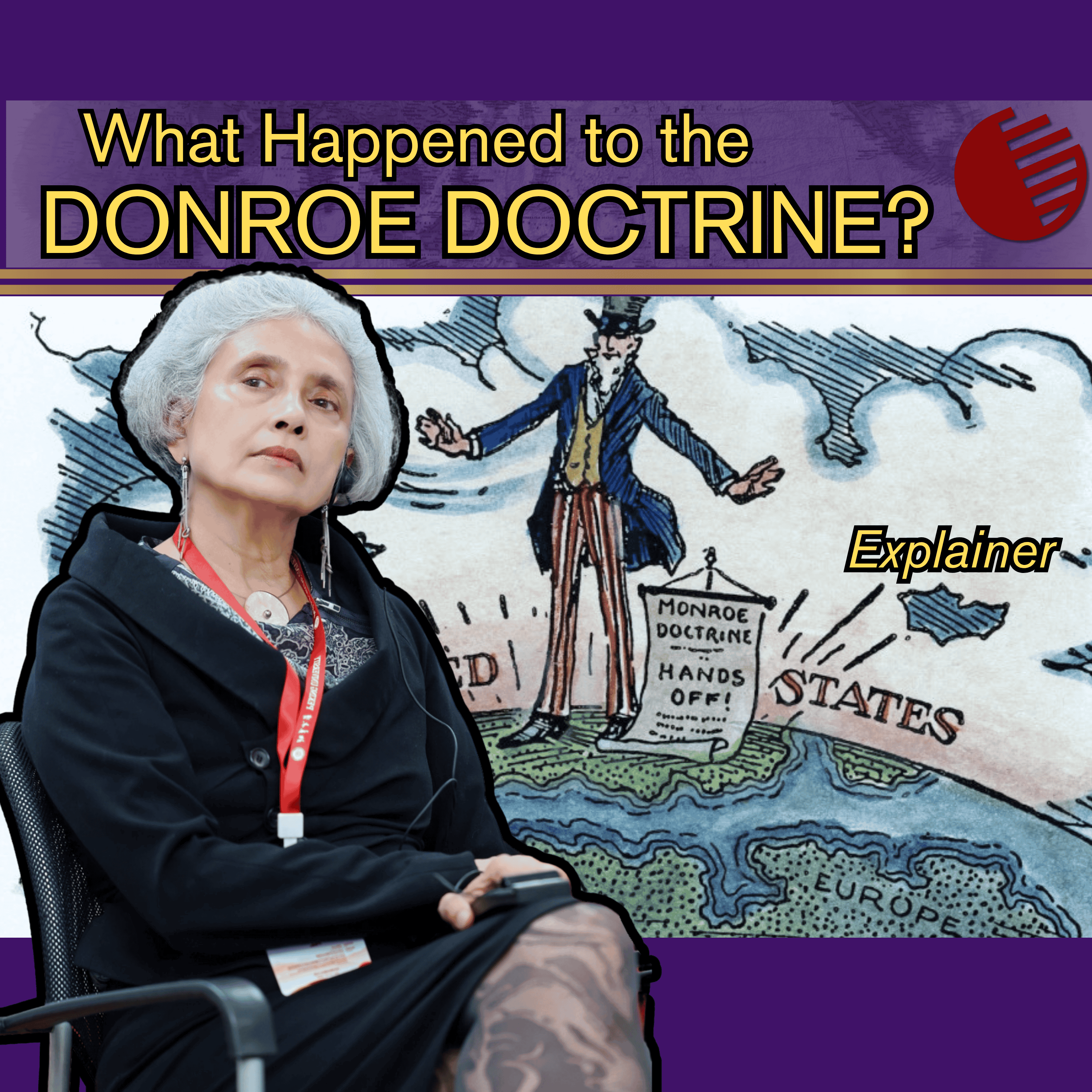 Geopolitical Economy Explainer: Whatever Happened to the Donroe Doctrine? 01.04.2026 22pGEOPOLITICAL ECONOMY EXPLAINER Just over a month ago, the world was abuzz with talk of the Donroe Doctrine? Radhika explains what the so-called "Donroe Doctrine" was supposed to be, what it really was, how it lined up with the Monroe Doctrine and the Roosevelt Corollary, and why it is hardly surprising that it was barely proclaimed before it was violated. The explanation may surprise you.
 -
 Reading Capital with Radhika Desai: 1. Mandel Introduction and Marx & Engels Prefaces 25.03.2026 1óStarting Sunday, 22 March 2026, Radhika Desai is leading a Capital Reading Group on line. It will consist of an hour’s lecture followed by at least an hour’s discussion.In her lectures, Radhika will be presenting an interpretation of Capital that she arrived at in the course of developing Geopolitical Economy, the Marxist approach to understanding the international relations of the capitalist world, which placed imperialism and anti-imperialist resistance at its centre and has required rescuing Marx’s original analysis of capitalism as contradictory value production from more than a century and a half of misinterpretation by Marxists themselves.In this first episode, Radhika analyses an Introduction by Ernest Mandel as well as two Prefaces by both Marx & Engels.
 -
 The West Couldn't Break North Korea And Now They're Afraid | Keith Bennett and Radhika Desai 16.06.2026 1ó 4pPresident Xi Jinping followed up his summits with Presidents Putin and Trump with his first foreign trip of the year. The destination – North Korea, or the Democratic People’s Republic of Korea, a nation of some 26 million normally portrayed in the Western media as a dangerously authoritarian state, an economic basket case, worthy of attention only for its nuclear weapons – may seem a surprise to many. However, as veteran Korea observer, Keith Bennett and Radhika Desai discuss, neither the destination nor the timing should surprise anyone with a sense of the intertwined histories of the Chinese and Korean revolutions (not to mention the Soviet) and the continuing cooperation between the two countries, founded on socialist solidarity. Nor should it surprise them that, amid the chaos unleashed on the world by a declining West, China and North Korea are quietly renewing their relations for a new phase of history, and their common history. Keith and Radhika discuss the socialist foundations of one of the most enduring international relationships of the modern era, the myths Western journalists and scholars perpetuate about North Korea, and the unexpected twist the matter of Korean reunification has taken.
 -
 (Blocked) Paths to Dedollarization | GEH with Paolo Nogueira Batista 01.06.2026 55pWhat does the future look like for Dedollarization? How does BRICS play a role? Radhika takes a deep dive with co-founder of New Development Bank, Paolo Nogueira Batista.
 -
 Mohammad Marandi Reveals Iran's True Nuclear Power Goal 21.05.2026 52pIn this interview, Radhika Desai speaks with Mohammad Marandi about Iran’s nuclear programme, the latest escalation with the United States, and the wider geopolitical struggle behind the so-called “Iran nuclear threat.” Is Iran really trying to build a nuclear weapons, or is the nuclear issue being used once again as a pretext for sanctions, pressure and imperialism? Professor Marandi explains how Iran views its nuclear rights, why Western governments continue to portray Iran as a danger, and how the confrontation fits into the broader decline of US power and the crisis of the Western-led order.
 -
 Is NATO Falling Apart? Trump, Ukraine, Russia and the Crisis of the West | GEH w Kees Van der Pijl 20.05.2026 45pGerman Chancellor, Friedrich Merz says, before an audience of schoolchildren, that Iran has humiliated the US. Donald Trump announces the withdrawal of 5000 of its troops from his country. Meanwhile, Minister DonaldTusk, Prime Minister of the most loyal of East European states loyal to the US and the Atlantic alliance, told the Financial Times that Europe's "biggest, most important question is if the United States is ready to be as loyal as it is described in our (NATO) treaties. The question is if NATO is still an organisation ready, politically and logistically, to react - for example, against Russia if they try toattack." The trouble is not recent but in the first year and a half of Donald Trump’s second administration these strains now seem to be building up to breaking point. The two sides of the Atlantic find themselves on opposite sides of both the major conflicts of our time, that in Ukraine and that against Iran. Tariffs on the European Union are hurting its economy. There is increasing discussion particularly in Brussels, on how that body should seek an autonomous defence infrastructure. Europe and Canada are ramping up defence expenditure and if such an infrastructure were to be built, notwithstanding the interminable squabbles of EU member countries, it would represent a major reversal of the foundation of the post Second World War North Atlantic alliance, the security umbrella that the United States provided to Europe in acceptance of US leadership. Radhika Desai and Kees van der Pijl, foremost critical international relations scholar of the Atlantic Alliance discuss
 -
 Trump’s China Trip Was A Disaster — And It’s Getting Worse | Michael Hudson And Radhika Desai 19.05.2026 39pTrump had hoped to go there in triumph after an easy victory over Iran. He actually went there in despair, hoping for China’s help in cleaning up the mess he made there. Last year, he had hoped to cow China into submission with his tariffs, only to push himself in a submissive position.In Beijing, the very tone of his comments – what a great leader Xi is, how wonderful China, is, how well he gets on with everyone, and how the US and China are going to have a ‘fantastic future together’ shows that for all his grandiose plans to project US power, he has ended exactly where China wanted him, having to accept parity with China. How else did he manage to expose the reduction of US power in Beijing? Given that the meeting was initiated by the Chinese, how well did they realise what they wanted? Who budged or blinked on all the major issues: tariffs, investment, Hormuz, Taiwan, Iran’s nuclear programme? How will this summit re-shape the contest between China and the US that has shaped the 21st century? Will the retinue of CEO’s that went there get what they want? Where will it leave the Iran war? and, above all, where will it leave the world which the Trump regime, shall we call it that, has landed in chaos of one sort or another since Trump’s election, let alone his inauguration….. With me to discuss all this is the most regular of regulars, Professor Michael Hudson.
 -
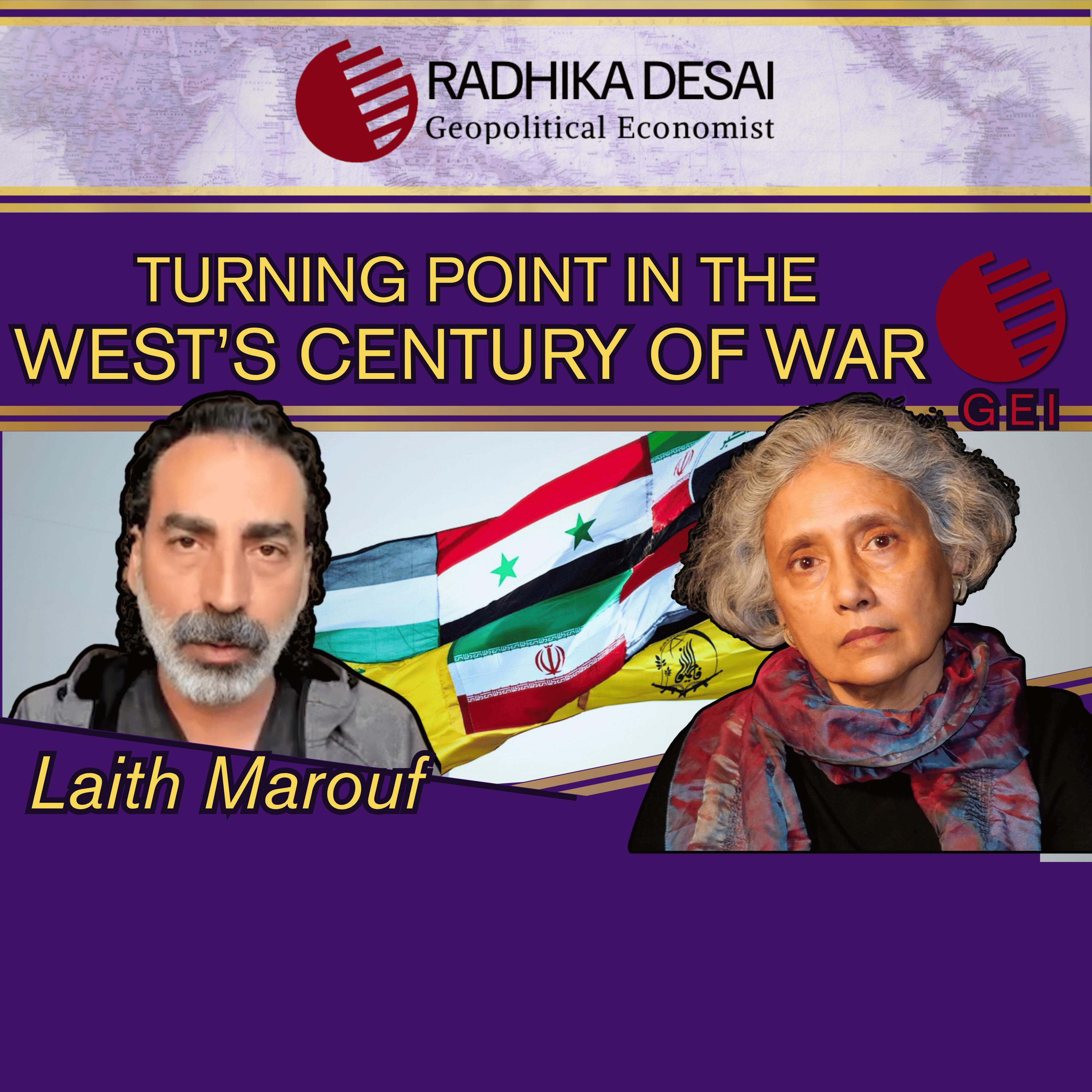 Turning Point in the West's Century of War: Geopolitical Economy Interview with Laith Marouf 30.04.2026 47pIn this collaboration between Radhika Desai – Geopolitical Economist and Free Palestine TV, its founder, Laith Marouf discuss the historical conjuncture of Trump and Netanyahu’s war on Iran, how it is the culmination of the West’s 100-year war, itself hundreds of years in preparation, on the West Asian region. The many questions we range over include the following: What gives Iran and the Axis of resistance its strength?How are we to understand the role of religion, particularly Shia Islam in itHow does it contrast with the instrumental use of synthetic religion in the West, whether by Hegseth or Trump or Netanyahu or Zionism?How have sanctions on Iran boomeranged even more spectacularly than those on Russia, giving that country a military confidence and autonomy few countries have enjoyed?When and how might the war on Iran end?
 -
 The US Is Trying To Save The Dollar Ponzi Scheme With This... Swap Lines Explained w Michael Hudson 08.05.2026 45pIn this episode, I am joined by Michael Hudson to discuss how the United States is attempting to defend dollar hegemony at a time when its global financial power is facing mounting pressure. We examine the role of swap lines, dollar liquidity, sanctions, oil politics, and the Iran crisis in sustaining a world economy still organised around the US dollar. Although swap lines may appear to be a technical instrument of central banking, they reveal something much larger about who has access to liquidity in moments of crisis, who remains dependent on Washington, and how the United States continues to use the dollar as a tool of geopolitical power. As more countries search for alternatives to the dollar system, this conversation asks whether these new financial arrangements are signs of strength or signs that the old order is beginning to crack.
 -
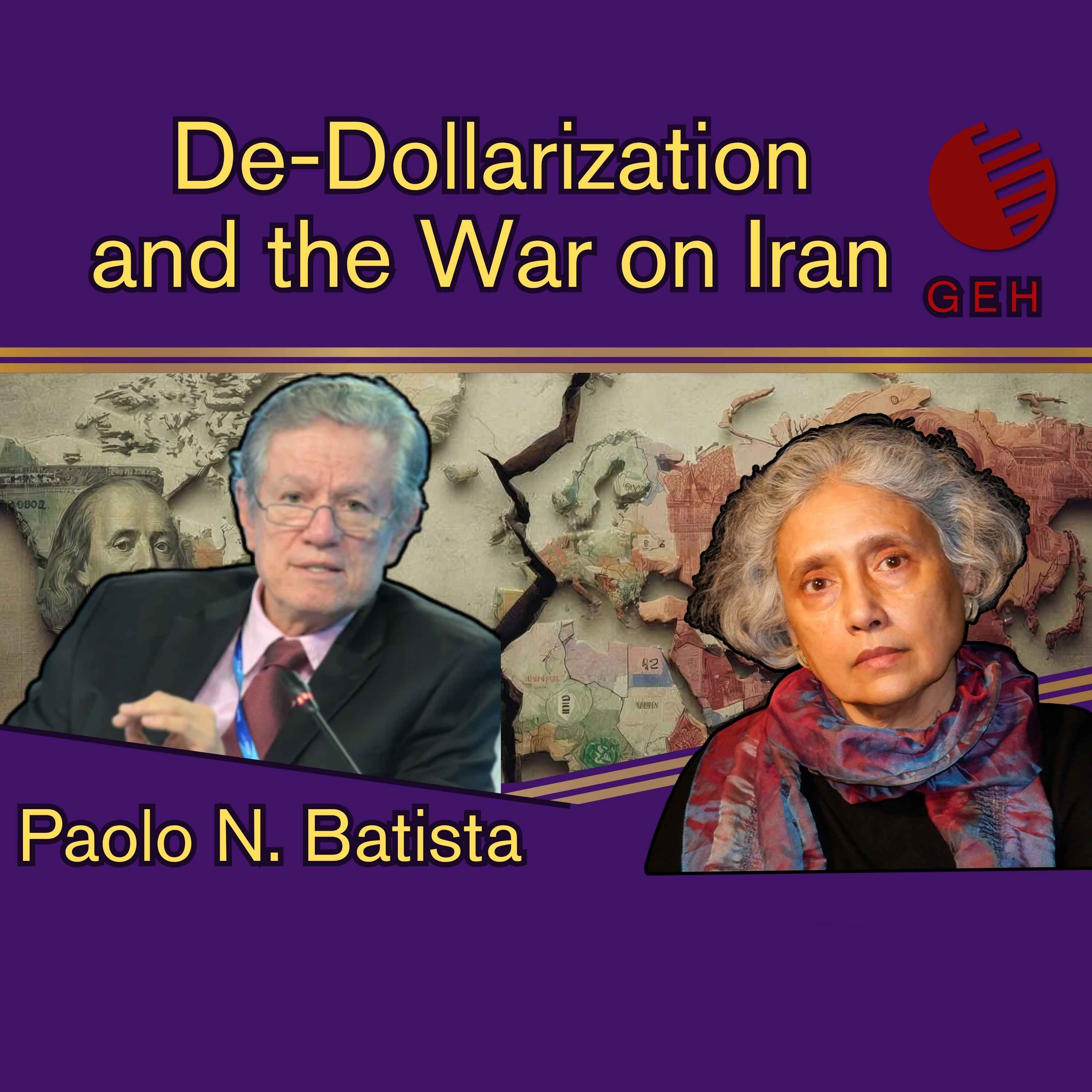 Geopolitical Economy Hour: Dedollarization and the War On Iran 11.04.2026 59pThe illegal, criminal US-Israeli war on Iran is now almost three weeks old. There are new twists and turns by the hour. However, some things are clear. The US and Israel are not winning, Trump is desperately looking for an off ramp and even the most delusional one is not available to him given that it is not up to the US-Israeli side to end the war, only up to Iran, which is willing to fight for months, even a year, and is seeking nothing less than the exit of the US from the middle eastern region, ending a more than century long engagement. Meanwhile, the war has already had significant economic and financial effects The price of oil and gas have risenSo have prices of associated products, like fertilizerInflation and food inflation are rising.Expected cuts to interest rates are now on hold and may even turn into hikesStock markets are falling on expectations of a recessionand dollar denominated asset markets, vulnerable to higher interest rates could soon be tottering on the brink of collapse While there is a lot of commentary on all this, there is hardly any discussion of that the war on Iran means for the dollar system and to the prospects of de-dollarization? In this Geopolitical Economy Hour, Radhika Desai discusses the ins and outs of this question with Paulo Nogueira Batista Jr, who has served, inter alia, with the IMF, the New Development Bank and the Brazilian government.
 -
 The West's International Civil War at the Munich Security Conference with K.J. Noh 22.03.2026 1ó 8pFor the Second Year Running, the Munich Security Conference became the theater of a battle in the West’s international civil war that stretches far beyond it, turning increasing insecurity rather than managing security around the world. This war – in which the stakes seem to be not only Greenland but also regime change in Europe – pits the establishment ‘globalizing’ neoliberals against the ultra neoliberal right wing forces represented by Trump, Farage, the Alternative für Deutschland and other such forces and is waged between and within countries. In this relaunch of Geopolitical Economy Hour, Radhika Desai, Geopolitical Economist discusses the outcomes of Munich with K J Noh, one of the best informed journalists and activists on international relations and military affairs. Where does Munich leave the Atlantic Alliance? What about the US equation with China, and, for that matter Russia?
 -
 Einar Tangen: How Trump Achieved Nothing at the Trump-Xi Summit | GEH W/ Radhika Desai 27.09.2026 56pPresident Xi's visit to Washington produced almost nothing concrete. There was no progress on Taiwan, AI or the Iran war, just a trade truce extended to January. So why did Trump greet him at Andrews Air Force Base, something no American president has done for a foreign leader in 60 years? Einar Tangen argues the real outcome was symbolic but huge: the United States has finally had to accept China as a peer. We talk about how America got here, from the decline of its industrial capitalism to a political system that no longer has a plan, and about what Trump might try before the November elections. As Einar puts it, the unipolar moment is over, and it was a US president who ended it.
 -
 Richard Murphy: The Fed Just Raised Interest Rates. Recession is next | GEH W/ Radhika Desai 27.09.2026 56pKevin Warsh's first move as Federal Reserve Chair was to raise interest rates, and the establishment hailed it as proof of central bank independence. But what inflation is he fighting? Professor Richard Murphy, founder of the Tax Justice Network, joins me to explain why today's price rises come from war-driven shocks to energy and food, not excess demand, and why higher rates will only push us toward recession. Murphy argues that central bank independence is a sham, that NAIRU makes unemployment a deliberate tool of policy, and that 700 years of data point to a real interest rate of zero. What we are witnessing, he says, is class warfare, with inflation serving as cover to restore the return to capital.
 -
 KJ Noh: Will South Korea Go To War With Iran To Appease Trump? | GEH W/ Radhika Desai 27.09.2026 1ó 1pFor the first time in its history, South Korea has refused a US demand to send troops to an American war. This is the same country that sent over 300,000 soldiers to fight in the Vietnam War. Regular guest K.J. Noh joins me to explain what is behind President Lee Jae Myung's refusal to join Trump's war on Iran. The pressure comes from a militant labour movement in the streets, Iran's warning over Korea's Gulf assets, and a US empire exposed as a paper tiger. We trace this struggle back to the US-backed massacres South Korea was built on, and ask how far Washington will go to keep its most loyal vassal in line.
 -
 Pravin Sawhney: India Abandons New World Order For America | GEH W/ Radhika Desai 27.09.2026 1óIs India's celebrated strategic autonomy real, or a myth sustained by domestic politics? Pravin Sawhney, director of the Force Research Institute, joins me to dismantle the popular narrative around Modi's foreign policy. According to Pravin, the world became multipolar in 2013, when Xi Jinping and Vladimir Putin outlined a new international order built on sovereign equality, only for the Modi government to reject China's rise and hitch India's fortunes to Washington instead. We examine why India refused to accept China as a major power despite an unbridgeable gap in military, economic, and technological strength, how this refusal shaped India's recent four-day war with Pakistan, in which, by Western assessment, the Pakistani military performed better. Even more so, Pakistan's ties to all three major powers now position it closer to the new order than India itself.
 -
 Ali Alizadeh: Iran Is Destroying All American Bases In West Asia | GEH W/ Radhika Desai 27.09.2026 59pThe United States has run through every tactic it knows against Iran, sanctions, assassination, a forty-day air war, tit-for-tat strikes, and still cannot achieve its objectives. Ali Alizadeh, editor of the Jadal YouTube channel, joins me to explain why. Alizadeh details how Iran has systematically dismantled the American military presence in West Asia, driving US forces out of bases in the UAE, Qatar, Bahrain, and Kuwait, then out of Iraq entirely after eighteen years, including Ain al-Assad, one of the largest American bases in the world. Jordan is next. Iran has even fired warning shots at a US aircraft carrier, a calculated signal of what it can do without crossing the line into nuclear escalation. Alizadeh argues this is not a quick war Iran expects to win in days. It is a methodical campaign to exhaust the United States and force it out of the region entirely, one base, one country, at a time.
 -
 Sushant Singh: India's Fear of China Is Sinking BRICS | GEH W/ Radhika Desai 27.09.2026 1ó 1pThe 2026 BRICS summit in New Delhi should have marked twenty years since Putin first gathered its leaders in a UN hallway. Instead, the Delhi Declaration was so watery that even a hawkish Indian foreign policy voice called it a virtue. Sushant Singh, consulting editor of Caravan magazine and lecturer at Yale, joins me to explain why. He traces how Modi's government, terrified of being seen as anything less than China's peer, blocked de-dollarization, AI cooperation, and climate coordination that would have cost India nothing and helped it directly.
 -
 Warwick Powell: America Chose Wall Street Over Factories And Now Is Paying For It 27.09.2026 59pChina's refusal to sign the G20 finance communique reveals a fiction Washington depends on. Warwick Powell, adjunct professor at Queensland University of Technology, joins me to show that the line between market and non-market policy never actually existed, and that every industrial power, including the United States, was built on state intervention. Warwick argues the real imbalance sits on the capital account, where American money now inflates Wall Street instead of building factories, while China's state-owned banks stayed disciplined toward production for eight decades. We look at why 2015, the year Chinese owned manufacturers overtook foreign firms operating inside China, marks the real turning point behind the overcapacity complaints. What America calls Chinese overcapacity, Warwick argues, is Global South demand finally being met after decades of the Global North pricing that equipment out of reach on purpose.
 -
 Michael Hudson: Russia, China and Iran Are Building the System America Can't Print Its Way Out Of 27.09.2026 46pIs the world quietly reviving a plan the United States buried eighty years ago? Professor Michael Hudson joins me to revisit Keynes' original Bretton Woods proposals, built on balance, capital controls, and the principle that bad debts should be written off rather than enforced into depression. Washington rejected all of it and built the dollar system instead, one designed to keep the world dependent on American credit and American rules. Now Russia, China and Iran are building the alternatives Keynes once imagined, from Lavrov's proposed SCO development bank to China's CIPS system shielding Iranian oil trade from US sanctions, while even the Netherlands has asked Washington to send its gold home. The dollar system is unraveling. The question is what replaces it, and whether the world has the will to build something more balanced this time.
 -
 Mohammad Marandi: Trump's Gulf Allies Are Bankrupting Themselves for His War | GEH W/ Radhika Desai 27.09.2026 48pIs this the most dangerous phase yet of the US war on Iran, or the moment the empire loses whatever control it still has? Professor Seyed Mohammad Marandi joins me for our monthly assessment of the conflict. He finds that Iran's retaliation now far outpacing Washington's. Recently Iran struck eight tankers, ten commercial ships, and fired warning shots at two US warships, all in response to unprovoked American strikes that hit a wedding. Marandi explains why Iran has abandoned its defensive posture for good and why the Gulf regimes that hosted this war are now the ones paying for it in dwindling reserves and battered economies. We examine why even Trump's own allies, from the Gulf states to Britain, are quietly breaking ranks with him, and why, of the only three ways this war can plausibly end, just one party has any real interest in prolonging it: the Israeli regime itself.
Hasonló podcastok


Népszerű itt:
Ez a podcast ezeknek az országoknak a podcast-listáin is szerepel.
