
Family Systems In 15 Minutes
Oliver Drakeford LMFT CGP
0
Family Systems in 15 Minutes is an audio adaptation of the Family Systems H.I.T. newsletter. Each short episode breaks down a concept from structural and systemic therapy, making it practical and ready for use in therapy sessions. The show targets licensed therapists, associates, trainees, and graduate students who are new to family therapy. Hosted by Oliver Drakeford, a Licensed Marriage and Family Therapist and Certified Group Psychotherapist, it aims to translate theory into actionable tools.
Epizódok
-
 Circular Questioning Workshop from The Family Systems Collective 22.09.2026 31pIn this second installment of the Circular Questioning Workshop, we delve into the practical applications of Family Systems Theory, a concept that has been widely studied and applied in the field of family therapy. Circular Questioning is a technique used to explore the complex dynamics within family systems, and by understanding the theory behind it, therapists and individuals can gain valuable insights into the collective patterns and behaviors that shape family relationships. Get access to the PDF and handout that accompanies this when you join The Family Systems Collective here: https://www.skool.com/family-systems-collective-7929/aboutBy making Family Systems Theory more accessible and practical, this workshop aims to provide a comprehensive understanding of how circular questioning can be used to facilitate positive change and growth within families. The workshop will explore the key principles of Family Systems Theory and demonstrate how circular questioning can be used to identify and address underlying issues, ultimately leading to more effective communication and stronger family bonds. Whether you are a therapist, counselor, or simply interested in learning more about family dynamics, this workshop is designed to provide you with the knowledge and tools needed to apply Family Systems Theory in a practical and meaningful way.0:00 The Four Pillars of Therapeutic Questioning2:38 Mastering Linear and Strategic Questions4:41 Reflective Questions for Future Possibilities5:26 The Core of Circular Questioning7:18 Eight Categories of Circular Inquiry19:32 Applying Circular Questions to Real Cases
 -
Five Reasons Consequences Fail (and how to help parents set them) 15.09.2026 14pMost families who come in for therapy are dealing with teens or tweens who are acting out — and often, parents have already given up on consequences because "nothing works." In this episode, I break down why consequences fail when a family's hierarchy has flipped, and how to help parents think about limit-setting differently when a teenager has more power in the household than they should.You'll learn the five reasons consequences stop working in an inverted hierarchy:The consequence isn't heard as a consequence — it lands as a challenge to be defendedThe consequence is too far away in time to matter to a teen brainTeens are loophole thinkers who find the gaps in how rules are writtenThe game changes halfway through the argument (switch tracking)Parents give up their power to someone else instead of holding it themselvesPlus: what an inverted hierarchy actually is, why teens who seem to want power often don't really want it, and why handing authority to another parent, a doctor, or a treatment center can backfire.Grab the free companion PDF on setting consequences — and join Oliver's consultation groups — by joining the Family Systems Collective for free. https://www.skool.com/family-systems-collective-7929/aboutFind out more about me here: https://www.oliverdrakefordtherapy.com/family-counselor/parent-coaching-los-angeles
-
Family Therapy Consultation Groups 03.09.2026 9pGraduate school taught us systems theory. Then we sat with a real family and discovered the theory doesn't tell you what to say when the room erupts. And once you're licensed, supervision disappears, and you carry your hardest families alone.https://www.skool.com/family-systems-collective-7929/about I'm Oliver Drakeford, LMFT and Certified Group Psychotherapist. As Clinical Director of a residential program built around family systems therapy, my job for years was sitting with therapists and their stuck family cases.Twice a month we meet for live case consultation using a seven-step sequence: frame your question, describe a recent moment, map the family's organization, build hypotheses, choose one next test, anticipate the family's response, then report back and revise. Along the way we work on systems theory, systems thinking, and systemic processes like parallel process. No family cases yet? Bring your individual clients. Systems show up everywhere.8 seats per cohort.More about me here
-
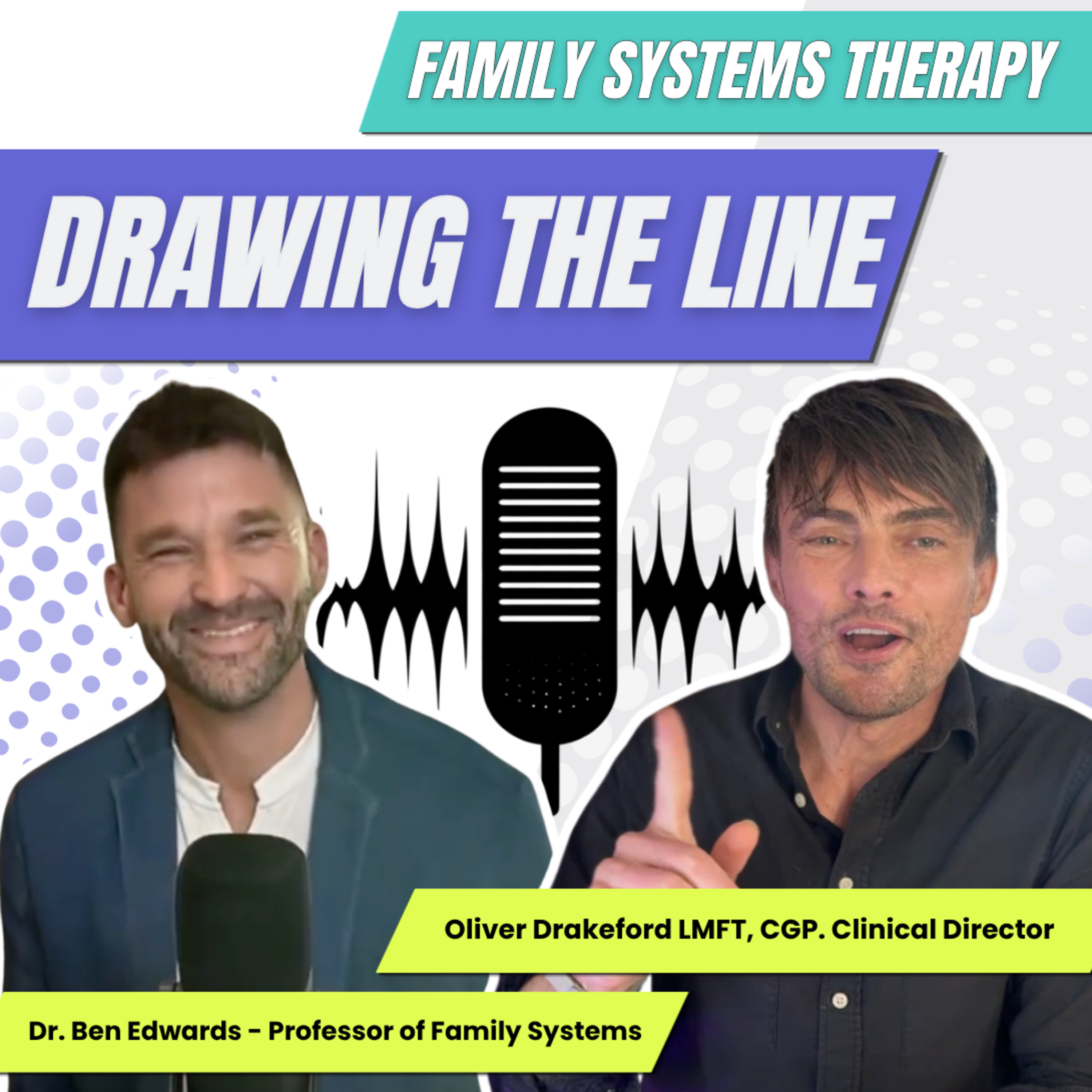 Family Therapy Models : Drawing The Line w Oliver Drakeford & Dr Ben Edwards 25.08.2026 26pHow do family therapy models change the way we understand a teenager who is lying, failing school, and becoming the focus of an entire family?Get more family systems theory, training and resources in my free online Skool Community here https://www.skool.com/family-systems-collective-7929/aboutIn this episode of Drawing the Line, Oliver Drakeford, LMFT, talks with Dr. Ben Edwards, a Los Angeles therapist and professor of family systems theory. Using a family case vignette, they move beyond the idea that the teenager is simply “the problem” and ask what her symptoms may be communicating about divorce, co-parenting, emotional distance, parental overinvolvement, and a family struggling to reorganize after a major change.One central idea in the episode: divorce may end a marriage, but it does not end the family system or the parenting relationship.The discussion draws from family systems theory, structural family therapy, and contextual family therapy. Topics include the identified patient, triangulation, circular causality, loyalty binds, family life-cycle transitions, parental hierarchy, unbalancing, paradoxical interventions, and the ways schools can unintentionally reinforce a child-focused explanation of the problem.Oliver and Ben also discuss who should attend the first family therapy session, what therapists notice when a family enters the room, and how a child’s symptoms can pull disconnected parents back into the same room. Oliver introduces two parts of his GLANCE framework—negativity and centrality—to show how a problem can become the organizing focus of family life.This conversation is for therapists, trainees, students, and anyone interested in seeing family therapy models applied to a practical clinical case.CHAPTERS00:00 Introduction00:54 The 5P family case presentation01:03 The presenting problem01:53 Triangulation after divorce03:28 Divorce reorganizes the family system04:02 Family life-cycle transitions and nodal events05:33 Moving beyond “fix the child” thinking06:23 How schools can become part of the triangle08:03 The identified patient and self-blame09:30 Overinvolved and disengaged parenting patterns10:46 Circular causality and loyalty binds12:39 Paradoxical interventions with parents13:43 Who should attend family therapy?17:21 What therapists observe in the first session20:19 Negativity and centrality in the GLANCE framework21:30 Power within the family22:46 How a teenager’s symptoms can organize the family24:21 What a teenager’s lying may communicate25:25 Final thoughtsFind out more about Dr Edwards here https://www.benedwardsphd.com/ and me, Oliver Drakeford here: https://www.oliverdrakefordtherapy.com/family-counselor/family-therapy-los-angeles-wehoThis video is intended for education and professional discussion. It is not a substitute for therapy, clinical supervision, or individualized mental health care.#FamilyTherapyModels #FamilySystemsTheory #StructuralFamilyTherapy
 -
Circular Questions: Forward Facing Questions That Make Change 11.08.2026 16pMost of the questions therapists ask families point backward: What happened? When did it start? What have you tried already?Those questions are useful. But when an entire session stays focused on the past, a family may hear an unintended message: you are stuck because of what has already happened.In this episode of Family Systems in 15 Minutes, Oliver Drakeford, LMFT, looks at how family therapy models can use circular future-questioning to help families think beyond their current roles, beliefs, and patterns.Oliver organizes circular questions into three zones: the past, the present, and the future. Questions about the past establish a timeline and help identify what changed when the problem began. Questions about the present reveal the beliefs and relationship patterns that may be keeping the problem in place. Questions about the future give family members more room to discuss hopes, fears, consequences, and possibilities that may feel too risky to name directly.The episode introduces six types of future-focused circular questions using the acronym FUTURE:F — Forecast: What happens if the current pattern continues?U — Unfreeze: Who will be the first to notice when change begins?T — Transfer: Would you carry this family role or response into your own future family?U — Unlock: What would happen if the family’s usual roles were reversed?R — Rehearse: How will the family handle an upcoming transition?E — Evaluate: Has the family faced something similar before, and will the same response work again?You’ll hear sample questions for each category, guidance on when to use them, and examples of how one well-timed question can help a family see that the future has not been decided yet.This episode is for family therapists, trainees, and clinicians looking for practical circular questioning techniques they can use in their next family therapy session.To receive the accompanying handout, sign up for the Family Systems Hint newsletter and look for the edition on future-oriented circular questions. You can also learn more about the Family Systems Collective, Oliver’s online community for therapists interested in family systems theory.Oliver Drakeford is a licensed marriage and family therapist in Los Angeles.New episodes of 15 Minutes of Family Systems every week. Read the newsletter or subscribe using the link below.https://www.mypeoplepatterns.com/newsletters/family-systems-h-i-t-newsletter/subscribeJoin the new free Family Therapy Community here https://www.skool.com/family-systems-collective-7929/about
-
 Creating A Hypothesis In Family Therapy: The Free Tool I Created 04.08.2026 13pIn this episode, I explore systemic case formulation in family therapy and why therapists can get stuck when we rely on simple, linear explanations of who or what is causing the problem. I look at how family systems therapy helps us move beyond the identified patient and begin seeing the relational patterns surrounding a symptom.I break down how I map a behavioral loop in couples and family therapy, including the triggers, responses, attempted solutions, and resets that keep a problem going. I also explain how circular questions can uncover the parts of the sequence we have not yet seen.Finally, I introduce a new AI-assisted family therapy case formulation tool I created to help therapists visualize systemic patterns, identify gaps in their assessment, and generate ideas for circular questions. It is practical, slightly nerdy, and designed to help turn family systems theory into something you can use in your next session.Join the free Family Systems Collective to try the tool, share ideas, and connect with other systems-minded therapists:https://www.skool.com/family-systems-collective-7929/about
 -
When Is A Family Enmeshed Or Just Close? The Tool You Need To Know For Sure 28.07.2026 14pEnmeshment is one of the most overused words in family systems therapy and one of the least precise. Fun fact: Minuchin used it two different ways in the same book, and we have been carrying that confusion ever since. There is also some research on how much family closeness therapists think is normal that I found genuinely uncomfortable to read.So this episode is about telling healthy closeness apart from the kind of control that actually needs treating. I share the model I now use for it, which has a name for a family type most of us see regularly and have never had a word for, plus a three-question check to run before you say the word enmeshed out loud. The full matrix, the session observation guide and the checklist are free for subscribers, link below.Oliver Drakeford is a licensed marriage and family therapist in Los Angeles.New episodes of 15 Minutes of Family Systems every week. Read the newsletter or subscribe using the link below.https://www.mypeoplepatterns.com/newsletters/family-systems-h-i-t-newsletter/subscribeJoin the new free Family Therapy Community here https://www.skool.com/family-systems-collective-7929/aboutMore about me: www.OliverDrakefordTherapy.com
-
 Case Conceptualization in Family Therapy- Structural Family Therapy 23.07.2026 26pThis Minuchin structural family therapy case conceptualization explores one of the most fascinating and clinically complex presentations you'll encounter in family work: a young man whose dissociative identity disorder is deeply rooted in dysfunctional family structure, porous boundaries, and a cross-generational coalition between mother and son. Using structural family therapy's core assessment tools — family mapping, the hypothesis generator, and circular questioning — we analyze how the symptom is maintaining homeostasis in the family and what the therapist needs to do to shift it.Ideal for therapists, counsellors, and students wanting to see structural family therapy applied to a real case, this video covers hierarchy, power dynamics, enmeshment, and the all-important question every systemic therapist has to ask: what is this symptom actually doing for the family? If you've been searching for a structural family therapy case study that goes beyond the basics and into genuine clinical depth, this one is for you.Join the new free Family Therapy Community here https://www.skool.com/family-systems-collective-7929/aboutNew episodes of 15 Minutes of Family Systems every week. Read the newsletter or subscribe using the link below.https://www.mypeoplepatterns.com/newsletters/family-systems-h-i-t-newsletter/subscribeMore about me: www.OliverDrakefordTherapy.com
 -
3 Column Worksheet For A Family Therapy Case Formulation 22.07.2026 15pFamily therapy case formulation is hard, and it's easy to blur your modalities the moment you sit down to organize a session. In this episode of 15 Minutes of Family Systems, I share the simple tool I use to keep a family case formulation systemic instead of sliding into attachment styles, DSM diagnoses, and learning labels.The video is here: https://youtu.be/F0zSbt6VwPEIt's three columns on one page, about twenty minutes of your time. History on the left, beliefs in the middle, and the behavioral loop on the right. You read it left to right and fill it in right to left, and once it's finished it hands you three things: who belongs in the room, where the resistance will come from, and the one or two places where pushing will actually work.If you want a systemic case conceptualization that also writes your treatment plan, this one's for you. The worksheet, the circular questions, and a full worked-through case walkthrough are all inside my free Family Systems Collective community. Link in the description.Oliver Drakeford is a licensed marriage and family therapist in Los Angeles.New episodes of 15 Minutes of Family Systems every week. Read the newsletter or subscribe using the link below.https://www.mypeoplepatterns.com/newsletters/family-systems-h-i-t-newsletter/subscribeJoin the new free Family Therapy Community here https://www.skool.com/family-systems-collective-7929/aboutMore about me: www.OliverDrakefordTherapy.com
-
 Circular Questions Family Therapy: A Techniques Framework For Structural Family Therapy 16.07.2026 23pCircular Questions Family Therapy - a framework and technique you can use in your next Structural Family Therapy session or just to brush up on your family systems therapy techniques.Most therapists live in two or three types of circular questions without realizing there are eight. This video walks through a full framework with example questions you can use in your next session.Circular questioning came out of the Milan school of structural family therapy in the early 1980s. The core idea is that information comes from difference, and difference is where change begins. But most trainings only cover the basics: time-based questions and triadic questions between people. This video goes deeper into the cells that tend to get skipped — parts of a person, situational context, belief connections, and meaning connections.Join the new free Family Therapy Community here https://www.skool.com/family-systems-collective-7929/aboutGrab the handout to this video here https://www.mypeoplepatterns.com/youtube#Circ26
 -
4 Ways Family Therapists Get Stuck In The System (And What To Do About It) 14.07.2026 15pWays Therapists Get Pulled Into The Family System (And The Questions That Bring You Back)Every therapist who does family systems work has felt it: the quiet pull toward one person in the room. In structural family therapy we're taught to join the family while staying neutral, but neutrality is slippery. By the time the parents, the school, and the psychiatrist have all had their say, the case can arrive with a plot, a villain, and a role set aside for you.In this episode I walk through four common ways therapists get recruited into a family's system without noticing, and the diagnostic questions that help you find your way back to center. If you work with couples, families, or the identified patient in any structural or systemic model, this one is about the part of the work no supervision hour quite prepares you for: your own place on the map.Whether you're a family therapist, an MFT trainee, or a clinician curious about structural family therapy techniques, you'll leave with a simple move to try before your next stuck session.New episodes of 15 Minutes of Family Systems every week. Read the newsletter or subscribe using the link below.https://www.mypeoplepatterns.com/newsletters/family-systems-h-i-t-newsletter/subscribeJoin the new free Family Therapy Community here https://www.skool.com/family-systems-collective-7929/aboutMore about me: www.OliverDrakefordTherapy.com
-
Complementarity: your new favorite family therapy skill. 07.07.2026 10pThis episode of Family Systems in 15 Minutes, hosted by Oliver Drakeford LMFT CGP covers complementarity — a concept from Minuchin's family systems theory.Core idea: Every person's behavior organizes everyone else's in a family, like a mobile where pulling one piece moves all the others. Problems don't live in one person; they live in the space between family members.Sign up for my new Family Systems Community here to get your free family systems assessment video course.Get the email version of this in your inbox every Tuesday here: https://www.mypeoplepatterns.com/newsletters/family-systems-h-i-t-newsletter/subscribeRead more about my practice here: www.OliverDrakefordTherapy.com
-
3 Signs a Family's Hierarchy Has Flipped And What To Do About It 30.06.2026 14pIn this episode of Family Systems in 15 Minutes, I’m looking at one of the sneakiest structural problems in family therapy: what happens when parents stop being in charge.In family therapy, the authority issues are usually much harder to spot. They show up as “communication problems,” school refusal, anxiety, conflict, curfew debates, or one parent being “too harsh” while the other becomes “the protector.”Using de-identified consultation material, I walk through three signs that the real issue may be structural: repeated conflict between parent and child, coalitions that cross generational boundaries, and hidden alliances that keep the whole system stuck.I also share a practical intervention I call the proposal method, which helps reduce haggling, strengthen the parental subsystem, and put parents back in a united leadership position.For therapists, psychologists, and anyone who enjoys family systems theory with a tiny bit of sarcasm and a cold, frozen English heart.Sign up for my new online Family Systems Community here: https://www.skool.com/family-systems-collective-7929/about Get the email version of this in your inbox every Tuesday here: https://www.mypeoplepatterns.com/newsletters/family-systems-h-i-t-newsletter/subscribeRead more about my practice here: www.OliverDrakefordTherapy.com For therapists, psychologists, and anyone who enjoys family systems theory with a tiny bit of sarcasm and a cold, frozen English heart.
-
Reframes In Family Systems Therapy 26.06.2026 15pReframes in family systems therapy are one of the most powerful tools a therapist can use — and one of the least explicitly taught. In this video I break down FRAME, a five-step framework for formulating and delivering reframes that actually land, using a single family case study from first session to intervention.Whether you're new to family therapy or looking to sharpen your structural family therapy techniques, this exercise will change how you think about the identified patient — and what family counseling techniques can do when the whole system is in the room.I send a weekly email with family systems case studies, techniques, and tools — it's totally free, click here to sign up https://www.mypeoplepatterns.com/newsletters/family-systems-h-i-t-newsletter/subscribeWe cover how to move from individual to relational framing (a cornerstone of Salvador Minuchin's structural family therapy), how to find the function of a symptom, and why tentative language is the difference between a reframe that opens a family up and one that closes them down.If you work in marriage and family therapy, family systems therapy, or any relational therapy context, this is for you.and for more Structural Family Therapy Training Online click here
-
5 Types Of Circular Questions For Your Next Family Therapy Session 23.06.2026 12pThis week I get into circular questioning, the approach I reach for most when I want a family to stop handing out blame and start noticing the pattern they're all standing inside. I sort it into five types, something I wish someone had laid out for me years earlier, and I talk through the one thing that separates a question that moves a family from one that only sounds clever. Oh and I include lots of examples of circular questions too.It holds up just as well in couples and individual work, which is half of why I find it so useful. Have a listen, and tell me if you want the running list of questions I still bring into sessions. Some of my other family therapy worksheets PDFS hereSign up for the digital version of my family systems therapy newsletter below - https://www.mypeoplepatterns.com/newsletters/family-systems-h-i-t-newsletter/subscribeRead more about my practice here: www.OliverDrakefordTherapy.com
-
Five Signs of Parental Alienation Explained: Structural Family Therapy 18.06.2026 21pParental alienation is one of the most heartbreaking dynamics therapists encounter when working with divorced families. In this video, I break down the five structural stages of parental alienation through the lens of Salvador Minuchin's family systems theory—so you can recognize it early, assess it accurately, and intervene effectively.Whether you're a therapist working with teens who refuse to see one parent, or supporting devastated caregivers whose children won't stay with them anymore, understanding these five pillars will give you a clear roadmap for clinical intervention.I'll walk you through what a healthy family structure looks like, then show you exactly how it deteriorates step by step—from the initial fracture to the self-reinforcing lock-in stage. You'll learn to differentiate alienation from estrangement, recognize triangulation patterns, and understand why individual therapy with the child alone won't solve this systems problem.If you work with families going through high-conflict divorces, this structural breakdown will help you spot the warning signs before alienation becomes entrenched.Sign up for the digital version of my family systems therapy newsletter below - https://www.mypeoplepatterns.com/newsletters/family-systems-h-i-t-newsletter/subscribe
-
8 Reasons To Offer Executive Coaching In Your Practice 16.06.2026 17pI want to make the case that everything you've already learned as a family systems therapist transfers directly into working with teams and organizations. The theory, the clinical instincts, the assessment approach: it all applies.In this episode I break down the eight structural areas I examine when I'm consulting with managers and workplace teams, all drawn directly from structural family systems theory.From power and hierarchy to boundaries and scapegoating, the patterns that show up in struggling companies look a lot like the ones we see in struggling families.Whether you're curious about expanding your practice or just want a fresh lens on the work you're already doing, this one's for you.If you've thought about offering this kind of work, I hope this shows you that you're already closer to being ready than you might think.Sign up for the digital version of my family systems therapy newsletter below - https://www.mypeoplepatterns.com/newsletters/family-systems-h-i-t-newsletter/subscribeRead more about my practice here: www.OliverDrakefordTherapy.com
-
Four Red Flags In Family Communication Styles and How To Spot Them 09.06.2026 16pHave you ever walked out of a session knowing something felt off — tense, charged, heavy — but struggled to find the clinical language to describe it? In this episode, I unpack a deceptively simple framework that gives therapists a more precise lens for what's actually happening in the room.This is the audio version of my free weekly family therapy newsletter. Subscribe to it here: https://www.mypeoplepatterns.com/newsletters/family-systems-h-i-t-newsletter/subscribeRead More about me, and Oliver Drakeford Therapy here: In every exchange between people carries two simultaneous signals: status (where each person positions themselves in terms of power) and warmth (the emotional attitude beneath the words). These two axes operate independently — someone can be warm and controlling at the same time, or cold and deferential — and learning to track both can sharpen your clinical observations considerably. This is so helpful to understand in family therapy sessions and gives us a way to interpret and intervene.
-
Every Structural Family Therapy Techniques Explained 08.06.2026 17pLearn the essential techniques that make structural family therapy so effective. In this comprehensive guide, I break down each core technique with practical examples and real-world applications to help you work more effectively with families.Whether you're a seasoned family therapist or just starting out, these techniques will transform how you approach family sessions. From establishing rapport through joining to creating powerful change through enactments, you'll discover the tools that matter most.Check out my complete course "Family Systems Step-by-Step": https://www.oliverdrakefordtherapy.com/training/family-therapy-training-online
-
Family Systems Therapy Assessments - What I've Learned About Intakes 04.06.2026 18pI break down a practical, real-world structural family systems therapy assessment kit built from a mistake I made early in my career. Despite strong rapport and supportive techniques, I completely missed what was actually driving change in the family. What I learned is that without a clear structure for assessing what’s happening in the room, therapists get pulled into the family’s story instead of seeing the system. This video introduces the exact frameworks I now use in every first session to quickly organize complex family dynamics and avoid that trap.You’ll learn six core assessment areas—identified patient dynamics (GLANCE), power and hierarchy (WIRES), family structure, the parental team, developmental fit, and boundaries—each paired with a simple worksheet you can use immediately. Together, these tools form a complete structural family therapy assessment kit designed to help you map the system, spot patterns, and build a working hypothesis from the very first session. Whether you’re a trainee or experienced therapist, this approach gives you a faster, clearer way to understand families and intervene more effectively.Get your hands on the free 59-page family therapy worksheets pdf here : https://www.mypeoplepatterns.com/offers/JS5zqgC3/checkout
Hasonló podcastok


Népszerű itt:
Ez a podcast ezeknek az országoknak a podcast-listáin is szerepel.
