
IFPRI Podcast
International Food Policy Research Institute
0
The International Food Policy Research Institute (IFPRI) provides research-based policy solutions to sustainably reduce poverty and end hunger and malnutrition in developing countries. Established in 1975, IFPRI currently has more than 600 employees working in over 50 countries. It is a research center of CGIAR, a worldwide partnership engaged in agricultural research for development. The podcast covers IFPRI's research findings, policy recommendations, and expert discussions on global food security and nutrition issues.
Epizódok
-
 Double exposure: How El Niño and the Iran crisis could reshape food security 08.10.2026 1ó 28pPolicy Seminar | IFPRI Policy Seminar Double exposure: How El Niño and the Iran crisis could reshape food security October 8, 2026 Both El Niño and the ongoing crisis in Iran threaten to disrupt the global food system and affect food prices through impacts on agricultural production, energy and fertilizer markets, and trade. National governments and international partners face pressure to respond to effects on global markets and prices, as well as the more immediate shocks to production and input costs at the country level. These shocks can have broad implications for countries, as reduced crop and livestock production and higher fuel and fertilizer costs can negatively affect economic growth, poverty, and food security. Join us for this IFPRI policy seminar examining the implications of overlapping climate and geopolitical shocks for food security. The seminar will feature complementary perspectives on risks at the global level and new IFPRI modeling of direct impacts in Malawi, Kenya, Ethiopia, India, and Guatemala. These presentations will emphasize the range of possible outcomes across countries and scenarios rather than offering a single forecast. A policy-focused panel will then discuss responses to these risks, where important gaps remain, how efforts can be tailored to different country contexts, and what constrained public finances and reduced foreign assistance mean for preparedness and response. Opening Remarks Johan Swinnen, Director General, IFPRI Potential Impacts of El Niño and Iran Joseph Glauber, Research Fellow Emeritus, IFPRI Emerta Aragie, Research Fellow, IFPRI Panel Discussion: Response Priorities Amidst Fiscal Constraints Richard Choularton, Director, Climate and Resilience Service, World Food Programme (WFP) Natasha Mbengo, Chief Disaster Preparedness Officer, Department of Disaster Management Affairs (DoDMA), Government of Malawi Ashley Pople, Economist, The World Bank Closing Remarks Ruth Hill, Director, Markets, Trade, and Institutions, IFPRI Moderator Chris Hillbruner, Program Head, Global Food Security Program, IFPRI More about this Event: https://www.ifpri.org/event/double-exposure-how-el-nino-and-the-iran-crisis-could-reshape-food-security/ Subscribe IFPRI Insights newsletter and event announcements at www.ifpri.org/content/newsletter-subscription
 -
 When Grain Trade Is Obstructed: Black Sea Disruptions and Global Market Impacts 01.10.2026 1ó 33pPolicy Seminar | IFPRI Policy Seminar When Grain Trade Is Obstructed: Black Sea Disruptions and Global Market Impacts Co-organized by IFPRI and Agricultural Market Information System (AMIS) October 1, 2026 The Black Sea region plays a critical role in global agricultural trade, supplying a significant share of internationally traded wheat, maize, and oilseeds. Yet ongoing disruptions to transport and export logistics—including damage to port infrastructure, shifting trade routes, rising freight and insurance costs, and heightened operational uncertainty—are affecting exports of agricultural commodities from the region. While global grain supplies remain generally adequate, constraints to moving grain efficiently can alter trade patterns, increase costs, and contribute to greater market uncertainty. This seminar will examine how continued logistical disruptions in the Black Sea region are reshaping agricultural markets and affecting global food security. Bringing together market analysts and industry practitioners, the discussion will explore the implications for grain exporters, import-dependent countries, traders, and shipping service providers. Particular attention will be given to evolving export routes, transportation and insurance costs, market competitiveness, and the resilience of global grain supply chains in an increasingly uncertain environment. Welcome Remarks and Framing Monika Tothova, Senior Economist, Food and Agriculture Organization of the United Nations (FAO); Agricultural Market Information System (AMIS) Secretary Global Wheat Markets: Navigating Renewed Black Sea Uncertainty Alexander Karavaytsev, Senior Economist, International Grains Council (IGC) Trading Through Disruption: The View from Ukraine Nikolay Gorbachov, President, Ukrainian Grain Association (UGA) Beyond Ukraine: Shifting Flows from Russia and Other Origins Indrek Aigro, Head of Business Development, Copenhagen Merchants Panel Discussion Session 1: How Disrupted Is Grain Trade Really? Nikolay Gorbachov, President, Ukrainian Grain Association (UGA) Indrek Aigro, Head of Business Development, Copenhagen Merchants Brian Arnold, President, The DeLong Co., Inc., Grain and Feed Trade Association (GAFTA) Alexander Karavaytsev, Senior Economist, International Grains Council (IGC) Session 2: Costs, Competitiveness and Changing Trade Patterns Malak Al Akiely, CEO, Golden Wheat for Grain Trading Brian Arnold, President, The DeLong Co., Inc., Grain and Feed Trade Association (GAFTA) Indrek Aigro, Head of Business Development, Copenhagen Merchants Nikolay Gorbachov, President, Ukrainian Grain Association (UGA) Session 3: Food Security and Policy Implications David Laborde, Director, Agrifood Economics and Policy Division, Food and Agriculture Organization of the United Nations (FAO) Malak Al Akiely, CEO, Golden Wheat for Grain Trading Moderators Monika Tothova, Senior Economist, Food and Agriculture Organization of the United Nations (FAO); Agricultural Market Information System (AMIS) Secretary Joseph Glauber, Research Fellow Emeritus, IFPRI More about this Event: https://www.ifpri.org/event/when-grain-trade-is-obstructed-black-sea-disruptions-and-global-market-impacts/ Subscribe IFPRI Insights newsletter and event announcements at www.ifpri.org/content/newsletter-subscription
 -
 AI Policy Considerations for Food, Land, and Water Systems 16.09.2026 1ó 32pPolicy Seminar | IFPRI Policy Seminar AI Policy Considerations for Food, Land, and Water Systems Co-organized by IFPRI and the CGIAR Program/Accelerator Digital Transformation September 15, 2026 Amid rapid advances in artificial intelligence (AI), there is growing interest in using AI as a tool to advance food systems transformation. AI has significant potential to transform policy research in food, land, and water systems (FLWS) by enhancing accessibility, efficiency, and responsiveness in policy analysis, but only if tools are rigorously tested, made transparent, and appropriately integrated into research and decision-making processes. This seminar brings together researchers, practitioners, and policymakers to examine how AI is being developed, financed, deployed, and governed across FLWS in low- and middle-income countries (LMICs), and the resulting implications for food policy research. Speakers will discuss current applications of AI, emerging trends, and political and economic forces shaping its use. Attendees will gain perspectives on governance, inclusion, and design, including how to ensure AI systems respond to real-world constraints and contribute to public value rather than reinforcing existing inequalities. Attendees will come away with three key insights: An understanding of the broad and growing landscape of AI innovation in FLWS Insights into how AI can most effectively strengthen policy research Practical reflections from leading experts on responsible and equitable AI in FLWS Welcome Remarks Jawoo Koo, Senior Research Fellow, IFPRI Landscape of AI Innovation in Food, Land, and Water Systems Speakers will present a landscape analysis of AI innovation across food, land, and water systems, looking at current applications, emerging trends, and key gaps, with a focus on how AI is being developed and deployed in low- and middle-income countries. Monisha Lakshminarayanan, Principal Consultant, Athena Infonomics Zeba Siddiqui, Senior Consultant, Athena Infonomics Shaping the Enabling Environment: Policy and Political Economy of AI This session examines how public and private investment, regulatory frameworks, and data governance are shaping the development and adoption of AI in FLWS. Speakers will also reflect on the evolving AI policy landscape in low- and middle-income countries and its implications for innovation. Judy Chambers, Director – Program for Biosafety Systems, IFPRI Testing Solutions (RIAPA Demo) This live demonstration showcases an example of how AI can be used to support policy research. It will illustrate how AI tools can make complex models more accessible and responsive, while highlighting considerations for their effective use in research and in informing policy and investment decisions. Askar Mukashov, Research Fellow, IFPRI Panel Discussion: AI for Policy and Practice in Food, Land, and Water Systems The seminar features a panel discussion bringing together leading experts from academia, industry, and international research to reflect on the opportunities and risks of AI in FLWS. Moderated by Eliot Jones-Garcia, Senior Research Analyst, IFPRI Joyce Nabende Nakatumba, Senior Lecturer, Makerere University Benjamin Cattermoul, Partnership Manager – FCDO & the Gates Foundation; Food and Agriculture Adviser, Foreign, Commonwealth & Development Office (FCDO) Tavonga Siyavora, Product Lead, Google Research Africa Rajesh Veeraraghavan, Associate Professor, Georgetown University Moderator Charlotte Hebebrand, Director of Communications and Public Affairs, IFPRI More about this Event: https://www.ifpri.org/event/ai-policy-considerations-for-food-land-and-water-systems/ Subscribe IFPRI Insights newsletter and event announcements at www.ifpri.org/content/newsletter-subscription
 -
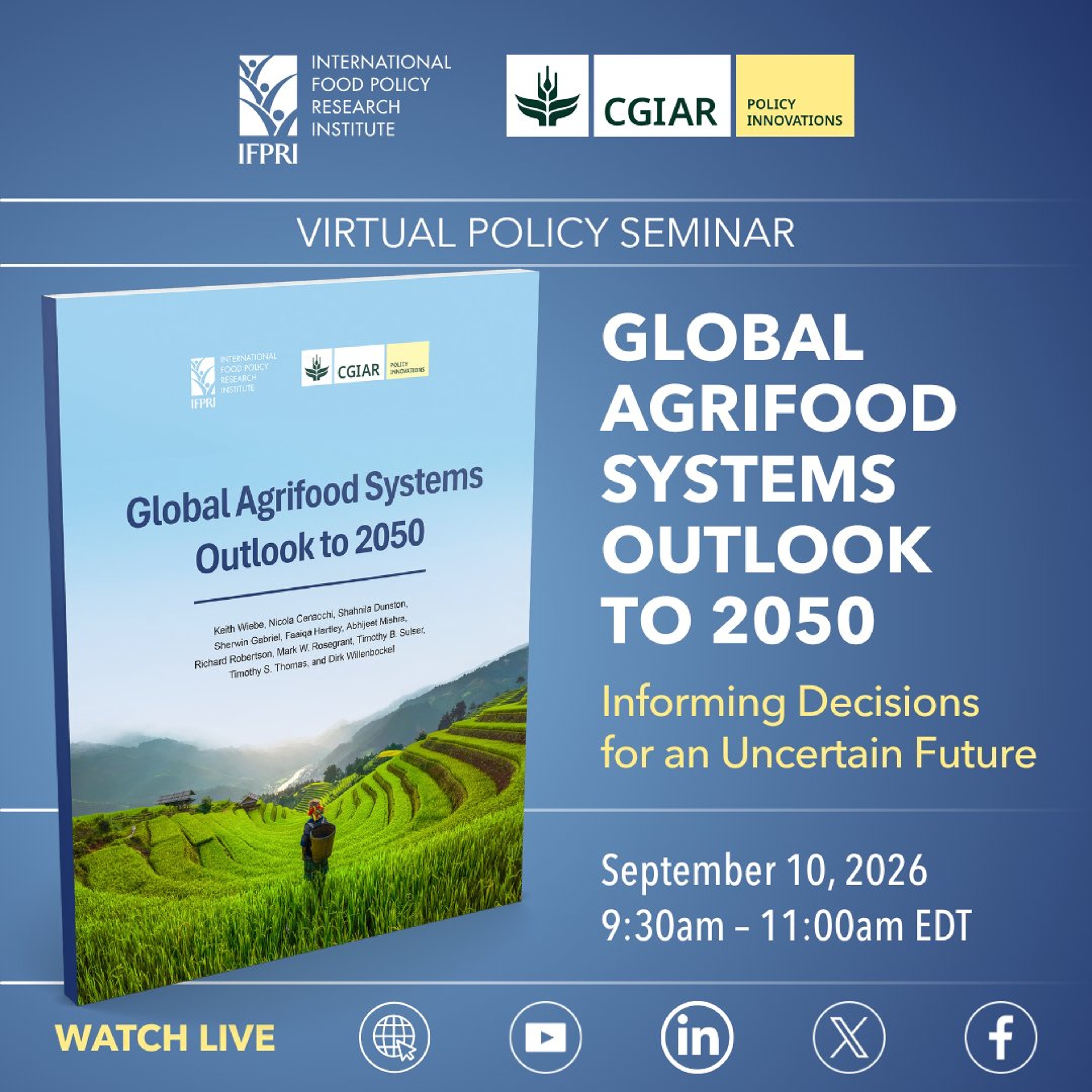 Global Agrifood Systems Outlook to 2050: Informing Decisions for an Uncertain Future 10.09.2026 1ó 31pPolicy Seminar | IFPRI Policy Seminar Global Agrifood Systems Outlook to 2050: Informing Decisions for an Uncertain Future Organized by IFPRI in collaboration with the CGIAR Science Program on Policy Innovations September 10, 2026 Around the world, agrifood systems are changing rapidly as populations grow, incomes rise, technological innovations emerge, and the climate shifts. But how will these systems continue to evolve over the next 25 years? Anticipating and preparing for change requires us to learn from the past and anticipate future dynamics. While near-term forecasts and medium-term outlooks on agrifood systems are readily available, information on longer-term challenges is limited. Helping decision-makers in low- and middle-income countries strategically plan for future agrifood system challenges requires a comprehensive longer-term outlook. Join us for this virtual event to launch the Global Agrifood Systems Outlook to 2050, a new IFPRI report that explores plausible futures for diets, agricultural production, trade, food security, and natural resource use under various scenarios. Prepared as part of the CGIAR Science Program on Policy Innovations, this report aims to help inform the decisions needed to ensure healthy and sustainable agrifood systems in the decades ahead. The event will feature key findings from the report, thematic highlights on productivity and resources, and a regional focus on Africa and trade. A panel discussion with leading experts will examine the report’s implications for the future of agrifood systems, including perspectives from development, policy, research, and practice, before concluding with a Q&A session and discussion of the report’s relevance for CGIAR and the broader policy research agenda. Welcome & Setting the Scene Moderator Welcome: Evgeniya Anisimova, Media and Digital Engagement Manager, IFPRI Why Look Ahead? The Importance of Looking Ahead to the Future of Agrifood Systems:Clemens Breisinger, Director, CGIAR Policy Innovations Program Introducing the Global Outlook Report Overview: Keith Wiebe, Senior Research Fellow, IFPRI Thematic Highlight: Productivity & Resources: Abhijeet Mishra, Research Fellow, IFPRI Regional Highlight: Africa & Trade: Faaiqa Hartley, Scientist, IFPRI Panel Discussion: What Does the Outlook Mean for Agrifood Systems? A discussion with leading experts on the implications of the report’s findings for the future of agrifood systems, including perspectives from development, policy, research, and practice. Rob Bertram, Chief Scientist, Food Security Leadership Council Valeria Piñeiro, Director Technical Cooperation, Inter-American Institute for Cooperation on Agriculture (IICA) Elisabetta Gotor, Director, Land Resource Economics Unit, Alliance of Bioversity and CIAT From Outlook to Action Connecting the Findings to the CGIAR and Policy Research Agenda: James Thurlow, Director, Foresight and Policy Modeling Unit, IFPRI More about this Event: https://www.ifpri.org/event/global-agrifood-systems-outlook-to-2050-informing-decisions-under-uncertain-future/ Subscribe IFPRI Insights newsletter and event announcements at www.ifpri.org/content/newsletter-subscription
 -
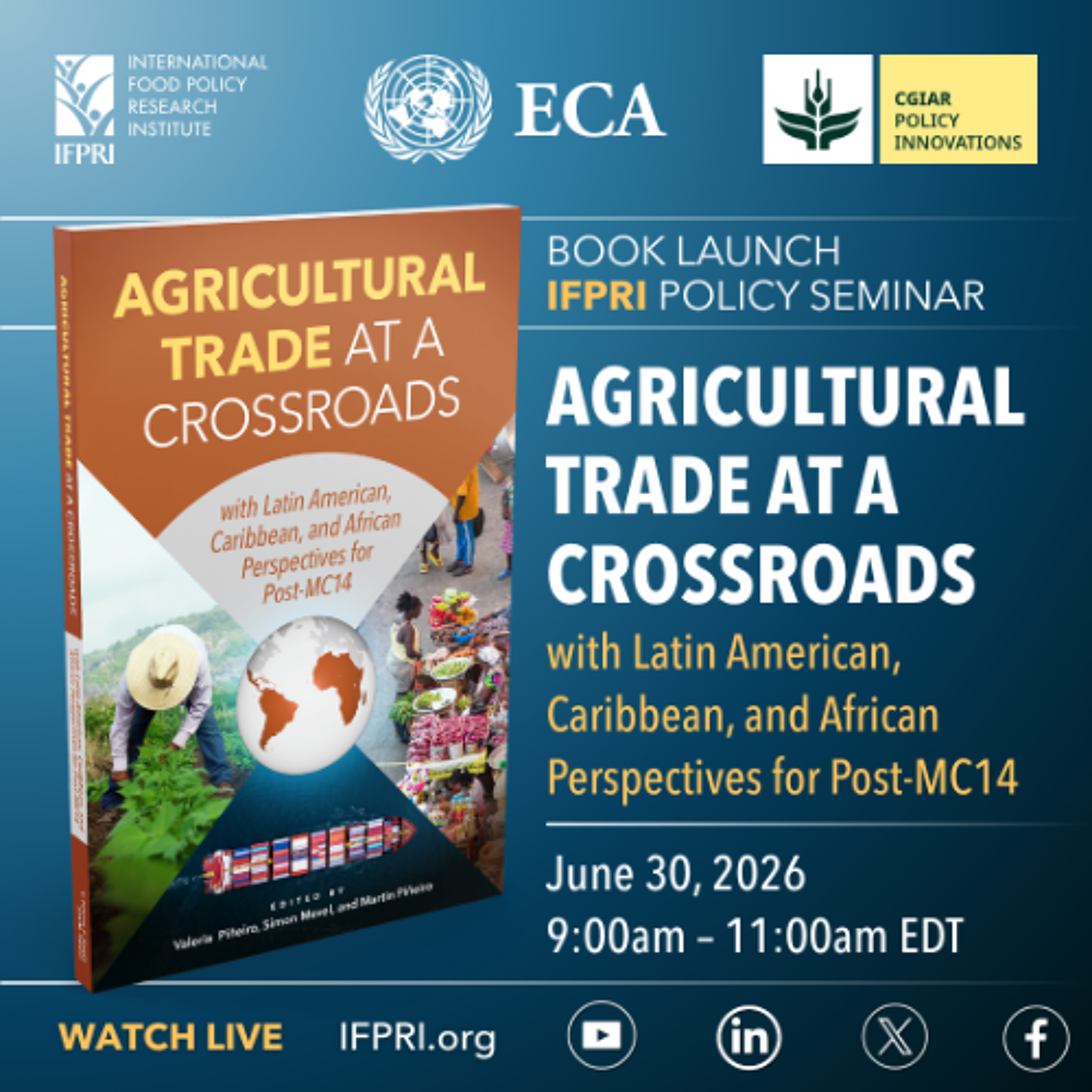 Agricultural Trade at a Crossroads with Latin American, Caribbean, and African Perspectives for Post-MC14 30.06.2026 1ó 52pPolicy Seminar | IFPRI Policy Seminar Agricultural Trade at a Crossroads with Latin American, Caribbean, and African Perspectives for Post-MC14 Organized by IFPRI, United Nations Economic Commission for Africa (ECA), and the CGIAR Science Program on Policy Innovations June 30, 2026 Agricultural trade is facing an increasingly complex environment shaped by geopolitical tensions, climate pressures, and growing trade disruptions. These developments are reshaping trade flows, affecting food security, and challenging the ability of existing institutions and policy frameworks to respond effectively. These pressures are also creating new opportunities for developing regions to strengthen their competitiveness, resilience, and participation in global markets. Understanding these changes is essential for identifying practical pathways toward a more inclusive, sustainable, and predictable agricultural trading system. Join us for the launch of Agricultural Trade at a Crossroads—with Latin American, Caribbean, and African Perspectives for Post-MC14 (https://hdl.handle.net/10568/183392). This seminar will bring together the book’s authors, policymakers, representatives from international organizations, development partners, and other stakeholders to discuss the future of agricultural trade and trade governance, including key findings of the book and priorities for a constructive agenda following the 14th Ministerial Conference of the WTO. Four thematic panels will cover global developments, Latin America and the Caribbean, Africa, and opportunities for cooperation. Discussions will highlight implications for food security, sustainability, competitiveness, regional integration, and the future of the WTO, as well as opportunities for strengthening dialogue and collaboration between Latin America, the Caribbean, and Africa. Opening Remarks Ruth Hill, Director, Markets, Trade, and Institutions, IFPRI H.E. Girma Amente, African Union High Representative to the World Trade Organization More about this Event: https://www.ifpri.org/event/agricultural-trade-at-a-crossroads-with-latin-american-caribbean-and-african-perspectives-for-post-mc14/ Subscribe IFPRI Insights newsletter and event announcements at www.ifpri.org/content/newsletter-subscription
 -
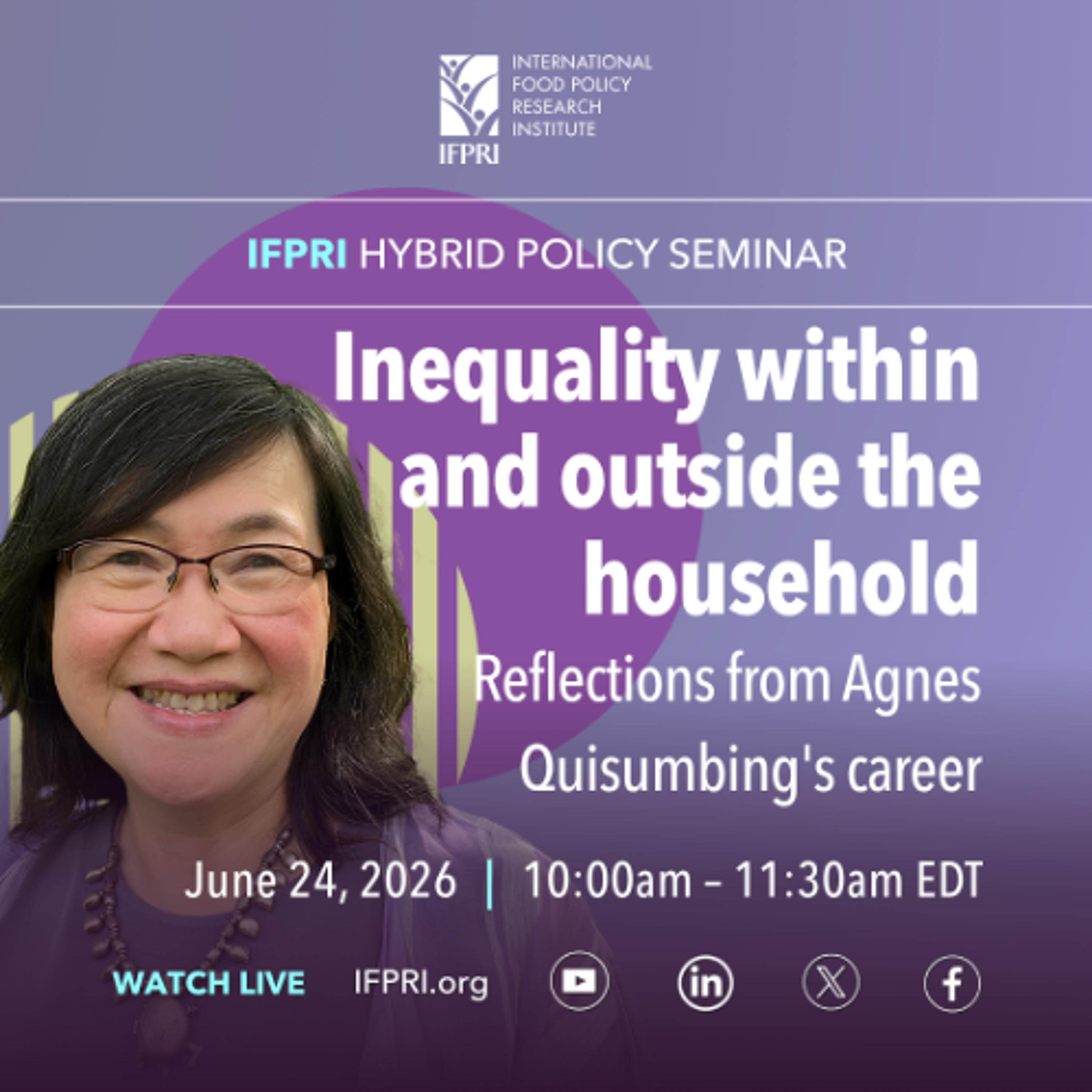 Inequality within and outside the household: Reflections from Agnes Quisumbing’s career 24.06.2026 1ó 35pPolicy Seminar | IFPRI Policy Seminar Inequality within and outside the household: Reflections from Agnes Quisumbing’s career June 24, 2026 Throughout a career spanning more than four decades, Agnes Quisumbing has made major contributions to research on intrahousehold allocation, poverty and economic mobility, women’s empowerment, and the design and implementation of gender-sensitive agricultural programs. Stemming from her long-standing interest in inequality, Agnes’s work on gender, property rights, and women’s empowerment examines how inequality within the household intersects with broader societal inequalities. Join us for this policy seminar highlighting Agnes’s research contributions, which will bring together colleagues and collaborators to examine the research and policy impact of her work. The event will feature a panel discussion of her legacy, as well as a keynote address from Agnes and reflections from Dan Gilligan, Director of IFPRI’s Poverty, Gender, and Inclusion Unit, and Purnima Menon, IFPRI’s Director of Strategy and Partnerships, IFPRI. Opening Remarks Daniel Gilligan, Director, Poverty, Gender, and Inclusion (PGI), IFPRI Keynote Reflections Agnes Quisumbing, Senior Research Fellow, IFPRI Panel Discussion: Reflections on Agnes’s Contributions to Research and Policy Ruth Meinzen-Dick, Research Fellow Emeritus, IFPRI Maria Floro, Professor Emerita, College of Arts & Sciences, American University Markus Goldstein, Vice President and Senior Fellow, Center for Global Development Jemimah Njuki, Director, Gender, Women and Civil Society, African Development Bank Group (AfDB) Closing Remarks Purnima Menon, Director of Strategy and Partnerships, IFPRI Moderator Hazel Malapit, Senior Research Coordinator, IFPRI More about this Event: https://www.ifpri.org/event/inequality-within-and-outside-the-household-reflections-from-agnes-quisumbings-career/ Subscribe IFPRI Insights newsletter and event announcements at www.ifpri.org/content/newsletter-subscription
 -
 Weather, Money, and Shifting Bets: What’s Driving Food Commodity Markets? 23.06.2026 1ó 30pIFPRI-AMIS Seminar Series | IFPRI Policy Seminar Weather, Money, and Shifting Bets: What’s Driving Food Commodity Markets? Co-organized by IFPRI and Agricultural Market Information System (AMIS) June 23, 2026 Global food commodity markets are entering a new phase in which traditional indicators may no longer provide a clear view of market dynamics. While supply conditions for key crops appear quite promising, a closer look reveals a more complex picture—shaped by climate risks, macroeconomic pressures, and shifting market behavior. Join us for this seminar that will bring together insights from market monitoring, macro analysis, and transportation to examine what is driving food commodity markets today—and where to expect future sources of risk and uncertainty. Presentations will unpack the conditions driving agricultural market behavior, and GEOGLAM will provide updates on crop conditions and the evolving threat from El Niño. The discussion will focus on the growing linkages between commodity markets and energy and transport markets and on renewed investor interest in agricultural commodities, the role of market speculation, and how to interpret these signals in today’s markets. Overview of Macroeconomic Prospects John Baffes, Senior Agriculture Economist, Development Economics Prospects Group, World Bank Overview of Crop Conditions and Emergence of El Niño Brian Barker, Principal Faculty Specialist, Department of Geographical Sciences, University of Maryland; Co-Lead, GEOGLAM Crop Monitors (AMIS) Panel Discussion Kona Haque, Former Head of Research, ED&F Seth Meyer, Director and Associate Professor, Food and Agricultural Policy Research Institute, University of Missouri Mads Frank Markussen, Head of Freight Research, CM Navigator Concluding Remarks Joseph Glauber, Research Fellow Emeritus, IFPRI Moderator Monika Tothova, Senior Economist, Food and Agriculture Organization of the United Nations (FAO); Agricultural Market Information System (AMIS) Secretary More about this Event: https://www.ifpri.org/event/weather-money-and-shifting-bets-whats-driving-food-commodity-markets/ Subscribe IFPRI Insights newsletter and event announcements at www.ifpri.org/content/newsletter-subscription
 -
 Engines of Growth in Fragile Contexts: Launching the IFPRI–UNU-WIDER research partnership 10.06.2026 1ó 55pPolicy Seminar | IFPRI Policy Seminar Engines of Growth in Fragile Contexts: Launching the IFPRI–UNU-WIDER research partnership Organized by IFPRI and United Nations University World Institute for Development Economics Research (UNU-WIDER) June 10, 2026 Fragile and conflict-affected settings account for a growing share of global poverty. Roughly 2 billion people live in these areas, accounting for 25% of the world’s population but 72% of the world’s extreme poor. At the national level, many fragile economies struggle to sustain growth, create jobs, and recover from repeated shocks. Yet even amid conflict, climate stress, and political instability, some communities continue to adapt, work, trade, and invest. For these “islands of resilience,” local livelihoods, skills, trust, and collective action support local economic activity that connects to broader growth trajectories. Understanding these dynamics can help identify how strategic support can strengthen resilience, recovery, and livelihoods in at-risk economies. Join us for this event marking the launch of the IFPRI–UNU-WIDER research partnership, which will work with local partners to generate evidence on the engines of growth that sustain economic activity amid fragility. This seminar will bring together researchers, donors, policy stakeholders, and implementation partners to discuss why some local economies remain resilient under stress, what evidence is needed to guide investment and programming, and how policy can support locally grounded pathways to economic recovery. This event was supported by the CGIAR Food Frontiers and Security Program. We gratefully acknowledge the financial support provided by CGIAR funders through the CGIAR Trust Fund. For more information visit: https://www.cgiar.org/cgiar-research-porfolio-2025-2030/food-frontiers-and-security/. Welcome Remarks Daniel Gilligan, Director, Poverty, Gender, and Inclusion (PGI), IFPRI Patricia Justino, Director, UNU-WIDER Presentations from IFPRI and UNU-WIDER Katrina Kosec, Senior Research Fellow, IFPRI Patricia Justino, Director, UNU-WIDER Panel Discussion: Unlocking Local Economies for Resilient Recovery Maya Ragab, Head of Programmes, Cairo International Centre for Conflict Resolution, Peacekeeping, and Peacebuilding (CCCPA) Elizabeth Radin, Senior Director of Research, International Rescue Committee (IRC) Luis Felipe López-Calva, Global Director, Prosperity Vertical, World Bank Group Closing Remarks Daniel Gilligan, Director, Poverty, Gender, and Inclusion (PGI), IFPRI Moderator Kibrom Abay, Senior Research Fellow, IFPRI More about this Event: https://www.ifpri.org/event/engines-of-growth-in-fragile-contexts-launching-an-ifpri-unu-wider-research-partnership/ Subscribe IFPRI Insights newsletter and event announcements at www.ifpri.org/content/newsletter-subscription
 -
 Success Pathways for Scaling Biofortified Crops 13.05.2026 1ó 33pSuccess Pathways for Scaling Biofortified Crops by International Food Policy Research Institute
 -
 Financing Social Protection in Low- and Middle-Income Countries 30.04.2026 1ó 31pPolicy Seminar | IFPRI Policy Seminar Financing Social Protection in Low- and Middle-Income Countries Co-organized by IFPRI and the CGIAR Science Program on Policy Innovations April 29, 2026 Social protection and safety net programs have expanded significantly across many low- and middle-income countries (LMICs) in the last two decades. Despite this progress, the expansion and coverage of these programs remain uneven, leaving nearly 2 billion people in LMICs without access to social protection. Innovative financing mechanisms and domestic funding have helped some LMICs make important strides in expanding their social protection programs, but fiscal constraints prevent other countries from doing so. These challenges are becoming more pronounced amid reduced international development aid and the effects of regional and global shocks, even as such shocks necessitate the expansion of social safety nets to protect poor and vulnerable populations. This policy seminar will discuss lessons learned from countries and organizations that have implemented large-scale social protection programs. It will bring together government representatives, practitioners, and researchers to share important insights and global, regional, and national statistics related to financing social protection and safety net programs. Welcoming Remarks Daniel Gilligan, Director, Poverty, Gender and Inclusion (PGI), IFPRI Global Experience and Lessons on Financing Social Protection and Safety Net Programs in LMICs Ugo Gentilini, Lead Economist, Social Policy (MENAAP region), World Bank Cases and Experiences from Africa Kibrom Abay, Senior Research Fellow, IFPRI Panel Discussion: Lessons and Experiences from Selected Countries Raafat Shafeek, Assistant Minister for Social Protection and Executive Director, Takaful and Karama Program, Ministry of Social Solidarity (MoSS), Egypt Asmita More, Deputy Collector (Land Acquisition), Gadchiroli, Govt. of Maharashtra, India Lynette Ochuma, Ag. Secretary, Directorate of Social Development (DSD), Ministry of Labour and Social Protection (MLSP), Kenya Buthaina Al-Iryani, Social Policy & Public Finance Specialist, United Nations Children’s Fund (UNICEF) Ival Cummings-John, Social Development Advisor, Foreign, Commonwealth & Development Office (FCDO) Closing Remarks Clemens Breisinger, Director, CGIAR Science Program on Policy Innovations Moderator Melissa Hidrobo, Senior Research Fellow, IFPRI More about this Event: https://www.ifpri.org/event/financing-social-protection-in-low-and-middle-income-countries/ Subscribe IFPRI Insights newsletter and event announcements at www.ifpri.org/content/newsletter-subscription
 -
 How does Trade Risk Influence Agricultural Policy? 28.04.2026 1ó 28pHow does Trade Risk Influence Agricultural Policy? by International Food Policy Research Institute
 -
 A Narrow Strait, Global Consequences: Hormuz Strait and Fertilizer Markets 23.04.2026 1ó 31pIFPRI-AMIS Seminar Series | IFPRI Policy Seminar A Narrow Strait, Global Consequences: Hormuz Strait and Fertilizer Markets Co-organized by IFPRI and Agricultural Market Information System (AMIS) April 23, 2026 Fertilizer markets have entered a phase of heightened uncertainty, where geopolitical risks intersect with highly concentrated production, energy dependence, and fragile logistics. These risks are no longer hypothetical. The Strait of Hormuz represents a critical chokepoint for fertilizer trade, with around 35 percent of global urea flows, over one quarter of ammonia trade, just above 20 percent of phosphates, and roughly 45 percent of global sulfur exports transiting the Strait. Ongoing restrictions on maritime traffic through Hormuz underscore its role as a key pressure point in global fertilizer supply chains. Even partial or temporary disruptions can reverberate through markets, while a prolonged or intensified disruption would pose serious challenges for securing adequate nutrient supplies ahead of future cropping seasons. Moreover, even in the event of an easing or reopening, restarting production, logistical normalization, and contract re‑alignment would take time, delaying a full recovery in supply flows. This IFPRI-AMIS seminar looks ahead to assess how fertilizer markets may evolve under these conditions. Drawing on the latest market intelligence and trade analysis, speakers will examine transmission channels from constrained shipping and elevated insurance risks to energy‑driven production costs, price volatility, and regional supply vulnerabilities. The discussion will focus on implications for major importing regions, risks to fertilizer affordability and application decisions, and potential knock‑on effects for agricultural production and food security, as well as policy and market responses to strengthen preparedness in an increasingly uncertain global environment. Opening Remarks Monika Tothova, Senior Economist, Food and Agriculture Organization of the United Nations (FAO); Agricultural Market Information System (AMIS) Secretary Landscape of Fertilizer Markets Delphine Leconte-Demarsy, Fertilizer consultant, Agricultural Market Information System (AMIS) Changes in Fertilizer Trade Flows Shawn Arita, Associate Director and Associate Research Professor, Agricultural Risk Policy Center, North Dakota State University (NDSU) Panel Discussion Africa: Maria Wanzala, Director of Policy, African Fertilizer and Agribusiness Partnership (AFAP) Brazil: Joana Colussi, Assistant Professor, Department of Agricultural Economics, Purdue University India: Shalender Singh, Chief Manager, Marketing, Krishak Bharati Cooperative Limited United States: Veronica Nigh, Chief Economist, The Fertilizer Institute Concluding Remarks Joseph Glauber, Research Fellow Emeritus, IFPRI More about this Event: https://www.ifpri.org/event/a-narrow-strait-global-consequences-hormuz-strait-and-fertilizer-markets/ Subscribe IFPRI Insights newsletter and event announcements at www.ifpri.org/content/newsletter-subscription
 -
 Data in Action: Getting Ahead of Crises: Launch of the Next Generation HungerMapLIVE 17.04.2026 1ó 16pPolicy Seminar | IFPRI Policy Seminar Data in Action: Getting Ahead of Crises: Launch of the Next Generation HungerMapLIVE Co-organized by IFPRI and the World Food Programme (WFP) | Convening alongside the World Bank and IMF Spring Meetings April 17, 2026 As global food security challenges intensify, using timely and reliable data to forecast food insecurity and malnutrition crises can prevent emerging shocks from escalating into humanitarian crises. This high‑level event brings together the World Food Programme, IFPRI and key partners for the launch of World Food Programme’s next‑generation HungerMapLIVE platform. Designed to strengthen global early warning systems, this latest generation incorporates richer indicators, enhanced forecasting, subnational modeling, advanced analytical capabilities and AI-enabled insights that help policymakers, researchers, and practitioners better anticipate and respond to food security and nutrition risks. Please join us for this debut and live demonstration of the latest HungerMapLIVE platform and a discussion on how timely data enables rapidly improving approaches to forecasting and early warning. The HungerMapLIVE platform will be inaugurated by The Honorable Cindy McCain, WFP’s Executive Director. A distinguished panel of experts will subsequently examine: New innovations to support more accurate early warning, including the responsible use of AI as an analytical enabler Approaches to filling existing data gaps The urgent need for sustained investments in strong data ecosystems to ensure sound food security and nutrition analytics Opportunities for deeper collaboration to support smarter and earlier decision-making The event will also feature remarks from policymakers and representatives of multilateral and regional development banks who rely on early warning systems to inform their operations, policies and investments. Welcome Remarks Johan Swinnen, Director General, IFPRI Opening Remarks on the Global Hunger Crisis and the Case for Faster, Data-Driven Action The Honorable Cindy McCain, Executive Director, World Food Programme (WFP) Launch of HungerMapLIVE Introducing HungerMapLIVE and live demonstration: Jean-Martin Bauer, Director, Food Security and Nutrition Analysis, World Food Programme (WFP) Innovation Spotlights – AI x Food Security Forecasting Yanyan Liu, Senior Research Fellow in the Markets, Trade, and Institutions, IFPRI Philipp Zimmer, Researcher, World Bank Group High-Level Panel Discussion: From Early Warning to Early Action Moderated by Kyriacos Koupparis, Head, Early Warning and Forecasting Unit, World Food Programme (WFP) Shobha Shetty, Global Director, Agriculture and Food, World Bank Laura Rojas Sánchez, Chief of the Disaster Risk Management Unit at the Inter-American Development Bank (IDB) Dan Gilligan, Director of the Poverty, Gender, and Inclusion, IFPRI Jean-Martin Bauer, Director, Food Security and Nutrition Analysis, World Food Programme (WFP) Moderator Charlotte Hebebrand, Director of Communications and Public Affairs, IFPRI More about this Event: https://www.ifpri.org/event/data-in-action-getting-ahead-of-crises-launch-of-the-next-generation-hungermaplive/ Subscribe IFPRI Insights newsletter and event announcements at www.ifpri.org/content/newsletter-subscription
 -
 Agricultural Insurance: Innovations, Policies, and Pathways to Scale 16.04.2026 1ó 43pAgricultural Insurance: Innovations, Policies, and Pathways to Scale by International Food Policy Research Institute
 -
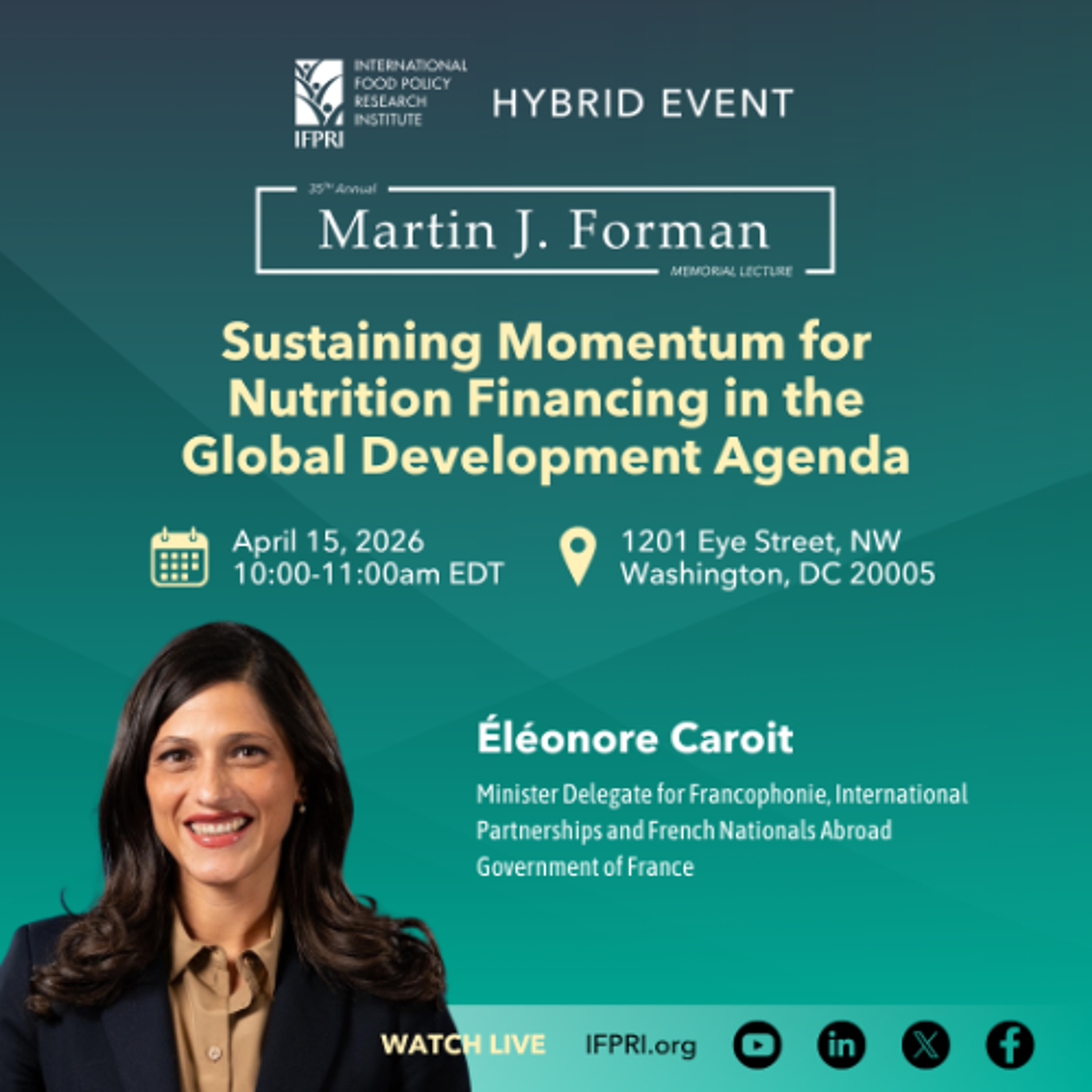 Sustaining Momentum for Nutrition Financing in the Global Development Agenda 15.04.2026 1óMartin J. Forman Memorial Lecture | IFPRI Policy Seminar Sustaining Momentum for Nutrition Financing in the Global Development Agenda 35th Annual Martin J. Forman Memorial Lecture April 15, 2026 Recognizing France’s tremendous leadership of the 2025 Nutrition for Growth Summit (N4G), IFPRI and the Forman lecture selection Committee are delighted to announce that Her Excellency Éléonore Caroit, France’s Minister Delegate to the Minister for Europe and Foreign Affairs Responsible for Francophonie, International Partnerships, and French Nationals Abroad has been invited to deliver the 35th Martin J. Forman Memorial Lecture. France’s leadership of the N4G Summit held in France helped to cement nutrition as a core development priority, reaffirmed a global commitment to fight all forms of malnutrition and emphasized the importance of policy coherence, continuity and long-term commitment. Importantly, the summit also delivered one of the strongest mobilizations since N4G began in 2013, generating 517 new commitments from 160 actors across 75 countries, spanning policy reforms, financing pledges, and programmatic actions. France’s stewardship helped ensure that the summit not only renewed global political attention to nutrition but also produced concrete, trackable commitments and a platform for continued accountability. The French government continues to emphasize the importance of following through on the N4G summit and of keeping nutrition front and center of the global policy agenda, also through its leadership of the G7. The annual lecture commemorates Martin J. Forman, who headed the Office of Nutrition at USAID for more than 20 years and made a significant impact on international nutrition. The lecturer is invited to present personal views about major issues related to malnutrition. Welcome Remarks from IFPRI Johan Swinnen, Director General, IFPRI Welcome Remarks from the Forman Family Kenan Forman, Son of Martin J. Forman Martin J. Forman Memorial Lecture Éléonore Caroit, Minister Delegate to the Minister for Europe and Foreign Affairs, Ministry for Europe and Foreign Affairs, France Discussant Remarks Matthew Freeman, Executive Director, Stronger Foundations for Nutrition Abigail Perry, Global Program Lead for Nutrition, World Bank Moderator Purnima Menon, Senior Director for Food and Nutrition Policy, IFPRI More about this Event: https://www.ifpri.org/event/sustaining-momentum-for-nutrition-financing-in-the-global-development-agenda/ Subscribe IFPRI Insights newsletter and event announcements at www.ifpri.org/content/newsletter-subscription
 -
 Conflict in the Middle East: Reverberations for Food Systems 13.04.2026 1ó 59pWhile the global food system has largely adjusted to the disruptions in agricultural commodities and fertilizers following the invasion of Ukraine, the new conflict in the Middle East introduces a new set of challenges at a time when markets and supply chains remain vulnerable to geopolitical shocks. Disruptions to shipping in the Strait of Hormuz, through which a significant share of the world’s oil and natural gas, as well as fertilizers, transit. Concerns about potential impacts on production sites in the region have added to the uncertainty. These developments have implications for countries heavily reliant on Gulf producers for oil, gas, and fertilizers, as well as for food-import dependent economies in the Gulf, should agricultural shipments to the region face prolonged delays. While the immediate effects on trade flows and prices are still unfolding, higher energy and fertilizer costs can influence agricultural production decisions and, over time, shape food security outcomes. Understanding these dynamics early is important for anticipating where pressures may emerge and how they may interact with existing vulnerabilities. As global food systems become increasingly exposed to conflict-related and geopolitical risks, timely analysis is essential for informing both rapid response and longer-term resilience efforts. Clear insights into potential stress points and market adjustments can help governments, value chain actors, development partners, and humanitarian organizations prepare and respond effectively. The event will feature: Presentations from IFPRI experts, who will provide an up‑to‑date assessment of these developments and discuss their implications for vulnerable low‑ and middle‑income countries. A second panel of senior representatives from governments, international organizations, and the private sector, who will reflect on how they are addressing the immediate effects of the crisis and share perspectives on priorities for strengthening resilience and improving risk management strategies going forward. An opportunity for questions, comments, and discussion. Moderated by: Charlotte Hebebrand, Director of Communications and Public Affairs, IFPRI Opening Remarks Ismahane Elouafi, Executive Managing Director, CGIAR Johan Swinnen, Director General, IFPRI Ramifications for Asian Economies Albert Park, Chief Economist, Asian Development Bank Food Security Considerations and MDB toolkits Renaud Seligmann, Director for Strategy and Operations, World Bank Planet Vice Presidency Early Analyses Market Responses to the Conflict in the Middle East: Joseph Glauber, Research Fellow Emeritus, IFPRI Understanding Vulnerabilities at the Country Level: James Thurlow, Director, Foresight and Policy Modeling, IFPRI Comments on Rapid Analysis: Mark Diamond, Economist-IBRD Lead, World Bank Group Team, International Financial Institutions Dept., Foreign, Commonwealth and Development Office (FCDO) External Panel on Rapid Response and Risk Management Moderated by: Anna Gawel, Managing Editor, Devex Humanitarian Needs: Rania Dagash-Kamara, Assistant Executive Director, Partnerships and Innovation, World Food Programme (WFP) Considerations for Food Import Dependent Gulf Countries: Josef Schmidhuber, Chief Sustainability Officer, Pure Harvest Smart Farms, UAE Considerations for India: Rakesh Kapur, Joint Managing Director, Indian Farmers Fertilizers Cooperative (IFFCO) Food Security Investments in Times of Conflict: Jonah Gold, Managing Director of Insurance, US International Development Finance Corporation More about this Event: https://www.ifpri.org/event/conflict-in-the-middle-east-reverberations-for-food-systems/ Subscribe IFPRI Insights newsletter and event announcements at www.ifpri.org/content/newsletter-subscription
 -
 Rooted in Biodiversity: Transforming Landscapes through Nature-Positive Agriculture 19.03.2026 1ó 31pRooted in Biodiversity: Transforming Landscapes through Nature-Positive Agriculture by International Food Policy Research Institute
 -
 Navigating Risk: Challenges in Agricultural Commodity Shipping and Insurance Markets 18.02.2026 1ó 28pIFPRI-AMIS Seminar Series | IFPRI Policy Seminar Navigating Risk: Challenges in Agricultural Commodity Shipping and Insurance Markets Co-organized by IFPRI and Agricultural Market Information System (AMIS) February 18, 2026 Shipping is at the heart of global agricultural trade, with more than 80 percent of staple crops and oilseeds moving by sea, yet maritime routes have become increasingly uncertain. Attacks on vessels in strategic corridors, drought‑restricted passages, and sharply rising war‑risk insurance premiums have created levels of exposure not seen in years. Bulk agricultural cargoes are inherently sensitive to handling and transit conditions. Physical vulnerabilities—affecting the cargo or the vessel—can lead to complex, costly claims, with insurers tightening terms as geopolitical and climate‑related risks escalate. Disruptions to bulk shipping affect freight costs, trade balances, and ultimately, the economic stability of import‑dependent countries. Insurance markets, particularly war‑risk underwriting, now exert significant influence over the viability of trade lanes. In some high‑risk corridors, premiums have surged or coverage has become unavailable, threatening trade continuity. This seminar brings together experts from the shipping, insurance, and agricultural economics communities to examine the evolving challenges facing maritime logistics. Speakers will discuss the latest developments in freight costs, insurance markets, war‑risk coverage, cargo‑damage risks, and macro‑market implications to provide clarity on an increasingly complex and volatile risk landscape. Moderator Opening Remarks Monika Tothova, Senior Economist, Food and Agriculture Organization of the United Nations (FAO); Agricultural Market Information System (AMIS) Secretary Maritime Logistics (Report) Hidenobu Tokuda, Economic Affairs Officer, Transport Section, Trade Logistics Branch, UNCTAD Insurance & Risk Transfer (Report) Veith Huesmann, Chief Analyst, International Union of Marine Insurance (IUMI) Panel Discussion The panel will discuss the most critical issues in shipping logistics and insurance, including geopolitical tensions driving war-risk exposures; rising premiums and cost pressures; climate-related losses; and aging fleets, technical failures, cybersecurity threats, and digital vulnerabilities. Panelists will identify the resulting implications for agricultural trade and import-dependent regions in 2026 and beyond. Dmytro Furda, Commercial Director, Tiryaki Agro (Turkiye) Bridget Diakun, Senior Risk and Compliance Analyst, Lloyd’s List Intelligence Joseph Glauber, Research Fellow Emeritus, IFPRI Closing Remarks Joseph Glauber, Research Fellow Emeritus, IFPRI More about this Event: https://www.ifpri.org/event/navigating-risk-challenges-in-agricultural-commodity-shipping-and-insurance-markets/ Subscribe IFPRI Insights newsletter and event announcements at www.ifpri.org/content/newsletter-subscription
 -
 Promoting Resilience with Improved Varieties, Quality Seed, and Better Seed Systems 12.02.2026 1ó 32pPolicy Seminar | IFPRI Policy Seminar Promoting Resilience through Improved Varieties, Quality Seed, and Better Seed Systems: Lessons from Nigeria Part of the Fragility to Stability Seminar Series February 11, 2026 Across sub-Saharan Africa, small-scale, resource-poor farmers are disproportionately affected by climatic and market shocks. Providing them with the tools and technologies to manage these shocks is critical to building resilience, especially in Nigeria, with its considerable diversity. This seminar will showcase novel evidence of how improved crop varieties, quality seed, and better seed systems can lead to improved outcomes in productivity, resilience, and nutrition across several Nigerian states. The event will bring together researchers, policymakers, and practitioners to present and reflect on this evidence, providing insights into adoption, demand, willingness to pay, complementarity of inputs, yields, and household consumption. The discussion will center on lessons for promoting improved inputs across similar settings, with a focus on how inputs can most effectively be marketed to vulnerable households to promote resilience. Introduction and Opening Remarks Oliver Kiptoo Kirui, Research Fellow and Acting Program Leader, IFPRI Nigeria Internal Displacement and the Promotion of Agricultural Intensification in Nigeria Rewa Misra, Head National Policy and Innovative Finance, HarvestPlus-IFPRI Interventions to Accelerate Varietal Turnover and Enhance Seed Resilience in Northern Nigeria Catherine Ragasa, Senior Research Fellow, IFPRI New Evidence on the Productivity, Profitability, and Welfare Impacts of Insect-Resistant Cowpea in Nigeria Mulubrhan Amare, Senior Research Fellow, IFPRI Panel Discussion Chinedu Agbara, Partner, Sahel Consulting Jonathan Mockshell, Scientist and Project Leader, Alliance Bioversity & CIAT Muhyideen Oyekunle, Maize Breeder/Lecturer, Institute for Agricultural Research (IAR) Jada Mohammed, Oxfam Novib Closing Remarks Arun Baral, Chief Executive Officer (CEO), HarvestPlus-IFPRI Moderator Kate Ambler, Senior Research Fellow, IFPRI More about this Event: https://www.ifpri.org/event/promoting-resilience-through-improved-varieties-quality-seed-and-better-seed-systems-lessons-from-nigeria/ Subscribe IFPRI Insights newsletter and event announcements at www.ifpri.org/content/newsletter-subscription
 -
 Advancing Poverty Graduation in Fragile Contexts: A New Agenda for Research and Policy 21.01.2026 1ó 30pPolicy Seminar | IFPRI Policy Seminar Advancing Poverty Graduation in Fragile Contexts: A New Agenda for Research and Policy Co-organized by IFPRI and Mercy Corps January 21, 2026 Multifaceted livelihoods interventions that target households in extreme poverty are extremely effective in reducing extreme poverty, with consistent gains in income, consumption, savings, and psychosocial well-being. These interventions, often called graduation models, have been widely evaluated, but most evidence comes from stable rural settings. In fragile and conflict-affected environments where poverty is increasingly concentrated, household-level interventions may not be sufficient to drive sustained poverty reduction. In today’s climate of constrained funding and compounding crises, there is a pressing need to understand how to adapt, scale, and sustain graduation models to deliver more cost-effective, resilient, and inclusive outcomes in contexts marked by fragility, displacement, and recurrent climate- and conflict-related shocks. Convened by Mercy Corps and IFPRI, this seminar will present new research, emerging program insights, and opportunities for continued learning to make graduation model interventions more impactful, inclusive, and resilient in fragile settings. The discussion will build on Mercy Corps’ recent report, Closing the Gap: Adapting Poverty Graduation for Fragile Contexts, which highlights evidence-based opportunities to adapt graduation design and delivery. The seminar will convene leading researchers, donors, policymakers, and implementing partners to showcase emerging evidence from IFPRI, Mercy Corps, and other partners. Together, participants will distill lessons from diverse experiences, explore frontiers for innovation and learning, and chart a forward-looking agenda to strengthen the impact, scalability, and resilience of poverty graduation in fragile contexts—laying the groundwork for deeper collaboration across the research and implementation community. Introduction and Opening Remarks Jeeyon Kim, Director of Research, Food Security, Mercy Corps Highlights from Recent Findings - The Impact of a Nutrition-Sensitive Graduation Model Program on Child Nutrition: Experimental Evidence from Ethiopia: Kalle Hirvonen, Senior Research Fellow, IFPRI - Displacement and Development: Evidence from a Graduation Program for Somalia’s Ultra-Poor: Jessica Leight, Senior Research Fellow, IFPRI - The impact of connecting poverty graduation and market systems development in refugee contexts: evidence from DREAMS Uganda: Daniel Hudner, Senior Researcher, Resilience and Market Systems, Mercy Corps Panel Discussion Chaired by: Kibrom Abay, Senior Research Fellow, IFPRI Radu Ban, Senior Program Officer, Women’s Economic Empowerment, Gates Foundation Wendy Chamberlin, Senior Technical Advisor, Resilience, Trickle Up Julie Kedroske, Director, Social Protection Program, Innovations for Poverty Action (IPA) Kibrom Tafere, Economist, Development Research Group, World Bank Closing Remarks Daniel Gilligan, Director, Poverty, Gender, and Inclusion Unit, IFPRI More about this Event: https://www.ifpri.org/event/advancing-poverty-graduation-in-fragile-contexts-a-new-agenda-for-research-and-policy/ Subscribe IFPRI Insights newsletter and event announcements at www.ifpri.org/content/newsletter-subscription


