
Politics Politics Politics
Justin Robert Young
0
Justin Robert Young offers unbiased political analysis, focusing on who will win elections rather than telling listeners what to think. The podcast covers US politics with a data-driven approach.
Episodi
-
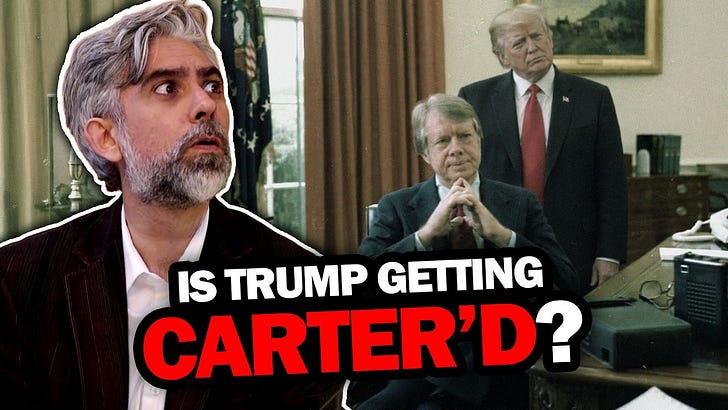 Is Iran Making Trump Into Jimmy Carter? Making Sense of Talarico’s Texas Pivots (with Michael Cohen) 17.09.2026 1h 3minWhen it comes to the war in Iran, my supposition is that the economic negativity driving the country — and creating an environment where Democrats could do very well in the midterms — is entirely about one thing: the price of gas. The war is incredibly unpopular, but it’s different from the war in Iraq. Both were very expensive, but Iraq brought coffins back at a scale we haven’t seen here. The biggest difference is what Americans are paying at the pump.According to AAA’s live average, gas is at $4.44 nationally. It’s higher in states like California and New York, but even here in Texas, where we have relatively low gas prices, it’s edging toward $4. During the memorandum of understanding, that son of a b***h kissed the twos. Before the war in Iran, it was sitting around the twos. It’s not good right now.The question is whether this is Iran’s play. Iran is extraordinarily sophisticated in its understanding of the American electorate and the American democratic system. Are they timing their greatest chaos in the region to spike the price of oil as high as possible during election season? The United States appeared to have established a flow of tanker traffic through the Strait of Hormuz, but now we’ve seen missiles and drones fired at American vessels and major damage to Saudi Arabia’s 745-mile east-west pipeline.Politics Politics Politics is a reader-supported publication. To receive new posts and support my work, consider becoming a free or paid subscriber.That pipeline can move four to five million barrels a day — roughly 4 to 5 percent of the global supply. Saudi Aramco has already told three European refiners they won’t receive their full September allotments, forcing them to buy emergency stock on the open market. Because oil is a globally traded commodity, that drives up the price. Chevron CEO Mike Wirth has warned that stockpile releases and access to previously restricted oil stored abroad had constrained prices, but those buffers are now played out. Iran has been warning about $200-a-barrel oil since the beginning of the conflict.The obvious historical comparison is Jimmy Carter. But this isn’t 1979. Headline inflation was 11.8 percent then, compared with 3.4 percent now, and unemployment was 6 percent instead of 4.1 percent. We’re doing better by those measures, but will any of it matter? Gas was 98 cents a gallon in August 1979. In August 2026, it was $4.20, and it’s even higher now.The sunniest version of Trump’s tariff policy was that he’d become the greatest energy president of all time and drive gas prices low enough to give him room to negotiate better trade deals. All of that went out the window with the rush into Iran. Even if you don’t totally hate the war from a foreign-policy standpoint, you can understand that this is political poison. It’s strychnine for the average voter. Electing Trump was, in part, a cry for economic relief from people who didn’t trust Joe Biden to provide it. The numbers currently suggest Democrats will receive that same benefit of the doubt. Whether it holds when people vote is the question.Chapters00:00:00 - Intro00:03:25 - Gas Prices00:16:34 - Update00:16:59 - Data Centers00:18:20 - ICE00:19:34 - Kennedy Center00:21:46 - Interview with Michael Cohen01:00:02 - Wrap-up This is a public episode. If you'd like to discuss this with other subscribers or get access to bonus episodes, visit www.politicspoliticspolitics.com/subscribe
 -
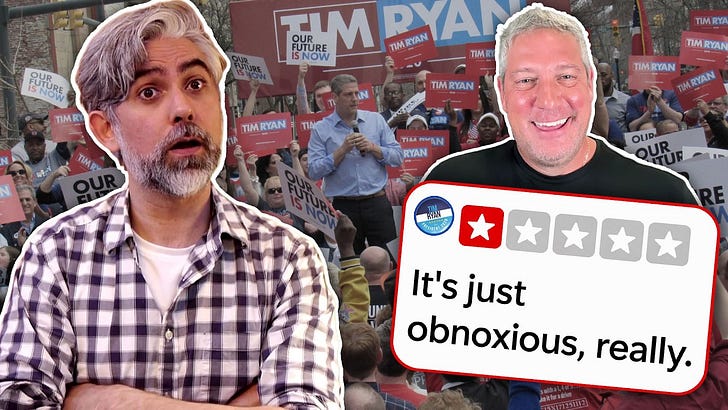 Ohio Governor Ads Get Spicy! Crypto, Congress, and Campaigning for President (with Tim Ryan) 15.09.2026 56minThe Republican Governors Association is already throwing downfield in Ohio. During the Ohio State–Texas game, it aired an ad attacking Amy Acton over a 2019 family dispute in which Acton’s daughter called 911, both adults acknowledged drinking, and Acton said she’d taken prescription migraine medication. The ad also called Acton a coward for refusing to debate Vivek Ramaswamy.This is earwly to throw out a smear like “you’re an alcoholic.” If the only thing Acton needs to do to beat that charge is not act like an alcoholic in public, she’ll likely be able to beat it. Acton is further ahead in this race than Republicans would like to see in a state Donald Trump won by the amount he did, so they’re trying to change the math of the game. I don’t think this is going to be enough.What Vivek really wants is a debate. The thing that put him on the map wasn’t his campaign ads or gigantic crowds — I was at the pizza places where he held events in Iowa, and they weren’t packed to the rafters. He built his reputation by fricasseeing Nikki Haley. He ent there, as the kids say. Now he desperately wants Acton onstage so he can drag the race into the mud, throw Republican red meat at her, and relitigate COVID. If Acton believes she’s ahead, her answer is simple: You can keep that debate spirit to yourself, Vivek.Politics Politics Politics is a reader-supported publication. To receive new posts and support my work, consider becoming a free or paid subscriber.Meanwhile, the Supreme Court has kept the Trump administration’s new mail-in-ballot restrictions from taking effect for the midterms. The existing block remains in place, allowing election officials to continue their current procedures. This is about where I thought things would land. We won’t have to worry about it for the midterms, but the broader fight will continue afterward. If Trump loses control of the House and enters the back half of his lame-duck term, his attention is going to turn toward executive orders like this.Texas Democrat Al Green is also forcing the House to address another effort to impeach Donald Trump. The real political tension isn’t on the Republican side. Democrats have to decide how much they want to tell voters that regaining the House means going back to 2018 through 2020 — impeachment, impeachment, impeachment. Did that really move the needle? Did it get anybody the political wins they wanted? Not really. Republicans would love to remind voters that Democrats just want power again.Finally, Mitch McConnell is back in the Senate after months away. Exactly how much Mitch is in the McConnell, I don’t know. Even in the worst video I saw, he seemed north of Dianne Feinstein — not a high bar, but nothing involving age in the Senate is. He doesn’t appear to be in fighting shape, but he’s a warm body, and Republicans need that vote on a lot of business between now and January.Chapters00:00 - Intro02:41 - Anti-Amy Acton Ads07:18 - Tim Ryan on Crypto and Clarity Act24:39 - Update25:40 - Mail-in Ballots27:20 - Al Green29:02 - Mitch McConnell31:58 - Tim Ryan on Political Careers and Running for President53:04 - Wrap-up This is a public episode. If you'd like to discuss this with other subscribers or get access to bonus episodes, visit www.politicspoliticspolitics.com/subscribe
 -
 Why Trump’s $5,000 Check Won’t Happen. How the Internet Mixed Politics with Fandom (with Katherine Dee) 10.09.2026 1h 2minTrump says he’ll give every American $5,000 if Republicans retain the House and Senate. That’s about $1.3 trillion, and the country is already $40 trillion in the hole. Is it a bribe? No — well, yes. Is it a political bribe? It’s unconventional, but I have a hard time separating it from politicians promising government services and warning that those services will disappear if you vote for the other party. The more important point is that even if Republicans keep Congress, this ain’t happening. There’s no political will for it, and I highly doubt the votes exist.So why are we talking about it? Because Trump would rather have a conversation about whether a $1.3 trillion gift is feasible than talk about $4 gas, high diesel prices, inflation, or the state of the economy. Promising $5,000 reframes him as somebody who understands that people need cash. After a brief improvement in economic sentiment, things look dour again, and Trump now says the Iran war will end shortly after the midterms. Even through his rose-colored glasses that sometimes turn BS brown, he’s admitting this won’t be over before November.Politics Politics Politics is a reader-supported publication. To receive new posts and support my work, consider becoming a free or paid subscriber.Republicans are heading into a massive fight. New polling has Sherrod Brown in Ohio and James Talarico in Texas ahead by four or five points, while Lindsey Graham’s sister leads by only two in South Carolina. I’d still bet on Ken Paxton over Talarico, but Talarico is moving toward the center. He says he opposes trans athletes competing where fairness and safety are at stake and would sign a law banning sex changes for minors. Not long ago, that would’ve been called an attack on trans children. Now a more liberal candidate is saying it because he believes the issue is an exhaust port on his Death Star. I’m ending this week more inclined toward My Blue Heaven than I was on Labor Day.The White House is also promising $500 rebates to roughly one million Obamacare customers in 30 states who were allegedly overcharged. That’s separate from Trump’s $5,000 promise, and neither announcement means money has reached anybody. This looks like an answer to Democrats’ warnings about the expiration of Obamacare subsidies — one of the issues that drove the earlier government shutdown. Is it really going to happen? I have no idea. But it puts the administration where it wants to be: talking about what it’ll do for voters who are hurting for money.Meanwhile, the Supreme Court has interrupted Republicans’ effort to use a new congressional map in Missouri, clearing the way for the older map approved by the state Supreme Court. Republicans wanted one more House seat from the redraw, but election officials need usable instructions before ballots go out. The broader redistricting push was hot and heavy a few months ago, but it was also slapdash. That’s the Trump administration: Somebody has an idea, everybody says it’s great, they start doing it, and they figure out whether it’s possible about halfway through.John Fetterman also appeared by recorded video at the Republican midterm convention to introduce fellow Pennsylvania senator Dave McCormick. Fetterman called himself a Democrat, praised McCormick, and discussed working with Trump to protect steel jobs. If you think that means he’s switching parties, he poured cold water on it. He remains a proud Democrat and says he votes with the party 80 to 90 percent of the time. But imagine Democrats reach 50 Senate seats and Fetterman becomes vote 51. I’d love to ask Abdul El-Sayed which he’d prefer: a Democratic majority that depends on Fetterman, or Fetterman revealing his “true colors” and becoming a Republican.Chapters00:00:00 - Intro00:02:11 - Trump’s $5,000 Promise00:06:30 - Polling00:09:42 - Interview with Katherine Dee00:31:29 - Trump’s $500 Refunds00:33:09 - Supreme Court00:34:29 - John Fetterman00:36:29 - Interview with Katherine Dee, con’t00:58:42 - Wrap-up This is a public episode. If you'd like to discuss this with other subscribers or get access to bonus episodes, visit www.politicspoliticspolitics.com/subscribe
 -
 Why It’s So Hard to Make Sense of These Midterms (with Chris Cillizza) 08.09.2026 1h 12minTrump’s threat to ban Bombardier aircraft sales has put Kansas Republicans in a bind. Senators Jerry Moran and Roger Marshall contacted the administration because the Canadian company supports American jobs, including more than 1,000 at its Wichita headquarters. Marshall is defending those jobs while still endorsing Trump’s goal of bringing more manufacturing home. That’s the political tension: A trade fight sold as protecting American workers is now threatening American workers who are already here.A deal with Canada was allegedly close before it fell apart at the eleventh hour. Neither country really wants this. They both want to talk tough, and Donald Trump is definitely throwing his weight around, while Mark Carney is trying to squeeze as much political juice as possible out of standing up to him. But the Quebec by-election has come and gone, and there’s still no agreement. You’ve got to wonder how long this can continue.Politics Politics Politics is a reader-supported publication. To receive new posts and support my work, consider becoming a free or paid subscriber.Carney is also making a more credible threat of moving Canada closer to China. At the end of the day, there aren’t really middle powers operating in independent silos. You’ve got to stand next to one of the big players, and Carney is smart enough to understand that. He needs to show Canada has another path that the United States doesn’t want, because otherwise Canada is effectively an American vassal state. Put aside what’s right or good — that’s the reality. I still suspect this gets resolved, but that’s just me.Meanwhile, Illinois Governor J.B. Pritzker is launching a political action committee that plans to invest at least $20 million in Democratic House races, including overlooked Republican-held districts in Ohio and Texas. The obvious question is how much helping other Democrats helps Pritzker, who is very much rumored to be considering a presidential run in 2028. His greatest advantage is money, and he’ll need to start making friends. But Democrats traditionally like their billionaires to keep cutting checks rather than seeking power themselves. Ask Tom Steyer or Michael Bloomberg how that works out.The first two disclosed targets are Max Miller in Ohio’s 7th District and Brandon Herrera in Texas’ 23rd. Both seats are held by Republicans, and both campaigns give Pritzker a chance to demonstrate that he can expand the map. It’ll be interesting to see who else receives help and whether those candidates remember it later. Pritzker isn’t wet behind the ears — he’s already a governor — but spending money on other Democrats and converting that spending into national support are two different things.Finally, Saudi Arabia says Houthi attacks have wounded 73 civilians and caused fires and temporary shutdowns at energy facilities. Iran is trying to create another edge that could force the United States toward negotiations on more favorable terms. Its inability to stop oil moving through the Strait of Hormuz has weakened its leverage, so we’re seeing more tough talk and more activity from the network of resistance. But the Houthis exist in a parallel world and aren’t completely beholden to Tehran. How loyal are any of Iran’s proxies to an Iran that’s increasingly broke? I don’t know what to make of it yet.Chapters00:00:00 - Intro00:05:15 - Chris Cillizza on the Midterms and Beyond00:37:37 - Update00:39:23 - Trade War00:43:25 - Pritzker00:46:08 - Iran00:48:27 - Chris Cillizza’s Midterm Prediction01:08:51 - Wrap-up This is a public episode. If you'd like to discuss this with other subscribers or get access to bonus episodes, visit www.politicspoliticspolitics.com/subscribe
 -
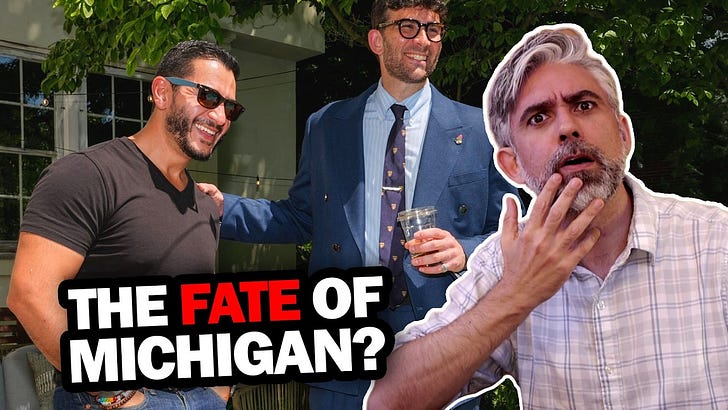 Could Hasan Piker Cost El-Sayed the Michigan Senate Race? (with Bill Scher) 03.09.2026 1h 9minI’m in Atlanta for Dragon Con, and normally that would give me a chance to see what the campaigns are putting on television. But I don’t expect to see many political ads while I’m in the Peach State, because Georgia’s Senate race wasn’t supposed to look like this. It was supposed to be Brian Kemp against Jon Ossoff — a heavyweight fight if there ever was one. But Kemp didn’t run; Mike Collins won the Republican primary, and plenty of Georgia Republicans really, really hate him. Ossoff has made himself more palatable and taken enough tough votes to argue that he’ll side with Georgia when his party doesn’t. I’ve been an Ossoff skeptic, but right now you can’t argue with it. I think this race is a wrap.Republicans have two exceptionally weak Senate challengers in states where they should perform well: Collins in Georgia and Michael Whatley in North Carolina. I’ll eat the L on Whatley because I thought he’d do better. I expected the environment to be bad for Republicans, but we’ve reached the point where nobody not named Donald Trump feels comfortable telling voters how awesome everything is. Trump’s secret is that you always say it’s awesome. Sometimes people believe you, sometimes they don’t, but you can’t have a parade unless somebody leads it. In Georgia, I think this race is wrapped. Ossoff will remain a senator.Politics Politics Politics is a reader-supported publication. To receive new posts and support my work, consider becoming a free or paid subscriber.Meanwhile, a federal judge has blocked Trump’s latest attempt to narrow birthright citizenship. The revised order targeted alleged birth tourism, certain foreign-government employees, and people designated as alien enemies, but Judge Deborah Boardman said those categories barely resembled the exceptions previously recognized by the Supreme Court and found the order almost certainly unconstitutional. This is the Trump 2.0 philosophy: Get shots up. Push, push, push. Make judges knock it down, take it to the Supreme Court, and make the justices rule.I’ve tried to interrogate why I don’t get as angry or worried about every one of these moves as other people do. Part of it is that there are so many of them, and I need to see how they rattle around before developing an emotional opinion. I’m willing to accept the criticism that I’m whistling while Rome burns, or while an arsonist fiddles with a matchbook. But the alternative is becoming a herky-jerky psychopath whose emotions are entirely controlled by the Trump administration. They decide when you’re mad, sad, or happy because everything depends on their latest action. I don’t want that, either.Finally, Hakeem Jeffries also got another preview of life with a narrow Democratic majority after Jared Golden and Marie Gluesenkamp Perez rescued a Republican procedural vote without warning him. Jeffries and Democratic leaders called it a serious breach of trust and sent the matter to a caucus committee, triggering backlash from progressives and centrists worried about uneven punishment and loyalty rules. If Democrats win a WINO majority — fewer than 15 seats — this will be Jeffries’ life. Be careful what you wish for, Speaker Jeffries.Chapters00:00:00 - Intro00:01:45 - Georgia00:06:27 - Midterms with Bill Scher00:32:07 - Update00:34:33 - House of Representatives00:36:06 - Birthright Citizenship00:39:18 - Hakeem Jeffries00:40:46 - Midterms with Bill Scher, con’t01:03:44 - Wrap-up This is a public episode. If you'd like to discuss this with other subscribers or get access to bonus episodes, visit www.politicspoliticspolitics.com/subscribe
 -
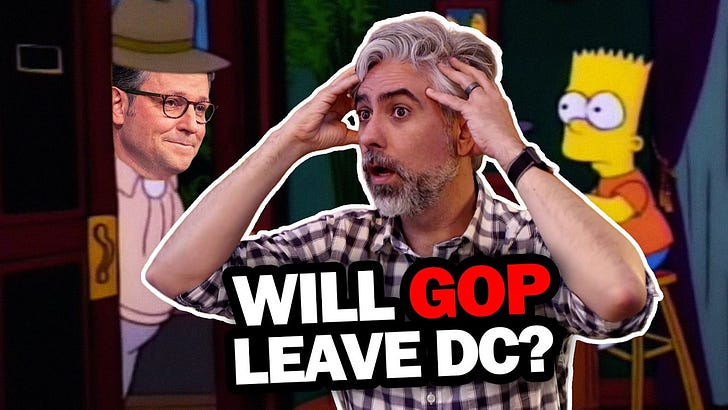 Will the GOP Leave DC Already? What You Should Be Watching For in Iran (with Riley Blanton) 01.09.2026 1h 17minHouse Republicans just returned from five weeks in their districts, and there’s already a rumor that they’re about to pull an “Abe Simpson” — walk into Washington, turn around, and leave again. They’ll vote on a Senate-approved stopgap funding bill to keep the government open through December, probably with Democratic support, and pass a few messaging bills about how they don’t like socialism. Beyond that, expectations are low. They want to leave until November 9, after the midterms.The reasoning is simple: If they’re not going to accomplish anything in this divided, fractious Congress, why stay? Republicans have such a thin majority that they can’t agree on much or put Democrats on defense beyond the broadest, most useless bills. Their members would rather go home, campaign, press the flesh, shake hands, and kiss babies because they believe they’re fighting for their political lives.The mood inside the Republican conference is bleak, bleak, bleak. One member holds a district Trump won by 10 points and the Republican candidate previously carried by 16. Their internal polling now has that Republican ahead by one point. Uno. These are the seats nobody treats as toss-ups until a wave turns them into toss-ups. Republicans are comparing their internal numbers in the hallways, and they don’t like what they see.Politics Politics Politics is a reader-supported publication. To receive new posts and support my work, consider becoming a free or paid subscriber.In 2022, Republican leaders told members they’d win the House by 20 seats; they won by five. The rule of thumb for some members now is to take whatever leadership says and subtract 20. Leadership says Republicans will hold by five, so members are preparing for Democrats to win a 15-seat majority. If Trump-plus-10 districts are already looking like toss-ups, they want to be home doing everything possible to eke out a victory.They probably won’t leave immediately. Going home would be a gigantic red flag from leadership, and fundraisers are already scheduled throughout Washington. Members might need time in their districts, but they also need money for television and streaming ads. That means showing up and giving face time to the people attending those fundraisers.The wild card is Big Chungus. If Trump says Congress should go home, Mike Johnson will face enormous pressure to disperse everybody. If Trump says members should remain in Washington, they’ll stay. From everything I’m hearing, there isn’t much good news on the Republican side. My personal barometer between WINO and My Blue Heaven is swinging left.Chapters00:00:00 - Intro00:04:29 - House Republicans00:12:53 - Update00:14:25 - Mail-in Ballots00:19:15 - Bonds00:21:51 - Ballroom00:25:46 - Interview with Riley Blanton01:12:43 - Wrap-up This is a public episode. If you'd like to discuss this with other subscribers or get access to bonus episodes, visit www.politicspoliticspolitics.com/subscribe
 -
 Trade War with Canada, Explained! (with Evan Scrimshaw) 28.08.2026 1h 53minThe Iran war has reached the six-month mark, far beyond the quick victory Trump once promised. Pakistan says it’s still working on diplomacy to reopen the Strait of Hormuz, while Trump says he has no timetable for ending the conflict and insists the United States is winning. The big story is that there now appears to be free passage through the American-controlled corridor off Oman’s coast. About half of the prewar oil traffic is reportedly getting through. That would represent a significant loss of Iranian leverage — but only if crude prices begin to fall.Brent crude remains just under $90 a barrel. That’s the low end of high, not the meaningful decline we saw during the memorandum-of-understanding period. Iran is at an impasse. Regime leaders have reportedly been doxxed, people aren’t getting paid because the country can’t move oil, and there are rumors that the supreme leader may be dead. If Iran’s leverage since the revolution was “Don’t interact with us or we’ll derail the world economy and set the region on fire,” that doesn’t appear to have happened. Its proxies haven’t ignited the region, its oil isn’t moving normally, and it may now be operating without a supreme leader.Politically, though, this has been an absolute disaster for Trump. It fractured his right flank and gave independent voters permission to say, “No, this guy sucks. He lied.” He called himself the president of peace, and now we’ve been at war with Iran for six months. Iran’s goal is to make Trump pay in the midterms, and Trump is doing a lot to help. He doesn’t have tremendous instincts for winning races when he isn’t on the ballot.Politics Politics Politics is a reader-supported publication. To receive new posts and support my work, consider becoming a free or paid subscriber.The administration may be looking to Venezuela for relief. It’s negotiating with the interim government for American ownership stakes in more than a dozen productive oil fields holding about 90 billion barrels of proven reserves. Venezuela would receive investment and additional revenue while American and other private firms rebuilt production. Is this energy security or an extraordinary American claim on another country’s resources? To quote the Stephen A. Smith meme: We don’t care. At least not when it comes to the one thing that matters in American politics — gas prices.So go gas prices, so goes the economy, inflation, and probably the midterms. Trump’s original pitch was that tariffs might create instability and make foreign goods more expensive, but Americans could count on cheaper energy. A funny thing happened on the way to Tehran, and that got screwed up. More Venezuelan oil could push prices down and make it easier to refill the Strategic Petroleum Reserve without buying expensive crude. It would also almost certainly benefit the oil companies that remain furious about Hugo Chávez taking their equipment.Chapters00:00:00 - Intro00:02:14 - Trade War with Canada00:34:44 - Update00:36:49 - Iran00:42:19 - Venezuelan Oil00:45:13 - 9/11 Trial00:47:25 - Evan Scrimshaw’s Midterm Picks01:25:03 - NFL01:48:34 - Wrap-up This is a public episode. If you'd like to discuss this with other subscribers or get access to bonus episodes, visit www.politicspoliticspolitics.com/subscribe
 -
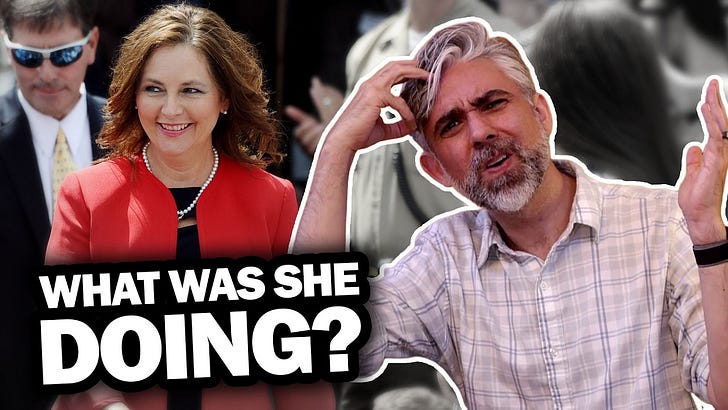 Is Darlene Graham Already Done in South Carolina? US Hackers vs. Foreign Gangs (with Eric Geller) 25.08.2026 1h 12minI’ve got a bad feeling about the South Carolina runoff for Darlene Graham. Lindsey Graham’s sister led the first round with roughly 32 percent but now faces Representative Ralph Norman. Trump encouraged her to run, endorsed her before she formally entered, campaigned with her in Myrtle Beach, and held a runoff-eve tele-rally. MAGA Inc. spent $827,000 on last-day calls and texts supporting her. Norman is a longtime officeholder with a hardline conservative record who backed Trump but committed the unforgivable sin of endorsing Nikki Haley in 2024.The problem is that Darlene has run an objectively bad campaign, even though the campaign she needed wasn’t difficult. Make it all about Lindsey. South Carolina Republicans had already chosen him, and nobody knew him like his sister. She could’ve presented herself as a caretaker working with his staff to finish the agenda he spent his life building. Every sentence should’ve begun or ended with “Lindsey told me” or “This is what Lindsey would’ve wanted.” Erase the Darlene.Instead, she’s tried to establish the Darlene show. She’s drawn distinctions between Lindsey’s foreign-policy focus and her domestic priorities, but if she’s going to be anything other than Lindsey’s caretaker, voters don’t know her. That choice also makes every piece of her own record fair game. Then she delivered one of the biggest gaffes of the midterms when Greta Van Susteren gave her a question about China and she absolutely gagged on it. You’ve got to know “China bad.” It’s a two-word answer. She hasn’t done good; she’s done bad.Politics Politics Politics is a reader-supported publication. To receive new posts and support my work, consider becoming a free or paid subscriber.This is also a low, low, low, low, low-turnout runoff. Dozens of people are going to vote, and the people who show up in elections like this are usually the most energized. The most energized South Carolina Republicans aren’t necessarily Lindsey Graham voters. Many of them are the people who hated Lindsey Graham and wanted a more purebred MAGA senator. Darlene has the Graham name, but the name was already controversial within the party. Her hedge is Trump. The question is whether Trump can still get those voters out.Trump’s average approval is 39.5 percent, with 57.2 percent disapproving. Stinky, bad, awful. If you’re in the low 40s, it’s bad. If you’re in the high 30s, it’s terrible. Darlene says she’s focused on domestic policy, the economy, and kitchen-table issues, but Trump’s economic numbers are even worse: 35.9 percent approve and 60.9 percent disapprove. That’s a 25-point spread. Donald Trump has been the wind beneath her wings, but I don’t know what kind of draft that endorsement creates anymore, even in deep-red South Carolina.MAGA Inc. has $404 million on hand but spent only $2.3 million through July before dumping nearly $1 million into this runoff at the last minute. A huge cash advantage works best when you define people early, not when you wait until the final days. The energy and the issues are with Democrats, while two supposed Republican advantages — money and redistricting — don’t look like advantages right now. If Trump’s endorsement and a last-minute MAGA Inc. spending spree can’t save Lindsey Graham’s sister in South Carolina, that’s a bad sign for Republicans far beyond this runoff.Chapters00:00:00 - Intro00:04:17 - College Sports Bill00:08:01 - Darlene Graham00:25:20 - Canada00:30:45 - Iran00:34:18 - Mail-in Voting00:37:57 - Interview with Eric Geller01:09:00 - Wrap-up This is a public episode. If you'd like to discuss this with other subscribers or get access to bonus episodes, visit www.politicspoliticspolitics.com/subscribe
 -
 The THREE Ways the 2026 Midterms Could Go (with Kirk Bado) 20.08.2026 1h 10minThe midterms will definitively fall into one of three scenarios. Republicans began this Congress with a 220–215 House majority and hold the Senate 53–47. The environment is brutal for them: Trump’s approval is at 33 percent, 70 percent disapprove of his handling of inflation and the cost of living, and the Democratic advantage on the generic ballot is getting close to eight points. But Republicans have a big money advantage, and the Senate map still requires almost everything to go right for Democrats.Scenario one is Ah, Nevertheless: Republicans retain both the House and Senate. They can lose two House seats and still hold 218, and a few candidate-specific wins, redrawn districts, or polling errors could get them there. The Senate is already a hard climb for Democrats, and all Trump has done his entire career is surprise people. But pretty much everything argues against this. The president’s party usually loses seats in the midterms, Trump’s approval and cost-of-living numbers stink on ice, and the battlefield is expanding into Republican territory. If the GOP holds both chambers, the story won’t be that Trump beat the odds. It’ll be that he is the odds. You don’t bet against Big Donny T.Politics Politics Politics is a reader-supported publication. To receive new posts and support my work, consider becoming a free or paid subscriber.Scenario two is WINO — Win in Name Only: Democrats win the House by fewer than 10 seats while Republicans retain the Senate. This is, in my view, the most likely scenario as of August. Democrats get Speaker Hakeem Jeffries, control of the legislative agenda, committee gavels, subpoena power, and the ability to impeach by a simple majority. But with a tiny margin, every ideological bloc becomes a potential veto point. A handful of members could threaten Jeffries’ speakership or stop legislation, and impeachment would be ceremonial without the Senate. Republicans keep the brake pedal while their senators become less Trump-aligned as his duck gets lamer. Democrats win the gavel, Republicans keep the brake pedal, and Jeffries ultimately pays the bill.Scenario three is My Blue Heaven: Democrats win the House by more than 10 seats and take the Senate, giving them at least 223 House seats and 51 Democratic-aligned senators. Trump’s approval would need to remain in the low-to-mid-30s, affordability would need to dominate, and Democratic enthusiasm would have to survive the transition from the primaries to November. Progressives and the establishment would need to mend their fences and say, “Onward, onward, onward.” The Senate table would have to be almost entirely clean, including pickups in Alaska, Iowa, and Maine, plus a Michigan hold with Abdul El-Sayed.Ah, Nevertheless would mean Trump wriggled out of it yet again and avoided impeachment. WINO would produce a loud, hectic Democratic House that can investigate and pass bills but can’t get much through the Senate. My Blue Heaven would give Democrats control of both chambers, allowing them to send legislation to Trump, multiply the investigations, and begin asking whether they have the votes to eliminate the filibuster.Those are the three paths in front of us: Republicans hold, the parties split power narrowly, or Democrats get their deliverance. It’s a multi-versal ride that will only get clearer as we approach November.Chapters00:00:00 - Intro00:04:19 - Midterms Scenarios Revealed00:23:35 - Bernie Endorses Angie Nixon00:27:43 - National Debt00:31:01 - Iran00:35:16 - Kirk Bado on the Midterms01:06:41 - Wrap-up This is a public episode. If you'd like to discuss this with other subscribers or get access to bonus episodes, visit www.politicspoliticspolitics.com/subscribe
 -
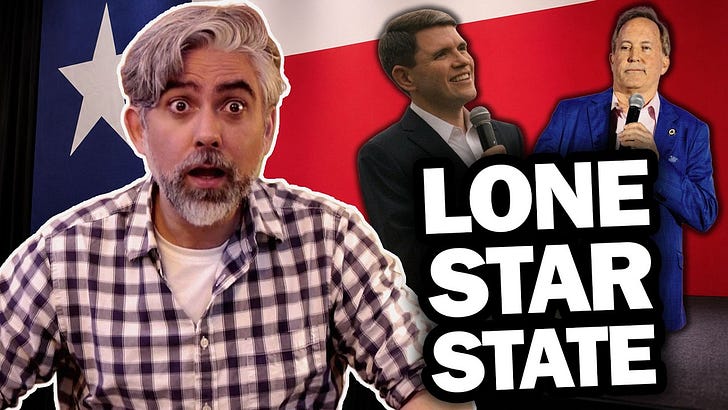 Florida Races Explained! Why Paxton vs. Talarico is Really Dallas vs. Austin (with Brian Brushwood) 18.08.2026 1h 28minFlorida is a red state, but it’s never without interest and intrigue. Byron Donalds is going to destroy everybody in the Republican primary for governor. He’s been a Trump loyalist, has Trump’s endorsement, and all the rumors about Casey DeSantis running amounted to a hill of beans. Alex Vindman will likely win the Democratic Senate primary before losing to Ashley Moody in November. But the more interesting races are farther down the ballot, where several people may be out of politics forever when this is over.Florida’s newly redrawn 22nd District has seven Republicans competing for what’ll likely be a safe Republican seat. It’s also where I finally found my line on AI-generated political content. A website attacking Belinda Keiser includes an AI image depicting her having sex with Jeffrey Epstein. I’ve had a lot of tolerance for campaigns turning metaphors and fantasies into images, but I guess my line in the sand is a candidate getting piped by Jeffrey Epstein. Now we know. David Burke appeared to be surging at the end, but there isn’t much reliable polling.Politics Politics Politics is a reader-supported publication. To receive new posts and support my work, consider becoming a free or paid subscriber.The race I’m watching most closely is Florida’s 7th District, where Corey Mills is seeking a third term against former television sports reporter Ryan Elijah. To say Mills is scandal-plagued is to say Pinocchio is only helping Monstro’s dental health, babe. Mills has faced allegations involving two former girlfriends, while the House Ethics Committee is examining possible sexual misconduct, inaccurate financial disclosures, campaign-finance violations, improper gifts, special favors tied to his office, and misuse of congressional resources. He denies wrongdoing. Sparse public polling suggests he could lose, and Republicans in Washington are desperately hoping he does.In Florida’s 20th District, redistricting pushed Debbie Wasserman Schultz into a traditionally Black seat. She’s running against former representative Sheila Cherfilus-McCormick, Dale Holness, Elijah Manley, and Uncle Luke himself, Luther Campbell. With four Black candidates dividing the vote and no runoff in Florida primaries, Wasserman Schultz only needs a plurality. I think she’ll win. Let the sun shine down and reveal the truth as Florida votes — and start a stopwatch when the polls close, because these races will probably be called within about 90 minutes. Shocking how fast that can go. Just saying.Congressional Democrats are preparing another war-powers challenge after Trump threatened to bomb Oman if it obstructs efforts to reopen the Strait of Hormuz. They’ve been looking for another non-affordability way to hit Trump over Iran, and this is a good strategy. It’s a historically unpopular war, and they want to tie him to it every way they can. Meanwhile, the administration has paused construction of a border wall inside Big Bend National Park while CBP reviews the project. Not all border is created equal. Big Bend accounts for a small share of crossings, and there are easier, lighter ways to patrol an area where somebody might still have to walk for three days after crossing.ABC has also filed a First Amendment lawsuit accusing the FCC of retaliating against the network for its editorial decisions. FCC Chairman Brendan Carr has threatened to revoke ABC’s license amid his fight with the network, particularly over Jimmy Kimmel’s comments about Charlie Kirk’s death. It’s not surprising that ABC is bringing a legal challenge, even if only as a predicate to any FCC action. If you’re ABC and the chairman of the FCC threatens your license, it would be malpractice not to take him seriously and prepare in case it actually happens.Chapters00:00:00 - Intro00:04:08 - Florida Races00:20:49 - Oman00:25:47 - Border Wall00:28:02 - ABC Sues FCC00:29:35 - Brian Brushwood on the Nuances of Texas’ Electorate01:25:20 - Wrap-up This is a public episode. If you'd like to discuss this with other subscribers or get access to bonus episodes, visit www.politicspoliticspolitics.com/subscribe
 -
 Wisconsin's Democratic UPSET. Exploring the Disney's America That Never Was (with Andrew Heaton) 12.08.2026 1h 22minWisconsin Democrats narrowly chose Milwaukee County Executive David Crowley over Democratic Socialist state representative Francesca Hong in the gubernatorial primary, 39.8 percent to 39.4 percent. It’s close enough that this might be headed to a recount, but it doesn’t appear that Hong won. Crowley, who was endorsed by Governor Tony Evers, will face Trump-endorsed Republican representative Tom Tiffany. The result halted the progressive left’s recent primary momentum, but it still showed its strength in a battleground state.What you’re probably going to hear about is the polling. After the polls wildly overestimated Abdul El-Sayed in Michigan, the final State Navigate poll had Hong at 44 percent and Crowley at 22 percent — a 22-point Hong lead. Instead, Crowley won by 0.4 percent. That’s a 22.4-point miss on the margin. Jeez Louise. Hong’s vote share wasn’t wildly off; the poll totally underestimated Crowley. The question is why these polls keep overrepresenting progressive-leaning voters.One theory is that more polls are using online surveys. The old problem with landline calls was that they overrepresented boomers because nobody under 60 had a landline. Nobody answers an unfamiliar number on a cellphone, so that leaves online responses, which might overrepresent progressives. It’s also worth noting that the DSA endorsed Hong, but Bernie Sanders and AOC didn’t. Pure DSA play isn’t good enough to get you over the hump, even in a Democratic primary. Bernie and AOC provide some wiggle room away from the DSA’s baggage.Politics Politics Politics is a reader-supported publication. To receive new posts and support my work, consider becoming a free or paid subscriber.Next door, Minnesota Democrats delivered a decisive progressive victory as Lieutenant Governor Peggy Flanagan defeated Representative Angie Craig by 20 points for the open Senate nomination. Flanagan overcame a major spending disadvantage after attacking Craig’s immigration record, particularly her 2025 vote expanding ICE authority. Republicans nominated former NFL reporter Michele Tafoya, but barring huge changes in the race, Flanagan is going to be Minnesota’s next senator. In the governor’s race, Amy Klobuchar easily secured the Democratic nomination, while state House speaker Lisa Demuth defeated Trump-backed My Pillow founder Mike Lindell. Please raise your combs in celebration.South Carolina’s emergency election to replace Lindsey Graham is headed to an August 25 runoff between interim senator Darlene Graham and Representative Ralph Norman. Graham, Lindsey’s sister and Trump’s endorsed candidate, finished first with 32.7 percent. Norman took the second spot with 24.6 percent, narrowly eliminating Representative Russell Fry. The vote was pretty split, and I don’t know whether Darlene has the juice to keep Norman off. A lot of Republicans were already angry that she decided to seek the seat permanently instead of serving as a placeholder. Ralph Norman has a real shot. The kiss of death for Darlene would be the double endorsement — a double Trump endorsement.Former Hartford mayor Luke Bronin also defeated 14-term Democratic representative John Larson, 54 percent to 33 percent. Larson, 78, became the seventh House Democrat defeated in a primary this cycle, while Governor Ned Lamont won renomination. In Alabama, Trump-endorsed Republican Rhett Marques advanced to face Democratic representative Shomari Figures in the redrawn Second District, where the Black voting-age population was reduced from 48 percent to 40 percent.Chapters00:00:00 - Intro00:05:42 - Tuesday Primary Results00:16:18 - Exploring Disney’s America with Andrew Heaton01:19:36 - Wrap-up This is a public episode. If you'd like to discuss this with other subscribers or get access to bonus episodes, visit www.politicspoliticspolitics.com/subscribe
 -
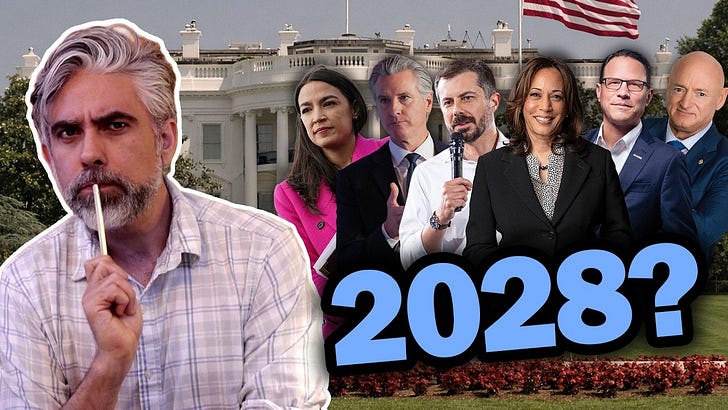 Progressives Scrape By in Michigan. Crowning a Way-Too-Early 2028 Champ (with Evan Scrimshaw) 05.08.2026 1h 22minAbdul El-Sayed is going to be the Democratic nominee for Senate in Michigan, but the victory was much closer than it looked when I initially planned to call it. With 23 percent of the vote counted, Haley Stevens was barely leading in Oakland County, which she represents in Congress, and the outstanding votes appeared to favor El-Sayed. I thought he was heading toward an eight-to-ten-point win. Instead, the margin narrowed to about 1.4 percent. Barring some miraculous vote drop out of Detroit, El-Sayed wins, but this wasn’t an overwhelming progressive victory.The polling miss is the polling miss. Congressional polling is never the most reliable. What’s strategically telling is that much of the expectation for a blowout came from El-Sayed’s own campaign, which released internal polling showing him ahead by 15 points. That obviously didn’t happen. Can you question the wisdom of releasing those numbers? You can. You can question that wisdom.Politics Politics Politics is a reader-supported publication. To receive new posts and support my work, consider becoming a free or paid subscriber.I still got my prediction wrong. I picked Stevens by five, so allow me to eat the mistakes. My prediction was closer to the final result than El-Sayed’s internal polls, but a loss is still a loss. I believed Mallory McMorrow’s female voting bloc would break more heavily for Stevens. I said from the beginning that McMorrow would decide this race; I just didn’t realize it would be her ghost bridging the gap between the other two candidates.El-Sayed started this three-way dance as the owner of the progressive lane, and he owned the issues that mattered in Michigan. It didn’t matter how folksy the Stevens campaign tried to make her. El-Sayed won, the establishment lost, and progressives deserve to celebrate. Raise a PBR and let your tears stain your unused college degree. Progressive listeners can dance on my shame because they’ve earned it.But the lesson for progressives is the opposite of what it was on The Real World: They need to stop getting real and start getting polite. Their movement isn’t overwhelming. I don’t care how fired up Michigan is about Israel, Medicare for All, or any other progressive policy. El-Sayed needs Haley Stevens voters if he’s going to defeat Mike Rogers. He needs to reach out and say, “Let’s stick it to ‘em… together,” because progressives aren’t going to get there by doing it exactly their way forever.This is still a big day for progressives, but the final margin changes what it means. It wasn’t proof that they can squash the establishment on their own. It was proof that they can win a close primary and then immediately need the people they just beat. Celebrate the victory, take the lesson from the margin, and rerack for the general election.Chapters00:00:00 - Intro and Updated Michigan Thoughts00:03:10 - Progressives and the Establishment00:12:37 - Evan Scrimshaw on 2028 Democratic Primaries01:18:44 - Wrap-up This is a public episode. If you'd like to discuss this with other subscribers or get access to bonus episodes, visit www.politicspoliticspolitics.com/subscribe
 -
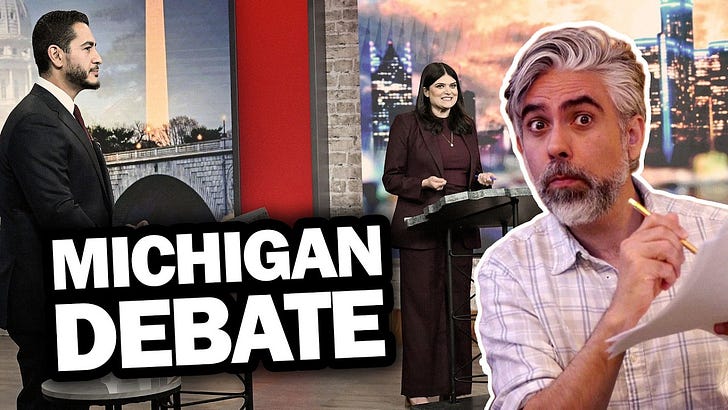 Thoughts on Michigan's Final Debate! The Impossible Midterms Archive Test (with Howard Mortman) 28.07.2026 1h 10minHaley Stevens has found her groove. She’s made herself into a plucky underdog, which is hard because she’d been typecast as the spoiled golden girl — Chuck Schumer’s special little lady who was handed everything and had all the money. Mallory McMorrow was fresh, Abdul El-Sayed was exciting, and Stevens looked like she was getting run over. Now her message is: I don’t care what they make fun of me for. I’m like you, and I’m looking out for you. It’s solid. It’s good.El-Sayed has run a very good campaign, but he’s had trouble restabilizing since Stevens found her footing. His problem is explaining his progressive message to people who don’t automatically buy into it. You need to describe the what before the why. Start with the person who counted on a government check that didn’t come, then explain why it happened and where the money went. El-Sayed keeps starting with AIPAC and the quid pro quo because he’s still talking to progressives. Progressives understand that language, but everybody else might not.Politics Politics Politics is a reader-supported publication. To receive new posts and support my work, consider becoming a free or paid subscriber.The Stevens campaign wants to make El-Sayed the bully. She keeps pointing out that he makes fun of the way she talks, and she brought up his comment about putting an ogre’s head on a spike. That matters because El-Sayed needs the McMorrow women — voters who weren’t into Stevens but could be talked into a more progressive way of thinking. He’s going to ride and die on being a fighter, including his support for abolishing ICE. That’s authentic, but he’s more of a blunt instrument than Bernie Sanders or Alexandria Ocasio-Cortez. Stevens looked confident under the lights. El-Sayed didn’t look in command. My prediction: Stevens by five.Trump, meanwhile, has asked the Supreme Court to revive parts of his executive order restricting mail voting before the November midterms. A federal judge blocked provisions directing agencies to build state citizenship lists and requiring the Postal Service to send mail ballots only to currently listed voters. I’m not personally for asking states to assemble these lists so close to an election, for the same reason I wasn’t for expanding mail voting during COVID. Anytime you’re expanding or restricting voting and changing the electorate, you’ve got to do it with some tender loving care.Trump also met with Benjamin Netanyahu for the first time since the United States and Israel launched their joint air campaign against Iran. Iran was expected to dominate the meeting as Trump decides whether to resume large-scale strikes or give diplomacy more time. There’s visible friction: Trump doesn’t like Netanyahu publicly raising concerns about activity at Iran’s Pickaxe Mountain to pressure him, while Netanyahu wants to preserve military pressure. Their decision could determine whether this pause becomes a negotiating window or merely an intermission. Nobody knows what’s happening in Iran. There are only so many ways I can say it.Michigan’s attorney general is also reviewing how a false allegation against Pete Buttigieg led authorities to separate him from his four-year-old twins. Officials acted on a vague tip before confirming the caller’s identity or credibility, and Michigan State Police later declared the allegation unfounded. Investigators found a Facebook post in which the apparent caller urged people not to vote for Buttigieg and referenced the accusation before contacting authorities. Emergency responses involving children need a hair trigger, but unsupported accusations can also become political intimidation. It’s ugly — really, really, really ugly.Chapters00:00:00 - Intro00:03:49 - Michigan00:21:31 - Israel, Iran, and Ukraine00:30:40 - Mayor Pete Swatted00:34:22 - Interview with Howard Mortman01:06:28 - Wrap-up This is a public episode. If you'd like to discuss this with other subscribers or get access to bonus episodes, visit www.politicspoliticspolitics.com/subscribe
 -
 Something Big is Happening in Iran. The Dumbest Right-Wing Media Outrage Ever (with Josh Jennings) 23.07.2026 1h 27minDonald Trump says he’s close to deciding whether to launch a massive attack on Iran as the U.S. military expands its campaign aimed at stopping attacks on commercial shipping in the Strait of Hormuz. The Pentagon used a B-1 bomber against Revolutionary Guard targets for the first time since the fighting resumed, while Iran continues attacking U.S. bases and shipping. Trump says Tehran wants negotiations, but the White House hasn’t accepted any of the Iranian proposals. The House voted 214 to 208 to demand an end to hostilities, while the Senate rejected a similar measure 47 to 49.There are a lot of signs that something is about to happen. Air traffic is moving, Israel is opening bomb shelters, hospitals are getting specific instructions, and skirmishes on the Iran-Iraq border might suggest American special forces will get involved. Trump has said Israel would quickly rejoin the fight if asked, but claims the United States could act alone. The B-1 launched from Britain can carry two dozen 2,000-pound bombs or dozens of cruise missiles. Its targets included Iranian military operations centers, maritime capabilities, aircraft hangars, drone storage, and logistics infrastructure.Iran still has some ability to threaten shipping despite officials saying its military capability around Hormuz has been sharply degraded. On the other side of Saudi Arabia, the Houthis have attacked a Saudi shipping line and threatened a second critical energy route through the Red Sea at the Bab el-Mandeb.Politics Politics Politics is a reader-supported publication. To receive new posts and support my work, consider becoming a free or paid subscriber.I think this is on and poppin’. Either there’s some kind of détente that lets Trump kick the can past the midterms, or you’ve got to extract a pound of flesh from Iran. You’ve got to call their bluff and say: Look, whatever you think you can do, go ahead and do it.I don’t think there are any coincidences in the Middle East. It’s a very transactional region, and I don’t think Saudi Arabia getting a nuclear deal is disconnected from what’s happening. My 360-degree view of Iran has always been predicated on the idea that both the region and the United States are looking to reshape the Middle East around Saudi Arabia, the UAE, and Israel as the new powers, while the United States pivots to China. But if you’re going to do that, you’ve got to really degrade Iran.I don’t know how you do it or what you can do. It certainly seems that the Trump administration believes bridges and power plants are what the IRGC really, really, really doesn’t want to lose. The more audacious military plans include storming an area where we believe Iran has nuclear material and taking it by force, seizing the coastline from which Iran is firing drones and missiles to ensure the Strait of Hormuz stays open, or seizing Kharg Island, where Iran exports its oil. I don’t know that Iran can function without the kind of money it gets from oil.It’s very hard to follow this because you don’t really know what’s happening. I didn’t know why oil stayed as low as it did before, why it fell before the memorandum of understanding, or why it’s shooting up now. If it goes way up, how fast can it fall? I don’t know. I have no idea. But it looks like something is about to pop. In fact, it might already be happening by the time this podcast hits your feed.Chapters00:00:00 - Intro00:02:52 - Campaign Undertaker00:13:42 - Iran Heats up00:20:20 - Stock Trading Bill00:21:57 - Midterm Polling00:25:33 - Interview with Josh Jennings01:22:51 - Wrap-up This is a public episode. If you'd like to discuss this with other subscribers or get access to bonus episodes, visit www.politicspoliticspolitics.com/subscribe
 -
 Somehow, Trump 1.0 Returned... The Ever-Shifting Midterm Winds (with Michael Cohen) 21.07.2026 1h 17minTo date, Trump 2.0 has been defined by everybody appearing to be on the same page and by a sense that the administration kept moving its priorities forward. You might not have liked what those priorities were, but the priorities did get done. The one big beautiful bill was described as an administration’s worth of priorities getting done too soon, and it seems like that might have been prophetic. Trump 1.0 returns when internal fights spill into public view, aides leak against one another, major spectacles vanish with nothing much changing, and the president treats factional drama as fuel rather than a problem to solve.Go back to the beginning of 2025, when Trump 2.0 very much was aligned. The coalition was locked in. The administration had momentum. USAID dismantled in a split second. The one big beautiful bill pushed over the finish line in record time. Again, the point isn’t that these were good things that happened. It’s that they kept happening. But no momentum is made to last forever. Maybe the coalition was always doomed to splinter. The cracks began to show as people were fired, as Kristi Noem and Pam Bondi went down for various different ICE shootings and Epstein, accelerating distrust and leaving Dan Bongino back on the radio airwaves. Either way, the drama that Trump 2.0 kept outside the tent has now fully moved back within it.How do we know? Because they’re telling us.Politics Politics Politics is a reader-supported publication. To receive new posts and support my work, consider becoming a free or paid subscriber.Take the address that happened last Thursday night. We knew officials were fighting over how much information the president should share when he was speaking to America. Acting DNI Bill Pulte pushed for a more aggressive version, but senior White House aides intervened. Separate reports said the speech might have claimed that Georgia’s two Democratic senators were elected illegitimately because they both came in during the 2020 runoff. The final address didn’t go that far, meaning somebody pulled something back — or at least that’s what the reports would lead us to believe, which means somebody inside the administration is telling a reporter. The 24-minute speech eventually focused more on election interference and intelligence findings as a way to get to the idea that the Save America Act should be passed. But even that’s telling, because the speech was quickly swallowed by the news cycle. That’s another hallmark of Trump 1.0: a lot of sound and fury signifying nothing, or at least nothing that’s remembered more than 48 hours later.The biggest Trump 1.0 tell is Iran. From the very beginning, the administration has said the Iran strategy has two hands. Marco Rubio and Pete Hegseth are the closed fist, the violence that will come down on the regime, while J.D. Vance, Jared Kushner, and Steve Witkoff are the open hand of diplomacy. If you want to make a deal on our terms, we’re always welcome. In the meantime, we’ll punch you in the face. Trump has actively encouraged a rivalry between Vance and Rubio, asking people all the time who they think should be the next president. And now the proxies of both men are in out-and-out war online.Alex Bruesewitz is on the J.D. Vance side, making it a priority to talk about how much foreign influence, including Israel, is affecting the discourse. Meanwhile, Israel hawks, including Mark Levin and Ben Shapiro, are attacking Vance, saying he’s surrendering to Qatar and he’s mostly a socialist. The damage is falling most heavily on Vance because he’s become the face of diplomacy. If the memorandum of understanding had worked, he would’ve gotten the credit. Since there’s now a lot of violence happening in that region again, he gets the blame. Instead of all of this being part of one big rolling ball that is the Trump administration, we now have winners and losers, which means people inside that sphere are playing the game. Very Trump 1.0.The reason this happens in both instances is, well, Big Chungus. Trump 2.0’s advantage was that the drama stayed outside the tent and the team inside was united. Now we’re getting a clearer view of exactly what the war behind closed doors looks like, and in my opinion, it goes hand in hand with priorities not being enacted. You hear a lot about the Save America Act, but it’s stalled and doesn’t have the votes to become law. Iran is different because the consequences are immediate. Trump has to show that either pressure or diplomacy can produce a successful end state. If neither path works, he’ll have made a very big bet without a clear conclusion, and he’ll have to define a win for himself even if it’s not very clear to the American people. We might already be in the lame-duck phase for Donald Trump, which may make all of these problems worse.Chapters00:00:00 - Intro00:03:44 - Trump 1.000:11:36 - Darlene Graham00:16:05 - Reconciliation, Again, Again00:19:38 - Andy Burnham00:25:03 - Interview with Michael Cohen01:13:55 - Wrap-up This is a public episode. If you'd like to discuss this with other subscribers or get access to bonus episodes, visit www.politicspoliticspolitics.com/subscribe
 -
 Donald Trump's Primetime Election Fraud Gambit. The Rise of Gray Money (with Dave Levinthal) 16.07.2026 1h 6minDonald Trump is going before the nation Thursday night to make a case about election integrity. We don’t know exactly where or how many places he’s going to be shown, but we do know what the case is supposed to be. And the difference between what he says and how he says it is literally the difference between 80% of America agreeing with him and 20% of America agreeing with him.What Trump really wants to do is demonstrate that now that he’s in control of the federal government, all the things he said about the federal government are indeed true. He wants to reveal elements of the secret workings of the deep state that he was previously unable or unwilling to reveal in his first term. According to Politico, Trump is expected to declassify previously unseen intelligence during the address, and White House aides are reportedly debating exactly how far they should go. Senior staffers have prepared a version they believe is supported by the available intelligence, while others want Trump to make broader claims.Politics Politics Politics is a reader-supported publication. To receive new posts and support my work, consider becoming a free or paid subscriber.Trump also wants to pass the SAVE America Act. The current House-passed version has two major requirements: documentary proof of citizenship when somebody registers to vote in a federal election, and photo identification when that person casts a federal ballot. The Senate doesn’t currently have the votes to pass it under normal rules unless Republicans suspend the filibuster or find another way to attach it to legislation that can pass. Whether an election law provision could survive the Senate’s reconciliation rules is a different story for a different day.The biggest, juiciest kernel inside the legislation is voter ID. That’s a huge political opportunity for Republicans and a problem for elected Democrats. If Trump were to get on television and say we need voter ID, we’re going to include it in the SAVE America package going to the Senate, and the reason is simple — only citizens should be able to vote — that’s overwhelmingly popular. Democrats will say it’s voter suppression. They’ll say women who change their names could be disenfranchised because their current identification doesn’t match what’s on their birth certificates. Well, Trump could answer that by putting money in the bill to expedite any new identification and documentation necessary to comply with the SAVE America Act, especially for women who’ve taken their husband’s names.That’s the layup. Pew found in August 2025 that 83% of Americans supported requiring government-issued photo IDs to vote, including 95% of Republicans and 71% of Democrats. Pew measured the issue again in January 2026: 80% supported voter ID, with 58% strongly favoring it and another 22% somewhat favoring it. Gallup found essentially the same thing, with 84% of Americans supporting photo identification at the polls. In politics, that’s called a no-brainer layup. Put the screws to him if you’re the GOP.But guess what? He ain’t gonna. Because Trump also wants to expose what he considers the nefarious deep state, and with that comes the greatest bugaboo of his political life: the 2020 election. If Trump goes on television and says the 2020 election was manipulated by China, Democrats, Brad Raffensperger, or anybody else, he’s no longer operating within the overwhelming support of the American public. Talking about 2020 and manipulated vote counts is, at best, red meat for the base. At worst, it’s exactly what Democrats want to be talking about, because it takes Trump further away from the current moment. Sometimes you get the 80-20 layup, and sometimes you get the long, meandering “Democrats plus China plus Brad Raffensperger ruined my life.”Chapters00:00:00 - Intro00:03:38 - Trump’s Primetime Speech00:12:02 - Iran00:15:59 - Israel and Democrats00:20:20 - NYS Data Centers00:29:23 - Interview with Dave Levinthal01:03:47 - Wrap-up This is a public episode. If you'd like to discuss this with other subscribers or get access to bonus episodes, visit www.politicspoliticspolitics.com/subscribe
 -
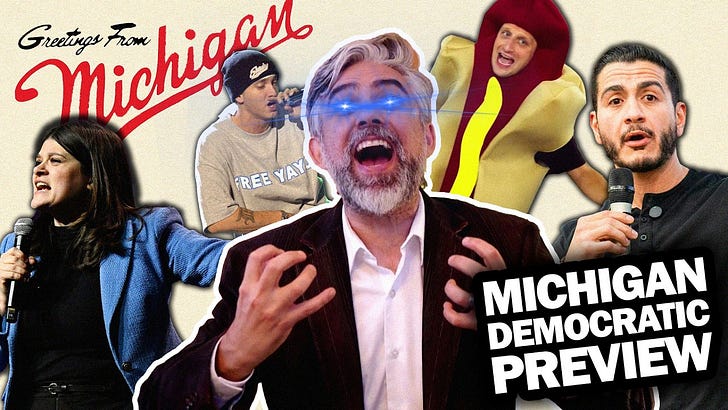 Michigan Democratic Primary Preview! The State of the Democrats Post-Platner (with Bill Scher) 14.07.2026 1h 24minCircle August 4th on your calendar: Michigan is now the number one marquee primary matchup I’m watching. Mallory McMorrow is out of the race as of a couple of weeks ago, and what’s left is a head-to-head contest between the Democratic establishment — or at least what’s left of it — and the insurgent progressive movement. Yes, friends, it’s Haley Stevens versus Abdul El-Sayed, and it’s set to be a knockout fight.This really represents the first live test for the current Democratic Party. Can the progressive movement, with a more charismatic candidate and a high-energy, extraordinarily competent campaign, expand its coalition enough to win statewide? Or will it do what it’s done in the past — hit a ceiling when the opposition consolidates?There’s only one new clean head-to-head test: a Tavern Research survey from July 6th through July 7th of 2,211 likely Democratic primary voters. It found Haley Stevens at 42%, El-Sayed at 41%, with 17 to 18% undecided. That’s a margin-of-error race, but it’s the first time in a very long time that we’ve seen Haley Stevens up over Abdul. The same poll tested the old three-person field and found El-Sayed at 41%, Stevens at 38%, and the flagging McMorrow at five. In other words, when McMorrow disappears, the voters are forced into a binary choice, and they’re making it more on the Stevens side than the El-Sayed side. But still: tight, tight, tight, tight, tight.Politics Politics Politics is a reader-supported publication. To receive new posts and support my work, consider becoming a free or paid subscriber.Because we live in reboot culture, this is essentially — coalitionally, at least — Bernie Sanders versus Hillary Clinton for a new generation. The Stevens coalition is exactly like Hill-dogs: older voters, Black voters, traditional self-identified Democrats, non-college voters, and on the Michigan side, Metro Detroit — particularly Oakland, Macomb, and Wayne counties. What’s powering Stevens is Black voters. She’s led El-Sayed consistently in almost every poll. Meanwhile, Abdul’s coalition is younger voters, very liberal and progressive voters, college-educated voters, voters outside Metro Detroit, Democratic Socialists, Arab Americans, and Muslim organizing networks. He also has significant labor support, including the UAW endorsement, despite most UAW members being non-college educated, which would normally fall outside his coalition. A very strange world we live in.The one demographic that’s going to decide this race is women. They’re the biggest disputed demo in every poll we’ve seen. An April Glenn Gariff poll showed Stevens leading among women 29% to 17%. But in a June Mitchell poll, the exact opposite was demonstrated: El-Sayed led with women 51% to Stevens’s 35%. So as we look at the rest of the polls from now until Election Day, keep an eye on the ladies. They’re the majority of the likely Democratic primary electorate. If Stevens can consolidate older and Black women while also inheriting McMorrow’s suburban women, she can win. But if El-Sayed’s progressive and younger female support holds, his coalition may be large enough to break through.Which brings me to the latest front of this war. I don’t know if it’s being done to court women, I don’t know if it’s being done specifically on purpose, but the results are undeniable: El-Sayed and Stevens are in an out-and-out shooting match to be more cringe. For Haley Stevens, this isn’t something she has to worry about. She’s naturally gifted in this regard. She’s awkward, she has a thick Great Lakes accent, and she speaks in this clipped, emphatic manner. On one hand, she is herself. She feels less like a polished Washington candidate and more like somebody who wandered out of a Detroiters sketch. Abdul El-Sayed has the opposite problem. He’s clearly a charismatic, compassionate candidate, a strong communicator, and an aggressive counterpuncher. But if you’re running against him, your job is to make El-Sayed scare the hos. I think his campaign has found a solution: make himself toe-cringingly embarrassing. My read — and this is analysis, not something the campaign has admitted — is that cringe is a form of inoculation against being defined as scary. If you’re embarrassing, you can’t be terrifying.So who’s going to win? I’m an old-school guy. I tend to bet chalk unless I’m convinced otherwise. And while I very much believe El-Sayed has the better campaign, and I think he’s the better candidate if we’re just looking at raw talent, I’d still bet the Michigan coalition that usually wins. Haley Stevens is a suboptimal candidate, and I’ve counted her out at every step of this race. I thought McMorrow was going to win. That obviously didn’t happen. So don’t take my prediction for a whole lot. But Stevens doesn’t really have to do anything but be her cringy self to get over the line. Meanwhile, waiting on the other side, smiling like the butcher’s dog, is Mike Rogers. He nearly beat Elissa Slotkin in 2024, losing by only 18 to 20,000 votes, about 0.3%. This is supposed to be more of a blue-wave year, but Rogers is going to benefit from a fractured leftward coalition. After Stevens and El-Sayed spend weeks beating the hell out of each other, the question is whether the losing half comes home. If they don’t, Rogers benefits.Chapters00:00:00 - Intro00:03:01 - Michigan Preview00:14:58 - Update00:22:04 - Trump’s Upcoming Address00:25:40 - Reconciliation00:29:36 - Inflation00:32:37 - Interview with Bill Scher01:20:01 - Wrap-up This is a public episode. If you'd like to discuss this with other subscribers or get access to bonus episodes, visit www.politicspoliticspolitics.com/subscribe
 -
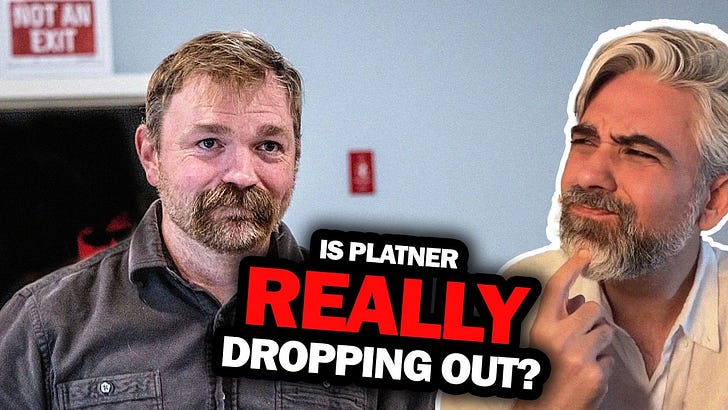 Is Platner REALLY Out? The Arizona Congressman Story You Won't Believe (with Juliegrace Brufke) 09.07.2026 55minGraham Platner is out… but is he? Last night in Maine, he released an 11-minute video that savaged the Democratic establishment and the progressive establishment. He blamed everybody but himself for why he’s suspending his campaign, saying all of his resources were taken away from him. The people who didn’t fight for him — Ro Khanna, Bernie Sanders, Hasan Piker — all wound up in the blast radius.Everybody wanted Platner to be a lot more conciliatory. He was not. He was forceful. He took what he wanted. But here’s the big question: you can’t declare bankruptcy like Michael Scott. You can’t just walk into the office and yell, “Bankruptcy.” You need to file paperwork. So even though Graham Platner suspended his campaign on Twitter, that doesn’t mean his campaign is suspended in real life.Politics Politics Politics is a reader-supported publication. To receive new posts and support my work, consider becoming a free or paid subscriber.He’s telling people he’ll suspend his campaign on Monday. By the way, Monday is when he needs to file by. If Graham Platner gets a little sleepy on Monday and forgets to file, then there’s no replacement. He’s the nominee. That’s something to keep an eye on. Now, full transparency: I don’t believe he’s going to do that. I do believe he’s going to file either then or sooner, and this will eventually blow over. But, still, with this guy, you really never know.So the question becomes: who’s running against Susan Collins? A handful of names are now in the mix, and they’ll essentially be decided at a hastily thrown together state convention sometime in the next few weeks, because Democrats need an answer by July 27th. Troy Jackson tends to be more of the favorite of the progressives. Nirav Shah, the former Maine CDC director, is in the conversation. Dan Kleban, who had initially been running against Platner before dropping out when Janet Mills got involved, is back in a big way. Jordan Wood, Paige Loud, and Shenna Bellows bring up the rear.I don’t know exactly what happens at that convention. Are they all going to debate on one stage? Are they just going to make their pitches and then have a back and forth? I do know this: if you leave it up to the supporters of those people, they’re going to start knifing each other. And if you’re a Democrat trying to take down Susan Collins, that’s the last thing you want. You don’t want this to get fractious.There’s some polling from a pro-Nirav Shah outside group showing Shah up on Collins 47-46, Collins up on Troy Jackson 48-47, and Collins tied with Shenna Bellows 47-47. I don’t know whether that’s a reputable outfit or whether those are reputable polls. What I’ll say is this: if you’re tied with Susan Collins, you’re losing. Platner, before the disaster, was running about eight to ten points ahead of Susan Collins. Now Democrats are looking at people who are tied, and Susan Collins regularly outperforms her polls by six to eight points. So if you’re tied with Susan Collins, you’re losing. Have we seen the last of Graham Platner? Man, I really don’t know.Chapters00:00 - Intro03:52 - Graham Platner09:47 - Trump’s Plane Switch12:40 - Mexico, ICE, and Dems Polling18:55 - Interview with Juliegrace Brufke52:36 - Wrap-up This is a public episode. If you'd like to discuss this with other subscribers or get access to bonus episodes, visit www.politicspoliticspolitics.com/subscribe
 -
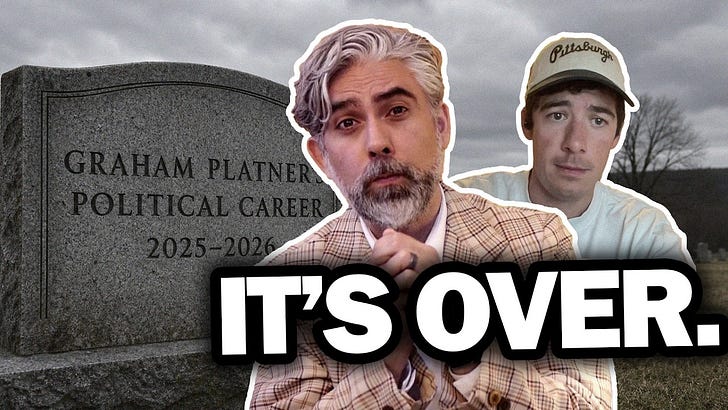 Europe's Ridiculous Divorce from America. It's Curtains for Graham Platner (with Kirk Bado) 07.07.2026 1h 2minEuropean leaders are talking about a rupture with America — a de-Americanization of the continent driven by Donald Trump’s demands that NATO members spend more on defense, his transactional view of alliances, and even his threats to annex Greenland. I don’t blame them for being frustrated. Their citizens hate the guy, and they still have to deal with him.Trump is never going to be a weepy internationalist reminiscing about the transatlantic bond forged in blood and mud from World War II through the Cold War. He looks at every relationship as a business deal: What are you doing for me, and what am I doing for you in return? He doesn’t mind doing something for Europe if Europe does something for America, and he views this as one of our more one-sided relationships.European governments are now removing American technology from their systems, adopting European open-source software, and investing hundreds of billions of dollars in their own space firms, artificial intelligence companies, and data centers. Good luck. If Europe were capable of developing that economy under its current system, it wouldn’t be in this situation. The talent exists, but investment is too hard, regulation is too burdensome, and companies must navigate a collection of fiefdoms with their own tax bases and regulatory structures. Europe has a gigantic social safety net, and it can’t grow its way out of it.Politics Politics Politics is a reader-supported publication. To receive new posts and support my work, consider becoming a free or paid subscriber.The numbers tell the story. From the fourth quarter of 2019 through the first quarter of 2026, real GDP grew 15.2 percent in the United States and 6.4 percent in the euro area. In the first quarter of 2026, American GDP was up 2.7 percent year over year, while the euro area managed 0.3 percent. Europe has made more promises to its citizens, created a larger regulatory burden, and left itself more vulnerable to inflationary spikes. If it wants to decouple from America, it will need to start paying its own bills — including the enormous cost of providing for its own defense.Quite simply, Europe is not a serious place. Many of the leaders complaining about Trump might not even be around in 2028. By then, a President Vance could meet a NATO shaped by Nigel Farage, Marine Le Pen, and an elder stateswoman Giorgia Meloni. The political order Europe imagines itself preserving may be disappearing faster than its relationship with Washington.For lack of a better phrase, Europe needs a sugar daddy, and its binary choice is either America or China. Only one of those countries has a shared history with Europe, and it’s us. I understand that Trump is frustrating and isn’t the American president European leaders came to know and love. But he’s the best they’ve got, and the alternative is either unrealistic or worse. There is no great substitute for America, so Europe will ultimately have to take the deal we give it.Chapters00:00:00 - Intro00:03:44 - Graham Platner00:07:29 - Kirk Bado on Graham Platner and More00:35:20 - Andrew Gillum’s Arrest00:45:49 - Trump’s F-35 Push for Turkey00:48:08 - Iran Attacks00:50:08 - Europe’s Divorce from America00:59:56 - Wrap-up This is a public episode. If you'd like to discuss this with other subscribers or get access to bonus episodes, visit www.politicspoliticspolitics.com/subscribe
 -
 Happy Birthday America, You Absolute Classic. The Fate of the Democratic Party (with Jeff Maurer) 02.07.2026 1h 27minWe talk all the time about how America is a very young country, and that’s true when you compare us to Europe, Africa, and Asia, where countries are built around lineages, ethnic majorities, and religions. But not America. We’re a melting pot. We’re risk takers. It’s woven into the fabric of the United States that no matter where you are right now, tomorrow can be better than today was, and your life can be better here than it can be anywhere else in the world. You can gain here. You can lose here, too, so you’ve got to be careful and you’ve got to be vigilant. But that lesson is what moves us forward.I keep telling people that, with America, we’ve got a classic. But what does that mean? In the same way your favorite song is a classic, something you can play over and over again and it never gets old. Your favorite movie that you quote with your friends. Something that lives in your head and every time you think about it, you find a new way to think about it. Two hundred and fifty years ago, we declared independence with the idea that we could make one. We could invent our own set of rules that would not only endure, but allow humans to prosper. What we got from it was the United States Constitution. It continues to endure to this day. We argue about it, we amend it, we challenge it, and we defend it because we know it’s worth defending. It’s a classic.Politics Politics Politics is a reader-supported publication. To receive new posts and support my work, consider becoming a free or paid subscriber.While we are a young country, we are old in one regard: we are the longest continuous form of government on the planet. Everybody else comes and goes. You don’t have to when you’re sitting on a classic. I love America. I love talking about our great moments. I love talking about our bad moments. I love learning lessons from the missteps we’ve made, and I love reveling in our success. Ronald Reagan once said that you could live a hundred years in Japan and not be Japanese, or in Germany and not be German, but if you come to the United States, you can be an American. It is a spirit that beats deep within those of us who are lucky enough to have been born here and lucky enough to live at the bleeding edge of technology, culture, and finance. We have our problems, but there is no better country on the planet to identify them and fix them.So this weekend, raise a glass with your loved ones. Grill whatever you want on that grill. Look around in that humid, hot weather, whether you’re by the lake, in your backyard, sitting at your desk, or doing whatever the hell you want. I hope that either physically or in spirit, you’re with your friends and family when you say, “Happy Birthday, America.” You absolute classic.Chapters00:00:00 - Intro00:10:17 - America at 25000:17:05 - Interview with Jeff Maurer00:42:55 - AOC Endorses El-Sayed00:48:54 - SAVE America Dead?00:51:18 - OpenAI’s 5% Plan00:54:37 - Interview with Jeff Maurer, con’t01:21:47 - Wrap-up This is a public episode. If you'd like to discuss this with other subscribers or get access to bonus episodes, visit www.politicspoliticspolitics.com/subscribe
Podcast simili


Popolare in
Questo podcast compare anche nelle classifiche dei podcast di questi paesi.
