
Geeky Stoics
Stephen Kent
0
Geeky Stoics explores Stoicism, philosophy, and wisdom found in pop culture, drawing lessons from stories like Star Wars, The Lord of the Rings, Marvel, and Batman. The podcast encourages listeners to see how their favorite stories can apply to real life. Hosted by Stephen Kent, it offers insights into how ancient philosophy intersects with modern narratives.
Episodi
-
 Kill the Myth, Kill the Man 16.09.2026 13minAnother day is upon us. It’s been a busy few weeks in the world of Geeky Stoics. Last week, I traveled to Nashville, Tennessee, to appear on the Jeremy Boreing Show for a wide-ranging conversation on how to save the West….a discourse I am honored to be part of. It’s weird to me that this Substack has allowed me to enter into such discussions. Very grateful. Before heading to Nashville, Boreing posted something that I felt compelled to React to: a monologue about myth and the heart of man. Stories anchor our hearts and, frankly, civilization, when storms inevitably arrive.Without a good story — we often don’t know what to do with misfortune, loss, pain and defeat. We don’t have any basis on which to deny temptation, decline power, or walk away from ugly situations. Story is the key. Check out the video above for more. We are hosting another retreat for Geeky Stoics!We’ll return to Magnalia Homestead in April 2027, with 18 spots available for members of the Geeky Stoics community. 3 days, 3 nights — dedicated to reading, community, and conversation. Renew your mind, make friends, and read a book. Registration is below. It is ticketed at $800 (lodging and meals included). $200 secures your spot; you can make the final payments in installments if that’s helpful for budgeting to attend. New on YouTube this week: Zelda!!!!!Thanks for reading Geeky Stoics! This post is public so feel free to share it. This is a public episode. If you'd like to discuss this with other subscribers or get access to bonus episodes, visit geekystoics.substack.com/subscribe
 -
 The Odyssey Isn't About Odysseus | A Thematic Review 21.07.2026 20minThis is a public episode. If you'd like to discuss this with other subscribers or get access to bonus episodes, visit geekystoics.substack.com/subscribe
 -
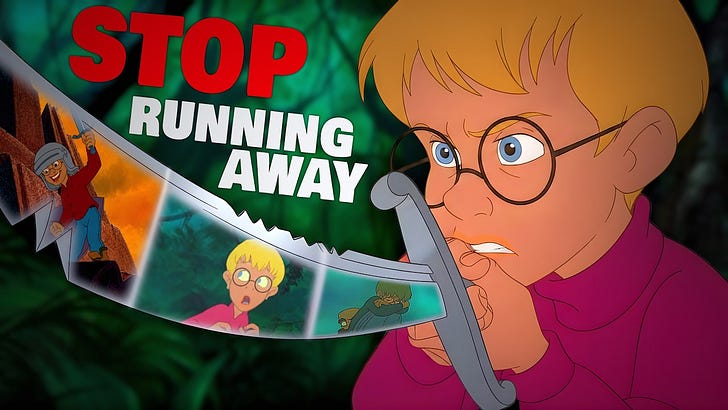 The Pagemaster and Young Men's Malaise 14.07.2026 4minThis is a free preview of a paid episode. To hear more, visit geekystoics.substack.comEvery now and then, I get motivated to write about a story I loved, which is niche and rather unknown to our subscribers. The Pagemaster (1994) is one such story. This VHS-era classic, starring Macaulay Culkin and Christopher Lloyd, is, to this day, one of my favorite animated movies. It’s about a young boy afraid to go outside or do anything that invol…
 -
 The State of Star Wars 09.06.2026 58minWe are witnessing the decline of Star Wars’ cultural dominance.In this week’s podcast, we’ll explore the current state of Star Wars, from its cultural impact to the storytelling challenges, and speculate about how the franchise might revive itself.We have a book coming this year!!! The Great Escape: 30 Reflections on Stoicism, Faith, and the Wisdom of Great Stories. Be the first to get early access, bonus content, and updates: The Rise and Fall of Star WarsStar Wars was more than movies; it was a shared cultural language. But since the end of the prequel era, its position in the cultural mainstream burst forth with the hype of The Force Awakens, then waned slowly but significantly. I’d argue that Star Wars has faded back into the niche. Not unlike the “Dark Times” of the late 80s and 90s, or even the post-Revenge of the Sith Clone Wars era. The explosion of Star Wars back into the zeitgeist after the Disney purchase showed its potential for a return to mass appeal. (Baby Yoda’s popularity is Exhibit A) Yet, the declining box office performance reveals a stark reality: audiences are less engaged, and the franchise struggles to resonate as it once did. (The decline in interest in the Baby Yoda movie is Exhibit B)The decline isn’t a death knell but an inflection point. The sheer mismanagement and lack of strategic storytelling have pushed Star Wars below the cultural radar.But I might be ok with that.Geeky Stoics is a reader-supported publication. To receive new posts and support my work, consider becoming a free or paid subscriber.Can Star Wars Rise Again?While the franchise faces cultural fatigue and spaghetti-on-wall mismanagement, I still have hope. IF.And it’s a big if…There’s a willingness to learn from the mistakes of the Disney era and start over fresh. Star Wars’ comeback depends on returning to its storytelling roots rather than propping up a failed era of postmodern, nihilistic storytelling. 00:00 Introduction04:07 Mandalorian and Grogu11:41 Star Wars Heresy vs. Bad Films15:10 Cultural Impact of Star Wars22:40 Optimism for the Future of Star Wars27:56 Crisis of Credibility in Star Wars30:56 Star Wars as an Underdog33:57 The Impact of Marketing on Star Wars35:47 C.S. Lewis and Star Wars40:56 Upcoming Star Wars Projects46:03 Stoicism and Christian Philosophy This is a public episode. If you'd like to discuss this with other subscribers or get access to bonus episodes, visit geekystoics.substack.com/subscribe
 -
 Unmasking Toxic Empathy 16.05.2026 1h 2minIn this week’s live stream and podcast, Geeky Stoics is exploring the concept of toxic empathy, its implications, and how it influences society, politics, and relationships. Riley and Stephen delve into the nature of empathy, moral virtue, and the importance of balancing compassion with discernment.Chapters:* 01:08 What Is Toxic Empathy?* 04:33 Empathy in Literature and Media: Star Wars and Narnia* 08:04 Moral and Cultural Relativism in Empathy* 15:13 Empathy in Justice and Punishment* 20:23 Evil and Moral Clarity* 27:27 The Limits and Risks of Empathy* 30:15 Advice for Self-Discovery* 37:17 Balancing Career, Family, and Personal Purpose* 43:30 Watchtower Intel* 48:02 Community and Future Retreats* 54:18 The Power of Storytelling and Shared ValuesResources: * Gad Saad’s book ‘Suicidal Empathy’* Paul Bloom’s book ‘Against Empathy’ * C.S. Lewis’s ‘The Four Loves’* Orthodoxy by GK Chesterton* Watchtower Intel on Substack This is a public episode. If you'd like to discuss this with other subscribers or get access to bonus episodes, visit geekystoics.substack.com/subscribe
 -
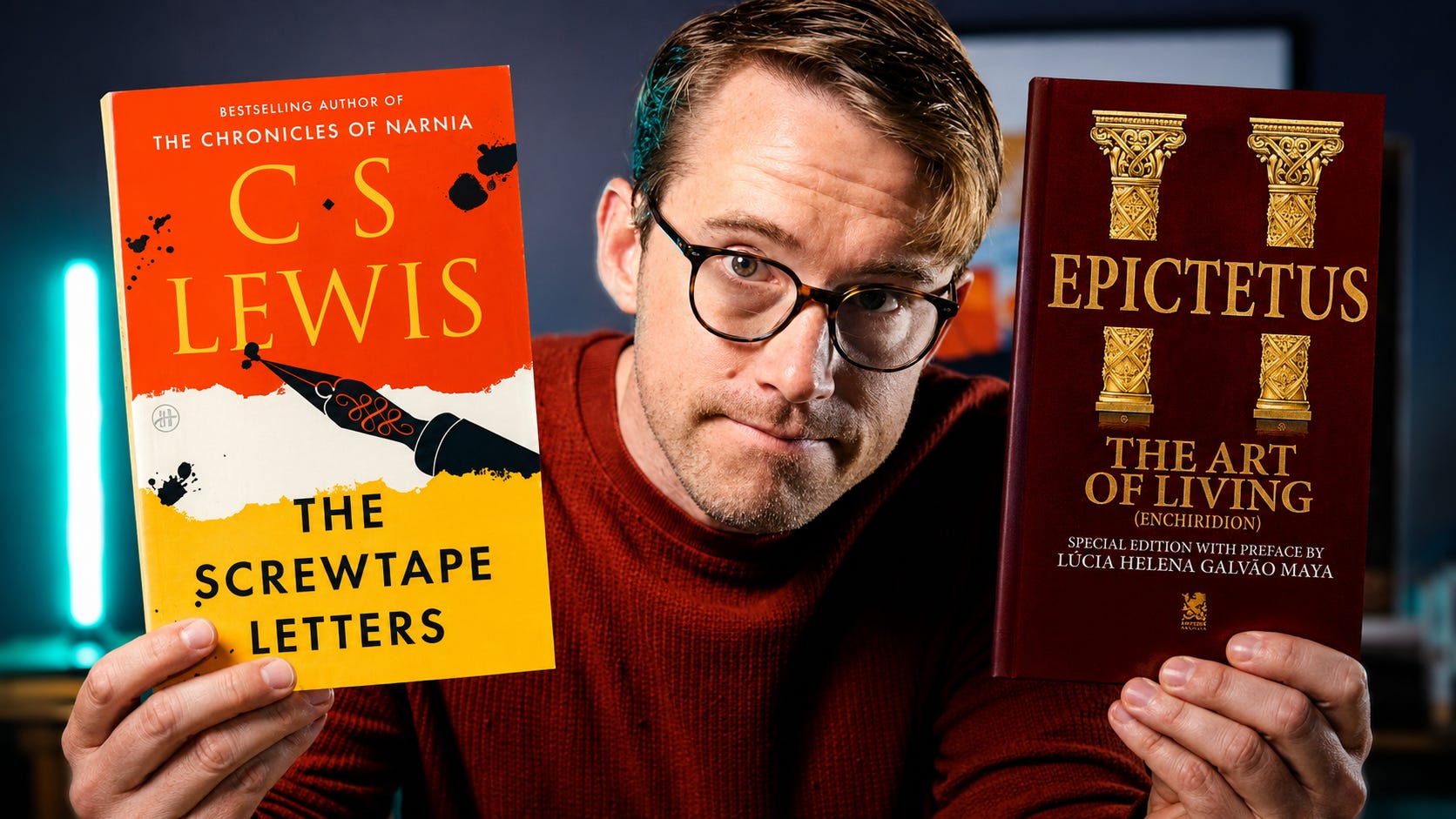 The Stoicism in The Screwtape Letters 09.05.2026 10minToday’s reading of The Screwtape Letters focuses on Chapter 3, a letter about personal/family relations and the importance of managing your impressions regarding facial expressions, tone of voice and other mannerisms. Things can break down rapidly when a relationship drifts toward enmity and assumed bad faith, and Lewis’s warning here is to reflect on how you let yourself off the hook for grating mannerisms—while scrutinizing those of everyone else. When two humans have lived together for many years it usually happens that each has tones of voice and expressions of face which are almost unendurably irritating to the other. Work on that. Bring fully into the consciousness of your patient that particular lift of his mother's eyebrows which he learned to dislike in the nursery, and let him think how much he dislikes it. Let him assume that she knows how annoying it is and does it to annoy — if you know your job he will not notice the immense improbability of the assumption. And, of course, never let him suspect that he has tones and looks which similarly annoy her. As he cannot see or hear himself, this is easily managed.It’s a distinctly Stoic letter, almost like Lewis drew directly from Epictetus. It is not the only time Screwtape Letters offers blocks of wisdom that parallel the Stoics. In this video, I also draw on a book called Jesus & Stoicism by Brittany Polat, which compares Bible verses with lines from the Stoic philosophers, to show where these “virtuous pagans” were on the right track when it came to ethics that Christianity made mainstream in the West. I highly recommend it for your bookshelf. You can buy it at the link above. This video is free for everyone to enjoy as a thank-you for being on the newsletter. We’re glad you’re here, and every subscription helps us keep Geeky Stoics going. This is a public episode. If you'd like to discuss this with other subscribers or get access to bonus episodes, visit geekystoics.substack.com/subscribe
 -
 Mind Your Own Business 28.04.2026 8minGood morning! At our recent retreat, I came across a wardrobe with a semi-magical tea room inside… so naturally, I decided to crawl in and record a video podcast (typical). This was filmed by Jon of First Time Readers, a truly great channel for Tolkien analysis, and it focuses on a passage from C.S. Lewis’ Narnia books that I enjoy and return to often. By the way, we are now signing people up for the waitlist to pre-order our new book: GREAT ESCAPE: 30 Reflections on Stoicism, Faith and the Wisdom of Great Stories. Coming December 1st from Post Hill Press. This is a public episode. If you'd like to discuss this with other subscribers or get access to bonus episodes, visit geekystoics.substack.com/subscribe
 -
 All Men Have Something To Teach 19.04.2026 5minBehind the scenes of the first Geeky Stoics retreat This is a public episode. If you'd like to discuss this with other subscribers or get access to bonus episodes, visit geekystoics.substack.com/subscribe
 -
 Maybe Escapism is Good, Actually 31.12.2025 13minI don’t like to turn my brain off when enjoying a movie, show, or book. For me, the point has never been to “escape” the real world or be off in La-La Land; it’s to think more deeply. If a story isn’t engaging me on the level of morality, ethics, political thought….I get kind of bored. So, I’ve always criticized fellow fans of, say, Star Wars, who argue in the comments that they expect a story to offer “escapism.” It’s possible that, according to Tolkien, I’m wrong about this. Today I sat down to read a few pages of On Fairy-stories, an essay by JRR Tolkien about the question of “escape” and how good stories are anything but…..This is early exclusive for subscribers on Substack and the Discord community, and then it will be posted on YouTube next week. Thanks for being part of our mythically minded community. Riley and I are hard at work on our new book, which should be wrapped up by March. Then we’ll be penning more regular posts again here for all of you.Happy New Year, y’all! 2025 was incredible. You played a part in that for us at Geeky Stoics. Thank you. This is a public episode. If you'd like to discuss this with other subscribers or get access to bonus episodes, visit geekystoics.substack.com/subscribe
 -
 Luminous Beings Are We: A Christmas Message 22.12.2025 9minThere’s a scene in The Empire Strikes Back that never gets old. It’s kept its grip on me to this day.Luke in the Dagobah swamp, staring down the task he’s already decided is impossible. “It’s too big,” he says. And Yoda’s quiet reply exposes the lie most of us carry: that truth is limited to what we can see, touch, and control.Luminous beings are we.This week’s video is a reflection on that moment and why it matters, especially during the Christmas season.The Stoics spoke of the Logos, the rational order holding the universe together. The beloved disciple John took that same word and made a shocking claim: the Logos is not an idea or a general “force,” but a person. The light did not stay distant. He stepped into the darkness of this world to save us.For some of you, Christmas doesn’t feel like “good news.” I get that. It can be a tough time of year. But the story didn’t begin in guilt or judgment. Jesus’ story began in wonder. As an answer to an ache. As the radical claim that you are more than “this crude matter.”At Geeky Stoics, we call that Wonder. And without it, even the best of Stoic philosophy collapses into hollow self-help.The video explores all of this: Yoda, the Stoics, Saint Augustine, and why “luminous beings are we” is a truth we must remember, especially this time of year.Merry Christmas,—Riley This is a public episode. If you'd like to discuss this with other subscribers or get access to bonus episodes, visit geekystoics.substack.com/subscribe
 -
 Wisdom showdown: Uncle Ben vs Uncle Ben 09.12.2025 2minThis is a free preview of a paid episode. To hear more, visit geekystoics.substack.comUncle Ben from Spider-Man serves as an introduction to wisdom and “maxims” for many kids around the world. It all starts with the movies we watch and the books we read. Here’s Uncle Ben in the 2002 movie….“This guy, Flash Thompson, he probably deserved what happened. But just because you can beat him up doesn’t give you the right to. Remember, with grea…
 -
 I finally made the video I’ve been scared to make. 03.11.2025 8minThis one feels different.It’s the first time I’ve ever made something this personal for Geeky Stoics, pulling back the curtain on my struggle as I lost myself in my Air Force career, and how I found my way back, training for a Half Iron Man. It’s a story about identity, ambition, and the moment you realize you’ve been chasing someone else’s version of success.And the only way I knew how to tell it…was through the lens of Star Wars.Luke Skywalker has always been my guide for understanding who I want to be. While he struggles and loses his way, he still finds his way back… A hero, like his father before him. Somewhere along the way, I forgot that. This video chronicles my obsession to remember again.It’s called “The Dream That Refused to Die.”And before it goes live to the rest of the world on YouTube, I wanted you, the Geeky Stoics community, to see it first. So here it is. Geeky Stoics is a reader-supported publication. To receive new posts and support my work, consider becoming a free or paid subscriber. This is a public episode. If you'd like to discuss this with other subscribers or get access to bonus episodes, visit geekystoics.substack.com/subscribe
 -
 What's This About A Bible Sales Surge? 02.11.2025 4minNews reports this October showed a surge in Bible sales across the United States and the UK, confirming what so many people can feel and polls have supported…which is that a religious revival is happening in the West. Generation Z, which Pew Research defines as being born between 1997 and 2012. Members of the generation — also known as Zoomers — have been increasingly drawn toward religion, particularly Christianity, with data showing the number of Americans who don’t identify with one particular church is stabilizing thanks to them.Fact: Overall, younger generations are more spiritually curious. Barna research group reports that most Gen Z teens are interested in learning more about Jesus, with younger cohorts leading the way in the growth of new commitments.This was what George Lucas wished for with Star Wars. He sought to awaken spirituality in young people back in the 1970s….which didn’t take right away. One has to wonder if there a delayed effect of stories like Star WarsBy in large, I believe the youth spiritual revival is a byproduct of “divorce culture” driven by Baby Boomers throughout the 1980s-2010s. Young people rebel against what older folks are doing, and it is not true to say that our elders are somehow rigid traditionalists and papist scolds. Most Boomers are in their second or third marriage, leaving the church as a result (feeling of shame) and experiencing a rapid decrease in their religiosity. There does come a point at which kids will notice the decisions they made, and do the opposite. And funny enough, that is now church and marriage. Geeky Stoics is a reader-supported publication. To receive new posts and support my work, consider becoming a free or paid subscriber.What do you think? Is something happening in the West when it comes to spirituality and a return to faith? Or is it something else? New from Geeky Stoics on YouTube This is a public episode. If you'd like to discuss this with other subscribers or get access to bonus episodes, visit geekystoics.substack.com/subscribe
 -
 Can we choose our feelings? Reflecting on Charlie Kirk, empathy and objective morality 19.09.2025 5minThis is a free preview of a paid episode. To hear more, visit geekystoics.substack.comThank you to everyone who tuned into my live video! Join us for our next live video in the app and upgrade your subscription to get more involved in the community.
 -
 Tolkien, Virtue, and the Good Life 29.08.2025 39minHobbits are curious creatures. Simple taste, a love of “good tilled earth” and yet surprisingly courageous. And according to Dr. Christopher Snyder, they might hold the key to living the good life.This week, I had a delightful conversation with Dr. Snyder, medieval historian, Tolkien scholar, and author of Hobbit Virtues: Rediscovering Virtue Ethics Through J.R.R. Tolkien’s The Hobbit and The Lord of the Rings.Chris’s work as an academic intersects history, philosophy, and storytelling and even has taken him to the hallowed halls of Oxford University - Tolkien’s alma mater.A few highlights from our conversation:Why Hobbit Virtues?Chris began writing this book in the aftermath of the 2016 election, during a time of cultural division. His thesis: virtue ethics can cut through polarization.By focusing on virtues like courage, humility, sacrifice, and friendship, we can find common ground. Chris argues Tolkien’s writings are full of timeless virtues embodied in hobbits, elves, and men.Fellowship as a VirtueFriendship is something of a hot topic right now at Geeky Stoics. Chris didn’t shy away from the controversy, arguing:* Tolkien modeled his Fellowship of the Ring partly on the Arthurian Round Table and partly on his own experiences at Oxford, where “fellowship” literally meant scholars eating, drinking, and learning together.* Unlike utilitarian philosophy (the greatest good for the greatest number), Tolkien’s heroes make personal, sometimes costly, choices rooted in courage. Aragorn choosing to save Merry and Pippin instead of chasing Frodo isn’t “efficient,” but it’s the right thing to do.* Chris ties this back to our modern loneliness crisis. Where Aristotle emphasized the polis (the city), Tolkien and Lewis remind us that the quality of our friendships and fellowships challenge us to be our best selves.Heroism: The Anglo-Pagan and Christian EthicAnother fascinating insight: Tolkien blended ancient pagan heroic traditions with Christian ethics.* The “barbarian ethos” of the Vikings and Anglo-Saxons valued courage even when hope was lost.* Christianity introduced something radical: hope not reserved for emperors or warriors, but for the meek, the humble, and the forgotten.* Tolkien fused these in his hobbits: ordinary folk who, precisely because of their humility, are capable of great virtue.As Chris put it, when Aragorn bows before the hobbits at his coronation, that’s Peter Jackson's interpretation of Tolkien’s ideal of kingship - ensuring Frodo and company “bow to no one.”So What?At Geeky Stoics, we’ve often said that pop culture stories are modern myths, our entry point for Western philosophy. Chris reminds us that this wasn’t accidental. Tolkien (like Lewis, like Lucas) used storytelling as a vessel for telling a greater truth.We remember Qui-Gon’s line, “Your focus determines your reality” more than reading a philosophy textbook; we remember Sam carrying Frodo, or Obi-Wan telling Anakin, “You were my brother.”Stories shape our moral imagination.I’ll end this where Chris began our conversation:“The elucidation of truth, and the encouragement of good morals in this real world, by the ancient device of exemplifying them in unfamiliar embodiments, that may tend to ‘bring them home.”-J.R.R. TolkienMTFBWY, -Riley This is a public episode. If you'd like to discuss this with other subscribers or get access to bonus episodes, visit geekystoics.substack.com/subscribe
 -
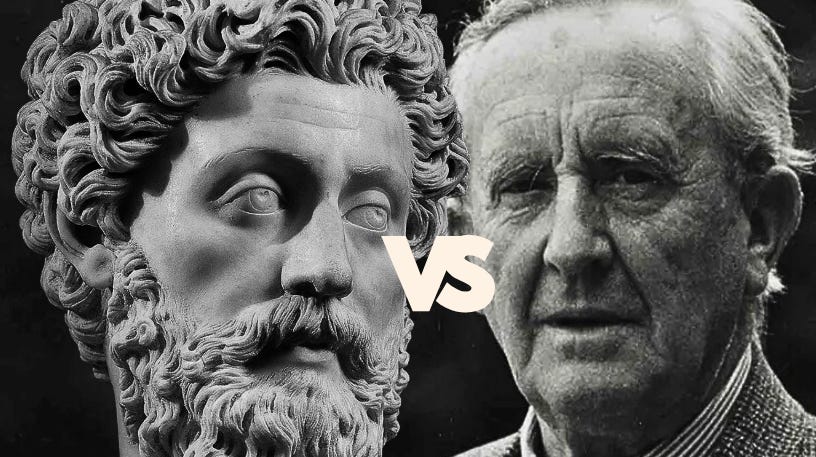 Call It What It Is 25.08.2025 6minUpdating your perspective on the world can, for some, be like seeing for the first time. Many of us have seen videos of colorblind people getting access to new tech that helps them see the full spectrum. When they tap in for the first time, it’s overwhelming and emotional. Something true shines through a veil that they’ve been burdened with forever. I remember when I started to reconnect with my faith several years ago, and things were becoming clearer to me about who I am and why I am here. I would get distracted while driving by trees and landscapes. Particularly Japanese Maples and other crimson trees mixed into mostly green gardens. Something was more striking about everything. Refined Jedi Sight Consider this poem out of the Star Wars universe about the role of the Jedi Order in bringing balance to the galaxy."First comes the dayThen comes the night.After the darknessShines through the light.The difference, they say,Is only made rightBy the resolving of grayThrough refined Jedi sight."― Journal of the Whills, 7:477It’s a beautiful stanza. Light is reality. Darkness is equally valid and inevitably enters the world, complicating whatever light came before it. What confounds so many of us is when the canvas then turns gray. Complex experiences and feelings stop us in our tracks.Am I loved?What is the right thing to do here?Somebody gets hurt, no matter what I choose.We overthink. We ache.You need a worldview, something that reconciles or can be used to interpret what you’re experiencing. Glasses. Philosophy. Story. Philosophy is in many ways a kind of story. The danger is, of course, that not all glasses reveal tru th equally. The Jedi, this poem suggests, have refined sight or an ability to interpret what’s happening.You might call that wisdom.How We Label ThingsJ.R.R. Tolkien wrote in his celebrated essay, On Fairy Stories, about the role of a good story in illuminating the world for its audience. He called it “recovery” in the sense that our vision and health have been compromised. A good story heals.Separating himself almost directly from the Stoics, Tolkien quipped, “I do not say ‘seeing things as they are’ and involve myself with the philosophers,” which is what Marcus Aurelius or Epictetus would call for. “I might venture to say,” Tolkien continues, “seeing things as we are (or were) meant to see them.”Geeky Stoics is a reader-supported publication. To receive new posts and support my work, consider becoming a free or paid subscriber.The Stoics had a dogmatic commitment to blunt reality and practiced it by doing things like calling wine “the mere juice of crushed grapes,” so as not to romanticize what it’s called for commercial purposes. Steak is a piece of dead cow, scorched and salted. That’s the “truth”. Dead Scorched Cow is a little less appealing for 12oz at $45 than calling it Premium Aged Ribeye Steak.“We need, in any case, to clean our windows; so that the things seen clearly may be freed from the drab blur of triteness or familiarity—from possessiveness,” Tolkien adds.Whether it’s eyeglasses, windows, or stained glass, the idea that unites so many great thinkers is that something exists outside of the room we’re living in. There is something we’re missing, and either smudges, a faulty prescription, or the absence of light is preventing us from seeing what we’re supposed to see on the other side.Truth. Beauty. Purpose. Design.Overexposure and familiarity dull the senses to what would otherwise take our breath away.The Stoic mindset, though it has a lot to offer, has some pitfalls, including this one. Aurelius refers to sex as just “friction between bodies — followed by a convulsion”. Okay…..He’s trying to deter himself from lust by demystifying sex and pointing out some of its peculiar and unattractive realities. That may have some utility, but it’s cold, and sex, like Tolkien might suggest, is meant to be something far more powerful, warm, and beautiful than this. The triteness and overfamiliarity Tolkien describes is also a good way to think about pornography and what it does to the viewer over time. Clean your windows from the “drab blur”. Have you ever seen Mount Rainier just beyond Seattle, Washington? It’s a wonder. The mountain stands so tall and grand that on a clear day, it’s like an alien spaceship landing on the horizon. The first few times you lay eyes on it, particularly if you’re not from that mountainous region, you’ll do a double-take.How is that real?Let's return to the issue of the steak. What if the answer is neither the Stoic insight, that it’s merely a charred strip of animal flesh, nor is it this thing we excitedly call steak? What if it's just sustenance, nourishment, and a gift deserving of gratitude?That is the perspective most of us are missing every single day. It’s not “Thank you Lord, for this ham, eggs, and sourdough,” it’s actually, “Thank you Lord, for this bounty.”Call the food whatever you want to call it, but what matters most at the end of the day is the value you attach to it. It’s a pretty good value to consider your meal a blessing and to be grateful for it. Has gratitude ever steered a person wrong? New on YouTube This is a public episode. If you'd like to discuss this with other subscribers or get access to bonus episodes, visit geekystoics.substack.com/subscribe
 -
 Is Stoicism Enough? 13.08.2025 1h 6minIt’s time for another long-form podcast! In this episode, we welcome Parker Settecase of ParkNotes Parker's Ponderings for a deep dive into the limits of Stoicism, the role of the God/Logos in this philosophy, and how these same ideas filter through Star Wars, The Lord of the Rings, and more.TOPICS WE’LL GET INTO* The overlap between Stoicism and Christianity: How Stoic principles align and diverge from Christian theology, and the importance of the Logos as a personal being.* Wrestling, discipline, and practical philosophy: How Parker’s wrestling background shaped his appreciation for Stoic ideas about self-control and focusing on what you can control.* Pop culture and philosophy: Using characters like Gandalf, Batman, and Star Wars’ Jedi and Sith to make philosophical concepts accessible and relatable.* Lust, self-control, and pop culture analogies: How Marcus Aurelius’ writings on physical desire relate to modern struggles, and parallels with the Star Wars narrative of Anakin Skywalker and the dark side.* The Sith vs. Jedi worldview: Technology, transhumanism, and the dangers of trying to “challenge forth” and reshape nature, with references to Heidegger, Nietzsche, and Foucault.* AI, humanity, and the risks of technological mimicry: Reflections on the use of AI to recreate lost loved ones, the philosophical implications of large language models, and the importance of preserving human uniqueness.* CS Lewis and the Inklings: The relevance of “That Hideous Strength,” “Till We Have Faces,” and the distinction between “major” and “goetia” magic as analogs for Jedi and Sith philosophies. This is a public episode. If you'd like to discuss this with other subscribers or get access to bonus episodes, visit geekystoics.substack.com/subscribe
 -
 Interview: Andrew Heaton of the Political Orphanage 07.08.2025 49minAndrew Heaton is a comedian, political commentator, author, and political orphan best known for his skits on ReasonTV. I’ve had the pleasure of knowing Andrew for many years and traveling in similar media circles. We both love to chat and interview people, and so when I saw he’d joined Substack, I knew we’d have to do something together. Both Heaton and I love to talk about fantasy and sci-fi, so we cover great fiction that has inspired Andrew’s worldview, and we get into the weeds of Andrew’s atheism and roots in Eastern Orthodoxy. Geeky Stoics is a reader-supported publication. To receive new posts and support my work, consider becoming a free or paid subscriber.What to expect (Pretty decent AI summary)* Good, evil, and C.S. Lewis. Kent and Heaton, with Lewis’s idea that evil is merely “a corruption of good,” and use A Clockwork Orange to probe whether pure malice can really exist.* Demonic dread in a secular mind. Despite skepticism, Kent and Heaton admit demonic possession (and even Ouija boards) still terrifies them—evidence that ancient spiritual anxieties survive modern disbelief.* Wealth and the eye of the needle. Heaton asks whether our unprecedented creature comforts, more than raw income, blunt any sense that we need transcendence, and discusses Jesus’ warning about riches.* Eco-Calvinism. Heaton argues parts of today’s environmentalism act like a new religion—humanity as fallen, Earth as sacred, redemption through self-denial—echoing Joseph Campbell’s predicted “eco-myth”.* Stories that shape a worldview. Heaton shares how Douglas Adams’ Hitchhiker’s Guide taught him the power of shifting perspective; Star Trek and Madeline Miller’s Circe reveal why being mortal trumps immortality * Love beyond belief. Leaving the church didn’t sever bonds for Andrew Heaton—his old church still checks on him and offers help, showing religion’s unmatched knack for forging lasting “kinship networks”.If you want to join up with the Political Orphanage and Andrew Heaton…. This is a public episode. If you'd like to discuss this with other subscribers or get access to bonus episodes, visit geekystoics.substack.com/subscribe
 -
 Reviewing "Superman": Virtue or Vice? 28.07.2025 15minSomehow…Monday returned. Welcome back! This morning I am headed into Washington, DC to speak to a group of young professionals about communication and breaking through both the noise and polarization. These are tough times for getting your message across. Ears are closed. Eyes are covered. Impressions are set. How do we break through? I’ll share a few brief thoughts. It’ll be brief mainly because I want you to check out the video today, my interview about the new Superman movie on Fox Radio with Ben Domenech of The Transom. Part of it can be watched here for Free Subscribers to Geeky Stoics, and if you want more, it’s posted here. I know Ben appreciates the views. To watch the whole thing here, like with other videos, you can upgrade to a Paid subscription to support the work we’re doing here. The community is growing! On YouTube, we hit 15,000 subscribers yesterday and notched our one millionth view, thanks in part to this video about Friendship vs Eros (Erotic, Romantic love). Getting Your Message AcrossSo, as I was saying….how do we break through? It’s all about moral foundations. Once you understand the moral framework your audience is operating under, you can make an effort to appeal to their code and move the needle. In his book, The Righteous Mind: Why Good People Are Divided by Politics and Religion, Jonathan Haidt breaks down the moral universes of conservatives and liberals (a simple left-to-right framing) into six pillars. * Care/harm – concern for the suffering of others* Fairness/cheating – emphasis on justice, rights, and equality* Loyalty/betrayal – allegiance to one’s group, family, or nation* Authority/subversion – respect for tradition and legitimate authority* Sanctity/degradation – valuing purity & avoiding the disgusting or profane* Liberty/oppression – a desire to resist domination and tyranny (added later in his framework)Geeky Stoics is a reader-supported publication. To receive new posts and support my work, consider becoming a free or paid subscriber.Haidt’s widely acclaimed social science research showed that liberals place an outsized value on 1 and 2, Care and Fairness. Their first principles involve displaying concern for others’ suffering and caring about matters of fairness. Of course, these streams meet on matters of social justice and civil rights. Conservatives are more balanced in how they see the world. Each pillar gets pretty equal attention, with slightly more attention paid to Loyalty and Authority. They care about Fairness and the factor of equality, but in terms of proportionality to one’s contributions. It’s funny because conservatives think about this with the collective in mind, which is a framework usually used by liberals. Some outside thoughts on these values from familiar namesC.S. Lewis on his skepticism of Equality: “Do not misunderstand me. I am not in the least belittling the value of this egalitarian fiction, which is our only defence against one another’s cruelty—the function of equality is purely protective. It is medicine, not food. By treating the human person as if they were all the same kind of thing, we avoid innumerable evils. But it is not on this that we were made to live. It is idle to say that men are of equal value. If value is taken in a worldly sense—if we mean that all men are equally useful or beautiful or good or entertaining—then it is nonsense. If it means that all are of equal value as immortal souls, then I think it conceals a dangerous error.”* In summary, Lewis believed that Equality was a social necessity, but nothing more than that. He held that hierarchies are in keeping with nature (Authority) and that people become vessels for ideas and values, and ideas and values are ranked. “Equality is medicine, not food”. It treats a kind of ailment, but it’s not our reason for being. J.R.R. Tolkien on Freedom: “-the word has been so abused by propaganda that it has ceased to have any value for reason, and become a mere emotional dose for generating heat.”* A short quote and simple. Freedom is nice, but there are higher goods than freedom, such as Sanctity. You’ll find liberals and conservatives switch places quickly on Freedom when it suits their competing moral pillars. Once you have this understanding of moral foundations, you can decide whether or not you want to attempt appealing to them for the purpose of making a connection. Last thing, and for this we’ll return to Narnia’s founder, C.S. Lewis, once more. You have to keep your heart open to the possibility that you’re only being served the worst possible impression of your opponents. We know this. TV news and social media algorithms are designed not to spread truth, but to maintain the audience. If Fox News or MSNBC starts going too easy on the other side, people change the channel. They tuned in for a worldview, so subverting that is not in the business model. Know this. You can watch and enjoy the “news” but know it’s a form of entertainment, first and foremost. Lewis wrote in Mere Christianity that with news, we become disappointed when our opponents are anything less than devils. Once we go down that road, we will start to see ourselves, the world, and God...as devils also. Turns out, believing the best in people is something that extends to how you treat yourself in the mirror. So be gracious. “Suppose one reads a story of filthy atrocities in the paper. Then suppose that something turns up suggesting that the story might not be quite true, or not quite so bad as it was made out. Is one's first feeling, 'Thank God, even they aren't quite so bad as that,' or is it a feeling of disappointment, and even a determination to cling to the first story for the sheer pleasure of thinking your enemies are as bad as possible? If it is the second, then it is, I am afraid, the first step in a process which, if followed to the end, will make us into devils. You see, one is beginning to wish that black was a little blacker. If we give that wish its head, later on we shall wish to see grey as black, and then to see white itself as black. Finally, we shall insist on seeing everything -- God and our friends and ourselves included -- as bad, and not be able to stop doing it: we shall be fixed for ever in a universe of pure hatred.”-C.S. Lewis in ‘Mere Christianity’Have a great week, everyone, and thank you for reading Geeky Stoics. This is a public episode. If you'd like to discuss this with other subscribers or get access to bonus episodes, visit geekystoics.substack.com/subscribe
 -
 4 Seneca Lessons You Can Use Today 17.07.2025 6minThis is a free preview of a paid episode. To hear more, visit geekystoics.substack.comOnce you go down the Stoicism rabbit hole, you can’t escape the ubiquitous appeal and words of Marcus Aurelius in Meditations. It’s everyone’s favorite, and for mostly good reason. But Seneca's Letters From A Stoic are even better.
Podcast simili


Popolare in
Questo podcast compare anche nelle classifiche dei podcast di questi paesi.
