
Smile with Daniel
Smile with Daniel
0
Every night, Daniel asks his mom a question. Why do we call money "bucks"? Why do we get dizzy when we spin? Why do we knock on wood? The answers are always surprising — and a lot more interesting than you'd expect. Smile with Daniel is a short podcast for curious kids and the adults who love them. Real questions. Real answers. No dumbing it down. New episodes every week.
Episodi
-
 Why Is Everyone Racing to Mars? 21.09.2026 9minDownload the free "Why Is Everyone Racing to Mars?" worksheet for fun questions, listening challenges, and activities inspired by this episode.Mars has rivers. Or it did. Ancient ones, carved into rock that is now bone dry.Scientists believe Mars was once warmer and wetter, possibly with conditions that could have supported life. Now it is a red desert with no breathable air — and the attention of every major space agency on Earth.Download the free Episode 91 worksheet at your website URL.Mars has an unusual combination of advantages. Its day is only about 37 minutes longer than Earth's. It has water ice and evidence of ancient rivers and lakes. Its surface may preserve clues about whether another planet was once habitable. That makes it one of the most compelling destinations beyond the Moon.Getting there is hard. The journey takes six to nine months. Radiation during the trip is a serious unsolved problem. Launch windows only open every 26 months when Earth and Mars align. And once you are committed to the journey, there is no quick emergency return. A radio signal takes about twenty minutes to travel one way.The motivations for going are not simple. Scientists want to understand Mars's history and whether it ever supported life. Some, including Elon Musk, have framed a Mars colony as an existential backup for humanity. Governments have strategic and geopolitical reasons. None of these point in exactly the same direction.As of 2026, the plans keep shifting. NASA's Mars Sample Return plan ran into major cost and schedule problems. There is currently no confirmed launch date or approved mission architecture for retrieving Perseverance's samples — which are sitting on Mars right now. SpaceX shifted its near-term priority toward the Moon in February 2026. And China is pressing ahead with Tianwen-3, targeting launch around 2028 and sample return around 2031.There is also a question nobody talks about enough. If Mars once had life — even ancient microbial life — sending humans there before we fully understand that could contaminate or destroy the very evidence we are looking for.Whether getting there fast is the same as getting there right is one of the genuine tensions in Mars exploration.What you will find in this episode:Why Mars specifically and what makes it compelling beyond the MoonThe real constraints: radiation, launch windows, and no emergency returnThe different reasons different people and countries want to goWhat happened to NASA's sample return plan and where Perseverance's samples are nowThe planetary protection question that rarely makes headlinesDaniel's closing line about ancient rivers, possible ancient life, and the 26-month bus scheduleShort, current, and the kind of episode that makes every Mars headline make more sense.Listen, wonder, and learn.
 -
 How Did a Volcano Help Invent the Bicycle? 21.09.2026 9minDownload the free "How Did a Volcano Help Invent the Bicycle?" worksheet for fun questions, listening challenges, and activities inspired by this episode.In April 1815 a volcano in Indonesia erupted so violently that people heard the explosion two thousand kilometers away.The following summer, it snowed in New England in June. Harvests failed across Europe and North America. Food prices soared.And somehow, all of that may have helped lead to the bicycle.The volcano was Mount Tambora. Its eruption was one of the most powerful in recorded history. Volcanic gases formed tiny particles high in the atmosphere that reflected sunlight and cooled the climate. 1816 became known as the Year Without a Summer.The harvest crisis put enormous pressure on people who depended on horses for transportation. Horses ate oats. Oats were scarce. Historians have proposed a connection between that crisis and what happened next.In 1817, in the German state of Baden, an inventor named Karl von Drais demonstrated something new: a steerable two-wheeled machine that needed no horse at all. No pedals. You sat on a wooden frame and pushed yourself along the ground with your feet. He called it the Laufmaschine. Some historians connect its appearance to the food and horse crisis that followed Tambora, though the link is compelling rather than proven.Pedals were added in the 1860s. The modern bicycle design with equal wheels and a chain drive came in the 1880s. The lineage traces back to Drais and his two-wheeled machine from 1817.And that same strange summer of 1816 produced another piece of history. Mary Shelley was staying near Lake Geneva, where the wet miserable weather kept her group indoors. They began reading ghost stories. Lord Byron suggested each of them write one. She began the story that became Frankenstein.One eruption. One strange summer. And two pieces of history connected to its aftermath.What you will find in this episode:What Mount Tambora did to the climate and why 1816 was the Year Without a SummerThe horse and harvest crisis and why historians connect it to the bicycleWhat Karl von Drais actually built in 1817 and how it workedHow the bicycle got from the Laufmaschine to the modern design over sixty yearsThe Mary Shelley and Frankenstein connectionDaniel's closing line about Tambora's legacyShort, surprising, and the kind of episode that makes every bicycle ride feel like a piece of unexpected history.Listen, wonder, and learn.[topic:history]
 -
 Why Is Tesla Named After Nikola Tesla? 17.09.2026 9minIn January 1943 a man died alone in a New York hotel room with almost nothing. At that exact moment, electrical systems built partly on his inventions were powering cities across the world.His name was Nikola Tesla. And his story explains why one of the world's most famous electric car companies carries his name.Tesla did not invent electricity or alternating current. What he did was help solve some of the big engineering problems that made AC practical on a huge scale. His polyphase system and induction motor were central to that work. AC electricity can have its voltage stepped up or down using transformers, which means it can be transmitted over long distances with far less loss. That capability is what made large-scale electrical grids possible.In the late 1880s, the AC system backed by George Westinghouse using Tesla's patents competed with the DC system championed by Thomas Edison. The War of Currents played out across the decade. In 1893 Tesla and Westinghouse lit the Chicago World's Fair with AC power. In 1896 the Niagara Falls power station began transmitting electricity to Buffalo. AC became the basis of modern electrical grids.Tesla's technical contributions were central to that outcome. His personal financial story was very different. His finances deteriorated in later years. Several ambitious projects never produced the results he hoped for. He died in January 1943 with very little.Tesla Motors was founded in 2003 by Martin Eberhard and Marc Tarpenning, who deliberately named it after Nikola Tesla as a tribute to his pioneering work on AC induction motors — technology closely connected to the kind of electric motor the company's first car would use. Elon Musk joined as an investor in 2004 and became CEO in 2008.What you will find in this episode:What Tesla actually contributed and what he did not inventThe War of Currents and how AC became the basis of modern gridsWhy Tesla's technical importance and personal success went in different directionsWho actually founded Tesla Motors and why they chose the nameThe cold open that sets the whole episode up in three sentencesDaniel's closing line about whether this story is poetic or deeply annoyingShort, surprising, and the kind of episode that makes the name on every charging cable feel completely different.Listen, wonder, and learn.[topic:history]
 -
 Why Do We Have Different Time Zones? 17.09.2026 8minDaniel opens with a joke about time zones and the future looking bright.Then he asks the real question.For most of human history, every town kept its own local time based on when the sun was overhead. If you were traveling by foot or horseback, the gradual difference between towns barely mattered. Trains changed everything. A railway needed a published schedule. But if every town kept its own solar time, a timetable became impossibly complicated. In the United States alone, railroad companies were using at least 75 different time standards.One of the most famous people who pushed for a worldwide solution was a Canadian engineer named Sandford Fleming, who wrote that he missed a train in Ireland in 1876 because a timetable showed p.m. when it should have shown a.m. But he was not the only person working on the problem.On November 18, 1883, American and Canadian railroads replaced their patchwork of local times with standardized railway time zones. Some locations experienced noon twice that day as clocks were reset. It became known as the Day of Two Noons.Then in 1884, delegates from 25 nations met in Washington for the International Meridian Conference. They recommended Greenwich in England as the world's prime meridian. The conference did not create today's time zones, but it provided an international reference that helped make global timekeeping more coordinated.Today's time zones do not follow pure geography. They bend around political borders and national preferences. China spans roughly the same east-west distance as the continental United States but uses a single time zone. Nepal runs fifteen minutes ahead of India by deliberate choice.What you will find in this episode:Why local solar time worked until railways made it a problemThe Day of Two Noons and what actually happened on November 18, 1883What the 1884 International Meridian Conference did and did not doWhy China uses one time zone for the entire countryWhy Nepal is fifteen minutes ahead of IndiaThe closing exchange about Sandford Fleming and jet lagShort, surprising, and the kind of episode that makes every clock feel like a political document.Listen, wonder, and learn.[topic:history]
 -
 What Does Social Media Do to a Kid's Brain? 16.09.2026 7minDaniel wants to know if social media is actually bad for you — or if that is just something adults say.The answer turns out to be more interesting and more complicated than most headlines suggest.Many social media apps are designed to keep you engaged and coming back. Notifications pull you back. Infinite scroll removes a natural stopping point. And unpredictable social feedback — sometimes a post gets lots of likes, sometimes nothing — can make checking especially compelling. Psychologists have studied similar patterns of intermittent reward in many kinds of behavior, including gambling. The comparison does not mean scrolling and gambling are identical. But both involve uncertainty about when the next rewarding thing will appear.Brain-imaging studies have found that social feedback such as receiving likes can engage reward-related regions of the brain. And adolescent brains are particularly sensitive to social rewards, making peer approval and social feedback especially important during those years.Researchers have found correlations between heavy social media use and higher rates of anxiety, depression, and sleep problems in adolescents. But correlation is not causation. And researchers increasingly ask different questions: which kinds of social media use, for which kids, under what circumstances, and what is that time replacing?Sleep is one area researchers pay particular attention to — especially when social media use pushes bedtime later or replaces sleep with scrolling. An hour of scrolling that replaces an hour of sleep, exercise, or time with other people matters differently from an hour of scrolling that replaces nothing.Social media does not affect every person the same way. Talking to a close friend is a different experience from spending an hour comparing yourself with strangers. Creating something with friends is different from consuming upsetting content alone. Both count as an hour on a screen. They are not the same experience.What you will find in this episode:Why many social media apps are designed to keep you engaged and coming backThe slot machine comparison — what it means and what it does not meanWhy the honest answer to "is social media bad?" depends on which kids, which use, and what it replacesWhy sleep is one of the most consistently studied effectsWhy screen time alone cannot tell you whether someone's use is helping or harming themThe closing exchange about who actually decided to open the appHonest, careful, and the kind of episode that gives children a framework for thinking about social media that will serve them long after this one conversation.Listen, wonder, and learn.[topic:health]
 -
 How Do Movies Trick Your Brain? 14.09.2026 7minDaniel knows movies are shown on a screen. He wants to know how his brain sees movement when he is really watching still pictures.The answer is stranger than most people realize.A film is a sequence of still photographs, typically around 24 per second for cinema. When they are shown fast enough, the brain does not see individual images flickering. It perceives continuous motion. But the motion itself does not exist on the screen. It is constructed by the visual system.The traditional explanation is called persistence of vision. The idea is that an afterimage lingers briefly after a frame disappears, which has been offered as one reason the gaps between frames are not jarring. Researchers have questioned how much that explanation fully accounts for, particularly when it comes to perceiving motion itself.Another concept researchers study is called the phi phenomenon. When the visual system sees two alternating images in quick succession, it can perceive apparent motion between them even when nothing actually moved. The brain appears to be actively filling in motion rather than passively receiving it.There is no single frame rate where the brain suddenly switches from seeing still images to perceiving motion. It depends on what is being shown and how. Twenty-four frames per second became the standard for cinema, but it is not a magic number built into human vision. Films shot at 48 frames per second have struck many viewers as looking unusually real or unsettling, because audiences are accustomed to the look of standard cinema, and when something looks noticeably different, it can feel off.The full explanation for how movies work is still being worked out by vision scientists. But the motion we experience watching a film is constructed by our visual system, not displayed on the screen.What you will find in this episode:What a film actually is and why the motion in it does not exist on screenWhat persistence of vision explains and what it does notThe phi phenomenon and what it suggests about how the visual system worksWhy 24 fps is a convention rather than a neurological thresholdWhat happens when filmmakers use 48 frames per secondThe closing line about what a brain and 24 still images can produce togetherShort, mind-bending, and the kind of episode that makes every film you watch feel completely different.Listen, wonder, and learn.
 -
 Why Are There 12 Months in a Year? 12.09.2026 9minDaniel notices something. September, October, November, and December sound like they mean seven, eight, nine, and ten. But they are the ninth, tenth, eleventh, and twelfth months.He wants to know why.The names are a fossil. The Roman year once started in March. September was the seventh month. October the eighth. When the calendar changed, the names stayed.The reason there are twelve months comes from the Moon. There are a little more than twelve lunar cycles in one solar year, so calendars built around lunar cycles naturally tend toward about twelve months. But twelve lunar months do not make a full solar year. That mismatch between the Moon and the Sun is one reason calendars have needed adjustments for thousands of years.Julius Caesar addressed the problem in 46 BC, apparently with help from the Alexandrian astronomer Sosigenes. He replaced the old system with a 365-day solar calendar with a leap day every four years. Getting the seasons back into alignment required stretching 46 BC by adding extra months. It is sometimes called the year of confusion.The Julian calendar was still about eleven minutes too long per year. By the 1500s that had accumulated to ten days. Pope Gregory XIII ordered a correction in 1582. In countries adopting the reform, October 4th was followed immediately by October 15th. He also adjusted the leap year rule so the calendar would drift much more slowly. Century years like 1700 and 1800 would only be leap years if divisible by 400. That is why 2000 was a leap year and 1900 was not.Britain did not adopt the Gregorian calendar until 1752. There is a famous story that crowds demanded their eleven days back. The phrase even appears in a painting by William Hogarth. Historians debate whether the riots described in popular accounts really happened the way people imagine them.What you will find in this episode:Why September through December have the wrong numbers in their namesWhy twelve months made sense in the first placeWhat Julius Caesar actually did to the calendar and why 46 BC was extraordinaryHow eleven minutes per year became a ten-day problem over centuriesThe Gregorian correction and the leap year rule that fixed the driftThe closing line about SeptemberShort, surprising, and the kind of episode that makes every month feel like a piece of unfinished history.Listen, wonder, and learn.[topic:history]
 -
 Why Did Everyone Used to Wear a Hat? 10.09.2026 8minDaniel is looking at old photographs and notices that everyone is wearing a hat. On the street, at the beach, at baseball games. Everyone.He wants to know when that stopped and why.The hat was doing several jobs at once. It offered protection from the weather. It signaled social position, occupation, and how formally you were dressed. And for a long time it was simply what a respectable person wore in public. Different hats belonged in different social worlds, and what sat on your head could introduce you before you said a word.The decline happened gradually across the 1950s and 1960s and had no single cause. Enclosed cars meant people spent less time exposed to the elements. Elaborate hairstyles became increasingly important, and hats did not work well on top of them. Clothing became more casual across the board, and the old etiquette rules that had made hats feel obligatory began to weaken.One thing that did not cause the decline: John F. Kennedy. He wore a silk top hat to his 1961 inauguration. He removed it for the oath and his speech, which created the famous hatless images. But men's hats were already declining well before he became president.Nobody announced the change. Nobody passed a law. A hat simply went from something people were expected to wear to something they could choose to wear. And once it became optional, most people chose not to.What you will find in this episode:What a hat actually communicated in the nineteenth and early twentieth centuriesWhy cars and hairstyles both contributed to the declineHow the social expectation itself disappeared, and why that mattered mostThe JFK myth correctedWhy women's hat wearing declined separately but for connected reasonsThe closing line about every hat in every old photographShort, surprising, and the kind of episode that makes every old photograph feel like a social history lesson.Listen, wonder, and learn.[topic:history]
 -
 Why Do Crickets Chirp All Night? 07.09.2026 9minDaniel is lying awake listening to crickets and wants to know why they never stop.The short answer is that they are trying to find a mate. But the longer answer is more interesting.Crickets do not make their sound by rubbing their legs together. They rub their wings together in a process called stridulation. One wing has a ridged edge called a file. The other has a scraper. Each pass produces a chirp. And in the species we usually hear singing, only males produce those songs.A male cricket does not just make one sound. Researchers have identified distinct songs for different purposes: a loud calling song to attract distant females, a quieter courtship song when a female is nearby, and an aggressive song for rival males. What sounds like background noise is a structured communication system.Because crickets are ectothermic, temperature affects how quickly they chirp. As temperature rises, their chirp rate generally rises too. Consistently enough that in 1897 an American physicist named Amos Dolbear published a paper called The Cricket as a Thermometer. Today a shortcut based on Dolbear's Law lets you estimate the outdoor temperature by counting chirps for about fourteen seconds and adding forty. The snowy tree cricket, sometimes called the thermometer cricket, is the species for which the relationship works most reliably.But Dolbear was not the first. In 1881 a woman named Margarette W. Brooks published experiments on the same relationship in Popular Science Monthly. And Brooks herself referred to an even earlier observation by someone identified only as W.G.B. Dolbear published the mathematical formula. The observation had been circulating before him.What you will find in this episode:How crickets actually make their sound, and why legs have nothing to do with itWhy males produce several different songs for different purposesWhy many crickets are most active at night, and why the pattern is not universalHow temperature affects chirp rate and what Dolbear's Law actually saysThe more complicated history behind the formula's famous nameThe closing line that sends Daniel back to where the episode beganShort, surprising, and the kind of episode that makes every summer night feel completely different.Listen, wonder, and learn.[topic:nature]
 -
 Why Are Police Cars Mostly Black and White? 04.09.2026 9minDaniel assumes police cars have always been black and white everywhere.They have not. And the origin of the ones that are is murkier than most people expect.Black was common on early American cars because it was an inexpensive factory finish. As police departments grew, the problem became recognition -- a dark patrol car blended in with civilian traffic. Departments began experimenting with contrast. Black and white police cars were appearing in California by around the early 1930s, though nobody seems to know exactly which department started it. There was never a national rule requiring it.What spread the image was television. Dragnet put LAPD black and white patrol cars in front of millions of Americans from the 1950s. Adam-12 did the same through the late 1960s and 1970s. Television did not invent the black and white police car. It helped invent the picture of a police car in people's heads.Police forces around the world use entirely different colors. The UK uses blue and yellow Battenburg markings. Germany uses blue and silver. New York's patrol cars are white with blue. Orange, California used orange and white before switching in 1991. There has never been a universal standard.Black and white became useful because it was distinctive. Hollywood helped make it iconic.What you will find in this episode:Why black was common on early American police cars and how contrast changed thatWhere black and white police cars first appeared and why the exact origin is unclearHow Dragnet and Adam-12 turned a local color scheme into a national imageWhy departments across the world use different colors for the same basic reasonThe Orange, California detail that Daniel handles perfectlyThe closing line about what television actually did to the image of a police carShort, surprising, and the kind of episode that makes every police car you see feel like a small piece of design history.Listen, wonder, and learn.[topic:history]
 -
 Why Don't All Countries Measure Things the Same Way? 02.09.2026 11minDaniel's friend in England measures distance in miles but temperature in Celsius and weight in kilograms.That inconsistency turns out to tell a much bigger story.The metric system was created during the French Revolution to replace a chaotic patchwork of local measurement standards across Europe. Different units with the same name could mean different things in different places. Revolutionary France designed something entirely new -- a universal decimal system originally tied to the size of the Earth itself. Today the meter is defined using the speed of light, but the original ambition was to base measurement on nature rather than tradition.Metric eventually became the dominant system around the world. The United States has been a prominent exception -- but the story is more complicated than most people realize.The US legalized metric use in 1866. It signed the Metre Convention in 1875. In 1975 Congress made a major push toward voluntary conversion, and in 1988 declared metric the preferred system for US trade and commerce. But everyday American life never fully converted. Road signs stayed in miles. Body weight stayed in pounds. Temperatures stayed in Fahrenheit.And here is the part that surprises almost everyone. American customary units are themselves defined in metric terms. An inch is exactly 25.4 millimeters. A pound is exactly 0.45359237 kilograms. The US has been measuring in customary units with metric foundations for well over a century -- it just does not advertise that.In 1999, the Mars Climate Orbiter was lost after traveling through space for nine months. One part of its ground software was supplying thruster data in customary units. NASA's navigation software expected metric. Nobody caught the mismatch. The spacecraft approached Mars far lower than planned, disappeared behind the planet, and was never heard from again. Cost: about $125 million.What you will find in this episode:Where the metric system came from and what made it genuinely differentWhy the US never fully converted -- and why the answer is more complicated than stubbornnessThe hidden metric foundation underneath American customary unitsThe Mars Climate Orbiter story -- what actually went wrong and whyThe closing line about what the whole story is really aboutShort, surprising, and the kind of episode that makes every mile marker and weather forecast feel like a piece of unfinished history.Listen, wonder, and learn.[topic:history]
 -
 Why Are Tires Always Black? 31.08.2026 8minDaniel notices that almost every tire he sees is black.Cars. Trucks. Bicycles. Always black.Natural rubber is not black. It is off-white -- milky and pale, the color of latex from a rubber tree. Early car tires in the 1900s were white or light-colored. They also wore out far faster than modern tires.The reason tires are black today is a single additive: carbon black. A fine dark powder made from burning hydrocarbons in a limited supply of air. When manufacturers discovered that mixing carbon black into rubber dramatically improved its strength and resistance to wear, heat, and degradation from sunlight, it became a permanent part of tire compounds. The black color is not a design choice. It is the visible signature of the chemistry inside.And the company that supplied the carbon black? Binney and Smith -- the same company that introduced Crayola crayons in 1903. Crayons on one side of the business. Industrial carbon black for tires on the other. In 1911, B.F. Goodrich reportedly asked them for a million pounds of it per year.There is also the question of whitewalls. Early tires sometimes combined black carbon-reinforced tread with white rubber sidewalls. You will sometimes hear this was simply a cost-cutting measure -- but the history is messier than that. What started as a practical combination eventually became a major automotive fashion statement. The chemistry explains why black rubber took over. Fashion explains why people sometimes wanted some of the white back.And here is the most surprising fact of all. Carbon black has been used in tires for over a century. It clearly worked. But scientists still debated exactly why the reinforcement was so powerful at the molecular level -- until 2026, when researchers at the University of South Florida published findings after running 1,500 computer simulations totaling about fifteen years of computing time. They found that carbon black constrains how rubber changes shape when stretched, causing the material to resist in a way that almost feels like fighting against itself.A hundred years of use. A 2026 explanation for why.What you will find in this episode:Why natural rubber is off-white -- and what early tires actually looked likeHow carbon black transformed tire durability and what it actually doesThe Crayola connection -- and why it is more surprising than it soundsThe real history of the whitewall tireThe 2026 discovery that finally explained carbon black's reinforcing effectDaniel's closing line about what a tire's color is actually telling youShort, surprising, and the kind of episode that makes every tire you see feel completely different.Listen, wonder, and learn.Find us @smilewithDaniel everywhere.[topic:tech]
 -
 Why Do Coconuts Have Three Holes? 30.08.2026 7minDaniel notices the three dark spots on a coconut.They look like a face. Two eyes and a mouth.They are not just for looking like a face. Those three spots are germination pores -- soft points in the hard inner shell -- and they reveal something about how the coconut fruit was built.Usually only one of the three is functional. That is the pore the developing seedling uses to push through when a coconut germinates. The other two are typically sealed. And understanding why there are three at all takes you back to the flower the coconut developed from.Palm flowers typically have their parts arranged in threes. The coconut's ovary is built from three carpels -- three female reproductive sections. That three-part structure is reflected in the fruit that develops from it. The mature coconut normally contains one seed, but the hard inner shell keeps three pores corresponding to that original three-part construction. Usually only one becomes the functional germination point.So those three little spots are a map of how the fruit was built -- and a connection back to the flower it came from.The coconut fruit is also remarkably well equipped for dispersal. The thick fibrous husk helps keep it buoyant. The hard inner shell protects the seed and embryo. The coconut water and meat provide nutrition for the developing seedling. And the germination pore provides a ready-made exit when it is time to grow.One more thing. The germination pore is the softest part of the shell -- which is why it is also where people pierce a coconut to get the water out. The same place the developing palm uses as its way out is the same place humans use as their way in.What you will find in this episode:What the three spots actually are and what they doWhy coconuts have three of them -- and why usually only one worksHow the coconut flower explains the coconut shellWhy the coconut fruit is so well suited for dispersalThe connection between germination and kitchen techniqueThe closing line about what a coconut is carryingShort, elegant, and the kind of episode that makes every coconut you ever see feel completely different.Listen, wonder, and learn.Find us @smilewithDaniel everywhere.[topic:nature]
 -
 Why Do Pirates Wear Eye Patches? 29.08.2026 8minDaniel assumes pirates wore eye patches because they lost an eye.That is probably part of the answer. But there is a more interesting theory.When you move from bright light into darkness, your eyes need time to adjust. Full dark adaptation can take up to half an hour. Part of what happens involves rod cells at the back of the eye becoming more sensitive to dim light -- a process that takes time because it was undone by the bright light you were just in.The theory is that some sailors kept one eye covered on deck so it stayed dark-adapted. Then when they went below -- into a dark hold or a gun deck -- they switched the patch to the other eye and immediately had useful night vision. No stumbling around waiting for their eyes to adjust.The biology behind this is real. Keeping one eye away from bright light does help preserve its sensitivity to darkness. Modern pilots and military crews use techniques to protect their night vision before night operations for the same reason.But here is the problem.Historians have not found good evidence that pirates routinely used eye patches this way. No ship logs, no manuals, no letters from the Golden Age of Piracy describe it. The dark-adaptation explanation is scientifically plausible -- but it is not something we can confidently trace back to pirates themselves.And the classic pirate image -- eye patches, parrots, buried treasure -- was shaped far more by storytelling and popular culture than by documented history. The novel Treasure Island was enormously influential. Long John Silver in that book actually uses a crutch, not an eye patch. Later illustrators, stage productions and Hollywood built the visual stereotype over more than a century.The episode ends on something more interesting than the eye-patch answer.What you will find in this episode:How dark adaptation works -- and why it takes longer than most people expectWhy the night-vision theory is scientifically plausibleWhy historians have not been able to confirm itHow the classic pirate image was constructed more by fiction than by historyThe closing thought about how a plausible story becomes accepted factShort, honest, and the kind of episode that changes how you think about satisfying explanations.Listen, wonder, and learn.Find us @smilewithDaniel everywhere.[topic:history]
 -
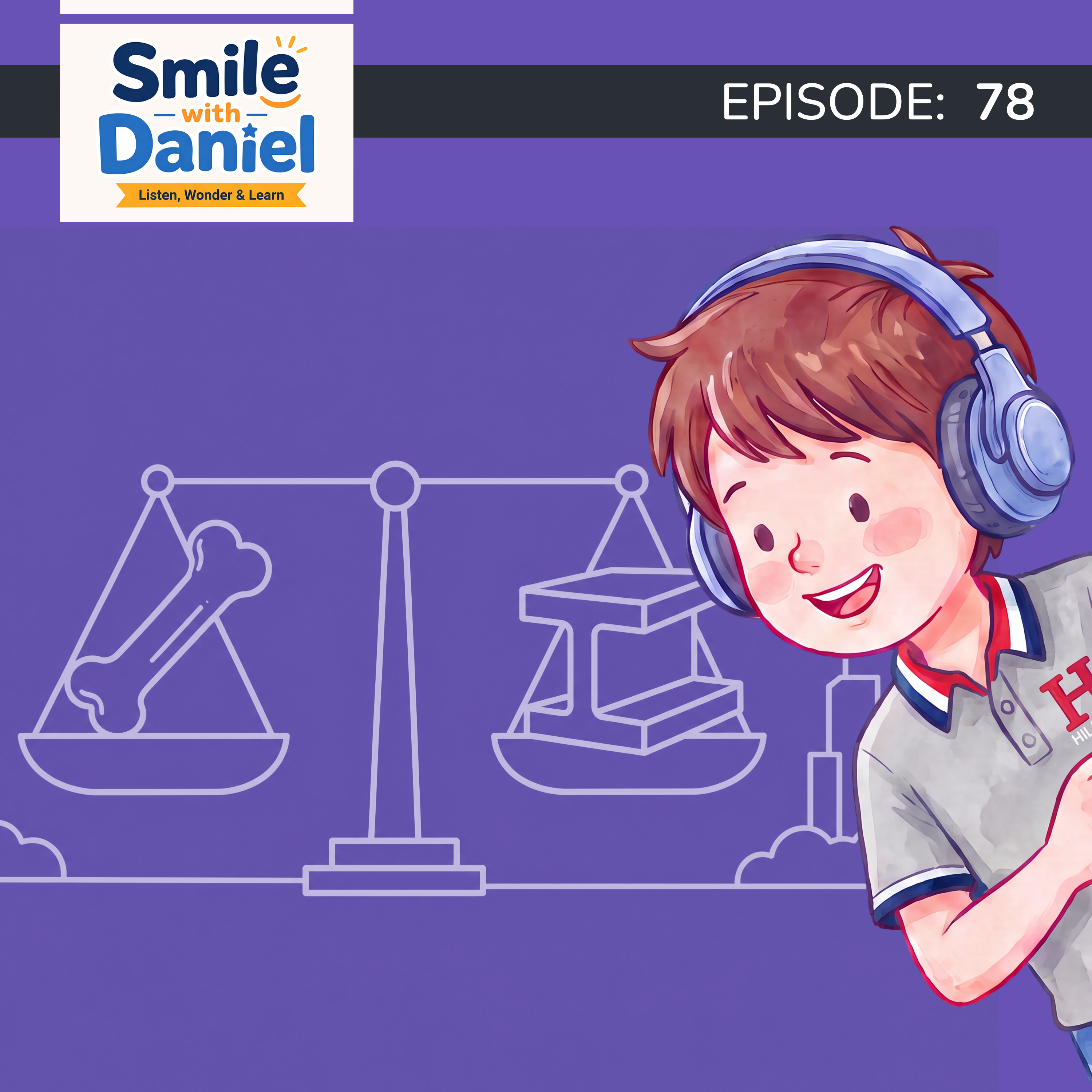 Bone vs. Steel: Which Is Actually Stronger? 28.08.2026 8minDaniel assumes steel wins easily.It does -- in one measurement. But the question turns out to be more interesting than a simple winner.Steel has a higher tensile strength than bone. But steel is also roughly four times as dense as cortical bone. When you compare by weight rather than volume, bone becomes much more impressive. And there is one thing bone does that steel cannot do at all.Fix itself.Bone is a composite material. Much of its solid structure is mineral -- hydroxyapatite crystals that give bone stiffness and hardness. Woven through it is collagen, a tough protein that helps bone deform and absorb energy rather than shatter. Bone's microscopic structure has several ways of absorbing energy and making cracks harder to spread -- which is why bone tolerates damage far better than a simple block of brittle mineral would.And then there is the living part. Bone contains specialized cells called osteoclasts and osteoblasts that continuously remodel it -- replacing old or damaged bone and helping repair accumulated microscopic damage. This process runs every day without you thinking about it. A crack in a steel beam under repeated loading can grow. The steel cannot remove the damaged material and replace it with new steel. Bone can.So which is stronger? It depends entirely on what you measure and what you value.What you will find in this episode:How bone and steel compare on raw tensile strength -- and why the number is not the whole storyWhy density matters and what comparing by weight revealsWhat hydroxyapatite and collagen each contribute -- and why the combination is remarkableWhy bone tolerates damage better than pure brittle mineralHow osteoclasts and osteoblasts maintain bone continuouslyDaniel's closing line about LEGOShort, surprising, and the kind of episode that makes you think very differently about what you are made of.Listen, wonder, and learn.Find us @smilewithDaniel everywhere.[topic:health]
 -
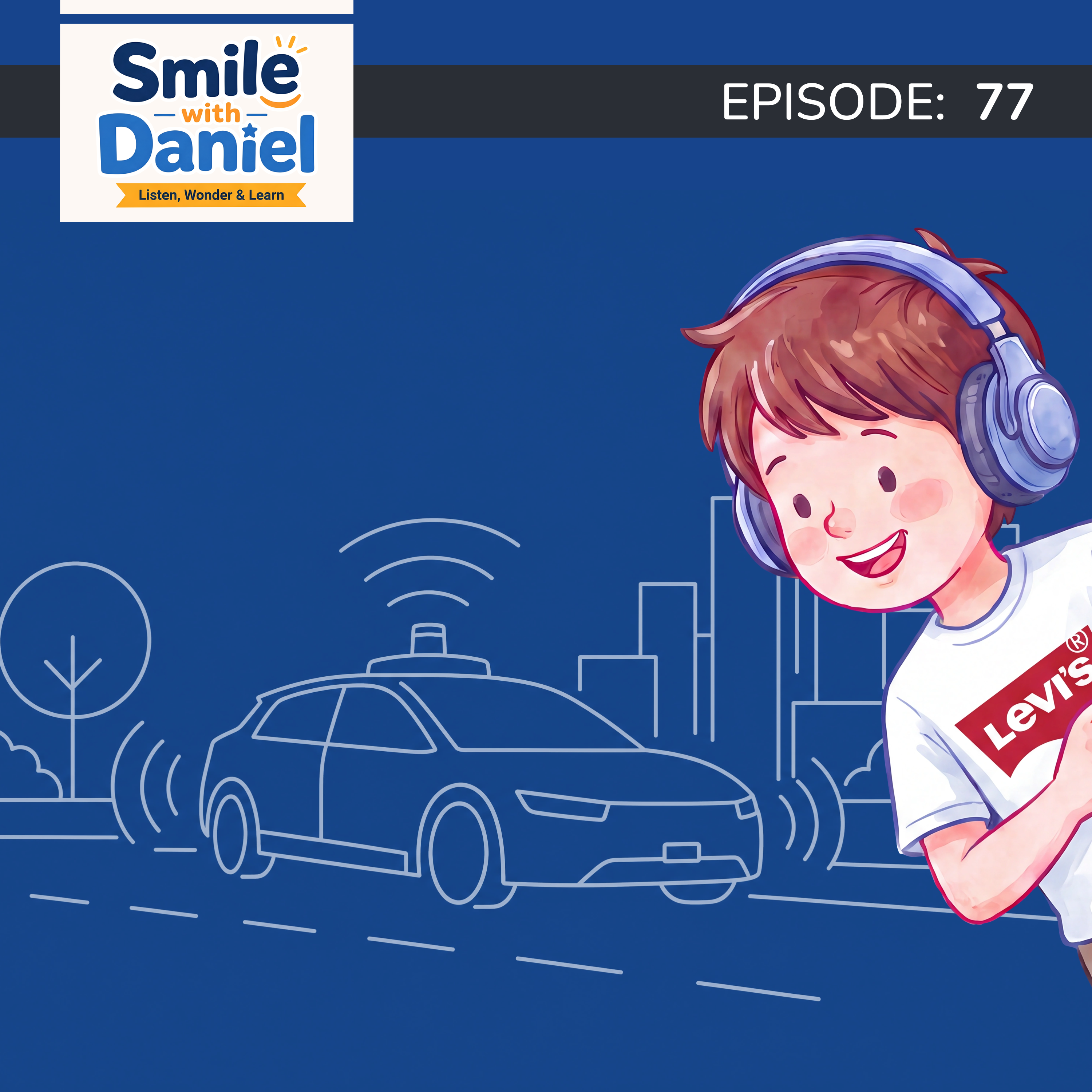 How Do Robotaxis Drive Without a Driver? 26.08.2026 9minDaniel sees a video of a Waymo robotaxi driving through San Francisco with nobody in the front seat.He assumes it must be following GPS.It is doing something far more interesting.The car is constantly answering four questions: Where am I? What is around me? What might happen next? What should I do? It answers all four simultaneously, in real time, without a human involved.Before Waymo operates in a new area it builds extremely detailed maps -- lane markings, curbs, crosswalks, signs and signals. While driving, the car matches what its sensors are seeing against those maps to locate itself precisely. GPS helps, but the car is also recognizing the world around it.Three kinds of sensors feed the system. Cameras give it visual detail -- traffic lights, signs, lane markings, pedestrians and cyclists. Radar measures distance and speed and works well in challenging conditions. And LiDAR fires millions of laser pulses in different directions around the vehicle, measuring how long each one takes to return, and building a precise three-dimensional picture of everything nearby -- every vehicle, every pedestrian, every wall, updated continually.The software combines all of that to identify what is around the car and estimate what might happen next. A pedestrian approaching a curb. A car drifting toward another lane. The system considers multiple possible futures and uses those possibilities to choose a safe path forward.One of the hardest unsolved problems is the long tail -- all the rare and unusual situations that are difficult to anticipate and test. A traffic officer giving unusual directions. Debris in the road. An unpredictable driver. Engineers have to prepare the system not just for ordinary driving but for an enormous range of unusual situations.Waymo has now completed more than twenty million fully autonomous rides.What you will find in this episode:How detailed maps replace simple GPS navigationWhat cameras, radar and LiDAR each contribute -- and why all three are neededHow the system predicts what might happen next rather than just reactingWhy robotaxis operate in defined areas rather than anywhere in the worldThe long tail problem -- and why it is the hardest challenge in autonomous drivingDaniel's closing line about watching a robotaxi handle a roundaboutShort, current, and the kind of episode that makes every self-driving car you see feel completely different.Listen, wonder, and learn.Find us @smilewithDaniel everywhere.[topic:tech]
 -
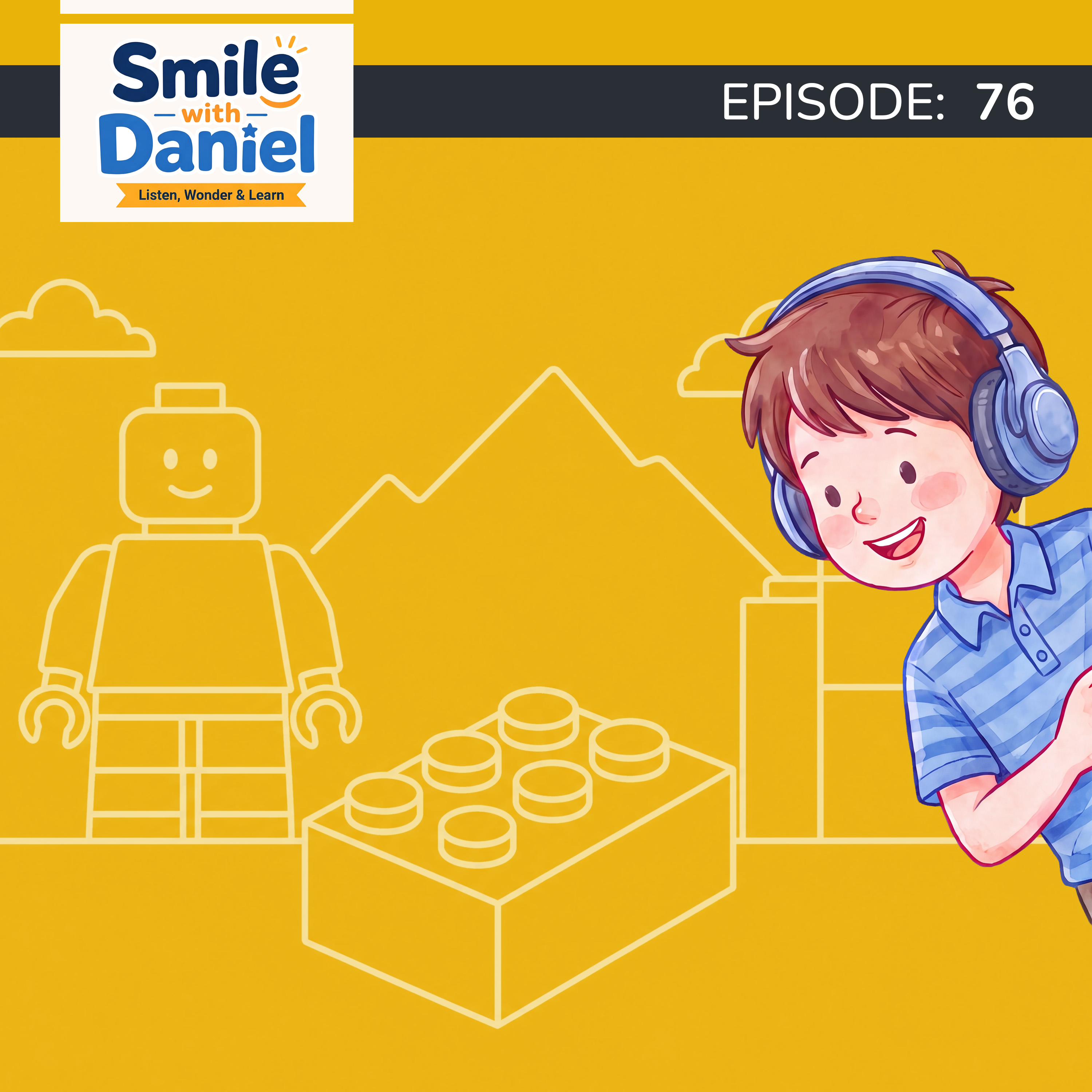 Six Bricks. 915 Million Combinations. The LEGO Story 25.08.2026 9minDaniel is building with LEGO and starts wondering why it feels so satisfying.The answer turns out to involve extraordinary precision engineering, a Danish carpenter, a fire, and a near-bankruptcy that almost erased one of the most beloved toy brands in history.LEGO started in 1932. Ole Kirk Kristiansen was a carpenter in Billund, Denmark, struggling through an economic crisis. He began making wooden toys to survive. A few years later he named the company LEGO -- from the Danish leg godt, meaning play well. Someone noticed later that lego also means I assemble in Latin. He considered it a good omen.The plastic brick came later. Ole's son Godtfred Kirk Kristiansen developed the stud-and-tube system that gives LEGO its clutch power -- the precise grip that holds bricks together firmly while still letting a child pull them apart. The molds that make LEGO elements are manufactured with extraordinary precision, measured in thousandths of a millimeter. A brick made decades ago can still connect with one made today.In 1960 a fire destroyed LEGO's wooden-toy warehouse. The company stopped making wooden toys and concentrated entirely on the plastic system. The company that began with a carpenter was now betting its future on the brick.Take six ordinary two-by-four LEGO bricks of the same color. There are more than 915 million different ways to combine them. The magic of LEGO is not how complicated each piece is. It is how many possibilities simple pieces can create.And then LEGO nearly destroyed itself. By 2003 and 2004 the company had expanded in too many directions and was facing serious financial crisis. A new chief executive helped lead a turnaround by simplifying the business and putting attention back on the building system itself. The thing that saved LEGO was returning to what made it special.What you will find in this episode:Where the name LEGO comes from -- and the Latin coincidenceHow Godtfred Kirk Kristiansen developed the stud-and-tube system and what clutch power actually meansWhy the 1960 fire was a turning point for the companyThe six-brick combinations fact -- and what it reveals about why LEGO worksHow LEGO nearly went bankrupt and what saved itThe closing line about stepping on a brick in the darkShort, surprising, and the kind of episode that makes every LEGO brick feel completely different.Listen, wonder, and learn.Find us @smilewithDaniel everywhere.
 -
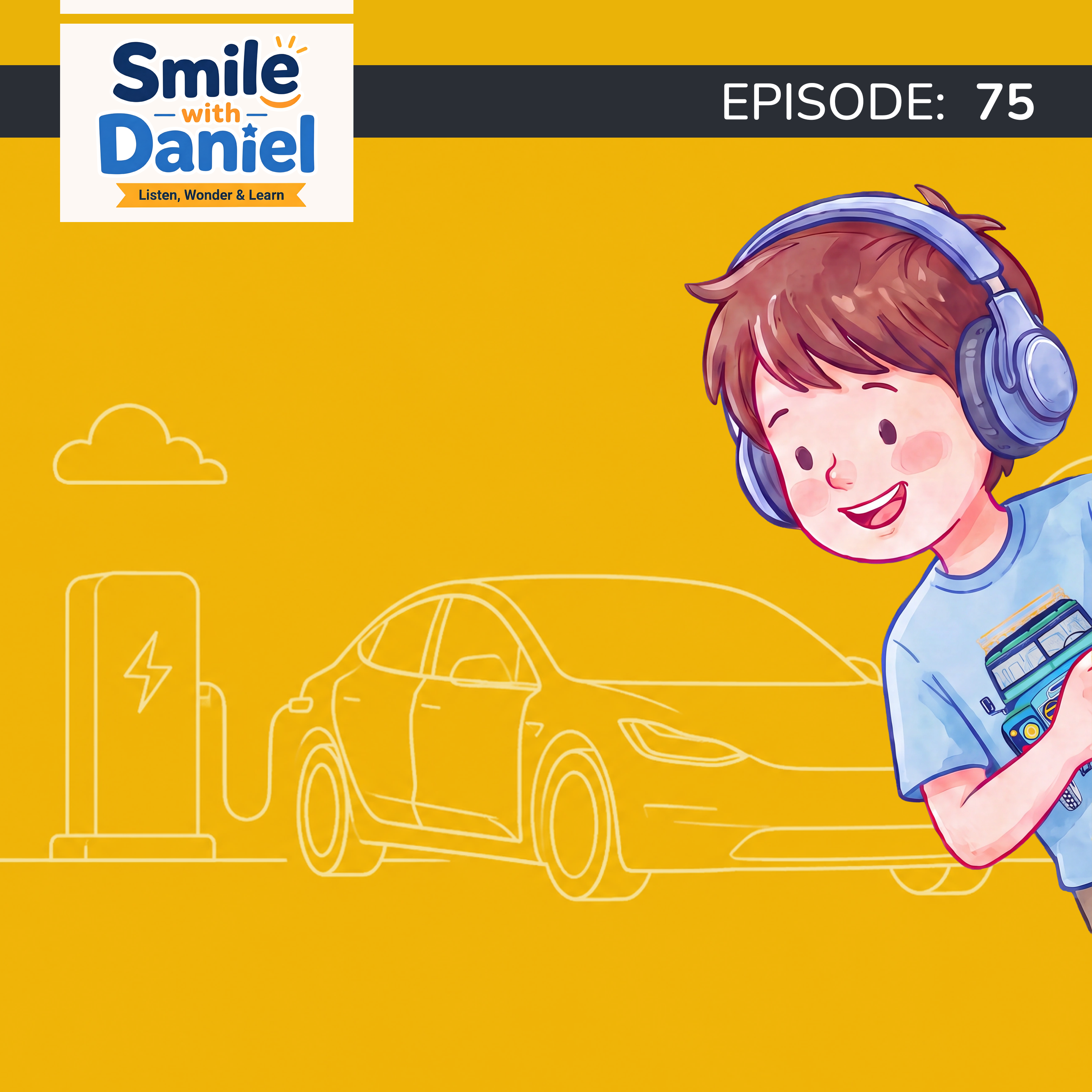 Electric Cars Are Almost 200 Years Old 24.08.2026 8minDaniel asks whether electric cars are going to take over from gasoline cars.Mom asks him a more interesting question. Did he know electric cars were already competing with gasoline cars more than a hundred years ago?He did not.The earliest experimental electric carriages appeared in the 1830s. By around 1900, electric cars were serious competitors to gasoline cars in the United States -- quieter, easier to drive, free of exhaust on the street, and with no hand crank required to start. Clara Ford, Henry Ford's own wife, drove a Detroit Electric. Thomas Edison worked on improving electric car batteries. Electric taxis were running in New York and London.And then several things changed the competition.Gasoline cars became cheaper as manufacturing improved. In 1912 Charles Kettering developed a practical electric self-starter that Cadillac introduced -- and ironically, electrical technology had just removed gasoline's biggest disadvantage. Oil became cheap and widely available. Roads improved and people wanted to travel farther between cities, where limited range became a bigger problem for electric cars. Outside cities, access to electricity was still limited.All of those things together pushed electric cars out of the passenger-car market. By the 1930s electric passenger cars had almost disappeared.They never fully went away. Milk floats, golf carts, forklifts. And interest revived periodically. But the batteries were not good enough for the distances people expected. Then lithium-ion batteries began to change the equation -- and growing concern about what burning fossil fuels does to the atmosphere added urgency the 1900 version of the story did not have.Gasoline did not win because history held a contest and declared it the better technology. Price, infrastructure, fuel, roads, and new inventions all helped decide which direction the world went.What you will find in this episode:Why electric cars were serious competitors to gasoline cars around 1900Why gasoline cars were genuinely difficult and dangerous to startHow the Model T, the electric self-starter, and cheap oil changed the marketWhy range and infrastructure mattered as much as any single inventionHow better batteries helped bring electric cars backDaniel's closing line -- and Mom's response about what actually decided the outcomeSurprising, historically rich, and the kind of episode that changes how you think about every electric car you see on the road.Listen, wonder, and learn.Find us @smilewithDaniel everywhere.
 -
 Why Do Some Countries Call It Tea and Some Call It Chai? 23.08.2026 7minDaniel assumes chai is a different drink from tea -- the spiced version with milk.It isn't. Chai and tea are the same word.They both trace back to a single Chinese character -- 茶 -- that means tea. But Chinese has many varieties of speech, and that same character was pronounced differently in different parts of China. Two of those pronunciations left China by two very different routes -- and that is why the world ended up with two words.The pronunciation closer to chá traveled overland. Along the Silk Road and related routes it spread westward through Central Asia, Persia, Russia, India, and the Arab world. Persian cha. Russian chai. Turkish çay. Arabic shay. Hindi chai.The pronunciation closer to te traveled by sea. Dutch traders encountered it at ports in southeastern China and carried it back to Europe as thee. From there it spread as thé in French, Tee in German, and tea in English.Cha by land. Tea by sea. Not a perfect rule -- but an amazing pattern. The word you use for tea can give you a clue about the route it traveled to get to you.Portugal is the exception. A great sea power that says chá -- because Portuguese traders operated through Macau and picked up a cha-type pronunciation rather than the te form that reached the Dutch.And when someone orders a chai tea at a coffee shop -- they are historically saying tea tea.What you will find in this episode:How the same Chinese character produced two different pronunciationsHow overland trade routes spread the cha family of wordsHow maritime trade spread the te family into EuropeWhy Portugal is the fascinating exceptionWhy chai tea is technically redundant -- and why it mattersThe closing line about what is hidden inside every word for teaShort, surprising, and the kind of episode that makes every cup of tea feel like a small piece of world history.Listen, wonder, and learn.Find us @smilewithDaniel everywhere.
 -
 Why Are Fire Hydrants Different Colors? 21.08.2026 9minDaniel walks past a green fire hydrant and wonders why it isn't red.The colors are not decoration. They can be information.Fire departments and water systems can use color to tell firefighters important things about a hydrant at a glance. Under a system recommended by the National Fire Protection Association, the color on the top and caps of a hydrant can indicate its rated flow capacity -- how many gallons per minute it can deliver. Light blue for the highest flow. Green for strong. Orange for moderate. Red for the lowest. A firefighter arriving at a fire can read that at a glance and know what water supply they are working with.The body of the hydrant can carry different information -- helping distinguish between public and private hydrants. And a violet or purple marking is used in many systems to identify non-potable water -- water that is not meant for drinking.But not every city follows the same system. The NFPA coding is a recommended practice, not a law. Some communities use their own markings entirely. The colors only make sense if you know which visual language your community uses.What you will find in this episode:Why hydrant colors carry information rather than being decorativeWhat the NFPA color coding system recommends -- and what each color meansWhat the body color can tell you versus what the top and caps tell youWhat a violet hydrant means -- and why it mattersWhy not every city follows the same systemThe closing line about what curiosity does to ordinary objectsShort, practical, and the kind of episode that makes every fire hydrant you walk past feel completely different.Listen, wonder, and learn.Find us @smilewithDaniel everywhere.
Podcast simili


Popolare in
Questo podcast compare anche nelle classifiche dei podcast di questi paesi.


