
Neuroscience Meets Social and Emotional Learning
The Neuroscience Meets Social and Emotional Learning Podcast provides support for school leadership and the workplace with a proven approach for implementing social and emotional learning in schools and emotional intelligence in the modern workplace. It offers a strategy to increase well-being, achievement, and results, backed by current neuroscience research. Andrea Samadi, a teacher from Toronto now living in Arizona, began working with success and social and emotional learning principles with students in the late 1990s. Her programs and trainings, grounded in brain-based research and practical neuroscience, help parents, teachers, coaches, and employees optimize learning, well-being, and achievement.
Episodi
-
 When Sleep Isn't Rest: What 'Sleep Stress' Reveals About Recovery (Bonus Episode) 13.09.2026 41minIn this episode Andrea Samadi explains the concept of sleep stress — a wearable-device measured how physiologically activated your body remains during sleep — and places it within a neuroscience-based movement and recovery framework. She reviews the autonomic nervous system (sympathetic vs. parasympathetic), how WHOOP estimates sleep stress from heart rate and HRV, and why trends over weeks matter more than single nights. Using her six-month data, Andrea shares how recovery habits and removing alcohol coincided with an 89% drop in nightly high sleep stress. The episode ends with practical steps and a seven-day experiment to help you observe and reduce nighttime physiological activation by changing daytime behaviors, sleep environment, and training timing so your body can better recover and adapt. When Sleep Isn’t Rest—What “Sleep Stress” Reveals About Recovery: The Story Behind My 89% Drop in Sleep Stress Welcome back to the Neuroscience Meets Social and Emotional Learning Podcast, where we bridge neuroscience, social and emotional learning, and human performance so we can create measurable improvements in our well-being, achievement, leadership, productivity and results. I’m Andrea Samadi, and if you’ve been following along through Season 16, you’ll know that we have been building what I call The Brain’s Operating System for Human Performance—a neuroscience-based framework designed to help us understand how the different systems of the brain and body work together to influence how we learn, adapt, connect, lead and ultimately perform. We are currently in Phase 3: Movement, Learning and Cognition, where we have been following a central pathway: Movement → Adaptation → Performance Movement creates a stimulus. But movement alone does not make the brain or body stronger. We must be able to recover from that stimulus before adaptation can occur, to give us our desired outcome of improved performance. This is why our recent bonus episodes have moved beyond exercise itself and into the recovery signals that help us understand whether our bodies are successfully handling the demands we are placing upon them. In Bonus Episode 3[i], we explored the hidden story behind my resting heart rate. My data showed that it was not merely a measure of fitness—it was also reflecting the total load my body was carrying. During the higher-stress months of January and February, my resting heart rate remained elevated at approximately 56–58 beats per minute. As I placed greater emphasis on sleep, hydration, Zone 2 movement, sauna, meditation and recovery, it gradually fell to 54 and then 53 beats per minute. The lesson was that a lower resting heart rate signals that the body is working less during rest, and recovering more efficiently. The idea is to learn what your baseline is, and see how you can improve this number for a more efficient RHR. In Bonus Episode 4[ii], we explored restorative sleep and learned that sleep quality is not measured by duration alone. Deep sleep supports physical restoration and repair, while REM sleep plays an important role in memory, learning and emotional processing. Because longer REM periods tend to occur later in the night/morning time my regular 4:00 AM wake time may give me less opportunity for that REM-rich portion of sleep—which is the tradeoff I’m choosing--since waking early allows me to exercise. Two additional hours in bed would not guarantee two more hours of REM, but they could create a greater opportunity for more REM sleep. The lesson was not to choose sleep over movement or movement over sleep. It was to protect enough sleep while still making room for movement, so the brain and body have the opportunity to adapt. Throughout these bonus episodes, I’m sharing patterns from my WHOOP wearable device[iii] data—not because everyone’s numbers should look like mine, but to demonstrate what can happen when we measure consistently, look for trends and test small changes. The goal is not comparison.
 -
 Attention Is the Gate—How Movement Becomes Lasting Learning with Dr. John Medina 06.09.2026 46minEpisode 406 explains how movement prepares the brain but does not guarantee learning. It traces the full sequence—movement, RAS-driven readiness, salience and relevance, focused attention, encoding, retrieval and repetition, and recovery and sleep—that turns activation into lasting memory and performance. The episode offers practical steps in a Move–Focus–Learn protocol: use brief movement to create readiness, clearly identify and remove distractions for one learning target, interact with material in meaningful ways, practice retrieval and spaced repetition, and protect recovery to support consolidation. Listeners are encouraged to test these simple experiments for school, work, or personal learning to make experience more usable and improve attention, memory, and performance. ON THIS EPISODE, YOU’LL LEARN: ✔ Why movement prepares the brain but does not guarantee learning ✔ How attention directs the capacity movement creates ✔ Why meaning and emotional relevance capture attention ✔ The difference between paying attention and actually learning ✔ How retrieval and repetition help new information stick ✔ How seeing, hearing, explaining, and applying an idea can help us remember it ✔ How restorative sleep supports memory and learning ✔ A practical Move–Focus–Learn Protocol for school, work, or your own personal learning The central idea is simple: Movement opens the window. Attention determines what enters. Repetition strengthens what remains. And recovery helps the brain integrate what it has experienced. Welcome back to the Neuroscience Meets Social and Emotional Learning Podcast, where we bridge neuroscience, social and emotional learning, and human performance so we can create measurable improvements in our well-being, achievement, leadership, productivity, and results. I’m Andrea Samadi, and if you’ve been following along through Season 16, you’ll know that we have been building what I call The Brain’s Operating System for Human Performance—a neuroscience-based framework designed to help us understand how the different systems of the brain and body work together to influence how we learn, adapt, connect, lead, and ultimately, how we perform. We are currently in Phase 3, focused on Movement, Learning, and Cognition. As I prepared for this phase, I went back through more than 400 episodes of the podcast and organized them according to the five phases of this framework. I wanted to see whether any patterns would emerge. And some did. Phase 1, Regulation and Safety, includes 57 episodes. Phase 2, Neurochemistry and Motivation, includes 41 episodes—the smallest category, possibly because this is the area I have explored the least with my learning. Phase 3, Movement, Learning, and Cognition, includes 174 episodes—the largest category by far. Phase 4, Perception and Social Intelligence, includes 68 episodes. And Phase 5, Integration and Meaning, includes 71 episodes. When I saw that 174 episodes—more than 40 percent of the entire podcast—fit into Movement, Learning, and Cognition, it immediately showed me where much of my curiosity has been directed over the years. I have always been fascinated by learning: How do we prepare the brain to learn? What captures our attention? Why do some ideas (or people) remain with us while others disappear? How does knowledge become something we can retrieve, apply, and actually use to improve our lives? And while I am spending most of my spare time hiking, or at the gym over the years, I wonder, how does this movement that I’m doing help to improve my attention, or memory, and finally, where does recovery fit into this process? The past few weeks, I’m finally connecting the dots with how important recovery is with this equation. I’m also learning how to determine what’s important to me. John Medina’s Brain Rules book explains what holds our attention. He reminds us that “we don’t pay attention to boring things (or people).[i] As we continue through these five phases of The Brain’s Oper
 -
 The 4:00 AM Tradeoff: Movement, REM and Recovery (Bonus Episode) 29.08.2026 29minIn this episode Andrea Samadi explores how movement and sleep work together in a "brain operating system" for human performance, focusing on restorative sleep (deep + REM), personal WHOOP data, and the trade-offs created by early-morning exercise. She shares four lessons and a simple experiment to help listeners protect REM and deep sleep while maintaining an active life, emphasizing weekly rhythms, small changes, and tracking patterns rather than chasing perfect numbers. SEASON 16 | BONUS EPISODE 4 RESTORATIVE SLEEP Where Adaptation Happens Why deep sleep restores the body, REM helps integrate experience, and healthy habits must work together. ON BONUS EPISODE 4, YOU’LL LEARN: ✔ What restorative sleep really measures ✔ How deep sleep and REM support different forms of recovery ✔ Why REM percentage and duration tell different stories ✔ What my six-month sleep data revealed ✔ The hidden tradeoff behind my 4:00 AM hiking routine ✔ What happened when I slept just 21 minutes longer ✔ Why healthy habits can sometimes compete ✔ How to protect sleep without giving up movement ✔ 4 Lessons and a simple experiment for discovering your own best rhythm Episode Introduction Welcome back to the Neuroscience Meets Social and Emotional Learning Podcast, where we bridge neuroscience, social and emotional learning, and human performance to create measurable improvements in well-being, achievement, leadership, productivity and results. I’m Andrea Samadi, and throughout Season 16 we have been building what I call the Brain’s Operating System for Human Performance—a neuroscience-based framework for understanding how the systems of the brain and body work together to influence how we learn, adapt, connect, lead and ultimately perform. We are currently in Phase 3: Movement, Learning and Cognition. Movement is the foundation of this phase because it affects far more than our muscles. When we move, we activate processes throughout the brain and body. Movement supports neurogenesis—the development of new neurons—particularly in areas involved in learning and memory. It strengthens connections between neurons through synaptic plasticity. We covered neurogenesis on EP 141[i] if you want to revisit that episode, if you are as curious as I am about how to regrow our brain cells. Movement that we are learning in this phase, also influences brain chemicals such as dopamine, serotonin, norepinephrine and acetylcholine, which affect motivation, mood, attention and learning. Movement can also strengthen our resilience by helping us manage stress and become more emotionally flexible. It builds sleep pressure, (the longer we stay awake, the more adenosine accumulates that increases our need or “pressure” to rest) which can support deeper, more restorative sleep. And over time, these changes may contribute to greater creativity, insight, endurance and human potential. But movement only creates the stimulus. The benefits don’t come from movement alone. They come from the way the brain and body respond to that movement—and that response is called adaptation. Movement changes the brain. Adaptation changes the body. Recovery is what connects the effort we make today with the strength, resilience and capacity we hope to build tomorrow. Without adequate recovery, we can receive the stimulus without fully receiving the benefit. That is why sleep belongs inside the Movement Loop. Sleep is not separate from movement, learning or performance. It is one of the primary places where the brain and body respond to what we have asked them to do. Throughout Season 16, I’ve been sharing some of my own health and performance data as a living case study—not because everyone should try to reproduce my numbers, but because our individual trends can help us understand how neuroscience shows up in everyday life. I thought that if I was curious about understanding my numbers—and using them to improve my health, well-being and productivity—then other people might benefit from
 -
 The Hidden Story Behind Your Resting Heart Rate: What Your RHR Can Reveal About Stress, Recovery & Adaptation (Bonus Episode) 22.08.2026 30minAndrea Samadi shares her personal resting heart rate data to show why measuring over time matters more than fixating on a single score. She explains how trends reveal stress, recovery, and adaptation, and why comparing yourself to your own baseline is the most useful approach. Learn practical steps to measure consistently, contextualize changes, experiment with one behavior, and use your physiological data to make intentional improvements in sleep, recovery, and performance. BONUS EPISODE 3: ON THIS EPISODE, WE’LL COVER ✔ What resting heart rate can reveal about stress, recovery, and adaptation over time✔ The story hidden in my own data — from a high of 57 bpm in February to 53 bpm in August✔ Why the six-month trend matters — and what my 2% lower average may be telling me✔ How stress and training load can show up in your physiology before you consciously recognize it✔ Why recovery and nervous-system regulation matter for building a more resilient baseline✔ How to find your own RHR baseline instead of comparing yourself with someone else✔ How to look for deviations and patterns across weeks and months—not individual days✔ How to connect RHR with sleep, HRV, recovery, training, stress, and life events✔ How to run your own personal experiment: change one variable, measure, and see what happens✔ The bigger lesson: What gets measured over time can reveal a story you couldn't see day to day. Welcome back to the Neuroscience Meets Social and Emotional Learning Podcast, where we bridge neuroscience, social and emotional learning, and human performance so we can create measurable improvements in our well-being, achievement, leadership, productivity, and results. I’m Andrea Samadi, and if you’ve been following along through Season 16, you’ll know that we’ve been building what I call The Brain’s Operating System for Human Performance—a neuroscience-based framework designed to help us understand how the different systems of the brain and body work together to influence how we learn, adapt, connect, lead, and ultimately how we perform. We are currently in Phase 3 where we are covering Movement, Learning and Cognition. If you just finished Episode 405[i] with Dr. Kristen Holmes, you know we've been looking at recovery as an essential part of our Movement Loop. Movement → Brain Activation → Attention → Learning → Recovery → Adaptation → Performance → Greater Capacity. And Kristen's work has reinforced something I've learned after years of tracking my own physiology: What gets measured gets improved. But this week, I wanted to dive into my own personal data to show us something I think is easy to miss: Sometimes what gets measured over time reveals a story you simply couldn't see day to day. When we're looking at a wearable every morning, it's easy to become focused on today's number. Today's recovery score. Today's HRV. Today's resting heart rate. Was it higher? Was it lower? But one number—or even one week—rarely tells us very much about the direction we're actually moving. It's when we begin to zoom out that patterns emerge. And that's exactly what happened when I looked more closely at my resting heart rate this year. What initially looked like a collection of numbers began to tell a much bigger story about stress, recovery, consistency, and adaptation. So my hope for this episode isn't that you compare your resting heart rate to mine. Your numbers will be different. My hope is that this episode encourages you to become curious about your own data. Maybe you track sleep. Maybe it's HRV. Resting heart rate. Recovery. Exercise. Blood pressure. Steps. Or even something as simple as your energy, mood, or ability to focus. Take one metric and zoom out. Look at three months. Six months. Maybe even a year. And instead of asking, “Is today's number good or bad?” Ask a different question: “What is the trend that I’m seeing here, trying to tell me?” Is something improving? Is something slowly moving in the wrong direction? Does your ph
 -
 The Science of Recovery—How Dr. Kristen Holmes Helps Us Turn Stress Into Greater Capacity 16.08.2026 45minIn this episode Andrea Samadi explores Phase 3 of the Brain's Operating System—movement, learning, and cognition—focusing on the recovery and adaptation side of the "movement loop." She revisits Dr. Kristen Holmes’ insights on measuring strain, sleep, and recovery to show how movement provides the stimulus while recovery enables lasting adaptation and greater capacity. The episode offers practical steps: identify your stimulus, track recovery, find your weakest link, and use feedback to train smarter—not just harder—so measurement becomes a tool for meaningful change. IN EPISODE 405, WE WILL COVER: ✔ Why recovery is not the absence of work—it is where adaptation occurs → How recovery allows the brain and body to absorb stress and build greater capacity. ✔ Where Dr. Kristen Holmes fits into the Movement Loop → Movement creates the stimulus; recovery determines how effectively we adapt. ✔ Why measuring your data matters → What gets measured can be adjusted, repeated, and improved. ✔ How to identify your personal recovery patterns → Using sleep, HRV, resting heart rate, strain, stress, and daily behaviors to uncover what helps—or limits—your performance. ✔ Why your recovery formula is uniquely yours → The habits that improve one person’s readiness may not produce the same results for someone else. ✔ How recovery helps create more predictable performance → When you understand your patterns, you can make better daily decisions instead of leaving your results to chance. ✔ How repeated behaviors become adaptation → Measure → Adjust → Repeat → Recover → Adapt → Build Capacity. ✔ Where the larger journey is taking us → A preview of The Journey of the Mind Workbook and its five-step process: Understand → Reflect → Apply → Measure → Become ✔ What comes next in the Movement Loop → A Bonus Episode applying recovery science to real-world data, followed by Dr. John Medina on how an activated brain turns experience into attention, learning, and lasting change. EP 405 — From Recovery to Adaptation: Revisiting Dr. Kristen Holmes in Phase 3 WELCOME BACK Welcome back to the Neuroscience Meets Social and Emotional Learning Podcast, where we bridge neuroscience, social and emotional learning, and human performance so we can create measurable improvements in our well-being, achievement, leadership, productivity, and results. I’m Andrea Samadi, and if you’ve been following along through Season 16, you’ll know that we’ve been building what I call The Brain’s Operating System for Human Performance—a neuroscience-based framework designed to help us understand how the different systems of the brain and body work together to influence how we learn, adapt, connect, lead, and perform. Our roadmap has five phases: Phase 1 — Regulation & SafetyWhere we built the foundation by asking: Is the nervous system regulated enough to learn and grow? Phase 2 — Neurochemistry & MotivationWhere we explored the systems that drive us to act, persist, and pursue meaningful goals. And now, we are here—Phase 3: Movement, Learning & Cognition. This is where movement becomes the catalyst for learning, adaptation, and performance. The central idea of Phase 3 is that the brain does not change through information alone. It changes through experience. Through movement. Through challenge. Through recovery. And through the repeated process of adapting to what we ask our brain and body to do. I called the framework we are building in this phase: The Movement Loop: Movement (the stimulus) → Brain Activation (the brain responds) → Attention (the brain becomes engaged and ready to learn) → Learning (new information and experience begin changing neural pathways) → Recovery (the brain consolidates and restores) → Adaptation (the brain and body adjust to the repeated challenge) → Performance (the adaptation shows up in what we can do) → Greater Capacity (we become capable of more) Movement is the stimulus.Brain activation is the response.Attention op
 -
 Find Your Gap: How Recovery Unlocks Predictable Performance (Bonus Episode) 08.08.2026 30minIn this bonus episode Andrea Samadi introduces the Predictable Performance System, a practical roadmap from her Brain’s Operating System. She shows how measuring patterns—not chasing daily scores—plus consistent movement and targeted recovery behaviors create reliable adaptations and better performance over time. Andrea shares two real-world experiments (including a nine-day green recovery streak), five clear steps—measure, move, recover, adapt, perform—and a simple 7-day challenge to help you discover the single habit that unlocks more consistent results. On BONUS EPISODE 2, we will cover: Why high performance isn’t about being “green” every day (using a wearable device) What nearly 2,000 recovery scores taught me about consistency and performance Why your daily inputs matter more than any single recovery score How I reached a personal best of 9 green recoveries in a row What happened when hard training caused my recovery to drop—and why that wasn’t failure How another WHOOP user improved his recovery by identifying one key gap: hydration How to find your own gap in sleep, hydration, stress, movement, training load, or recovery The Predictable Performance System™:Measure → Move → Recover → Adapt → Perform → Repeat Why recovery is the bridge between today’s effort and tomorrow’s capacity How to create your own 7-Day Predictable Performance Experiment The key question to ask yourself:“What is the one missing input that could unlock my next level of performance?” The goal: Find your gap. Uncover your recipe. Build the system that works for you. BONUS EPISODE 2 The Predictable Performance System™ How Small Daily Inputs Create Better Recovery, Adaptation and More Consistent Results WELCOME BACK Welcome back to the Neuroscience Meets Social and Emotional Learning Podcast, where we explore how understanding the brain can help us create measurable improvements in our well-being, achievement, leadership, productivity, and results. I'm Andrea Samadi, and over the past several months, we've been building something much bigger than a collection of interviews. We've been building what I call The Brain's Operating System—a roadmap for understanding how our brain and body work together to create optimal human performance. Before we jump into today's second Bonus Episode, let's quickly remember where we've been. PHASE 1 — REGULATION & SAFETY Everything begins with regulation. Before the brain can learn, perform, or grow, it first needs the biological conditions that support safety and stability. In Phase 1, we explored sleep, stress regulation, trauma, resilience and the nervous system. The lesson was simple: Regulation creates the conditions for growth. PHASE 2 — NEUROCHEMISTRY & MOTIVATION Then we asked: What moves us into action? We explored dopamine, beliefs, motivation, habits, attention and sustained effort. We learned that motivation isn't simply about willpower. Our brain is continually learning: What's worth pursuing? What should I repeat? Where should I invest my energy with? Phase 2 gave us some direction. PHASE 3 — MOVEMENT, LEARNING & COGNITION And now we're deep inside Phase 3. This is where movement becomes much more than exercise. Movement activates the brain. It supports attention. Learning. Memory. Metabolism. And when movement is paired with adequate recovery, something important happens: Adaptation. That's where our system begins to change. So the basic sequence we've been studying is: Movement → Recovery → Adaptation → Performance. But while studying this process, another question kept coming back to me. Why do some people consistently improve...while others feel like they're starting over every Monday and they are searching for the right formula. That question led me to today's framework: THE PREDICTABLE PERFORMANCE SYSTEM™ And this Bonus Episode is where I want to put the science into action. Throughout The Brain's Operating System, these Bonus Episodes will give me an opportunity to step a
 -
 Dr. John Ratey and The Movement Loop: How Movement Becomes Human Performance 02.08.2026 21minIn this episode Andrea Samadi explores Phase Three of the Brain’s Operating System — how movement acts as the essential input that activates the brain, sharpens attention, boosts learning, and improves social and emotional readiness. Drawing on Dr. John Ratey’s insights and related neuroscience research, she explains the chain reaction from exercise to brain activation, learning, and adaptation. The episode also emphasizes the vital role of recovery in consolidating gains so movement leads to lasting performance improvements, and invites listeners to adopt movement as a daily catalyst for clearer thinking, better learning, and greater resilience. Dr. John Ratey and The Movement Loop On this episode 404, we will: Explore where Dr. John Ratey's groundbreaking research fits within the Movement Loop. Understand how movement activates the brain and prepares us to learn. Discover why attention is the gateway to learning and performance. Connect Dr. Ratey's work with Dr. Chuck Hillman, Dr. John Medina, Kristen Holmes, and Jason Whitrock to see the bigger picture. Learn how movement becomes lasting human performance by building our capacity over time. How Movement Becomes Human Performance Welcome back to the Neuroscience Meets Social and Emotional Learning Podcast. I'm Andrea Samadi, and on this podcast, we bridge the science behind social and emotional learning, emotional intelligence, and practical neuroscience so we can create measurable improvements in well-being, achievement, productivity, and results. If you've been following along through Season 16, you'll know we've been building what I call The Brain's Operating System for Human Performance—a neuroscience-based framework that explains how movement, recovery, and adaptation work together to improve our health, learning, leadership, and performance. Over the past seven years and more than 400 episodes, I've had the privilege of interviewing neuroscientists, physicians, psychologists, educators, and high performers from around the world. As I looked across those conversations, I realized they weren't isolated ideas—they were pieces of a much larger system. I've organized that system into five interconnected phases that mirror how we grow and develop throughout life. And as we work through each of these phases, we are sharpening our saw for productivity, learning and high performance, really, with the brain and body in mind. Phase 1 is Regulation and Safety, we launched on EP 384[i] with Dr. Baland Jalal on Sleep, Safety and Curiosity. This phase is where we build the foundation by understanding the nervous system, stress, emotions, and the importance of creating internal and external safety before learning or productivity can take place. Phase 2 is Neurochemistry and Motivation, where we explore how dopamine, reward, purpose, and emotional regulation influence our choices, habits, and sustained effort. Today, we're in Phase 3: Movement, Learning, and Cognition. This is where movement becomes the catalyst that prepares the brain to pay attention, learn, adapt, and ultimately perform at a higher level. In Phase 4, we'll discover how perception and social intelligence shape the way we understand ourselves, communicate, build trust, and strengthen relationships. And finally, in Phase 5, we'll bring everything together through integration and meaning—understanding how our experiences become wisdom, resilience, purpose, and lifelong growth. Each phase builds on the one before it, because meaningful human performance isn't created in a single breakthrough—it's built one system at a time. Together, they create what I believe is the brain's operating system for human performance. If we want to improve the entire big picture of our results, we can dive deeper into these 5 phases to see what areas we could sharpen a bit. I’ve put the individual episodes of each phase in the show notes for a deeper dive. Today's episode is one of those foundational pieces of Phase 3. Becaus
 -
 Five Years, 1,905 Recoveries: How Daily Movement Rewires Your Brain (Bonus Episode) 25.07.2026 16minAndrea Samadi shares a five-year self-experiment using a WHOOP wearable to track sleep, recovery, movement, and biological age. She reveals how daily low-intensity movement and consistent recovery—not one intense workout—produced lasting improvements in heart rate, recovery scores, and biological age. Andrea distills five lessons: movement prepares the brain, consistency beats intensity, recovery is where adaptation happens, small habits compound over time, and every step is an investment in your future brain. Practical takeaways include walking daily, adding 2–3 strength sessions per week, protecting sleep, and tracking trends instead of perfection. In this Bonus Episode you'll learn: Why recovery matters more than you think. What 1,905 recoveries taught me about human performance. Why consistency beats intensity. How movement changes the brain. How to create lasting biological adaptation. Why every walk is an investment in your future brain. EPISODE BONUS Move Today. Recover Tonight. Younger Tomorrow. Five Years. 1,905 Recoveries. One Lesson That Changed Everything. Welcome Back Welcome back to the Neuroscience Meets Social and Emotional Learning Podcast. I'm Andrea Samadi. Over the past seven years, I've had the privilege of interviewing many of the world's leading experts in neuroscience, psychology, learning, leadership, health, and human performance. Throughout Season 16, we've been connecting those conversations into a simple framework I call The Brain's Operating System for Human Performance—a practical way of understanding how the brain and body work together to help us learn better, think more clearly, live healthier, and perform at our highest potential. In Episode 402[i], we introduced The Movement Loop, built around one simple idea: Movement is the input. Adaptation is the process. Performance is the outcome. Then, in Episode 403[ii], Dr. Chuck Hillman helped us understand why movement changes the brain. Every step increases blood flow. Exercise stimulates Brain-Derived Neurotrophic Factor—BDNF—often called fertilizer for the brain. Movement strengthens the neural networks responsible for learning, memory, attention, and executive function. But after recording those episodes, I found myself asking a different question. What happens when we apply those principles consistently—not for days, weeks, or even months—but for years? Today's bonus episode is my attempt to answer that question. Not from another research study. Not from another interview. And definitely not to give you one more thing to add to your already busy schedule. Instead... I'd like to share a five-year experiment I never realized I was conducting—one that completely changed the way I think about health, movement, recovery, and human performance. Five Years Looking for the Answer When I started wearing a WHOOP device back in April of 2021, just before my fiftieth birthday, I thought I was buying a fitness tracker. I thought it would help me train harder. I thought it would reward intensity. Instead... It spent the next five years teaching me something far more valuable. How to recover. Over those five years I've tracked nearly everything I could measure. Sleep. Movement. Recovery. Resting heart rate. Heart rate variability. VO₂ Max. Biological age. Blood work. Thousands of workouts. And more than 1,905 recoveries. Nearly two thousand mornings of waking up and asking my body the same question. How well did I recover? At first, I didn't really know what I was looking for. I simply assumed the harder I trained... the healthier I'd become. The Mystery Then WHOOP introduced a new metric. WHOOP Age. The first time I looked at it, I honestly couldn't believe what I was seeing. My biological age measured 48.7 years old. I was fifty-five. More than six years younger biologically than chronologically. Of course, my first question wasn't, "That's great." My first question was... Why? What was I doing that created this result? Naturally, I assum
 -
 The Movement Loop: How Movement Activates the Brain for Learning, Adaptation & Performance 19.07.2026 34minWelcome back to Season 16 of the Neuroscience Meets Social and Emotional Learning Podcast. I'm Andrea Samadi, and this is where we bridge neuroscience, social and emotional learning, and human performance so we can create measurable improvements in our well-being, achievement, leadership, productivity, and results. In this episode 403 The Movement Loop: How Movement Activates the Brain for Learning, Adaptation & Performance we will cover: ✔ Why movement is the biological input that prepares the brain for learning, adaptation, and performance. ✔ How Dr. Chuck Hillman's groundbreaking neuroscience research explains what happens inside the brain during and immediately after exercise. ✔ Why even one bout of physical activity can improve attention, executive function, and learning readiness. ✔ How Paul Zientarski translated neuroscience into practice through Naperville Central High School's internationally recognized Zero Hour PE Program. ✔ The science behind brain activation, neuroplasticity, positive stress, and cognitive reserve. ✔ Why movement isn't a break from learning—it's preparation for learning. ✔ How teachers, coaches, parents, and workplace leaders can use movement to improve focus, decision-making, creativity, and performance. ✔ How to apply the Movement Loop in everyday life using practical strategies you can begin today. ✔ Why movement is the input, adaptation is the process, and performance is the result. If you're just joining us, Season 16 explores Phase 3 of the Brain's Operating System for Human Performance—the Movement Loop. This season asks one central question: How does movement change the brain, adaptation change the body, and together create measurable improvements in performance? If you'd like the full overview of the five-phase framework, I encourage you to start with Episode 402. In Episode 402[i], we introduced Phase 3 of the Brain's Operating System for Human Performance—where we introduced The Movement Loop. We discovered one powerful idea. Movement is the input. When you move, your body sends a powerful biological signal to the brain that says: "Prepare. Activate. Adapt." Adaptation is the process. With movement, repetition, and recovery, the brain and body strengthen, rewire, and become more efficient. Performance is the output. The changes become visible in everyday life—clearer thinking, better decisions, stronger health, and improved performance. Then the loop begins again. Today we're asking the next question. Why does movement come first? Not simply because exercise is good for our bodies. But because movement is one of the most powerful biological signals we can send to the brain. Before we can focus... Before we can learn... Before we can adapt... The brain must first be activated. That's why movement isn't the outcome. It's the beginning. When we first interviewed Dr. Chuck Hillman on Episode 123[ii], (back in April 2021) I wanted to understand how his neuroscience research inspired Paul Zientarski's revolutionary Zero Hour PE Program at Naperville Central High School. It was Naperville's extraordinary performance on the Trends in International Mathematics and Science Study (TIMSS) that caught the eye of Dr. John Ratey. Naperville District 203 entered the international comparison as if it were its own "country" and ranked #1 in the world in science and #6 in the world in math. Those results made Dr. Ratey ask, "What are they doing differently?" That question ultimately led him to Naperville, (IL) where he discovered Zientarksi’s Zero Hour PE initiative and made it the opening case study in his book Spark. We will cover this story on our next episode Then years later, we revisited that conversation in Episode 397[iii] through the lens of motivation—exploring how movement increases engagement and helps us want to move more. But looking back through the lens of Phase 3, I realized I had been asking the wrong question. The bigger question isn't whether movement motivates us.
 -
 How Movement Builds the Brain, the Body & Human Performance (Phase 3 Introduction) 11.07.2026 25minSeason 16, Episode 402 explores the Brain's Operating System for Human Performance, focusing on Phase 3: movement, adaptation, and performance. Andrea Samadi explains how movement triggers neurochemicals and blood flow, recovery enables adaptation, and measurable performance follows. The episode shows how consistent, purposeful movement plus prioritized recovery creates lasting biological change—improved sleep, lower resting heart rate, higher VO2 max, and clearer thinking—and offers simple strategies to build the movement loop into daily life. EP 402 — Introducing Phase 3 Movement, Adaptation & Performance Watch Andrea teach this episode on YouTube https://youtu.be/Btaihnb5HPs On EP 402, We'll Cover: Why movement is the missing link in human performance—and why the brain evolved to move before it learned. The Brain's Operating System for Human Performance—how the first three phases connect to create lasting change. The Movement Loop—my new framework explaining how movement leads to adaptation and ultimately performance. The science of adaptation—why the workout isn't what changes you, but the body's response during recovery is. My personal performance experiment—how tracking recovery, resting heart rate, heart rate variability, VO₂ Max, sleep, body composition, and biological age revealed measurable evidence of neuroscience in action. How the world's leading experts helped build this framework—and how their research fits together into one repeatable system. A preview of Phase 3—what you'll learn from Dr. Chuck Hillman, Dr. John Ratey, Kristen Holmes, Dr. John Medina, Jason Whitrock, and the bonus episodes throughout this season. Practical strategies you can begin using immediately to help your brain learn more effectively, your body adapt more efficiently, and your performance improve over time. Opening Welcome back to Season 16 of the Neuroscience Meets Social and Emotional Learning Podcast. I'm Andrea Samadi, and this is where we bridge neuroscience, social and emotional learning, and human performance so we can create measurable improvements in our well-being, achievement, leadership, productivity, and results. Seven years ago, when we launched this podcast, I started with one simple question: If results matter—and they matter now more than ever—how exactly are we using our brain to create those results? This question stemmed from the fact that very few of us were ever taught how the brain actually learns. How motivation begins. How emotions shape decisions. How relationships influence performance. Or how movement changes the brain. That single question has taken us on an incredible journey through neuroscience, psychology, education, leadership, and human performance. But something unexpected happened along the way. I thought I was collecting interviews. Instead... I discovered that I was uncovering a system. Looking back now, over the past 7 years, I realized every expert was describing the same mountain (or obstacle to overcome) but just from a different side (or with a different strategy). One explained motivation. Another explained attention. Another explained learning. Or repetition. Another explained recovery. Another explained movement. None of them contradicted each other. They completed each other. That was the moment I realized... I wasn't collecting interviews. I was assembling a blueprint. A Personal Discovery But there was still one question I couldn't answer. How would these ideas actually work together in everyday life? Could they work for anyone? Not a pro athlete who has all day to train, but a regular person, like me, who was determined to improve their health, well-being and productivity and results. That's when I stopped being just the interviewer... and participated in the experiment. Over the past year, I wasn't trying to become younger. I think our 50s, 60s and beyond, are an incredible time to practice and perfect our health beyond what we might have been able to do without a
 -
 Trust as the Foundation with Greg Hill: How Great Leaders Create the Conditions for Learning, Growth and Performance 27.06.2026 37minIn episode 401 Andrea Samadi welcomes Greg Hill to explore why trust is the essential foundation for learning, growth, and high performance. They discuss how trust creates psychological safety, encourages risk-taking and creativity, and acts as a multiplier for organizational results. Greg shares practical leadership practices—truthfulness, consistency, competence, and genuine care—and personal stories about marathon training to show how movement builds confidence and supports clear thinking, resilience, and sustained motivation. This episode launches Phase 3: Movement, Adaptation, and Learning in the podcast's brain operating system series. Welcome back to Season 16 of the Neuroscience Meets Social and Emotional Learning Podcast. I'm Andrea Samadi, and on this podcast, we bridge the science behind social and emotional learning, emotional intelligence, and practical neuroscience so we can create measurable improvements in well-being, achievement, productivity, and results. Watch the full YouTube interview here https://youtu.be/kfvSFMQZ3dk On EP 401, You Will Learn: ✔ Why trust is the foundation of learning, growth, and high performance. ✔ How psychological safety changes the brain, reducing threat and increasing engagement. ✔ Why great leaders create environments where people feel safe enough to learn, take risks, and perform at their best. ✔ How trust influences attention, confidence, decision-making, and long-term success. ✔ The connection between movement, trust, and the brain's readiness to learn as we launch Phase 3: Movement, Learning & Cognition. ✔ Practical leadership strategies from Greg Hill to build trust with your team, family, classroom, or organization. Before the brain can learn, grow, adapt, or perform at its highest level, it must first feel safe enough to trust. In this episode, Greg Hill explains why trust is the hidden foundation of every high-performing individual and team. Trust → Engagement → Movement → Brain Activation → Attention → Learning → Memory → Performance → Confidence. Over the past several months, we've been building what I've called The Brain's Operating System for Human Performance. In Phase 1, we explored Regulation and Safety, learning why the brain performs best when the nervous system feels regulated, balanced, and secure. In Phase 2, we examined Motivation and Neurochemistry, uncovering what drives action, what sustains effort, and what breaks the motivation loop. Next we will move into Phase 3: Movement, Adaptation and Learning. The theme for Phase 3 did change and I’ll explain that once we dive into EP 403. But before we can get there, we are going to go a bit deeper into something the brain needs to feel safe: trust. EP 401 — Trust: The Foundation of Learning Question: What must happen before learning or any change can occur? Trust → Safety → Engagement → Action → Learning Before movement changes the brain, the brain must feel safe enough to engage. With Trust. Because trust creates psychological safety. Safety creates engagement. Engagement creates action. And action creates learning. When trust is present, people are more willing to take risks, embrace challenges, learn from mistakes, and move beyond what is comfortable. When trust is absent, the brain shifts its energy toward protection rather than growth. We've explored the importance of trust before on this podcast. Back on EP 207[i], we spoke with Greg Link, co-founder of the Covey Leadership Center and founder of FranklinCovey's Global Speed of Trust Practice. Greg Link shared how trust accelerates relationships, strengthens organizations, and serves as a multiplier for performance. Today's conversation takes that idea one step further. Throughout my career, whenever I've met someone who consistently brings out the very best in others, I've wanted to understand why. What are they doing differently? What principles guide them? How do they create environments where people feel safe enough to grow, learn, and pe
 -
 Episode 400: Sales Leadership Under Pressure with Majid Samadi: 7 Lessons Learned from 7 Years of Neuroscience 20.06.2026 47minIn this milestone episode (400), Andrea Samadi celebrates seven years of the Neuroscience Meets SEL Podcast with her husband Majid Samadi. They reflect on the journey of translating neuroscience into practical strategies for performance, learning, and well-being. Together they review core lessons — everything begins with the brain, safety before performance, how thoughts shape biology, the power of movement, recovery as a performance strategy, and the central role of relationships and support. Majid also shares leadership insights from his decades in educational sales, including stress management, motivation, continuous learning, and the guiding motto: do the right thing. They close by looking ahead to the next phase on movement, learning and cognition and invite listeners to subscribe for future episodes. Sales Leadership Under Pressure: Applying the Neuroscience of High Performance to Real-World Leadership Guest: Majid Samadi Listen to YouTube interview here https://youtu.be/SSZH3qwPqf8 Intro: Top 7 Lessons from the past 7 years Guest: Majid Samadi (Interview begins at 10:16) EP 400: Sales Leadership Under Pressure with Majid Samadi In this milestone 400th episode, Andrea welcomes back her husband, Majid Samadi, who first appeared on Episode 1 when the podcast launched in 2019. Together, they reflect on seven years, fifteen seasons, and 400 episodes of exploring the neuroscience behind achievement, leadership, learning, motivation, and human potential. In this episode, we will cover: ✔ The Top 7 Lessons Learned from 7 Years and 400 Episodes ✔ Why understanding the brain changes the way we learn, lead, and perform ✔ The neuroscience of stress, self-regulation, and leadership under pressure ✔ How high-performing leaders sustain motivation without burning out ✔ The connection between movement, learning, cognition, and peak performance ✔ Why relationships are the foundation of leadership and long-term success ✔ The role trust plays in building high-performing teams ✔ Leadership lessons learned through organizational change, uncertainty, and growth ✔ How the definition of success evolves over a lifetime and career ✔ Why no meaningful achievement happens alone As Andrea reflects on the lessons learned from hundreds of conversations with neuroscientists, educators, physicians, psychologists, business leaders, and peak performers, she shares the one lesson that stands above all the rest: Behind every meaningful accomplishment is someone who believed in you enough to help you keep going. Welcome back to Season 15 of the Neuroscience Meets Social and Emotional Learning Podcast. I'm Andrea Samadi, and on this podcast, we bridge the science behind social and emotional learning, emotional intelligence, and practical neuroscience so we can create measurable improvements in well-being, achievement, productivity, and results. Over the past 399 episodes, we’ve explored the neuroscience behind performance, learning, stress, motivation, and human potential. For this milestone Episode 400, I wanted to do something different. Instead of interviewing another neuroscientist, or reviewing past episodes, we’re going to explore what happens when these ideas are applied in the real world. Joining me is someone listeners heard on EP 1[i] my husband, Majid Samadi, where we laid out the framework for future episodes, EP 200[ii] (Why we launched this podcast), and EP 300[iii] (a special episode with my Mom, Hazel MacPhail, where she taught us “how to live the good life”). I’ll never forget EP 1, when I asked Majid if he would record with me to help me to launch this podcast thing I wanted to start. He had just come home from working LAUSD (in California) and he put his suit jacket on my desk, and sat down in front of the microphone. I showed him the questions I would ask him, and off we went. I learned that when you start something, it doesn’t have to be perfect. Just start. What 15 Seasons Taught Me Before we begin today's conversation, I w
 -
 Phase 2 Review: The Motivation Loop: How to Keep Effort Worthwhile 14.06.2026 28minEpisode 399 reviews Phase 2 of Season 15 and introduces the Motivation Loop — the sequence of meaning, belief, attention, action, reward, and recovery that drives sustained effort. The episode explains common loop breakers (loss of meaning, negative thoughts, distracted attention, too much challenge, poor recovery, and no visible progress) and how to diagnose which link is failing. Practical takeaway: identify your gap, reconnect purpose, protect attention, celebrate small wins, and balance challenge with recovery to keep motivation alive. In This Episode 399, We Will Cover: ✅ The Motivation Loop — what it is, why it matters, and how it influences behavior, focus, effort, and achievement. ✅ What Keeps the Loop Alive — the role of meaning, belief, attention, action, reward, recovery, and growth. ✅ What Breaks the Loop — how loss of meaning, negative thoughts, distraction, lack of progress, poor recovery, and burnout weaken motivation. ✅ The Neuroscience of Motivation — why the brain repeats what it rewards and how dopamine reinforces behavior. ✅ The Difference Between Challenge and Burnout — finding the sweet spot where effort creates growth instead of exhaustion. ✅ My Personal Motivation Loop Story — how I watched my own loop begin to break in real time while pushing too hard with hiking and what I learned from it. ✅ How to Repair a Broken Loop — practical strategies to restore motivation before burnout takes hold. ✅ The Anterior Mid-Cingulate Cortex (AMCC) — the brain region associated with persistence, self-regulation, resilience, and doing hard things. ✅ Why Doing Hard Things Grows the Brain — how meaningful challenges strengthen the neural circuits responsible for sustained effort. ✅ Finding Your Gap — using our Brain's Operating System framework to identify where your system may be out of alignment. ✅ The Biggest Lessons from Phase 2: Neurochemistry & Motivation — insights from Bob Proctor, Dr. Caroline Leaf, Dr. John Medina, Dr. Anna Lembke, Dr. Chuck Hillman, and Friederike Fabritius. ✅ What's Next — a preview of Episodes 400 and 401 on Leadership and Trust, and our transition into Phase 3: Movement, Learning & Cognition. Key Question of the Episode "When motivation begins to disappear, have we lost our drive—or is there simply a broken link in the loop?" Aha Moment The goal isn't to push harder. The goal is to identify the broken link, repair it, and keep the loop alive. EP 399: The Motivation Loop: What Keeps It Going—and What Breaks It? Welcome back to the Neuroscience Meets Social and Emotional Learning Podcast. This week, we're wrapping up Phase 2: Neurochemistry and Motivation. Over the past several months, we've explored some of the most important drivers of human behavior, attention, effort, learning, and performance. Through the work of Bob Proctor, Dr. Caroline Leaf, John Medina, Dr. Anna Lembke, Chuck Hillman, and Friederike Fabritius, we've been focused on one fundamental question: What drives sustained effort and forward movement? Today, I want to zoom out and connect everything we've learned into one simple framework: The Motivation Loop. More importantly, we'll look at: What keeps the loop going What causes it to break How we can strengthen it over time And why doing hard things may actually help grow parts of our brain responsible for persistence and self-regulation. The Brain's Operating System of Human Performance Before we dive into the Motivation Loop, let's remember what we’ve covered so far. One of the biggest insights from neuroscience is that high performance doesn't happen in one part of the brain. It happens through a sequence. Just like a computer has an operating system, our brains have an operating system for learning, achievement, and human performance. Over the past several months, we've been building that system one phase at a time. Phase 1: Regulation & Safety REGULATE The first question we asked was: "Is the nervous system safe enough to learn?" Before mo
 -
 Fun, Fear, Focus: Closing the Motivation Loop with Friederike Fabritius 08.06.2026 23minEpisode 398 revisits neuroscientist Friederike Fabritius (from November 2022) to explain how three ingredients — fun (dopamine), fear (productive challenge), and focus — create the neurochemical conditions for sustained motivation and flow. You'll also learn why individual neurosignatures matter and how designing environments that match your brain, rather than forcing yourself to change, makes effort easier and motivation durable. Welcome back to Season 15 of the Neuroscience Meets Social and Emotional Learning Podcast. I'm Andrea Samadi, and on this podcast, we bridge the science behind social and emotional learning, emotional intelligence, and practical neuroscience so we can create measurable improvements in well-being, achievement, productivity, and results. In This Episode 398, Closing the Motivation Loop, with Friederike Fabritius, We Will Cover: ✔ How FUN, FEAR, and FOCUS create the neurochemical conditions for sustainable motivation ✔ Why dopamine is more than a pleasure chemical—and how it fuels motivation, anticipation, effort, and reinforcement ✔ How FUN creates dopamine and keeps us engaged in meaningful work ✔ Why the right amount of FEAR (challenge) drives growth without causing burnout ✔ How FOCUS converts energy, attention, and motivation into measurable results ✔ The connection between FUN, FEAR, FOCUS, and the Motivation Loop ✔ Why different brains require different motivation strategies ✔ Understanding your unique "Neurosignature" and how it influences performance ✔ How dopamine interacts with other neurochemicals like testosterone, estrogen, serotonin, and oxytocin ✔ Why sustainable motivation begins with self-awareness ✔ The Stress vs. Performance Curve and finding your optimal challenge zone ✔ How under-challenge leads to boredom and over-challenge leads to burnout ✔ Why peak performance occurs when challenge matches your brain's needs ✔ How to design environments that support attention, motivation, and performance ✔ Why the strongest motivation loops are powered by alignment—not willpower ✔ Practical strategies to create the conditions where your brain naturally wants to engage and perform ✔ How self-awareness, energy management, and neurochemistry work together to sustain long-term success ✔ What keeps the Motivation Loop repeating—and what causes it to break ✔ How to close Phase 2: Neurochemistry & Motivation and prepare for Phase 3: Movement, Learning & Cognition 🧠 Big Takeaway ✔ Sustainable motivation isn't something we force—it’s something we create by aligning our beliefs, thoughts, attention, neurochemistry, movement, and environment so that effort becomes meaningful, progress becomes rewarding, and the Motivation Loop continues to repeat. The Big Idea for EP 398 This week, we continue our journey through Phase 2: Neurochemistry and Motivation, where we've been exploring one central question: What drives sustained effort and forward movement? How do we sustain this cycle over months, years, and even decades without burning out? If EP 392-397 have taken us around the motivation loop, Friederike Fabritius today is the person who explains how to keep the loop repeating as we look at energy and sustainability. Today we will revisit Friederike Fabritius to help us to close the motivation loop. Looking at our roadmap graphic we began with: Belief (Bob Proctor)[i] → Why you start something (The power of our beliefs and internal drive). Thought Patterns (Dr. Caroline Leaf)[ii] → What we think and how what we think shapes our neurochemistry and results. Attention & Reward (Dr. John Medina)[iii] → Showed us that attention determines what the brain decides matters. Neurochemistry & Reinforcement (Dr. Anna Lembke)[iv] → Showed us why dopamine reinforces behavior and why motivation can break when we rely on borrowed dopamine. Movement (Chuck Hillman)[v] → How movement activates the brain and fuels action for learning and performance. Neuroleadership & Energy (Friederike Fabrit
 -
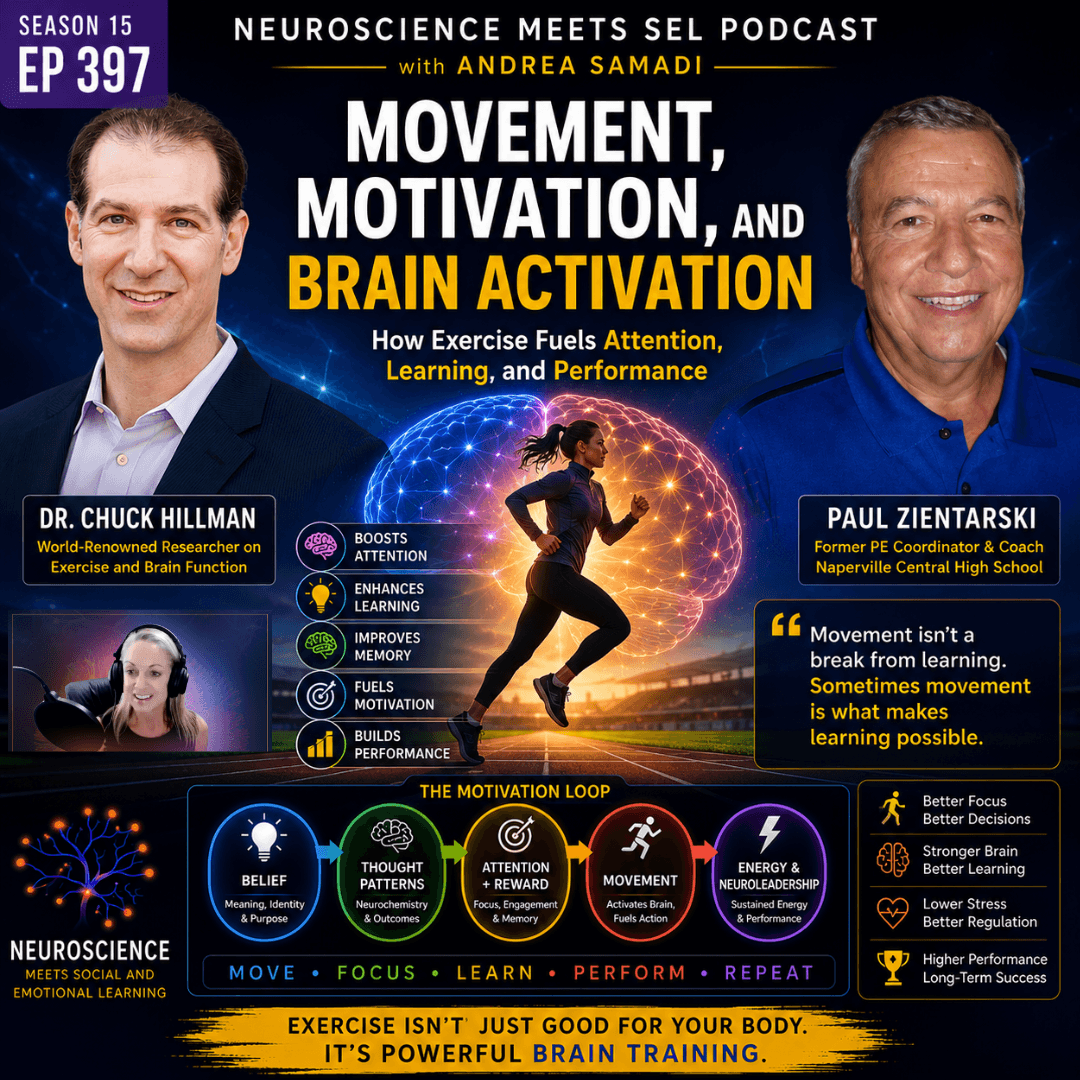 Move to Learn: How Movement Activates the Brain and Fuels Motivation (with Dr. Chuck Hillman and Paul Zientarski) 31.05.2026 35minSeason 15, Episode 397 revisits research and real-world practice showing movement is more than fitness: it activates the brain, boosts attention, enhances learning, and sustains motivation. Dr. Chuck Hillman’s studies reveal how even short bouts of exercise light up brain activity, while Paul Zientarski's Naperville program demonstrates how heart-rate monitoring and purposeful movement improve readiness, recovery, and academic performance. In EP 397: Movement, Motivation, and Brain Activation with Dr. Chuck Hillman and Paul Zientarski, we explore why movement may be one of the most powerful tools we have for improving brain function, learning, motivation, and performance. In this episode, we cover: ✅ Why most children are not meeting the recommended daily physical activity guidelines and what we can do to change that. ✅ How exposing children to a variety of activities helps them discover movement they enjoy—and are more likely to continue throughout their lives. ✅ Why there is no perfect exercise program, and why the best exercise is the one you'll consistently do. ✅ How enjoyment, reward, and dopamine reinforce healthy habits and keep the Motivation Loop repeating. ✅ What Naperville Central High School learned from heart rate monitoring and how recovery impacts performance. ✅ Why peak performance requires both effort and recovery. ✅ How exercise changes the brain, improving attention, learning, memory, and cognitive performance. ✅ The groundbreaking research behind Spark: The Revolutionary New Science of Exercise and the Brain and how it changed the way educators think about learning. ✅ Why movement is not a break from learning—but one of the most effective ways to prepare the brain for learning. ✅ How movement fits into our Phase 2 Motivation Loop, helping transform motivation into action and sustaining long-term performance. The biggest takeaway? Movement isn't just exercise. It's activation. It's preparation. It's performance. When we move our bodies, we activate the brain systems responsible for attention, learning, motivation, and success. The episode highlights practical takeaways: expose children to varied enjoyable activities, prioritize consistency over intensity, use movement as cognitive preparation, and track recovery to protect motivation. Movement becomes a bridge between motivation and sustained performance—improving focus today and long-term brain health tomorrow. Welcome back to Season 15 of the Neuroscience Meets Social and Emotional Learning Podcast. I'm Andrea Samadi, and on this podcast, we bridge the science behind social and emotional learning, emotional intelligence, and practical neuroscience so we can create measurable improvements in well-being, achievement, productivity, and results. Movement, Motivation, and Brain Activation with Dr. Chuck Hillman and Paul Zientarski This week, we continue our journey through Phase 2: Neurochemistry and Motivation, where we've been exploring one central question: What drives sustained effort and forward movement? So far, we've learned that motivation begins with belief and meaning from Bob Proctor[i], is shaped by our thought patterns with Dr. Caroline Leaf,[ii] strengthened through attention and reward with Dr. John Medina[iii], and powered by the brain's dopamine-based motivation system through Dr. Anna Lembke's[iv] work. But today, we arrive at a fascinating question: What happens when we actually move? Because motivation isn't just something that happens in the mind. The brain was designed to work in partnership with the body. And according to our review of today's two guests, one of the most powerful ways to activate attention, learning, memory, and motivation is through movement itself. This week we're revisiting insights from two pioneers whose work helped transform our understanding of movement and learning. First, Dr. Chuck Hillman, one of the world's leading researchers on exercise and brain function, whose groundbreaking research has shown
 -
 Dopamine, Motivation and Why the Brain Repeats Behavior with Dr. Anna Lembke 24.05.2026 23minHost Andrea Samadi welcomes Dr. Anna Lembke to explain how pleasure and pain share the same neural circuitry and how dopamine governs motivation. The episode explores why overconsumption of easy rewards dulls motivation, creates withdrawal-like deficits, and shifts the brain toward pain. Through clear takeaways—delay borrowed rewards, try temporary abstinence, create friction for temptations, and practice purposeful effort—the episode shows how recalibrating the brain’s reward system restores enjoyment in ordinary activities and builds sustainable motivation. Welcome back to Season 15 of the Neuroscience Meets Social and Emotional Learning Podcast. I'm Andrea Samadi, and on this podcast, we bridge the science behind social and emotional learning, emotional intelligence, and practical neuroscience so we can create measurable improvements in well-being, achievement, productivity, and results. Season 15 Orientation This season, we're exploring what I call: The Brain's Operating System for Human Performance. Instead of looking at neuroscience, health, learning, motivation, and emotional intelligence as separate topics, (like we did for the past 14 seasons) we're exploring how these systems come online in sequence. Each phase builds on the one before it: ✔ Phase 1 — Regulation & SafetyIs the nervous system safe enough to learn? ✔ Phase 2 — Neurochemistry & MotivationWhat drives behavior, focus, and sustained effort? ✔ Phase 3 — Movement, Learning & Cognition ✔ Phase 4 — Perception, Emotion & Social Intelligence ✔ Phase 5 — Integration, Insight & Meaning By the end of this year my hope is that we can step back and ask: Where am I out of alignment? Is it regulation? Is it my thinking? Is it my focus? Or Belief? Is it how I’m learning or connecting with others? Or do I need some work with integration, insight and meaning? Because once we can see our gap… We can begin to close it. “The goal is not more effort—it’s better alignment.” “And when these systems are aligned… Effort feels easier Learning becomes faster And results become more consistent Because peak performance is not about doing more. It’s about aligning the systems that drive our results. Recap Where We've Been In EP 392[i], we introduced the Motivation Loop and explored how the brain decides what is worth doing. In EP 393[ii], we looked at how our beliefs trigger neurochemistry that drives action, feedback, and repetition. In EP 394[iii] we looked at how our thought patterns impact our neurochemistry and results with Dr. Caroline Leaf. Then in EP 395[iv], reviewing Dr. John Medina's work on Theory of Mind, we explored something equally important: The brain pays attention to what it believes matters. Dr. Medina showed us that attention and reward are deeply connected. When the brain predicts something will be valuable, relevant, or meaningful, attention increases. And when attention and reward align: ✔ Learning improves ✔ Memory strengthens ✔ Motivation increases ✔ Behaviors become repeatable But that leaves us with an important question: What creates that sense of reward in the first place? What makes the brain continue pursuing something? What makes us stay motivated and what makes us lose interest? And why can effort sometimes feel rewarding—and other times feel exhausting? Today's Episode To answer those questions, we're turning to Dr. Anna Lembke, author of the book: Dopamine Nation who we first met September 2021 on EP 162.[v] Her work helps to explain the neurochemical engine underneath the Motivation Loop that we’ve been covering. While John Medina helped us understand how attention and reward influence learning, Dr. Lembke helps us understand: ✔ Why the brain seeks reward ✔ How dopamine drives motivation ✔ Why pleasure and pain operate on the same neural system ✔ And what happens when the balance gets disrupted Because the real goal isn't simply just feeling good. The goal is understanding how the brain learns to associate eff
 -
 Theory of Mind: The Missing Link Between Attention, Reward, and Motivation with John Medina 17.05.2026 37minEpisode 395 explores how theory of mind — our ability to understand others' intentions — drives attention, emotional relevance, and reward, shaping motivation and behavior. Dr. John Medina explains why the brain pays attention to people and meaning, how reading narrative fiction can strengthen perspective-taking, and practical tips for teachers, leaders, and coaches to build motivation through understanding rather than pressure. This Episode 395, We Will Cover: ✔ What Theory of Mind actually is, and why it matters for communication, learning, and leadership ✔ Why the brain pays attention to:• people• meaning• emotion• intention• and relevance ✔ How Theory of Mind helps us move beyond simply reacting to behavior—and begin understanding the human experience behind behavior ✔ Why emotionally relevant information captures attention and strengthens memory ✔ How attention and reward work together inside the brain’s Motivation Loop ✔ How dopamine helps reinforce behaviors the brain believes are worth repeating ✔ Why pressure and emotional stress can shut down motivation, focus, creativity, and learning ✔ Practical ways to strengthen Theory of Mind through:• observation• emotional awareness• communication• perspective-taking• and even reading high-quality narrative fiction ✔ Why understanding people more deeply may improve:• relationships• leadership• teaching• teamwork• learning• and overall human performance One of the biggest takeaways from this episode: 👉 Where attention goes… the brain follows.👉 And what the brain repeatedly rewards… eventually becomes behavior. Welcome back to Season 15 of the Neuroscience Meets Social and Emotional Learning Podcast. I’m Andrea Samadi, and on this podcast, we bridge the science behind social and emotional learning, emotional intelligence, and practical neuroscience—so we can create measurable improvements in well-being, achievement, productivity, and results. If you’re new here, welcome. In Season 15, we are revisiting past episodes through a new lens—a roadmap of the brain’s foundational systems. Instead of treating neuroscience, health, mindset, and performance as separate topics like we’ve done in past seasons…we’re now exploring how these systems come online in sequence. Because the brain functions as an integrated system—and each phase builds on the one before it. In Phase 1, we focused on Regulation and Safety—because without it, nothing else in the brain fully activates. 👉 If we don’t feel safe, the brain shifts into survival mode.👉 And when that happens, the systems we need for motivation, focus, learning, and performance don’t fully come online. This season is organized into five connected phases: Phase 1 — Regulation & Safety• Phase 2 — Neurochemistry & Motivation• Phase 3 — Movement, Learning & Cognition• Phase 4 — Perception, Emotion & Social Intelligence• Phase 5 — Integration, Insight & Meaning And by the end of this year, my hope is that we can step back and ask: 👉 Where am I out of alignment?👉 Is it regulation?👉 Is it my thinking?👉 Is it my focus or belief?👉 Is it how I’m learning or connecting with others? Because once we can see the gap…👉 We can begin to close it. The goal is not more effort—it’s better alignment. And when these systems are aligned… 👉 Effort feels easier👉 Learning becomes faster👉 And results become more consistent Because peak performance is not about doing more.It’s about aligning the systems that drive our results. We are now in Phase 2 — Neurochemistry & Motivation, where we are exploring one core question: 👉 What actually drives human behavior forward? In EP 392[i], we introduced the Motivation Loop—how the brain decides what’s worth doing. In EP 393[ii], with Bob Proctor, we explored how belief influences neurochemistry—driving action, feedback, and repetition. Then in EP 394[iii], with Dr. Caroline Leaf, we moved deeper into the loop—examining how thought patterns shape our neurochemistry and influence behavior ove
 -
 Thought Patterns & Neurochemistry — The Hidden Drivers of Your Life (Revisiting Dr. Caroline Leaf) 26.04.2026 25minIn this episode Andrea Samadi revisits her October 2022 interview with Dr. Caroline Leaf about how our thought patterns act as biological instructions that shape brain chemistry, behavior, and results. They explore the mind–brain distinction, the magnet analogy for pattern formation, and practical steps to interrupt negative thinking. Listeners learn why repeated thoughts build neural pathways, how beliefs trigger neurochemistry in the motivation loop, and how consistent practices—like Dr. Leaf’s 63-day NeuroCycle—can rewire thinking over time for better focus, motivation, and wellbeing. This Episode, We Will Cover: ✔ What it means when we say your thoughts are “biological instruction”✔ How your thoughts influence brain chemistry, the nervous system, and behavior✔ Why thinking, feeling, and choosing are always working together✔ The connection between thought patterns and future results✔ How repeated thoughts create neural pathways and habits ✔ The Motivation Loop — and where thought patterns fit in✔ The “magnet analogy” — how your thoughts organize patterns in the brain✔ How to identify and change toxic or limiting thought patterns✔ Dr. Carolyn Leaf’s 63-day Neurocycle process for rewiring thinking ✔ How your internal state influences your external results and environment✔ Why you are both shaping and responding to your environment🎯 How to begin directing your thinking to create more consistent outcomes Practical Strategies You’ll Learn: ✔️ How to identify the thought patterns that are holding you back✔️ Simple ways to interrupt negative thinking loops✔️ How to build positive neural pathways through repetition✔️ Questions to help you get to the root of your thinking✔️ Daily habits to rewire your brain over time 🎯 Key Takeaway: 👉 Your thoughts are not just ideas—they are shaping your brain, your behavior, and your results. Welcome back to Season 15 of the Neuroscience Meets Social and Emotional Learning Podcast. I’m Andrea Samadi, and on this podcast, we bridge the science behind social and emotional learning, emotional intelligence, and practical neuroscience—so we can create measurable improvements in well-being, achievement, productivity, and results. If you’re new here, welcome. We are currently reviewing past episodes in Season 15--organized as a roadmap of the brain’s foundational systems. Instead of treating neuroscience, health, mindset, and performance as separate topics—like we’ve done in the past 14 seasons—we’re now exploring how these systems come online in sequence. “In Phase 1, we focused on regulation and safety—because without it, nothing else in the brain fully activates. 👉 If we don’t feel safe, the brain shifts into survival mode👉 And when that happens, the systems we need for motivation, focus, and learning don’t fully come online” Phase 1 — Regulation & Safety• Phase 2 — Neurochemistry & Motivation• Phase 3 — Movement, Learning & Cognition• Phase 4 — Perception, Emotion & Social Intelligence• Phase 5 — Integration, Insight & Meaning By the end of this season, my hope is that we can step back and ask: 👉 Where am I out of alignment?👉 Is it regulation?👉 Is it my thinking?👉 Is it my focus? Or Belief?👉 Is it how I’m learning or connecting with others? Because once we can see the gap… 👉 We can begin to close it” “The goal is not more effort—it’s better alignment.” “And when these systems are aligned… 👉 Effort feels easier👉 Learning becomes faster👉 And results become more consistent Because peak performance is not about doing more. It’s about aligning the systems that drive our results. 🧠 We are now in Phase 2 — Neurochemistry & Motivation, where we asked one core question: 👉 What IS IT that drives us forward? In EP 392[i], we introduced the Motivation Loop—how our brain decides what’s worth doing.In EP 393[ii], we saw how belief triggers neurochemistry—driving action, feedback, and repetition. THOUGHT PATTERNS (Dr. Carolyn Leaf) For today’s EP 394, we move de
 -
 The Neuroscience of Belief: How Meaning, Identity and Frequency, Drive Motivation (Featuring Bob Proctor) 19.04.2026 28minAndrea Samadi explores Phase Two of the brain roadmap, showing how belief—shaped by meaning, identity, and daily practice—starts the motivation loop and drives action. Featuring insights from Bob Proctor, this episode offers practical steps to find your why, train your mind, act from your next-level frequency, and grow into the results you envision. Welcome back to Season 15 of the Neuroscience Meets Social and Emotional Learning Podcast. I’m Andrea Samadi, and on this podcast, we bridge the science behind social and emotional learning, emotional intelligence, and practical neuroscience—so we can create measurable improvements in well-being, achievement, productivity, and results. If you’re new here, welcome. On today’s EP 393 of the Neuroscience Meets Social and Emotional Learning Podcast, we revisit the work of Bob Proctor to explore something foundational: 👉 The Neuroscience of Belief Because before motivation…before action…before results… 👉 there is belief. In this episode, we break down how belief actually works in the brain—and why it’s the starting point of everything we do. ✔ Why motivation doesn’t start with discipline👉 it starts with belief and expectation ✔ How belief shapes your neurochemistry👉 dopamine rises when your brain believes something matters ✔ The Motivation Loop👉 Belief → Chemistry → Action → Feedback → Repeat ✔ Why goals are not about what you get👉 but who you become in the process ✔ The power of alignment👉 when you stop comparing and start following your own path ✔ Understanding “frequency”👉 how your thoughts, emotions, and focus determine what you experience ✔ Why imagination is more than visualization👉 it’s how the brain begins solving for a new future ✔ And why you don’t need the full plan👉 just the next step forward SEASON 15 ORIENTATION In Season 15, we’ve organized everything as a roadmap of the brain’s foundational systems. Instead of treating neuroscience, health, mindset, and performance as separate topics— we’re exploring how they come online in sequence. Each phase we are covering, builds on the one before it: Phase 1 — Regulation & Safety• Phase 2 — Neurochemistry & Motivation• Phase 3 — Movement, Learning & Cognition• Phase 4 — Perception, Emotion & Social Intelligence• Phase 5 — Integration, Insight & Meaning Because peak performance isn’t built by doing more— 👉 it’s built by aligning the systems underneath. And I want to understand these systems myself. So thank you for joining me on this journey— as we learn how to align our brains…to unlock what’s truly possible. TRANSITIONING FROM PHASE 1 → PHASE 2 In Phase 1, we asked a foundational question: 👉 Is the nervous system safe enough to learn? Because without safety— nothing else in the brain fully activates. But once the brain is regulated… a new question begins to emerge: 👉 What actually drives us forward? What determines whether we: start something• stay with it• or stop altogether PHASE 2: NEUROCHEMISTRY and MOTIVATION We started Phase 2 with something simple. To think about the last time you felt truly motivated. Not forced…not pushing yourself… but naturally pulled into something. 👉 What made you start? Was it discipline? Or was it something deeper? … Because here’s what neuroscience—and the work of many experts—has shown us: 👉 Motivation doesn’t start with action.👉 It starts with belief. Before you ever take a step— your brain has already made a decision. If you are thinking: “This matters.”• “This is worth it.”• “This could REALLY work.” That’s THE moment that belief is formed— 🧠 your brain begins releasing dopamine in anticipation. Not because you’ve succeeded… 👉 but because you expect to. THE MOTIVATION LOOP This is what we call: The Motivation Loop. It works like this: Belief — meaning and expectation Neurochemistry — dopamine and drive Action — effort and behavior Feedback — reward or disappointment Repeat… or Burnout And it all begins with one question: 👉 What do you believe is worth y
 -
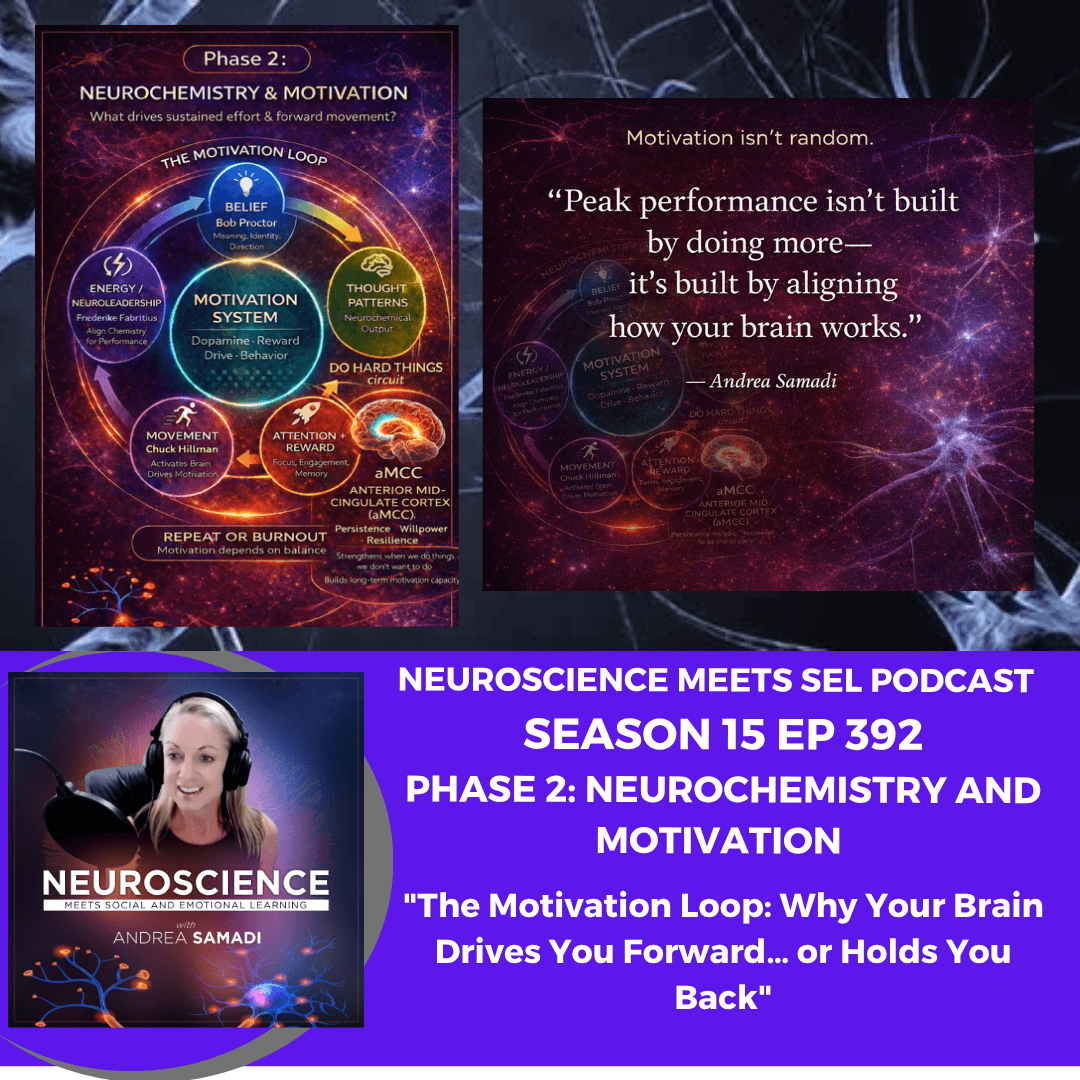 The Motivation Loop: How Your Brain Decides What’s Worth Doing 12.04.2026 19minSeason 15, Episode 392 introduces phase two of the roadmap: neurochemistry and motivation. Andrea Samadi breaks down the motivation loop—expectation, thought patterns, attention and action, feedback, and repetition—and explains how belief and dopamine drive what we start, persist with, or stop. The episode highlights earned vs. borrowed dopamine, the role of the anterior mid-cingulate cortex in willpower, and offers practical steps to build sustainable motivation through small wins, effort-first rewards, and consistent practice. ✅ What You’ll Learn in This Episode ✔️ How the Motivation Loop works—and why your brain is always running it ✔️ Why dopamine is about anticipation, not just pleasure ✔️ The difference between borrowed vs earned dopamine—and how it impacts your drive ✔️ How your beliefs and thought patterns shape your brain chemistry ✔️ Why doing hard things strengthens willpower (aMCC) and builds resilience ✔️ What causes motivation to increase… or break down ✔️ How your brain decides to repeat a behavior—or avoid it next time ✔️ Why effort first, reward after is the key to building lasting motivation ✔️ Simple ways to train your brain to stay motivated ✔️ How to align your brain for sustained performance and results Welcome back to Season 15 of the Neuroscience Meets Social and Emotional Learning Podcast. I’m Andrea Samadi, and it’s here that we bridge the science behind social and emotional learning, emotional intelligence, and practical neuroscience—so we can create measurable improvements in well-being, achievement, productivity, and results. If you’re new here, welcome. We are currently reviewing past episodes as part of Season 15—organized as a roadmap of the brain’s foundational systems. Instead of treating neuroscience, health, mindset, and performance as separate topics—like we’ve done in the past 14 seasons—we’re now exploring how these systems come online in sequence. We started Phase 1, Regulation and Safety, with EP 384[i], with Dr. Baland Jalal, who taught us how learning begins (with curiosity, sleep, imagination and creativity), and reviewed anchor episodes with Dr. Bruce Perry[ii], looking into trauma, rhythm, and relational safety, Dr. Sui Wong[iii] on autonomic balance, and Rohan Dixit[iv], on HRV, real-time self-regulation and nervous system literacy. Now, we are moving to Phase 2, diving deeper into neurochemistry and motivation…then we’ll cover movement, learning, and cognition…Then perception, emotion, social intelligence…and finally integration, insight, and meaning as we put all of the phases together. Season 15 Roadmap: Phase 1 — Regulation & Safety Phase 2 — Neurochemistry & Motivation Phase 3 — Movement, Learning & Cognition Phase 4 — Perception, Emotion & Social Intelligence Phase 5 — Integration, Insight & Meaning Because peak performance isn’t built by doing more—it’s built by aligning the systems underneath. And the truth is, most of us were never taught how these systems drive our behavior and results in the first place. So as I continue to explore and better understand these systems myself,I want to thank you for joining me on this journey…So that together, we learn how to align our brains—and use this understanding to unlock what’s truly possible for us to achieve. Because I do believe that we’re capable of achieving far more than we think is possible—with this understanding. PHASE 2 Today, we move into Phase 2 of our roadmap—Neurochemistry and Motivation. In Phase 1, we asked a foundational question:👉 Is the nervous system safe enough to learn? Because without safety, nothing else in the brain fully activates. But once the brain is regulated…a new question begins to emerge: 👉 What actually drives us forward? What determines whether we start something…stay with it…or stop it altogether? We will cover 6 PARTS in this episode, where we will answer this question, give some real world examples, and come up with some action steps to help us to build moti
Podcast simili


Popolare in
Questo podcast compare anche nelle classifiche dei podcast di questi paesi.


