
YaleCourses
YaleCourses
0
YaleCourses provides access to lectures and academic programs from Yale University, including complete sets from the Open Yale Courses initiative. The channel aims to train a broadly based, highly disciplined intellect without prescribing how it will be used. Students can also find complementary syllabi, transcripts, and other resources on the Open Yale Courses website. The podcast offers a window into the core of the university's classrooms and academic offerings.
Episodi
-
 14. Never Call Retreat: Military and Political Turning Points in 1863 21.09.2026 57minThe Civil War and Reconstruction (HIST 119)Professor Blight lectures on the military history of the early part of the war. Beginning with events in the West, Blight describes the Union victories at Fort Donelson and Fort Henry, introduces Union General Ulysses S. Grant, and narrates the horrific battle of Shiloh, fought in April of 1862. Moving back East, the lecture describes the Union General George McClellan's abortive 1862 Peninsula campaign, which introduced the world to Confederate General Thomas "Stonewall" Jackson. The lecture concludes with Confederate General Robert E. Lee's decision to take the battle to the North.00:00 - Chapter 1. The Mood of the Civil War and McClellan's Army09:46 - Chapter 2. Early Union Successes and Ulysses S. Grant's Entry into the War20:07 - Chapter 3. The Battle of Shiloh26:29 - Chapter 4. McClellan's Abortive 1862 Naval Campaign and "Stonewall" Jackson33:34 - Chapter 5. The Battle of Seven Days and Robert E. Lee's Move North49:14 - Chapter 6. ConclusionComplete course materials are available at the Open Yale Courses website: http://open.yale.edu/coursesThis course was recorded in Spring 2008. Learn more about your ad choices. Visit megaphone.fm/adchoices
 -
 Low-Cost, High-Nutrition Eating for Graduate Students: Quick and Tasty Cooking 21.09.2026 18minIn this video, discover the key to cooking quick and tasty recipes perfect for busy student life. Dr. Nate Wood shares tips and tricks to prepare meals that are both delicious and time-efficient.Managing your finances as a student is challenging. Yale’s Graduate and Professional Student Senate collaborated with Dr. Nate Wood, Assistant Professor and Director of Culinary Medicine at the Yale School of Medicine, to create this video series aimed at helping our community to shop and eat affordably and nutritiously. According to a 2024 Senate report, 30% of Yale's graduate and professional students experience food insecurity. Our goal is to provide tangible support through practical tips, recipes, and strategies. For more resources or to share your thoughts, use our contact form!https://www.gpsenate.yale.edu/contact Learn more about your ad choices. Visit megaphone.fm/adchoices
 -
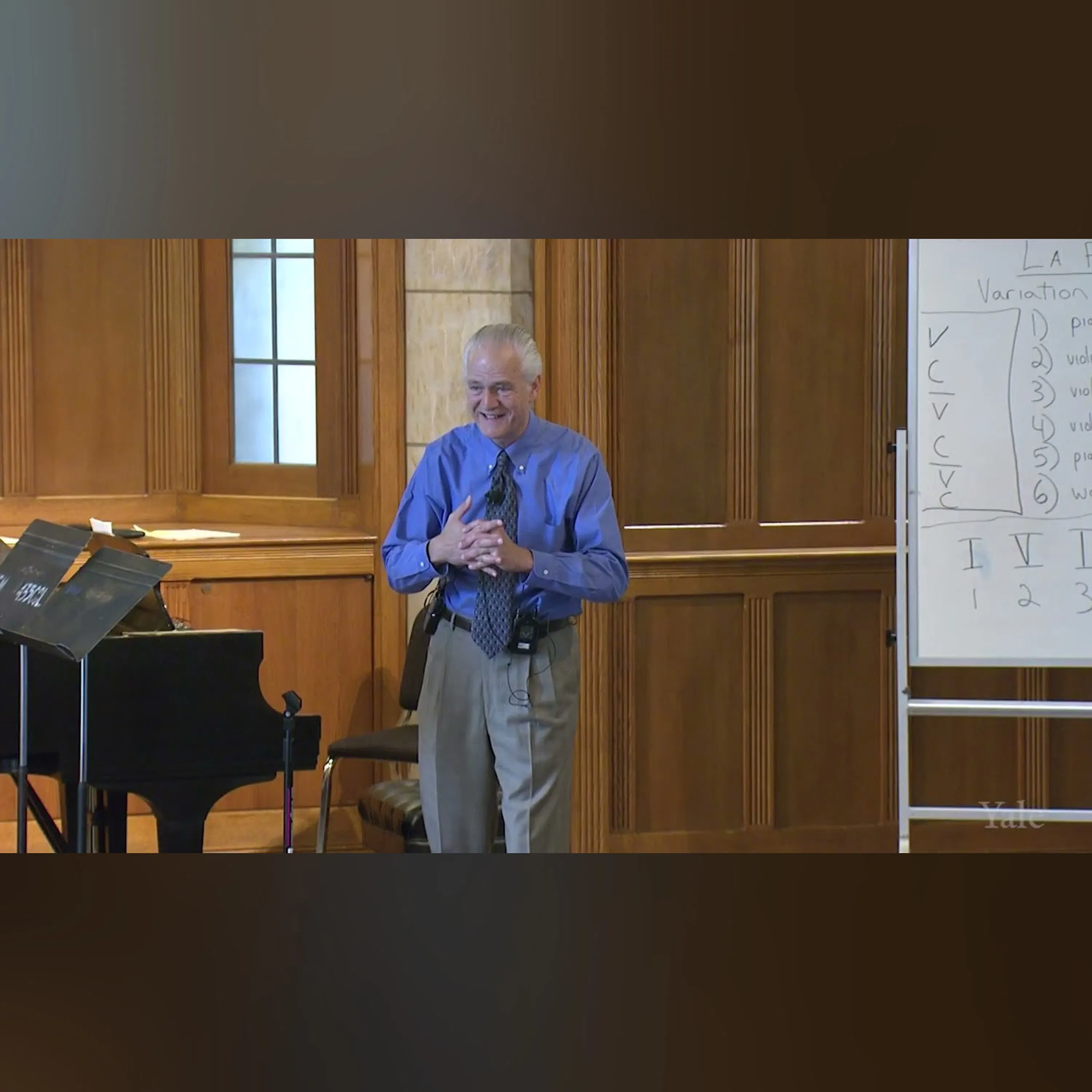 Lecture 10 Sonata-Allegro and Theme and Variations 21.09.2026 59minListening to Music (MUSI 112)Professor Wright delves into sonata-allegro form in some depth in this lecture. He focuses especially on characterizing four types of music found within a sonata: thematic, transitional, developmental, and cadential. He then moves on to discuss a different form, theme and variations, which is accomplished through the use of examples from Beethoven's and Mozart's compositions. Professor Wright and guest artist Kensho Watanabe then conclude the lecture by demonstrating a set of theme and variations through a live performance of Corelli's La Folia.00:00 - Chapter 1. Introduction02:34 - Chapter 2. Parts of the Sonata-Allegro Form08:18 - Chapter 3. Distinguishing Functional Types within the Sonata-Allegro20:58 - Chapter 4. Theme and Variations34:11 - Chapter 5. Examining Theme and Variations in Corelli's La FoliaComplete course materials are available at the Yale Online website: online.yale.eduThis course was recorded in Fall 2008. Learn more about your ad choices. Visit megaphone.fm/adchoices
 -
 12. Evolution, Emotion, and Reason: Emotions, Part II 21.09.2026 1h 2minIntroduction to Psychology (PSYC 110)Professor Bloom continues the discussion of emotions as useful evolutionary adaptations for dealing with our social environment. In particular, this lecture describes evolutionary explanations for several important emotional responses, such as the love between parents and their offspring, the gratitude we feel towards cooperative behaviors, the spite we feel for cheaters, and the cultural differences in feelings of revenge.00:00 - Chapter 1. Emotional Responses to Caregivers and Kin15:44 - Chapter 2. Question and Answer on Emotions Towards Kin18:14 - Chapter 3. Evolutionary Explanations for Emotional Responses25:20 - Chapter 4. Cooperative Behavior and The Prisoner's Dilemma40:43 - Chapter 5. The Ultimatum Game, Rationally and Irrationality49:20 - Chapter 6. Cultures of HonorComplete course materials are available at the Yale Online website: online.yale.eduThis course was recorded in Spring 2007. Learn more about your ad choices. Visit megaphone.fm/adchoices
 -
 14. Paradise Lost, Book IV 21.09.2026 58minMilton (ENGL 220)This lecture examines Book Four's depiction of Adam and Eve and the sexual politics of life in Eden. Seventeenth-century political theory, particularly the work of Thomas Hobbes, is considered with a focus on then-contemporary theories of the structure and government of the first human societies. Critical perspectives on what have variously been proposed as sexist and feminist elements of Milton's Eden are surveyed. Milton's struggle with the problem of depicting an unfallen world to a fallen audience is closely detailed. The lecture concludes with a study of Rembrandt's 1638 drawing, "Adam and Eve."00:00 - Chapter 1. Dissimiles in "Paradise Lost": Fallen Representation of Unfallen-ness10:16 - Chapter 2. Politics and Seventeenth-Century Descriptions of Adam and Eve15:45 - Chapter 3. Milton's Political Philosophy26:29 - Chapter 4. What Made Adam and Eve Unequal?Complete course materials are available at the Open Yale Courses website: http://open.yale.edu/coursesThis course was recorded in Fall 2007. Learn more about your ad choices. Visit megaphone.fm/adchoices
 -
 707 | The McDonald's of Healthcare: Aravind Eye Systems Case Study - Social Entrepreneurship Course 21.09.2026 14minHow can a social enterprise provide high-quality medical care to millions, even those who can't pay? In this lesson, we delve into the inspiring case study of Aravind Eye Systems, a pioneering organization in India that revolutionized cataract surgery access through innovative operational models, strategic cost reduction, and a unique differential pricing system.🎯 Learning Objectives• Understand how Aravind Eye Systems addressed multiple barriers to access eye care, including awareness, fear, and cost.• Analyze the operational efficiency strategies employed by Aravind, such as task shifting, high-volume surgery, and resource innovation.• Explore Aravind's unique differential pricing model and how it achieved financial viability through cross-subsidization.• Discover how Aravind scaled its impact through vision centers and technology, decentralizing primary eye care.📚 About the Course Have you ever wondered what it would be like to create real change? You don't have to start your own organization to make a difference in the world. Everyone can learn the social entrepreneurship mindset and skillset to build social impact. In this course, you will immerse yourself in a social or environmental challenge you want to tackle. You'll start by researching your topic of choice, talking to people, and ideating a potential solution that you can contribute. Then, you'll build a business model around that solution, understanding concepts like measuring social change, ensuring financial viability, funding and pitching. This course is a safe space to experiment and explore. You'll be guided by a ten stage framework to help structure your journey. Along the way, you'll hear from social entrepreneurs around the world through case studies and campus conversations. These include Yale alumni, members of the New Haven community, and global changemakers. Everyone is welcome to join this course! You can apply your lived, learned, or professional experience to discover how you're going to make a difference. 📺 Watch the full playlist on YouTube: https://www.youtube.com/playlist?list=PLh9mgdi4rNezbi0aRJeVnt99ynTVZG1PL🎓 Enroll on Coursera for assessments and a certificate: https://online.yale.edu/courses/creating-change-through-social-entrepreneurship🌐 Explore more learning opportunities on Yale Online: https://online.yale.edu/courses/creating-change-through-social-entrepreneurship#SocialEntrepreneurship #YaleCourse #Impact #Changemakers #BusinessPlan #DesignThinking Learn more about your ad choices. Visit megaphone.fm/adchoices
 -
 Low-Cost, High-Nutrition Eating for Graduate and Prof Students: Intro 21.09.2026 8minIn this video, learn about how to use this series as a tool for low-cost, high-nutrition eating.Managing your finances as a student is challenging. Yale’s Graduate and Professional Student Senate collaborated with Dr. Nate Wood, Assistant Professor and Director of Culinary Medicine at the Yale School of Medicine, to create this video series aimed at helping our community to shop and eat affordably and nutritiously. According to a 2024 Senate report, 30% of Yale's graduate and professional students experience food insecurity. Our goal is to provide tangible support through practical tips, recipes, and strategies. For more resources or to share your thoughts, use our contact form! Learn more about your ad choices. Visit megaphone.fm/adchoices
 -
 18. Paradise Lost, Books IX-X 21.09.2026 58minMilton (ENGL 220)This second lecture on the Fall traces Milton's use of the word wander, in all of its forms, across the poem. The transformation of wander from its pre-fallen sense to its more nefarious incarnation following the transgression is examined closely. The wider literary context of the concept of wandering, with particular emphasis placed on its importance to the romance genre, is briefly discussed. The reductive forces of Book Nine -- particularly its tendency to transform the moral ambivalence, disputed sexual hierarchy, and general poetic ambiguity of earlier books into more definitive representations -- are considered, with the lecture ultimately suggesting that the poem begins to turn away in Book Nine from many of its proto-feminist elements.00:00 - Chapter 1. Introduction: The Fall, Language and Literature06:33 - Chapter 2. Milton's Motivations for writing about The Fall14:41 - Chapter 3. Tracing the History of the Word "Wandering" as it Progresses through the Poem31:31 - Chapter 4. A New Understanding of Eve41:07 - Chapter 5. "Paradise Lost" Book X: The Consequences of The FallComplete course materials are available at the Open Yale Courses website: http://open.yale.edu/coursesThis course was recorded in Fall 2007. Learn more about your ad choices. Visit megaphone.fm/adchoices
 -
 11. John Barth, Lost in the Funhouse 21.09.2026 55minThe American Novel Since 1945 (ENGL 291)In her lecture on John Barth's collection of stories Lost in the Funhouse, Professor Amy Hungerford delves beyond the superficial pleasures and frustrations of Barth's oft-cited metafictional masterwork to illuminate the profound commitment to language that his narrative risks entail. Foremost among Barth's concerns, Hungerford argues, is the multi-faceted relationship between language and love. Desire can drive a narrative, or disrupt it. Language can create desire, or replace it. Unifying the virtuosic variety of his tales is Barth's inquiry: Does language always stand in for a loss of bodily presence? Must the written word always exist as the shadow of the oral?00:00 - Chapter 1. Barth, the Teacher10:00 - Chapter 2. The Modernist Ambition in 'Night-Sea Journey'25:27 - Chapter 3. Alienation and Desire42:05 - Chapter 4. The Power of VoiceComplete course materials are available at the Open Yale Courses website: http://open.yale.edu/coursesThis course was recorded in Spring 2008. Learn more about your ad choices. Visit megaphone.fm/adchoices
 -
 America at 250, DeVane, Class 16 - Gilded Age and Aftermath of Reconstruction, South, North, and West 21.09.2026 1h 2minWhat becomes of a nation filled with corruption that’s covered with gold. Professor David Blight returns to Mark Twain as he details the Gilded Age and what it brings.Recorded in Yale’s Battell Chapel. This one-time-only course examines U.S. history from 1776 to the present, in advance of the nation’s semiquincentennial (or 250th birthday) in 2026. Taught jointly by Professors Joanne Freeman, David Blight, and Beverly Gage, the course emphasizes the history of the nation-state and the contested nature of American national identity. All three scholars will deliver the course’s first and final lectures together, as an introduction and a wrap-up. In between, they will each deliver eight lectures individually based on their areas of expertise. Joanne Freeman, the Alan Boles, Class of 1929 Professor of History and American Studies, and an expert in the revolutionary and early national periods of American history, will cover the period from the Revolution up through the 1830s, touching on such topics as the birth of party politics, the nature of “Jacksonian democracy,” and the rise of the reform and protest movements.David Blight, Sterling Professor of History and African American Studies and one of the country’s foremost authorities on the history of slavery and the Civil War, will cover the Civil War era up through Reconstruction and the emergence of the Jim Crow laws.Beverly Gage, John Lewis Gaddis Professor of History, who is currently writing a book on the nation’s past to mark the 250th anniversary of the signing of the Declaration of Independence, will pick up in the 1890s and continue through the end of the 20th century, addressing debates around immigration, wealth inequality, and the creation of the social welfare state. The course explores U.S. political history broadly conceived–not just as a realm of presidents and elections and wars (though there will be plenty of those) but as a conversation across time between citizens about what the United States is, was, and was meant to be. It proceeds from the premise that the American Revolution was the first but not the last radical act of national reimagining in U.S. history. The DeVane Lecture series was established in 1969 to honor William Clyde DeVane, dean of Yale College from 1939 to 1963. A copy of the course syllabus with required readings can be downloaded at the bottom of the page at this link: https://president.yale.edu/committees-programs/devane-lectures/america-at-250-a-history To view all the classes in the DeVane Lecture series, go to this playlist link: https://youtube.com/playlist?list=PLh9mgdi4rNezTQrY_6XMNBWaZqLRdgpoq&feature=shared Learn more about your ad choices. Visit megaphone.fm/adchoices
 -
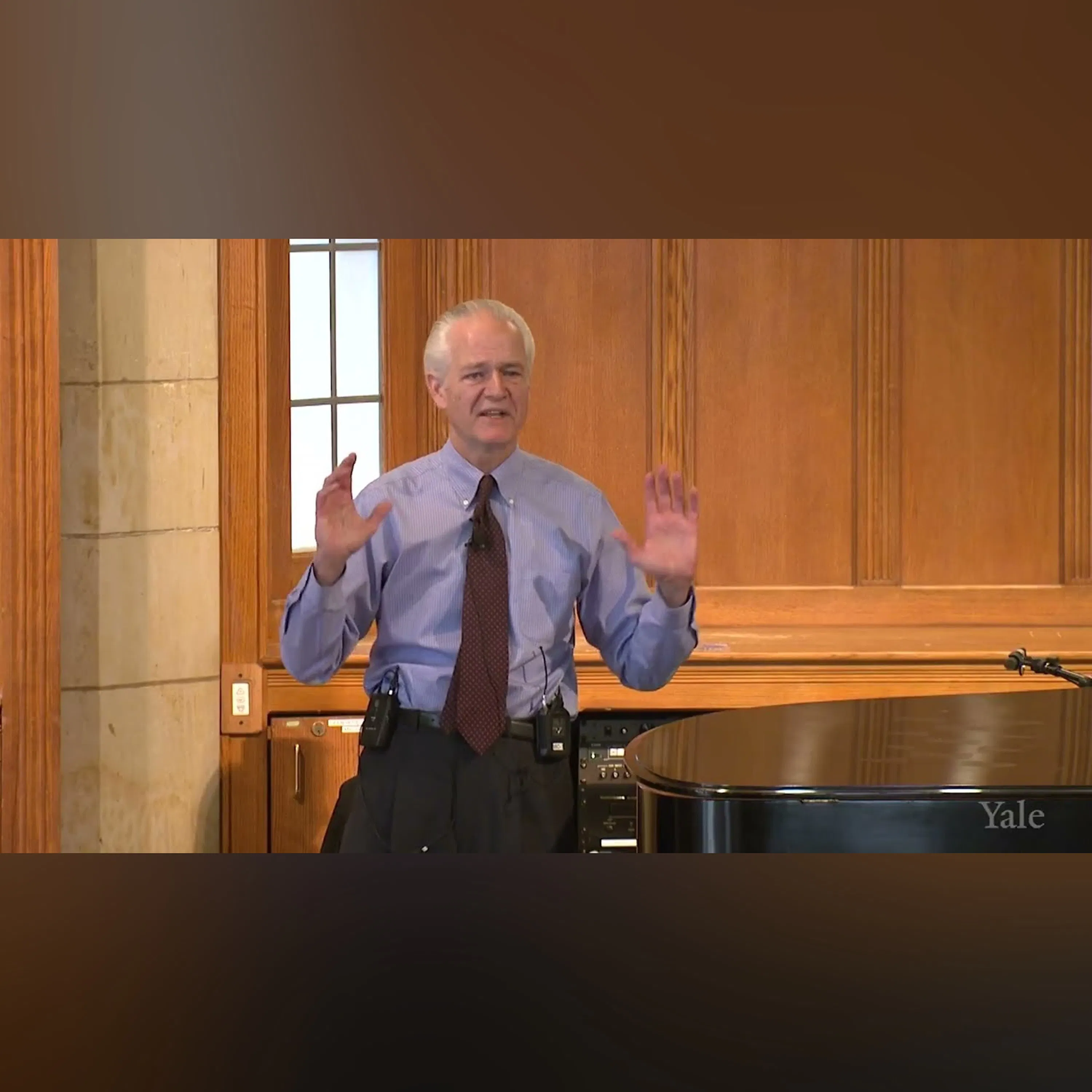 Lecture 9. Sonata-Allegro Form: Mozart and Beethoven 21.09.2026 55minListening to Music (MUSI 112)A brief foray into the formal characteristics of contemporary popular music is used to launch this lecture on musical form. After a discussion of the "verse-chorus" form often used in popular music, Professor Wright proceeds to take students into the realm of classical music, focusing particularly on ternary form and sonata-allegro form. Throughout his detailed explanation of sonata-allegro form, he also elaborates upon some harmonic concepts describing, for example, the relationship between relative major and minor keys. This lecture draws its musical examples from 'N Sync, Mozart, and Beethoven.00:00 - Chapter 1. Verse-Chorus Form in Popular Music05:56 - Chapter 2. Introduction to Form in Classical Music12:18 - Chapter 3. Ternary Form18:00 - Chapter 4. The Sonata-Allegro Form in Mozart's "A Little Night Music"36:19 - Chapter 5. The Sonata-Allegro Form in Beethoven's Fifth SymphonyComplete course materials are available at the Yale Online website: online.yale.eduThis course was recorded in Fall 2008. Learn more about your ad choices. Visit megaphone.fm/adchoices
 -
 7. Plato, Part II: Arguments for the immortality of the soul 21.09.2026 53minDeath (PHIL 176)The discussion of Plato's Phaedo continues, presenting more arguments for the existence and immortality of the soul. One such argument is "the argument from the nature of the forms," which states that because the forms are non-physical objects and cannot be grasped by something physical like the body, it follows that they must be grasped by the soul which must be non-physical as well. This argument is followed by the "argument from recycling" and "the argument from recollection."00:00 - Chapter 1. Review of Plato's Heaven: Platonic Forms 04:13 - Chapter 2. Concerns and Issues Leading to the Development of Platonic Forms 14:17 - Chapter 3. The Argument from the Nature of the Forms 24:33 - Chapter 4. The Argument from Recycling 33:33 - Chapter 5. The Argument from Recollection 43:54 - Chapter 6. Do Plato's Arguments Suffice? Complete course materials are available at the Yale Online website: online.yale.edu This course was recorded in Spring 2007. Learn more about your ad choices. Visit megaphone.fm/adchoices
 -
 America at 250: A History, DeVane Lecture, Class 9, Whose America? Protest and Reform 20.09.2026 59minSearching and struggles, opportunities and losses. Professor Joanne Freeman concludes her series of lectures for the course.Recorded in Yale’s Battell Chapel. This one-time-only course examines U.S. history from 1776 to the present, in advance of the nation’s semiquincentennial (or 250th birthday) in 2026. Taught jointly by Professors Joanne Freeman, David Blight, and Beverly Gage, the course emphasizes the history of the nation-state and the contested nature of American national identity. All three scholars will deliver the course’s first and final lectures together, as an introduction and a wrap-up. In between, they will each deliver eight lectures individually based on their areas of expertise. Joanne Freeman, the Alan Boles, Class of 1929 Professor of History and American Studies, and an expert in the revolutionary and early national periods of American history, will cover the period from the Revolution up through the 1830s, touching on such topics as the birth of party politics, the nature of “Jacksonian democracy,” and the rise of the reform and protest movements.David Blight, Sterling Professor of History and African American Studies and one of the country’s foremost authorities on the history of slavery and the Civil War, will cover the Civil War era up through Reconstruction and the emergence of the Jim Crow laws.Beverly Gage, John Lewis Gaddis Professor of History, who is currently writing a book on the nation’s past to mark the 250th anniversary of the signing of the Declaration of Independence, will pick up in the 1890s and continue through the end of the 20th century, addressing debates around immigration, wealth inequality, and the creation of the social welfare state. The course explores U.S. political history broadly conceived–not just as a realm of presidents and elections and wars (though there will be plenty of those) but as a conversation across time between citizens about what the United States is, was, and was meant to be. It proceeds from the premise that the American Revolution was the first but not the last radical act of national reimagining in U.S. history. A copy of the course syllabus with required readings can be downloaded at the bottom of the page at this link: https://president.yale.edu/committees-programs/devane-lectures/america-at-250-a-history To view all the classes in the DeVane Lecture series, go to this playlist link: https://youtube.com/playlist?list=PLh9mgdi4rNezTQrY_6XMNBWaZqLRdgpoq&feature=shared Learn more about your ad choices. Visit megaphone.fm/adchoices
 -
 24. Suicide, Part I: The rationality of suicide 20.09.2026 52minDeath (PHIL 176)This is the first of a series of lectures on suicide. Two very distinct contexts are presented in which the subject can be further explored. The first is rationality and the question of under what circumstances it makes sense to end one's own life. The second is morality and the question of whether we can ever ethically justify resorting to suicide. The lecture's focus is on the rational requirements of suicide, and Professor Kagan introduces a number of cases which demonstrate that ending one's life, in certain instances, may be rationally sound.00:00 - Chapter 1. Introduction to Suicide: Does it Make Sense? Distinguishing Issues of Rationality and Morality 05:14 - Chapter 2. When Is It Rational to Commit Suicide? Problems with the Two-State Requirement 17:11 - Chapter 3. Is Life Worth Having in the First Place? An Exploration of Intrinsic Value 28:51 - Chapter 4. Medical Complications: Rationale for Euthanasia 37:35 - Chapter 5. Suicide on a Positive-Negative Life Curve Complete course materials are available at the Yale Online website: online.yale.eduThis course was recorded in Spring 2007. Learn more about your ad choices. Visit megaphone.fm/adchoices
 -
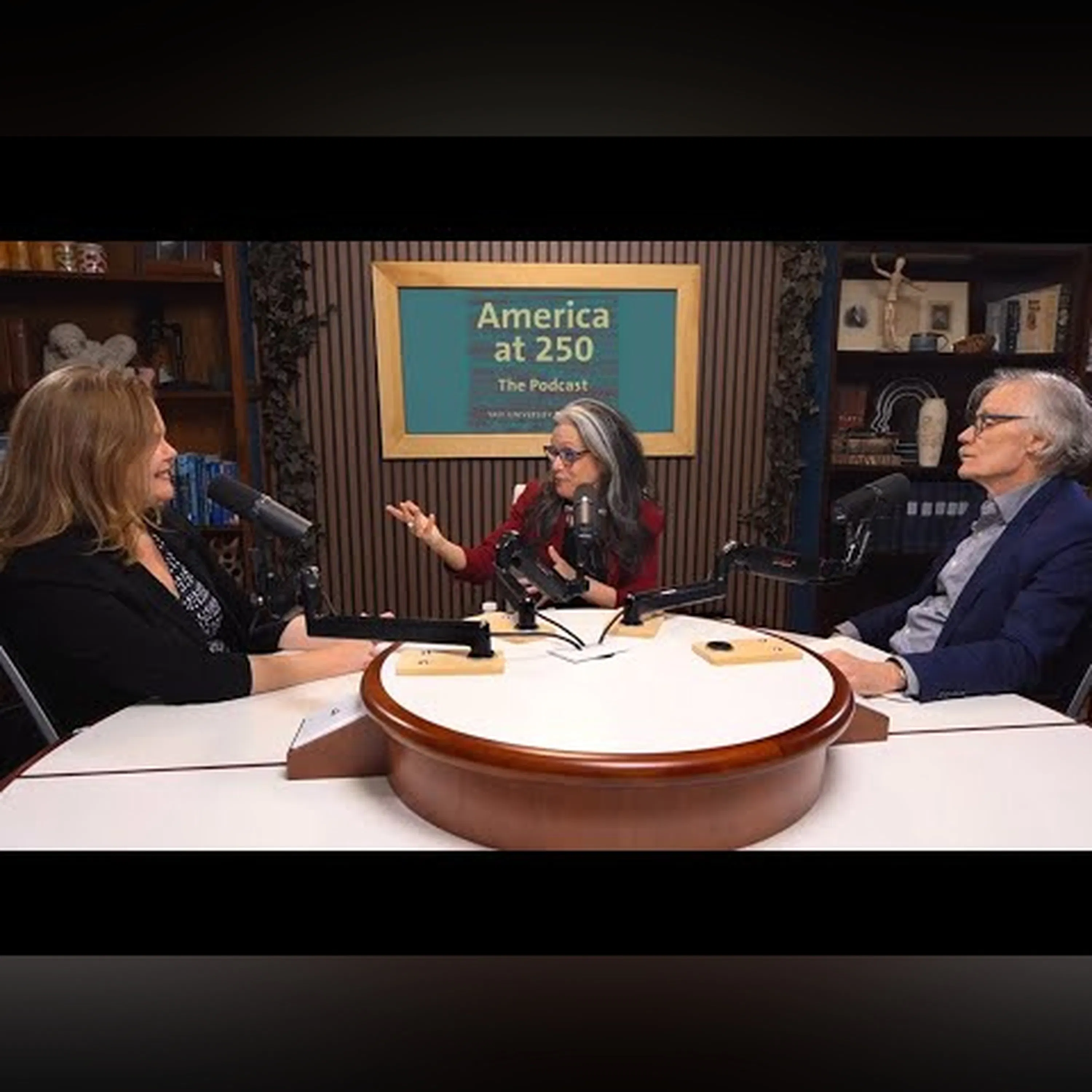 America at 250 Podcast Episode 10: Left and Right in the 60s and 70s 20.09.2026 58minProfessor Beverly Gage describes the growing movements on the left and the right in the 1960s and 70s while Professors Blight and Freeman try to resist the urge to stroll down memory lane. This podcast is also available on Apple: https://podcasts.apple.com/us/podcast/america-at-250-the-podcast/id1840422776 and Spotify: https://open.spotify.com/show/4C8qfQf21r4eO6mVUFguG2To view all the videos in this course or view and download a copy of the course syllabus with required readings please scroll through the page at this link: https://president.yale.edu/committees-programs/devane-lectures/america-at-250-a-history Learn more about your ad choices. Visit megaphone.fm/adchoices
 -
 7. Lycidas (cont.) 20.09.2026 59minMilton (ENGL 220)In this second lecture on "Lycidas," moments of intrusion and revelation are closely examined. Saint Peter's protracted sermon is connected with the wider context of Puritan practices and controversies. The poem's tendency to suggest pairs and substitutions is duly noted. Finally, its conclusion is read as a triumphant moment in the young Milton's poetry, at which point he parts with the claims of ill-preparedness and little experience that dominated the early poems and assumes instead a prophetic voice for himself akin to Isaiah's.00:00 - Chapter 1. Introduction: Analyzing the Beginning of "Lycidas"03:11 - Chapter 2. The Pastoral Framework of "Lycidas"14:00 - Chapter 3. Milton: "The Reason of Church Government"19:36 - Chapter 4. The Dramatic Structure of "Lycidas": A Succession of Four Mourners48:50 - Chapter 5. Milton: The Prophetic Poet?Complete course materials are available at the Open Yale Courses website: http://open.yale.edu/coursesThis course was recorded in Fall 2007. Learn more about your ad choices. Visit megaphone.fm/adchoices
 -
 504 | The Customer's Journey: The Power of a Customer Flowchart - Social Entrepreneurship Course 20.09.2026 4minIn this lesson, you'll learn about the customer flowchart, a powerful tool for visualizing and detailing how your social venture's idea will work. Beyond just defining your customer, this module helps you map out their interaction with your offering, including how they discover it, what motivates their engagement, and the anticipated impact on their lives.🎯 Learning Objectives• Understand the utility of a customer flowchart in detailing your social venture's operations.• Describe the complete customer interaction with your offering, from learning about it to its impact.• Identify key questions regarding costs, engagement, and the flow of your social venture's services.• Learn how to use a diagram to clarify and communicate your idea to others.📚 About the Course Have you ever wondered what it would be like to create real change? You don't have to start your own organization to make a difference in the world. Everyone can learn the social entrepreneurship mindset and skillset to build social impact. In this course, you will immerse yourself in a social or environmental challenge you want to tackle. You'll start by researching your topic of choice, talking to people, and ideating a potential solution that you can contribute. Then, you'll build a business model around that solution, understanding concepts like measuring social change, ensuring financial viability, funding and pitching. This course is a safe space to experiment and explore. You'll be guided by a ten stage framework to help structure your journey. Along the way, you'll hear from social entrepreneurs around the world through case studies and campus conversations. These include Yale alumni, members of the New Haven community, and global changemakers. Everyone is welcome to join this course! You can apply your lived, learned, or professional experience to discover how you're going to make a difference. 📺 Watch the full playlist on YouTube: https://www.youtube.com/playlist?list=PLh9mgdi4rNezbi0aRJeVnt99ynTVZG1PL🎓 Enroll on Coursera for assessments and a certificate: https://online.yale.edu/courses/creating-change-through-social-entrepreneurship🌐 Explore more learning opportunities on Yale Online: https://online.yale.edu/courses/creating-change-through-social-entrepreneurship#SocialEntrepreneurship #YaleCourse #Impact #Changemakers #BusinessPlan #DesignThinking Learn more about your ad choices. Visit megaphone.fm/adchoices
 -
 Low-Cost, High-Nutrition Eating for Graduate Students: Meal Planning 20.09.2026 21minIn this video, learn the art of meal planning to save time and money. Dr. Nate Wood provides strategies for planning your meals in advance, ensuring balanced and nutritious eating throughout the week.Managing your finances as a student is challenging. Yale’s Graduate and Professional Student Senate collaborated with Dr. Nate Wood, Assistant Professor and Director of Culinary Medicine at the Yale School of Medicine, to create this video series aimed at helping our community to shop and eat affordably and nutritiously. According to a 2024 Senate report, 30% of Yale's graduate and professional students experience food insecurity. Our goal is to provide tangible support through practical tips, recipes, and strategies. For more resources or to share your thoughts, use our contact form!https://www.gpsenate.yale.edu/contact Learn more about your ad choices. Visit megaphone.fm/adchoices
 -
 19. Omega and the End of the Universe 20.09.2026 55minFrontiers/Controversies in Astrophysics (ASTR 160)Class begins with a review of the issues previously addressed about the origin and fate of the universe. The role of gravity in the expansion of the universe is discussed and given as the reason why the rate of expansion cannot remain constant and will eventually slow down. The actual density of the universe is calculated using various methods. Finally, the unsolved problem of dark matter is addressed and two explanatory hypotheses are proposed. One is that the universe is comprised of WIMPs (Weakly Interactive Massive Particles) that fulfill two requirements: they have mass and do not interact with light. The second hypothesis is that dark matter is made of MACHOs (Massive Astrophysical Compact Halo Objects), which scientists have attempted to identify through gravitational lenses.00:00 - Chapter 1. Review of Issues in Cosmology08:28 - Chapter 2. Determining Mass26:39 - Chapter 3. Dark Matter: WIMPs?37:30 - Chapter 4. Dark Matter: MACHOs?Complete course materials are available at the Open Yale Courses website: http://open.yale.edu/courses This course was recorded in Spring 2007. Learn more about your ad choices. Visit megaphone.fm/adchoices
 -
 4.6 | Mastering Medical Software Risk Management: Control and Evaluation — Medical Software Course 20.09.2026 8minHow do you ensure your medical software is not just functional, but also safe? In this lesson, we conclude our deep dive into the risk management process, focusing on the critical stages of risk evaluation and control. We'll explore how to determine acceptable risk levels, delve into the hierarchy of risk control techniques—eliminate, reduce, and warn—and understand the concept of residual risk, ultimately reinforcing why diligent risk management, though seemingly alarmist, is vital for long-term quality and trust.🎯 Learning Objectives• Define risk evaluation and its role in the risk management process.• Understand the concept of acceptable risk and its determination.• Describe the three fundamental risk control techniques: eliminate, reduce, and warn.• Explain what residual risk is and how it is re-evaluated.• Appreciate the strategic importance of proactive risk management in medical software development. Learn more about your ad choices. Visit megaphone.fm/adchoices
Podcast simili


Popolare in
Questo podcast compare anche nelle classifiche dei podcast di questi paesi.

