
Today in the Word Devotional
Today In The Word
0
Today in the Word is a daily audio devotional podcast from Moody Bible Institute. It presents biblical content and study that reflect the Institute's mission and values. Each episode offers listeners a short, focused look at Scripture, helping them grow in their faith and understanding of the Bible.
Episodi
-
 Feast of Firstfruits 06.10.2026 2minWhat was actually eaten at the first Thanksgiving? The colonists and Native Americans feasted on fresh venison; ducks, geese, and other fowl; and a kind of corn that they made into cornbread and porridge. Their “stuffing” was onions and nuts. They also ate cod, eel, lobster, and vegetables such as peas, beans, and squash. Sorry, no turkey, no mashed potatoes with gravy, no pumpkin pie. Like Thanksgiving, Israel’s Feast of Firstfruits was a harvest festival. It took place during what would be March or April on our calendar. “Firstfruits” is just what it sounds like: The earliest part of the harvest was to be offered to the Lord. Specifically, the priest would wave before God “a sheaf of the first grain” harvested (vv. 10–11). The act of waving signified honor and worship to the Lord, acknowledging Him as the source and provider of all blessings, including food. This wave offering was to be accompanied by a burnt offering of a lamb without defect (v. 12). Why? Again the main purpose was worship, but in this case it also signified substitutionary blood atonement for sin. Ideally, these were outward actions revealing the inward state of the worshipers’ hearts. The burnt offering was likewise accompanied by a grain offering and a drink offering (v. 13). These were not mere formalities but serious business. Not so much as a loaf of bread was to be eaten until these offerings had been made (v. 14)! God declared this and other feasts before Israel had even entered the promised land. Receiving the Law was therefore an act of faith by the people in God’s promises. “Firstfruits” is used in the New Testament to talk about resurrection. Christ is the “firstfruits” from among the dead, meaning that since He rose, we will in due time also rise (1 Cor. 15:20–23).Donate to Today in the Word: https://give.todayintheword.org/See omnystudio.com/listener for privacy information.
 -
 Reap What You Sow 05.10.2026 2min“Sow a thought, reap an action,” observes a classic adage. “Sow an action, reap a habit. Sow a habit, reap a character. Sow a character, reap a life.” The principle behind these words is one we all know: We reap what we sow (v. 7; Hos. 10:12–13). God put this principle in place as a general representation of justice or fairness. To act otherwise is to mock Him. This works in both positive and negative directions (v. 8). If we live to please the flesh (our sin nature), the result will be destruction or hell. If we live to please the Spirit, on the other hand, the result will be eternal life or heaven. We cannot do both, and there are no cases in which one way of life leads to the other outcome. Paul explains that is why we should keep doing the latter (good deeds to please the Holy Spirit) in order to reap the right kind of harvest (v. 9). Even if we’re not seeing immediate results, we can stick with this path in confidence that it will lead to the desired destination. Therefore—Paul stated—we should take every opportunity to “do good to all people, especially to those who belong to the family of believers” (v. 10). We need to be careful to see sowing and reaping as a general principle, not as an ironclad law by which God is bound. That’s how Job’s “comforters” erroneously saw it: If Job was suffering, he must have done something sinful to deserve it (Job 4:8). Nor does Paul in today’s reading promise that righteous choices will automatically lead to prosperity or comfort in this world. As he wrote elsewhere: “Our light and momentary troubles are achieving for us an eternal glory that far outweighs them all” (2 Cor. 4:17).Donate to Today in the Word: https://give.todayintheword.org/See omnystudio.com/listener for privacy information.
 -
 An Agricultural Planner 04.10.2026 2minMaster gardener Gregory Bratton has helped start nearly 100 urban farms across Chicago. For decades, he has worked to bring fresh vegetables to urban neighborhoods. Local volunteers are very willing to invest time in these gardens, especially when they and their communities benefit directly. We might not think of Joseph as an agricultural planner, but he was! In Genesis 41, Joseph had interpreted Pharaoh’s dreams about seven years of plenty and seven of famine, and as a reward was made second-in-command over the entire land of Egypt. What did he do with that power? Followed his own recommendation to collect grain during the good years in preparation for the lean years. Joseph’s wise plans of setting aside a fifth of the harvest per year enabled him to collect all the money in Egypt for Pharaoh (v. 15); to collect all the livestock in Egypt for Pharaoh (v. 18); and to buy all the land in Egypt for Pharaoh, except for that belonging to the priests (vv. 20–22). Talk about successful investing! There was no injustice or exploitation involved. His actions kept people alive not only in Egypt but throughout the ancient Near East (Gen. 50:20). The “servitude” (v. 21) was more than fair in that time and culture. In fact, Joseph seems to have been rather gracious, asking for only a fifth of the harvest-to-come when he distributed seeds, when he could have, since he had a monopoly, demanded it all (vv. 23–26). Joseph combined wise agricultural planning with wise rulership. If he had actually attempted harsher measures, he would likely have sparked bitterness and rebellion (see Prov. 18:23). Although Joseph’s brothers had sold him into slavery (Gen. 37), God’s plan for saving their lives ironically involved Joseph buying the entire Egyptian population as “debt-slaves.”Donate to Today in the Word: https://give.todayintheword.org/See omnystudio.com/listener for privacy information.
 -
 The First Farmer 03.10.2026 2minOur family enjoys going to the Art Institute of Chicago to appreciate great paintings and sculptures. In one gallery hangs Grant Wood’s American Gothic (1930), an iconic representation of a farming couple. A dour-looking man grips his pitchfork, while a similarly unsmiling woman looks into the distance. The first farmer in the Bible, as you may know, was Cain. Technically, it was probably Adam and Eve, laboring obediently in the Garden of Eden before the Fall, but Cain is the first person specifically identified as a farmer. He “worked the soil” while his brother Abel cared for livestock (v. 2). When Cain brought an offering of the “fruits of the soil,” however, God “did not look with favor on it” (v. 5). Abel gave from the “firstborn” of his flocks (v. 4), which honored the Lord (Heb. 11:4). There’s no indication in the text that there was anything wrong with the content of Cain’s offering, which points to his attitude and lack of faith as the problem. This is confirmed by his angry response to Abel’s acceptance and his own rejection. He was so angry, in fact, that he was considering premeditated murder. No wonder the apostle John later wrote that Cain “belonged to the evil one” (1 John 3:12). God hadn’t punished Cain at that point, only rejected his offering. He also mercifully gave him a direct warning to resist the temptation he was contemplating (vv. 6–7). Cain murdered his brother anyway (v. 8). Part of God’s judgment evokes the curse on Adam: “When you work the ground, it will no longer yield its crops for you” (v. 12). When Cain and his descendants thus became wandering nomads, they, ironically, probably had to become shepherds to survive.Donate to Today in the Word: https://give.todayintheword.org/See omnystudio.com/listener for privacy information.
 -
 Curse of the Ground 02.10.2026 2minJohn Milton first published the Christian epic poem Paradise Lost in 1667. But while previous epic poems featured heroes and battles, this one focused on the temptation of Adam and Eve in the Garden of Eden. The battle was spiritual not physical—and our first parents lost it by sinning against God. Adam and Eve suffered the costs of their disobedient choice. Sin and death entered the world (Rom. 5:12), and they and the serpent (Satan) were cursed. Part of the curse, focusing on Adam, concerned work (vv. 17–19). The relationship with nature would no longer be harmonious. Even just to grow food to eat would require “painful toil.” Ironically, Adam would “work the ground from which he had been taken” (v. 23). He would struggle against thorns, thistles, and the ground itself. And at the end of the struggle waited death (see Gen. 2:16–17): “to dust you will return” (3:19). All hope was not lost, however. God remained graciously involved (vv. 21–24). He made Adam and Eve clothing from animal skins, much better than the fig leaf coverings they had made for themselves (Gen. 3:7). Then He exiled them from the Garden of Eden so that they would not eat from the tree of life and live forever in their sinful condition. Later, He ordained the birth of Noah, a “comfort” against the curse (Gen. 5:29) and the reason humanity survived the Flood. Even so, there were consequences. Adam and Eve lost a well-ordered and fulfilling relationship with nature and would from then on experience it mainly as conflict and struggle. Adam would spend most of his time in the fields working by the sweat of his brow in order to survive. All creation has in fact been groaning for redemption from then until now (Rom. 8:19–22).Donate to Today in the Word: https://give.todayintheword.org/See omnystudio.com/listener for privacy information.
 -
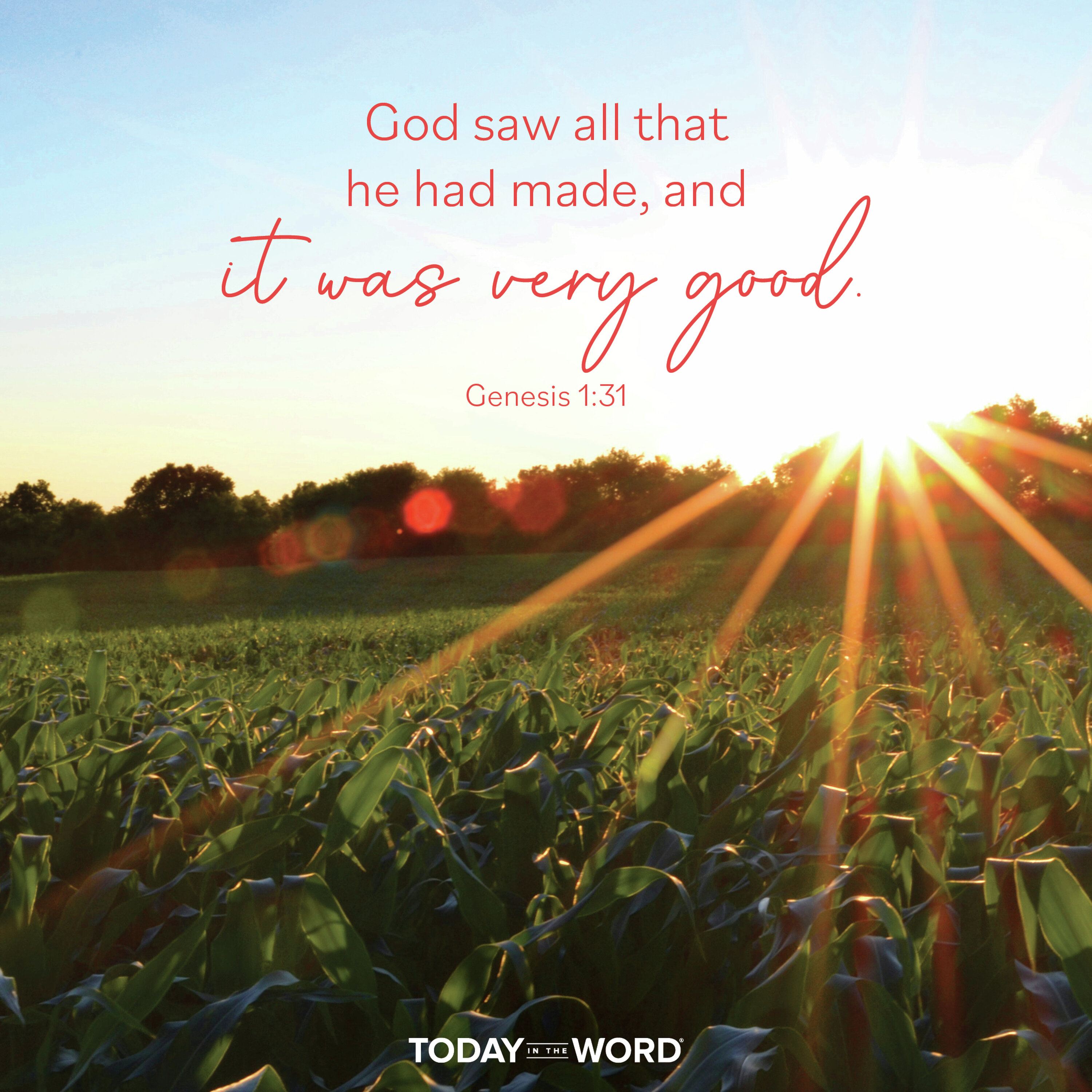 The Creation Mandate 01.10.2026 2minA seventeenth-century German prince created a garden in which he collected all the shrubs and flowering plants known at that time from throughout the world. Then he commissioned a lavish illustrated book of them, titled Hortus Eystettensis(Garden of Eichstätt), using elaborate copper engravings. Published in 1613, it “was and is the greatest botanical picture book ever created.” The prince may not have known it, but his garden and picture book were merely tributes to God who had created all those plants and so much more. In this month’s study, we will consider literal and figurative images of agriculture in the Bible, including farming, seeds, cultivation, crops, and harvests. Human beings, created in the image of God, were given authoritative stewardship by and under Him over the created world, including the plant and animal kingdoms (vv. 26–27). As David wrote: “You made them rulers over the works of your hands; you put everything under their feet” (Ps. 8:6). This is called the “creation mandate,” which is summarized as a command: “Be fruitful and increase in number; fill the earth and subdue it” (v. 28). Many commentators see this mandate as including the work and responsibility of cultivating creation until the whole earth became like the Garden of Eden—a mandate that we’re to finish during the Millennial Kingdom. The idea is that God created Eden as a model, and to “subdue” or “rule” meant to work on making the rest of the earth like this paradise. In imitation of God Himself, human beings were to care for that over which they ruled. God indicated that seed-bearing plants and trees would be sources of food for both humans and animals (vv. 29–30). Finally, “God saw all that he had made, and it was very good” (v. 31).Donate to Today in the Word: https://give.todayintheword.org/See omnystudio.com/listener for privacy information.
 -
 The People Repent 30.09.2026 2minMob justice often becomes injustice. There is no judge, no jury, no presentation of evidence or a trial—just the accusation, the mob’s confidence in their own righteousness, and the punishment of perceived evil. At the close of the book of Ezra, we see a situation that could very easily have veered toward vigilantism. Instead, Ezra shows godly wisdom in laying out a plan to ensure just judgment. Responding to the decree in verses 7–8, “within the three days, all the men of Judah and Benjamin had gathered in Jerusalem” (v. 9). “All the people were sitting in the square before the house of God,” and all of them were “greatly distressed” (v. 9). Ezra stood to confront the crowd. He pulled no punches: “You have been unfaithful; you have married foreign women, adding to Israel’s guilt” (v. 10). Ezra then tells them what they must do: “Now honor the Lord, the God of your ancestors, and do his will. Separate yourselves from the peoples around you and from your foreign wives” (v. 11). This was a tall order that required radical obedience. But the people responded well: “You are right! We must do as you say” (v. 12). They asked for time to obey because of the poor weather and the extent of their sin. Ezra agreed and “selected men who were family heads” to investigate each case (v. 16). The book of Ezra ends with a list of people who had sinned. Imagine having your name and your sin memorialized in this way! It may feel like the book of Ezra ends unsatisfactorily. While we have witnessed God’s great acts on behalf of His people, the book closes with a list of sinners. Be reassured, however, that these are sinners who repent, so “there is still hope for Israel” (Ezra 10:2).Donate to Today in the Word: https://give.todayintheword.org/See omnystudio.com/listener for privacy information.
 -
 The People Confess 29.09.2026 2minHave you ever heard the saying that God has no grandchildren? It’s a simple yet powerful reminder that we cannot depend on our Christian heritage for our salvation. We must personally trust in Jesus and turn from our sins. Ezra had confessed Israel’s sin to God. But that was not enough—the people responsible also needed to confess in order to be made right with God. In Ezra 10, we are told that the prophet had led the people faithfully. In verse 1 we see him “praying and confessing, weeping and throwing himself down before the house of God.” During this time, a large crowd gathered around him including “men, women and children” (v. 1). The inclusion of women and children is significant and countercultural for the ancient world. Women and children would not typically be included in such a group, yet the Scripture makes clear that God’s salvation is open and available to all. A leader arose from the group, confessing their sin to Ezra: “We have been unfaithful to our God by marrying foreign women from the peoples around us” (v. 2). The people of Israel recognized their sin and confessed it in clear, plain language. There were no excuses, only a clear statement of the facts. As we’ve seen throughout the Bible, “there is still hope for Israel” (v. 2). Upon their confession, Ezra withdrew to seek the Lord and issued an order for all the people of Israel to “assemble in Jerusalem”; whoever failed to appear would “forfeit all his property” (vv. 7–8). This was a reminder that sin is serious, and the people must deal with it seriously.Donate to Today in the Word: https://give.todayintheword.org/See omnystudio.com/listener for privacy information.
 -
 Prayer of Repentance 28.09.2026 2minThere’s a vast difference between being sorry that you got caught doing something and being sorry that you did something. In the book of Ezra, after God’s people acted wickedly, Ezra approached God in repentance. He reflected genuine sorrow—even though he personally had not participated in the sin. Ezra’s prayer of confession for the people highlights the concept of corporate solidarity. The apostle Paul uses the metaphor of the body to discuss corporate solidarity in the church: “If one part suffers, every part suffers with it” (1 Cor 12:26). Ezra’s suffering shines clearly through these verses—and Ezra is deeply concerned that even greater suffering is on the horizon. “Would you not be angry enough with us to destroy us, leaving us no remnant or survivor?” Ezra asks the Lord (v. 14). Ezra begins by confessing his shame “because our sins are higher than our heads and our guilt has reached to the heavens” (v. 6). He then briefly recounts Israel’s history of sin that led to the captivity in Babylon. They’ve only returned, Ezra says, because “the Lord our God has been gracious” (v. 8). God “has shown us kindness,” “granted us new life,” and “given us a wall of protection in Judah and Jerusalem” (v. 9). Yet the returnees “have forsaken the commands” God gave regarding intermarriage with the surrounding peoples (vv. 10–12). Ezra confesses that the exile happened as “a result of our evil deeds and our great guilt,” and yet their punishment was “less than our sins deserved” (v. 13). Ezra does the only thing he can do—the only thing any of us can do. He confesses the people’s sin and throws himself on the mercy of the God who has been faithful over and over and over again.Donate to Today in the Word: https://give.todayintheword.org/See omnystudio.com/listener for privacy information.
 -
 Covenant Unfaithfulness 27.09.2026 2minFrom time to time my wife and I leave our three young sons with a babysitter. On the way home I always feel the same anxiety—did our children torment this sweet girl who watched them for a few hours? I’ve never gotten a bad report, but I still worry. Ezra, unfortunately, received a bad report about the behavior of the people living in Israel. Chapter 9 begins, “After these things had been done.” This was after the delivery of valuables and the sacrifices mentioned in yesterday’s passage—the leaders delivered their report to Ezra. “The people of Israel, including the priests and the Levites, have not kept themselves separate from the neighboring peoples with their detestable practices” (v. 1). In fact, they’ve gone so far as to take “some of their daughters as wives for themselves and their sons” (v. 2). What’s even worse, “the leaders and officials have led the way in this unfaithfulness” (v. 2). Remember—God had long ago commanded the Israelites not to intermarry with the surrounding peoples. Why? Because “they will turn your children away from following me to serve other gods, and the LORD’s anger will burn against you and will quickly destroy you” (Deut. 7:4). This is how God’s people ended up in exile in the first place! Now they had disobeyed again, returning to the practices that had caused God to judge them nearly a century ago. When he heard this report, Ezra was “appalled.” He says, “I tore my tunic and cloak, pulled hair from my head and beard” (v. 3). Then Ezra did what we’ve come to expect: “I...fell on my knees with my hands spread out to the LORD my God” (v. 5). God’s people had sinned, but Ezra remained faithful and turned to the Lord in his devastation.Donate to Today in the Word: https://give.todayintheword.org/See omnystudio.com/listener for privacy information.
 -
 Arrival in Jerusalem 26.09.2026 2minReaching the end of a long journey is a beautiful thing—you step out of the car, stretch your legs, and look forward to some rest and relaxation. In our study of the book of Ezra, we’ve seen this godly leader and his co-travelers reach the end of their long trip to Jerusalem—all without the benefit of planes, trains, or automobiles! Earlier in chapter 8 Ezra refused to ask the king for protection on the journey, even though the returnees were bringing with them an enormous amount of silver and gold. In today’s market, the value of the materials listed in 8:26–27 reaches $604,081,991.20. Ezra was wise to proclaim a fast and ask for the Lord’s protection on their trip home! In verse 31 we read that the Lord indeed answered their prayers: “The hand of our God was on us, and he protected us from enemies and bandits along the way.” As we’ve seen many times already since meeting Ezra in chapter 7, he is quick to credit the Lord for his success. He never took credit for himself but rather consistently acknowledged God’s grace and kindness toward him. Ezra and the returnees rested for three days (v. 32). Then they “weighed out the silver and gold and the sacred articles into the hands of Meremoth son of Uriah, the priest” (v. 33). The men proved faithful: “Everything was accounted for by number and weight, and the entire weight was recorded at that time” (v. 34). The exiles then worshiped the Lord. They sacrificed “twelve bulls for all Israel” (v. 35), again reminding us that the people returning from exile represent all Israel and not just the ten tribes of Judah (see discussion on September 19). Now in Jerusalem, Ezra and his group of Levites and temple servants “gave assistance to the people and to the house of God” (v. 36).Donate to Today in the Word: https://give.todayintheword.org/See omnystudio.com/listener for privacy information.
 -
 A Safe Journey 25.09.2026 2minYou’ve mapped out your journey. The car is packed. The children are buckled in. But before you embark on a cross-country road trip, what else do you do? If you were Ezra, you would stop and plead yet again for the Lord to give you a safe and successful journey. In 8:21, Ezra said: “There, by the Ahava Canal, I proclaimed a fast, so that we might humble ourselves before our God and ask him for a safe journey for us and our children, with all our possessions.” We’ve already seen Ezra trust the Lord time and again during his preparations to return to Jerusalem. Today’s reading gives us insight into Ezra’s thought process. He was “ashamed to ask the king” for protection on the journey. Why? He had already assured the king that “the gracious hand of our God is on everyone who looks to him, but his great anger is against all who forsake him” (v. 22). Ezra didn’t want to appear to dishonor the Lord by asking for human help when he’d already been clear in saying that God would care for him. So, Ezra says, “we fasted and petitioned our God about this” (v. 23). Just as we’ve seen God do many times throughout the book of Ezra, God answered their prayer (v. 23). The rest of today’s passage lists the many valuable items that Ezra and the returnees brought with them to Jerusalem. Here we see Ezra’s practical wisdom again. He entrusts “twelve of the leading priests” with care of the valuables and charges them to deliver the items safely to their destination (v. 24). For all the details involved in this journey, Ezra trusts the Lord, fasting and praying. He also takes appropriate steps to ensure success. Both were needed.Donate to Today in the Word: https://give.todayintheword.org/See omnystudio.com/listener for privacy information.
 -
 Needing Help 24.09.2026 2minI’m not very handy, but from time to time I’ll attempt a DIY home project. These typically require about a hundred trips to Home Depot, lots of hand-wringing, and then a call to a buddy or two for help. In today’s passage Ezra wasn’t wringing his hands or running to the home improvement store, but he did realize he needed more help. He called for reinforcements. The passage opens with Ezra and the list of people in 8:1–14 “assembled ... at the canal that flows toward Ahava” (v. 15). They camped “there three days,” during which Ezra “checked among the people and the priests,” searching for Levites (v. 15). He did not find any, so he gathered several leaders, whom he refers to as “men of learning,” and sends them to “Iddo, the leader in Kasiphia” (vv. 16–17). We don’t know exactly what Kasiphia refers to, but we do know there were Levites there, and the “men of learning” returned to Ezra with 20 more Levites, in addition to 220 “temple servants” (vv. 19–20). Ezra would need these temple servants, who ensure smooth and proper functioning at the Jerusalem temple, reestablishing and then maintaining proper worship. As has been Ezra’s pattern, he credits the Lord with the success of this mission. It succeeded “because the gracious hand of our God was on us” (Ezra 8:18). A few things stand out about this passage. First, Ezra was humble. He recognized when he needed help and was willing to ask for it. Second, Ezra was wise. He took all necessary precautions to ensure his work would be successful. Third, Ezra relied fully on the Lord. Here and throughout the book, we see Ezra credit the Lord with any and all of his success.Donate to Today in the Word: https://give.todayintheword.org/See omnystudio.com/listener for privacy information.
 -
 Ezra’s Response 23.09.2026 2minWhat do you do when God provides an unexpected gift in your life? In the time of Ezra, the reigning king, Artaxerxes, had a huge change of heart. He went from shutting down work on the temple to giving full support and sending Ezra to teach God’s people God’s law. Today, we see how Ezra responds to this kindness from the Lord. His reaction is a model for us as we reflect on the many ways God continues to work in our world today. After Artaxerxes listed all the financial resources he was supplying for the temple, he issued an order that Ezra was eager to obey: “And you, Ezra, in accordance with the wisdom of your God, which you possess, appoint magistrates and judges to administer justice to all the people of Trans-Euphrates—all who know the laws of your God. And you are to teach any who do not know them” (Ezra 7:25). Ezra gave credit for all of this to the Lord. He says, “Praise be to the LORD, the God of our ancestors, who has put it into the king’s heart to bring honor to the house of the LORD in Jerusalem in this way” (v. 27). And for the third time since we met Ezra in Ezra 7:1, he says that “the hand of the LORD my God was on me” (v. 28). And so Ezra obeyed the king’s order, which in this case was consistent with what God had called him to do: “I took courage and gathered leaders from Israel to go up with me” (v. 28). As we read of God’s work in ancient Persia and His faithfulness to Ezra individually and His people as a whole, we cannot help but to marvel at both. Ezra’s response of worship and courage is a model to follow as the Lord works in our own lives.Donate to Today in the Word: https://give.todayintheword.org/See omnystudio.com/listener for privacy information.
 -
 Miraculous Decree 22.09.2026 2minChanging hearts, reversal of fortune, good winning out over evil—those are my favorite types of books to read and movies to watch. There’s something refreshing and encouraging when we see the little guy win or the hardhearted ruler change his ways. In Ezra 4 we learned about the opposition God’s people faced. At that time, Artaxerxes had issued “an order to these men to stop work, so that this city will not be rebuilt until I so order” (Ezra 4:21). In Ezra 7, we witness nothing short of a miracle, especially in light of Artaxerxes’ earlier decree. Here the Persian king shows enormous favor to Ezra and God’s people living in Persia: “I decree that any of the Israelites in my kingdom, including priests and Levites, who volunteer to go to Jerusalem with you, may go” (Ezra 7:13). But wait, there’s more. Artaxerxes didn’t just allow his subjects to return to the land of promise, he paved the way with gold (almost literally!). He told Ezra, “Take with you the silver and gold that the king and his advisers have freely given to the God of Israel” (v. 15). He added “the articles entrusted to you for worship in the temple of your God” (v. 19). And if that was not enough, “anything else needed ... you may provide from the royal treasury” (v. 20). But the king still didn’t stop! He listed abundant supplies, like gold and silver, wheat, wine, olive oil, and salt. There was a slight hiccup in the king’s changed heart. He ended his decree in typical domineering fashion: “Whoever does not obey the law of your God and the law of the king must surely be punished by death, banishment, confiscation of property, or imprisonment” (v. 26). Even so, what a reversal for this king who had earlier shut down construction in Israel!Donate to Today in the Word: https://give.todayintheword.org/See omnystudio.com/listener for privacy information.
 -
 Ezra the Scribe 21.09.2026 2minWhen movies switch back and forth in time, a caption on the screen will typically appear: “twenty years later” or “1957.” The book of Ezra doesn’t quite do that, but it does use the reigns of kings to signal transitions in time. Chapter 6 ends in 515 BC, with the completion of the temple. Chapter 7 opens nearly 60 years later, “during the reign of Artaxerxes king of Persia.” The author introduces us to Ezra, the godly scribe who returns to Jerusalem to teach God’s people. The chapter then transitions to another long list of names (remember chapter 2?). This time it’s the genealogy of Ezra, recorded in order to prove his qualifications. Ezra’s lineage traces back to the first high priest, Aaron (Exod. 28–29). We also see a few familiar names. Hilkiah was the priest who ministered during Josiah’s reign, when the Book of the Law was rediscovered and revival broke out in Judah (2 Kings 22). Phinehas was the famous Levite who defended God’s name in the wilderness (Num. 25). Ezra had a heritage to be proud of! We read that “priests, Levites, musicians, gatekeepers and temple servants” came to Jerusalem with Ezra (Ezra 7:7). Verse 6 says “the hand of the LORD his God was on” Ezra, and the same message is repeated in verse 9: “the gracious hand of his God was on him.” What is significant about Ezra is that he was “well versed in the Law of Moses” (v. 6). He “had devoted himself to the study and observance of the Law of the LORD, and to teaching its decrees and laws in Israel” (v. 10). Ezra was just what the people needed. He was a faithful priest who was devoted to learning God’s Word. This appointed man of God could teach them to follow God with their whole hearts.Donate to Today in the Word: https://give.todayintheword.org/See omnystudio.com/listener for privacy information.
 -
 Passover Observed 20.09.2026 2minMany churches observe Communion weekly; you may call it the Lord’s Supper or Eucharist. Others observe it monthly or quarterly. Jesus commanded that His followers do this regularly in remembrance of Him (Luke 22:19). The wine (or grape juice) represents the blood of the new covenant, and the bread represents His body, broken for us. The Lord’s Supper was patterned after the Passover meal, which Jesus shared with His disciples on the night Judas betrayed Him (Luke 22:14–23). In Ezra 6, the returnees were celebrating Passover and the ensuing seven-day Festival of Unleavened Bread. This festival commemorated that harrowing night when “the destroyer” (Exod. 12:23) went through Egypt killing the firstborn of all families who did not have the blood of the lamb on their doorposts. The meal celebrated God’s incredible rescue of His people from slavery, His great kindness in passing over them, and His utter faithfulness to Abraham’s children. The priest and Levites took care to be “ceremonially clean” (Ezra 6:20), just as the Lord commanded. “The Israelites who had returned from exile” ate the meal. Joining them were “all who had separated themselves from the unclean practices of their Gentile neighbors in order to seek the Lord, the God of Israel” (v. 21). Note the emphasis on following God completely. Both religious leaders and the everyday people were seeking the Lord with obedience. The people “celebrated with joy” because “the LORD had filled them with joy by changing the attitude of the king of Assyria” (v. 22). In contrast to Pharaoh, who stubbornly refused to let God’s people go and whose heart God hardened, God softened the heart of the foreign ruler. Either way, the Lord receives the glory for His faithful care.Donate to Today in the Word: https://give.todayintheword.org/See omnystudio.com/listener for privacy information.
 -
 The Temple Dedicated 19.09.2026 2minHave you ever been part of a church moving into a new building? If so, you understand the significance of the celebration described in Ezra 6: God’s people were rejoicing at the completion of the temple! Verse 13 reports that Tattenai, the governor of Trans-Euphrates, and his associates received Darius’s letter to support the completion of the temple. They “carried it out with diligence.” Because of this, “the Jews continued to build and prosper under the preaching of Haggai the prophet and Zechariah” (v. 14). Finally, two decades after their return from exile, God’s people “finished building the temple” (approx. 515 BC). An enormous celebration ensued! A rough, low-end estimate of the value of the animals they sacrificed in today’s market? A quarter of a million dollars! Significantly, the people offered “a sin offering for all Israel” that included “twelve male goats, one for each of the tribes of Israel” (v. 17). The northern kingdom of Israel had all but ceased to exist when the Assyrian forces overran the nation in 722 BC and scattered its people. This return from exile symbolically encompassed all of Israel’s tribes, not just the southern kingdom of Judah that had been exiled to Babylon and was now returning to the promised land. These returnees were a remnant, a small portion who represented all of Israel’s tribes, not just the southern kingdom of Judah, which comprised two tribes, Benjamin and Judah. Today, we ourselves are God’s temple, with His Spirit living within us. But in the Old Testament, God’s presence dwelled specially in the temple, where His people worshiped Him and offered sacrifices. All that to say, these few verses depict a significant moment for God’s people.Donate to Today in the Word: https://give.todayintheword.org/See omnystudio.com/listener for privacy information.
 -
 The Heart of Kings 18.09.2026 2minHave you ever experienced waiting for some bureaucratic decision over which you had no real power? You fill out the forms, state your case, pray like crazy, and then just wait. And wait. And wait. And wait. Ezra 6 gives us an inside look on what was happening on the government side of things, at least in ancient Persia. King Darius had received Tattenai’s letter (Ezra 5:7–17) and took to heart its request to search the archives for Cyrus’s decree. Ezra 6:1–2 tells us that a search was made and in fact such a decree was found. Of course, we already know about the decree from Ezra’s first chapter and the last chapter of 2 Chronicles. The second half of Darius’s letter to Tattenai and his associates goes into great detail about how they were not to simply allow the work to continue but support it (vv. 6–12). Remarkably, the king even allotted tax revenue to rebuild God’s temple: “Their expenses are to be fully paid out of the royal treasury, from the revenues of Trans-Euphrates” (v. 8). The returnees were to be given “whatever is needed,” including “young bulls, rams, male lambs for burnt offerings to the God of heaven, and wheat, salt, wine and olive oil.” In short anything the priests requested “must be given them daily without fail” (v. 9). Darius then, with typical flair, adds a stark punishment for whoever might oppose the rebuilding of God’s temple: “I decree that if anyone defies this edict, a beam is to be pulled from their house and they are to be impaled on it. And for this crime their house is to be made a pile of rubble” (v. 11). The Lord had moved Cyrus’s heart to favor the exiles, and here He moves Darius’s heart to do the same. The Lord is indeed the true King over the entire earth!Donate to Today in the Word: https://give.todayintheword.org/See omnystudio.com/listener for privacy information.
 -
 Report to the King 17.09.2026 2minHow do Christians live faithfully when governed by unbelieving leaders, especially in a culture that is often hostile to the Christian faith? This brief section in Ezra gives a clear example of how we can faithfully give witness in a way that is gentle, kind, firm, and clear. Previously Tattenai, the governor of the province where Jerusalem was situated, had questioned the Jewish leaders about their work rebuilding the temple (see Ezra 5:1–5). There we read that “the eye of their God was watching over the elders of the Jews” (v. 5). Verses 6–7 introduces the “copy of the letter that Tattenai ... sent to King Darius.” And the following verses record the contents of the letter. The letter informed the king that the Jewish people were rebuilding “the temple of the great God” (v. 8) and that the provincial leaders had inquired about the work (vv. 9–10). The Jewish leaders responded: “We are the servants of the God of heaven and earth, and we are rebuilding the temple that was built many years ago, one that a great king of Israel built and finished. But because our ancestors angered the God of heaven, he gave them into the hands of Nebuchadnezzar the Chaldean, king of Babylon, who destroyed this temple and deported the people to Babylon” (vv. 11–12). Note the content and tone of their response. They witnessed faithfully to the Lord, “the God of heaven and earth,” and gave the theological reason for their exile: “our ancestors angered the God of heaven.” The leaders did not cling to their “rights” or demand that the king and government leaders mind their own business. Instead, they witnessed clearly and faithfully to the true God and stated simply what they were doing and why. Their response shows how we can live faithfully in a non-Christian culture.Donate to Today in the Word: https://give.todayintheword.org/See omnystudio.com/listener for privacy information.
Podcast simili


Popolare in
Questo podcast compare anche nelle classifiche dei podcast di questi paesi.
