
The Noble Update Podcast
George Noble
0
The Noble Update Podcast features deep-dive investment insights curated by George Noble. Each episode explores financial markets, investment strategies, and economic trends. It is distributed through George Noble's Substack, where listeners can find additional analysis and updates. The show is aimed at investors seeking thoughtful commentary on current market developments.
Episodi
-
 Back to June 1999 | Live with George Noble 25.09.2026 1h 10minMacro Musings by Danny D joined me for a Substack live, and these are the 5 biggest takeaways from our conversation:1. The low rate world was the anomaly, and it isn't coming back.Danny explained why rates stayed so low for so long, and why those forces have flipped:* Last cycle had baby boomers in their peak saving years and households repairing their balance sheets after 2008, and both pushed rates down.* This cycle, household wealth is up nearly $70 trillion and the boomers are spending their retirement savings instead of adding to them.* The savings rate sits at 3% versus 8% last cycle, even with rates far higher.What to do: Stop waiting for 2021 to come back and start valuing stocks like capital costs something again.2. The Fed just changed its rulebook, and we're back in June 1999.Danny thinks last week's FOMC was a paradigm shift, and I agree:* Warsh called the neutral rate an academic exercise and described the hike as removing accommodation, which means the Fed thinks policy is still loose.* The Fed is now watching nominal GDP, which has gone from 5% to 6.6% as of Q2.* There's no forward guidance anymore, so the market has no idea how far this goes.Greenspan ran the same playbook in 1999, and stocks and bonds played ping-pong until the 10-year hit 6.75% and things broke in March 2000.What to do: Get out of long duration, high multiple and consumer stocks before financial conditions finally tighten.3. The inflation gauge Wall Street trusts is broken.* Break-evens have sat at 2.5% the entire cycle, no matter what inflation prints.* The Fed bought far more 10-year nominals than 10-year TIPS during QE, which mechanically squeezed break-evens tighter, and now it reads that same market as proof inflation expectations are anchored.* The University of Michigan survey has inflation expectations above 7%.What to do: Stop plugging break-evens into your models, and stop trading off the second decimal of a CPI print.4. Scott Bessent is out of tricks.Danny walked through the levers Bessent has pulled, and each one has stopped working:* Oil deal headlines can't move prices anymore because inventories are drawn down and diesel and jet fuel are a mess.* DOGE and tariff promises can't talk yields down anymore.* A weaker dollar is his last lever, but with the 2-year up from 4.3% to 4.93% and import prices running 7%, pushing the dollar down just feeds inflation and hurts bonds anyway.What to do: Fade him. The day he doubled the buybacks, I called it a call to short more bonds.5. The market is screaming that policy is too loose.* The 10-year has gone from 4% to 5.2%, and credit spreads haven't budged.* Stocks are near all-time highs, up over 80% since the Fed stopped hiking in 2023.* $95 oil and a ripping dollar haven't dented anything.What to do: The Fed has a lot more work to do, so own gold, gold miners, energy and copper, and run from consumer and tech. Danny thinks gold is dead money until the Fed starts cutting, and I think he's early on that call, but we both agree the 60/40 portfolio is the wrong place to be. This is a public episode. If you'd like to discuss this with other subscribers or get access to bonus episodes, visit georgenoble.substack.com/subscribe
 -
 No Easy Way Out | Sam Kovacs 22.09.2026 58min1. Strategic Actions and Decisions* Assess Central Bank Disconnect: Re-evaluate fixed-income and equities positions: Monetary policy tightening amidst a energy-driven inflation spike creates heightened downside risk for broader economic growth. [01:39]* Capital Allocation in Energy: Maintain high exposure to energy and supply chains: Structural supply deficits, ongoing geopolitical tensions, and physical market tightness continue to support energy sector outperformance. [17:05]* Mitigate Consumer-Exposed Risks: Divest from consumer discretionary assets: Squeezed real incomes and rising interest rates are severely impacting consumer spending power and earnings. [28:05]* Sovereign Debt Realignment: Reduce long-duration Treasury holdings: Structural fiscal deficits and currency debasement pressures undermine the long-term thesis for holding long-dated U.S. debt. [32:40]* AI Valuation Restructuring: Exit overpriced AI hardware and infrastructure plays: High capital expenditure requirements coupled with limited pricing power point to unfavorable long-term risk-reward profiles. [46:23]2. Executive SummaryFederal Reserve interest rate hikes into a severe oil and diesel price shock threaten to trigger broad economic contraction rather than tame supply-driven inflation. Structural supply chain disruptions and geopolitical conflicts in the Middle East and Russia continue to constrain energy availability, creating persistent inflationary pressure. Concurrently, unsustainable U.S. fiscal spending and expanding debt levels threaten the status of long-duration Treasuries, forcing central banks globally to diversify reserves. In response, portfolio management strategies must pivot toward hard assets, energy, healthcare, and software, while aggressively exiting consumer-sensitive sectors, hyper-scalers, and highly leveraged debt-backed investments.Key Takeaways and Practical Lessons* Policy Over-Tightening Risks Economic Contraction: Raising rates into a supply-side commodity spike compounds cost pressures on consumers, increasing the probability of a sharp recession.* Energy Inelasticity Drives Broader Market Volatility: Diesel and refined product shortages act as an unavoidable drag on corporate margins across all non-energy sectors.* Fiscal Dominance Weakens Sovereign Debt Signals: High deficit spending and currency debasement impair long-term Treasury reliability, making real assets more attractive stores of value.* AI Infrastructure Spending Faces Monetization Challenges: High capital expenditure in AI hardware fails to yield proportional subscription revenue, eroding long-term capital efficiency.* Rigorous Exit Strategies Protect Capital: Maintaining clear falsification criteria and abandoning positions when market dynamics shift is crucial to long-term risk management.🔗 Website: https://sam-kovacs.com/🐦 Twitter/X: @SamKovXSubstack: @samkovacsWatch on Youtube: This is a public episode. If you'd like to discuss this with other subscribers or get access to bonus episodes, visit georgenoble.substack.com/subscribe
 -
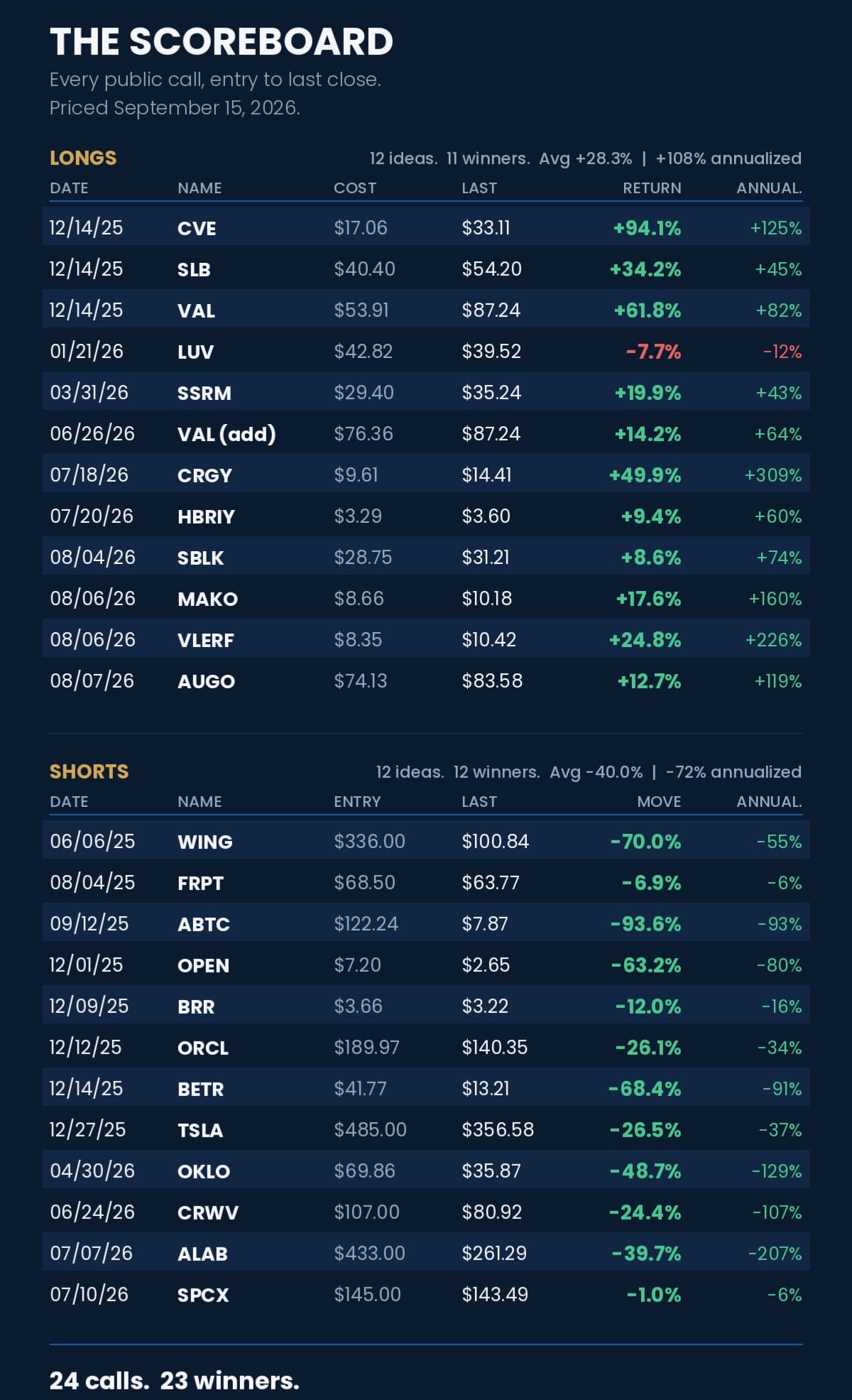 I'm more excited about this fourth quarter than any I can remember 21.09.2026 4minDispersion is increasing and the corrections are starting to arrive, and after 3 years where owning the index was enough, this market has started paying the people who actually know what they own.I've been through enough cycles to know this is where stock picking starts to matter again:Our longs are up 28% this year and our shorts are down 40%, which puts 68 points of spread between the 2 books. It's all documented and time stamped on my feed, so go check the work yourself.We were early on gold and the miners, early on energy, and one of the first to call the AI buildout the biggest misallocation of capital in history. None of it was a narrative and all of it was valuation and fundamentals.That's the Fidelity way, and it's the same one Peter Lynch taught me.45 years and five crashes since then, and everything I'm seeing says we're just getting started.So before Q4 starts:For the next 10 days you can still get The Noble Update Premium at $450 for the year or $45 a month. That's what this year's 68% long-short return cost the people who were already inside.Founding Membership is $950 and includes 6 conferences a year on top of everything else. The next one is the technicians conference on October 27 and 28, where 20 of the best chartists on the street each bring 3 ideas, which puts 60 actionable money-making ideas in your hands over 2 days.The conferences alone are worth more than the membership.Any fool can make money in a rising market. What you're paying for is the 45 years that tell you what to own when the tide goes out.On October 1 the annual goes to $599, the monthly goes to $99, and Founding Membership goes to $1,200. Waiting 10 days costs you $149 on the annual and $250 on Founding.It's a market of stocks, and Q4 is where that really starts to count.Join our journey today: This is a public episode. If you'd like to discuss this with other subscribers or get access to bonus episodes, visit georgenoble.substack.com/subscribe
 -
 34 years ago today... 16.09.2026 6min34 years ago today, the market broke the Bank of England for holding the pound at a price that wasn't real.Scott Bessent is now trying to manipulate the price of the US 10-year the exact same way.HISTORY WILL NOT BE KIND This is a public episode. If you'd like to discuss this with other subscribers or get access to bonus episodes, visit georgenoble.substack.com/subscribe
 -
 This is going to be the biggest misallocation of capital in history 16.09.2026 11minTake the dot com bubble, merge it with the 2008 housing crisis, and that is roughly what we are looking at.You have a commodity deflating at record speed while the debt built up to produce it explodes at record speed.What could possibly go wrong?Normally the market fixes this by itself. Prices fall, management gets nervous, budgets get cut. But that wiring is CUT right now. Prices never fell far enough to scare anybody, and Washington is running a deficit near 7% of GDP that papers over the damage.So prices stopped carrying information. Now they carry a story instead.I call it NARRATIVE DOMINANCE. Reality is beside the point. What matters is what you can get people to BELIEVE while there is enough money sloshing around to keep everyone comfortable.One market still tells the truth:Last month the Treasury doubled its buybacks and Wall Street read it as support. I said short bonds instead. Today the 10 year went through 5% for the first time since 2007.Defend a price the fundamentals do not justify and the market comes for you every time.Eventually somebody cuts a capex budget, and that day the story dies.I do not see how this ends any other way.Do you? This is a public episode. If you'd like to discuss this with other subscribers or get access to bonus episodes, visit georgenoble.substack.com/subscribe
 -
 Rates Aren’t Coming to Save You 12.09.2026 48min1. Strategic Actions and Decisions* Transition portfolio allocations toward scarce, capital-light real assets: Shift away from long-duration growth assets toward tangible asset oligopolies to protect capital against sticky inflation and rising baseline capital costs.* Avoid over-allocating capital to hyper-cyclical semiconductor producers: Recognize the structural risks of chasing record margins in tech hardware as major tech firms build proprietary chips and capacity expansions mean-revert.* Rebalance natural gas holdings toward royalty trusts and infrastructure: Target pure-play royalty vehicles (e.g., White Hawk) that capture nominal price increases without incurring direct operating expenses or heavy capital expenditure obligations.* Capitalize on regional energy restructuring opportunities: Monitor and evaluate restructurings like Permian Basin Trust, which transition legacy assets into direct net profit interest streams and add land optionality for data infrastructure.* Maintain core exposure to high-grade nuclear and uranium leaders: Gain nuclear market exposure through tier-one miners like Cameco, which offer structural operating leverage and upside via downstream assets like Westinghouse.2. Executive SummaryThis interview outlines a fundamental strategy for navigating a shifting macroeconomic regime defined by sticky inflation, persistent budget deficits, and rising interest rates. Horizon Kinetics highlights the end of the zero-interest-rate era and urges a structural shift away from high-multiple growth equities dependent on cheap capital. Instead, investors should pivot toward capital-light real assets, scarce commodity royalties, and infrastructure oligopolies that generate inflation-indexed cash flows. By focusing on high-margin royalty structures and nuclear infrastructure, leadership can mitigate downside risks while positioning portfolios to capture structural tailwinds in energy, real assets, and industrial productivity.Key Takeaways and Practical Lessons1. Macro regimes dictate baseline portfolio outcomes: The historical anomaly of near-zero interest rates and low inflation has ended, requiring a fundamental reorientation of discount rate assumptions.* Re-evaluate equity discount rates and terminal valuations across all long-duration holdings to ensure stress testing accounts for higher cost of capital.2. Royalty business models offer superior asymmetric protection: Royalty structures in energy and metals deliver high gross margins while insulating investors from rising operational expenses and capital expenditure creep.* Prioritize royalty trusts over direct commodity producers to capture commodity upside while eliminating direct exposure to operating cost inflation.3. Capital cycles inevitably undermine peak profit margins: Capital-intensive industries like semiconductors suffer from cyclical supply overshoots as massive reinvestment eventually compresses margins.* Trim exposure to cyclical manufacturing leaders when profit margins hit record highs and customer concentration drives internal product substitution.4. Regional energy infrastructure benefits from AI and power demand: Natural gas and land holdings retain substantial hidden value through optionality for data center power generation and regional LNG exports.* Analyze energy and land holdings for secondary monetization pathways, such as water treatment, power distribution, and computing infrastructure co-location.5. Clean baseload power requirements favor tier-one nuclear providers: Sustained global demand for baseline power makes high-quality uranium producers and service providers essential inflation hedges.* Limit speculative junior mining exposure by concentrating nuclear allocations into established, high-jurisdiction leaders and physical uranium holdings.🔗 Website: https://horizonkinetics.com/products/etf/infl/Watch on Youtube This is a public episode. If you'd like to discuss this with other subscribers or get access to bonus episodes, visit georgenoble.substack.com/subscribe
 -
 Does a Rising Tide Lift All Boats? 10.09.2026 52min1. Strategic Actions and Decisions* Pivot capital allocation to short-term trading: Shift strategy away from duration risk and medium-to-long-term investing toward short-term algorithmic trading to navigate high macroeconomic uncertainty.* Maintain neutral positioning on peak-cycle tanker equities: Avoid taking long-term short positions against strong cash flows while managing volatility via short-term equities and derivatives.* Capitalize on shipyard capacity constraints and order backlogs: Monitor expanding newbuilding order books—particularly for 2027–2028 deliveries—to prepare for eventual cyclical rate collapses.* Position for upcoming weather-driven market disruptions: Prepare for El Niño-driven trade disruptions over the next 3–6 months that favor Panamax and Supramax dry bulk vessels.* Launch algorithmic crypto fund for high-volatility yield: Diversify firm strategy by deploying a proprietary long-short quantitative algorithm in cryptocurrency markets.Executive SummaryThe shipping sector is experiencing peak-cycle conditions across multiple subsectors, driven by high day rates, geopolitical inefficiencies, and tight shipyard capacity. However, long-term visibility is severely impaired by macroeconomic uncertainty, making extended multi-year forecasts unreliable. While strong cash flows sustain high stock valuations and retail sentiment, expanding order books through 2028 risk oversupply and an eventual market collapse. Executives should avoid long-duration directional bets and focus on short-term tactical trading. Meanwhile, dry bulk shows near-term catalyst potential driven by El Niño disruptions, whereas LNG faces prolonged weakness until 2030.Key Takeaways and Practical Lessons1. Peak Cycles Obscure Duration Risk: High spot rates generate temporary super-profits that lead generalist investors to overvalue cyclical assets.* Prioritize capital returns through dividends or asset sales over long-term equity accumulation at top-of-cycle valuations.2. Supply Glut Risks Loom in 2027–2028: Heavy shipyard order backlogs will inevitably increase fleet capacity and deflate day rates.* Hedge against structural rate declines by avoiding long-term fixed-asset purchases priced at cycle peaks.3. Weather Inefficiencies Create Short-Term Opportunities: Phenomenons like El Niño disrupt trade routes, driving demand for specific dry bulk vessel classes.* Allocate tactical capital to Panamax and Supramax operators to capture 3-to-6-month rate spikes.4. LNG Infrastructure Delays Prolong Downcycles: A lack of new liquefaction terminals will depress LNG shipping fundamentals through the decade.* Steer clear of high-yielding LNG equities with unsustainable dividend coverage stemming from expiring contracts.5. Systemic Uncertainty Favors Algorithmic Agility: Unpredictable geopolitical inputs weaken traditional econometric forecasting models.* Deploy quantitative, data-driven trading strategies that exploit short-term volatility rather than relying on long-term macro thesis assumptions.Joakim’s website: https://www.gersemiam.com/Watch on Youtube: This is a public episode. If you'd like to discuss this with other subscribers or get access to bonus episodes, visit georgenoble.substack.com/subscribe
 -
 I can't take this anymore 09.09.2026 2minScott Bessent is either incompetent or a liar.Short bonds. THIS IS INSANITY!Check out our most recent Pod Street Week edition - diving deeper into what's going on right now and how you should be positioned, by distilling the highest-value finance conversations into one investment-focused summary: This is a public episode. If you'd like to discuss this with other subscribers or get access to bonus episodes, visit georgenoble.substack.com/subscribe
 -
 If Something Can Not Go On Forever, It Will Stop 08.09.2026 1h1. Strategic Actions and Decisions* Transition away from momentum-driven asset strategies: Reallocate capital toward strict, fundamental free cash flow analysis to insulate portfolios from severe day-to-day market volatility. * Capitalize on global fiscal debt realignments: Rebalance fixed income and equity portfolios to account for high long-term interest rates and expanding US fiscal deficits.* Target mispriced, cash-generating healthcare assets: Invest selectively in targeted pharmaceutical equity baskets that possess robust drug pipelines and at least five years of patent protection. * Exploit semiconductor supply oligopolies: Acquire deeply discounted memory chip suppliers that hold pricing power over high-bandwidth hardware required for AI infrastructure. * Capture emerging foreign corporate governance catalysts: Overweight international equities—specifically in Japan and Korea—benefiting from government-mandated return-on-equity reforms. 2. Executive SummaryMarket price discovery is increasingly distorted by short-term momentum strategies, systemic liquidity surpluses, and unsustainable US debt service costs. As rising real interest rates devalue distant future growth projections, capital allocation must prioritize immediate, inflation-adjusted free cash flows over speculative growth narratives. High-valuation technology sectors face compressed margins due to excessive capital expenditure requirements, whereas key opportunities exist in tight refining markets, targeted mid-cap pharmaceuticals, and memory chip oligopolies. Internationally, government-led corporate governance reforms in Japan and Korea provide strong tailwinds for long-term equity performance.3. Key Takeaways and Practical Lessons* 1. High market valuations dilute long-dated cash flows: Elevated real interest rates severely penalize companies dependent on distant earnings projections.* Focus portfolio screens strictly on short-duration, high current free-cash-flow yields rather than speculative growth.* 2. Massive AI capital expenditure strains profit margins: Hyperscalers face unproven returns on trillions in hardware investments, eroding their historical cash-flow profiles.* Audit tech holdings to avoid software and hardware vendors that lack clear unit-economic returns on AI investments.* 3. Refined product bottlenecks create energy sector value: Global refining capacity constraints from geopolitical disruptions yield elevated crack spreads.* Maintain exposure to well-positioned energy refiners and non-US integrated oil majors with active exploration pipelines.* 4. Memory chip suppliers hold hardware pricing power: High-bandwidth memory producers form an oligopoly capable of pricing for value alongside primary AI processor designers.* Look beyond flagship chip designers to low-multiple memory manufacturers essential to overall hardware architecture.* 5. Governance mandates unlock foreign equity value: Asian market reforms are forcing under-booked firms to prioritize shareholder returns and return on equity.* Expand international allocations toward Japanese and Korean equities meeting premier stock exchange return-on-equity thresholds.Follow Bernie:🔗 Website: https://polariscapital.com/bernard-horn/Watch on Youtube: This is a public episode. If you'd like to discuss this with other subscribers or get access to bonus episodes, visit georgenoble.substack.com/subscribe
 -
 Noble Update Subscriber Call - Sept. 3 Replay 04.09.2026 3minThis is a free preview of a paid episode. To hear more, visit georgenoble.substack.comYesterday's subscriber call was one of the BEST we've done.There are decades when nothing happens, and there are weeks when decades happen. Right now, decades are happening. The market is sitting near all-time highs and blissfully ignoring all of it.Here's what we covered:* Bonds: The real story isn't Hormuz or the CPI decimal. It's a global capex boom co…
 -
 No Way Out | Patrick Oddoux 30.08.2026 48min1. Strategic Actions and Decisions* Mitigate Interest Rate Volatility: Position portfolios to be short the long end of the yield curve to hedge against rising long-term yields driven by massive deficit spending and capital competition.* Reallocate to Tangible Real Assets: Increase structural exposure to physical commodities and gold miners with verified volume growth to counter systemic fiat currency debasement.* De-Risk High-Debt and Discretionary Holdings: Divest from debt-laden companies and vulnerable consumer sectors facing margin compression from sticky food and input inflation.* Target Strategic European Growth Drivers: Capitalize on European market shifts by allocating directly into defense technology and power infrastructure providers benefiting from CapEx booms.* Execute Downside Equity Protection: Implement defensive options strategies or purchase market volatility protection ahead of political turbulence and sovereign debt risks in Europe.2. Executive Summary Macroeconomic stability faces headwinds from escalating fiscal dominance, tightening global central bank liquidity, and a breakdown in sovereign debt demand. Aggressive U.S. deficit spending collides with a global CapEx surge, threatening long-end yield spikes and broader risk-asset valuations. Key foreign buyers—including Japan and China—are reducing U.S. Treasury holdings to protect domestic liquidity, signaling heightened currency and funding volatility. Simultaneously, European markets face imminent political stress, particularly surrounding French fiscal targets. Leaders must pivot strategies to favor defensive positioning, cash-flow-generative business models, energy grid infrastructure, and real assets like gold over leverage-dependent equities.Key Takeaways and Practical Lessons1. Central Bank Liquidity Tightening: Macro headwinds are worsening as central banks prioritize inflation control over balance-sheet expansion, restricting market excess.* Practical Lesson: Conduct a stress test across all portfolio assets to evaluate cash flow resilience under tight credit conditions.2. Foreign Capital Withdrawal from Treasuries: Major sovereign holders are reducing U.S. debt purchases to fund domestic liabilities, putting upward pressure on long-term yields.* Practical Lesson: Reduce long-duration fixed-income exposure and shift capital toward shorter-duration paper or inflation-hedged assets.3. European Defensive CapEx Boom: Geopolitical realignments are forcing major European investments into defense and power grid infrastructure, despite wider regional stagnation.* Practical Lesson: Focus European equity allocations strictly on power generation, nuclear energy components, and specialized defense contractors.4. Sovereign Political and Credit Vulnerabilities: Rising European political populism and expanding budget deficits—particularly in France—threaten severe financial sector friction.* Practical Lesson: Trim exposure to French financial institutions and purchase downside put options ahead of major regional election cycles.5. Commodity Outperformance Over Currency: Commodity markets and real assets are decoupling positively from depreciating fiat currencies amid sticky energy and food inflation.* Practical Lesson: Allocate capital into proven gold producers demonstrating actual production volume increases rather than relying solely on spot price appreciation.Watch on Youtube: This is a public episode. If you'd like to discuss this with other subscribers or get access to bonus episodes, visit georgenoble.substack.com/subscribe
 -
 Rotation Rotation Rotation | David Nicoski 28.08.2026 31min1. Strategic Actions and Decisions* Capitalize on Sector Rotation Out of Tech: Shift allocation away from the broad tech indices into outperforming market sectors such as biotechs and healthcare. ***** Execute Long Positions in Gold and Energy Assets: Accumulate gold, gold equities, and energy stocks during pullbacks as long-term base structures signal extended bull trends.* Monitor Critical Technical Levels Across Key Indices: Track the S&P 500 support around the 7600 level while leveraging the 200-day moving average for downside protection on tech futures.* Target Value Discrepancies in Mispriced Equities: Identify fundamentally mispriced individual stocks like low-P/E consumer names that are poised for significant relative outperformance.* Mitigate Credit Risk in Overheated Construction and Data Center Suppliers: Exercise caution or build short exposure on high-default-risk targets and data center suppliers experiencing margin compression.Executive SummaryCapital market dynamics indicate a broad sector rotation away from large-cap technology and mega-cap indices toward under-owned, value-driven sectors. Rather than evaluating index-level trajectory, current conditions favor granular stock selection. Key opportunities exist in healthcare, biotech, energy, and precious metals, all of which display strong relative-strength chart formations and expanding valuation multiples. Conversely, high-valuation market favorites, data center supply-chain infrastructure, and distressed credit names face headwinds due to labor inflation and shifting market participation. Leadership favors identifying structural inflections, deploying capital into mispriced assets, and protecting downside exposure through disciplined technical execution.Key Takeaways and Practical Lessons* Broad Index Performance Masks Sector Alpha: Disconnect from general market indices to identify underlying sector performance divergence.* Practical Lesson: Allocate research to cross-sector relative-strength spreads—such as pairing long healthcare positions against short semiconductor exposure—to capture isolated alpha regardless of overall market direction.* Valuation Compression Creates Asymmetric upside: Overvalued market darlings carry capped upside, whereas high-quality, depressed assets yield substantial recoveries.* Practical Lesson: Screen for under-followed consumer or value equities trading at low single-digit P/E multiples relative to historical averages to enter high-reward risk positions.* Precious Metals and Commodities Present Multiregional Base Breakouts: Long-term technical patterns point to early-stage secular advances in gold and natural gas, supported by macro tailwinds.* Practical Lesson: Establish long exposure in gold, gold mining equities, and natural gas producers via pullbacks to key support levels or bull flag consolidations.* Supply Chain Inflation Erodes Data Center Infrastructure Margins: Input cost escalation in skilled labor (electrical, HVAC, plumbing) is eating into bottom-line profits for infrastructure buildout leaders.* Practical Lesson: Tighten stop-losses or reduce exposure to engineering, construction, and data center supply equities that are breaking below their 200-day moving averages.* Credit Default Spikes Signal Impending Equity Weakness: Credit default swap (CDS) pricing acts as a reliable leading indicator for equity market distress and corporate default potential.* Practical Lesson: Review corporate debt yields and CDS spreads on speculative portfolio holdings, taking tactical short positions on companies with yields exceeding investment-grade thresholds.Follow David:🔗 Website: https://vermilioncap.com/🐦 Twitter/X: @davevermilionWatch on Youtube: This is a public episode. If you'd like to discuss this with other subscribers or get access to bonus episodes, visit georgenoble.substack.com/subscribe
 -
 Melody Wright | Daniel Frank | Nobody Special - What, Me Worry? 27.08.2026 54min1. Strategic Actions and Decisions* Monitor macro capital competition: Track U.S. Treasury liquidity against heavy private AI debt issuance crowding out yields.* Prepare for commercial real estate exposure: Anticipate Q3/Q4 hard debt maturity walls in the $2.3T multifamily sector.* Evaluate regulatory and political shifts: Factor in growing state-level moratoriums and bipartisan pushback against data centers ahead of elections.* Hedge against hardware centralization: Capitalize on the transition from centralized data centers to localized edge computing models like Mac Minis.* Position portfolios in real assets: Allocate defensively into precious metals, energy supply, fertilizers, and cash while reducing high-multiple tech exposure.Executive SummaryMacroeconomic conditions reflect severe capital misallocations driven by speculative AI build-outs, elevated debt obligations, and underlying consumer weakness. Hyper-scalers and private debt markets face potential liquidity constraints, threatening tech valuations and public offerings. Concurrently, commercial real estate faces severe structural pressure due to a $2.3 trillion multifamily maturity wall lacking extension options or private credit relief. Supply-chain stress across global energy and agricultural markets further elevates inflation risks. Executives must prepare portfolios by paring down high-valuation equities and allocating toward commodities, physical energy sources, local hardware models, and capital preservation assets.Key Takeaways and Practical Lessons* Illiquidity Risks in AI Infrastructure: Subsidizing hyper-growth through non-investment-grade private debt creates systemic refinancing vulnerability: Maintain conservative liquidity buffers to weather private-credit market dislocations.* Impending Commercial Real Estate Stress: The multifamily sector faces an inescapable debt maturity wall without structural refinancing relief: Audit balance sheets for direct or indirect exposure to regional banks holding CRE debt.* Decentralization of AI Workloads: Inference demands are shifting toward cost-effective, secure, local hardware over expensive cloud data centers: Strategic tech investments should pivot toward edge-computing architectures.* Resurgence of Commodity and Energy Scarcity: Geopolitical strains and global supply disruptions favor secure physical energy assets and agricultural inputs: Secure long-term supply contracts for core operational materials and energy.* Capital Discipline in Distorted Markets: Extreme market valuations require disciplined patience and adherence to fundamental value: Resist momentum-driven market exposure and hold cash reserves to deploy during deep market pullbacks.Follow Melody: 🔗 Website: https://www.youtube.com/@m3_melody Follow Nobody Special:https://www.youtube.com/@NobodySpecialFinance🐦 Twitter/X: @m3_melody, @JG_NukeWatch on Youtube: This is a public episode. If you'd like to discuss this with other subscribers or get access to bonus episodes, visit georgenoble.substack.com/subscribe
 -
 What Scott Bessent did today is a call to SHORT more US bonds 19.08.2026 3minThe government couldn't find enough buyers for its own long bonds, so the government became the buyer.Argentina does this and Turkey does this.We now do it 3 months before an election, and the financial press is calling it “decisive leadership.”These are emerging market tactics, and the effect will be temporary at best.Bessent will go down as one of the most consequential Treasury secretaries in history, and history will not be kind to him.Short the bonds. You cannot own enough gold.Listen to my full take on this, and what you should own right now.P.S. Sign up to Pod Street Week here to stay up to date with the best conversations each week, the newest edition is highly relevant to what's going on right now: This is a public episode. If you'd like to discuss this with other subscribers or get access to bonus episodes, visit georgenoble.substack.com/subscribe
 -
 Robin J Brooks | Between a Rock and a Hard Place 16.08.2026 29min1. Strategic Actions and Decisions* Capitalize on the “debasement trade” re-acceleration: Pivot investments into precious metals like gold and silver as markets walk back rate-hike expectations and yield curves steepen. * Mitigate bond market exposure to high debt-to-GDP sovereigns: Reduce holdings in countries with unmoored fiscal policies (such as the US at 7% deficit-to-GDP and Japan at over 200%) to safeguard capital against potential yield blowups. * Construct a resilient safe-haven basket: Diversify out of devaluing fiat currencies by allocating into a multi-asset basket featuring precious metals and sovereign assets from low-debt nations like Switzerland, Sweden, and Germany. * Hedge against near-term oil price upside: Prepare portfolios for potential oil spikes back into the $80–$90 range given geopolitical open-ended risks and market complacency regarding Iranian supply disruptions. * Implement targeted strategic pressure on Iranian oil infrastructure: Enforce policy via a incremental, timed campaign targeting specific oil export berths to break geopolitical stalemates and curb regional leverage. Executive SummaryGlobal markets are witnessing a resurgence of the “debasement trade” as expectations for monetary tightening soften alongside weakening economic data. Concurrently, unmoored fiscal policy—evidenced by the U.S. running a 7% deficit-to-GDP ratio outside a recession—presents structural risk. Yield curves are steepening, signalling severe underlying fiscal and credibility concerns that mirror systemic risks seen in Japan and European sovereign bond markets. To protect capital from systemic fiat devaluation and rising cost of capital, executive portfolios should strategically transition toward precious metals and fiscal safe-havens, while preparing for oil market volatility driven by persistent Middle Eastern supply tensions.Key Takeaways and Practical Lessons* Monitor structural fiscal deficits over short-term inflation noise: Focus strategic decision-making on structural spending trends and debt-to-GDP trajectories rather than chasing minor, high-frequency inflation datapoints.* Establish long-term capital allocation plans based on sovereign debt sustainability rather than short-term rate predictions.* Divergent fiscal policies alter sovereign risk profiles: Global debt levels are not uniformly high; low-debt sovereigns offer genuine downside protection against global inflation.* Shift cash reserves or conservative fixed-income exposure toward currencies and bonds of fiscally disciplined nations like Switzerland, Sweden, or Germany.* Central bank yield suppression creates currency vulnerability: Artificially holding down bond yields without market buyers strips away the necessary risk premium, causing rapid currency depreciation as seen with the Japanese Yen.* Avoid unhedged foreign exchange exposure in jurisdictions where central banks aggressively suppress yield curves.* Market resilience can obscure underlying tail risks: Financial markets adapt quickly to supply constraints through inventory drawdowns and trade rerouting, but prolonged structural impasses ultimately reassert upward price pressure.* Maintain hedges on critical commodities like oil during periods of artificially low market volatility.* Steepening yield curves signal escalating sovereign risk premiums: When long-term yields surge while short-term yields fall, the market is pricing in either future debt monetization (inflation) or institutional credibility loss.* Re-evaluate corporate capital expenditure hurdle rates to account for a sustained, higher long-term cost of capital.🐦 Twitter/X: robin_j_brooksSubstack: @robinjbrooksWatch on Youtube: This is a public episode. If you'd like to discuss this with other subscribers or get access to bonus episodes, visit georgenoble.substack.com/subscribe
 -
 Sentiment Trader | Jay Kaeppel | Beware Election Years 14.08.2026 25min1. Strategic Actions and Decisions* Maintain Structural Bullish Equity Stance: Continue holding macro equity index exposure driven by overall trend-following signals while managing risk dynamically [01:40].* Capitalize on Insider Buying Sectors: Prioritize allocation to healthcare [04:03] and technology [05:08] sectors due to significant insider accumulation signals over recent months [04:48, 05:40].* Execute Mean-Reversion Metal Trades: Maintain long positions in gold based on recent sentiment buy signals, and prepare to overweight gold mining equities for multi-year mean reversion [09:41, 11:13].* Divest Long-Term Treasuries: Maintain zero long-term Treasury bond allocation for structural investment accounts due to a multi-decade rising interest rate cycle [12:49, 13:42].* Prepare Capital for Post-October 1 Bull Window: Exercise high tactical caution through late summer, then aggressively deploy equity capital entering the seasonally strong midterm election period starting October 1 [15:20, 16:25].Executive SummaryIn this strategy session, analyst Jay Kaeppel outlines market positioning rooted in objective sentiment data and trend following. Structural equity and commodity trends remain bullish, while fixed income faces long-term headwinds from an ascending interest rate cycle. High insider accumulation underscores strong opportunities in healthcare and tech indices, while precious metals present key mean-reversion upside—particularly gold miners relative to physical bullion. Tactically, leadership should anticipate seasonal equity weakness through late summer before aggressively committing capital to equities on October 1, the historical start of a highly reliable cyclical rally.Key Takeaways and Practical Lessons* Separation of Investment vs. Trade Accounts: Mixing long-term thesis-driven growth capital with short-term tactical trades degrades decision-making discipline.* Implement two distinct operating accounts with clear guidelines to prevent taking premature profits on investments or converting failed trades into long-term bag-holding.* Insider Activity as a Primary Sector Indicator: Sustained corporate insider purchasing over extended periods serves as an early signal for undervalued or resilient sectors.* Monitor aggregate weekly insider buying data to confirm sector allocations in beaten-down or overly criticized market areas.* Risk Management via Trend Adherence: Investors suffer severe capital destruction when emotional attachment overrides systematic technical signals.* Enforce systematic trailing stops on all trend-following positions to exit positions objectively when trends reverse.* Cycle-Driven Strategic Positioning: Seasonality and long-term macro cycles provide structural clarity on asset direction rather than exact timing entries.* Utilize historical seasonal cycles—such as the favorable midterm election rally window—to determine optimal timing for strategic capital deployment.* Position Sizing and Capital Preservation: Institutional trading success relies far more on controlling position sizing and downside risk than achieving a high trade win rate.* Limit single-position risk to small percentage allocations to prevent emotional distress and financial impairment on adverse moves.Follow Jay:🔗 Website: sentimenttrader.com🐦 Twitter/X: @jaykaeppelWatch on Youtube: This is a public episode. If you'd like to discuss this with other subscribers or get access to bonus episodes, visit georgenoble.substack.com/subscribe
 -
 We Won't Get Fooled Again | Sam Kovacs 12.08.2026 38min1. Strategic Actions and Decisions* Capitalize on oil supply constraints: Leverage the extended geopolitical conflict restricting Middle East supply by holding assets insulated from regional disruption, such as Petrobras.* Deploy capital into super-spec offshore drilling: Invest in providers like Aquestive/NorAm Drilling that control high-specification rigs in the Permian Basin to capture rising day rates and 12–14% dividend yields.* Exploit regulatory mispricings in biopharma: Acquire shares of Aquestive Therapeutics following its sell-off over minor FDA packaging rejections, anticipating an 80% probability of rerating toward $6.50–$10.00.* Implement active portfolio risk management: Cut underperforming positions rapidly and scale up winning trades where fundamental improvements outpace market price adjustments.* Subscribe to Babylon Burns premium model: Access live portfolio tracking, real-time trade notifications, and deep-dive equity research prior to the Labor Day price increase.2. Executive SummaryCurrent macroeconomic misperceptions present high-conviction entry points across global energy and mispriced equities. Geopolitical friction in the Middle East and depleted Strategic Petroleum Reserves continue to strain global energy inventories, creating structural tailwinds for offshore producers and Permian Basin infrastructure. Investors can capture asymmetric risk-reward by focusing on high-dividend energy assets and oversold healthcare equities affected by temporary regulatory hurdles. Portfolio performance hinges on aggressive position sizing, cutting losing trades early, and letting fundamental winners run. Capital should be deployed defensively while remaining agile enough to exploit the widening gap between market perception and supply-demand realities.3. Key Takeaways and Practical Lessons* Geopolitical risk de-risks the bull thesis for energy: Geopolitical disruptions and low strategic inventories establish a long-term structural floor for energy prices despite short-term market noise.* Focus on low-break-even producers with high cash-flow generation and strong dividend distributions.* Supply bottlenecks create localized pricing power: The depletion of pre-drilled inventories forces dependence on specialized Permian Basin horizontal drilling rigs.* Target super-spec equipment providers capable of capturing multi-year utilization backlogs and high day rates.* Regulatory delays offer asymmetric entry points: Non-fatal FDA rejections tied to packaging or labeling create sharp sell-offs unrelated to core drug efficacy.* Audit trial rejection letters to identify administrative fixes that offer clean 12-to-18-month approval pathways.* Portfolio returns follow a non-linear distribution: A small percentage of portfolio positions drive the vast majority of overall investment performance.* Scale aggressively into winning positions as fundamentals improve rather than anchoring to initial cost bases.* Macro volatility demands defensive positioning: Passive index strategies face elevated systemic risks from sovereign debt and currency instability.* Prioritize capital preservation by enforcing strict stop-loss discipline and avoiding crowded tech valuations.Follow Sam:🔗 Website: https://sam-kovacs.com/🐦 Twitter/X: @SamKovXSubstack: Watch on Youtube: This is a public episode. If you'd like to discuss this with other subscribers or get access to bonus episodes, visit georgenoble.substack.com/subscribe
 -
 Energy, Uranium, Situational Unawareness 07.08.2026 41min1. Strategic Actions and Decisions* Capitalize on Oil Services and Drilling Platforms: Position investments into leveraged offshore oil service companies like Transocean to take advantage of rising daily rig rates and expanding free cash flows.* Reallocate to High-Quality Energy Engineering Giants: Invest in dominant engineering and service firms such as Schlumberger and Baker Hughes as they transition into critical infrastructure players for data centers.* Execute Short Positions on Overvalued SMR Companies: Target small modular reactor (SMR) startups lacking products or revenue—such as Oklo and NuScale—ahead of Westinghouse’s upcoming IPO.* Gain Exposure to Junior Uranium Miners via ETFs: Establish positions in junior uranium mining ETFs to capture upside from structural supply deficits and growing global reactor demand.* Hedge Systemic Risk via Gold, Gold Miners, and Physical Assets: Allocate capital into gold, gold miners, and copper to hedge against rising global cost of capital and central bank fiat debasement.Executive SummaryThe global macro environment faces severe structural underinvestment across core energy and commodity markets. Oil and gas services are primed for massive cash flow expansion as global reserve life drops below five years, driving record day rates for drilling platforms and subsea infrastructure. Simultaneously, structural supply deficits in uranium will persist through 2035 due to Rosatom’s financing constraints and slow mine development timelines, favoring real producers over unproven SMR startups. With rising global bond yields and mounting financial system risks, equity valuations remain uncompensated for risk. Portfolio strategy must emphasize energy services, physical commodities, and gold over speculative tech assets.Key Takeaways and Practical Lessons* Energy services offer greater asymmetry than raw E&P: Decades of CapEx underinvestment have created an asset shortage where service equipment can command prime pricing power.* Focus capital on leveraged offshore oil services and subsea contractors rather than direct equity in exploration companies.* Commercial market realities invalidate speculative AI nuclear plays: Unproven SMR companies command inflated valuations despite having zero revenue or commercialized technology.* Short zero-revenue SMR equities ahead of major established nuclear IPOs that re-anchor market multiples.* Global nuclear supply chains face severe geopolitical bottlenecks: Western reliance on Russian enrichment and project financing creates acute structural deficits for raw uranium input.* Gain exposure to uranium through diversified junior miner ETFs rather than single-asset speculative vehicles.* Yield curve distortions signal broad asset repricing ahead: Sovereign debt monetization and forced currency interventions indicate rising global cost of capital.* Reduce exposure to overvalued broader equity indices and maintain trailing stops on high-beta risk assets.* Grid expansion and demographic trends drive base metal demand: Long-term commodity demand relies on physical power grid modernization rather than short-term tech hypes.* Accumulate long-term positions in physical gold, gold miners, and copper on any market pullbacks.Renaud’s website: https://www.anaconda-invest.com/Watch on Youtube: This is a public episode. If you'd like to discuss this with other subscribers or get access to bonus episodes, visit georgenoble.substack.com/subscribe
 -
 AI: The Wheels Are Coming Off 30.07.2026 1h 8min1. Strategic Actions and Decisions* Identify single point of failure: OpenAI functions as the primary load-bearing foundation for the entire AI trade, accounting for $17.2 billion in Microsoft Azure spend and driving 69% of its annual growth. * Audit hyperscaler earnings distortions: Big tech firms deploy aggressive accounting practices, including extending data center useful life from 15 to 25 years to suppress depreciation and artificially boost operating margins. * Track corporate capital destruction: Hyperscaler capital expenditure is projected at $1 trillion annually over six years, which will reduce hyper-scaler net income by 98% by 2033 without multi-trillion dollar “killer apps.” * Prepare for liquidity constraints: Traditional banking institutions and private lenders are pulling back capital exposure to AI infrastructure and high-leverage data center buildouts. * Reallocate capital away from overvalued tech: Initiate short positions targeting GPU owners, specialized neoclouds, and chip suppliers, while shifting long exposure toward resource equities and emerging markets. Executive SummaryThe current artificial intelligence expansion is driven by concentrated spending, financial engineering, and aggressive accounting tactics. OpenAI serves as the primary pillar supporting the market; its loss of venture capital backing would jeopardize major tech revenue models and infrastructure valuations. Despite trillions spent on capital expansion, the industry has failed to yield commercially viable “killer applications” capable of covering hardware depreciation costs. Analysts project hyperscaler net margins could collapse as high-interest debt and infrastructure costs outpace practical yield. Institutional leaders must brace for a sharp market correction, tighten debt exposure, and shift capital into real assets.Key Takeaways and Practical Lessons* OpenAI is the structural pillar of the tech sector: The entire commercial AI narrative relies on OpenAI’s venture-backed capital expenditure.* Practical Lesson: Re-evaluate supply chain dependencies and cloud investments that rely on OpenAI’s capital continuation, as insolvency would cause immediate counterparty risks across Microsoft, CoreWeave, and Oracle.* Accounting adjustments are masking operational losses: Hyperscalers suppress depreciation expenses by arbitrarily extending asset lifespans despite rapid hardware obsolescence and high thermal strain.* Practical Lesson: Adjust valuation models by applying aggressive 3-year hardware depreciation schedules to reveal true operational profit margins.* Production growth does not equal economic value: AI coding tools increase line-item output, but fail to deliver profitable consumer applications or user growth.* Practical Lesson: Stop funding internal software development velocity projects without clear commercial distribution strategies or verified moat advantages.* Private cloud infrastructure represents systemic credit risk: Neoclouds operate as leveraged entities carrying depreciating GPU assets backed by high-yield debt instruments.* Practical Lesson: Reduce direct equity and credit exposure to secondary cloud hosting vendors and specialized GPU leasing firms.* Macroeconomic pressures will halt infrastructure buildouts: Rising long-term bond yields and local power infrastructure moratoriums threaten debt-financed data center growth.* Practical Lesson: Transition macro allocations out of capital-intensive tech stocks and into defensive commodities, resources, and rate-resilient emerging market assets.Follow Julien:🔗 Website: https://www.macrostrategy.co.uk/teamFollow Ed:🐦 Twitter/X: @edzitronFollow Nobody Special:www.youtube.com/@NobodySpecialFinance🐦 Twitter/X: @JG_NukeWatch on Youtube: This is a public episode. If you'd like to discuss this with other subscribers or get access to bonus episodes, visit georgenoble.substack.com/subscribe
 -
 I'm tired of it 29.07.2026 12minI'm tired of the fakers. I'm tired of the posers. I'm tired of watching people with a million followers say absolutely NOTHING and get paid handsomely for it.Everyone's a Fed expert today. Last month everyone was a shipping expert. Before that everyone was an energy expert.But NOBODY ever puts an actual recommendation on the board.The difference between them and me is that I put a name, a date and a price on it and then I live with it in public. Our CoreWeave short is down roughly 35% in a month. We called SpaceX at 145 on the way down and it's near 115 now. One pick from last week's conference is already up 18%. I always tell people: Hate me if it makes you feel better but you cannot argue with a printed price.Liquidity is contracting. Real yields are rising. The wheels are coming off the AI trade. The margin of safety is zero and the market is barely down from its highs.I just wanted to get this video out because I genuinely believe this is extremely important and worth your time.If you want to know where I'm putting my money right now then feel free to join our Noble Update Founding Member plan to get weekly stock picks, honest insights on the market, and exclusive access to every upcoming conference this year.Plus, if you want your weekly edge in ideas, people and trends, I highly suggest you sign up to The Pod Street Week where my team and I distill the most valuable conversations each week into actionable, investment focused summaries and frameworks: This is a public episode. If you'd like to discuss this with other subscribers or get access to bonus episodes, visit georgenoble.substack.com/subscribe
Podcast simili


Popolare in
Questo podcast compare anche nelle classifiche dei podcast di questi paesi.
