
Beyond the Mekong
The Diplomat
0
Beyond the Mekong is a podcast by The Diplomat, hosted by Luke Hunt, that delivers insights into Southeast Asian geopolitics. Each episode features interviews with experts and correspondents who understand the region's complexities. The show covers topics such as security, politics, and international relations across Southeast Asia.
Episoade
-
 A Matter of Trust: Google, Artificial Intelligence, and the Public Sphere 14.09.2026 27minSingapore-based Bertha Chan heads Trust and Safety Global Engagements across the Asia-Pacific for Google, focusing on the safeguards and considerations needed to prevent AI misuse while keeping pace with the technology.Her remit covers jurisdictions and partnerships with governments and civil society, as well as combating the ever-evolving online scam industry, which is already adopting the latest advances in AI, especially the production of deep fakes.Chan says that the foundation of all innovation and technology adoption has to be trust and that Google aims to protect its users at every part of their “entire digital journey,” adding that its email product, Gmail, stops 90 percent of spam phishing and malware from ever reaching an inbox.“So that’s what we call all safety by design,” Chan told The Diplomat’s Luke Hunt, adding that Google has deployed research teams seek to establish policies and frameworks aimed at safeguarding children and families from dangerous and sexual content, and preventing fraud.“These experts are advisors that specialize in a very wide range of expertise, for example, developmental psychology, cultural anthropology, human development, youth culture [and] youth behavior – when it comes to technology more,” Chan said.“So with their expertise we collaborate and understand and seek to really fine tune our products.”Prior to Google, Chan drove digital transformation and international relations initiatives within the Singapore government. She holds a Master’s degree in sociology from the University of Oxford and a Bachelor’s degree in psychology from University College London.
 -
El Niño, Climate Catastrophe, and the Coming Financial Showdown 10.09.2026 28minPablo Berrutti is founder and managing director of Altiorem, a sustainable finance library, and a strategic advisor with a background in the integration of artificial intelligence measuring the impact of climate change and its impact on business.This includes banks and insurance companies and their awkward relationships with factoring in the challenges of climate change and confronting their responsibilities, which have recently been sorely tested by the arrival of a super-charged El Niño weather phenomena.In recent weeks the glacial collapse in Nepal, wildfires in Indonesia, the haze, droughts and typhoons across East Asia have taken horrible toll on human life and racked-up damage bills that will be measured in the tens of billions of dollars.Governments and financial institutions were warned. The potential for this year’s El Niño was first raised in May, formally announced on June 16 and the World Meteorological Organization says the current conditions are expected to last until February.But Berrutti told The Diplomat’s Luke Hunt that wealthy countries like Australia had spent very little on preparation and building in resilience into assets. Instead, about 95 percent of disaster funds went to recovery.“Whereas other countries, sadly, who aren’t as wealthy as Australia, a lot of Southeast Asian countries, clearly aren’t in a position to be able to build that resilience to these types of events," he said.He added that it’s not only the big events that made headlines, caused destruction, and loss of life that matter, but also the chronic effects of extreme heat, noting that more than 30,000 people had died this year from back-to-back European heatwaves.“It’s also an economic productivity perspective or a human health perspective, the knock on effects from fires and what that means from a lung disease and heart disease perspective,” Berrutti said.
-
Mohan Malik on Trump, Asia, and the Legacy of the Global War on Terror 03.09.2026 27minMohan Malik is a veteran China-Asia analyst and military strategist who has advised senior brass on geopolitics at the U.S. Defense Department’s Asia-Pacific Center for Security Studies, and he is a former director of Defence Studies at Deakin University in Australia.Malik spoke with The Diplomat’s Luke Hunt, his former student, about how China, Asia, and the Association of Southeast Asian Nations (ASEAN) are shaping-up as U.S. President Donald Trump prepares for the mid-term elections and as the world marks 25 years since the 9/11 attacks that spawned the Global War on Terror.Also known as the 9/11 Wars, the Global War on Terror ended with the withdrawal of U.S.-led forces from Afghanistan five years ago. Left behind was a vastly different geopolitical landscape and the ramifications have continued to influence diplomacy in China, Asia, and ASEAN to this day.ASEAN is divided between maritime and mainland countries but also by religion, mainly Buddhism, Christianity, and Islam, and Malik says they are still confronted by major problems. But some nations emerged from the 9/11 Wars stronger than others.“Thailand, Indonesia, and India in South Asia, to some extent Sri Lanka to Bangladesh have done relatively better, they have been able to manage, contain the threat of domestic terrorism,” he said.China also emerged in a stronger position and is now facing headwinds from the Trump administration and perhaps ASEAN, which wants to finalize its Code of Conduct in the South China Sea with Beijing by the end of this year.“Even if Code of Conduct is concluded it’s not going to stop China’s creation of artificial islands and militarization of those artificial islands,” Malik said.“It’s going to provide greater legitimacy to China's efforts to subdue Southeast Asian countries and other rival claimants to the South China Sea.”
-
AI, Scams, the Law and Governance, a Conversation with David Tan 27.08.2026 32minGovernments across Southeast Asia are struggling with the arrival of artificial intelligence, its endless possibilities that can improve everyday life and the threats posed by organized crime and the scam industries which have taken hold in the region.Singapore-based, David Tan, co-director of the Centre for Technology, Robotics, Artificial Intelligence & the Law, says the predominant issues evolve around what he calls the three Ps: permanence, proliferation and perniciousness. “We only need to regulate what’s truly important – what’s really pernicious, that proliferates and has that permanent digital memory,” he said, adding: “Intimate sexual images, child abuse images, whether digital or not, that should be a priority.”Tan, who also heads Intellectual Property of the EW Barker Centre for Law & Business at the National University of Singapore, spoke with The Diplomat’s Luke Hunt about how to combat the negative impact and AI’s reach into financial markets, public health and pop culture.Common law and legislation are key as is online safety commissions, which have been deployed by a core group of eight countries, Singapore and South Korea among them, where national authorities coordinate across borders through the Global Online Safety Regulators Network.But he says the industrialized scam industry is here to stay with crime syndicates expected to grow and continue in taking advantage of AI and in particular, deep fakes.“I think that one just has to be more vigilant as to the kind of fakes we get,” he said.
-
ASEAN Fractures Widen as Thailand Hosts Myanmar's Min Aung Hlaing 11.08.2026 33minAs the people of Myanmar recently commemorated the 8888 uprising that demanded political freedom but was brutally put down in August 1988, Thailand was playing host to Min Aung Hlaing, the former general who seized power through a coup in early 2021.This was Min Aung Hlaing's second official visit to an ASEAN member state since military-staged elections in December and January ensured his transition to the presidency and one that widened the schisms within ASEAN, which has barred Myanmar from official summits and events amid a bloody civil war.Thai Prime Minister Anutin Charnvirakul broke with that line despite ASEAN protocols and potential legal issues given the International Court of Justice will soon deliver its verdict on whether Min Aung Hlaing and Myanmar’s senior generals committed a genocide against the Rohingya.Min Aung Hlaing’s first official visit as president was to Laos in early July and his trip to Thailand came less than a week after he allowed a representative from the International Committee of the Red Cross to meet with the jailed former leader Aung San Suu Kyi, who had been unsighted for many years amid concerns for health.Mark Cogan is an associate professor of Peace and Conflict Studies at Kansai Gaidai University in Osaka and a regular contributor to The Diplomat. He joined Luke Hunt on Beyond the Mekong to discuss the recent developments in regional politics.That includes the moral and political questions that have divided maritime and mainland Southeast Asia, including the civil war in Myanmar, which has claimed 100,000 lives, the Code of Conduct in the South China Sea, and Thailand’s simmering border conflict with Cambodia.
-
Where is Myanmar's Aung San Suu Kyi? 07.08.2026 27minThe military-backed government in Myanmar this week released four photos of the country's jailed former leader Aung San Suu Kyi, who met with Arnaud de Baecque, the resident representative for the International Committee of the Red Cross to Myanmar, on August 3.“This may be a first step, but it must not be the last,” her son, Kim Aris, said in a statement.Sean Turnell, an Australian economist who worked with Suu Kyi and then shared a prison with her after the military coup in 2021, agrees, adding that "proof of life" is also required for some 20,000 people who are believed to be held as political prisoners inside Myanmar’s jails.Turnell returned to Beyond the Mekong and spoke with The Diplomat’s Luke Hunt about the first confirmation of Suu Kyi’s existence in many years and the issues facing the opposition National Unity Government (NUG) and the various armed groups battling the military.The NUG, its People’s Defense Force (PDF), and the country's numerous ethnic armed organizations (EAOs) have faced a resurgent military this year and a counter-offensive aimed at retaking territory won by the rebels during 2023 and 2024.Min Aung Hlaing, the coup leader and now military-backed civilian leader, has also gone on a diplomatic offensive in search of international legitimacy for his administration within ASEAN, which wants the junta to return to its Five-Point Consensus as a roadmap for peace.Turnell, who spent 650 days behind bars prior to his release in November 2022, says the civil war which has claimed some 100,000 lives cannot be won by the military, as the NUG and EAOs continue to formulate a federal framework for a country mired by ethnic differences. But eventually, he says, peace will prevail.
-
The Shifting Contours of Transnational Cybercrime in the Asia-Pacific 28.07.2026 26minLast week the United Nations Office on Drugs and Crime (UNODC) released its latest report on transnational scam networks, which found that victims from East Asia, Southeast Asia, Australia, and New Zealand had been defrauded of up to $114.1 billion in 2025.The report draws on official data, case records, financial intelligence, and field research in describing an increasingly sophisticated criminal ecosystem dominated by Chinese-origin transnational organized crime groups.It also covers the trafficking of physical goods and services, including wildlife, along with cyber-enabled fraud, criminal infrastructure, and platform-based financial settlements.Ian Timberlake, a retired journalist who acts as a part-time adviser on anti-money laundering and financial crime, attended the launch of the 256-page UNODC report in Bangkok and the expert discussions that followed.In the latest edition of the Beyond the Mekong podcast, he speaks with The Diplomat’s Luke Hunt about the spread of industrialized scamming and fraud across the region, from Sri Lanka to Timor-Leste.AI is also playing a role in the scam economy, with deep fakes being deployed to defraud banks, financial institutions, and ordinary people, at a level that is challenging international law enforcement agencies and their governments.Timberlake worked as a journalist for 39 years, initially in his native Canada, focusing mostly on crime and police reporting. He also spent 26 years as a correspondent and editor with the Agence France-Presse news agency in Asia, the Middle East, Africa, and Washington, D.C.He is a member of the Association of Certified Anti-Money Laundering Specialists and the author of “The Bay Man from Bulawayo,” available on Rakuten Kobo.
-
Transnational Repression, Organized Crime, and Conflict in Southeast Asia 22.07.2026 32minChinese dissident Zhang Xinyan was detained by authorities in Thailand last week while boarding her scheduled flight from Bangkok to Canada for resettlement, despite holding a refugee visa from the United Nations High Commissioner for Refugees and all required approvals from Ottawa.Human rights groups immediately leapt to her defense, adding there are three more Chinese dissidents – Bai Zhaodong, Tan Yixiang, and Zhou Junyi – currently being held in Thai detention centers who were at risk of being forcibly returned if local authorities bow to pressure from Beijing.Phil Robertson, director of Asia Human Rights and Labour Advocates, returns to Beyond the Mekong to speak with The Diplomat’s Luke Hunt about their plight and the region-wide issue of transnational repression.“If they, these four refugees, are sent back, including Zhang and others, they would face persecution, arrest, likely torture and detention, and long prison terms,” he said.Robertson said Zhang Xinyan’s detention had again raised concerns in the United States, European Union, Australia, and Canada, which was expected to lead diplomatic efforts in securing her release. Their plight was also reminiscent of the 40 Uyghurs that Thailand forcibly repatriated to China last year.“If Thailand, at the last minute pulls back a case like this, because the autocratic dictatorship [in China] has demanded the return of their people, it raises concerns about whether Thailand has any seriousness in the protection of refugees,” he said.Bangkok-based Robertson, who has 30 years of experience working in human rights, also speaks about organized crime, human trafficking networks, and scam compounds in mainland Southeast Asia, as well as cross-border relations between Thailand and Cambodia.He said both countries are suffering, particularly economically, as the border remains shut after they fought a bitter six month conflict across the frontier last, ending in a December truce.But Robertson says Cambodia has not done enough to end the scourge of organized crime – a key plank in the ceasefire – and has failed to hold accountable the country’s business tycoons, some of which have been named and sanctioned by the United States and others for their ties to scam compounds.“They continue to be too big to touch,” he said, adding the crackdown is selective and Cambodia was trying to create an impression for the international community that it was tackling organized crime while trying to maintain the bigger, well connected scam centers.“The international community right now is not buying it,” he said.
-
The State of Cambodia's Online Scamming Industry 17.07.2026 29minScotsman Nathan Paul Southern is the Operations Director of the Eyewitness Project and an investigative reporter specializing in global conflict, transnational crime, and corruption, primarily in Southeast Asia.Based in Cambodia, he investigates the intersection of war and criminality, uncovering the networks and power structures that drive conflict and illicit activity around the world.Southern spoke with The Diplomat’s Luke Hunt about the Cambodian government’s crackdown on organized crime and those who were trafficked or duped into the country and then forced to work in scam compounds.He says the government is still struggling with its crackdown given the sheer scale of the scam compounds, which have also frightened off tourists and foreign investors while remaining a thorn in the side of relations with Thailand.Cambodia and Thailand fought a bitter border war last year, which had its roots in organized crime, and government insiders on both sides of the closed border say they fear a return to hostilities is possible. After a recent trip to the border, Southern agrees.“I was last there about two months ago, we had warning shots fired… there were shots coming over from the border, and we've been told that those shots are happening daily. There was an incident last week when four Cambodian soldiers were injured in an explosion," he said.“We're also hearing from various parts of the country that the Thais are actually still flying fighter jets into Cambodian territory. They’re not dropping anything.“But they are flying in. So the risk of conflict is incredibly high and it doesn't take a centralized decision for this to escalate. It just takes one side to shoot back on these warning shots or something to be fired over the border and we're back there again,” Southern added said.
-
Analyzing the Human Toll of Myanmar's Civil War 26.06.2026 28minSu Mon is a senior analyst with Armed Conflict Location & Event Data (ACLED) specializing in conflict dynamics and democracy in the Asia-Pacific. Her focus is on Myanmar, where her independent, non-profit organization collects real time data and analysis.According to Su Mon and ACLED, the death toll from all sides since the civil war erupted with a coup d’etat in February 2021 is about to hit 100,000 with the conflict entering a stalemate.Of particular recent concern are allegations of atrocities committed against the Rohingya by the Arakan Army (AA) in 2024-2025, during its successful offensives in Rakhine State, and whether the Rohingya can return home from the refugee camps in Bangladesh.Su Mon said the AA had not fully denied the allegations but argued militants from the Arakan Rohingya Salvation Army and Rohingya recruited by the military had intermingled with civilians, resulting in civilian casualties.“Notably, these incidents occurred after the Myanmar military began recruiting Rohingyas and were reportedly cooperating with Rohingya insurgent groups to counter the AA,” she told The Diplomat’s Luke Hunt.Since then, clashes between the AA and Rohingya armed groups have intensified, accompanied by increased violence against Rohingya civilians by multiple actors, including the military, the AA, and Rohingya insurgents. It’s a trend, Su Mon says, that will be difficult to reverse.“These developments suggest that conditions remain unsafe for Rohingya repatriation, regardless of who controls Rakhine state or whether a ceasefire is reached between the military and the AA," she said.“Without credible security guarantees from all parties and broader political arrangements that address the underlying drivers of the conflict, Rohingya communities will remain vulnerable to violence and displacement."
-
Journalism and Fighting for Indigenous Rights in Myanmar 04.06.2026 27minScott Johnson is an Australian lawyer, journalist, and human rights advocate with more than 25 years experience, focusing on indigenous groups and geopolitical issues in Southeast Asia. He also runs Tribal Action Group and its popular YouTube channel.His work began in the 1990s with human rights campaigns and lobbying on behalf of the Montagnard Foundation, representing the interests of the indigenous Montagnard hill tribe groups of Vietnam in the corridors of power around the world.In recent years that focus has shifted to Myanmar where Johnson has conducted some 30 excursions, including more than 70 jungle border crossings, to report on the various resistance forces – the Karen, Kachin, Chin, and Rakhine – opposing military dictatorship.Despite recent territorial gains by the military and a far from united opposition made up of about 20 ethnic armed organizations, Johnson says the civil war remains unwinnable for the junta.Johnson spoke to The Diplomat’s Luke Hunt about his recent trip into Karen State where he met with the Kawthoolei Army and its leader Gen. Nerdah Bo Mya who has declared an independent Republic of Kawthoolei.Opinions about the declaration and Nerdah himself are mixed but Johnson says Nerdah is adamant about independence and is prepared to take the fight to the military, where other militias appear content to sit back and focus on controlling their own territories.“In all my conversations with him, he’s reiterating the fact that he's gonna stick with the people and they're gonna demand independence, freedom, and are not giving up,” he said.Johnson has also written for The Washington Times, The Epoch Times, Soldier of Fortune, Asia Times and the West Australian. He has worked on documentaries about Vietnam, Myanmar, and the long running civil war in Aceh, which ended in 2005.
-
A Welsh Reporter on Myanmar’s Frontlines 28.05.2026 27minLorcan Lovett is a Welsh journalist based in Southeast Asia who has reported across the region with a focus on Myanmar since 2017. He has just returned from a trip to the war-torn country and to Bangladesh, where he toured the refugee camps housing the Rohingya.He says life remains tough in the camps but those with access to the internet are following the International Court of Justice (ICJ) in The Hague where judges are deliberating on allegations that senior generals in the Myanmar junta committed a genocide against the Rohingya.A verdict is expected in about three months.Lovett spoke with The Diplomat’s Luke Hunt about their plight and the military’s recent counter offensive aimed at taking back territory lost to the rebel ethnic armed organizations since Myanmar erupted into a civil war in early 2021.And there are allegations of atrocities committed by the Arakan Army which has proven itself the most affective fighting force against the junta.Lovett’s work has appeared in The Guardian, The Observer, Nieman Reports, The Sunday Times, and Al Jazeera, among other international outlets, and he has also reported on Thailand, Vietnam, Malaysia, and Cambodia as well as from the U.K. and Ukraine.He has featured on NPR, BBC Radio and other radio programmes and podcasts. He writes and presents video reports regularly on his Substack, On Myanmar.
-
Trump and Xi: The Impact on Southeast Asia 18.05.2026 28minFew political meetings have been anticipated as much as U.S. President Donald Trump’s summit with Chinese Premier Xi Jinping, held in Beijing late last week. It was the first bilateral engagement of its type in a decade and delivered with all the pomp and ceremony that the Chinese could muster.For the rest of the world, however, it was a two-man show based on their interests. Xi left no doubt in the minds of Americans that Taiwan was at the forefront of his agenda while Trump secured trade deals – soy beans and beef – for farmers back home.But where did that leave ASEAN and the middle powers struggling with the U.S.-Israel war on Iran and the closure of the Strait of Hormuz?It remains the world’s biggest issue with the global economy on the brink as emergency stockpiles of oil and gas run low and governments are forced to decide whether to maintain costly subsidies or pass the spiraling costs of energy supplies onto the general public.Bart Édes, a distinguished fellow at the Asia Pacific Foundation of Canada, followed the summit closely and spoke with The Diplomat’s Luke Hunt about what it did and didn’t mean for the region, where China is adamant about Taiwan.“President Xi said at the outset that if the U.S. did not handle Taiwan properly, it would risk a clash between the two great powers,” Édes noted.“He also warned of the Thucydides trap, referring to the Greek historian who observed the clash that occurred when Athens rose to challenge Sparta, a rising power and an existing power, and how over the course of history that has often led to clashes.“And Xi warned against the relationship heading in that direction,” Édes added.It was a calculated warning. Trump and Xi may have added some much needed clarity to their relationship but scant attention was paid to the fog of war that is still blowing in from the Middle East, as thick as ever, as the damage bill continues to pile up.
-
ASEAN's Trade With Europe: The Costs and Trials of Doing Business 28.04.2026 30minThe European Union is ASEAN’s third largest trading partner after China and the United States and its third largest source of direct foreign investment, with last year’s total merchandise trade reaching about $320 billion.It’s a formidable number, which both sides would like to improve upon and the EU is negotiating free trade agreements (FTAs) with Thailand, Malaysia, The Philippines after successfully signing such deals with Indonesia, Singapore, and Vietnam.Chris Humphrey, executive director of the EU-ASEAN Business Council, spoke with The Diplomat’s Luke Hunt about the status of current FTA negotiations and issues including counterfeit goods, labor rights, environmental standards, and protectionism.In regards to counterfeit goods, he noted that ASEAN’s top six economies – Singapore, Malaysia, Indonesia, Thailand, Philippines, and Vietnam – lost as an estimated $13 billion to illicit tobacco products over the past two years.Indonesia accounted for more than $5 billion of those losses while more than half of cigarettes sold in Malaysia were illicit – making it the only market where illicit cigarettes outnumbered legal sales.“So there are things that need to be resolved. But to be fair to the ASEAN member states, they are working to resolve them,” he said.Negotiations with Myanmar for an FTA were initiated in 2014 but are on hold amid the civil war and Humphrey also points to organized crime and scam compounds as damaging its image abroad, in a similar way to Cambodia and Laos.But he remains optimistic about Cambodia and its plans to leave the ranks of the least developed countries by the end of the decade, if it can purge the country of scam compounds and human trafficking networks.“Cambodia has got one of the fastest growing economies in Southeast Asia. It will naturally start to attract more foreign direct investment going forward. But companies will be wary of dealing with a country that has reputational damage,” he said.Humphrey, who has run the EU-ASEAN Business Council since its formal inception in 2014, also spoke about the impact of the conflict between Cambodia and Thailand, the closure of their border, and its impact on trade.He also talks about the disproportionate affects the Israel-U.S. war in Iran is having on the region, particularly in terms of inflation and its impact on the broader economies from the price of energy to food costs.
-
Reevaluating ASEAN’s Economic Outlook Amid the Iran Conflict 21.04.2026 25minMarcus Tantau, a senior associate at Templeton Research, returns to Beyond the Mekong for an update on the outlook for ASEAN economies as the crisis in the Middle East persists with the costs of the Israel-U.S. war on Iran hitting government expenditure across the region.Tantau spoke with The Diplomat’s Luke Hunt about ASEAN’s outlook for 2026 in January. For this update he has revised his numbers. The cost of oil and shipping remains key. The World Bank had cut around one percentage point off regional GDP forecasts for the year, but this could rise substantially in the event of a severe, long term blockade of the Strait of Hormuz. That, combined with inflationary costs, has raised the prospect of stagflation, a significant problem for economists and politicians attempting to steer economies through turbulent times.
-
The Iran War, ASEAN and Global Supply Chains 09.04.2026 24minChris Catto-Smith is a logistics specialist, a career that began with the Royal Australian Air Force in the 1970s. He then moved into the private sector and used his experiences in Southeast Asia and the Pacific Islands, helping farmers and small businesses in getting their goods to market.It’s a difficult job made harder by the U.S.-Israeli war in Iran that has upended oil deliveries through the Straits of Hormuz, which Catto-Smith says has led to “vessel bunching” out of ports like Singapore resulting in supply chain disruptions and lengthy delays.As a result, perishable goods are rotting before they can be delivered and that is punishing financial returns for farmers at the gate and leading to higher prices in Southeast Asian markets where people by their food.Catto-Smith, managing director of Freshport Asia, returns to Beyond the Mekong where he spoke with The Diplomat’s Luke Hunt in Kampot, Cambodia, about the issues confronting supply chains and what can be done to mitigate the impact of the war in Iran.This is in addition to his usual work which aligns with Corporate Social Responsibility, or CSR, where he focuses on cold storage and the logistics needed in remote areas, where crops are grown but infrastructure and post-harvest skills required for market are lacking.
-
Myanmar, War, and Federalism: A Conversation With Joe Lo Bianco 24.03.2026 23minJoseph Lo Bianco is president of the Australia Myanmar Institute and a professor emeritus from the University of Melbourne in linguistics, with a sharp focus on the ever evolving civil war in Myanmar, the politics behind it and the prospect of a future federal government.While the junta has deployed a new propaganda unit to tell the good news about a war that has cost about 93,000 lives, opposition ethnic armed organizations (EAOs) have been writing constitutions and forming governments and administrations to run their respective states.Then there’s the opposition in exile, National Unity Government (NUG) which – despite its differences with the EAOs and its allied People’s Defense Force – remains the only viable political outfit with a nationalist agenda for Myanmar.“The NUG does have a well worked out policy about federalism, they have taken this seriously,” Lo Bianco told The Diplomat’s Luke Hunt, adding that this is about delivering the decision making process closer to the people in a country where some 130 languages are spoken.“Federalism doesn’t mean just one thing and Myanmar has to work this out,” he said. “It’s complex. The disadvantages are obvious. You can’t compare Rakhine with Mon or Chin states. Kachin is a huge and has a dominant language.”Under Senior General Min Aung Hlaing the junta has full authority over just 21 percent of Myanmar, according to the Council on Foreign Relations. EAOs and the PDF hold 42 percent, while the balance is in dispute.The Chinland Council and the Karen National Union have written constitutions and a rules-based order while the Arakan Army has seized control of most Rakhine State and built judicial and taxation systems while operating as a de facto government.Other EAOs are heading down the same path while a declaration of independence by an eastern Karen splinter group led by Gen. Nerdah Mya and known as the Republic of Kawthoolei has been dismissed by the KNU and others as bereft of any legitimacy.The buzz-phrase is bottom-up federalism and Lo Bianco adds: “After all the fighting it has to happen. It may not be imminent but it is inevitable."
-
The Iran War: Its Impact on ASEAN and Myanmar 17.03.2026 27minMichael Martin returns to Beyond the Mekong following the outbreak of the Israeli-U.S. war on Iran, which is having a profound impact across the world and on ASEAN, where oil prices have surged, supply chains are being severely disrupted, and the costs are being borne by ordinary people.Martin, who has retired as a specialist in Asian affairs for the Congressional Research Service of the Library of Congress and at the Center for Strategic and International Studies (CSIS), spoke with The Diplomat’s Luke Hunt in Bangkok about the war and Trump’s foreign policy intentions.This includes the prospects for Myanmar, which Amnesty International says is believed to have been supplied with aviation gasoline by Iran. Iranian fuel enabled the military’s relentless aerial bombing campaigns that has left thousands of civilians dead amid a five-year civil war.
-
Solving the Mysteries of Southeast Asia's Prehistory 10.02.2026 28minCanadian archeologist Dougald O’Reilly and his team were widely credited with solving the mysteries surround the Plain of Jars in northeast Laos, a vast megalithic landscape of massive stone jars scattered in clusters, dating to the Iron Age, around 500 BCE to 500 CE.O’Reilly, a professor at the Australian National University in Canberra, has also released his latest book "Empires of the Southern Ocean," which traces state-level societies across Southeast Asia, encompassing modern-day Myanmar, Malaysia, Indonesia, Cambodia, Thailand, and Vietnam.He spoke with The Diplomat’s Luke Hunt about his discoveries at the Plain of Jars, which have besotted and mystified archeologists, explorers, and tourists for centuries and the issues confronted by his team in preserving the site.
-
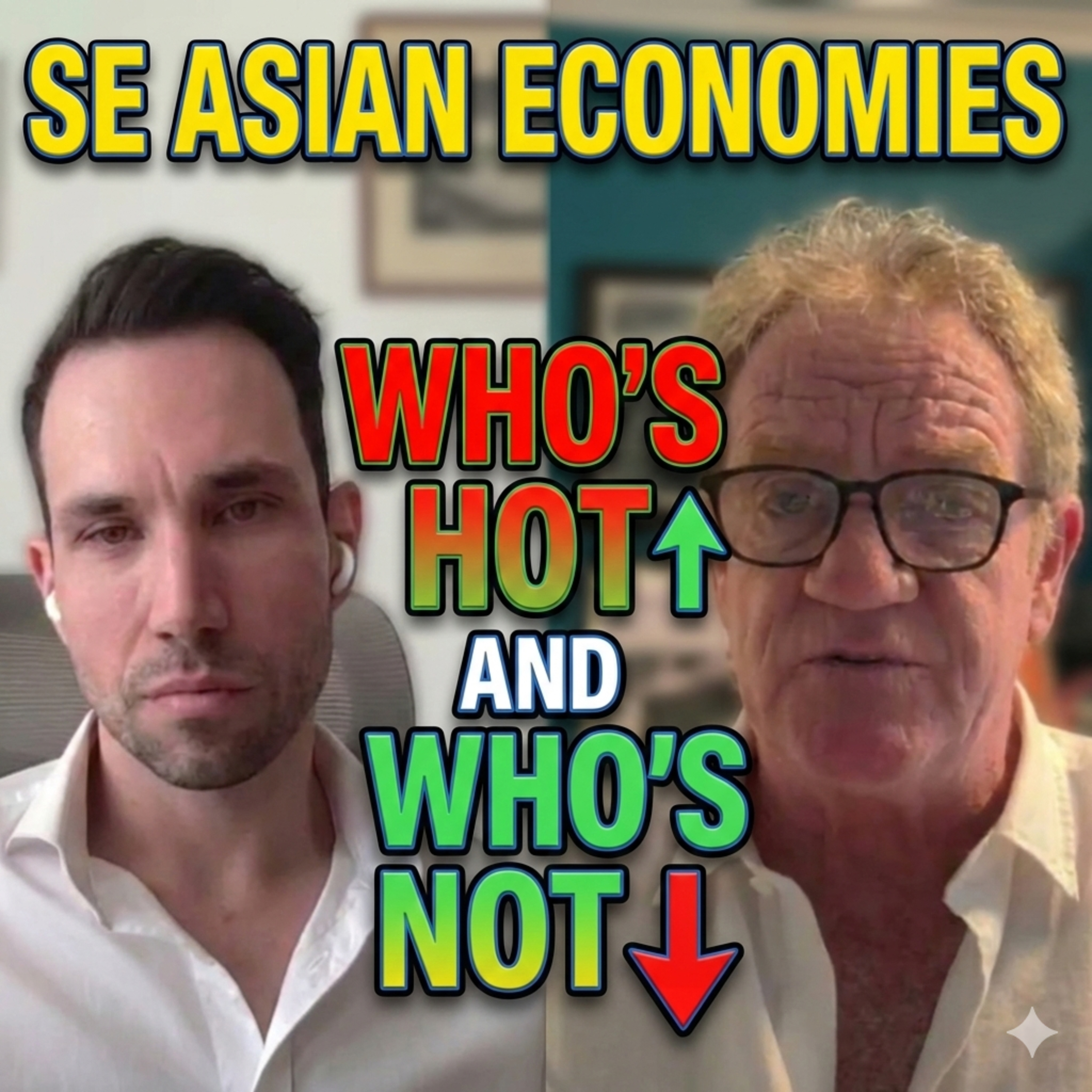 Southeast Asia: The Economic Outlook for 2026 03.02.2026 26minMarcus Tantau is a Senior Associate at Templeton Research, where he leads the firm’s Southeast Asia practice from Singapore. He specializes in corporate investigations and strategic intelligence and advises financial institutions on how to navigate complex risks.He spoke with The Diplomat’s Luke Hunt on a broad range of topics, including the election of To Lam as Vietnam’s president and Communist Party chief, and how regional leaders are faring, among them Malaysia’s Anwar Ibrahim, Indonesia’s Prabowo Subianto. and Ferdinand Marcos Jr. of the Philippines.
Podcasturi similare


Popular în
Acest podcast apare și în topurile de podcasturi din aceste țări.


