
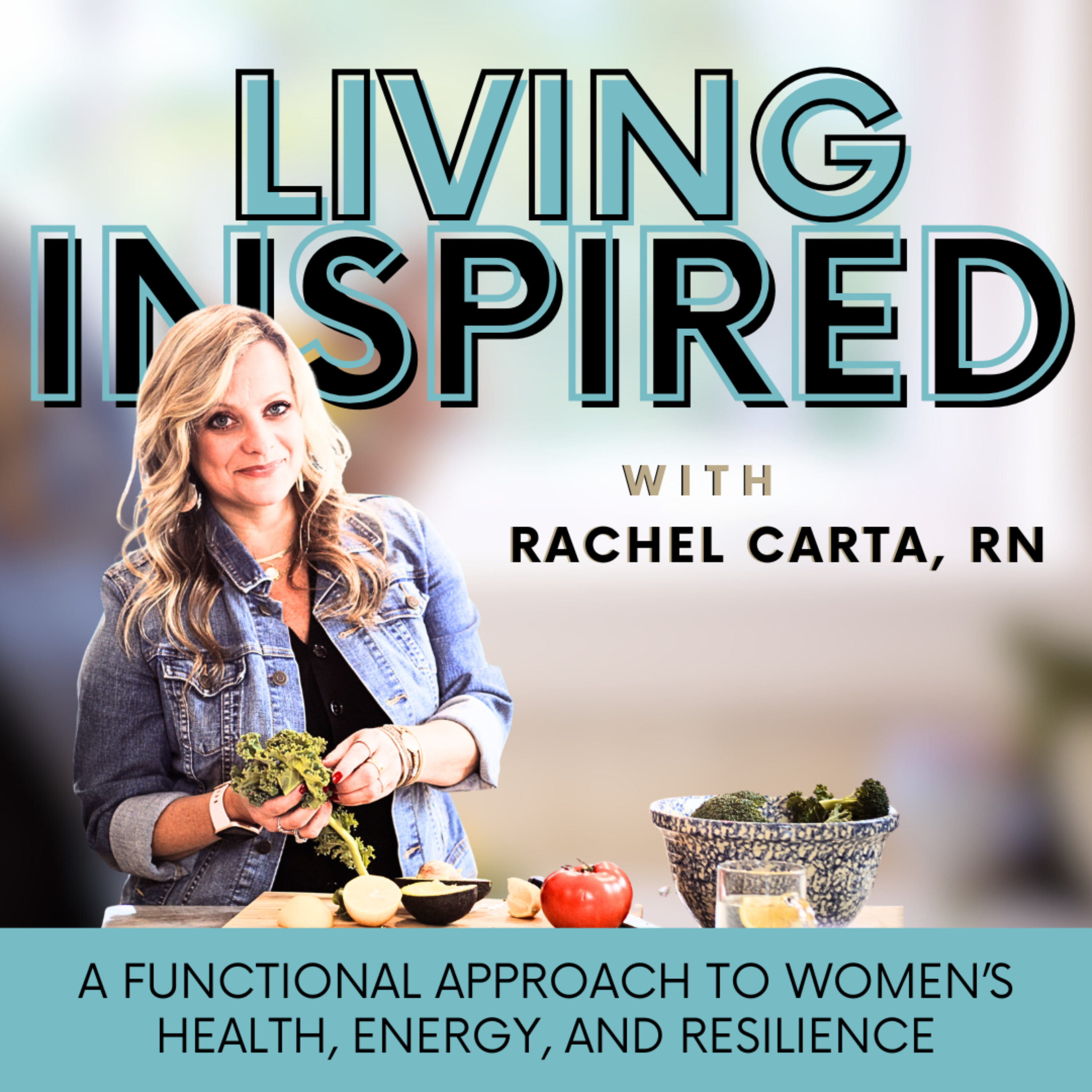
Living Inspired - A Functional Approach to Women’s Health, Energy, and Resilience
Rachel Carta, RN
0
Living Inspired is a podcast about women's health that takes a functional, root-cause approach. Host Rachel Carta, a registered nurse and functional nutrition counselor, discusses issues like fatigue, stress, hormonal changes, sleep difficulties, and metabolism. The show focuses on making small, sustainable changes to restore energy and build resilience, avoiding quick fixes or rigid protocols.
Episoade
-
 113. The Mouth-Body Connection: What Your Gums Are Telling You About Your Hormones 18.09.2026 48minYou floss, you see a little pink, and you rinse and move on with your night. You've pushed through the fatigue, the headaches, the feeling that something is off, because you've got kids and a career and aging parents and there just isn't room to stop and ask what your body is actually trying to tell you. This episode is for the woman who has been managing her symptoms instead of listening to them. My guest, Christine Horton, is a dental hygienist and health coach with a specialty in PCOS and PMOS awareness. She was diagnosed with PCOS at seventeen and has spent decades since connecting a field most of us have never heard of, oral systemic health, to the hormone and metabolic symptoms so many women are told to just live with. If you've ever wondered why your gums, your gut, and your hormones might actually be having a conversation with each other, this one is for you.In This EpisodeThe recent PCOS to PMOS name change, and what polyendocrine and metabolic reveal about the condition that the old name never capturedOral systemic health, the field connecting what's happening in your mouth to what's happening everywhere else in your bodyThe bidirectional relationship between your gum health and your blood sugar or A1C numbersBleeding gums as a warning sign, and what that little bit of pink when you floss is actually telling youThe overlooked connection between mouth bacteria and gut healthPregnancy gingivitis, and what it reveals about hormones and tissue sensitivity even in women with excellent oral hygieneOne in eight women living with PCOS or PMOS, and why most of them don't know it yetChristine's actual nighttime oral care recommendations, and why individualized care beats any one size fits all protocolFind Christine HortonHealth coaching: fusionhealthcoach.comSocial media: @pmospcosglowhygienist on Instagram, YouTube, and PinterestPCOS Awareness Association: pcosaa.org — including the monthly support groups she co-hosts on second WednesdaysPCOS CON: September is PMOS/PCOS Awareness Month, and the one-day virtual conference with experts from around the world is at pcoscon.orgListen to the full episode of Living Inspired, and if this was useful, share it. Women's health progress right now is grassroots. We get better care by passing the information to each other.More ResourcesMood Swings? Get the 5 minute audio to calm them now. https://rachelcartarn.com/sosDo you want to understand more of what's changing in your body in midlife and get a few simple tools to feel better now? Get the free guide: The Real Reason You Still Feel Off.Ready to Talk: Book a Clarity & Relief Session here.Eat Well Made Easy Course
 -
112. Why Trying Harder To Be Healthy Wasn’t the Answer 11.09.2026 40minWhat happens when you already know a lot about health, you’re trying hard to take care of yourself, and you still don’t feel like yourself?In this episode, I’m talking with my friend and client Johanna about what changed when we stopped looking for another plan and started looking at the whole picture.We talk about anxiety, grief, perimenopause, overwhelm, nervous system load, and why healthy habits are so much harder to follow when your body is already at capacity.Johanna also shares one of my favorite shifts from our work together: seeing her past attempts at change as practice instead of proof that she had done something wrong.If you’ve ever thought, “I know what I should be doing, so why can’t I just do it?” this conversation is for you.In this episode, we talk about:Why we didn’t start with foodHow stress, grief, and hormonal changes can stack upWhy more discipline is not always the answerWhat it means to treat healthy habits like a practiceHow small experiments can work better than another complete overhaulFinding your way back to yourself in midlifeMentions from the Show: Lizard Toes Yoga: facebook.com/lizardtoesyogaRunaway Stroller: facebook.com/runawaystrollerJohanna’s album, Why Would I Sing?: available on major streaming platforms. Episode 36: Shift Your Mind, Change Your Life: Chris Chitty's Inspiring Health TransformationSecrets to Authentic Happiness: by Rachel CartaMore Resources: Mood Swings? Get the 5 minute audio to calm them now. https://rachelcartarn.com/sosDo you want to understand more of what's changing in your body in midlife and get a few simple tools to feel better now? Get the free guide: The Real Reason You Still Feel Off.Ready to Talk: Book a Clarity & Relief Session here.Eat Well Made Easy Course
-
111. Your Hormones Aren't the Whole Story of Perimenopause 05.09.2026 25minSome mornings you feel completely like yourself. Other mornings you don't recognize your own body before your feet hit the floor. If you're exhausted, not sleeping, or thinking "I don't feel like myself anymore," this one's for you. Rachel breaks down why the hormone-only conversation leaves so much out, and introduces the Living Inspired Life Lab, a small group opening September 21st for Perimenopause Awareness Month.In this episode: The moment Rachel's fourteen-year-old daughter put words to something most women spend years trying to explainWhy "get the patch and you're good" misses most of the pictureThe Three Roots framework and the terrain underneath a hormonal transitionWhy two women with the same hormonal shifts can have completely different experiencesThe real link between a client's headaches, her digestion, and a workday with zero transitionWhy a nightly dessert habit was never about disciplineThe Vital Six: sleep, movement, nutrition, hydration, relationships, stress resilienceWhat's inside the Living Inspired Life Lab and who the September group is forResourcesLiving Inspired Life Lab (12-week group, begins September 21st )RachelCartaRN.comInstagram: @peaceinperimenopauseRachel's Free Resources:Mood Swings? Get the 5 minute audio to calm them now. https://rachelcartarn.com/sosDo you want to understand more of what's changing in your body in midlife and get a few simple tools to feel better now? Get the free guide: The Real Reason You Still Feel Off.Ready to Talk: Book a Clarity & Relief Session here.
-
110. Is Nervous System Regulation Enough? A Conversation with Psychotherapist Kim Saunders 28.08.2026 40minNervous system regulation can help you feel calmer, but is calm the same thing as healed?In this episode, I’m joined by psychotherapist and yoga educator Kim Saunders to talk about the difference between regulating the nervous system and processing what may be underneath the reaction. We discuss somatic work, EMDR, Internal Family Systems, old belief patterns, and why the same reactions can keep showing up even when you’re doing all the “right” things.If you’ve been working on your nervous system but still feel stuck in familiar patterns, this episode will help you understand why.Connect with Kim:TheLiftYouNeed.comInstagram: https://www.instagram.com/kimuplift/Connect with Rachel:Instagram: https://www.instagram.com/peaceinperimenopause/Rachel's Free Resources:Mood Swings? Get the 5 minute audio to calm them now. https://rachelcartarn.com/sosDo you want to understand more of what's changing in your body in midlife and get a few simple tools to feel better now? Get the free guide: The Real Reason You Still Feel Off.Ready to Talk: Book a Clarity & Relief Session here.Eat Well Made Easy CourseThis episode is brought to you by the Living Inspired Life Lab, my group coaching program for women who want to feel better, understand what’s driving their symptoms, and make sustainable changes in stress, sleep, nutrition, movement, relationships, and more. Doors are opening soon.
-
109. The Brain You’re Building in Midlife 21.08.2026 21minBrain health is not only something to think about later in life. What we do in midlife may influence the brain we have in our seventies and eighties, and many of the same habits that support long-term brain health can also help us feel better now.In this episode, I’m breaking down what women in perimenopause need to know about blood sugar, ultra-processed food, movement, strength training, sleep, relationships, mental health, and the modifiable factors connected with dementia risk.This conversation is personal for me because my dad developed dementia, and watching how much it changed him made brain health something I care deeply about.Most importantly, this is not about fear or trying to fix everything at once. It is about understanding where you have influence and choosing one small place to begin.In this episode:Why brain health matters in midlifeHow blood sugar and metabolic health connect to brain healthWhy movement, strength, sleep, and relationships matterWhat ultra-processed food actually meansHow to focus on one realistic change instead of doing everything at onceFind Rachel on Instagram: @peaceinperimenopauseDr. Mark Hyman's episode that was referenced in today's podcast: https://podcasts.apple.com/us/podcast/the-dr-hyman-show/id1382804627?i=1000784321249Mood Swings? Get the 5 minute audio to calm them now. https://rachelcartarn.com/sosDo you want to understand more of what's changing in your body in midlife and get a few simple tools to feel better now? Get the free guide: The Real Reason You Still Feel Off.Ready to Talk: Book a Clarity & Relief Session here.Eat Well Made Easy Course
-
108. What a 93-Year-Old Taught Me About Aging Well 07.08.2026 41minIf you have caught yourself holding onto a version of you that no longer fits, this conversation is for you. Barb Wojahn, who is 93 years old, has volunteered as a bird bander for 52 years, held leadership roles in her church for decades, and is only now handing off a seniors program she has run for almost 30 years. This is not a conversation about how to live to 93. It is a conversation about how to keep asking who you want to be, no matter what stage of life you are in.In This EpisodeThe interest inventory that told Barb she was suited to be a housewife, and what it took to build a life beyond thatLetting go of activities and identities that no longer fit, and why that is harder than it soundsLearning to say no at 93, and what her husband used to tell her about being in two places at onceThe advice Barb's mother gave her about friendship that shaped her entire lifeWhy connection is one of the six vital inputs your nervous system reads every dayFind Rachel on Instagram: @peaceinperimenopauseRachel's Free Resources:Mood Swings? Get the 5 minute audio to calm them now. https://rachelcartarn.com/sosDo you want to understand more of what's changing in your body in midlife and get a few simple tools to feel better now? Get the free guide: The Real Reason You Still Feel Off.Ready to Talk: Book a Clarity & Relief Session here.Get the Eat Well Made Easy Course, on sale now
-
107. How to Stay Calm Under Pressure: Lessons From a Pilot 31.07.2026 43minYou already know the feeling. The plan falls apart, the day turns sideways, and you are left standing in the wreckage of your own expectations, wondering why you could not just stay calm this time. In this episode, I sit down with a woman who spent decades in the cockpit of major airliners, flying everything from a small four passenger plane to a 787 across oceans, and who is now retired and figuring out what comes next. This conversation is not just about flying. It is about what happens in your body before the crisis ever shows up, and whether you have trained for it.In This EpisodeAn unconventional path into a forty-six-year flying career, and the one conversation that started it.What it took to build a career in a field where only a small percentage of pilots were women.The exact moment an engine failed midair, and why the response was calm instead of panic.Simulators, checklists, and the real difference between talent and training.Calculated risk versus recklessness, and how to tell which one you are actually taking.The fine line between fear and excitement, and how to use it to make better decisions.What retirement actually looks like eighteen months in, and who would not let the dream sit unfinished.Why a hobby that hits more than one of your values will carry you further than one that only hits one.Rachel's Resources:- Mood Swings? Get the 5 minute audio to calm them now. https://rachelcartarn.com/sos- Do you want to understand more of what's changing in your body in midlife and get a few simple tools to feel better now? Get the free guide: The Real Reason You Still Feel Off.- Ready to Talk: Book a Clarity & Relief Session here.- Eat Well Made Easy Course
-
106. Root Cause Nutrition for Women: Reading the Signals 24.07.2026 49minYou already know the feeling. It's the moment your calendar says you should be able to keep going, but your body has quietly decided otherwise: the fog rolling in mid-afternoon, the irritability you can't explain, the sense that you used to handle more than this without falling apart. In this episode, I'm sharing a conversation I had as a guest on Tracy Hoth's podcast, The Organized Coach, where we got into why so many high-achieving women blame their mindset or their discipline for something that is actually coming straight from the body. In This EpisodeRoot causes: the three places nearly every chronic symptom actually traces back toGenes and epigenetics: why family history is not the same thing as fateThe soil and the roots: a garden metaphor for how autoimmune conditions really developFight or flight and your to-do list: why your nervous system can't tell a real threat from a busy dayBlood sugar and business: the physical reason behind midday irritability and brain fogThe three-minute nervous system reset that changes how the rest of your day goesFat, fiber, and protein: the simplest way to stabilize blood sugar without tracking anythingSleep as the first domino: why it matters more than any other single habitPattern awareness: the practice that comes before any protocolResourcesTracy's podcast, The Organized CoachFree Guide: The Real You Still Feel Off: What Your Symptoms Are Telling YouWebsite: rachelcartarn.comIG: @peaceinperimenopause
-
105. The Magic Meal Formula: Fewer Cravings, More Energy, No More Diets 17.07.2026 15minIf you've spent another Sunday night staring at a grocery list wondering whether you should be low carb, cutting dairy, fasting, or counting macros, this one is for you. In this episode, Rachel steps away from all the noise and hands you the one place she starts with almost every client, no matter what brought her through the door. This isn't another diet. It's a simple formula you can carry into any kitchen, for the rest of your life.In This EpisodeThe Magic Meal Formula and why it starts with three simple pieces, not another diet.Blood sugar spikes and crashes, and what's actually behind your cravings.Healthy fat sources and what they're doing for your hormones, your brain, and your energy.Fiber, the piece almost every woman is under-eating, and how much you actually need.Protein's role in steady mood, muscle, and blood sugar, and how to tell if you're getting enough.Real client patterns, mood swings and hot flashes that shifted once meals were rebuilt around this formula.Simple examples for smoothies, salads, and eggs so you can build a plate without overthinking it.Eat Well Made Easy, the mini course this teaching is pulled from.ResourcesEat Well Made EasyRachelCartaRN.comFind Rachel on IG: https://www.instagram.com/peaceinperimenopause/Rachel's Free Resources:Mood Swings? Get the 5 minute audio to calm them now. https://rachelcartarn.com/sosDo you want to understand more of what's changing in your body in midlife and get a few simple tools to feel better now? Get the free guide: The Real Reason You Still Feel Off.Ready to Talk: Book a Clarity & Relief Session here.
-
104. What Nobody Explained to You About Perimenopause and Hormones 11.07.2026 25minYou wake up in a body that doesn't quite feel like yours. Sleep is worse, moods are sharper, weight settles somewhere it never used to, and when you finally ask your doctor, you’re told your labs are normal. In this episode, I'm opening the doors to something I teach inside the Living Inspired Life Lab. This is the hormone conversation I have with nearly every woman who finds her way to me. It's not the version you've seen online where estrogen is the enemy and the right supplement fixes everything. It's the real one, where your hormones are one part of a much bigger story your body is telling you, and if you're in your late 30s, 40s, or beyond and you've started to feel like a stranger to yourself, this one is for you.In This EpisodeThe hormone hierarchy, and why your sex hormones sit at the very top of the pyramidBlood sugar as the foundation everything else is built onThe monthly cycle, and the difference between feeling unstable and being cyclicalPerimenopause, menopause, and post-menopause, and why menopause is only one single dayThe estrogen roller coaster, and why this stretch is often harder than menopause itselfProgesterone, ovulation, and the reason your sleep changedFSH, lab tests, and why a normal result doesn't mean nothing is happeningHormone therapy as a start-at-the-base conversation, not a first moveResources MentionedFind Rachel on Instagram: @peaceinperimenopausePodcast episode with a hormone nurse practitioner, Dana Culp, on the hormone therapy process.Podcast episode with Jane Butler on the mindset of the menopause journey.
-
103. The Pelvic Health Conversation No One Ever Had With You 27.06.2026 50minYou laugh, you sneeze, you pick up the laundry basket, and there it is again, that little leak you've quietly learned to work around. Or intimacy has started to hurt, and the only advice you've ever gotten was to have a glass of wine and relax. Maybe days pass without a real bathroom trip and you've decided that's just how your body is now. I sat down again with Dr. Judy Rossi, a pelvic floor therapist with a doctorate in physical therapy and advanced training in pelvic health and orthopedics, for the honest conversation most of us were never offered about what these symptoms are actually trying to tell us. If you've been handed the word "normal" every time you've worked up the courage to ask, this episode is for you.In This EpisodeThe pelvic floor as twenty-five percent of your core, and why the six-pack you were taught to chase isn't even part of itStress incontinence versus urge incontinence, and why the leaking you brushed off gets treated two completely different waysPainful intimacy, medical gaslighting, and the "just relax" advice that sends women home without help when ninety percent of the time it's fixableChronic constipation and dyssynergic defecation, the pattern where your pelvic floor clenches at the exact moment it's supposed to let goThe two-way highway between your brain and your pelvic floor, and what stays stuck when you're living in fight or flightWhy you can't out-supplement, out-exercise, or out-biohack a dysregulated nervous system, and where the work actually has to beginJudy's own decade with IBS and interstitial cystitis, and the tight, angry muscles that turned out to be the real driverThe places the body stores stress, from the jaw to the neck to the pelvic floor, and one patient story you won't forgetPerimenopause, thinning tissue, and the topical estrogen conversation worth having with your providerSimple vagus nerve practices like gargling, humming, and cold water that you can start at the bathroom sink todayResourcesDr. Judy Rossi, Woodstock Pelvic HealthJudy on Instagram @woodstockpelvichealthLiving Inspired Podcast, Episode 54 (pelvic health basics and myths with Dr. Judy Rossi)Learn More About RachelRachel on Instagram @peaceinperimenopauseGet the Free Guide The Real Reason You Still Feel Off in Perimenopause
-
102. What a Gas Line Trench Taught Me About Gratitude and the Nervous System 19.06.2026 22minThis is one of those solo episodes where I interrupt the regular schedule because an ordinary moment had something to say. If you've been moving so fast that you're missing your own life, and carrying a stress load you've never actually named, this one is for you.In This EpisodeA hole in the road, a hard hat, and the morning that changed how I see comfortPhysical stress versus emotional stress, and why your body counts bothThe hidden labor behind the heat, the roads, the gas lines, and the clean sidewalks most of us never seeWhy a nervous system living at its limit can't heal, no matter how hard you pushThe irritation of construction delays, and the one question that calms your body in the momentComfort as the baseline, and what it costs us to treat every interruption as a problemA missions trip at fifteen, trash trenches, and what infrastructure really isReading the name tag: a ten-second practice for actually seeing the people around youRachel's Free Resources:Mood Swings? Get the 5 minute audio to calm them now. https://rachelcartarn.com/sosDo you want to understand more of what's changing in your body in midlife and get a few simple tools to feel better now? Get the free guide: The Real Reason You Still Feel Off.Ready to Talk: Book a Clarity & Relief Session here.
-
101. A New Way to Understand Your Body in Midlife with Andrea Nakayama 13.06.2026 1h 6minIf your health feels like a list of problems you're supposed to fix on your own, and the internet keeps adding one more thing you "have to" do to feel okay in midlife, this conversation is the exhale you've been needing. My guest is Andrea Nakayama, a pioneer in functional nutrition, the founder of the Functional Nutrition Alliance, and the educator who trained me to think the way I think. She has taught thousands of practitioners to see the person instead of the diagnosis, and that one shift changes everything about how you understand your own body. If you're a high-achieving woman who is tired of chasing symptoms and quietly wondering why you couldn't just figure this out yourself, this one is for you.In This EpisodeThe note-card model of medicine most of us were handed, and why symptom plus disease plus drug was never the whole story.The matrix Andrea teaches, made of story, soup, and skill, and the layer almost everyone skips.The tree, its roots, and the soil, and why you don't heal by cutting off the branches.The pause, and the one person who actually profits from it.Blood sugar at the base of the hormone hierarchy, and the morning habit that quietly sets your whole day off.Hormone therapy in midlife, and why it helps some women and isn't the fix it's being sold as for everyone.The nervous system stuck in fight or flight, and what your body cannot do until it feels safe.One client, fifteen supplements, and the two-minute practice that finally moved the needle on her IBS.Building your own ecosystem of support instead of asking one doctor to be everything.Resources:Find Andrea here: https://www.andreanakayama.com/Andrea on IGRachel's Resources:Website: RachelCartaRN.comMood Swings? Get the 5 minute audio to calm them now. https://rachelcartarn.com/sosDo you want to understand more of what's changing in your body in midlife and get a few simple tools to feel better now? Get the free guide: The Real Reason You Still Feel Off.Ready to Talk: Book a Clarity & Relief Session here.
-
100. Surviving Your Life, or Living It 06.06.2026 24minYou're doing all the things you've always done, and somehow your body is pushing back anyway. You're tired in a way sleep doesn't touch, reactive over things that never used to rattle you, moving so fast that whole days disappear before you've actually been inside any of them. You keep telling yourself you'll slow down once everything calms down and everyone else is taken care of. This is episode 100 of the Living Inspired Podcast, and instead of a guest, Rachel sits down to reflect on what 100 episodes, two decades with women, and the last three nights of her father's life have taught her about the difference between surviving your life and actually living it. If you've forgotten what it feels like to be fully present in your own days, this one was made for you.Key TakeawaysYour symptoms are rarely the problem. They are your body's response to a load that's been building for years, and that means they can be read and answered rather than only silenced.Your body was always paying the price. Midlife is simply the season it stops letting you defer the bill, which is information, not a verdict.Living inspired means living at a pace your body and soul can actually sustain, and slowing down enough to notice you are alive now, not eventually.Rachel's Free Resources:Mood Swings? Get the 5 minute audio to calm them now. https://rachelcartarn.com/sosDo you want to understand more of what's changing in your body in midlife and get a few simple tools to feel better now? Get the free guide: The Real Reason You Still Feel Off.Ready to Talk: Book a Clarity & Relief Session here.
-
99. Why Your Cravings Aren't a Willpower Problem 29.05.2026 16minYou've made it through the day. You ate well, you stayed focused, you held it together. And then the evening comes and something shifts. Suddenly you're standing in your kitchen reaching for bread, or something sweet, or anything that will quiet the noise. You tell yourself you'll do better tomorrow. But tomorrow looks exactly the same. If this is your life right now, this episode is going to explain something nobody has taken the time to tell you: your cravings have a physiological root cause, and willpower was never the solution.In This EpisodeBlood sugar mechanics and why refined carbohydrates trigger a craving cycle that feels nearly impossible to breakCortisol, sleep deprivation, and the direct connection between a hard night and a carb-heavy next dayInsulin resistance, what it actually means, and why it makes cravings more intense even when you're eating enoughThe brain chemistry behind why sugar temporarily calms a stressed nervous system, and what that means for women who think they're "just emotional eaters"The gut microbiome's role in what you reach for and why certain imbalances can make sugar cravings feel relentlessThe fat, fiber, protein principle Rachel teaches every client and why it's the most consistent shift she sees make a real differenceWhy restrictive dieting keeps failing and what your body is actually asking for insteadResourcesWebsite: RachelCartaRN.com Instagram: @peaceinperimenopauseRachel's Free Resources:1. Mood Swings? Get the 5 minute audio to calm them now. https://rachelcartarn.com/sos2. Do you want to understand more of what's changing in your body in midlife and get a few simple tools to feel better now? Get the free guide: The Real Reason You Still Feel Off.3. Ready to Talk: Book a Clarity & Relief Session here.
-
98. Mud Before Wings: What Nobody Told You About the Woman You're Becoming 23.05.2026 44minYou've done the labs. Everything looks normal. But you still don't feel like yourself and nobody has been able to tell you why. In this episode, Rachel sits down with Dr. Ellen Albertson, psychologist, self-compassion researcher, and the Midlife Whisperer, to talk about what is actually happening in your body and mind during perimenopause and why feeling lost in this season doesn't mean something is wrong. It means you're becoming.Dr. Ellen introduces the dragonfly as a metaphor for midlife — the nymph stage, the murky water, the slow and often uncomfortable process of transforming into something with 360-degree vision and the freedom to fly. This conversation is for any woman who has felt dismissed, confused, or quietly exhausted by a season of life nobody prepared her for.In this episode:Why your operating system is updating and what that actually means in your brain and bodyThe estrogen veil: what happens when it lifts and why so many women finally say "enough"Why we cannot put everything in the perimenopause bucket and what else to look atThe three elements of self-compassion and why the research says it changes your health, not just your mindsetDestination vibration: how to access the felt sense of feeling well even when you're not there yetWhy self-care is not a spa day and what it actually looks like when your nervous system needs supportHuman design, the dragonfly framework, and understanding your unique wiring in midlifeKey Takeaways:Your symptoms are not a malfunction. They are a recalibration.Self-compassion is a muscle. The more you practice treating yourself like a good friend, the more your relationship with yourself changes.Small hinges swing big doors. You don't need an overhaul. You need to find the one or two things creating the most drag and start there.Resources:Dr. Ellen Albertson: themidlifewhisper.comInstagram: @the_midlife_whisperRachel Carta: RachelCartaRN.comInstagram: @peaceandperimenopauseRachel's Free Resources:Mood Swings? Get the 5 minute audio to calm them now. https://rachelcartarn.com/sosDo you want to understand more of what's changing in your body in midlife and get a few simple tools to feel better now? Get the free guide: The Real Reason You Still Feel Off.
-
97. The Hidden Cost of Urgency in Midlife 18.05.2026 35minIf you’ve been feeling more overwhelmed, emotionally reactive, mentally exhausted, or disconnected from yourself lately, this episode is for you.And no, I don’t think it’s “just hormones.”In this conversation, I’m talking about something I see constantly with women in midlife: the hidden cost of living in a constant state of internal urgency.Everything feels important.Everything feels immediate.Everyone needs something.Over time, the nervous system starts treating life like one ongoing emergency, and eventually that pressure impacts far more than stress levels. It affects sleep, digestion, hormones, focus, emotional regulation, energy, and your ability to actually feel present in your own life.Inside this episode, I share a powerful framework from one of my Root & Rise coaching calls that helps explain why so many women feel emotionally overloaded all the time, even when they’re “doing all the right things.”We talk about:Why many women are not just tired, but stuck in chronic reaction modeThe connection between nervous system overload and midlife symptomsHow urgency quietly steals peace, fulfillment, and emotional capacityThe difference between what feels urgent and what actually moves your life forwardWhy many healing practices get abandoned first when life gets busyThe four zones that shape how you feel every daySimple ways to reduce mental overload and create more nervous system safetyThis episode is not about becoming less responsible or getting everything perfectly balanced. It’s about recognizing that many women have spent years operating from pressure and reaction, and that healing often begins by slowing down enough to become more intentional again.Because peace does not come from getting everything done.Peace comes from learning what really matters.If this episode resonated with you, send it to a woman who feels like she’s carrying the weight of everything right now.And if you enjoyed this conversation, I’d love for you to leave a review or share the episode on Instagram and tag me at @peaceinperimenopause.Learn more about working with me: RachelCartaRN.com
-
96. Burnout In Midlife: Why Your Body Is Pushing Back 08.05.2026 54minIf you’ve been feeling exhausted, overwhelmed, emotionally reactive, wired but tired, or like your body suddenly isn’t responding the way it used to, this episode is for you.In this powerful conversation, I sit down with functional diagnostic nutrition practitioner and HTMA expert Dori Martin to talk about what burnout really is, why so many women in midlife feel stuck in survival mode, and how chronic stress impacts everything from hormones and sleep to energy, mood, and healing capacity.We talk about the hidden emotional and physiological load many women are carrying, especially in midlife, and why symptoms are often connected instead of random.This episode is not about doing more. It’s about understanding what your body has been trying to tell you.Inside this conversation, we discuss:why midlife often feels like “everything stopped working”the connection between burnout, nervous system stress, and hormone symptomshow your body prioritizes survival over repairwhy so many women feel exhausted even when they’re trying everythingthe role of mitochondria and energy productionwhy women in midlife often feel stuck in fight or flightthe emotional load of caregiving, perfectionism, and over-functioningsimple shifts that can help your body feel safer and more supportedwhy sunlight, hydration, breathing, and slowing down matter more than people realizeDori also shares her personal story of caregiving, chronic stress, and burnout, and we talk honestly about the shame many women feel when their bodies can no longer keep up with the pace they’ve been forcing themselves to maintain.Resources:Learn more about Dori Martin: https://dorimartin.comFollow Rachel on Instagram: https://instagram.com/peaceinperimenopauseLearn more about working with Rachel: https://RachelCartaRN.comLiving Inspired Podcast Episode 7: Meditation for Stress ReliefLiving Inspired Podcast Episode 12: Medication to Just BeLiving Inspired Podcast Episode 37: Feel Stress Release NowIf this episode resonated with you, please share it with someone who needs this conversation right now, and if you haven’t yet, I’d be so grateful if you left a review for the podcast.
-
95. You’re Not Crazy. Your Body Is Trying to Tell You Something 02.05.2026 24minIf you’ve been feeling more anxious, more reactive, or just not like yourself lately… this episode is for you.You’re trying to do the right things. You’re taking care of yourself, paying attention to your health, maybe even running labs… and still, something feels off.In this episode, Rachel sits down with a client, Amanda, who shares what it felt like to be in that exact place. After having her baby, Amanda experienced anxiety, exhaustion, mood swings, and a sense that she had lost herself. Even though she knew something wasn’t right, she wasn’t getting the answers she needed.What you’ll hear in this conversation is what changed when she stopped trying to fix the symptoms and started addressing what was actually driving them.Rachel breaks down:why mood swings, anxiety, and irritability are signals, not personality changeswhy hormones are part of the story, but not the whole storyhow stress, blood sugar, inflammation, and the nervous system all play a rolewhat it actually looks like to make small shifts that create meaningful changeAmanda shares how, within a matter of weeks, she went from feeling like a shell of herself to feeling safe in her body again and genuinely happy, without overhauling her life.If you’ve been feeling off and can’t quite explain why, this episode will help you start to see what your body might be trying to tell you.If you’re ready to go deeper, here are a few ways to get support:Book a call with Rachel: https://rachelcarterrn.com/schedule A simple conversation to talk through what’s going on and what your next step could look like.Mood Swings SOS (free 5-minute reset): https://rachelcarterrn.com/SOS A quick, practical tool to help you calm your system in the moment when everything feels heightened.Free Guide: The Real Reason You Still Feel Off https://rachelcarterrn.com/LastingHealth A deeper look at what’s actually driving your symptoms and how to start addressing them at the root.Partner Communication Guide https://rachelcarterrn.com/communication Because this season of life affects your relationships too. This will help you communicate what’s going on in a way that brings more understanding and support.
-
94. Lifestyle Medicine: How Daily Habits Shape Your Health and Long-Term Disease Risk 27.04.2026 44minIn this conversation with Dr. Ann Hester, we talk about what’s missing in traditional healthcare, and why lifestyle is not just a side note, but a major driver of how you feel day to day. This isn’t about doing everything perfectly or overhauling your life overnight. It’s about understanding how your daily habits are shaping your energy, your hormones, your inflammation, and your long-term health in ways most people have never been taught to look at.We also talk about why change feels hard, even when you know what to do, and how small, consistent shifts can create meaningful results without overwhelm.What We CoverThe gap in medical training around nutrition and lifestyleHow daily habits impact hormones, energy, and inflammationThe role of lifestyle medicine in long-term healthWhy change feels hard (and what actually works instead)How to start making small, sustainable shiftsYour body is responding to what you do every single day. When you understand that, you stop chasing fixes and start seeing patterns.Resources MentionedDr. Ann Hester’s website: https://ptrreset.comTake the Survey: Click Here. If this episode resonated with you, I’d love to hear what stood out.You can send me a message on Instagram:👉 https://instagram.com/peaceinperimenopauseOr explore more resources here:👉 https://rachelcartaRN.com
Podcasturi similare


Popular în
Acest podcast apare și în topurile de podcasturi din aceste țări.
