
A Productive Conversation
Mike Vardy
0
Hosted by productivity strategist Mike Vardy, this podcast features conversations about designing a life aligned with your intentions. Episodes explore time devotion, productivity, and practical strategies for working smarter and living more intentionally. Mike brings on thinkers, doers, and creators to share mindset shifts and tips for balancing a busy life. The show aims to help listeners reframe their relationship with time and achieve a more productive, intentional existence.
ตอน
-
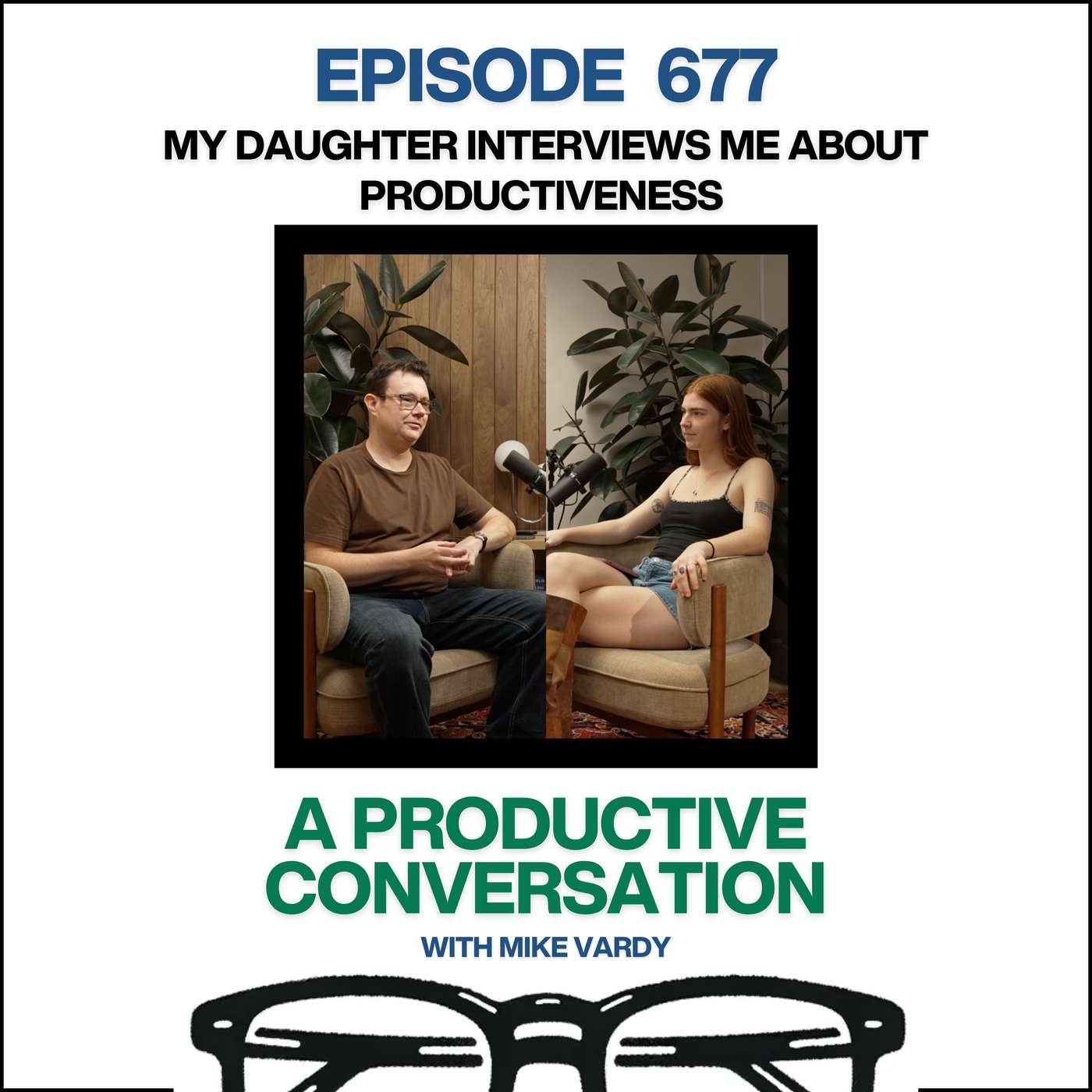 My Daughter Interviews Me About Productiveness (with Grace Vardy) 30.09.2026 1ชม. 1นาทีNormally I'm the one asking the questions. This time I wasn't. I was in New York for Podcast Movement, my daughter Grace came down from Montreal to meet me — partly for a concert, let's be honest — and since we were both sitting in a studio anyway, we turned the tables. She'd written her own questions. She hadn't read the book. I had no idea where any of it was going.What came out of it is the most personal conversation I've put on this feed in a long time: why productiveness is a state and not a rate, and why that distinction matters more than it sounds like it should; which of the nine principles I actually struggle with, and the reframe a therapist gave me years ago that changed how I measured a decade of my working life; why I've cut interviews on this show from fifty-two a year to twelve; and why, after eighteen years of doing this, I've never once described myself as a podcaster.It felt right to put this one out on International Podcast Day. Eighteen years, no breaks, and the thing I keep coming back to is that the show was never the point — it's the connective tissue between everything else.Six Discussion PointsProductiveness predates productivity as a word, and the substitution quietly swapped a state for a rate — which matters because a state is tethered to identity in a way a rate never is.Data can change your rate. It can't change your state — which is why measurement alone has never made anyone feel less behind."Is this the right app?" is almost never the first question; whether the work is aligned with your energy is, and most systems will never stop to ask it.A therapist's reframe — that you're a stay-at-home parent who happens to run a business, rather than a business owner who happens to be at home — leaves every fact unchanged and completely alters what success was ever supposed to look like.Cadence is the hardest principle to hold because the seasons of a life keep invalidating the rhythm that was working, and grace is what makes that survivable rather than damning.Legacy is built by the ride rather than designed at the end of it, and you don't get a vote in how it turns out — which is an argument for being more interested in the ride than the result.Three Connection PointsProductivenessThe Front Nine-era photo of Grace and ColtonGrace's ask: She's a psychology student looking for lab experience. If you're a teacher, psychologist or sociologist with room in your lab, get in touch and I'll pass it along.Grace has been around for this work her entire life — she wrote show notes for this show as a teenager for twenty dollars an episode, which she brought up on air and which I had genuinely forgotten. Getting to have this conversation with her, in a studio, in a city we were both in for completely different reasons, is about as good an illustration of the ride-over-the-result argument as I could have staged on purpose. I didn't stage it. That's rather the point.
 -
 You Didn't Fall Behind This Summer. You Just Stopped. 23.09.2026 32นาทีI missed two Wednesday livestreams this month, and I spent more time than I'd like to admit trying to decide whether that meant I'd fallen behind. Somewhere in there I realized I was asking the wrong question. Falling behind and stopping are not the same thing — they just feel the same and they get called the same name.Falling behind requires somebody waiting. There's a pace that was set, an agreement, a real person on the other side of it. Stopping is just the absence of motion. That's the whole definition. In this one I get into why confusing the two costs people entire summers, the three predictable ways re-entry breaks, and the distinction between consistency and cadence that finally made all of this click for me. I use my own two missed Wednesdays as the worked example throughout, because it would be a bit strange if I didn't.Six Discussion PointsFalling behind requires that someone was actually waiting; if you can't name them in four seconds, you didn't fall behind — you stopped, and nobody sends a bill for stopping.A guilty conscience quietly converts a neutral fact ("I stopped") into a moral one ("I failed"), and once it's moral you feel you have to atone before you're allowed to simply resume.The Full Restore assumes two weeks away had zero effect on your capacity — an expectation nobody would apply to running or to a language, but that we apply to our work constantly.The debt story treats rest as a withdrawal to be repaid, which quietly means rest was never rest at all; it was borrowing, and every day off becomes a loan against a future day of overwork.The clean slate delay is the most expensive of the three because it feels like planning when it's actually stalling with a calendar in your hand — a two-week stop becomes a six-week one.Consistency is mechanical and treats any gap as a broken chain; cadence is musical, and a rhythm can absorb a rest because rests are written into the score.Three Connection PointsSubscribe to The LanternThe 10-Second InboxListen to the Gary John Bishop conversation (APC668)A system you can return to is worth more than a system you never leave — because the one you never leave is going to get left eventually. Something always happens. When it does, the only thing that matters is whether you built something you can walk back into. If you stopped something in the last six weeks, the question isn't how you let it happen. It's whether this is a rest or a drift, and the only difference between those two is whether you come back.
 -
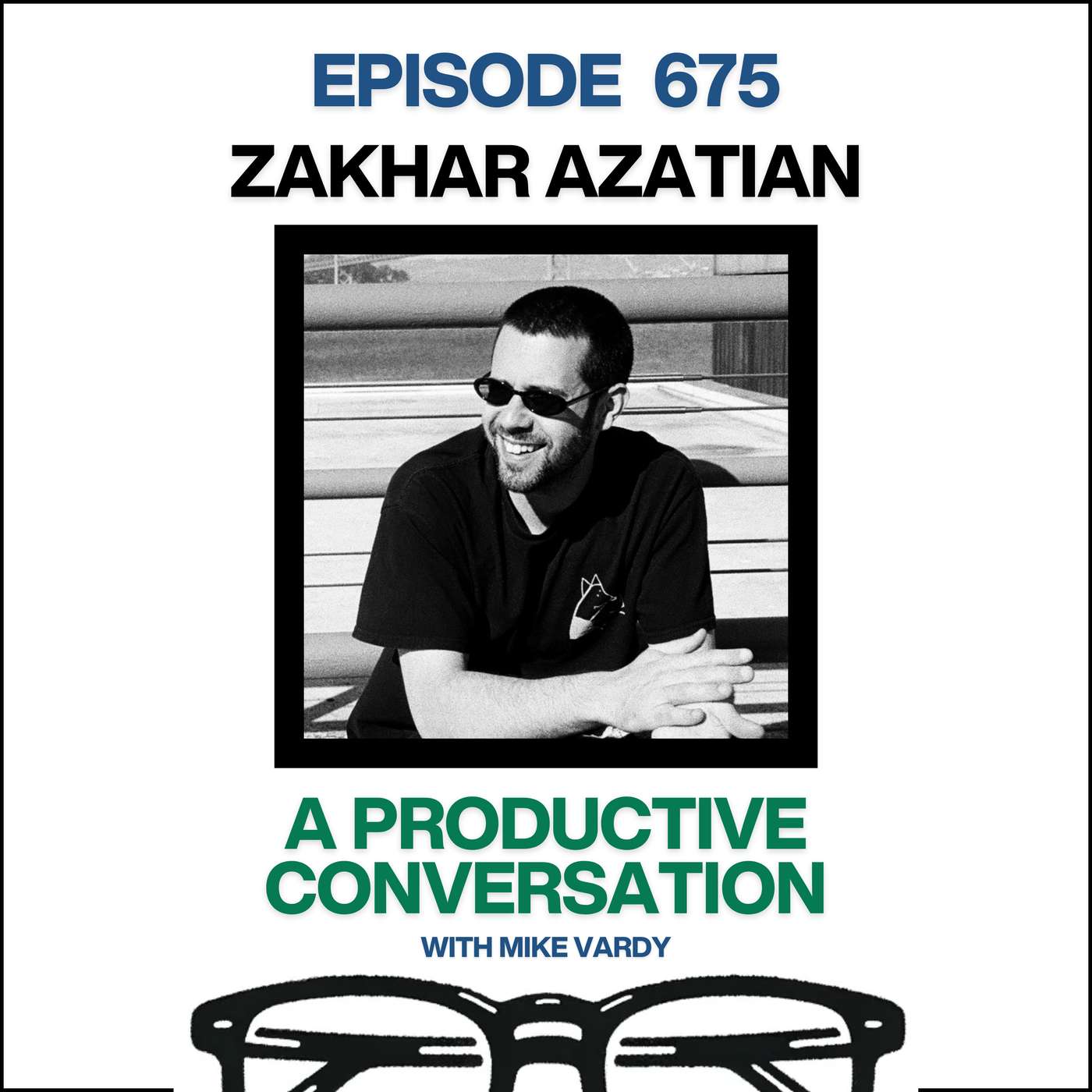 Why One Challenge Beats Ten (with Zakhar Azatian) 16.09.2026 25นาทีThe appeal of a hard challenge is that nobody's pretending it's easy. Most of what gets sold to us leads with how simple it'll be; programs like 75 Hard do the opposite, and that honesty is a large part of why they work. But the failure mode is predictable, and it's not laziness — it's taking on so many challenges at once that none of them survive contact with an ordinary week.Zakhar Azatian — Zach — is a founder building Be Hard, a platform for structured personal challenges, and he's failed at more of these than he's completed, which makes him a more useful guide than someone with a perfect record. We got into why one challenge with one focus beats ten, how longer challenges force you across seasons and schedule changes in a way 30-day sprints don't, why "I forgot" is a more common failure cause than any lack of discipline, and why a challenge that looks indulgent from the outside can still be doing real work.Six Discussion PointsPrograms like 75 Hard succeed partly because they're honest about being hard, in a market that mostly competes on how easy something will be.Doing multiple challenges simultaneously is the most common way people fail — one challenge with one clear focus, even if it combines physical, social, and mental elements, is far more sustainable.Longer challenges force you across month boundaries, season changes, and disrupted schedules, which is exactly what reveals whether something actually fits your life.Most failures aren't about discipline — they're about a rescheduled task falling out of routine and simply being forgotten.A challenge should be designed around a specific problem you're trying to solve, which means the same activity can be a real challenge for one person and meaningless for another.Fitting a challenge into a full life usually requires removing something rather than finding time — but that removal has to be honest about what's actually optional.Three Connection PointsBe Hard — Zakhar's challenge platformConnect with Zakhar Azatian on LinkedInCheck out Mike's booksIf you've been circling a challenge you keep not starting, the useful question isn't whether you have the discipline. It's whether you've picked one thing instead of five, and whether you know what problem it's actually meant to solve. Get those right and the difficulty stops being the obstacle.
 -
 PM Talks S3E9: What Problem Does This Actually Solve? 09.09.2026 45นาทีPatrick's wife has an iPad mini she uses for exactly one thing: reading. She's never called it an iPad mini in her life. She calls it her Kindle — and she isn't confused, she's being precise. The name follows the job, not the packaging. That's the second time in two months we've stumbled into how the words people choose quietly reveal what a thing is actually for.This month's PM Talks opens there and lands on a question Patrick puts plainly about twenty minutes in: what problem does this solve? We get into Clayton Christensen's milkshake, why a tool that does everything usually does nothing especially well, why the unused device in the corner is a capital-P project you've been sitting on rather than a small privileged annoyance, and — less comfortably — what happens when you point that same question at a friendship, a marriage, or a default nobody ever asked you to agree to.Six Discussion PointsWhat people call a thing reveals what it's actually for; a device used only for reading becomes "her Kindle" regardless of what's printed on the box or which app is open.The jobs-to-be-done question cuts in both directions — it explains what you should buy, and it exposes what you're still holding onto that stopped doing its job a while ago.Deliberately refusing to install certain apps on a device is a forcing function, not a limitation; knowing what each device is for is what makes any of them work well.An unused device sitting in the corner isn't clutter, it's an open loop — and in David Allen's terms it's a full project with multiple tasks underneath it, not a single thing you can dash off.Capturing an open loop doesn't close it; what actually relieves the weight is having a plan and knowing the boundaries of the thing you captured.Asking what problem a relationship or a social default solves sounds cold, but it's really a prompt to notice when something has stopped doing the job you originally needed it to do — and to stop treating inherited arrangements as settled.Three Connection PointsRead more from Patrick Rhone at patrickrhone.comGrowth in ReverseGet ProductivenessThe move worth stealing from this one is Patrick's double-take in the Costco aisle: the walk past, the stop, the walk back. Most of us keep walking. Whether it's a device you've stopped using, a phone you pull out without deciding to, or an arrangement you've never actually questioned, the pause is the whole thing. What in your life is still there mostly because you never stopped to ask what it was for?
 -
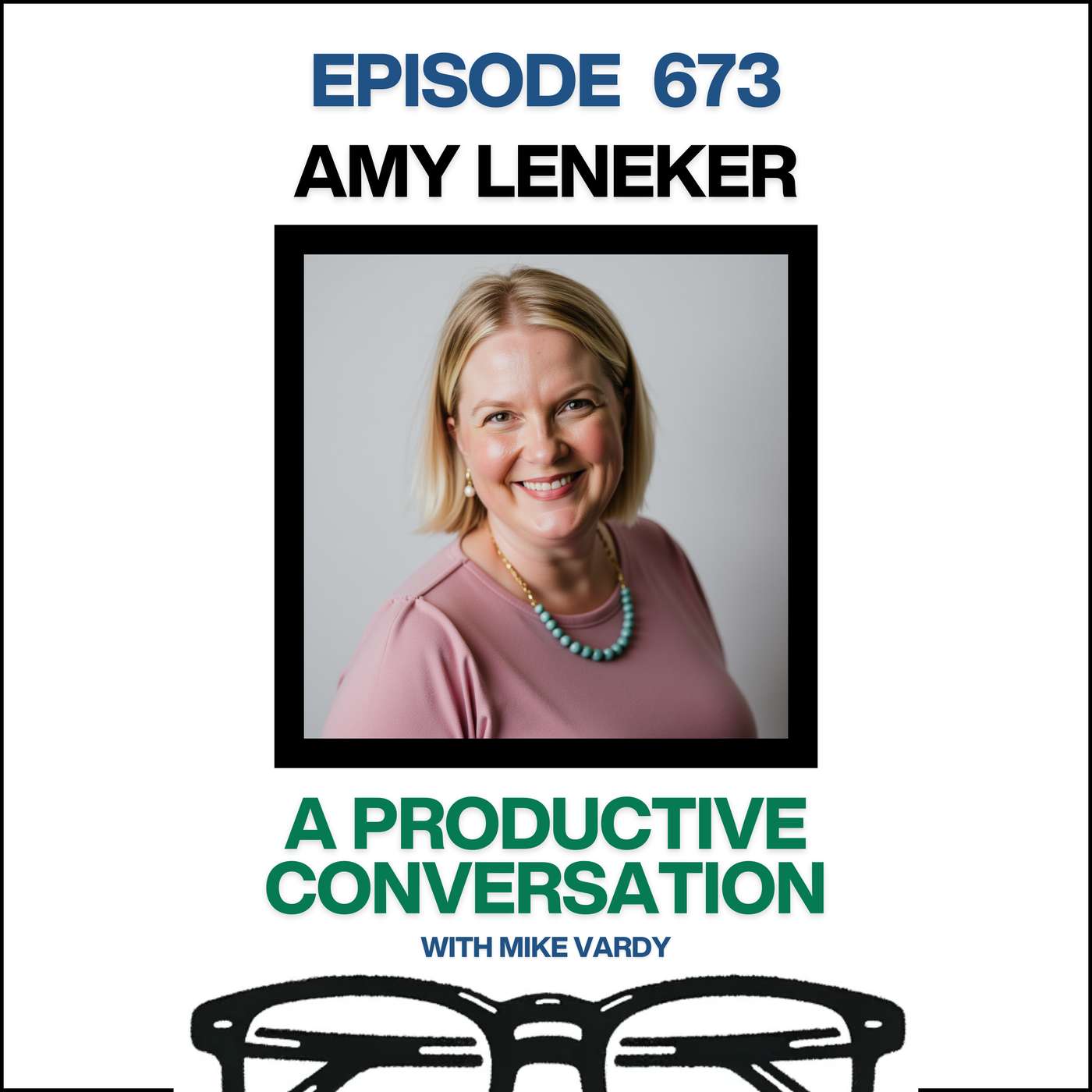 The Five Kinds of Work Stress (with Amy Leneker) 02.09.2026 32นาทีMost people describe work stress as one undifferentiated thing: I'm stressed at work. Amy Leneker's research says there are actually five distinct kinds, and the one doing the most damage to working people isn't the one that shows up most often. It's the sudden kind — the unexpected thing that yanks you off whatever you'd planned to do — and it has a nasty habit of multiplying into all the others.Amy is the author of Cheers to Monday: The Surprisingly Simple Method to Lead and Live with Less Stress and More Joy, and her book is built around a sequence — see, sort, solve, and then celebrate — that has to be done in that order, though almost nobody does. We got into why writing a stressor down doesn't make it bigger, why "just forget about it, it's not important" is terrible advice your brain physically can't follow, the research on how you ask for help mattering far more than who you ask, and why the shortest section of the book might be the one people skip most.Six Discussion PointsA ten-word question — what are your hobbies, what do you do for fun — can expose how completely you've lost track of yourself, which is exactly how Amy's own unraveling started.There are five distinct types of work stress: schedule, suspense, social, sudden, and system — and sorting your stressors into the right one is what makes them solvable rather than just heavy.Sudden stress does the most damage despite occurring least often, largely because it snowballs — one person's missed deadline instantly becomes another person's social stress.Writing a stressor down doesn't make it more real or bigger than it is; those stressors are already running in the background like open browser tabs whether you name them or not.Telling yourself something unimportant isn't worth thinking about doesn't work — your brain hates open loops, and simple acknowledgment is what actually lets it move on.New research shows that how you ask for help determines whether it builds trust or damages it — framing it as learning and problem-solving reads as credible, while framing it as handing off your problem does the opposite.Three Connection PointsCheers to Monday by Amy LenekerFind Amy and her work at amyleneker.comStop Managing Your Time, Start Crafting Your Time InsteadThe average person works roughly 2,109 Mondays in a lifetime. Deciding in advance that you're going to dislike all of them is a big thing to sign up for without thinking about it. If this conversation gets you to sort even one stressor into the right category this week, that's a start — and the book will take you the rest of the way.
 -
 Why a Retreat Is Part of the Work, Not a Reward for It 26.08.2026 27นาทีWe treat retreats as something you earn — a reward that shows up once you've worked hard enough, long enough. I don't think that's right, and I think it's the exact reason most people never actually take one. A retreat isn't a break from the work. It's part of it.I had just wrapped a multi-day virtual retreat inside our TimeCrafting Trust community and was about to head into another one at a conference, so I was sitting right in the middle of two different kinds of retreat as I recorded this. That felt like the right moment to break down what a retreat actually is, the two forms it can take, and the five most common ways people sabotage their own attempt at one.Six Discussion PointsTreating a retreat as a reward for hard work puts it at the end of effort, contingent on having "done enough" — which means most people never feel like they qualify for one.The military root of "retreat" isn't surrender, it's a strategic withdrawal to regroup and reassess before moving forward again.There are two forms of retreat — retreat as place (the getaway, the conference, the cabin) and retreat as practice (a daily or weekly stepping back) — and the practice is what makes the place valuable, not the reverse.A retreat is not the same as rest; the deepest retreats can be genuinely challenging and often leave you needing an actual break afterward.Most retreats fail not in the stepping back, but in the reentry — without a plan to carry intentions forward, a retreat becomes a pause instead of a strategic reset.A retreat requires a balance of both time and space: too much space with too little time invites rushing, and too much time with too little space invites drift and procrastination.Three Connection PointsGet the free Retreat MapJoin Time Crafting TrustStop Managing Your Time, Start Crafting Your Time InsteadA retreat doesn't require a flight, a mountain, or a week away from your life. It requires a boundary and an intention — and permission you give yourself instead of waiting for. If you take nothing else from this episode, take this: the practice is what makes the place richer. Not the other way around.
 -
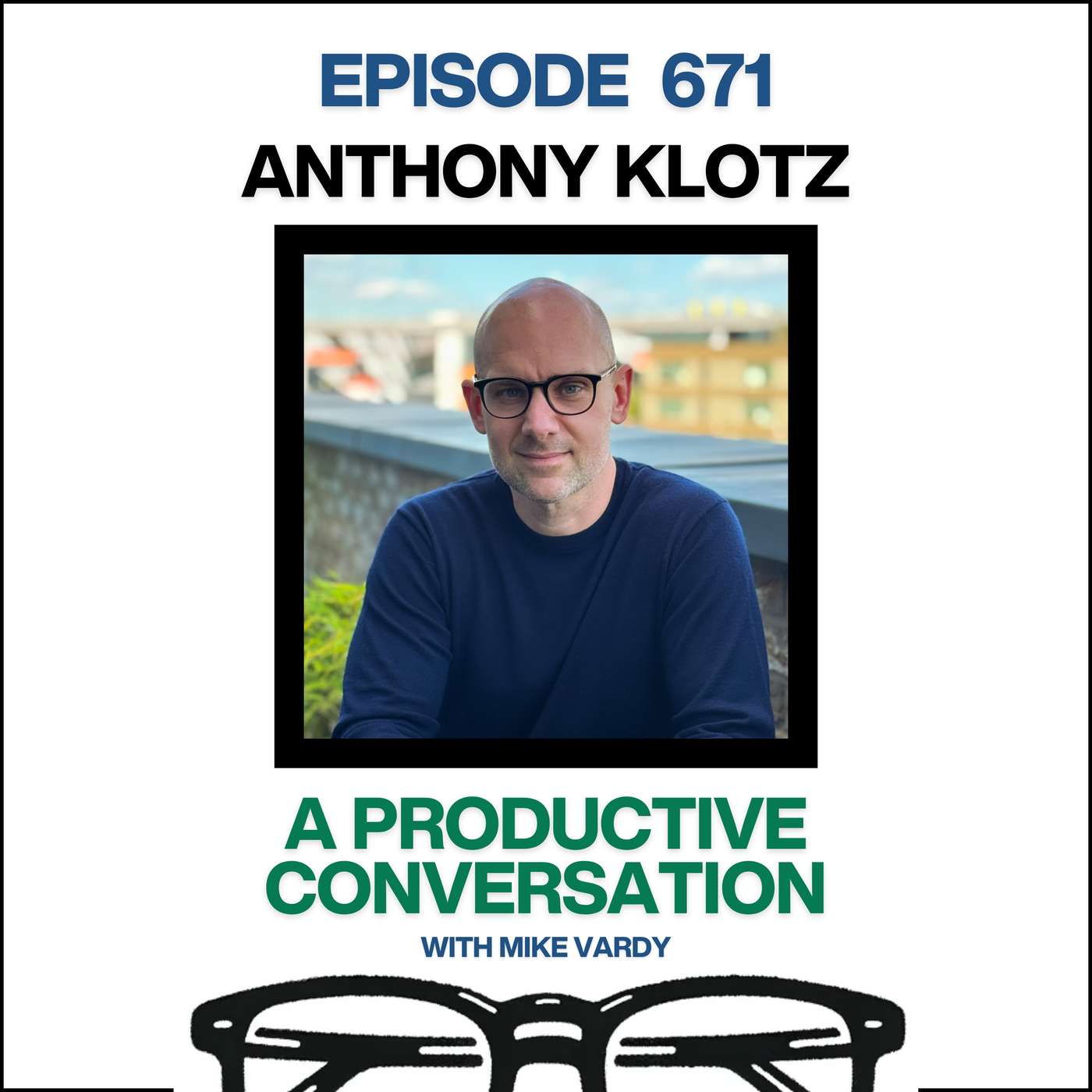 The Jolts That Make Us Quit — and the Ones Worth Ignoring (with Anthony Klotz) 19.08.2026 44นาทีMost of us don't drift into quitting a job. Something happens — a single, identifiable moment — and that's when the relationship with our work actually changes. Anthony Klotz calls these moments "jolts," and once you have the word for it, you start seeing them everywhere: in your own career, in the people around you, in decisions you made years ago that you never quite had language for until now.Anthony is the organizational psychologist who coined the term "the Great Resignation," and his new book, Jolted: Why We Quit, When to Stay, and Why It Matters, is the deepest treatment I've read of why people actually leave jobs — and just as importantly, why they sometimes shouldn't. We got into direct jolts versus honeymoon jolts, why positive jolts are rarer and more powerful than negative ones, the "power surge" that hits right before someone quits, and why silence is usually the smartest exit strategy. I shared my own Costco story along the way — a demotion that turned out to be one of the clearest jolts of my working life.Six Discussion PointsA "jolt" is a single identifiable event that knocks you out of autopilot with your work — almost half of all quitting decisions trace back to one, rather than a slow, logical decline.The instinct after a jolt is to react immediately; the better move is almost always to reflect first, because doing nothing right away is often the strongest default option.Positive jolts exist but are rarer and less discussed than negative ones — our brains are wired to dwell longer on the bad, even though a compliment or a big win can just as easily be the moment that changes everything.The "honeymoon hangover effect" explains why job-change regret is so common: we see all the flaws in our current role and only the upside of the next one, until the new role reveals its own brown spots."Leaning back" — quietly renegotiating your extra, unpaid job tasks — is an underused alternative to quitting that doesn't require dramatic action or public declaration.The "power surge" that hits right before someone resigns is real, and the discipline to sit with it quietly is usually worth more than any parting message ever could be.Three Connection PointsJolted: Why We Quit, When to Stay, and Why It MattersConnect with Anthony on LinkedInStop Managing Your Time, Start Crafting Your Time InsteadIf you're sitting in a job right now wondering whether what you're feeling is a real signal or just a bad week, this conversation is worth the full listen. And if you take one thing from it: remember what Anthony's colleague Kim Scott says — don't forget to quit. Not as a threat, but as a reminder that it's always been an option on the table.
 -
 The Difference Between an Aha Moment and a Full-Blown Epiphany (PM Talks S3E8) 12.08.2026 44นาทีThis month's PM Talks starts with a confession: I've had an epiphany, and I don't use that word lightly. Somewhere between an "aha, I get it now" moment and what I can only describe as a holy moment is a distinction most of us never bother making — and once you start looking for the difference, you start noticing which of your own realizations actually deserved the weight you gave them.Patrick Rhone and I use this month's conversation to pull that distinction apart: the difference between a dawning recognition and a genuine unlocking, why holding an idea loosely lets it unfold instead of unravel, and how something as small as what his daughter calls a credit card turned into a real look at the nature-versus-nurture question neither of us can fully answer. I don't give away the specifics of the epiphany I'm sitting with this month — some things need more than one episode to explain — but the shape of it, and what to do with a moment like that once it arrives, is exactly what we get into.Six Discussion PointsAn "aha moment" is a small recognition — oh, I get it now — while a full epiphany carries a much heavier, more disorienting weight; treating every insight as the second kind burns you out.Real epiphanies tend to arrive with equal parts fear and fascination — the discomfort isn't a sign to back away, it's part of what makes the moment significant.Holding an idea loosely gives it room to unfold; gripping it tightly is what causes it to unravel instead — the difference between disassembling something on purpose and watching it fall apart.Genetic or predisposition information (like a cholesterol test result) doesn't eliminate the value of lifestyle choice — it just narrows the range you're actually choosing within.Big epiphanies rarely land once and disappear; they tend to keep resurfacing for days or weeks afterward, the way aftershocks follow an earthquake.The right response to a major realization is often reflection, not immediate action — sitting with it, journaling about it, letting it keep unfolding before trying to "do" anything with it.Three Connection PointsRead more from Patrick RhoneCatch up on past issues of The Lantern (and more)ProductivenessI'm not going to tell you what the epiphany was — not yet, anyway. What I will say is that if something's been quietly resurfacing in your own life for years without your noticing why, it might be worth sitting with it instead of trying to explain it away. Some things take six years to make sense. Give yours the same patience.
 -
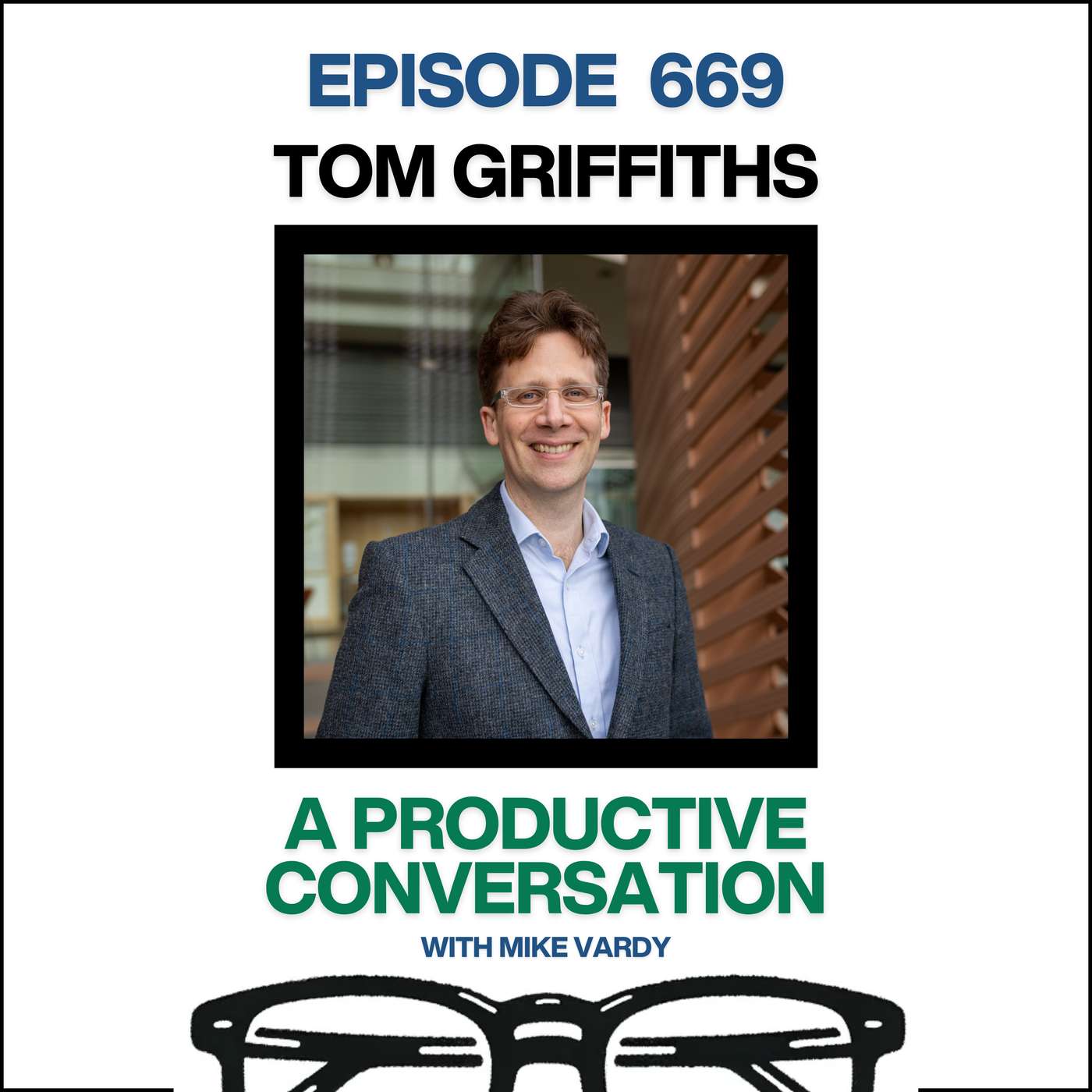 Why Logic Alone Can't Explain the Human Mind (with Tom Griffiths) 05.08.2026 38นาทีLogic is beautiful and it's also almost never enough. That's the tension running through this entire conversation — the idea that we want our decisions to be purely logical because it's simple and concrete, but almost no real situation in a human life actually has the structure logic requires. I've believed for a long time that reason lives somewhere in the nuanced middle between logic and emotion, and I wanted to sit down with someone who's spent a career studying exactly that boundary.Tom Griffiths is a Princeton professor and the author of the new book The Laws of Thought: The Quest for a Mathematical Theory of the Mind. If you know his earlier book, Algorithms to Live By, this one is the foundation underneath it — the deeper, denser history of how mathematics has tried, and often failed, to fully capture how minds work. We covered logic's limits, David Hume's riddle about induction, why AI systems fail in strange and "jagged" ways humans don't, and how a 200-year-old idea from George Boole ended up, several generations later, inside modern neural networks through his own great-great-grandson.Six Discussion PointsLogic only works when you already have all the information you need and the conclusion is certain — which describes almost none of the decisions we actually make as humans.Amos Tversky's early work on similarity (a horse is more "like" a camel than a camel is "like" a horse) laid the groundwork for the heuristics-and-biases research he later did with Daniel Kahneman."Productivity," in the cognitive science sense, means a system's ability to generate something genuinely new — which is closer to creativity than to output.David Hume's riddle of induction shows we can't logically justify assuming the future will resemble the past — we simply have a habit of expecting it to.AI systems demonstrate "jagged intelligence": strong on one problem, mysteriously weak on the problem right next to it, because they arrive at solutions through a completely different process than human brains do.Reading old, "outdated" books remains valuable specifically because they capture the right questions — not just today's most efficient answers.Three Connection PointsThe Laws of Thought by Tom GriffithsAlgorithms to Live By by Tom Griffiths and Brian ChristianStop Managing Your Time, Start Crafting Your Time InsteadIf there's one thing to sit with after this conversation, it's that fuzziness isn't a flaw in how we think — it's often the most accurate description available. Tom's book gives you the historical throughline for why that's true, and honestly, it's a book you want to take your time with, not tear through. Give it the same patience the ideas in it deserve.
 -
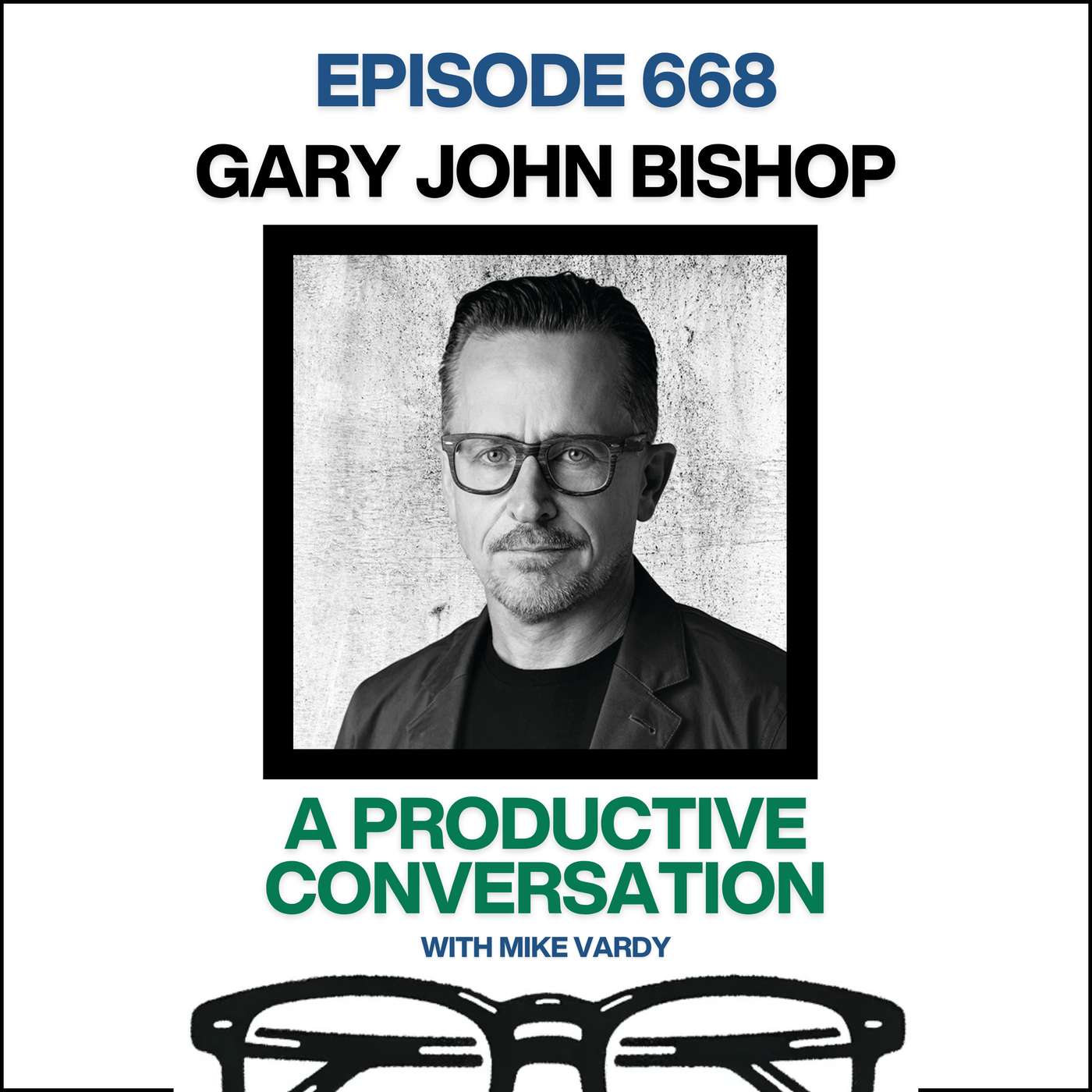 Why "Life Is" Might Be the Only Sentence You Need (with Gary John Bishop) 29.07.2026 38นาทีThere's a two-word sentence that's been sitting with me since I finished this book, and I haven't been able to shake it: life is. Not life is hard, not life is good, not life is anything — just life is. Gary John Bishop makes the case that the moment you add a descriptor to that sentence, you're not describing life anymore, you're arguing with it.Gary is the author of Unfuck Yourself and his newest book, Now What: You, Your Life, and the Truth You've Been Avoiding — a book I finished in one sitting and then immediately wanted to read again, which is about as strong an endorsement as I can give. We got into ontology, why "time management" is a phrase we cling to out of a need for false control, the difference between knowing something and knowing it "to the degree that it gets here," and yes, eventually, a fairly deep dive into vintage watches.Six Discussion Points"Life is" isn't an incomplete sentence waiting for a descriptor — the descriptor is where the struggle and noise get added back in.Language isn't something that happens after you feel or see something; you speak from a distinct place, and that place shapes what becomes possible for you."Time management" survives as a phrase because it offers the illusion of control over something — time itself — that was never actually manageable to begin with.Now isn't a moment in time; Gary frames it as a location — the one place where your memories, hopes, and worries are all actually happening.Real understanding isn't the same as having knowledge about something — you can know all about love, or now, or time, without it ever "landing" the way lived experience does.Setting concrete goals is fine, but postponing your sense of confidence, power, or satisfaction until you reach them is optional — those states are available to practice right now, not just after you arrive somewhere.Three Connection PointsNow What: You, Your Life, and the Truth You've Been Avoiding by Gary John BishopConnect with Gary at garyjohnbishop.com, or his new podcast, Truth and ConversationStop Managing Your Time, Start Crafting Your Time InsteadIf there's one exercise to take from this conversation, it's this: try sitting with the sentence "life is" and stopping right there. No descriptor, no judgment, no story attached. See how long you can hold it before your mind wants to finish the sentence for you. That's the whole book, honestly — and it's worth spending more than one sitting with.
 -
 The Goal Was Never Inbox Zero (It Was a Quiet Mind) 22.07.2026 22นาทีInbox zero was never about the number. That's the part almost everybody forgets. When Merlin Mann coined the term in the early 2000s, "zero" wasn't a count of unread messages — it was the amount of mental space your inbox occupied. Somewhere along the way, we turned a philosophy about protecting attention into a scoreboard, and the guilt machine that followed is the reason so many of us feel like we're failing at something that was never actually the goal.I want to walk you through where this idea went sideways, why even someone as rigorous as Cal Newport still aims at the same numeric target after correctly diagnosing the problem, and what I think the real goal should be instead. I'm calling it Inbox Today — not a number, a state. This one connects directly to the broader work I do around TimeCrafting and productiveness: the shift from chasing quantity to protecting quality of attention.Six Discussion PointsMerlin Mann's original "inbox zero" was never about the count in your inbox — it was about getting email out of your head.Cal Newport diagnoses the inbox problem correctly (it's a terrible place to store obligations) but still calls the win condition "empty," proving how deeply the numeric frame is baked in.Your inbox is a receiving dock, not a warehouse — it's meant to be passed through, not lived in.Batching email by context, instead of processing top-to-bottom in arrival order, protects you from the mental cost of constantly switching topics."Inbox Today" swaps a universal number everyone interprets the same way for a personal, situational sense of calm that's different for every person, every day.Doing one task that's actually yours before you open email at all tilts the entire day back in your favor — no app, no system, just a 10-minute head start.Three Connection PointsGet the FREE inbox tips matched to where you're at right now → mikevardy.com/emailStop Managing Your Time, Start Crafting It InsteadSubscribe to The Lantern for more on productivenessEmail isn't a solvable problem the way we've been taught to treat it — it's a relationship, and relationships need boundaries, not scoreboards. If today's conversation landed for you, the next step isn't a new app. It's deciding what "today" looks like for your inbox, not what "zero" does.
 -
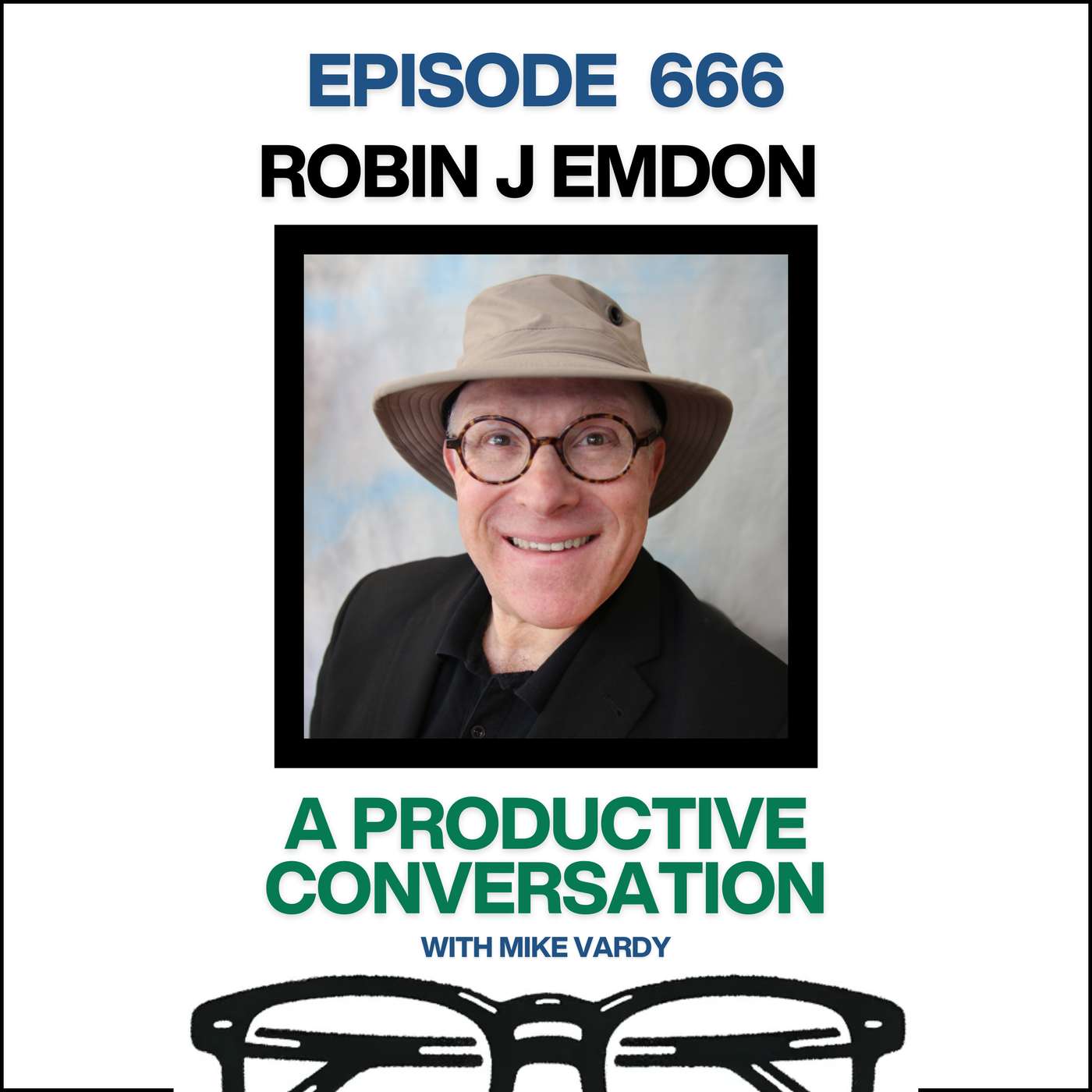 Why Procrastination Is Emotional, Not a Discipline Problem (with Robin J Emdon) 15.07.2026 52นาทีWe tend to treat procrastination like a willpower leak — something we could plug if we just tried harder, planned better, or bought the right system. Robin J Emdon makes the case that we've been aiming at the wrong target entirely. Procrastination isn't a discipline failure; it's an emotional one. It's a survival instinct doing exactly what it was built to do, which is why "try harder" so rarely works and why the cupboard full of abandoned planners keeps growing.Robin trained as a life coach with Tony Robbins back in 2001, raised two sons on his own, and then had a coffee-shop epiphany in 2019 that sent him through more than 900 studies on procrastination. The result is his book, Get Resultsology: The Science of Getting Stuff Done — an arts-and-humanities translation of the science into plain English. Our conversation moves from why we stall, to why goals can quietly make it worse, to the one thing that actually pulls us forward: a clear sense of who we're becoming.Six Discussion PointsProcrastination is a survival instinct, not a character flaw — it runs on threat and reward, and the thing you avoid usually feels worse than the thing you escape into.Order matters more than effort: understanding has to come before strategy, and momentum has to be built before motivation inevitably runs dry.Goals can manufacture the very stalling they're meant to cure, because a goal creates obligation, and obligation creates stress.A personal life vision isn't a goal — it's identity, and it's what makes a small act like doing the dishes connect to a fifteen-year future."Productive" procrastination — the tidy garage, the cleared desk — is rationalization wearing a checkmark.There is no universal system; mastery is finding what fits your wiring and letting go of the borrowed habits that don't.Three Connection PointsRobin gives away the full, unabridged book as a free PDF hereFind Robin on LinkedIn (Robin J Emdon) — he replies to every message personally.If this episode has you wanting to slow down before you speed up, my TimeCrafting overview maps onto Robin's "understand first" ideaIf you've ever ended a day wondering where the hours went — busy the whole time, yet somehow off the thing that mattered — this conversation will land. Robin's reframe is freeing precisely because it stops asking you to white-knuckle your way to better habits and starts asking a quieter question: who are you trying to become, and is this moment moving you toward that person? Sit with that one. Then have a listen, and let it shape how you spend the next hour.
 -
 Within Tolerance (PM Talks S3E7) 08.07.2026 44นาทีPatrick Rhone joins me again for the latest installment of our monthly PM Talks series, and this month we landed on a word that does a lot more heavy lifting than most people realize: tolerance. We start where we always seem to start lately — wandering through names, nicknames, and the strange cadence of how people get called what they get called — before Patrick pulls us back on track and asks the only question that matters: how much tolerance does anyone have for two guys talking about etymology for an hour?From there it opens up. Tolerance isn't just the human, get-along-with-people meaning we all reach for first. It's also a range — the amount of variance you're willing to accept before something stops working. Patrick brings the language of circus rigging, I bring the darts scene from Ted Lasso that shows up in my book, and somewhere in between we end up at Costco, minimalism, graduation dress shopping, and why "enough" is really just tolerance wearing a different shirt.Six Discussion PointsThe two meanings of tolerance — the "getting along with people" sense and the engineering "range you'll accept" sense — and the surprising place where they overlapPatrick's world of circus rigging: static load versus dynamic load, and why the right tolerance depends entirely on the act being performedThe Ted Lasso darts lesson from Productiveness — why accuracy beats perfection, and what "be curious, not judgmental" really teaches usHow "enough" is a form of tolerance, told through Patrick's wife and the great graduation dress hunt — a static need that suddenly turned dynamicCostco, the ketchup aisle, and Toffler's idea of "overchoice" — how narrowing your options lowers decision fatigue and quietly sets your tolerance for youWhy real tolerance demands patience and grace, and why it lives in the reasoned middle rather than at the purely logical or purely emotional extremesThree Connection PointsMy recent conversation with former WWE executive George BarriosPatrick Rhone's home base for everything he's up toUpdates on my forthcoming book ProductivenessWe didn't set out to make tolerance this expansive, but that's the fun of these conversations — they go where they go, and the topic ends up proving its own point. If there's one thing I want you to sit with after this one, it's that tolerance isn't about getting things perfect. It's about knowing your range, respecting that other people's ranges look nothing like yours, and giving yourself a little grace in the gap. Patrick and I will be back next month — possibly to talk about nuance, possibly not, because the whole point of nuance is that we might not get there.
 -
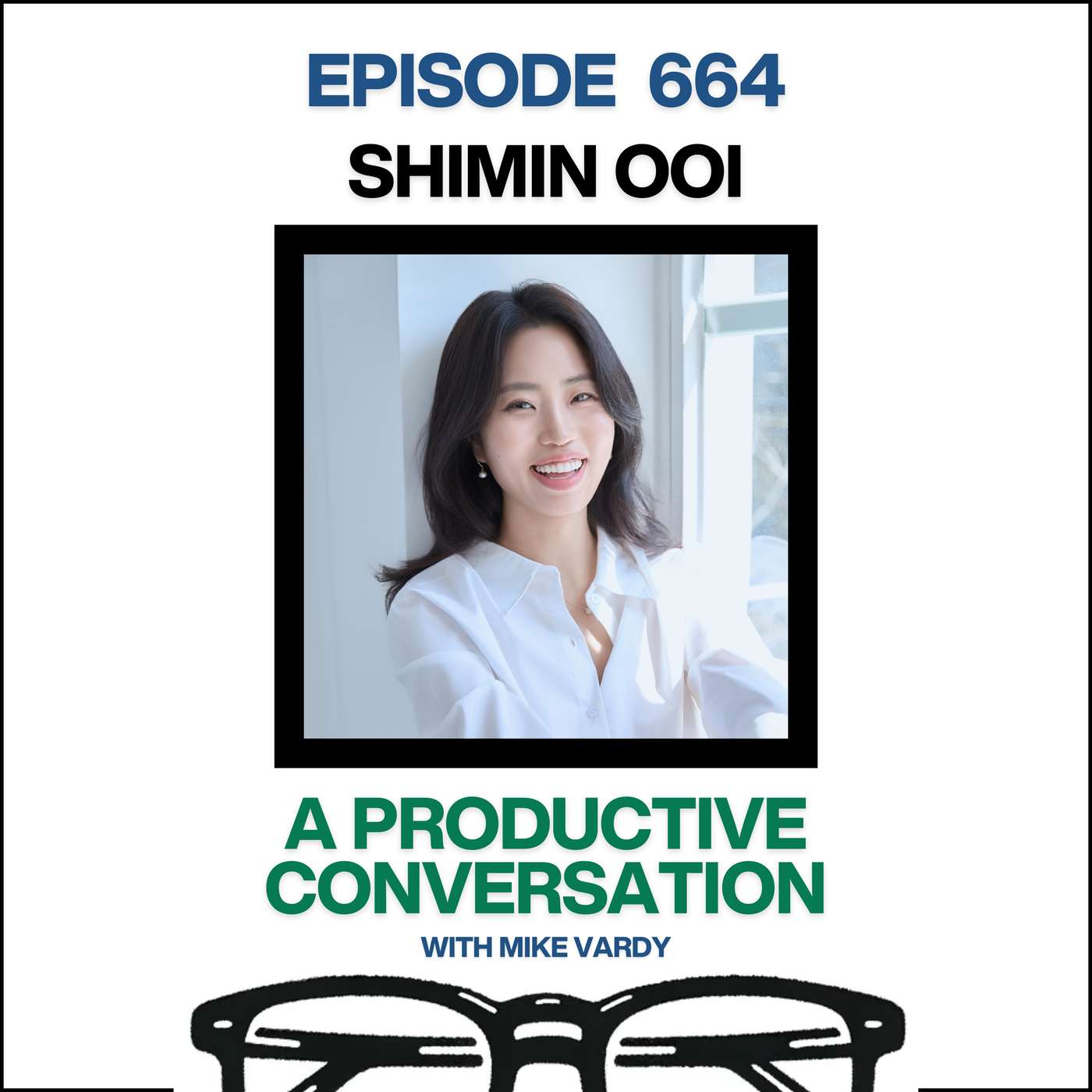 Why You Can't Outwork Bad Sleep (with Shimin Ooi) 01.07.2026 40นาทีWe tend to treat sleep like the thing we'll get to once everything else is handled — the line item we trim first when life speeds back up. But sleep isn't the reward for a productive day. It's the foundation that makes one possible. And one of the more uncomfortable truths about it is that you can't outwork it, out-exercise it, or optimize your way around it.My guest this week is Shimin Ooi, who leads Sleep Reset, a sleep clinic built around CBT-I — the gold-standard approach to insomnia. Shimin's interest in this isn't academic. She spent her childhood with undiagnosed pediatric sleep apnea, sleeping ten hours a night and still exhausted, until her late teens. Fixing it was, in her words, night and day, and that experience shapes how she helps people find genuinely restorative sleep. What surfaced again and again in our conversation is how often the effort to sleep is the very thing keeping us awake.Six Discussion PointsExercise can't stand in for sleep. They do biologically different jobs, and the brain maintenance, tissue repair, immune function, and metabolic regulation that happen while you sleep have no real substitute — a single rough night can knock down immune function dramatically.The pressure to sleep well is often what keeps you awake. Telling yourself "I have to sleep tonight" reads to your brain as a threat, raises cortisol, and makes rest harder. Giving yourself permission to sleep badly is paradoxically what lets it come.Your bed is teaching your brain a lesson. Every hour spent working or worrying under the covers trains your mind to treat that space as a place for alertness rather than rest, and over time that's how the association breaks.Sleep trackers can quietly become the problem. For an anxious sleeper, a "10-hour sleep deficit" reading can trigger the exact spiral that worsens sleep — the data isn't always on your side.CBT-I isn't trying to turn an owl into a lark. It addresses insomnia, not your chronotype. Fighting your natural wiring is a different and usually losing battle from fixing a genuine sleep problem.Naps are contextual, not categorical. A short, early nap can sharpen a well-rested person, but for someone already struggling at night it drains the sleep pressure they need to fall asleep later.Three Connection PointsSleep Reset — Shimin's sleep clinic and CBT-I programCasey Neistat's "Fat and Lazy" — the video I mentioned, where he talks about replacing sleep with exercise (a theory Shimin gently dismantles)Dr. Michael Breus on A Productive Conversation — for more on chronotypes and the "wolf" wiring I referencedIf you've ever lain awake running the math on how little sleep you're about to get, this conversation reframes the whole problem. The fix isn't more discipline or a smarter device — it's loosening your grip. Sleep, like so much of what we cover here, responds better to being allowed than to being forced. Give it a listen, and notice where you might be trying too hard at the one thing that asks you to stop trying.
 -
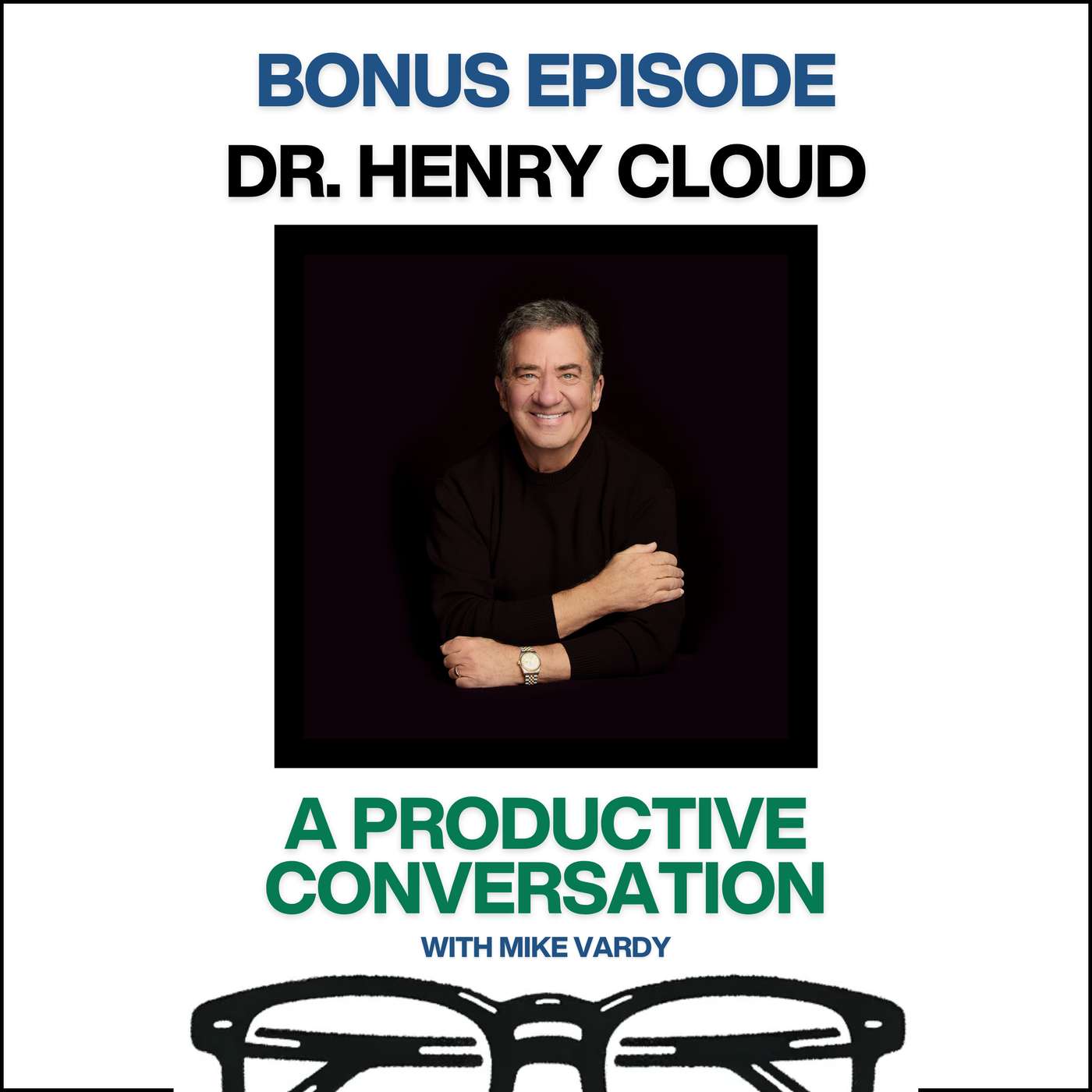 What You're Not Measuring Is Costing You (with Dr. Henry Cloud) 26.06.2026 49นาทีMost of us have convinced ourselves that the problem is effort. We're not working hard enough, moving fast enough, or checking enough boxes. But what if the real problem is that we're measuring the wrong things, pruning nothing, and assembling a team built entirely in our own image? That's where today's conversation starts — and it doesn't let up from there.Dr. Henry Cloud is a clinical psychologist, leadership consultant, and the author of more than twenty books, including the boundary-setting classic Boundaries and Necessary Endings. His latest work, Your Desired Future: The Five Essential Steps That Take You Where You Want to Go, uses the human body as a model for understanding how high performance actually works — not as a motivational metaphor, but as a biological and organizational framework for getting from where you are to where you want to be. I've been following Henry's work for years, and this conversation gave me a chance to go deeper into the framework, the principles, and a few surprises along the way.Six Discussion PointsPruning toward a vision, not away from problems — The best gardeners don't prune reactively. They prune toward a picture of what a champion rose looks like. The same discipline applies to your projects, your commitments, and your team: cutting the good so the best can have the resources it needs.The prefrontal cortex is your competitive advantage — Unlike Finley the Doberman, who does her job without once asking whether it gets her closer to where she wants to be next Thursday, humans can picture a future that doesn't exist yet. That capacity is the starting point for everything — and most people squander it by not taking it seriously.You can't build a high-performance path in your own image — We're naturally drawn to the two or three of Cloud's five components we're already good at, and we starve the others. The solution isn't to become well-rounded. It's to deliberately recruit the talent you don't have — whether that's paid consultants, an advisory board, or a friend who knows someone who knows what you don't.Measuring the goal is like looking at the scoreboard after the game — Accountability isn't a negative system; it's a navigation system. The pilot doesn't take off without knowing speed, altitude, and direction. You don't win by checking monthly revenue numbers. You win by identifying the specific activities that move the needle and measuring those, in the right cadence, before it's too late to course-correct.Triage is a strategy, not a crisis response — Emergency rooms don't treat everything with equal urgency. They categorize. The most important word in strategy, Cloud argues, is no — and triage is how you earn the right to say it clearly and without guilt.A problem left unattended becomes a pattern — and a pattern becomes identity — The concrete is still wet. Miss a workout once, fine. Miss it twice and the research shows the goalline shifts. Let a product launch slip and soon you're not the team that missed a launch; you're the team that misses launches. Fix and adapt quickly, or the mutation rewires the DNA.Three Connection PointsNecessary Endings by Dr. Henry Cloud — Referenced throughout the conversation, particularly in the context of pruning and strategy. The rose bush metaphor comes from this book, and it's worth reading alongside Your Desired Future: The Five Essential Steps That Take You Where You Want to Go.TimeCrafting: Stop Managing Your Time, Start Crafting It — Cloud's five-component model is ultimately about organizing energy toward a desired future — which is exactly what TimeCrafting is built around. If this conversation sparked something for you, this is the right next read.The Lantern — My Weekly Newsletter — Each week I write about the ideas that are shaping how I think about productive living. If this episode connected with you, the newsletter is where I go deeper between episodes.Henry's framework isn't about doing more. It's about pruning what isn't leading to the best, recruiting what you don't have, measuring what actually moves you forward, and fixing problems before they become who you are. That last one stays with me: a problem becomes a pattern, and a pattern becomes identity. The concrete is still wet. That's both a warning and an invitation. Take it seriously.
 -
 Paying Attention to Your Attention 24.06.2026 50นาทีMost of the conversation around focus starts in the wrong place. We talk about distraction as if it's the problem — the notifications, the open tabs, the interruptions — when distraction is really just a symptom. The actual problem is that most people don't know where they are in their own attention at any given moment. They're applying effort at the wrong level and wondering why it doesn't stick.That's what this episode is about. I've developed what I call the Spheres of Attention — a framework I first introduced in The Productivity Diet and have continued to refine through my work with the TimeCrafting Trust community. It's not a hack or a to-do list. It's a map that shows you the terrain of your own focus, from the outermost edge all the way to the bullseye. And once you understand how to read that map, everything changes — not because you work harder, but because you stop applying the wrong kind of effort at the wrong time.A quick note: This episode was recorded live on my YouTube channel, so you'll hear me respond to a few folks in the chat as we go. The thread holds up just fine as a listen, but if you ever want to join these live, that's where to find me.Six Discussion PointsDistraction is a symptom, not the root problem — the real issue is not knowing which sphere of attention you're currently in, which causes you to apply effort at the wrong levelThe four spheres — Noticing, Awareness, Focus, and Concentration — form a progression from passive signal-picking to full immersion, and each one has its own value and its own costScrolling is Noticing with the illusion of productivity attached to it: scanning without progressing creates a felt sense of engagement that isn't really thereAwareness is where procrastination builds its nest — you've recognized that something matters, but you haven't committed, so you hover in the filtering phase indefinitelyFocus is the first sphere that requires a conscious decision and carries real accountability: you can't say you're "on it" and stay in awareness — at some point, you have to moveConcentration is the most fragile sphere and the one most worth protecting — it takes significant time to reach and almost nothing to break, which is why your environment has to do a lot of the work before you even beginThree Connection PointsThe TimeCrafting Framework — The Spheres of Attention map directly onto TimeCrafting's structure of days, themes, and tasks. Understanding which sphere you're in helps you match the right work to the right time. Read more about TimeCraftingThe Lantern — If this episode resonated with you and you want to go deeper on ideas like this between episodes, my newsletter is where that thinking lives. Sign up for The Lantern at mikevardy.comIndistractable by Nir Eyal — Referenced in this episode as a foundational text on attention and distraction. Eyal's framing that attention is more commandable than time is a useful companion to the Spheres model. Get the book hereThe skill isn't getting to Concentration. The skill is knowing how to move through the spheres deliberately — and recognizing quickly when you've slipped back out. Because you will slip back out. Everyone does. The question is how fast you notice it happening, and what you do next. I hope this episode gives you a useful map for that. And if you want to keep exploring this territory, stick around — there's a lot more where this came from.
 -
 The Art of Pacing: Why Slowing Down Is a Long Game Strategy (with Elizabeth Svoboda) 19.06.2026 40นาทีWe spend a lot of time talking about how to do more. What we talk about far less — and what might matter far more — is the question of how to pace yourself while you do it. Not as a wellness concept or a vague self-care suggestion, but as a genuine strategy for sustaining quality, avoiding collapse, and staying aligned with what actually matters to you over time.Elizabeth Svoboda is the author of The Art of Pacing: A Guide to Balancing Shorter-Term Demands with Long-Term Thriving, and this conversation covers a lot of ground in the best possible way. Elizabeth is a science journalist whose work has appeared in the New York Times, Psychology Today, and many other publications. Her book grew out of a thirty-year reckoning with her own pacing failures — a culture of maximum output with no equivalent emphasis on what you leave to the side. What she built from that is something both research-grounded and deeply practical.Six Discussion PointsPacing without purpose is just slowing down — knowing where you're headed is what makes a deliberate pace possible at all, and this is where most productivity advice quietly falls apartThe difference between racing and pacing is a single letter, but the difference in outcomes compounds over years — top athletes understand this through tapering, and the rest of us are still catching upBurnout is not an event, it's a trajectory — heart rate variability (HRV) tracking and tools like the Maslach Burnout Inventory can help you see the train coming before it hits, shifting you from reactive to proactiveRigid, hyper-granular scheduling is brittle by design — adaptability and flexibility aren't the enemies of structure, they're the only way a structure survives contact with real life"Restorying" — the hero's journey applied inward — is a surprisingly useful alignment tool: when what you say you want doesn't match how you're spending your time, the story reveals itBrief candles, those short moments of focused, selfless attention toward others, can change the entire arc of someone's life and cost almost nothing in terms of time or energyThree Connection PointsElizabeth Svoboda's website: elizabethsvoboda.com — find her book The Art of Pacing and her broader journalism workTimeCrafting: The connection between pacing and intentional time use is at the heart of my own framework — if this episode resonated, you might find this useful: Stop Managing Your Time. Start Crafting It.The Lantern: My weekly newsletter is where I continue these kinds of conversations outside the podcast — join here at mikevardy.comPacing is not the opposite of progress. If this conversation shifted anything for you — even a small recognition that you might be racing when you could be pacing — I'd encourage you to sit with that for a bit before doing anything about it. That's the point. And if you want to go deeper, Elizabeth's book is worth the time.
 -
 The Principles You're Already Overlooking (with Heather Jo Kennedy) 17.06.2026 41นาทีMost productivity conversations start with systems, tools, and tactics. This one starts with something more fundamental: the quiet principles sitting right beneath the surface of your day that you've been walking past without noticing. Not because they're hidden — but because they're too simple to take seriously. That's what Heather Jo Kennedy's book For Starters is about, and it's why this conversation resonated with me in a way that felt less like an interview and more like a long overdue reminder.Heather Jo Kennedy is an author, speaker, and coach who grew up in the Dallas Cowboys organization — her father is quarterback Danny White — and that world of fundamentals, teamwork, and earned results is threaded through everything she teaches. Her book presents six core principles that she argues aren't just overlooked, they're statistically proven to change how you move through a day. We dig into all of them here, and the conversation went places I didn't expect.Six Discussion PointsGratitude isn't soft — it's structural. Heather shares the Duke University "Three Good Things" study, which found that a simple nightly practice of noting three positives can outperform antidepressants within two weeks. The real insight: gratitude is principle number one not because it's inspirational, but because it grounds everything else.Identity is the bedrock of productive impact. You can't make the difference you're meant to make if you don't know who you are. Growing up as a celebrity daughter, Heather watched identity get shaped by outside perception — and spent years reclaiming her own. That experience is at the heart of how she teaches this principle.Productivity is the means, not the end. Heather's definition — recognizing your unique purpose and acting on it — cuts against the idea that productivity is about maximizing output. We explored how that framing shift changes what you actually do with your time and energy.Frustration is a control signal, not just a mood. In the action chapter, Heather breaks frustration down to its root: you're either trying to control something you can't, or you're letting something control you when it shouldn't. Recognizing which one is happening is the first step to acting rather than reacting.Giving is the destination, not a detour. The Picasso line — "the meaning of life is to find your gift; the purpose of life is to give it away" — becomes a genuine lens here. We talked about what happens when you run every decision through the filter of am I adding value, and what that would do to the quality of everything we put into the world.Finishing requires humility, not just grit. The principle that landed hardest: sometimes quitting is a form of finishing. Clarity about whether a goal is wrong for you can't always come before you start — it often comes from the movement itself. Don't quit because it's hard. But quit when it's wrong.Three Connection PointsFor Starters by Heather Jo Kennedy — the book we discussed throughout this episode, and the best starting point for her workTimeCrafting: Stop Managing Your Time, Start Crafting It — my take on why "time management" is a broken concept, and how crafting your time changes the whole relationshipThe Lantern — my weekly newsletter — where I continue exploring these kinds of foundational ideas between episodesThe idea of overlooked principles is a quiet indictment of the way most of us approach getting things done. We reach for the system, the app, the strategy — and skip right over gratitude, identity, and the question of whether we're actually controlling what we think we're controlling. Heather's framework is a reset button disguised as a short book. If any of the six principles we discussed pulled your attention, that's probably where to start. Until next time, remember: stop doing productive, start being productive. See you later.
 -
 Letting Go of "Normal" to Finally Try Again (with Steve Kamb) 12.06.2026 42นาทีThere's a loop most of us know well, even if we've never named it: feel behind, find the thing that's going to fix everything, go all in for a few weeks, get derailed by life, and start over — carrying a little more shame each time. It doesn't matter whether we're talking about fitness, productivity, or building a business. The pattern is the same, and so is the trap. We keep waiting for things to get back to normal so we can try again properly. But what if that version of normal isn't coming back?Steve Kamb is the founder of Nerd Fitness, which has grown over 17 years into a platform that has coached more than 20,000 people one-on-one. His new book, How to Try Again, grew out of that work — specifically from the most universal problem he kept encountering across thousands of conversations: the all-or-nothing mindset. Steve built a four-part framework called PACT — Pause, Accept, Change, Try — to help people break the doom loop and stop waiting for ideal conditions that never arrive.Six Discussion PointsThe pause is the hardest part of PACT not because it requires effort, but because it requires restraint — and our productivity culture has no patience for it. Slowing down feels like falling behind, when it's often the only way to figure out if you're even moving in the right direction."Normal" is not a destination you return to — it's whatever your actual days look like right now, including the chaos, the interruptions, and the laundry on the floor. Waiting for a predictable routine to materialize before you start is a way of never starting.Before you commit to a goal, ask the question most people skip: What if this works? If success means you have to keep doing the thing you hate, you've picked the wrong goal. The reward for getting good at Instagram is that you have to keep doing Instagram.Treating your next attempt like a non-judgmental experiment — part scientist, part detective — removes the weight of outcome and replaces it with curiosity. You're not measuring whether you become the person you admired; you're measuring what you learned about yourself.The doom loop compounds. Every incomplete attempt doesn't just reset the clock; it adds guilt and shame to the pile you're already carrying. Recognizing the loop is the first step to using one of the escape pods Steve calls "half-assing it" — doing the most of the thing you can do today, rather than the ideal version of it.Steve effectively fired himself as CEO of his own company to get back to the work he actually loved — writing. The book that resulted is his most personal project, and it came from applying PACT to his own life: pausing, accepting who he really is, changing his role, and trying again on his own terms.Three Connection PointsHow to Try Again by Steve Kamb — howtotryagain.comNerd Fitness — Steve's 17-year-old community and platform: nerdfitness.comStop Managing Your Time, Start Crafting It — My piece on the TimeCrafting approach, which shares a lot of philosophical ground with Steve's ideas about working within your actual constraints rather than imagined ones: Read it on MediumThe conversation Steve and I had goes back sixteen years, and there's something fitting about the fact that both of us have spent that time learning — the hard way, repeatedly — that the frameworks and tools only work when they're built around the life you're actually living. PACT isn't a productivity system. It's permission to be human and then do something about it. If you've been waiting for the right moment to try again, this might be the episode that helps you stop waiting.
 -
 The Wisdom in Waiting: Rediscovering Prudence (PM Talks S3E6) 10.06.2026 53นาทีThis episode marks the latest installment in PM Talks, the monthly series I do with my longtime collaborator Patrick Rhone. We've been doing this for a few years now — closing in on three seasons — and what I love most about these conversations is that they're genuinely reflective. We're not coming in with a polished take. We're working through ideas in real time, and that's exactly what makes them worthwhile.This time around, Patrick and I dove into a word that doesn't get nearly enough airtime in 2026: prudence. It's one of those terms that has been moralized, gendered, and generally squeezed out of everyday conversation. But it's also one of the nine principles in my upcoming book Productiveness, and the more I unpack it, the more convinced I am that it's something we're all practicing quietly — even when we don't call it by name.Six Discussion PointsPrudence traces back to the mid-14th century as a concept tied to intelligence, foresight, and practical wisdom — and it sits alongside justice, fortitude, and temperance as one of the four classical cardinal virtues. That's a lot of weight for a word most people associate with Dana Carvey doing George H.W. Bush.The word has faded from everyday use for a few reasons: it got moralized through its religious and philosophical associations, it became a common woman's name that then fell out of fashion, and perhaps most crucially, it got sidelined by a speed culture that has no patience for anything that feels unhurried.Prudence lives in interesting territory between "too soft" words like intentional and "too hard" words like strategic or tactical. It carries a moral dimension that neither of those fully captures, which is part of why it's so hard to replace and so easy to overlook.The connection between prudence and AI turned into one of the richest threads we pulled on. Patrick made the point that AI is fundamentally not prudent — it doesn't tolerate known unknowns well, and tends to hallucinate its way toward confident-sounding answers even on questions that science genuinely hasn't resolved (yawning being a particularly delightful example). Applying AI prudently means knowing where human judgment still has to lead.Evening routines and morning preparation came up as lived examples of prudence in action — laying out clothes the night before, prepping dinner before your brain is fully engaged, checking in with a collaborator ahead of a scheduled call. Prudence often shows up in the small, low-glamour decisions we make before we even know we'll need them.Patrick, who does circus rigging work, offered a line that I think is the most compressed definition of prudence I've heard: "Slow is smooth and smooth is fast." When you're under time pressure — two minutes to set up a flying net — the prudent approach isn't to rush. It's to move deliberately, know the order of operations, and trust that the method will get you there faster than panic will.Three Connection PointsPatrick Rhone's blog post: Thoughts on AI and the Known UnknownsRyan Holiday's video responding to Ivanka Trump's comments on stoicismMike's upcoming book Productiveness, where prudence is one of the nine core principlesPatrick and I will be back next month for PM Talks S3E7, where we're taking on a word with a lot of range: tolerance. It means something very specific in rigging and something very different in everyday conversation, and I suspect we'll cover a fair bit of ground on both fronts. In the meantime, I hope this episode gives you an excuse to bring "prudence" back into your vocabulary — and more importantly, to notice the places where you're already living it.
พอดแคสต์ที่คล้ายกัน


ยอดนิยมใน
พอดแคสต์นี้ปรากฏในชาร์ตพอดแคสต์ของประเทศเหล่านี้ด้วย
