
SLOW ENGLISH POCAST | YOUR ENGLISH TOOLBOX | Learn by Listening and Speaking
YOUR ENGLISH TOOLBOX
0
This podcast is designed for English language learners, using slow, natural pronunciation and carefully chosen vocabulary. Episodes are narrated with advanced AI voice technology for clarity and consistency. The content covers a wide range of topics including exam preparation, business English, and fluency training. It aims to help learners improve listening and speaking skills through deep, focused practice.
ตอน
-
 10 Habits of People Who Live to 100 | Part 2: Your Mind 27.09.2026 15นาทีhttps://yourenglishtoolbox.com/episodes/150-10-habits-of-people-who-live-to-100-part-2-your-mind/This podcast is created through a human-led editorial process. Every episode concept, educational strategy, narrative direction and final editorial decision is developed and reviewed by people committed to making English learning meaningful. Artificial intelligence supports script development and editing, while ElevenLabs provides the synthetic voices of our hosts. Human judgement leads the process; technology supports its production.Learn with this episode on Your English Toolbox: listen and read without registering, or use a free student account to access the downloadable transcripts, vocabulary PDFs, flashcards and progress tools.Martin followed all five body habits from the previous episode: stairs, shopping bags, lentils and the same bedtime every night. It was a perfect week. Then, standing in the kitchen and feeling extremely healthy, a voice in his head asked: and all of this is for what, exactly?That question is habit number six.This is the second half of the bonus conversation that closes How to Live a Good Life: five habits connected with purpose, rest, learning, belonging and the people who matter. It is a warm, evidence-aware Slow English conversation about building a fuller life, not a promise that any habit can guarantee longevity.You will meet Dorothy, 88, from Bristol: choir on Tuesdays, stories at the library on Thursdays, her 91-year-old sister on Sundays, Italian class on Mondays — she started at 84 and says she is terrible — and one quiet hour in the garden every afternoon. Asked for her secret, she says: “I have things on Tuesdays.”What you will learn today:Why “What is my purpose?” may be too large a question, and the smaller question that can help.How to distinguish real rest from sitting down while absorbing somebody else’s stress.What cognitive reserve means, why challenging learning matters and what the evidence can — and cannot yet — say about learning a language later in life.Why belonging to something with a calendar can be more reliable than waiting to feel sociable.Three natural English sentences for purpose, learning and belonging, practised with pauses.English in context includes: a reason to get up, to look forward to something, to downshift, to unload stress, cognitive reserve, to take up something, to belong, to turn up and a ritual.Practice sentences:What are you looking forward to this week?I have taken up something new. I am terrible at it.Same time next week?Sentence of the day: A long life is not the goal. A full one is.All six conversations in How to Live a Good Life stand on their own. Start wherever you like, or listen to the complete series in order on Your English Toolbox.This episode provides general information, not medical advice. Evidence about healthy ageing describes population patterns and cannot predict an individual life. Every body and every situation is different; for anything that concerns you, speak to your doctor or another qualified health professional.💬 We’d love to hear from you!If you enjoyed this episode, leave a comment, share your thoughts, or tell us how you’re using these tips to improve your English. Your feedback helps us grow and create even better content for you. Hosted on Acast. See acast.com/privacy for more information.
 -
 Short Stories with Peter: The Necklace by Guy de Maupassant (Abridged B1–B2 Level) 26.09.2026 9นาทีhttps://yourenglishtoolbox.com/episodes/148-short-stories-with-peter-the-necklace-by-guy-de-maupassant/This podcast is created through a human-led editorial process. Every episode concept, educational strategy, narrative direction and final editorial decision is developed and reviewed by people committed to making English learning meaningful. Artificial intelligence supports script development and editing, while ElevenLabs provides the synthetic voices of our hosts. Human judgement leads the process; technology supports its production.Learn with this episode on Your English Toolbox: follow the complete transcript, choose a translation in several languages, and explore the vocabulary guide with clear definitions, nuances and examples.How much can one evening of elegance really cost?Mathilde Loisel dreams of beautiful rooms, fine clothes and a life filled with admiration.When her husband obtains an invitation to an important party, Mathilde borrows a magnificent diamond necklace from her wealthy friend Jeanne.For a few perfect hours, Mathilde becomes the woman she has always imagined herself to be.Then she returns home and discovers that the necklace has disappeared.In this new English abridgement of Guy de Maupassant’s classic 1884 story, Peter guides you through a tale of appearance, pride, debt and one decision with consequences that last for years.After the story, Peter explores four useful expressions:look the part — have the appearance expected in a particular situation;beyond your means — more expensive than you can reasonably afford;pay off a debt — finish returning all the money you owe;take something at face value — accept an appearance without questioning the truth behind it.You will also learn how the third conditional helps us imagine a different result in the past: “If Mathilde had told the truth, she would not have lost ten years of her life.”This is a slow, atmospheric listening experience for B1–B2 learners who want richer narrative English, distinct character voices and a classic ending that changes the meaning of everything before it.The Necklace — a new English abridgement of La Parure by Guy de Maupassant (1884). Originally written in French and adapted for B1–B2 English learners by Your English Toolbox. This is not a reproduction of a modern English translation. The original work is in the public domain in Spain.Content note: financial hardship, class inequality and prolonged poverty.Level: B1–B2 · Focus: listening comprehension · appearance and social pressure · money and debt · third conditional · classic literature abridged for English learnersKeywords: English short stories, learn English with stories, The Necklace Guy de Maupassant, La Parure, B1 B2 English listening, twist ending story, English vocabulary in context, third conditional, classic literature adapted, slow English podcast, Your English Toolbox#ShortStoriesWithPeter #LearnEnglishWithStories #B1B2English #EnglishListening #TheNecklace #ClassicLiterature #YourEnglishToolbox💬 We’d love to hear from you!If you enjoyed this episode, leave a comment, share your thoughts, or tell us how you’re using these tips to improve your English. Your feedback helps us grow and create even better content for you. Hosted on Acast. See acast.com/privacy for more information.
 -
 Weekly English Recap: 21 Shadowing Pairs 26.09.2026 9นาทีhttps://yourenglishtoolbox.com/episodes/149-weekly-english-recap-21-shadowing-pairs/This podcast is created through a human-led editorial process. Every episode concept, educational strategy, narrative direction and final editorial decision is developed and reviewed by people committed to making English learning meaningful. Artificial intelligence supports script development and editing, while ElevenLabs provides the synthetic voices of our hosts. Human judgement leads the process; technology supports its production.Learn with this episode on Your English Toolbox: follow every pair on the transcript, review all twenty-one items and choose from seven listening speeds for a gentler or more challenging shadowing workout.Can you understand an expression, repeat it naturally and recognise the same idea in different words? In this weekly recap, Peter turns this week’s three short episodes into one focused vocabulary and shadowing workout.The two-sentence game is simple:Peter says a short, natural sentence containing one target expression.You get three seconds of silence to shadow it aloud and copy the pronunciation, rhythm and stress.Peter gives you a second sentence with the same meaning but different vocabulary, so you can confirm the meaning without translating.You will review all twenty-one learning items from this week:Decision idioms:on the fence;sleep on it;go with your gut;take the plunge.Better ways to describe and explain interesting things:fascinating;thought-provoking;engaging;hold your attention;encourage involvement;stay in your mind;reconsider an idea;strongly attract your curiosity.Natural ways to end a conversation from the audio lesson:I should let you go;I’d better get going;Let’s catch up soon;It was good talking to you.Extra closing expressions from the web lesson:I won’t keep you;I should get back to it;Let’s do this again soon;Take care;I’ll be in touch.Listen once for meaning. Then play the episode again and begin repeating as soon as Peter speaks, using the three-second silence to finish each sentence. The alternative sentence that follows gives you immediate feedback and strengthens active recall.Level: B1–B2 · Focus: weekly vocabulary review · shadowing · retrieval practice · paraphrasing · pronunciation and fluencyKeywords: English shadowing practice, weekly English recap, English vocabulary review, decision idioms, ways to say interesting, end a conversation in English, paraphrasing practice, retrieval practice, improve English fluency, slow English podcast, Your English Toolbox#EnglishShadowing #VocabularyReview #EnglishIdioms #EverydayEnglish #SpeakEnglish #SlowEnglishPodcast #LearnEnglish #YourEnglishToolbox💬 We’d love to hear from you!If you enjoyed this episode, leave a comment, share your thoughts, or tell us how you’re using these tips to improve your English. Your feedback helps us grow and create even better content for you. Hosted on Acast. See acast.com/privacy for more information.
 -
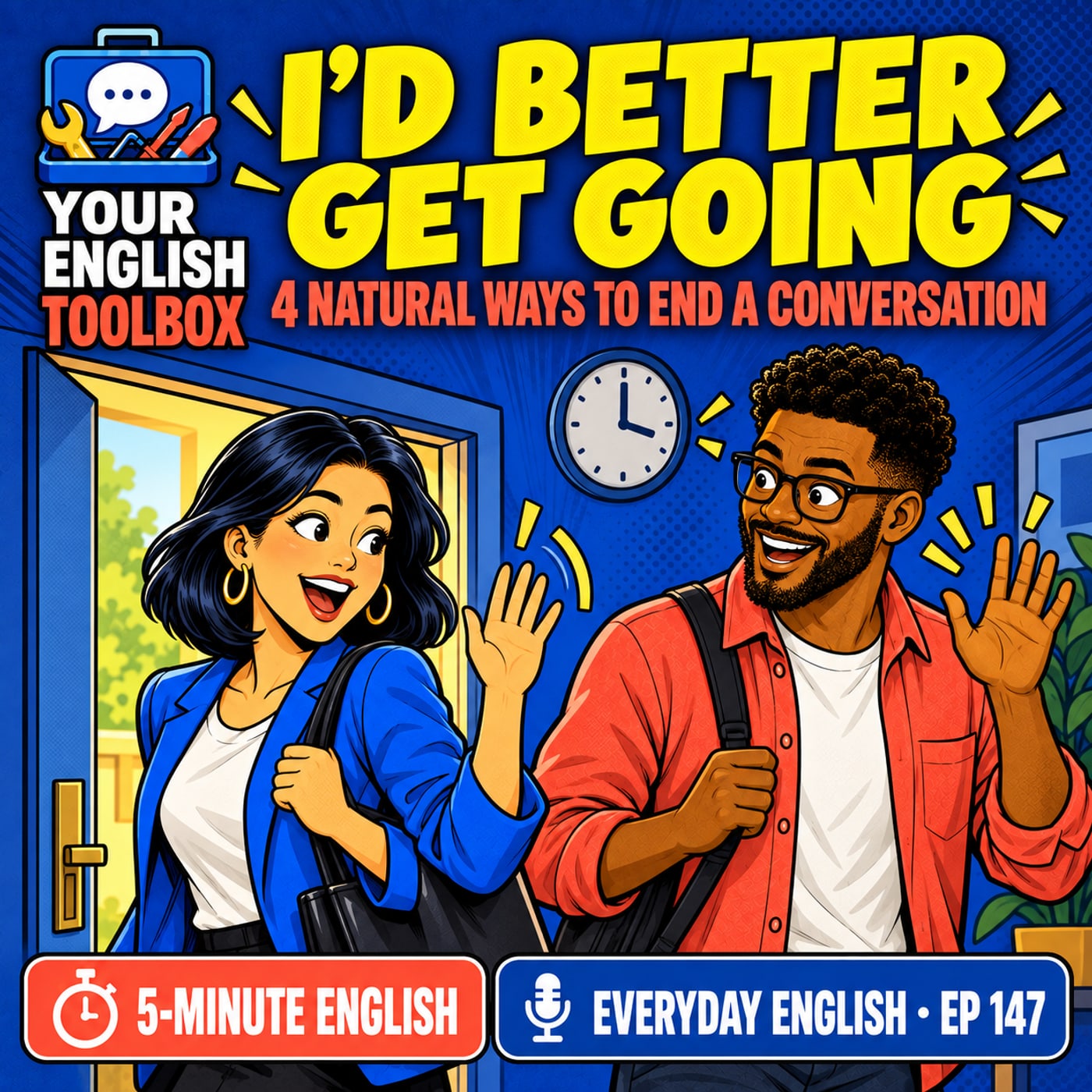 I’d Better Get Going: 4 Natural Ways to End a Conversation 25.09.2026 6นาทีhttps://yourenglishtoolbox.com/episodes/147-id-better-get-going-4-natural-ways-to-end-a-conversation/This podcast is created through a human-led editorial process. Every episode concept, educational strategy, narrative direction and final editorial decision is developed and reviewed by people committed to making English learning meaningful. Artificial intelligence supports script development and editing, while ElevenLabs provides the synthetic voices of our hosts. Human judgement leads the process; technology supports its production.Have you ever said “well…” several times because you wanted to leave but did not know how to end the conversation politely?In episode seven of Everyday Useful Expressions, Martin and Julia practise four natural closing expressions you can use immediately in phone calls and face-to-face conversations.You will learn:I should let you go — show consideration for the other person’s time;I’d better get going — introduce your own need to leave or stop talking;Let’s catch up soon — express a warm intention to speak again;It was good talking to you — close an enjoyable or useful conversation warmly.The episode explains why “I’d better” is natural spoken English, how “soon” can be friendly but non-specific and why the past tense in “It was good talking to you” signals that the conversation is ending.The web lesson adds five more expressions with meanings, nuance, two examples and active practice: “I won’t keep you”, “I should get back to it”, “Let’s do this again soon”, “Take care” and “I’ll be in touch”.Level: B1–B2 · Focus: ending conversations · functional English · polite social language · Format: short conversational Slow EnglishKeywords: how to end a conversation in English, I should let you go meaning, I had better get going, let us catch up soon, it was good talking to you, useful English expressions, polite English conversation, everyday English, slow English podcast, English speaking practice, Your English Toolbox#EverydayEnglish #UsefulExpressions #EnglishConversation #SlowEnglishPodcast #LearnEnglish #YourEnglishToolbox💬 We’d love to hear from you!If you enjoyed this episode, leave a comment, share your thoughts, or tell us how you’re using these tips to improve your English. Your feedback helps us grow and create even better content for you. Hosted on Acast. See acast.com/privacy for more information.
 -
 Short Stories with Peter: The Monkey’s Paw by W. W. Jacobs (Abridged B1–B2 Level) 24.09.2026 11นาทีhttps://yourenglishtoolbox.com/episodes/144-short-stories-with-peter-the-monkeys-paw-by-w-w-jacobs/This podcast is created through a human-led editorial process. Every episode concept, educational strategy, narrative direction and final editorial decision is developed and reviewed by people committed to making English learning meaningful. Artificial intelligence supports script development and editing, while ElevenLabs provides the synthetic voices of our hosts. Human judgement leads the process; technology supports its production.What would you wish for if one small object promised to change your life?On a cold and stormy night, the White family receives a strange object from an old friend: a dried monkey’s paw said to grant three wishes.Sergeant-Major Morris warns them not to use it.Mr White makes one simple wish anyway.The wish comes true, but the price is far greater than the family imagined.In this abridged adaptation of W. W. Jacobs’s classic 1902 story, Peter guides you through a carefully paced tale of temptation, grief and consequences. The horror is suggested rather than shown, and the final moment preserves the original story’s unsettling ambiguity.After the story, Peter explores four useful expressions:grant a wish — make somebody’s wish come true;tempt fate — take an unnecessary risk when things are going well;at any cost — regardless of the danger or sacrifice;be careful what you wish for — getting what you want may create a worse problem.You will also examine how English uses wish to describe something unreal or contrary to present reality.This is a slow, atmospheric listening experience for B1–B2 learners who want richer narrative English, natural dialogue and a classic story with a powerful ending.The Monkey’s Paw — an abridged adaptation of the original story by W. W. Jacobs (1902). Adapted for B1–B2 English learners by Your English Toolbox. The original work is in the public domain in Spain.Content note: grief, death described without graphic detail, and supernatural suspense.Level: B1–B2 · Focus: listening comprehension · supernatural suspense · wishes and consequences · useful expressions · grammar with wish · classic literature abridged for English learnersKeywords: English short stories, learn English with stories, The Monkey’s Paw, W W Jacobs, B1 B2 English listening, horror story in English, English vocabulary in context, wish grammar, classic literature adapted, slow English podcast, Your English Toolbox#ShortStoriesWithPeter #LearnEnglishWithStories #B1B2English #EnglishListening #TheMonkeysPaw #ClassicLiterature #YourEnglishToolbox💬 We’d love to hear from you!If you enjoyed this episode, leave a comment, share your thoughts, or tell us how you’re using these tips to improve your English. Your feedback helps us grow and create even better content for you. Hosted on Acast. See acast.com/privacy for more information.
 -
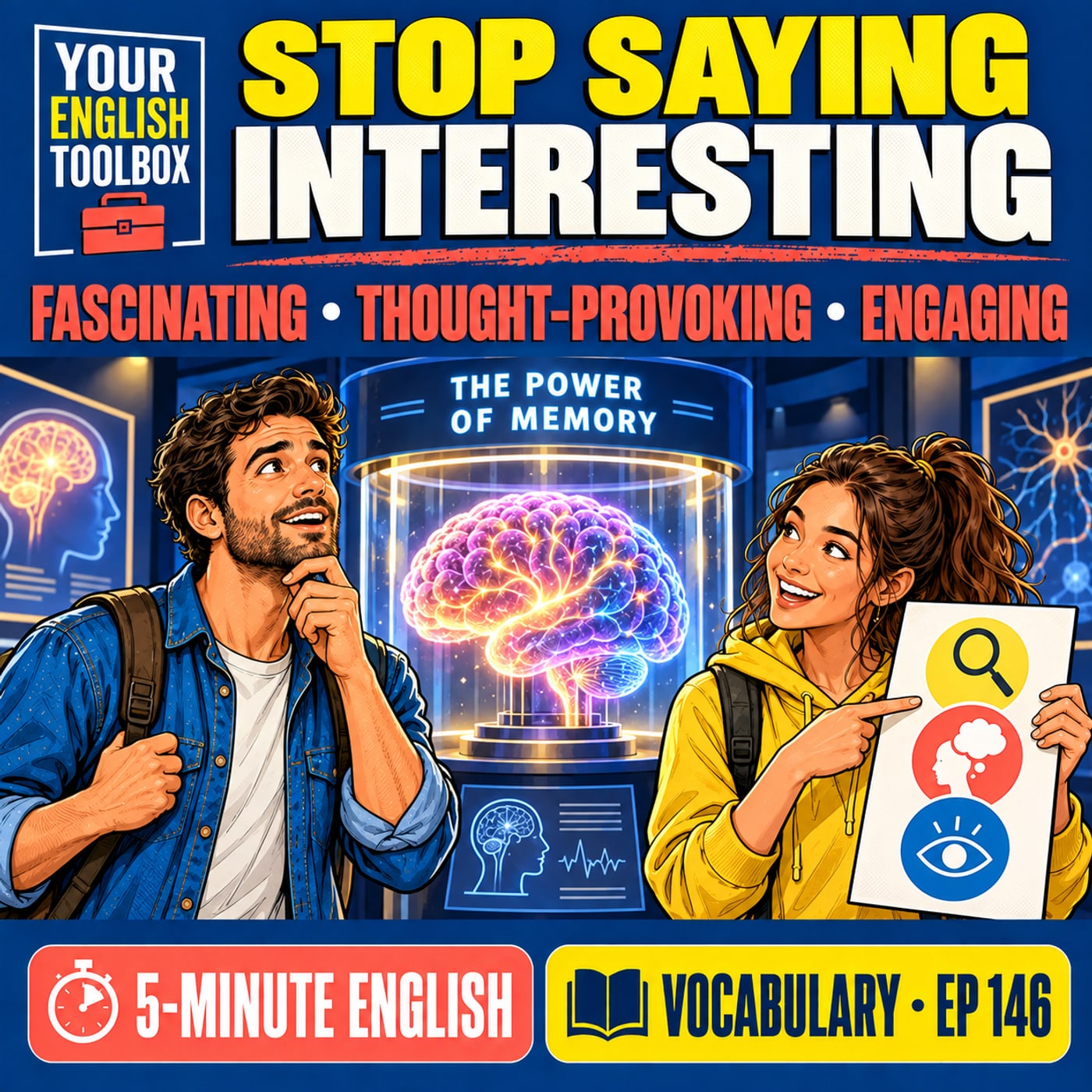 Stop Saying “Interesting”: Fascinating, Thought-Provoking or Engaging? 22.09.2026 6นาทีhttps://yourenglishtoolbox.com/episodes/146-stop-saying-interesting-fascinating-thought-provoking-or-engaging/This podcast is created through a human-led editorial process. Every episode concept, educational strategy, narrative direction and final editorial decision is developed and reviewed by people committed to making English learning meaningful. Artificial intelligence supports script development and editing, while ElevenLabs provides the synthetic voices of our hosts. Human judgement leads the process; technology supports its production.Martin describes an entire science festival with one word: interesting. Julia challenges him to say exactly what held his attention and why.In this short conversational Slow English episode, Martin and Julia compare three precise B1–B2 adjectives for curiosity, deeper reflection and sustained attention.You will learn:fascinating — extremely interesting because something strongly attracts your curiosity;thought-provoking — making you think seriously or consider an idea in a new way;engaging — holding your attention through an appealing or involving style.The episode compares a fascinating subject with an engaging presentation, explains why something uncomfortable can still be thought-provoking and shows the natural nouns used with each adjective.Finish with a four-situation active-recall challenge and a practical method for replacing vague “interesting” sentences with more precise English.Level: B1–B2 · Focus: precise vocabulary · curiosity and attention · adjective collocations · Format: short conversational Slow EnglishKeywords: alternatives to interesting, fascinating meaning, thought-provoking meaning, engaging meaning, precise English vocabulary, English adjectives B1 B2, improve English vocabulary, natural English collocations, slow English podcast, English listening practice, Your English Toolbox#EnglishVocabulary #StopSayingInteresting #SlowEnglishPodcast #LearnEnglish #IntermediateEnglish #YourEnglishToolbox💬 We’d love to hear from you!If you enjoyed this episode, leave a comment, share your thoughts, or tell us how you’re using these tips to improve your English. Your feedback helps us grow and create even better content for you. Hosted on Acast. See acast.com/privacy for more information.
 -
 On the Fence? 4 Decision Idioms to Help You Choose 22.09.2026 5นาทีhttps://yourenglishtoolbox.com/episodes/145-on-the-fence-4-decision-idioms-to-help-you-choose/This podcast is created through a human-led editorial process. Every episode concept, educational strategy, narrative direction and final editorial decision is developed and reviewed by people committed to making English learning meaningful. Artificial intelligence supports script development and editing, while ElevenLabs provides the synthetic voices of our hosts. Human judgement leads the process; technology supports its production.Continue with Lesson 9 — Decisions — in our free Idiom Toolbox course: https://yourenglishtoolbox.com/idioms/lesson-09-decisions/Martin has opened the same workshop registration page six times. Should he wait, trust his instinct or finally press the button?In this short conversational Slow English episode, Martin and Julia explore four useful idioms from Lesson 9 of the free Idiom Toolbox course.You will learn:on the fence — be unable to decide between two options;sleep on it — wait until the next day before making a decision;go with your gut — trust your instinct after considering the facts;take the plunge — finally make a bold decision and act on it.The conversation explains the natural pattern “on the fence about something”, compares careful reflection with instinct and shows why taking the plunge is more than simply choosing.Finish with an active-recall challenge and two personal speaking prompts that turn the four idioms into usable English.Level: B1–B2 · Focus: decision idioms · hesitation and commitment · listening and speaking · Format: short conversational Slow EnglishKeywords: decision idioms in English, on the fence meaning, sleep on it meaning, go with your gut meaning, take the plunge meaning, English idioms B1 B2, how to make decisions in English, slow English podcast, English listening practice, Idiom Toolbox, Your English Toolbox#EnglishIdioms #DecisionIdioms #SlowEnglishPodcast #LearnEnglish #EnglishListeningPractice #YourEnglishToolbox💬 We’d love to hear from you!If you enjoyed this episode, leave a comment, share your thoughts, or tell us how you’re using these tips to improve your English. Your feedback helps us grow and create even better content for you. Hosted on Acast. See acast.com/privacy for more information.
 -
 10 Habits of People Who Live to 100 | Part 1: Your Body 20.09.2026 17นาทีhttps://yourenglishtoolbox.com/episodes/143-10-habits-of-people-who-live-to-100-part-1-your-body/This podcast is the result of a genuine human creative process. Every episode concept, educational strategy, narrative structure, and pedagogical direction is designed, written, and carefully curated by real people who are deeply committed to making English learning a human, meaningful experience. Artificial intelligence plays a supporting role in two specific areas: it assists in the refinement and editing of scripts, and it powers the voice synthesis technology from ElevenLabs that brings our hosts to life with exceptional phonetic clarity and natural pacing. The result is a podcast where human intelligence leads, and AI serves. Every lesson was designed for you.Julia has found the secret to living to a hundred. It is goat's milk, from a specific island, at a specific time of day. There was a whole article. Martin is about to ruin it completely.For four episodes, How to Live a Good Life argued that relationships are the foundation of a good life. That is still true — but you also live in a body. This bonus conversation begins a two-part exploration of ten habits associated with healthier ageing. Today: the first five.The episode starts with an honest scientific debate. In 2024, demographer Saul Newman received an Ig Nobel Prize for a controversial, non-peer-reviewed analysis challenging the records behind some famous longevity regions. Researchers who study the Blue Zones strongly dispute his conclusions and point to detailed civil, church and genealogical records used to validate ages. Martin and Julia present both sides before turning to stronger observational evidence.That evidence includes two major US cohorts: 123,219 participants followed for up to 34 years. At age 50, the researchers estimated around 14 additional years of life expectancy for women with all five low-risk lifestyle factors and about 12 for men, compared with participants who had none. Those figures are population estimates, not guarantees for any individual.You will also meet Genaro, 79, a former building caretaker in Valencia who has never been inside a gym — and who follows the spirit of all five habits without believing he has any habits at all.What you will learn today:Why an active hour does not make the rest of the day irrelevant.Why maintaining muscle supports independence, and how to approach a simple floor movement safely.The broad food patterns often seen in populations that age well, plus the Okinawan idea of stopping at eight parts full.Why sleep regularity matters as well as duration, and what researchers are learning about overnight brain maintenance.How the evidence around smoking and alcohol has changed the familiar longevity story.English in context includes: a habit, to get into the habit of doing something, to cut down on something, to give something up, life expectancy, evidence, a claim, a preprint, it turns out, to be in good shape, to hold that thought, and to respond at any age.Sentence of the day: You do not need a new life. You need a better Tuesday.Next: Part 2, Your Mind — purpose, rest, learning, belonging, and the habit at the top of the list.This episode provides general information, not medical advice. Every body is different; for anything that concerns you, speak to your doctor or another qualified health professional.Keywords: habits of people who live to 100, longevity habits, blue zones debate, blue zones evidence, Ig Nobel longevity research, Harvard five healthy habits, healthy ageing, how to live longer, maintaining muscle after 50, sleep regularity, eat mostly plants, hara hachi bu, slow English podcast, English listening practice, learn English, English podcast for intermediate learners, English vocabulary in context, health vocabulary in English, Your English Toolbox, English transcripts, intermediate English, IELTS speaking practice, Cambridge B2 First, C1 Advanced#SlowEnglishPodcast #YourEnglishToolbox #LearnEnglish #EnglishListeningPractice #EnglishPodcast #HowToLiveAGoodLife #Longevity #HealthyHabits #BlueZones #HealthyAgeing #StudyEnglish #IELTS💬 We’d love to hear from you!If you enjoyed this episode, leave a comment, share your thoughts, or tell us how you’re using these tips to improve your English. Your feedback helps us grow and create even better content for you. Hosted on Acast. See acast.com/privacy for more information.
 -
 Weekly English Recap: 20 Shadowing Pairs 19.09.2026 8นาทีhttps://yourenglishtoolbox.com/episodes/141-weekly-english-recap-20-shadowing-pairs/This podcast is created through a human-led editorial process. Every episode concept, educational strategy, narrative direction and final editorial decision is developed and reviewed by people committed to making English learning meaningful. Artificial intelligence supports script development and editing, while ElevenLabs provides the synthetic voices of our hosts. Human judgement leads the process; technology supports its production.Can you understand an expression, repeat it naturally and recognise the same idea in different words? In this weekly recap, Peter turns the three short episodes from this week into one focused vocabulary and shadowing workout.The two-sentence game is simple:Peter says a short, natural sentence containing one target expression.You get three seconds of silence to shadow it aloud and copy the rhythm and stress.Peter gives you a second sentence with the same meaning but different vocabulary, so you can confirm the meaning without translating.You will review all twenty learning items from this week:Success idioms, collocations and learning language:come out on top;pay off;go places;with flying colours;compete against;a challenging situation;pass an assessment;retrieval practice.Probability vocabulary:likely;unlikely;inevitable.Natural reactions from the audio lesson:No way!;That’s great news!;What a relief!;I’m sorry to hear that.Extra reactions from the web lesson:You’re joking!;I’m so pleased for you;Thank goodness!;That’s a shame;That must be difficult.Listen once for meaning. Then play the episode again and begin repeating as soon as Peter speaks, using the three-second silence to finish each sentence. The paraphrase that follows gives you immediate feedback and strengthens active recall.Level: B1–B2 · Focus: weekly vocabulary review · shadowing · retrieval practice · paraphrasing · pronunciation and fluencyKeywords: English shadowing practice, weekly English recap, English vocabulary review, paraphrasing practice, English idioms, likely unlikely inevitable, react to news in English, retrieval practice, improve English fluency, slow English podcast, Your English Toolbox#EnglishShadowing #VocabularyReview #EnglishIdioms #SpeakEnglish #SlowEnglishPodcast #LearnEnglish #YourEnglishToolbox💬 We’d love to hear from you!If you enjoyed this episode, leave a comment, share your thoughts, or tell us how you’re using these tips to improve your English. Your feedback helps us grow and create even better content for you. Hosted on Acast. See acast.com/privacy for more information.
 -
 Short Stories with Peter: The Open Window by Saki (Abridged B1–B2 Level) 19.09.2026 8นาทีhttps://yourenglishtoolbox.com/episodes/142-short-stories-with-peter-the-open-window-by-saki/This podcast is created through a human-led editorial process. Every episode concept, educational strategy, narrative direction and final editorial decision is developed and reviewed by people committed to making English learning meaningful. Artificial intelligence supports script development and editing, while ElevenLabs provides the synthetic voices of our hosts. Human judgement leads the process; technology supports its production.What can happen when a nervous visitor trusts the wrong storyteller?Framton Nuttel has come to the countryside for a quiet rest.Instead, he meets Vera: a poised fifteen-year-old with bright eyes, an open window behind her, and a remarkable story about three men who never returned from the marshes.The window is open because Vera’s aunt is waiting for them to come home.Or so Vera says.In this abridged adaptation of Saki’s classic 1911 story, Peter guides you through a compact mystery with a sharply surprising ending.You will hear how Vera makes an impossible story sound believable, why Framton is ready to accept it, and how Saki prepares the final twist in only a few minutes.After the story, Peter unpacks the language that makes the deception work. You will learn:• spin a yarn — tell an entertaining story that may not be true;• take someone in — make somebody believe something false;• a mischievous streak — a tendency to enjoy playful trouble;• keep a straight face — avoid showing that you are amused or hiding something.You will also notice how the past perfect helps Vera create a believable past, and how tiny descriptive details can make a story feel completely real.This is a slow, carefully paced listening experience for B1–B2 learners who want richer narrative English, clear pronunciation, and a story worth remembering.Level: B1–B2 · Focus: listening comprehension · narrative English · deception and storytelling vocabulary · past perfect · classic literature abridged for English learnersKeywords: English short stories, learn English with stories, Saki The Open Window, B1 B2 English listening, mystery story in English, English vocabulary in context, past perfect storytelling, classic literature adapted, slow English podcast, Your English Toolbox#ShortStoriesWithPeter #LearnEnglishWithStories #B1B2English #EnglishListening #MysteryStory #ClassicLiterature #YourEnglishToolbox💬 We’d love to hear from you!If you enjoyed this episode, leave a comment, share your thoughts, or tell us how you’re using these tips to improve your English. Your feedback helps us grow and create even better content for you. Hosted on Acast. See acast.com/privacy for more information.
 -
 No Way! 4 Natural Ways to React to News 17.09.2026 6นาทีhttps://yourenglishtoolbox.com/episodes/140-no-way-4-natural-ways-to-react-to-news/This podcast is created through a human-led editorial process. Every episode concept, educational strategy, narrative direction and final editorial decision is developed and reviewed by people committed to making English learning meaningful. Artificial intelligence supports script development and editing, while ElevenLabs provides the synthetic voices of our hosts. Human judgement leads the process; technology supports its production.How should you respond when someone shares surprising, exciting, reassuring or difficult news? “All right” may be grammatically possible, but it rarely shows the interest or support the moment needs.In episode six of Everyday Useful Expressions, Martin and Julia practise four natural reactions you can use immediately in real conversations.You will learn:No way! — express strong informal surprise or disbelief;That’s great news! — respond warmly to positive news;What a relief! — show that worry or uncertainty has ended;I’m sorry to hear that — express sympathy after bad or disappointing news.The episode explains how tone changes “No way”, why a natural follow-up question shows genuine interest and how to choose between happiness, relief and sympathy. It ends with active recall and a complete response-building challenge.The web lesson adds five more expressions with meanings, nuance, two examples and active practice: “You’re joking!”, “I’m so pleased for you”, “Thank goodness”, “That’s a shame” and “That must be difficult”.Level: B1–B2 · Focus: reacting to news · functional English · empathy and conversation · Format: short conversational Slow EnglishKeywords: how to react to news in English, no way meaning, that is great news, what a relief meaning, sorry to hear that, natural English reactions, useful English expressions, everyday English conversation, slow English podcast, English speaking practice, Your English Toolbox#EverydayEnglish #UsefulExpressions #ReactToNews #SlowEnglishPodcast #LearnEnglish #YourEnglishToolbox💬 We’d love to hear from you!If you enjoyed this episode, leave a comment, share your thoughts, or tell us how you’re using these tips to improve your English. Your feedback helps us grow and create even better content for you. Hosted on Acast. See acast.com/privacy for more information.
 -
 Will It Happen? Likely, Unlikely or Inevitable 16.09.2026 5นาทีhttps://yourenglishtoolbox.com/episodes/139-will-it-happen-likely-unlikely-or-inevitable/This podcast is created through a human-led editorial process. Every episode concept, educational strategy, narrative direction and final editorial decision is developed and reviewed by people committed to making English learning meaningful. Artificial intelligence supports script development and editing, while ElevenLabs provides the synthetic voices of our hosts. Human judgement leads the process; technology supports its production.Will tomorrow’s outdoor concert continue? Rain may be likely, cancellation may be unlikely and getting wet may be inevitable — but these three words are not interchangeable.In this short conversational Slow English episode, Martin and Julia compare three precise B1–B2 adjectives for probability, expectation and certainty.You will learn:likely — expected or probable, but not completely certain;unlikely — not expected, although still possible;inevitable — certain to happen or impossible to avoid.You will also practise the natural patterns “something is likely”, “it is likely to happen” and “it is likely that…”. The episode explains why unlikely does not mean impossible, why inevitable is much stronger than likely and why “very inevitable” normally sounds unnecessary.Finish with a four-situation active-recall challenge and a practical method for replacing vague “maybe” sentences with more precise English.Level: B1–B2 · Focus: precise vocabulary · probability and certainty · adjective patterns · Format: short conversational Slow EnglishKeywords: likely meaning, unlikely meaning, inevitable meaning, probability vocabulary English, English adjectives B1 B2, precise English vocabulary, English collocations, improve English vocabulary, slow English podcast, English listening practice, Your English Toolbox#EnglishVocabulary #LikelyOrUnlikely #SlowEnglishPodcast #LearnEnglish #IntermediateEnglish #YourEnglishToolbox💬 We’d love to hear from you!If you enjoyed this episode, leave a comment, share your thoughts, or tell us how you’re using these tips to improve your English. Your feedback helps us grow and create even better content for you. Hosted on Acast. See acast.com/privacy for more information.
 -
 Come Out on Top: 4 Success Idioms That Pay Off 15.09.2026 6นาทีhttps://yourenglishtoolbox.com/episodes/138-come-out-on-top-4-success-idioms-that-pay-off/This podcast is created through a human-led editorial process. Every episode concept, educational strategy, narrative direction and final editorial decision is developed and reviewed by people committed to making English learning meaningful. Artificial intelligence supports script development and editing, while ElevenLabs provides the synthetic voices of our hosts. Human judgement leads the process; technology supports its production.Continue with Lesson 8 — Success — in our free Idiom Toolbox course: https://yourenglishtoolbox.com/idioms/lesson-08-success/Why is Martin carrying a tiny plastic trophy, and how can one small success teach four expressions you can reuse in work, study and everyday life?In this short conversational Slow English episode, Martin and Julia explore four useful idioms from Lesson 8 of the free Idiom Toolbox course.You will learn:come out on top — succeed after competition or difficulty;pay off — produce a good result after effort, patience or investment;go places — show the potential to become very successful;with flying colours — pass a test or assessment extremely successfully.The conversation contrasts a completed success with future potential, explains the different meaning of paying off a debt and shows the grammar and collocations that make every expression sound natural.Finish with an active-recall challenge and a personal speaking prompt that turns recognition into usable English.Level: B1–B2 · Focus: success idioms · achievement and progress · listening and speaking · Format: short conversational Slow EnglishKeywords: success idioms in English, come out on top meaning, pay off meaning, go places meaning, with flying colours meaning, English idioms B1 B2, English for achievement, slow English podcast, English listening practice, Idiom Toolbox, Your English Toolbox#EnglishIdioms #SuccessIdioms #SlowEnglishPodcast #LearnEnglish #EnglishListeningPractice #YourEnglishToolbox💬 We’d love to hear from you!If you enjoyed this episode, leave a comment, share your thoughts, or tell us how you’re using these tips to improve your English. Your feedback helps us grow and create even better content for you. Hosted on Acast. See acast.com/privacy for more information.
 -
 Is It Too Late to Start Again? | How to Live a Good Life, Episode 4 13.09.2026 19นาทีhttps://yourenglishtoolbox.com/episodes/137-is-it-too-late-to-start-again/This podcast is created through a human-led editorial process. Every episode concept, educational strategy, narrative direction and final editorial decision is developed and reviewed by people committed to making English learning meaningful. Artificial intelligence supports script development and editing, while ElevenLabs provides the synthetic voices of our hosts. Human judgement leads the process; technology supports its production.Downloadable study PDFs and progress tools are available with a free student account. The audio and Listen & Read experience remain freely accessible without registration.At the end of the previous episode, Martin sent a message to Tomás, a friend he had not spoken to in eleven years. This episode opens with the answer — and it is not the one Martin expected.“I thought you had forgotten about me.”In the fourth and final conversation of How to Live a Good Life, Martin and Julia examine the phrase we use to close doors before we have even tried to open them: too late. Julia asks Martin to name every reason he almost did not write to his old friend, and dismantles them one by one — until Martin dismantles the final one himself.You will also meet Miriam. At fifty-two, the company where she had worked for twenty-one years closed. She left Bogotá for Lisbon with two suitcases and the certainty that she was too old to learn the language properly, find meaningful work or belong somewhere new.Five years later, her life is not a miracle story. It is a Portuguese class she arrives at ten minutes early, a Saturday market where a stallholder finally learns her name, a part-time job discovered through someone in the room, and Dona Alice — the elderly neighbour downstairs who calls Miriam, the woman upstairs, when she needs help.This episode does not claim that everything happens for a reason or that suffering automatically makes people stronger. Some experiences simply hurt. But decades of research suggest that supportive relationships can help people regulate stress, solve practical problems, make sense of difficult experiences and hold on to their identity when a major part of life changes.Martin and Julia also explore an intriguing pattern found in many international studies: average life satisfaction often dips in midlife and rises again later. It is not a prediction for every person or every country, but it challenges the idea that the rest of life must follow a straight line down.What you will learn:Why “too late” is often a feeling wearing the clothes of a fact.Four ways supportive relationships can help during a crisis.What a midlife dip in average life satisfaction does — and does not — tell us.How Laura Carstensen’s socioemotional selectivity theory explains our growing preference for emotionally meaningful relationships.What generativity means and how purpose can continue beyond a job title.Three natural English sentences for reconnecting, joining a new community and asking for help when you begin again.Practise these three sentences:“It has been a long time, and I would still like to hear from you.”“I am new here. Do you mind if I join you?”“I have never done this before. Where do I start?”Vocabulary in context: too late, to start again, to start over, a fresh start, to write someone off, to move on, resilience, to make sense of something, generativity, to belong.Sentence of the day: It is late. It is not too late.Each episode in this four-part series stands on its own:Part 1: They Studied Happiness for 80 YearsPart 2: People Like You More Than You ThinkPart 3: Why We Drift Apart — and How to Stay ClosePart 4: Is It Too Late to Start Again?Coming next: a bonus conversation about ten habits associated with a longer, healthier life — including movement, food, sleep, rest, purpose and relationships.Keywords: is it too late to start again, starting over after 50, how to start over in life, changing your life after 40, midlife happiness, U-shaped happiness curve, socioemotional selectivity theory, resilience after job loss, moving to a new country, finding purpose after retirement, generativity, English for immigrants, English for expats, slow English podcast, British English conversation, English listening practice, intermediate English podcast, English vocabulary in context, personal development podcast, Your English Toolbox#YourEnglishToolbox #SlowEnglishPodcast #HowToLiveAGoodLife #LearnEnglish #EnglishListeningPractice #StartingAgain #Resilience #Purpose #PersonalDevelopment💬 We’d love to hear from you!If you enjoyed this episode, leave a comment, share your thoughts, or tell us how you’re using these tips to improve your English. Your feedback helps us grow and create even better content for you. Hosted on Acast. See acast.com/privacy for more information.
 -
 Why We Drift Apart — and How to Stay Close | How to Live a Good Life, Episode 3 12.09.2026 18นาทีhttps://yourenglishtoolbox.com/episodes/136-why-we-drift-apart-and-how-to-stay-close/This podcast is created through a human-led editorial process. Every episode concept, educational strategy, narrative direction and final editorial decision is developed and reviewed by people committed to making English learning meaningful. Artificial intelligence supports script development and editing, while ElevenLabs provides the synthetic voices of our hosts. Human judgement leads the process; technology supports its production.Downloadable study PDFs are available with a free student account. The audio and Listen & Read experience remain freely accessible without registration.Martin was looking for a photo of his passport when he found a photograph from 2014 instead: a wedding in Valencia, and a friend who once knew everything about his life. They never argued. Nothing happened. They simply stopped calling.When did they last speak? He would have to check — and that, Julia tells him, is the answer.In Part 3 of How to Live a Good Life, Martin and Julia explore the difficult part of relationships: not starting them, but keeping them. Robert Waldinger and Marc Schulz call it social fitness. Relationships are living systems, and like physical fitness, they need regular attention.Julia puts Martin through a seven-question check-up of his social world, and the silences become part of the diagnosis. Then they explore John Gottman's research on bids for connection: the tiny everyday moments — a story, a photograph, a bird in the garden — that quietly invite us to turn towards another person.You will also meet Nadia, an accountant from Tunis living in Manchester, who mistakes a warm but vague suggestion for a fixed invitation. Her story introduces the WISER model — Watch, Interpret, Select, Engage and Reflect — and shows how slowing down an interpretation can protect a relationship.What you will learn:What social fitness means and why shared history cannot keep a relationship alive by itself.How bids for connection work, and the difference between turning towards, turning away and turning against.Why phrases such as “We should grab a coffee sometime” depend on tone, context and what happens next.How the WISER model helps you respond thoughtfully instead of reacting to your first interpretation.Three natural English sentences for following up, making a real plan and repairing a misunderstanding.Vocabulary in context: social fitness, to drift apart, to keep in touch, to turn towards, a bid for connection, to pull back, to grab a coffee, to put something in the diary, to show up, a ritual of connection.Sentence of the day: Love is not a feeling you keep. It is a thing you do, again and again.Each episode in this four-part series stands on its own:Part 1: They Studied Happiness for 80 YearsPart 2: People Like You More Than You ThinkPart 3: Why We Drift Apart — and How to Stay ClosePart 4: Is It Too Late to Start Again?Keywords: how to keep friends, how to maintain relationships, social fitness, bids for connection, why friends drift apart, relationship habits, WISER model, British English expressions, English for immigrants, English for expats, slow English podcast, English listening practice, intermediate English, English conversation practice, English vocabulary in context, personal development podcast, Your English Toolbox#YourEnglishToolbox #SlowEnglishPodcast #HowToLiveAGoodLife #LearnEnglish #Relationships #SocialFitness💬 We’d love to hear from you!If you enjoyed this episode, leave a comment, share your thoughts, or tell us how you’re using these tips to improve your English. Your feedback helps us grow and create even better content for you. Hosted on Acast. See acast.com/privacy for more information.
 -
 Do You Mean…? 4 Natural Ways to Ask for Clarification 11.09.2026 6นาทีhttps://yourenglishtoolbox.com/episodes/135-do-you-mean-4-natural-ways-to-ask-for-clarification/This podcast is created through a human-led editorial process. Every episode concept, educational strategy, narrative direction and final editorial decision is developed and reviewed by people committed to making English learning meaningful. Artificial intelligence supports script development and editing, while ElevenLabs provides the synthetic voices of our hosts. Human judgement leads the process; technology supports its production.Someone asks you to make a webpage “lighter”. Do they mean a brighter colour or a simpler design? One small word can create a completely different task — unless you know how to check what the other person means.In episode five of Everyday Useful Expressions, Martin and Julia practise four natural clarification formulas for meetings, instructions and everyday conversations.You will learn:Do you mean...? — offer a possible interpretation;So, what you’re saying is... — summarise the main idea in your own words;If I understand correctly... — check an interpretation carefully and professionally;Could you walk me through that? — ask for a step-by-step explanation.The episode explains tone, register, grammar and natural responses such as “Yes, exactly”, “Not quite” and “Yes, that’s right”. It ends with active recall and a complete speaking prompt.The web lesson adds five more expressions with meanings, nuance, examples and practice: “Could you clarify what you mean by...?”, “Are you saying that...?”, “Could you give me an example?”, “Have I got that right?” and “Sorry, I didn’t quite follow that.”Level: B1–B2 · Focus: asking for clarification · functional English · meetings and conversation · Format: short conversational Slow EnglishKeywords: how to ask for clarification in English, do you mean meaning, if I understand correctly, could you walk me through that, English for meetings, useful English expressions, functional English phrases, everyday English conversation, slow English podcast, English speaking practice, Your English Toolbox#EverydayEnglish #UsefulExpressions #AskForClarification #SlowEnglishPodcast #LearnEnglish #YourEnglishToolbox💬 We’d love to hear from you!If you enjoyed this episode, leave a comment, share your thoughts, or tell us how you’re using these tips to improve your English. Your feedback helps us grow and create even better content for you. Hosted on Acast. See acast.com/privacy for more information.
 -
 Stop Saying “Good”: Enjoyable, Rewarding or Worthwhile? 09.09.2026 6นาทีhttps://yourenglishtoolbox.com/episodes/134-stop-saying-good-enjoyable-rewarding-or-worthwhile/This podcast is created through a human-led editorial process. Every episode concept, educational strategy, narrative direction and final editorial decision is developed and reviewed by people committed to making English learning meaningful. Artificial intelligence supports script development and editing, while ElevenLabs provides the synthetic voices of our hosts. Human judgement leads the process; technology supports its production.Was the course good? Was the evening good? Was helping another person good? “Good” is correct, but it often hides the most useful part of your meaning.In this short conversational Slow English episode, Martin and Julia compare three B1–B2 adjectives for positive experiences. The words overlap, but they answer different questions.You will learn:enjoyable — pleasant and giving you pleasure while you experience it;rewarding — giving satisfaction, achievement or personal value, often after effort;worthwhile — worth the time, effort or money involved.You will also learn why “I was enjoyable” may communicate the wrong idea, how rewarding differs from easy, and the natural patterns “the course was worthwhile” and “it was worth taking”.The episode includes realistic examples, collocation guidance, common learner mistakes, a four-situation listening challenge and a personal speaking transfer.Level: B1–B2 · Focus: precise vocabulary · English adjectives · collocations · Format: short conversational Slow EnglishKeywords: synonyms for good in English, enjoyable meaning, rewarding meaning, worthwhile meaning, English adjectives B1 B2, intermediate English vocabulary, English collocations, improve English vocabulary, slow English podcast, English listening practice, Your English Toolbox#EnglishVocabulary #LearnEnglish #SlowEnglishPodcast #EnglishListeningPractice #IntermediateEnglish #YourEnglishToolbox💬 We’d love to hear from you!If you enjoyed this episode, leave a comment, share your thoughts, or tell us how you’re using these tips to improve your English. Your feedback helps us grow and create even better content for you. Hosted on Acast. See acast.com/privacy for more information.
 -
 The Bottom Line: 4 Business Idioms You’ll Hear at Work 08.09.2026 5นาทีhttps://yourenglishtoolbox.com/episodes/133-the-bottom-line-4-business-idioms-youll-hear-at-work/This podcast is created through a human-led editorial process. Every episode concept, educational strategy, narrative direction and final editorial decision is developed and reviewed by people committed to making English learning meaningful. Artificial intelligence supports script development and editing, while ElevenLabs provides the synthetic voices of our hosts. Human judgement leads the process; technology supports its production.Continue with Lesson 7 — Business — in our free Idiom Toolbox course: https://yourenglishtoolbox.com/idioms/lesson-07-business/Why does a business email contain a base, a bottom line, a bar and an extra mile? In this conversational Slow English lesson, Martin and Julia decode four common business idioms that appear in meetings, emails and workplace conversations.You will learn:touch base — make brief contact to exchange information;the bottom line — identify the essential fact or final financial result;raise the bar — set a higher standard;go the extra mile — make more effort than is normally expected.The conversation also explains useful grammar patterns, the financial meaning of “the bottom line”, the difference between extra effort and unhealthy expectations, and the situations where each expression sounds natural.Finish with an active-recall challenge and create a personal example that connects the language with your own work or studies.Level: B1–B2 · Focus: business idioms · workplace English · listening and speaking · Format: short conversational Slow EnglishKeywords: business English idioms, the bottom line meaning, touch base meaning, raise the bar meaning, go the extra mile meaning, English for work, workplace English vocabulary, business English listening practice, slow English podcast, English idioms course, intermediate English, Your English Toolbox#BusinessEnglish #EnglishIdioms #SlowEnglishPodcast #LearnEnglish #EnglishForWork #YourEnglishToolbox💬 We’d love to hear from you!If you enjoyed this episode, leave a comment, share your thoughts, or tell us how you’re using these tips to improve your English. Your feedback helps us grow and create even better content for you. Hosted on Acast. See acast.com/privacy for more information.
 -
 Why People Like You More Than You Think | How to Live a Good Life, Part 2 06.09.2026 20นาทีhttps://yourenglishtoolbox.com/episodes/132-people-like-you-more-than-you-think/This podcast is created through a human-led editorial process. Every episode concept, educational strategy, narrative direction and final editorial decision is developed and reviewed by people committed to making English learning meaningful. Artificial intelligence supports script development and editing, while ElevenLabs provides the synthetic voices of our hosts. Human judgement leads the process; technology supports its production.Downloadable study PDFs are available with a free student account.Julia came home from a barbecue certain that all thirty guests disliked her. Martin has a different theory, and the research is on his side: after almost every conversation, people believe they were liked less than they really were. Psychologists call it the liking gap — and if you speak English as a second language, you probably live inside it every day.In Part 2 of How to Live a Good Life, Martin and Julia turn that finding into something you can use tomorrow morning. You'll meet Lena, a fictional healthcare assistant from Bratislava who has forty conversations a day in a Dublin hospital and not one person who knows her mother's name. You'll hear what an experiment with Chicago-area commuters discovered when people were asked to talk to a stranger. And you'll watch Julia dismantle Martin's four reasons for never speaking to anyone at a bus stop, until only one is left — and that one gets fixed with three sentences.What you will learn today:Why you are a terrible judge of your own conversations in English — and what the other person actually remembers.The difference between alone, isolated and lonely, and why belonging comes from repetition, not talent: the idea of the third place, and how to become a regular.Three natural small talk sentences that turn "good, you?" into a real conversation — practised with pauses, including the one that closes the liking gap from both sides.Vocabulary in context: the liking gap, to underestimate, to come across as, awkward, alone / isolated / lonely, a sense of belonging, small talk, to strike up a conversation, a third place, a regular, to bump into someone, an opener.Sentence of the day: People like you more than you think. Give them the chance to show it.Each part in this series stands on its own. Part 1: They Studied Happiness for 80 Years. Part 3: How to Keep the People You Love.Keywords: small talk in english, how to talk to strangers in english, liking gap, loneliness in a new country, how to make friends in a new country, english for immigrants, english for expats, sense of belonging, third place, slow english podcast, english listening practice, learn english, english podcast for intermediate learners, english conversation practice, english vocabulary in context, personal development podcast, your english toolbox, english transcripts, intermediate english, IELTS speaking practice, Cambridge B2 First, C1 Advanced#SlowEnglishPodcast #YourEnglishToolbox #LearnEnglish #EnglishListeningPractice #EnglishPodcast #HowToLiveAGoodLife #SmallTalk #Loneliness #Belonging #PersonalDevelopment #StudyEnglish #IELTS💬 We’d love to hear from you!If you enjoyed this episode, leave a comment, share your thoughts, or tell us how you’re using these tips to improve your English. Your feedback helps us grow and create even better content for you. Hosted on Acast. See acast.com/privacy for more information.
 -
 They Studied Happiness for 80 Years | How to Live a Good Life, Part 1 05.09.2026 18นาทีhttps://yourenglishtoolbox.com/episodes/131-they-studied-happiness-for-80-years/This podcast is created through a human-led editorial process. Every episode concept, educational strategy, narrative direction and final editorial decision is developed and reviewed by people committed to making English learning meaningful. Artificial intelligence supports script development and editing, while ElevenLabs provides the synthetic voices of our hosts. Human judgement leads the process; technology supports its production.Downloadable study PDFs are available with a free student account.Julia has just received the best professional news of her year. She picks up her phone, opens her contacts... and does not know who to call. That moment opens a new four-part series: How to Live a Good Life — four slow English conversations about happiness, relationships, purpose and the small choices that improve our quality of life.In Part 1, Martin and Julia follow one of the world's longest-running studies of adult development. It began in Boston in 1938 with 724 people — Harvard students and boys from some of the city's poorest neighbourhoods — and continues today across generations. The researchers who started it never saw the full answer. When a powerful pattern emerged, it pointed beyond money, fame and even the very good sofa Julia insists on defending.You will also meet Daniel Okafor, a fictional engineer from Lagos who gets the promotion he has chased for eight years in Calgary — and discovers, while scrolling through WhatsApp that evening, how many important conversations he has postponed.What you will learn:What researchers learned when they compared midlife relationships, health indicators and later well-being.Why “money can't buy happiness” is a cliché that misses the point — and why money and relationships give us different things.Three natural English sentences for reconnecting with someone you have lost touch with, practised with pauses so you can say them aloud.Vocabulary in context: to follow someone over time, to take part in, to keep track of, findings, a pattern, foundations, to put something off, to catch up with, to lose touch with, to take someone for granted.Sentence of the day: “A good life is not something you reach. It is something you build with other people.”Each episode in this series stands on its own. Part 2: Why You Can Feel Lonely in a Crowd.Harvard happiness study · how to live a good life · relationships and happiness · slow English podcast · English listening practice · English vocabulary in context · personal growth in English · reconnecting with friends#SlowEnglish #LearnEnglish #EnglishPodcast #HowToLiveAGoodLife #Happiness #Relationships💬 We’d love to hear from you!If you enjoyed this episode, leave a comment, share your thoughts, or tell us how you’re using these tips to improve your English. Your feedback helps us grow and create even better content for you. Hosted on Acast. See acast.com/privacy for more information.
พอดแคสต์ที่คล้ายกัน


ยอดนิยมใน
พอดแคสต์นี้ปรากฏในชาร์ตพอดแคสต์ของประเทศเหล่านี้ด้วย


