
The Bible Standard - Re-Discover the Truth.
Christadelphians Talk
0
This podcast features conversations from Christadelphians Talk, exploring various topics related to the Bible and its teachings. Each episode focuses on 'true Bible teaching,' aiming to help listeners re-discover the truth found in Scripture. The discussions cover a range of biblical subjects and doctrines from a Christadelphian perspective. It serves as a resource for those seeking deeper understanding of the Bible.
ตอน
-
 “MAKE YOURSELVES A NEW HEART” 22.09.2026 4นาทีOur chapter (18) in Ezekiel offers us a change of focus, instead of describing the sins of God’s nation, the prophet is caused to express God’s encouragement to individuals in that nation to turn from their evil ways and serve him. This is also a chapter which stresses the divine judgement on individuals and shows that the word ‘soul’ does not mean some ‘spirit’ part of a person, often referred to as ‘the soul’ that is able to continue ‘living’ in some way – even though the body is dead. This is what the Greeks and Romans believed – and the Catholics believed and most other ‘christians’- under their influence – came to believe in later centuries – and, of course, the Muslims.Twice in this chapter Ezekiel records the words of God, “the soul who sins shall die” [v.4,20]. The Hebrew word can be translated as ‘the person’ wherever it occurs. Ezekiel conveys God’s blunt words to the people, “Therefore I will judge you … every one according to his (her) ways, declares the Lord GOD. Repent and turn from your transgressions, lest iniquity be your ruin.” [v.30] Godlessness is obviously going to be the ruin of our world today. Just as Jerusalem and its wonderful temple were destroyed in the days of Jeremiah and Ezekiel, so will our world will experience an awesome judgement by God. Our present readings of the words of Jesus in the Gospel of Luke are making this increasingly clear.The final verses in our Ezekiel chapter catches our attention; its appeal applies just as much now as it did then. “Make yourselves a new heart and a new spirit! Why will you die …?” [v.31] This is equally a question for today, “why will you die” eternally – never again to see the light and experience and explore the wonders of existence? Many Scriptures ask this question, read Psalm 49 as an outstanding example.Luke records [ch. 15] Jesus’ parable about a lost coin. A diligent search is made and it is found – what rejoicing follows! “Just so,” says Jesus [v.10], “I tell you, there is joy before the angels of God over one sinner who repents.” Jesus is the only person who ever lived who has never had to repent about anything. Has there been “joy in heaven” over you? Or will there be when you “make yourself a new heart” and marvel in “a new spirit” of mind as you are baptised into the name of Christ and commit yourself to use your particular talents in the service of Christ – before he returns!
 -
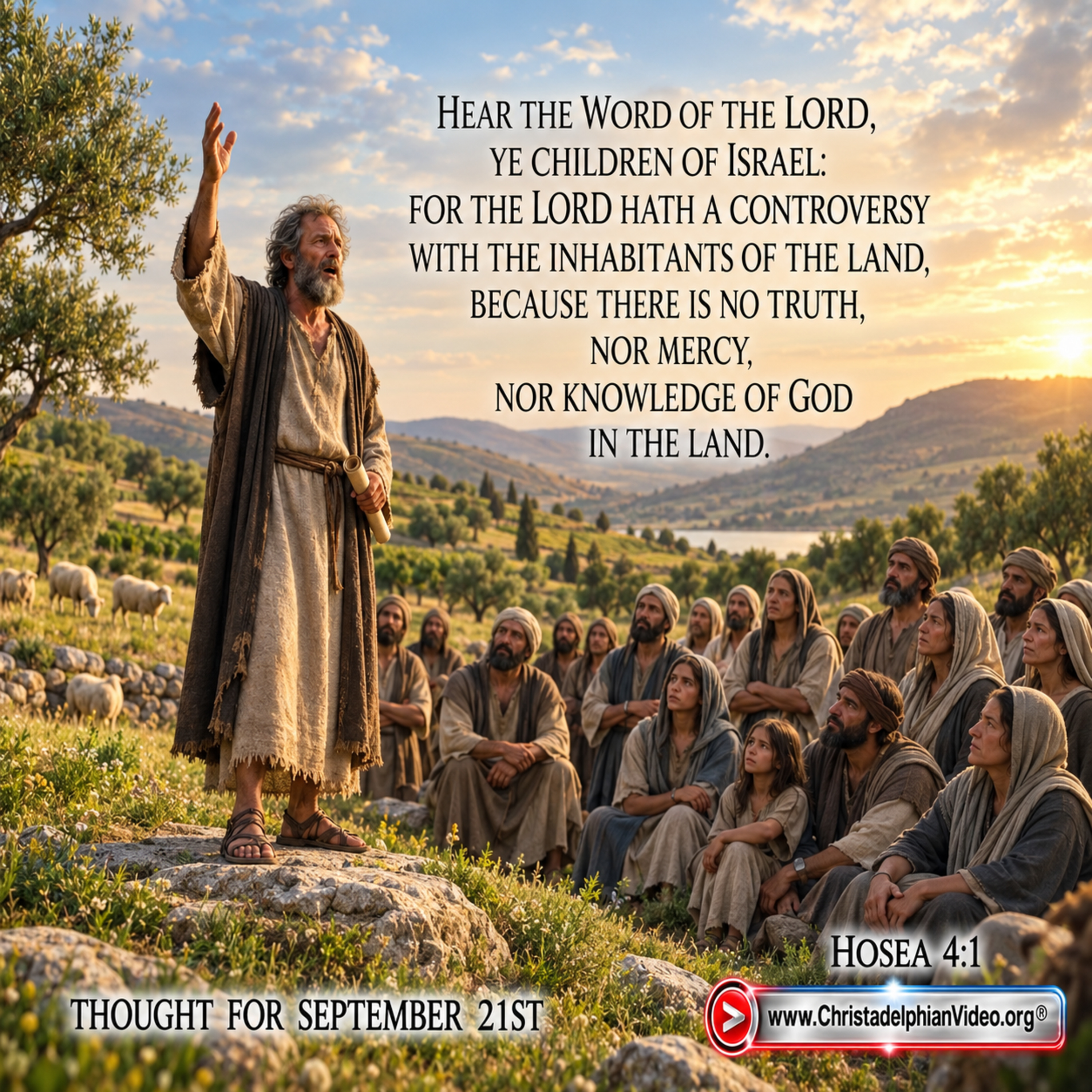 “NO KNOWLEDGE OF GOD” 21.09.2026 5นาทีSin is not a word people use these days, I even met a teenager who had never heard the word ‘adultery’ – and had no idea what it meant – she came into our Bible Education Centre on a rainy morning while waiting for the Internet place next door to open. Today, attitudes are as they were in the days of Hosea who wrote, “ the LORD has a controversy with the inhabitants … There is no faithfulness or steadfast love, and no knowledge of God” [ch. 4 v.1] That is exactly the case with our world today – “the LORD has a controversy with the inhabitants” – and soon this will become awesomely evident. In the days of Jesus, people more widely believed that God was the ultimate arbiter of punishment for their sins. Our readings in Ezekiel also show this, making the point that God had been merciful toward his people, yet there comes a point when God, seeing that his people do not change although he keeps showing mercy, ultimately brings awesome destruction – and Jerusalem came to a terrible end because of the abundance of their sins and lack of repentance. It is significant that only once does Ezekiel use the word ‘mercy’ – although Jeremiah uses it frequently. God’s people abused his merciful attitude in Jeremiah’s time. The one occasion Ezekiel uses it is in his ch. 39 v.25 “Therefore thus says the Lord GOD: Now I will restore the fortunes of Jacob and have mercy on the whole house of Israel, and I will be jealous for my holy name” A latter day prophecy we believe will soon occur.. Now Jesus makes a very interesting point in today’s ch. 13 in Luke. Evidently people had been saying that when a tower collapsed in Siloam and killed 18 people (v.4), those people must have been worse sinners than other people. How did Jesus respond? “No” he says, “I tell you they were not, and if you fail to repent you will all likewise perish.” There is less and less belief in God these days, so no spirit of repentance.We must look at ourselves! If we are not on God’s side, trying our best to do his will, there is no future for us. Jesus followed up his warning about Siloam by telling them a parable about a man who planted a tree (v.6-9) and who came for 3 years, looking for fruit, but found none. It was given one more year to produce fruit and a special effort was made to fertilise it. If it did not produce fruit it would be destroyed. Jesus came to the lost sheep of Israel, most would not follow him, 40 years later there was terrible destruction, especially in Jerusalem..The response of Peter on the day of Pentecost when the people were ‘cut to the heart’ in realizing they had killed their Messiah, was to tell them to “Repent and be baptised” [Acts 2 v38] So we have done that! Good. Are we heeding the lessons of God’s word – not only with a repentant attitude – we must each ask ourselves, are we producing fruit? There is no point in having a “knowledge of God” if we do not.
 -
 “FOR WHERE YOUR TREASURE IS …” 20.09.2026 4นาทีThey did not have banks in those days! We read today in Luke 12 v.16-20 of a man who built many barns to “store all my grain and my goods” so he could “relax, eat, drink and be merry.” This is the spirit among many in Australia today, the emphasis is on material well-being! Of course it is not necessary to build bigger barns or have barns at all, but what security do banks offer? Figures in computers, plenty of ‘paper’ money!As the Creator brings more and more of his promised time of trouble, a time, to quote our Lord (in Mark 13 v.19) when “there will be such tribulation as has not been from the beginning of the creation that God created until now, and never will be” again – it will almost certainly be useless to have any money in the bank, or any money at all, the only thing of value for the true believer to have – will be an overflowing abundance of faith.Jesus calls the man in his parable who built bigger barns a “Fool!” adding, “So is the one who lays up treasure for himselfand is not rich toward God.” His next words to his disciples are, “”Therefore I tell you, do not be anxious about your life, what you will eat, nor about your body, what you will put on. For life is more than food … more than clothing …” [v.24]Human minds today are totally concerned about such things – but we take to heart in what Jesus goes on to say, ” For all the nations of the world seek after these things, and your Father knows that you need them. Instead, seek his kingdom, and these things will be added to you.” [v.30,31] His next words are, “”Fear not, little flock, for it is your Father’s good pleasure to give you the kingdom….” Those who belong to his “little flock” spend their time developing more and more “treasure in the heavens that does not fail, where no thief approaches and no moth destroys.” [v.33]Finally note an even more vital point Jesus makes, ” For where your treasure is, there will your heart be also.” And he adds this instruction; “Stay dressed for action and keep your lamps burning …” [v.32-35] Are you “dressed for action?” Is your faith shining bright? Let us all be conscious, with full honesty of heart, where our treasure is!
 -
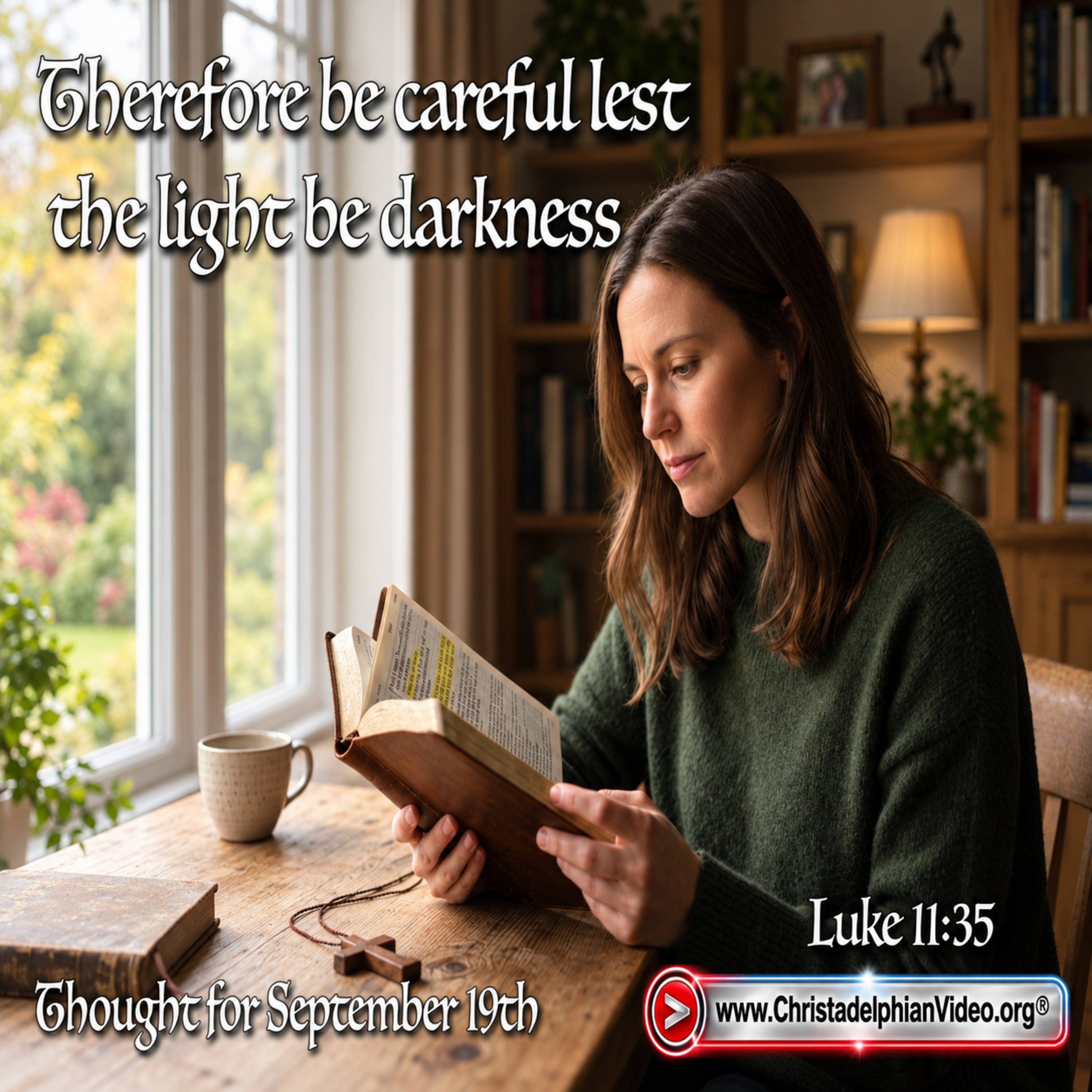 “THEREFORE BE CAREFUL LEST …” 20.09.2026 4นาทีOur chapter (11) in Luke’s gospel today is full of challenging sayings by our Lord. There is great spiritual value in deeply meditating on them and seeing the extent to which they have application to the circumstances in which we live today. The background to many of them is the self-righteous attitudes of the religious leaders who contended with Jesus. Praise of Jesus’ mother developed in early centuries and led to the cult of a sort of Mary worship. Luke records a little incident which those influenced by such attitudes must gloss over and ignore. We read the response of Jesus to a woman in the crowd who calls out, “Blessed is the womb that bore you and the breasts at which you nursed” Jesus responds, “Blessed rather are those who hear the words of God and keep it.” [v.27,28] May we all be blessed for that reason, and recognise our additional blessing in being able to read all the words of God..The way that we “keep it” will result in us being “full of light”! As a result our “eye is healthy” [v.34] and so our eye (or ear) keep bringing ‘healthy food’ into our minds. This is more and more essential today as our world is so full of junk food!Underline the next 2 verses, “Therefore be careful lest the light (you think you have) be darkness” [v. 35] Let’s fully absorb the point Jesus makes in the next verse, “If then your whole body is full of light, having no part dark, it will be wholly bright, as when a lamp with its rays gives you light.” Are you and I “full of light”? How difficult it is to maintain such light in the increasing darkness of this world – evil words and deeds multiply all around us. Now the words of David in Psalm 139 are a special inspiration to us with his perception of the light of God in the darkness. “If I say,’ writes David, ‘Surely the darkness shall cover me, and the light about me be night, even the darkness is not dark to you; the night is bright as the day, for darkness is as light to you.” [v12] Read the rest of that Psalm, especially the last 2 verses – and then you and I will be even more dedicated to “be careful lest” the light of God’s word be smothered by the darkness that increasingly surrounds us.
 -
 'The Disciple and the World' 18.09.2026 37นาที'The Disciple and the World'
 -
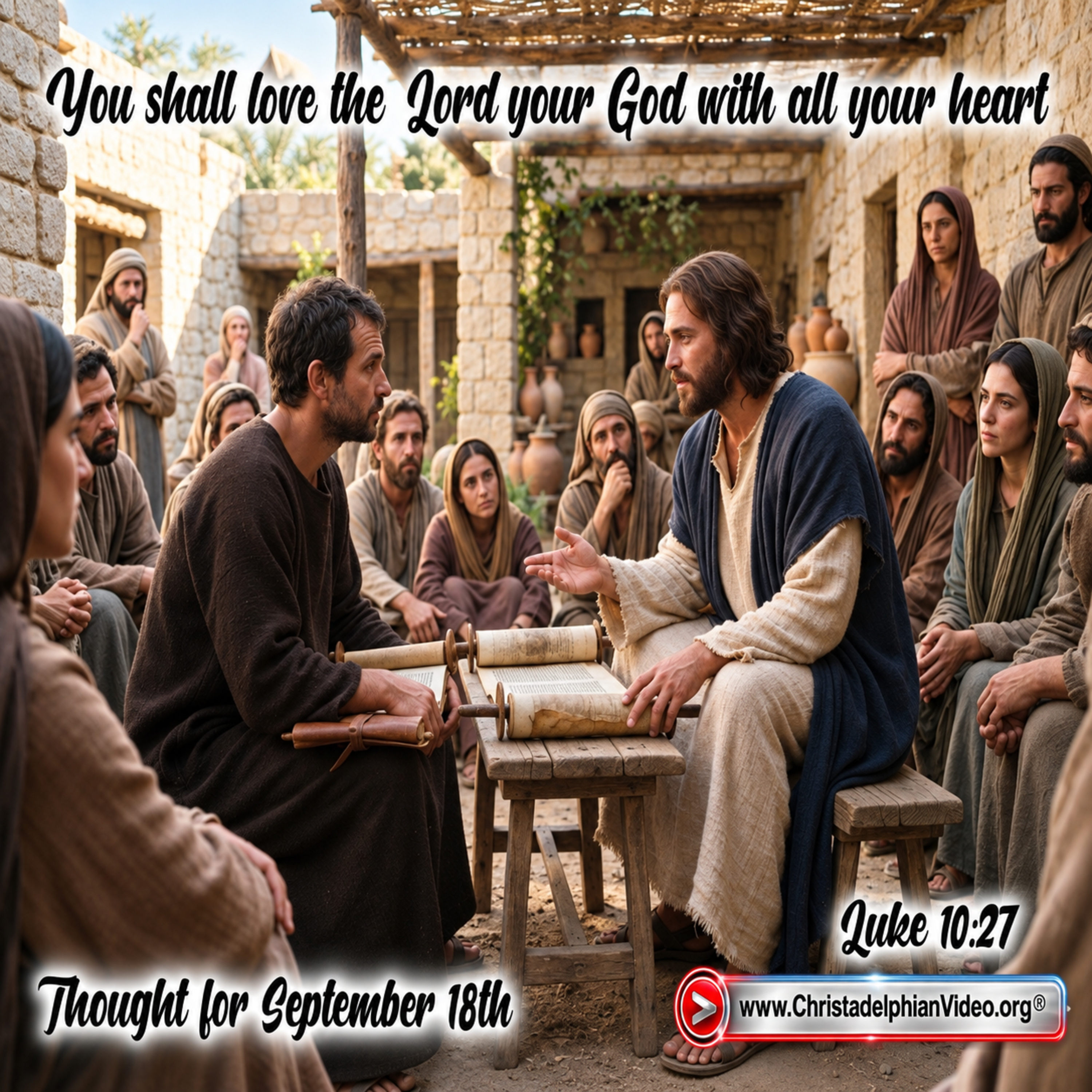 “LOVE THE LORD YOUR GOD WITH ALL YOUYR HEART" 18.09.2026 4นาทีHow depressed Ezekiel must have been! The LORD caused him to be aware of the totally godless attitude that existed in Jerusalem. He writes, “certain of the elders of Israel came to see me.” [14 v.1] The “word of the LORD” comes to him, “… these men have taken their idols into their hearts and set the stumbling block of their iniquity before their faces. Should I indeed let myself be consulted by them?” [v.3] The lesson is plain, it is folly to come to seek God and yet retain fleshly thoughts in our minds. Ezekiel is further told, “any one of the house of Israel … who separates himself from me, taking his idols into his heart … and yet comes to a prophet to consult me through him, I, the LORD will answer him myself. And I will set my face against that man (or woman)…” [v.7,8] Surely the same applies today to those who “consult” God through reading his word – but have a wrong motive in their hearts. Peter’s words come to mind about Paul’s writings,, “There are some things in them that are hard to understand, which the ignorant and unstable twist to their own destruction, as they do the other Scriptures.” [2 Peter 3 v.16] In our chapter [10] in Luke there is some comparison with the attitude of the lawyer who asked Jesus, “Teacher, what shall I do to inherit eternal life?” He said to him, “What is written in the Law? How do you read it?” And he answered, “You shall love the Lord your God with all your heart and with all your soul and with all your strength and with all your mind, and your neighbour as yourself.” [v.25-27] Jesus says to him, “You have answered correctly: do this and you will live.” But he asks, “and, who is my neighbour?” In response Jesus tells him the well-known account of the ‘Good Samaritan’ and asks the man, “Which of these three, do you think, proved to be a neighbour to the man who fell among robbers?” [v.36] He answers, “The one who showed mercy” and is told, “You go and do likewise.” Let us all love our Lord, with all our heart, our soul, our strength and our mind showing our love by our actions day after day: of course, we will sense at times, something similar to what the LORD caused Ezekiel to sense. But surely, in at least some cases, it will cause others to “do likewise” and – for at least one or two to take serious notice of the message and meaning of what we talk about – the wonder and real meaning of the word of God – as the only ‘light’ in the darkness that covers the world today.
 -
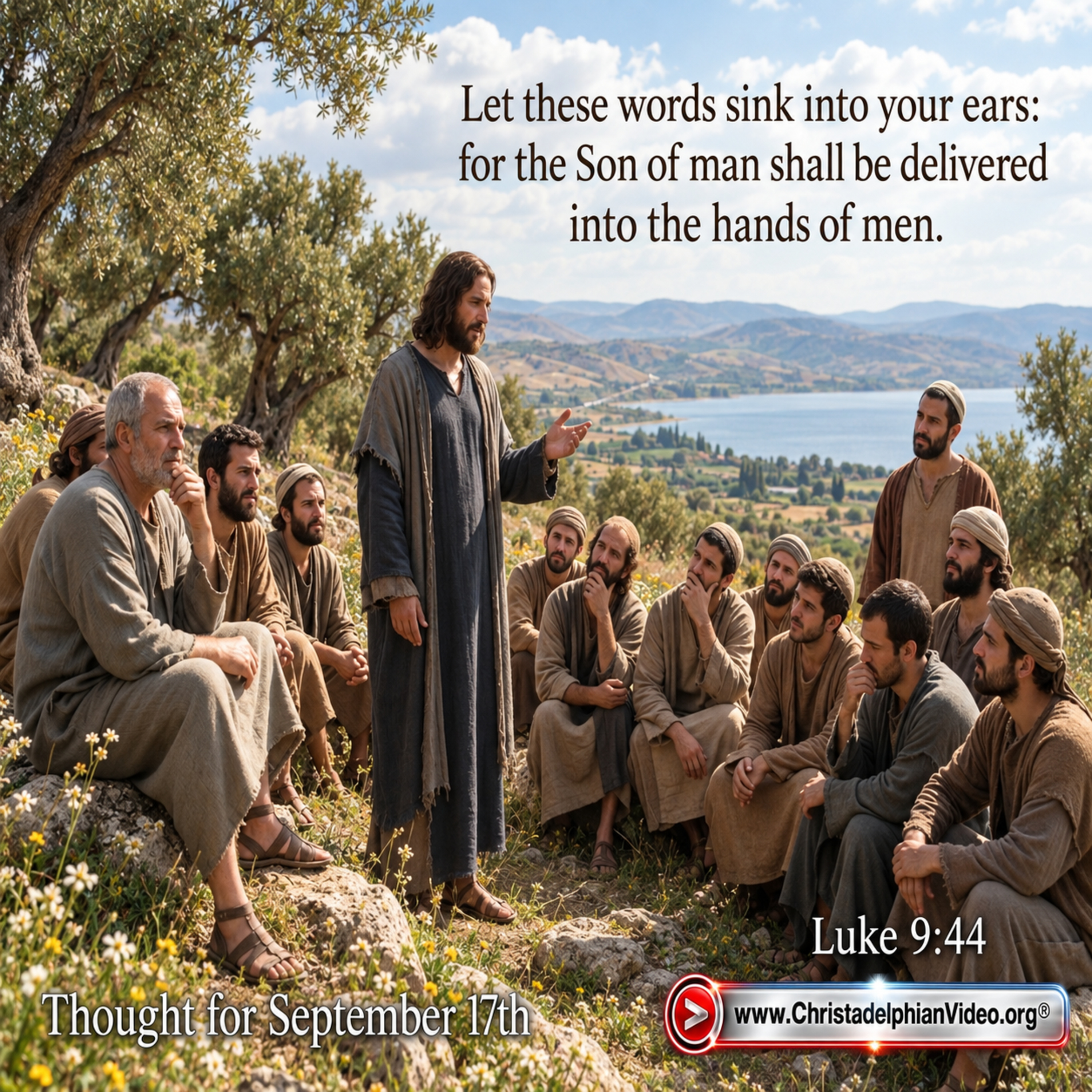 “Let these words sink into your ears: 17.09.2026 4นาทีWhat effect do the words of the Bible have on you as you read them? They vary greatly as we have seen today: but this causes us to exercise our minds in many different ways – and this is good for us. God has overseen the recording of many different events and messages so that what he has caused to be written is a lifelong study – indeed, more than a study, often a cause of prayerful meditation. So often it is about human failure and the causes of that failure.Our Old Testament readings today were both about the dismal end of God’s nation. The final 2 chapters in 2nd Kings detailed the dreadful destruction of Jerusalem and the distress of the people – and Ezekiel 13 is about the ungodliness at the time and how the Lord GOD said, “I will make stormy winds break out in my wrath … and great hailstones in wrath to make a full end.” [v.13] And today? The Psalms of David had long been written so would one here and there, who knew them, have mediated on them? Maybe Psalm 12, to take one example; it ends with the words, “on every side the wicked prowl, as vileness is exalted …”! Those trying to be righteous would surely have meditated on the two previous verses which start, “The words of the LORD are pure words …” ! We compare the forecasts of the destruction of Jerusalem with the forecasts Jesus made of his death and the reaction of his hearers to these forecasts. . We read today in Luke Ch. 9, “… while they were all marvelling at everything he was doing, Jesus said to his disciples, “Let these words sink into your ears: the Son of Man is about to be delivered into the hands of men.’ But they did not understand this saying … “ [v.43-45] Their minds were focussed on “which of them was the greatest” [v.46]! With that state of mind his words would not sink into their minds! We see a telling comparison with what we will read later in Luke in Ch.24. After his resurrection, 2 disciples who had walked with an unrecognized Messiah later confessed, “Did not our hearts burn within us as he talked with us on the road, while he opened to us the Scriptures?” [v.32] They were in a mood to “let these words sink” into their minds! He had chided them, that they “were slow of heart to believe all that the prophets had spoken” [v.25]. It seems to be our nature to believe only what we want to believe – but in looking at all that the prophets have spoken and seeing alarming comparisons with our world today to the forecasts then of the destruction of Jerusalem and the reasons for it, let us cause the words of Christ and the prophets to sink more fully into our minds, so we can walk with greater and greater faith in the increasing darkness of today’s world.
 -
 The Sheep and the Goats: Judgment of the Saints or the Nations with Bible scholar Roger Lewis 16.09.2026 56นาทีA @Christadelphians Video: Description: This video compares scripture with scripture to suggest an interpretation of the prophecy in Matthew 25:31-46, which relates to the judgement of the nations when Christ returns.[Actual, provable Bible Truth] We present an in-depth, expositional study on one of the most thought-provoking prophecies in Scripture: The Sheep and the Goats. Is this a judgment of the saints or the nations? In this outstanding and wonderful analysis, we uncover the profound, scripture-based evidence that proves this pivotal moment is primarily a judgment of the nations, setting the stage for the Kingdom of God on Earth.This video is not a surface-level reading. We delve into the Olivet Prophecy, examining the specific Greek words used—distinguishing between the *Bema* (judgment seat) and the *Thronos* (throne of royal authority)—to reveal the divine order of judgment. This insightful presentation demonstrates how the Old Testament lays the foundation for understanding the final judgment of all nations, and how their destiny is intrinsically linked to their treatment of the Jewish people. It is a revealing study that connects the dots between the "least of these My brethren" and the ongoing struggles of Israel, providing a powerful lens through which to view world events.We consider Brother Thomas’s expositions in *Eureka* to show how the Midheaven proclamation of Revelation 14 acts as the dividing line. The nations are not judged on personal piety but on their national response to God's King and His people. This is a true, Biblical truth that clarifies the hope for the "sheep nations" and the solemn warning for the "goat nations," all leading to the glorious establishment of the Kingdom Age.**Chapters:**00:00 - Introduction00:30 - Parable or Prophecy?01:53 - Saints or Nations: Which Interpretation is Primary?02:43 - The Three Sections of the Olivet Prophecy05:15 - Old Testament Basis for National Judgment10:01 - The Throne of Glory vs. The Judgment Seat13:47 - National Delegates & The "Righteous Nation"15:42 - The Midheaven Proclamation: The Moment of Division21:35 - The King Speaks to the Sheep Nations26:29 - "Inherit the Kingdom" for the Nations30:15 - The Test: Feeding the Hungry & Clothing the Naked33:57 - The Suffering of the Jewish Diaspora & The Second Exodus41:12 - The Goat Nations & The False Shepherd45:20 - The Reality of "Everlasting Fire" (Not Eternal Torment)50:29 - The Life of the Aion: National Inheritance53:40 - Conclusion: Our Responsibility to Tell the Next Generation**Bible Verse Category:**📖 Matthew 25:31-46📖 Jeremiah 25:31📖 Psalm 67:4📖 Isaiah 2:2-4📖 Revelation 14:6-7📖 Genesis 12:3📖 Deuteronomy 32:8📖 Zechariah 10:3**Tags:**Bible Study, Matthew 25, Sheep and Goats, Last Judgment, Prophecy, Eureka, John Thomas, Olivet Prophecy, Israel, Nations, Christadelphian, End Times, Kingdom of God, Bible Truth, Second Coming, Jesus Christ, Bible Prophecy, Midheaven, Gospel, British EnglishWe are a Christadelphian team, Brothers and sisters of Christ, and we're passionate about delivering powerful, Scripture-based content to strengthen and inspire your faith journey. If this presentation resonated with you, help spread the encouragement—share it with a friend today!
 -
 Fearing God in Times of Suffering with Bible student Dan Blackburn 16.09.2026 51นาทีA @Christadelphians Video:Description: This is a deep-dive study delivered to encourage Christadelphians in their faith, - may not be suitable for 'all' esp those with little knowledge of the Bible. A detailed comparison of the First Letter of Peter in the New Testament and the life of King Hezekiah in the Old Testament reminds us that trusting completely in the God of Israel will bring us eternal salvation. This is how the Lord Jesus Christ was able to endure his sufferings. And it will help us too. [Actual, provable Bible Truth]: The Apostle Peter, writing to believers facing intense persecution, does not promise an escape from suffering. Instead, he offers a profound, counter-intuitive strategy for enduring it: we must learn to fear God more than we fear man. This is not a fear of terror, but a deep, reverential awe that reorients our entire perspective, allowing us to see our trials through the lens of God’s eternal purpose.This expositional study of 1 Peter chapter 2 is a truly outstanding and thought-provoking journey into the heart of what it means to be a disciple under pressure. We go beyond the surface to uncover the hidden treasures of the Old Testament that Peter masterfully weaves into his message of hope. Prepare to be amazed as we reveal how Peter uses the lives of Old Testament heroes—David, Hezekiah, and Daniel—as the ultimate pattern for our conduct in a hostile world.This isn't just a history lesson; it's a powerful, revealing blueprint for our own lives today. Whether you are facing subtle pressures or profound suffering, this analysis will strengthen your resolve and deepen your trust in the God of all grace. We break down the key themes of the chapter, from our identity as "living stones" and a "royal priesthood" to the ultimate example of Christ’s patient suffering. Discover how the call to "sanctify God in your hearts" is the single most important principle for navigating the fiery trials of our age.**Chapters:**00:00 - Introduction to Suffering in 1 Peter01:55 - The Key Theme of Persecution03:30 - Context: The Calling of the Saints05:03 - Nero's Persecution & The Fiery Trial06:45 - Newborn Babes: The Call to Grow11:05 - Psalm 34: Fearing God Over Man14:52 - Living Stones: The Hezekiah Connection17:43 - Isaiah 28: Trusting the Cornerstone22:44 - The Stone of Stumbling & The Fear of God27:54 - A Royal Priesthood & Our High Calling36:04 - Strangers and Pilgrims in Gentile Lands38:40 - The Suffering Servant of Isaiah 5344:39 - Conclusion: The Daniel Connection & Resisting Babylon**Bible Verse Category:**📖 1 Peter 2:1-3📖 1 Peter 2:4-8📖 1 Peter 2:9-10📖 Psalm 34:8📖 Isaiah 28:16📖 Isaiah 8:13-14📖 Isaiah 53 (as quoted in 1 Peter 2)📖 Daniel 3 (The Fiery Furnace)📖 Daniel 6 (The Lion's Den)**Tags:**Christadelphian, Bible Study, 1 Peter, Suffering, Persecution, Fearing God, Book of Peter, Hezekiah, Daniel, Psalm 34, Bible Standard, Faith, Trials, Expository Teaching, Trusting God, Royal Priesthood, Living Stones, End Times, Hope of IsraelWe are a Christadelphian team, Brothers and sisters of Christ, and we're passionate about delivering powerful, Scripture-based content to strengthen and inspire your faith journey. If this presentation resonated with you, help spread the encouragement—share it with a friend today!
 -
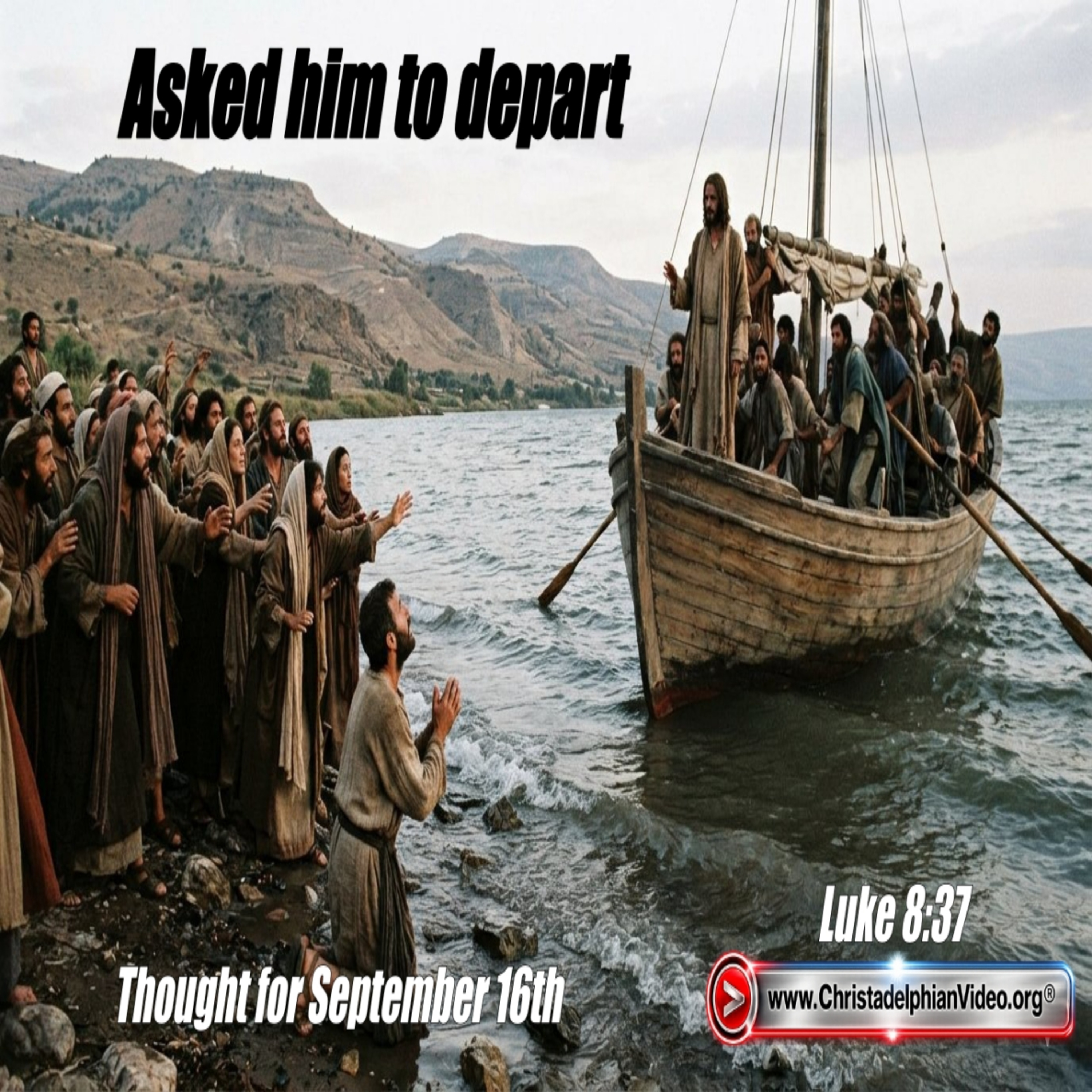 'They asked him to depart' Luke 8:37 16.09.2026 4นาทีWe read of a remarkable miracle today in Luke ch. 8., the healing of a man who had become totally deranged in mind. He was well known, owned a house and lived in the city before he became insane. Jesus did many miracles in many different ways but this healing was particularly challenging to those who knew the man and lived in his city. Jesus came to “the country of the Gerasenes and this man, in his insane state, now lived among the tombs, “When he saw Jesus, he cried out and fell down before him and said with a loud voice, ‘What have you to do with me, Jesus, Son of the Most High God?” [v.28] His insane mind led him to perceive who Jesus really was! There was nothing to be gained by Jesus explaining that such a state of mind was not caused by an ‘evil spirit’ taking over control of the mind; this belief had arisen as a result of the Greek conquest; this was what the Greeks superstitiously believed: the Old Testament shows that no such beliefs were held in earlier years.A dramatic healing occurs! The supposed ‘demons’ are ‘seen’ to be in the pigs because they madly rush down the slope and drown in the waters of Galilee. Now eating pork, even touching their carcases was ‘unclean’ under the law God gave to Moses [Lev. 11 v.7,8]; obviously those keeping the pigs had no regard for the law! The event was a challenge to the “people (who) went out to see what had happened, and they came to Jesus and found the man from whom the demons had gone, clothed and in his right mind, and they were afraid.” [v.35]Every other healing Jesus did resulted in many more to come for healings but not here! “All the people of the surrounding country of the Gerasenes asked him to depart from them for they were seized with great fear. [v.37] We suspect they were afraid of other things that might happen that would cause a further loss of livelihood. The reasons are not entirely different today for those who believe in evolution rather than a Creator who will hold them responsible for how they live their lives. Those who believe in a Creator have at least some responsibility! Recall what we read last week in Ezekiel in chapter 3. “If I say to the wicked, ’You shall sure die,” God says to Ezekiel, “and you give him no warning, nor speak to warn … he shall die for his iniquity but his blood I will require at your hand. But if you warn the wicked … you will have delivered your soul” [ch. 3 v.18,19] Any words we attempt to speak or write must be done in love. Jesus told his hearers to “love your enemies, and pray for those who persecute you.” [Matt 5 v.44]. We do not want Jesus “to depart” from us.
 -
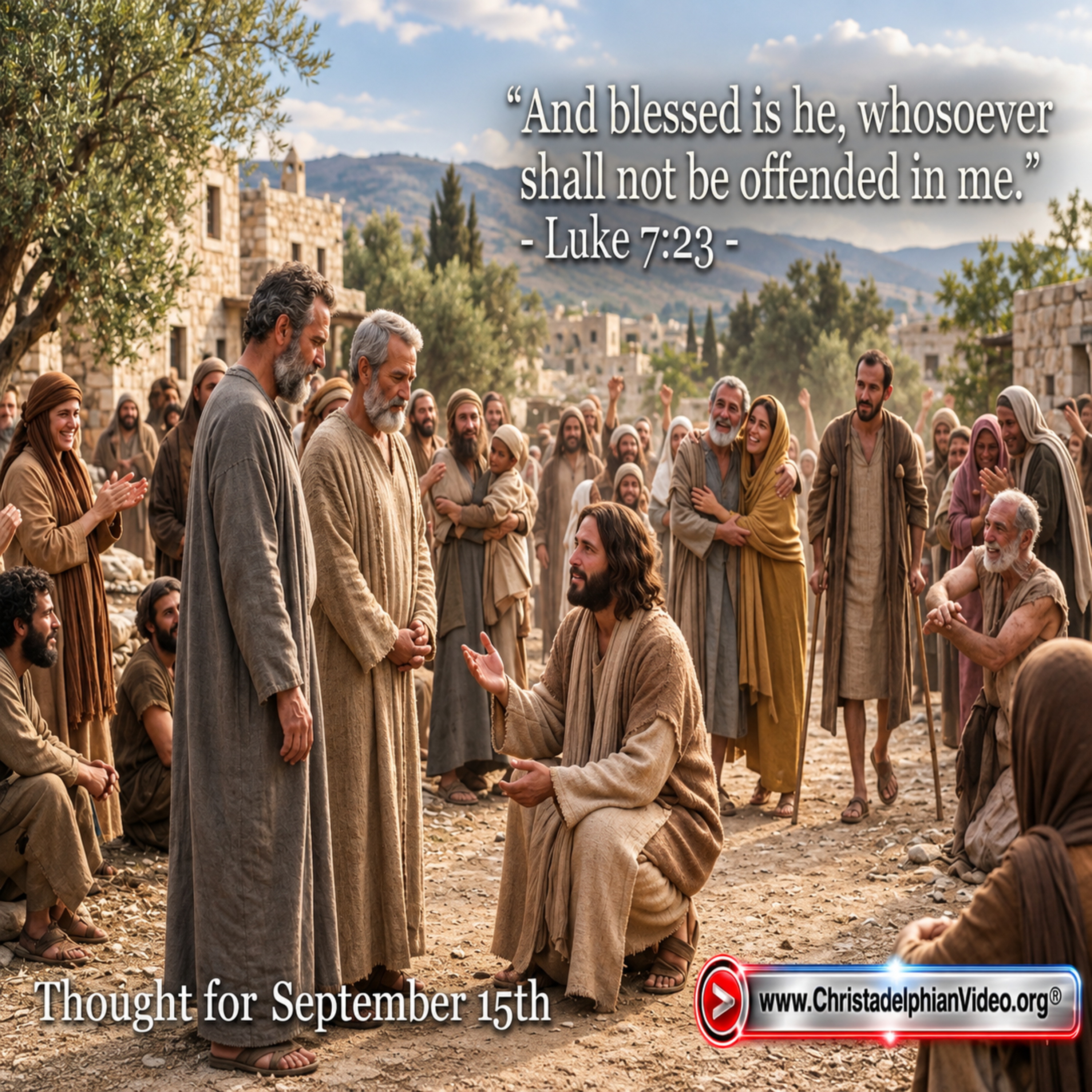 “BLESSED IS THE ONE WHO is not offended in me …” Luke 27:23 15.09.2026 4นาทีAs usual, all our chapters are full of meaningful lessons: first, Hezekiah after his life is extended 15 years is succeeded by a 12 yr old son, Manasseh who turns out to be a very bad king. We wonder about the role of Hephzibah, his mother in this. The spirituality of whom we marry is very important. Her name is apparently of Phoenician origin, meaning, ‘delight of Baal.’ Again the spirit takes Ezekiel to Jerusalem and gives him insight into God’s reaction because of his full awareness of the minds of those living there. God always has such knowledge! Awesome! Ezekiel learns, “But as for those whose heart goes after their detestable things and their abominations, I will bring their deeds upon their own heads, declares the Lord GOD.” [Ch. 11 v.21] And today?In Luke (Ch. 7) we read how messengers come to Jesus from John the Baptist. Our Lord has been doing many remarkable miracles, but when he brings to life again a young man who is being carried out to his burial, “fear seized them all, and they glorified God, saying, ‘A great prophet has arisen among us!’ and ‘God has visited his people!’ And this report about him spread through the whole of Judea and all the surrounding country. The disciples of John reported all these things to him. And John, calling two of his disciples to him, sent them to the Lord, saying, “Are you the one who is to come, or shall we look for another?” [v.16-19]The way Jesus answers him is instructive – and challenging! John evidently had certain expectations of the Messiah’s work – and what was happening did not fit these. We look back at ch. 4 and see how Jesus quoted from a scroll of Isaiah when in the Synagogue, v.17-19. It is now instructive to note how Jesus responds to these messengers, “”Go and tell John what you have seen and heard: the blind receive their sight, the lame walk, lepers are cleansed, and the deaf hear, the dead are raised up, the poor have good news preached to them. And blessed is the one who is not offended by me.” [v.22-23]He is telling John to check out and “believe all that the prophets have spoken”! These are the words of Jesus we will read in ch. 24 v.25, when, after his resurrection he speaks to 2 disciples on the road to Emmaus. This is a lesson for us as we anticipate the return of our Lord and our expectations are increasing! We must take a lesson from the quandary of John the Baptist and look to “all that the prophets” have written! Are they not like pieces of a jigsaw! We have more and more pieces that seem to fit, but there are still others we are not sure about: events yet to come, maybe very soon, will make the picture clearer and clearer.
 -
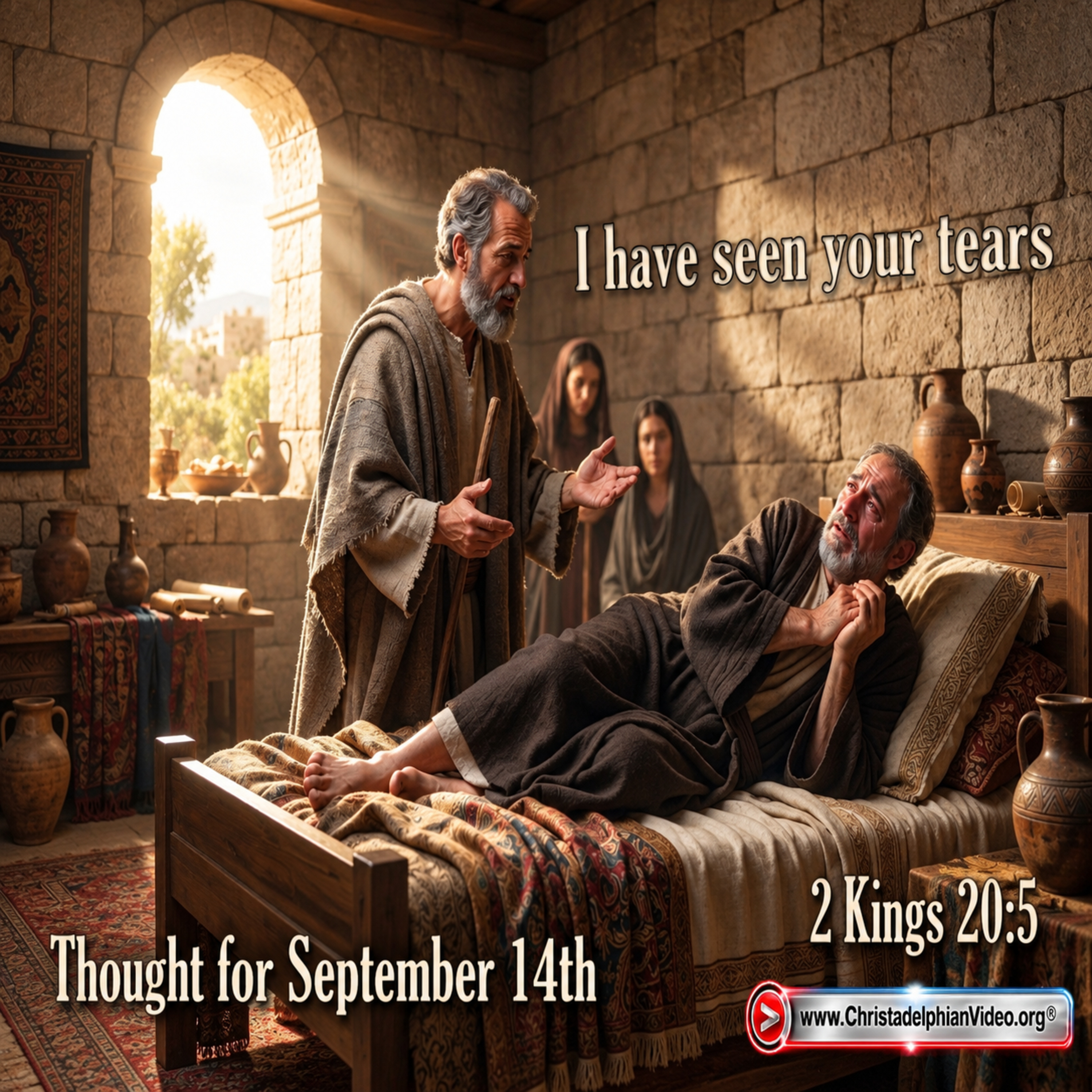 “I HAVE SEEN YOUR TEARS” (2 Kings 20:5) 14.09.2026 4นาทีWe read and thought yesterday about the anxieties of King Hezekiah over the Assyrian invasion and the potential fall of Jerusalem. The king appealed to Isaiah to seek the help of the LORD. Later he went into the Temple and “prayed before the LORD” [2 Kings 19 v.15] himself. There is a progression in his approach to God – do we have the same experience as we seek to get closer to our Creator and His Son our Saviour? It is natural that we should if we are truly spiritually minded.. Today in ch. 20 we read of Hezekiah’s illness, one that he is told, will be fatal; Isaiah comes with this message, “Set your house in order for you shall not recover” [v.1] He makes an impassioned prayer to the LORD, “I have walked before you in faithfulness and with a whole heart, and have done what is good in your sight.” [v.3] His prayer is heard and answered – “I have heard your prayer; I have seen your tears. Behold, I will heal you” [v.5] God hears and sees all things in the lives of those who truly seek to serve him. We should each meditate on whether we could utter such an impassioned prayer if we found ourselves in a life threatening situation – when we feel we still have work we can do in serving our Lord. It may not be a health situation as with Hezekiah. Our world, especially in some parts, increasingly threatens us; potentially there could be extreme difficulties. In our prayers could we say we have serve him with “our whole heart.”? This week we will read in Ezekiel how the prophet is told of God’s impending judgements, “Thus says the Lord GOD: None of my words will be delayed any longer…” [12 v.28] The time is coming, we do not know how soon, when God will be saying the same about our godless world. In Luke today we read the challenging words of Jesus, “Why do you call me, ‘Lord, Lord’ and do not do what I tell you” [6 v.46] Let us not be guilty of reading God’s word but then failing to put into practice what we read. We can talk and preach about it – and exhort each other – but this must not be only an outward show. We are all building the “house” of our life: Jesus said, “the one who hears (reads) my words … I will show you what he is like: he is like a man building a house who dug deep and laid the foundation on the rock …” [v.48] A lot of sweat and tears are involved in such earnest building: so in our building, can our Lord say to you, and me, “I have seen your tears.”
 -
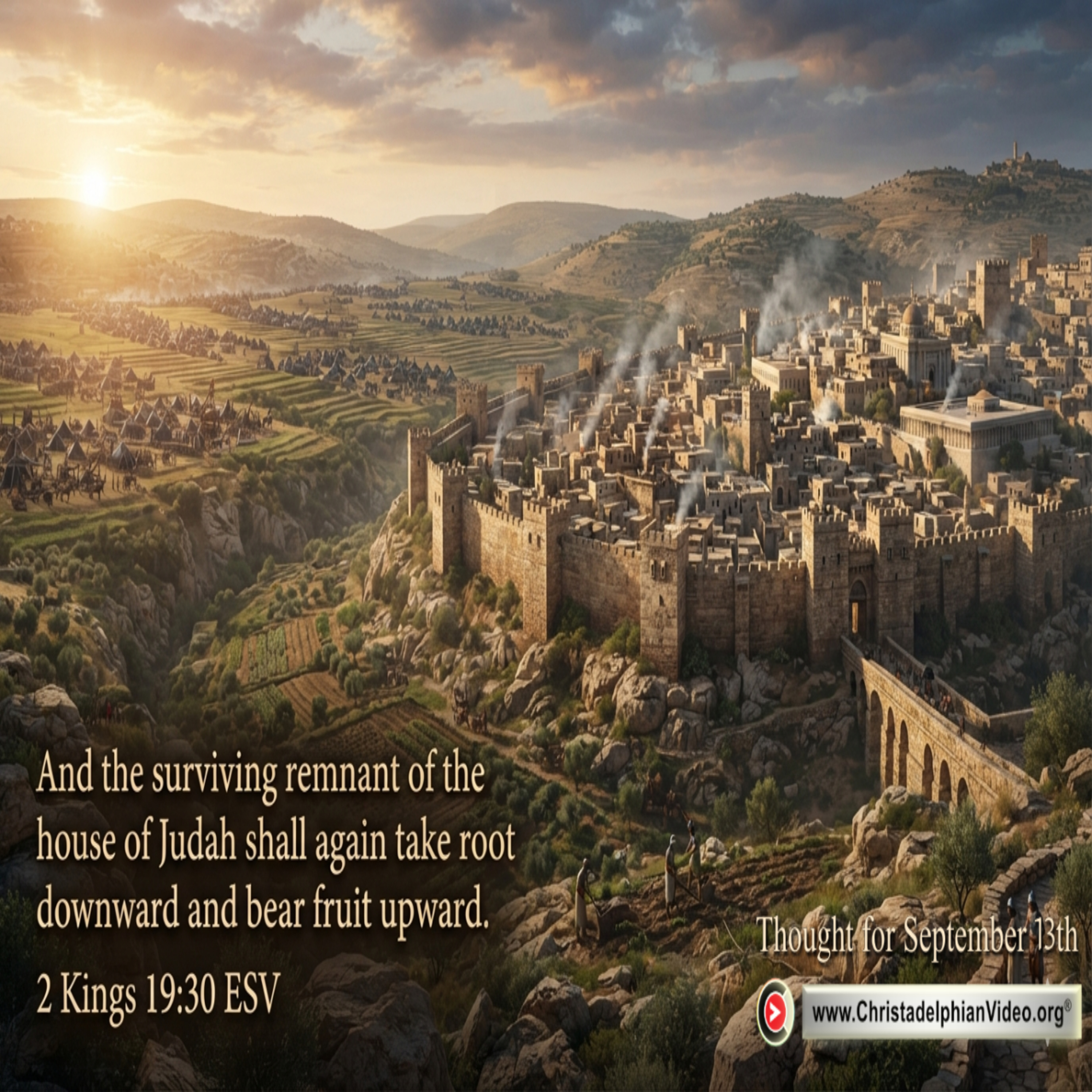 “THE SURVIVING REMNANT” 13.09.2026 4นาทีToday’s chapter 19 of 2nd Kings brings Isaiah onto the scene. King Hezekiah in his great distress at the conquests of the Assyrians and now their presence outside the walls of Jerusalem sends his secretary and senior priests to the prophet, with a message saying, “It may be that the LORD your God heard all the words of the Rabshakeh,” adding, “therefore lift up your prayer for the remnant that is left” [v.4]Isaiah’s response is very positive; “Say to your Master, ‘Thus says the LORD: Do not be afraid because of the words that you have heard with which the servants of the king of Assyria have reviled me. Behold, I will put a spirit in him, so that he shall hear a rumour and return to his own land, and I will make him fall by the sword in his own land.'” [v.6,7] This happens, but as the Assyrians depart they say, “Thus shall you speak to Hezekiah king of Judah: ‘Do not let your God in whom you trust deceive you by promising that Jerusalem will not be given into the hand of the king of Assyria. ‘Behold, you have heard what the kings of Assyria have done to all lands, devoting them to destruction. And shall you be delivered?” [v.10,11] History is full of human boasting like this, but “The word of the LORD” comes to Isaiah over this (v.21-28) that the LORD is “aware of their raging against me”[v.27] Within a generation or two the Assyrians fade into history and Nineveh is a heap of ruins to this day – the Babylonians then become the main enemy, but in time Babylon too becomes a heap of ruins, as it is today. Then Isaiah conveys a remarkable long term prophecy. “ … the surviving remnant of the house of Judah shall again take root downward and bear fruit upward. For out of Jerusalem shall go a remnant, and out of Mount Zion a band of survivors. The zeal of the LORD will do this.” [v.30,31] We witness the resilience of the “surviving remnant” today. We can read in Isaiah’s book, the prophecy the LORD gives him, how “in that day the Lord will extent his hand a second time to recover the remnant that remains of his people … and gather the dispersed of Judah from the four corners of the earth” [11 v.11,12] We are witnessing that event and are in awe of the climax when God “shall strike the earth with the rod of his mouth, and with the breath of his lips he shall kill the wicked.” [v.4] Soon, in Luke’s gospel, we will come to Jesus’ awesome words predicting this. How awesome the fate of the great Assyrian army, because they reviled God! (185,000 died – v.35) How awesome the fate awaiting at least some who do so today! Let us do the opposite. And what is the opposite?.
 -
 The Christadelphians:#22 'Walking with God' 13.09.2026 37นาที[Actual, provable Bible Truth] Walking with God is not a single moment of decision but a lifelong journey of faith. Salvation is a process—from being a servant of sin to becoming a son of God—and it is completed only at the return of Christ, when the faithful are granted immortality. This is the powerful, scriptural reality that transforms everyday life into a pilgrimage towards the Kingdom.This thought-provoking and expositional video, Chapter 22 of our series on the Philadelphiaians, delves deep into the nature of discipleship. It explores what it truly means to "walk with God," using the lives of Enoch and Noah as our foundation. We unpack the profound truth that the disciple is a sojourner, a traveler following the narrow way, with the Bible as our infallible compass.The journey is marked by both wonderful peace and purposeful testing. We explore how the "peace of God which passes all understanding" coexists with the "tribulation" that shapes our character for eternity. This outstanding presentation reveals that our trials are not punishments but the divine refining fire, preparing us for the Kingdom.Through constant prayer, daily reading of the whole Bible, and a humble submission to God's will, we find the strength to endure. The video also highlights the inseparable link between the Old and New Testaments, showing the unity of God's plan from Genesis to Revelation. It is a reassuring and challenging call to examine our own walk and to hold fast to the hope set before us.**Chapters:**00:00 - Introduction: The Journey of Salvation01:50 - The Process: From Servant to Son02:48 - The Pilgrim Aspect: Walking with God03:08 - Scriptural Examples: Enoch and Noah05:45 - Guidance: The Path and the Signposts07:43 - The Bible: Our Traveller's Compass10:13 - The Whole Council of God13:49 - God's Personal Care and Protection17:05 - The Conditions for Blessing20:20 - Peace, Joy, and Abiding Assurance23:16 - The Refining Fire: Trials and Character27:54 - The Divine Order of Progression30:57 - God's Faithfulness in Temptation32:05 - The Power of Prayer35:41 - Conclusion: Our Anchor of Hope**Bible Verse Category:**📖 Romans 2:7 & 16📖 1 Corinthians 1:18📖 Genesis 5:22-24, 6:9, 17:1📖 Micah 6:8📖 Psalm 23:4, 119:105📖 2 Timothy 3:15-17📖 John 14:21-23, 10:27-29📖 2 Corinthians 4:17-18, 6:16-18📖 Hebrews 12:5-11, 13:5-6📖 James 1:2-4, 12📖 Romans 8:28, 35-37📖 Hebrews 6:18-20Tags: Christadelphian, Walking with God, Bible Study, Discipleship, Salvation, Biblical Truth, Faith Journey, Christian Living, Bible Reading, Prayer, Tribulation, Kingdom of God, Scriptural Exposition, Bible Verses, Philadelphiaians, Christian Doctrine, Hope, FaithWe are a Christadelphian team, Brothers and sisters of Christ, and we're passionate about delivering powerful, Scripture-based content to strengthen and inspire your faith journey. If this presentation resonated with you, help spread the encouragement—share it with a friend today!
 -
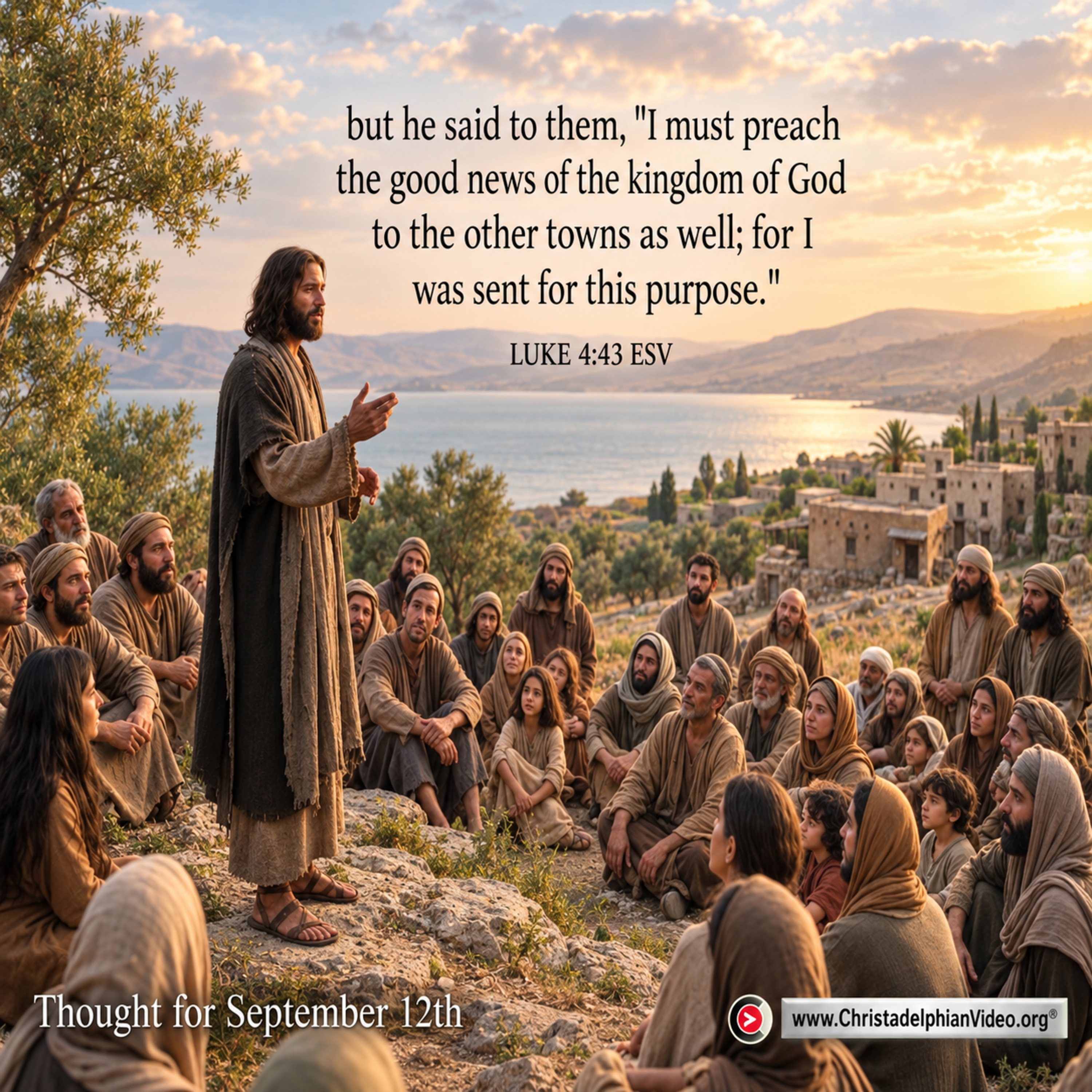 “THE GOOD NEWS OF THE KINGDOM” 12.09.2026 4นาทีHow hard it is to hear or find any “good news” these days! All nations and kingdoms appear to be in disarray especially in the Middle East, only Israel stands firm. The nations think that their destiny is entirely in their own hands, but God’s purpose is being worked out and dedicated Bible students diligently watch events trying to see more clearly how the various prophecies apply. We read in 2 Kings 18 of the faith of the good king Zedekiah in Jerusalem, standing firm against the boasting of the invading Assyrians (which is called Iraq is today). We will read tomorrow of how the prophet Isaiah comes on the scene and, through God’s spirit, sees and says what God will cause to happen because Hezekiah is a spiritually minded king.In contrast, the prophet Ezekiel (ch.8) is caused to be carried in vision to Jerusalem and made aware of the abominations taking place in the Temple; for him, it is the opposite kind of news of what will soon happen! Ezekiel is told that God is so angry that, when trouble comes, “though they cry in my ears with a loud voice, I will not hear them.” [v.18]In Luke’s gospel (ch.4) we read how Jesus travels to many places and heals many, and “the people sought him and came to him, and would have kept him from leaving them, but he said to them, ‘I must preach the good news of the kingdom of God to the other towns as well; for I was sent for this purpose.” [v.42,43] Those who really listened were few, most were fascinated by seeing miracles or being miraculously fed but the really important work of Christ was proclaiming, “The good news of the kingdom of God.” This was not as many have imagined over the centuries up until today – a ’sky kingdom’ but, as in the ‘Lords’ prayer, ‘Thy will be done on earth” – What wonders “Isaiah … saw … it shall come to pass in the latter days … the house (temple) of the LORD shall be established … and all nations shall flow to it …” [Isaiah 2 v.1,2] Jesus came to bring this wondrous message of God’s ultimate purpose for the earth – to happen when he returns. Let us ever more surely make this our hope and expectation and share it with anyone who will listen.
 -
 Why does God allow suffering? 11.09.2026 43นาทีA @Christadelphians Video:Pleased to present in collaboration with the Bible Unlocked team, this thought-provoking presentation from the sixth season of Bible Unlocked Live, A foundational series, “Why You Should Believe the Bible,” revealing how faith is built on a rock-solid foundation of evidence and reason. They hold a webinar each week....Find out more @ https://www.bibleunlocked.com/ [Inspiring] Why does a loving God allow suffering? It’s one of the most profound and emotionally challenging questions of the human experience. In this thought-provoking and insightful exposition, we delve into the Bible’s honest and comprehensive answer to this age-old dilemma. We explore with Caleb Osborn how Scripture does not shy away from this topic; instead, entire books like Job, Ecclesiastes, and Lamentations are dedicated to wrestling with pain and loss. We examine the origin of suffering in Genesis, its three key purposes in our lives today, and the profound truth that God is not distant from our pain. Most importantly, we look forward to the wonderful hope of Revelation, where God promises to wipe away every tear and eliminate suffering forever.This is an outstanding and revealing study that provides real comfort and a scriptural framework for understanding our trials.*Chapters:*00:00 - Introduction: The Challenge of Suffering02:10 - The Bible Doesn't Shy Away from the Question04:00 - The Origin of Suffering (Genesis 3)07:00 - Purpose #1: To Expose the Effects of Sin09:30 - Purpose #2: To Highlight Our Need for God12:00 - Purpose #3: To Develop Faithful Character14:20 - God’s Empathy: He is Afflicted with Us16:00 - Jesus: Our High Priest Who Understands18:30 - The End of the Story: No More Curse20:40 - Q&A: Sin, Suffering, and Repentance24:00 - Q&A: Jesus Felt Forsaken (Psalm 22)27:00 - Q&A: The Hope of the Kingdom29:00 - Conclusion*Bible Verses Referenced:*📖 Genesis 3:16-19📖 Romans 6:21📖 Psalm 107:10-13📖 Romans 8:20-22📖 Romans 5:3-5📖 Hebrews 12:11📖 1 Peter 1:6-7📖 Isaiah 63:9📖 Hebrews 4:15📖 Revelation 21:3-4📖 Revelation 22:3📖 Luke 13:1-5📖 Psalm 22:1, 24📖 Hebrews 2:9-10*Tags:*Bible study, why does God allow suffering, problem of evil, Christadelphians, Bible teaching, book of Job, Genesis 3, Romans 8, Christian apologetics, faith under trial, hope in suffering, purpose of pain, God's love, Kingdom of God, Bible explanation, scripture studyWe are a Christadelphian team, Brothers and sisters of Christ, and we're passionate about delivering powerful, Scripture-based content to strengthen and inspire your faith journey. If this presentation resonated with you, help spread the encouragement—share it with a friend today!
 -
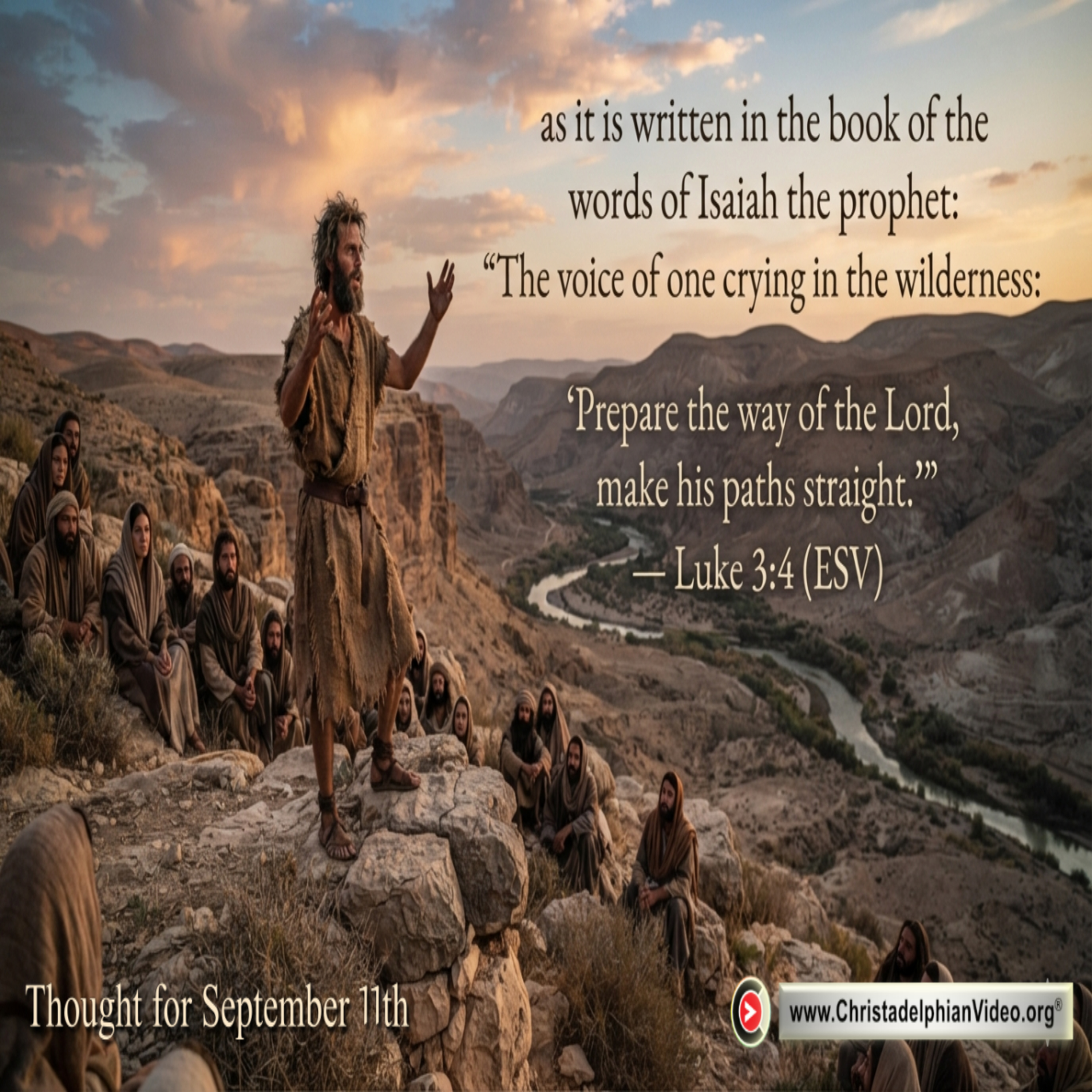 “CRYING IN THE WILDERNESS” 11.09.2026 4นาทีThe world is a spiritual wilderness today. We read today of when John the Baptist appeared on the scene and that he was a “voice crying in the wilderness” [Luke 3 v.4] – it was a spiritual wilderness then too, there had been no prophet from God for about 400 years – since the days of Malachi. Today there has been no message from God that people have taken serious notice of since the Bible was translated and printed and became available in all major languages, this was at least 400 years ago. People “listened” to God’s “voice” then and the world underwent a spiritual reformation; but deafness set in again more and more with each generation until today, nearly all are totally ‘deaf.’We saw significant parallels in our Ezekiel reading (ch.7) today. The 10 northern tribes that made up the kingdom of Israel, as distinct from Judah in the south, had become so wicked that they were all in the process of being taken away into captivity: the southern kingdom was soon to follow. However, God’s words through Ezekiel, could be his words to the great majority today. It seems no one was listening to Ezekiel – and it’s the same today, so few are seriously listening.“Behold the day! Behold it comes! Your doom has come” [v.10] wrote Ezekiel, adding, “Violence has grown up into a rod of wickedness” [v.11] He continues, “The time has come; the day has arrived. Let not the buyer rejoice, nor the seller mourn, for wrath is upon all …” [v.12] “When anguish comes they will seek peace, but there shall be none. Disaster comes upon disaster….” [v.25,26] Thankfully, wonderfully, there is an end coming to the disasters that will surely multiply in today’s world’. Those who know God’s word and have established a relationship with him, will know where to “seek peace” and that “the prince of peace” will return “and the government shall be upon his shoulder” [Isa. 9 v.6] and “the wilderness” will be no more – but only those who have heard (by reading and thinking and believing) “the voice crying in the wilderness” will experience the everlasting wonders that “that day” will bring. Are you listening? What effect is it having on your heart?
 -
 The Canadian C-9 Bill what it means for Christians with Bible Scholar Ted Hodge. 10.09.2026 10นาทีA @Christadelphians Video: [Prophecy being fulfilled!] In this thought-provoking and revealing episode of the Watchman Report, we examine Canada’s Bill C-9—a law that, on the surface, addresses rising anti-Semitism, yet in reality places believers in a more precarious position. Could this be another sign that secular society is moving further from God, Christ, and the Bible? We provide an insightful and expositional analysis of this legislation, exploring how the removal of the religious defence for "wilful promotion of hatred" could potentially criminalise the very expression of biblical truth. This is an outstanding and wonderful resource for those seeking to understand how current events align with scriptural prophecy.*Summary*Join us as we dissect the Canadian government's Bill C-9, which came into effect in July 2026. While it includes positive steps to combat anti-Semitism, we reveal the alarming removal of the "good faith" religious defence. We discuss the ambiguity of new definitions like "detestation" and "vilification," and ask the crucial question: does this law threaten the believer's ability to publicly declare the whole counsel of God? We break down the biblical standard on hate, demonstrating that God hates wickedness while still loving the sinner, and we challenge the government's narrowing of what constitutes acceptable speech. This is essential viewing for every Bible student.*Chapters*00:00 - Introduction & The Watchman Report Mandate00:46 - Examining Bill C-9: The Good and the Bad01:39 - New Hate Crime Offences Listed02:19 - The Removal of the Religious Defence03:10 - The Government’s New Definition of Hatred04:23 - Applying the Law: Leviticus 20:1305:46 - The "Hallmarks of Hate" Examined07:19 - The Scriptural Teaching on Hate08:36 - Government Position & The Believer's Response09:48 - Conclusion & Call to Action*📖 Bible Verse Category*- 📖 Leviticus 20:13 – The scripture dealing with abomination.- 📖 Psalm 5:5 & 11:5 – God hates wickedness and the wicked.- 📖 Psalm 139:21-22 – The believer’s hatred of evil.- 📖 Matthew 5:44-45 – Loving our enemies.- 📖 John 3:16 – God’s love for the world.**Tags**Bible Prophecy, Bill C-9, Canada, Religious Freedom, Hate Speech Laws, Christadelphian, Watchman Report, Biblical Standard, Prophecy Fulfilled, Secularism, Christian Persecution, End Times, God’s Law, Truth, Bible StudyWe are a Christadelphian team, Brothers and sisters of Christ, and we're passionate about delivering powerful, Scripture-based content to strengthen and inspire your faith journey. If this presentation resonated with you, help spread the encouragement—share it with a friend today!
 -
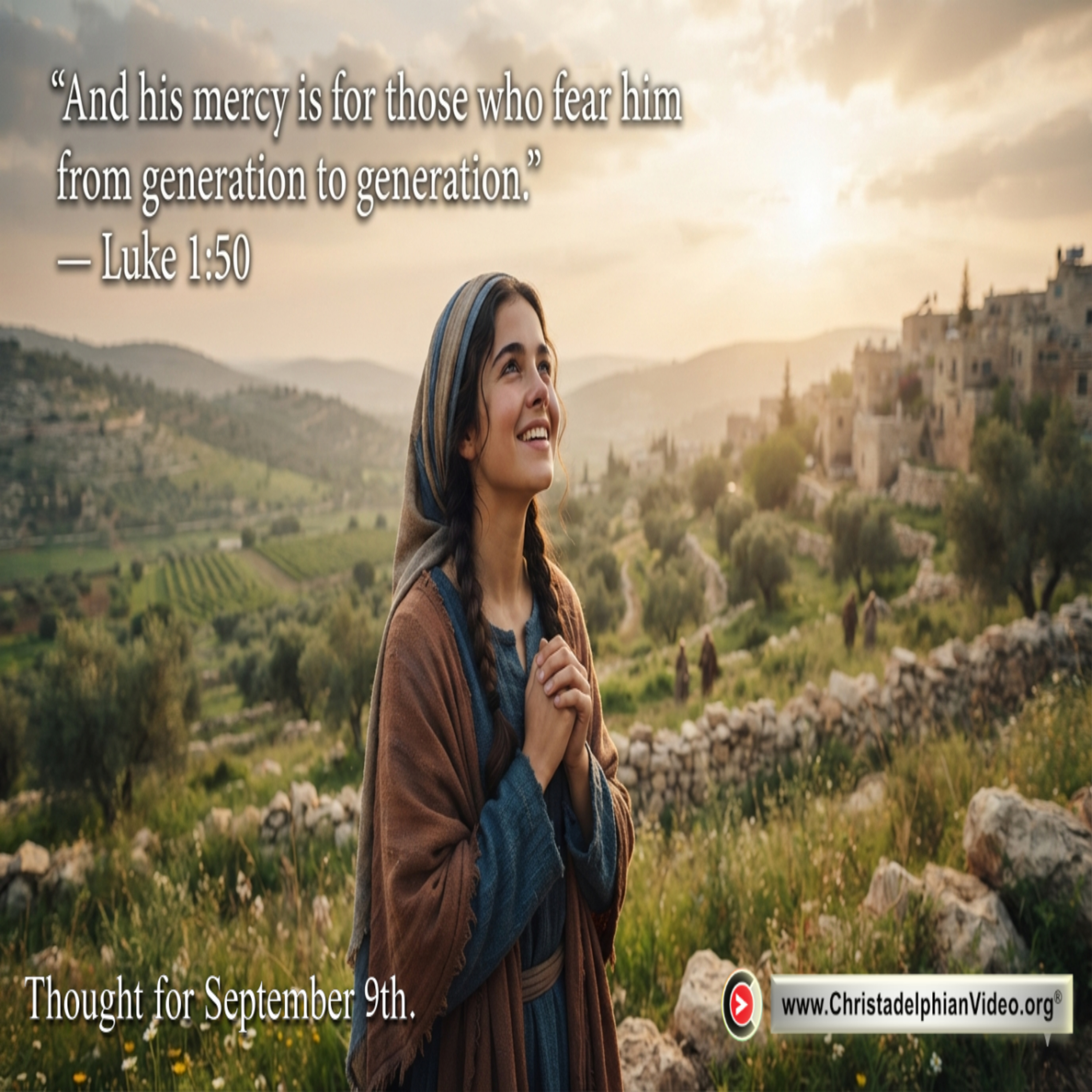 Thought for September 9th. “HIS MERCY IS FOR THOSE WHO …” 09.09.2026 4นาทีWhat a depressing account we have today in 2 Kings 15! It lists a succession of godless kings in the northern kingdom of Israel and makes us think of the world in which we live! If we listen to or watch the news – there is a complete lack of good news on every hand – so it seems that people ‘bury’ their minds in the sports news. Similarly, in Ezekiel 5, we read the acted parables the prophet has to perform to indicate how “fire will come out into all the house of Israel” [v.4] and the LORD’s comment in v.13, “Thus shall my anger spend itself, and I will vent my fury upon them …” And we meditate with awe and fear in our minds on the ways the Creator will vent his fury more and more on the utterly godless world of the 21st Century.In contrast, it is uplifting to read the 80 verses of the first chapter of Luke. The author says that “it seemed good to me … having followed all things closely for some time past to write an orderly account … that you may have certainty …” [v.3,4] Through Luke’s writings, we, in these last days, “may have certainty” too! After compiling his gospel Luke put together an orderly account of the Acts of the Apostles after their Lord ascended to heaven. This contained so many historical references that the sceptics of the 19th and 20th Centuries were sure they would uncover flaws in Luke’s records as more and more ancient details came to light through archaeological and other discoveries – but none have come to light! What Luke has recorded includes major planks for the foundations of our faith.Today’s chapter includes the testimony of Mary before Jesus was born, she was inspired to say how her “spirit rejoices in God my Saviour” and that “his mercy is for those who fear him” [v.47,50]. May we truly rejoice and “fear him” – that is – be in awe of him. We especially pray that we may experience his mercy and gain strength from him as our godless world disintegrates more and more in coming days, months and years – if years yet remain? We are going to have a need to even more earnestly take to heart the words of the Master, “and when you hear of wars and tumults, do not be terrified, for these things must first take place …” [Luke 21 v.9] May we all fully realise and know in our hearts that “his mercy is for those who fear him – but who learn – not to fear the world!
 -
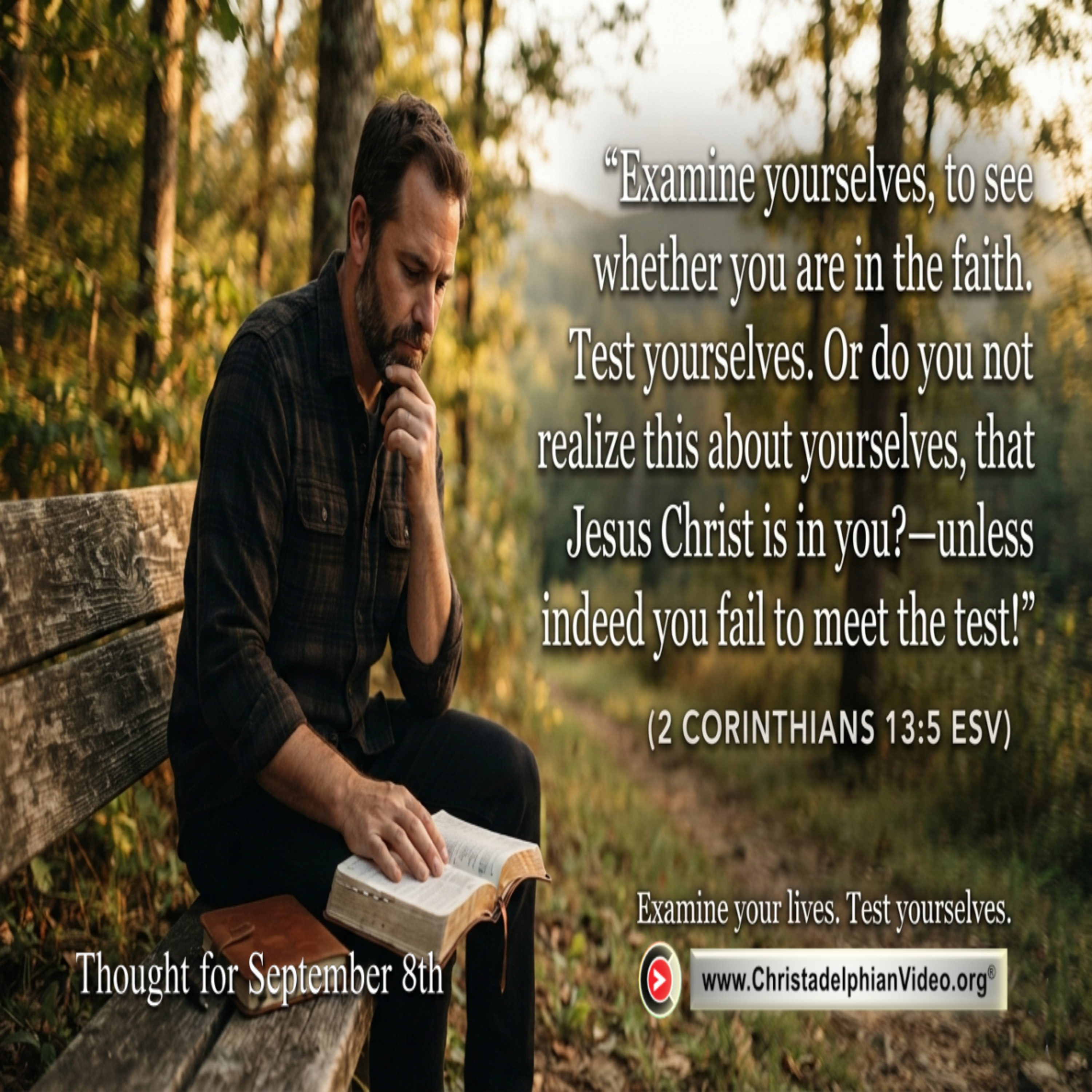 Thought for September 8th. “EXAMINE YOURSELVES … TEST YOURSELVES” 08.09.2026 4นาทีToday we completed reading Paul’s second letter to the believers at Corinth; he is still anxious about them, his letter expresses many concerns. Let us recognise that correcting faults in our life in Christ is a personal responsibility. The concept of endless ‘grace abounding’ that exists among many who see themselves as Christians is dangerous. Let us carefully note the points Paul makes as he brings his letter to a conclusion. “Examine yourselves, to see whether you are in the faith” [13 v.5]. And so also must we. Let us fully realize that Christ, by his spirit, is present among believers and sees their actions, knows their minds and that this knowledge will be the ‘foundation’ for his right judgment on the day of judgment. Paul is developing the points he made in his first letter when he said, “Let a person examine himself … and so eat … and drink” [1 Cor. 11 v.28] when he or she comes to the table of remembrance to have fellowship. This self-examination is not only when we come together to the table of the Lord; in v.3 of this last chapter Paul stresses, “Christ is … not weak … but is powerful among you.” Christ sees their thoughts and actions (and, of course, ours). Paul stresses the need to, “Test yourselves. or do you not realize this about yourselves, that Jesus Christ is in you? – unless you fail to meet the test.” [v.5] Let us realize the sense he is “in us – and that we meet all the tests the ungodly world around us, puts on us.?When we were baptised we entered into a wonderful spiritual relationship with him, we were no longer our own; Paul expressed his own feeling to the Galatians, “It is no longer I who live, but Christ who lives in me.” [2 v.20]. Let us realize the reality of this, our Saviour is watching over us, this is both wonderful and awesome. Paul completes his message to the Corinthians by writing; “finally brothers (& sisters) Rejoice … comfort one another, agree with one another, live in peace, and the God of love and peace will be with you.” [v.11] It is the same today, our “peace” and teamwork together, means we will also fully have divine fellowship: remember Jesus said, “where two or three are gathered in my name, there am I among them.” [Matt 18 v.20] How wonderful! It is beyond our human comprehension. Let us appreciate the full meaning of the final verse of Paul’s letter, “The grace of the Lord Jesus Christ and the love of God and the fellowship of the Holy Spirit be with you all” Let us try ever harder to sense that “fellowship” as we “EXAMINE” and “TEST OURSELVES” every day.
พอดแคสต์ที่คล้ายกัน


ยอดนิยมใน
พอดแคสต์นี้ปรากฏในชาร์ตพอดแคสต์ของประเทศเหล่านี้ด้วย
