
The Data Flowcast: Mastering Apache Airflow ® for Data Engineering and AI
Astronomer
0
The Data Flowcast is a podcast dedicated to Apache Airflow, a workflow management system for data engineering and AI. Each week, the show explores the current state, future, and potential of Airflow with leading thinkers in the community. It provides insights on how to leverage Airflow to meet the evolving needs of data engineering and AI ecosystems. The podcast is produced by Astronomer, a company specializing in Airflow solutions.
Епізоди
-
 Orchestrating local LLMs for sensitive data with Airflow 01.10.2026 26хвRunning LLMs over sensitive data means external APIs are off the table, but open-weight models still need reproducibility, validation, and a paper trail before downstream systems can depend on their output. In this episode, Kenten is joined by Chhayank Jain, Senior ML Engineer at Visa, to talk through how Airflow orchestrates local LLM pipelines end to end: nightly inference over millions of records, silent failure handling with Pydantic and distribution checks, and using a separate DAG to manage LoRA fine-tuning cycles.Key Takeaways:00:00 Introduction.01:47 From modeling to pipelines. Chhayank shares how leading a readmission risk model across hospitals with different EHR systems turned him into a "pipeline person."03:14 Day-to-day as an LLM engineer. Serving with ONNX Runtime, failure design, and agentic tooling with LangGraph. The model is only about one-fifth of the work.05:03 The sensitive data problem. Why hosted LLM APIs are off the table for PHI and payments data, and why the real challenge is running Llama 3 nightly with enough checks that downstream models can trust the output.07:34 Where Airflow fits. Sensors per site, dependency ordering, retries and backfills, and run records as the "paper trail" for audits.10:03 DAG structure. Four stages: ingest and normalize, inference on GPU pods via the KubernetesPodOperator, validation, and load to the feature store.12:32 Loud vs silent failures. OOM kills and timeouts are easy. Silent failures where the output looks clean but is wrong are the scary category, handled with Pydantic schemas, cross-checks against structured records, and distribution monitoring.16:45 LoRA fine-tuning in its own DAG. A separate monthly or quarterly DAG pulls labeled data, fine-tunes with Hugging Face PEFT on top of Llama 3, and only writes a new adapter if it beats the frozen holdout.20:33 Hardest production lessons. Pin everything (model version, temperature, features, seed), match parallelism to GPU capacity, and invest in traceability so you can answer "which adapter produced this row" six months later.23:00 Airflow wishlist. First-class GPU awareness so teams stop reinventing it through pools and queues, and treating model versions as Airflow assets.Resources Mentioned:- Annual Airflow survey- Airflow Summit talk: From Hours to Minutes: Orchestrating Local LLMs for Sensitive Data Pipelines with Apache Airflow- Llama 3- Hugging Face PEFT- ONNX Runtime- LangGraph- PydanticThanks for listening to "The Data Flowcast: Mastering Apache Airflow® for Data Engineering and AI." If you enjoyed this episode, please leave a 5-star review to help get the word out about the show. And be sure to subscribe so you never miss any of the insightful conversations.#AI #Orchestration #Airflow
 -
 Improving security in Airflow 3 24.09.2026 22хвSecurity is one of the least visible parts of Airflow for most users, but it shapes what features teams can turn on in production. In this episode, Kenten Danas talks with Anish Giri, Senior Software Engineer and active Apache Airflow contributor focused on security, about three recent contributions that touch nearly every Airflow 3 deployment: hardening connection testing, adding JWT revocation, and splitting execution tokens by scope.Key Takeaways:00:00 Introduction.01:16 Anish's inside-out path into Airflow, starting from source code and docs rather than running pipelines in production.03:13 Why security engineering flips the usual software question from "what can this do?" to "what can anyone make this to?"04:49 How connection testing worked before, why it was disabled in Airflow 2.7 after a CVE, and how the redesign moves execution off the API server.06:26 Running connection tests on the worker in Airflow 3 so credentials never leave the API server boundary.07:50 What the mailing list and architecture review looked like, including a first-round rejection and eventual consensus.10:00 The JWT logout problem in Airflow 3 and the revocation table that makes logout an actual logout.13:12 A production incident with a GPU pipeline task hitting 403 after 15 minutes, and why it required splitting the token in two.15:41 How the workload token and the auth token now have different lifetimes and scopes, tied to the task queue timeout.19:53 Advice for new Airflow contributors: start small, don't fear the PR review, and treat feedback as mentorship.Resources Mentioned:Annual Airflow surveyApache AirflowAirflow on GitHubAirflow SlackAnish Giri at Airflow SummitThanks for listening to "The Data Flowcast: Mastering Apache Airflow® for Data Engineering and AI." If you enjoyed this episode, please leave a 5-star review to help get the word out about the show. And be sure to subscribe so you never miss any of the insightful conversations.#AI #Orchestration #Airflow
 -
 Orchestrating data across 30 companies at itti 17.09.2026 19хвOrchestrating data across more than 30 companies means most Airflow users on the platform aren't data engineers. In this episode, Kenten Danas talks with Lucas Trubiano, Data Engineer at itti, the technology company within Grupo Vázquez in Paraguay. Lucas walks through the custom YAML framework his Center of Excellence built on top of Airflow, how they baked data quality and custom operators into it, and how a spec-driven AI workflow now lets product and business users contribute to templates without knowing Python.Key Takeaways:00:00 Introduction.01:47 What itti and Grupo Vázquez do, and the Data Engineering Center of Excellence's mandate to build a 360-degree view of the customer across more than 30 companies.02:56 How Airflow fits in as a central task orchestrator (not a processing engine) across around 300 production DAGs.04:25 Managing enterprise-scale Airflow: preferring Airflow-as-a-service, plus enabling self-service for non-technical users through YAML.05:44 Why itti built a second, more opinionated YAML framework after DAG Factory-style customization created a code review bottleneck.07:14 More than 80% of new DAGs are now created with the new framework because it's simply faster.07:54 How the framework works end to end: Python DAGs, Jinja templates, YAML configs, and CI/CD compilation.09:10 A Google Sheets ingestion example that shows how prevalidation, download, and processing tasks are hidden behind a simple YAML config to preserve reliability.10:14 Building an in-house data quality tool that tests per partition instead of full-scanning tables, triggered via custom Airflow operators.11:17 Custom operators for dbt, the in-house data quality tool, and AWS services like QuickSight dashboard refreshes, and how OSS Airflow makes them portable across instances.15:35 Spec-driven development with a fork of GitHub Spec Kit so business users can describe what they want and let agents generate DAGs against certified templates.17:24 Slack-native error routing: every DAG has an owner team, common errors ship with explanations, and only deep issues escalate to the central team.19:29 Where they're heading next: agent-triggered pull requests for self-healing pipelines.20:22 Airflow 3 wishlist: backfill improvements, event-driven orchestration for streaming pipelines, and Human in the Loop for generative AI DAGs.Resources Mentioned:Apache AirflowApache SparkDAG FactoryGitHub Spec KitThanks for listening to "The Data Flowcast: Mastering Apache Airflow® for Data Engineering and AI." If you enjoyed this episode, please leave a 5-star review to help get the word out about the show. And be sure to subscribe so you never miss any of the insightful conversations.#AI #Automation #Airflow
 -
 Building self-healing Airflow pipelines at ATC Drivetrain 10.09.2026 27хвManufacturing data pipelines can't afford silent failures. When quality decisions and shop-floor visibility depend on Airflow, a broken DAG at midnight can cost real money. In this episode, Kenten Danas talks with Kumuda Sreenivasa, Founder of Receitly and Senior Data Architect at ATC Drivetrain, about how her team built self-healing Airflow pipelines, where AI fits into the recovery loop, and how they orchestrate AI agents as governed workflow components.Key Takeaways:00:00 Introduction.02:29 How ATC Drivetrain uses Airflow across thousands of DAGs to orchestrate ETL/ELT jobs, data quality checks, and production reporting for a complex automotive remanufacturing environment.04:08 Defining self-healing: pipelines that identify a known failure, decide whether they can recover safely, execute an approved action, and validate the result, all without paging an engineer.07:03 The five-layer self-healing architecture: observe, classify, policy, recover, and validate.10:00 Where AI fits in the recovery loop: classification, context gathering, and recommendations, but never bypassing operational policies or approval steps.13:00 A concrete before/after: a currency-exchange failure caught overnight by AI-assisted recovery that saved four hours of downtime and roughly 120K.14:27 Confidence levels and success rates: about 95% of small failure modes recover on their own.15:34 AI-assisted troubleshooting at scale: how contextual log analysis and recommended actions save engineers from digging through thousands of log lines.20:13 Orchestrating AI agents through Airflow: treating agents as bounded, governed workflow components with human approval and confidence-based stop conditions.23:45 What Kumuda wants next from Airflow: stronger AI agent governance, standardized tracking of prompts and tool calls, and more flexible event-driven execution.Resources Mentioned:Orchestrate EverythingApache AirflowATC DrivetrainThanks for listening to "The Data Flowcast: Mastering Apache Airflow® for Data Engineering and AI." If you enjoyed this episode, please leave a 5-star review to help get the word out about the show. And be sure to subscribe so you never miss any of the insightful conversations.#AI #Automation #Airflow
 -
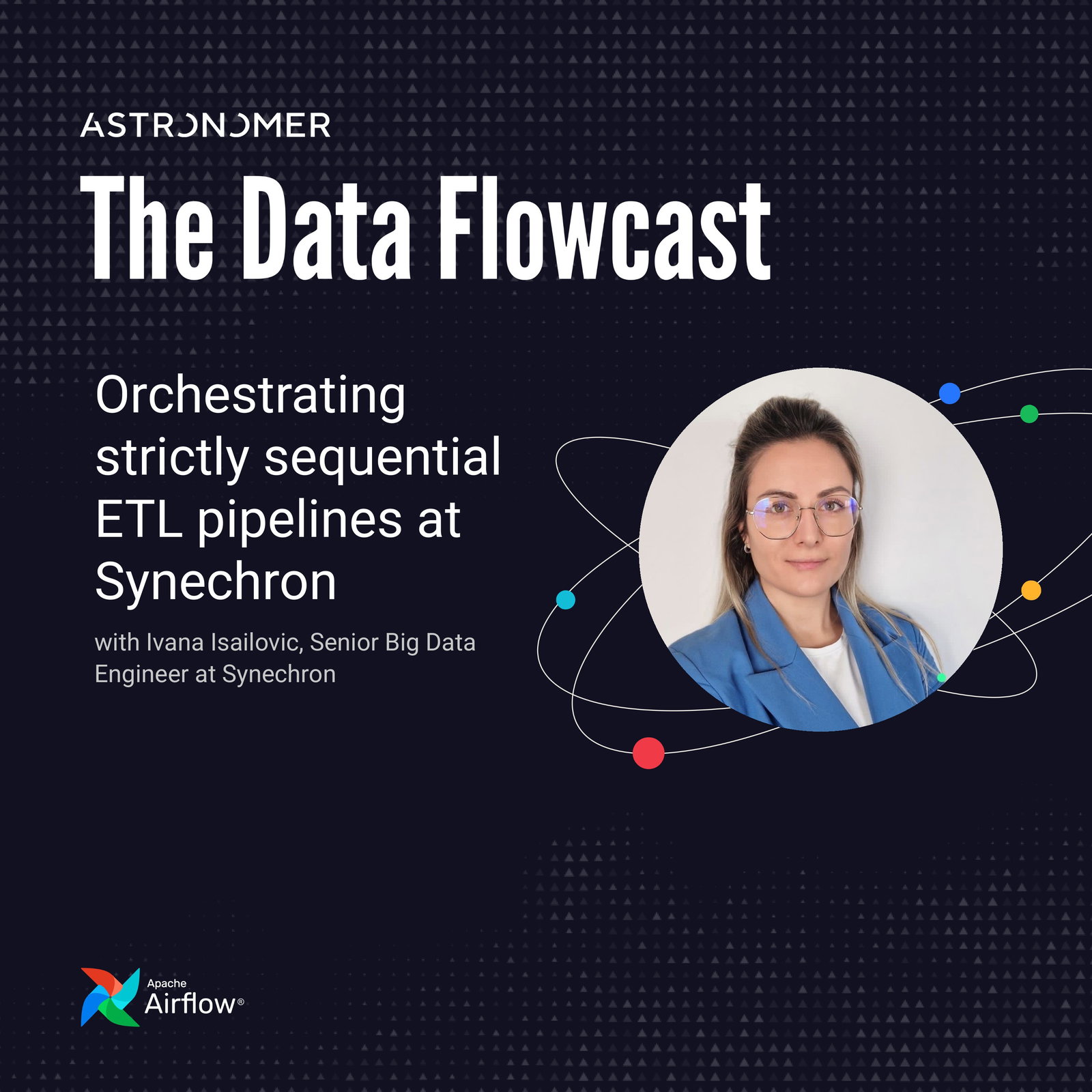 Orchestrating strictly sequential ETL pipelines at Synechron 03.09.2026 24хвStrict sequential execution across DAGs sounds simple until you have scheduled pipelines and event-driven pipelines writing to the same MongoDB collections. Ivana Isailovic, Senior Big Data Engineer at Synechron, joins Marc Lamberti to walk through the three-layer DAG architecture her team built to solve exactly that, plus how they generate 200-task DAGs and how they rebuilt subdag-style group retries in Airflow 3.Key Takeaways:(00:00) Introduction.(02:16) The stack: Snowflake source, MongoDB with a medallion (bronze, silver, gold) layout, Spark for processing, Airflow for orchestration, Elasticsearch for reports.(05:29) Why standard Airflow options (max active runs, pools, dependency setups) each solved only part of the problem.(06:40) Data consistency across bronze, silver, and gold layers is what forced strict sequential execution.(09:11) Scheduled DAGs versus event-driven DAGs triggered at any moment from the application side.(10:04) The three-layer architecture: trigger DAGs, a single proxy DAG that controls the queue, and main ETL DAGs.(12:00) The queue is literally another DAG. The proxy DAG allows only one active run and serializes everything behind it.(15:13) 200-task DAGs generated from nested task groups and YAML configuration files, with DAG versions tied to release numbers.(17:38) How the layers talk to each other: sensors and TriggerDagRunOperator.(19:44) Migrating from subdags to task groups without losing the ability to retry a whole group.(21:49) Airflow 2.9 approach: reset task instance state via the metadata DB, keyed off the task group identifier.(23:13) Airflow 3 approach: move the retry logic onto the official REST API for stability, security, and maintainability.Resources Mentioned:Orchestrate EverythingApache AirflowSnowflakeMongoDBApache SparkElasticsearchThanks for listening to "The Data Flowcast: Mastering Apache Airflow® for Data Engineering and AI." If you enjoyed this episode, please leave a 5-star review to help get the word out about the show. And be sure to subscribe so you never miss any of the insightful conversations.#AI #Automation #Airflow
 -
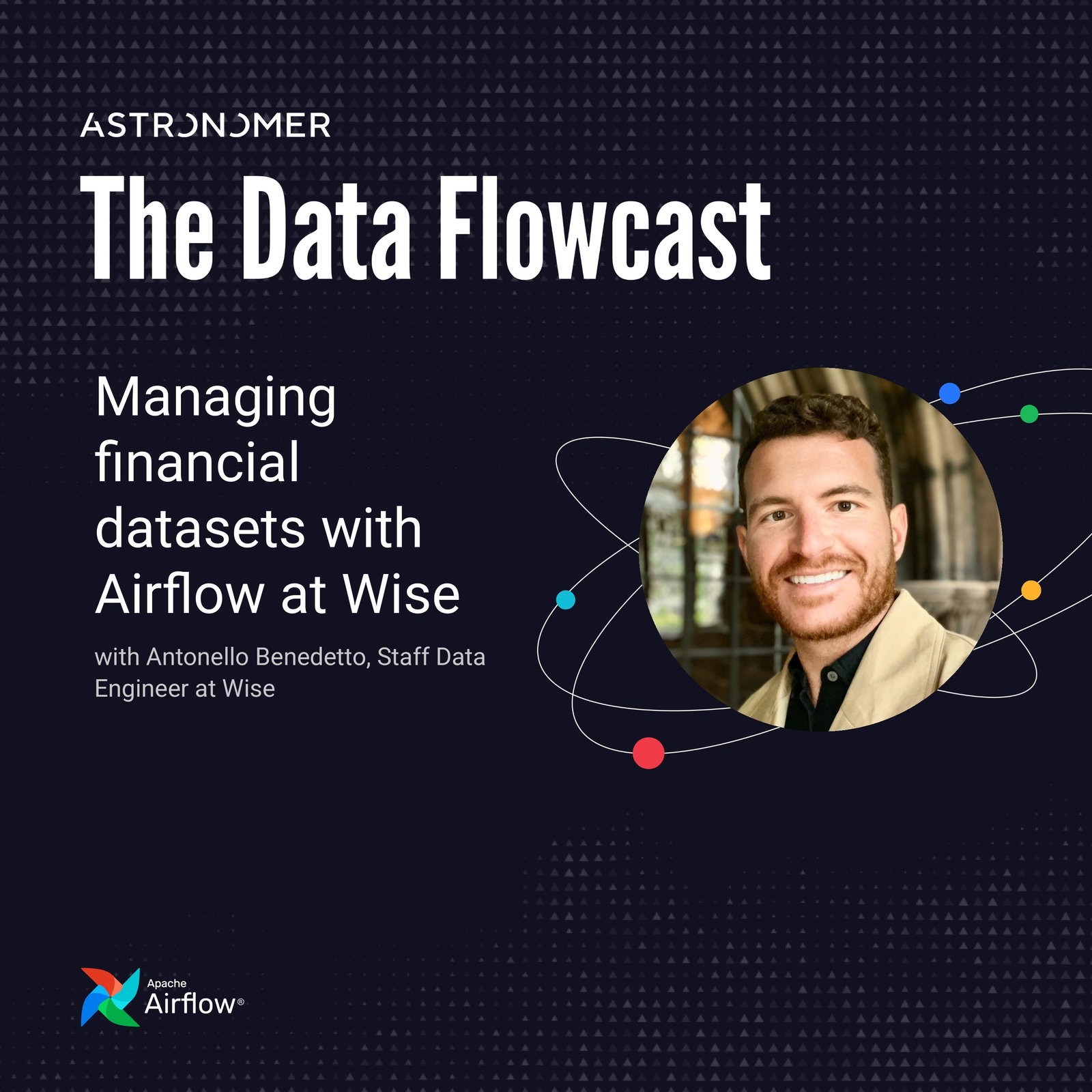 Managing financial datasets with Airflow at Wise 27.08.2026 28хвFinancial data pipelines have to be right the first time. On this episode, Kenten sits down with [Antonello Benedetto](linkedin.com/in/anbento4), Staff Data Engineer at Wise, to talk about how the central data and analytics engineering team runs Airflow for critical financial datasets, tiers pipelines by reliability, and orchestrates LLM-enabled workflows with validation layers and agent-checking-agent patterns.Key Takeaways:00:00 Introduction.01:47 What Wise does and Antonello's role in the central data and analytics engineering team, a hybrid platform-plus-analytics team that owns dbt infrastructure, BI, and Analytics MCPs as a service.05:53 Three principles that guide Airflow pipeline design at Wise: a clean separation between orchestration and computation logic, computational awareness (offloading memory-intensive tasks to EMR or SageMaker), and standardized deployments.07:21 Why Wise treats Airflow as a pure orchestration layer and pushes memory-intensive work to external workers.08:45 Moving to the Python Virtual Environment Operator to standardize Airflow deployments across the org while giving analysts and data scientists per-job Python environments.10:50 The tiering system for pipelines, how it distinguishes highly controlled, well-documented, well-observed pipelines from newer ones, and how requirements from downstream drive tier promotion.17:18 Where LLM-enabled workflows differ from standard pipelines: validation layers for specific use cases, plus observability and evaluation platforms that track model performance across executions.19:08 Using Airflow to orchestrate LLM generation of monthly variance commentary for analysts.21:10 Handling non-idempotent LLM outputs with multi-layer validation against source-of-truth data, and using a second agent (CI/CD style) to validate the first agent's output.23:04 How AI-enabled workflow orchestration differs from batch ETL, and why teams should start small before building fully agentic pipelines.25:25 What Antonello would most like to see from Airflow next: native support for agentic workflows and better local development that mirrors production.Resources Mentioned:[Orchestrate Everything](https://astronomer.link/data-flowcast-oe)[Wise](wise.com)[Wise Careers](wise.jobs)[Apache Airflow](airflow.apache.org)[dbt](getdbt.com)[Python Virtual Environment Operator](airflow.apache.org/docs/apache-airflow/stable/core-concepts/operators.html)Thanks for listening to "The Data Flowcast: Mastering Apache Airflow® for Data Engineering and AI." If you enjoyed this episode, please leave a 5-star review to help get the word out about the show. And be sure to subscribe so you never miss any of the insightful conversations.#AI #Automation #Airflow
 -
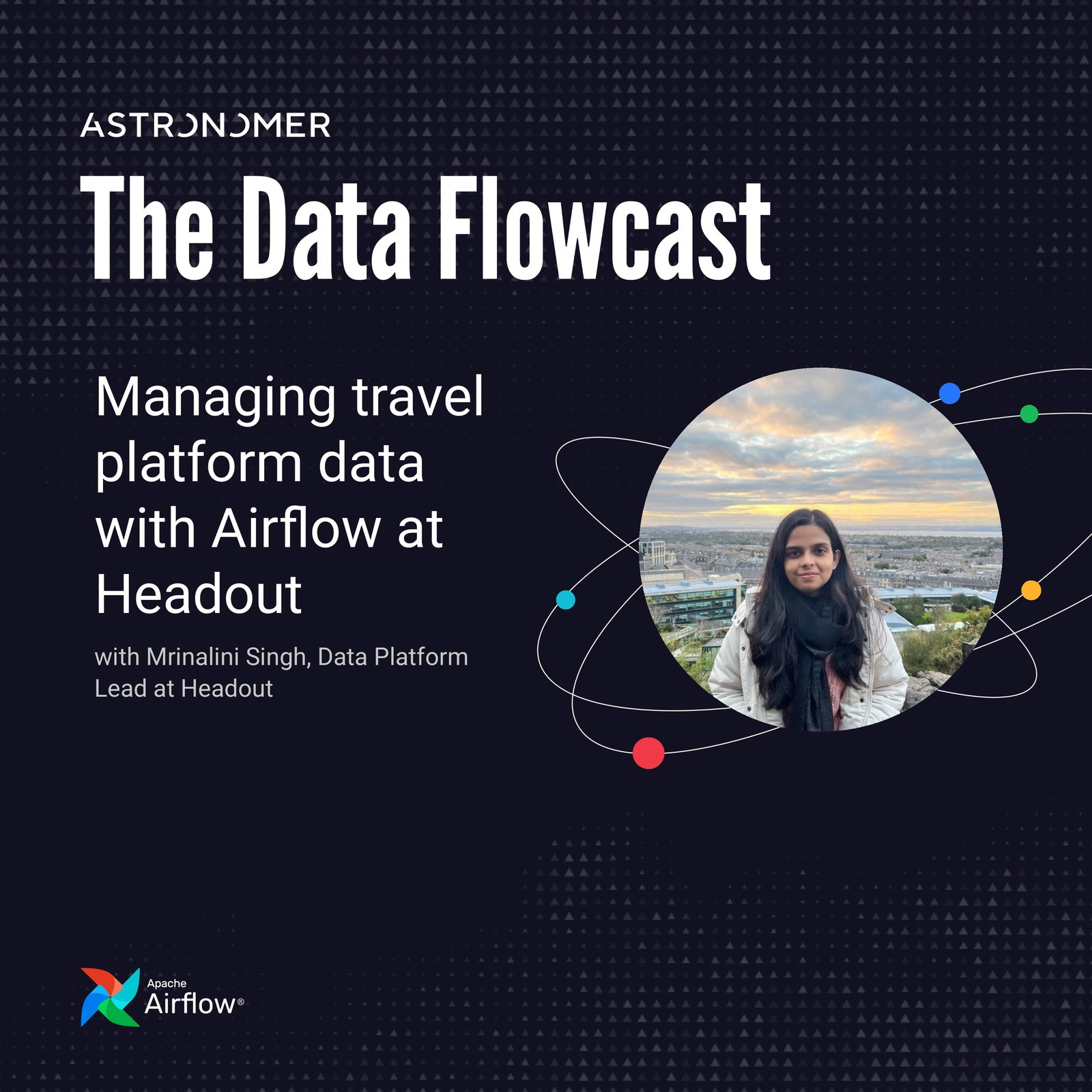 Managing travel platform data with Airflow at Headout 20.08.2026 28хвRunning a travel platform means dealing with fast-moving inventory, real-time fraud detection, and heavy performance marketing attribution, all while keeping data trustworthy for a data-driven org. In this episode, Mrinalini Singh, Data Platform Engineer at [Headout](headout.com), walks through how her team uses Airflow as the nervous system of their stack: orchestrating dbt with a write-audit-publish pattern, running ML training and inference, and wiring up alerting that points to the exact commit that broke a DAG.Key Takeaways:00:00 Introduction.01:05 What a data platform engineer does at Headout, and the hub-and-spokes model where analysts and scientists write their own dbt models.04:11 The specific data challenges of a travel platform: fast-changing inventory, real-time fraud analytics, and performance marketing attribution.05:40 Where Airflow sits in the stack, from ingestion to transformation to serving.07:01 The write-audit-publish dbt pattern and why slightly stale data beats wrong data.09:55 Why Headout uses a custom Python operator instead of the dbt provider or Cosmos, reading the dbt manifest to build task groups per model.13:45 ML use cases on Airflow: Feast feature store, model training, inference, and data/feature drift tracking.17:00 Custom Slack failure hooks that stitch together Airflow logs, GitHub commit URLs, and teammate Slack IDs.20:04 A zombie task incident that filled the metadata DB, caused locking issues, and drove the move to Grafana-based monitoring.22:26 Using AI to generate Airflow code, encoding internal patterns as a skill file, and running an AI reviewer bot on every PR.Resources Mentioned:[Orchestrate Everything](https://astronomer.link/data-flowcast-oe)[Headout](headout.com)[dbt](getdbt.com)[Cosmos](github.com/astronomer/astronomer-cosmos)[Feast](feast.dev)[Apache Flink](flink.apache.org)[Grafana](grafana.com)Thanks for listening to "The Data Flowcast: Mastering Apache Airflow® for Data Engineering and AI." If you enjoyed this episode, please leave a 5-star review to help get the word out about the show. And be sure to subscribe so you never miss any of the insightful conversations.#AI #Automation #Airflow
 -
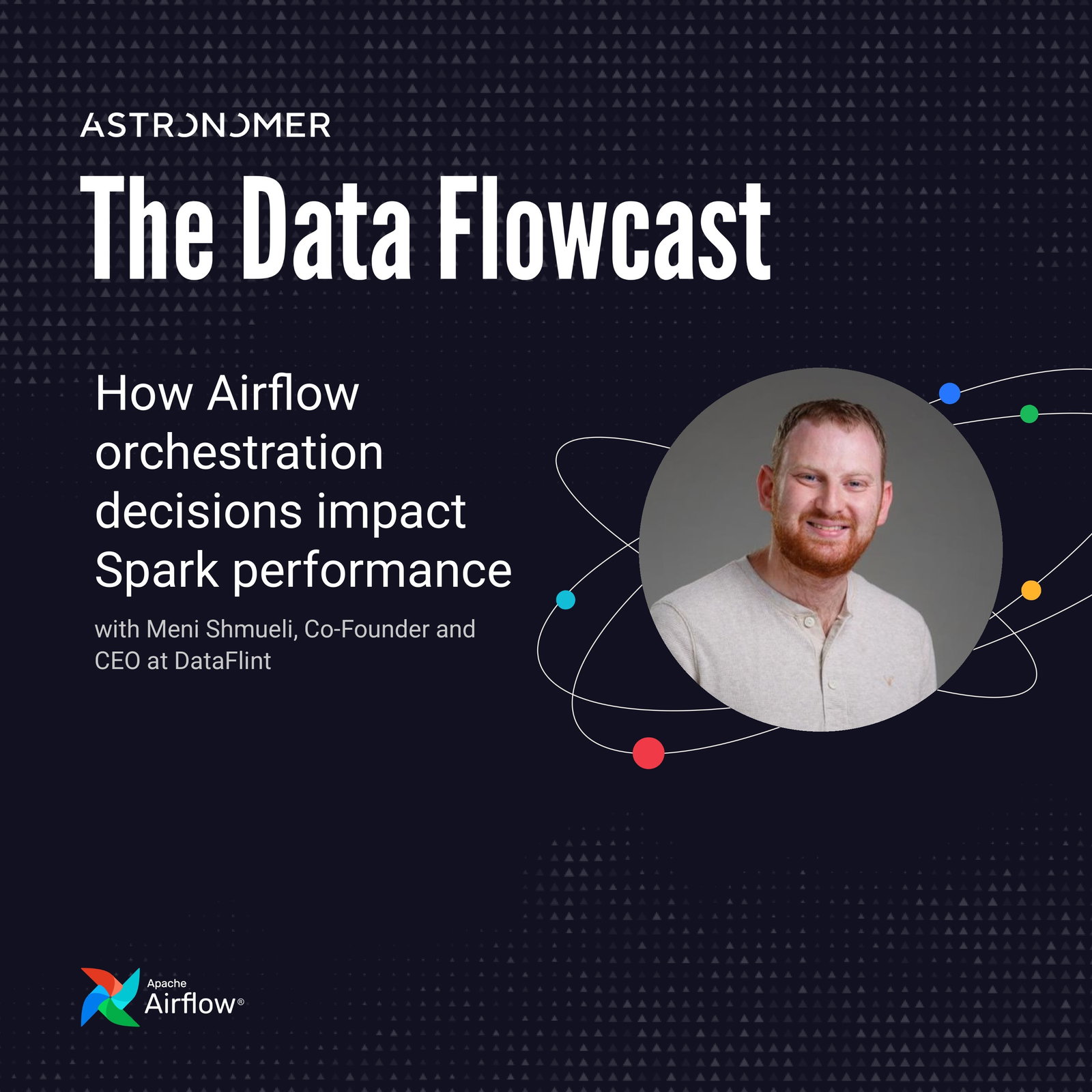 How Airflow orchestration decisions impact Spark performance 13.08.2026 19хвAirflow and Spark are one of the most common combinations in modern data platforms, but the orchestration decisions made on the Airflow side often determine whether Spark jobs run fast and cheap or slow and expensive. In this episode, Kenten is joined by [Meni Shmueli](linkedin.com/in/meni-shmueli-dataflint), Co-Founder and CEO at [DataFlint](dataflint.io), to dig into how Airflow and Spark fit together, where teams go wrong, and how AI is changing the way they reason about cost and performance.Key Takeaways:00:00 Introduction.01:40 Meni's background as a data engineer and what led him to start DataFlint, a production observability agent for Apache Spark.02:53 Why the Airflow plus Spark combination is so common, and how each tool plays to its strengths.04:23 How orchestration decisions in Airflow directly impact Spark performance and cost.04:44 A customer story where parallelizing Airflow tasks made Spark jobs slower, less stable, and more expensive, and the opposite case where sequential runs left compute on the table.07:02 The number one mistake teams make benchmarking pipelines: only looking at the Airflow side and ignoring underlying Spark cost and resource usage.08:13 What DataFlint's Airflow and Astro integration gives teams, and how it brings production context into AI agents.10:46 How AI is changing pipeline optimization, including holistic scheduling across hundreds of pipelines and connecting context from Spark, FinOps, and cloud.12:21 A customer migration from Databricks to EMR that cut workflow costs by 80%, with examples of up to 100x optimizations.14:23 Where the Airflow and Spark story could be better, including Spark Declarative Pipelines and tighter feedback between the two projects.Resources Mentioned:[Orchestrate Everything](https://astronomer.link/data-flowcast-oe)[DataFlint](dataflint.io)[Apache Airflow](airflow.apache.org)[Apache Spark](spark.apache.org)[Astro](astronomer.io/astro)[Airflow Summit](airflowsummit.org)Thanks for listening to "The Data Flowcast: Mastering Apache Airflow® for Data Engineering and AI." If you enjoyed this episode, please leave a 5-star review to help get the word out about the show. And be sure to subscribe so you never miss any of the insightful conversations.#AI #Automation #ApacheAirflow
 -
 Using Airflow for diverse client projects at Accion Labs 06.08.2026 27хвWhen a real-time loan eligibility scoring pipeline is built on cron jobs, midnight pages are inevitable. In this episode, [Chandan Gowda](linkedin.com/in/chandan-gowda-a-h-744908195), Data Engineer at [Accion Labs](accionlabs.com), joins Kenten to discuss how his team uses Airflow across client projects, including a financial services scoring use case and a POC applying production-grade orchestration to RAG and GenAI data pipelines.Key Takeaways:00:00 Introduction.01:00 What Accion Labs does as a technology consulting and services firm working across BFSI, healthcare, and retail.02:00 Chandan's role at the intersection of data engineering and GenAI, building pipelines one week and RAG-based agents the next.04:20 Why Airflow tends to win client evaluations: infrastructure agnostic, no cloud lock-in, fine-grained control over pipeline logic.06:00 Containerizing Airflow on Kubernetes or VMs so migrations between clouds don't require a rewrite.08:14 The loan eligibility scoring use case for a financial services client, and replacing fragile cron jobs with a single Airflow DAG end to end, cutting effort by about 25%.10:42 Triggering strategy: S3 file sensors as the primary trigger handling 90% of runs, plus a scheduled fallback as a safety net.12:53 End-to-end flow inside Airflow: ingestion into the data lake, validation and transformation with credit bureau joins, containerized model inference, and writeback to the loan management system.15:56 The AI orchestration POC and why the data feeding GenAI models needs the same rigor as any production pipeline.18:09 Using Airflow to detect document changes and re-chunk and re-embed only what changed, with quality thresholds and rollback before promoting to live.20:23 The roadmap: model evaluation pipelines, multi-agent orchestration, and provider packages for LangChain, OpenAI, and Hugging Face.22:32 Wishlist for Airflow: native event-driven triggers beyond polling sensors, first-class observability for AI workloads, and better dynamic DAG generation at scale.Resources Mentioned:[Orchestrate Everything](https://astronomer.link/data-flowcast-oe)[Accion Labs](accionlabs.com)[Apache Airflow](airflow.apache.org)[Airflow LangChain provider](airflow.apache.org/docs/apache-airflow-providers-langchain/stable/index.html)[Airflow OpenAI provider](airflow.apache.org/docs/apache-airflow-providers-openai/stable/index.html)Thanks for listening to "The Data Flowcast: Mastering Apache Airflow® for Data Engineering and AI." If you enjoyed this episode, please leave a 5-star review to help get the word out about the show. And be sure to subscribe so you never miss any of the insightful conversations.#AI #Automation #Airflow
 -
 Consolidating legacy job schedulers with Airflow at Trading Technologies 30.07.2026 31хвMigrating two decades of legacy job orchestration is the kind of project most teams quietly avoid. In this episode, Marc Lamberti is joined by [Sanket Patel](linkedin.com/in/sanket-patel-a2a57b3a), Director of Engineering at Trading Technologies, to talk through how his team is consolidating 20 years of C#/.NET-based scheduling and a recently acquired company's stack onto Airflow, Astronomer, and Snowflake. The conversation covers orchestrator selection, observability, the operational economics of managed Airflow, the human side of migrations, and where AI fits into the new data platform.Key Takeaways:00:00 Introduction.02:11 Sanket's background and role leading data platform initiatives at Trading Technologies.04:32 The data landscape at TT: silos, OLTP-driven reporting, and an acquired company running orchestration on a 17-18 year old ASP.NET stack.10:53 Choosing Airflow and Snowflake as the foundation of the new data platform.11:36 Why Airflow won over legacy schedulers like Autosys plus Informatica, especially past the 2,000-3,000 job mark.16:34 Collapsing thousands of legacy jobs into 15-20 Airflow DAGs.17:38 Argo vs Airflow: community support and ecosystem as the deciding factors.18:20 Why Astronomer over self-managing Airflow on MWAA or Cloud Composer: CI/CD, observability, SLAs, PagerDuty, and billing alerts.24:07 The operational math: why running Airflow globally needs dedicated specialists, and why a generalist cannot handle upgrades.27:00 Migration strategy and the human side: addressing the "why" so teams move off legacy tools willingly.30:31 Where AI fits in: letting customers dialogue with their own data, and using cloud skills with co-pilots to generate boilerplate DAGs.36:00 The honest take on AI coding tools: accelerators, not replacements for engineering judgment.Resources Mentioned:[Trading Technologies](tradingtechnologies.com)[Apache Airflow](airflow.apache.org)[Astronomer](astronomer.io)[Snowflake](snowflake.com)Thanks for listening to "The Data Flowcast: Mastering Apache Airflow® for Data Engineering and AI." If you enjoyed this episode, please leave a 5-star review to help get the word out about the show. And be sure to subscribe so you never miss any of the insightful conversations.#AI #Automation #ApacheAirflow
 -
 Orchestrating AI video intelligence and evaluation pipelines at Firework 23.07.2026 22хвHow do you orchestrate AI workflows when LLM outputs are non-deterministic and evaluation costs can quietly exceed compute costs? Shawn Feng, Head of Data at [Firework](firework.com), joins the show to walk through how his team uses Airflow to coordinate ingestion, embeddings, and evaluation pipelines for AI features in a video commerce platform. The conversation covers the technical stack, the challenges of validating LLM output, cost guardrails, and what Shawn wants to see next from the Airflow project.Key Takeaways:00:00 Introduction.00:48 What Firework does: a video commerce platform bringing short-form shoppable video and livestream experiences directly onto brand websites and apps.02:13 Shawn's team owns the full data and AI platform stack at Firework, from ingestion through BI and applied AI.02:59 Airflow has been the main orchestration layer for batch transformations since the early open source days, and now powers AI workflows like conversational insights, knowledge-base building, and automated eval pipelines.06:45 The AI workflow stack: ingestion of user interaction and content data, transformation into personalized profiles and embeddings, separate eval pipelines dispatched from third-party systems, all on Snowflake with Cortex AI and coordinated by Airflow.08:55 Why Airflow stuck: flexibility, reliability, and clear visibility into dependencies across SQL, Python, and AI tasks.11:27 The deterministic pipeline problem. Airflow assumes predictable input and output. LLM workflows break that assumption, which forces evaluation layers, traceability, regression testing, and feedback loops into the pipeline itself.13:07 Evaluation cost can exceed compute cost. Validating a single output can mean running four or five parallel eval jobs across prompts and configurations, so caching, batching, and selective evaluation become essential.15:58 Building safeguards: alerting and aborting jobs when cost exceeds thresholds, so the platform stays operationally stable while other improvements catch up.18:30 Wishlist: stronger first-class support for AI workflow patterns (evaluation tracking, prompt experimentation, model observability, event-driven AI orchestration) and continued UI/UX improvement in Airflow 3.Resources Mentioned:[Firework](firework.com)[Apache Airflow](airflow.apache.org)[Snowflake Cortex AI](snowflake.com/en/data-cloud/cortex)[Airflow common.ai provider](airflow.apache.org/docs/apache-airflow-providers-common-ai/stable/index.html)Shawn Feng on LinkedIn (https://www.linkedin.com/in/shawnshifeng/)Thanks for listening to "The Data Flowcast: Mastering Apache Airflow® for Data Engineering and AI." If you enjoyed this episode, please leave a 5-star review to help get the word out about the show. And be sure to subscribe so you never miss any of the insightful conversations.#AI #Automation #ApacheAirflow
 -
 Orchestrating Retail Data Pipelines at Saks Global 16.07.2026 25хвSaks Global runs one of the largest retail data operations in the US, with around 8 million SKUs flowing across point-of-sale, e-commerce, catalog, and fraud detection systems into Snowflake. In this episode, [Shailesh Kadam](linkedin.com), Architect at [Saks Global](saks.com), joins Kenten to walk through how Airflow acts as the nervous system tying it all together, why they moved from self-managed Kubernetes to Astro, what is driving their Airflow 3 upgrade, and how they are approaching agentic AI, MCP, and credential security.Key Takeaways:00:00 Introduction.01:31 Saks Global today. Shailesh describes the business after separating e-commerce from brick and mortar and acquiring Neiman Marcus, and the modern cloud-native stack on AWS, Snowflake, and Airflow.02:50 8 million SKUs in motion. Why every name, image, inventory, and price change has to flow in near real time across operational systems.04:50 What the pipelines look like. Point-of-sale ingestion, fraud signals to third parties like Fiserv, and hourly product catalog feeds out to Meta and Google.07:30 Moving off self-managed Kubernetes to Astro. Shailesh contrasts past experience with Kubernetes, IBM Tivoli, and Control-M against running on Astro.09:35 Upgrading to Airflow 3. Event and asset-based scheduling, DAG versioning, task isolation, and using Otto to convert DAGs in a phased rollout.13:13 Agentic AI and MCP on the roadmap. How Saks plans to use Airflow's MCP for LLM-driven product classification and to feed Snowflake analyses like churn and spend.18:01 Securing PII and credentials. Secrets backends, cloud secret manager integration, key rotation, and keeping credentials out of DAG code.21:02 Wishlist for Airflow. Interactive data lineage across DAGs and a UI-based debugging interface for support teams.Resources Mentioned:[Apache Airflow](airflow.apache.org)[Astro](astronomer.io/product)[Otto, the Astronomer data engineering agent](astronomer.io)[Snowflake](snowflake.com)[Saks Global](saks.com)Thanks for listening to "The Data Flowcast: Mastering Apache Airflow® for Data Engineering and AI." If you enjoyed this episode, please leave a 5-star review to help get the word out about the show. And be sure to subscribe so you never miss any of the insightful conversations.#AI #Automation #Airflow
 -
 What's New in Apache Airflow® 3.3 09.07.2026 27хвAirflow 3.3 is here, with a set of features to help with the messy realities of production pipelines: persisting state across retries, reacting intelligently to different failure types, and partitioning assets by more than just time. In this episode, Marc Lamberti, Education Content Lead at [Astronomer](astronomer.io), joins Kenten Danas to walk through what's new in the release and where each feature actually pays off.Key Takeaways:00:00 Introduction.01:46 The new task state store (AIP-103) lets tasks persist state across retries, so a long-running Spark job can be reattached after a worker failure instead of being duplicated on retry.03:46 The asset state store enables watermarking patterns: persist the last processed date or offset to an asset and resume from there on the next run.05:33 Why this matters for agentic workflows: resume an agent from where it left off rather than replaying every action.06:58 Why XComs don't solve this problem: they get reinitialized on every retry.09:27 Pluggable retries let you attach a retry policy to a task that branches on the exception type. Retry on transient errors, stop immediately on a 403.11:42 Subclassing the retry rule for more complex logic, including dynamic retry counts that used to require hacking the metadatabase.15:52 Updates to asset partitions in 3.3: segment-based partitioning with fan-out and roll-up mappers for downstream DAGs.21:42 Running tasks in Java and Go, moving Airflow toward a multi-language orchestrator.23:33 DAG versioning improvement: choose whether a manual rerun uses the most recent DAG version or the original version from that run.25:03 Advice for teams still on Airflow 2: use the upgrade ebook and Astro's AI migration tooling to handle the undifferentiated heavy lifting.Resources Mentioned:AstronomerAirflow 3.3 Release NotesThe Task State StoreUpdates to the asset partitions featureRetry policiesMulti-language support3.3 WebinarUpgrading from Airflow 2 to 3 ebookThanks for listening to "The Data Flowcast: Mastering Apache Airflow® for Data Engineering and AI." If you enjoyed this episode, please leave a 5-star review to help get the word out about the show. And be sure to subscribe so you never miss any of the insightful conversations.#AI #Automation #Airflow
 -
 Running Airflow 3 in a regulated environment at OTPP 25.06.2026 18хвRunning Apache Airflow at a major pension fund means balancing strict compliance requirements with the need to move fast on new capabilities. On this episode, Kowsy Narayan, Cloud Data Platform Lead, Data Engineering at [Ontario Teachers' Pension Plan](otpp.com), joins host Kenten Danas to walk through OTPP's cloud migration, their move to Airflow 3, and going fully live on remote execution.Key Takeaways:00:00 Introduction.01:18 Inside the OTPP data platform team and what they're responsible for across cloud migration, standards, and enablement.02:33 What's driving OTPP's multi-year move off on-prem to a cloud architecture built around scalability and resilience.02:57 The new stack: Snowflake as the enterprise data platform, dbt for transformation, and Airflow as the orchestrator in the middle.04:15 Why OTPP chose Astronomer: active contributions to the Airflow OSS project, fast runtime releases, and built-in monitoring, observability, and RBAC.05:50 Evolving from dbt core with Bash operators to dbt Cosmos for model-level granularity, lineage, and precise failure recovery, plus a performance boost from watcher mode.08:00 Upgrading from Airflow 2.9 to Airflow 3, using the Astro CLI and linters to catch deprecations quickly.09:32 The drivers behind adopting remote execution: keeping data inside the security perimeter and scaling workloads on their own Kubernetes cluster.11:35 How remote execution replaced a complex network architecture of VPN tunnels and firewall rules, removing latency along the way.12:53 The POV process, success criteria, and a six week timebox to validate remote execution before going to production.14:14 Going fully live: OTPP's last hosted deployment was sunset just before recording.15:06 What Kowsy wants next from Airflow: AI orchestration capabilities and continued maturation of remote execution.Resources Mentioned:[Ontario Teachers' Pension Plan](otpp.com)[Apache Airflow](airflow.apache.org)[Astronomer](astronomer.io)[Cosmos](astronomer.io/cosmos)Thanks for listening to "The Data Flowcast: Mastering Apache Airflow® for Data Engineering and AI." If you enjoyed this episode, please leave a 5-star review to help get the word out about the show. And be sure to subscribe so you never miss any of the insightful conversations.#AI #Automation #Airflow
 -
 Managing a Customer Analytics Platform with Airflow at Skimlinks 11.06.2026 22хвSkimlinks runs a reporting platform that serves around 2,000 weekly publisher users, and the data infrastructure behind it runs on Airflow. In this episode, Julian Larralde, Director of Data Engineering at Skimlinks, walks through the stack, the migration from external task sensors to event-driven Assets, and a YAML-based DAG factory the team built to onboard new publishers without rewriting Python.Key Takeaways00:00 Introduction.00:45 What Skimlinks does and how it operates as an affiliate marketing network aggregator for publishers.02:12 Julian's team and the data platform they own: a reporting portal that serves ~2,000 weekly publisher users.03:07 The stack: real-time ingestion into BigQuery, Airflow as the orchestrator, raw / silver / gold layers, and Apache Druid as the serving database for sub-second BI queries.04:50 Reusing the same data marts for ~100 internal customers across marketing, finance, operations, and account management.06:25 Airflow as the single orchestrator: BigQuery operators for SQL business logic, plus raw file exports for the largest publishers.08:08 Moving from external task sensors to datasets (now Assets) and what the migration actually solved.09:18 Why sensor polling created scheduler load and worker overload, and how event-driven Assets fixed both.10:15 The lineage view in the Airflow UI that came as a bonus after the Assets migration.10:49 The vision for multi-tenant Airflow inside Skimlinks: replacing cron, Rundeck, and team-local Airflow instances with a shared platform.14:31 Building a custom DAG factory with YAML configuration for onboarding new publishers.17:33 Breaking a single Python class into single-responsibility components for the DataPipe project.19:07 Adding a Pydantic layer so misconfigured YAML fails at DAG parse time instead of run time.20:31 Using AI assistance to guide refactoring decisions and generate tests across the new class structure.22:34 What Julian wants from Airflow next: asset watchers paired with data contracts.Resources MentionedSkimlinks - skimlinks.comApache Airflow - airflow.apache.orgAstronomer - astronomer.ioGoogle BigQuery - cloud.google.com/bigqueryApache Druid - druid.apache.orgPydantic - docs.pydantic.devLooker - cloud.google.com/lookerThanks for listening to "The Data Flowcast: Mastering Apache Airflow® for Data Engineering and AI." If you enjoyed this episode, please leave a 5-star review to help get the word out about the show. And be sure to subscribe so you never miss any of the insightful conversations.#AI #Automation #Airflow
 -
 Building a custom Tableau provider for Airflow at JLR 04.06.2026 21хвJLR is the UK's largest automotive manufacturer, behind brands like Range Rover, Jaguar, Defender, and Discovery. In this episode, Najeeb Sulaiman, Senior Data Engineer at JLR, walks through how Airflow orchestrates data across manufacturing, supply chain, and finance — including a custom Tableau provider his team built (after the community version dropped PAT authentication) and a CI/CD pipeline that validates DAGs before they reach production.Key Takeaways:00:00 Introduction.00:48 What JLR makes: luxury vehicles under the Range Rover, Jaguar, Defender, and Discovery brands.01:42 Najeeb's team in the Data and AI Office, supporting manufacturing, supply chain, finance, and commerce analytics.03:25 Airflow as the central nervous system of the JLR data stack — the orchestrator that connects every source and downstream system.05:01 How JLR uses Tableau, and the two modes for getting data in: live connection and scheduled extract refresh.06:24 Why scheduled Tableau refreshes go stale: they aren't aware of when the data pipeline actually finished.08:09 First attempt at solving it: Python scripts calling the Tableau REST API directly.08:47 Why the script approach didn't scale across teams — code duplication and version drift.10:00 Trying the community Airflow Tableau provider and hitting the PAT authentication roadblock.12:21 Building a custom provider on top of the community one to keep PAT auth.13:30 Treating CI/CD as a deployment gate for Airflow DAGs at JLR's scale.15:23 What the CI/CD pipeline actually catches: top-level code making external calls, import errors, and Airflow 3 compatibility.17:47 How the gate blocks broken DAGs from reaching production.18:30 What Najeeb wants from Airflow next: native integration testing, better OpenTelemetry support, and built-in lineage.Resources Mentioned:JLR - jaguarlandrover.comApache Airflow - airflow.apache.orgAstronomer - astronomer.ioTableau - tableau.comTableau REST API - help.tableau.com/current/api/rest_api/en-us/REST/rest_api.htmAirflow Tableau provider (community) - airflow.apache.org/docs/apache-airflow-providers-tableauThanks for listening to "The Data Flowcast: Mastering Apache Airflow® for Data Engineering and AI." If you enjoyed this episode, please leave a 5-star review to help get the word out about the show. And be sure to subscribe so you never miss any of the insightful conversations.#AI #Automation #Airflow
 -
 Orchestrating 2,000 Airflow pipelines at Luiza Labs with Mateus Ferreira 28.05.2026 32хвRunning Airflow at the scale of a national retailer means more than just scheduling. It means giving non-engineers a path to ship DAGs, and classifying thousands of runs to know which ones need attention. In this episode, Mateus Ferreira, Senior Data Engineer at Luiza Labs (the technology arm of Magazine Luiza, one of Brazil's largest retailers), joins Marc to talk about the patterns his team uses to run 2,000+ Airflow pipelines across more than four petabytes of data.Key Takeaways:00:00 Introduction01:11 Mateus introduces himself and Luiza Labs, the technology arm of Magazine Luiza (Magalu), one of Brazil's largest retailers (founded 1957). 1,000+ physical stores, multi-region operations, and a data team that has to handle the variability that comes with all of it.04:33 Lu Brain, Magalu's AI initiative built around their character Lu, and how AI fits into the data work.06:47 The data reliability engineering channel where AI summarizes Airflow errors with confidence scores and posts a suggested fix in chat.08:30 How Airflow became the heart of orchestration. Coming from Control-M in banking, then GCP, then consolidating on Cloud Composer to centralize roughly 2,000 pipelines.14:23 The YAML wrapper that lets non-engineers ship DAGs. Reads namespace, tables, and Spark options. Handles CDC, JDBC full, and JDBC incremental collection types with checkpoints. All changes go through data reliability engineering.17:20 Why metadata is the most valuable asset in the AI era, and how the wrapper makes data lineage observable across 2,000 pipelines.18:26 The Data Reliability Engineering team. A 10-person group that is the window to the company, handling maintenance, validation, corrections, and optimization for the business unit pipelines.20:09 Operating at four petabytes of data.21:24 Why they built custom Spark operators. Cost drove the move off the DataprocOperator. The custom operator exposes Spark driver and executor sizing as Airflow parameters and generates the Kubernetes manifest.24:36 The monitoring dashboard built on the Airflow metadata DB. A timeline view that shows how many DAGs run each hour, used to spread scheduling across the day.26:37 Classifying DAGs by their last five runs: success, partially correct, intermittent, total failure. A reusable observability pattern.29:57 How to reach Mateus, and a closing thought in Portuguese on appreciating the good old times while you are living them.Resources Mentioned:Apache Airflow (airflow.apache.org)Magalu Cloud / MGCLuiza Labs (luizalabs.com) and Magazine Luiza / MagaluAstro Observe (https://www.astronomer.io/product)Mateus Ferreira on LinkedIn (linkedin.com/in/mateusmferreira)Thanks for listening to "The Data Flowcast: Mastering Apache Airflow® for Data Engineering and AI." If you enjoyed this episode, please leave a 5-star review to help get the word out about the show. And be sure to subscribe so you never miss any of the insightful conversations.#AI #Automation #Airflow
 -
 Enhancing DAGs for Data Processing with William Orgertrice III at Cargill 21.05.2026 26хвIn the data engineering world, the difference between a pipeline that works and one that's truly production-ready often comes down to a handful of deliberate decisions. William Orgertrice III, Data Engineer at Cargill, joins us to share the DAG design and monitoring practices he presented at Airflow Summit 2025 and how his team is rolling out Airflow across 60+ internal teams as part of Cargill's new Minerva data platform.Key Takeaways:00:00 Introduction. 01:45 Cargill is one of the largest privately owned companies in the US, operating across 70 countries and serving 125+ markets.03:45 William's team on the Cargill Data Platform supports 60+ internal teams, providing data products that drive decisions across finance, inventory and operations.05:10 Cargill chose Airflow as a core component of its new Minerva data platform to replace older ETL tooling with a more supportable, observable stack.06:26 Native SLA sensors and dependency management were specific features that made Airflow the right fit for Cargill's batch ingestion pipelines.09:00 Cargill is running Airflow through Astronomer as their managed solution, with some teams already in production.13:22 Every task in a DAG should have a single, documented purpose — one task doing everything makes troubleshooting significantly harder.14:40 A DAG that never enters a failed state but keeps running indefinitely will spend compute budget without alerting anyone.15:25 In shared Airflow environments, embedding contact information and owner tags in DAGs ensures the right team is reached when something breaks upstream.21:00 William flags connection testing as a friction point in pipeline development — verifying a connection string before building the full job would reduce iteration time.Resources Mentioned:Cargill | Websitehttps://www.cargill.com/food-beverageAirflow Community on Slack https://airflow.apache.org/community/Thanks for listening to “The Data Flowcast: Mastering Apache Airflow® for Data Engineering and AI.” If you enjoyed this episode, please leave a 5-star review to help get the word out about the show. And be sure to subscribe so you never miss any of the insightful conversations.#AI #Automation #Airflow
 -
 Getting Into Data Engineering with Shrividya Hegde, Data and AI Engineer 14.05.2026 27хвIn this episode, we take a step back from implementation-specific topics to explore what it actually takes to build a career in data engineering — and how AI is reshaping that path.Shrividya Hegde, a data and AI engineer and an Airflow champion in Astronomer’s Champions program, joins us to discuss getting into data engineering, contributing to open source and why good data engineering should make AI output trustworthy rather than confidently wrong.Key Takeaways:00:00 Introduction.04:08 Build fundamentals before chasing trending tools — understanding what a tool does, why it exists and what problem it solves has to come first. 07:19 Data engineering fundamentals mean SQL query performance under joins and aggregations, how data moves between pipelines, DAG failure recovery and idempotency — not just writing queries. 08:10 The most common mistake newer data engineers make is skipping fundamentals to chase trends — it is a sequencing problem, not a talent problem. 13:15 AI creates more opportunity for data engineers because AI output quality is directly determined by the quality of the data pipeline feeding it — confidently wrong output is harder to catch than obviously wrong output. 15:06 Airflow's supporting operators make AI outputs production-ready — orchestration is what converts experimental AI into something reliable. 17:14 AI-generated DAGs help newer engineers understand underlying concepts rather than just producing working code. 23:12 The Airflow open source community is more welcoming than most people expect for a project of its size — raising issues and reviewing PRs are viable entry points for first contributions.Resources Mentioned:Shrividya Hegdehttps://www.linkedin.com/in/shrividya-hegde-shri-91562365/Astronomer | LinkedInhttps://www.linkedin.com/company/astronomer/Astronomer | Websitehttps://www.astronomer.ioWomen in Data | Websitehttps://womenindata.mn.co/landingApache Airflow Slack https://airflow.apache.org/Shrividya's Medium writinghttps://medium.com/@shrihegdeShrividya’ Substack writinghttps://substack.com/@shrividyahegdeThanks for listening to “The Data Flowcast: Mastering Apache Airflow® for Data Engineering and AI.” If you enjoyed this episode, please leave a 5-star review to help get the word out about the show. And be sure to subscribe so you never miss any of the insightful conversations.#AI #Automation #Airflow #MachineLearning
 -
 Orchestrating DBT With Cosmos and Airflow with Filip Kunčar at ShipMonk Product Development 07.05.2026 24хвWe explore how a third-party logistics platform built its entire data orchestration layer on Airflow, and what that makes possible for developer teams and merchant-facing products alike.Filip Kunčar, Platform Director at ShipMonk Product Development, discusses migrating from a closed source tool to Airflow, orchestrating dbt with both Cosmos and the BashOperator and using Airflow to power customer-facing data delivery.Key Takeaways:00:00 Introduction.01:07 ShipMonk is a third-party logistics company guaranteeing two-day delivery across the US. The data platform team's mission is to lower cognitive load for developers working with data. 05:13 ShipMonk migrated to Airflow in 2022, moving away from a closed-source UI-based tool, driven by the need for a code-first approach, open source extensibility and broad cloud provider support. 10:02 The team uses Cosmos for developer-facing visibility and lineage and BashOperator for internal pipelines where runtime performance matters. 12:20 Switching from Cosmos to the BashOperator for a frequently running pipeline reduced runtime from over 15 minutes to three minutes. 13:14 Because the full dbt chain runs inside Airflow, a configurable downstream DAG can deliver processed data directly to each merchant's preferred destination, with secrets management and SLA tracking already handled. 15:03 Per-team alerting is hooked to each DAG by owner and severity, so teams can react to SLA breaches immediately. 18:09 ShipMonk uses Airflow in three ways for AI: authoring DAGs faster with skills, orchestrating AI workloads in Lambda and containers and using Astronomer's skills repo to simplify Airflow version upgrades.Resources Mentioned:Filip Kunčarhttps://www.linkedin.com/in/filipkuncar/ShipMonk Product Developmenthttps://www.linkedin.com/company/shipmonk-product-development/ShipMonk | Websitehttp://www.shipmonk.comAstronomer Cosmoshttp://www.astronomer.io/cosmosAstronomer AI Skills Repohttp://www.github.com/astronomer/airflow-llm-providers-demoDatadoghttp://www.datadoghq.comThanks for listening to “The Data Flowcast: Mastering Apache Airflow® for Data Engineering and AI.” If you enjoyed this episode, please leave a 5-star review to help get the word out about the show. And be sure to subscribe so you never miss any of the insightful conversations.#AI #Automation #Airflow #MachineLearning
Схожі подкасти


Популярний у
Цей подкаст також потрапляв у чарти подкастів у цих країнах.

