
Carl Sagan
Podra Network
0
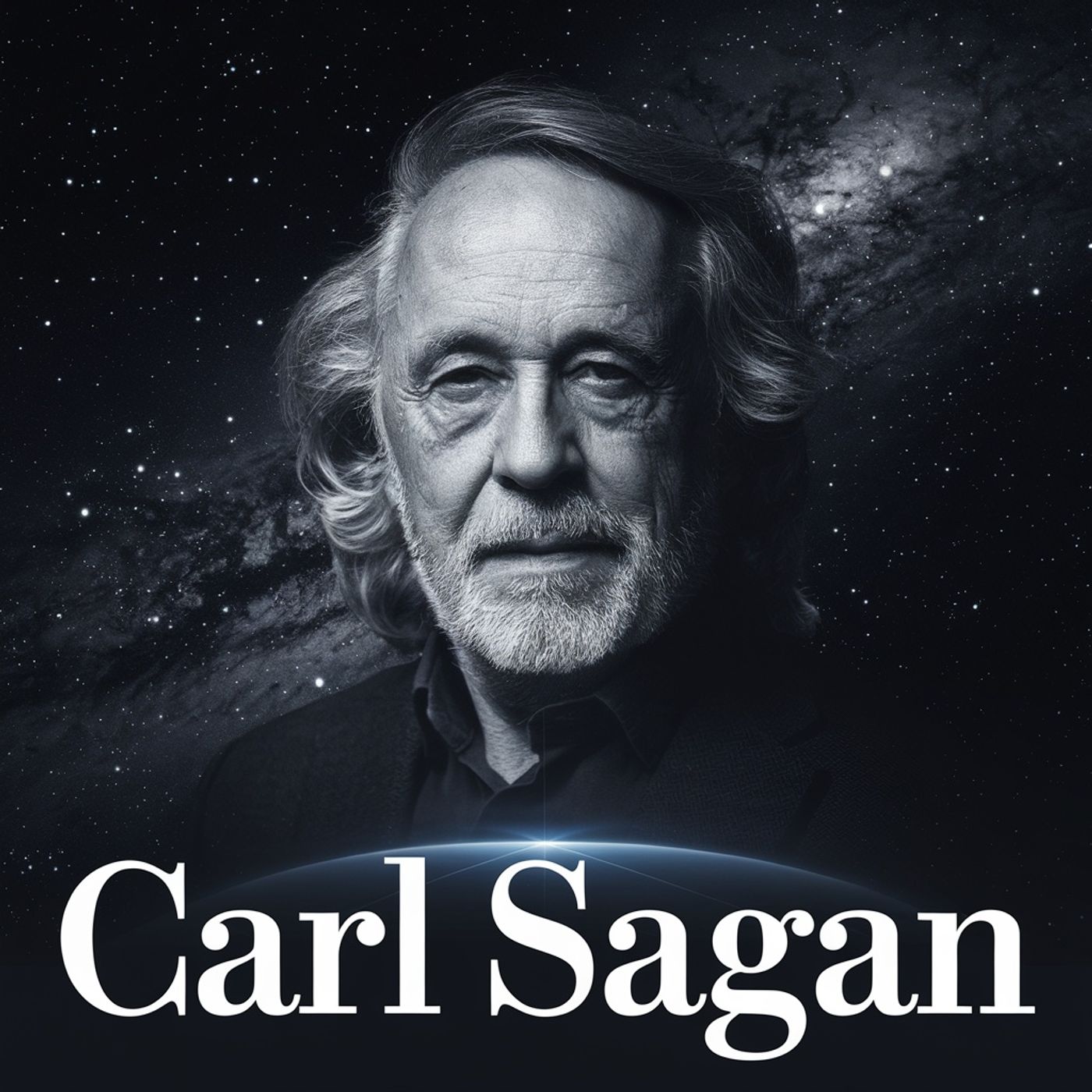
We are made of star stuff — the life, vision and cosmic wonder of Carl Sagan.
Епізоди
-
 Stardust and Dreams: The Enduring Sagan Message 02.07.2026 4хвJoin Dr. Sarah Quinn as she explores Carl Sagan's most profound and enduring message: that we are made of star stuff. This episode examines how Sagan's poetic approach to stellar nucleosynthesis continues to inspire wonder and scientific curiosity today. We discuss the science behind our cosmic origins, from the formation of elements in stellar cores to the explosion of supernovae that scattered the building blocks of life throughout the universe. Dr. Quinn explores how Sagan's cosmic perspective remains relevant in our modern era, influencing everything from space exploration to our understanding of our place in the universe. The episode covers Sagan's unique ability to combine rigorous scientific thinking with genuine poetry, his warnings about pseudoscience, and his vision for humanity's future as cosmic citizens. We examine how contemporary discoveries in astronomy and planetary science continue to validate and expand upon Sagan's insights, from exoplanet research to Mars exploration. This thoughtful exploration of Sagan's legacy demonstrates why his message of cosmic connection, critical thinking, and wonder continues to resonate with new generations of science enthusiasts and curious minds seeking to understand their place in the cosmos.
 -
Legacy of Wonder: Sagan's Influence on Modern Science 25.06.2026 5хвIn this episode of Carl Sagan, host Dr. Sarah Quinn explores the profound and lasting influence of Carl Sagan on modern science and scientific communication. From his revolutionary approach to making complex scientific concepts accessible to the general public to his foundational work in astrobiology and SETI research, Sagan's legacy continues to shape how we explore and understand our universe. The episode examines how contemporary science communicators like Neil deGrasse Tyson follow Sagan's methodology, how his interdisciplinary approach influenced fields like astrobiology, and how his famous principle that 'extraordinary claims require extraordinary evidence' became central to modern scientific methodology. Dr. Quinn discusses Sagan's impact on Mars exploration programs, climate science research, and the democratization of astronomy through citizen science projects. The episode also covers how Sagan's emphasis on teaching scientific thinking rather than memorizing facts has transformed science education worldwide. From the continuing work of the SETI Institute to the influence of the Voyager Golden Record on interstellar communication protocols, this episode reveals how Sagan's vision of wonder combined with skeptical inquiry remains remarkably relevant for addressing today's scientific challenges and inspiring future generations of researchers.
-
The Dragon in My Garage: Teaching Critical Thought 18.06.2026 4хвIn this thought-provoking episode, Dr. Sarah Quinn explores Carl Sagan's famous 'dragon in my garage' thought experiment, a powerful tool for understanding critical thinking and the scientific method. This engaging parable demonstrates the importance of falsifiability and the burden of proof when evaluating extraordinary claims. We examine how this framework applies to historical accounts of unexplained phenomena, conspiracy theories, and everyday decision-making. The episode discusses the balance between healthy skepticism and open-minded inquiry, showing how the scientific method protects us from self-deception while remaining flexible enough to accommodate genuine discoveries. Dr. Quinn explores how ancient civilizations documented mysterious phenomena and how modern science has provided natural explanations for many once-supernatural events. The discussion emphasizes intellectual humility and the courage required to examine our own beliefs critically. Perfect for educators, students, and anyone interested in developing stronger critical thinking skills, this episode demonstrates how Sagan's dragon teaches us to distinguish between real mysteries worth investigating and unfalsifiable claims that can't be meaningfully tested. Essential listening for navigating our information-rich world with both wonder and wisdom.
-
Skeptical Thinking: Sagan's War on Pseudoscience 11.06.2026 5хвIn this episode of Carl Sagan, Dr. Sarah Quinn explores Carl Sagan's lifelong commitment to combating pseudoscience through critical thinking and scientific skepticism. We examine Sagan's famous 'baloney detection kit' and his approach to evaluating extraordinary claims with extraordinary evidence. The episode covers how Sagan addressed popular pseudoscientific beliefs including astrology and UFO phenomena while maintaining respect for human curiosity and wonder. We discuss his masterwork 'The Demon-Haunted World' and its warnings about scientific illiteracy in democratic society. Sagan's gentle yet firm methodology for promoting skeptical thinking is analyzed, showing how he balanced scientific rigor with accessibility and wonder. The episode highlights Sagan's belief that understanding real scientific phenomena enhances rather than diminishes their beauty and mystery. We explore his concerns about leaders lacking critical thinking skills and the vulnerability of scientifically illiterate populations to manipulation. This comprehensive look at Sagan's intellectual legacy demonstrates the continued relevance of his skeptical thinking tools in our current information age, emphasizing how scientific reasoning serves as protection against deception while opening doors to genuine discovery and awe.
-
The Greenhouse Effect on Venus: Climate Pioneer 04.06.2026 4хвJoin Dr. Sarah Quinn as she explores Carl Sagan's groundbreaking research on Venus's extreme greenhouse effect, a discovery that revolutionized our understanding of planetary climate systems. This episode examines how Sagan's predictions about Venus's hellish surface conditions were confirmed by Soviet space missions, revealing temperatures hot enough to melt lead and atmospheric pressures nearly 100 times greater than Earth's. We discuss how Venus's runaway greenhouse effect, caused by its dense carbon dioxide atmosphere and sulfuric acid clouds, transformed the planet into an inhospitable furnace despite its initial similarity to Earth. Sagan's work on Venus pioneered comparative planetology and provided crucial insights into climate science that remain relevant today. The episode explores the complex atmospheric dynamics that trap heat so effectively on Venus, creating surface temperatures of 900 degrees Fahrenheit. We examine how Sagan's Venus research informed his later environmental advocacy and understanding of Earth's climate vulnerability. Perfect for astronomy enthusiasts, climate science students, and anyone interested in planetary exploration history. Discover how studying our nearest planetary neighbor helped establish fundamental principles of atmospheric physics and greenhouse gas effects that continue to guide modern climate research and space exploration missions.
-
Nuclear Winter: Sagan's Warning to the World 28.05.2026 6хвIn this compelling episode of Carl Sagan, host Dr. Sarah Quinn explores one of the renowned scientist's most impactful contributions to global security: his groundbreaking research on nuclear winter. During the 1980s Cold War tensions, Sagan collaborated with colleagues in the landmark TTAPS study, revealing how nuclear warfare could trigger catastrophic global climate change through atmospheric dust and debris blocking sunlight. Drawing on his expertise in planetary atmospheres and Mars dust storms, Sagan's computer models demonstrated that even limited nuclear conflict could cause worldwide temperature drops, crop failures, and ecosystem collapse. The episode examines how Sagan communicated these sobering findings to policymakers and the public, transforming complex atmospheric science into accessible warnings about humanity's survival. We discuss the scientific methodology behind the research, the initial mixed responses from the scientific community, and the eventual validation of many nuclear winter predictions. The episode also explores how this work exemplified Sagan's philosophy about scientists' moral obligations to share knowledge affecting human survival. His nuclear winter research influenced international nuclear policy discussions and contributed to eventual arms reduction efforts. Today, this interdisciplinary approach continues informing how we address global environmental challenges. Join us for this examination of how rigorous science, effective communication, and moral responsibility combined in Sagan's urgent warning to the world about nuclear warfare's planetary consequences.
-
The Search for E.T.: SETI and Beyond 21.05.2026 5хвJoin Dr Sarah Quinn as she explores humanity's scientific search for extraterrestrial intelligence, inspired by Carl Sagan's passionate advocacy for SETI research. This episode examines the evolution of search methods from Frank Drake's pioneering Project Ozma in 1960 to today's sophisticated multi-wavelength approaches using advanced telescopes and machine learning algorithms.Discover how the famous Drake Equation attempts to quantify the probability of communicating civilizations, and learn about Carl Sagan's role in creating humanity's first interstellar messages through the Pioneer plaques and Voyager Golden Records. We explore modern search strategies including optical SETI, technosignature detection, and the hunt for biosignatures on newly discovered exoplanets.The episode discusses fascinating mysteries like the unexplained Wow! Signal from 1977, examines the Fermi Paradox and its implications, and considers how projects like Breakthrough Listen are revolutionizing our search capabilities. We also explore the philosophical questions raised by SETI research about the nature of intelligence and humanity's place in the cosmic perspective.Whether we find evidence of extraterrestrial intelligence or confirm our cosmic solitude, the search itself advances our technology, deepens our understanding of the universe, and continues the great human tradition of exploration that Sagan championed throughout his career.
-
Contact: When Carl Sagan's Science Fiction Became Science 14.05.2026 3хвExplore Carl Sagan's groundbreaking novel Contact and its profound impact on both science fiction and real scientific research. Dr. Sarah Quinn examines how Sagan's background in astrophysics and SETI research informed his compelling story of humanity's first contact with extraterrestrial intelligence. This episode delves into the scientific accuracy behind Contact's premise, from radio astronomy and signal detection to the physics of interstellar communication. Discover how Sagan addressed complex challenges like faster-than-light travel limitations and cross-species communication while exploring deeper themes of science, faith, and human nature. Learn about the novel's prescient anticipation of modern SETI methods and its lasting cultural influence through the acclaimed 1997 film adaptation starring Jodie Foster. Perfect for science fiction enthusiasts, astronomy lovers, and anyone fascinated by the search for extraterrestrial life. The episode highlights how rigorous scientific thinking can enhance rather than constrain imaginative storytelling, demonstrating Sagan's unique ability to blend hard science with profound philosophical questions about our place in the cosmos and what it truly means to be human in an infinite universe.
-
The Pale Blue Dot: Our Cosmic Perspective 07.05.2026 4хвExplore Carl Sagan's profound reflection on the famous 'Pale Blue Dot' photograph captured by Voyager 1 in 1990. Dr. Sarah Quinn examines how this iconic image of Earth from nearly 4 billion miles away revolutionized our cosmic perspective and understanding of our place in the universe. Discover the profound implications of seeing our planet as a tiny speck in the cosmic arena, and how this viewpoint both humbles humanity and elevates our responsibility as planetary stewards. Learn about the Voyager mission's remarkable achievement in providing this unprecedented view of home, and explore how the cosmic perspective can inform our approach to global challenges, environmental protection, and human unity. This episode delves into themes of cosmic insignificance versus consciousness, planetary fragility, space exploration achievements, and the philosophical implications of our unique position as the universe becoming aware of itself. Perfect for space enthusiasts, philosophy lovers, and anyone seeking a deeper understanding of humanity's cosmic context and our shared responsibility for Earth's future.
-
Cosmos: Bringing the Universe to Everyone 30.04.2026 4хвJoin Dr. Sarah Quinn as she explores Carl Sagan's revolutionary work Cosmos and its transformative impact on science communication. This episode examines how Sagan's 1980 book and PBS television series brought complex astronomical and scientific concepts to mainstream audiences, becoming the best-selling science book in English and reaching over 500 million viewers worldwide. Discover how Sagan's famous phrase 'we are made of star stuff' connected humanity to the cosmos, and learn about his innovative approach to making science accessible without sacrificing accuracy or wonder. We discuss the book's unique storytelling structure, its integration of multiple scientific disciplines, and how it addressed complex topics from extraterrestrial life to climate change. The episode also covers the groundbreaking television series with its iconic 'Ship of the Imagination' sequences and innovative special effects. Explore Sagan's philosophy that science belongs to everyone and his belief that scientific literacy is essential for democratic participation. Learn about Cosmos's lasting legacy in science education and communication, including its influence on subsequent programs like Neil deGrasse Tyson's 'Cosmos: A Spacetime Odyssey.' This episode celebrates how effective science communication can inspire wonder, foster understanding, and demonstrate that knowledge shared amplifies rather than diminishes the majesty of our universe.
-
The Golden Record: Humanity's Message to the Cosmos 23.04.2026 4хвJoin Dr Sarah Quinn as she explores the remarkable story behind the Voyager Golden Record, humanity's most ambitious message to the cosmos. Launched in 1977 aboard the Voyager spacecraft, this golden time capsule contains sounds, images, and greetings representing Earth's diverse cultures and life forms. Discover how Carl Sagan and his team tackled the incredible challenge of distilling human civilization into a single record that could potentially outlast our species. From Bach to Chuck Berry, from whale songs to a baby's cry, learn about the careful selection process that went into choosing what music, sounds, and images would represent humanity to any extraterrestrial intelligence that might one day discover it. The episode examines the scientific ingenuity behind encoding images and location data using universal mathematical concepts, while reflecting on the profound optimism of the project during Cold War tensions. Today, as Voyager 1 travels through interstellar space as our first interstellar ambassador, the Golden Record continues its eternal journey, serving both as a message to potential cosmic neighbors and a mirror reflecting our own hopes and values as a species reaching toward the stars.
-
From Brooklyn to the Stars: Sagan's Early Years 16.04.2026 4хвExplore the fascinating early years of Carl Sagan, from his birth in Brooklyn in 1934 to his entry into the University of Chicago. This episode examines how a curious child from Bensonhurst became one of the world's most celebrated astronomers and science communicators. We delve into Sagan's immigrant family background, his parents Samuel and Rachel's influence on his intellectual development, and the pivotal moments that shaped his scientific worldview. Discover how the 1939 World's Fair ignited his imagination, how his family's sacrifices enabled his education, and why his childhood questions about stars would lead to a lifetime of cosmic exploration. Dr Sarah Quinn traces the formative experiences that laid the foundation for Sagan's later groundbreaking work in planetary science and his gift for making complex scientific concepts accessible to millions. From Brooklyn libraries to high school astronomy clubs, learn how Sagan's early environment nurtured the curiosity and wonder that would define his remarkable career. Perfect for fans of science history, astronomy, and anyone inspired by the power of childhood curiosity to change the world.
-
The Making of a Cosmic Messenger 12.04.2026 5хвJoin Dr Sarah Quinn as she explores the remarkable transformation of Carl Sagan from a curious Brooklyn boy into one of history's most influential science communicators. This episode traces Sagan's journey from his early fascination with astronomy at age five through his groundbreaking work on the Voyager Golden Record and the creation of the legendary 'Cosmos' series that reached over 500 million people worldwide. We examine how Sagan revolutionized science communication by blending rigorous scientific inquiry with a sense of cosmic wonder, coining the famous phrase 'we are made of star stuff' and helping humanity understand its place in the universe. The episode delves into his educational background at the University of Chicago under Nobel laureate Harold Urey, his pioneering work in astrobiology, and his controversial but ultimately successful efforts to bring science to the masses. We also explore Sagan's advocacy for environmental protection and nuclear disarmament, showing how his cosmic perspective informed his views on earthly challenges. This compelling portrait reveals how one man's passion for the stars transformed public understanding of science and inspired generations to look up at the night sky with new eyes, forever changing how we see ourselves as cosmic citizens in an vast and wondrous universe.
Схожі подкасти


Популярний у
Цей подкаст також потрапляв у чарти подкастів у цих країнах.

